

- Market Size (2026)
- USD 2.0 Bn
- Forecast (2036)
- USD 26.1 Bn
- CAGR (2026 to 2036)
- 29.3%
How big is CBD Gummies Market in 2026?
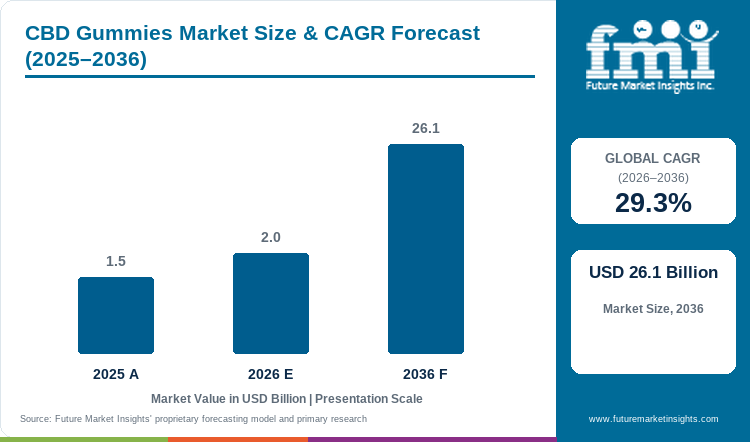
USD 2.0 billion in 2026 and USD 26.1 billion by 2036, expanding at a 29.3% CAGR.
Demand for CBD gummies is projected to expand at 29.3% CAGR between 2026 and 2036. Valuation grows from USD 1.5 billion in 2025 to USD 2.0 billion in 2026 and reaches USD 26.1 billion by 2036. Consumers are comparing products based on potency, ingredients and formulation instead of baseline brand awareness. In the United States, demand is moving well beyond initial curiosity. National survey data from SAMHSA shows that 9.9% of American adults actively use CBD, creating an established and educated consumer base. Repeat purchasing depends on lawful product access and label information that matches tested batches.
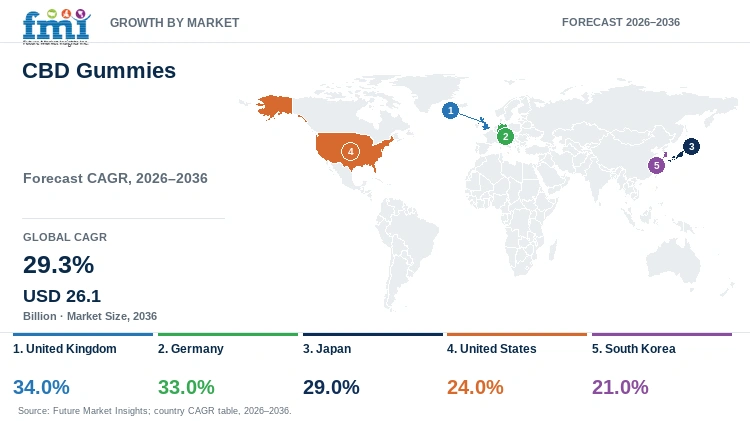
Lawful food access determines national inventory commitments for CBD gummies. The United Kingdom is projected to grow at 34.0% CAGR over the forecast period, influenced by its novel-food authorization route. The United States is forecast to expand at 24.0% CAGR under a more fragmented federal and state channel framework. Food Standards Agency guidance updated in August 2026 keeps CBD extracts and isolates inside the United Kingdom novel-food authorization process. The agency recommends a 10 mg daily CBD intake level for healthy adults. These requirements are shaping product design and listing decisions as suppliers convert consumer familiarity into repeat retail orders.
Key Takeaways
- Demand is rising among experienced CBD users who prefer a portable oral format with a stated serving and accessible batch evidence.
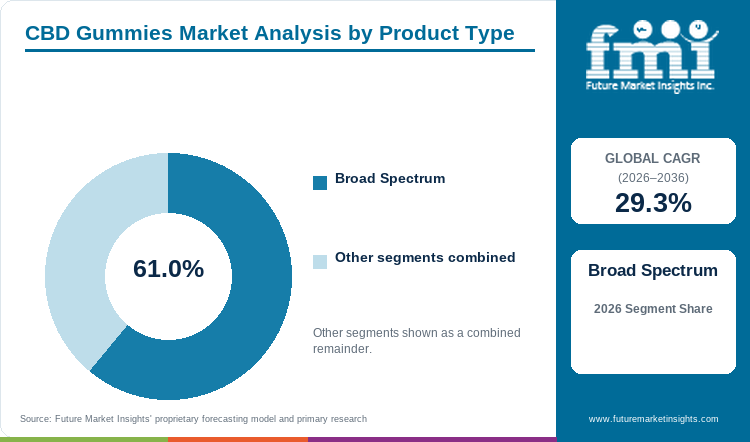
- By product type, broad spectrum is estimated to hold 61.0% in 2026, attributable to lower THC-related selection friction.
- E-retailers are set to lead the distribution channel with 34.0% share in 2026, driven by product visibility and specification comparison at checkout.
- Retailers are granting shelf access more readily to documented low-THC formulations under stricter testing and jurisdiction-specific shipment controls.
- Fragmented food authorization and residual THC rules can force reformulation or remove an otherwise marketable gummy from a target channel.
- Some of the key players in this market include Charlotte's Web Holdings, Inc., cbdMD, Inc., Green Roads, Medterra CBD, LLC, Joy Organics, LLC, Hemp Bombs, Cornbread Hemp, FAB CBD, Koi CBD, and CV Sciences, Inc.
Analyst Perspective
"CBD gummies earn repeat purchases through clear cannabinoid specifications and batch evidence that survives retailer review. Suppliers are protecting channel continuity by treating legal access as a product requirement across countries with different rules."
- Nandini Roy Choudhury, Principal Consultant, Future Market Insights
How is the CBD gummies market segmented?
The CBD gummies market is segmented by Product Type, Distribution Channel and Region.
The CBD gummies market is segmented by product type, distribution channel and region. Product type separates broad spectrum gummies from full spectrum gummies according to the cannabinoid profile used during product selection. Distribution channel includes e-retailers, hypermarket - supermarket, pharmacy - drug store, convenience store, food and drink specialty store, discount store and independent small grocery.
How does broad spectrum reduce THC-related selection friction within product type?
Broad spectrum gummies retain multiple hemp-derived compounds and target lower THC exposure than full-spectrum formulas. Buyers choosing broad spectrum CBD gummies are weighing cannabinoid composition against residual THC limits and retailer documentation requirements. cbdMD completed a self-affirmed GRAS determination for its proprietary broad-spectrum hemp extract in July 2026 through independent expert-panel review. The company stated that its dossier supported intended use levels up to 200 mg CBD per day for healthy adults. Current safety substantiation and batch-level composition records are shortening retailer review for formulas designed around lower THC exposure.
- Based on product type, broad spectrum is projected to account for 61.0% in 2026, reinforced by buyer preference for lower THC exposure and documented composition.
- Safety substantiation and batch-level composition records are reducing retailer review work for formulas designed around lower THC exposure.
How do digital storefronts manage jurisdiction-specific CBD gummy eligibility?
E-retailers are placing cannabinoid strength and laboratory documentation beside the transaction so buyers can review both at checkout. Brands selling USA CBD gummies are using state-aware order controls to block shipments into jurisdictions that prohibit a formula. Charlotte's Web said in June 2026 that California requirements effective July 1 would significantly restrict direct-to-consumer and online sales of affected ingestible broad-spectrum and full-spectrum hemp products. The company said it would cease direct shipments of those products to California consumers. Digital storefronts are managing eligibility at checkout instead of treating national visibility as universal shipment access.
- E-retailers are set to lead the distribution channel with 34.0% share in 2026, enabled by visible product records and jurisdiction-aware checkout controls.
- State-aware shipping controls protect order acceptance because nationally visible products are not legally shippable to every jurisdiction.
What are the drivers, restraints and opportunities in the CBD Gummies Market?
Established CBD use expands the addressable buyer base, fragmented food rules delay wider listings and stronger safety documentation can open stricter institutional or retail channels.
- Driver: Existing CBD use gives gummy suppliers an addressable audience that already understands the ingredient and can compare delivery formats.
- Restraint: Novel-food authorization and residual THC limits can stop listings despite ordinary manufacturing quality checks.
- Opportunity: Safety files and transparent testing can move compliant gummies into channels that require more evidence than ordinary wellness retail.
Existing CBD Use Supports Measured Edible Demand
Existing CBD use is supporting demand for a familiar chewable format without requiring brands to introduce the ingredient from the beginning. Consumers already use gummy supplements as a measured chewable format for comparing serving size and composition. In April 2026 cbdMD launched a clinical healthcare channel for eligible hemp-derived CBD products within limited CMS Innovation Center models. The company emphasized published safety data and provider-grade documentation for participating organizations using the limited model pathway. The pathway requires provider-grade documentation in a more demanding purchasing setting without creating broad Medicare reimbursement.
Novel-Food Authorization Limits Wider Listings
Food authorization is a direct barrier because a CBD gummy classified as a novel food cannot enter lawful retail without authorization. The European Commission terminated several 2026 procedures involving cannabidiol and broad-spectrum cannabidiol without updating the Union list of novel foods. Retailers evaluating CBD gummies in Europe are checking ingredient status during national listing review. Consumer interest can exist without a legal route to shelf placement. Retailers need authorization status tied to the specific ingredient to commit national inventory. Suppliers recover formulation investment more slowly because specifications do not transfer freely between national food-authorization systems.
Label Evidence Improves Retailer Evaluation
Label clarity is a purchasing feature because CBD users rely on packaging to set their dose. In June 2026 the Food Standards Agency Consumer Insights Tracker found that 52% of recent CBD consumers chose a suitable dose by following package or label instructions. Retailers assessing private label CBD gummies are comparing declared strength with current batch results. Certificates of analysis give those teams a second check on labeled CBD content. Suppliers maintaining lot-level records are reducing avoidable review work and preserving traceability between tested composition and shelf-facing information. Brands are using the same records to manage packaging changes without breaking lot-level traceability.
Which country CAGRs are profiled in the CBD Gummies Market?
| Country | CAGR |
|---|---|
| United Kingdom | 34.0% |
| Germany | 33.0% |
| Japan | 29.0% |
| United States | 24.0% |
| South Korea | 21.0% |
How do country-level CAGRs compare in the CBD Gummies Market?
The country forecasts form a European upper pair followed by Japan and two lower-rate markets. The 13-point spread describes forecast pace rather than current national size because market access depends on food authorization and cannabinoid controls.
- The United Kingdom's novel-food process now carries high-purity CBD applications toward ministerial decisions and gives compliant formulations a clearer authorization route.
- Germany pairs strong cannabinoid laboratory capability with strict food-law review and rewards suppliers that combine reliable composition data with product-specific legal fit.
- In Japan, residual delta-9 THC limits make finished-product testing a shipment requirement because over-limit products can be treated as narcotics.
- United States demand benefits from broad CBD familiarity, but state restrictions can block shipment of the same ingestible formula.
- South Korea keeps CBD inside national cannabis control regardless of plant part, so ordinary consumer distribution depends on a clearly permitted legal route.
The full report provides country-level CAGR analysis across North America, Latin America, Western Europe, Eastern Europe, East Asia, South Asia and Pacific, and the Middle East and Africa.
Country-wise Analysis
- The United Kingdom is moving from application triage toward the first potential authorizations for high-purity CBD ingredients. CBD gummy demand in the United Kingdom is forecast to rise at 34.0% CAGR over the forecast period, reinforced by a novel-food process that advances high-purity applications toward ministerial decisions. In September 2026 the Food Standards Agency recommended three CBD novel-food applications to ministers based on positive safety opinions and public consultation. Authorization still applies to the reviewed ingredient and stated use conditions rather than every gummy formula. Suppliers of low dose CBD gummies need formulation records that match the authorized ingredient specification for national listing expansion.
- Germany combines national food oversight with formal laboratory proficiency work for cannabinoid measurement in hemp foods. Germany's CBD gummies outlook is anticipated to advance at 33.0% CAGR over the assessment period, influenced by stricter composition review for edible cannabinoid specifications. A September 2026 BfR proficiency report covered 19 laboratories and found 91% of reported z-scores within the satisfactory range. The national reference-laboratory exercise tests cannabinoid measurement in hemp-food matrices that share CBD and THC control needs with gummies. Analytical controls used for CBD oil support composition checks for gummies, but product-specific novel-food authorization remains separate. Retailers need analytical records and defensible legal status for national listing expansion.
- Japan places residual delta-9 THC control directly inside the legality of imported cannabinoid foods and finished products. CBD gummy demand in Japan is predicted to advance at 29.0% CAGR through 2036, shaped by residual delta-9 THC limits that create a direct legal threshold. In May 2025 the Ministry of Health, Labour and Welfare warned consumers about CBD EAST GUMMIES because a sampled product exceeded the national residual limit. Finished-product laboratory control determines legal sale eligibility for the exact gummy format in Japan. Importers comparing hemp seed oil with edible CBD products must apply the finished-product CBD category and test result required for legal entry.
- The United States CBD user base is large, but federal oversight and state-level channel rules continue to shape ingestible products. CBD gummy demand in the United States is forecast to rise at 24.0% CAGR over the forecast period, supported by an established user base that already compares edible formats and documented product quality. A February 2026 nationally representative study estimated that 21.8% of adults had used CBD during the preceding twelve months. Buyers familiar with nutraceutical gummies understand measured chewable servings. CBD products carry additional cannabinoid and shipment requirements. State rules can still block a nationally marketed formula in a specific jurisdiction. Suppliers are using state-aware fulfillment controls to protect accepted online orders.
- South Korea treats CBD as cannabis regardless of which plant part supplied the compound. CBD gummy sales in South Korea are forecast to expand at 21.0% CAGR by 2036, constrained by national cannabis controls that limit ordinary shelf access. The Ministry of Food and Drug Safety stated that classification directly in June 2025 and tied it to narcotics control. Consumer gummy suppliers face a legal-admission requirement that overrides ordinary channel economics. Consumer familiarity with jellies and gummies does not change the legal-admission requirement because cannabinoid classification governs market entry. Wider commercial orders require a clearly lawful national pathway with product-specific documentation for ordinary retail distribution.
Who are the notable companies in the CBD Gummies Market?
Charlotte's Web Holdings, Inc., cbdMD, Inc., Green Roads, Medterra CBD, LLC, Joy Organics, LLC, Hemp Bombs, Cornbread Hemp, FAB CBD, Koi CBD, and CV Sciences, Inc.
Competition is fragmented between science-led CBD platforms, consumer wellness brands and vertically supported gummy manufacturers. Retailer review increases the burden on batch testing, formula eligibility and current channel documentation. Company scale alone does not replace the testing and legal records required during qualification of ingestible CBD products.
- Science-led multi-channel operators include Charlotte's Web and cbdMD alongside Medterra. Direct channels and documented safety records support market access for these brands.
- Testing-led wellness brands include Green Roads and Joy Organics alongside Hemp Bombs and Koi CBD. Public laboratory records support retailer review for these products.
- Manufacturing or portfolio-backed participants include Cornbread Hemp and FAB CBD alongside CV Sciences with current gummy portfolios and documented production or retail support.
Competitive Benchmarking: CBD Gummies Market
| Company | Public Testing Evidence | Regulatory / Quality Documentation | Channel Documentation | Geographic Reach |
|---|---|---|---|---|
| Charlotte's Web Holdings, Inc. | High | High | High | United States retail, practitioner and e-commerce |
| cbdMD, Inc. | High | High | High | United States retail, direct-to-consumer and healthcare |
| Green Roads | High | Medium | High | United States e-commerce and wholesale |
| Medterra CBD, LLC | Medium | Medium | High | United States and international direct channels |
| Joy Organics, LLC | High | High | High | United States e-commerce and wholesale |
| Hemp Bombs | High | High | Medium | United States-focused e-commerce and wholesale |
| Cornbread Hemp | Medium | High | Medium | United States direct-to-consumer and manufacturing |
| FAB CBD | Medium | High | Medium | United States-focused e-commerce |
| Koi CBD | High | Medium | High | United States e-commerce and wholesale |
| CV Sciences, Inc. | High | High | High | United States natural-products retail and online |
Scoring basis: High requires multiple current official evidence streams or batch-level laboratory access plus documented quality or channel controls. Medium requires one current official evidence stream that documents the criterion with narrower public detail than a High rating. Low requires a documented limitation that materially narrows the criterion under the stated evidence threshold. Geographic reach remains descriptive because the table does not convert territorial activity into a competitive score.
Key Developments in the CBD Gummies Market
- In May 2026, Joy Organics, LLC published a transition plan to replace its full-spectrum raspberry lemonade gummies with new broad-spectrum options under a stated November compliance deadline.
- In January 2026, Charlotte's Web Holdings, Inc. announced a sugar-coated finish for selected CBD gummies without changing the underlying formulations or functional positions.
- In February 2025, Cornbread Hemp announced a USD 1 million Louisville manufacturing expansion that was expected to create 50 jobs and increase capacity for its full-spectrum organic CBD portfolio.
Key Players in the CBD Gummies Market
Science and Compliance-Led Multi-Channel Brands
- Charlotte's Web Holdings, Inc.
- cbdMD, Inc.
- Medterra CBD, LLC
- CV Sciences, Inc.
Testing-Led Consumer Wellness Brands
- Green Roads
- Joy Organics, LLC
- Hemp Bombs
- Koi CBD
Manufacturing and Portfolio-Backed Brands
- Cornbread Hemp
- FAB CBD
CBD Gummies Market - Report Scope
| Coverage field | Report scope |
|---|---|
| Market breakdown | By Product Type, Distribution Channel and Region. |
| Quantitative Units | USD billion. |
| Market Definition | Commercial revenue from CBD-defined gummy products sold through the listed channels. The scope excludes non-gummy CBD formats, prescription cannabidiol, pet products and gummies in which CBD is not the defining cannabinoid. |
| Regions Covered | North America, Latin America, Western Europe, Eastern Europe, East Asia, South Asia and Pacific, and Middle East and Africa. |
| Countries Covered | United Kingdom, Germany, Japan, United States, South Korea, and 20+ countries included in the full report. |
| Key Companies Profiled | Charlotte's Web Holdings, Inc., cbdMD, Inc., Green Roads, Medterra CBD, LLC, Joy Organics, LLC, Hemp Bombs, Cornbread Hemp, FAB CBD, Koi CBD, and CV Sciences, Inc. |
| Forecast Period | 2026 to 2036. |
| Approach | Primary and secondary research with market triangulation. |
CBD Gummies Market - Research Methodology
| Method | Approach |
|---|---|
| Primary Research | FMI analysts gathered input from manufacturers, service providers, technology developers, distributors, end users, procurement teams, and subject-matter experts. Interviews examined purchasing decisions, product or service evaluation, adoption barriers, approval requirements, pricing considerations, and expectations for technical or commercial support. Respondents were also asked what evidence is required before a trial, pilot, or initial order develops into regular purchasing. |
| Desk Research | Desk research covered government statistics, regulatory publications, trade data, industry associations, technical literature, standards, company filings, product information, and official corporate announcements. Sources were reviewed for relevance, publication date, geographic coverage, and consistency with the defined market scope. Claims relating to performance, applications, approvals, capacity, investment, and commercial activity were retained only when supported by credible public evidence. |
| Market Sizing and Forecasting | The market model combined the baseline value with historical performance, segment structure, pricing and volume indicators, adoption levels, company participation, and country-level demand conditions. Forecast assumptions considered economic activity, investment trends, regulatory developments, technology adoption, purchasing cycles, supply availability, and barriers to wider market use. Segment and regional estimates were reconciled before the final market total was calculated. |
| Data Validation | Estimates were checked against multiple independent indicators, including public data, company activity, trade patterns, industry developments, and findings from primary interviews. Validation also tested whether products, services, applications, and company revenues fell within the defined market boundaries. Adjacent categories, unsupported claims, overlapping revenues, and activities without direct market relevance were excluded to reduce double counting and maintain consistency across segments and countries. |
CBD Gummies Market by Segments
CBD Gummies Market segmented by Product Type:
- Broad Spectrum
- Full Spectrum
CBD Gummies Market segmented by Distribution Channel:
- E-Retailers
- Hypermarket - Supermarket
- Pharmacy - Drug Store
- Convenience Store
- Food and Drink Specialty Store
- Discount Store
- Independent Small Grocery
CBD Gummies Market by Region:
- North America
- United States
- Canada
- Latin America
- Brazil
- Mexico
- Chile
- Rest of Latin America
- Western Europe
- Germany
- United Kingdom
- Italy
- Spain
- France
- Nordics
- Benelux
- Rest of Western Europe
- Eastern Europe
- Russia
- Poland
- Hungary
- Balkan and Baltic States
- Rest of Eastern Europe
- East Asia
- China
- Japan
- South Korea
- South Asia and Pacific
- India
- ASEAN
- Australia and New Zealand
- Rest of South Asia and Pacific
- Middle East and Africa
- Kingdom of Saudi Arabia
- Other GCC Countries
- Türkiye
- South Africa
- Other African Union Countries
- Rest of Middle East and Africa
Research Sources and Bibliography
- Substance Abuse and Mental Health Services Administration. (2025, August 6). 2024 NSDUH Detailed Tables.
- Food Standards Agency. (2026, August 28). Cannabidiol (CBD) guidance.
- cbdMD, Inc. (2026, July 7). cbdMD Sets a New Safety Standard for Broad Spectrum CBD With Self-Affirmed GRAS Determination.
- Charlotte's Web Holdings, Inc. (2026, June 26). Charlotte's Web Provides Update on Diverging Hemp Policies: Federal Momentum Builds as California Restricts Therapeutic Hemp Product Access.
- cbdMD, Inc. (2026, April 1). cbdMD Launches Clinical Healthcare Channel to Support First Federal Pathway for Hemp-Derived CBD in Medicare.
- European Commission. (2026). Decisions terminating the procedure.
- Food Standards Agency & YouGov. (2026, August). Consumer Insights Tracker (April 2026-June 2026). FSA Research and Evidence.
- Food Standards Agency. (2026, September 15). CBD novel food applications: recommendations to ministers on first authorisations.
- German Federal Institute for Risk Assessment. (2026, September 3). Determination of cannabinoids in hemp flour, hemp oil cake, hemp tea, and hemp seed pesto: Report on the 2025 Proficiency Test of the German Reference Laboratory for Mycotoxins and Plant Toxins.
- Ministry of Health, Labour and Welfare, Japan. (2025, May 23).
- Austin, E. A. C., et al. (2026, February 6). Self-reported use of cannabidiol as a substitute or adjunct for approved medications.
- Ministry of Food and Drug Safety, South Korea. (2025, June 10).
- Joy Organics, LLC. (2026, May 14). Understanding the Upcoming THC Ban and What It Means for You.
- Charlotte's Web. (2026, January 26). Better by Design: Charlotte's Web Gummies Get a New Coating.
- Kentucky Cabinet for Economic Development. (2025, February 27). Gov. Beshear: Cornbread Hemp To Expand Manufacturing Operation in Louisville With $1 Million Investment Creating 50 Quality Jobs.
- Green Roads. (n.d.). CBD Lab Sheets & COA Test Results. Retrieved September 17, 2026.
- Medterra CBD, LLC. (n.d.). High-Quality Wholesale CBD Products - Register to Sell Medterra. Retrieved September 17, 2026.
- Joy Organics, LLC. (n.d.). Gummies Labs. Retrieved September 17, 2026.
- Hemp Bombs. (n.d.). CBD Lab Testing Results. Retrieved September 17, 2026.
- High Tide Inc. (n.d.). Brands. Retrieved September 17, 2026.
- Koi CBD. (n.d.). Koi CBD Lab Results: View COA's For All Koi Products. Retrieved September 17, 2026.
- CV Sciences, Inc. (2026). Annual Report 2025.
- Charlotte's Web Holdings, Inc. (2026, August 19). Charlotte's Web Launches Route CBD to Support Californians Who Depend on Full-Spectrum Hemp CBD.
- cbdMD, Inc. (2026, January 14). cbdMD Announces Strategic Acquisition of Bluebird Botanicals.
- Splash Beverage Group, Inc. (2026, May 18). Quarterly Report on Form 10-Q for the quarter ended March 31, 2026.
- High Tide Inc. (2026, March 17). High Tide Reports First Quarter 2026 Financial Results Featuring Record Revenue Exceeding $700 Million Annualized.
- Global Widget. (2026, April 13). Manufacturing Certifications.
- Charlotte's Web Holdings, Inc. (2026, March 31). Charlotte's Web Reports 2025 Fourth Quarter and Full Year Financial Results.
This bibliography is provided for reader reference and is not exhaustive. The full report contains the complete reference list and detailed citations
This Report Answers
- How large is the CBD gummies market in 2026 and 2036?
- Which operating conditions support repeat demand for CBD gummies across regulated channels?
- Why does broad spectrum hold 61.0% of product type demand?
- Why do e-retailers account for 34.0% of distribution channel demand?
- How do the five country growth rates differ between national CBD gummy markets?
- Which national regulations most directly affect CBD gummy market access and shipment?
- Which companies provide current evidence of active CBD gummy products and channels?
- Which quality records influence retailer and institutional review of CBD gummy suppliers?
Frequently Asked Questions
How big is the CBD gummies market in 2026?
The CBD gummies market is estimated at USD 2.0 billion in 2026 and is projected to reach USD 26.1 billion by 2036. Expansion depends on repeat edible use and lawful channel access supported by reproducible product specifications.
What is the CAGR of the CBD gummies market from 2026 to 2036?
The CBD gummies market is projected to expand at a 29.3% CAGR between 2026 and 2036. Sustained growth requires suppliers to convert existing CBD familiarity into repeat purchases and preserve access to regulated food and online channels.
Which product type leads the CBD gummies market in 2026?
The product type category is forecast to be led by broad spectrum at 61.0% share in 2026, shaped by lower THC-related selection friction and stronger batch documentation.
Which distribution channel leads the CBD gummies market in 2026?
E-retailers are projected to hold 34.0% of distribution channel demand in 2026, supported by visible strength and testing information plus jurisdiction-aware shipment controls.
Which companies are active in the CBD gummies market?
Active companies include Charlotte's Web and cbdMD alongside Green Roads and Medterra across direct consumer and retail channels. Joy Organics and Hemp Bombs compete beside Cornbread Hemp and FAB CBD through documented gummy products and testing records. Koi CBD and CV Sciences complete the company set through current gummy portfolios and established distribution activity.
Preview the report firsthand - request a free sample
Get SampleGet the brochure for pricing and purchase details.
Get PDFTable of Content
- Key Takeaways
- Market Size and CAGR
- Top Growth Driver
- Fastest Growing Segment
- Leading Region
- Key Companies
- Emerging Opportunities
- Executive Summary
- Global Market Outlook
- Demand-side Trends
- Supply-side Trends
- Technology Roadmap Analysis
- Analysis and Recommendations
- Analyst Perspective (What is happening? Why now? What should investors know?)
- Key Questions Answered
- How large is the market?
- What is the CAGR?
- What are key trends?
- Which region dominates?
- Who are the leaders?
- Market Overview
- Market Coverage / Taxonomy
- Market Definition / Scope / Limitations
- Research Methodology
- Chapter Orientation
- Analytical Lens and Working Hypotheses
- Market Structure, Signals, and Trend Drivers
- Benchmarking and Cross-market Comparability
- Market Sizing, Forecasting, and Opportunity Mapping
- Research Design and Evidence Framework
- Desk Research Programme (Secondary Evidence)
- Expert Input and Fieldwork (Primary Evidence)
- Tooling, Models, and Reference Databases
- Data Engineering and Model Build
- Quality Assurance and Audit Trail
- Market Background
- Market Dynamics (Drivers, Restraints, Opportunity, Trends)
- Scenario Forecast (Optimistic, Likely, Conservative)
- Impact Analysis
- AI Impact
- Sustainability Impact
- Regulatory Impact
- Technology Impact
- Consumer / Buyer Analysis
- Purchase Drivers
- Adoption Barriers
- Buyer Journey
- Opportunity Map Analysis
- Product Life Cycle Analysis
- Supply Chain Analysis
- Investment Feasibility Matrix
- Value Chain Analysis
- PESTLE and Porter's Analysis
- Regulatory Landscape
- Regional Parent Market Outlook
- Production and Consumption Statistics
- Import and Export Statistics
- Global Market Analysis and Forecast, 2021 to 2036
- Historical Market Size Value (USD Billion) Analysis, 2021 to 2025
- Current and Future Market Size Value (USD Billion) Projections, 2026 to 2036
- Y-o-Y Growth Trend Analysis
- Absolute $ Opportunity Analysis
- Global Market Pricing Analysis, 2021 to 2036
- Global Market Analysis and Forecast, By Product Type, 2021 to 2036
- Introduction / Key Findings
- Historical Market Size Value (USD Billion) Analysis By Product Type, 2021 to 2025
- Current and Future Market Size Value (USD Billion) Analysis and Forecast By Product Type, 2026 to 2036
- Broad Spectrum
- Full Spectrum
- Y-o-Y Growth Trend Analysis By Product Type, 2021 to 2025
- Absolute $ Opportunity Analysis By Product Type, 2026 to 2036
- Global Market Analysis and Forecast, By Distribution Channel, 2021 to 2036
- Introduction / Key Findings
- Historical Market Size Value (USD Billion) Analysis By Distribution Channel, 2021 to 2025
- Current and Future Market Size Value (USD Billion) Analysis and Forecast By Distribution Channel, 2026 to 2036
- E-Retailers
- Hypermarket - Supermarket
- Pharmacy - Drug Store
- Convenience Store
- Food and Drink Specialty Store
- Discount Store
- Independent Small Grocery
- Y-o-Y Growth Trend Analysis By Distribution Channel, 2021 to 2025
- Absolute $ Opportunity Analysis By Distribution Channel, 2026 to 2036
- Global Market Analysis and Forecast, By Region, 2021 to 2036
- Introduction
- Historical Market Size Value (USD Billion) Analysis By Region, 2021 to 2025
- Current Market Size Value (USD Billion) Analysis and Forecast By Region, 2026 to 2036
- North America
- Latin America
- Western Europe
- Eastern Europe
- East Asia
- South Asia and Pacific
- Middle East and Africa
- Market Attractiveness Analysis By Region
- North America Market Analysis and Forecast, By Country, 2021 to 2036
- Historical Market Size Value (USD Billion) Trend Analysis By Market Taxonomy, 2021 to 2025
- Market Size Value (USD Billion) Forecast By Market Taxonomy, 2026 to 2036
- By Country
- United States
- Canada
- By Product Type
- By Distribution Channel
- By Country
- Market Attractiveness Analysis
- By Country
- By Product Type
- By Distribution Channel
- Key Takeaways
- Latin America Market Analysis and Forecast, By Country
- Historical Market Size Value (USD Billion) Trend Analysis By Market Taxonomy, 2021 to 2025
- Market Size Value (USD Billion) Forecast By Market Taxonomy, 2026 to 2036
- By Country
- Brazil
- Mexico
- Chile
- Rest of Latin America
- By Product Type
- By Distribution Channel
- By Country
- Market Attractiveness Analysis
- By Country
- By Product Type
- By Distribution Channel
- Key Takeaways
- Western Europe Market Analysis and Forecast, By Country
- Historical Market Size Value (USD Billion) Trend Analysis By Market Taxonomy, 2021 to 2025
- Market Size Value (USD Billion) Forecast By Market Taxonomy, 2026 to 2036
- By Country
- Germany
- United Kingdom
- Italy
- Spain
- France
- Nordics
- Benelux
- Rest of Western Europe
- By Product Type
- By Distribution Channel
- By Country
- Market Attractiveness Analysis
- By Country
- By Product Type
- By Distribution Channel
- Key Takeaways
- Eastern Europe Market Analysis and Forecast, By Country
- Historical Market Size Value (USD Billion) Trend Analysis By Market Taxonomy, 2021 to 2025
- Market Size Value (USD Billion) Forecast By Market Taxonomy, 2026 to 2036
- By Country
- Russia
- Poland
- Hungary
- Balkan and Baltic States
- Rest of Eastern Europe
- By Product Type
- By Distribution Channel
- By Country
- Market Attractiveness Analysis
- By Country
- By Product Type
- By Distribution Channel
- Key Takeaways
- East Asia Market Analysis and Forecast, By Country
- Historical Market Size Value (USD Billion) Trend Analysis By Market Taxonomy, 2021 to 2025
- Market Size Value (USD Billion) Forecast By Market Taxonomy, 2026 to 2036
- By Country
- China
- Japan
- South Korea
- By Product Type
- By Distribution Channel
- By Country
- Market Attractiveness Analysis
- By Country
- By Product Type
- By Distribution Channel
- Key Takeaways
- South Asia and Pacific Market Analysis and Forecast, By Country
- Historical Market Size Value (USD Billion) Trend Analysis By Market Taxonomy, 2021 to 2025
- Market Size Value (USD Billion) Forecast By Market Taxonomy, 2026 to 2036
- By Country
- India
- ASEAN
- Australia and New Zealand
- Rest of South Asia and Pacific
- By Product Type
- By Distribution Channel
- By Country
- Market Attractiveness Analysis
- By Country
- By Product Type
- By Distribution Channel
- Key Takeaways
- Middle East and Africa Market Analysis and Forecast, By Country
- Historical Market Size Value (USD Billion) Trend Analysis By Market Taxonomy, 2021 to 2025
- Market Size Value (USD Billion) Forecast By Market Taxonomy, 2026 to 2036
- By Country
- Kingdom of Saudi Arabia
- Other GCC Countries
- Türkiye
- South Africa
- Other African Union Countries
- Rest of Middle East and Africa
- By Product Type
- By Distribution Channel
- By Country
- Market Attractiveness Analysis
- By Country
- By Product Type
- By Distribution Channel
- Key Takeaways
- Key Countries Market Analysis
- United States
- Pricing Analysis
- Market Share Analysis, 2025
- By Product Type
- By Distribution Channel
- Canada
- Pricing Analysis
- Market Share Analysis, 2025
- By Product Type
- By Distribution Channel
- Mexico
- Pricing Analysis
- Market Share Analysis, 2025
- By Product Type
- By Distribution Channel
- Brazil
- Pricing Analysis
- Market Share Analysis, 2025
- By Product Type
- By Distribution Channel
- Chile
- Pricing Analysis
- Market Share Analysis, 2025
- By Product Type
- By Distribution Channel
- Germany
- Pricing Analysis
- Market Share Analysis, 2025
- By Product Type
- By Distribution Channel
- United Kingdom
- Pricing Analysis
- Market Share Analysis, 2025
- By Product Type
- By Distribution Channel
- Italy
- Pricing Analysis
- Market Share Analysis, 2025
- By Product Type
- By Distribution Channel
- Spain
- Pricing Analysis
- Market Share Analysis, 2025
- By Product Type
- By Distribution Channel
- France
- Pricing Analysis
- Market Share Analysis, 2025
- By Product Type
- By Distribution Channel
- India
- Pricing Analysis
- Market Share Analysis, 2025
- By Product Type
- By Distribution Channel
- ASEAN
- Pricing Analysis
- Market Share Analysis, 2025
- By Product Type
- By Distribution Channel
- Australia and New Zealand
- Pricing Analysis
- Market Share Analysis, 2025
- By Product Type
- By Distribution Channel
- China
- Pricing Analysis
- Market Share Analysis, 2025
- By Product Type
- By Distribution Channel
- Japan
- Pricing Analysis
- Market Share Analysis, 2025
- By Product Type
- By Distribution Channel
- South Korea
- Pricing Analysis
- Market Share Analysis, 2025
- By Product Type
- By Distribution Channel
- Russia
- Pricing Analysis
- Market Share Analysis, 2025
- By Product Type
- By Distribution Channel
- Poland
- Pricing Analysis
- Market Share Analysis, 2025
- By Product Type
- By Distribution Channel
- Hungary
- Pricing Analysis
- Market Share Analysis, 2025
- By Product Type
- By Distribution Channel
- Kingdom of Saudi Arabia
- Pricing Analysis
- Market Share Analysis, 2025
- By Product Type
- By Distribution Channel
- Türkiye
- Pricing Analysis
- Market Share Analysis, 2025
- By Product Type
- By Distribution Channel
- South Africa
- Pricing Analysis
- Market Share Analysis, 2025
- By Product Type
- By Distribution Channel
- United States
- Market Structure Analysis
- Competition Dashboard
- Competition Benchmarking
- Market Share Analysis of Top Players
- By Regional
- By Product Type
- By Distribution Channel
- Emerging Startups
- Innovation Benchmarking
- Competition Analysis
- Competition Deep Dive
- Charlotte's Web Holdings, Inc.
- Overview
- Product Portfolio
- Profitability by Market Segments
- Sales Footprint
- Strategy Overview
- Marketing Strategy
- Product Strategy
- Channel Strategy
- cbdMD, Inc.
- Green Roads
- Medterra CBD, LLC
- Joy Organics, LLC
- Hemp Bombs
- Cornbread Hemp
- FAB CBD
- Koi CBD
- CV Sciences, Inc.
- Charlotte's Web Holdings, Inc.
- Case Studies
- Success Stories
- Recent Developments
- Competition Deep Dive
- Assumptions & Acronyms Used


