

- Market Size (2026)
- USD 280.6 Mn
- Forecast (2036)
- USD 479.3 Mn
- CAGR (2026 to 2036)
- 5.5%
How big is Cement Gas Migration Testers Market in 2026?
USD 280.6 million in 2026 and USD 479.3 million by 2036 at a 5.5% CAGR.
Cement gas migration tester demand is projected to expand at 5.5% CAGR between 2026 and 2036. The market is valued at USD 280.6 million in 2026 and is forecast to reach USD 479.3 million by 2036. Cementing laboratories justify dedicated systems against the cost of qualifying slurry transition before gas-bearing wells are placed. OFI Testing Equipment documented revised API RP 10B-2 calibration recommendations in April 2025 for well-cement instruments. Those procedures keep instrument condition inside the acceptance workflow for repeatable cement tests. The same qualification workload also shapes oil and gas field services that design cement programs.
Country demand separates new-installation markets from mature laboratories that justify replacement against installed equipment. In August 2026 the USA Energy Information Administration forecast marketed natural gas production at 122.5 Bcf/d for 2026. That production base sustains cement-testing workload without implying greenfield laboratory expansion in every basin. Gulf markets grow faster because concentrated projects require new laboratory capacity and regional service. Adjacent onshore drilling fluids activity follows the same well schedule. Cement gas migration tester orders depend more narrowly on cement qualification volume.
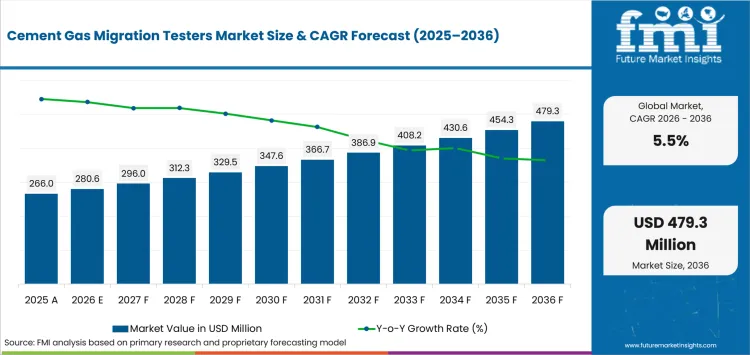
Key Takeaways
- Gas-bearing and HPHT well programs increase demand for laboratory systems that reproduce cement transition before field placement.
- Based on tester type, static gas migration testers are projected to account for 29.0% in 2026 due to direct measurement of slurry-transition behavior.
- In 2026, gas migration evaluation is expected to lead application with 34.0% share because direct testing addresses the failure mode these instruments are purchased to assess.
- By end use, cementing service labs are estimated to hold 38.0% in 2026 owing to repeated client-specific slurry qualification before field placement.
- Calibration effort and pressure-system maintenance can delay replacement where annual test volume cannot justify a dedicated instrument.
- Some of the key players in this market include Chandler Engineering, OFI Testing Equipment, Fann Instrument Company, Grace Instrument, Cement Test Equipment, Shenyang Taige Oil Equipment, Tianjin Nithons Technology, and Hilton Instruments.
Analyst Perspective
"The purchasing case changes once a laboratory must measure static-gel transition or direct gas flow under the pressure schedule of planned wells. Instrument economics then depend on calibration access and daily test throughput since specialized pressure hardware loses value during avoidable service downtime."
- Nikhil Kaitwade, Principal Consultant, Future Market Insights
How is the cement gas migration testers market segmented?
The market is segmented by tester type, pressure rating, application, end use, and sales channel.
Tester type covers static gas migration testers, dynamic gas migration testers, HPHT gas migration testers, and automated gas flow testers. Pressure rating spans below 5,000 psi through above 20,000 psi. Application covers gas migration evaluation, anti-gas additive screening, cement bond design, and HPHT slurry testing. End use includes cementing service labs, oilfield chemical suppliers, operator R&D labs, and independent test labs. Sales channels include instrument OEMs, direct service company supply, regional distributors, and calibration or service contracts.
What makes static gas migration testers central to the tester type category?
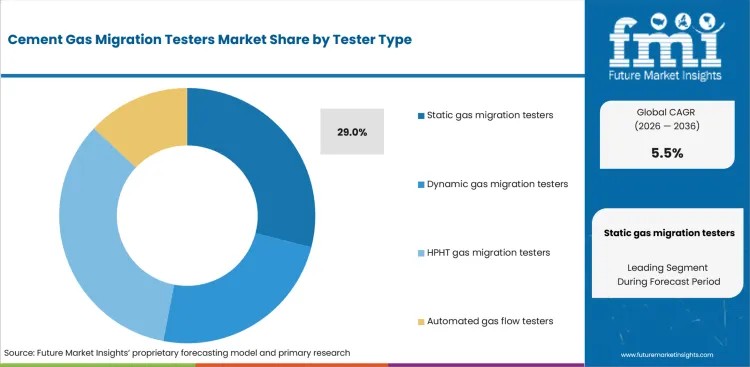
Static platforms measure how quickly a slurry loses hydrostatic support as gel strength develops under controlled downhole conditions. Laboratories compare these systems with broader test and measurement equipment because purchase approval depends on repeatable pressure and temperature records for the intended well schedule.
- Based on tester type, static gas migration testers are projected to account for 29.0% in 2026 due to established gel-strength workflows that isolate the transition period.
- Shenyang Taige Oil Equipment documented in August 2026 that a customer had ordered a static gel strength analyzer and later completed onsite installation with operator training.
Why does below 5,000 psi lead the pressure rating category?
Pressure selection follows the measurement method instead of well depth alone. Tianjin Nithons Technology documented API Spec 10A cement-testing deliveries on June 11, 2026 for laboratory programs. Moderate-pressure gas-flow cells cover routine migration work whereas higher-pressure platforms address severe HPHT qualification. Engineers make the same condition-based choice with non-destructive testing equipment used for pressure-sensitive inspection work.
- By pressure rating, below 5,000 psi is forecast to represent 22.0% in 2026 driven by routine direct-flow testing that avoids unnecessary high-pressure hardware.
- Laboratories reserve higher vessel classes for severe HPHT programs because moderate migration testing does not justify the same pressure hardware or maintenance burden.
How does gas migration evaluation lead the application category?
Gas migration evaluation gives cement engineers a direct pre-placement decision since it tests whether formation gas can enter during slurry transition. Other gas-analysis methods such as FTIR gas analysers measure gas properties. Cement gas migration testers instead reproduce the slurry and pressure path that governs channeling risk.
- In 2026, gas migration evaluation is expected to lead application with 34.0% share because direct testing measures the failure mode that defines this equipment category.
- Shenyang Taige Oil Equipment installed a twin-cell static gel strength analyzer in a Middle East cementing laboratory during January 2026. The installation put gel-strength measurement beside HTHP consistometry and fluid-loss testing in the qualification sequence.
What supports cementing service labs in the end use category?
Cementing service laboratories run qualification close to job design since one pressure-rated system can serve multiple wells and client slurry programs. In December 2025 Shenyang Taige Oil Equipment supplied a South American laboratory with HTHP consistometry and mechanical gel-strength equipment. Their work also intersects oilfield chemicals because additive screening changes the slurry that later enters migration testing.
- Cementing service labs are set to lead the end use category with 38.0% share in 2026 due to repeated client-specific qualification and high instrument utilization.
- Repeated job design gives service laboratories a stronger utilization case as one tester can support changing slurry programs for multiple field jobs.
What are the drivers, restraints and opportunities in the Cement Gas Migration Testers Market?
Gas-development programs increase qualification workload, service-intensive pressure systems slow replacement, and portable integrated laboratories offer a practical route to field-adjacent testing.
- Driver: Gas-focused drilling programs require repeated cement-barrier qualification as well conditions and slurry designs change.
- Restraint: Pressure vessels, sensors, gas supply, and calibration service increase the ownership burden for low-utilization laboratories.
- Opportunity: Portable cement laboratories can place qualified testing closer to remote drilling programs without building permanent facilities.
Gas-focused developments increase the number of cement designs that laboratories must qualify before field placement. Aramco announced in February 2026 that Jafurah had started production and Tanajib Gas Plant had entered operation. Those programs require repeated slurry decisions since well conditions differ between drilling locations. Cement-test purchasing therefore follows qualification workload and the cadence visible in rotary drilling rigs instead of hydrocarbon output alone.
Specialized pressure hardware becomes expensive if calibration or repair removes a tester from a small laboratory schedule. Shenyang Taige Oil Equipment documented a cement-instrument maintenance and calibration service program in February 2026. That requirement raises lifecycle cost beyond purchase price and can extend replacement intervals in low-utilization laboratories. Improved lab automation does not remove the need for pressure-system service.
Remote drilling programs can shorten slurry decisions by placing qualified equipment closer to field operations. Shenyang Taige Oil Equipment reported in June 2026 that it had produced a fifth containerized cement laboratory with configured utilities and installed test equipment. The mobile format reduces sample transport time without requiring a permanent building. It also gives manufacturers a route to installation and service revenue following delivery. Specialized hydrocarbon testers used near operating sites follow comparable service economics.
Which country CAGRs are profiled in the Cement Gas Migration Testers Market?
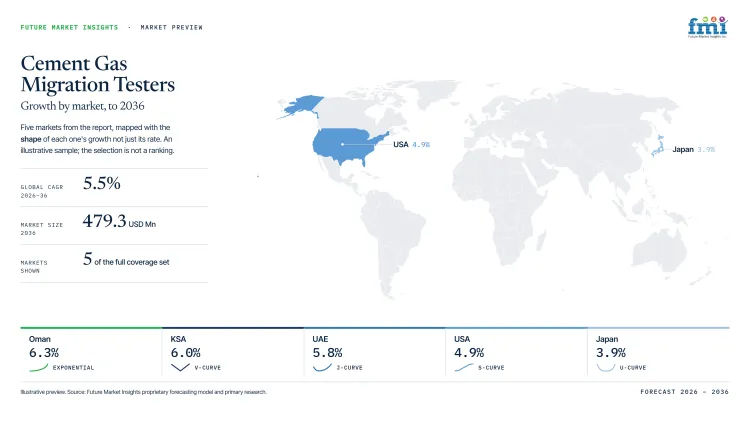
| Country | CAGR |
|---|---|
| Oman | 6.3% |
| KSA | 6.0% |
| UAE | 5.8% |
| Qatar | 5.7% |
| USA | 4.9% |
How do country-level CAGRs compare in the Cement Gas Migration Testers Market?
The 1.4-point range separates four Gulf markets from the lower-growth USA replacement market. Oman through Qatar occupy a narrow 0.6-point band that reflects concentrated gas investment and project-linked laboratory demand. The USA grows more slowly because mature service infrastructure shifts spending toward replacement and throughput gains instead of greenfield laboratories.
- Oman development wells increase demand for rapid pre-job slurry screening.
- KSA gas projects raise pressure-range requirements for new laboratory systems.
- UAE offshore schedules favor instruments that preserve digital records for multi-rig work.
- Qatar's concentrated operator base makes service-contract timing more important than distributor breadth.
- USA replacement decisions favor software compatibility with the installed cement-testing base.
Comparable CAGRs can therefore mask different order timing and service economics between project-led and mature laboratory markets. Detailed country CAGR coverage includes North America, Latin America, Europe, East Asia, South Asia, Oceania and the Middle East and Africa.
Country-wise Analysis
- Omani cementing laboratories support clustered development programs that compress the time available for slurry qualification and instrument service. Oman is estimated to post 6.3% CAGR over the forecast period, tied to sustained drilling programs that keep laboratory workloads active. Occidental's February 2026 Form 10-K recorded 120 wells drilled in Oman during 2025 development programs. Regional workshop access reduces calibration downtime during concentrated campaigns and limits the need for duplicate pressure systems. Spare-parts delays at remote field bases still favor manufacturers that maintain Gulf repair capacity near active programs. Local service depth therefore changes order conversion more than software features for laboratories working against fixed campaign windows.
- Saudi cement laboratories face gas projects that require repeatable HPHT qualification prior to field execution and frequent changes in slurry design. Aramco's August 2026 half-year update confirmed that Jafurah phase one maintained steady sales-gas and condensate production. Cement gas migration tester demand in KSA is forecast to rise at 6.0% CAGR over the forecast period, because expanding gas infrastructure increases qualification programs. Rising pressure and temperature requirements make test throughput the main operating constraint during large gas-development programs. Local technical teams need parts inventories aligned with Jafurah schedules because laboratory downtime can interrupt qualification sequencing. Instrument makers without regional support face a slower path into high-volume accounts that require predictable repair turnaround.
- UAE cementing programs use tightly sequenced offshore schedules that place a premium on fast laboratory turnaround prior to cement placement. ADNOC's July 2026 Umm Shaif Gas Cap decision included a 14-well drilling program for offshore development. Adoption of cement gas migration testers in the UAE is estimated to expand at 5.8% CAGR through 2036, aided by project schedules that reward automated records and rapid service response. Regional calibration and replacement-part access become critical during concentrated offshore campaigns that cannot absorb lengthy instrument downtime. Digital records improve workflow only if pressure systems stay available for every scheduled cement qualification run. Offshore operators therefore evaluate service response beside instrument specifications for repeated multi-rig work.
- Qatar concentrates cement-testing demand on large North Field assets and scheduled maintenance programs that cluster laboratory work into defined campaign periods. QatarEnergy awarded North Field Injection Station turnaround maintenance with an April 2026 effective date for work covering instrumentation and commissioning support. Service planning lets laboratories limit pressure-system downtime between projects without holding redundant equipment at every campaign site. Cement gas migration tester sales in Qatar are forecast to expand at 5.7% CAGR by 2036, given project concentration that favors planned technical coverage. A small operator base can produce uneven replacement cycles because major programs concentrate testing demand into defined periods. Equipment makers therefore face strong project orders followed by quieter intervals between major North Field campaigns.
- USA laboratories operate within a mature oilfield service network where replacement purchases need measurable throughput gains over installed instruments. The USA Energy Information Administration reported in March 2026 that marketed natural gas production averaged 118.5 Bcf/d in 2025. By 2036, the USA is projected to grow at 4.9% CAGR, supported by sustained gas activity and large regional cementing workloads. The installed laboratory base makes calibration interoperability more persuasive than extra pressure capacity during routine replacement decisions. Service companies justify replacement through faster turnaround and compatible software that fits existing cement-testing workflows. Manufacturers selling capacity without documented workflow gains face a harder replacement case than in project-led Gulf markets.
Who are the notable companies in the Cement Gas Migration Testers Market?
Chandler Engineering, OFI Testing Equipment, Fann Instrument Company, Grace Instrument, Cement Test Equipment, Shenyang Taige Oil Equipment, Tianjin Nithons Technology, and Hilton Instruments.
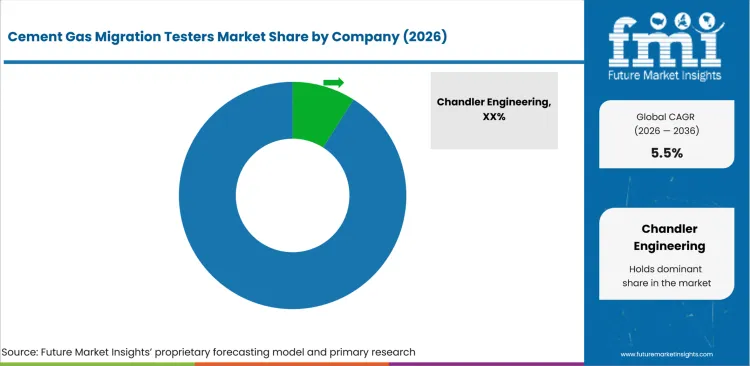
Specialist well-cement instrument manufacturers account for most documented competition. Chandler Engineering and Cement Test Equipment document migration or static-gel systems. OFI Testing Equipment and Fann Instrument Company maintain broader cement-test portfolios. Grace Instrument supplies direct migration and cement-strength instruments. Shenyang Taige Oil Equipment and Tianjin Nithons Technology sell complete laboratory packages with onsite support. Hilton Instruments supplies and services Chandler cement-testing equipment in Europe and Africa. Service depth also shapes adjacent combustion testing equipment platforms.
- Dedicated migration and SGS specialists include Chandler Engineering, Cement Test Equipment, Grace Instrument, and Shenyang Taige Oil Equipment.
- Broader cement-test providers include OFI Testing Equipment, Fann Instrument Company, Tianjin Nithons Technology, and Hilton Instruments.
Competitive Benchmarking: Cement Gas Migration Testers Market
| Company | Dedicated Gas-Migration/SGS Coverage | HPHT Cement-Test Range | Automation & Lifecycle Support | Geographic Reach |
|---|---|---|---|---|
| Chandler Engineering | High | High | High | United States with global service |
| OFI Testing Equipment | High | High | High | United States with international distribution |
| Fann Instrument Company | High | High | High | United States with worldwide distributors |
| Grace Instrument | High | High | High | United States with international customers |
| Cement Test Equipment | High | High | High | United States with worldwide supply |
| Shenyang Taige Oil Equipment | High | High | High | China with Middle East and international projects |
| Tianjin Nithons Technology | High | High | High | China with 15+ export countries |
| Hilton Instruments | Medium | High | High | United Kingdom with European and African coverage |
Scoring basis: High dedicated coverage requires documented gas-migration and static-gel routes. Medium requires one verified route and Low requires an explicitly narrower cement-test scope. High HPHT range requires advanced-pressure cement equipment with documented test coverage. Medium requires a narrower pressure range and Low identifies atmospheric or basic-pressure testing. High automation and lifecycle support requires digital control plus documented service. Medium requires either digital control or lifecycle service and Low requires a documented limitation in both areas.
Key Developments in the Cement Gas Migration Testers Market
- In July 2026, Chandler Engineering offered a five-day cementing maintenance and calibration program covering operation and calibration of its cement instruments.
- In December 2025, Tianjin Nithons Technology delivered and commissioned an HTHP consistometer at Dulaty University in Kazakhstan for advanced cement-testing research.
- In October 2025, Shenyang Taige Oil Equipment reported ADNOC prequalification for its laboratory equipment and parts through the operator procurement system.
Key Players in the Cement Gas Migration Testers Market
Dedicated gas-migration and static-gel specialists
- Chandler Engineering
- Grace Instrument
- Cement Test Equipment
- Shenyang Taige Oil Equipment
Broader cement-test platform providers
- OFI Testing Equipment
- Fann Instrument Company
- Tianjin Nithons Technology
- Hilton Instruments
Cement Gas Migration Testers Market - Report Scope
| Coverage field | Report scope |
|---|---|
| Market breakdown | By tester type, pressure rating, application, end use, sales channel and region. |
| Quantitative Units | USD million. |
| Market Definition | Commercial cement gas migration and static-gel test systems supplied with directly related pressure, control, data-acquisition, calibration, or service components within the defined tester boundary. |
| Regions Covered | North America, Latin America, Europe, East Asia, South Asia and Pacific, and Middle East and Africa. |
| Countries Covered | Oman, KSA, UAE, Qatar, USA, and 20+ countries included in the full report. |
| Key Companies Profiled | Chandler Engineering, OFI Testing Equipment, Fann Instrument Company, Grace Instrument, Cement Test Equipment, Shenyang Taige Oil Equipment, Tianjin Nithons Technology, Hilton Instruments. |
| Forecast Period | 2026 to 2036. |
| Approach | Primary and secondary research with market triangulation. |
Cement Gas Migration Testers Market - Research Methodology
| Method | Approach |
|---|---|
| Primary Research | FMI analysts gathered input from manufacturers, service providers, technology developers, distributors, end users, procurement teams, and subject-matter experts. Interviews examined purchasing decisions, product or service evaluation, adoption barriers, approval requirements, pricing considerations, and expectations for technical or commercial support. Respondents were also asked what evidence is required before a trial, pilot, or initial order develops into regular purchasing. |
| Desk Research | Desk research covered government statistics, regulatory publications, trade data, industry associations, technical literature, standards, company filings, product information, and official corporate announcements. Sources were reviewed for relevance, publication date, geographic coverage, and consistency with the defined market scope. Claims relating to performance, applications, approvals, capacity, investment, and commercial activity were retained only when supported by credible public evidence. |
| Market Sizing and Forecasting | The market model combined the baseline value with historical performance, segment structure, pricing and volume indicators, adoption levels, company participation, and country-level demand conditions. Forecast assumptions considered economic activity, investment trends, regulatory developments, technology adoption, purchasing cycles, supply availability, and barriers to wider market use. Segment and regional estimates were reconciled before the final market total was calculated. |
| Data Validation | Estimates were checked against multiple independent indicators, including public data, company activity, trade patterns, industry developments, and findings from primary interviews. Validation also tested whether products, services, applications, and company revenues fell within the defined market boundaries. Adjacent categories, unsupported claims, overlapping revenues, and activities without direct market relevance were excluded to reduce double counting and maintain consistency across segments and countries. |
Cement Gas Migration Testers Market by Segments
Cement Gas Migration Testers Market segmented by tester type:
- Static gas migration testers
- Dynamic gas migration testers
- HPHT gas migration testers
- Automated gas flow testers
Cement Gas Migration Testers Market segmented by pressure rating:
- Below 5,000 psi
- 5,000-10,000 psi
- 10,000-20,000 psi
- Above 20,000 psi
Cement Gas Migration Testers Market segmented by application:
- Gas migration evaluation
- Anti-gas additive screening
- Cement bond design
- HPHT slurry testing
Cement Gas Migration Testers Market segmented by end use:
- Cementing service labs
- Oilfield chemical suppliers
- Operator R&D labs
- Independent test labs
Cement Gas Migration Testers Market segmented by sales channel:
- Instrument OEMs
- Direct service company supply
- Regional distributors
- Calibration/service contracts
Cement Gas Migration Testers Market by Region:
- North America
- United States
- Canada
- Latin America
- Brazil
- Mexico
- Chile
- Rest of Latin America
- Western Europe
- Germany
- United Kingdom
- Italy
- Spain
- France
- Nordics
- Benelux
- Rest of Western Europe
- Eastern Europe
- Russia
- Poland
- Hungary
- Balkan and Baltic States
- Rest of Eastern Europe
- East Asia
- China
- Japan
- South Korea
- South Asia and Pacific
- India
- ASEAN
- Australia and New Zealand
- Rest of South Asia and Pacific
- Middle East and Africa
- Kingdom of Saudi Arabia
- Other GCC Countries
- Türkiye
- South Africa
- Other African Union Countries
- Rest of Middle East and Africa
Research Sources and Bibliography
- OFI Testing Equipment. (2025, April 18). Updated Calibration Procedures in API RP 10B-2.
- USA Energy Information Administration. (2026, August 12). United States on track for record natural gas production in 2026.
- Shenyang Taige Oil Equipment. (2026, August 2). Cementing test equipment were recommended and applied by our valued customer.
- Tianjin Nithons Technology Co., Ltd. (2026, June 11). NITHONS Delivers High-Precision Oilfield Cement Testing Equipment and API Spec 10A Laboratory Equipment.
- Shenyang Taige Oil Equipment. (2026, January 6). New Year, Newly delivery of cementing lab test equipment.
- Shenyang Taige Oil Equipment. (2025, December 3). Equipment suitable for various oilwell cement testing to be delivered.
- Saudi Aramco. (2026, February 26). Aramco’s gas strategy builds momentum with major progress towards growth target.
- Shenyang Taige Oil Equipment. (2026, February 6). Services upgrade of Equipment Repair and calibration.
- Shenyang Taige Oil Equipment. (2026, June 26). Latest share of Mobile Cementing Container lab.
- Occidental Petroleum Corporation. (2026, February 18). 2025 Form 10-K.
- Saudi Aramco. (2026, August 4). Aramco announces second quarter and half year 2026 results.
- ADNOC. (2026, July 21). ADNOC Accelerates Gas Growth Strategy with $6.2 Billion FID For Umm Shaif Gas Cap.
- QatarEnergy. (2026, April 5). Turnaround Maintenance Services for NFIS (North Field Injection Station) - 2026.
- USA Energy Information Administration. (2026, March 13). USA natural gas production reached a new record in 2025.
- Chandler Engineering. (2026). Cementing Maintenance & Calibration Training Course.
- Shenyang Taige Oil Equipment. (2025, October 11). Pre-qualified Vendor of ADNOC (Abu Dhabi National Oil Company).
- Tianjin Nithons Technology Co., Ltd. (2025, December 4). Nithons Delivers HTHP Consistometer to Dulaty University in Kazakhstan.
- Chandler Engineering. Company Overview. Retrieved August 30, 2026.
- Fann Instrument Company. About Us. Retrieved August 30, 2026.
- Grace Instrument. About Us. Retrieved August 30, 2026.
- Cement Test Equipment. About Us. Retrieved August 30, 2026.
- Shenyang Taige Oil Equipment. Company news. Retrieved August 30, 2026.
- Tianjin Nithons Technology Co., Ltd. Company History. Retrieved August 30, 2026.
- Hilton Instruments. Service and Repair. Retrieved August 30, 2026.
- OFI Testing Equipment. (2025, August 15). Introducing OFITE Static Ovens.
- Shenyang Taige Oil Equipment. (2025, August 14). Installation&Commissioning of test equipment for customer in South America.
- Shenyang Taige Oil Equipment. (2026, February 13). Mobile Cementing Laboratory Cases in 2025.
- Tianjin Nithons Technology Co., Ltd. (2026, March 2). NITHONS Factory Secures ISO and HSE Certifications, Reinforcing Global Supply Chain Trust.
- Hilton Instruments Limited. (2025, July 24). SEQual Certificate of Registration.
This bibliography is provided for reader reference and is not exhaustive. The full report contains the complete reference list and detailed citations
This Report Answers
- What is the cement gas migration testers market size in 2026 and 2036?
- What drives cement gas migration tester demand?
- Why do static gas migration testers lead tester type?
- Why does below 5,000 psi lead pressure rating?
- Why does gas migration evaluation lead application demand?
- How do profiled country CAGRs compare?
- Which companies provide dedicated or broader cement-test platforms?
- What delays cement gas migration tester replacement?
Frequently Asked Questions
How big is the cement gas migration testers market in 2026?
The cement gas migration testers market is valued at USD 280.6 million in 2026 and is projected to reach USD 479.3 million by 2036. Growth follows repeated cement-barrier qualification for gas-bearing and HPHT well programs before field placement.
What is the CAGR of the cement gas migration testers market from 2026 to 2036?
The cement gas migration testers market is projected to grow at a CAGR of 5.5% between 2026 and 2036. Expansion follows gas-development programs that increase laboratory qualification workloads before cement placement.
Which tester type leads the cement gas migration testers market?
The static gas migration testers segment is expected to hold 29.0% of the cement gas migration testers market in 2026, attributable to direct measurement of slurry-transition behavior. Cementing laboratories use those records to assess gas-entry risk before approving a slurry for field placement.
Which application leads the cement gas migration testers market?
The gas migration evaluation segment is expected to hold 34.0% of the cement gas migration testers market in 2026, driven by direct testing of migration risk. Cement engineers use the results to revise slurry design before field execution.
Which countries are projected to record the highest growth in the cement gas migration testers market?
Oman is projected to grow at 6.3% CAGR, followed by KSA at 6.0% and UAE at 5.8% through 2036. Concentrated Gulf gas programs require repeated cement qualification and reliable regional service coverage.
Which companies are active in the cement gas migration testers market?
Key companies operating in the cement gas migration testers market include Chandler Engineering, OFI Testing Equipment, Fann Instrument Company, Grace Instrument, Cement Test Equipment, Shenyang Taige Oil Equipment, Tianjin Nithons Technology, and Hilton Instruments. Competition differs by direct migration coverage and regional calibration access.
Preview the report firsthand - request a free sample
Get SampleGet the brochure for pricing and purchase details.
Get PDFTable of Content
- Key Takeaways
- Market Size and CAGR
- Top Growth Driver
- Fastest Growing Segment
- Leading Region
- Key Companies
- Emerging Opportunities
- Executive Summary
- Global Market Outlook
- Demand-side Trends
- Supply-side Trends
- Technology Roadmap Analysis
- Analysis and Recommendations
- Analyst Perspective (What is happening? Why now? What should investors know?)
- Key Questions Answered
- How large is the market?
- What is the CAGR?
- What are key trends?
- Which region dominates?
- Who are the leaders?
- Market Overview
- Market Coverage / Taxonomy
- Market Definition / Scope / Limitations
- Research Methodology
- Chapter Orientation
- Analytical Lens and Working Hypotheses
- Market Structure, Signals, and Trend Drivers
- Benchmarking and Cross-market Comparability
- Market Sizing, Forecasting, and Opportunity Mapping
- Research Design and Evidence Framework
- Desk Research Programme (Secondary Evidence)
- Expert Input and Fieldwork (Primary Evidence)
- Tooling, Models, and Reference Databases
- Data Engineering and Model Build
- Quality Assurance and Audit Trail
- Market Background
- Market Dynamics (Drivers, Restraints, Opportunity, Trends)
- Scenario Forecast (Optimistic, Likely, Conservative)
- Impact Analysis
- AI Impact
- Sustainability Impact
- Regulatory Impact
- Technology Impact
- Consumer / Buyer Analysis
- Purchase Drivers
- Adoption Barriers
- Buyer Journey
- Opportunity Map Analysis
- Product Life Cycle Analysis
- Supply Chain Analysis
- Investment Feasibility Matrix
- Value Chain Analysis
- PESTLE and Porter's Analysis
- Regulatory Landscape
- Regional Parent Market Outlook
- Production and Consumption Statistics
- Import and Export Statistics
- Global Market Analysis and Forecast, 2021 to 2036
- Historical Market Size Value (USD Million) Analysis, 2021 to 2025
- Current and Future Market Size Value (USD Million) Projections, 2026 to 2036
- Y-o-Y Growth Trend Analysis
- Absolute $ Opportunity Analysis
- Global Market Pricing Analysis, 2021 to 2036
- Global Market Analysis and Forecast, By Tester Type, 2021 to 2036
- Introduction / Key Findings
- Historical Market Size Value (USD Million) Analysis By Tester Type, 2021 to 2025
- Current and Future Market Size Value (USD Million) Analysis and Forecast By Tester Type, 2026 to 2036
- Static gas migration testers
- Dynamic gas migration testers
- HPHT gas migration testers
- Automated gas flow testers
- Static gas migration testers
- Y-o-Y Growth Trend Analysis By Tester Type, 2021 to 2025
- Absolute $ Opportunity Analysis By Tester Type, 2026 to 2036
- Global Market Analysis and Forecast, By Pressure Rating, 2021 to 2036
- Introduction / Key Findings
- Historical Market Size Value (USD Million) Analysis By Pressure Rating, 2021 to 2025
- Current and Future Market Size Value (USD Million) Analysis and Forecast By Pressure Rating, 2026 to 2036
- Below 5,000 psi
- 5,000-10,000 psi
- 10,000-20,000 psi
- Above 20,000 psi
- Below 5,000 psi
- Y-o-Y Growth Trend Analysis By Pressure Rating, 2021 to 2025
- Absolute $ Opportunity Analysis By Pressure Rating, 2026 to 2036
- Global Market Analysis and Forecast, By Application, 2021 to 2036
- Introduction / Key Findings
- Historical Market Size Value (USD Million) Analysis By Application, 2021 to 2025
- Current and Future Market Size Value (USD Million) Analysis and Forecast By Application, 2026 to 2036
- Gas migration evaluation
- Anti-gas additive screening
- Cement bond design
- HPHT slurry testing
- Gas migration evaluation
- Y-o-Y Growth Trend Analysis By Application, 2021 to 2025
- Absolute $ Opportunity Analysis By Application, 2026 to 2036
- Global Market Analysis and Forecast, By End Use, 2021 to 2036
- Introduction / Key Findings
- Historical Market Size Value (USD Million) Analysis By End Use, 2021 to 2025
- Current and Future Market Size Value (USD Million) Analysis and Forecast By End Use, 2026 to 2036
- Cementing service labs
- Oilfield chemical suppliers
- Operator R&D labs
- Independent test labs
- Cementing service labs
- Y-o-Y Growth Trend Analysis By End Use, 2021 to 2025
- Absolute $ Opportunity Analysis By End Use, 2026 to 2036
- Global Market Analysis and Forecast, By Sales Channel, 2021 to 2036
- Introduction / Key Findings
- Historical Market Size Value (USD Million) Analysis By Sales Channel, 2021 to 2025
- Current and Future Market Size Value (USD Million) Analysis and Forecast By Sales Channel, 2026 to 2036
- Instrument OEMs
- Direct service company supply
- Regional distributors
- Calibration/service contracts
- Instrument OEMs
- Y-o-Y Growth Trend Analysis By Sales Channel, 2021 to 2025
- Absolute $ Opportunity Analysis By Sales Channel, 2026 to 2036
- Global Market Analysis and Forecast, By Region, 2021 to 2036
- Introduction
- Historical Market Size Value (USD Million) Analysis By Region, 2021 to 2025
- Current Market Size Value (USD Million) Analysis and Forecast By Region, 2026 to 2036
- North America
- Latin America
- Western Europe
- Eastern Europe
- East Asia
- South Asia and Pacific
- Middle East & Africa
- Market Attractiveness Analysis By Region
- North America Market Analysis and Forecast, By Country, 2021 to 2036
- Historical Market Size Value (USD Million) Trend Analysis By Market Taxonomy, 2021 to 2025
- Market Size Value (USD Million) Forecast By Market Taxonomy, 2026 to 2036
- By Country
- USA
- Canada
- By Tester Type
- By Pressure Rating
- By Application
- By End Use
- By Sales Channel
- By Country
- Market Attractiveness Analysis
- By Country
- By Tester Type
- By Pressure Rating
- By Application
- By End Use
- By Sales Channel
- Key Takeaways
- Latin America Market Analysis and Forecast, By Country
- Historical Market Size Value (USD Million) Trend Analysis By Market Taxonomy, 2021 to 2025
- Market Size Value (USD Million) Forecast By Market Taxonomy, 2026 to 2036
- By Country
- Brazil
- Mexico
- Chile
- Rest of Latin America
- By Tester Type
- By Pressure Rating
- By Application
- By End Use
- By Sales Channel
- By Country
- Market Attractiveness Analysis
- By Country
- By Tester Type
- By Pressure Rating
- By Application
- By End Use
- By Sales Channel
- Key Takeaways
- Western Europe Market Analysis and Forecast, By Country
- Historical Market Size Value (USD Million) Trend Analysis By Market Taxonomy, 2021 to 2025
- Market Size Value (USD Million) Forecast By Market Taxonomy, 2026 to 2036
- By Country
- Germany
- UK
- Italy
- Spain
- France
- Nordic
- BENELUX
- Rest of Western Europe
- By Tester Type
- By Pressure Rating
- By Application
- By End Use
- By Sales Channel
- By Country
- Market Attractiveness Analysis
- By Country
- By Tester Type
- By Pressure Rating
- By Application
- By End Use
- By Sales Channel
- Key Takeaways
- Eastern Europe Market Analysis and Forecast, By Country
- Historical Market Size Value (USD Million) Trend Analysis By Market Taxonomy, 2021 to 2025
- Market Size Value (USD Million) Forecast By Market Taxonomy, 2026 to 2036
- By Country
- Russia
- Poland
- Hungary
- Balkan & Baltic
- Rest of Eastern Europe
- By Tester Type
- By Pressure Rating
- By Application
- By End Use
- By Sales Channel
- By Country
- Market Attractiveness Analysis
- By Country
- By Tester Type
- By Pressure Rating
- By Application
- By End Use
- By Sales Channel
- Key Takeaways
- East Asia Market Analysis and Forecast, By Country
- Historical Market Size Value (USD Million) Trend Analysis By Market Taxonomy, 2021 to 2025
- Market Size Value (USD Million) Forecast By Market Taxonomy, 2026 to 2036
- By Country
- China
- Japan
- South Korea
- By Tester Type
- By Pressure Rating
- By Application
- By End Use
- By Sales Channel
- By Country
- Market Attractiveness Analysis
- By Country
- By Tester Type
- By Pressure Rating
- By Application
- By End Use
- By Sales Channel
- Key Takeaways
- South Asia and Pacific Market Analysis and Forecast, By Country
- Historical Market Size Value (USD Million) Trend Analysis By Market Taxonomy, 2021 to 2025
- Market Size Value (USD Million) Forecast By Market Taxonomy, 2026 to 2036
- By Country
- India
- ASEAN
- Australia & New Zealand
- Rest of South Asia and Pacific
- By Tester Type
- By Pressure Rating
- By Application
- By End Use
- By Sales Channel
- By Country
- Market Attractiveness Analysis
- By Country
- By Tester Type
- By Pressure Rating
- By Application
- By End Use
- By Sales Channel
- Key Takeaways
- Middle East & Africa Market Analysis and Forecast, By Country
- Historical Market Size Value (USD Million) Trend Analysis By Market Taxonomy, 2021 to 2025
- Market Size Value (USD Million) Forecast By Market Taxonomy, 2026 to 2036
- By Country
- Kingdom of Saudi Arabia
- Other GCC Countries
- Türkiye
- South Africa
- Other African Union
- Rest of Middle East & Africa
- By Tester Type
- By Pressure Rating
- By Application
- By End Use
- By Sales Channel
- By Country
- Market Attractiveness Analysis
- By Country
- By Tester Type
- By Pressure Rating
- By Application
- By End Use
- By Sales Channel
- Key Takeaways
- Key Countries Market Analysis
- USA
- Pricing Analysis
- Market Share Analysis, 2025
- By Tester Type
- By Pressure Rating
- By Application
- By End Use
- By Sales Channel
- Canada
- Pricing Analysis
- Market Share Analysis, 2025
- By Tester Type
- By Pressure Rating
- By Application
- By End Use
- By Sales Channel
- Mexico
- Pricing Analysis
- Market Share Analysis, 2025
- By Tester Type
- By Pressure Rating
- By Application
- By End Use
- By Sales Channel
- Brazil
- Pricing Analysis
- Market Share Analysis, 2025
- By Tester Type
- By Pressure Rating
- By Application
- By End Use
- By Sales Channel
- Chile
- Pricing Analysis
- Market Share Analysis, 2025
- By Tester Type
- By Pressure Rating
- By Application
- By End Use
- By Sales Channel
- Germany
- Pricing Analysis
- Market Share Analysis, 2025
- By Tester Type
- By Pressure Rating
- By Application
- By End Use
- By Sales Channel
- UK
- Pricing Analysis
- Market Share Analysis, 2025
- By Tester Type
- By Pressure Rating
- By Application
- By End Use
- By Sales Channel
- Italy
- Pricing Analysis
- Market Share Analysis, 2025
- By Tester Type
- By Pressure Rating
- By Application
- By End Use
- By Sales Channel
- Spain
- Pricing Analysis
- Market Share Analysis, 2025
- By Tester Type
- By Pressure Rating
- By Application
- By End Use
- By Sales Channel
- France
- Pricing Analysis
- Market Share Analysis, 2025
- By Tester Type
- By Pressure Rating
- By Application
- By End Use
- By Sales Channel
- India
- Pricing Analysis
- Market Share Analysis, 2025
- By Tester Type
- By Pressure Rating
- By Application
- By End Use
- By Sales Channel
- ASEAN
- Pricing Analysis
- Market Share Analysis, 2025
- By Tester Type
- By Pressure Rating
- By Application
- By End Use
- By Sales Channel
- Australia & New Zealand
- Pricing Analysis
- Market Share Analysis, 2025
- By Tester Type
- By Pressure Rating
- By Application
- By End Use
- By Sales Channel
- China
- Pricing Analysis
- Market Share Analysis, 2025
- By Tester Type
- By Pressure Rating
- By Application
- By End Use
- By Sales Channel
- Japan
- Pricing Analysis
- Market Share Analysis, 2025
- By Tester Type
- By Pressure Rating
- By Application
- By End Use
- By Sales Channel
- South Korea
- Pricing Analysis
- Market Share Analysis, 2025
- By Tester Type
- By Pressure Rating
- By Application
- By End Use
- By Sales Channel
- Russia
- Pricing Analysis
- Market Share Analysis, 2025
- By Tester Type
- By Pressure Rating
- By Application
- By End Use
- By Sales Channel
- Poland
- Pricing Analysis
- Market Share Analysis, 2025
- By Tester Type
- By Pressure Rating
- By Application
- By End Use
- By Sales Channel
- Hungary
- Pricing Analysis
- Market Share Analysis, 2025
- By Tester Type
- By Pressure Rating
- By Application
- By End Use
- By Sales Channel
- Kingdom of Saudi Arabia
- Pricing Analysis
- Market Share Analysis, 2025
- By Tester Type
- By Pressure Rating
- By Application
- By End Use
- By Sales Channel
- Türkiye
- Pricing Analysis
- Market Share Analysis, 2025
- By Tester Type
- By Pressure Rating
- By Application
- By End Use
- By Sales Channel
- South Africa
- Pricing Analysis
- Market Share Analysis, 2025
- By Tester Type
- By Pressure Rating
- By Application
- By End Use
- By Sales Channel
- USA
- Market Structure Analysis
- Competition Dashboard
- Competition Benchmarking
- Market Share Analysis of Top Players
- By Regional
- By Tester Type
- By Pressure Rating
- By Application
- By End Use
- By Sales Channel
- Emerging Startups
- Innovation Benchmarking
- Competition Analysis
- Competition Deep Dive
- Chandler Engineering
- Overview
- Product Portfolio
- Profitability by Market Segments
- Sales Footprint
- Strategy Overview
- Marketing Strategy
- Product Strategy
- Channel Strategy
- OFI Testing Equipment
- Fann Instrument Company
- Grace Instrument
- Vinci Technologies
- RIGCHINA
- Cement Test Equipment
- Core Laboratories
- Labtech Services
- PetroLab Engineering
- Chandler Engineering
- Case Studies
- Success Stories
- Recent Developments
- Competition Deep Dive
- Assumptions & Acronyms Used


