

- Industry Size (2026)
- USD 0.5 Bn
- Forecast (2036)
- USD 1.3 Bn
- CAGR (2026 to 2036)
- 10.2%
Chitosan Films Market Size, Market Forecast and Outlook By FMI
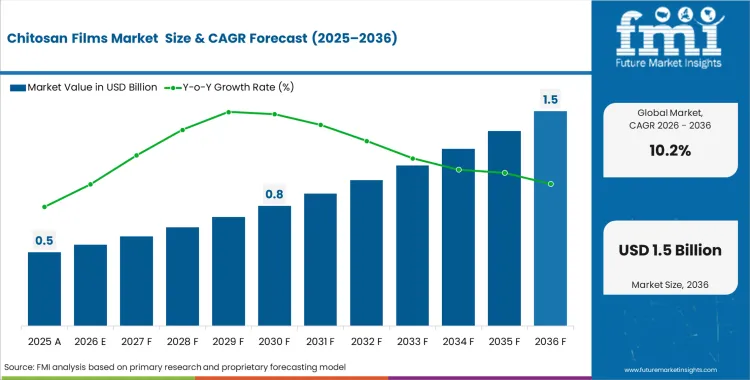
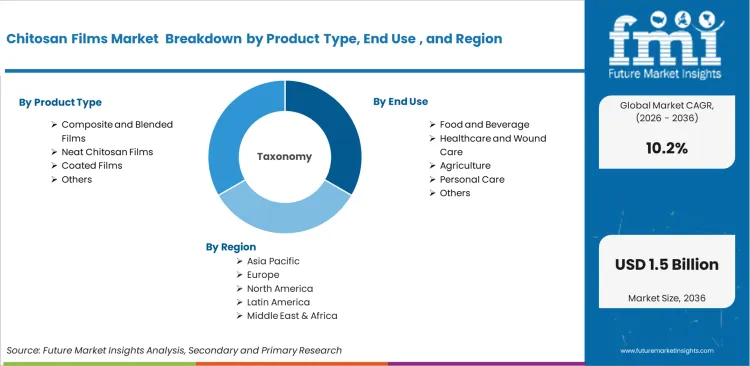
The chitosan films market was valued at USD 0.4 billion in 2025. The market is projected to reach USD 0.5 billion in 2026 and USD 1.3 billion by 2036, expanding at a CAGR of 10.2% during the forecast period. Marine-derived chitosan is expected to lead source demand with a 58.4% share in 2026. Composite and blended films are projected to remain the leading film type with a 41.7% share in 2026. Food and beverage is expected to lead end-use demand with a 39.1% share in 2026.
Summary of Chitosan Films Market
- Key Drivers
- Antimicrobial packaging demand: Brands and food processors are replacing synthetic barrier films with chitosan films that deliver oxygen and moisture barrier properties alongside inherent antimicrobial action.
- Regulatory pressure on synthetic packaging: Single-use plastic restrictions and recyclability mandates in Europe and parts of Asia are accelerating qualification programs for biopolymer films in fresh produce and bakery packaging.
- Healthcare wound care adoption: Chitosan films are gaining traction in wound management due to biocompatibility, hemostatic properties, and the ability to incorporate active pharmaceutical ingredients for controlled release.
- Key Segments Analyzed in the Report
- Source: marine-derived (shrimp, crab, squid), fungal-derived, and others
- Film type: neat chitosan films, composite and blended films, coated films, and others
- End use industry: food and beverage, healthcare and wound care, agriculture, personal care, and others
- Region: North America, Latin America, Western Europe, Eastern Europe, East Asia, South Asia and Pacific, and Middle East and Africa
- Analyst Opinion
- Ismail Sutaria, Sr. Consultant at FMI says, "Chitosan films are crossing from laboratory curiosity into repeatable commercial formats. The category will scale where producers solve moisture sensitivity and bring fermentation-grade consistency to packaging-relevant volumes. Applications that need both barrier performance and an active antimicrobial story are the natural commercial entry point."
Chitosan Films Market Definition
The chitosan films market includes thin-film and sheet-form packaging materials derived from chitosan, a deacetylated chitin biopolymer sourced from marine crustacean shells or fungal biomass. The market covers neat chitosan films, composite films blended with starch, cellulose, or other biopolymers, and coated substrate formats used in food contact, wound care, agricultural mulching, and personal care packaging. These films are valued where biodegradability, inherent antimicrobial activity, and compatibility with bio-based packaging programs are required alongside acceptable barrier and mechanical performance.
Chitosan Films Market Inclusions
- Sales of chitosan-based films and sheets used in food packaging, wound dressings, agricultural films, and personal care packaging applications.
- Revenue from composite and coated chitosan film formats including blends with starch, polyvinyl alcohol, cellulose derivatives, and natural extracts.
- All commercial demand across global production and converting networks where chitosan is the primary active film-forming component.
Chitosan Films Market Exclusions
- Synthetic polymer films, biodegradable PLA, and PBAT films that do not incorporate chitosan as a primary film-forming or functional component.
- Chitosan used in powder, flake, or solution form for applications outside thin-film and sheet packaging or wound care formats.
- Injection-molded, compression-molded, or thermoformed chitosan articles that are not film or sheet-format products.
Chitosan Films Market Research Methodology
This study evaluates the chitosan films market by source, film type, and end use industry using 2025 as the base year and 2026 to 2036 as the forecast period in value terms. Evidence inputs include European packaging regulation, biopolymer trade association guidance, peer-reviewed literature on chitosan film mechanical and barrier properties, company product disclosures, and regulatory documentation on food-contact biopolymer approvals. Market estimates are built through triangulation of chitin processing capacity, film conversion feasibility, active packaging substitution rates, and the commercialization pace of bio-based flexible packaging alternatives in food, healthcare, and agricultural end markets.
Key Drivers, Restraints, and Trends in Chitosan Films market
Drivers
Chitosan films are gaining commercial attention as brands and food processors search for bio-based packaging materials that go beyond passive containment. The key pull is the inherent antimicrobial activity of chitosan, which allows film packaging to actively contribute to shelf life extension without additional chemical additives. Regulatory pressure to eliminate synthetic films in food contact and agricultural applications is creating urgency, particularly in Western Europe where the Packaging and Packaging Waste Regulation is driving rapid substitution. Healthcare adoption is also adding a parallel demand stream as wound care formulators seek biocompatible single-use films with controlled drug release capability.
Restraints
Commercial adoption of chitosan films remains constrained by processing cost and performance limitations. Extracting and purifying chitosan from marine or fungal sources costs significantly more per kilogram than producing conventional polymer films, which limits the economics for volume packaging applications. Moisture sensitivity is a persistent technical barrier because chitosan film integrity degrades in high-humidity environments, restricting use cases where prolonged exposure to moisture is expected. Batch-to-batch feedstock variability from marine sources also creates inconsistency challenges for film converters who require reproducible mechanical and barrier specifications.
Trends
The market is moving toward composite and blended film formats that address the standalone limitations of neat chitosan. Blending with starch, polyvinyl alcohol, and cellulose derivatives is improving elongation at break and moisture resistance while preserving biodegradability. Fungal-derived chitosan is drawing increasing investment as a more consistent, vegan-positioned alternative to marine sources. Active packaging systems incorporating plant extracts, essential oils, and nano-zinc oxide into chitosan film matrices are becoming a commercial differentiation path for food packaging converters targeting extended shelf life claims in fresh produce, seafood, and bakery categories.
Segmental Analysis
Chitosan Films market Analysis by Product Type
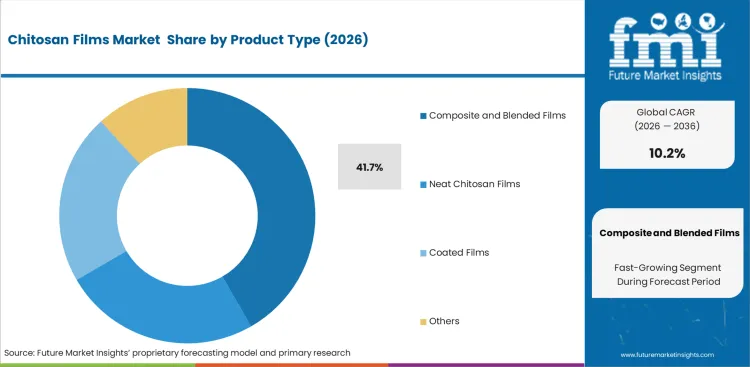
Composite and blended films are projected to hold 41.7% of market value in 2026. They address the core technical limitation of neat chitosan films by improving mechanical strength, moisture resistance, and processability on existing converting equipment. The segment benefits from formulation flexibility that allows producers to tailor film properties to specific food contact, agricultural, or healthcare specifications. As converter experience with chitosan blending grows, this segment is also becoming the commercialization entry point for brands that want active packaging credentials without fully rebuilding their film supply chain.
Chitosan Films market Analysis by End Use Industry
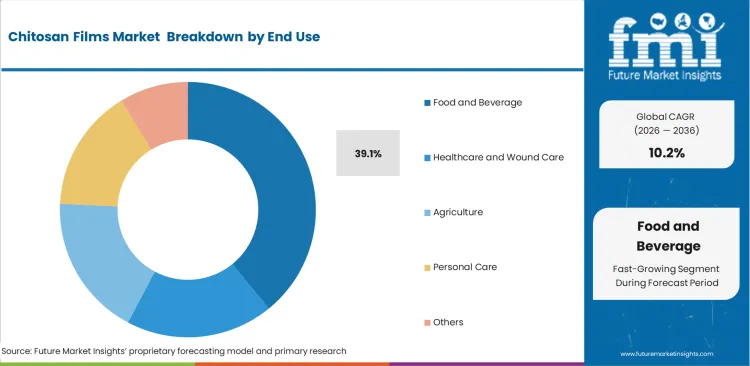
Food and beverage is expected to account for 39.1% of demand in 2026 because perishable food categories need packaging that actively extends shelf life while meeting compostability or recyclability targets. Retailers and food processors are under mounting pressure to demonstrate measurable plastic reduction, and chitosan films with validated antimicrobial activity are becoming viable candidates for fresh produce, seafood, and bakery packaging replacement programs. The segment also benefits from the growing consumer premium for packaging that communicates natural ingredient and bio-based material credentials.
Competitive Aligners for Market Players
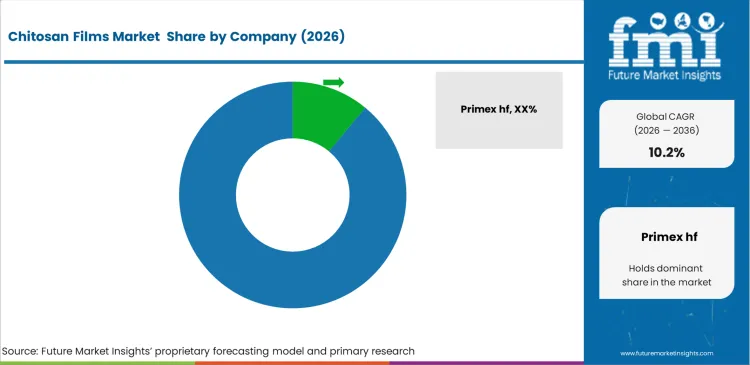
Competitive advantage in chitosan films is building around feedstock consistency, composite formulation know-how, and application-specific regulatory clearance. Broad sustainability positioning is not enough to win purchasing mandates. Buyers need food-contact approval documentation, validated shelf life extension data, and mechanical performance that is compatible with existing form-fill-seal and lamination equipment. Producers that can deliver consistent chitosan grade specifications alongside application engineering support and regulatory filing assistance will command the strongest converter relationships. The market is still forming, which means early movers who build application credibility in food packaging and wound care will define the reference standards that later entrants must meet.
Key Players in Chitosan Films market
- Primex hf
- Advanced Biopolymers AS
- KitoZyme
- Novamatrix (FMC BioPolymer)
- Heppe Medical Chitosan GmbH
- G.T.C. Bio Corporation
- BIO21 Pty Ltd
- Chitosan Lab
- Kraeber GmbH
- Agrawal Chemicals
Strategic Outlook by FMI on Chitosan Films market
FMI sees chitosan films as a high-potential but technically demanding category where the commercial pathway runs through composite formulation and application-specific regulatory clearance rather than through neat film substitution. Growth through 2036 will be paced by feedstock cost reduction, moisture resistance improvements, and the accumulation of food-contact approvals in key markets. Producers who invest in formulation depth and converter support programs will capture the value that generic bio-based claims alone cannot hold.
Scope of the Report
| Market Value | USD 0.4 billion in 2025 to USD 1.3 billion by 2036 |
|---|---|
| CAGR | 10.2% from 2026 to 2036 |
| Base Year | 2025 |
| Forecast Period | 2026 to 2036 |
| Source Segmentation | Marine-derived (Shrimp, Crab, Squid), Fungal-derived, Others |
| Film Type Segmentation | Neat Chitosan Films, Composite and Blended Films, Coated Films, Others |
| End Use Industry Segmentation | Food and Beverage, Healthcare and Wound Care, Agriculture, Personal Care, Others |
| Regions Covered | North America, Latin America, Western Europe, Eastern Europe, East Asia, South Asia and Pacific, Middle East and Africa |
Bibliography
- European Commission. 2025. Packaging and Packaging Waste Regulation.
- Food and Agriculture Organization of the United Nations. 2021. Chitin and Chitosan: Properties and Applications.
- International Chitin Society. 2024. Chitosan in Packaging Applications.
- Rinaudo, M. 2006. Chitin and Chitosan: Properties and Applications. Progress in Polymer Science.
- Aranaz, I. et al. 2021. Chitosan: An Overview of Its Properties and Applications. Polymers.
- Semple, K. E. et al. 2022. Moulded Pulp Fibers for Disposable Food Packaging.
- USA Food and Drug Administration. 2023. Generally Recognized as Safe: Chitosan.
Frequently Asked Questions
How large is the chitosan films market and what is its growth trajectory through 2036?
The market was valued at USD 0.4 billion in 2025 and is projected to reach USD 1.3 billion by 2036, growing at a CAGR of 10.2%. Antimicrobial packaging demand and regulatory pressure on synthetic films are the primary growth engines.
Which chitosan source dominates production today?
Marine-derived chitosan leads with a 58.4% share in 2026, primarily sourced from shrimp and crab shell byproducts, though fungal-derived alternatives are attracting investment for their supply consistency and vegan positioning.
What is limiting wider commercial adoption of chitosan films?
High extraction costs relative to synthetic films, moisture sensitivity that degrades film integrity in humid conditions, and batch-to-batch feedstock variability from marine sources are the three core constraints.
Why is the food and beverage sector the largest end-use segment?
Food and beverage represents 39.1% of demand in 2026 because the combination of active antimicrobial functionality and biodegradability makes chitosan films directly competitive with synthetic barrier films in fresh produce, seafood, and bakery packaging.
Which regions present the strongest growth opportunity for chitosan films?
Western Europe leads given the stringency of packaging regulation. East Asia follows on the strength of established seafood processing infrastructure and existing marine chitin supply chains that reduce feedstock logistics cost.
Preview the report firsthand - request a free sample
Get SampleGet the brochure for pricing and purchase details.
Get PDFTable of Content
- Executive Summary
- Global Market Outlook
- Demand-side Trends
- Supply-side Trends
- Technology Roadmap Analysis
- Analysis and Recommendations
- Market Overview
- Market Coverage / Taxonomy
- Market Definition / Scope / Limitations
- Research Methodology
- Chapter Orientation
- Analytical Lens and Working Hypotheses
- Market Structure, Signals, and Trend Drivers
- Benchmarking and Cross-market Comparability
- Market Sizing, Forecasting, and Opportunity Mapping
- Research Design and Evidence Framework
- Desk Research Programme (Secondary Evidence)
- Company Annual and Sustainability Reports
- Peer-reviewed Journals and Academic Literature
- Corporate Websites, Product Literature, and Technical Notes
- Earnings Decks and Investor Briefings
- Statutory Filings and Regulatory Disclosures
- Technical White Papers and Standards Notes
- Trade Journals, Industry Magazines, and Analyst Briefs
- Conference Proceedings, Webinars, and Seminar Materials
- Government Statistics Portals and Public Data Releases
- Press Releases and Reputable Media Coverage
- Specialist Newsletters and Curated Briefings
- Sector Databases and Reference Repositories
- FMI Internal Proprietary Databases and Historical Market Datasets
- Subscription Datasets and Paid Sources
- Social Channels, Communities, and Digital Listening Inputs
- Additional Desk Sources
- Expert Input and Fieldwork (Primary Evidence)
- Primary Modes
- Qualitative Interviews and Expert Elicitation
- Quantitative Surveys and Structured Data Capture
- Blended Approach
- Why Primary Evidence is Used
- Field Techniques
- Interviews
- Surveys
- Focus Groups
- Observational and In-context Research
- Social and Community Interactions
- Stakeholder Universe Engaged
- C-suite Leaders
- Board Members
- Presidents and Vice Presidents
- R&D and Innovation Heads
- Technical Specialists
- Domain Subject-matter Experts
- Scientists
- Physicians and Other Healthcare Professionals
- Governance, Ethics, and Data Stewardship
- Research Ethics
- Data Integrity and Handling
- Primary Modes
- Tooling, Models, and Reference Databases
- Desk Research Programme (Secondary Evidence)
- Data Engineering and Model Build
- Data Acquisition and Ingestion
- Cleaning, Normalisation, and Verification
- Synthesis, Triangulation, and Analysis
- Quality Assurance and Audit Trail
- Market Background
- Market Dynamics
- Drivers
- Restraints
- Opportunity
- Trends
- Scenario Forecast
- Demand in Optimistic Scenario
- Demand in Likely Scenario
- Demand in Conservative Scenario
- Opportunity Map Analysis
- Product Life Cycle Analysis
- Supply Chain Analysis
- Investment Feasibility Matrix
- Value Chain Analysis
- PESTLE and Porter’s Analysis
- Regulatory Landscape
- Regional Parent Market Outlook
- Production and Consumption Statistics
- Import and Export Statistics
- Market Dynamics
- Global Market Analysis 2021 to 2025 and Forecast, 2026 to 2036
- Historical Market Size Value (USD Million) Analysis, 2021 to 2025
- Current and Future Market Size Value (USD Million) Projections, 2026 to 2036
- Y-o-Y Growth Trend Analysis
- Absolute $ Opportunity Analysis
- Global Market Pricing Analysis 2021 to 2025 and Forecast 2026 to 2036
- Global Market Analysis 2021 to 2025 and Forecast 2026 to 2036, By Product Type
- Introduction / Key Findings
- Historical Market Size Value (USD Million) Analysis By Product Type , 2021 to 2025
- Current and Future Market Size Value (USD Million) Analysis and Forecast By Product Type , 2026 to 2036
- Composite and Blended Films
- Neat Chitosan Films
- Coated Films
- Others
- Composite and Blended Films
- Y-o-Y Growth Trend Analysis By Product Type , 2021 to 2025
- Absolute $ Opportunity Analysis By Product Type , 2026 to 2036
- Global Market Analysis 2021 to 2025 and Forecast 2026 to 2036, By End Use
- Introduction / Key Findings
- Historical Market Size Value (USD Million) Analysis By End Use, 2021 to 2025
- Current and Future Market Size Value (USD Million) Analysis and Forecast By End Use, 2026 to 2036
- Food and Beverage
- Healthcare and Wound Care
- Agriculture
- Personal Care
- Others
- Food and Beverage
- Y-o-Y Growth Trend Analysis By End Use, 2021 to 2025
- Absolute $ Opportunity Analysis By End Use, 2026 to 2036
- Global Market Analysis 2021 to 2025 and Forecast 2026 to 2036, By Region
- Introduction
- Historical Market Size Value (USD Million) Analysis By Region, 2021 to 2025
- Current Market Size Value (USD Million) Analysis and Forecast By Region, 2026 to 2036
- North America
- Latin America
- Western Europe
- Eastern Europe
- East Asia
- South Asia and Pacific
- Middle East & Africa
- Market Attractiveness Analysis By Region
- North America Market Analysis 2021 to 2025 and Forecast 2026 to 2036, By Country
- Historical Market Size Value (USD Million) Trend Analysis By Market Taxonomy, 2021 to 2025
- Market Size Value (USD Million) Forecast By Market Taxonomy, 2026 to 2036
- By Country
- USA
- Canada
- Mexico
- By Product Type
- By End Use
- By Country
- Market Attractiveness Analysis
- By Country
- By Product Type
- By End Use
- Key Takeaways
- Latin America Market Analysis 2021 to 2025 and Forecast 2026 to 2036, By Country
- Historical Market Size Value (USD Million) Trend Analysis By Market Taxonomy, 2021 to 2025
- Market Size Value (USD Million) Forecast By Market Taxonomy, 2026 to 2036
- By Country
- Brazil
- Chile
- Rest of Latin America
- By Product Type
- By End Use
- By Country
- Market Attractiveness Analysis
- By Country
- By Product Type
- By End Use
- Key Takeaways
- Western Europe Market Analysis 2021 to 2025 and Forecast 2026 to 2036, By Country
- Historical Market Size Value (USD Million) Trend Analysis By Market Taxonomy, 2021 to 2025
- Market Size Value (USD Million) Forecast By Market Taxonomy, 2026 to 2036
- By Country
- Germany
- UK
- Italy
- Spain
- France
- Nordic
- BENELUX
- Rest of Western Europe
- By Product Type
- By End Use
- By Country
- Market Attractiveness Analysis
- By Country
- By Product Type
- By End Use
- Key Takeaways
- Eastern Europe Market Analysis 2021 to 2025 and Forecast 2026 to 2036, By Country
- Historical Market Size Value (USD Million) Trend Analysis By Market Taxonomy, 2021 to 2025
- Market Size Value (USD Million) Forecast By Market Taxonomy, 2026 to 2036
- By Country
- Russia
- Poland
- Hungary
- Balkan & Baltic
- Rest of Eastern Europe
- By Product Type
- By End Use
- By Country
- Market Attractiveness Analysis
- By Country
- By Product Type
- By End Use
- Key Takeaways
- East Asia Market Analysis 2021 to 2025 and Forecast 2026 to 2036, By Country
- Historical Market Size Value (USD Million) Trend Analysis By Market Taxonomy, 2021 to 2025
- Market Size Value (USD Million) Forecast By Market Taxonomy, 2026 to 2036
- By Country
- China
- Japan
- South Korea
- By Product Type
- By End Use
- By Country
- Market Attractiveness Analysis
- By Country
- By Product Type
- By End Use
- Key Takeaways
- South Asia and Pacific Market Analysis 2021 to 2025 and Forecast 2026 to 2036, By Country
- Historical Market Size Value (USD Million) Trend Analysis By Market Taxonomy, 2021 to 2025
- Market Size Value (USD Million) Forecast By Market Taxonomy, 2026 to 2036
- By Country
- India
- ASEAN
- Australia & New Zealand
- Rest of South Asia and Pacific
- By Product Type
- By End Use
- By Country
- Market Attractiveness Analysis
- By Country
- By Product Type
- By End Use
- Key Takeaways
- Middle East & Africa Market Analysis 2021 to 2025 and Forecast 2026 to 2036, By Country
- Historical Market Size Value (USD Million) Trend Analysis By Market Taxonomy, 2021 to 2025
- Market Size Value (USD Million) Forecast By Market Taxonomy, 2026 to 2036
- By Country
- Kingdom of Saudi Arabia
- Other GCC Countries
- Turkiye
- South Africa
- Other African Union
- Rest of Middle East & Africa
- By Product Type
- By End Use
- By Country
- Market Attractiveness Analysis
- By Country
- By Product Type
- By End Use
- Key Takeaways
- Key Countries Market Analysis
- USA
- Pricing Analysis
- Market Share Analysis, 2025
- By Product Type
- By End Use
- Canada
- Pricing Analysis
- Market Share Analysis, 2025
- By Product Type
- By End Use
- Mexico
- Pricing Analysis
- Market Share Analysis, 2025
- By Product Type
- By End Use
- Brazil
- Pricing Analysis
- Market Share Analysis, 2025
- By Product Type
- By End Use
- Chile
- Pricing Analysis
- Market Share Analysis, 2025
- By Product Type
- By End Use
- Germany
- Pricing Analysis
- Market Share Analysis, 2025
- By Product Type
- By End Use
- UK
- Pricing Analysis
- Market Share Analysis, 2025
- By Product Type
- By End Use
- Italy
- Pricing Analysis
- Market Share Analysis, 2025
- By Product Type
- By End Use
- Spain
- Pricing Analysis
- Market Share Analysis, 2025
- By Product Type
- By End Use
- France
- Pricing Analysis
- Market Share Analysis, 2025
- By Product Type
- By End Use
- India
- Pricing Analysis
- Market Share Analysis, 2025
- By Product Type
- By End Use
- ASEAN
- Pricing Analysis
- Market Share Analysis, 2025
- By Product Type
- By End Use
- Australia & New Zealand
- Pricing Analysis
- Market Share Analysis, 2025
- By Product Type
- By End Use
- China
- Pricing Analysis
- Market Share Analysis, 2025
- By Product Type
- By End Use
- Japan
- Pricing Analysis
- Market Share Analysis, 2025
- By Product Type
- By End Use
- South Korea
- Pricing Analysis
- Market Share Analysis, 2025
- By Product Type
- By End Use
- Russia
- Pricing Analysis
- Market Share Analysis, 2025
- By Product Type
- By End Use
- Poland
- Pricing Analysis
- Market Share Analysis, 2025
- By Product Type
- By End Use
- Hungary
- Pricing Analysis
- Market Share Analysis, 2025
- By Product Type
- By End Use
- Kingdom of Saudi Arabia
- Pricing Analysis
- Market Share Analysis, 2025
- By Product Type
- By End Use
- Turkiye
- Pricing Analysis
- Market Share Analysis, 2025
- By Product Type
- By End Use
- South Africa
- Pricing Analysis
- Market Share Analysis, 2025
- By Product Type
- By End Use
- USA
- Market Structure Analysis
- Competition Dashboard
- Competition Benchmarking
- Market Share Analysis of Top Players
- By Regional
- By Product Type
- By End Use
- Competition Analysis
- Competition Deep Dive
- Primex hf
- Overview
- Product Portfolio
- Profitability by Market Segments (Product/Age /Sales Channel/Region)
- Sales Footprint
- Strategy Overview
- Marketing Strategy
- Product Strategy
- Channel Strategy
- Advanced Biopolymers AS
- KitoZyme
- Novamatrix (FMC BioPolymer)
- Heppe Medical Chitosan GmbH
- G.T.C. Bio Corporation
- BIO21 Pty Ltd
- Chitosan Lab
- Kraeber GmbH
- Agrawal Chemicals
- Primex hf
- Competition Deep Dive
- Assumptions & Acronyms Used


