

- Market Size (2026)
- USD 12.2 Bn
- Forecast (2036)
- USD 27.8 Bn
- CAGR (2026 to 2036)
- 8.6%
How big is CMP Slurry Delivery Systems Market in 2026?
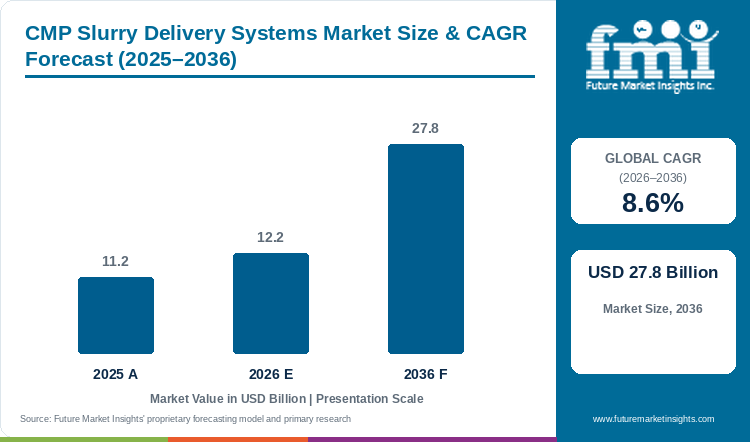
Demand for CMP slurry delivery systems is projected to expand at 8.6% CAGR between 2026 and 2036. Industry value grows from USD 11.2 billion in 2025 to USD 12.2 billion in 2026 and is projected to reach USD 27.8 billion by 2036.
CMP slurry delivery systems market is projected to reach USD 27.8 billion by 2036, at 8.6% CAGR, as per FMI. Value moves from USD 11.2 billion in 2025 to USD 12.2 billion in 2026, adding USD 15.6 billion by 2036. Rising capital deployment in wafer manufacturing equipment is projected to lift sales to USD 143.9 billion in 2026, increasing 23.1% from 2025.[1] TSMC manufactured 12,682 products through 305 process technologies for 534 customers in 2025, with capacity above 17 million 12-inch equivalent wafers.[2] Such a large production base requires several slurry recipes and long circulation lines. Entegris retained up to 95% of particles above 0.43 µm during CMP filtration testing, while total scratch defects declined below 10%.[3] These factors are increasing demand for blending, filtration, monitoring and point-of-use delivery systems.
Key Market Trends & Insights
- By wafer size compatibility, 300 mm advanced fab wafers held the leading share of 37.2% in 2026, supported by high-volume logic and memory fab production.
- By process node, leading-edge sub-5nm nodes accounted for 34.9% of demand in 2026, reflecting multi-step planarization requirements in advanced logic.
- By system architecture, automated central blend and dispense cluster systems represented 46.8% in 2026, supported by continuous supply, automatic changeover and recipe control.
- By end user tier, IDMs held 39.7% share in 2026, owing to direct ownership of fab utilities, process qualification and maintenance standards.
Regional Highlights
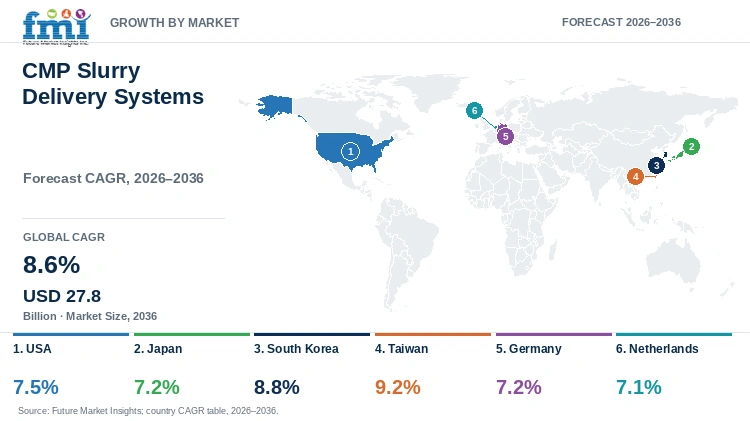
- Fastest-growing profiled country: Taiwan (9.2% CAGR, 2026 to 2036).
- By country: South Korea (8.8%) and the USA (7.5%) follow, while the Netherlands records the lowest profiled CAGR at 7.1%.
Market Size & Forecast
Table 1: Market Size and Forecast for the CMP Slurry Delivery Systems Market (USD billion and percentage), 2025 to 2036
| Metric | Value |
|---|---|
| 2025 Market Size | USD 11.2 billion |
| Estimated Market Size in 2026 | USD 12.2 billion |
| Projected Market Size by 2036 | USD 27.8 billion |
| CAGR, 2026 to 2036 | 8.6% |
| Added Revenue, 2026 to 2036 | USD 15.6 billion |
| Market Expansion Multiple | 2.28x |
CMP slurry delivery systems are purchased when fabs add polishing tools, slurry recipes and distribution points. Merck opened a 150,000 square meter site for semiconductor fabrication materials in Kaohsiung during December 2025, with production beginning in 2026 and 150 new jobs.[4] Near-fab material capacity is expected to shorten technical support and supply routes for Taiwan manufacturers. Slurry particles can change during dilution, storage, circulation and mechanical handling before reaching the wafer.[5] Planargard filters are available from below 1 µm to 50 µm, but tighter filters can remove working particles and reduce polishing rate.[6] Due to this, each delivery system requires a filter, pump and circulation setting suited to the selected slurry. Fabs adding new branches will create demand, whereas systems without measured particle control may face longer production approval.
Fab Capacity and Slurry-Control Readiness
Wafer fab spending creates the equipment base, while production scale decides the number of slurry points served by each system. A high-volume foundry uses different recipes for logic, memory and specialty products, due to which one standard filter setting cannot be used throughout the fab. Higher recipe count is expected to support modular blending and recorded concentration, whereas longer circulation route will increase focus on particle stability.
Table 2: Fab Capacity and Slurry-Control Readiness for the CMP Slurry Delivery Systems Market (USD billion, wafers, products, technologies, customers, square meters, jobs, percentages, and micrometers), mixed reporting years from 2025 to 2026
| Indicator | Data Point | Why It Matters | Source |
|---|---|---|---|
| Wafer fab equipment sales | USD 143.9 billion in 2026; 23.1% annual increase | Expands the tool base requiring chemical and slurry delivery | [1] |
| TSMC product and technology range | 12,682 products; 305 technologies; 534 customers in 2025 | Shows the recipe diversity supported by a high-volume foundry network | [2] |
| TSMC wafer capacity | Above 17 million 12-inch equivalent wafers in 2025 | Supports centralized blending and long circulation loops | [2] |
| Merck Kaohsiung site | 150,000 square meters; 150 new jobs; production from 2026 | Places semiconductor materials and technical support near Taiwan fabs | [4] |
| Entegris NMB filtration study | Up to 95% retention above 0.43 µm; scratches below 10% | Connects filter selection with defect reduction and slurry stability | [3] |
| Planargard filter range | Below 1 µm to 50 µm | Supports application-specific filtration rather than one filter setting | [6] |
Analyst Perspective
“I expect advanced fabs to prefer slurry systems which hold particle distribution during long production runs. Automatic changeover and measured concentration will decide which systems receive wider approval during new fab qualification.”
- Nikhil Kaitwade, Principal Consultant, Future Market Insights.
How is the CMP slurry delivery systems market segmented?
CMP slurry delivery systems market is segmented by four primary commercial axes and region: wafer size compatibility, process node, system architecture, end user tier, and region. In 2026, 300 mm advanced fab wafers are projected at 37.2%, leading-edge sub-5nm nodes at 34.9%, automated central blend and dispense cluster systems at 46.8%, and IDMs at 39.7%.
By wafer size compatibility: 300 mm advanced fab wafers, 200 mm legacy fab wafers, and compound semiconductor substrates (SiC/GaN).
By process node: leading-edge sub-5nm nodes, mature 7nm to 28nm nodes, and legacy power and discrete nodes.
By system architecture: automated central blend and dispense cluster systems, loop distribution systems, point-of-use dispense modules, and day-tank blending skids.
By end user tier: IDMs (integrated device manufacturers), pure-play foundries, OSAT (packaging and test houses), and advanced R&D cleanrooms.
By region: North America, Latin America, Western Europe, Eastern Europe, East Asia, South Asia and Pacific, and Middle East and Africa.
Why do 300 mm wafers retain a notable compatibility share?
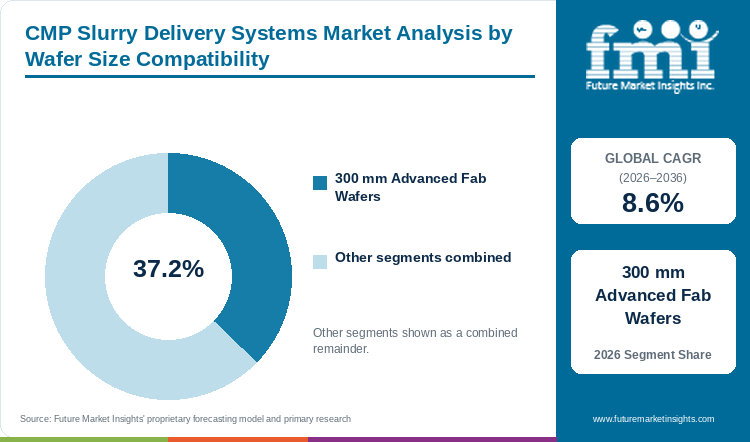
Based on wafer size compatibility, 300 mm advanced fab wafers are projected to account for 37.2% in 2026, driven by high-volume fabs.
Table 3: Wafer Size Compatibility Share for the CMP Slurry Delivery Systems Market (percentage share), 2026
| Wafer Size Compatibility | Share (2026) |
|---|---|
| 300 mm Advanced Fab Wafers | 37.2% |
| Other Segments Combined | 62.8%* |
| Total | 100.0% |
*Calculated as the balance remaining after deducting the leading segment's reported share from 100.0%.
Table 4: Wafer Size Compatibility Leadership and Market Growth for the CMP Slurry Delivery Systems Market (segment and CAGR percentage), 2026 to 2036
| Metric | Value |
|---|---|
| Global CAGR (2026 to 2036) | 8.6% |
| Leading Segment | 300 mm Advanced Fab Wafers |
300 mm wafers are used for high-volume production of logic and memory chips. These fabs operate several polishing tools and integrated wafer cleaning equipment, due to which centralized blending and continuous slurry circulation is required. Higher production volume and longer distribution lines are expected to support demand for 300 mm compatible slurry delivery systems.
- 300 mm advanced fab wafers account for 37.2% share in 2026, supported by high-volume logic and memory production.
- Higher 300 mm production requires centralized blending, longer circulation loops and automatic slurry supply to several polishing tools.
What supports sub-5nm nodes as a preferred process category?
By process node, leading-edge sub-5nm nodes are estimated to hold 34.9% in 2026, owing to tighter defect-control requirements.
Leading-edge sub-5nm nodes require repeated planarization during wafer manufacturing. Small changes in slurry concentration and particle size can affect the polished surface and later process steps. Due to this requirement, manufacturers are increasing the use of filtration, flow control, semiconductor inspection systems and slurry monitoring platforms. These factors are anticipated to support segment growth over the forecast period.
- Leading-edge sub-5nm nodes hold 34.9% share in 2026, owing to repeated planarization and lower particle defect tolerance.
- Increasing movement towards 2nm production is raising requirement for lower particle variation and recorded slurry concentration.
How do automated cluster tools meet changing fab requirements?
In 2026, automated central blend and dispense cluster systems are expected to lead system architecture with 46.8% share, supported by closed-loop process control.
Automated central blend and dispense cluster systems integrate slurry supply with recipe and process control. These systems provide continuous flow and lower wear on consumable parts for semiconductor equipment, allowing slurry changeover without stopping the complete processing line. Increasing requirement for controlled delivery and lower production interruption is expected to drive demand for automated central blend and dispense cluster systems.
- Automated central blend and dispense cluster systems represent 46.8% share in 2026, owing to recipe control and continuous tool operation.
- EMD Electronics states that FLOWMASTER uses redundant systems and analytical capability for maintaining accurate slurry blends.[7]
Why are IDMs central to end-user tier demand?
IDMs are set to lead the end user tier with 39.7% share in 2026, underpinned by integrated process ownership.
IDMs are involved in chip design, wafer fabrication and process improvement under the same manufacturing network. In the FMI report, IDMs hold 39.7% of end user tier demand as these companies invest heavily in semiconductor capital equipment and directly control facility utilities and process approval. One maintenance standard can be used for storage, filtration and point-of-use delivery, which is anticipated to support demand from IDMs.
- IDMs account for 39.7% of end user tier demand in 2026, supported by direct control over fab infrastructure.
- IDMs can use one maintenance standard for slurry storage, filtration and point-of-use delivery within the same manufacturing network.
What are the drivers, restraints, and opportunities in the CMP slurry delivery systems market?
In the CMP slurry delivery systems market, fab expansion drives adoption, slurry instability restrains performance, and modular retrofits create opportunity.
- Driver: New wafer-fab capacity expands demand for automated slurry blending, recirculation, filtration, and point-of-use distribution.
- Restraint: Particle agglomeration, concentration drift, and incompatible wetted materials can raise defects and qualification time.
- Opportunity: Modular delivery skids can add metrology or redundancy without replacing an entire chemical-distribution layout.
Fab Spending Expands Installed Demand
More semiconductor manufacturing facilities are increasing requirements for CMP slurry delivery systems. SEMI projected broader semiconductor manufacturing equipment sales at USD 165.9 billion in 2026.[8] Each new CMP tool needs controlled slurry pressure, filtration and changeover before production begins. Higher tool installation is expected to drive new delivery-system demand and expansion of existing slurry lines.
Particle Stability Limits Process Performance
CMP slurry contains abrasive particles which can agglomerate during storage and circulation. Pall identifies recirculation loop, point-of-use and tote-to-day-tank transfer as three industrial filtration positions in a slurry system.[9] Improper filtration can change particle distribution and may increase scratch defects during polishing. Pump shear, filter loading and material compatibility can increase qualification time, which may hamper adoption of new CMP slurry delivery systems.
Modular Systems Widen Retrofit Options
Existing semiconductor fabs are adding process capacity without replacing complete facility infrastructure. According to FMI, modular blending and delivery systems allow manufacturers to add chemical mechanical planarization recipes or increase flow in an existing line. FAST Chemtech provides configurable modules depending on process volume.[10] Expansion of existing fabs is expected to create growth opportunities for modular CMP slurry delivery systems.
Which country CAGRs are profiled in the CMP slurry delivery systems market?
Table 5: Country CAGR Comparison for the CMP Slurry Delivery Systems Market (CAGR percentage), 2026 to 2036
| Country | CAGR |
|---|---|
| USA | 7.5% |
| Japan | 7.2% |
| South Korea | 8.8% |
| Taiwan | 9.2% |
| Germany | 7.2% |
| Netherlands | 7.1% |
How do country-level CAGRs compare in the CMP slurry delivery systems market?
Demand for CMP slurry delivery systems differs according to wafer production, fab construction and type of semiconductor manufactured. As per the analysis from FMI, Taiwan and South Korea will witness stronger growth owing to foundry, memory and HBM expansion. The USA is adding logic, memory, material and packaging facilities, whereas Germany and the Netherlands have demand from industrial chips and equipment development.
Germany and the Netherlands are projected to witness steady demand due to presence of industrial chip and semiconductor equipment manufacturers. Japan is expanding advanced logic production, but longer component qualification can limit immediate adoption of new delivery systems.
- USA demand is supported by new front-end fabs, material plants and advanced packaging projects in different states.
- Japan combines new logic capacity with domestic material, equipment, automotive and industrial semiconductor production.
- South Korea has concentrated memory, HBM and foundry production around large semiconductor manufacturing clusters.
- Taiwan has dense 300 mm foundry production and frequent movement towards advanced semiconductor process nodes.
- Germany demand is contributed by automotive, power, sensor and industrial semiconductor manufacturing facilities.
- Netherlands demand is supported by equipment engineering, pilot manufacturing, integrated photonics and chip development facilities.
Full report country CAGRs cover: North America; Latin America; Western Europe; Eastern Europe; East Asia; South Asia and Pacific; Middle East and Africa.
Country-wise Analysis
- The USA CMP slurry delivery systems market is anticipated to grow at 7.5% CAGR over the assessment period. In September 2026, the Semiconductor Industry Association reported more than 160 semiconductor projects across 30 states since 2020.[11] New logic, memory, material and advanced packaging facilities require bulk storage, day tanks, filtration and point-of-use delivery. Presence of projects in different states is also increasing requirement for regional installation and maintenance service. Expansion of semiconductor manufacturing is expected to support the USA market growth.
- CMP slurry delivery system demand in Japan is forecast to rise at 7.2% CAGR over the forecast period. The U.S. International Trade Administration reported in September 2026 that Japan semiconductor market is expected to reach USD 57.1 billion in 2026.[12] New logic production by Rapidus and semiconductor facilities in Kumamoto is increasing requirement for 300 mm chemical and slurry systems. Automotive, power and industrial semiconductor production also supports demand from mature lines. However, longer qualification can limit immediate adoption of new systems.
- Adoption of CMP slurry delivery systems in South Korea is estimated to expand at 8.8% CAGR through 2036. SEMICON Korea 2026 included about 550 companies and more than 2,400 booths covering equipment, material and smart manufacturing suppliers.[13] Samsung Electronics and SK hynix operate large memory and foundry production in the country. HBM and advanced DRAM requires repeated CMP steps, due to which controlled concentration and particle distribution is receiving higher preference. Expansion of semiconductor clusters is expected to support market growth.
- Taiwan CMP slurry delivery systems market is estimated to post 9.2% CAGR over the forecast period. In 2025, the Taiwan Semiconductor Industry Association reported that Taiwan accounted for approximately 78.1% of global pure-play IC foundry revenue.[14] High production of 300 mm wafers requires slurry systems which can handle different process recipes without cross-contamination. Advanced logic also needs lower particle defects during repeated polishing. Presence of a large semiconductor supplier base is expected to support system installation and maintenance.
- Germany CMP slurry delivery systems market is projected to record 7.2% CAGR during the assessment period. Germany has automotive, power, sensor and industrial semiconductor production using different wafer sizes and process nodes.[15] New fab activity and upgrades in existing lines is creating demand for system engineering, installation and maintenance. However, material compatibility and process qualification may limit the speed of new system adoption.
- Sales of CMP slurry delivery systems in the Netherlands are forecast to expand at 7.1% CAGR through 2036. Statistics Netherlands reported in August 2026 that semiconductor employment increased to more than 43,000 jobs during 2025.[16] The country has equipment, metrology, deposition, packaging and analytical system manufacturers which supply global fabs. Pilot production and chip development facilities need flexible systems for different recipes. These activities are expected to support steady market demand.
Who are the notable companies in the CMP slurry delivery systems market?
Merck KGaA/EMD Electronics, FAST Chemtech, Kinetics, JST Manufacturing and Mitsubishi Chemical Engineering are engaged in complete or integrated slurry delivery systems. Diversified Fluid Solutions, RENA Technologies and Ichor Systems are providing fluid engineering and integration. Pall Corporation and Entegris are participating through filtration and contamination control products.
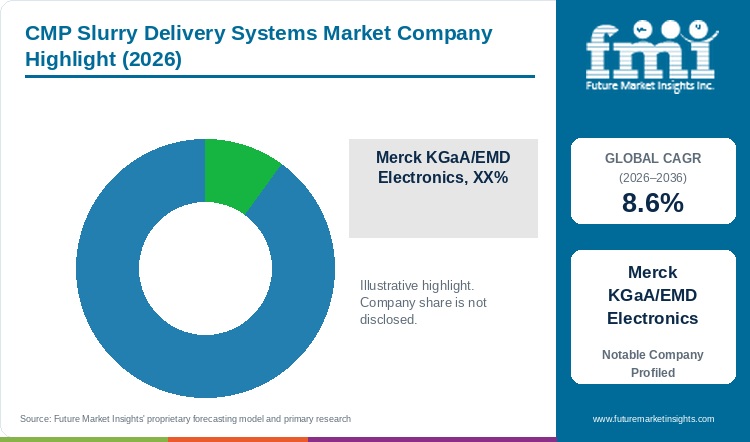
CMP slurry delivery systems market is moderately fragmented with presence of dedicated system manufacturers, facility integrators and filtration suppliers. Merck KGaA/EMD Electronics and FAST Chemtech are offering slurry blending and delivery platforms. Kinetics, JST Manufacturing and Mitsubishi Chemical Engineering provides wider chemical and wet-process systems. Pall Corporation and Entegris supplies filtration and fluid control products used in slurry lines. FMI data suggests that companies are increasing focus on modular systems, particle control and local service in order to cater the growing demand from semiconductor fabs.
- Integrated slurry platforms: Merck KGaA/EMD Electronics, FAST Chemtech, Kinetics, JST Manufacturing, and Mitsubishi Chemical Engineering.
- Fluid-system integration: Diversified Fluid Solutions, RENA Technologies, and Ichor Systems.
- Filtration and contamination control: Pall Corporation and Entegris.
Competitive Benchmarking: CMP Slurry Delivery Systems Market
Table 6: Competitive Benchmarking for the CMP Slurry Delivery Systems Market (qualitative capability ratings), 2026
| Company | System breadth | Process control | Current activity | Geographic reach |
|---|---|---|---|---|
| Merck KGaA/EMD Electronics | High | High | High | High |
| FAST Chemtech | High | High | Medium | Medium |
| Kinetics | High | High | Medium | High |
| JST Manufacturing | High | Medium | Medium | Medium |
| Mitsubishi Chemical Engineering | High | High | Medium | High |
| Diversified Fluid Solutions | Medium | High | Medium | Medium |
| RENA Technologies | Medium | High | Medium | High |
| Ichor Systems | Medium | High | Medium | High |
| Pall Corporation | Low | High | High | High |
| Entegris | Medium | High | High | High |
High indicates wider product and geographic presence, Medium indicates limited product or regional presence and Low indicates lower direct participation. These ratings do not indicate product quality, market share or company rank.
Key Developments in the CMP Slurry Delivery Systems Market
- In September 2026, ESMC invited suppliers for gas, chemical, and slurry systems as its Dresden fab moved toward operational readiness.
- In July 2026, SEMI raised its 2026 wafer-fab equipment forecast to USD 143.9 billion, increasing the addressable installed base for facility delivery systems.
- In April 2026, the Dutch government published its National Semiconductor Vision 2035 with materials, equipment, advanced packaging, and high-mix manufacturing among its priorities.
- In February 2026, SEMICON Korea brought about 550 companies together across more than 2,400 booths, including equipment and materials suppliers.
Key Players in the CMP Slurry Delivery Systems Market
Integrated Slurry Delivery Platforms
- Merck KGaA/EMD Electronics
- FAST Chemtech
- Kinetics
- JST Manufacturing
- Mitsubishi Chemical Engineering
Fluid-System Engineering and Integration
- Diversified Fluid Solutions
- RENA Technologies
- Ichor Systems
Filtration and Contamination Control
- Pall Corporation
- Entegris
CMP Slurry Delivery Systems Market - Report Scope
Table 7: Report Scope for the CMP Slurry Delivery Systems Market (coverage fields and definitions), 2026 to 2036
| Coverage field | Report scope |
|---|---|
| Market breakdown | Wafer size compatibility; process node; system architecture; end user tier; region |
| Quantitative units | USD billion |
| Market definition | First-sale revenue from systems and integrated modules used to blend, store, recirculate, filter, monitor, and deliver CMP slurry to semiconductor processing tools. |
| Exclusions | CMP slurry chemistry, polishing pads, standalone polishers, general bulk-chemical systems without slurry use, and after-market revenue not tied to the defined systems. |
| Regions covered | North America; Latin America; Western Europe; Eastern Europe; East Asia; South Asia and Pacific; Middle East and Africa |
| Countries covered | USA; Japan; South Korea; Taiwan; Germany; Netherlands |
| Forecast period | 2026 to 2036 |
CMP Slurry Delivery Systems Market - Research Methodology
Table 8: Research Methodology for the CMP Slurry Delivery Systems Market (research methods and approach), 2026 edition
| Method | Approach |
|---|---|
| Primary Research | The research study includes primary interviews with manufacturers, system integrators, technology developers, distributors, semiconductor fabs and industry experts. Interviews covers purchasing decision, system evaluation, adoption barriers, approval requirement, pricing and technical support. Respondents were also asked about evidence required before a pilot develops into regular purchasing. |
| Desk Research | Desk research covers government statistics, trade data, industry associations, technical literature, company filings, product information and official announcements. Sources were checked for publication date, geographic coverage and direct relevance to CMP slurry delivery systems market. Unsupported claims and adjacent products were excluded from the study. |
| Market Sizing and Forecasting | Market sizing combines the baseline value with historical performance, segment structure, system pricing, adoption and country demand conditions. Forecast assumptions covers semiconductor investment, technology adoption, purchasing cycle, supply availability and barriers to wider use. Segment and regional estimates were reconciled with the final market value. |
| Data Validation | Market estimates are checked with public statistics, company developments, trade activity and findings from primary interviews. Product, application and company revenue were reviewed against the defined market boundary. Overlapping revenue and products without direct market relevance were excluded from the market. |
CMP Slurry Delivery Systems Market by Segments
CMP Slurry Delivery Systems Market segmented by Wafer Size Compatibility:
- 300 mm Advanced Fab Wafers
- 200 mm Legacy Fab Wafers
- Compound Semiconductor Substrates (SiC/GaN)
CMP Slurry Delivery Systems Market segmented by Process Node:
- Leading-Edge Sub-5nm Nodes
- Mature 7nm to 28nm Nodes
- Legacy Power and Discrete Nodes
CMP Slurry Delivery Systems Market segmented by System Architecture:
- Automated Central Blend and Dispense Cluster Systems
- In-Line Track Systems
- Single-Wafer Processing Chambers
- Batch Immersion Modules
CMP Slurry Delivery Systems Market segmented by End User Tier:
- IDMs (Integrated Device Manufacturers)
- Pure-Play Foundries
- OSAT (Packaging and Test Houses)
- Advanced R&D Cleanrooms
CMP Slurry Delivery Systems Market by Region
- North America
- United States
- Canada
- Latin America
- Brazil
- Mexico
- Argentina
- Chile
- Western Europe
- Germany
- France
- United Kingdom
- Italy
- Spain
- Benelux
- Nordics
- Eastern Europe
- Poland
- Czech Republic
- Romania
- Hungary
- East Asia
- Japan
- South Korea
- Taiwan
- South Asia and Pacific
- ASEAN
- Australia and New Zealand
- Middle East and Africa
- GCC Countries
- South Africa
- Türkiye
- Israel
Research Sources and Bibliography
- [1] SEMI. (2026, July 14). Global Semiconductor Equipment Sales Forecast to Reach a Record $229 Billion in 2028, SEMI Reports.
- [2] Taiwan Semiconductor Manufacturing Company Limited. (2026). Investors: Manufacturing scale and 2025 production profile.
- [3] Entegris, Inc. (2026). Optimizing wafer polishing: Innovations in CMP slurry characterization and filtration.
- [4] Merck KGaA. (2025, December 1). Merck inaugurates semiconductor solutions site in Taiwan to support AI growth.
- [5] Entegris, Inc. (2026). From lab to fab: Capturing the uncatchable in CMP filtration.
- [6] Entegris, Inc. (2026). Planargard CMP cartridge filters.
- [7] Merck KGaA. (2026). FLOWMASTER CMP Slurry Delivery System.
- [8] SEMI. (2026, July 14). Mid-Year Total Semiconductor Equipment Forecast - OEM Perspective.
- [9] Pall Corporation. (2026). CMP slurry filtration for defect reduction and process stability.
- [10] FAST Chemtech. (2026). Slurry blending and delivery solutions.
- [11] Semiconductor Industry Association. (2026, September 22). Semiconductor supply chain investments.
- [12] International Trade Administration. (2026, September 24). Japan semiconductor.
- [13] SEMI. (2026, February 10). SEMICON Korea opens to strengthen innovation and connectivity across the global semiconductor ecosystem.
- [14] Taiwan Semiconductor Industry Association. (2025). Overview on Taiwan Semiconductor Industry (2025 Edition).
- [15] Germany Trade & Invest. (2026). The Semiconductor Market in Germany: Issue 2026.
- [16] Statistics Netherlands. (2026, August 27). Semiconductor sector in the Netherlands was worth EUR 46 billion in 2025.
This bibliography is provided for reader reference and is not exhaustive. The full report contains the complete reference list and detailed citations.
This Report Answers
- How big is the CMP slurry delivery systems market during 2026?
- What value is projected for the CMP slurry delivery systems market by 2036?
- Which wafer size compatibility segment holds a notable share?
- Which system architecture holds a notable share in 2026?
- Which countries show notable expansion outlooks through 2036?
- Which companies are notable in CMP slurry delivery systems?
Frequently Asked Questions
How large is the CMP slurry delivery systems market in 2026?
Future Market Insights estimates that CMP slurry delivery systems market will be valued at USD 12.2 billion in 2026. The market is projected to reach USD 27.8 billion by 2036 owing to expansion of advanced semiconductor production.
What CAGR is projected for the market through 2036?
As per FMI analysis, CMP slurry delivery systems market is projected to grow at an 8.6% CAGR between 2026 and 2036. Growth is supported by increasing CMP steps in logic, memory and advanced packaging.
Which wafer size compatibility segment holds notable share in 2026?
300 mm advanced fab wafers are projected to account for 37.2% of wafer size compatibility demand in 2026. The segment benefits from high-volume fabs using centralized slurry blending and continuous circulation.
Which system architecture holds notable share during 2026?
Automated central blend and dispense cluster systems are expected to represent 46.8% of system architecture demand in 2026. Automatic changeover and continuous slurry supply are supporting demand for these systems.
Which country has a notable expansion outlook through 2036?
Taiwan is projected to expand at a 9.2% CAGR during the 2026 to 2036 assessment period. Growth is supported by dense 300 mm foundry operations and continuous adoption of advanced semiconductor process nodes.
Who are the notable CMP slurry delivery system companies?
Notable companies include Merck KGaA/EMD Electronics, FAST Chemtech, Kinetics, JST Manufacturing, and Mitsubishi Chemical Engineering. These companies are focusing on slurry blending, delivery control and semiconductor fab support.
Preview the report firsthand - request a free sample
Get SampleGet the brochure for pricing and purchase details.
Get PDFTable of Content
- Key Takeaways
- Market Size and CAGR
- Top Growth Driver
- Fastest Growing Segment
- Leading Region
- Key Companies
- Emerging Opportunities
- Executive Summary
- Global Market Outlook
- Demand-side Trends
- Supply-side Trends
- Technology Roadmap Analysis
- Analysis and Recommendations
- Analyst Perspective (What is happening? Why now? What should investors know?)
- Key Questions Answered
- How large is the market?
- What is the CAGR?
- What are key trends?
- Which region dominates?
- Who are the leaders?
- Market Overview
- Market Coverage / Taxonomy
- Market Definition / Scope / Limitations
- Research Methodology
- Chapter Orientation
- Analytical Lens and Working Hypotheses
- Market Structure, Signals, and Trend Drivers
- Benchmarking and Cross-market Comparability
- Market Sizing, Forecasting, and Opportunity Mapping
- Research Design and Evidence Framework
- Desk Research Programme (Secondary Evidence)
- Expert Input and Fieldwork (Primary Evidence)
- Tooling, Models, and Reference Databases
- Data Engineering and Model Build
- Quality Assurance and Audit Trail
- Market Background
- Market Dynamics (Drivers, Restraints, Opportunity, Trends)
- Scenario Forecast (Optimistic, Likely, Conservative)
- Impact Analysis
- AI Impact
- Sustainability Impact
- Regulatory Impact
- Technology Impact
- Consumer / Buyer Analysis
- Purchase Drivers
- Adoption Barriers
- Buyer Journey
- Opportunity Map Analysis
- Product Life Cycle Analysis
- Supply Chain Analysis
- Investment Feasibility Matrix
- Value Chain Analysis
- PESTLE and Porter's Analysis
- Regulatory Landscape
- Regional Parent Market Outlook
- Production and Consumption Statistics
- Import and Export Statistics
- Global Market Analysis and Forecast, 2021 to 2036
- Historical Market Size Value (USD Billion) Analysis, 2021 to 2025
- Current and Future Market Size Value (USD Billion) Projections, 2026 to 2036
- Y-o-Y Growth Trend Analysis
- Absolute $ Opportunity Analysis
- Global Market Pricing Analysis, 2021 to 2036
- Global Market Analysis and Forecast, By Wafer Size Compatibility, 2021 to 2036
- Introduction / Key Findings
- Historical Market Size Value (USD Billion) Analysis By Wafer Size Compatibility, 2021 to 2025
- Current and Future Market Size Value (USD Billion) Analysis and Forecast By Wafer Size Compatibility, 2026 to 2036
- 300 mm Advanced Fab Wafers
- 200 mm Legacy Fab Wafers
- Compound Semiconductor Substrates (SiC/GaN)
- Y-o-Y Growth Trend Analysis By Wafer Size Compatibility, 2021 to 2025
- Absolute $ Opportunity Analysis By Wafer Size Compatibility, 2026 to 2036
- Global Market Analysis and Forecast, By Process Node, 2021 to 2036
- Introduction / Key Findings
- Historical Market Size Value (USD Billion) Analysis By Process Node, 2021 to 2025
- Current and Future Market Size Value (USD Billion) Analysis and Forecast By Process Node, 2026 to 2036
- Leading-Edge Sub-5nm Nodes
- Mature 7nm to 28nm Nodes
- Legacy Power and Discrete Nodes
- Y-o-Y Growth Trend Analysis By Process Node, 2021 to 2025
- Absolute $ Opportunity Analysis By Process Node, 2026 to 2036
- Global Market Analysis and Forecast, By System Architecture, 2021 to 2036
- Introduction / Key Findings
- Historical Market Size Value (USD Billion) Analysis By System Architecture, 2021 to 2025
- Current and Future Market Size Value (USD Billion) Analysis and Forecast By System Architecture, 2026 to 2036
- Automated Central Blend and Dispense Cluster Systems
- In-Line Track Systems
- Single-Wafer Processing Chambers
- Batch Immersion Modules
- Y-o-Y Growth Trend Analysis By System Architecture, 2021 to 2025
- Absolute $ Opportunity Analysis By System Architecture, 2026 to 2036
- Global Market Analysis and Forecast, By End User Tier, 2021 to 2036
- Introduction / Key Findings
- Historical Market Size Value (USD Billion) Analysis By End User Tier, 2021 to 2025
- Current and Future Market Size Value (USD Billion) Analysis and Forecast By End User Tier, 2026 to 2036
- IDMs (Integrated Device Manufacturers)
- Pure-Play Foundries
- OSAT (Packaging and Test Houses)
- Advanced R&D Cleanrooms
- Y-o-Y Growth Trend Analysis By End User Tier, 2021 to 2025
- Absolute $ Opportunity Analysis By End User Tier, 2026 to 2036
- Global Market Analysis and Forecast, By Region, 2021 to 2036
- Introduction
- Historical Market Size Value (USD Billion) Analysis By Region, 2021 to 2025
- Current Market Size Value (USD Billion) Analysis and Forecast By Region, 2026 to 2036
- North America
- Latin America
- Western Europe
- Eastern Europe
- East Asia
- South Asia and Pacific
- Middle East and Africa
- Market Attractiveness Analysis By Region
- North America Market Analysis and Forecast, By Country, 2021 to 2036
- Historical Market Size Value (USD Billion) Trend Analysis By Market Taxonomy, 2021 to 2025
- Market Size Value (USD Billion) Forecast By Market Taxonomy, 2026 to 2036
- By Country
- United States
- Canada
- By Wafer Size Compatibility
- By Process Node
- By System Architecture
- By End User Tier
- By Country
- Market Attractiveness Analysis
- By Country
- By Wafer Size Compatibility
- By Process Node
- By System Architecture
- By End User Tier
- Key Takeaways
- Latin America Market Analysis and Forecast, By Country
- Historical Market Size Value (USD Billion) Trend Analysis By Market Taxonomy, 2021 to 2025
- Market Size Value (USD Billion) Forecast By Market Taxonomy, 2026 to 2036
- By Country
- Brazil
- Mexico
- Argentina
- Chile
- By Wafer Size Compatibility
- By Process Node
- By System Architecture
- By End User Tier
- By Country
- Market Attractiveness Analysis
- By Country
- By Wafer Size Compatibility
- By Process Node
- By System Architecture
- By End User Tier
- Key Takeaways
- Western Europe Market Analysis and Forecast, By Country
- Historical Market Size Value (USD Billion) Trend Analysis By Market Taxonomy, 2021 to 2025
- Market Size Value (USD Billion) Forecast By Market Taxonomy, 2026 to 2036
- By Country
- Germany
- France
- United Kingdom
- Italy
- Spain
- Benelux
- Nordics
- By Wafer Size Compatibility
- By Process Node
- By System Architecture
- By End User Tier
- By Country
- Market Attractiveness Analysis
- By Country
- By Wafer Size Compatibility
- By Process Node
- By System Architecture
- By End User Tier
- Key Takeaways
- Eastern Europe Market Analysis and Forecast, By Country
- Historical Market Size Value (USD Billion) Trend Analysis By Market Taxonomy, 2021 to 2025
- Market Size Value (USD Billion) Forecast By Market Taxonomy, 2026 to 2036
- By Country
- Poland
- Czech Republic
- Romania
- Hungary
- By Wafer Size Compatibility
- By Process Node
- By System Architecture
- By End User Tier
- By Country
- Market Attractiveness Analysis
- By Country
- By Wafer Size Compatibility
- By Process Node
- By System Architecture
- By End User Tier
- Key Takeaways
- East Asia Market Analysis and Forecast, By Country
- Historical Market Size Value (USD Billion) Trend Analysis By Market Taxonomy, 2021 to 2025
- Market Size Value (USD Billion) Forecast By Market Taxonomy, 2026 to 2036
- By Country
- Japan
- South Korea
- Taiwan
- By Wafer Size Compatibility
- By Process Node
- By System Architecture
- By End User Tier
- By Country
- Market Attractiveness Analysis
- By Country
- By Wafer Size Compatibility
- By Process Node
- By System Architecture
- By End User Tier
- Key Takeaways
- South Asia and Pacific Market Analysis and Forecast, By Country
- Historical Market Size Value (USD Billion) Trend Analysis By Market Taxonomy, 2021 to 2025
- Market Size Value (USD Billion) Forecast By Market Taxonomy, 2026 to 2036
- By Country
- ASEAN
- Australia and New Zealand
- By Wafer Size Compatibility
- By Process Node
- By System Architecture
- By End User Tier
- By Country
- Market Attractiveness Analysis
- By Country
- By Wafer Size Compatibility
- By Process Node
- By System Architecture
- By End User Tier
- Key Takeaways
- Middle East and Africa Market Analysis and Forecast, By Country
- Historical Market Size Value (USD Billion) Trend Analysis By Market Taxonomy, 2021 to 2025
- Market Size Value (USD Billion) Forecast By Market Taxonomy, 2026 to 2036
- By Country
- GCC Countries
- South Africa
- Türkiye
- Israel
- By Wafer Size Compatibility
- By Process Node
- By System Architecture
- By End User Tier
- By Country
- Market Attractiveness Analysis
- By Country
- By Wafer Size Compatibility
- By Process Node
- By System Architecture
- By End User Tier
- Key Takeaways
- Key Countries Market Analysis
- United States
- Pricing Analysis
- Market Share Analysis, 2025
- By Wafer Size Compatibility
- By Process Node
- By System Architecture
- By End User Tier
- Canada
- Pricing Analysis
- Market Share Analysis, 2025
- By Wafer Size Compatibility
- By Process Node
- By System Architecture
- By End User Tier
- Mexico
- Pricing Analysis
- Market Share Analysis, 2025
- By Wafer Size Compatibility
- By Process Node
- By System Architecture
- By End User Tier
- Brazil
- Pricing Analysis
- Market Share Analysis, 2025
- By Wafer Size Compatibility
- By Process Node
- By System Architecture
- By End User Tier
- Chile
- Pricing Analysis
- Market Share Analysis, 2025
- By Wafer Size Compatibility
- By Process Node
- By System Architecture
- By End User Tier
- Germany
- Pricing Analysis
- Market Share Analysis, 2025
- By Wafer Size Compatibility
- By Process Node
- By System Architecture
- By End User Tier
- United Kingdom
- Pricing Analysis
- Market Share Analysis, 2025
- By Wafer Size Compatibility
- By Process Node
- By System Architecture
- By End User Tier
- Italy
- Pricing Analysis
- Market Share Analysis, 2025
- By Wafer Size Compatibility
- By Process Node
- By System Architecture
- By End User Tier
- Spain
- Pricing Analysis
- Market Share Analysis, 2025
- By Wafer Size Compatibility
- By Process Node
- By System Architecture
- By End User Tier
- France
- Pricing Analysis
- Market Share Analysis, 2025
- By Wafer Size Compatibility
- By Process Node
- By System Architecture
- By End User Tier
- ASEAN
- Pricing Analysis
- Market Share Analysis, 2025
- By Wafer Size Compatibility
- By Process Node
- By System Architecture
- By End User Tier
- Australia and New Zealand
- Pricing Analysis
- Market Share Analysis, 2025
- By Wafer Size Compatibility
- By Process Node
- By System Architecture
- By End User Tier
- Japan
- Pricing Analysis
- Market Share Analysis, 2025
- By Wafer Size Compatibility
- By Process Node
- By System Architecture
- By End User Tier
- South Korea
- Pricing Analysis
- Market Share Analysis, 2025
- By Wafer Size Compatibility
- By Process Node
- By System Architecture
- By End User Tier
- Poland
- Pricing Analysis
- Market Share Analysis, 2025
- By Wafer Size Compatibility
- By Process Node
- By System Architecture
- By End User Tier
- Hungary
- Pricing Analysis
- Market Share Analysis, 2025
- By Wafer Size Compatibility
- By Process Node
- By System Architecture
- By End User Tier
- Türkiye
- Pricing Analysis
- Market Share Analysis, 2025
- By Wafer Size Compatibility
- By Process Node
- By System Architecture
- By End User Tier
- South Africa
- Pricing Analysis
- Market Share Analysis, 2025
- By Wafer Size Compatibility
- By Process Node
- By System Architecture
- By End User Tier
- Taiwan
- Pricing Analysis
- Market Share Analysis, 2025
- By Wafer Size Compatibility
- By Process Node
- By System Architecture
- By End User Tier
- Netherlands
- Pricing Analysis
- Market Share Analysis, 2025
- By Wafer Size Compatibility
- By Process Node
- By System Architecture
- By End User Tier
- United States
- Market Structure Analysis
- Competition Dashboard
- Competition Benchmarking
- Market Share Analysis of Top Players
- By Regional
- By Wafer Size Compatibility
- By Process Node
- By System Architecture
- By End User Tier
- Emerging Startups
- Innovation Benchmarking
- Competition Analysis
- Competition Deep Dive
- Merck KGaA/EMD Electronics
- Overview
- Product Portfolio
- Profitability by Market Segments
- Sales Footprint
- Strategy Overview
- Marketing Strategy
- Product Strategy
- Channel Strategy
- FAST Chemtech
- Kinetics
- JST Manufacturing
- Mitsubishi Chemical Engineering
- Diversified Fluid Solutions
- RENA Technologies
- Ichor Systems
- Pall Corporation
- Entegris
- Merck KGaA/EMD Electronics
- Case Studies
- Success Stories
- Recent Developments
- Competition Deep Dive
- Assumptions & Acronyms Used


