

- Market Size (2026)
- USD 15.6 Bn
- Forecast (2036)
- USD 28.9 Bn
- CAGR (2026 to 2036)
- 6.4%
How big is Comprehensive Metabolic Panel Cmp Testing Market in 2026?
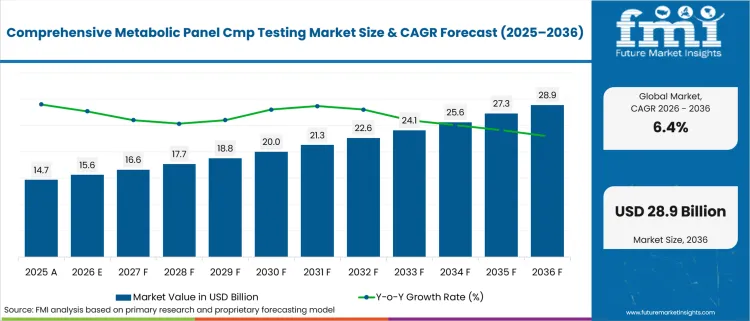
USD 15.6 billion in 2026 and USD 28.9 billion by 2036 at a 6.4% CAGR.
Demand for comprehensive metabolic panel cmp testing is projected to expand at 6.4% CAGR between 2026 and 203. The forecast reflects recurring test volumes rather than a single equipment replacement cycle. CMP orders are generated by routine assessment, preoperative workups, inpatient care and serial monitoring. Each order also pulls through collection supplies, analyzer time, reagents and quality control and reporting workflow. Commercial growth therefore depends on both clinical demand and the laboratory system that converts orders into validated results.
The platform decision depends on random-access capacity, ion-selective electrode capacity, maintenance burden and reagent inventory because these factors determine usable output. Country growth diverges when reimbursement, accreditation and network consolidation change the economics of placing analyzers close to patients versus sending specimens to a central laboratory.
Key Takeaways of Comprehensive Metabolic Panel Cmp Testing Market
- Routine Comprehensive Metabolic Panel leads Test Type with a 42.0% share because standardized ordering supports repeat volume across primary care and hospitals.
- Routine Health Assessment leads Application at 34.0% as one order gives clinicians an initial view of metabolic balance and organ-related chemistry.
- Hospitals account for 38.0% of End User demand due to emergency testing, inpatient monitoring and preoperative workflows.
- Automated Clinical Chemistry Analyzers lead Technology at 44.0% by combining random-access processing with quality control and electrolyte testing.
- Whole-panel release remains vulnerable to specimen quality, calibration events, reagent waste and cross-site method differences.
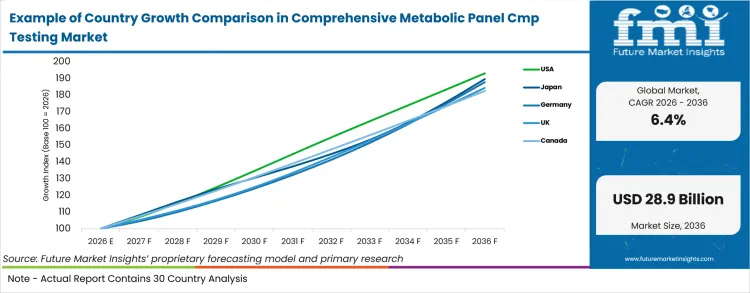
- The USA leads the profiled country CAGRs at 6.8%, followed by Japan at 6.6% and Germany at 6.5%.
Analyst Perspective
“CMP testing earns recurring volume because it compresses multiple chemistry decisions into one order, but the commercial value is created only when the laboratory can release the full panel without repeats. Buyers will favor suppliers that lower calibration work, protect reagent yield, keep electrolyte and photometric channels aligned and preserve result comparability across sites. The decisive metric is cost per reportable panel, not instrument throughput on paper.”
- Anurag Sharma, Principal Consultant, Future Market Insights
How is the Comprehensive Metabolic Panel Cmp Testing Market segmented?
The comprehensive metabolic panel Cmp Testing market is segmented by Test Type, Application, End User, Distribution Channel, Technology and Region.
Why does routine comprehensive metabolic panel lead the test type category?
Routine Comprehensive Metabolic Panel holds a 42.0% share in 2026.
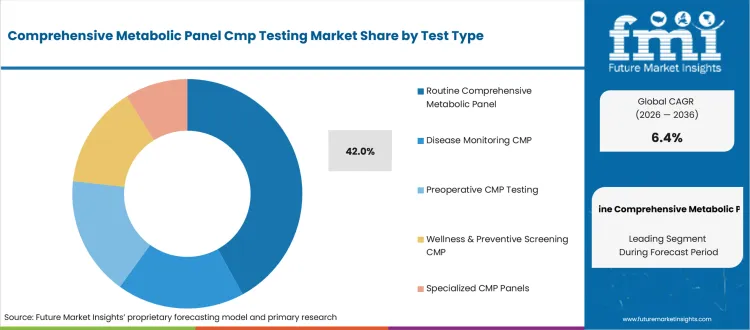
Routine Comprehensive Metabolic Panel is the leading Test Type because it fits established order sets and gives a broad chemistry baseline without forcing the clinician to build a custom combination for every encounter. It supports primary care assessment, hospital admission and follow-up when symptoms are non-specific. Routine Comprehensive Metabolic Panel holds a 42.0% share in 2026.
Why does routine health assessment lead the application category?
Routine Health Assessment holds a 34.0% share in 2026.
Routine Health Assessment leads Application because a single panel provides an initial view of glucose, electrolytes, proteins and markers associated with kidney or liver function. It is efficient for encounters where the clinician needs a broad baseline before selecting a narrower test. Annual Physical Examination and Preventive Health Checkups create scheduled demand, but local reimbursement rules determine whether the full panel or separate profiles are ordered. Kidney Function Assessment, Renal Disease Screening and Chronic Kidney Disease Monitoring require consistent creatinine and related chemistry results over time. Serial comparability and trend interpretation have more value than a single isolated result.
Why do hospitals lead the end user category?
Hospitals hold a 38.0% share in 2026.
Hospitals lead the End User category because they combine emergency volume, inpatient monitoring, surgery and specialist care within one testing environment. Their laboratories can support continuous operation, instrument redundancy and immediate clinical escalation. Public Hospitals usually purchase through formal budgets or tenders, making service coverage and reagent continuity central to the award. Private Hospitals place more weight on turnaround, physician experience and differentiated patient service. Hospital-Based Laboratories benefit from direct access to the electronic medical record, while Independent Diagnostic Laboratories depend on collection networks, courier timing and route density.
Why does direct sales lead the distribution channel category?
Direct Sales holds a 39.0% share in 2026.
Direct Sales leads Distribution Channel because CMP capacity is usually embedded in an analyzer-reagent-service relationship rather than purchased as an isolated consumable. Direct engagement supports installation, method verification, staff training and integration with laboratory software. Hospital Procurement and Laboratory Contracts convert the direct relationship into multi-year supply terms, service levels and price-per-test economics. Medical Device Distributors extend coverage where suppliers cannot support every account directly. Authorized Distributors protect product traceability and training, while Regional Distributors compete through local stock, credit terms and field support.
Why do automated clinical chemistry snalyzers lead the technology category?
Automated Clinical Chemistry Analyzers hold a 44.0% share in 2026.
Automated Clinical Chemistry Analyzers lead Technology because they combine random-access processing, photometric assays and electrolyte measurement in a controlled workflow. They also automate calibration and quality checks that would otherwise add manual work. High-Throughput Analyzers fit central laboratories and hospital hubs where sample arrival is continuous. Bench-Top Analyzers fit lower-volume sites that still need broad chemistry coverage. Integrated Chemistry-Immunoassay Systems reduce sample transfers between platforms. Multi-Parameter Systems broaden the menu, while Fully Automated Systems connect pre-analytics, analysis and sample handling to limit manual steps.
What are the drivers, restraints and opportunities in the Comprehensive Metabolic Panel Cmp Testing Market?
- Driver: Recurring multi-analyte demand from routine care and chronic disease monitoring.
- Restraint: Whole-panel release is exposed to pre-analytical errors, quality-control failures and method-comparison work.
- Opportunity: Connected platform tiers and validated low-volume sampling can improve access without fragmenting quality control.
The driver begins with clinical workflow. A single order can provide a broad metabolic baseline, which makes CMP testing useful before diagnosis is narrowed and during follow-up. CMP demand is more dependent on daily chemistry operations than on episodic launches of a new biomarker.
The restraint appears when a panel is treated as fourteen independent outputs even though the clinician receives one report. Hemolysis, improper storage, insufficient sample volume or an analyzer flag can delay release. Calibration changes and reagent-lot transitions can also force comparison work. A laboratory may therefore reject a low-priced platform if it increases repeats, manual review or cross-site inconsistency.
The opportunity is to standardize the workflow across volume tiers. A supplier can place high-throughput systems at the hub, compact analyzers at branch sites and connected software across both. Validated capillary claims can widen access for difficult venous draws in eligible markets. Service contracts that protect uptime and inventory programs that limit reagent expiry can convert technical capability into lower cost per reportable panel.
Which country CAGRs are profiled in the Comprehensive Metabolic Panel Cmp Testing Market?
| Country | CAGR |
|---|---|
| USA | 6.8% |
| Japan | 6.6% |
| Germany | 6.5% |
| UK | 6.3% |
| Canada | 6.2% |
| Australia | 6.0% |
| Brazil | 5.8% |
How do country-level CAGRs compare in the Comprehensive Metabolic Panel Cmp Testing Market?
The profiled country rates span 1.0 percentage point, from 5.8% in Brazil to 6.8% in the USA.
The USA leads at 6.8% because service-network scale and hospital outreach contracts support recurring volume. Japan and Germany follow through organized preventive care, established laboratory standards and platform replacement. The UK, Canada and Australia grow through network consolidation and access models. Brazil expands from a more price-sensitive base where public procurement and reagent continuity shape adoption.
How does the Comprehensive Metabolic Panel Cmp Testing Market vary by country?
- USA: CLIA makes accurate, reliable and timely results the operating baseline, with requirements tied to test complexity. Large laboratories and health systems buy through instrument placements, reagent agreements and service-network contracts. Growth is strongest where national testing networks add hospital outreach volume while maintaining comparable methods across sites.
- Japan: Specific health checkups include blood testing linked to glucose and liver assessment, with renal measures used when indicated. Buyers favor compact footprints, controlled change management and dependable service. Annual screening creates predictable volume, while chronic disease management increases the need for repeat chemistry monitoring.
- Germany: The G-BA health examination framework supports structured preventive assessment, while the EU in vitro diagnostic regulation raises evidence and quality obligations for suppliers. Laboratories balance standardized results with reimbursement discipline, which favors platforms that document traceability and control reagent waste.
- UK: NHS pathology networks use hub-and-spoke models to standardize testing and use equipment more efficiently. CMP-equivalent demand is often ordered as component profiles rather than a single US-style panel. Procurement therefore centers on network-wide menus, workforce capacity and common reporting rules.
- Canada: Provincial systems combine centralized laboratory capacity with community collection access. Health Canada device authorization and ISO 15189-oriented accreditation shape platform qualification. Provincial result repositories increase the value of consistent coding and comparable chemistry results across care settings.
- Australia: Medicare pathology funding and NPAAC accreditation requirements determine where testing is performed and how branch laboratories are supervised. Large private and public networks can centralize routine chemistry, while regional access supports compact systems when quality control and supervision can be maintained.
- Brazil: ANVISA Resolution RDC 978/2025 applies operating requirements to public and private services performing clinical analysis tests, including biochemical testing. Demand is supported by primary care and private laboratory networks, but tenders, import exposure and field-service coverage keep purchasing focused on affordability and reagent availability.
Who are the notable companies in the Comprehensive Metabolic Panel Cmp Testing Market?
Quest Diagnostics Incorporated, Labcorp Holdings Inc., F. Hoffmann-La Roche Ltd., Abbott Laboratories,.
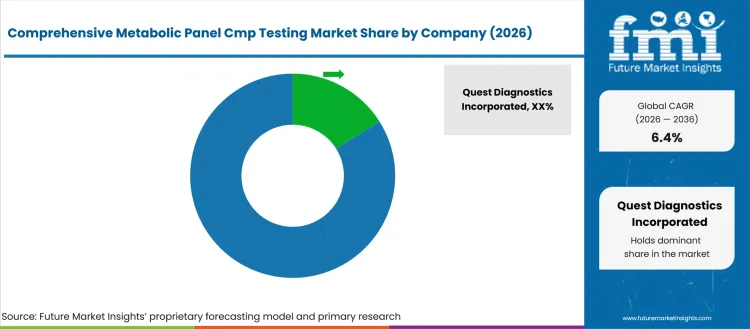
- Quest Diagnostics Incorporated and Labcorp Holdings Inc. compete through patient access, health-system relationships and laboratory logistics.
- F. Hoffmann-La Roche Ltd., Abbott Laboratories, Danaher Corporation and Siemens Healthineers AG are focusing on analyzer menus and automation and reagent supply and service coverage.
- Thermo Fisher Scientific Inc. and Randox Laboratories Ltd. support chemistry workflows with instruments, reagents and controls. bioMérieux SA and Sysmex Corporation are broader IVD suppliers whose laboratory relationships may influence adjacent workflow decisions.
How do companies compare in the Comprehensive Metabolic Panel Cmp Testing Market?
| Company | Documented capability | Commercial fit |
|---|---|---|
| Quest Diagnostics Incorporated | Large diagnostic testing network with hospital outreach and community access. | Service-scale contracts and referral logistics. |
| Labcorp Holdings Inc. | National clinical diagnostics network with health-system and specialty testing relationships. | Patient access, route density and integrated service delivery. |
| F. Hoffmann-La Roche Ltd. | cobas clinical chemistry and ISE units within scalable integrated core-lab systems. | High-volume laboratories seeking automation and menu consolidation. |
| Abbott Laboratories | Alinity c and Alinity ci chemistry and integrated chemistry-immunoassay platforms. | Standardized platform families across different laboratory volumes. |
| Danaher Corporation | Beckman Coulter DxC chemistry analyzers and integrated chemistry-immunoassay systems. | Core laboratories and lower-volume sites requiring common workflow logic. |
| Siemens Healthineers AG | Atellica chemistry platforms, automation and validated capillary claims in applicable markets. | Network standardization and access-oriented sample options. |
| Thermo Fisher Scientific Inc. | Indiko clinical chemistry systems with reagents and quality-control materials. | Compact laboratory workflows and assay support. |
| Randox Laboratories Ltd. | RX series automated and semi-automated chemistry analyzers with a broad reagent menu. | Independent laboratories and distributed testing environments. |
What are the key developments in the Comprehensive Metabolic Panel Cmp Testing Market?
- In May 2021, Beckman Coulter, a Danaher operating company, launched the DxA 5000 Fit workflow-automation solution designed for mid-volume laboratories running fewer than 5,000 tests a day, reducing manual processing steps by up to 80%.
- In March 2024, Labcorp announced an agreement to acquire select BioReference Health laboratory testing assets focused on clinical diagnostics and reproductive and women’s health.
- In June 2024, Roche launched the cobas c 703 and cobas ISE neo analytical units for cobas pro integrated solutions in countries accepting the CE mark, adding chemistry capacity and automated electrolyte maintenance.
- In August 2024, Quest Diagnostics completed its acquisition of LifeLabs, extending its diagnostic information services footprint in Canada.
- In October 2024, Siemens Healthineers launched Atellica Integrated Automation on the Atellica CI Analyzer, consolidating 25 manually performed laboratory tasks and reducing manual workflow steps by 75%.
What is included in the Comprehensive Metabolic Panel Cmp Testing Market report scope?
| Coverage field | Report scope |
|---|---|
| Market breakdown | Test Type, Application, End User and Distribution Channel and Technology and Region |
| Quantitative Units | Revenue in USD Billion and CAGR in %. |
| Market Definition | Revenue includes payments for CMP or equivalent comprehensive chemistry testing performed by clinical laboratories, plus directly attributable analyzer, reagent and service revenue for in-house CMP workflows where the testing service is not separately counted. Intercompany transfers, unrelated chemistry assays and downstream treatment revenue are excluded to limit double counting. |
| Regions Covered | North America; Latin America; Western Europe; Eastern Europe; East Asia; South Asia and Pacific; Middle East and Africa |
| Countries Covered | USA, Japan, Germany and UK and Canada and Australia and Brazil and more than thirty additional countries in the full report |
| Key Companies Profiled | Quest Diagnostics Incorporated; Labcorp Holdings Inc.; F. Hoffmann-La Roche Ltd.; Abbott Laboratories; Danaher Corporation; Siemens Healthineers AG; Thermo Fisher Scientific Inc.; bioMérieux SA; Sysmex Corporation; Randox Laboratories Ltd. |
| Forecast Period | 2026 to 2036 |
| Approach | Hybrid bottom-up and top-down sizing using test volumes, reimbursement and private-pay rates, analyzer placements and reagent consumption and service mix and country indicators and buyer-side validation. |
How was the Comprehensive Metabolic Panel Cmp Testing Market research conducted?
| Method | Approach |
|---|---|
| Primary Research | FMI engages clinical laboratories, hospitals, diagnostic service networks and clinical chemistry platform suppliers and distributors and procurement teams and laboratory managers and subject-matter experts. |
| Desk Research | The review covers official laboratory regulation, accreditation requirements, government health programs and reimbursement schedules and company filings and first-party product documentation and investor releases and official company announcements. |
| Market Sizing and Forecasting | The model reconciles test volumes, service prices, analyzer placements and reagent pull-through and end-user mix and channel structure and country indicators and replacement or expansion cycles. |
| Data Validation | Supplier-side findings are cross-checked with laboratory buyers, service providers, channel evidence and regulatory constraints and country-level operating models. |
How is the Comprehensive Metabolic Panel Cmp Testing Market segmented by category?
Comprehensive Metabolic Panel Cmp Testing Market segmented by Test Type:
- Routine Comprehensive Metabolic Panel
- Standard CMP Test
- Preventive Health CMP
- Disease Monitoring CMP
- Chronic Kidney Disease Monitoring
- Liver Disease Monitoring
- Preoperative CMP Testing
- Elective Surgery Testing
- Emergency Surgery Testing
- Wellness & Preventive Screening CMP
- Annual Health Screening
- Occupational Health Screening
- Specialized CMP Panels
- Geriatric CMP
- Pediatric CMP
Comprehensive Metabolic Panel Cmp Testing Market segmented by Application:
- Routine Health Assessment
- Annual Physical Examination
- Preventive Health Checkups
- Kidney Function Assessment
- Renal Disease Screening
- Chronic Kidney Disease Monitoring
- Liver Function Assessment
- Hepatic Disease Diagnosis
- Liver Therapy Monitoring
- Diabetes & Metabolic Disorder Management
- Glucose Monitoring
- Electrolyte Imbalance Assessment
- Hospital & Emergency Care
- Emergency Department Testing
- Inpatient Clinical Evaluation
Comprehensive Metabolic Panel Cmp Testing Market segmented by End User:
- Hospitals
- Public Hospitals
- Private Hospitals
- Diagnostic Laboratories
- Independent Diagnostic Laboratories
- Hospital-Based Laboratories
- Physician Offices & Clinics
- Primary Care Clinics
- Specialty Clinics
- Ambulatory Surgical Centers
- Outpatient Surgical Centers
- Day Care Centers
- Research & Academic Institutes
- Clinical Research Centers
- University Laboratories
Comprehensive Metabolic Panel Cmp Testing Market segmented by Distribution Channel:
- Direct Sales
- Hospital Procurement
- Laboratory Contracts
- Medical Device Distributors
- Authorized Distributors
- Regional Distributors
- Diagnostic Service Providers
- Central Laboratory Networks
- Reference Laboratories
- Online Procurement
- E-Procurement Platforms
- Manufacturer Portals
- Government & Institutional Procurement
- Public Health Programs
- Tender-Based Procurement
Comprehensive Metabolic Panel Cmp Testing Market segmented by Technology:
- Automated Clinical Chemistry Analyzers
- High-Throughput Analyzers
- Bench-Top Analyzers
- Integrated Chemistry-Immunoassay Systems
- Multi-Parameter Systems
- Fully Automated Systems
- Point-of-Care Chemistry Systems
- Portable CMP Analyzers
- Handheld Chemistry Devices
- Semi-Automated Chemistry Systems
- Tabletop Analyzers
- Compact Chemistry Systems
- Laboratory Information Integration Systems
- LIS-Integrated Platforms
- Cloud-Based Data Management
Comprehensive Metabolic Panel Cmp Testing Market segmented by Region:
- North America
- Latin America
- Western Europe
- Eastern Europe
- East Asia
- South Asia and Pacific
- Middle East and Africa
Which sources support the Comprehensive Metabolic Panel Cmp Testing Market analysis?
- MedlinePlus, USA National Library of Medicine (2023, December 4). Comprehensive Metabolic Panel (CMP).
- Centers for Medicare & Medicaid Services (updated 2026, May 14). Clinical Laboratory Improvement Amendments.
- Centers for Disease Control and Prevention (2024, September 11). About CLIA.
- USA Food and Drug Administration. Clinical Laboratory Improvement Amendments regulatory assistance.
- Gemeinsamer Bundesausschuss. Health Examination Guideline.
- German Federal Ministry of Health. Implementation of the EU in vitro diagnostic regulation.
- NHS England (2019). Pathology networking: State of the nation.
- Ministry of Health, Labour and Welfare, Japan (updated 2024 and December 3). Specific health checkup test items.
- Australian Department of Health. Requirements for the supervision of pathology laboratories.
- Australian Commission on Safety and Quality in Health Care. Requirements for quality control, external quality assurance and method evaluation.
- Australian Government Department of Health and Aged Care. Medicare Benefits Schedule pathology services.
- Health Canada (effective 2025, January 27). List of recognized standards for medical devices.
- Accreditation Canada Diagnostics. Medical laboratory and diagnostic imaging accreditation programs.
- Ontario Health. Ontario Laboratories Information System privacy and system description.
- Alberta Health Services. Provincial laboratory services.
- Agência Nacional de Vigilância Sanitária (2025, June 6). Collegiate Board Resolution No. 978.
- Brazil Ministry of Health. Primary health care services and policy structure.
- Roche (2024, June 24). Launch of cobas c 703 and cobas ISE neo analytical units.
- Abbott. Alinity ci-series clinical chemistry and immunoassay systems.
- Beckman Coulter (2024, January 30). Introduction of the DxC 500 AU Chemistry Analyzer.
- Siemens Healthineers (2026, July 23). Capillary testing claims for 24 assays on Atellica analyzers.
- Thermo Fisher Scientific. Indiko clinical chemistry systems.
- Randox Laboratories. RX series clinical chemistry analyzer overview.
- Quest Diagnostics (2024, August 26). Completion of the LifeLabs acquisition.
- Labcorp (2024, March 28). Agreement to acquire select BioReference Health assets.
- bioMérieux. Official corporate and diagnostics portfolio information.
- Sysmex Corporation. Official diagnostics portfolio information.
This bibliography is provided for reader reference and is not exhaustive. The full report contains the complete reference list and detailed citations.
What questions does this report answer?
- What is the Comprehensive Metabolic Panel Cmp Testing Market size in 2026 and what value is forecast for 2036?
- Why does Routine Comprehensive Metabolic Panel lead the Test Type category?
- How do routine health assessment and chronic disease monitoring generate repeat demand?
- Why do hospitals account for the largest End User share?
- How do direct sales and laboratory contracts shape analyzer-reagent economics?
- Why do automated clinical chemistry analyzers lead the Technology category?
- How do specimen quality and calibration events affect cost per reportable panel?
- How do country growth rates compare across the USA, Japan, Germany and UK and Canada and Australia and Brazil?
- Which companies compete through testing networks, core-lab systems, compact analyzers or chemistry controls?
- What should laboratory managers evaluate before changing a CMP testing platform?
Frequently Asked Questions
How big is the Comprehensive Metabolic Panel Cmp Testing Market in 2026?
The comprehensive metabolic panel cmp testing market is valued at USD 15.6 billion in 2026 and is forecast to reach USD 28.9 billion by 2036. Growth reflects recurring test volumes generated by routine assessment, preoperative workups, inpatient care and serial monitoring across primary care and hospital settings.
What is the CAGR of the Comprehensive Metabolic Panel Cmp Testing Market from 2026 to 2036?
The comprehensive metabolic panel cmp testing market grows at a CAGR of 6.4% between 2026 and 2036, supported by recurring multi-analyte demand from routine care, preoperative workups and chronic disease monitoring across hospitals, laboratories and diagnostic networks that convert orders into validated results.
Which test type leads the Comprehensive Metabolic Panel Cmp Testing Market?
Routine Comprehensive Metabolic Panel leads the comprehensive metabolic panel cmp testing market with a 42.0% share in 2026, because standardized ordering supports repeat volume across primary care and hospital admission workflows without requiring clinicians to build a custom test combination for each encounter.
How much will the Comprehensive Metabolic Panel Cmp Testing Market add between 2026 and 2036?
The comprehensive metabolic panel cmp testing market is set to add USD 13.3 billion between 2026 and 2036, growing from USD 15.6 billion to USD 28.9 billion as recurring test volumes, hospital procurement and analyzer-reagent service contracts expand across primary care, hospitals and diagnostic laboratory networks.
Who are the leading companies in the Comprehensive Metabolic Panel Cmp Testing Market?
The comprehensive metabolic panel cmp testing market is led by 4 companies, including Quest Diagnostics Incorporated, Labcorp Holdings Inc., F. Hoffmann-La Roche Ltd. and Abbott Laboratories, competing through patient access, analyzer menus, automation, reagent supply and service coverage across hospital and diagnostic laboratory networks worldwide.
Preview the report firsthand - request a free sample
Get SampleGet the brochure for pricing and purchase details.
Get PDFTable of Content
- Key Takeaways
- Market Size and CAGR
- Top Growth Driver
- Fastest Growing Segment
- Leading Region
- Key Companies
- Emerging Opportunities
- Executive Summary
- Global Market Outlook
- Demand-side Trends
- Supply-side Trends
- Technology Roadmap Analysis
- Analysis and Recommendations
- Analyst Perspective (What is happening? Why now? What should investors know?)
- Key Questions Answered
- How large is the market?
- What is the CAGR?
- What are key trends?
- Which region dominates?
- Who are the leaders?
- Market Overview
- Market Coverage / Taxonomy
- Market Definition / Scope / Limitations
- Research Methodology
- Chapter Orientation
- Analytical Lens and Working Hypotheses
- Market Structure, Signals, and Trend Drivers
- Benchmarking and Cross-market Comparability
- Market Sizing, Forecasting, and Opportunity Mapping
- Research Design and Evidence Framework
- Desk Research Programme (Secondary Evidence)
- Expert Input and Fieldwork (Primary Evidence)
- Tooling, Models, and Reference Databases
- Data Engineering and Model Build
- Quality Assurance and Audit Trail
- Market Background
- Market Dynamics (Drivers, Restraints, Opportunity, Trends)
- Scenario Forecast (Optimistic, Likely, Conservative)
- Impact Analysis
- AI Impact
- Sustainability Impact
- Regulatory Impact
- Technology Impact
- Consumer / Buyer Analysis
- Purchase Drivers
- Adoption Barriers
- Buyer Journey
- Opportunity Map Analysis
- Product Life Cycle Analysis
- Supply Chain Analysis
- Investment Feasibility Matrix
- Value Chain Analysis
- PESTLE and Porter's Analysis
- Regulatory Landscape
- Regional Parent Market Outlook
- Production and Consumption Statistics
- Import and Export Statistics
- Global Market Analysis and Forecast, 2021 to 2036
- Historical Market Size Value (USD Billion) Analysis, 2021 to 2025
- Current and Future Market Size Value (USD Billion) Projections, 2026 to 2036
- Y-o-Y Growth Trend Analysis
- Absolute $ Opportunity Analysis
- Global Market Pricing Analysis, 2021 to 2036
- Global Market Analysis and Forecast, By Test Type, 2021 to 2036
- Introduction / Key Findings
- Historical Market Size Value (USD Billion) Analysis By Test Type, 2021 to 2025
- Current and Future Market Size Value (USD Billion) Analysis and Forecast By Test Type, 2026 to 2036
- Routine Comprehensive Metabolic Panel
- Standard CMP Test
- Preventive Health CMP
- Disease Monitoring CMP
- Chronic Kidney Disease Monitoring
- Liver Disease Monitoring
- Preoperative CMP Testing
- Elective Surgery Testing
- Emergency Surgery Testing
- Wellness & Preventive Screening CMP
- Annual Health Screening
- Occupational Health Screening
- Specialized CMP Panels
- Geriatric CMP
- Pediatric CMP
- Routine Comprehensive Metabolic Panel
- Y-o-Y Growth Trend Analysis By Test Type, 2021 to 2025
- Absolute $ Opportunity Analysis By Test Type, 2026 to 2036
- Global Market Analysis and Forecast, By Application, 2021 to 2036
- Introduction / Key Findings
- Historical Market Size Value (USD Billion) Analysis By Application, 2021 to 2025
- Current and Future Market Size Value (USD Billion) Analysis and Forecast By Application, 2026 to 2036
- Routine Health Assessment
- Annual Physical Examination
- Preventive Health Checkups
- Kidney Function Assessment
- Renal Disease Screening
- Chronic Kidney Disease Monitoring
- Liver Function Assessment
- Hepatic Disease Diagnosis
- Liver Therapy Monitoring
- Diabetes & Metabolic Disorder Management
- Glucose Monitoring
- Electrolyte Imbalance Assessment
- Hospital & Emergency Care
- Emergency Department Testing
- Inpatient Clinical Evaluation
- Routine Health Assessment
- Y-o-Y Growth Trend Analysis By Application, 2021 to 2025
- Absolute $ Opportunity Analysis By Application, 2026 to 2036
- Global Market Analysis and Forecast, By End User, 2021 to 2036
- Introduction / Key Findings
- Historical Market Size Value (USD Billion) Analysis By End User, 2021 to 2025
- Current and Future Market Size Value (USD Billion) Analysis and Forecast By End User, 2026 to 2036
- Hospitals
- Public Hospitals
- Private Hospitals
- Diagnostic Laboratories
- Independent Diagnostic Laboratories
- Hospital-Based Laboratories
- Physician Offices & Clinics
- Primary Care Clinics
- Specialty Clinics
- Ambulatory Surgical Centers
- Outpatient Surgical Centers
- Day Care Centers
- Research & Academic Institutes
- Clinical Research Centers
- University Laboratories
- Hospitals
- Y-o-Y Growth Trend Analysis By End User, 2021 to 2025
- Absolute $ Opportunity Analysis By End User, 2026 to 2036
- Global Market Analysis and Forecast, By Distribution Channel, 2021 to 2036
- Introduction / Key Findings
- Historical Market Size Value (USD Billion) Analysis By Distribution Channel, 2021 to 2025
- Current and Future Market Size Value (USD Billion) Analysis and Forecast By Distribution Channel, 2026 to 2036
- Direct Sales
- Hospital Procurement
- Laboratory Contracts
- Medical Device Distributors
- Authorized Distributors
- Regional Distributors
- Diagnostic Service Providers
- Central Laboratory Networks
- Reference Laboratories
- Online Procurement
- E-Procurement Platforms
- Manufacturer Portals
- Government & Institutional Procurement
- Public Health Programs
- Tender-Based Procurement
- Direct Sales
- Y-o-Y Growth Trend Analysis By Distribution Channel, 2021 to 2025
- Absolute $ Opportunity Analysis By Distribution Channel, 2026 to 2036
- Global Market Analysis and Forecast, By Technology, 2021 to 2036
- Introduction / Key Findings
- Historical Market Size Value (USD Billion) Analysis By Technology, 2021 to 2025
- Current and Future Market Size Value (USD Billion) Analysis and Forecast By Technology, 2026 to 2036
- Automated Clinical Chemistry Analyzers
- High-Throughput Analyzers
- Bench-Top Analyzers
- Integrated Chemistry-Immunoassay Systems
- Multi-Parameter Systems
- Fully Automated Systems
- Point-of-Care Chemistry Systems
- Portable CMP Analyzers
- Handheld Chemistry Devices
- Semi-Automated Chemistry Systems
- Tabletop Analyzers
- Compact Chemistry Systems
- Laboratory Information Integration Systems
- LIS-Integrated Platforms
- Cloud-Based Data Management
- Automated Clinical Chemistry Analyzers
- Y-o-Y Growth Trend Analysis By Technology, 2021 to 2025
- Absolute $ Opportunity Analysis By Technology, 2026 to 2036
- Global Market Analysis and Forecast, By Region, 2021 to 2036
- Introduction
- Historical Market Size Value (USD Billion) Analysis By Region, 2021 to 2025
- Current Market Size Value (USD Billion) Analysis and Forecast By Region, 2026 to 2036
- North America
- Latin America
- Western Europe
- Eastern Europe
- East Asia
- South Asia and Pacific
- Middle East & Africa
- Market Attractiveness Analysis By Region
- North America Market Analysis and Forecast, By Country, 2021 to 2036
- Historical Market Size Value (USD Billion) Trend Analysis By Market Taxonomy, 2021 to 2025
- Market Size Value (USD Billion) Forecast By Market Taxonomy, 2026 to 2036
- By Country
- USA
- Canada
- By Test Type
- By Application
- By End User
- By Distribution Channel
- By Technology
- By Country
- Market Attractiveness Analysis
- By Country
- By Test Type
- By Application
- By End User
- By Distribution Channel
- By Technology
- Key Takeaways
- Latin America Market Analysis and Forecast, By Country
- Historical Market Size Value (USD Billion) Trend Analysis By Market Taxonomy, 2021 to 2025
- Market Size Value (USD Billion) Forecast By Market Taxonomy, 2026 to 2036
- By Country
- Brazil
- Mexico
- Chile
- Rest of Latin America
- By Test Type
- By Application
- By End User
- By Distribution Channel
- By Technology
- By Country
- Market Attractiveness Analysis
- By Country
- By Test Type
- By Application
- By End User
- By Distribution Channel
- By Technology
- Key Takeaways
- Western Europe Market Analysis and Forecast, By Country
- Historical Market Size Value (USD Billion) Trend Analysis By Market Taxonomy, 2021 to 2025
- Market Size Value (USD Billion) Forecast By Market Taxonomy, 2026 to 2036
- By Country
- Germany
- UK
- Italy
- Spain
- France
- Nordic
- BENELUX
- Rest of Western Europe
- By Test Type
- By Application
- By End User
- By Distribution Channel
- By Technology
- By Country
- Market Attractiveness Analysis
- By Country
- By Test Type
- By Application
- By End User
- By Distribution Channel
- By Technology
- Key Takeaways
- Eastern Europe Market Analysis and Forecast, By Country
- Historical Market Size Value (USD Billion) Trend Analysis By Market Taxonomy, 2021 to 2025
- Market Size Value (USD Billion) Forecast By Market Taxonomy, 2026 to 2036
- By Country
- Russia
- Poland
- Hungary
- Balkan & Baltic
- Rest of Eastern Europe
- By Test Type
- By Application
- By End User
- By Distribution Channel
- By Technology
- By Country
- Market Attractiveness Analysis
- By Country
- By Test Type
- By Application
- By End User
- By Distribution Channel
- By Technology
- Key Takeaways
- East Asia Market Analysis and Forecast, By Country
- Historical Market Size Value (USD Billion) Trend Analysis By Market Taxonomy, 2021 to 2025
- Market Size Value (USD Billion) Forecast By Market Taxonomy, 2026 to 2036
- By Country
- China
- Japan
- South Korea
- By Test Type
- By Application
- By End User
- By Distribution Channel
- By Technology
- By Country
- Market Attractiveness Analysis
- By Country
- By Test Type
- By Application
- By End User
- By Distribution Channel
- By Technology
- Key Takeaways
- South Asia and Pacific Market Analysis and Forecast, By Country
- Historical Market Size Value (USD Billion) Trend Analysis By Market Taxonomy, 2021 to 2025
- Market Size Value (USD Billion) Forecast By Market Taxonomy, 2026 to 2036
- By Country
- India
- ASEAN
- Australia & New Zealand
- Rest of South Asia and Pacific
- By Test Type
- By Application
- By End User
- By Distribution Channel
- By Technology
- By Country
- Market Attractiveness Analysis
- By Country
- By Test Type
- By Application
- By End User
- By Distribution Channel
- By Technology
- Key Takeaways
- Middle East & Africa Market Analysis and Forecast, By Country
- Historical Market Size Value (USD Billion) Trend Analysis By Market Taxonomy, 2021 to 2025
- Market Size Value (USD Billion) Forecast By Market Taxonomy, 2026 to 2036
- By Country
- Kingdom of Saudi Arabia
- Other GCC Countries
- Türkiye
- South Africa
- Other African Union
- Rest of Middle East & Africa
- By Test Type
- By Application
- By End User
- By Distribution Channel
- By Technology
- By Country
- Market Attractiveness Analysis
- By Country
- By Test Type
- By Application
- By End User
- By Distribution Channel
- By Technology
- Key Takeaways
- Key Countries Market Analysis
- USA
- Pricing Analysis
- Market Share Analysis, 2025
- By Test Type
- By Application
- By End User
- By Distribution Channel
- By Technology
- Canada
- Pricing Analysis
- Market Share Analysis, 2025
- By Test Type
- By Application
- By End User
- By Distribution Channel
- By Technology
- Mexico
- Pricing Analysis
- Market Share Analysis, 2025
- By Test Type
- By Application
- By End User
- By Distribution Channel
- By Technology
- Brazil
- Pricing Analysis
- Market Share Analysis, 2025
- By Test Type
- By Application
- By End User
- By Distribution Channel
- By Technology
- Chile
- Pricing Analysis
- Market Share Analysis, 2025
- By Test Type
- By Application
- By End User
- By Distribution Channel
- By Technology
- Germany
- Pricing Analysis
- Market Share Analysis, 2025
- By Test Type
- By Application
- By End User
- By Distribution Channel
- By Technology
- UK
- Pricing Analysis
- Market Share Analysis, 2025
- By Test Type
- By Application
- By End User
- By Distribution Channel
- By Technology
- Italy
- Pricing Analysis
- Market Share Analysis, 2025
- By Test Type
- By Application
- By End User
- By Distribution Channel
- By Technology
- Spain
- Pricing Analysis
- Market Share Analysis, 2025
- By Test Type
- By Application
- By End User
- By Distribution Channel
- By Technology
- France
- Pricing Analysis
- Market Share Analysis, 2025
- By Test Type
- By Application
- By End User
- By Distribution Channel
- By Technology
- India
- Pricing Analysis
- Market Share Analysis, 2025
- By Test Type
- By Application
- By End User
- By Distribution Channel
- By Technology
- ASEAN
- Pricing Analysis
- Market Share Analysis, 2025
- By Test Type
- By Application
- By End User
- By Distribution Channel
- By Technology
- Australia & New Zealand
- Pricing Analysis
- Market Share Analysis, 2025
- By Test Type
- By Application
- By End User
- By Distribution Channel
- By Technology
- China
- Pricing Analysis
- Market Share Analysis, 2025
- By Test Type
- By Application
- By End User
- By Distribution Channel
- By Technology
- Japan
- Pricing Analysis
- Market Share Analysis, 2025
- By Test Type
- By Application
- By End User
- By Distribution Channel
- By Technology
- South Korea
- Pricing Analysis
- Market Share Analysis, 2025
- By Test Type
- By Application
- By End User
- By Distribution Channel
- By Technology
- Russia
- Pricing Analysis
- Market Share Analysis, 2025
- By Test Type
- By Application
- By End User
- By Distribution Channel
- By Technology
- Poland
- Pricing Analysis
- Market Share Analysis, 2025
- By Test Type
- By Application
- By End User
- By Distribution Channel
- By Technology
- Hungary
- Pricing Analysis
- Market Share Analysis, 2025
- By Test Type
- By Application
- By End User
- By Distribution Channel
- By Technology
- Kingdom of Saudi Arabia
- Pricing Analysis
- Market Share Analysis, 2025
- By Test Type
- By Application
- By End User
- By Distribution Channel
- By Technology
- Türkiye
- Pricing Analysis
- Market Share Analysis, 2025
- By Test Type
- By Application
- By End User
- By Distribution Channel
- By Technology
- South Africa
- Pricing Analysis
- Market Share Analysis, 2025
- By Test Type
- By Application
- By End User
- By Distribution Channel
- By Technology
- USA
- Market Structure Analysis
- Competition Dashboard
- Competition Benchmarking
- Market Share Analysis of Top Players
- By Regional
- By Test Type
- By Application
- By End User
- By Distribution Channel
- By Technology
- Emerging Startups
- Innovation Benchmarking
- Competition Analysis
- Competition Deep Dive
- Quest Diagnostics Incorporated
- Overview
- Product Portfolio
- Profitability by Market Segments
- Sales Footprint
- Strategy Overview
- Marketing Strategy
- Product Strategy
- Channel Strategy
- Labcorp Holdings Inc.
- F. Hoffmann-La Roche Ltd.
- Abbott Laboratories
- Danaher Corporation
- Siemens Healthineers AG
- Thermo Fisher Scientific Inc.
- bioMérieux SA
- Sysmex Corporation
- Randox Laboratories Ltd.
- Quest Diagnostics Incorporated
- Case Studies
- Success Stories
- Recent Developments
- Competition Deep Dive
- Assumptions & Acronyms Used


