

- Market Size (2026)
- USD 412.3 Mn
- Forecast (2036)
- USD 826.3 Mn
- CAGR (2026 to 2036)
- 7.2%
How big is Coaxial RF Probes Market in 2026?
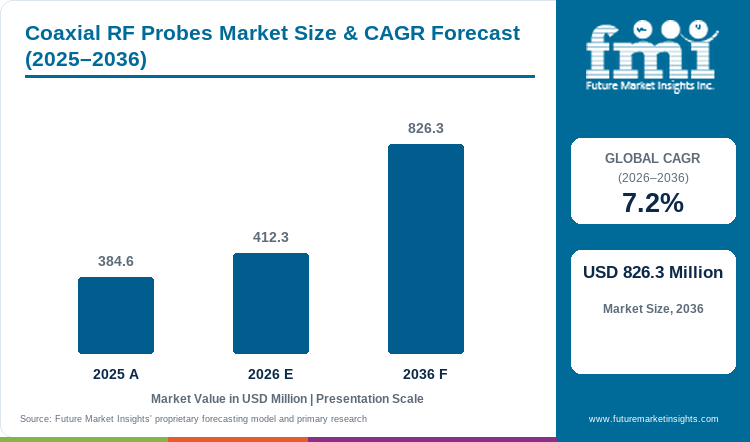
USD 412.3 Million in 2026 and USD 826.3 Million by 2036, expanding at 7.2% CAGR.
Sales of coaxial RF probes are estimated to rise at 7.2% CAGR through 2036. Valuation rises from USD 384.6 Million in 2025 to USD 412.3 Million in 2026 and reaches USD 826.3 Million by 2036. Chip laboratories are using radio frequency test equipment across wider bands to evaluate devices before packaging. Probe tips and calibration kits keep the measurement path stable across approved wafer-level test setups. Repeatable contact gives laboratories more confidence in results as tested frequency bands widen. In September 2025, Keysight launched 170 GHz and 250 GHz extenders with a 0.5 mm calibration kit. Keysight included on-wafer probes so laboratories could keep the probe path inside the expanded broadband setup.
Taiwan is projected to grow at 8.2% CAGR through 2036 as dense chip production and packaging activity increases local RF test work. In May 2026, the Ministry of Economic Affairs reported 28.97% annual growth in first-quarter integrated-circuit output. Higher chip output increases RF testing near fabrication and packaging sites, where probe replacement and calibration support remain important. Germany is projected to grow at 6.0% CAGR through 2036 amid a more gradual front-end capacity expansion schedule. Probe makers need spare parts and field support as semiconductor manufacturing equipment sites add new test hardware and qualification work.
Key Takeaways
- Wider RF wafer tests increase demand for probes that maintain stable contact throughout calibration and repeated device checks.
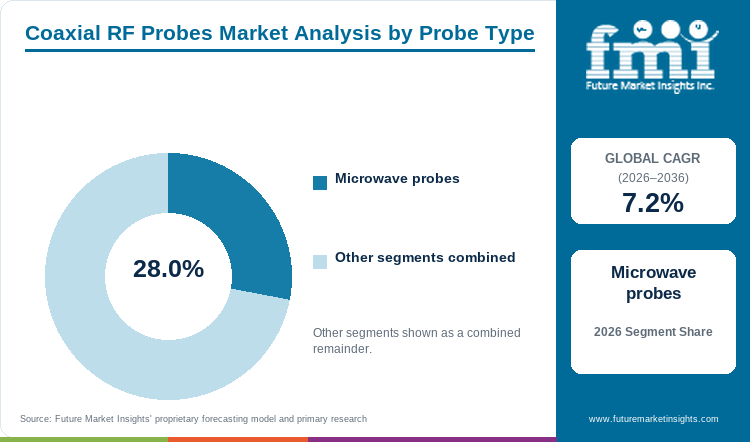
- Microwave probes are projected to hold 28.0% of probe type revenue in 2026 as routine coaxial wafer testing remains common across laboratories.
- The 26.5-67 GHz range is estimated to hold 34.0% of frequency-range revenue in 2026 because practical mmWave coverage remains available through coaxial ports.
- Standard pitch is forecast to represent 44.0% of pitch revenue in 2026, with common layouts simplifying alignment and probe replacement.
- Calibration uncertainty and unstable probe contact can delay qualification as laboratories extend testing across wider frequency bands.
- Key players include FormFactor, MPI Corporation, GGB Industries, Keysight Technologies, Technoprobe, Wentworth Laboratories, MicroXact, Lake Shore Cryotronics, Advantest, and Rohde & Schwarz.
Analyst Perspective
“The opportunity lies in broadband probes that extend RF testing without forcing laboratories to rebuild every approved wafer-test setup. Stable contact and repeatable calibration determine whether broader frequency coverage can pass qualification without disrupting established measurement workflows.”
- Nikhil Kaitwade, Principal Consultant, Future Market Insights
How is the coaxial RF probes market segmented?
The market is segmented by Probe Type, Frequency Range, Pitch, Application, and Sales Channel.
The coaxial RF probes market uses five primary segmentation axes for analysis. Probe type includes microwave probes, DC to RF probes, mmWave probes, ground-signal-ground probes, and multi-contact coaxial probes. Frequency range includes below 6 GHz, 6-26.5 GHz, 26.5-67 GHz, and above 67 GHz. Pitch categories include standard pitch, fine pitch, and custom pitch options. Application covers wafer probing, RF device testing, 5G component testing, aerospace-defense RF, and research laboratories. Sales channel covers direct probe OEMs, test equipment distributors, semiconductor test integrators, and custom engineering providers.
How do microwave probes shape demand within the probe type category?
Microwave probes support wafer RF tests that depend on coaxial lines and ground-signal-ground contact. Before approval, laboratories check impedance and tip position across the intended wafer measurement setup. In March 2026, FormFactor and Rohde & Schwarz announced a joint on-wafer RF test program. Their program connects probe hardware with RF components test tools from early design work through production testing.
- Microwave probes are projected to account for 28.0% within probe type in 2026, supported by routine coaxial wafer testing.
- Laboratories can replace worn microwave probes without rebuilding an already approved test station.
Why does 26.5-67 GHz hold a major position within the frequency range category?
The 26.5-67 GHz band covers many mmWave tests while retaining familiar coaxial interfaces. Engineers can use 5G testing equipment without moving each setup to waveguide hardware. In June 2026, Lake Shore Cryotronics reported that selected probe stations support GSG probing up to 67 GHz. The supported range gives laboratories more flexibility when positioning probes across mmWave device tests.
- By frequency range, 26.5-67 GHz is estimated to hold 34.0% in 2026, linked to broad mmWave coverage through familiar coaxial interfaces.
- Laboratories can retain established test kits and connector types as operating frequency rises.
How does standard pitch influence selection within the pitch category?
Standard pitch reduces the number of probe shapes that laboratories must qualify and stock. Common pad spacing also makes alignment easier during repeated wafer measurements and probe changes. In August 2025, FormFactor launched InfinityXF with pitch support from 50 µm to 150 µm. The initial release included 50 µm, 75 µm, and 100 µm versions for common layouts. These options give wafer probing test systems a more consistent contact plan across routine qualification work.
- Standard pitch is expected to lead the pitch category with 44.0% share in 2026, reinforced by common layouts and simpler replacement.
- Custom pitch supports unusual layouts, although each new geometry requires additional qualification and replacement planning.
What supports wafer probing within the application category?
Wafer probing measures RF behavior before packaging changes the device signal path. Engineers use direct contact to build device models and verify early design performance. In March 2025, NIST updated CalNet for traceable on-wafer S-parameter calibration from 10 MHz to 110 GHz. The updated framework gives metrology and inspection teams a defined basis for direct wafer measurements.
- By application, wafer probing is forecast to represent 32.0% in 2026, attributable to early RF verification before packaging.
- Laboratories must check both the probe and reference standard because either component can change measured S-parameters.
Why does direct probe OEM remain important within the sales channel category?
Direct OEM sales remain important because probe geometry must match the station and measurement method. Laboratories review pitch, signal-ground layout, ports, and test temperature before approving a probe. In September 2025, MPI launched a 250 GHz system with TITAN probes and Keysight tools. The system links probe selection with automated test equipment and the approved station configuration. Integrated probe and instrument selection requires laboratories to evaluate the complete measurement path instead of treating the probe as an isolated contact.
- Direct probe OEM is set to lead the sales channel with 46.0% share in 2026, enabled by engineering support during setup and qualification.
- Direct engineering support can speed fault checks when probe contact changes measured test data.
What are the drivers, restraints and opportunities in the Coaxial RF Probes Market?
Wider RF bandwidth supports demand, calibration uncertainty slows qualification, and integrated broadband probe designs can reduce hardware changes.
- Driver: Wider RF and mmWave bands raise the need for wafer-level tests before packaging.
- Restraint: Calibration and stable probe contact are harder to control as frequency rises and pad geometry tightens.
- Opportunity: Broadband coaxial probes can cut setup changes by covering wider bands with stable positioning.
Wider device bandwidth raises the value of compatible probe interfaces
Chip test teams need probe interfaces that match wider RF instrument bands without adding setup work. In February 2025, Advantest showed its Wave Scale RF20ex RF IC test card for wider RF test work. As instrument coverage expands, probe tips must maintain clean contact with wafer pads across repeated measurements. Probe makers address this requirement with contacts designed for millimeter wave technology test chains. Procurement teams judge usable S-parameter data instead of relying only on the stated maximum frequency. The same review covers station fit, cable compatibility, and wafer pad layout. Stable contact helps laboratories trust measured results across the wider operating band. Poor interface matching wastes available bandwidth and creates additional setup work during device qualification.
Calibration uncertainty can extend qualification time
At higher frequencies, laboratories find it harder to separate setup error from real device behavior. In March 2025, NIST reported that commercial on-wafer calibration kits can produce different results. The same update found no commercial CalNet kit with validated performance beyond 100 GHz. Laboratories keep an approved probe until a replacement setup reproduces the expected result across repeated checks. Additional verification extends qualification time without removing the need for broader frequency coverage. Clear test procedures and repeatable contact help probe makers support routine laboratory qualification. Above 67 GHz, small contact errors can shift measured results enough to complicate device interpretation. Detailed records help staff trace those errors before they alter a device model or delay approval.
Integrated broadband probes can reduce hardware transitions
Laboratories often use different probes or test heads as frequency requirements extend beyond established microwave bands. In August 2025, FormFactor launched InfinityXF with DC to 250 GHz single-sweep coverage and compact 0.5 mm coaxial links. Broader single-sweep coverage can reduce hardware changes between microwave and sub-THz measurement work. Fewer transitions help laboratories manage approved setups without repeating every configuration and calibration step. Some laboratories accept a higher probe cost when one design reduces repeated setup changes. The probe must still protect test data and wafer pads during each hardware move. Reduced switching also saves time between frequency bands and limits opportunities for configuration error. Test teams compare tip life, pad damage, and service support before changing an established probe family.
Which country CAGRs are profiled in the Coaxial RF Probes Market?
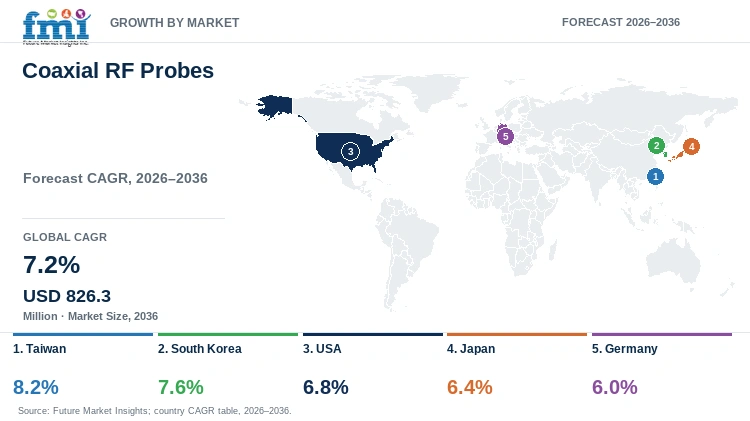
| Country | CAGR |
|---|---|
| Taiwan | 8.2% |
| South Korea | 7.6% |
| USA | 6.8% |
| Japan | 6.4% |
| Germany | 6.0% |
How do country-level CAGRs compare in the Coaxial RF Probes Market?
The five country CAGRs span 2.2 percentage points from Taiwan at 8.2% to Germany at 6.0%. Taiwan and South Korea form the higher-growth group within this five-country comparison. The USA and Japan form the middle group between the faster Asian rates and Germany’s lower forecast.
- Taiwan’s short device cycles create frequent pad-layout checks and favor probes that laboratories can requalify without rebuilding established test stations.
- Concentrated chip hubs in South Korea keep memory production close to device testing and sustain frequent high-frequency probe use across established test cells.
- Advanced packaging research in the USA requires flexible RF probing across prototype platforms and makes repeatable calibration important during equipment transfers.
- Long semiconductor qualification cycles in Japan favor probes that limit pad damage and preserve repeatable RF data across extended device trials.
- Germany’s automotive and industrial chip base prioritizes repeatable RF test records that fit strict plant-quality requirements during equipment changes.
Similar growth rates can produce different order patterns as local test infrastructure and service needs vary by country.
The full report provides country-level CAGR analysis across North America, Latin America, Western Europe, Eastern Europe, East Asia, South Asia and Pacific, and the Middle East and Africa.
Country-wise Analysis
- Taiwan is projected to grow at 8.2% CAGR through 2036, supported by its dense chip production and packaging base. In May 2026, the Ministry of Economic Affairs reported 28.97% annual growth in first-quarter integrated-circuit output. Higher chip output increases RF testing before packaging and expands the need for semiconductor assembly and testing support. Active test sites also need nearby field service when probe downtime threatens qualification and production transfers. Spare probe stock gives laboratories a faster replacement path when contact performance changes or components wear. Local service teams can restore approved measurement setups without repeating unnecessary configuration work. These operating conditions keep probe support closely connected with Taiwan’s concentrated semiconductor manufacturing network and recurring RF test activity.
- South Korea is forecast to expand at 7.6% CAGR through 2036, tied to concentrated memory production and frequent RF test work. In July 2025, MOTIE reported that first-half chip exports rose 11.4% from the previous year. High-value memory products sustained that increase and kept device testing active across large production programs. Inconsistent probe contact can interrupt scheduled production work, making stable contact essential across busy test cells. Local field service shortens probe-change downtime and helps technicians complete repeated data checks efficiently. Teams supporting wafer inspection systems and RF measurements can restore approved setups after contact problems. Reliable service also protects test continuity as large semiconductor sites maintain steady production and qualification activity.
- The USA is estimated to post 6.8% CAGR through 2036, shaped by expanding chip research and advanced packaging test work. In January 2025, NIST announced plans for a CHIPS research site with a 300 mm advanced-packaging prototype line. The planned facility is expected to support process development before high-volume manufacturing and create several test environments. Probe suppliers must support multiple platforms across research partners and production-oriented laboratories. Equipment transfers can extend data checks when calibration records are incomplete or inconsistent. Service teams help shorten probe changes and verification work across those partner environments. Clear calibration records also help laboratories transfer semiconductor test equipment between sites while preserving the approved measurement path.
- Japan’s coaxial RF probes outlook is anticipated to advance at 6.4% CAGR through 2036, influenced by chip capacity and long qualification cycles. In November 2025, METI selected Rapidus as a next-generation semiconductor manufacturer eligible for public support. The decision keeps advanced process development inside Japan’s national semiconductor investment program. RF laboratories require repeatable data across many device runs before changing approved probe hardware. Long review cycles increase the value of probes that limit pad damage and keep calibration records consistent. Probe suppliers need dependable spare stock and service coverage near advanced production sites. Local support can shorten replacement delays during process trials and qualification. Reliable service helps laboratories keep approved setups available as new capacity moves toward production.
- Germany’s coaxial RF probe demand is forecast to rise at 6.0% CAGR through 2036, linked to new front-end capacity and industrial chip testing. Germany combines automotive and industrial semiconductor demand with planned investment around Dresden. In February 2025, the federal economy ministry backed Infineon’s planned 300 mm front-end expansion in Dresden. The site plans to begin chip output during 2027 and will require new test hardware qualification. Plant teams need consistent data before accepting probe changes across newly installed equipment. Local service coverage can reduce disruption during qualification and later maintenance work. Longer product cycles also reward technical support that remains available across extended production programs. Stable support helps protect scheduled RF testing during equipment changes.
Who are the notable companies in the Coaxial RF Probes Market?
FormFactor, MPI Corporation, GGB Industries, Keysight Technologies, Technoprobe, Wentworth Laboratories, MicroXact, Lake Shore Cryotronics, Advantest, and Rohde & Schwarz are active within the defined market boundary.
Competition spans direct probe makers, probe-station providers, and RF test-system companies serving different stages of wafer-level measurement. FormFactor and MPI combine probe hardware with wafer-test systems for integrated laboratory workflows. Direct contact specialists GGB Industries and MicroXact focus on RF probing for device and laboratory tests. Keysight, Advantest, and Rohde & Schwarz provide instruments that connect probes with broader measurement chains. Wentworth Laboratories and Lake Shore Cryotronics supply stations for controlled motion and temperature conditions. Technoprobe contributes advanced probe-card interfaces for integrated semiconductor test systems. Laboratories compare these roles according to qualification effort, measurement compatibility, and service access across the complete test path.
- FormFactor, MPI Corporation, GGB Industries, and MicroXact compete in coaxial contact and wafer-level RF probing.
- Wentworth Laboratories and Lake Shore Cryotronics serve probe-station work that needs controlled motion or temperature.
- Keysight Technologies, Advantest, Rohde & Schwarz, and Technoprobe shape integrated RF and semiconductor test setups.
Competitive Benchmarking: Coaxial RF Probes Market
| Company | Coaxial RF Bandwidth | Probe Geometry & Pitch Flexibility | Wafer-Test Integration Depth | Geographic Reach |
|---|---|---|---|---|
| FormFactor | High | High | High | North America, Europe, and Asia |
| MPI Corporation | High | High | High | Taiwan, United States, Europe, and Asia |
| GGB Industries | High | High | Medium | United States with global customers |
| Keysight Technologies | Low | Low | High | Global |
| Technoprobe | Low | Medium | High | Europe, United States, and Asia |
| Wentworth Laboratories | Low | Medium | High | United Kingdom, United States, and representatives |
| MicroXact | High | Medium | Medium | United States |
| Lake Shore Cryotronics | Medium | Medium | High | United States with international research customers |
| Advantest | Low | Medium | High | Global |
| Rohde & Schwarz | Low | Low | High | Global |
Public evidence of direct coaxial probe operation across mmWave or sub-THz bands determines bandwidth scores. A Medium rating applies when direct probe use covers a narrower RF range. Low system-use ratings identify tool-level roles without broad direct probe coverage. Multiple documented contact or pitch formats support a High geometry-breadth rating. High system fit requires direct wafer-test integration, while partial integration receives Medium. Tool-level use without direct wafer-test integration receives Low system fit.
Key Developments in the Coaxial RF Probes Market
- In June 2026, Lake Shore Cryotronics showed probe stations with GSG RF and microwave probing up to 67 GHz at IMS.
- In September 2025, MPI Corporation launched a 250 GHz test system with TITAN probes and Keysight tools.
- In August 2025, FormFactor launched InfinityXF with DC to 250 GHz single-sweep coverage and compact coaxial links.
Key Players in the Coaxial RF Probes Market
Direct coaxial RF probe suppliers
- FormFactor
- MPI Corporation
- GGB Industries
- MicroXact
Probe station and controlled-environment providers
- Wentworth Laboratories
- Lake Shore Cryotronics
Integrated semiconductor and RF test systems
- Keysight Technologies
- Advantest
- Rohde & Schwarz
Advanced probe-card interfaces
- Technoprobe
Coaxial RF Probes Market - Report Scope
| Coverage field | Report scope |
|---|---|
| Market breakdown | By probe type, frequency range, pitch, application, sales channel, and region. |
| Quantitative Units | USD Million. |
| Market Definition | Commercial coaxial RF probes and coaxial probe contact assemblies used for microwave, RF, mmWave, and wafer-level measurements are included. Downstream device revenue and separate revenue from probe stations, VNAs, extenders, and non-coaxial probes are excluded. |
| Regions Covered | North America, Latin America, Western Europe, Eastern Europe, East Asia, South Asia and Pacific, and Middle East and Africa. |
| Countries Covered | Taiwan, South Korea, USA, Japan, Germany, and 20+ countries included in the full report. |
| Key Companies Profiled | FormFactor, MPI Corporation, GGB Industries, Keysight Technologies, Technoprobe, Wentworth Laboratories, MicroXact, Lake Shore Cryotronics, Advantest, Rohde & Schwarz. |
| Forecast Period | 2026 to 2036. |
| Approach | Primary and secondary research with market triangulation. |
Coaxial RF Probes Market - Research Methodology
| Method | Approach |
|---|---|
| Primary Research | FMI analysts gathered input from manufacturers, service providers, technology developers, distributors, end users, procurement teams, and subject-matter experts. Interviews examined purchasing decisions, product or service evaluation, adoption barriers, approval requirements, pricing considerations, and expectations for technical or commercial support. Respondents were also asked what evidence is required before a trial, pilot, or initial order develops into regular purchasing. |
| Desk Research | Desk research covered government statistics, regulatory publications, trade data, industry associations, technical literature, standards, company filings, product information, and official corporate announcements. Sources were reviewed for relevance, publication date, geographic coverage, and consistency with the defined market scope. Claims relating to performance, applications, approvals, capacity, investment, and commercial activity were retained only when supported by credible public evidence. |
| Market Sizing and Forecasting | The market model combined the baseline value with historical performance, segment structure, pricing and volume indicators, adoption levels, company participation, and country-level demand conditions. Forecast assumptions considered economic activity, investment trends, regulatory developments, technology adoption, purchasing cycles, supply availability, and barriers to wider market use. Segment and regional estimates were reconciled before the final market total was calculated. |
| Data Validation | Estimates were checked against multiple independent indicators, including public data, company activity, trade patterns, industry developments, and findings from primary interviews. Validation also tested whether products, services, applications, and company revenues fell within the defined market boundaries. Adjacent categories, unsupported claims, overlapping revenues, and activities without direct market relevance were excluded to reduce double counting and maintain consistency across segments and countries. |
Coaxial RF Probes Market by Segments
Coaxial RF Probes Market segmented by Probe Type:
- Microwave probes
- DC to RF probes
- mmWave probes
- Ground-signal-ground probes
- Multi-contact coaxial probes
Coaxial RF Probes Market segmented by Frequency Range:
- 26.5-67 GHz
- 6-26.5 GHz
- Below 6 GHz
- Above 67 GHz
Coaxial RF Probes Market segmented by Pitch:
- Standard pitch
- Fine pitch
- Custom pitch
Coaxial RF Probes Market segmented by Application:
- Wafer probing
- RF device testing
- 5G component testing
- Aerospace - defense RF
- Research labs
Coaxial RF Probes Market segmented by Sales Channel:
- Direct probe OEM
- Test equipment distributors
- Semiconductor test integrators
- Custom engineering
Coaxial RF Probes Market by Region:
- North America
- United States
- Canada
- Latin America
- Brazil
- Mexico
- Argentina
- Chile
- Western Europe
- Germany
- France
- United Kingdom
- Italy
- Spain
- Benelux
- Nordics
- Eastern Europe
- Poland
- Czech Republic
- Romania
- Hungary
- East Asia
- China
- Japan
- South Korea
- South Asia and Pacific
- India
- ASEAN
- Australia and New Zealand
- Middle East and Africa
- GCC Countries
- South Africa
- Türkiye
- Israel
Research Sources and Bibliography
- Keysight Technologies. (2025, September 9). Keysight introduces two frequency extenders and calibration kit to extend broadband vector network analyzer up to 250 GHz.
- Ministry of Economic Affairs, Taiwan. (2026, May 19). Q1 2026 manufacturing output statistics.
- FormFactor, Inc. (2026, March 25). Rohde & Schwarz joins FormFactor’s MeasureOne partner program, advancing their partnership in on-wafer RF component characterization.
- Lake Shore Cryotronics. (2026, June 4). Visit Lake Shore at IMS to learn about probe stations and cryostats for RF/microwave R&D.
- FormFactor, Inc. (2025, August 27). Introducing the InfinityXF Probe - Redefining wafer-level broadband testing.
- National Institute of Standards and Technology. (2025, March 26). CalNet.
- MPI Corporation. (2025, September 9). MPI Corporation expands high-frequency test leadership with new 250 GHz broadband probe solution.
- Advantest Corporation. (2025, February 13). Advantest to showcase latest test solutions at SEMICON Korea 2025.
- Ministry of Trade, Industry and Energy, Republic of Korea. (2025, July 1). Korea’s exports grow 4.3% in June.
- National Institute of Standards and Technology. (2025, January 6). CHIPS for America announces planned semiconductor research and advanced packaging facility.
- Ministry of Economy, Trade and Industry, Japan. (2025, November 21). Next-generation semiconductor manufacturer eligible for financial support selected.
- Federal Ministry for Economic Affairs and Climate Action, Germany. (2025, February 20). Support for Infineon’s planned semiconductor expansion in Dresden.
- FormFactor, Inc. (2026, July 28). FormFactor and Keystone Microtech announce strategic partnership supporting next-generation semiconductor technologies.
- MPI Corporation. (2025, November 17). MPI Corporation acquires Focus Microwaves, strengthening RF and millimeter-wave test capabilities.
- Advantest Corporation. (2025, January 9). Advantest forms strategic partnerships with FormFactor and Technoprobe.
- Advantest Corporation. (2025, December 16). Advantest and Tokyo Seimitsu announce joint development of die-level prober.
- Lake Shore Cryotronics. (2026, June 10). Arcline-backed DwyerOmega acquires Lake Shore Cryotronics.
- Wentworth Laboratories. (2026, February 9). Website update.
- GGB Industries. (n.d.). Company overview. Retrieved September 22, 2026.
- MicroXact. (n.d.). Company overview. Retrieved September 22, 2026.
The bibliography provides reader references without listing every source used for the analysis. The full report contains the complete reference list and detailed citations.
This Report Answers
- How large is the coaxial RF probes market in 2026 and 2036?
- What factors support coaxial RF probe demand throughout the forecast period to 2036?
- Which probe type is projected to hold 28.0% share during 2026?
- Which frequency range is estimated to hold 34.0% share during 2026?
- Which pitch category is forecast to hold 44.0% share during 2026?
- How do projected CAGRs differ across the five countries profiled in this report?
- What technical factors can delay approval of a wider-band coaxial RF probe?
- Which companies supply direct probes, probe stations, or wafer-test systems?
- What should RF laboratories check before approving a new coaxial probe?
Frequently Asked Questions
How big is the coaxial RF probes market in 2026?
The coaxial RF probes market is valued at USD 412.3 Million in 2026. The value is projected to reach USD 826.3 Million by 2036. Wider RF wafer tests require stable contact and checked calibration across the complete measurement setup. Stable contact and calibration help laboratories trust measured results across wider frequency bands.
What is the coaxial RF probes market CAGR through 2036?
The coaxial RF probes market is projected to grow at 7.2% CAGR from 2026 to 2036. Chip laboratories test wider bands and check each probe against its test kit before routine use. Consistent probe and test-kit results support approval for repeated wafer-level measurements.
Which probe type leads the coaxial RF probes market in 2026?
Based on probe type, microwave probes are projected to account for 28.0% in 2026. Routine coaxial wafer tests support that share across repeated RF device measurements. Laboratories use coaxial contact to return to the wafer during regular device testing.
Which frequency range holds a 34.0% share in the market during 2026?
By frequency range, 26.5–67 GHz is estimated to hold 34.0% in 2026. Practical mmWave coverage strengthens the segment while laboratories retain familiar coaxial interfaces. Laboratories can keep established test methods across much of that frequency range.
Which pitch category holds a 44.0% share in the market during 2026?
By pitch, standard pitch is forecast to represent 44.0% in 2026. Common pad spacing strengthens that position by making probe alignment easier during repeated tests. The layout also gives laboratories a simpler replacement path during routine device work.
What factors can delay coaxial RF probe approval during laboratory qualification?
Test error becomes harder to control as frequency rises and contact size falls. A laboratory delays approval until probe and test-kit results match across several repeated checks. Consistent results help engineers separate setup error from actual device behavior.
What should chip test teams check before buying coaxial RF probes?
Test teams compare usable frequency range and contact stability before reviewing pitch and test-kit compatibility. The same review covers temperature range, station fit, and service access. Every requirement must match the laboratory setup before the team approves a probe.
Which companies are active in the coaxial RF probes market?
Active companies include FormFactor, MPI Corporation, GGB Industries, Keysight Technologies, and Technoprobe. Wentworth Laboratories, MicroXact, Lake Shore Cryotronics, Advantest, and Rohde & Schwarz also operate within the defined scope. Their roles cover direct probes, probe stations, test interfaces, and RF instruments used in wafer testing. Together these companies support contact hardware and the wider measurement path around each probe.
Preview the report firsthand - request a free sample
Get SampleGet the brochure for pricing and purchase details.
Get PDFTable of Content
- Key Takeaways
- Market Size and CAGR
- Top Growth Driver
- Fastest Growing Segment
- Leading Region
- Key Companies
- Emerging Opportunities
- Executive Summary
- Global Market Outlook
- Demand-side Trends
- Supply-side Trends
- Technology Roadmap Analysis
- Analysis and Recommendations
- Analyst Perspective (What is happening? Why now? What should investors know?)
- Key Questions Answered
- How large is the market?
- What is the CAGR?
- What are key trends?
- Which region dominates?
- Who are the leaders?
- Market Overview
- Market Coverage / Taxonomy
- Market Definition / Scope / Limitations
- Research Methodology
- Chapter Orientation
- Analytical Lens and Working Hypotheses
- Market Structure, Signals, and Trend Drivers
- Benchmarking and Cross-market Comparability
- Market Sizing, Forecasting, and Opportunity Mapping
- Research Design and Evidence Framework
- Desk Research Programme (Secondary Evidence)
- Expert Input and Fieldwork (Primary Evidence)
- Tooling, Models, and Reference Databases
- Data Engineering and Model Build
- Quality Assurance and Audit Trail
- Market Background
- Market Dynamics (Drivers, Restraints, Opportunity, Trends)
- Scenario Forecast (Optimistic, Likely, Conservative)
- Impact Analysis
- AI Impact
- Sustainability Impact
- Regulatory Impact
- Technology Impact
- Consumer / Buyer Analysis
- Purchase Drivers
- Adoption Barriers
- Buyer Journey
- Opportunity Map Analysis
- Product Life Cycle Analysis
- Supply Chain Analysis
- Investment Feasibility Matrix
- Value Chain Analysis
- PESTLE and Porter's Analysis
- Regulatory Landscape
- Regional Parent Market Outlook
- Production and Consumption Statistics
- Import and Export Statistics
- Global Market Analysis and Forecast, 2021 to 2036
- Historical Market Size Value (USD Million) Analysis, 2021 to 2025
- Current and Future Market Size Value (USD Million) Projections, 2026 to 2036
- Y-o-Y Growth Trend Analysis
- Absolute $ Opportunity Analysis
- Global Market Pricing Analysis, 2021 to 2036
- Global Market Analysis and Forecast, By Probe Type, 2021 to 2036
- Introduction / Key Findings
- Historical Market Size Value (USD Million) Analysis By Probe Type, 2021 to 2025
- Current and Future Market Size Value (USD Million) Analysis and Forecast By Probe Type, 2026 to 2036
- Microwave probes
- DC to RF probes
- mmWave probes
- Ground-signal-ground probes
- Multi-contact coaxial probes
- Y-o-Y Growth Trend Analysis By Probe Type, 2021 to 2025
- Absolute $ Opportunity Analysis By Probe Type, 2026 to 2036
- Global Market Analysis and Forecast, By Frequency Range, 2021 to 2036
- Introduction / Key Findings
- Historical Market Size Value (USD Million) Analysis By Frequency Range, 2021 to 2025
- Current and Future Market Size Value (USD Million) Analysis and Forecast By Frequency Range, 2026 to 2036
- 26.5-67 GHz
- 6-26.5 GHz
- Below 6 GHz
- Above 67 GHz
- Y-o-Y Growth Trend Analysis By Frequency Range, 2021 to 2025
- Absolute $ Opportunity Analysis By Frequency Range, 2026 to 2036
- Global Market Analysis and Forecast, By Pitch, 2021 to 2036
- Introduction / Key Findings
- Historical Market Size Value (USD Million) Analysis By Pitch, 2021 to 2025
- Current and Future Market Size Value (USD Million) Analysis and Forecast By Pitch, 2026 to 2036
- Standard pitch
- Fine pitch
- Custom pitch
- Y-o-Y Growth Trend Analysis By Pitch, 2021 to 2025
- Absolute $ Opportunity Analysis By Pitch, 2026 to 2036
- Global Market Analysis and Forecast, By Application, 2021 to 2036
- Introduction / Key Findings
- Historical Market Size Value (USD Million) Analysis By Application, 2021 to 2025
- Current and Future Market Size Value (USD Million) Analysis and Forecast By Application, 2026 to 2036
- Wafer probing
- RF device testing
- 5G component testing
- Aerospace - defense RF
- Research labs
- Y-o-Y Growth Trend Analysis By Application, 2021 to 2025
- Absolute $ Opportunity Analysis By Application, 2026 to 2036
- Global Market Analysis and Forecast, By Sales Channel, 2021 to 2036
- Introduction / Key Findings
- Historical Market Size Value (USD Million) Analysis By Sales Channel, 2021 to 2025
- Current and Future Market Size Value (USD Million) Analysis and Forecast By Sales Channel, 2026 to 2036
- Direct probe OEM
- Test equipment distributors
- Semiconductor test integrators
- Custom engineering
- Y-o-Y Growth Trend Analysis By Sales Channel, 2021 to 2025
- Absolute $ Opportunity Analysis By Sales Channel, 2026 to 2036
- Global Market Analysis and Forecast, By Region, 2021 to 2036
- Introduction
- Historical Market Size Value (USD Million) Analysis By Region, 2021 to 2025
- Current Market Size Value (USD Million) Analysis and Forecast By Region, 2026 to 2036
- North America
- Latin America
- Western Europe
- Eastern Europe
- East Asia
- South Asia and Pacific
- Middle East and Africa
- Market Attractiveness Analysis By Region
- North America Market Analysis and Forecast, By Country, 2021 to 2036
- Historical Market Size Value (USD Million) Trend Analysis By Market Taxonomy, 2021 to 2025
- Market Size Value (USD Million) Forecast By Market Taxonomy, 2026 to 2036
- By Country
- United States
- Canada
- By Probe Type
- By Frequency Range
- By Pitch
- By Application
- By Sales Channel
- By Country
- Market Attractiveness Analysis
- By Country
- By Probe Type
- By Frequency Range
- By Pitch
- By Application
- By Sales Channel
- Key Takeaways
- Latin America Market Analysis and Forecast, By Country
- Historical Market Size Value (USD Million) Trend Analysis By Market Taxonomy, 2021 to 2025
- Market Size Value (USD Million) Forecast By Market Taxonomy, 2026 to 2036
- By Country
- Brazil
- Mexico
- Argentina
- Chile
- By Probe Type
- By Frequency Range
- By Pitch
- By Application
- By Sales Channel
- By Country
- Market Attractiveness Analysis
- By Country
- By Probe Type
- By Frequency Range
- By Pitch
- By Application
- By Sales Channel
- Key Takeaways
- Western Europe Market Analysis and Forecast, By Country
- Historical Market Size Value (USD Million) Trend Analysis By Market Taxonomy, 2021 to 2025
- Market Size Value (USD Million) Forecast By Market Taxonomy, 2026 to 2036
- By Country
- Germany
- France
- United Kingdom
- Italy
- Spain
- Benelux
- Nordics
- By Probe Type
- By Frequency Range
- By Pitch
- By Application
- By Sales Channel
- By Country
- Market Attractiveness Analysis
- By Country
- By Probe Type
- By Frequency Range
- By Pitch
- By Application
- By Sales Channel
- Key Takeaways
- Eastern Europe Market Analysis and Forecast, By Country
- Historical Market Size Value (USD Million) Trend Analysis By Market Taxonomy, 2021 to 2025
- Market Size Value (USD Million) Forecast By Market Taxonomy, 2026 to 2036
- By Country
- Poland
- Czech Republic
- Romania
- Hungary
- By Probe Type
- By Frequency Range
- By Pitch
- By Application
- By Sales Channel
- By Country
- Market Attractiveness Analysis
- By Country
- By Probe Type
- By Frequency Range
- By Pitch
- By Application
- By Sales Channel
- Key Takeaways
- East Asia Market Analysis and Forecast, By Country
- Historical Market Size Value (USD Million) Trend Analysis By Market Taxonomy, 2021 to 2025
- Market Size Value (USD Million) Forecast By Market Taxonomy, 2026 to 2036
- By Country
- China
- Japan
- South Korea
- By Probe Type
- By Frequency Range
- By Pitch
- By Application
- By Sales Channel
- By Country
- Market Attractiveness Analysis
- By Country
- By Probe Type
- By Frequency Range
- By Pitch
- By Application
- By Sales Channel
- Key Takeaways
- South Asia and Pacific Market Analysis and Forecast, By Country
- Historical Market Size Value (USD Million) Trend Analysis By Market Taxonomy, 2021 to 2025
- Market Size Value (USD Million) Forecast By Market Taxonomy, 2026 to 2036
- By Country
- India
- ASEAN
- Australia and New Zealand
- By Probe Type
- By Frequency Range
- By Pitch
- By Application
- By Sales Channel
- By Country
- Market Attractiveness Analysis
- By Country
- By Probe Type
- By Frequency Range
- By Pitch
- By Application
- By Sales Channel
- Key Takeaways
- Middle East and Africa Market Analysis and Forecast, By Country
- Historical Market Size Value (USD Million) Trend Analysis By Market Taxonomy, 2021 to 2025
- Market Size Value (USD Million) Forecast By Market Taxonomy, 2026 to 2036
- By Country
- GCC Countries
- South Africa
- Türkiye
- Israel
- By Probe Type
- By Frequency Range
- By Pitch
- By Application
- By Sales Channel
- By Country
- Market Attractiveness Analysis
- By Country
- By Probe Type
- By Frequency Range
- By Pitch
- By Application
- By Sales Channel
- Key Takeaways
- Key Countries Market Analysis
- United States
- Pricing Analysis
- Market Share Analysis, 2025
- By Probe Type
- By Frequency Range
- By Pitch
- By Application
- By Sales Channel
- Canada
- Pricing Analysis
- Market Share Analysis, 2025
- By Probe Type
- By Frequency Range
- By Pitch
- By Application
- By Sales Channel
- Mexico
- Pricing Analysis
- Market Share Analysis, 2025
- By Probe Type
- By Frequency Range
- By Pitch
- By Application
- By Sales Channel
- Brazil
- Pricing Analysis
- Market Share Analysis, 2025
- By Probe Type
- By Frequency Range
- By Pitch
- By Application
- By Sales Channel
- Chile
- Pricing Analysis
- Market Share Analysis, 2025
- By Probe Type
- By Frequency Range
- By Pitch
- By Application
- By Sales Channel
- Germany
- Pricing Analysis
- Market Share Analysis, 2025
- By Probe Type
- By Frequency Range
- By Pitch
- By Application
- By Sales Channel
- United Kingdom
- Pricing Analysis
- Market Share Analysis, 2025
- By Probe Type
- By Frequency Range
- By Pitch
- By Application
- By Sales Channel
- Italy
- Pricing Analysis
- Market Share Analysis, 2025
- By Probe Type
- By Frequency Range
- By Pitch
- By Application
- By Sales Channel
- Spain
- Pricing Analysis
- Market Share Analysis, 2025
- By Probe Type
- By Frequency Range
- By Pitch
- By Application
- By Sales Channel
- France
- Pricing Analysis
- Market Share Analysis, 2025
- By Probe Type
- By Frequency Range
- By Pitch
- By Application
- By Sales Channel
- India
- Pricing Analysis
- Market Share Analysis, 2025
- By Probe Type
- By Frequency Range
- By Pitch
- By Application
- By Sales Channel
- ASEAN
- Pricing Analysis
- Market Share Analysis, 2025
- By Probe Type
- By Frequency Range
- By Pitch
- By Application
- By Sales Channel
- Australia and New Zealand
- Pricing Analysis
- Market Share Analysis, 2025
- By Probe Type
- By Frequency Range
- By Pitch
- By Application
- By Sales Channel
- China
- Pricing Analysis
- Market Share Analysis, 2025
- By Probe Type
- By Frequency Range
- By Pitch
- By Application
- By Sales Channel
- Japan
- Pricing Analysis
- Market Share Analysis, 2025
- By Probe Type
- By Frequency Range
- By Pitch
- By Application
- By Sales Channel
- South Korea
- Pricing Analysis
- Market Share Analysis, 2025
- By Probe Type
- By Frequency Range
- By Pitch
- By Application
- By Sales Channel
- Poland
- Pricing Analysis
- Market Share Analysis, 2025
- By Probe Type
- By Frequency Range
- By Pitch
- By Application
- By Sales Channel
- Hungary
- Pricing Analysis
- Market Share Analysis, 2025
- By Probe Type
- By Frequency Range
- By Pitch
- By Application
- By Sales Channel
- Türkiye
- Pricing Analysis
- Market Share Analysis, 2025
- By Probe Type
- By Frequency Range
- By Pitch
- By Application
- By Sales Channel
- South Africa
- Pricing Analysis
- Market Share Analysis, 2025
- By Probe Type
- By Frequency Range
- By Pitch
- By Application
- By Sales Channel
- Taiwan
- Pricing Analysis
- Market Share Analysis, 2025
- By Probe Type
- By Frequency Range
- By Pitch
- By Application
- By Sales Channel
- United States
- Market Structure Analysis
- Competition Dashboard
- Competition Benchmarking
- Market Share Analysis of Top Players
- By Regional
- By Probe Type
- By Frequency Range
- By Pitch
- By Application
- By Sales Channel
- Emerging Startups
- Innovation Benchmarking
- Competition Analysis
- Competition Deep Dive
- FormFactor
- Overview
- Product Portfolio
- Profitability by Market Segments
- Sales Footprint
- Strategy Overview
- Marketing Strategy
- Product Strategy
- Channel Strategy
- MPI Corporation
- GGB Industries
- Keysight Technologies
- Technoprobe
- Wentworth Laboratories
- MicroXact
- Lake Shore Cryotronics
- Advantest
- Rohde & Schwarz
- FormFactor
- Case Studies
- Success Stories
- Recent Developments
- Competition Deep Dive
- Assumptions & Acronyms Used


