

- Market Size (2026)
- USD 67.8 Bn
- Forecast (2036)
- USD 95.6 Bn
- CAGR (2026 to 2036)
- 3.5%
How big is Coffee Ingredients & Sustainable Sourcing Market size in 2026?
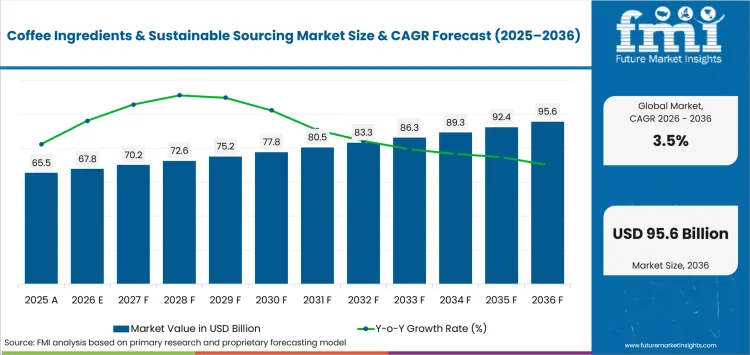
USD 67.8 billion in 2026 and USD 95.6 billion by 2036 at a 3.5% CAGR.
Demand for coffee ingredients & sustainable sourcing is projected to expand at 3.5% CAGR between 2026 and 2036, increasing valuation from USD 67.8 billion in 2026 to USD 95.6 billion by 2036. In its June 2026 update, Nescafé reported training more than 100,000 coffee farmers during 2025. This extensive agronomic support helps ensuring coffee batches being able to be accurately traced back to their exact origins. Documented origin control directly encourages repeat purchasing, as coffee roasters and ingredient processors rely on consistent quality across all of their production cycles.
International buyers evaluate sustainable coffee ingredients based on distinct regional priorities. Buyers in Brazil and the United States focus primarily on supply continuity and clear traceability records. Buyers in Italy and Japan emphasize verified origin evidence alongside detailed process-control files. Large-scale agricultural initiatives demonstrate how industry leaders are standardizing these practices globally. By January 2026, JDE Peet’s reported that its Common Grounds program had reached close to 1 million farmers. This extensive reach shows how shared field programs support consistent supplier evaluations across several different consuming regions.
Key Takeaways for the Coffee Ingredients & Sustainable Sourcing Market
- Ingredient demand is supported by stable coffee consumption, expanding cold formats, and closer control over origin-linked quality.
- Conventional is forecast to retain 48.0% share of sourcing in 2026, reflecting established volumes and familiar qualification routes.
- RTD is estimated to lead application with 43.2% share in 2026, led by portable cold formats and consistent extracts.
- Price movement and incomplete traceability records restrict dependable formulation and release.
- Competition includes Nestlé S.A., Keurig Dr Pepper Inc. and JDE Peet’s, Starbucks Corporation, ofi, Louis Dreyfus Company, Neumann Kaffee Gruppe, Sucafina, and Atomo Coffee.
Analyst Perspective
“Coffee ingredient purchasing creates durable value only through stable specifications across processing and final application. Buyers need traceable evidence for extraction performance and sustainability claims. Suppliers combining dependable material control with application support are better positioned for recurring contracts.”
- Nandini Roy Choudhury, Principal Analyst for Food and Beverage at Future Market Insights
How is Coffee Ingredients & Sustainable Sourcing Market segmented?
The coffee ingredients & sustainable sourcing industry is segmented by product, sourcing, application, and region.
The coffee ingredients & sustainable sourcing industry is segmented by product, sourcing, application, and region. Product coverage includes green coffee, soluble/instant, coffee extracts, and upcycled grounds. Sourcing distinguishes conventional, sustainable, and upcycled programs according to origin evidence and processing records. Application coverage spans RTD, instant, and foodservice uses requiring separate flavor and preparation controls. Regional coverage includes North America, Latin America, Western Europe, Eastern Europe, East Asia, South Asia and Pacific, Middle East and Africa.
Why does green coffee lead product demand?
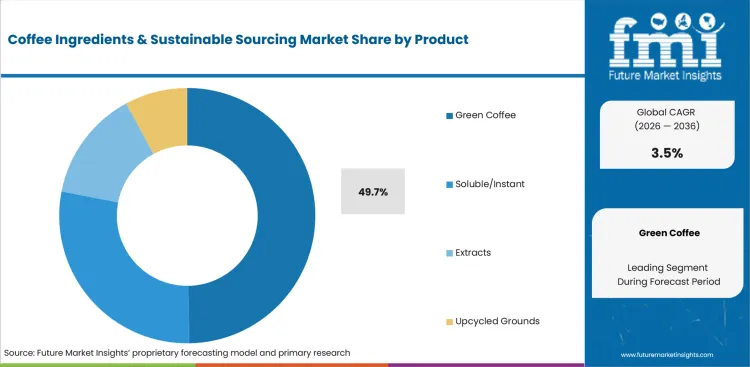
Green Coffee preserves origin choice for roasters managing roast profile and extraction performance. International Coffee Organization reported world coffee exports at 12.38 million 60-kilogram bags during May 2026 in its June 2026 report, supporting international material access for downstream ingredient processing. Supplier approval examines fermentation and storage history since every attribute affects repeatable output.
- Green coffee is predicted to represent 49.7% share of product in 2026, driven by direct management of origin selection and quality release. Buyers assess farm identity together with post-harvest records since both influence flavor consistency and processing economics.
- Soluble/instant and extracts support rapid preparation through controlled dosage and defined concentration. Upcycled Grounds require separate safety and sensory evidence suited to intended food or beverage systems.
How does conventional shape sourcing demand?
Conventional sourcing connects large origin networks with familiar grading and contract procedures. Global Coffee Platform reported 11 roasters and retailers in its Sustainable Coffee Purchases Report published in December 2025, showing wider use of comparable sourcing metrics across established purchasing systems. Contract review balances traceability depth and claim requirements.
- Based on sourcing, conventional is projected to secure 48.0% share in 2026, aided by extensive supplier networks and established grading procedures across commercial volumes. Roasters retain origin flexibility provided incoming lots meet sensory and food-safety specifications under controlled release procedures.
- Sustainable routes add verified farm practices and chain-of-custody evidence to supplier review. Upcycled sourcing needs clear recovered-material identity supported by documented processing controls for customer approval.
What supports RTD within application demand?
Ready-to-drink coffee requires ingredients delivering repeatable strength, aroma, solubility, and shelf stability. National Coffee Association reported RTD preparation reached 15% of past-day coffee drinkers in April 2024, nearly doubling from 8% and demonstrating greater use of packaged coffee formats. Formulation review addresses thermal treatment and packaging performance.
- RTD is estimated to account for 43.2% share in 2026, backed by bottled and canned products requiring standardized flavor delivery across production batches. Extract strength and aroma retention receive close review since raw-material variation may alter sweetness balance or texture.
- Instant applications favor rapid preparation supported by stable powder behavior and controlled agglomeration. Foodservice programs emphasize adaptable dosage and dependable brewing guidance during recipe or equipment changes.
What are drivers, restraints, and opportunities in Coffee Ingredients & Sustainable Sourcing Market?
Coffee demand supports recurring ingredient purchases; price volatility and variable crop quality complicate contract planning. Traceable sustainable supply and by-product conversion create additional routes for differentiated offers.
- Driver: Daily coffee consumption sustains repeat purchases across green and soluble ingredient programs. RTD and foodservice launches extend demand for application-ready extracts with stable performance.
- Restraint: Crop variability disrupts flavor consistency and complicates purchasing plans across supply cycles. Commodity price swings increase budgeting pressure and weaken long-term supplier commitments.
- Opportunity: Traceable sourcing strengthens buyer confidence through verified origin and production records. Recovered coffee materials create differentiated offers supported by credible environmental and technical evidence.
Coffee consumption provides a durable base for ingredient purchasing across retail, foodservice, and packaged beverage programs. National Coffee Association reported 66% of USA adults drank coffee daily in April 2025, supporting repeated demand for roasting inputs and service products. Extensive consumption does not guarantee supplier selection, with consistent quality and dependable delivery determining contract retention.
Price instability creates planning pressure across green coffee contracts and downstream ingredient quotations. International Coffee Organization reported a 7.8% monthly decline in its composite indicator during December 2025, reflecting changing supply expectations. Rapid price movement affects inventory timing and quotation validity, prompting buyers to seek contract safeguards with origin flexibility.
Coffee by-products provide new ingredient options through controlled recovery and processing. ofi reported cascara upcycling activity across 6 origins in June 2026, connecting discarded coffee fruit with soluble extract powder for food and beverage use. Comparable upcycled food products require stable composition and documented safety. Upcycled offers gain commercial value through stable composition and transparent claims supporting customer product development.
How are country CAGRs aligned in Coffee Ingredients & Sustainable Sourcing Market?
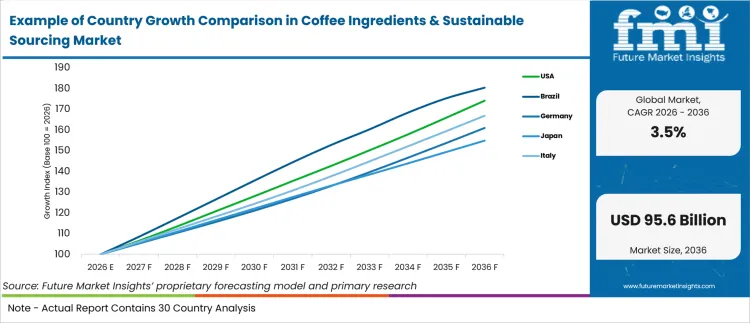
| Country | CAGR |
|---|---|
| Brazil | 6.1% |
| USA | 5.7% |
| Italy | 5.3% |
| Germany | 4.9% |
| Japan | 4.5% |
Source: Future Market Insights analysis, 2026.
How do country-level CAGRs compare in the Coffee Ingredients & Sustainable Sourcing Market?
Country comparison shows a gradual step-down across the markets covered. Brazil occupies the upper end of the range, followed by the United States. Italy forms the middle position, followed by Germany and Japan at moderately lower rates. A 1.6 percentage-point spread separates Brazil from Japan. Profiled markets share a positive expansion outlook, although national positions reflect different levels of commercial momentum.
- Brazil leads the comparison and establishes Latin America as the principal expansion cluster among the markets shown.
- The United States follows Brazil with a limited rate difference, reflecting continued demand across RTD, instant, specialty, and foodservice applications.
- Italy forms the middle growth band through established roasting expertise and extensive demand for imported green coffee.
- Germany and Japan complete the comparison through developed processing systems and quality-led ingredient requirements.
- The pattern resembles a gradual downward slope instead of a sharp separation between higher-growth and lower-growth markets.
Markets carrying similar CAGRs may present different entry conditions through origin access, processing capability, traceability requirements, and supplier documentation. Full report coverage extends across North America, Latin America, Western Europe, Eastern Europe, East Asia, South Asia and Pacific, Middle East and Africa.
Country-wise Analysis
- Coffee ingredient demand in Brazil is forecast to expand at 6.1% CAGR by 2036, led by Conilon availability and domestic processing capacity. United States Department of Agriculture estimated Brazilian output at 65 million 60-kilogram bags for 2025/26 in May 2025, providing a substantial base for green and extract production. Origin proximity reduces inbound complexity for processors, and harvest variation continues to require flexible specifications and inventory planning.
- United States Department of Agriculture projected USA bean imports at 23.8 million 60-kilogram bags for 2025/26 in December 2025, reflecting sustained dependence on diverse producing origins. Import diversity supports blending and product variety, with suppliers needing complete food-safety and origin documentation for each route. Sales in the United States is anticipated to advance at 5.7% CAGR during the forecast period, driven by specialty and foodservice applications.
- Espresso-focused roasting creates recurring need for carefully selected Arabica and Robusta inputs across branded and private-label programs. Sector in Italy is projected to increase at 5.3% CAGR between 2026 and 2036, assisted by roasting expertise and export-oriented finished products. Italian Exhibition Group reported coffee imports reached 703.5 million kilograms during 2024 in its December 2025 industry release, supporting substantial green-coffee intake for domestic roasting and ingredient preparation.
- Coffee ingredients in Germany are estimated to progress at 4.9% CAGR from 2026 to 2036, reflecting substantial import and re-export activity. German Federal Statistical Office reported green coffee import prices stood 12.9% above December 2024 levels during December 2025 in its January 2026 release, intensifying blend-cost review and contract planning. Buyers place close attention on traceability and documentation suited to European sourcing requirements.
- All Japan Coffee Association reported 28,498,387 kilograms of green coffee imports during December 2025 in its English monthly trade release, demonstrating continued raw-material demand across roasting and packaged beverage production. Exact flavor control and dependable lot performance shape supplier approval, especially across canned, bottled, instant, and foodservice formats. Japan is forecast to register 4.5% CAGR through 2036, helped by established consumption patterns and quality-led product renewal.
Who are notable companies in Coffee Ingredients & Sustainable Sourcing Market?
Nestlé S.A., Keurig Dr Pepper Inc. and JDE Peet’s, Starbucks Corporation, ofi, Louis Dreyfus Company, Neumann Kaffee Gruppe, Sucafina, and Atomo Coffee are notable companies active across coffee ingredient supply and sustainable sourcing.
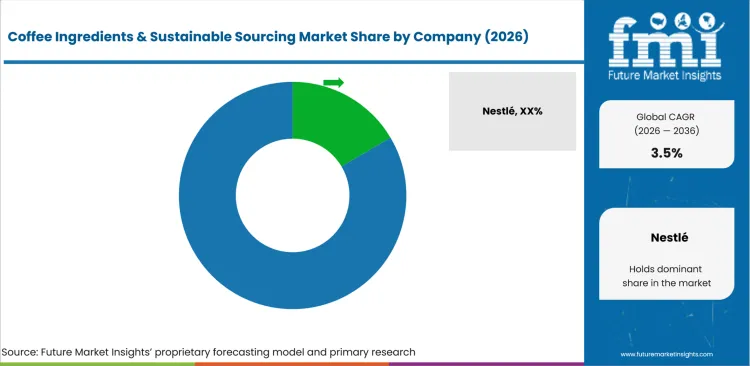
Competition for the sector centers on soluble and extract capability and service reach. Integrated groups combine agricultural programs with branded applications. Origin specialists concentrate on trading and customer supply. Atomo Coffee contributes an Upcycled Grounds route requiring separate sensory and labeling review.
- Nestlé S.A. competes based on green coffee programs and technical scale. Customer review examines traceability depth and ingredient consistency across regional product requirements.
- Keurig Dr Pepper Inc. and Starbucks Corporation combine branded coffee demand with supplier programs spanning origins and finished formats. Buyer assessment focuses on sourcing governance and application insight across multiple channels.
- Louis Dreyfus Company and Sucafina participate depending on verification and customer supply services. Contract decisions reflect soluble capability and documentation quality.
- Atomo Coffee adds Upcycled Grounds and blended alternatives based on recovered plant materials. Commercial review requires manufacturing consistency and credible environmental substantiation.
Competitive Benchmarking: Coffee Ingredients & Sustainable Sourcing Market
| Company | Origin and Green Coffee Access | Soluble or Extract Capability | Traceability and Sourcing Support | Service Reach |
|---|---|---|---|---|
| Nestlé S.A. | High | High | High | Global |
| Keurig Dr Pepper Inc. and JDE Peet’s | High | High | High | Global |
| Starbucks Corporation | High | Medium | High | Global |
| ofi | High | High | High | Global |
| Louis Dreyfus Company | High | High | High | Global |
| Neumann Kaffee Gruppe | High | Medium | High | Global |
| Sucafina | High | Medium | High | International |
| Atomo Coffee | Low | Medium | Medium | Selected markets |
Source: Future Market Insights competitive analysis, 2026.
Key Developments in Coffee Ingredients & Sustainable Sourcing Market
- In April 2025, Nestlé expanded Nescafé Ready-to-Drink coffee into India, Middle East and North Africa, and Brazil. Added availability increased demand routes for stable concentrates and sourcing programs serving packaged cold coffee.
- In May 2025, ofi inaugurated a soluble coffee facility in Linhares, Brazil, with two freeze-dried and spray-dried production lines. Origin-based processing expanded traceable soluble supply for customers in American, European, and Asian applications.
- In November 2025, Starbucks Coffee Company and Tata Starbucks announced a Farmer Support Partnership intended to reach 10,000 Indian coffee farmers by 2030. Agronomy support and varietal testing strengthen future Arabica quality within regional sourcing programs.
Coffee Ingredients & Sustainable Sourcing Market Report Scope
| Coverage Field | Report Scope |
|---|---|
| Market Breakdown | Coffee ingredients & sustainable sourcing market breakdown by product, sourcing, application, and region |
| Quantitative Units | Revenue in USD billion and CAGR in %. |
| Market Definition | Green coffee, soluble coffee, extracts, and upcycled coffee ingredients supplied through Conventional, Sustainable, or Upcycled routes for RTD, Instant, and Foodservice use. |
| Regions Covered | North America, Latin America, Western Europe, Eastern Europe, East Asia, South Asia and Pacific, Middle East and Africa |
| Countries Covered | 30+ countries including USA, Brazil, Germany, Japan, and Italy |
| Key Companies Profiled | Nestlé S.A., Keurig Dr Pepper Inc. and JDE Peet’s, Starbucks Corporation, ofi, Louis Dreyfus Company, Neumann Kaffee Gruppe, Sucafina, and Atomo Coffee |
| Forecast Period | 2026 to 2036 |
| Approach | Hybrid bottom-up and top-down assessment reconciles fixed market values, segment shares, country CAGRs, company participation, application conditions, and sourcing requirements. |
Source: Future Market Insights analysis, 2026.
Coffee Ingredients & Sustainable Sourcing Market - Research Methodology
| Method | Approach |
|---|---|
| Primary Research | FMI analysts gathered input from manufacturers, service providers, technology developers, distributors, end users, procurement teams, and subject-matter experts. Interviews examined purchasing decisions, product or service evaluation, adoption barriers, approval requirements, pricing considerations, and expectations for technical or commercial support. Respondents were also asked what evidence is required before a trial, pilot, or initial order develops into regular purchasing. |
| Desk Research | Desk research covered government statistics, regulatory publications, trade data, industry associations, technical literature, standards, company filings, product information, and official corporate announcements. Sources were reviewed for relevance, publication date, geographic coverage, and consistency with the defined market scope. Claims relating to performance, applications, approvals, capacity, investment, and commercial activity were retained only when supported by credible public evidence. |
| Market Sizing and Forecasting | The market model combined the baseline value with historical performance, segment structure, pricing and volume indicators, adoption levels, company participation, and country-level demand conditions. Forecast assumptions considered economic activity, investment trends, regulatory developments, technology adoption, purchasing cycles, supply availability, and barriers to wider market use. Segment and regional estimates were reconciled before the final market total was calculated. |
| Data Validation | Estimates were checked against multiple independent indicators, including public data, company activity, trade patterns, industry developments, and findings from primary interviews. Validation also tested whether products, services, applications, and company revenues fell within the defined market boundaries. Adjacent categories, unsupported claims, overlapping revenues, and activities without direct market relevance were excluded to reduce double counting and maintain consistency across segments and countries. |
Source: Future Market Insights analysis, 2026.
Coffee Ingredients & Sustainable Sourcing Market by Segments
Coffee Ingredients & Sustainable Sourcing Market segmented by Product:
- Green Coffee
- Soluble/Instant
- Extracts
- Upcycled Grounds
Coffee Ingredients & Sustainable Sourcing Market segmented by Sourcing:
- Conventional
- Sustainable
- Upcycled
Coffee Ingredients & Sustainable Sourcing Market segmented by Application:
- RTD
- Instant
- Foodservice
Coffee Ingredients & Sustainable Sourcing Market by Region:
- North America
- United States
- Canada
- Latin America
- Brazil
- Mexico
- Argentina
- Chile
- Western Europe
- Germany
- France
- United Kingdom
- Italy
- Spain
- Benelux
- Nordics
- Eastern Europe
- Poland
- Czech Republic
- Romania
- Hungary
- East Asia
- China
- Japan
- South Korea
- South Asia and Pacific
- India
- ASEAN
- Australia and New Zealand
- Middle East and Africa
- GCC Countries
- South Africa
- Türkiye
- Israel
Research Sources and Bibliography
- All Japan Coffee Association. (2026, March). Month of imports: 2025 December.
- German Federal Statistical Office. (2026, January 30). Import prices in December 2025: -2.3% on December 2024.
- Global Coffee Platform. (2025, December 8). Sustainable Coffee Purchases Report 2024.
- International Coffee Organization. (2025, December). Coffee Market Report - December 2025.
- International Coffee Organization. (2026, June). Coffee Market Report - June 2026.
- Italian Exhibition Group. (2025, December 22). SIGEP World 2026: Gelato, pastry, chocolate, bread, pizza and coffee industries worth over €40 billion.
- JDE Peet’s. (2026, January 29). JDE Peet’s launches Nature Transition Plan to advance regenerative agriculture and deforestation-free coffee supply chains.
- National Coffee Association of USA (2025, April 15). More Americans drink coffee each day than any other beverage, bottled water back in second place.
- National Coffee Association of USA (2024, April 11). Daily coffee consumption at 20-year high, up nearly 40%.
- Nestlé. (2025, April 2). Nescafé Ready-to-Drink expands its reach, captivating a new generation of coffee lovers.
- Nestlé. (2026, June 18). Nescafé sources over 50% of its coffee supplies from farmers adopting regenerative agriculture practices in 2025.
- ofi. (2025, May 13). ofi opens soluble coffee facility in Brazil, expanding its manufacturing capacity with focus on sustainable innovation.
- ofi. (2026, June 5). Finding value in crop waste through innovative upcycling.
- Starbucks Coffee Company. (2025, November 19). Starbucks Coffee Company and Tata Starbucks re-affirm coffee leadership and announce a Farmer Support Partnership to strengthen the coffee value chain from bean to cup.
- United States Department of Agriculture, Foreign Agricultural Service. (2025, December). Coffee: World Markets and Trade.
- United States Department of Agriculture, Foreign Agricultural Service. (2025, May 19). Brazil: Coffee Annual.
This bibliography is provided for reader reference and is not exhaustive. The full report contains the complete reference list and detailed citations.
This Report Answers
- How do product, sourcing, application, and region influence demand?
- Why does green coffee hold its product position in 2026?
- How does conventional influence purchasing across sourcing programs?
- Why does RTD lead application demand across packaged coffee formats?
- What conditions support repeat orders for coffee ingredients and sourcing services?
- How do country CAGRs compare across Brazil, USA, Italy, Germany, and Japan?
- What companies provide origin access or upcycled alternatives?
- How do price movement and crop variation affect supplier qualification?
- What evidence supports sustainable sourcing and traceability claims?
- How are estimates validated through primary and desk research?
Frequently Asked Questions
How big is the Coffee Ingredients & Sustainable Sourcing Market in 2026?
The coffee ingredients & sustainable sourcing market is valued at USD 67.8 billion in 2026 and is forecast to reach USD 95.6 billion by 2036. Growth is supported by stable daily coffee consumption across retail, foodservice, and packaged beverage programs that sustain recurring demand for green coffee, soluble ingredients, and traceable extracts globally.
What is the CAGR of the Coffee Ingredients & Sustainable Sourcing Market from 2026 to 2036?
The coffee ingredients & sustainable sourcing market grows at a CAGR of 3.5% between 2026 and 2036, supported by expanding cold and RTD formats, closer origin control, and traceable sourcing programs that strengthen buyer confidence and support recurring ingredient contracts across commercial roasting and packaged beverage applications worldwide.
Which sourcing type leads the Coffee Ingredients & Sustainable Sourcing Market?
Conventional sourcing accounts for 48.0% of the coffee ingredients & sustainable sourcing market by sourcing in 2026, driven by extensive supplier networks and established grading procedures that provide roasters with origin flexibility across commercial volumes, provided incoming lots meet sensory and food-safety specifications under controlled release procedures.
How much will the Coffee Ingredients & Sustainable Sourcing Market add between 2026 and 2036?
The coffee ingredients & sustainable sourcing market is set to add USD 27.8 billion between 2026 and 2036, growing from USD 67.8 billion to USD 95.6 billion as traceable sustainable sourcing, upcycled coffee by-product recovery, and expanding RTD and foodservice applications drive recurring ingredient demand across major consuming markets globally.
Who are the leading companies in the Coffee Ingredients & Sustainable Sourcing Market?
Eight companies lead the coffee ingredients & sustainable sourcing market, including Nestlé S.A., Keurig Dr Pepper Inc. and JDE Peet's, Starbucks Corporation, ofi, Louis Dreyfus Company, Neumann Kaffee Gruppe, Sucafina, and Atomo Coffee, competing through green coffee access, soluble and extract capability, traceability support, and upcycled ingredient development across global supply programs.
Preview the report firsthand - request a free sample
Get SampleGet the brochure for pricing and purchase details.
Get PDFTable of Content
- Key Takeaways
- Market Size and CAGR
- Top Growth Driver
- Fastest Growing Segment
- Leading Region
- Key Companies
- Emerging Opportunities
- Executive Summary
- Global Market Outlook
- Demand-side Trends
- Supply-side Trends
- Technology Roadmap Analysis
- Analysis and Recommendations
- Analyst Perspective (What is happening? Why now? What should investors know?)
- Key Questions Answered
- How large is the market?
- What is the CAGR?
- What are key trends?
- Which region dominates?
- Who are the leaders?
- Market Overview
- Market Coverage / Taxonomy
- Market Definition / Scope / Limitations
- Research Methodology
- Chapter Orientation
- Analytical Lens and Working Hypotheses
- Market Structure, Signals, and Trend Drivers
- Benchmarking and Cross-market Comparability
- Market Sizing, Forecasting, and Opportunity Mapping
- Research Design and Evidence Framework
- Desk Research Programme (Secondary Evidence)
- Expert Input and Fieldwork (Primary Evidence)
- Tooling, Models, and Reference Databases
- Data Engineering and Model Build
- Quality Assurance and Audit Trail
- Market Background
- Market Dynamics (Drivers, Restraints, Opportunity, Trends)
- Scenario Forecast (Optimistic, Likely, Conservative)
- Impact Analysis
- AI Impact
- Sustainability Impact
- Regulatory Impact
- Technology Impact
- Consumer / Buyer Analysis
- Purchase Drivers
- Adoption Barriers
- Buyer Journey
- Opportunity Map Analysis
- Product Life Cycle Analysis
- Supply Chain Analysis
- Investment Feasibility Matrix
- Value Chain Analysis
- PESTLE and Porter's Analysis
- Regulatory Landscape
- Regional Parent Market Outlook
- Production and Consumption Statistics
- Import and Export Statistics
- Global Market Analysis and Forecast, 2021 to 2036
- Historical Market Size Value (USD Billion) Analysis, 2021 to 2025
- Current and Future Market Size Value (USD Billion) Projections, 2026 to 2036
- Y-o-Y Growth Trend Analysis
- Absolute $ Opportunity Analysis
- Global Market Pricing Analysis, 2021 to 2036
- Global Market Analysis and Forecast, By Product, 2021 to 2036
- Introduction / Key Findings
- Historical Market Size Value (USD Billion) Analysis By Product, 2021 to 2025
- Current and Future Market Size Value (USD Billion) Analysis and Forecast By Product, 2026 to 2036
- Green Coffee
- Soluble/Instant
- Extracts
- Upcycled Grounds
- Green Coffee
- Y-o-Y Growth Trend Analysis By Product, 2021 to 2025
- Absolute $ Opportunity Analysis By Product, 2026 to 2036
- Global Market Analysis and Forecast, By Sourcing, 2021 to 2036
- Introduction / Key Findings
- Historical Market Size Value (USD Billion) Analysis By Sourcing, 2021 to 2025
- Current and Future Market Size Value (USD Billion) Analysis and Forecast By Sourcing, 2026 to 2036
- Conventional
- Sustainable
- Upcycled
- Conventional
- Y-o-Y Growth Trend Analysis By Sourcing, 2021 to 2025
- Absolute $ Opportunity Analysis By Sourcing, 2026 to 2036
- Global Market Analysis and Forecast, By Application, 2021 to 2036
- Introduction / Key Findings
- Historical Market Size Value (USD Billion) Analysis By Application, 2021 to 2025
- Current and Future Market Size Value (USD Billion) Analysis and Forecast By Application, 2026 to 2036
- RTD
- Instant
- Foodservice
- RTD
- Y-o-Y Growth Trend Analysis By Application, 2021 to 2025
- Absolute $ Opportunity Analysis By Application, 2026 to 2036
- Global Market Analysis and Forecast, By Region, 2021 to 2036
- Introduction
- Historical Market Size Value (USD Billion) Analysis By Region, 2021 to 2025
- Current Market Size Value (USD Billion) Analysis and Forecast By Region, 2026 to 2036
- North America
- Latin America
- Western Europe
- Eastern Europe
- East Asia
- South Asia and Pacific
- Middle East & Africa
- Market Attractiveness Analysis By Region
- North America Market Analysis and Forecast, By Country, 2021 to 2036
- Historical Market Size Value (USD Billion) Trend Analysis By Market Taxonomy, 2021 to 2025
- Market Size Value (USD Billion) Forecast By Market Taxonomy, 2026 to 2036
- By Country
- USA
- Canada
- By Product
- By Sourcing
- By Application
- By Country
- Market Attractiveness Analysis
- By Country
- By Product
- By Sourcing
- By Application
- Key Takeaways
- Latin America Market Analysis and Forecast, By Country
- Historical Market Size Value (USD Billion) Trend Analysis By Market Taxonomy, 2021 to 2025
- Market Size Value (USD Billion) Forecast By Market Taxonomy, 2026 to 2036
- By Country
- Brazil
- Mexico
- Chile
- Rest of Latin America
- By Product
- By Sourcing
- By Application
- By Country
- Market Attractiveness Analysis
- By Country
- By Product
- By Sourcing
- By Application
- Key Takeaways
- Western Europe Market Analysis and Forecast, By Country
- Historical Market Size Value (USD Billion) Trend Analysis By Market Taxonomy, 2021 to 2025
- Market Size Value (USD Billion) Forecast By Market Taxonomy, 2026 to 2036
- By Country
- Germany
- UK
- Italy
- Spain
- France
- Nordic
- BENELUX
- Rest of Western Europe
- By Product
- By Sourcing
- By Application
- By Country
- Market Attractiveness Analysis
- By Country
- By Product
- By Sourcing
- By Application
- Key Takeaways
- Eastern Europe Market Analysis and Forecast, By Country
- Historical Market Size Value (USD Billion) Trend Analysis By Market Taxonomy, 2021 to 2025
- Market Size Value (USD Billion) Forecast By Market Taxonomy, 2026 to 2036
- By Country
- Russia
- Poland
- Hungary
- Balkan & Baltic
- Rest of Eastern Europe
- By Product
- By Sourcing
- By Application
- By Country
- Market Attractiveness Analysis
- By Country
- By Product
- By Sourcing
- By Application
- Key Takeaways
- East Asia Market Analysis and Forecast, By Country
- Historical Market Size Value (USD Billion) Trend Analysis By Market Taxonomy, 2021 to 2025
- Market Size Value (USD Billion) Forecast By Market Taxonomy, 2026 to 2036
- By Country
- China
- Japan
- South Korea
- By Product
- By Sourcing
- By Application
- By Country
- Market Attractiveness Analysis
- By Country
- By Product
- By Sourcing
- By Application
- Key Takeaways
- South Asia and Pacific Market Analysis and Forecast, By Country
- Historical Market Size Value (USD Billion) Trend Analysis By Market Taxonomy, 2021 to 2025
- Market Size Value (USD Billion) Forecast By Market Taxonomy, 2026 to 2036
- By Country
- India
- ASEAN
- Australia & New Zealand
- Rest of South Asia and Pacific
- By Product
- By Sourcing
- By Application
- By Country
- Market Attractiveness Analysis
- By Country
- By Product
- By Sourcing
- By Application
- Key Takeaways
- Middle East & Africa Market Analysis and Forecast, By Country
- Historical Market Size Value (USD Billion) Trend Analysis By Market Taxonomy, 2021 to 2025
- Market Size Value (USD Billion) Forecast By Market Taxonomy, 2026 to 2036
- By Country
- Kingdom of Saudi Arabia
- Other GCC Countries
- Türkiye
- South Africa
- Other African Union
- Rest of Middle East & Africa
- By Product
- By Sourcing
- By Application
- By Country
- Market Attractiveness Analysis
- By Country
- By Product
- By Sourcing
- By Application
- Key Takeaways
- Key Countries Market Analysis
- USA
- Pricing Analysis
- Market Share Analysis, 2025
- By Product
- By Sourcing
- By Application
- Canada
- Pricing Analysis
- Market Share Analysis, 2025
- By Product
- By Sourcing
- By Application
- Mexico
- Pricing Analysis
- Market Share Analysis, 2025
- By Product
- By Sourcing
- By Application
- Brazil
- Pricing Analysis
- Market Share Analysis, 2025
- By Product
- By Sourcing
- By Application
- Chile
- Pricing Analysis
- Market Share Analysis, 2025
- By Product
- By Sourcing
- By Application
- Germany
- Pricing Analysis
- Market Share Analysis, 2025
- By Product
- By Sourcing
- By Application
- UK
- Pricing Analysis
- Market Share Analysis, 2025
- By Product
- By Sourcing
- By Application
- Italy
- Pricing Analysis
- Market Share Analysis, 2025
- By Product
- By Sourcing
- By Application
- Spain
- Pricing Analysis
- Market Share Analysis, 2025
- By Product
- By Sourcing
- By Application
- France
- Pricing Analysis
- Market Share Analysis, 2025
- By Product
- By Sourcing
- By Application
- India
- Pricing Analysis
- Market Share Analysis, 2025
- By Product
- By Sourcing
- By Application
- ASEAN
- Pricing Analysis
- Market Share Analysis, 2025
- By Product
- By Sourcing
- By Application
- Australia & New Zealand
- Pricing Analysis
- Market Share Analysis, 2025
- By Product
- By Sourcing
- By Application
- China
- Pricing Analysis
- Market Share Analysis, 2025
- By Product
- By Sourcing
- By Application
- Japan
- Pricing Analysis
- Market Share Analysis, 2025
- By Product
- By Sourcing
- By Application
- South Korea
- Pricing Analysis
- Market Share Analysis, 2025
- By Product
- By Sourcing
- By Application
- Russia
- Pricing Analysis
- Market Share Analysis, 2025
- By Product
- By Sourcing
- By Application
- Poland
- Pricing Analysis
- Market Share Analysis, 2025
- By Product
- By Sourcing
- By Application
- Hungary
- Pricing Analysis
- Market Share Analysis, 2025
- By Product
- By Sourcing
- By Application
- Kingdom of Saudi Arabia
- Pricing Analysis
- Market Share Analysis, 2025
- By Product
- By Sourcing
- By Application
- Türkiye
- Pricing Analysis
- Market Share Analysis, 2025
- By Product
- By Sourcing
- By Application
- South Africa
- Pricing Analysis
- Market Share Analysis, 2025
- By Product
- By Sourcing
- By Application
- USA
- Market Structure Analysis
- Competition Dashboard
- Competition Benchmarking
- Market Share Analysis of Top Players
- By Regional
- By Product
- By Sourcing
- By Application
- Emerging Startups
- Innovation Benchmarking
- Competition Analysis
- Competition Deep Dive
- Nestlé
- Overview
- Product Portfolio
- Profitability by Market Segments
- Sales Footprint
- Strategy Overview
- Marketing Strategy
- Product Strategy
- Channel Strategy
- JDE Peet's
- Starbucks
- Keurig Dr Pepper
- Olam (ofi)
- Cargill
- Atomo (beanless)
- Nestlé
- Case Studies
- Success Stories
- Recent Developments
- Competition Deep Dive
- Assumptions & Acronyms Used


