

- Industry Size (2026)
- USD 1.5 Bn
- Forecast (2036)
- USD 2.3 Bn
- CAGR (2026 to 2036)
- 4.4%
Coffee Extracts Market Forecast and Outlook 2026 to 2036
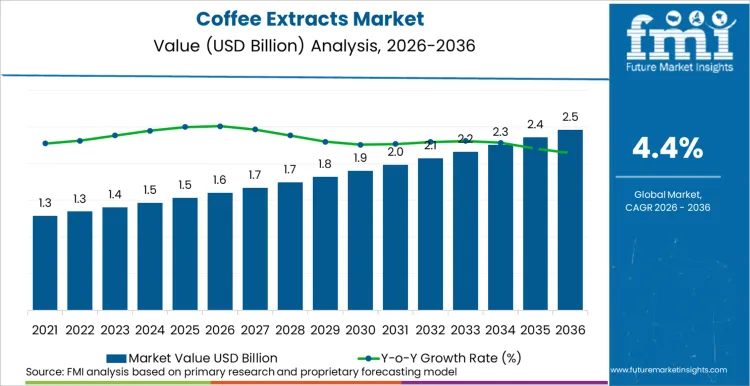
The global coffee extracts sector is on track to achieve a valuation of USD 2.4 Billion by 2036, accelerating from USD 1.6 Billion in 2026 at a CAGR of 4.4%. As per Future Market Insights, expansion is structurally underpinned by the rapid adoption of liquid coffee concentrate formats driven by Gen Z and millennial consumers who favor cold, customizable beverages over traditional hot coffee.
The International Coffee Organization reported in its 2024 market outlook that global coffee consumption reached 178 million 60-kg bags, validating the sustained demand base that supports value-added extract innovation. This consumption momentum compels manufacturers to invest in proprietary extraction and concentration technologies that preserve flavor complexity while enabling shelf-stable, ready-to-dilute formats. Simultaneously the competitive landscape is shifting from fragmented regional roasters to consolidated global platforms which forces a major restructuring of supply agreements and brand portfolios.
Juan Aranols, CEO of Nestle Malaysia, stated: 'NESCAFE Espresso Concentrate is set to tap into new and innovative growth opportunities in the very dynamic coffee space that are especially relevant for the younger generations.' This statement, made during the August 2025 launch of a dedicated NESCAFE Espresso Concentrate production line at the Sri Muda factory in Malaysia, confirms that major multinationals are committing dedicated manufacturing capacity to the liquid extract segment.
FMI opines that the consolidation cycle is accelerating. Keurig Dr Pepper entered into a definitive agreement to acquire JDE Peet's for approximately EUR 15.7 Billion (USD 18 Billion) in August 2025, a transaction that unites KDP's North American single-serve platform with JDE Peet's global portfolio of soluble coffee and extract brands. This deal is designed to scale coffee innovation, specifically leveraging JDE Peet's 2024 to 2025 launches in liquid concentrates across KDP's distribution network. Separately, Finlays made a strategic investment in NewTree Fruit Company in December 2025 to integrate patented 'De-Sugaring' technology into its global extracts business for low-sugar, nutrition-led liquid coffee solutions. FMI analysts are of the opinion that these moves confirm the industry is transitioning from commodity-grade soluble powder toward high-margin, technology-differentiated liquid extract platforms.
Key Takeaways
Power in the coffee extracts value chain is held by vertically integrated multinationals such as Nestle, JDE Peet's (now under Keurig Dr Pepper), and Tata Consumer Products, who control the supply chain from green bean sourcing through extraction, concentration, and global distribution. These firms set price benchmarks and extraction standards that smaller regional processors must follow.
Pricing asymmetry in the coffee extracts market is driven by the spread between volatile green coffee commodity prices and the stable, premium retail pricing of branded liquid concentrates and cold brew extracts. FMI analysts note that brands using proprietary extraction technologies (such as Nestle's roasting-brewing process for Espresso Concentrate) capture margins that commodity soluble producers cannot replicate.
Sourcing fragility centers on the dependence of the global coffee supply on a limited number of producing regions, primarily Brazil, Vietnam, Colombia, and Ethiopia. Climate volatility, as documented by the International Coffee Organization, creates recurring supply shocks that affect raw material costs for extract manufacturers, particularly those without long-term supply contracts or origin-based processing facilities.
Brand and compliance risks in the coffee extracts market relate to clean-label demands, traceability requirements, and fair-trade certification. As per FMI, consumers in North America and Europe are increasingly rejecting extracts with undisclosed additives, pressing manufacturers toward transparent ingredient lists and verifiable origin claims.
Geographic leverage varies significantly. North America is the largest consumption market for cold brew and liquid concentrate formats. Europe retains strength in soluble and espresso-based extracts. Asia Pacific, led by China, Japan, and India, is the fastest-growing region driven by urbanization and the expansion of out-of-home coffee culture. Latin America is primarily a raw material supplier with growing domestic extract consumption. The Middle East and Africa are emerging markets for instant and extract-based coffee.
FMI is of the opinion that the executive reframing for this market is a shift from 'coffee as commodity ingredient' to 'coffee extract as formulation platform.' The USD 2.4 Billion opportunity by 2036 will be captured by companies that invest in extraction technology, secure origin-based supply chains, and develop format-specific products for the cold, ready-to-mix, and functional beverage segments.
Summary of Coffee Extracts Market
What Is Growth Outlook for Coffee Extracts Market as per Future Market Insights Projection?
Future Market Insights projects the coffee extracts market to expand at a CAGR of 4.4% from 2026 to 2036, increasing from USD 1.6 Billion in 2026 to USD 2.4 Billion by 2036.
FMI Research Approach: FMI proprietary forecasting model based on global coffee consumption data from the International Coffee Organization and retail pricing trend analysis.
How Do FMI Analysts Perceive Coffee Extracts Market to Evolve?
FMI analysts perceive the market evolving toward liquid concentrate and cold brew extract formats where extraction technology and brand positioning determine margin capture rather than raw volume.
FMI Research Approach: Tracking of Nestle Espresso Concentrate launch, Keurig Dr Pepper and JDE Peet's acquisition filings, and Finlays strategic investment disclosures.
Which Country Holds Largest Share in Global Coffee Extracts Market?
The United States holds a significant share of the global coffee extracts market by value which is supported by the dominance of cold brew, concentrate, and ready-to-drink coffee segments.
FMI Research Approach: FMI country-level revenue modeling by retail scan data and branded concentrate distribution tracking.
How Large Will Coffee Extracts Market Be by 2036?
The global coffee extracts market is projected to reach USD 2.4 Billion by 2036.
FMI Research Approach: FMI long-term revenue forecast derived from International Coffee Organization consumption projections and premium format penetration modeling.
What Is Definition of Coffee Extracts Market?
The coffee extracts market comprises revenue from concentrated coffee products including liquid concentrates, cold brew extracts, spray-dried and freeze-dried soluble coffee, and specialty extraction outputs sold to retail, foodservice, and industrial end users.
FMI Research Approach: FMI market taxonomy and inclusion-exclusion framework.
What Are Globally Unique Trends Shaping Coffee Extracts Market?
Globally unique trends include the mega-consolidation of global coffee platforms through the KDP and JDE Peet's deal, the rise of hybrid coffee-infused functional beverages, and the deployment of de-sugaring extraction technology for health-conscious formulations.
FMI Research Approach: Kerry 2026 flavor trend report and Finlays NewTree investment tracking.
Coffee Extracts Market Key Takeaways
| Metric | Details |
|---|---|
| Industry Size (2026) | USD 1.6 Billion |
| Industry Value (2036) | USD 2.4 Billion |
| CAGR (2026 to 2036) | 4.4% |
Source: Future Market Insights (FMI) analysis, based on proprietary forecasting model and primary research
Industry Outlook
The surge in consumer preference for natural and health-promoting products positively correlates with the market growth. The shift toward health-conscious products is seen as a major factor driving the demand for coffee extracts in the future.
Additionally, some issues may stand in the way of the growth of the market. For example, green coffee bean extracts normally have just 25% of the caffeine that is typically found in roasted beans, so some customers who are into coffee drinking might get put off by this fact. Also, one of the arguments against the extracts is that they are not taken the same way as regular coffee, which could be seen as a deterring factor for normal coffee drinkers.
The market will indeed experience a steady rise in the years to come, with 2035 being no exception. Continued expansion of the functional foods and beverages sector, along with new product development, will contribute heavily to the positive growth of this market. Businesses that specialize in the production of cool and delicious coffee extracts, with the help of exclusive extraction methods, are the ones to gain the most profits.
Trend Analysis 2021 to 2025 VS 2026 to 2036
| 2021 to 2025 | 2026 to 2036 |
|---|---|
| Increased demand for natural and functional food products, particularly driven by health-conscious consumers. | Demand will further shift toward personalized nutrition and fortified beverages, expanding opportunities for coffee extract-based functional drinks. |
| Green coffee bean extracts gained popularity for their antioxidant properties and weight management benefits. However, limited caffeine content restricted its mainstream adoption. | Greater emphasis on scientifically-backed benefits, such as metabolic support and cognitive health, will drive wider adoption in functional beverages and nutraceuticals. |
| Companies experimented with different extraction methods to enhance flavors and health benefits, but the focus was primarily on traditional liquid and powdered extracts. | Advanced extraction techniques will emerge, improving flavor retention, solubility, and bioavailability. Cold brew extracts and high-potency caffeine isolates will gain traction. |
| Lack of awareness and the inability to consume green coffee extracts like traditional coffee limited widespread adoption. | Market expansion could be hampered by regulatory restrictions on caffeine-based supplements and potential concerns over sustainability in sourcing raw materials. |
| North America and Europe dominated, driven by growing coffee culture and interest in functional foods. Asia Pacific showed rising demand due to increasing health consciousness. | The Asia Pacific market is expected to grow significantly due to urbanization and the rising middle-class population, while Europe and North America will continue to be key revenue generators. |
| Market players included both established beverage companies and niche health supplement brands, with moderate levels of innovation. | The market will see increased competition, with larger players acquiring smaller firms and new startups introducing innovative coffee extract products tailored to emerging consumer trends. |
| Supermarkets, specialty stores, and online platforms played a major role in sales, with e-commerce growing significantly post-pandemic. | Direct-to-consumer (DTC) brands and subscription-based models will become more prevalent, with personalized and on-demand coffee extract products gaining popularity. |
| Initial steps were taken toward ethical sourcing and sustainability, with some brands promoting fair-trade and organic coffee extracts. | Sustainability will be a core focus, with companies investing in regenerative agriculture, carbon-neutral production, and eco-friendly packaging to meet consumer expectations. |
Consumer Trends
Growing Demand for Product Innovations
The coffee extract market is encountering a number of consumer trends that are transforming not only the demand but also the product innovations. Health and wellness are becoming more and more central to consumers, which in turn is pushing the demand for coffee extracts that are natural sources of antioxidants and compounds that boost metabolism, such as chlorogenic acid.
The clean-label trend makes brands offer organic, no-GMO, and additive-free coffee extracts while consumers are longing for ingredient transparency. Sustainability concerns are also a dominant power in purchasing decisions as an increasing number of people tend to choose ethically sourced and fair-trade coffee extracts, which support eco-friendly farming practices.
Functional beverages have become the latest trend as coffee extracts are now being used in energy drinks, protein shakes, and brain-boosting tea. In addition, the rising demand for nutrition personalization is the factor that is really kicking interest in formulated coffee extracts that suit specific dietary and wellness needs. The ease of preparation trend is also a reason for growth of the market, because customers are accepting more ready-to-drink (RTD) beverages, instant powders, and liquid concentrates that come in the packaging of the coffee extract.
Technical progress in methods of extraction has led to the further improvement of the quality and taste of the coffee extracts, bringing in more premium and specialty coffee consumers. With the worldwide coffee culture developing all the time, the demand for not only extraordinary but also for the creative coffee extract experiences is growing, thus promoting the innovation in tastes, combinations, and packaging.
Segment-wise Analysis
By Nature
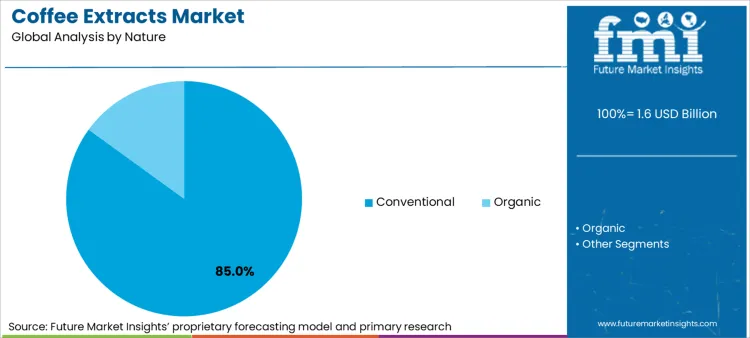
Based on nature, the market is divided into conventional and organic. Conventional green coffee extract has become so popular because of its health benefits and the fact that it is the rich source of chlorogenic acids. These acids are thought to have antioxidant and anti-inflammatory effects, which can possibly reduce the risk of heart and liver diseases.
Researchers have found that green coffee extract also helps in weight loss by decreasing the absorption of carbohydrates and increasing the metabolism of fats, and on the other hand, this extract is also able to balance the sugar in the blood while controlling blood pressure.
By End Use
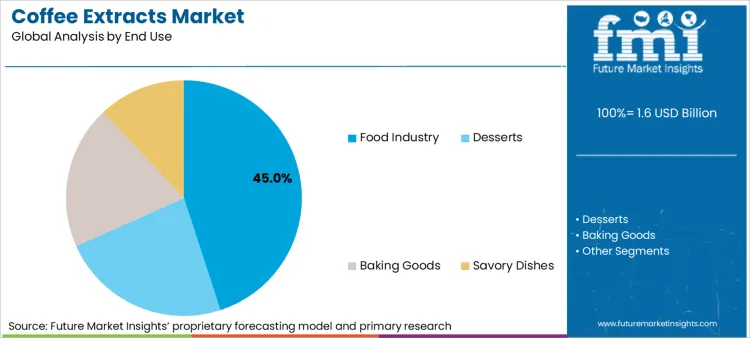
Based on end use, the market is divided into food industry, desserts, baking goods, savory dishes, beverage industry, pharmaceutical industry, and others.
The food market is the main user of coffee extracts, fueled by their varied uses across many foodstuffs. Coffee extracts, from roasted coffee beans, provide an intense source of coffee flavor and aroma, a staple ingredient for use in bakery, confectionery, dairy, and ready-to-drink (RTD) beverages.
By Product
Based on product, the market is divided into liquid concentrate, dried form, and capsules or tablets. Dried coffee extract's application in different industries is due to the fact that it can be kept for a long time, it is easy to store, and it is an excellent source of flavor and nutrients. The powdered or granulated forms of dried coffee extract, unlike the liquid forms, do not change and remain stable, which makes them fit for use in food manufacturing on a large scale.
By Formulation
Based on formulation, the market is divided into roasted and unroasted. The food, beverage, and pharmaceutical industries are the most significant consumers of roasted coffee extract because it is characterized by its full aroma, strong taste, and high caffeine content.
While the extract of green coffee has a lighter taste, the extract from roasted coffee gives the full-bodied, complex notes mainly associated with coffee from a brewer, which is the reason it is the first choice for ready-to-drink (RTD) beverages, bakery products, confectionery, and dairy applications. It is added to products such as coffee-flavored ice creams, chocolates, syrups, and protein shakes, making the product taste better and adding the coffee experience in a more natural way.
Market Definition
The coffee extracts market represents revenue generated from concentrated and processed coffee products sold for retail, foodservice, and industrial use. The market measures the value of liquid concentrates, cold brew extracts, freeze-dried and spray-dried soluble coffee, and specialty extraction outputs.
Inclusions cover liquid coffee concentrates, cold brew extracts, instant soluble coffee, coffee-infused beverage ingredients, and extraction technology outputs sold to food manufacturers and beverage formulators.
Exclusions include whole bean and ground coffee retail sales, coffee farming and green bean commodity trading revenue, and coffee shop operational revenue. Coffee machines and brewing equipment are outside the scope.
Country-wise Analysis
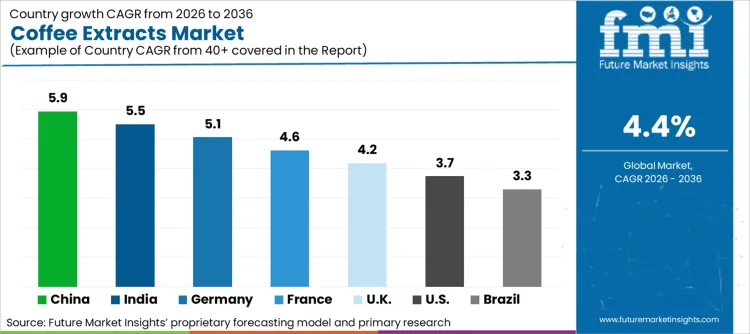
USA: Expansion of Home Brewing and Do-It-Yourself Coffee Culture
The popularity of home brewing has created strong demand for coffee extracts utilized in home-made coffee beverages. Buyers experimenting with cold brews, flavor lattes, and desserts infused with coffee are pushing the sales of powdered and liquid coffee extracts. Online shopping options and specialty food stores offering coffee extracts have contributed significantly to market penetration.
Brazil: Growing Demand for Specialty Coffee Drinks
Being globally recognized coffee producer, Brazil is on the road to extraordinary growth in the coffee extract market during 2025 to 2035. The surging demand for specialty coffee drinks and the rise of coffee-infused drinks with functional benefits will be the main drivers of that demand. Also, the inclusion of coffee extracts in cosmetic and skincare products will be the key factor for the opening of different potential markets in this country.
UK: Increase in Demand for High-end Coffee-Based Products
The market for coffee extracts in the UK is growing as the demand for premium and specialty coffee flavors continues to rise. There is a need for strong, fragrant coffee experiences, creating more demand for coffee extracts to be used in gourmet and artisan food items. The specialty coffee culture within the nation is prompting the use of extracts in chocolate, cakes, and sweets, further stimulating growth in the market.
Germany: Growing Demand for Organic and Fair-trade Coffee Extracts
Germany, which is Europe's main coffee consumer and market shareholder, is up for a consistent fragmentation of the market. Organic and fair-trade coffee extracts of high quality are predicted to be the most popular products, based on the increasing shift of climate-conscious consumers to those supplied sustainably. The country’s booming bakery and confectionery sector will also give a hand regarding the use of coffee extract in cakes, chocolates, and desserts.
China: Western Influence and Urban Coffee Culture
China's coffee market is growing rapidly with the rising impact of Western coffee drinking culture. Young urban consumers are acquiring a taste for coffee, and thus demand for coffee-flavored products is increasing. Coffee extracts are used extensively in instant coffee, RTD drinks, and desserts and are therefore a central ingredient in China's changing coffee culture.
Japan: Robust Demand for Ready-to-Drink Coffee
Japan boasts a mature RTD coffee market, with canned coffee drink products being found in vending machines and convenience stores. Coffee extracts are the essential ingredient in such pre-packaged drinks, providing consistency in taste and aroma. Smooth, mild coffee flavors have been in demand, which has triggered the demand for premium coffee extracts applied to both hot and cold RTD coffees.
Market Concentration
As per FMI analysis, the market remains concentrated due to growing sales by key players through different product lines and strategic replacements. Companies are putting money into high-quality, organic, and sustainable coffee extracts to cater to the food and beverage and wellness sectors.
Concentration of producers of coffee extracts in different regions varies. North America and Europe are the two regions that desire premium and specialty coffee extract the most, whereas Asia Pacific is the place where the market has the fastest growth owing to the increasing health awareness and convenience eating habits. The main players are making their way into untapped markets by launching e-commerce sites, the distribution of products directly to consumers, and partnerships with food manufacturers which help them in their effort to achieve market leadership in the global coffee extract sector.
Competitive Landscape
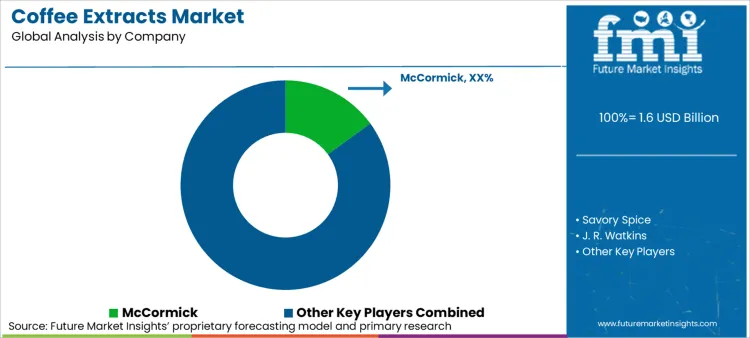
The coffee extract market is highly competitive, with the major players focusing on product innovation, sustainability, and expanding their global reach. Companies like Nestlé S.A., Döhler Group, Synergy Flavors, Kerry Group, and Naturex (Givaudan) are leading the way in the industry as they are the ones who provide the top-notch coffee extracts that are used in food, beverage, and nutraceuticals.
Nestlé keeps pushing on with its Nescafé and Nespresso ranges which now include both premium and organic coffee extracts. Döhler Group is all about natural and clean-label extracts, which corresponds to the trend of people wanting more plant-based and functional drinks.
The key strategies include the global expansion of operations, mergers and acquisitions, and green initiatives. Kerry Group has made strides in the field of sustainability by turning to responsible sourcing and carbon-neutral production, this is a decision that has proven to be in line with the ethical consumer preference. Synergy Flavors is a company focused on custom coffee extract solutions for flavored beverages as well as confectionery applications.
Naturex (Givaudan) pairs coffee with botanicals to optimize health benefits and targets the functional food market. Also, these businesses are maximizing their e-commerce, direct-to-consumer, and partnerships with food manufacturers to gain access and visibility thus paving the way for the long-term survival in the highly competitive coffee extract market.
Key Market Players
- McCormick
- Savory Spice
- J. R. Watkins
- NatureWise
- Sports Research
- Huntington
- SVETOL
- Health Plus
- Lumen
Recent Developments
- In August 2025, Keurig Dr Pepper entered into a definitive agreement to acquire JDE Peet's for approximately EUR 15.7 Billion (USD 18 Billion). The consolidation brings together KDP's North American single-serve platform with JDE Peet's global portfolio of soluble coffee and extract brands such as L'OR and Peet's, with a key focus on scaling liquid concentrate innovation.
- In December 2025, Finlays made a strategic investment in NewTree Fruit Company to scale its patented 'De-Sugaring' technology. Finlays plans to integrate this technology into its global extracts business to offer low-sugar, nutrition-led liquid coffee solutions, following its 2025 acquisition of Leahy-IFP.
- In May 2024, Nestle launched its premium Nescafe Espresso Concentrate targeting Australia and China as strategic testing grounds for the younger, cold-coffee-first demographic. The product utilizes Nestle's proprietary roasting and brewing technologies to create a high-solids liquid extract.
Research Scope
| Items | Values |
|---|---|
| Quantitative Units (2026) | USD 1.6 Billion |
| Product Type | Liqu id Concentrates, Cold Brew Extracts, Spray-Dried Soluble, Freeze-Dried Soluble |
| End Use | Retail, Foodservice, Industrial (Beverage Formulation, Confectionery) |
| Regions Covered | North America, Europe, Asia Pacific, Latin America, Middle East and Africa |
| Key Companies Profiled | Nestle, JDE Peet's (Keurig Dr Pepper), Tata Consumer Products, Finlays, Olam (ofi) |
Segmentation
By Nature:
With respect to nature, the market is classified into organic and conventional.
By Product:
In terms of product, the market is segmented into liquid concentrate, dried form, and capsules or tablets.
By End Use:
In terms of end use, the market is divided into food industry, desserts, baking goods, savory dishes, beverage industry, pharmaceutical industry, and others.
By Formulation:
In terms of formulation, the market is divided into roasted and unroasted.
By Region:
In terms of region, the market is segmented into North America, Europe, Asia Pacific, the Middle East & Africa, and Latin America.
Bibliography
- International Coffee Organization. (2024). Global Coffee Market Outlook. ICO.
- Nestle Malaysia. (2025, August). Launch of NESCAFE Espresso Concentrate at Sri Muda Factory. Nestle Malaysia Press.
- JDE Peet's N.V. (2025, August). Acquisition by Keurig Dr Pepper. JDE Peet's Investor Relations.
- Kerry Group. (2025, December). 2026 Taste Trends Report. Kerry Health and Nutrition Institute.
Frequently Asked Questions
How big is the coffee extract market?
The market is anticipated to reach USD 1.6 billion in 2026.
What is the outlook on coffee extract sales?
The market is predicted to reach a size of USD 2.4 billion by 2036.
Who are the key coffee extract companies?
Prominent players include McCormick, Savory Spice, J.R. Watkins, NatureWise, Sports Research, Huntington, SVETOL, Health Plus, and Lumen
Which country is likely to lead the market?
The USA is slated to dominate the market.
Preview the report firsthand - request a free sample
Get SampleGet the brochure for pricing and purchase details.
Get PDFTable of Content
- Executive Summary
- Global Market Outlook
- Demand-side Trends
- Supply-side Trends
- Technology Roadmap Analysis
- Analysis and Recommendations
- Market Overview
- Market Coverage / Taxonomy
- Market Definition / Scope / Limitations
- Research Methodology
- Chapter Orientation
- Analytical Lens and Working Hypotheses
- Market Structure, Signals, and Trend Drivers
- Benchmarking and Cross-market Comparability
- Market Sizing, Forecasting, and Opportunity Mapping
- Research Design and Evidence Framework
- Desk Research Programme (Secondary Evidence)
- Company Annual and Sustainability Reports
- Peer-reviewed Journals and Academic Literature
- Corporate Websites, Product Literature, and Technical Notes
- Earnings Decks and Investor Briefings
- Statutory Filings and Regulatory Disclosures
- Technical White Papers and Standards Notes
- Trade Journals, Industry Magazines, and Analyst Briefs
- Conference Proceedings, Webinars, and Seminar Materials
- Government Statistics Portals and Public Data Releases
- Press Releases and Reputable Media Coverage
- Specialist Newsletters and Curated Briefings
- Sector Databases and Reference Repositories
- FMI Internal Proprietary Databases and Historical Market Datasets
- Subscription Datasets and Paid Sources
- Social Channels, Communities, and Digital Listening Inputs
- Additional Desk Sources
- Expert Input and Fieldwork (Primary Evidence)
- Primary Modes
- Qualitative Interviews and Expert Elicitation
- Quantitative Surveys and Structured Data Capture
- Blended Approach
- Why Primary Evidence is Used
- Field Techniques
- Interviews
- Surveys
- Focus Groups
- Observational and In-context Research
- Social and Community Interactions
- Stakeholder Universe Engaged
- C-suite Leaders
- Board Members
- Presidents and Vice Presidents
- R&D and Innovation Heads
- Technical Specialists
- Domain Subject-matter Experts
- Scientists
- Physicians and Other Healthcare Professionals
- Governance, Ethics, and Data Stewardship
- Research Ethics
- Data Integrity and Handling
- Primary Modes
- Tooling, Models, and Reference Databases
- Desk Research Programme (Secondary Evidence)
- Data Engineering and Model Build
- Data Acquisition and Ingestion
- Cleaning, Normalisation, and Verification
- Synthesis, Triangulation, and Analysis
- Quality Assurance and Audit Trail
- Market Background
- Market Dynamics
- Drivers
- Restraints
- Opportunity
- Trends
- Scenario Forecast
- Demand in Optimistic Scenario
- Demand in Likely Scenario
- Demand in Conservative Scenario
- Opportunity Map Analysis
- Product Life Cycle Analysis
- Supply Chain Analysis
- Investment Feasibility Matrix
- Value Chain Analysis
- PESTLE and Porter’s Analysis
- Regulatory Landscape
- Regional Parent Market Outlook
- Production and Consumption Statistics
- Import and Export Statistics
- Market Dynamics
- Global Market Analysis 2021 to 2025 and Forecast, 2026 to 2036
- Historical Market Size Value (USD Million) Analysis, 2021 to 2025
- Current and Future Market Size Value (USD Million) Projections, 2026 to 2036
- Y-o-Y Growth Trend Analysis
- Absolute $ Opportunity Analysis
- Global Market Pricing Analysis 2021 to 2025 and Forecast 2026 to 2036
- Global Market Analysis 2021 to 2025 and Forecast 2026 to 2036, By Nature
- Introduction / Key Findings
- Historical Market Size Value (USD Million) Analysis By Nature , 2021 to 2025
- Current and Future Market Size Value (USD Million) Analysis and Forecast By Nature , 2026 to 2036
- Conventional
- Organic
- Conventional
- Y-o-Y Growth Trend Analysis By Nature , 2021 to 2025
- Absolute $ Opportunity Analysis By Nature , 2026 to 2036
- Global Market Analysis 2021 to 2025 and Forecast 2026 to 2036, By End Use
- Introduction / Key Findings
- Historical Market Size Value (USD Million) Analysis By End Use, 2021 to 2025
- Current and Future Market Size Value (USD Million) Analysis and Forecast By End Use, 2026 to 2036
- Food Industry
- Desserts
- Baking Goods
- Savory Dishes
- Food Industry
- Y-o-Y Growth Trend Analysis By End Use, 2021 to 2025
- Absolute $ Opportunity Analysis By End Use, 2026 to 2036
- Global Market Analysis 2021 to 2025 and Forecast 2026 to 2036, By Region
- Introduction
- Historical Market Size Value (USD Million) Analysis By Region, 2021 to 2025
- Current Market Size Value (USD Million) Analysis and Forecast By Region, 2026 to 2036
- North America
- Latin America
- Western Europe
- Eastern Europe
- East Asia
- South Asia and Pacific
- Middle East & Africa
- Market Attractiveness Analysis By Region
- North America Market Analysis 2021 to 2025 and Forecast 2026 to 2036, By Country
- Historical Market Size Value (USD Million) Trend Analysis By Market Taxonomy, 2021 to 2025
- Market Size Value (USD Million) Forecast By Market Taxonomy, 2026 to 2036
- By Country
- USA
- Canada
- Mexico
- By Nature
- By End Use
- By Country
- Market Attractiveness Analysis
- By Country
- By Nature
- By End Use
- Key Takeaways
- Latin America Market Analysis 2021 to 2025 and Forecast 2026 to 2036, By Country
- Historical Market Size Value (USD Million) Trend Analysis By Market Taxonomy, 2021 to 2025
- Market Size Value (USD Million) Forecast By Market Taxonomy, 2026 to 2036
- By Country
- Brazil
- Chile
- Rest of Latin America
- By Nature
- By End Use
- By Country
- Market Attractiveness Analysis
- By Country
- By Nature
- By End Use
- Key Takeaways
- Western Europe Market Analysis 2021 to 2025 and Forecast 2026 to 2036, By Country
- Historical Market Size Value (USD Million) Trend Analysis By Market Taxonomy, 2021 to 2025
- Market Size Value (USD Million) Forecast By Market Taxonomy, 2026 to 2036
- By Country
- Germany
- UK
- Italy
- Spain
- France
- Nordic
- BENELUX
- Rest of Western Europe
- By Nature
- By End Use
- By Country
- Market Attractiveness Analysis
- By Country
- By Nature
- By End Use
- Key Takeaways
- Eastern Europe Market Analysis 2021 to 2025 and Forecast 2026 to 2036, By Country
- Historical Market Size Value (USD Million) Trend Analysis By Market Taxonomy, 2021 to 2025
- Market Size Value (USD Million) Forecast By Market Taxonomy, 2026 to 2036
- By Country
- Russia
- Poland
- Hungary
- Balkan & Baltic
- Rest of Eastern Europe
- By Nature
- By End Use
- By Country
- Market Attractiveness Analysis
- By Country
- By Nature
- By End Use
- Key Takeaways
- East Asia Market Analysis 2021 to 2025 and Forecast 2026 to 2036, By Country
- Historical Market Size Value (USD Million) Trend Analysis By Market Taxonomy, 2021 to 2025
- Market Size Value (USD Million) Forecast By Market Taxonomy, 2026 to 2036
- By Country
- China
- Japan
- South Korea
- By Nature
- By End Use
- By Country
- Market Attractiveness Analysis
- By Country
- By Nature
- By End Use
- Key Takeaways
- South Asia and Pacific Market Analysis 2021 to 2025 and Forecast 2026 to 2036, By Country
- Historical Market Size Value (USD Million) Trend Analysis By Market Taxonomy, 2021 to 2025
- Market Size Value (USD Million) Forecast By Market Taxonomy, 2026 to 2036
- By Country
- India
- ASEAN
- Australia & New Zealand
- Rest of South Asia and Pacific
- By Nature
- By End Use
- By Country
- Market Attractiveness Analysis
- By Country
- By Nature
- By End Use
- Key Takeaways
- Middle East & Africa Market Analysis 2021 to 2025 and Forecast 2026 to 2036, By Country
- Historical Market Size Value (USD Million) Trend Analysis By Market Taxonomy, 2021 to 2025
- Market Size Value (USD Million) Forecast By Market Taxonomy, 2026 to 2036
- By Country
- Kingdom of Saudi Arabia
- Other GCC Countries
- Turkiye
- South Africa
- Other African Union
- Rest of Middle East & Africa
- By Nature
- By End Use
- By Country
- Market Attractiveness Analysis
- By Country
- By Nature
- By End Use
- Key Takeaways
- Key Countries Market Analysis
- USA
- Pricing Analysis
- Market Share Analysis, 2025
- By Nature
- By End Use
- Canada
- Pricing Analysis
- Market Share Analysis, 2025
- By Nature
- By End Use
- Mexico
- Pricing Analysis
- Market Share Analysis, 2025
- By Nature
- By End Use
- Brazil
- Pricing Analysis
- Market Share Analysis, 2025
- By Nature
- By End Use
- Chile
- Pricing Analysis
- Market Share Analysis, 2025
- By Nature
- By End Use
- Germany
- Pricing Analysis
- Market Share Analysis, 2025
- By Nature
- By End Use
- UK
- Pricing Analysis
- Market Share Analysis, 2025
- By Nature
- By End Use
- Italy
- Pricing Analysis
- Market Share Analysis, 2025
- By Nature
- By End Use
- Spain
- Pricing Analysis
- Market Share Analysis, 2025
- By Nature
- By End Use
- France
- Pricing Analysis
- Market Share Analysis, 2025
- By Nature
- By End Use
- India
- Pricing Analysis
- Market Share Analysis, 2025
- By Nature
- By End Use
- ASEAN
- Pricing Analysis
- Market Share Analysis, 2025
- By Nature
- By End Use
- Australia & New Zealand
- Pricing Analysis
- Market Share Analysis, 2025
- By Nature
- By End Use
- China
- Pricing Analysis
- Market Share Analysis, 2025
- By Nature
- By End Use
- Japan
- Pricing Analysis
- Market Share Analysis, 2025
- By Nature
- By End Use
- South Korea
- Pricing Analysis
- Market Share Analysis, 2025
- By Nature
- By End Use
- Russia
- Pricing Analysis
- Market Share Analysis, 2025
- By Nature
- By End Use
- Poland
- Pricing Analysis
- Market Share Analysis, 2025
- By Nature
- By End Use
- Hungary
- Pricing Analysis
- Market Share Analysis, 2025
- By Nature
- By End Use
- Kingdom of Saudi Arabia
- Pricing Analysis
- Market Share Analysis, 2025
- By Nature
- By End Use
- Turkiye
- Pricing Analysis
- Market Share Analysis, 2025
- By Nature
- By End Use
- South Africa
- Pricing Analysis
- Market Share Analysis, 2025
- By Nature
- By End Use
- USA
- Market Structure Analysis
- Competition Dashboard
- Competition Benchmarking
- Market Share Analysis of Top Players
- By Regional
- By Nature
- By End Use
- Competition Analysis
- Competition Deep Dive
- McCormick
- Overview
- Product Portfolio
- Profitability by Market Segments (Product/Age /Sales Channel/Region)
- Sales Footprint
- Strategy Overview
- Marketing Strategy
- Product Strategy
- Channel Strategy
- Savory Spice
- J. R. Watkins
- NatureWise
- Sports Research
- Lumen
- McCormick
- Competition Deep Dive
- Assumptions & Acronyms Used


