

- Market Size (2026)
- USD 168.0 Mn
- Forecast (2036)
- USD 1892.4 Mn
- CAGR (2026 to 2036)
- 27.4%
How big is Cultivated Coffee & Cell-Based Beverage Ingredients Market in 2026?
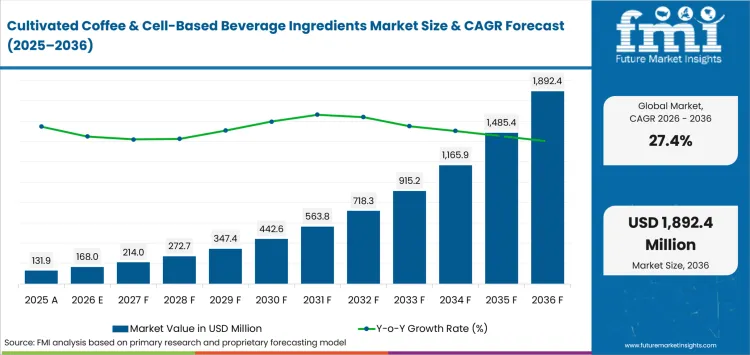
USD 168.0 million in 2026 and USD 1,892.4 million by 2036 at a 27.4% CAGR.
Sales of cultivated coffee and cell-based beverage ingredients are projected to expand at 27.4% CAGR from 2026 to 2036. The valuation is estimated to rise from USD 168.0 million in 2026 to USD 1892.4 million by 2036. The category uses plant cell culture to produce coffee biomass and taste precursors inside controlled bioreactors. USDA FAS reported in December 2025 that world coffee production was lowered by 900,000 bags from the June estimate to 175.3 million bags. That revision gives beverage companies a practical reason to test controlled coffee inputs. Commercial orders are expected to follow only when taste and caffeine profile stay stable through storage at plant scale.
Technical proof is still separate from commercial adoption. An August 2024 ACS study involving VTT found differences in caffeine and chlorogenic acids between cell-cultured coffee and farm-grown coffee. The same work found differences in aroma intensity and precursor chemistry. Beverage teams are expected to approve broader use after sensory panels match the planned ready-to-drink coffee or foodservice format.
Key Takeaways of Cultivated Coffee & Cell-Based Beverage Ingredients Market
- Demand for cultivated coffee and cell-based beverage ingredients is shaped by the need to reduce dependence on farm-grown supply, manage input cost variation, and maintain consistent sensory profile and caffeine levels across beverage production.
- By product, Cultivated Coffee holds 50.9% share in 2026, while RTD accounts for 56.1% share in 2026 within application, reflecting alignment with familiar coffee formats and controlled launch routes through fixed-recipe, shelf-stable beverages.
- Singapore leads country growth at 31.5% CAGR through 2036, followed by the USA at 31.1% and the UK at 30.7%, shaped by regulatory pathways, food-technology infrastructure, and consumer readiness.
- Competition centers on Atomo Coffee, Compound Foods, Prefer, Food Brewer, The Cultured Hub, and Coffeesai, with differentiation spanning bean-free formats, B2B applications, plant-cell scale-up, and application testing.
- Batch sensory repeatability, regulatory documentation, caffeine consistency, and ingredient performance through heat treatment and storage remain key considerations for wider commercial adoption.
- Commercial expansion is expected to follow measured performance in cultivated coffee and RTD applications, with procurement approval contingent on pilot batch results demonstrating stable taste across production runs.
Analyst Perspective
"The cultivated coffee & cell-based beverage ingredients market is moving from proof of concept toward commercial validation. Beverage manufacturers are evaluating sensory consistency, batch repeatability, regulatory readiness, and formulation performance under routine production conditions. Suppliers that demonstrate scalable quality, clear specifications, and reliable application support will be better positioned to expand adoption across cultivated coffee and ready-to-drink formulations."
— Nandini Roy Choudhury, Principal Analyst at Future Market Insights
Source: FMI's proprietary forecasting model and primary research
How is the Cultivated Coffee & Cell-Based Beverage Ingredients Market segmented?
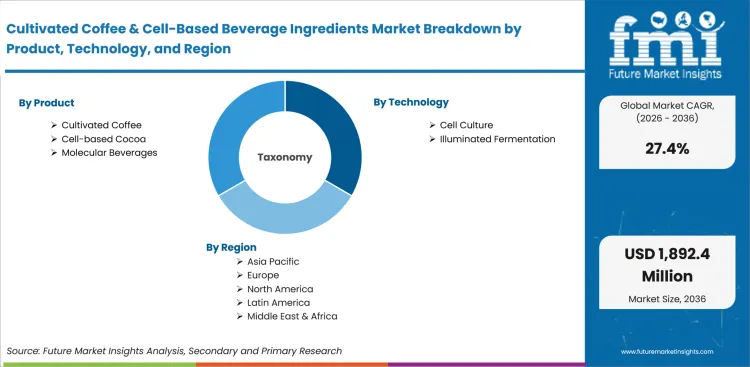
The market is analyzed by Product, Technology, Application, and Region.
The segmentation framework separates ingredient output from the production route and the launch format. Product analysis covers Cultivated Coffee, Cell-based Cocoa, Molecular Beverages, Coffee Aroma Precursors, and Botanical Beverage Bases. Technology analysis covers Cell Culture, Precision Fermentation, Biomass Fermentation, Ingredient Extraction and Drying, and Sensory or Analytical Validation. Application analysis follows RTD, Foodservice, B2B Beverage Concentrates, Powdered Mixes, and CPG Product Development. Regional analysis shows how approval routes and food-tech manufacturing capability affect adoption across country markets.
What supports demand for cultivated coffee within the product category?
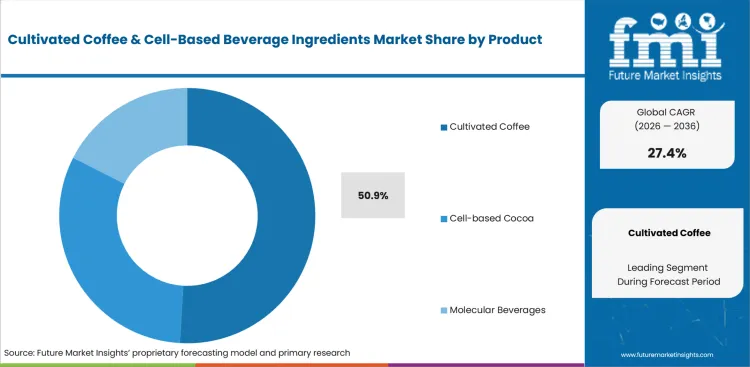
Cultivated Coffee is the first product test for many beverage companies because its target taste is easy to compare with farm-grown coffee. It still carries a high proof burden. Developers must show that the ingredient works after extraction and drying. They need evidence that the finished drink holds its taste through storage.
- With an estimated 50.9% of Product revenue in 2026, cultivated coffee is anticipated to lead through its close fit with familiar coffee formats. The segment gives developers a clear target for roast profile and caffeine profile. Commercial approval depends on repeatable taste after processing and storage.
- Beverage teams are expected to test Cultivated Coffee through concentrates and RTD formats before they move into broad retail packs. This sequence limits reformulation risk and gives companies time to prepare safety and label documents around the final ingredient form.
Why does cell culture lead within the technology category?
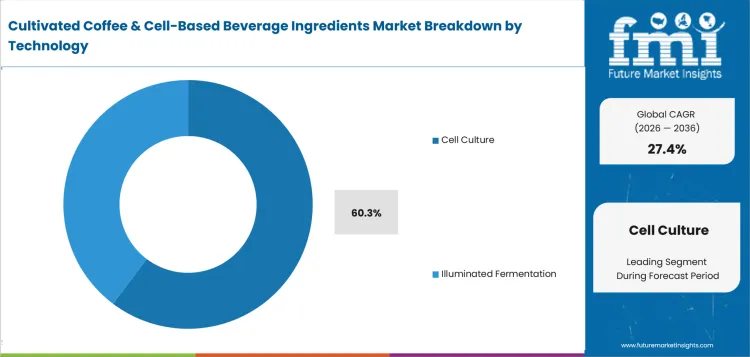
Cell Culture leads because it is the core route used to grow coffee or cocoa plant cells under controlled conditions. The method gives developers more control over inputs and process records than field-grown supply. That control becomes commercially useful only when cell lines grow consistently in larger vessels. Ingredient companies therefore evaluate yield and sensory output together before any production commitment.
- By Technology, Cell Culture is expected to dominate with 60.3% share in 2026 since it controls the core biomass production step. The method allows companies to test media composition and growth conditions before downstream drying or extraction begins.
- Manufacturers compare Cell Culture projects through batch stability and processing cost. A lower-cost medium helps only if sensory results remain acceptable. The preferred system is expected to be the one that keeps taste variation within a narrow range across repeated batches.
What makes RTD central to the application category?
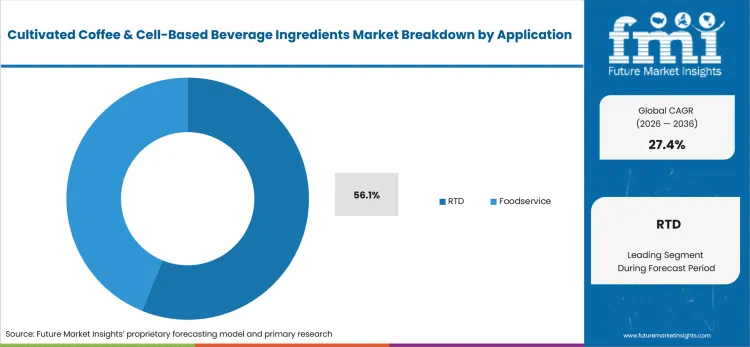
RTD formats give cultivated coffee developers a controlled launch route. The drink recipe is set before filling and the product can be checked after storage. This makes the application easier to measure than open-ended café use. Developers still need to prove that the ingredient holds taste and color under heat treatment or cold-chain handling.
- Stable bottled and canned formats mean RTD is forecast to hold 56.1% of Application revenue in 2026. The format gives product teams a fixed recipe and a clear shelf-life test before wider distribution.
- RTD beverage companies are expected to approve cultivated coffee only after processing tests match label and taste requirements. Pilot batches can show whether the ingredient survives filling and normal storage. Wider placement depends on repeatable results across more than one production run.
What are the drivers, restraints, and opportunities in the Cultivated Coffee & Cell-Based Beverage Ingredients Market?
High coffee price pressure, novel-food approval requirements, and staged application testing are shaping demand for cultivated coffee and cell-based beverage ingredients.
- Driver: coffee cost volatility is expected to raise interest in controlled production routes.
- Restraint: approval files require product-specific safety and process evidence.
- Opportunity: powders and RTD pilots allow staged launches before broader retail supply.
Demand is expected to be driven by coffee-cost volatility and the need for more predictable ingredient planning. The International Coffee Organization reported in December 2025 that its Composite Indicator Price averaged 304.68 US cents per pound. The price level makes controlled coffee inputs easier to justify during product development. It still does not remove the need for sensory proof. Purchasing teams are expected to compare cultivated ingredients with existing coffee contracts before recurring orders begin.
Regulatory proof remains the main restraint because cultivated coffee is a novel input in most launch markets. SFA guidance updated in December 2025 requires applicants to submit information listed in its safety assessment requirements. The same guidance says changed cell lines or culture media can require approval again. This matters for plant cell culture because a small process change may alter composition. Companies need a stable production file before they ask for retail or foodservice approval.
The primary opportunity is concentrated in staged export testing. Export-focused programmes support market research and customer identification before international launch. That type of funding is expected to help cultivated ingredient companies test partners before they scale. The route is most useful when plant-based food ingredients move from pilot recipes to recurring supply agreements.
Which country CAGRs are profiled in the Cultivated Coffee & Cell-Based Beverage Ingredients Market?
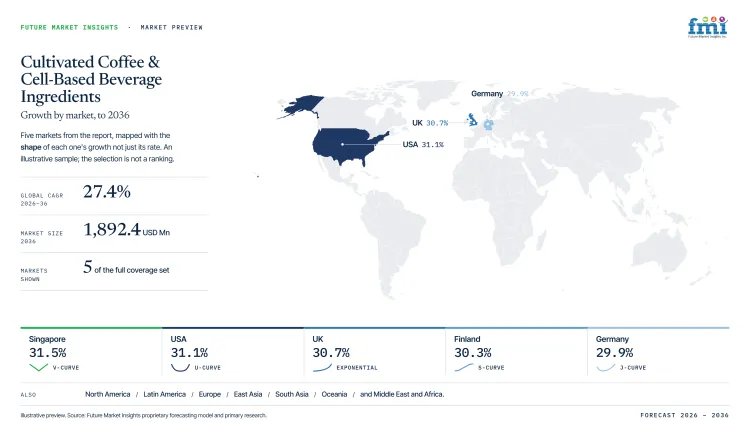
| Country | CAGR |
|---|---|
| Singapore | 31.5% |
| USA | 31.1% |
| UK | 30.7% |
| Finland | 30.3% |
| Germany | 29.9% |
How do country-level CAGRs compare in the Cultivated Coffee & Cell-Based Beverage Ingredients Market?
A global growth rate represents the weighted average of all markets included in the analysis. It therefore does not need to match the growth rate of each country shown in the comparison. The five countries presented are illustrative markets within the wider coverage set. Their comparison with the global figure shows that country-level growth can vary according to approval timing and commercial readiness.
- The countries are distinguished less by their CAGRs, which remain within a narrow range of 1.6 percentage points, and more by their different routes to market development.
- Singapore and the USA form a closely aligned upper group with only a limited difference between their growth rates. Singapore benefits from a compact food-technology ecosystem and a structured novel-food approval framework. The USA follows a different route through food-tech investment and RTD product testing before wider retail expansion.
- The UK and Finland occupy closely spaced middle positions. UK market development is supported by online product testing and regulated-product authorization routes. Finland depends more heavily on cellular-agriculture research and public funding while export partnerships remain important for commercial scale.
- Germany is positioned slightly outside the upper group but remains closely connected to the other markets. Its established coffee industry provides a broad testing base for cultivated ingredients. However EU novel-food dossier requirements may extend the period between sensory validation and commercial supply.
- Markets with broadly similar CAGRs can therefore present substantially different entry conditions. These differences become relevant when comparing approval schedules and production partnerships across the countries covered.
The full report examines these dynamics for every market included in the study. It provides country-level CAGR analysis across North America, Latin America, Europe, East Asia, South Asia, Oceania, and the Middle East and Africa.
Country-wise Analysis
- USA demand is expected to advance through RTD testing and food-ingredient review work. The USA is projected to post 31.1% CAGR from 2026 to 2036. The USA Census Bureau reported in May 2026 that e-commerce accounted for 16.9% of retail sales in the first quarter. The share gives beverage brands a direct route to trial cans and limited runs before they commit supermarket space. FDA GRAS Notice GRN 1242 closed in July 2025 for short-chain fructooligosaccharides at use levels from 0.4% to 15% across beverages and other foods. That figure shows why cultivated coffee dossiers need clear composition and intended-use data before routine beverage supply. US launch plans should test taste stability and regulatory status as separate gates.
- Singapore offers a compact test market with active food-tech regulation. Sales in Singapore are forecast to rise at 31.5% CAGR through 2036. Enterprise Singapore and IMDA launched a refreshed Food Manufacturing Industry Digital Plan in February 2026 to guide over 1,500 food manufacturers. That support can help food producers add digital records and quality checks around novel ingredients. SFA reported in May 2026 that Singapore imports more than 90% of its food and sourced food from over 180 countries and regions in 2025. The import position is expected to keep interest in controlled production routes high. Companies still need SFA pre-market approval before supply.
- Germany gives cultivated coffee developers a large coffee comparison base and a formal EU approval route. The German market is estimated to record 29.9% CAGR during the forecast period. Destatis reported in June 2025 that Germany imported 1.25 million tonnes of raw and roasted coffee in 2024. The same release said April 2025 import prices for unroasted coffee beans were 53.1% higher than one year earlier. This figure shows trial interest because roasters and beverage companies face both volume exposure and cost pressure. EFSA stated in May 2026 that novel food applications move through pre-submission and submission before risk assessment and post-adoption work. German commercialization needs early dossier planning so testing does not stall after a positive sensory trial.
- Finland has a strong research base for cellular agriculture and plant cell culture scale-up. Demand in Finland is anticipated to expand at 30.3% CAGR by 2036. Business Finland reported in April 2025 that cellular agriculture could generate EUR 500-1,000 million in Finnish export potential by 2035. The same release said Business Finland had granted around EUR 90 million in R&D funding to cellular agriculture companies from 2018 to 2025. That public support strengthens the case for pilot equipment and export-facing ingredient work. Finnish developers still need partners outside the domestic market because local beverage volume is limited.
- UK demand is expected to develop through online retail testing and a visible regulated-products route. The UK is forecast to record 30.7% CAGR from 2026 to 2036. ONS reported in June 2026 that online spending values rose 9.8% compared with the three months to May 2025. This gives RTD and direct-to-consumer coffee alternatives a route for small launch batches with measurable reorder data. FSA and FSS listed 173 novel food authorisations in the GB register updated in March 2026. The regulated product applications register showed 448 entries in July 2026. UK plans should allow time for authorisation work and claims review before broad retail rollout.
Which companies are the notable providers in the Cultivated Coffee & Cell-Based Beverage Ingredients Market??
Atomo Coffee, Compound Foods, Prefer, Food Brewer, The Cultured Hub, and Coffeesai are the notable providers shaping this market.
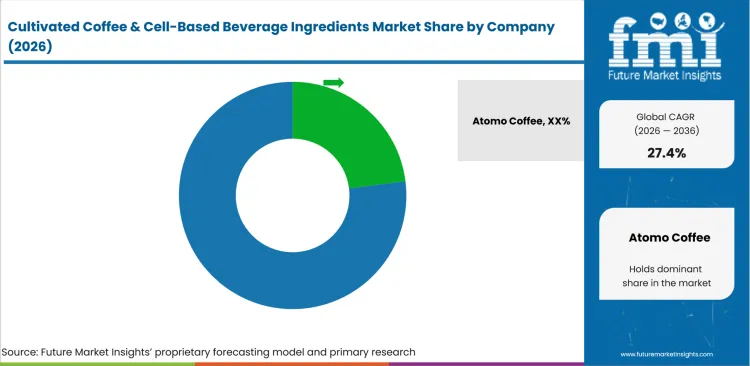
The competitive outlook remains early and divided across two groups. One group works on bean-free or coffee-like beverage ingredients that can enter tasting and sampling channels. The second group supports plant cell culture scale-up and application testing. Providers are expected to compete through taste proof and process repeatability before they compete through capacity alone.
- Atomo Coffee and Compound Foods give the market consumer-facing and B2B reference points for bean-free coffee formats. Their role is useful for beverage companies that want familiar taste before they evaluate full cultivated-coffee supply.
- Prefer and Food Brewer are relevant to ingredient development because both are tied to coffee or cocoa alternatives. Their commercial test is whether powders and concentrates can meet food-manufacturer handling needs.
- The Cultured Hub and Coffeesai support the plant-cell route through scale-up access and stabilized coffee cell-line work. Their role is expected to grow where early-stage companies need validation partners before building dedicated facilities.
Competitive Benchmarking: Cultivated Coffee & Cell-Based Beverage Ingredients Market
| Company | Market Role | Technology Position | Application Fit | Geographic Reach |
|---|---|---|---|---|
| Atomo Coffee | Bean-free coffee formats | Medium | Retail and foodservice trials | United States and online channels |
| Compound Foods | Bean-free coffee ingredients | Medium | B2B beverage formats | United States |
| Prefer | Fermented coffee and cocoa alternatives | High | Soluble powders and B2B food use | Singapore and export markets |
| Food Brewer | Plant cell-culture ingredient developer | High | Coffee and cocoa cell-culture work | Europe |
| The Cultured Hub | Scale-up and validation infrastructure | High | Pilot and process development support | Europe |
| Coffeesai | Coffee cell-line development | Medium | Plant-cell coffee validation | Europe |
Key Developments in the Cultivated Coffee & Cell-Based Beverage Ingredients Market
- In August 2025, Prefer listed the launch of soluble coffee and cocoa powders for food-industry customers. The release supports B2B trial formats for beverage and food applications. It gives product teams a powder route before refrigerated RTD testing begins.
- In December 2025, The Cultured Hub expanded its service offer into plant cell culturing for cocoa and coffee along with other ingredients. The announcement added a scale-up route for plant-cell ingredient developers. It can reduce pilot risk for start-ups that are not ready to build dedicated bioprocessing assets.
Key Players in the Cultivated Coffee & Cell-Based Beverage Ingredients Market
Bean-Free Coffee and Beverage-Format Providers
- Atomo Coffee
- Compound Foods
- Prefer
Plant Cell-Culture Ingredient Developers
- Food Brewer
- Coffeesai
Scale-Up and Validation Platforms
- The Cultured Hub
Cultivated Coffee & Cell-Based Beverage Ingredients Market - Report Scope
| Coverage field | Report scope |
|---|---|
| Market breakdown | Product, technology, application, and region. |
| Quantitative Units | Revenue in USD Million, CAGR in %. |
| Market Definition | Cultivated coffee and related cell-based beverage ingredients produced through plant cell culture, fermentation, or adjacent controlled production routes for beverage and food applications. |
| Regions Covered | North America, Latin America, Europe, East Asia, South Asia, Oceania, and Middle East and Africa. |
| Countries Covered | USA, Singapore, Germany, Finland, and UK, with wider coverage across more than 30 countries. |
| Key Companies Profiled | Atomo Coffee, Compound Foods, Prefer, Food Brewer, The Cultured Hub, and Coffeesai |
| Forecast Period | 2026 to 2036. |
| Approach | Hybrid bottom-up and top-down market sizing supported by primary interviews and official desk research. |
Cultivated Coffee & Cell-Based Beverage Ingredients Market - Research Methodology
| Method | Approach |
|---|---|
| Primary Research | FMI analysts gathered input from manufacturers, service providers, technology developers, distributors, end users, procurement teams, and subject-matter experts. Interviews examined purchasing decisions, product or service evaluation, adoption barriers, approval requirements, pricing considerations, and expectations for technical or commercial support. Respondents were also asked what evidence is required before a trial, pilot, or initial order develops into regular purchasing. |
| Desk Research | Desk research covered government statistics, regulatory publications, trade data, industry associations, technical literature, standards, company filings, product information, and official corporate announcements. Sources were reviewed for relevance, publication date, geographic coverage, and consistency with the defined market scope. Claims relating to performance, applications, approvals, capacity, investment, and commercial activity were retained only when supported by credible public evidence. |
| Market Sizing and Forecasting | The market model combined the baseline value with historical performance, segment structure, pricing and volume indicators, adoption levels, company participation, and country-level demand conditions. Forecast assumptions considered economic activity, investment trends, regulatory developments, technology adoption, purchasing cycles, supply availability, and barriers to wider market use. Segment and regional estimates were reconciled before the final market total was calculated. |
| Data Validation | Estimates were checked against multiple independent indicators, including public data, company activity, trade patterns, industry developments, and findings from primary interviews. Validation also tested whether products, services, applications, and company revenues fell within the defined market boundaries. Adjacent categories, unsupported claims, overlapping revenues, and activities without direct market relevance were excluded to reduce double counting and maintain consistency across segments and countries. |
Cultivated Coffee & Cell-Based Beverage Ingredients Market by Segments
Cultivated Coffee & Cell-Based Beverage Ingredients Market segmented by Product:
- Cultivated Coffee
- Cell-based Cocoa
- Molecular Beverages
- Coffee Aroma Precursors
- Botanical Beverage Bases
Cultivated Coffee & Cell-Based Beverage Ingredients Market segmented by Technology:
- Cell Culture
- Precision Fermentation
- Biomass Fermentation
- Ingredient Extraction and Drying
- Sensory and Analytical Validation
Cultivated Coffee & Cell-Based Beverage Ingredients Market segmented by Application:
- RTD
- Foodservice
- B2B Beverage Concentrates
- Powdered Mixes
- CPG Product Development
Cultivated Coffee & Cell-Based Beverage Ingredients Market by Region:
- North America
- United States
- Canada
- Latin America
- Brazil
- Mexico
- Argentina
- Chile
- Western Europe
- Germany
- France
- United Kingdom
- Italy
- Spain
- Benelux
- Nordics
- Eastern Europe
- Poland
- Czech Republic
- Romania
- Hungary
- East Asia
- China
- Japan
- South Korea
- South Asia and Pacific
- India
- ASEAN
- Australia and New Zealand
- Middle East and Africa
- GCC Countries
- South Africa
- Türkiye
- Israel
Research Sources and Bibliography
- USA Department of Agriculture, Foreign Agricultural Service. (2025, December). Coffee: World Markets and Trade.
- International Coffee Organization. (2025, December). I-CIP falls on easing of supply concerns.
- USA Census Bureau. (2026, May). Quarterly Retail E-Commerce Sales Report.
- Enterprise Singapore. (2026, February 9). Refreshed Industry Digital Plan to support over 1,500 food manufacturers in accelerating technology adoption.
- European Food Safety Authority. (2026, May 6). Novel food application procedure.
- Office for National Statistics. (2026, June 19). Retail sales, Great Britain: May 2026.
- Food Standards Agency. (2026, July 1). Register of regulated product applications.
- Prefer. (2025, August 12). Prefer Launches Soluble Coffee and Cocoa Powders for the food industry.
- Bühler Group. (2025, December 17). The Cultured Hub unveils plant cell culturing for cocoa, coffee, and other ingredients.
This bibliography is provided for reader reference and is not exhaustive. The full report contains the complete reference list and detailed citations.
This Report Answers
- How large is the cultivated coffee & cell-based beverage ingredients market in 2026 and 2036?
- Which product and technology categories lead demand in 2026?
- Why does Cultivated Coffee lead the Product category?
- How do regulatory approval routes affect country-level growth?
- Which companies are notable providers in cultivated coffee and cell-based beverage ingredients?
- What are the main drivers and restraints affecting commercialization?
Frequently Asked Questions
How big is the Cultivated Coffee & Cell-Based Beverage Ingredients Market in 2026?
The cultivated coffee and cell-based beverage ingredients market is valued at USD 168.0 million in 2026 and is forecast to reach USD 1892.4 million by 2036, rising from USD 131.9 million in 2025.
What is the CAGR of the Cultivated Coffee & Cell-Based Beverage Ingredients Market from 2026 to 2036?
The cultivated coffee and cell-based beverage ingredients market is projected to grow at a CAGR of 27.4% between 2026 and 2036, supported by rising coffee cost volatility and growing demand for controlled, consistent ingredient production routes.
What is a notable restraint in the cultivated coffee and cell-based beverage ingredients market?
Novel-food approval requirements create a significant barrier because developers need product-specific safety and process evidence. Changes in cell lines or culture media may also require additional review before commercial supply begins.
Which product leads the Cultivated Coffee & Cell-Based Beverage Ingredients Market?
Cultivated Coffee accounts for 50.9% of the cultivated coffee and cell-based beverage ingredients market by product in 2026, driven by its close fit with familiar coffee taste, aroma, and caffeine profiles that beverage developers can benchmark against farm-grown standards.
Which country is growing fastest in the Cultivated Coffee & Cell-Based Beverage Ingredients Market?
The cultivated coffee and cell-based beverage ingredients market in Singapore is projected to grow at a CAGR of 31.5% through 2036, supported by a compact food-technology ecosystem and a structured novel-food approval framework that accelerates commercial readiness for alternative ingredients.
Who are the leading companies in the Cultivated Coffee & Cell-Based Beverage Ingredients Market?
Leading companies in the cultivated coffee and cell-based beverage ingredients market include Atomo Coffee, Compound Foods, Prefer, Food Brewer, The Cultured Hub, and Coffeesai, spanning bean-free beverage formats, plant cell-culture development, and scale-up validation platforms.
Preview the report firsthand - request a free sample
Get SampleGet the brochure for pricing and purchase details.
Get PDFTable of Content
- Key Takeaways
- Market Size and CAGR
- Top Growth Driver
- Fastest Growing Segment
- Leading Region
- Key Companies
- Emerging Opportunities
- Executive Summary
- Global Market Outlook
- Demand-side Trends
- Supply-side Trends
- Technology Roadmap Analysis
- Analysis and Recommendations
- Analyst Perspective (What is happening? Why now? What should investors know?)
- Key Questions Answered
- How large is the market?
- What is the CAGR?
- What are key trends?
- Which region dominates?
- Who are the leaders?
- Market Overview
- Market Coverage / Taxonomy
- Market Definition / Scope / Limitations
- Research Methodology
- Chapter Orientation
- Analytical Lens and Working Hypotheses
- Market Structure, Signals, and Trend Drivers
- Benchmarking and Cross-market Comparability
- Market Sizing, Forecasting, and Opportunity Mapping
- Research Design and Evidence Framework
- Desk Research Programme (Secondary Evidence)
- Expert Input and Fieldwork (Primary Evidence)
- Tooling, Models, and Reference Databases
- Data Engineering and Model Build
- Quality Assurance and Audit Trail
- Market Background
- Market Dynamics (Drivers, Restraints, Opportunity, Trends)
- Scenario Forecast (Optimistic, Likely, Conservative)
- Impact Analysis
- AI Impact
- Sustainability Impact
- Regulatory Impact
- Technology Impact
- Consumer / Buyer Analysis
- Purchase Drivers
- Adoption Barriers
- Buyer Journey
- Opportunity Map Analysis
- Product Life Cycle Analysis
- Supply Chain Analysis
- Investment Feasibility Matrix
- Value Chain Analysis
- PESTLE and Porter's Analysis
- Regulatory Landscape
- Regional Parent Market Outlook
- Production and Consumption Statistics
- Import and Export Statistics
- Global Market Analysis and Forecast, 2021 to 2036
- Historical Market Size Value (USD Million) Analysis, 2021 to 2025
- Current and Future Market Size Value (USD Million) Projections, 2026 to 2036
- Y-o-Y Growth Trend Analysis
- Absolute $ Opportunity Analysis
- Global Market Pricing Analysis, 2021 to 2036
- Global Market Analysis and Forecast, By Product, 2021 to 2036
- Introduction / Key Findings
- Historical Market Size Value (USD Million) Analysis By Product, 2021 to 2025
- Current and Future Market Size Value (USD Million) Analysis and Forecast By Product, 2026 to 2036
- Cultivated Coffee
- Cell-based Cocoa
- Molecular Beverages
- Cultivated Coffee
- Y-o-Y Growth Trend Analysis By Product, 2021 to 2025
- Absolute $ Opportunity Analysis By Product, 2026 to 2036
- Global Market Analysis and Forecast, By Technology, 2021 to 2036
- Introduction / Key Findings
- Historical Market Size Value (USD Million) Analysis By Technology, 2021 to 2025
- Current and Future Market Size Value (USD Million) Analysis and Forecast By Technology, 2026 to 2036
- Cell Culture
- Illuminated Fermentation
- Cell Culture
- Y-o-Y Growth Trend Analysis By Technology, 2021 to 2025
- Absolute $ Opportunity Analysis By Technology, 2026 to 2036
- Global Market Analysis and Forecast, By Application, 2021 to 2036
- Introduction / Key Findings
- Historical Market Size Value (USD Million) Analysis By Application, 2021 to 2025
- Current and Future Market Size Value (USD Million) Analysis and Forecast By Application, 2026 to 2036
- RTD
- Foodservice
- RTD
- Y-o-Y Growth Trend Analysis By Application, 2021 to 2025
- Absolute $ Opportunity Analysis By Application, 2026 to 2036
- Global Market Analysis and Forecast, By Region, 2021 to 2036
- Introduction
- Historical Market Size Value (USD Million) Analysis By Region, 2021 to 2025
- Current Market Size Value (USD Million) Analysis and Forecast By Region, 2026 to 2036
- North America
- Latin America
- Western Europe
- Eastern Europe
- East Asia
- South Asia and Pacific
- Middle East & Africa
- Market Attractiveness Analysis By Region
- North America Market Analysis and Forecast, By Country, 2021 to 2036
- Historical Market Size Value (USD Million) Trend Analysis By Market Taxonomy, 2021 to 2025
- Market Size Value (USD Million) Forecast By Market Taxonomy, 2026 to 2036
- By Country
- USA
- Canada
- By Product
- By Technology
- By Application
- By Country
- Market Attractiveness Analysis
- By Country
- By Product
- By Technology
- By Application
- Key Takeaways
- Latin America Market Analysis and Forecast, By Country
- Historical Market Size Value (USD Million) Trend Analysis By Market Taxonomy, 2021 to 2025
- Market Size Value (USD Million) Forecast By Market Taxonomy, 2026 to 2036
- By Country
- Brazil
- Mexico
- Chile
- Rest of Latin America
- By Product
- By Technology
- By Application
- By Country
- Market Attractiveness Analysis
- By Country
- By Product
- By Technology
- By Application
- Key Takeaways
- Western Europe Market Analysis and Forecast, By Country
- Historical Market Size Value (USD Million) Trend Analysis By Market Taxonomy, 2021 to 2025
- Market Size Value (USD Million) Forecast By Market Taxonomy, 2026 to 2036
- By Country
- Germany
- UK
- Italy
- Spain
- France
- Nordic
- BENELUX
- Rest of Western Europe
- By Product
- By Technology
- By Application
- By Country
- Market Attractiveness Analysis
- By Country
- By Product
- By Technology
- By Application
- Key Takeaways
- Eastern Europe Market Analysis and Forecast, By Country
- Historical Market Size Value (USD Million) Trend Analysis By Market Taxonomy, 2021 to 2025
- Market Size Value (USD Million) Forecast By Market Taxonomy, 2026 to 2036
- By Country
- Russia
- Poland
- Hungary
- Balkan & Baltic
- Rest of Eastern Europe
- By Product
- By Technology
- By Application
- By Country
- Market Attractiveness Analysis
- By Country
- By Product
- By Technology
- By Application
- Key Takeaways
- East Asia Market Analysis and Forecast, By Country
- Historical Market Size Value (USD Million) Trend Analysis By Market Taxonomy, 2021 to 2025
- Market Size Value (USD Million) Forecast By Market Taxonomy, 2026 to 2036
- By Country
- China
- Japan
- South Korea
- By Product
- By Technology
- By Application
- By Country
- Market Attractiveness Analysis
- By Country
- By Product
- By Technology
- By Application
- Key Takeaways
- South Asia and Pacific Market Analysis and Forecast, By Country
- Historical Market Size Value (USD Million) Trend Analysis By Market Taxonomy, 2021 to 2025
- Market Size Value (USD Million) Forecast By Market Taxonomy, 2026 to 2036
- By Country
- India
- ASEAN
- Australia & New Zealand
- Rest of South Asia and Pacific
- By Product
- By Technology
- By Application
- By Country
- Market Attractiveness Analysis
- By Country
- By Product
- By Technology
- By Application
- Key Takeaways
- Middle East & Africa Market Analysis and Forecast, By Country
- Historical Market Size Value (USD Million) Trend Analysis By Market Taxonomy, 2021 to 2025
- Market Size Value (USD Million) Forecast By Market Taxonomy, 2026 to 2036
- By Country
- Kingdom of Saudi Arabia
- Other GCC Countries
- Türkiye
- South Africa
- Other African Union
- Rest of Middle East & Africa
- By Product
- By Technology
- By Application
- By Country
- Market Attractiveness Analysis
- By Country
- By Product
- By Technology
- By Application
- Key Takeaways
- Key Countries Market Analysis
- USA
- Pricing Analysis
- Market Share Analysis, 2025
- By Product
- By Technology
- By Application
- Canada
- Pricing Analysis
- Market Share Analysis, 2025
- By Product
- By Technology
- By Application
- Mexico
- Pricing Analysis
- Market Share Analysis, 2025
- By Product
- By Technology
- By Application
- Brazil
- Pricing Analysis
- Market Share Analysis, 2025
- By Product
- By Technology
- By Application
- Chile
- Pricing Analysis
- Market Share Analysis, 2025
- By Product
- By Technology
- By Application
- Germany
- Pricing Analysis
- Market Share Analysis, 2025
- By Product
- By Technology
- By Application
- UK
- Pricing Analysis
- Market Share Analysis, 2025
- By Product
- By Technology
- By Application
- Italy
- Pricing Analysis
- Market Share Analysis, 2025
- By Product
- By Technology
- By Application
- Spain
- Pricing Analysis
- Market Share Analysis, 2025
- By Product
- By Technology
- By Application
- France
- Pricing Analysis
- Market Share Analysis, 2025
- By Product
- By Technology
- By Application
- India
- Pricing Analysis
- Market Share Analysis, 2025
- By Product
- By Technology
- By Application
- ASEAN
- Pricing Analysis
- Market Share Analysis, 2025
- By Product
- By Technology
- By Application
- Australia & New Zealand
- Pricing Analysis
- Market Share Analysis, 2025
- By Product
- By Technology
- By Application
- China
- Pricing Analysis
- Market Share Analysis, 2025
- By Product
- By Technology
- By Application
- Japan
- Pricing Analysis
- Market Share Analysis, 2025
- By Product
- By Technology
- By Application
- South Korea
- Pricing Analysis
- Market Share Analysis, 2025
- By Product
- By Technology
- By Application
- Russia
- Pricing Analysis
- Market Share Analysis, 2025
- By Product
- By Technology
- By Application
- Poland
- Pricing Analysis
- Market Share Analysis, 2025
- By Product
- By Technology
- By Application
- Hungary
- Pricing Analysis
- Market Share Analysis, 2025
- By Product
- By Technology
- By Application
- Kingdom of Saudi Arabia
- Pricing Analysis
- Market Share Analysis, 2025
- By Product
- By Technology
- By Application
- Türkiye
- Pricing Analysis
- Market Share Analysis, 2025
- By Product
- By Technology
- By Application
- South Africa
- Pricing Analysis
- Market Share Analysis, 2025
- By Product
- By Technology
- By Application
- USA
- Market Structure Analysis
- Competition Dashboard
- Competition Benchmarking
- Market Share Analysis of Top Players
- By Regional
- By Product
- By Technology
- By Application
- Emerging Startups
- Innovation Benchmarking
- Competition Analysis
- Competition Deep Dive
- Atomo Coffee
- Overview
- Product Portfolio
- Profitability by Market Segments
- Sales Footprint
- Strategy Overview
- Marketing Strategy
- Product Strategy
- Channel Strategy
- Compound Foods
- Prefer
- Northern Wonder
- Stem (cultured coffee)
- Fermbox Bio
- Atomo Coffee
- Case Studies
- Success Stories
- Recent Developments
- Competition Deep Dive
- Assumptions & Acronyms Used


