

- Market Size (2026)
- USD 30.4 Bn
- Forecast (2036)
- USD 52.8 Bn
- CAGR (2026 to 2036)
- 5.7%
Low-calorie RTD Beverages Market Size, Market Forecast and Outlook By FMI
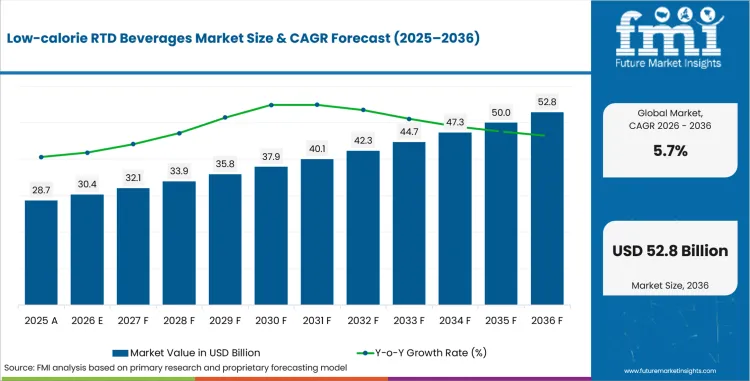
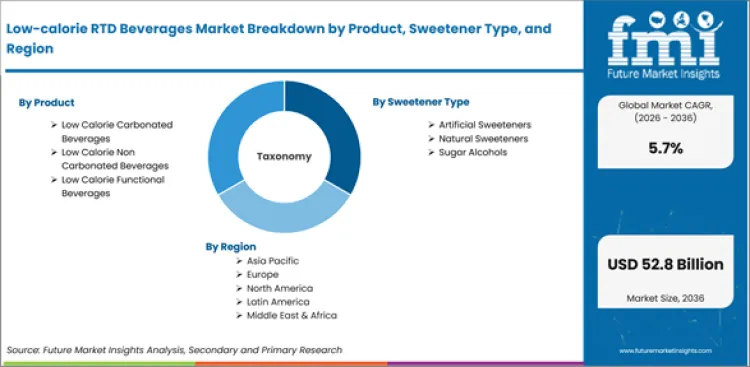
The low-calorie rtd beverages market was valued at USD 28.7 billion in 2025. The market is set to reach USD 30.4 billion by 2026-end and grow at a CAGR of 5.7% between 2026-2036 to reach USD 52.8 billion by 2036. Low Calorie Carbonated Beverages will dominate with a 40.0% share, while Artificial Sweeteners will lead with a 50.0% share.
Key Takeaways, Market Size, and Forecast
- 2026 Market Size: USD 30.4 billion
- 2036 Market Size: USD 52.8 billion
- Compound Annual Growth Rate (CAGR): 5.7% from 2026 to 2036
- Absolute $ Opportunity: USD 22.4 billion between 2026 and 2036
- Leading Product Segment: Low Calorie Carbonated Beverages
- Low Calorie Carbonated Beverages Share in 2026: 40.0%
- Fastest-growing Country: China
- China CAGR: 7.7% through 2036
| Parameter | Details |
|---|---|
| Market Size in 2026 (Value) | USD 30.4 billion |
| Market Forecast in 2036 (Value) | USD 52.8 billion |
| CAGR (2026 to 2036) | 5.7% from 2026 to 2036 |
| Years Considered | 2021 to 2036 |
| Base Year | 2025 |
| Forecast Period | 2026 to 2036 |
| Units Considered | Value (USD Billion) |
| Leading Sub-Region | China |
Summary of the Low-calorie RTD Beverages Market
- Demand and Growth Drivers
- Consumer health consciousness and calorie awareness are expected to sustain demand migration toward low-calorie ready-to-drink beverages across carbonated, tea, juice, and functional drink categories.
- Sweetener technology improvements enabling closer taste parity with full-calorie equivalents are likely to accelerate consumer switching from standard to reduced-calorie RTD options.
- Expanding retail and vending distribution of low-calorie RTD formats is expected to improve consumer accessibility for on-the-go calorie-managed beverage consumption.
- Product and Segment View
- Low calorie carbonated beverages are estimated to account for 40.0% of product demand in 2026, driven by zero-sugar cola and flavored soda formats leading the category transition.
- Liquid ready to drink formats dominate at 80.0%, reflecting consumer preference for immediate consumption convenience without mixing or preparation.
- Retail consumption is expected to account for 70.0% of application demand, with grocery, convenience, and vending as primary purchase channels.
- Geography and Competitive Outlook
- China is likely to lead country level growth at 7.7% through 2036, driven by rising urban health consciousness and expanding retail distribution of reduced-calorie beverage products.
- North America and Western Europe are expected to sustain demand as the largest markets with established zero-sugar beverage retail infrastructure.
- Companies with broad beverage brand portfolios, sweetener formulation expertise, and multi-channel distribution are likely to capture growing health-conscious consumer demand.
- Analyst Opinion
- Nandini Roy Choudhury, Principal Consultant at FMI says, 'Beverage manufacturers that can deliver taste-competitive low-calorie RTD products across carbonated, tea, and functional categories while maintaining competitive retail pricing are positioned to capture accelerating calorie-conscious consumer migration through 2036.'
- The low-calorie RTD beverages market is experiencing structural growth as consumer calorie awareness reshapes beverage purchasing behavior across all major consumption markets.
- Adoption is increasing due to zero-sugar and reduced-calorie product availability expanding across carbonated, tea, juice, and functional beverage categories.
- The market is also benefiting from sugar tax implementation in multiple jurisdictions creating price incentives that favor reduced-calorie beverage selection.
- Demand is further supported by natural sweetener adoption in RTD formulations that addresses consumer concerns about artificial ingredient content.
Low-calorie RTD Beverages Market Definition
The low-calorie RTD beverages market includes ready-to-drink beverages formulated with reduced or zero calorie content across carbonated soft drinks, iced teas, juices, functional drinks, and flavored waters. Products use artificial sweeteners, natural sweeteners, or sweetener blends to achieve calorie reduction while maintaining taste profiles.
Low-calorie RTD Beverages Market Inclusions
Market scope encompasses all commercially traded low-calorie RTD beverages categorized by product (low calorie carbonated beverages, low calorie iced teas, low calorie juices, low calorie functional drinks, low calorie flavored water), sweetener type (artificial sweeteners, natural sweeteners, sweetener blends), form (liquid ready to drink, concentrated), application (retail consumption, food service, vending), and end use (individual consumers, hospitality, institutional). Revenue scope covers 2026 to 2036.
Low-calorie RTD Beverages Market Exclusions
The scope does not include full-calorie standard RTD beverages, plain water without flavoring or sweetening, or powdered drink mixes requiring consumer preparation.
Low-calorie RTD Beverages Market Research Methodology
- Primary Research: FMI analysts conducted interviews with beverage manufacturers, sweetener suppliers, and retail beverage category managers across key consumption markets.
- Desk Research: Combined data from beverage retail sales tracking, sweetener trade statistics, and manufacturer production disclosures.
- Market Sizing and Forecasting: Bottom-up aggregation across carbonated, tea, juice, and functional beverage categories with adoption curves based on sugar tax and health trend penetration.
- Data Validation: Cross-checked quarterly against retail scanner data, beverage production statistics, and manufacturer shipment reports.
Why is the Low-calorie RTD Beverages Market Growing?
- Consumer calorie awareness and health-conscious beverage selection are generating sustained demand migration from full-calorie to reduced-calorie RTD beverage options across all major drink categories.
- Sugar tax implementation in the UK, Mexico, and other jurisdictions is creating structural price incentives that accelerate consumer switching to reduced-calorie beverages.
- China leads country level growth at 7.7% CAGR, driven by rising urban health consciousness among younger consumers and expanding distribution of zero-sugar beverage products through e-commerce and convenience retail.
The low-calorie RTD beverages market is expanding as health-conscious consumer behavior fundamentally reshapes beverage purchasing patterns. Zero-sugar carbonated soft drinks are leading the transition, with major brand zero-sugar variants achieving mainstream consumer acceptance. Low-calorie iced teas, functional beverages, and flavored waters are growing as complementary reduced-calorie options.
Sweetener technology advancement is enabling beverage manufacturers to deliver closer taste approximation to full-calorie products. Blended sweetener systems combining multiple artificial and natural sweeteners create taste profiles that reduce the sensory compromise historically associated with diet beverages.
Regulatory pressure through sugar taxes creates measurable consumer switching behavior. Markets with implemented sugar levies demonstrate higher growth rates for reduced-calorie beverages compared to untaxed jurisdictions, confirming the structural impact of fiscal policy on beverage category dynamics.
Market Segmentation Analysis
- Low calorie carbonated beverages lead at 40.0%, with zero-sugar cola, citrus, and flavored soda formats driving the largest volume segment of reduced-calorie RTD demand.
- Artificial sweeteners account for 50.0% of sweetener demand, though natural sweetener blends are gaining share in premium and clean label RTD products.
- Individual consumers dominate end use at 75.0%, with daily hydration and on-the-go consumption as primary demand occasions.
The low-calorie RTD beverages market is segmented by product, sweetener type, form, application, and end use. Low calorie carbonated beverages lead while liquid ready-to-drink form dominates.
Insights into the Low Calorie Carbonated Beverages Product Segment
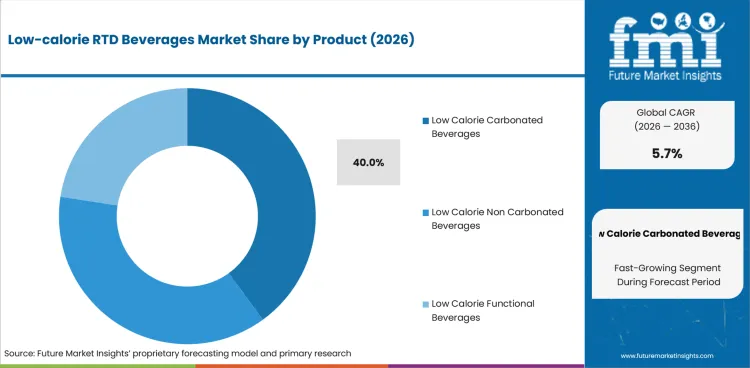
In 2026, low calorie carbonated beverages are estimated to account for 40.0% of total product demand. Zero-sugar variants of established cola, lemon-lime, and orange soda brands serve as the primary growth vehicle, with brand familiarity reducing consumer trial barriers. Diet and zero-sugar reformulation is extending across the full carbonated beverage brand portfolio of major manufacturers.
Craft and specialty reduced-calorie carbonated beverages using natural sweeteners including stevia serve the clean label consumer segment. These products typically command modest price premiums supported by natural ingredient positioning and distinctive flavor profiles.
Insights into the Liquid Ready To Drink Form Segment
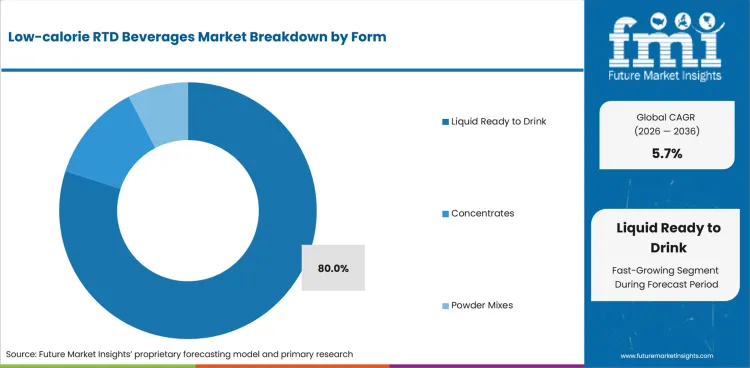
Liquid RTD format accounts for 80.0% of form demand in 2026, reflecting the fundamental category characteristic of immediate consumption convenience. Single-serve cans and PET bottles serve on-the-go consumption, while multi-pack formats provide household procurement for daily consumption.
Concentrated formats requiring dilution represent a small but stable sub-segment serving cost-conscious consumers and food service operators seeking portion-control flexibility. The overwhelming consumer preference for ready-to-drink convenience sustains liquid format dominance.
Low-calorie RTD Beverages Market Drivers, Restraints, and Opportunities
- Consumer health consciousness and calorie awareness drive structural demand migration from full-calorie to reduced-calorie RTD beverages across all major beverage categories.
- Taste parity gaps between reduced-calorie and full-sugar beverages constrain conversion among consumers with strong taste preferences for conventional formulations.
- Sugar tax implementation creates fiscal policy incentives that measurably accelerate consumer switching to reduced-calorie beverage options.
- Natural sweetener adoption in RTD formulations addresses consumer concerns about artificial ingredients, supporting premium clean label positioning.
The low-calorie RTD beverages market continues to grow based on health trends, regulatory incentives, and sweetener technology. Taste parity and consumer perception shape adoption patterns.
Health-Driven Beverage Migration
Demand is shaped by fundamental consumer health awareness driving selection of lower-calorie beverage options. Daily beverage consumption frequency creates high switching impact, as even modest per-occasion calorie reduction accumulates to significant dietary change across millions of consumers.
Taste Technology and Consumer Acceptance
Growth is constrained by taste differences between reduced-calorie and standard beverages. Blended sweetener systems are progressively improving taste profiles, with each reformulation cycle bringing closer approximation to full-sugar equivalents that broadens consumer conversion.
Sugar Tax Regulatory Acceleration
Adoption is accelerating in markets with sugar levy implementation. Price differentials between taxed full-calorie and untaxed reduced-calorie beverages create consumer incentives that generate measurable category switching, demonstrating the structural impact of fiscal policy on beverage demand.
Natural Sweetener Premium Positioning
Products using stevia, monk fruit, and erythritol serve the growing clean label consumer segment willing to pay premiums for beverages without artificial sweetener ingredients. This sub-segment provides value growth within the broader reduced-calorie RTD category.
Analysis of Low-calorie RTD Beverages Market By Key Countries
.webp "Top Country Growth Comparison Low Calorie Rtd Beverages Market Cagr (2026 2036)")
| Country | CAGR |
|---|---|
| China | 7.7% |
| India | 7.1% |
| Germany | 6.6% |
| Brazil | 6.0% |
| USA | 5.4% |
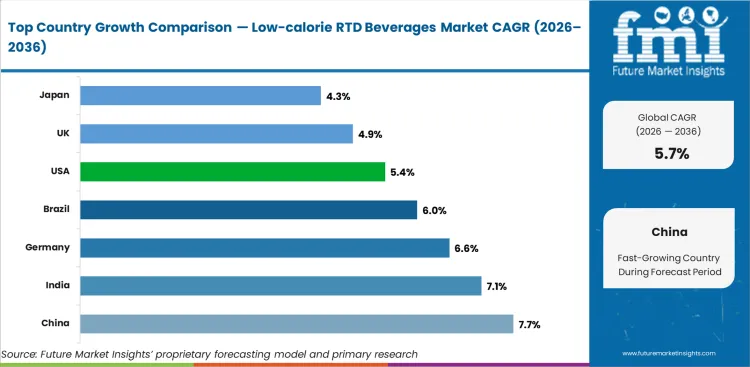
- China at 7.7% leads growth, driven by rising urban health consciousness and expanding distribution of reduced-calorie beverages through e-commerce and convenience retail.
- India at 7.1% reflects growing health awareness among urban consumers and expanding modern retail distribution of packaged low-calorie beverages.
- Germany at 6.6% sustains demand through EU nutrition labeling influence and established health-conscious beverage retail channels.
- Brazil at 6.0% shows growth from expanding modern beverage retail and growing consumer interest in reduced-calorie drink options.
The global low-calorie RTD beverages market is projected to expand at 5.7% CAGR from 2026 to 2036. The study covers more than 30 countries, and the main markets are listed below.
Demand Outlook for Low-calorie RTD Beverages Market in China
China is projected to record a 7.7% CAGR through 2036. Rising health consciousness among urban consumers and expanding e-commerce and convenience retail distribution sustain demand for reduced-calorie RTD beverages.
- E-commerce platforms and convenience store expansion provide growing distribution for zero-sugar and low-calorie beverage products.
- Health consciousness among younger urban demographics drives trial and adoption of reduced-calorie alternatives to traditional sweetened beverages.
- Domestic beverage manufacturers are expanding reduced-calorie product lines to compete with international brands in the growing health beverage segment.
Future Outlook for Low-calorie RTD Beverages Market in India
India is expected to grow at 7.1% through 2036. Growing urban health awareness and expanding modern retail distribution create conditions for low-calorie RTD beverage market development.
- Expanding modern retail and convenience distribution improves consumer access to packaged low-calorie beverage products in urban markets.
- Growing health awareness among urban middle-class consumers creates demand for reduced-calorie alternatives to traditional sweetened drinks.
- Domestic beverage manufacturing capacity expansion enables local production of low-calorie RTD products at competitive pricing.
Opportunity Analysis of Low-calorie RTD Beverages Market in Germany
Germany is projected to record a 6.6% CAGR through 2036. EU nutrition labeling and established health-conscious beverage retail sustain demand for reduced-calorie RTD products.
- EU nutrition labeling including front-of-pack calorie disclosure supports consumer identification and selection of reduced-calorie beverages.
- Established health-conscious beverage retail sections in German supermarkets provide distribution for expanding low-calorie RTD product ranges.
- EU sweetener regulations govern permitted ingredients and usage levels influencing reduced-calorie beverage formulation across the single market.
Sales Analysis of Low-calorie RTD Beverages Market in Brazil
Brazil is estimated to grow at 6.0% through 2036. Expanding modern beverage retail and growing consumer interest in health-positioned drinks sustain demand growth for low-calorie RTD options.
- Large consumer base and modern retail expansion provide distribution scale for reduced-calorie beverage products across metropolitan areas.
- Growing consumer health awareness in urban markets creates demand for lower-calorie alternatives to traditional high-sugar beverage consumption.
- Price sensitivity among mass-market consumers creates demand for competitively priced reduced-calorie options alongside premium natural sweetener products.
In-depth Analysis of Low-calorie RTD Beverages Market in USA
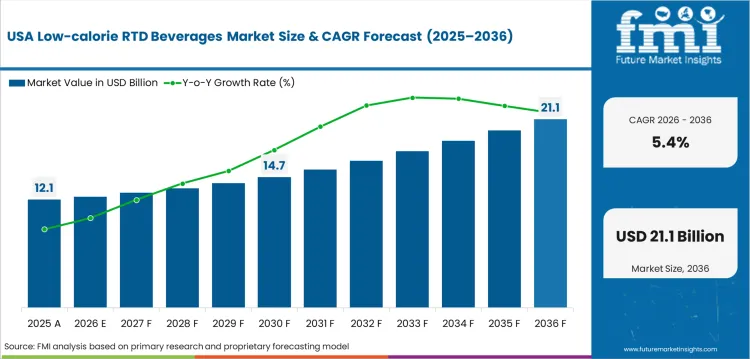
The USA is expected to grow at 5.4% through 2036. Established zero-sugar beverage retail and ongoing brand reformulation sustain category growth. Municipal sugar taxes in select cities create localized demand acceleration.
- Established zero-sugar beverage brands maintain broad retail and vending distribution across grocery, convenience, and food service channels.
- Municipal sugar taxes in select US cities create localized price incentives that measurably favor reduced-calorie beverage selection.
- Natural sweetener RTD brands are capturing consumer demand for clean label beverages without artificial sweetener ingredients.
Competitive Landscape and Strategic Positioning
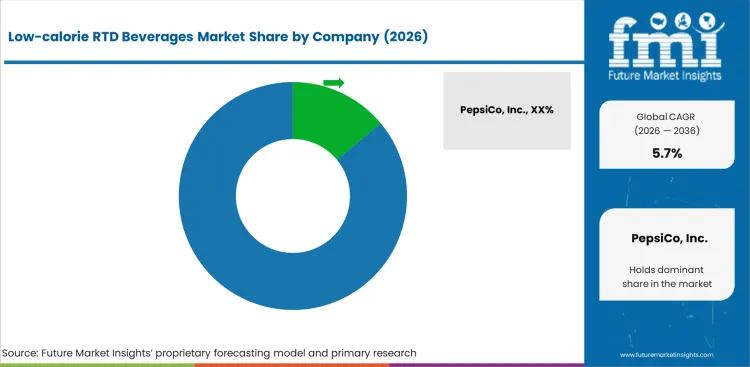
- The Coca-Cola Company and PepsiCo dominate with comprehensive zero-sugar and low-calorie RTD portfolios spanning carbonated, tea, juice, and functional beverage categories.
- Diageo and Bacardi compete in the low-calorie alcoholic RTD segment with reduced-calorie premixed cocktail and hard seltzer products.
- Specialty brands including Zevia and clean label beverage companies serve the natural sweetener consumer segment.
The Coca-Cola Company and PepsiCo, Inc. hold dominant positions through comprehensive zero-sugar and low-calorie product portfolios across their full brand families. Both companies have invested significantly in sweetener technology and reformulation to deliver improved taste profiles in reduced-calorie variants.
Diageo plc and Bacardi Limited serve the low-calorie alcoholic RTD segment with reduced-calorie premixed cocktail and hard seltzer products. Asahi Breweries and Global Brands Limited serve regional markets with low-calorie beverage products.
Barriers to entry include brand establishment, sweetener formulation expertise, and multi-channel distribution infrastructure. Strategic priorities include natural sweetener reformulation, taste technology improvement, and emerging market distribution expansion.
Key Companies in the Low-calorie RTD Beverages Market
Key global companies leading the low-calorie rtd beverages market include:
- PepsiCo, Inc. (USA), The Coca-Cola Company (USA), and Diageo plc (UK) maintain comprehensive reduced-calorie RTD beverage portfolios with global manufacturing and multi-channel distribution.
- Asahi Breweries, Ltd. (Japan), Global Brands Limited (UK), and Bacardi Limited (Bermuda) serve regional markets with low-calorie beverage products across carbonated, alcoholic RTD, and specialty categories.
- Kold Group (USA) and SGC Global, LLC (USA) compete in specialty and emerging segments with differentiated reduced-calorie beverage products.
Competitive Benchmarking: Low-calorie RTD Beverages Market
| Company | RTD Range | Zero-Sugar Tech | Distribution | Geo. Reach |
|---|---|---|---|---|
| PepsiCo | Very High | Advanced | Global | Global |
| Coca-Cola Company | Very High | Advanced | Global | Global |
| Diageo | Medium | Medium | Strong | Global |
| Asahi Breweries | Medium | Advanced | Strong | Asia Pacific |
| Global Brands | Medium | Medium | Medium | UK, Europe |
| Bacardi | Medium | Medium | Strong | Global |
| Kold Group | Low | Medium | Growing | N. America |
| SGC Global | Low | Medium | Growing | N. America |
Source: Future Market Insights competitive analysis, 2026.
Key Developments in Low-calorie RTD Beverages Market
- In 2025, PepsiCo expanded its zero-sugar product portfolio with new RTD tea and functional beverage variants for North American and European retail distribution.
- In 2025, The Coca-Cola Company launched a reformulated zero-sugar line across its flavored sparkling water and functional beverage brands for global markets.
Key Players in the Low-calorie RTD Beverages Market
Major Global Players
- PepsiCo, Inc.
- Diageo plc.
- Asahi Breweries, Ltd.
- Global Brands Limited
- Bacardi Limited
- The Coca-Cola Company
Emerging Players/Startups
- Poppi
- Chini Kum
- Utopian Drinks
Report Scope and Coverage
| Parameter | Details |
|---|---|
| Market size by 2036 | USD 52.8 billion |
| Growth rate | 5.7% CAGR (2026 to 2036) |
| Forecast period | 2026 to 2036 |
| Base year value (2025) | USD 28.7 billion |
| Key Segment Covered | Product, Sweetener Type, Form, Application, End Use |
| Regions covered | North America, Latin America, Western Europe, Eastern Europe, East Asia, South Asia and Pacific, Middle East and Africa |
| Countries covered | USA, South Korea, UK, Japan, China, India, Germany, 30 plus countries |
| Key companies profiled | PepsiCo Inc., Diageo plc., Asahi Breweries Ltd., Global Brands Limited, Bacardi Limited, The Coca-Cola Company, Kold Group, SGC Global LLC |
| Approach | Hybrid bottom-up and top-down methodology starting with verified transaction data, projecting adoption velocity across segments and regions. |
Market Segmentation Analysis
Low-calorie RTD Beverages Market Segmented by Product:
- Low Calorie Carbonated Beverages
- Diet Soda
- Cola Based
- Flavored Soda
- Sparkling Water
- Flavored Sparkling Water
- Functional Sparkling Water
- Diet Soda
- Low Calorie Non Carbonated Beverages
- Ready to Drink Tea
- Green Tea
- Black Tea
- Ready to Drink Coffee
- Cold Brew
- Iced Coffee
- Ready to Drink Juice
- Diluted Juice
- Low Sugar Juice
- Ready to Drink Tea
- Low Calorie Functional Beverages
- Energy Drinks
- Low Calorie Energy Drinks
- Sugar Free Energy Drinks
- Sports Drinks
- Electrolyte Drinks
- Hydration Beverages
- Protein Drinks
- High Protein RTD
- Fitness Drinks
- Energy Drinks
Low-calorie RTD Beverages Market Segmented by Sweetener Type:
- Artificial Sweeteners
- Aspartame
- Sucralose
- Acesulfame Potassium
- Natural Sweeteners
- Stevia
- Monk Fruit
- Sugar Alcohols
- Erythritol
- Xylitol
Low-calorie RTD Beverages Market Segmented by Form:
- Liquid Ready to Drink
- Single Serve Packs
- Multi Serve Packs
- Concentrates
- Liquid Concentrates
- Syrup Bases
- Powder Mixes
- Instant Drink Mix
- Functional Powders
Low-calorie RTD Beverages Market Segmented by Application:
- Retail Consumption
- Supermarket Sales
- Packaged Beverages
- Impulse Purchase
- Supermarket Sales
- Food Service
- Restaurants
- Beverage Menus
- Cafes
- Ready to Serve Drinks
- On the Go Consumption
- Restaurants
Low-calorie RTD Beverages Market Segmented by End Use:
- Individual Consumers
- Health Conscious Consumers
- Weight Management
- Calorie Control
- Fitness Consumers
- Active Lifestyle
- Performance Drinks
- Health Conscious Consumers
- Food Service Operators
- Restaurants and Cafes
- Menu Integration
- Beverage Service
- Restaurants and Cafes
Low-calorie RTD Beverages Market by Region:
- North America
- USA
- Canada
- Mexico
- Latin America
- Brazil
- Chile
- Rest of Latin America
- Western Europe
- Germany
- UK
- Italy
- Spain
- France
- Nordic
- BENELUX
- Rest of Western Europe
- Eastern Europe
- Russia
- Poland
- Hungary
- Balkan & Baltic
- Rest of Eastern Europe
- East Asia
- China
- Japan
- South Korea
- South Asia and Pacific
- India
- ASEAN
- Australia & New Zealand
- Rest of South Asia and Pacific
- Middle East & Africa
- Kingdom of Saudi Arabia
- Other GCC Countries
- Türkiye
- South Africa
- Other African Union
- Rest of Middle East & Africa
Research Sources and Bibliography
- 1. World Health Organization. (2025). WHO Guidelines on Sugar-Sweetened Beverage Reduction. WHO.
- 2. European Commission. (2025). EU Regulation on Beverage Labeling and Sugar Content Disclosure. EC.
- 3. USA Food and Drug Administration. (2025). FDA Nutrition Labeling for Beverages and Sweetener Regulations. FDA.
- 4. International Council of Beverages Associations. (2025). ICBA Global Beverage Industry Reformulation Report. ICBA.
- 5. HM Revenue and Customs. (2025). UK Soft Drinks Industry Levy Implementation Report. HMRC.
This bibliography is provided for reader reference.
This Report Answers
- Estimating the size of the low-calorie RTD beverages market and projected revenue from 2026 to 2036.
- Segmentation by product, sweetener type, form, application, and end use.
- Insights about more than 30 markets in the region.
- Analysis of product categories including carbonated beverages, iced teas, juices, and functional drinks.
- Assessment of the competitive landscape.
- Identifying investment opportunities in zero-sugar reformulation, natural sweetener products, and emerging market distribution.
- Tracking the supply chain from sweetener sourcing to beverage retail distribution.
- Delivery of data in PDF and Excel formats.
Frequently Asked Questions
How big is the low-calorie rtd beverages market in 2026?
The global low-calorie rtd beverages market is estimated to be valued at USD 30.4 billion in 2026.
What will be the size of the low-calorie rtd beverages market in 2036?
The market size for the low-calorie rtd beverages market is projected to reach USD 52.8 billion by 2036.
How much will the low-calorie rtd beverages market growth be between 2026 and 2036?
The low-calorie rtd beverages market is expected to grow at a 5.7% CAGR between 2026 and 2036.
What are the key products in the low-calorie rtd beverages market?
The key products in the low-calorie rtd beverages market are Low Calorie Carbonated Beverages, Low Calorie Non Carbonated Beverages and Low Calorie Functional Beverages.
Which sweetener type segment is expected to contribute a significant share in the low-calorie rtd beverages market in 2026?
In terms of sweetener type, the artificial sweeteners segment is expected to command 50.0% share in the low-calorie rtd beverages market in 2026.
Preview the report firsthand - request a free sample
Get SampleGet the brochure for pricing and purchase details.
Get PDFTable of Content
- Key Takeaways
- Market Size and CAGR
- Top Growth Driver
- Fastest Growing Segment
- Leading Region
- Key Companies
- Emerging Opportunities
- Executive Summary
- Global Market Outlook
- Demand-side Trends
- Supply-side Trends
- Technology Roadmap Analysis
- Analysis and Recommendations
- Analyst Perspective (What is happening? Why now? What should investors know?)
- Key Questions Answered
- How large is the market?
- What is the CAGR?
- What are key trends?
- Which region dominates?
- Who are the leaders?
- Market Overview
- Market Coverage / Taxonomy
- Market Definition / Scope / Limitations
- Research Methodology
- Chapter Orientation
- Analytical Lens and Working Hypotheses
- Market Structure, Signals, and Trend Drivers
- Benchmarking and Cross-market Comparability
- Market Sizing, Forecasting, and Opportunity Mapping
- Research Design and Evidence Framework
- Desk Research Programme (Secondary Evidence)
- Expert Input and Fieldwork (Primary Evidence)
- Tooling, Models, and Reference Databases
- Data Engineering and Model Build
- Quality Assurance and Audit Trail
- Market Background
- Market Dynamics (Drivers, Restraints, Opportunity, Trends)
- Scenario Forecast (Optimistic, Likely, Conservative)
- Impact Analysis
- AI Impact
- Sustainability Impact
- Regulatory Impact
- Technology Impact
- Consumer / Buyer Analysis
- Purchase Drivers
- Adoption Barriers
- Buyer Journey
- Opportunity Map Analysis
- Product Life Cycle Analysis
- Supply Chain Analysis
- Investment Feasibility Matrix
- Value Chain Analysis
- PESTLE and Porter's Analysis
- Regulatory Landscape
- Regional Parent Market Outlook
- Production and Consumption Statistics
- Import and Export Statistics
- Global Market Analysis and Forecast, 2021 to 2036
- Historical Market Size Value (USD Million) Analysis, 2021 to 2025
- Current and Future Market Size Value (USD Million) Projections, 2026 to 2036
- Y-o-Y Growth Trend Analysis
- Absolute $ Opportunity Analysis
- Global Market Pricing Analysis, 2021 to 2036
- Global Market Analysis and Forecast, By Product, 2021 to 2036
- Introduction / Key Findings
- Historical Market Size Value (USD Million) Analysis By Product, 2021 to 2025
- Current and Future Market Size Value (USD Million) Analysis and Forecast By Product, 2026 to 2036
- Low Calorie Carbonated Beverages
- Diet Soda
- Sparkling Water
- Low Calorie Non Carbonated Beverages
- Ready to Drink Tea
- Ready to Drink Coffee
- Low Calorie Functional Beverages
- Energy Drinks
- Sports Drinks
- Low Calorie Carbonated Beverages
- Y-o-Y Growth Trend Analysis By Product, 2021 to 2025
- Absolute $ Opportunity Analysis By Product, 2026 to 2036
- Global Market Analysis and Forecast, By Sweetener Type, 2021 to 2036
- Introduction / Key Findings
- Historical Market Size Value (USD Million) Analysis By Sweetener Type, 2021 to 2025
- Current and Future Market Size Value (USD Million) Analysis and Forecast By Sweetener Type, 2026 to 2036
- Artificial Sweeteners
- Aspartame
- Sucralose
- Acesulfame Potassium
- Natural Sweeteners
- Stevia
- Monk Fruit
- Sugar Alcohols
- Erythritol
- Xylitol
- Artificial Sweeteners
- Y-o-Y Growth Trend Analysis By Sweetener Type, 2021 to 2025
- Absolute $ Opportunity Analysis By Sweetener Type, 2026 to 2036
- Global Market Analysis and Forecast, By Form, 2021 to 2036
- Introduction / Key Findings
- Historical Market Size Value (USD Million) Analysis By Form, 2021 to 2025
- Current and Future Market Size Value (USD Million) Analysis and Forecast By Form, 2026 to 2036
- Liquid Ready to Drink
- Single Serve Packs
- Multi Serve Packs
- Concentrates
- Liquid Concentrates
- Syrup Bases
- Powder Mixes
- Instant Drink Mix
- Functional Powders
- Liquid Ready to Drink
- Y-o-Y Growth Trend Analysis By Form, 2021 to 2025
- Absolute $ Opportunity Analysis By Form, 2026 to 2036
- Global Market Analysis and Forecast, By Application, 2021 to 2036
- Introduction / Key Findings
- Historical Market Size Value (USD Million) Analysis By Application, 2021 to 2025
- Current and Future Market Size Value (USD Million) Analysis and Forecast By Application, 2026 to 2036
- Retail Consumption
- Supermarket Sales
- Food Service
- Restaurants
- Cafes
- Retail Consumption
- Y-o-Y Growth Trend Analysis By Application, 2021 to 2025
- Absolute $ Opportunity Analysis By Application, 2026 to 2036
- Global Market Analysis and Forecast, By End Use, 2021 to 2036
- Introduction / Key Findings
- Historical Market Size Value (USD Million) Analysis By End Use, 2021 to 2025
- Current and Future Market Size Value (USD Million) Analysis and Forecast By End Use, 2026 to 2036
- Individual Consumers
- Health Conscious Consumers
- Fitness Consumers
- Food Service Operators
- Restaurants and Cafes
- Individual Consumers
- Y-o-Y Growth Trend Analysis By End Use, 2021 to 2025
- Absolute $ Opportunity Analysis By End Use, 2026 to 2036
- Global Market Analysis and Forecast, By Region, 2021 to 2036
- Introduction
- Historical Market Size Value (USD Million) Analysis By Region, 2021 to 2025
- Current Market Size Value (USD Million) Analysis and Forecast By Region, 2026 to 2036
- North America
- Latin America
- Western Europe
- Eastern Europe
- East Asia
- South Asia and Pacific
- Middle East & Africa
- Market Attractiveness Analysis By Region
- North America Market Analysis and Forecast, By Country, 2021 to 2036
- Historical Market Size Value (USD Million) Trend Analysis By Market Taxonomy, 2021 to 2025
- Market Size Value (USD Million) Forecast By Market Taxonomy, 2026 to 2036
- By Country
- USA
- Canada
- Mexico
- By Product
- By Sweetener Type
- By Form
- By Application
- By End Use
- By Country
- Market Attractiveness Analysis
- By Country
- By Product
- By Sweetener Type
- By Form
- By Application
- By End Use
- Key Takeaways
- Latin America Market Analysis and Forecast, By Country
- Historical Market Size Value (USD Million) Trend Analysis By Market Taxonomy, 2021 to 2025
- Market Size Value (USD Million) Forecast By Market Taxonomy, 2026 to 2036
- By Country
- Brazil
- Chile
- Rest of Latin America
- By Product
- By Sweetener Type
- By Form
- By Application
- By End Use
- By Country
- Market Attractiveness Analysis
- By Country
- By Product
- By Sweetener Type
- By Form
- By Application
- By End Use
- Key Takeaways
- Western Europe Market Analysis and Forecast, By Country
- Historical Market Size Value (USD Million) Trend Analysis By Market Taxonomy, 2021 to 2025
- Market Size Value (USD Million) Forecast By Market Taxonomy, 2026 to 2036
- By Country
- Germany
- UK
- Italy
- Spain
- France
- Nordic
- BENELUX
- Rest of Western Europe
- By Product
- By Sweetener Type
- By Form
- By Application
- By End Use
- By Country
- Market Attractiveness Analysis
- By Country
- By Product
- By Sweetener Type
- By Form
- By Application
- By End Use
- Key Takeaways
- Eastern Europe Market Analysis and Forecast, By Country
- Historical Market Size Value (USD Million) Trend Analysis By Market Taxonomy, 2021 to 2025
- Market Size Value (USD Million) Forecast By Market Taxonomy, 2026 to 2036
- By Country
- Russia
- Poland
- Hungary
- Balkan & Baltic
- Rest of Eastern Europe
- By Product
- By Sweetener Type
- By Form
- By Application
- By End Use
- By Country
- Market Attractiveness Analysis
- By Country
- By Product
- By Sweetener Type
- By Form
- By Application
- By End Use
- Key Takeaways
- East Asia Market Analysis and Forecast, By Country
- Historical Market Size Value (USD Million) Trend Analysis By Market Taxonomy, 2021 to 2025
- Market Size Value (USD Million) Forecast By Market Taxonomy, 2026 to 2036
- By Country
- China
- Japan
- South Korea
- By Product
- By Sweetener Type
- By Form
- By Application
- By End Use
- By Country
- Market Attractiveness Analysis
- By Country
- By Product
- By Sweetener Type
- By Form
- By Application
- By End Use
- Key Takeaways
- South Asia and Pacific Market Analysis and Forecast, By Country
- Historical Market Size Value (USD Million) Trend Analysis By Market Taxonomy, 2021 to 2025
- Market Size Value (USD Million) Forecast By Market Taxonomy, 2026 to 2036
- By Country
- India
- ASEAN
- Australia & New Zealand
- Rest of South Asia and Pacific
- By Product
- By Sweetener Type
- By Form
- By Application
- By End Use
- By Country
- Market Attractiveness Analysis
- By Country
- By Product
- By Sweetener Type
- By Form
- By Application
- By End Use
- Key Takeaways
- Middle East & Africa Market Analysis and Forecast, By Country
- Historical Market Size Value (USD Million) Trend Analysis By Market Taxonomy, 2021 to 2025
- Market Size Value (USD Million) Forecast By Market Taxonomy, 2026 to 2036
- By Country
- Kingdom of Saudi Arabia
- Other GCC Countries
- Türkiye
- South Africa
- Other African Union
- Rest of Middle East & Africa
- By Product
- By Sweetener Type
- By Form
- By Application
- By End Use
- By Country
- Market Attractiveness Analysis
- By Country
- By Product
- By Sweetener Type
- By Form
- By Application
- By End Use
- Key Takeaways
- Key Countries Market Analysis
- USA
- Pricing Analysis
- Market Share Analysis, 2025
- By Product
- By Sweetener Type
- By Form
- By Application
- By End Use
- Canada
- Pricing Analysis
- Market Share Analysis, 2025
- By Product
- By Sweetener Type
- By Form
- By Application
- By End Use
- Mexico
- Pricing Analysis
- Market Share Analysis, 2025
- By Product
- By Sweetener Type
- By Form
- By Application
- By End Use
- Brazil
- Pricing Analysis
- Market Share Analysis, 2025
- By Product
- By Sweetener Type
- By Form
- By Application
- By End Use
- Chile
- Pricing Analysis
- Market Share Analysis, 2025
- By Product
- By Sweetener Type
- By Form
- By Application
- By End Use
- Germany
- Pricing Analysis
- Market Share Analysis, 2025
- By Product
- By Sweetener Type
- By Form
- By Application
- By End Use
- UK
- Pricing Analysis
- Market Share Analysis, 2025
- By Product
- By Sweetener Type
- By Form
- By Application
- By End Use
- Italy
- Pricing Analysis
- Market Share Analysis, 2025
- By Product
- By Sweetener Type
- By Form
- By Application
- By End Use
- Spain
- Pricing Analysis
- Market Share Analysis, 2025
- By Product
- By Sweetener Type
- By Form
- By Application
- By End Use
- France
- Pricing Analysis
- Market Share Analysis, 2025
- By Product
- By Sweetener Type
- By Form
- By Application
- By End Use
- India
- Pricing Analysis
- Market Share Analysis, 2025
- By Product
- By Sweetener Type
- By Form
- By Application
- By End Use
- ASEAN
- Pricing Analysis
- Market Share Analysis, 2025
- By Product
- By Sweetener Type
- By Form
- By Application
- By End Use
- Australia & New Zealand
- Pricing Analysis
- Market Share Analysis, 2025
- By Product
- By Sweetener Type
- By Form
- By Application
- By End Use
- China
- Pricing Analysis
- Market Share Analysis, 2025
- By Product
- By Sweetener Type
- By Form
- By Application
- By End Use
- Japan
- Pricing Analysis
- Market Share Analysis, 2025
- By Product
- By Sweetener Type
- By Form
- By Application
- By End Use
- South Korea
- Pricing Analysis
- Market Share Analysis, 2025
- By Product
- By Sweetener Type
- By Form
- By Application
- By End Use
- Russia
- Pricing Analysis
- Market Share Analysis, 2025
- By Product
- By Sweetener Type
- By Form
- By Application
- By End Use
- Poland
- Pricing Analysis
- Market Share Analysis, 2025
- By Product
- By Sweetener Type
- By Form
- By Application
- By End Use
- Hungary
- Pricing Analysis
- Market Share Analysis, 2025
- By Product
- By Sweetener Type
- By Form
- By Application
- By End Use
- Kingdom of Saudi Arabia
- Pricing Analysis
- Market Share Analysis, 2025
- By Product
- By Sweetener Type
- By Form
- By Application
- By End Use
- Türkiye
- Pricing Analysis
- Market Share Analysis, 2025
- By Product
- By Sweetener Type
- By Form
- By Application
- By End Use
- South Africa
- Pricing Analysis
- Market Share Analysis, 2025
- By Product
- By Sweetener Type
- By Form
- By Application
- By End Use
- USA
- Market Structure Analysis
- Competition Dashboard
- Competition Benchmarking
- Market Share Analysis of Top Players
- By Regional
- By Product
- By Sweetener Type
- By Form
- By Application
- By End Use
- Emerging Startups
- Innovation Benchmarking
- Competition Analysis
- Competition Deep Dive
- PepsiCo, Inc.
- Overview
- Product Portfolio
- Profitability by Market Segments (Product/Region/Sales Channel)
- Sales Footprint
- Strategy Overview
- Marketing Strategy
- Product Strategy
- Channel Strategy
- Diageo plc.
- Asahi Breweries, Ltd.
- Global Brands Limited
- Bacardi Limited
- Kold Group
- THE COCA-COLA COMPANY
- SGC Global, LLC
- Malibu Drinks
- Herbal Water, Inc.
- AB InBev (Spiked Seltzer)
- Tata Global Beverages Limited
- Suntory Holdings Limited
- The Brown-Forman Corporation
- Red Bull GmbH
- Heineken N.V.
- Nestlé S.A.
- Starbucks Corporation
- Danone S.A.
- Welch Foods Inc.
- PepsiCo, Inc.
- Case Studies
- Success Stories
- Recent Developments
- Competition Deep Dive
- Assumptions & Acronyms Used


