
- Market Size (2026)
- USD 13000.0 Mn
- Forecast (2036)
- USD 18337.8 Mn
- CAGR (2026 to 2036)
- 3.5%
How big is the Coin-Operated Laundries Market in 2026?
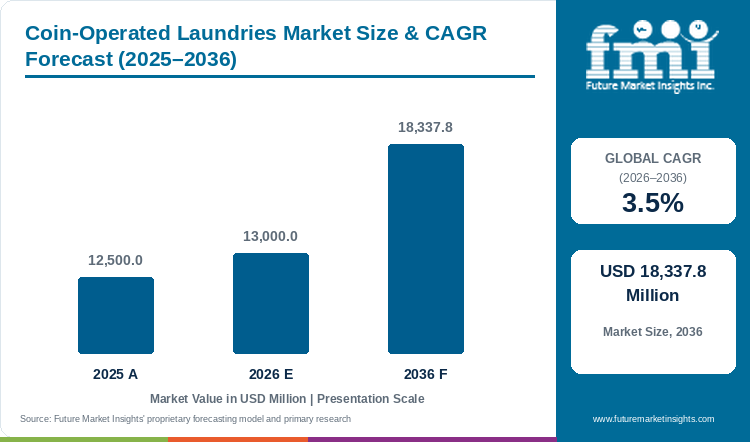
The global coin-operated laundries market should reach USD 18,337.8 million by 2036 at a 3.5% CAGR across 2026 to 2036. The market was valued at USD 12,500.0 million in 2025, and FMI estimates USD 13,000.0 million for 2026.
Coin-Operated Laundries Market Size and Forecast
Table 1: Coin-Operated Laundries Market Size and Forecast
| Market size and forecast | Value |
|---|---|
| Market size in 2025 | USD 12,500.0 million |
| Estimated market size in 2026 | USD 13,000.0 million |
| Projected market size by 2036 | USD 18,337.8 million |
| CAGR from 2026 to 2036 | 3.5% |
Source: Future Market Insights analysis of the Coin-Operated laundries market, 2026.
Revenue growth increasingly depends on the performance of existing locations. The forecast for store numbers advances more slowly than service value, making machine availability and the collection of repeat wash revenue commercially consequential. In May 2025, LG agreed to supply commercial washers and dryers to CSC ServiceWorks. The agreement brings an equipment manufacturer's supply relationship into an established North American laundry-service network. It supports replacement and service planning.
Property contracts create a different route to demand from a street-front shop lease. WASH describes a managed laundry offer that combines equipment installation with repair and payment management. FMI's assessment is that an operator's ability to retain a building contract depends on keeping that installed equipment productive. In Europe, ME Group's April 2026 agreement with ASDA targets locations on supermarket and forecourt sites. The proposed rollout illustrates how access to established retail premises can shape expansion. The estate itself is still a target.
Key Market Trends & Insights
- Mobile App payments rise from 34.0% of payment-mode revenue in 2026 to 49.1% in 2036 in FMI's outlook. ME Group's results presentation records the launch of its Wash.ME app in November 2025 and a wider country rollout beginning in January 2026. Digital collection is becoming part of the operating offer at established laundry locations.
- Local operators can combine unattended machine revenue with staffed services. Duds N Suds in Bozeman lists self-service laundry alongside wash-and-fold and collection services.
- Equipment replacement has a measurable resource dimension. ENERGY STAR states that its certified commercial clothes washers use about 45.0% less water than standard models on average. Savings depend on the chosen machine and its operating conditions.
Regional Highlights
- Global share rises for China, Brazil and Mexico. FMI projects China at 11.8% against 10.0% in 2026, Brazil at 5.3% against 5.0% in 2026 and Mexico at 5.3% against 5.0% in 2026 by 2036.
- The United States, Japan and Germany add revenue at a pace below the global rate. FMI projects the United States at 34.9% against 36.0% in 2026, Japan at 6.2% against 7.0% in 2026 and Germany at 3.5% against 4.0% in 2026 by 2036.
Analyst Perspective
“The most defensible laundry contracts join prompt repairs with a payment system residents can use consistently. A higher vend price has limited value if queues or failed starts send customers elsewhere. Operators should measure completed paid cycles and refund handling alongside store openings. That is especially relevant while mobile collection gains share and property owners compare the service record of competing route operators.”
- Anurag Sharma, Principal Consultant, FMI
How is the Coin-Operated Laundries Market segmented?
- By operation: Self-Service Laundromats, Multi-Housing Laundry Rooms, and Attended and Wash-Dry-Fold Stores.
- By payment mode: Coin and Cash, Card, and Mobile App.
- By service: Washing, Drying, and Value-Added Services.
- By region: North America, Latin America, Western Europe, East Asia, and the Rest of world aggregate.
Why does the Self-Service Laundromats segment lead by Operation in the Coin-Operated Laundries Market in 2026?
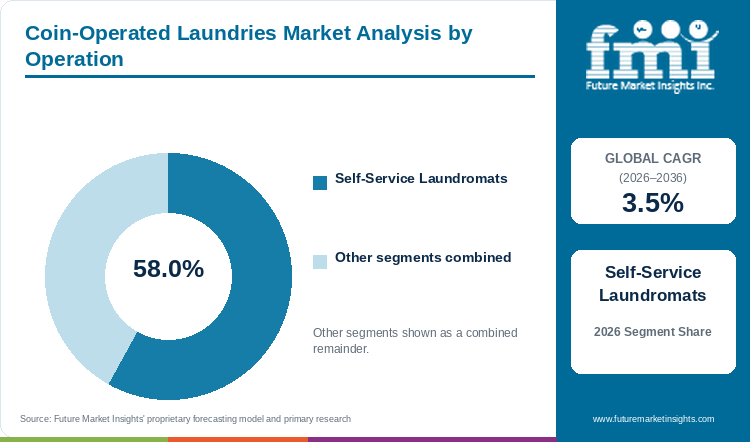
The Self-Service Laundromats segment holds 58.0% of the Coin-Operated Laundries Market by operation in 2026.
Self-service revenue has a different labor structure from a full garment-care service. Customers load and unload machines, while the operator maintains the premises and equipment. The commercial issue is how much usable capacity a location sells during its busiest periods. An otherwise well-equipped shop can lose demand if customers cannot find a working dryer after completing a wash.
Local combinations of services show why this leading format does not have to remain a single-revenue business. The Bozeman Duds N Suds operator offers self-service machines and staffed wash-and-fold. Its published business description also identifies laundry-card integration.
FMI forecasts a 3.1% CAGR for Self-Service Laundromats during 2026 to 2036. Attended and Wash-Dry-Fold Stores grow at 5.1% over the same period from a smaller base. Store owners evaluating an attended service need to compare its contribution after labor with the machine hours it occupies. Large-load self-service demand and timed drop-off work can compete for the same washers.
Multi-Housing Laundry Rooms and Attended and Wash-Dry-Fold Stores together hold the remaining 42.0% by operation.
Table 2: Operation, 2026 Share
| Leading Share | 2026 market share |
|---|---|
| Self-Service Laundromats | 58.0% |
| All Other Segments Combined Share | 42.0% |
Source: Future Market Insights analysis of the Coin-Operated laundries market, 2026.
Why does the Card segment lead by Payment Mode in the Coin-Operated Laundries Market in 2026?
The Card segment holds 36.0% of the Coin-Operated Laundries Market by payment mode in 2026.
Card systems remain commercially relevant in environments where residents already carry a building or campus payment credential. At studierendenWERK BERLIN's Dauerwaldweg residence, the published instructions allow laundry payments using the locking coin/card or MensaCard. Such a local arrangement embeds laundry within a wider resident payment routine.
The next stage of competition concerns the cost of changing that routine. An app installation may add machine status or remote support, but balances, refunds and access must remain understandable during conversion. ME Group's Wash.ME presentation describes direct payment and cycle notifications in its app. The combination makes digital service part of the laundry visit.
FMI's forecast places Card at 35.9% of payment-mode revenue in 2036. Coin and Cash fall from 30.0% to 15.1%, while Mobile App reaches 49.1%. Operators therefore face a mixed estate over the forecast period. Payment retrofit decisions should follow the local user base and the remaining life of the machines. Replacing a working card arrangement prematurely can add conversion expense before a corresponding increase in paid cycles appears.
Coin and Cash and Mobile App together hold the remaining 64.0% by payment mode.
Table 3: Payment Mode, 2026 Share
| Leading Share | 2026 market share |
|---|---|
| Card | 36.0% |
| All Other Segments Combined Share | 64.0% |
Source: Future Market Insights analysis of the Coin-Operated laundries market, 2026.
Why does the Washing segment lead by Service in the Coin-Operated Laundries Market in 2026?
The Washing segment holds 52.0% of the Coin-Operated Laundries Market by service in 2026.
The washer starts the paid sequence and determines the load that proceeds to drying. Its performance also affects the time and energy required later in the visit. Operators need to assess wash capacity and dryer capacity together. Increasing large-load washing capacity while leaving a restricted dryer bank can create a bottleneck at the point when a customer expects to finish. Equipment specifications and replacement cycles are covered from the supplier side in FMI's washing machine market.
Water consumption is one measurable part of the replacement decision. ENERGY STAR's commercial guidance distinguishes equipment provided and maintained by route operators from equipment bought or leased directly by a facility. The property owner consequently chooses both an appliance and an operating responsibility. A lower quoted equipment cost can leave maintenance and collection duties with the building.
Washing revenue is forecast to expand at a CAGR of 3.2% from 2026 to 2036. Its share declines modestly to 50.4% as Value-Added Services rise to 14.8%. The adjacent fabric care market covers detergent and finishing purchases. Laundry operators earn the washing receipt from completing the paid service, and consistent dosing and clear cycle choices help preserve it.
Drying and Value-Added Services together hold the remaining 48.0% by service.
Table 4: Service, 2026 Share
| Leading Share | 2026 market share |
|---|---|
| Washing | 52.0% |
| All Other Segments Combined Share | 48.0% |
Source: Future Market Insights analysis of the Coin-Operated laundries market, 2026.
What are the key drivers restraints and opportunities?
Shared-laundry contracts and the use of established retail locations support recurring wash revenue. Repair costs and weak site utilization constrain expansion. Attended services and digital collection offer additional revenue where local demand supports them.
Driver
Paid communal laundry rooms concentrate repeat demand within a property and give route operators a defined service area.
Restraint
A new lease or machine installation creates fixed obligations before a location develops enough completed paid cycles.
Opportunity
Selective payment upgrades and staffed services can increase revenue from an existing estate without requiring every operator to add a new shop.
How do purchasing rules and qualification affect Coin-Operated laundries market demand?
The forecast adds USD 5,337.8 million of annual market revenue between 2026 and 2036. Store growth alone does not explain that increase. Operators also need to sell a different mix of services and retain regular users over the life of a location. In communal rooms, the relationship with a property manager gives a service provider access to demand while exposing its performance to repeated scrutiny. Repair delays and collection disputes are visible to the same residents every week.
FMI sees particular value in service territories where an operator can maintain equipment without excessive travel between calls. WASH's documented North American footprint includes 27 branch offices. Contract bids should be assessed at that local level.
What limits reliable Coin-Operated laundries market supply and quality?
The cost of a paid wash is incurred through water, energy, detergent and equipment wear. Rent and financing continue during periods when a machine is out of service. Certified equipment comparisons provide one useful input, although a facility's actual resource bill also depends on cycle selection and machine loading.
Payment conversion introduces a separate risk. An operator can replace coin collection with digital fees while leaving the physical bottleneck untouched. Customer support must cover both a failed transaction and a failed cycle. A clear responsibility for refunds is therefore part of the service arrangement.
Where can suppliers win additional business in the Coin-Operated laundries market?
Attended and Wash-Dry-Fold Stores reach USD 2,563.8 million by 2036 in FMI's operation forecast. The opening is commercially meaningful where paid handling can use quieter machine periods. It becomes less attractive if staffed orders displace higher-contribution self-service cycles during peak hours.
Collection services also compete for the household's laundry budget. The online laundry services market addresses that adjacent offer. Laundryheap documents collection through drivers and cleaning through partner facilities. A self-service operator considering delivery needs a route plan and handling process, not merely an app. The opportunity should be assessed as an additional operation with its own costs.
Coin-Operated Laundries Market by Country (2026 to 2036)
Table 5: Coin-Operated Laundries Market Country Growth Forecast
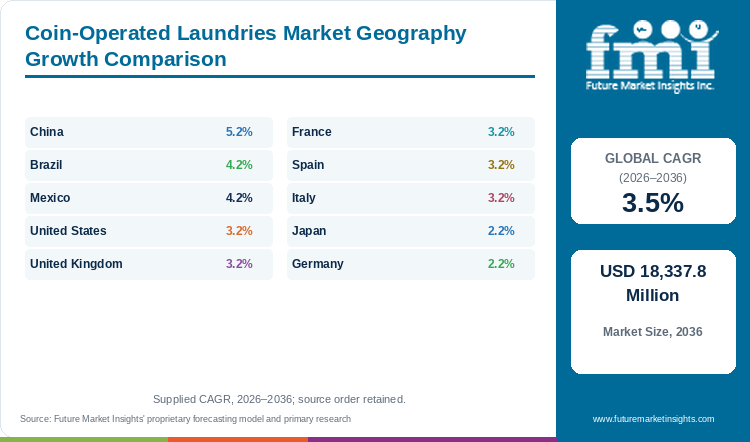
| Country | CAGR, 2026 to 2036 |
|---|---|
| China | 5.2% |
| Brazil | 4.2% |
| Mexico | 4.2% |
| United States | 3.2% |
| United Kingdom | 3.2% |
| France | 3.2% |
| Spain | 3.2% |
| Italy | 3.2% |
| Japan | 2.2% |
| Germany | 2.2% |
Source: Future Market Insights analysis of the Coin-Operated laundries market, 2026.
China
China's commercial laundry suppliers describe campus and self-service settings as distinct installation scenarios. Haier's commercial-laundry support site records an AWE presentation on 12 March 2026 and identifies campus washing among its solution areas. A campus location has a defined user community, whereas an open shop must attract repeat visits from its surrounding area.
China's forecast CAGR is 5.2% from 2026 to 2036, the highest among the named countries. Revenue rises from USD 1,300.0 million to USD 2,155.7 million. FMI's commercial interpretation is that service deployment and repeat use must progress together for that forecast to be realized. An equipment demonstration establishes supplier capability but does not independently establish the scale of paid laundry demand. China adds USD 855.7 million, ranking second for increase. China moves from 10.0% of global revenue in 2026 to 11.8% in 2036.
Service support is an important boundary around expansion. Haier advertises warranty-period response and scheduled checks on its commercial site. An operator comparing locations needs to verify what support is available for the actual installation and which failures remain its responsibility.
China's relatively quick growth therefore calls for scrutiny of contract execution. Securing more locations without maintaining equipment can increase the estate while weakening repeat use. FMI expects procurement to favor proposals with a clear installation scope and an accountable local service arrangement.
Brazil
Brazil offers both neighborhood laundry shops and paid rooms inside residential developments. OMO Lavanderia's operating description distinguishes its own locations and franchises from shared facilities within condominiums. This gives suppliers different routes to a paying customer. A street-front franchise competes for visits, while a condominium installation depends on the building agreement and sustained resident use.
The operating distinction affects expansion costs. A condominium proposal must address responsibility for common space and the collection of resident payments. A shop proposal must support rent and attract sufficient local demand. The same brand can participate in both settings without making their economics interchangeable. Its promotional network total may also include several formats, so it is unsuitable as a direct count of comparable self-service shops.
The Brazilian revenue outlook reaches USD 979.5 million in 2036 from USD 650.0 million in 2026. FMI forecasts a 4.2% CAGR over 2026 to 2036. Brazil's share of the world total stands at 5.0% in 2026 and 5.3% in 2036. In the Coin-Operated laundries market, Brazil contributes USD 329.5 million of new revenue, joint third of ten.
FMI sees the commercial case in matching the format to the premises. A shared room with limited floor area may require a different equipment mix from a laundry accepting bulky household loads. An operator should demonstrate how that mix serves the expected users before presenting the project as a simple replication of another store.
Mexico
Repeat purchasing is visible in Mexico's laundry offer through store-based loyalty arrangements. AquaMatic advertises its Aquahorro card with promotional access and points from washes. This is evidence of a customer-retention mechanism within an operating chain.
A loyalty card can make the next visit more attractive while also producing an obligation to honor balances or rewards. A low advertised wash price therefore needs to be read alongside the full customer payment arrangement. For a chain, consistency across locations becomes part of the offer. For an independent outlet, the local service record can remain more influential than participation in a wider rewards scheme.
Equipment availability also limits the value of promotion. Rewarding another visit will not recover a customer who repeatedly finds the required capacity out of service. FMI expects the stronger commercial proposals to connect retention activity with investment in the machines that generate the underlying wash receipt. Loyalty spending should be evaluated against repeat paid cycles instead of registrations alone. Mexico and Brazil share the same 4.2% forecast CAGR for 2026 to 2036, although their local businesses do not have to follow the same route to growth. Mexico's market advances from USD 650.0 million to USD 979.5 million. FMI's assessment places the emphasis on frequent repeat visits and the operator's ability to keep those visits within the same network. In the Coin-Operated laundries market, Mexico's 4.2% CAGR sits 0.7 points above the global 3.5%.
United States
Route density gives the United States a different commercial structure from markets dominated by individual street-front stores. CSC's agreement with LG in May 2025 covers equipment supply to a service provider already active in multifamily and academic housing. Equipment procurement can consequently serve a portfolio of existing properties as well as future installations. The agreement does not disclose a national increase in laundromat numbers. Route operators compete on uptime and service response across many sites, a requirement a single-store owner does not face.
FMI forecasts US revenue at USD 6,402.8 million by 2036 from USD 4,680.0 million in 2026. The implied outlook uses a 3.2% CAGR over 2026 to 2036. Its 36.0% share of global revenue in 2026 makes retention commercially important even when national growth is moderate. A small improvement in the performance of an established property base can matter more than a highly publicized new store. Retaining an existing laundry room is therefore a service-quality question as much as an equipment choice.
For property managers, the comparison concerns who owns the machines and who is responsible when a cycle fails. A managed arrangement transfers operating duties but needs a clear service record. Independent shop owners face a different decision about maintaining control of vend pricing and selecting replacement equipment. FMI expects these two purchasing routes to coexist. A portfolio contract does not eliminate the local operator whose shop serves customers beyond one building.
United Kingdom
Supermarket and forecourt partnerships create a distinct UK expansion route. ME Group's agreement with ASDA, dated 9 April 2026, sets an ambition to place up to 700 Wash.ME machines across several ASDA site formats. It is a deployment target instead of confirmation that 700 machines are already working. The commercial importance lies in access to identifiable premises and a retail partner.
This route changes the relationship between location and customer acquisition. An operator gains access to premises already used for another purpose, but still needs a service arrangement that supports laundry visits. Site selection should account for access and the practical position of equipment.
FMI forecasts UK revenue rising from USD 520.0 million in 2026 to USD 711.4 million by 2036, a 3.2% CAGR over the period. The forecast includes traditional laundrettes and other qualifying paid-laundry locations. Outdoor retail-site machines are one format within that broader definition. By absolute increase, the United Kingdom ranks sixth with USD 191.4 million over the decade. Global revenue share for the United Kingdom decreases from 4.0% to 3.9%. In the Coin-Operated laundries market, the United Kingdom grows 3.2% a year, 0.3 points below the global rate.
A rollout announcement describes equipment deployment. This report's estate outlook concerns laundry locations on its stated basis. FMI expects investors to compare each project's actual capacity and service arrangements before treating a retail partnership as equivalent to a conventional laundrette chain acquisition.
France
France is an important operating base in ME Group's European laundry estate. Its 2025 annual report identifies estate expansion, particularly in France, as a contributor to Continental European laundry performance. The region's laundry vending revenue rose 6.9% to GBP 68.5 million. That regional result cannot be assigned entirely to France or treated as national market growth.
The French commercial argument concerns the deployment of a repeatable service at individual locations. An operator can expand through a familiar equipment format while still needing to assess the practical demand around every site.
FMI considers this distinction particularly useful when evaluating reported expansion. A company's net machine addition can involve new premises, additional capacity at an existing site or replacement elsewhere. Only part of that activity necessarily increases the number of service locations. Investors should therefore compare operating receipts and retained capacity alongside new installations. A good site remains valuable because it produces completed paid cycles after the initial opening period, not because the installation contributes to a group target. FMI's separate French outlook records a CAGR of 3.2% from 2026 to 2036. Revenue is projected to increase from USD 390.0 million to USD 533.6 million. The forecast covers the defined service market instead of one automated-equipment provider's receipts. Global revenue share for France decreases from 3.0% to 2.9%. Growth of USD 143.6 million leaves France joint seventh among the ten named countries.
Spain
Local shop specifications make Spain's laundry economics more visible than a broad statement about convenience. Gira Gira lists six self-service locations in eastern Madrid and describes machines ranging from 8.0 to 18.0 kilograms. Its published offer includes detergent within the wash price. Spain's market is forecast at USD 533.6 million by 2036 compared with USD 390.0 million in 2026. FMI's CAGR for 2026 to 2036 is 3.2%. A mixed machine bank can serve different load sizes, but the operator must still sell enough use of that capacity to cover the premises and equipment. Spain grows at 3.2% a year, 0.3 points slower than the global rate. Growth of USD 143.6 million leaves Spain joint seventh among the ten named countries.
Including detergent within the price also changes the comparison with a basic vend quote. The customer sees a combined service charge while the operator carries the dosing cost. A competitor quoting a lower cycle price may sell a different package. FMI therefore expects transparent comparisons of the full paid visit to be more useful than comparisons of the lowest advertised wash.
The next commercial question is how a local network allocates machines across its locations. Installing identical capacity everywhere can simplify purchasing but can also leave the wrong balance of washers and dryers at a particular shop.
Italy
Italy's self-service investment offer includes combinations of equipment and business support. Bloomest presents its laundry concept with Miele technology, a dedicated app, marketing tools and collection lockers. An investor still has to assess the premises and the demand it can realistically attract.
The range of support offered around a new laundry changes the supplier comparison. A package with an app and marketing assistance can reduce some setup work, yet those services should be assessed separately from machine performance. The relevant commercial test is what the operator receives over the life of the location and which responsibilities remain with the owner.
The Italian market increases from USD 390.0 million in 2026 to USD 533.6 million in 2036 in FMI's outlook. The 3.2% CAGR over 2026 to 2036 matches several other named European markets, but the route to earning that growth depends on individual stores. Financing an installation does not create the wash revenue needed to support it. Italy grows at 3.2% a year, 0.3 points slower than the global rate. In the Coin-Operated laundries market, Italy ranks joint eighth of ten on 2026 revenue.
FMI sees scope for useful extensions such as lockers where they support a defined service. They can accommodate a drop-off arrangement, although handling and staffing must still be provided somewhere in the operation. A disciplined project therefore identifies which revenue is paid machine use and which comes from a separately managed service.
Japan
Store closures remain part of Japan's operating reality even where suppliers promote new formats. WASH HOUSE's monthly disclosure records 571 stores at December 2025 compared with 583 at December 2024. It nevertheless illustrates why gross openings can overstate the improvement in an operator's estate. FMI's Japan outlook grows at a CAGR of 2.2% between 2026 and 2036. Revenue increases from USD 910.0 million to USD 1,129.3 million. The slower forecast gives existing-site performance a greater role in the commercial argument. Removing an unproductive location can be more sensible than retaining it to defend a headline store count. By absolute increase, Japan ranks fifth with USD 219.3 million over the decade.
Japan also requires a distinction between a laundry location and the equipment installed within it. One site can contain several washers and dryers with different capacity and earning patterns. Comparing a supplier's machine installations with an operator's store figures without that distinction would misstate competition. The same care applies when assessing the annual revenue benchmark in this report.
For investors, the useful questions concern repeat transactions and the remaining operating life of the site. A replacement program may improve reliability without creating a new location. Conversely, a new shop can shift revenue from a nearby outlet without generating equivalent new market demand. FMI's assessment therefore gives greater weight to the quality of the retained estate than to openings in isolation.
Germany
Germany's shared-laundry arrangements can draw on payment systems already embedded in student life. Instructions for studierendenWERK BERLIN's Dauerwaldweg residence permit payment through the locking coin/card or MensaCard and state that detergent is included automatically. That local example makes the contract boundary concrete. Residents buy a defined cycle through a residence facility instead of a separate retail garment-care service.
Germany's forecast grows from USD 520.0 million in 2026 to USD 645.3 million in 2036. FMI applies a 2.2% CAGR for 2026 to 2036. The modest pace directs attention toward renewal and the performance of existing rooms, alongside any additional store openings.
For a service provider, compatibility with the site's existing payment routine can reduce the complexity of a changeover. However, it can also limit the appeal of a generic app proposal. The property manager needs to know how residents gain access and how account problems are resolved. A new interface must fit the service actually sold at that building.
Public laundromats remain a separate source of demand within the national total. Their catchment extends beyond the residents of one property and their service menu need not match a campus room. FMI's interpretation is therefore specific: the Berlin example supports a campus-contract argument, not a claim that every German laundromat follows the same payment model. Procurement should retain this local distinction when comparing operating bids.
Who are the notable companies in the Coin-Operated Laundries Market?
Notable companies in the Coin-Operated Laundries Market include CSC ServiceWorks, Wash Multifamily Laundry Systems, Duds N Suds, Laundryheap and Washmen.
The company comparison separates direct operation from adjacent household garment care. CSC ServiceWorks and WASH Multifamily Laundry Systems address property owners as well as end users. Their service position includes equipment and ongoing support within shared premises. WASH's corporate description identifies multifamily and campus customers in the United States and Canada. This role differs from a neighborhood operator attracting customers to one shop.
Duds N Suds is assessed through the identifiable Bozeman business. Its mix of self-service and staffed work illustrates one local operating model. The name is not treated here as a verified global chain. Laundryheap coordinates collection and delivery through local partner facilities. Washmen describes mobile-based laundry and dry-cleaning services in Dubai, Abu Dhabi and Sharjah. These businesses compete for part of the same household budget, but their full receipts lie outside a strict pay-per-cycle comparison unless an activity meets the stated store scope.
Equipment makers and installation networks also influence competitive choices. They are not assigned operating shares in this report. The distinction matters because selling a washer, managing a communal room and collecting a bag of garments represent different commercial activities.
Key Developments in the Coin-Operated Laundries Market
- In January 2026, ME Group began extending its Wash.ME app across its laundry countries after launching it in November 2025, according to its annual results presentation.
- April 2026: ME Group agreed an ASDA-site rollout with an ambition of up to 700 Wash.ME machines. The announcement is a deployment agreement and target, not confirmation of completed installations.
Key Players in the Coin-Operated Laundries Market
- CSC ServiceWorks
- Wash Multifamily Laundry Systems
- Duds N Suds
- Laundryheap
- Washmen
Coin-Operated Laundries Market Report Scope
Table 6: Coin-Operated Laundries Market Report Scope
| Coverage field | Report scope |
|---|---|
| Market definition | Paid self-service stores, attended and unattended laundry locations, and route-based communal laundry rooms |
| Payment boundary | Coin, cash, card and app-operated wash and dry transactions |
| Included premises | Laundromats and qualifying apartment-building or campus laundry rooms |
| Exclusions | Equipment manufacturing receipts and unrelated garment-care or delivery revenue outside the stated paid-location scope |
| Quantitative Units | USD million |
| Operating indicator | Thousand stores on the defined laundry-location basis |
| Segmentation | Operation, Payment Mode and Service |
| Named countries | United States, China, Japan, Brazil, Mexico, United Kingdom, Germany, France, Spain and Italy |
| Company coverage | CSC ServiceWorks, Wash Multifamily Laundry Systems, Duds N Suds, Laundryheap and Washmen, with direct and adjacent roles distinguished |
Source: Future Market Insights analysis of the Coin-Operated laundries market, 2026.
Coin-Operated Laundries Market Research Methodology
This assessment combines FMI's market outlook with secondary review of original company announcements, operating descriptions, investor disclosures and public service guidance. The review tests how paid-location revenue differs from equipment supply and collection-only garment care. Segment and country comparisons retain a common currency and forecast period. Competitive positioning follows documented commercial roles, while company-level shares are excluded where they have not been disclosed.
Coin-Operated Laundries Market by Segments
Coin-Operated Laundries Market segmented by Operation:
- Self-Service Laundromats
- Multi-Housing Laundry Rooms
- Attended and Wash-Dry-Fold Stores
Coin-Operated Laundries Market segmented by Payment Mode:
- Coin and Cash
- Card
- Mobile App
Coin-Operated Laundries Market segmented by Service:
- Washing
- Drying
- Value-Added Services
Coin-Operated Laundries Market by Region
- North America
- United States
- Mexico
- Latin America
- Brazil
- Western Europe
- United Kingdom
- Germany
- France
- Spain
- Italy
- East Asia
- China
- Japan
- Rest of world aggregate
Research Sources and Bibliography
- AquaMatic. (Accessed 2026, November 9). Tarjeta Aquahorro and Company Introduction. https://www.aquamatic.com.mx/
- Bloomest Laundry. (Accessed 2026, November 9). Lavanderie Self Service Bloomest Laundry. https://www.bloomestlaundry.it/
- Duds N Suds, Bozeman. (Accessed 2026, November 9). About Us. https://dudsnsuds.com/about-us/
- Gira Gira by Speed Queen. (Accessed 2026, November 9). Lavanderia Autoservicio en la Comunidad de Madrid. https://lavanderiagiragira.es/
- Haier Professional Laundry. (Accessed 2026, November 9). Service and Support; AWE2026 Announcement Dated 12 March 2026. https://haierlaundry.com.cn/support
- Laundryheap. (Accessed 2026, November 9). How Laundryheap Works in United States. https://www.laundryheap.com/en-us/how-it-works
- LG Electronics USA. (2025, May 21). LG Partners with CSC ServiceWorks to Strengthen Position in North American Commercial Laundry Market.
- ME Group International plc. (2026, March). 2025 Annual Results Presentation. https://me-group.com/wp-content/uploads/2026/03/ME-Group-2025-Annual-Results-Presentation.pdf
- ME Group International plc. (2026, March 23). Annual Report 2025, Review of Performance by Geography. https://me-group.com/wp-content/uploads/2026/03/ME-Group-Annual-Report-2025.pdf
- ME Group International plc. (2026, April 9). ME Group Signs New Partnership for a Large-Scale Roll-Out with ASDA to Install Wash.ME Laundry Machines.
- OMO Lavanderia. (Accessed 2026, November 9). Quem Somos. https://www.omolavanderia.com.br/quem-somos
- studierendenWERK BERLIN. (Accessed 2026, November 9). Residence Information for Tenants, Dauerwaldweg. https://www.stw.berlin/en/housing/residences/charlottenburg-wilmersdorf/residence-dauerwaldweg/wohnheiminfos-dauerwaldweg.html
- US Environmental Protection Agency, ENERGY STAR. (Accessed 2026, November 9). Commercial Clothes Washers. https://www.energystar.gov/products/commercial_clothes_washers
- WASH. (Accessed 2026, November 9). Company Overview. https://www.wash.com/company-overview/
- WASH HOUSE. (Accessed 2026, November 9). Investor Information: Store Counts and Monthly Sales. https://corporate.wash-house.jp/ir/achievement.php
- Washmen. (Accessed 2026, November 9). Support and Service Description. https://www.washmen.com/help
This bibliography is provided for reader reference and is not exhaustive. The full report contains the complete reference list and detailed citations.
Table of Content
- Key Takeaways
- Market Size and CAGR
- Top Growth Driver
- Fastest Growing Segment
- Leading Region
- Key Companies
- Emerging Opportunities
- Executive Summary
- Global Market Outlook
- Demand-side Trends
- Supply-side Trends
- Technology Roadmap Analysis
- Analysis and Recommendations
- Analyst Perspective (What is happening? Why now? What should investors know?)
- Key Questions Answered
- How large is the market?
- What is the CAGR?
- What are key trends?
- Which region dominates?
- Who are the leaders?
Read More...
- Market Overview
- Market Coverage / Taxonomy
- Market Definition / Scope / Limitations
- Research Methodology
- Chapter Orientation
- Analytical Lens and Working Hypotheses
- Market Structure, Signals, and Trend Drivers
- Benchmarking and Cross-market Comparability
- Market Sizing, Forecasting, and Opportunity Mapping
- Research Design and Evidence Framework
- Desk Research Programme (Secondary Evidence)
- Expert Input and Fieldwork (Primary Evidence)
- Tooling, Models, and Reference Databases
- Data Engineering and Model Build
- Quality Assurance and Audit Trail
- Market Background
- Market Dynamics (Drivers, Restraints, Opportunity, Trends)
- Scenario Forecast (Optimistic, Likely, Conservative)
- Impact Analysis
- AI Impact
- Sustainability Impact
- Regulatory Impact
- Technology Impact
- Consumer / Buyer Analysis
- Purchase Drivers
- Adoption Barriers
- Buyer Journey
- Opportunity Map Analysis
- Product Life Cycle Analysis
- Supply Chain Analysis
- Investment Feasibility Matrix
- Value Chain Analysis
- PESTLE and Porter's Analysis
- Regulatory Landscape
- Regional Parent Market Outlook
- Production and Consumption Statistics
- Import and Export Statistics
- Global Market Analysis and Forecast, 2021 to 2036
- Historical Market Size Value (USD Million) Analysis, 2021 to 2025
- Current and Future Market Size Value (USD Million) Projections, 2026 to 2036
- Y-o-Y Growth Trend Analysis
- Absolute $ Opportunity Analysis
- Global Market Pricing Analysis, 2021 to 2036
- Global Market Analysis and Forecast, By Operation, 2021 to 2036
- Introduction / Key Findings
- Historical Market Size Value (USD Million) Analysis By Operation, 2021 to 2025
- Current and Future Market Size Value (USD Million) Analysis and Forecast By Operation, 2026 to 2036
- Self-Service Laundromats
- Multi-Housing Laundry Rooms
- Attended and Wash-Dry-Fold Stores
- Y-o-Y Growth Trend Analysis By Operation, 2021 to 2025
- Absolute $ Opportunity Analysis By Operation, 2026 to 2036
- Global Market Analysis and Forecast, By Payment Mode, 2021 to 2036
- Introduction / Key Findings
- Historical Market Size Value (USD Million) Analysis By Payment Mode, 2021 to 2025
- Current and Future Market Size Value (USD Million) Analysis and Forecast By Payment Mode, 2026 to 2036
- Coin and Cash
- Card
- Mobile App
- Y-o-Y Growth Trend Analysis By Payment Mode, 2021 to 2025
- Absolute $ Opportunity Analysis By Payment Mode, 2026 to 2036
- Global Market Analysis and Forecast, By Service, 2021 to 2036
- Introduction / Key Findings
- Historical Market Size Value (USD Million) Analysis By Service, 2021 to 2025
- Current and Future Market Size Value (USD Million) Analysis and Forecast By Service, 2026 to 2036
- Washing
- Drying
- Value-Added Services
- Y-o-Y Growth Trend Analysis By Service, 2021 to 2025
- Absolute $ Opportunity Analysis By Service, 2026 to 2036
- Global Market Analysis and Forecast, By Region, 2021 to 2036
- Introduction
- Historical Market Size Value (USD Million) Analysis By Region, 2021 to 2025
- Current Market Size Value (USD Million) Analysis and Forecast By Region, 2026 to 2036
- North America
- Latin America
- Western Europe
- East Asia
- Market Attractiveness Analysis By Region
- North America Market Analysis and Forecast, By Country, 2021 to 2036
- Historical Market Size Value (USD Million) Trend Analysis By Market Taxonomy, 2021 to 2025
- Market Size Value (USD Million) Forecast By Market Taxonomy, 2026 to 2036
- By Country
- United States
- Mexico
- By Operation
- By Payment Mode
- By Service
- By Country
- Market Attractiveness Analysis
- By Country
- By Operation
- By Payment Mode
- By Service
- Key Takeaways
- Latin America Market Analysis and Forecast, By Country
- Historical Market Size Value (USD Million) Trend Analysis By Market Taxonomy, 2021 to 2025
- Market Size Value (USD Million) Forecast By Market Taxonomy, 2026 to 2036
- By Country
- Brazil
- By Operation
- By Payment Mode
- By Service
- By Country
- Market Attractiveness Analysis
- By Country
- By Operation
- By Payment Mode
- By Service
- Key Takeaways
- Western Europe Market Analysis and Forecast, By Country
- Historical Market Size Value (USD Million) Trend Analysis By Market Taxonomy, 2021 to 2025
- Market Size Value (USD Million) Forecast By Market Taxonomy, 2026 to 2036
- By Country
- United Kingdom
- Germany
- France
- Spain
- Italy
- By Operation
- By Payment Mode
- By Service
- By Country
- Market Attractiveness Analysis
- By Country
- By Operation
- By Payment Mode
- By Service
- Key Takeaways
- East Asia Market Analysis and Forecast, By Country
- Historical Market Size Value (USD Million) Trend Analysis By Market Taxonomy, 2021 to 2025
- Market Size Value (USD Million) Forecast By Market Taxonomy, 2026 to 2036
- By Country
- China
- Japan
- Rest of world aggregate
- By Operation
- By Payment Mode
- By Service
- By Country
- Market Attractiveness Analysis
- By Country
- By Operation
- By Payment Mode
- By Service
- Key Takeaways
- Key Countries Market Analysis
- United States
- Pricing Analysis
- Market Share Analysis, 2025
- By Operation
- By Payment Mode
- By Service
- Mexico
- Pricing Analysis
- Market Share Analysis, 2025
- By Operation
- By Payment Mode
- By Service
- Brazil
- Pricing Analysis
- Market Share Analysis, 2025
- By Operation
- By Payment Mode
- By Service
- Germany
- Pricing Analysis
- Market Share Analysis, 2025
- By Operation
- By Payment Mode
- By Service
- United Kingdom
- Pricing Analysis
- Market Share Analysis, 2025
- By Operation
- By Payment Mode
- By Service
- Italy
- Pricing Analysis
- Market Share Analysis, 2025
- By Operation
- By Payment Mode
- By Service
- Spain
- Pricing Analysis
- Market Share Analysis, 2025
- By Operation
- By Payment Mode
- By Service
- France
- Pricing Analysis
- Market Share Analysis, 2025
- By Operation
- By Payment Mode
- By Service
- China
- Pricing Analysis
- Market Share Analysis, 2025
- By Operation
- By Payment Mode
- By Service
- Japan
- Pricing Analysis
- Market Share Analysis, 2025
- By Operation
- By Payment Mode
- By Service
- United States
- Market Structure Analysis
- Competition Dashboard
- Competition Benchmarking
- Market Share Analysis of Top Players
- By Regional
- By Operation
- By Payment Mode
- By Service
- Emerging Startups
- Innovation Benchmarking
- Competition Analysis
- Competition Deep Dive
- CSC ServiceWorks
- Overview
- Product Portfolio
- Profitability by Market Segments
- Sales Footprint
- Strategy Overview
- Marketing Strategy
- Product Strategy
- Channel Strategy
- Wash Multifamily Laundry Systems
- Duds N Suds, Bozeman
- Laundryheap
- Washmen
- Duds N Suds
- CSC ServiceWorks
- Case Studies
- Success Stories
- Recent Developments
- Competition Deep Dive
- Assumptions & Acronyms Used
List of Tables
- Table 1: Global Market Value (USD Million) Forecast by Region, 2021 to 2036
- Table 2: Global Market Value (USD Million) Forecast by Operation, 2021 to 2036
- Table 3: Global Market Value (USD Million) Forecast by Payment Mode, 2021 to 2036
- Table 4: Global Market Value (USD Million) Forecast by Service, 2021 to 2036
- Table 5: North America Market Value (USD Million) Forecast by Country, 2021 to 2036
- Table 6: North America Market Value (USD Million) Forecast by Operation, 2021 to 2036
- Table 7: North America Market Value (USD Million) Forecast by Payment Mode, 2021 to 2036
- Table 8: North America Market Value (USD Million) Forecast by Service, 2021 to 2036
- Table 9: Latin America Market Value (USD Million) Forecast by Country, 2021 to 2036
- Table 10: Latin America Market Value (USD Million) Forecast by Operation, 2021 to 2036
- Table 11: Latin America Market Value (USD Million) Forecast by Payment Mode, 2021 to 2036
- Table 12: Latin America Market Value (USD Million) Forecast by Service, 2021 to 2036
- Table 13: Western Europe Market Value (USD Million) Forecast by Country, 2021 to 2036
- Table 14: Western Europe Market Value (USD Million) Forecast by Operation, 2021 to 2036
- Table 15: Western Europe Market Value (USD Million) Forecast by Payment Mode, 2021 to 2036
- Table 16: Western Europe Market Value (USD Million) Forecast by Service, 2021 to 2036
- Table 17: East Asia Market Value (USD Million) Forecast by Country, 2021 to 2036
- Table 18: East Asia Market Value (USD Million) Forecast by Operation, 2021 to 2036
- Table 19: East Asia Market Value (USD Million) Forecast by Payment Mode, 2021 to 2036
- Table 20: East Asia Market Value (USD Million) Forecast by Service, 2021 to 2036
List of Figures
- Figure 1: Global Market Pricing Analysis
- Figure 2: Global Market Value (USD Million) Forecast 2021-2036
- Figure 3: Global Market Value Share and BPS Analysis by Operation, 2026 and 2036
- Figure 4: Global Market Y-o-Y Growth Comparison by Operation, 2026-2036
- Figure 5: Global Market Attractiveness Analysis by Operation
- Figure 6: Global Market Value Share and BPS Analysis by Payment Mode, 2026 and 2036
- Figure 7: Global Market Y-o-Y Growth Comparison by Payment Mode, 2026-2036
- Figure 8: Global Market Attractiveness Analysis by Payment Mode
- Figure 9: Global Market Value Share and BPS Analysis by Service, 2026 and 2036
- Figure 10: Global Market Y-o-Y Growth Comparison by Service, 2026-2036
- Figure 11: Global Market Attractiveness Analysis by Service
- Figure 12: Global Market Value (USD Million) Share and BPS Analysis by Region, 2026 and 2036
- Figure 13: Global Market Y-o-Y Growth Comparison by Region, 2026-2036
- Figure 14: Global Market Attractiveness Analysis by Region
- Figure 15: North America Market Incremental Dollar Opportunity, 2026-2036
- Figure 16: Latin America Market Incremental Dollar Opportunity, 2026-2036
- Figure 17: Western Europe Market Incremental Dollar Opportunity, 2026-2036
- Figure 18: East Asia Market Incremental Dollar Opportunity, 2026-2036
- Figure 19: North America Market Value Share and BPS Analysis by Country, 2026 and 2036
- Figure 20: North America Market Value Share and BPS Analysis by Operation, 2026 and 2036
- Figure 21: North America Market Y-o-Y Growth Comparison by Operation, 2026-2036
- Figure 22: North America Market Attractiveness Analysis by Operation
- Figure 23: North America Market Value Share and BPS Analysis by Payment Mode, 2026 and 2036
- Figure 24: North America Market Y-o-Y Growth Comparison by Payment Mode, 2026-2036
- Figure 25: North America Market Attractiveness Analysis by Payment Mode
- Figure 26: North America Market Value Share and BPS Analysis by Service, 2026 and 2036
- Figure 27: North America Market Y-o-Y Growth Comparison by Service, 2026-2036
- Figure 28: North America Market Attractiveness Analysis by Service
- Figure 29: Latin America Market Value Share and BPS Analysis by Country, 2026 and 2036
- Figure 30: Latin America Market Value Share and BPS Analysis by Operation, 2026 and 2036
- Figure 31: Latin America Market Y-o-Y Growth Comparison by Operation, 2026-2036
- Figure 32: Latin America Market Attractiveness Analysis by Operation
- Figure 33: Latin America Market Value Share and BPS Analysis by Payment Mode, 2026 and 2036
- Figure 34: Latin America Market Y-o-Y Growth Comparison by Payment Mode, 2026-2036
- Figure 35: Latin America Market Attractiveness Analysis by Payment Mode
- Figure 36: Latin America Market Value Share and BPS Analysis by Service, 2026 and 2036
- Figure 37: Latin America Market Y-o-Y Growth Comparison by Service, 2026-2036
- Figure 38: Latin America Market Attractiveness Analysis by Service
- Figure 39: Western Europe Market Value Share and BPS Analysis by Country, 2026 and 2036
- Figure 40: Western Europe Market Value Share and BPS Analysis by Operation, 2026 and 2036
- Figure 41: Western Europe Market Y-o-Y Growth Comparison by Operation, 2026-2036
- Figure 42: Western Europe Market Attractiveness Analysis by Operation
- Figure 43: Western Europe Market Value Share and BPS Analysis by Payment Mode, 2026 and 2036
- Figure 44: Western Europe Market Y-o-Y Growth Comparison by Payment Mode, 2026-2036
- Figure 45: Western Europe Market Attractiveness Analysis by Payment Mode
- Figure 46: Western Europe Market Value Share and BPS Analysis by Service, 2026 and 2036
- Figure 47: Western Europe Market Y-o-Y Growth Comparison by Service, 2026-2036
- Figure 48: Western Europe Market Attractiveness Analysis by Service
- Figure 49: East Asia Market Value Share and BPS Analysis by Country, 2026 and 2036
- Figure 50: East Asia Market Value Share and BPS Analysis by Operation, 2026 and 2036
- Figure 51: East Asia Market Y-o-Y Growth Comparison by Operation, 2026-2036
- Figure 52: East Asia Market Attractiveness Analysis by Operation
- Figure 53: East Asia Market Value Share and BPS Analysis by Payment Mode, 2026 and 2036
- Figure 54: East Asia Market Y-o-Y Growth Comparison by Payment Mode, 2026-2036
- Figure 55: East Asia Market Attractiveness Analysis by Payment Mode
- Figure 56: East Asia Market Value Share and BPS Analysis by Service, 2026 and 2036
- Figure 57: East Asia Market Y-o-Y Growth Comparison by Service, 2026-2036
- Figure 58: East Asia Market Attractiveness Analysis by Service
- Figure 59: Global Market - Tier Structure Analysis
- Figure 60: Global Market - Company Share Analysis
Frequently Asked Questions
How big is the Coin-Operated laundries market in 2026?
FMI estimates the market at USD 13,000.0 million in 2026, up from USD 12,500.0 million in 2025. It is forecast to reach USD 18,337.8 million by 2036 at a 3.5% CAGR.
Which operation leads the Coin-Operated laundries market in 2026?
Self-Service Laundromats leads by operation with 58.0% in 2026. All other segments together hold 42.0%.
Which payment mode and service lead in 2026?
Card holds 36.0% by payment mode and Washing holds 52.0% by service in FMI's 2026 assessment.
Which market is forecast to grow fastest through 2036?
China has the highest forecast CAGR at 5.2% during 2026 to 2036, followed by Brazil and Mexico at 4.2%.
Does coin-operated laundry exclude app-operated locations?
No. The market includes coin, cash, card and app-operated paid laundry locations. An app-based collection service is assessed separately where customers buy garment care instead of machine use.
Preview the report firsthand - request a free sample
Get SampleGet the brochure for pricing and purchase details.
Get PDF
