

- Industry Size (2026)
- USD 0.52 Bn
- Forecast (2036)
- USD 2.1 Bn
- CAGR (2026 to 2036)
- 15.00%
Anti Greenwashing Compliance Tools Market Size, Market Forecast and Outlook By FMI
The anti greenwashing compliance tools market was valued at USD 0.5 billion in 2025. Industry is poised to reach USD 0.52 billion in 2026 at a CAGR of 15.00% during the forecast period. Demand outlook carries the valuation to USD 2.1 billion through 2036 as precision-timing of regulatory enforcement cycles forces a transition from aspirational marketing to contractually verifiable carbon accounting.
Corporate legal departments and sustainability leads are currently navigating a fundamental pivot where marketing claims must now mirror granular operational data. The introduction of the EU Green Claims Directive eliminates the era of vague terminology, forcing brand owners to substantiate every "eco-friendly" label with life-cycle assessment (LCA) data. Those who delay the adoption of sustainability reporting solutions face a disqualification window during Tier-1 procurement cycles and escalating litigation risks. Practitioners realize that the real challenge isn't the volume of data, but the inability of legacy systems to reconcile unstructured invoices with formal ESG disclosures.
Summary of Anti Greenwashing Compliance Tools Market
- Anti Greenwashing Compliance Tools Market Definition:
- Anti Greenwashing Compliance Tools encompass specialized software and services built to guarantee that environmental claims are backed by granular, auditable data.
- Demand Drivers in the Market:
- The EU Corporate Sustainability Reporting Directive forces multinational companies to replace manual ESG tracking with automated, auditable software platforms.
- Increasing litigation from consumer advocacy groups compels advertising agencies to verify client claims before campaign launch to avoid multi-million dollar penalties.
- Institutional investors require high-fidelity ESG data feeds to prevent "greenwashing" liability in specialized sustainable investment funds.
- Key Segments Analyzed in the FMI Report:
- Software & Platforms: 46.0% share in 2026, reflecting the massive transition from spreadsheets to AI-driven verification engines.
- Financial Services: 55.0% share in 2026, as asset managers standardize on unified data backbones for regulatory reporting.
- China: 18.0% compound growth driven by greenfield renewable energy projects requiring digitized verification for green bond eligibility.
- Analyst Opinion at FMI
- Ronak Shah, Principal Consultant, opines, "In my analysis, I have observed that the true bottleneck in sustainability is not physical technology, but the network jitter between marketing intent and operational data. Facilities attempting to run advanced motion control applications over standard IT infrastructure face unavoidable packet collisions that trigger automated safety shutdowns. Control systems architects who continue patching legacy networks will find themselves unable to meet the deterministic response times required for next-generation automation."
- Strategic Implications / Executive Takeaways:
- Procurement leads must mandate native audit capabilities in all new sustainability software specifications to ensure long-term regulatory compliance.
- Marketing directors should phase out third-party agency dependency and invest in internal verification tools to protect brand equity.
- Systems integrators must develop specialized API-testing competencies to prove data integrity between ERP systems and sustainability platforms.
- Methodology:
- Primary Research: Detailed technical interviews were conducted with 250+ sustainability architects and ESG fund managers globally.
- Desk Research: Aggregated public standards documentation from the EFRAG and SEC to validate adoption timelines.
- Market-Sizing and Forecasting: Applied a bottom-up methodology based on historical corporate spending on non-financial reporting.
- Data Validation and Update Cycle: Forecasts undergo cross-validation against corporate capital expenditure guidance for digital transformation.
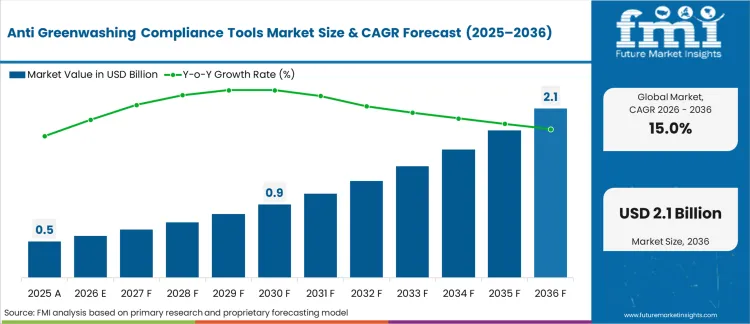
Anti Greenwashing Compliance Tools Market Key Takeaways
| Metric | Details |
|---|---|
| Industry Size (2026) | USD 0.52 billion |
| Industry Value (2036) | USD 2.1 billion |
| CAGR (2026-2036) | 15.00% |
Source: Future Market Insights (FMI) analysis, based on proprietary forecasting model and primary research
Growth becomes self-sustaining once institutional lenders tie interest rate reductions directly to real-time verification streams. Asset managers and corporate treasurers must implement automated API-driven compliance audits by 2028 to secure preferential green financing rates. This shift transforms compliance tools from a regulatory burden into a primary driver of capital efficiency.
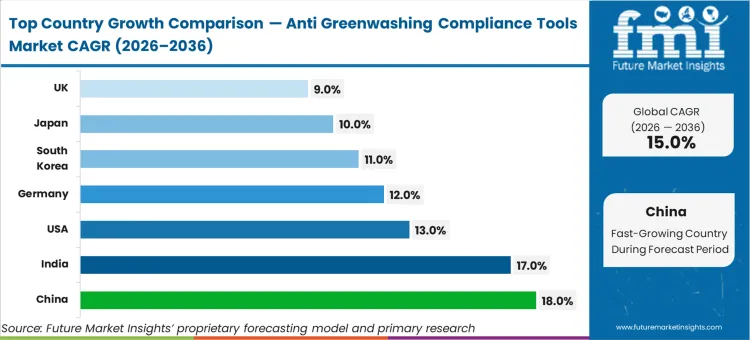
China advances at 18.0% as state-mandated green finance frameworks require digitized verification for all state-owned enterprise bonds. India records 17.0% growth driven by pharmaceutical and textile export sectors facing stringent traceability requirements from Western buyers. The USA tracks 13.0% expansion as the aerospace and defense sectors prioritize supply chain transparency. Germany reaches 12.0% while South Korea posts 11.0%, followed by Japan at 10.0% and the UK expanding at 9.0%. This geographic spread is structurally anchored by the synchronization of global trade standards.
Anti Greenwashing Compliance Tools Market Definition
Anti Greenwashing Compliance Tools represent the digital infrastructure and professional services designed to verify, audit, and substantiate environmental, social, and governance (ESG) claims. These systems utilize advanced analytics, blockchain ledgers, and natural language processing to ensure that public disclosures align with underlying operational reality. The market is distinguished from standard accounting by its specific focus on non-financial metric validation and regulatory alignment with anti-deception frameworks.
Anti Greenwashing Compliance Tools Market Inclusions
The market scope incorporates purpose-built software platforms, cloud-based ESG data lakes, and automated supply chain mapping tools featuring native audit capabilities. Protocol-specific verification modules, AI-driven claim-scanning engines, and specialized third-party auditing services are fully included. Products that provide real-time carbon footprinting and life-cycle assessment (LCA) data integration for marketing departments are also within the boundaries.
Anti Greenwashing Compliance Tools Market Exclusions
Standard enterprise resource planning (ERP) systems lacking specialized ESG audit trails are explicitly excluded from the valuation. Generic marketing analytics software, pure public relations consulting, and standalone physical sensors without data-bridging capabilities fall outside the defined parameters. Legacy manual spreadsheet templates and general IT security tools are also omitted from the market scope.
Anti Greenwashing Compliance Tools Market Research Methodology
- Primary Research: FMI analysts engaged with Chief Sustainability Officers (CSOs), regulatory compliance leads, and ESG data architects across 40 countries to map the decision gates triggering software adoption.
- Desk Research: Analysts aggregated compliance roadmaps from the ISSB (International Sustainability Standards Board), SEC climate disclosure rules, and major automotive OEM sustainability guidelines.
- Market-Sizing and Forecasting: The baseline value derives from a bottom-up aggregation of subscription revenues and professional service contracts, applying region-specific regulatory enforcement curves.
- Data Validation and Update Cycle: Projections were cross-validated against quarterly investment volumes in climate-tech and publicly reported ESG consulting revenues from Tier-1 firms.
Segmental Analysis
Anti Greenwashing Compliance Tools Market Analysis by Component
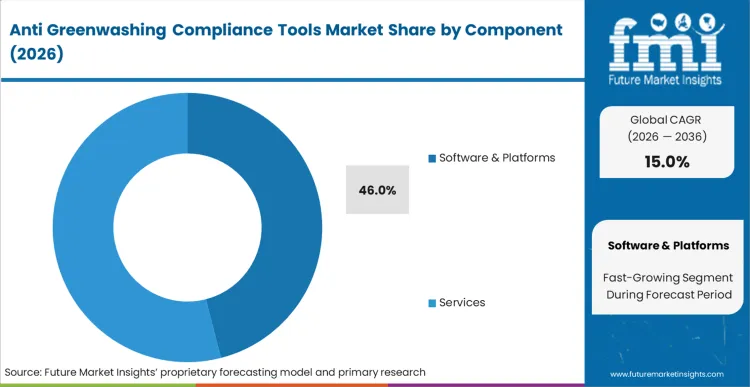
Capital projects directors are currently executing a full-scale replacement of manual reporting frameworks as legacy spreadsheets prove inadequate for sub-millisecond data verification. Software & Platforms command a dominant 46.0% share in 2026, reflecting the absolute requirement for digital orchestration before advanced logical verification can occur. Manufacturers deploying integrated ESG software directly into their supply chain operations establish the foundation for converged IT and sustainability environments. This silicon-level integration eliminates the need for expensive external audit gateways, streamlining the deployment of compliance protocols. FMI analysts opine that facilities transitioning to native verification hardware realize measurable reductions in annual audit costs. Software vendors unable to supply certified interoperable modules risk immediate exclusion from the next wave of corporate tenders.
- Automated Ingestion Protocol: AI-driven engines natively handle the extraction of ESG metrics from unstructured invoices, shifting the processing burden away from human auditors.
- Interoperability Verification: Compliance platforms demand rigorous third-party testing to guarantee seamless communication between competing ERP systems on the same data layer.
- Audit Footprint Reduction: Eliminating manual data entry shrinks the administrative time required for quarterly disclosures in constrained corporate environments.
Anti Greenwashing Compliance Tools Market Analysis by Application
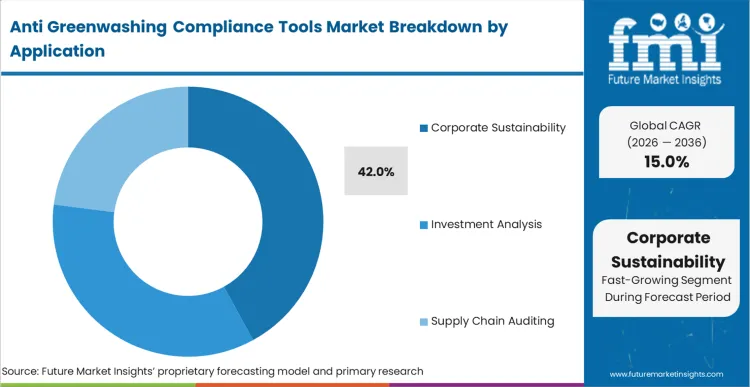
Corporate Sustainability Reporting emerges as the dominant application area, expected to represent 42.0% of total market share in 2026. Modern discrete manufacturing environments are increasingly built around unified communication networks, removing the delays caused by traditional manual data translation. FMI analysts opine that flattening the data architecture directly enables real-time edge computing applications on the factory floor, allowing for instant carbon adjustment. Plant leads must validate environmental audit performance during site acceptance testing to authorize final project sign-off. The integration of global communication standards across isolated machine cells forces systems integrators to rethink traditional hierarchical topologies.
- Telemetry Acceleration: Connecting field devices directly to the main production backbone accelerates the extraction of energy data for predictive reporting platforms.
- Data Isolation: Critical compliance messages receive guaranteed transmission windows while standard diagnostic data flows utilize remaining bandwidth without interference.
- Standardized Mapping: Automated configuration models reduce the engineering hours previously required to map proprietary data structures between disparate process domains.
Anti Greenwashing Compliance Tools Market Analysis by End use
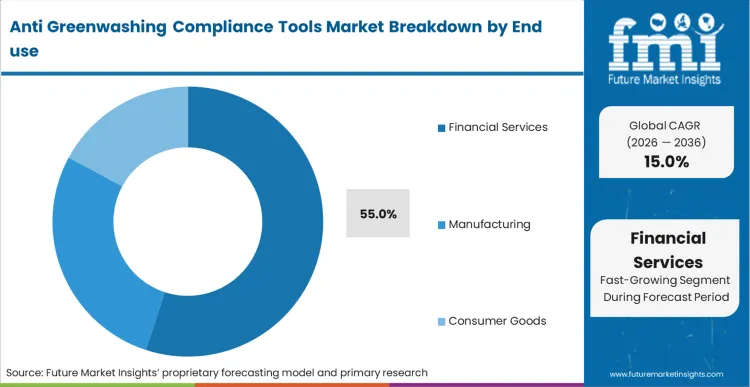
Financial Services end use accounts for a leading 55.0% segment share in 2026 as fund managers reject any data feeds introducing variable jitter into the investment loop. Incorporating certified industrial control network modules guarantees that high-speed transactional data arrives exactly when scheduled. As per FMI's projection, the convergence of vision inspection systems with carbon management amplifies the demand for high-bandwidth deterministic compliance tools. Suppliers failing to demonstrate seamless integration with established financial databases lose priority status in critical infrastructure upgrade cycles. Every network specification lead bidding on facility modernization contracts now faces strict adherence criteria for global sustainability standards.
- Jitter Elimination: Fixed execution schedules ensure compliance packets bypass standard queuing mechanisms, delivering microsecond accuracy for high-speed trading platforms.
- Agnostic Sourcing: Open communication standards empower asset owners to source specialized data feeds without worrying about proprietary vendor lock-in.
- High-Bandwidth Visibility: Dedicated bandwidth allocation permits high-resolution satellite imagery to share the same physical backbone as precise financial signals.
Anti Greenwashing Compliance Tools Market Drivers, Restraints, and Opportunities
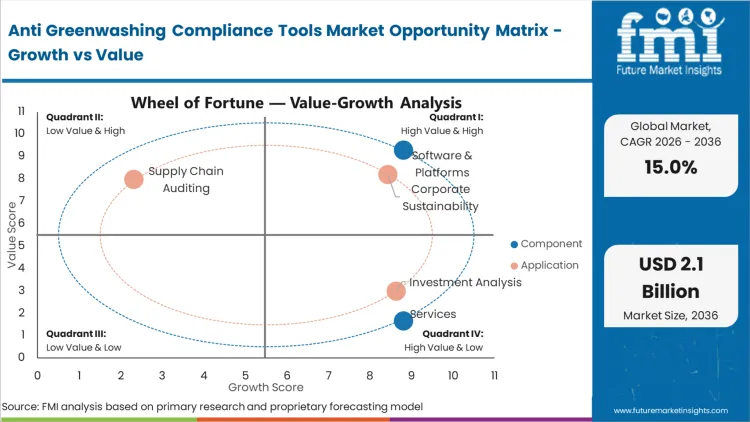
The convergence of IT monitoring tools and OT control systems forces network specification leads to extract actionable compliance data directly from the factory floor. This architectural requirement renders fragmented, proprietary fieldbuses obsolete, as asset owners face a strict binary choice between deploying complex translation gateways or overhauling the base infrastructure. Transitioning to a unified deterministic backbone simplifies network topology and enables direct cloud connectivity for advanced analytics. Facilities that fail to modernize their core communication layers risk operational blind spots and reduced overall equipment effectiveness.
The intricate configuration parameters required to optimize scheduled traffic flows create steep learning curves for traditional sustainability engineers. Designing conflict-free transmission schedules across multi-vendor hardware demands specialized network calculus expertise that most manufacturing facilities lack internally. To mitigate this skill gap, capital projects directors increasingly rely on advanced software configuration tools that automate the scheduling process and validate network designs before physical deployment.
Opportunities in the Anti Greenwashing Compliance Tools Market
- Edge Compute Consolidation: Next-generation deterministic endpoints enable sustainability architects to run virtualized audit logic directly on the network switch. This consolidation eliminates dedicated industrial PCs and drastically simplifies control cabinet design.
- High-Bandwidth Vision Systems: Upgraded deterministic bandwidth permits quality assurance teams to deploy inline optical inspection without impacting critical motion control traffic. This capability prevents defective, non-compliant components from progressing through the assembly sequence.
- Energy Grid Synchronization: Utility network planners integrating distributed renewable energy resources require precise phase measurement data to prove green generation. Deterministic switching provides the microsecond accuracy necessary to balance volatile power inputs across the wide-area network.
Regional Analysis
Based on the regional analysis, the anti greenwashing compliance tools market market is segmented into North America, Latin America, Europe, East Asia, South Asia, Oceania and Middle East & Africa across 40 plus countries.
.webp "Top Country Growth Comparison Anti Greenwashing Compliance Tools Market Cagr (2026 2036)")
| Country | CAGR (2026 to 2036) |
|---|---|
| China | 18.0% |
| India | 17.0% |
| USA | 13.0% |
| Germany | 12.0% |
| South Korea | 11.0% |
| Japan | 10.0% |
| UK | 9.0% |
Source: Future Market Insights (FMI) analysis, based on proprietary forecasting model and primary research
East Asia Anti Greenwashing Compliance Tools Market Analysis
Greenfield infrastructure development across East Asia accelerates the bypass of legacy communication constraints that often hinder Western markets. Capital projects directors constructing new electric vehicle and semiconductor fabrication facilities specify unified deterministic networking in their initial site blueprints. FMI analysts opine that this clean-slate approach entirely eliminates the costly and time-consuming retrofit phase that plagues older manufacturing centers in Europe. By building native synchronization capabilities into the foundation, regional asset owners establish highly flexible production environments capable of rapid retooling for changing ESG standards. The integration of robust network architecture forms the critical prerequisite for deploying advanced robotics and machine learning applications.
- China: China's electric vehicle manufacturing sector deploys highly automated, software-defined production lines requiring seamless data exchange between IT systems and OT assembly robots. Greenfield facility architects bypass legacy fieldbus protocols entirely, specifying native deterministic endpoints for all new motion control procurement contracts. This aggressive modernization strategy drives an 18.0% CAGR for anti-greenwashing infrastructure through 2036. Supply chain directors who ignore these verification requirements face severe commercial disadvantages on high-volume production routes.
- South Korea: South Korea's semiconductor fabrication complex operates to wafer-handling jitter tolerances that exceed standard industrial network specifications by orders of magnitude. Plant automation leads mandate zero-packet-loss architectures to ensure multi-axis robotic transfer systems perform sub-millimeter positioning tasks flawlessly. South Korea's demand for verified compliance hardware is sustaining a 11.0% CAGR to 2036. Network hardware suppliers targeting the next fab expansion must prove sub-50 nanosecond synchronization before entering the approved vendor list.
- Japan: Japan's automotive OEM supply chain enforces strict component qualification through the JAMA/JAPIA electronic data interchange standards for synchronized production sequences. Every new motion control architecture must validate network timing compliance before receiving authorization for series production integration. This continuous qualification constraint sustains a 10.0% projected compound growth over the forecast period. Component suppliers lacking verified interoperable testing records forfeit access to the next generation of full-line vehicle electrification contracts.
FMI's report includes comprehensive evaluation of Taiwan and Hong Kong. Regional asset owners are prioritizing platforms that avoid the complexity associated with external timing gateways.
South Asia Anti Greenwashing Compliance Tools Market Analysis
The rapid expansion of specialized manufacturing hubs in South Asia is driven by national industrial policies targeting high-value export markets. Procurement leads in this region are increasingly adopting unified network architectures to satisfy stringent global brand traceability requirements. FMI analysts opine that the localization of electronic component assembly forces contract manufacturers to deploy deterministic systems that can reliably transport fail-safe signals alongside standard operational data.
- India: India's pharmaceutical export sector operates under stringent FDA Pre-Approval Inspection frameworks requiring immutable electronic records for all batch production parameters. Process engineers must deploy control networks capable of guaranteeing critical data delivery to centralized historians without any packet loss. This regulatory compliance pressure anchors India's 17.0% annual expansion through the decade. Suppliers failing to provide hardware with built-in data integrity mechanisms face disqualification from major life sciences facility tenders.
FMI's report includes detailed analysis of Indonesia, Thailand, and the broader ASEAN region. A primary trend shaping these nations is the rapid bypass of legacy communication constraints via greenfield construction.
Europe Anti Greenwashing Compliance Tools Market Analysis
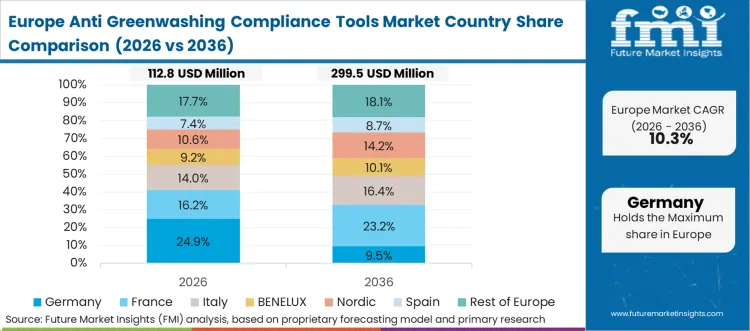
European industrial policy actively penalizes the continued operation of technologically isolated and energy-inefficient manufacturing facilities. Automation architects redesigning legacy production lines must now integrate continuous energy monitoring data alongside critical machine control signals. This dual-purpose network requirement forces the rapid adoption of traffic-shaping protocols to guarantee control stability while transmitting heavy diagnostic payloads. The transition requires a complete overhaul of existing communication topologies, shifting from hierarchical polling structures to event-driven deterministic architectures. Upgrading the core switching infrastructure provides the necessary bandwidth and synchronization precision to support advanced sustainable manufacturing practices. Facility directors recognize that maintaining outdated network standards severely limits their ability to compete in highly regulated European markets.
- Germany: Germany's automotive OEM supply chain dictates stringent validation criteria for mixed-criticality network traffic on advanced electric vehicle assembly lines. Control systems engineers must demonstrate flawless execution of scheduled traffic flows before receiving authorization to connect new production cells to the main factory backbone. The national machine tool export sector operates under rigorous functional safety certifications that mandate unified diagnostic layers, creating a recurring compliance cycle that accelerates switch hardware replacement. This systemic qualification pressure drives a 12.0% annual expansion rate for certified OT switching hardware as the standard proliferates. Network infrastructure providers targeting domestic vehicle assembly plant retooling projects must guarantee microsecond-level synchronization performance prior to the finalization of capital procurement budgets. The market is sustaining a 12.0% CAGR to 2036.
- United Kingdom: The United Kingdom's energy grid modernization programs require precise phase measurement data to balance increasingly volatile renewable power generation inputs. Utility network planners deploying advanced substation automation systems mandate communication architectures capable of sub-millisecond data delivery across distributed geographic assets. The shift toward decentralized power generation forces grid operators to abandon legacy telecontrol protocols in favor of highly resilient, synchronized Ethernet networks. This critical infrastructure transition anchors the UK's 9.0% compound trajectory to 2036 as utility providers systematically upgrade their operational backbones. Systems integrators unable to demonstrate absolute network determinism under severe load conditions forfeit qualification for national grid expansion projects. The industry is advancing at a 9.0% compound annual rate through 2036.
FMI's report includes thorough investigation of the European industrial networking framework. The analysis encompasses Italy, France, Spain, the Nordics, and the Benelux region. A prevailing structural condition across these nations is the mandatory compliance with strict machinery safety directives, forcing asset owners to specify deterministic networks that can reliably transport fail-safe signals alongside standard operational data.
North America Anti Greenwashing Compliance Tools Market Analysis
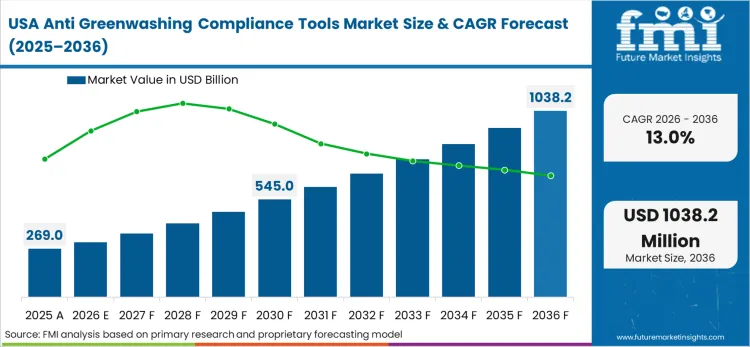
Industrial modernization mandates across North America target the systematic eradication of isolated operational technology networks that pose cybersecurity risks. Control systems engineers leading critical infrastructure overhauls face strict directives to unify disparate communication domains under a single manageable architecture. According to FMI's estimates, the aerospace and defense manufacturing sectors actively drive this consolidation to secure their supply chain data flows against sophisticated intrusion attempts. Implementing a standardized, deterministic backbone enables facilities to deploy advanced predictive maintenance algorithms without compromising real-time control stability.
- USA: The United States aerospace and defense manufacturing sector enforces strict cybersecurity and data visibility mandates across its entire multi-tier supply chain ecosystem. Network specification leads replacing aging proprietary control systems must deploy converged architectures capable of supporting both real-time machining precision and secure telemetry extraction. Federal infrastructure modernization initiatives actively fund the replacement of vulnerable legacy fieldbuses, allowing the market to sustain a 13.0% CAGR to 2036. Hardware vendors lacking documented compliance with rigorous industrial cybersecurity standards face immediate exclusion from defense-adjacent contracts.
FMI's report includes coverage of Canada and Mexico. A defining dynamic involves the integration of cross-border automotive supply chains, which requires standardized network protocols to maintain synchronized production schedules.
Competitive Aligners for Market Players
The introduction of standardized testing profiles under the IEC/IEEE 60802 initiative is reshaping how industrial buyers evaluate factory automation networking hardware. Instead of accepting proprietary timing mechanisms, procurement teams now demand certified, interoperable switching silicon in all new tenders. This shift has raised the performance bar across the industry, meaning vendors that continue to rely on closed, single-vendor ecosystems risk being excluded from major modernization programs. Industry leaders have already begun adapting by aligning their portfolios with open, deterministic networking standards.
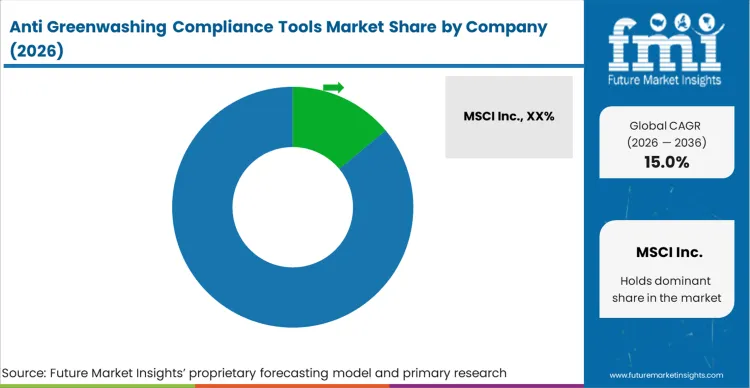
MSCI Inc. and S&P Global maintain significant structural advantages through their massive installed base of financial data terminals. Challengers entering this market must specifically build deep-tier supply chain mapping capabilities to displace these incumbents who primarily focus on top-tier ESG metrics. Vendors embedding precision timing and synchronization protocols directly into edge devices gain a significant architectural advantage. This silicon-first approach accelerates brownfield migration projects, allowing network architects to prioritize platforms that avoid external timing gateways.
Large corporate buyers prevent vendor lock-in by mandating multi-vendor interoperability programs and open communication standards. This structural tension between buyer flexibility and dominant vendor control limits pricing power even in a concentrated market. The competitive trajectory to 2036 suggests a move toward further commoditization of the physical communication layer, forcing vendors to compete on advanced logical orchestration software.
Key Players in Anti Greenwashing Compliance Tools Market
- MSCI Inc.
- S&P Global
- Sustainalytics (Morningstar)
- LSEG
- EcoVadis
- OneTrust
- Watershed
- Persefoni
- Diligent Corporation
- Envizi
Scope of the Report
| Metric | Value |
|---|---|
| Quantitative Units | USD 0.52 billion to USD 2.1 billion, at a CAGR of 15.00% |
| Market Definition | Anti Greenwashing Compliance Tools encompass specialized network switches, endpoints, and software stacks built on IEEE 802.1 standards to guarantee bounded low latency and zero packet loss for industrial automation traffic. |
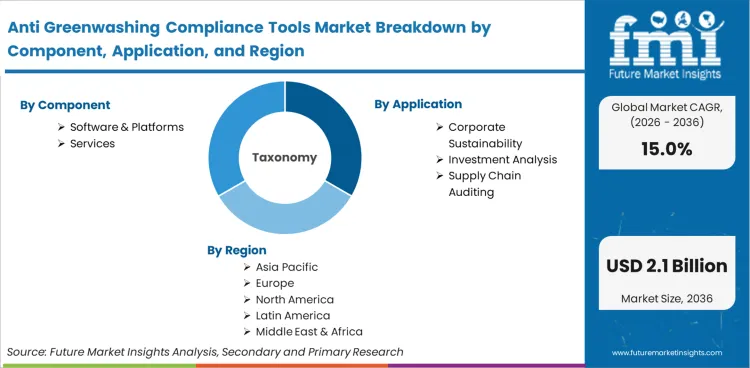
| Component Segmentation | Software & Platforms, Services |
| Application Segmentation | Corporate Sustainability Reporting, Investment Analysis, Supply Chain Auditing, Others |
| End use Segmentation | Financial Services, Manufacturing, Consumer Goods, Others |
| Function Segmentation | Data Verification & Audit, Traffic scheduling/shaping, FRER (replication/elimination), Others |
| Regions Covered | North America, Latin America, Europe, East Asia, South Asia, Oceania, Middle East & Africa |
| Countries Covered | China, India, USA, Germany, South Korea, Japan, UK, and 40 plus countries |
| Key Companies Profiled | MSCI Inc., S&P Global, Sustainalytics, Refinitiv, EcoVadis, OneTrust, Watershed, Persefoni, Diligent Corporation, IBM |
| Forecast Period | 2026 to 2036 |
| Approach | The baseline value derives from a bottom-up aggregation of deterministic switch shipments, applying region-specific modernization curves to project future adoption velocity. |
Source: Future Market Insights (FMI) analysis, based on proprietary forecasting model and primary research
Anti Greenwashing Compliance Tools Market Analysis by Segments
Component:
- Software & Platforms
- Services
Application:
- Corporate Sustainability Reporting
- Investment Analysis
- Supply Chain Auditing
- Others
End use:
- Financial Services
- Manufacturing
- Consumer Goods
- Others
Function:
- Data Verification & Audit
- Traffic scheduling/shaping
- FRER (replication/elimination)
- Others
Region:
- Asia Pacific
- India
- China
- Japan
- South Korea
- Indonesia
- Australia & New Zealand
- ASEAN
- Rest of Asia Pacific
- Europe
- Germany
- Italy
- France
- United Kingdom
- Spain
- Benelux
- Nordics
- Central & Eastern Europe
- Rest of Europe
- North America
- United States
- Canada
- Mexico
- Latin America
- Brazil
- Argentina
- Chile
- Rest of Latin America
- Middle East & Africa
- Kingdom of Saudi Arabia
- United Arab Emirates
- South Africa
- Turkey
- Rest of Middle East & Africa
Bibliography
- Financial Conduct Authority. (2024, April 23). FG24/3: Finalised non-handbook guidance on the anti-greenwashing rule
- European Securities and Markets Authority. (2024, June 4). Final report on greenwashing.
- EFRAG. (2024, May 31). ESRS implementation guidance documents.
- Australian Securities and Investments Commission. (2024, August 23). REP 791: ASIC’s interventions on greenwashing misconduct: 20232024.
- Central Consumer Protection Authority. (2024). Guidelines for prevention and regulation of greenwashing or misleading environmental claims, 2024. Ministry of Consumer Affairs, Food & Public Distribution, Government of India.
- IFRS Foundation. (2024, May 2). ESRSISSB standards interoperability guidance.
This bibliography is provided for reader reference and is not exhaustive. The full report contains the complete reference list and detailed citations.
Frequently Asked Questions
How large is the Anti Greenwashing Compliance Tools Market in 2026?
The market is estimated to reach USD 0.52 billion in 2026 as corporate legal departments replace aspirational marketing with contractually verifiable carbon accounting.
What will it be valued at by 2036?
The total opportunity is projected to hit USD 2.1 billion by 2036, propelled by institutional lenders tying interest rate reductions directly to real-time verification streams.
What CAGR is projected?
The industry is expected to grow at a CAGR of 15.00% through the forecast period, structurally supported by the strict enforcement of the EU Green Claims Directive eliminating vague terminology.
Which Component segment leads?
Software & Platforms commands a 46.0% share in 2026 because capital projects directors require robust digital orchestration to replace manual reporting frameworks before advanced verification can occur.
Which Application segment leads?
Corporate Sustainability Reporting represents 42.0% of the segment share in 2026, driven by discrete manufacturing environments unifying their communication networks to enable real-time carbon adjustments.
Which End use segment leads?
Financial Services holds a dominant 55.0% share in 2026 as fund managers reject any data feeds that introduce variable jitter into their high-speed investment loops.
What drives rapid growth?
The convergence of the EU Corporate Sustainability Reporting Directive and rising consumer litigation forces multinational companies to implement automated platforms that substantiate every eco-friendly label.
What is the primary restraint?
The intricate configuration parameters required to optimize scheduled traffic flows and validate multi-vendor hardware networks demand specialized network calculus expertise that most sustainability engineers currently lack.
Which country grows fastest?
China advances at the fastest compound rate of 18.0% through 2036 as state-mandated frameworks require digitized verification for all state-owned enterprise green bonds.
How does the EU Green Claims Directive impact this market?
This specific regulation eliminates vague marketing terminology, forcing brand owners to substantiate every environmental claim with granular, auditable life-cycle assessment (LCA) data.
What specific technology is being replaced?
Legacy manual spreadsheet templates are being systematically replaced by AI-driven verification engines and cloud-based ESG data lakes to ensure sub-millisecond data verification.
How do major players compete in this landscape?
Dominant incumbents like MSCI Inc. and S&P Global leverage their massive installed base of financial data terminals, forcing challengers to compete by building deep-tier supply chain mapping capabilities.
How does India contribute to the market's expansion?
India records a 17.0% growth rate driven by its pharmaceutical and textile export sectors facing stringent traceability and data integrity requirements from Western buyers.
Why is the USA prioritizing these compliance tools?
The United States tracks a 13.0% expansion as strict cybersecurity and data visibility mandates across multi-tier aerospace and defense supply chains force the deployment of converged verification architectures.
What is the key driver for Germany's market adoption?
Germany's 12.0% expansion is anchored by its automotive OEM supply chain, which dictates stringent validation criteria for mixed-criticality network traffic on advanced electric vehicle assembly lines.
How is South Korea approaching anti-greenwashing compliance?
South Korea's market is sustaining an 11.0% CAGR as semiconductor plant automation leads mandate zero-packet-loss architectures to guarantee verified compliance data alongside robotic control systems.
What shapes Japan's demand for these tools?
Japan's 10.0% growth is sustained by continuous qualification constraints, where every new motion control architecture must validate network timing compliance before receiving series production authorization.
Why is the UK market growing at 9.0%?
The United Kingdom's energy grid modernization programs require precise phase measurement data to prove green generation, forcing utility planners to abandon legacy telecontrol protocols.
What is included within the scope of this report?
The market scope incorporates purpose-built software platforms, cloud-based ESG data lakes, automated supply chain mapping tools, and AI-driven claim-scanning engines.
What technologies are explicitly excluded from the valuation?
Standard enterprise resource planning (ERP) systems lacking specialized ESG audit trails, generic marketing analytics software, and legacy manual spreadsheet templates are explicitly omitted.
How do institutional investors utilize these tools?
Asset managers require high-fidelity, API-driven ESG data feeds to prevent greenwashing liability within specialized sustainable investment funds and to secure preferential green financing rates.
What role do AI-driven engines play in this ecosystem?
Automated ingestion protocols natively extract non-financial metrics from unstructured invoices, shifting the intensive processing burden away from human auditors and reducing quarterly disclosure times.
How does FMI validate its forecasting model?
Analysts cross-validate bottom-up subscription revenue projections against quarterly investment volumes in climate-tech and publicly reported ESG consulting revenues from Tier-1 firms.
Preview the report firsthand - request a free sample
Get SampleGet the brochure for pricing and purchase details.
Get PDFTable of Content
- Executive Summary
- Global Market Outlook
- Demand-side Trends
- Supply-side Trends
- Technology Roadmap Analysis
- Analysis and Recommendations
- Market Overview
- Market Coverage / Taxonomy
- Market Definition / Scope / Limitations
- Research Methodology
- Chapter Orientation
- Analytical Lens and Working Hypotheses
- Market Structure, Signals, and Trend Drivers
- Benchmarking and Cross-market Comparability
- Market Sizing, Forecasting, and Opportunity Mapping
- Research Design and Evidence Framework
- Desk Research Programme (Secondary Evidence)
- Company Annual and Sustainability Reports
- Peer-reviewed Journals and Academic Literature
- Corporate Websites, Product Literature, and Technical Notes
- Earnings Decks and Investor Briefings
- Statutory Filings and Regulatory Disclosures
- Technical White Papers and Standards Notes
- Trade Journals, Industry Magazines, and Analyst Briefs
- Sector Databases and Reference Repositories
- FMI Internal Proprietary Databases and Historical Market Datasets
- Subscription Datasets and Paid Sources
- Social Channels, Communities, and Digital Listening Inputs
- Additional Desk Sources
- Expert Input and Fieldwork (Primary Evidence)
- Primary Modes
- Qualitative Interviews and Expert Elicitation
- Quantitative Surveys and Structured Data Capture
- Blended Approach
- Why Primary Evidence is Used
- Field Techniques
- Interviews
- Surveys
- Focus Groups
- Observational and In-context Research
- Social and Community Interactions
- Stakeholder Universe Engaged
- C-suite Leaders
- Board Members
- Presidents and Vice Presidents
- R&D and Innovation Heads
- Technical Specialists
- Domain Subject-matter Experts
- Scientists
- Physicians and Other Healthcare Professionals
- Governance, Ethics, and Data Stewardship
- Research Ethics
- Data Integrity and Handling
- Primary Modes
- Tooling, Models, and Reference Databases
- Desk Research Programme (Secondary Evidence)
- Data Engineering and Model Build
- Data Acquisition and Ingestion
- Cleaning, Normalisation, and Verification
- Synthesis, Triangulation, and Analysis
- Quality Assurance and Audit Trail
- Market Background
- Market Dynamics
- Drivers
- Restraints
- Opportunity
- Trends
- Scenario Forecast
- Demand in Optimistic Scenario
- Demand in Likely Scenario
- Demand in Conservative Scenario
- Opportunity Map Analysis
- Product Life Cycle Analysis
- Supply Chain Analysis
- Investment Feasibility Matrix
- Value Chain Analysis
- PESTLE and Porter’s Analysis
- Regulatory Landscape
- Regional Parent Market Outlook
- Production and Consumption Statistics
- Import and Export Statistics
- Market Dynamics
- Global Market Analysis 2021 to 2025 and Forecast, 2026 to 2036
- Historical Market Size Value (USD Million) Analysis, 2021 to 2025
- Current and Future Market Size Value (USD Million) Projections, 2026 to 2036
- Y-o-Y Growth Trend Analysis
- Absolute $ Opportunity Analysis
- Global Market Pricing Analysis 2021 to 2025 and Forecast 2026 to 2036
- Global Market Analysis 2021 to 2025 and Forecast 2026 to 2036, By Component
- Introduction / Key Findings
- Historical Market Size Value (USD Million) Analysis By Component , 2021 to 2025
- Current and Future Market Size Value (USD Million) Analysis and Forecast By Component , 2026 to 2036
- Software & Platforms
- Services
- Software & Platforms
- Y-o-Y Growth Trend Analysis By Component , 2021 to 2025
- Absolute $ Opportunity Analysis By Component , 2026 to 2036
- Global Market Analysis 2021 to 2025 and Forecast 2026 to 2036, By Application
- Introduction / Key Findings
- Historical Market Size Value (USD Million) Analysis By Application, 2021 to 2025
- Current and Future Market Size Value (USD Million) Analysis and Forecast By Application, 2026 to 2036
- Corporate Sustainability
- Investment Analysis
- Supply Chain Auditing
- Corporate Sustainability
- Y-o-Y Growth Trend Analysis By Application, 2021 to 2025
- Absolute $ Opportunity Analysis By Application, 2026 to 2036
- Global Market Analysis 2021 to 2025 and Forecast 2026 to 2036, By End use
- Introduction / Key Findings
- Historical Market Size Value (USD Million) Analysis By End use, 2021 to 2025
- Current and Future Market Size Value (USD Million) Analysis and Forecast By End use, 2026 to 2036
- Financial Services
- Manufacturing
- Consumer Goods
- Financial Services
- Y-o-Y Growth Trend Analysis By End use, 2021 to 2025
- Absolute $ Opportunity Analysis By End use, 2026 to 2036
- Global Market Analysis 2021 to 2025 and Forecast 2026 to 2036, By Region
- Introduction
- Historical Market Size Value (USD Million) Analysis By Region, 2021 to 2025
- Current Market Size Value (USD Million) Analysis and Forecast By Region, 2026 to 2036
- North America
- Latin America
- Western Europe
- Eastern Europe
- East Asia
- South Asia and Pacific
- Middle East & Africa
- Market Attractiveness Analysis By Region
- North America Market Analysis 2021 to 2025 and Forecast 2026 to 2036, By Country
- Historical Market Size Value (USD Million) Trend Analysis By Market Taxonomy, 2021 to 2025
- Market Size Value (USD Million) Forecast By Market Taxonomy, 2026 to 2036
- By Country
- USA
- Canada
- Mexico
- By Component
- By Application
- By End use
- By Country
- Market Attractiveness Analysis
- By Country
- By Component
- By Application
- By End use
- Key Takeaways
- Latin America Market Analysis 2021 to 2025 and Forecast 2026 to 2036, By Country
- Historical Market Size Value (USD Million) Trend Analysis By Market Taxonomy, 2021 to 2025
- Market Size Value (USD Million) Forecast By Market Taxonomy, 2026 to 2036
- By Country
- Brazil
- Chile
- Rest of Latin America
- By Component
- By Application
- By End use
- By Country
- Market Attractiveness Analysis
- By Country
- By Component
- By Application
- By End use
- Key Takeaways
- Western Europe Market Analysis 2021 to 2025 and Forecast 2026 to 2036, By Country
- Historical Market Size Value (USD Million) Trend Analysis By Market Taxonomy, 2021 to 2025
- Market Size Value (USD Million) Forecast By Market Taxonomy, 2026 to 2036
- By Country
- Germany
- UK
- Italy
- Spain
- France
- Nordic
- BENELUX
- Rest of Western Europe
- By Component
- By Application
- By End use
- By Country
- Market Attractiveness Analysis
- By Country
- By Component
- By Application
- By End use
- Key Takeaways
- Eastern Europe Market Analysis 2021 to 2025 and Forecast 2026 to 2036, By Country
- Historical Market Size Value (USD Million) Trend Analysis By Market Taxonomy, 2021 to 2025
- Market Size Value (USD Million) Forecast By Market Taxonomy, 2026 to 2036
- By Country
- Russia
- Poland
- Hungary
- Balkan & Baltic
- Rest of Eastern Europe
- By Component
- By Application
- By End use
- By Country
- Market Attractiveness Analysis
- By Country
- By Component
- By Application
- By End use
- Key Takeaways
- East Asia Market Analysis 2021 to 2025 and Forecast 2026 to 2036, By Country
- Historical Market Size Value (USD Million) Trend Analysis By Market Taxonomy, 2021 to 2025
- Market Size Value (USD Million) Forecast By Market Taxonomy, 2026 to 2036
- By Country
- China
- Japan
- South Korea
- By Component
- By Application
- By End use
- By Country
- Market Attractiveness Analysis
- By Country
- By Component
- By Application
- By End use
- Key Takeaways
- South Asia and Pacific Market Analysis 2021 to 2025 and Forecast 2026 to 2036, By Country
- Historical Market Size Value (USD Million) Trend Analysis By Market Taxonomy, 2021 to 2025
- Market Size Value (USD Million) Forecast By Market Taxonomy, 2026 to 2036
- By Country
- India
- ASEAN
- Australia & New Zealand
- Rest of South Asia and Pacific
- By Component
- By Application
- By End use
- By Country
- Market Attractiveness Analysis
- By Country
- By Component
- By Application
- By End use
- Key Takeaways
- Middle East & Africa Market Analysis 2021 to 2025 and Forecast 2026 to 2036, By Country
- Historical Market Size Value (USD Million) Trend Analysis By Market Taxonomy, 2021 to 2025
- Market Size Value (USD Million) Forecast By Market Taxonomy, 2026 to 2036
- By Country
- Kingdom of Saudi Arabia
- Other GCC Countries
- Turkiye
- South Africa
- Other African Union
- Rest of Middle East & Africa
- By Component
- By Application
- By End use
- By Country
- Market Attractiveness Analysis
- By Country
- By Component
- By Application
- By End use
- Key Takeaways
- Key Countries Market Analysis
- USA
- Pricing Analysis
- Market Share Analysis, 2025
- By Component
- By Application
- By End use
- Canada
- Pricing Analysis
- Market Share Analysis, 2025
- By Component
- By Application
- By End use
- Mexico
- Pricing Analysis
- Market Share Analysis, 2025
- By Component
- By Application
- By End use
- Brazil
- Pricing Analysis
- Market Share Analysis, 2025
- By Component
- By Application
- By End use
- Chile
- Pricing Analysis
- Market Share Analysis, 2025
- By Component
- By Application
- By End use
- Germany
- Pricing Analysis
- Market Share Analysis, 2025
- By Component
- By Application
- By End use
- UK
- Pricing Analysis
- Market Share Analysis, 2025
- By Component
- By Application
- By End use
- Italy
- Pricing Analysis
- Market Share Analysis, 2025
- By Component
- By Application
- By End use
- Spain
- Pricing Analysis
- Market Share Analysis, 2025
- By Component
- By Application
- By End use
- France
- Pricing Analysis
- Market Share Analysis, 2025
- By Component
- By Application
- By End use
- India
- Pricing Analysis
- Market Share Analysis, 2025
- By Component
- By Application
- By End use
- ASEAN
- Pricing Analysis
- Market Share Analysis, 2025
- By Component
- By Application
- By End use
- Australia & New Zealand
- Pricing Analysis
- Market Share Analysis, 2025
- By Component
- By Application
- By End use
- China
- Pricing Analysis
- Market Share Analysis, 2025
- By Component
- By Application
- By End use
- Japan
- Pricing Analysis
- Market Share Analysis, 2025
- By Component
- By Application
- By End use
- South Korea
- Pricing Analysis
- Market Share Analysis, 2025
- By Component
- By Application
- By End use
- Russia
- Pricing Analysis
- Market Share Analysis, 2025
- By Component
- By Application
- By End use
- Poland
- Pricing Analysis
- Market Share Analysis, 2025
- By Component
- By Application
- By End use
- Hungary
- Pricing Analysis
- Market Share Analysis, 2025
- By Component
- By Application
- By End use
- Kingdom of Saudi Arabia
- Pricing Analysis
- Market Share Analysis, 2025
- By Component
- By Application
- By End use
- Turkiye
- Pricing Analysis
- Market Share Analysis, 2025
- By Component
- By Application
- By End use
- South Africa
- Pricing Analysis
- Market Share Analysis, 2025
- By Component
- By Application
- By End use
- USA
- Market Structure Analysis
- Competition Dashboard
- Competition Benchmarking
- Market Share Analysis of Top Players
- By Regional
- By Component
- By Application
- By End use
- Competition Analysis
- Competition Deep Dive
- MSCI Inc.
- Overview
- Product Portfolio
- Profitability by Market Segments (Product/Age /Sales Channel/Region)
- Sales Footprint
- Strategy Overview
- Marketing Strategy
- Product Strategy
- Channel Strategy
- S&P Global
- Sustainalytics (Morningstar)
- LSEG
- EcoVadis
- OneTrust
- Watershed
- Persefoni
- MSCI Inc.
- Competition Deep Dive
- Assumptions & Acronyms Used


