

- Industry Size (2026)
- USD 12.1 Bn
- Forecast (2036)
- USD 48.4 Bn
- CAGR (2026 to 2036)
- 14.9%
Anticipatory Commerce Infrastructure Market Size, Market Forecast and Outlook By FMI
The anticipatory commerce infrastructure market was valued at USD 10.5 billion in 2025. Revenue is USD 12.1 billion in 2026 at a CAGR of 14.9% during the forecast period. Valuation is expected to be around USD 48.4 billion through 2036 as fulfillment operators replace static inventory mapping with predictive placement logic to protect margins on rapid delivery promises.
Supply chain operations must meet extremely short, typically thirty-minute, delivery windows. This operational reality indicates that relying solely on centralized regional hubs for inventory ensures failure and missed targets. Moving stock closer to consumers becomes necessary, creating fragmented capital pools. This requires extreme analytical precision for management and profitability assurance. A process delay directly and severely lowers the profit margin. Consequently, leading retailers now directly integrate advanced digital commerce platform capabilities into their core inventory planning and management cycles. Executives postponing predictive node selection technology integration face rapidly escalating last-mile execution costs. These costs are entirely eliminating the thin margins characteristic of online grocery fulfillment.
Summary of Anticipatory Commerce Infrastructure Market
- Market Snapshot
- The anticipatory commerce infrastructure market is valued at USD 10.5 billion in 2025, projected to reach USD 48.4 billion by 2036.
- The industry is expected to grow at a 14.9% CAGR from 2026 to 2036, creating an incremental opportunity of USD 36.3 billion.
- This market covers the predictive infrastructure deciding the placement of inventory, the routing of orders, and the specific fulfillment node serving demand before checkout or immediately after order creation.
- The category remains a software-led, data-dependent infrastructure layer defined by forecasting accuracy, real-time inventory visibility, and orchestration across stores, dark stores, and automated nodes.
- Demand and Growth Drivers
- Growing digital retail scale is driving increased demand, supported by USA e‑commerce revenue is expanding at a faster pace than overall retail sales.
- Rising expectations for same‑day and rapid fulfillment are accelerating investment in predictive and anticipatory systems.
- Ongoing investment in automated fulfillment is further propelling market adoption. Companies are reported to reinforce their focus on scaling its automated fulfillment network.
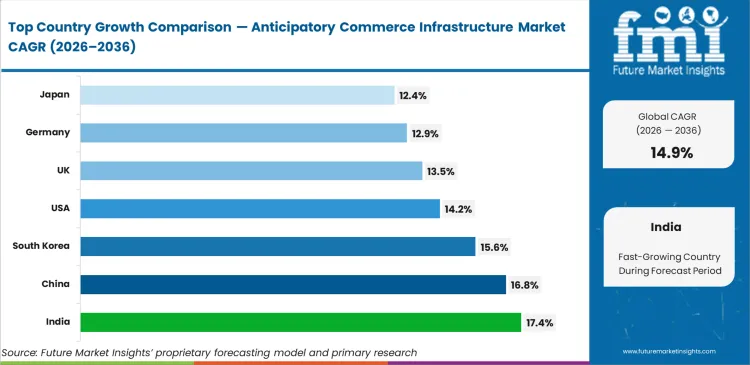
- Among leading markets, India shows the fastest growth at 17.4% CAGR, followed by China at 16.8%, South Korea at 15.6%, the United States at 14.2%, the United Kingdom at 13.5%, Germany at 12.9%, and Japan at 12.4%.
- Market expansion is tempered by challenges such as legacy‑system integration costs, inconsistent in‑store data quality, and the need to demonstrate clear ROI across mixed environments-traditional stores, dark‑store networks, and third‑party delivery partners.
- Product and Segment View
- The anticipatory commerce infrastructure market includes cloud software, analytics engines, orchestration layers, inventory visibility modules, API connectors, and selected automation interfaces.
- These platforms are used to pre-position stock and enable faster fulfillment across online grocery, general merchandise, pharmacy, fashion, and electronics.
- Software leads with a 44.0% share, driven by reliance on demand engines, orchestration rules, and inventory intelligence.
- Demand forecasting leads with a 29.0% share, as high-frequency updates and location-level demand signals are essential for pre-positioning logic.
- Cloud leads with a 63.0% share, favored by retailers for scalability and real-time updates across multiple nodes.
- Grocery leads with a 31.0% share, due to the critical nature of perishability, order frequency, and narrow delivery windows.
- Store fulfillment leads with a 28.0% share, as large retailers utilize existing stores as flexible nodes for same-day and scheduled delivery.
- Predictive demand planning, order orchestration, inventory positioning, node selection, and replenishment control.
- Generic ERP upgrades, pure parcel delivery operations, and warehouse automation without predictive fulfillment logic.
- Geography and Competitive Outlook
- India, China, and South Korea are the fastest-growing markets.
- The United States has the most stable high-value demand base due to its scale, installed infrastructure, and same-day retail intensity.
- Competition is shaped by retailer-platform integration, automation partnerships, and deeper forecasting capabilities.
- Key participants in the competition include Ocado Group, Symbotic, Manhattan Associates, Blue Yonder, Instacart, AutoStore, and Fluent Commerce.
- The sector is moderately fragmented, with the leading player's share remaining under the standard.
- The market participants consist of software vendors, grocery automation specialists, OMS providers, and retailer-platform operators.
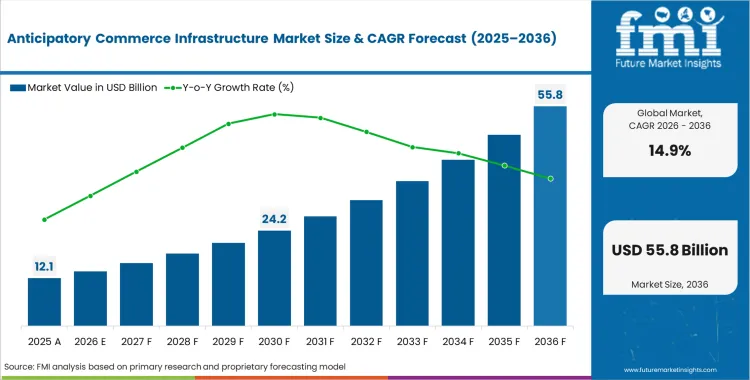
Anticipatory Commerce Infrastructure Market Key Takeaways
| Metric | Details |
|---|---|
| Industry Size (2026) | USD 12.1 billion |
| Industry Value (2036) | USD 48.4 billion |
| CAGR (2026 to 2036) | 14.9% |
Source: Future Market Insights (FMI) analysis, based on proprietary forecasting model and primary research
Manual store-picking operations become completely unsustainable, collapsing profitability. This makes the shift to automated orchestration of fulfillment processes mandatory. Fulfillment managers typically initiate this critical transition after detailed analysis. This analysis reveals that cumulative labor costs from manual picking and packing consistently exceed the average customer basket's profitability. Implementing and upgrading these predictive engines instantly and dramatically changes the optimal stock allocation across various fulfillment nodes, including specialized dark stores and traditional retail aisles.
Quick-commerce expansion is rapidly transforming last-mile logistics across the globe, with distinct regional strategies emerging. India leads at 17.4% as quick-commerce density forces aggressive node expansion. China follows at 16.8% with app-led grocery usage dictating inventory placement. South Korea tracks at 15.6% due to dense urban delivery networks. United States operators expand at 14.2% optimizing massive existing same-day footprints. United Kingdom fulfillment centers grow at 13.5%, just ahead of Germany at 12.9%. Japan advances at 12.4% possessing slower network reconfiguration cycles. Structural divergence separates regions requiring immediate micro-node deployment from regions optimizing established infrastructure.
Segmental Analysis
Anticipatory Commerce Infrastructure Market Analysis by Component
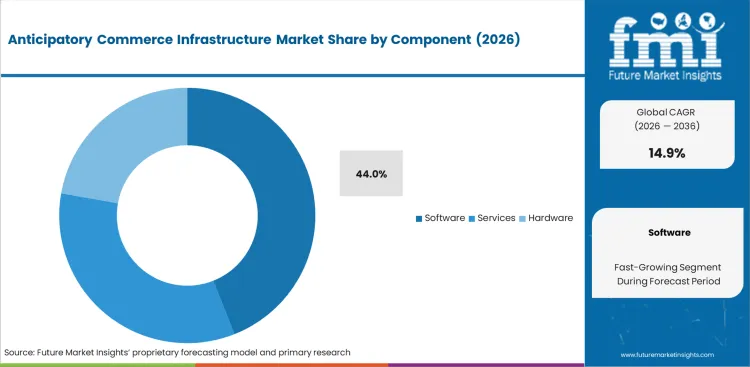
Physical automation is useless without the algorithmic intelligence to direct its movement. The software segment accounts for 44.0% market share in 2026, driven by continuous integration needs across fractured networks. FMI notes that predictive logic determines inventory location well before a robotic arm retrieves it. Retail technology buyers evaluating a live commerce capability quickly realize that hardware limitations are less critical than data latency. Integrating predictive engines completely transforms warehouse operations by shifting labor from reactive picking to proactive pre-positioning. Procurement teams often underestimate the hidden integration costs when pairing modern cloud tools with decades-old enterprise systems. Failure to bridge this technology gap leaves hardware assets idle, waiting for instructions.
- Algorithmic intelligence routing: Centralized software analyzes local buying signals to position inventory before orders are placed, helping fulfillment directors avoid expensive last-mile charges.
- Legacy integration friction: Connecting new predictive layers to outdated warehouse control systems causes significant latency, leading IT teams to face deployment delays and cost overruns.
- Systemic hardware utilization: Perfect data synchronization ensures automated storage systems can operate at maximum capacity continually, allowing operators to achieve a full return on their hardware investments.
Anticipatory Commerce Infrastructure Market Analysis by Function
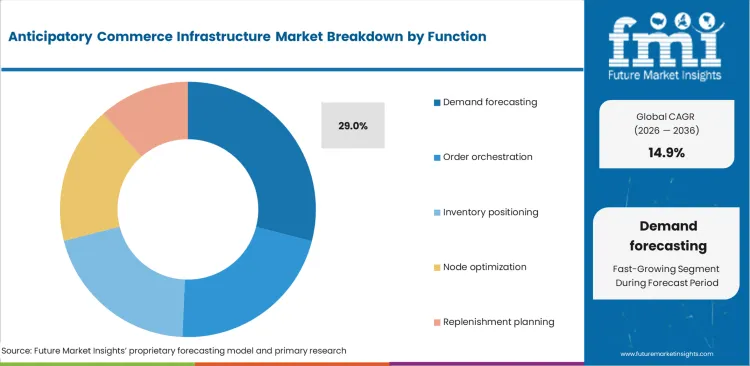
Correct inventory placement demands precise knowledge of consumer purchases arriving the next morning. High-frequency updates drive Demand forecasting segment holds 29.0% share in 2026, due to the goal of ending chaotic morning dispatch rushes. Inventory planners using modular E-commerce system architectures rely entirely on this predictive accuracy. Switching to algorithmic anticipation eliminates the manual, reactive processing that destroys picking efficiency. Supply chain directors see pure forecasting accuracy decline exponentially when weather or local events disrupt standard purchasing rhythms. Planners neglecting these hyper-local variables routinely strand capital in incorrect zip codes.
- Hyper-local variable integration: Machine learning incorporates neighborhood-level event data for adjusting stock targets. Inventory planners achieve significant reduction in out-of-stock rates.
- Disruption event penalties: Unforeseen local anomalies instantly destroy baseline forecasting models. Operations teams must manually reroute incoming deliveries in a scramble.
- Lifecycle margin preservation: Accurate long-term prediction lessens end-of-season markdown pressure. Merchandising directors ensure overall category profitability protection.
Anticipatory Commerce Infrastructure Market Analysis by Deployment
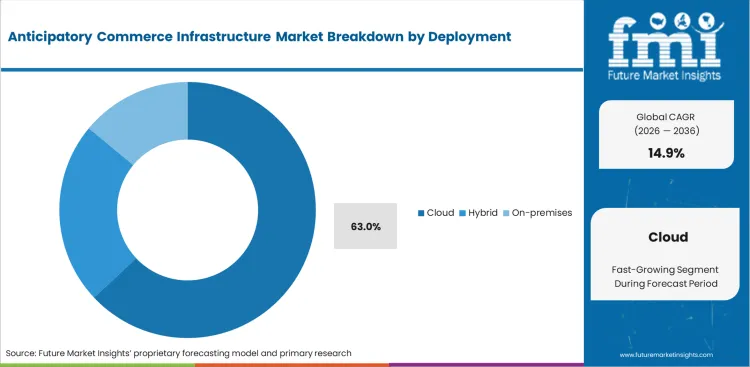
Constant data synchronization across numerous isolated physical locations requires immense external computing power. Network architects implementing digital commerce strategies avoid localized hosting because API calls must execute in milliseconds. Moving to distributed web architecture provides real-time inventory visibility across all dark stores simultaneously. Multi-node connectivity requirements raise the cloud segment revenue share to 63.0% in 2026, facilitated by the need for immediate multi-node synchronization. The irony of this shift is the retailer dependence on external servers, introducing an absolute vulnerability to third-party outage events during peak promotional windows. Chief technology officers underinvesting in redundancy risk catastrophic sales losses during crucial shopping hours.
- Real-time visibility synchronization: Cloud servers update inventory counts across the entire network instantly. Network architects prevent overselling of constrained items.
- Third-party outage exposure: Reliance on external computing infrastructure creates a single point of failure. IT directors face complete operational paralysis during server drops.
- Peak volume scalability: Flexible hosting automatically expands processing capacity during holiday surges. Operations leaders maintain thirty-minute delivery promises even under extreme load.
Anticipatory Commerce Infrastructure Market Analysis by End Use
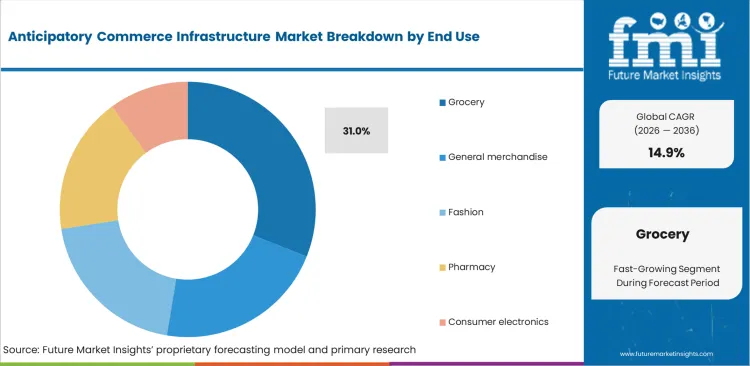
Narrow delivery windows multiply the cost of incorrect placement significantly. E-commerce strategy executives managing e commerce platform grocery sales understand transporting milk across town destroys the entire basket margin. Predictive positioning ensures high-velocity items sit exactly next to the required automated pickers. Perishability constraints is a key factor driving the grocery segment’s revenue share to 31.0% in 2026, accelerated by severe margin penalties connected to delayed dispatch. Generalist observers assume spoilage drives grocery automation, but the actual forcing function is the labor cost of picking disparate items across a massive physical footprint. Grocery managers failing to automate this routing inevitably lose market share to specialized quick-commerce competitors.
- Margin destruction prevention: Pre-positioning heavy or perishable goods minimizes expensive cross-town transfers. E-commerce strategy executives protect thin category margins.
- Picking velocity constraints: Human pickers navigating standard aisles cannot match the speed of automated micro-fulfillment. Store managers encounter an absolute limit on daily order volume.
- Category volume consolidation: Successful predictive placement enables broader assortment without increasing delivery times. Merchandising directors capture a larger share of weekly household spend.
Anticipatory Commerce Infrastructure Market Analysis by Fulfillment Model
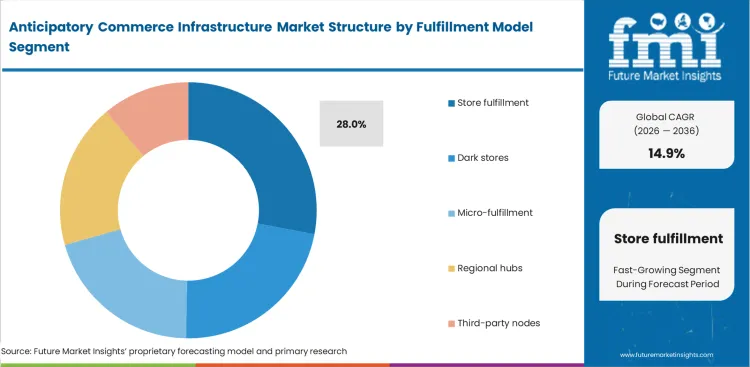
Retail giants use existing physical footprints to address last-mile proximity challenges. Regional operations managers integrating United States conversational commerce demand signals recognize retail aisles offer poor picking efficiency without algorithmic wave-planning. Implementing these systems transforms chaotic store floors into highly sequenced fulfillment zones. The paradox suggests treating a retail store like a dark warehouse inevitably degrades the in-person shopping experience for walk-in traffic. Operations managers ignoring this friction degrade their core brand equity while pursuing digital growth. The store segment holds a share of 28.0% in 2026, maintained by the urgency to use existing localized real estate efficiently.
- Proximity advantage capitalization: Existing retail locations are closer to consumers than any centralized warehouse could be. Regional operations managers minimize final-mile transit costs.
- In-store customer friction: Pickers crowding aisles to fulfill digital orders alienate traditional shoppers. Store directors must carefully balance conflicting revenue streams.
- Hybrid model transition: Retailers eventually wall off specific sections of stores for automated picking. Operations leaders resolve the conflict between digital and physical channels.
Anticipatory Commerce Infrastructure Market Drivers, Restraints, and Opportunities
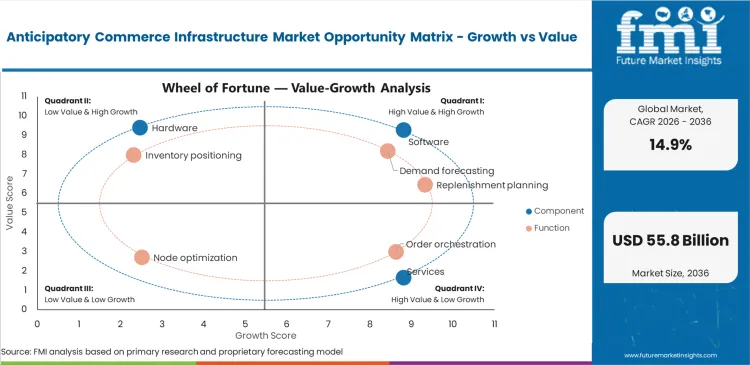
The stringent micro-delivery timeframes now mandate that the supply chain department strategically pre-position inventory closer to projected centers of consumer demand. The traditional reliance on fixed hub-and-spoke distribution networks is no longer sustainable, guaranteeing operational failure in the face of customers who anticipate fulfillment in under thirty minutes. Operations leaders are increasingly adopting and integrating hosting infrastructure service capabilities to actively perform complex calculations. This involves weighing the costs associated with predictive stock placement against the financial penalties incurred from consumer cart abandonment due to slow delivery estimates. Postponing this essential technological and logistical shift compels retailers to absorb prohibitively expensive last-mile courier surcharges simply to meet fundamental consumer expectations for speed and convenience.
Outdated warehouse control systems present a significant barrier, generating massive internal friction that severely impedes the effective adoption of modern predictive fulfillment engines. A common issue is the inability of point-of-sale data streams to communicate in real-time or seamlessly integrate with sophisticated orchestration algorithms. IT procurement executives frequently encounter substantial difficulty in justifying the complete removal of twenty-year-old enterprise resource planning (ERP) tools, a necessary step for truly enabling rapid, decentralized local delivery operations. Integrating a high performance message infrastructure provides an immediate, though only partial, stop-gap solution; achieving genuine, comprehensive real-time synchronization remains a formidable challenge without undertaking a complete and costly architectural overhaul of the entire system.
Opportunities in the Anticipatory Commerce Infrastructure Market
- Third-party node integration: Orchestrating inventory across independent courier locations expands physical reach without capital expenditure. Fulfillment operations directors capture new geographic demand.
- Return prediction modeling: Algorithms forecasting high-return probability items adjust inbound logistics flows proactively. Supply chain vice presidents reduce reverse logistics costs.
- Dynamic pricing synchronization: Linking ecommerce software and platform pricing to hyper-local stock levels maximizes margin. Merchandising directors extract premium value during scarcity events.
Regional Analysis
Based on regional analysis, the anticipatory commerce infrastructure market is segmented into North America, Europe, Asia Pacific, Latin America, and Middle East & Africa across 40 plus countries.
.webp "Top Country Growth Comparison Anticipatory Commerce Infrastructure Market Cagr (2026 2036)")
| Country | CAGR (2026 to 2036) |
| India | 17.4% |
| China | 16.8% |
| South Korea | 15.6% |
| United States | 14.2% |
| United Kingdom | 13.5% |
| Germany | 12.9% |
| Japan | 12.4% |
Source: Future Market Insights (FMI) analysis, based on proprietary forecasting model and primary research
Asia Pacific Anticipatory Commerce Infrastructure Market Analysis
Optimizing dense urban delivery networks for omnichannel retail requires focus on massive population centers. Logistics architects employ predictive engines for continuous management of large same-day order flows. FMI analysts observe that deploying datacenter infrastructure services facilitates perfect real-time synchronization across numerous micro-nodes. Maintaining profitability amid intense regional competition demands absolute algorithmic precision and high operational discipline.
- India: Inventory placement strategy across fragmented urban nodes relies on app-driven grocery usage, registering market revenue at 17.4% CAGR. Extreme quick-commerce density necessitates sophisticated predictive placement capabilities. Supply chain directors use advanced algorithms for maintaining service levels and preventing out-of-stock situations. Achieving precise local positioning grants a substantial competitive advantage over retailers using manual forecasting models. This rapid compound growth reflects an urgent need to deploy localized micro-fulfillment infrastructure ahead of escalating consumer expectations.
- China: Platform scale drives instant fulfillment execution. Logistics architects manage intricate routing rules, ensuring instantaneous access to high-velocity items. Scaling these capabilities fundamentally changes domestic consumer daily essential purchasing habits. Fulfillment-node expansion makes predictive stock positioning financially beneficial for large marketplace operators, securing a 16.8% CAGR. Sustaining this expansion requires continuous investment in machine learning algorithms that seamlessly process billions of localized transactional data points.
- South Korea: Dense urban infrastructure penalizes inefficient routing, accelerating growth. Dense urban delivery networks require advanced forecasting of omnichannel retail behavior, resulting in industry to grow at a 15.6% rate. Supply chain executives integrate real-time demand feeds to immediately anticipate hyper-local purchasing shifts. Mastering this environment creates a barrier against new market entrants lacking sophisticated data orchestration layers. Rapid growth directly results from extreme population density, severely amplifying the cost of incorrect inventory placement.
- Japan: Operations leaders carefully navigate complex integrations, ensuring seamless data flow. Slower network reconfiguration cycles require a focus on ROI before allocating capital to predictive systems, thereby growing market revenue at 12.4% CAGR. This reflects the methodical modernization of logistics frameworks. Automating these flows significantly reduces systemic labor dependency across an aging workforce. This steady expansion aligns with an ongoing need to balance experimental deployments with proven orchestration platforms.
North America Anticipatory Commerce Infrastructure Market Analysis
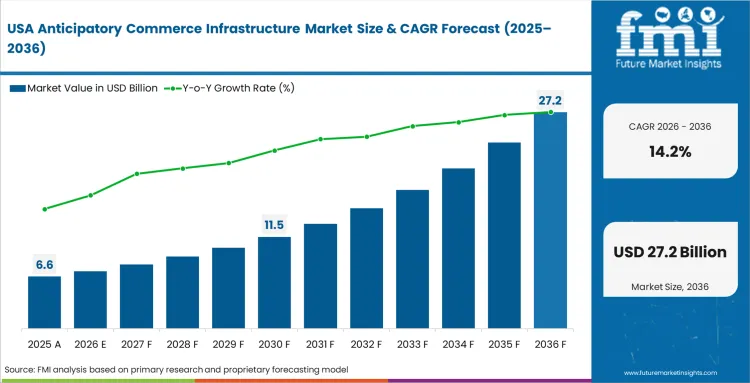
Extensive installed bases necessitate comprehensive, same-day infrastructure optimization across all operational segments for businesses to maintain a competitive edge in rapidly evolving marketplaces. Fulfillment directors are increasingly concentrating efforts on enhancing algorithmic efficiency. This focus allows businesses to meticulously extract maximum value from their existing physical footprints, turning legacy assets into dynamic tools for modern commerce. FMI analysis strongly indicates the implementation of usa digital commerce predictive logic empowers sophisticated retailers. This strategic technological adoption transforms traditionally static retail stores into highly responsive, dynamic fulfillment hubs capable of servicing digital orders with remarkable speed and accuracy. Upgrading these entrenched fulfillment networks requires careful, expert navigation around significant, long-standing software constraints.
- United States: Businesses possessing large installed bases coupled with the broad requirement for same-day infrastructure need exceptionally sophisticated inventory visibility logic to satisfy consumer demand. The market is experiencing substantial growth, expanding at 14.2% CAGR. Sustaining this high growth is the absolute necessity of aligning localized stock levels perfectly and instantaneously against real-time digital consumption signals originating from online shoppers. Fulfillment directors are aggressively optimizing these massive existing physical footprints and distribution centers. This intensive optimization effort serves as a direct countermeasure against the rapid and successful expansion of independent courier networks across the country. Effectively solving the significant final-mile cost equation proves to be the definitive action that ultimately unlocks total category dominance for established dominant retail players. These established organizations often hold significant, necessary capital reserves permitting extensive investment. The stable long-term growth trajectory reflects sustained, ongoing investments into modern, scalable cloud architecture. This substantial investment is primarily intended to conclusively solve persistent multi-store order visibility challenges that historically hamper rapid fulfillment across diverse geographic locations.
Europe Anticipatory Commerce Infrastructure Market Analysis
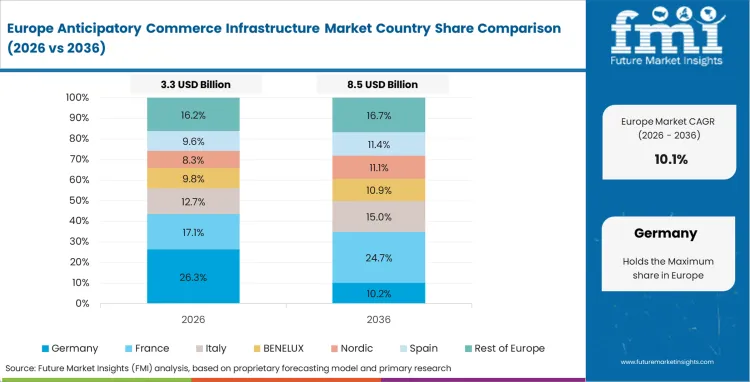
Stringent regional labor laws and strictly enforced zoning regulations heavily influence the strategic build-out of automated network capabilities across the continent. Operations directors are systematically developing highly localized micro-fulfillment logic capabilities designed specifically to bypass the inherent space limitations and planning restrictions associated with traditional, large-scale warehousing. FMI's comprehensive assessment clearly demonstrates the strategic application of voice commerce services intelligence directly to these local fulfillment hubs. This smart application effectively offsets notoriously high courier expenses prevalent across many European markets, significantly improving margin. Stricter requirements for Return on Investment (ROI) inherently slow down the pace of purely experimental technology deployments across the region
- United Kingdom: Technology procurement leads are prioritizing high API stability above all else in new deployments. This focus is essential to ensure uninterrupted, seamless data exchanges across numerous disparate and isolated system environments operating simultaneously. Successfully resolving this pervasive data friction issue is critically important for protecting grocers from entirely surrendering significant digital market share to more agile, technology-forward quick-commerce upstarts. The country’s extremely high e-commerce penetration rate places immense pressure on grocery retailers, forcing them to rapidly modernize their existing fulfillment algorithms and supply chain processes. This intense modernization is resulting in sector expansion tracking at a strong 13.5% Compound Annual Growth Rate. This robust growth is driven by the intense retailer pressure to retrofit existing, high-street retail locations with advanced predictive sorting capabilities.
- Germany: The country's exceptionally strict consumer privacy laws significantly complicate the construction and deployment of effective hyper-local demand forecasting models, requiring complex legal and technical workarounds. Industry is tracking a steady 12.9% CAGR, consistently supported by ongoing investments prioritizing the analysis of aggregated behavioral signals. This methodology is necessary to accurately predict regional purchasing trends without violating privacy regulations. Planners rely heavily on these aggregated behavioral signals to predict regional purchasing trends with the necessary degree of accuracy for stocking.
FMI’s detailed report includes deep-dive analyses on Canada, Brazil, Mexico, and several additional major European markets beyond those previously mentioned. Implementing UK digital commerce logic and strategies across these regions consistently reveals stricter financial Return on Investment (ROI) requirements. These financial hurdles inevitably slow the pace of purely experimental technology deployments and instead significantly favor the adoption of proven, reliable orchestration platforms that deliver immediate, measurable operational improvements across complex networks.
Competitive Aligners for Market Players
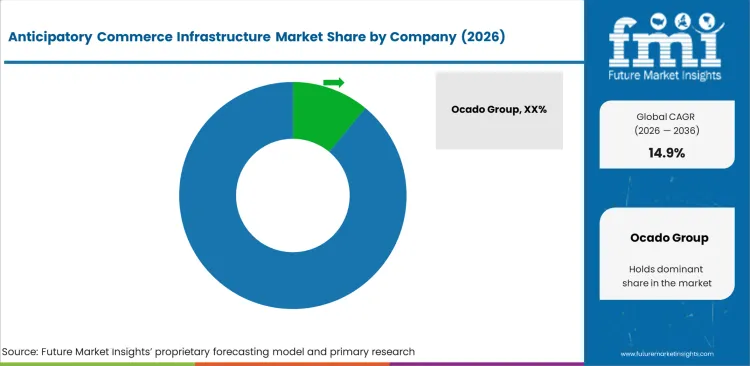
Retailer-platform integration defines competitive separation far more than standalone software features. Vendors like Ocado Group and Symbotic succeed due to physically embedding their predictive engines directly into the retailer's core operational flow. Supply chain procurement directors evaluate these systems based upon their ability to ingest messy, unstructured point-of-sale data and output clean routing instructions. Implementing india digital commerce capabilities proves algorithmic accuracy matters little absent the system's ability to parse enterprise resource planning formats.
Entrenched software providers possess massive libraries of historical fulfillment data impossible for new entrants to replicate. Companies such as Manhattan Associates and Blue Yonder leverage decades of inventory visibility experience to train their predictive models. Technology procurement leads rely on this historical depth to prevent catastrophic routing failures during peak holiday surges. Integrating japan digital commerce orchestration layers requires proving systemic stability under extreme transactional load.
Major retailers actively resist vendor lock-in by decoupling their forecasting engines from their physical automation hardware. Fulfillment strategy executives intentionally select API-driven middleware to maintain flexibility across multiple robotics providers. AutoStore and Fluent Commerce navigate this reality by offering highly composable architecture fitting inside larger technology stacks. Moving forward, the ability to orchestrate independent micro-fulfillment nodes without demanding total system control determines the vendors securing enterprise-level contracts.
Key Players in Anticipatory Commerce Infrastructure Market
- Ocado Group
- Symbotic
- Manhattan Associates
- Blue Yonder
- Instacart
- AutoStore
- Fluent Commerce
Scope of the Report
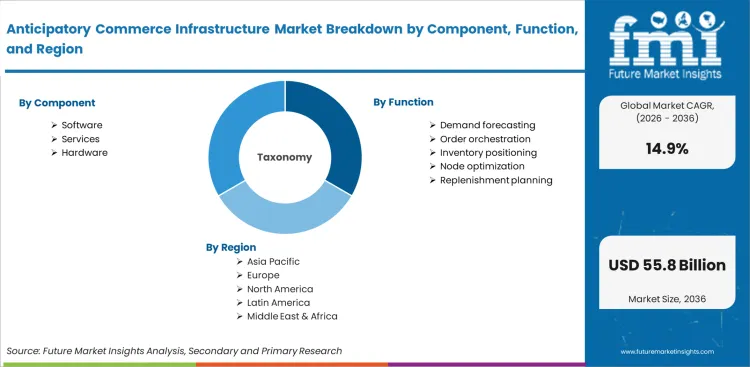
| Metric | Value |
| Quantitative Units | USD 12.1 billion to USD 48.4 billion, at a CAGR of 14.9% |
| Market Definition | Predictive routing engines and inventory positioning software define this functional boundary. Systems must determine precise stock locations and order flows prior to checkout finalization to qualify for inclusion. |
| Segmentation | Component, Function, Deployment, End Use, Fulfillment Model, and Region |
| Regions Covered | North America, Europe, Asia Pacific, Latin America, Middle East & Africa |
| Countries Covered | United States, Canada, Germany, United Kingdom, France, Italy, Spain, China, Japan, South Korea, Taiwan, Singapore, Brazil, Mexico, Argentina, GCC Countries, South Africa, Israel |
| Key Companies Profiled | Ocado Group, Symbotic, Manhattan Associates, Blue Yonder, Instacart, AutoStore, Fluent Commerce |
| Forecast Period | 2026 to 2036 |
| Approach | E-commerce sales volume data crossed against automated node deployment figures |
Source: Future Market Insights (FMI) analysis, based on proprietary forecasting model and primary research
Anticipatory Commerce Infrastructure Market Analysis by Segments
Component
- Software
- Services
- Hardware
Function
- Demand forecasting
- Order orchestration
- Inventory positioning
- Node optimization
- Replenishment planning
Deployment
- Cloud
- Hybrid
- On-premises
End Use
- Grocery
- General merchandise
- Fashion
- Pharmacy
- Consumer electronics
Fulfillment Model
- Store fulfillment
- Dark stores
- Micro-fulfillment
- Regional hubs
- Third-party nodes
Region
- North America
- United States
- Canada
- Europe
- Germany
- United Kingdom
- France
- Italy
- Spain
- Asia Pacific
- China
- Japan
- South Korea
- Taiwan
- Singapore
- Latin America
- Brazil
- Mexico
- Argentina
- Middle East & Africa
- GCC Countries
- South Africa
- Israel
- Rest of Middle East & Africa
Bibliography
- USA Census Bureau. (2026, March 10). Quarterly retail e-commerce sales: 4th quarter 2025. USA Department of Commerce.
- Eurostat. (2026, January 9). Volume of retail trade up by 0.2% in both the euro area and the EU. European Commission.
- Symbotic Inc. (2025, November 24). Annual report on Form 10-K for the fiscal year ended September 27, 2025. USA Securities and Exchange Commission filing.
- Manhattan Associates, Inc. (2025, February 7). Annual report on Form 10-K for the year ended December 31, 2024.
- Maplebear Inc. (Instacart). (2026, February 26). Annual report on Form 10-K. USA Securities and Exchange Commission filing.
This bibliography is provided for reader reference. The full FMI report contains the complete reference list with primary source documentation.
This Report Addresses
- Anticipatory software adoption accelerating across automated grocery networks.
- Legacy integration friction slowing multi-node predictive orchestration deployments.
- Perishability constraints driving hyper-local inventory positioning investments.
- Distributed cloud architecture solving multi-store order visibility challenges.
- Machine learning algorithms calculating pre-positioning costs against abandonment.
- Predictive node selection maximizing existing retail aisle picking velocity.
- Independent courier networks integrating directly with enterprise fulfillment platforms.
- Algorithmic precision reducing last-mile execution penalties for quick-commerce.
Frequently Asked Questions
What was the anticipatory commerce infrastructure market value in 2025?
The valuation reached USD 10.5 billion in 2025. This baseline anchors the cost of replacing static hub-and-spoke logic with dynamic node mapping. Operators require precise digital routing to protect thin margins on rapid delivery promises.
What is the anticipatory commerce infrastructure market projection for 2036?
Revenue is projected to reach USD 48.4 billion by 2036. Sustained capital flows into algorithmic intelligence as labor inflation makes manual picking operations economically unviable. Retailers must pre-position stock perfectly to survive thirty-minute fulfillment demands.
What is the anticipatory commerce infrastructure market CAGR?
Demand expands at a 14.9% CAGR through 2036. This trajectory reflects the escalating cost of last-mile execution errors. Fulfillment directors deploy these predictive layers to prevent catastrophic cross-town courier surcharges.
Why does software lead the component segment?
Software holds 44.0% share because physical automation yields zero return without algorithmic intelligence directing it. Hardware robots remain static without the predictive logic that defines where inventory belongs long before a physical arm retrieves it.
What drives demand forecasting leadership in function?
Capturing 29.0% share, this function leads because positioning inventory correctly requires knowing precisely what consumers will buy tomorrow. High-frequency update capabilities prevent the chaotic morning dispatch rush that destroys overall picking efficiency.
Why does cloud dominate the deployment segment?
Securing 63.0% share, cloud architecture enables continuous data synchronization across dozens of isolated physical locations. Centralized hosting allows network architects to update inventory counts across the entire network instantly without localized server latency.
What forces grocery to lead the end use segment?
Holding 31.0% share, narrow delivery windows amplify the cost of incorrect placement exponentially. Perishability constraints force e-commerce executives to ensure high-velocity items sit exactly where automated pickers need them to avoid massive spoilage.
Why does store fulfillment hold significant share?
Accounting for 28.0% share, large retailers utilize existing physical footprints to solve last-mile proximity challenges. Maximizing real estate minimizes final-mile transit costs better than building entirely new centralized fulfillment hubs.
What causes India to grow faster than China?
India tracks at 17.4% against China's 16.8% because its extreme quick-commerce density forces incredibly aggressive predictive capability expansion. Supply chain directors facing ten-minute delivery promises cannot rely on reactive picking logic under any circumstance.
How does infrastructure impact the United States trajectory?
United States operators expand at 14.2% while optimizing massive existing same-day footprints. Upgrading these entrenched networks requires careful navigation of software constraints that often refuse to communicate with modern orchestration algorithms.
What role do third-party nodes play in future growth?
Orchestrating inventory across independent courier locations expands physical reach without capital expenditure. Fulfillment operations directors leverage these independent networks to capture new geographic demand without building dedicated physical dark stores.
Why do major retailers resist vendor lock-in?
Decoupling forecasting engines from physical automation hardware maintains flexibility across multiple robotics providers. Strategy executives intentionally select API-driven middleware to orchestrate independent micro-fulfillment nodes without demanding total system control.
What happens when predictive engines lack real-time data?
Accuracy degrades exponentially when local events disrupt standard purchasing rhythms. Planners who ignore these hyper-local variables routinely strand capital in the wrong zip code, requiring manual rerouting that erases expected margins.
How does cloud reliance expose fulfillment networks?
Relying on external computing infrastructure creates a single point of failure during peak promotional windows. Chief technology officers face complete operational paralysis if third-party servers drop during critical shopping hours.
What friction emerges when treating stores like dark warehouses?
Pickers crowding aisles to fulfill digital orders alienate traditional walk-in shoppers. Store directors must balance conflicting revenue streams carefully to prevent algorithmic wave-planning from degrading core physical brand equity.
How does return prediction alter inbound logistics?
Algorithms forecasting high-return probability items adjust inbound flows proactively. Supply chain vice presidents utilize this intelligence to minimize reverse logistics costs before the initial outbound shipment even leaves the facility.
Why do hardware assets often sit stranded post-deployment?
Connecting new predictive layers to old warehouse control systems introduces massive latency. IT leads face delayed deployments when modern cloud tools fail to bridge the communication gap with twenty-year-old enterprise resource systems.
What forces retailers to adopt automated orchestration?
When order volume crosses the threshold where manual store-picking collapses profitability, automated orchestration becomes mandatory. Fulfillment managers trigger this transition after seeing labor costs exceed basket profitability consistently.
How does local demand visibility affect pricing strategy?
Linking hyper-local stock levels to pricing algorithms maximizes margin during scarcity events. Merchandising directors extract premium value by understanding exactly when a specific micro-node holds the only available inventory in a region.
Why do observers misjudge grocery automation drivers?
Observers assume spoilage drives grocery automation, but the actual forcing function is the labor cost of picking disparate items across a massive physical footprint. Predictive placement solves this labor limitation entirely.
What capability defines competitive vendor success?
Ingesting messy, unstructured point-of-sale data and outputting clean routing instructions defines competitive separation. Algorithmic accuracy matters little if the system cannot parse enterprise resource planning formats reliably.
How do entrenched software providers defend their position?
Possessing massive libraries of historical fulfillment data allows incumbents to train superior predictive models. Technology procurement leads rely on this historical depth to prevent catastrophic routing failures during peak holiday surges.
Preview the report firsthand - request a free sample
Get SampleGet the brochure for pricing and purchase details.
Get PDFTable of Content
- Executive Summary
- Global Market Outlook
- Demand-side Trends
- Supply-side Trends
- Technology Roadmap Analysis
- Analysis and Recommendations
- Market Overview
- Market Coverage / Taxonomy
- Market Definition / Scope / Limitations
- Research Methodology
- Chapter Orientation
- Analytical Lens and Working Hypotheses
- Market Structure, Signals, and Trend Drivers
- Benchmarking and Cross-market Comparability
- Market Sizing, Forecasting, and Opportunity Mapping
- Research Design and Evidence Framework
- Desk Research Programme (Secondary Evidence)
- Company Annual and Sustainability Reports
- Peer-reviewed Journals and Academic Literature
- Corporate Websites, Product Literature, and Technical Notes
- Earnings Decks and Investor Briefings
- Statutory Filings and Regulatory Disclosures
- Technical White Papers and Standards Notes
- Trade Journals, Industry Magazines, and Analyst Briefs
- Conference Proceedings, Webinars, and Seminar Materials
- Government Statistics Portals and Public Data Releases
- Press Releases and Reputable Media Coverage
- Specialist Newsletters and Curated Briefings
- Sector Databases and Reference Repositories
- FMI Internal Proprietary Databases and Historical Market Datasets
- Subscription Datasets and Paid Sources
- Social Channels, Communities, and Digital Listening Inputs
- Additional Desk Sources
- Expert Input and Fieldwork (Primary Evidence)
- Primary Modes
- Qualitative Interviews and Expert Elicitation
- Quantitative Surveys and Structured Data Capture
- Blended Approach
- Why Primary Evidence is Used
- Field Techniques
- Interviews
- Surveys
- Focus Groups
- Observational and In-context Research
- Social and Community Interactions
- Stakeholder Universe Engaged
- C-suite Leaders
- Board Members
- Presidents and Vice Presidents
- R&D and Innovation Heads
- Technical Specialists
- Domain Subject-matter Experts
- Scientists
- Physicians and Other Healthcare Professionals
- Governance, Ethics, and Data Stewardship
- Research Ethics
- Data Integrity and Handling
- Primary Modes
- Tooling, Models, and Reference Databases
- Desk Research Programme (Secondary Evidence)
- Data Engineering and Model Build
- Data Acquisition and Ingestion
- Cleaning, Normalisation, and Verification
- Synthesis, Triangulation, and Analysis
- Quality Assurance and Audit Trail
- Market Background
- Market Dynamics
- Drivers
- Restraints
- Opportunity
- Trends
- Scenario Forecast
- Demand in Optimistic Scenario
- Demand in Likely Scenario
- Demand in Conservative Scenario
- Opportunity Map Analysis
- Product Life Cycle Analysis
- Supply Chain Analysis
- Investment Feasibility Matrix
- Value Chain Analysis
- PESTLE and Porter’s Analysis
- Regulatory Landscape
- Regional Parent Market Outlook
- Production and Consumption Statistics
- Import and Export Statistics
- Market Dynamics
- Global Market Analysis 2021 to 2025 and Forecast, 2026 to 2036
- Historical Market Size Value (USD Million) Analysis, 2021 to 2025
- Current and Future Market Size Value (USD Million) Projections, 2026 to 2036
- Y-o-Y Growth Trend Analysis
- Absolute $ Opportunity Analysis
- Global Market Pricing Analysis 2021 to 2025 and Forecast 2026 to 2036
- Global Market Analysis 2021 to 2025 and Forecast 2026 to 2036, By Component
- Introduction / Key Findings
- Historical Market Size Value (USD Million) Analysis By Component , 2021 to 2025
- Current and Future Market Size Value (USD Million) Analysis and Forecast By Component , 2026 to 2036
- Software
- Services
- Hardware
- Software
- Y-o-Y Growth Trend Analysis By Component , 2021 to 2025
- Absolute $ Opportunity Analysis By Component , 2026 to 2036
- Global Market Analysis 2021 to 2025 and Forecast 2026 to 2036, By Function
- Introduction / Key Findings
- Historical Market Size Value (USD Million) Analysis By Function, 2021 to 2025
- Current and Future Market Size Value (USD Million) Analysis and Forecast By Function, 2026 to 2036
- Demand forecasting
- Order orchestration
- Inventory positioning
- Node optimization
- Replenishment planning
- Demand forecasting
- Y-o-Y Growth Trend Analysis By Function, 2021 to 2025
- Absolute $ Opportunity Analysis By Function, 2026 to 2036
- Global Market Analysis 2021 to 2025 and Forecast 2026 to 2036, By Deployment
- Introduction / Key Findings
- Historical Market Size Value (USD Million) Analysis By Deployment, 2021 to 2025
- Current and Future Market Size Value (USD Million) Analysis and Forecast By Deployment, 2026 to 2036
- Cloud
- Hybrid
- On-premises
- Cloud
- Y-o-Y Growth Trend Analysis By Deployment, 2021 to 2025
- Absolute $ Opportunity Analysis By Deployment, 2026 to 2036
- Global Market Analysis 2021 to 2025 and Forecast 2026 to 2036, By End Use
- Introduction / Key Findings
- Historical Market Size Value (USD Million) Analysis By End Use, 2021 to 2025
- Current and Future Market Size Value (USD Million) Analysis and Forecast By End Use, 2026 to 2036
- Grocery
- General merchandise
- Fashion
- Pharmacy
- Consumer electronics
- Grocery
- Y-o-Y Growth Trend Analysis By End Use, 2021 to 2025
- Absolute $ Opportunity Analysis By End Use, 2026 to 2036
- Global Market Analysis 2021 to 2025 and Forecast 2026 to 2036, By Fulfillment Model
- Introduction / Key Findings
- Historical Market Size Value (USD Million) Analysis By Fulfillment Model, 2021 to 2025
- Current and Future Market Size Value (USD Million) Analysis and Forecast By Fulfillment Model, 2026 to 2036
- Store fulfillment
- Dark stores
- Micro-fulfillment
- Regional hubs
- Third-party nodes
- Store fulfillment
- Y-o-Y Growth Trend Analysis By Fulfillment Model, 2021 to 2025
- Absolute $ Opportunity Analysis By Fulfillment Model, 2026 to 2036
- Global Market Analysis 2021 to 2025 and Forecast 2026 to 2036, By Region
- Introduction
- Historical Market Size Value (USD Million) Analysis By Region, 2021 to 2025
- Current Market Size Value (USD Million) Analysis and Forecast By Region, 2026 to 2036
- North America
- Latin America
- Western Europe
- Eastern Europe
- East Asia
- South Asia and Pacific
- Middle East & Africa
- Market Attractiveness Analysis By Region
- North America Market Analysis 2021 to 2025 and Forecast 2026 to 2036, By Country
- Historical Market Size Value (USD Million) Trend Analysis By Market Taxonomy, 2021 to 2025
- Market Size Value (USD Million) Forecast By Market Taxonomy, 2026 to 2036
- By Country
- USA
- Canada
- Mexico
- By Component
- By Function
- By Deployment
- By End Use
- By Fulfillment Model
- By Country
- Market Attractiveness Analysis
- By Country
- By Component
- By Function
- By Deployment
- By End Use
- By Fulfillment Model
- Key Takeaways
- Latin America Market Analysis 2021 to 2025 and Forecast 2026 to 2036, By Country
- Historical Market Size Value (USD Million) Trend Analysis By Market Taxonomy, 2021 to 2025
- Market Size Value (USD Million) Forecast By Market Taxonomy, 2026 to 2036
- By Country
- Brazil
- Chile
- Rest of Latin America
- By Component
- By Function
- By Deployment
- By End Use
- By Fulfillment Model
- By Country
- Market Attractiveness Analysis
- By Country
- By Component
- By Function
- By Deployment
- By End Use
- By Fulfillment Model
- Key Takeaways
- Western Europe Market Analysis 2021 to 2025 and Forecast 2026 to 2036, By Country
- Historical Market Size Value (USD Million) Trend Analysis By Market Taxonomy, 2021 to 2025
- Market Size Value (USD Million) Forecast By Market Taxonomy, 2026 to 2036
- By Country
- Germany
- UK
- Italy
- Spain
- France
- Nordic
- BENELUX
- Rest of Western Europe
- By Component
- By Function
- By Deployment
- By End Use
- By Fulfillment Model
- By Country
- Market Attractiveness Analysis
- By Country
- By Component
- By Function
- By Deployment
- By End Use
- By Fulfillment Model
- Key Takeaways
- Eastern Europe Market Analysis 2021 to 2025 and Forecast 2026 to 2036, By Country
- Historical Market Size Value (USD Million) Trend Analysis By Market Taxonomy, 2021 to 2025
- Market Size Value (USD Million) Forecast By Market Taxonomy, 2026 to 2036
- By Country
- Russia
- Poland
- Hungary
- Balkan & Baltic
- Rest of Eastern Europe
- By Component
- By Function
- By Deployment
- By End Use
- By Fulfillment Model
- By Country
- Market Attractiveness Analysis
- By Country
- By Component
- By Function
- By Deployment
- By End Use
- By Fulfillment Model
- Key Takeaways
- East Asia Market Analysis 2021 to 2025 and Forecast 2026 to 2036, By Country
- Historical Market Size Value (USD Million) Trend Analysis By Market Taxonomy, 2021 to 2025
- Market Size Value (USD Million) Forecast By Market Taxonomy, 2026 to 2036
- By Country
- China
- Japan
- South Korea
- By Component
- By Function
- By Deployment
- By End Use
- By Fulfillment Model
- By Country
- Market Attractiveness Analysis
- By Country
- By Component
- By Function
- By Deployment
- By End Use
- By Fulfillment Model
- Key Takeaways
- South Asia and Pacific Market Analysis 2021 to 2025 and Forecast 2026 to 2036, By Country
- Historical Market Size Value (USD Million) Trend Analysis By Market Taxonomy, 2021 to 2025
- Market Size Value (USD Million) Forecast By Market Taxonomy, 2026 to 2036
- By Country
- India
- ASEAN
- Australia & New Zealand
- Rest of South Asia and Pacific
- By Component
- By Function
- By Deployment
- By End Use
- By Fulfillment Model
- By Country
- Market Attractiveness Analysis
- By Country
- By Component
- By Function
- By Deployment
- By End Use
- By Fulfillment Model
- Key Takeaways
- Middle East & Africa Market Analysis 2021 to 2025 and Forecast 2026 to 2036, By Country
- Historical Market Size Value (USD Million) Trend Analysis By Market Taxonomy, 2021 to 2025
- Market Size Value (USD Million) Forecast By Market Taxonomy, 2026 to 2036
- By Country
- Kingdom of Saudi Arabia
- Other GCC Countries
- Turkiye
- South Africa
- Other African Union
- Rest of Middle East & Africa
- By Component
- By Function
- By Deployment
- By End Use
- By Fulfillment Model
- By Country
- Market Attractiveness Analysis
- By Country
- By Component
- By Function
- By Deployment
- By End Use
- By Fulfillment Model
- Key Takeaways
- Key Countries Market Analysis
- USA
- Pricing Analysis
- Market Share Analysis, 2025
- By Component
- By Function
- By Deployment
- By End Use
- By Fulfillment Model
- Canada
- Pricing Analysis
- Market Share Analysis, 2025
- By Component
- By Function
- By Deployment
- By End Use
- By Fulfillment Model
- Mexico
- Pricing Analysis
- Market Share Analysis, 2025
- By Component
- By Function
- By Deployment
- By End Use
- By Fulfillment Model
- Brazil
- Pricing Analysis
- Market Share Analysis, 2025
- By Component
- By Function
- By Deployment
- By End Use
- By Fulfillment Model
- Chile
- Pricing Analysis
- Market Share Analysis, 2025
- By Component
- By Function
- By Deployment
- By End Use
- By Fulfillment Model
- Germany
- Pricing Analysis
- Market Share Analysis, 2025
- By Component
- By Function
- By Deployment
- By End Use
- By Fulfillment Model
- UK
- Pricing Analysis
- Market Share Analysis, 2025
- By Component
- By Function
- By Deployment
- By End Use
- By Fulfillment Model
- Italy
- Pricing Analysis
- Market Share Analysis, 2025
- By Component
- By Function
- By Deployment
- By End Use
- By Fulfillment Model
- Spain
- Pricing Analysis
- Market Share Analysis, 2025
- By Component
- By Function
- By Deployment
- By End Use
- By Fulfillment Model
- France
- Pricing Analysis
- Market Share Analysis, 2025
- By Component
- By Function
- By Deployment
- By End Use
- By Fulfillment Model
- India
- Pricing Analysis
- Market Share Analysis, 2025
- By Component
- By Function
- By Deployment
- By End Use
- By Fulfillment Model
- ASEAN
- Pricing Analysis
- Market Share Analysis, 2025
- By Component
- By Function
- By Deployment
- By End Use
- By Fulfillment Model
- Australia & New Zealand
- Pricing Analysis
- Market Share Analysis, 2025
- By Component
- By Function
- By Deployment
- By End Use
- By Fulfillment Model
- China
- Pricing Analysis
- Market Share Analysis, 2025
- By Component
- By Function
- By Deployment
- By End Use
- By Fulfillment Model
- Japan
- Pricing Analysis
- Market Share Analysis, 2025
- By Component
- By Function
- By Deployment
- By End Use
- By Fulfillment Model
- South Korea
- Pricing Analysis
- Market Share Analysis, 2025
- By Component
- By Function
- By Deployment
- By End Use
- By Fulfillment Model
- Russia
- Pricing Analysis
- Market Share Analysis, 2025
- By Component
- By Function
- By Deployment
- By End Use
- By Fulfillment Model
- Poland
- Pricing Analysis
- Market Share Analysis, 2025
- By Component
- By Function
- By Deployment
- By End Use
- By Fulfillment Model
- Hungary
- Pricing Analysis
- Market Share Analysis, 2025
- By Component
- By Function
- By Deployment
- By End Use
- By Fulfillment Model
- Kingdom of Saudi Arabia
- Pricing Analysis
- Market Share Analysis, 2025
- By Component
- By Function
- By Deployment
- By End Use
- By Fulfillment Model
- Turkiye
- Pricing Analysis
- Market Share Analysis, 2025
- By Component
- By Function
- By Deployment
- By End Use
- By Fulfillment Model
- South Africa
- Pricing Analysis
- Market Share Analysis, 2025
- By Component
- By Function
- By Deployment
- By End Use
- By Fulfillment Model
- USA
- Market Structure Analysis
- Competition Dashboard
- Competition Benchmarking
- Market Share Analysis of Top Players
- By Regional
- By Component
- By Function
- By Deployment
- By End Use
- By Fulfillment Model
- Competition Analysis
- Competition Deep Dive
- Ocado Group
- Overview
- Product Portfolio
- Profitability by Market Segments (Product/Age /Sales Channel/Region)
- Sales Footprint
- Strategy Overview
- Marketing Strategy
- Product Strategy
- Channel Strategy
- Symbotic
- Manhattan Associates
- Blue Yonder
- Instacart
- AutoStore
- Fluent Commerce
- Ocado Group
- Competition Deep Dive
- Assumptions & Acronyms Used


