

- Industry Size (2026)
- USD 5.0 Bn
- Forecast (2036)
- USD 24.4 Bn
- CAGR (2026 to 2036)
- 17.20%
Ambient Commerce Enablement Infrastructure Market Size, Market Forecast and Outlook By FMI
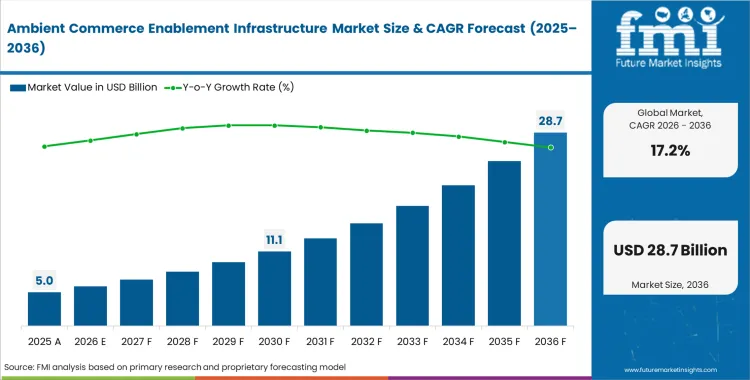
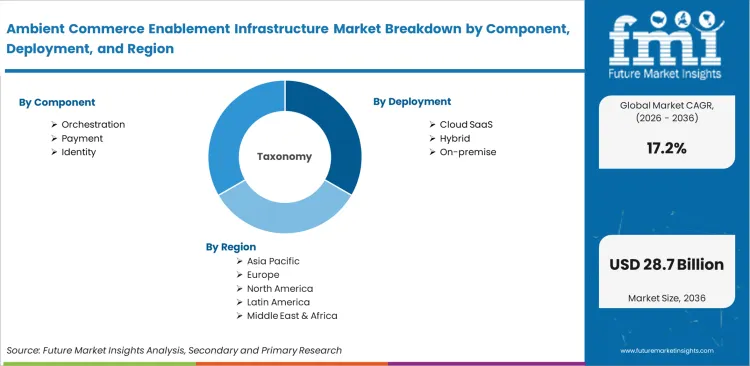
The ambient commerce infrastructure market crossed a valuation of USD 4.3 billion in 2025, and is projected to reach USD 5.0 billion in 2026, expanding at a CAGR of 17.2% during the forecast period. This swiftly growing industry takes total valuation to USD 24.4 billion through 2036 as digital commerce platform capabilities shift from reactive web interfaces to background-layer processing.
Summary of Ambient Commerce Enablement Infrastructure Market
- Market Snapshot
- The Ambient Commerce Enablement Infrastructure Market is valued at USD 4.3 billion in 2025 and is projected to reach USD 24.4 billion by 2036.
- A fast-paced unanticipated adoption of this technological realm constitutes for a 17.2% CAGR from 2026 to 2036, creating an incremental opportunity of USD 19.4 billion over the decade.
- The market remains a software-and-data infrastructure layer where orchestration, identity, payment routing, tokenization, event capture, and low-friction transaction execution matter more than storefront design alone.
- Market structure is being shaped by composable commerce adoption, commerce media monetization, enterprise IoT expansion, and the spread of transaction experiences into messaging, apps, and connected endpoints.
- Demand and Growth Drivers
- The significant surge in the industry landscape represents enterprises that want transactions to happen inside the moment of intent rather than sending users through a separate checkout journey, which raises the value of orchestration APIs and embedded payment logic.
- Adoption is also increasing as commerce stacks move from channel-centric builds to governed platform models that centralize merchandising, checkout, and compliance controls.
- Retail media and commerce media broadening are pushing brands and retailers to connect attribution, product feeds, and transaction paths more tightly, which expands the need for ambient commerce infrastructure.
- Connected-device is widening the number of potential purchase surfaces, especially across smart buildings, smart home, mobility, and device-assisted retail workflows.
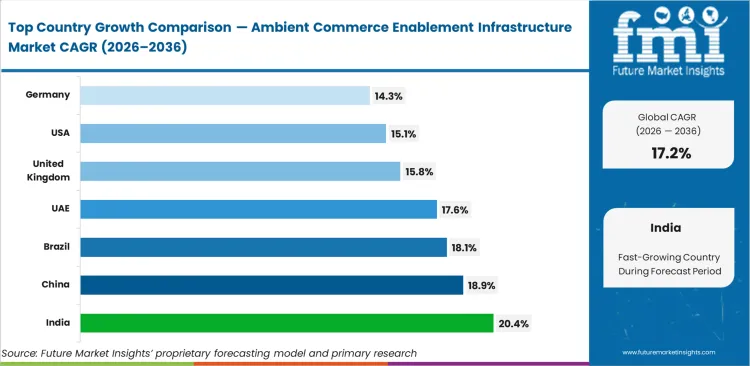
- Among modeled countries, India currently holds a 20.4% CAGR, followed by China at 18.9%, Brazil at 18.1%, UAE at 17.6%, United Kingdom at 15.8%, United States at 15.1%, and Germany at 14.3%.
- Growth is moderated by privacy-compliance friction, integration complexity, fragmented legacy systems, and the fact that many enterprises still run separate stacks for payments, messaging, loyalty, and fulfillment events.
- Product and Segment View
- A combination of orchestration APIs, identity layers, payment rails, and offer engines defines the market, with most systems operating on cloud-native software architectures to manage complex event-data.
- These platforms support a wide array of modern purchasing methods, ranging from voice-assisted orders and messaging commerce to POS-linked journeys and transaction triggers within connected devices.
- Enterprises typically prioritize a control layer to sync payment and fulfillment, which has resulted in orchestration APIs securing a leading 31.0% share of the component segment.
- Cloud SaaS represents 74.0% of the deployment segment, a figure driven by the corporate need for easier regional scaling, faster rollouts, and significantly lower integration drag.
- Most invisible transactions still originate during mobile-led discovery phases, positioning mobile apps as the top touchpoint with a 29.0% market share.
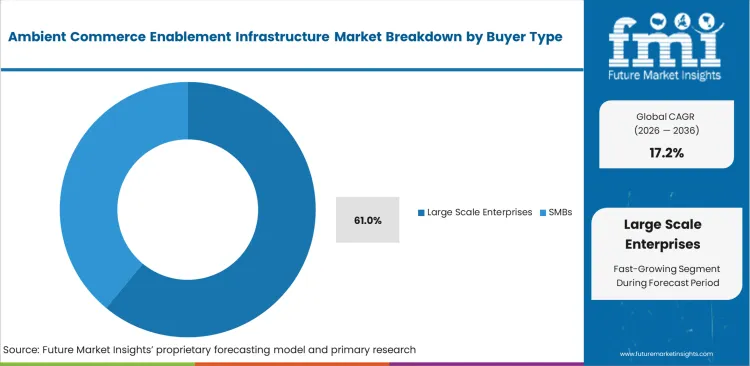
- Large enterprises account for 61.0% of the buyer type segment, as these organizations possess the substantial budgets required to unify fragmented commerce operations through advanced infrastructure.
- Merchants and marketplaces lead the end-use segment with a 34.0% share because these retail operators face the highest urgency to shorten checkout paths and boost attributable conversion rates.
- The scope includes software revenues tied to embedded transaction enablement, but excludes full merchant payment volume, standalone banking-product revenues, and pure storefront or agency-service revenues.
- Geography and Competitive Outlook
- India, China, and Brazil are the fastest-growing national markets, while the United States remains the most stable high-value demand base.
- Competition is being shaped by unified commerce, composable architecture, AI-assisted shopping, embedded financial services, and commerce-data connectivity rather than by checkout widgets alone.
- Shopify, Stripe, Adyen, Salesforce, Adobe, commercetools, and VTEX are among the most visible active vendors spanning different layers of the stack.
- The market is moderately fragmented as merchants and enterprises often assemble ambient commerce capability from several interoperating platforms rather than from one vendor.
Store managers are now dealing with a big change as it is no longer just about selling online and in-person, but about making the actual payment part invisible. Today, a shopping trip might start with a smart mirror or a sensor in your pantry, and these gadgets need a very smooth system to finish the sale instantly. If a shop is slow to switch to this automatic way of selling, they might lose their most loyal customers to huge tech companies that already have everyone’s login and payment information secured. This pressure is making the software that runs these deals more important than the actual physical store.
Companies grow even faster when they make it easy to pay using just a face or fingerprint scan across different places. The real secret is making sure a person is recognized everywhere, so a smart car can approve a grocery pickup without the driver ever having to type in a password. Instead of having separate apps for everything, the focus is shifting to building one flexible system that stays up and running most of the time to handle these hidden payments.
The India ambient commerce market leads at 20.4%, with rapid digitization of Tier-2 retail networks, while China tracks at 18.9% on the back of mature autonomous retail clusters. The Brazil ambient commerce infrastructure market is positioned at 18.1% as instant payment frameworks encourage ambient adoption. The UAE ambient commerce enablement market is set to record 17.6%, followed by the UK ambient commerce software market at 15.8%, USA ambient commerce infrastructure at 15.1%, and Germany at 14.3%. Structural divergence is defined by the varying speeds at which central bank digital infrastructures allow private merchants to trigger pull transactions without multi-step authentication.
Segmental Analysis
Ambient Commerce Enablement Infrastructure Market Analysis by Component
Orchestration wins procurement evaluations because it provides the connective tissue between disparate IoT sensors and the layer. Managing a single checkout is easy, but managing ten thousand simultaneous sensor pings across a retail floor requires sophisticated checkout orchestration software, reflecting the 31.0% share as the need for this specific component rises. FMI’s assessment indicates that without high-performance orchestration, ambient commerce collapses into a series of failed background tasks. R&D directors at major retail chains recognize that re-qualifying an orchestration layer is a three-year undertaking, creating a significant vendor lock-in effect for ambient commerce infrastructure vendors. What the share figure does not communicate is that orchestration is increasingly being absorbed into broader stacks to enable real-time pricing updates at the shelf edge. Buyers who delay this structural integration find themselves unable to react to competitor pricing shifts in the ambient environment.
- Logic-Flow Validation: Orchestration engines ensure that sensor data is converted into actionable commercial events without overloading the core database.
- API Handshake Integrity: These engines manage the critical sub-second window between user recognition and payment authorization.
- Edge-to-Cloud Routing: This mechanism determines which transaction tasks are processed at the physical store and which are sent to the central cloud.
Ambient Commerce Enablement Infrastructure Market Analysis by Deployment
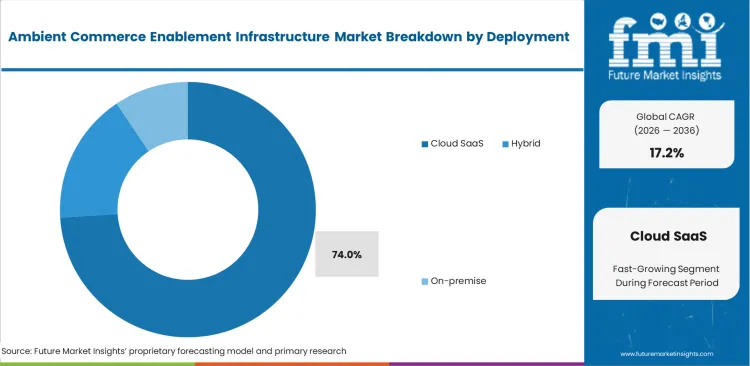
Cloud SaaS represents the dominant delivery model because ambient environments generate massive, unpredictable bursts of sensor data that local servers cannot handle. This deployment mode accounts for 74.0% share, driven by the need for retailers to outsource the heavy lifting of and real-time offer generation to specialized providers. FMI observes that the choice of unified commerce software is shaped by the speed of deployment rather than just cost; a global marketplace can activate a new geographic region in weeks rather than months. One non-obvious observation is that cloud environments are the only ones capable of training the machine learning models required for in real-time. Failing to adopt a cloud-first approach leaves a merchant stuck with static logic that cannot adapt to fluid consumer behavior.
- Burst-Capacity Management: Cloud SaaS allows merchants to handle holiday shopping peaks without over-provisioning hardware for the rest of the year.
- Global Latency Reduction: Specialized cloud providers place transaction logic at the network edge, closer to the physical touchpoint.
- Security Update Automation: SaaS providers manage the constant evolution of biometric security protocols and compliance requirements.
Ambient Commerce Enablement Infrastructure Market Analysis by Touchpoint
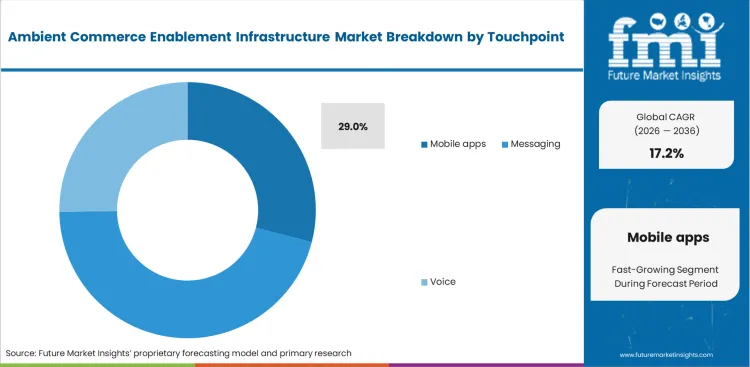
Mobile applications are currently the most common way for consumers to interact with these hidden systems because they already store the necessary payment and identity credentials. This familiar interface is expected to account for a 29.0% share of the total market, as instead of requiring a new gadget, retailers are simply adding background logic to the apps people already have on their phones to trigger transactions. This approach allows for a smooth transition from traditional clicking to automated walk-out experiences without a steep learning curve. Success for developers depends on making the app's handshake with physical store sensors so fast that the user never has to take their phone out of their pocket.
- App-Native Transaction Triggers: Mobile software uses location data and Bluetooth signals to tell the store's backend exactly when a customer has picked up an item.
- Biometric Identity Handshaking: Fingerprint or face scans on a personal device serve as the secure key that unlocks an automated payment in a public space.
- Proximity-Based Offer Pushing: Sensors near the shelf communicate with the user's phone to apply digital coupons or loyalty points the moment they stand in front of a product.
Ambient Commerce Enablement Infrastructure Market Analysis by Buyer Type
Large scale enterprises currently lead the way in using these advanced systems because they already possess the massive data pools needed to make automated shopping work. Big brands are willing to spend heavily on the complex sensor setups and long-term tech projects that smaller shops cannot yet afford. The ultimate goal for these giants is to build a shopping world where customers never have to stand in a traditional checkout line, these major market players as a result determine a 61.0% share of the as we enter 2026. By controlling the entire identity system, these companies can make sure a shopper is recognized the second they walk through the door.
- Data Lake Monetization: Large firms use their existing customer information to train the smart engines that predict what a shopper wants before they ask.
- Multi-Store Synchronization: Big retailers need systems that work exactly the same way across hundreds of different locations at once.
- Custom API Development: Enterprise buyers often pay for unique software bridges that connect their old inventory systems to new ambient sensors.
Ambient Commerce Enablement Infrastructure Market Analysis by End Use
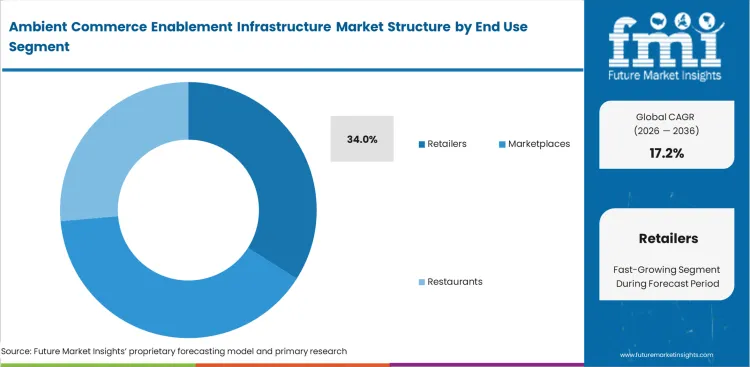
Traditional retailers are the main group using this technology right now as they try to make buying things in person as easy as clicking a button on a phone, this leading group sets the bar at 34.0% share while they set up more staff-free kiosks and autonomous stores. Most businesses see an immediate win when they can move workers away from a cash register and onto the sales floor to help customers. While restaurants and delivery apps are starting to use these tools, the massive number of daily sales in regular stores keeps them at the top of the industry. Success in this field depends on making the payment part of the trip so smooth that people eventually forget it is even happening.
- Frictionless Grocery Replenishment: Supermarkets use these tools to let shoppers grab milk or bread and just walk out while the bill is handled in the background.
- In-App Mobility Payments: Transportation apps use this infrastructure to let riders pay for fares automatically the moment they step onto a bus or train.
- Autonomous Dining Checkouts: Restaurants are testing systems where the bill is settled the moment a diner gets up from their table.
Ambient Commerce Enablement Infrastructure Market Drivers, Restraints, and Opportunities
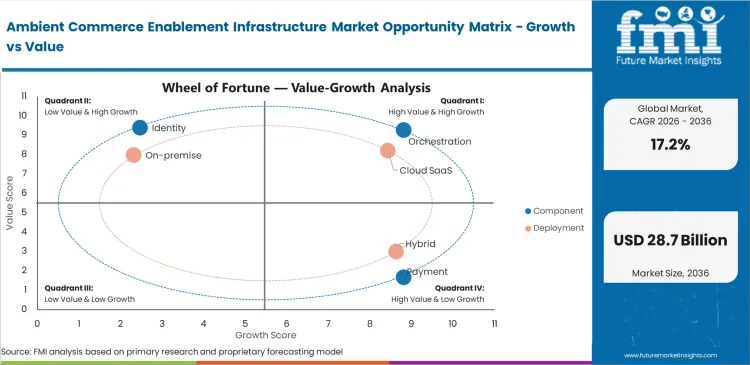
The commercial urgency of checkout-free environments is forcing retail operations managers to act now, as competitors who adopt an ambient commerce platform market strategy see a 20.0% increase in basket size through reduced friction. When a consumer can simply walk out of a store or order via voice without reaching for a wallet, the psychological barrier to spending drops. This drastically reformed method means that merchants who wait for the perfect technology will find their high-frequency customers have already migrated to platforms that offer levels of payment speed.
The primary operational friction that inhibits adoption is the unstructured environment problem, where ambient commerce software market solutions fail to accurately attribute a transaction in crowded or multi-user settings. This is not a software bug but a fundamental physical sensing challenge that requires costly multi-sensor fusion. R&D directors find that even when a buyer wants to move, the cost of re-fitting a physical space with the necessary depth sensors and microphones creates a multi-year budget hurdle.
- Ambient Commerce in Automotive: Vehicle manufacturers are becoming the new retail touchpoint by integrating logic directly into the dashboard for fuel, parking, and food pickup.
- Smart Home Replenishment: White goods manufacturers who embed ambient ordering into refrigerators and washing machines can lock consumers into specific supply contracts via automated background triggers.
- Hyper-Local Micro-Marketplaces: Smaller retailers are utilizing connected device commerce platform technology to create 24/7 autonomous kiosks that rely on cloud-based identity verification rather than on-site staff.
Regional Analysis
.webp "Top Country Growth Comparison Ambient Commerce Enablement Infrastructure Market Cagr (2026 2036)")
Modern shopping habits are changing globally as countries move away from traditional storefronts toward systems that handle payments in the background. This significant change is most apparent in areas where mobile-first cultures are outstripping older banking methods to embrace completely frictionless environments.
| Country | CAGR (2026 to 2036) |
|---|---|
| India | 20.4% |
| China | 18.9% |
| Brazil | 18.1% |
| UAE | 17.6% |
| United Kingdom | 15.8% |
| United States | 15.1% |
| Germany | 14.3% |
Source: Future Market Insights (FMI) analysis, based on proprietary forecasting model and primary research
South Asia & Pacific Ambient Commerce Enablement Infrastructure Market Analysis
Digital habits in this region have matured quickly, moving from simple phone-based apps to high-tech systems that recognize shoppers instantly. Local stores are skipping the era of plastic cards and going straight to automated bank-to-bank transfers that happen without a single click. This area is currently the world’s most active testing ground for invisible retail due to widespread government support for digital identity.
- India: Demand for the Ambient Commerce Enablement Infrastructure Market in India is anticipated to rise at a 20.4% CAGR through 2036, supported by the growing use of biometric scanners across small retail outlets. Local shop owners are replacing traditional registers with systems that connect directly to bank accounts because setup costs remain manageable even for neighborhood stores. This is helping smaller retailers offer a checkout experience that was once associated mainly with large supermarket chains. The shift is also supporting wider adoption of automated retail formats across major cities. As digital payment infrastructure becomes more common, staff-light and staff-free shopping models are gaining stronger commercial acceptance. India is expected to remain a high-growth market for ambient commerce infrastructure as payment automation spreads across everyday retail settings.
- China: Sales of the Ambient Commerce Enablement Infrastructure Market in China are set to record an 18.9% CAGR during the forecast period, driven by retailer investment in more accurate background sensing systems. Many retail operators are improving sensor performance to manage in-store activity more efficiently and support smoother automated shopping environments. Since consumers already use social platforms widely for daily transactions and services, adding an ambient layer to physical retail has become a more natural extension of existing behavior. These improvements help shopping centers handle higher customer volumes without creating longer checkout lines or requiring more security staff. China is likely to remain a major market as retailers continue connecting digital consumer habits with automated physical commerce infrastructure.
As per FMI’s assessments, the rapid industry transitions in South Asia are forcing technology providers to create more reliable ways to identify users in crowded spaces. As businesses that fail to update their systems, they risk being ignored by a generation of shoppers who never carry cash. Future growth will likely depend on how well these countries can protect personal data while keeping the shopping experience fast and effortless.
North America & Latin America c Analysis
Infrastructure in the Americas is being redesigned to merge the physical and digital worlds, allowing for smoother buying journeys. Instead of building entirely new facilities, many regions are integrating smart sensors into existing retail spaces to compete with the speed of online platforms. The focus remains on removing the friction of manual checkouts to cater to consumers who prioritize efficiency.
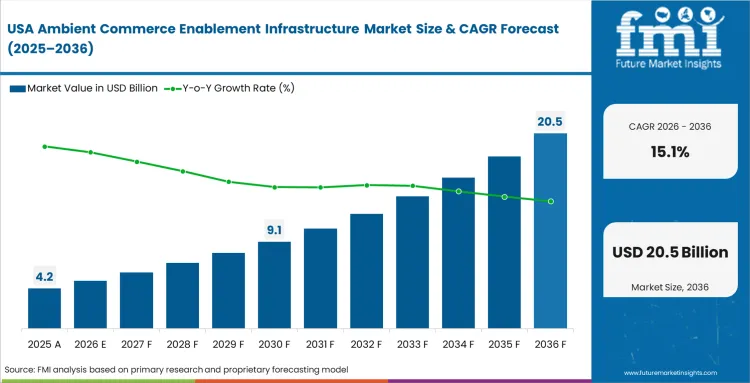
- United States: Sales of the Ambient Commerce Enablement Infrastructure Market in the United States are set to expand at a 15.1% CAGR through 2036, supported by the rollout of walk-out retail systems across large store networks. Adoption remains more measured than in mobile-first economies, though the scale of the domestic retail sector keeps the country central to infrastructure growth. Retail operators are focusing on how these background systems perform across supermarkets, convenience stores, and other varied store formats. That makes reliability across different layouts and traffic levels a key requirement for suppliers. The United States is expected to remain a major market as large retailers move automated shopping systems into broader day-to-day use.
- Brazil: Demand for the Ambient Commerce Enablement Infrastructure Market in Brazil is anticipated to rise at an 18.1% CAGR during the forecast period, supported by the growing use of instant bank transfer systems in retail spending. As consumer dependence on credit cards declines, more local retailers are exploring checkout-free formats built around quick and frequent purchase occasions. This is creating stronger demand for technology that links mobile payment behavior with physical store sensing systems. Suppliers are finding new opportunities as brands look for smoother ways to connect digital payment flows with in-store automation. Brazil is poised to remain an attractive market as payment modernization continues to support ambient retail adoption.
FMI assesses, both North and Latin American markets are prioritizing the integration of existing mobile payment habits into physical shopping environments. As consumers increasingly expect zero-click interactions at home, they are pushing retailers to provide the same level of ease in person. Companies that can bridge this gap while ensuring high levels of payment security will lead the next wave of commerce in these regions.
Europe Ambient Commerce Enablement Infrastructure Market Analysis
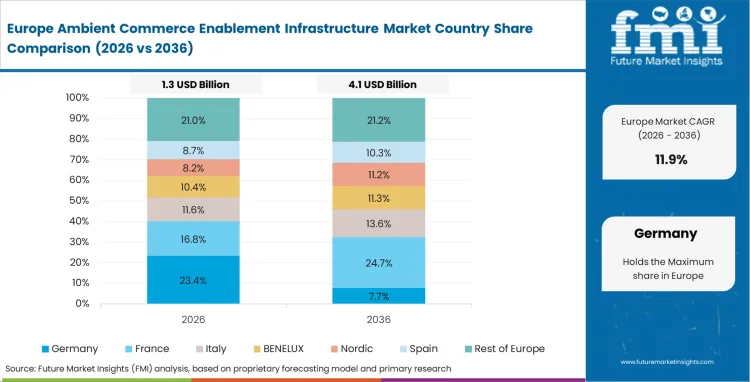
European retailers are focusing on automation to tackle labor shortages while improving the overall shopper experience. By layering smart technology onto established high-street infrastructure, they are turning traditional shopping trips into fast, background-processed events. The emphasis is on practical utility, using technology to keep stores operational and efficient in a changing economic landscape.
- United Kingdom: Demand for the Ambient Commerce Enablement Infrastructure Market in the United Kingdom is poised to expand at a 15.8% CAGR through 2036, supported by the growing use of conversational shopping tools among urban consumers. Voice assistants are increasingly being used to reorder household essentials, which is influencing how grocery chains track demand and manage stock movement. This is encouraging retailers to connect shelf-level activity more closely with real-time purchasing signals. As automated reordering becomes more common, inventory systems are becoming more responsive across daily-use product categories. The United Kingdom is likely to remain a notable market as voice-led shopping gains a stronger role in routine retail transactions.
- Germany: The Ambient Commerce Enablement Infrastructure Market in Germany is expected to record a 14.3% CAGR during the forecast period, as retailers and industrial operators look for practical ways to address labor shortages. Checkout automation is helping businesses extend store operations without depending on additional hiring at the same scale. That is improving the appeal of ambient commerce systems across cost-sensitive retail environments. Companies are also using these platforms to support continuity in service while managing higher operating expenses. Germany is set to remain a steady market as automation becomes more important to store efficiency and workforce planning.
Per FMI’s reports, European markets are currently balancing the need for operational speed with strict rules about how personal information is handled. As automation becomes a necessity for daily business, the demand for invisible, background-processed payment systems will continue to rise. Future success will depend on building consumer trust in these automated systems while maintaining high-speed performance.
Middle East Ambient Commerce Enablement Infrastructure Market Analysis
Rapid urban development in the Middle East is providing a unique opportunity to build smart retail infrastructure from the ground up. Major cities are investing heavily in technologies that allow for luxury, staff-free shopping experiences in high-traffic areas. This move toward automated environments is a key part of wider regional plans to lead the world in smart city innovation.
- UAE: Major shopping destinations in the Gulf are establishing a CAGR of 17.6% as they invest heavily in luxury autonomous kiosks. By using advanced face and palm recognition, these high-end stores allow visitors to walk in and out without ever opening a wallet. This move toward staff-free luxury is a key part of the region’s wider plan to become a global leader in smart city technology.
FMI analyses, the Middle East is positioning itself as a premier destination for high-end, high-tech retail that removes traditional barriers to purchase. By prioritizing biometric recognition and staff-free environments, regional leaders are setting a new standard for modern urban shopping. The long-term landscape depends on scaling these luxury innovations into broader, everyday retail applications.
Competitive Aligners for Market Players
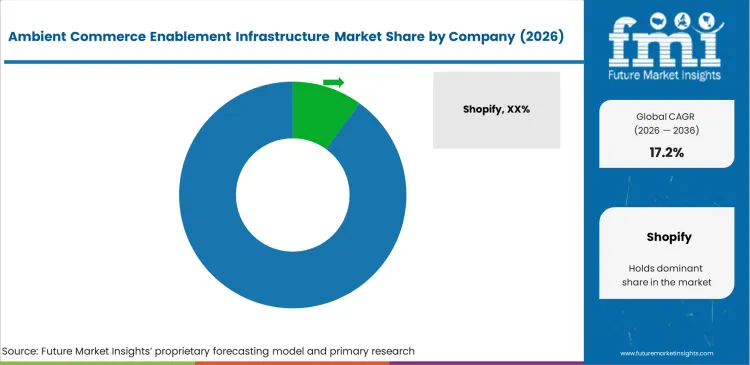
Control of the identity-to-payment gateway now dictates market leadership more than AI sophistication. Top ambient commerce platform providers increasingly serve as the essential orchestration layer, verifying user presence across physical and digital spaces as seen in the rivalry between Stripe and Adyen. Since the payment handshake remains the ultimate point of truth, these firms hold a structural advantage over traditional IT vendors. To avoid vendor lock-in, large retail buyers are adopting strategies that let them retain ownership of customer data while outsourcing only the transaction logic.
Challengers find it difficult to replicate the massive installed base of incumbents like Shopify and Salesforce, particularly in the mid-market where easy integration is a priority. Legacy systems struggle to adapt web-first architectures to the high-frequency demands of sensor-driven commerce, a tension visible in Shopify vs commercetools for ambient commerce evaluations. Competition now centers on providing a unified experience that functions identically in a smart car or a smart mirror. By offering API-first structures, new entrants are gaining ground through easier integration with edge-computing hardware.
Retailers are using their massive scale to force commerce orchestration software vendors into strict interoperability standards. This shift is driven by buyer demand for multi-touchpoint portability, ensuring a consumer’s identity and payment preferences follow them across different merchant environments. The market will likely split into two distinct tiers by 2036, infrastructure utilities, managing the transaction plumbing, and, experience platforms, focused on customer-facing ambient logic
Key Players in Ambient Commerce Enablement Infrastructure Market
- Shopify
- Stripe
- Adyen
- Salesforce
- Adobe
- commercetools
- VTEX
Scope of the Report
| Metric | Value |
|---|---|
| Quantitative Units | USD 5.0 billion to USD 24.4 billion, at a CAGR of 17.2% |
| Market Definition | Systems providing the automated logic, identity management, and payment triggers for frictionless transactions in non-traditional environments. It removes manual checkout actions through background processing. |
| Segmentation | Component, Deployment, Touchpoint, Buyer Type, End Use, and Region |
| Regions Covered | North America, Latin America, Europe, East Asia, South Asia & Pacific, Middle East & Africa |
| Countries Covered | India, China, Brazil, UAE, United Kingdom, United States, Germany |
| Key Companies Profiled | Shopify, Stripe, Adyen, Salesforce, Adobe, commercetools, VTEX |
| Forecast Period | 2026 to 2036 |
| Approach | Proprietary event-driven transaction volume tracking and API call analysis across retail and mobility verticals. |
Source: Future Market Insights (FMI) analysis, based on proprietary forecasting model and primary research
Segments:
Component
- Orchestration
- Payment
- Identity
- Identity stack
- Event data
- Offer engines
Deployment
- Cloud SaaS
- Hybrid
- On-premise
Touchpoint
- Mobile apps
- Messaging
- Voice
- In-store
- Connected devices
Buyer Type
- Large enterprises
- Mid-market
- SMBs
End Use
- Retailers
- Marketplaces
- Restaurants
- Mobility
- Financial services
Regions:
- North America
- United States
- Canada
- Latin America
- Brazil
- Mexico
- Europe
- United Kingdom
- Germany
- Asia-Pacific & ASEAN
- India
- China
- Japan
- Australia
Bibliography
- Cornelli, G., Frost, J., Warren, J., Yang, C., & Velasquez, C. (2024). Retail fast payment systems as a catalyst for digital finance (BIS Working Papers No. 1228). Bank for International Settlements.
- European Parliament and the Council of the European Union. (2024, June 13). Regulation (EU) 2024/1689 of the European Parliament and of the Council of 13 June 2024 laying down harmonised rules on artificial intelligence and amending Regulations (EC) No 300/2008, (EU) No 167/2013, (EU) No 168/2013, (EU) 2018/858, (EU) 2018/1139 and (EU) 2019/2144 and Directives 2014/90/EU, (EU) 2016/797 and (EU) 2020/1828 (Artificial Intelligence Act). EUR-Lex.
- Press Information Bureau. (2026, March 16). UPI emerges as world’s largest real-time retail payment system, accounting for 81% of retail digital payments in FY 2024-25. Government of India.
- Agrawal, S. R., & Mittal, D. (2024). Cashier-free checkout system: to improve in-store shopping experience. International Journal of Retail & Distribution Management, 52(5), 612-625.
- Yu, T., Wang, C., Bian, Q., & Teoh, A. P. (2024). Acceptance of or resistance to facial recognition payment: A systematic review. Journal of Consumer Behaviour, 23(6), 2933-2951.
This bibliography is provided for reader reference. The full FMI report contains the complete reference list with primary source documentation.
This Report Addresses
- How orchestration engines manage the critical sub-second latency between sensor triggers and payment authorization.
- Why Cloud SaaS has become the non-negotiable deployment model for retailers seeking to scale autonomous shopping.
- The structural advantage payment gateways hold over traditional CRM vendors in the ambient commerce environment.
- How India's unified payment infrastructure is accelerating the adoption of frictionless retail across South Asia.
- The operational friction caused by unstructured physical environments and its impact on autonomous retail ROI.
- Why large enterprises are prioritizing identity stack interoperability to avoid platform lock-in by 2036.
- The role of automotive dashboards as the newest high-growth touchpoint for background transaction execution.
- How R&D directors navigate the stability-testing cycles required to integrate biometric payments into mobile apps.
Frequently Asked Questions
What is ambient commerce enablement infrastructure?
It is the set of background systems, including APIs, identity stacks, and payment triggers, that allow transactions to occur automatically as consumers interact with their physical or digital environment.
How does ambient commerce work?
The workflow involves IoT sensors detecting a consumer's intent or presence, a commerce orchestration software vendors' engine validating the identity, and a tokenized payment layer finalizing the transaction without manual checkout.
What is the difference between ambient commerce and ecommerce?
E-commerce requires an active digital session and manual checkout, whereas ambient commerce is invisible, removing the checkout action through continuous background sensing and automated triggers.
What are the layers in ambient commerce infrastructure?
The core layers include the in-app purchasing infrastructure for mobile, shoppable media infrastructure for retail advertising, messaging commerce infrastructure for chat, and a centralized orchestration hub.
What is a composable commerce infrastructure layer?
It is an architectural approach where merchants compose their stack using modular, best-of-breed services, such as separate vendors for identity and payments, connected via APIs.
Who are the top ambient commerce infrastructure vendors?
Leading ambient commerce infrastructure vendors include payment-first platforms like Stripe and Adyen, as well as API-first commerce engines like commercetools and VTEX.
What enables commerce inside apps?
App-native commerce infrastructure and dedicated SDKs allow developers to embed frictionless purchasing paths directly into mobile environments without redirecting users to external browsers.
How do retail media and shoppable content affect this market?
A strong retail media checkout integration allows brands to turn digital ads into direct purchase points, fueling the demand for shoppable media infrastructure.
Why is India growing faster than mature markets?
The India ambient commerce market is leapfrogging legacy systems due to a government-backed unified payment interface that makes embedded payments market adoption seamless for even small merchants.
Is ambient commerce the same as unified commerce?
Not exactly; unified commerce focuses on a single view of the customer across channels, while ambient commerce focuses specifically on the invisible execution of transactions within those channels.
Preview the report firsthand - request a free sample
Get SampleGet the brochure for pricing and purchase details.
Get PDFTable of Content
- Executive Summary
- Global Market Outlook
- Demand-side Trends
- Supply-side Trends
- Technology Roadmap Analysis
- Analysis and Recommendations
- Market Overview
- Market Coverage / Taxonomy
- Market Definition / Scope / Limitations
- Research Methodology
- Chapter Orientation
- Analytical Lens and Working Hypotheses
- Market Structure, Signals, and Trend Drivers
- Benchmarking and Cross-market Comparability
- Market Sizing, Forecasting, and Opportunity Mapping
- Research Design and Evidence Framework
- Desk Research Programme (Secondary Evidence)
- Company Annual and Sustainability Reports
- Peer-reviewed Journals and Academic Literature
- Corporate Websites, Product Literature, and Technical Notes
- Earnings Decks and Investor Briefings
- Statutory Filings and Regulatory Disclosures
- Technical White Papers and Standards Notes
- Trade Journals, Industry Magazines, and Analyst Briefs
- Conference Proceedings, Webinars, and Seminar Materials
- Government Statistics Portals and Public Data Releases
- Press Releases and Reputable Media Coverage
- Specialist Newsletters and Curated Briefings
- Sector Databases and Reference Repositories
- FMI Internal Proprietary Databases and Historical Market Datasets
- Subscription Datasets and Paid Sources
- Social Channels, Communities, and Digital Listening Inputs
- Additional Desk Sources
- Expert Input and Fieldwork (Primary Evidence)
- Primary Modes
- Qualitative Interviews and Expert Elicitation
- Quantitative Surveys and Structured Data Capture
- Blended Approach
- Why Primary Evidence is Used
- Field Techniques
- Interviews
- Surveys
- Focus Groups
- Observational and In-context Research
- Social and Community Interactions
- Stakeholder Universe Engaged
- C-suite Leaders
- Board Members
- Presidents and Vice Presidents
- R&D and Innovation Heads
- Technical Specialists
- Domain Subject-matter Experts
- Scientists
- Physicians and Other Healthcare Professionals
- Governance, Ethics, and Data Stewardship
- Research Ethics
- Data Integrity and Handling
- Primary Modes
- Tooling, Models, and Reference Databases
- Desk Research Programme (Secondary Evidence)
- Data Engineering and Model Build
- Data Acquisition and Ingestion
- Cleaning, Normalisation, and Verification
- Synthesis, Triangulation, and Analysis
- Quality Assurance and Audit Trail
- Market Background
- Market Dynamics
- Drivers
- Restraints
- Opportunity
- Trends
- Scenario Forecast
- Demand in Optimistic Scenario
- Demand in Likely Scenario
- Demand in Conservative Scenario
- Opportunity Map Analysis
- Product Life Cycle Analysis
- Supply Chain Analysis
- Investment Feasibility Matrix
- Value Chain Analysis
- PESTLE and Porter’s Analysis
- Regulatory Landscape
- Regional Parent Market Outlook
- Production and Consumption Statistics
- Import and Export Statistics
- Market Dynamics
- Global Market Analysis 2021 to 2025 and Forecast, 2026 to 2036
- Historical Market Size Value (USD Million) Analysis, 2021 to 2025
- Current and Future Market Size Value (USD Million) Projections, 2026 to 2036
- Y-o-Y Growth Trend Analysis
- Absolute $ Opportunity Analysis
- Global Market Pricing Analysis 2021 to 2025 and Forecast 2026 to 2036
- Global Market Analysis 2021 to 2025 and Forecast 2026 to 2036, By Component
- Introduction / Key Findings
- Historical Market Size Value (USD Million) Analysis By Component , 2021 to 2025
- Current and Future Market Size Value (USD Million) Analysis and Forecast By Component , 2026 to 2036
- Orchestration
- Payment
- Identity
- Orchestration
- Y-o-Y Growth Trend Analysis By Component , 2021 to 2025
- Absolute $ Opportunity Analysis By Component , 2026 to 2036
- Global Market Analysis 2021 to 2025 and Forecast 2026 to 2036, By Deployment
- Introduction / Key Findings
- Historical Market Size Value (USD Million) Analysis By Deployment, 2021 to 2025
- Current and Future Market Size Value (USD Million) Analysis and Forecast By Deployment, 2026 to 2036
- Cloud SaaS
- Hybrid
- On-premise
- Cloud SaaS
- Y-o-Y Growth Trend Analysis By Deployment, 2021 to 2025
- Absolute $ Opportunity Analysis By Deployment, 2026 to 2036
- Global Market Analysis 2021 to 2025 and Forecast 2026 to 2036, By Touchpoint
- Introduction / Key Findings
- Historical Market Size Value (USD Million) Analysis By Touchpoint, 2021 to 2025
- Current and Future Market Size Value (USD Million) Analysis and Forecast By Touchpoint, 2026 to 2036
- Mobile apps
- Messaging
- Voice
- Mobile apps
- Y-o-Y Growth Trend Analysis By Touchpoint, 2021 to 2025
- Absolute $ Opportunity Analysis By Touchpoint, 2026 to 2036
- Global Market Analysis 2021 to 2025 and Forecast 2026 to 2036, By Buyer Type
- Introduction / Key Findings
- Historical Market Size Value (USD Million) Analysis By Buyer Type, 2021 to 2025
- Current and Future Market Size Value (USD Million) Analysis and Forecast By Buyer Type, 2026 to 2036
- Large Scale Enterprises
- SMBs
- Large Scale Enterprises
- Y-o-Y Growth Trend Analysis By Buyer Type, 2021 to 2025
- Absolute $ Opportunity Analysis By Buyer Type, 2026 to 2036
- Global Market Analysis 2021 to 2025 and Forecast 2026 to 2036, By End Use
- Introduction / Key Findings
- Historical Market Size Value (USD Million) Analysis By End Use, 2021 to 2025
- Current and Future Market Size Value (USD Million) Analysis and Forecast By End Use, 2026 to 2036
- Retailers
- Marketplaces
- Restaurants
- Retailers
- Y-o-Y Growth Trend Analysis By End Use, 2021 to 2025
- Absolute $ Opportunity Analysis By End Use, 2026 to 2036
- Global Market Analysis 2021 to 2025 and Forecast 2026 to 2036, By Region
- Introduction
- Historical Market Size Value (USD Million) Analysis By Region, 2021 to 2025
- Current Market Size Value (USD Million) Analysis and Forecast By Region, 2026 to 2036
- North America
- Latin America
- Western Europe
- Eastern Europe
- East Asia
- South Asia and Pacific
- Middle East & Africa
- Market Attractiveness Analysis By Region
- North America Market Analysis 2021 to 2025 and Forecast 2026 to 2036, By Country
- Historical Market Size Value (USD Million) Trend Analysis By Market Taxonomy, 2021 to 2025
- Market Size Value (USD Million) Forecast By Market Taxonomy, 2026 to 2036
- By Country
- USA
- Canada
- Mexico
- By Component
- By Deployment
- By Touchpoint
- By Buyer Type
- By End Use
- By Country
- Market Attractiveness Analysis
- By Country
- By Component
- By Deployment
- By Touchpoint
- By Buyer Type
- By End Use
- Key Takeaways
- Latin America Market Analysis 2021 to 2025 and Forecast 2026 to 2036, By Country
- Historical Market Size Value (USD Million) Trend Analysis By Market Taxonomy, 2021 to 2025
- Market Size Value (USD Million) Forecast By Market Taxonomy, 2026 to 2036
- By Country
- Brazil
- Chile
- Rest of Latin America
- By Component
- By Deployment
- By Touchpoint
- By Buyer Type
- By End Use
- By Country
- Market Attractiveness Analysis
- By Country
- By Component
- By Deployment
- By Touchpoint
- By Buyer Type
- By End Use
- Key Takeaways
- Western Europe Market Analysis 2021 to 2025 and Forecast 2026 to 2036, By Country
- Historical Market Size Value (USD Million) Trend Analysis By Market Taxonomy, 2021 to 2025
- Market Size Value (USD Million) Forecast By Market Taxonomy, 2026 to 2036
- By Country
- Germany
- UK
- Italy
- Spain
- France
- Nordic
- BENELUX
- Rest of Western Europe
- By Component
- By Deployment
- By Touchpoint
- By Buyer Type
- By End Use
- By Country
- Market Attractiveness Analysis
- By Country
- By Component
- By Deployment
- By Touchpoint
- By Buyer Type
- By End Use
- Key Takeaways
- Eastern Europe Market Analysis 2021 to 2025 and Forecast 2026 to 2036, By Country
- Historical Market Size Value (USD Million) Trend Analysis By Market Taxonomy, 2021 to 2025
- Market Size Value (USD Million) Forecast By Market Taxonomy, 2026 to 2036
- By Country
- Russia
- Poland
- Hungary
- Balkan & Baltic
- Rest of Eastern Europe
- By Component
- By Deployment
- By Touchpoint
- By Buyer Type
- By End Use
- By Country
- Market Attractiveness Analysis
- By Country
- By Component
- By Deployment
- By Touchpoint
- By Buyer Type
- By End Use
- Key Takeaways
- East Asia Market Analysis 2021 to 2025 and Forecast 2026 to 2036, By Country
- Historical Market Size Value (USD Million) Trend Analysis By Market Taxonomy, 2021 to 2025
- Market Size Value (USD Million) Forecast By Market Taxonomy, 2026 to 2036
- By Country
- China
- Japan
- South Korea
- By Component
- By Deployment
- By Touchpoint
- By Buyer Type
- By End Use
- By Country
- Market Attractiveness Analysis
- By Country
- By Component
- By Deployment
- By Touchpoint
- By Buyer Type
- By End Use
- Key Takeaways
- South Asia and Pacific Market Analysis 2021 to 2025 and Forecast 2026 to 2036, By Country
- Historical Market Size Value (USD Million) Trend Analysis By Market Taxonomy, 2021 to 2025
- Market Size Value (USD Million) Forecast By Market Taxonomy, 2026 to 2036
- By Country
- India
- ASEAN
- Australia & New Zealand
- Rest of South Asia and Pacific
- By Component
- By Deployment
- By Touchpoint
- By Buyer Type
- By End Use
- By Country
- Market Attractiveness Analysis
- By Country
- By Component
- By Deployment
- By Touchpoint
- By Buyer Type
- By End Use
- Key Takeaways
- Middle East & Africa Market Analysis 2021 to 2025 and Forecast 2026 to 2036, By Country
- Historical Market Size Value (USD Million) Trend Analysis By Market Taxonomy, 2021 to 2025
- Market Size Value (USD Million) Forecast By Market Taxonomy, 2026 to 2036
- By Country
- Kingdom of Saudi Arabia
- Other GCC Countries
- Turkiye
- South Africa
- Other African Union
- Rest of Middle East & Africa
- By Component
- By Deployment
- By Touchpoint
- By Buyer Type
- By End Use
- By Country
- Market Attractiveness Analysis
- By Country
- By Component
- By Deployment
- By Touchpoint
- By Buyer Type
- By End Use
- Key Takeaways
- Key Countries Market Analysis
- USA
- Pricing Analysis
- Market Share Analysis, 2025
- By Component
- By Deployment
- By Touchpoint
- By Buyer Type
- By End Use
- Canada
- Pricing Analysis
- Market Share Analysis, 2025
- By Component
- By Deployment
- By Touchpoint
- By Buyer Type
- By End Use
- Mexico
- Pricing Analysis
- Market Share Analysis, 2025
- By Component
- By Deployment
- By Touchpoint
- By Buyer Type
- By End Use
- Brazil
- Pricing Analysis
- Market Share Analysis, 2025
- By Component
- By Deployment
- By Touchpoint
- By Buyer Type
- By End Use
- Chile
- Pricing Analysis
- Market Share Analysis, 2025
- By Component
- By Deployment
- By Touchpoint
- By Buyer Type
- By End Use
- Germany
- Pricing Analysis
- Market Share Analysis, 2025
- By Component
- By Deployment
- By Touchpoint
- By Buyer Type
- By End Use
- UK
- Pricing Analysis
- Market Share Analysis, 2025
- By Component
- By Deployment
- By Touchpoint
- By Buyer Type
- By End Use
- Italy
- Pricing Analysis
- Market Share Analysis, 2025
- By Component
- By Deployment
- By Touchpoint
- By Buyer Type
- By End Use
- Spain
- Pricing Analysis
- Market Share Analysis, 2025
- By Component
- By Deployment
- By Touchpoint
- By Buyer Type
- By End Use
- France
- Pricing Analysis
- Market Share Analysis, 2025
- By Component
- By Deployment
- By Touchpoint
- By Buyer Type
- By End Use
- India
- Pricing Analysis
- Market Share Analysis, 2025
- By Component
- By Deployment
- By Touchpoint
- By Buyer Type
- By End Use
- ASEAN
- Pricing Analysis
- Market Share Analysis, 2025
- By Component
- By Deployment
- By Touchpoint
- By Buyer Type
- By End Use
- Australia & New Zealand
- Pricing Analysis
- Market Share Analysis, 2025
- By Component
- By Deployment
- By Touchpoint
- By Buyer Type
- By End Use
- China
- Pricing Analysis
- Market Share Analysis, 2025
- By Component
- By Deployment
- By Touchpoint
- By Buyer Type
- By End Use
- Japan
- Pricing Analysis
- Market Share Analysis, 2025
- By Component
- By Deployment
- By Touchpoint
- By Buyer Type
- By End Use
- South Korea
- Pricing Analysis
- Market Share Analysis, 2025
- By Component
- By Deployment
- By Touchpoint
- By Buyer Type
- By End Use
- Russia
- Pricing Analysis
- Market Share Analysis, 2025
- By Component
- By Deployment
- By Touchpoint
- By Buyer Type
- By End Use
- Poland
- Pricing Analysis
- Market Share Analysis, 2025
- By Component
- By Deployment
- By Touchpoint
- By Buyer Type
- By End Use
- Hungary
- Pricing Analysis
- Market Share Analysis, 2025
- By Component
- By Deployment
- By Touchpoint
- By Buyer Type
- By End Use
- Kingdom of Saudi Arabia
- Pricing Analysis
- Market Share Analysis, 2025
- By Component
- By Deployment
- By Touchpoint
- By Buyer Type
- By End Use
- Turkiye
- Pricing Analysis
- Market Share Analysis, 2025
- By Component
- By Deployment
- By Touchpoint
- By Buyer Type
- By End Use
- South Africa
- Pricing Analysis
- Market Share Analysis, 2025
- By Component
- By Deployment
- By Touchpoint
- By Buyer Type
- By End Use
- USA
- Market Structure Analysis
- Competition Dashboard
- Competition Benchmarking
- Market Share Analysis of Top Players
- By Regional
- By Component
- By Deployment
- By Touchpoint
- By Buyer Type
- By End Use
- Competition Analysis
- Competition Deep Dive
- Shopify
- Overview
- Product Portfolio
- Profitability by Market Segments (Product/Age /Sales Channel/Region)
- Sales Footprint
- Strategy Overview
- Marketing Strategy
- Product Strategy
- Channel Strategy
- Stripe
- Adyen
- Salesforce
- Adobe
- commercetools
- Shopify
- Competition Deep Dive
- Assumptions & Acronyms Used


