

- Industry Size (2026)
- USD 2320 Mn
- Forecast (2036)
- USD 8140 Mn
- CAGR (2026 to 2036)
- 13.4%
Anti Glare Film Market Forecast and Outlook By FMI
The anti glare film market is forecasted to total USD 2,320 million in 2026 and is expected to increase to USD 8,140 million by 2036, expanding at a 13.4% CAGR over the forecast period. The category is transitioning from a specialized optical enhancement layer into a baseline display-performance and automotive safety requirement, shaped by higher pixel densities, outdoor readability expectations, large-format cockpit display proliferation, and tightening legibility criteria in automotive environments.
A decisive structural force is the escalation of display resolution and pixel density. With 8K and microLED technology moving into mainstream premium product stacks and pixel densities exceeding 200 PPI, specular reflections create a veiling luminance that can reduce perceived contrast substantially under ambient illumination-turning high-resolution detail into washed-out imagery. As a result, anti glare films are increasingly specified as engineered optical surfaces defined by tightly controlled metrics such as haze (typically 20-25%), gloss thresholds, and DOI requirements for premium-grade applications.
Summary of Anti Glare Film Market
- The anti glare film market comprises polymeric films engineered to reduce specular reflection and perceived glare through controlled surface roughening, nanostructured coatings, or light-diffusing particles, enabling enhanced outdoor readability, reduced eye strain, and improved contrast under ambient illumination across display protection, automotive glass, mobile devices, and professional optical displays.
- The defined scope is structured by FMI taxonomy across application segment, coating technology, base film, and region, focusing exclusively on films with dedicated anti glare functionality while excluding bare-glass treatments, integrated display coatings applied directly to panel components, and non-optical glare-reduction surfaces.
- FMI projects the market to expand at a 13.4% CAGR from 2026 to 2036, rising from USD 2,320 million to USD 8,140 million. Growth is anchored in 8K/microLED commercialization and high-PPI displays where ambient reflections degrade perceived contrast, automotive cockpit digitization requiring legibility under variable lighting, mobile device outdoor usability requirements that cannot be solved by brightness escalation alone, and professional visualization standards where reflected ambient light can affect diagnostic confidence and color-critical grading.
- Competition is concentrated among optical film and materials-science leaders-3M, Mitsubishi Chemical, Covestro, and Nitto Denko-with differentiation defined by optical balance (haze vs. DOI), automotive-grade durability validation, process yield, and the ability to deliver sustainable coating routes and circular-material options.
- China leads growth at 14.8% CAGR through 2036, propelled by dominant LCD/OLED panel manufacturing capacity and Gen10.5-scale optical film qualification; the United States follows at 12.0% CAGR driven by automotive display content and interactive commercial display proliferation
- Germany expands at 11.2% CAGR on luxury automotive HMI specifications and industrial HMI requirements; Japan grows at 9.8% CAGR supported by leadership in high-clarity, low-haze films for professional medical and broadcast displays.
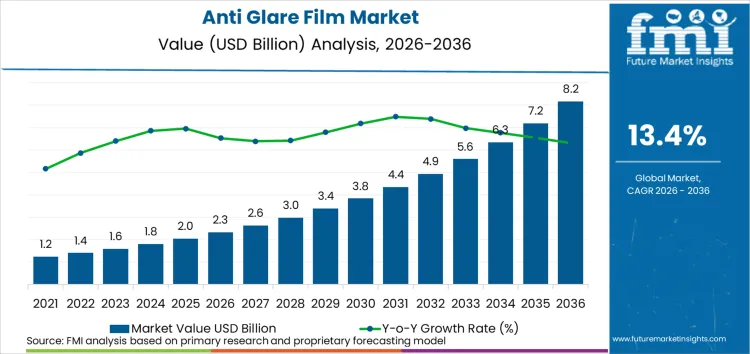
The automotive cockpit digitization cycle reinforces the shift. Large bonded displays-often spanning center stack, instrument cluster, passenger display, and pillar-to-pillar panels-must remain legible under dynamic lighting transitions (noon glare to night driving) while supporting touch functionality and curved geometries. As vehicles move toward higher levels of driver-assistance and SAE Level 3+ HMI expectations, anti glare becomes part of functional safety and human factors performance rather than purely aesthetic optimization.
Competitive differentiation is consolidating around “optical engineering under real-world lighting.” In that context, anti glare film development is moving toward precision matte coatings, nano-structured surface technologies, and combined antiglare/antireflective stacks that minimize both specular reflection and image blur while ensuring durability (abrasion resistance, humidity aging stability, UV resistance) for automotive and public-facing interactive displays.
A clear market signal is the elevation of anti glare from a lamination choice to a design-embedded component of the display stack. Industry positioning increasingly frames anti glare as part of how a display is judged in practice-sunlit offices, brightly lit lobbies, and vehicle interiors-where user perception is determined by performance under ambient light rather than native panel specifications alone.
Anti Glare Film Market Key Takeaways
| Metric | Value |
|---|---|
| Expected Value (2026E) | USD 2,320 million |
| Projected Value (2036F) | USD 8,140 million |
| CAGR (2026 to 2036) | 13.4% |
Source: Future Market Insights (FMI) analysis, based on proprietary forecasting model and primary research
Why is the Anti Glare Film Market Growing?
Anti glare film demand is expanding through the convergence of display resolution escalation, automotive cockpit digitization, mobile device outdoor usability requirements, and professional visualization contrast standards. Institutional procurement by panel makers, automotive OEMs, and consumer electronics brands is increasingly forcing adoption of validated anti glare film systems at the component qualification stage rather than leaving glare mitigation as an aftermarket or optional feature.
The resolution and pixel-density shift is the most direct optical driver. At high PPI, specular reflections introduce veiling luminance that reduces perceived contrast and obscures fine detail. That optical penalty grows as 8K and microLED formats proliferate, pushing large-area premium panels toward engineered scattering surfaces with tightly controlled haze and DOI to avoid sparkle and blur.
Automotive contributes a second structural acceleration. Display count per vehicle and total display area have expanded sharply as cockpits migrate to bonded, curved glass systems. Glare is not merely a comfort issue in this context-disabling reflections can reduce display contrast to levels that impair information legibility, elevating anti glare to a performance requirement across center stack, instrument cluster, and passenger displays.
Mobile device usability is another catalyst. Outdoor readability remains constrained by the power and thermal penalties of brightness escalation. Anti glare films offer a passive route to improved readability by suppressing reflections without draining battery or forcing thicker thermal solutions. This dynamic strengthens adoption in tablets, laptops, and premium smartphones where users increasingly operate devices under mixed lighting conditions.
Professional visualization, medical imaging, broadcast reference monitoring, and graphic arts, reinforces demand for high-clarity, low-haze anti glare surfaces. These applications require stable contrast under ambient light to preserve diagnostic confidence and color-critical accuracy, supporting premium-grade films that balance glare suppression with image fidelity.
How is the Anti Glare Film Market Segmented?
The anti glare film market is segmented by application, coating technology, and base film, reflecting how glare-reduction requirements differ across consumer displays, automotive glazing, professional visualization systems, and public-facing interactive screens. Segmentation in this category is fundamentally optics-driven rather than cost-driven. Buyers specify films based on quantifiable performance parameters such as haze percentage, gloss units, DOI, total light transmission, sparkle suppression, and touch compatibility, rather than thickness or basic material class alone.
As display systems migrate toward higher resolution, larger surface areas, and more complex lighting environments, segment value increasingly concentrates around films that can balance glare suppression with image fidelity. Over-scattering leads to blur and sparkle, while under-scattering fails to suppress reflections. This optical trade-off defines segmentation leadership and pushes demand toward application-engineered anti glare systems rather than generic matte laminates.
Why does Display Protection dominate anti glare film demand?
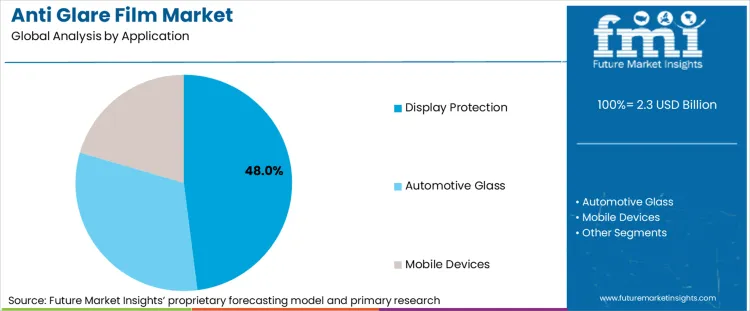
Display protection accounts for 48% of total market demand, making it the largest application segment. This dominance is anchored in the ubiquity of displays across consumer electronics, enterprise devices, and public installations, where glare directly impacts usability and perceived quality. Anti glare films are increasingly embedded at the component level for laptops, tablets, monitors, and interactive kiosks to ensure consistent readability across mixed indoor-outdoor lighting conditions.
Scale amplifies this segment’s leadership. Even incremental adoption across high-volume consumer electronics platforms translates into substantial film demand. Additionally, display OEMs are converging on standardized optical performance windows for premium devices, favoring suppliers that can deliver reproducible haze and DOI characteristics at scale. As displays grow larger and thinner, anti glare films also play a mechanical role by providing surface durability and scratch resistance, further reinforcing their central position in the market.
How is Automotive Glass emerging as a high-value segment?
Automotive glass and cockpit displays represent one of the fastest-growing application segments, driven by rapid digitization of vehicle interiors. Modern vehicles integrate multiple large-area displays-often curved and bonded-covering infotainment, instrumentation, passenger interaction, and auxiliary controls. In this environment, glare is not merely a comfort issue; reflections can obscure critical information under direct sunlight, creating functional and safety concerns.
Anti glare films used in automotive applications must meet far stricter requirements than consumer electronics counterparts. These include resistance to thermal cycling, UV exposure, humidity aging, abrasion, and chemical exposure from interior cleaners. Films must also maintain optical stability across curved surfaces and support touch functionality without introducing distortion. As a result, automotive-grade anti glare films command higher margins and longer qualification cycles, positioning this segment as a major value-growth driver through 2036.
Why do Matte Coatings remain the dominant technology platform?
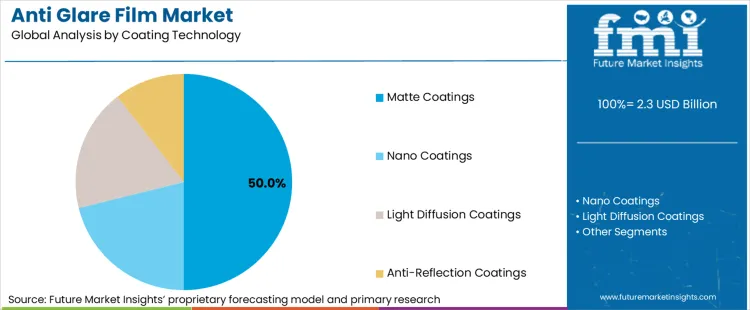
Matte coatings account for 50% of coating technology adoption, reflecting their ability to deliver predictable glare reduction through controlled surface roughness. Matte technologies diffuse incoming light, reducing specular reflection and lowering perceived glare across a wide range of viewing angles. Their dominance is reinforced by process maturity, scalability, and compatibility with existing coating and lamination infrastructure.
However, the nature of matte coatings is evolving. Traditional high-haze matte films are being replaced by precision-engineered low-sparkle matte systems that optimize the balance between glare suppression and image clarity. These next-generation matte coatings employ controlled particle size distributions or nano-textured surfaces to minimize sparkle artifacts while maintaining acceptable DOI levels, particularly important for high-PPI displays and automotive HMIs.
Why are PET films retaining leadership as the base material?
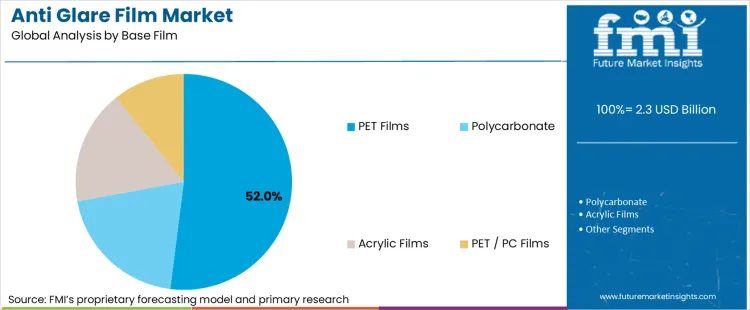
PET films account for 52% of base film usage, supported by their optical clarity, dimensional stability, and suitability for precision coating processes. PET provides a stable substrate for uniform matte and nano-structured coatings, enabling consistent optical performance across wide web widths and long production runs.
PET’s dominance is also tied to mechanical and environmental performance. It offers good scratch resistance, thermal stability, and compatibility with adhesive systems used in display lamination. Additionally, PET aligns with emerging sustainability requirements, as recycled-content PET and chemical recycling pathways are increasingly integrated into optical film supply chains. These attributes sustain PET’s leadership despite experimentation with polycarbonate and hybrid substrates in niche applications.
What Market Forces Are Shaping the Anti Glare Film Industry?
The anti glare film market is being shaped by a fundamental shift in how display performance is evaluated in real-world environments. As displays proliferate across vehicles, workplaces, public spaces, and personal devices, performance under ambient light-not laboratory contrast ratios-has become the defining metric of usability. This elevates anti glare films from optional accessories to essential optical components embedded within display stacks.
Display resolution escalation intensifies this shift. Higher pixel densities magnify the visual impact of reflections, making glare suppression critical to preserving perceived sharpness and contrast. Anti glare films provide a passive optical solution that avoids the power consumption, thermal load, and eye strain associated with brute-force brightness increases. This advantage is particularly important in mobile devices and battery-powered systems.
Automotive digitization reinforces demand by introducing safety and human-factors considerations. As cockpits adopt large, contiguous displays, glare can compromise legibility during rapid lighting transitions. Anti glare films are therefore specified alongside antireflective and anti-fingerprint layers to deliver stable visibility under all driving conditions, embedding them into OEM qualification frameworks.
Professional visualization and regulated environments add another layer of influence. In medical imaging, broadcast, and industrial control rooms, glare-induced contrast loss can affect diagnostic accuracy or operational decision-making. These use cases favor premium anti glare films with tightly controlled optical properties, durability, and long-term stability.
The market faces technical trade-offs. Excessive haze degrades image fidelity, while insufficient diffusion fails to suppress reflections. Managing this balance requires advanced coating control and application-specific design, favoring suppliers with deep optical engineering expertise. Sustainability expectations are also rising, encouraging development of solvent-efficient coating processes and recyclable film architectures without compromising optical performance.
Analysis of Anti Glare Film Market by Key Countries
The global landscape for anti glare film is undergoing regional differentiation based on display panel manufacturing concentration, automotive HMI adoption velocity, mobile device innovation leadership, and professional display specialization. As of early 2026, China’s display-led acceleration, the United States’ automotive and interactive display strength, Germany’s luxury automotive HMI dominance, and Japan’s high-value optical materials leadership characterize the market.
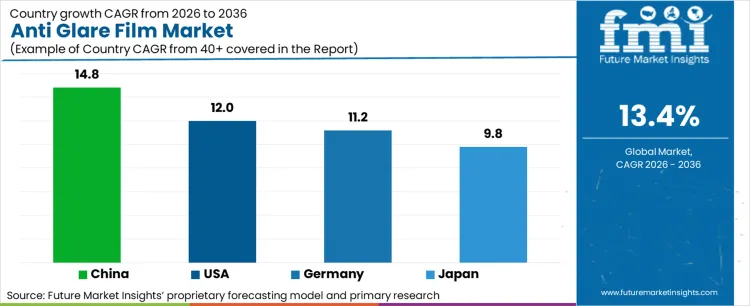
| Country | CAGR (2026 to 2036) |
|---|---|
| China | 14.8% |
| United States | 12.0% |
| Germany | 11.2% |
| Japan | 9.8% |
Source: FMI’s proprietary forecasting model and primary research
How is display panel manufacturing dominance driving China’s anti glare film market expansion at 14.8% CAGR?
China exhibits the highest market acceleration, expanding at a 14.8% CAGR from 2026 to 2036, because anti glare film demand is structurally “hard-linked” to the country’s scale in LCD and OLED panel manufacturing. The operating footprint of Gen10.5 TFT-LCD fabs (including BOE, CSOT, and HKC Display sites) creates a sustained requirement for glare-management layers across very large motherglass formats optimized for 65-inch to 85-inch panels. Because each motherglass yields multiple large-area panels and each panel requires antiglare functionality, capacity expansions translate into predictable film area pull-through rather than discretionary consumption. This manufacturing-driven demand profile also reduces cyclicality versus end-device shipments, since procurement is increasingly embedded into panel qualification and standardized bill-of-material architectures for premium large-area displays.
A second amplifier is China’s explicit industrial policy emphasis on domestic substitution for optical films. Incentives such as tax support and R&D subsidies reinforce local supplier qualification programs at leading panel makers, which tends to shift procurement toward suppliers that can meet Gen10.5-compatible coating consistency, defect control, and optical metrology requirements at scale. As local suppliers scale and win approvals, the market’s growth is not only volume-led but also capability-led, moving beyond commodity matte laminates into higher-DOI, tighter-haze-window formats needed for premium 8K televisions. Premium TV adoption provides a parallel demand stream: domestic brands pushing large-format 8K models require antiglare films engineered to protect contrast while maintaining image distinctness, accelerating qualification cycles for better-performing grades.
How is automotive display innovation driving United States anti glare film demand at 12.0% CAGR?
The United States expands at a 12.0% CAGR over 2026 to 2036, with growth anchored in two reinforcing pillars: cockpit digitization in vehicles and the breadth of interactive commercial display deployments. Automotive OEM adoption of large-format center-stack and pillar-to-pillar displays increases both the number of glare-critical surfaces per vehicle and the performance burden on films.
As HMI real estate expands, the design requirement shifts from “reducing reflections” to “maintaining legibility and perceived contrast under real cabin conditions,” which favors validated antiglare systems over low-cost matte layers. That shift raises value per square meter, not only total square meters consumed, because qualification-grade films tend to command premiums tied to durability and optical stability under temperature/humidity cycling and abrasion.
In parallel, the U.S. footprint in interactive commercial displays sustains steady, non-automotive demand for large-area antiglare surfaces designed to reduce eye strain in brightly lit environments. These applications are procurement-driven-integrated into device specifications-rather than consumer-optional add-ons.
A further reinforcement comes from the medical monitor ecosystem, where diagnostic displays require high DOI and low haze to preserve visual fidelity while controlling glare in clinical environments. This mix gives the USA market a diversified demand base: automotive drives growth rate, while commercial and medical applications support steadier baseline consumption and ongoing upgrades to higher-performance film grades.
How does luxury automotive HMI leadership influence Germany’s 11.2% anti glare film market growth?
Germany grows at an 11.2% CAGR, shaped by its position as the global benchmark for premium automotive interiors and the associated “tightest tolerance” display performance expectations. Luxury OEMs impose stringent optical and environmental stability requirements that effectively narrow the eligible supplier pool to films that can demonstrate sustained performance through extended high-temperature/high-humidity aging and thermal cycling.
This raises the economic value of the German market: qualification is expensive and time-consuming, but once achieved, it tends to lock in multi-year, multi-platform supply agreements because switching risk is high and requalification burdens are substantial. As a result, Germany’s growth is not merely a function of more displays-it is also a function of more demanding displays, where glare control must coexist with high image clarity, scratch resistance, and long-term stability.
Germany’s supplier ecosystem further concentrates demand through tier-1 cockpit integrators that require just-in-sequence delivery and precise converting into display-specific geometries. That converts anti glare film from a generic roll-good into a tightly specified, dimension-critical component in a broader HMI module supply chain. Beyond passenger vehicles, Industry 4.0 investment sustains demand for antiglare displays in industrial HMIs deployed under intense factory lighting and from variable viewing angles. This supports a “dual-market” structure: high-premium automotive programs set performance benchmarks and qualification regimes, while industrial HMI deployments provide volume continuity and broaden the installed base of antiglare-specified interfaces across Germany’s manufacturing footprint.
How does Japan’s optical materials leadership shape its 9.8% anti glare film market trajectory?
Japan advances at a 9.8% CAGR, reflecting a market that is comparatively mature in volume terms but highly advantaged in high-value optical film segments. Japanese suppliers maintain leadership in premium antiglare grades used for professional monitors, broadcast reference displays, and high-end devices where the tolerance for haze-induced blur is minimal and defect density requirements are exceptionally strict.
This positions Japan’s growth as value-led rather than purely area-led: even where domestic display production is not expanding aggressively, Japan’s role in supplying the highest-performance films into global device ecosystems supports steady growth tied to technology upgrades.
Japan also functions as an innovation and qualification center for advanced display technologies, sustaining demand through R&D and high-spec prototyping pipelines even as certain mass-production activities diversify globally. Another important shift is the gradual convergence of Japanese automotive display expectations toward the more demanding standards seen in Europe.
As domestic OEMs move toward larger-format, higher-quality displays in premium models, the pull for higher-grade antiglare treatments increases, supporting incremental domestic demand for better-performing film stacks. The combination of global export positioning in premium films and domestic upgrading in automotive HMIs sustains Japan’s 9.8% CAGR trajectory without requiring the same scale-driven manufacturing expansion that characterizes China.
What is the Competition Outlook for Anti Glare Film Market?
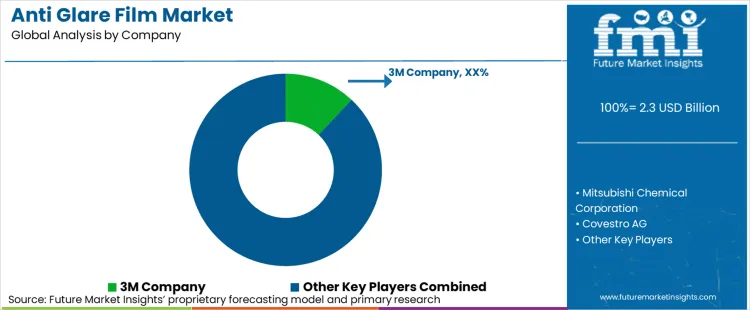
The competitive landscape for anti glare film has shifted from a broad base of regional coaters supplying commoditized matte PET laminates to a tighter set of integrated optical film corporations delivering application-engineered, qualification-ready film systems with documented optical stability and environmental durability. Large display panel makers, automotive cockpit integrators, and premium consumer electronics OEMs increasingly prefer single-supplier programs that can package coating formulation, precision roll-to-roll coating execution, optical metrology, reliability testing support, and global logistics into one accountable supply relationship. This procurement consolidation structurally favors players with proprietary coating chemistries, clean manufacturing discipline, and the ability to support multi-region qualification cycles at the same time.
Competitive advantage is increasingly defined by (i) the ability to balance haze and distinctness of image (DOI) inside narrow optical windows demanded by premium displays, and (ii) validated durability under automotive interior conditions (thermal cycling, humidity aging, abrasion, and UV exposure). Suppliers capable of repeatedly delivering haze in the ~20-25% band while sustaining high DOI for crispness are positioned to win premium display programs, especially as ultrahigh-resolution panel architectures institutionalize antiglare layers in the display stack. In parallel, automotive programs place disproportionate weight on qualification protocols and long-life performance stability, creating a second, durability-driven moat that many commodity matte film suppliers cannot cross.
Key Players Profiled
- 3M Company
- Mitsubishi Chemical Corporation
- Covestro AG
- Nitto Denko Corporation
- Toppan Inc.
- Dai Nippon Printing Co., Ltd.
- SKC hi-tech & marketing Co., Ltd.
- Ningbo Solartron Technology Co., Ltd.
Market Definition
The anti glare film market comprises revenues generated from polymeric films engineered to reduce specular reflection and perceived glare through controlled surface roughening, nanostructured coatings, or light-diffusing particles. These films are specified to enhance outdoor readability, reduce eye strain, and improve perceived contrast under ambient illumination across display protection, automotive glass, mobile devices, and professional optical display applications.
The scope includes antiglare film systems categorized by application segment (display protection, automotive glass, mobile devices, optical displays), coating technology (matte coatings, nano coatings, light diffusion coatings, antireflection coatings), and base film (PET, polycarbonate, acrylic films, PET/PC blends). Products in scope are engineered for intentional antiglare functionality and are specified against optical performance metrics such as haze, gloss, distinctness of image, and transmission.
Scope of Report
| Items | Values |
|---|---|
| Quantitative Units (2026) | USD 2,320 million |
| Application Segment | Display Protection, Automotive Glass, Mobile Devices, Optical Displays |
| Coating Technology | Matte Coatings, Nano Coatings, Light Diffusion Coatings, AntiReflection Coatings |
| Base Film | PET Films, Polycarbonate, Acrylic Films, PET / PC Films |
| Regions Covered | East Asia, North America, Europe, Japan, Rest of the World |
| Countries Covered | China, United States, Germany, Japan, South Korea, Taiwan, Canada, Mexico, United Kingdom, France, Italy, Spain, India, Brazil, and additional regional markets |
| Key Companies Profiled | 3M Company, Mitsubishi Chemical Corporation, Covestro AG, Nitto Denko Corporation |
Anti Glare Film Market Key Segments
By Application Segment:
- Display Protection
- Automotive Glass
- Mobile Devices
- Optical Displays
By Coating Technology:
- Matte Coatings
- Nano Coatings
- Light Diffusion Coatings
- Anti-Reflection Coatings
By Base Film:
- PET Films
- Polycarbonate
- Acrylic Films
- PET / PC Films
By Region:
- East Asia
- North America
- Europe
- Japan
- Rest of the World
Bibliography
- 3M Company. (2026). AG400 series antiglare film technical data sheet: Haze 22%, DOI ≥95%. 3M Display Materials & Systems Division.
- ASTM International. (2026). ASTM D523-26 Standard test method for specular gloss. ASTM.
- Covestro AG. (2026). Makrofol® SRAG polycarbonate film: Integrated antiglare functionality for automotive displays. Covestro Technical Marketing.
- Daimler AG. (2025). DBL 5406: Display systems for motor vehicles - Optical and environmental requirements. Mercedes-Benz Group.
- International Display Metrics. (2026). Global large-area TFT-LCD capacity report: Gen10.5 fab expansion and optical film demand. IDM.
- LG Display. (2026). OLED signage product specification: 88-inch 8K panel with integrated antiglare treatment. LG Display.
- Mitsubishi Chemical Corporation. (2026). Diaresin™ antiglare polycarbonate films: Automotive display qualification report. Mitsubishi Chemical Advanced Materials.
- Nitto Denko Corporation. (2026). Ultrathin antiglare film for foldable displays: Technical white paper. Nitto Denko.
- Society of Automotive Engineers. (2025). SAE J1757/1: Standard metrology for vehicular display performance. SAE International.
- Volkswagen AG. (2025). PV 3952: Interior components - Climatic and optical requirements. VW Group.
Frequently Asked Questions
What is the projected global growth rate for the anti glare film market?
The global market is projected to expand at a 13.4% CAGR from 2026 to 2036.
How large is the global anti glare film market expected to be by 2036?
The market is expected to grow from USD 2,320 million in 2026 to approximately USD 8,140 million by 2036.
What is driving the growth of anti glare film?
Growth is driven by display resolution escalation (where reflections more visibly degrade perceived contrast), automotive cockpit digitization and display legibility expectations, mobile device outdoor usability requirements, and professional visualization environments where image fidelity must be preserved under real-world lighting.
Which application segment and coating technology dominate market demand?
Display protection represents the leading application segment (48%), and matte coatings remain the leading coating technology (50%), reflecting the large installed base of flat-panel displays and the cost-performance balance achievable through controlled matte scattering approaches for mainstream premium panels.
Which base film leads anti glare film production and why?
PET films lead base film demand (52%), supported by optical clarity, dimensional stability for coating operations, established supply economics, and broad compatibility with high-throughput roll-to-roll coating and converting across display protection applications.
Preview the report firsthand - request a free sample
Get SampleGet the brochure for pricing and purchase details.
Get PDFTable of Content
- Executive Summary
- Global Market Outlook
- Demand-side Trends
- Supply-side Trends
- Technology Roadmap Analysis
- Analysis and Recommendations
- Market Overview
- Market Coverage / Taxonomy
- Market Definition / Scope / Limitations
- Research Methodology
- Chapter Orientation
- Analytical Lens and Working Hypotheses
- Market Structure, Signals, and Trend Drivers
- Benchmarking and Cross-market Comparability
- Market Sizing, Forecasting, and Opportunity Mapping
- Research Design and Evidence Framework
- Desk Research Programme (Secondary Evidence)
- Company Annual and Sustainability Reports
- Peer-reviewed Journals and Academic Literature
- Corporate Websites, Product Literature, and Technical Notes
- Earnings Decks and Investor Briefings
- Statutory Filings and Regulatory Disclosures
- Technical White Papers and Standards Notes
- Trade Journals, Industry Magazines, and Analyst Briefs
- Conference Proceedings, Webinars, and Seminar Materials
- Government Statistics Portals and Public Data Releases
- Press Releases and Reputable Media Coverage
- Specialist Newsletters and Curated Briefings
- Sector Databases and Reference Repositories
- FMI Internal Proprietary Databases and Historical Market Datasets
- Subscription Datasets and Paid Sources
- Social Channels, Communities, and Digital Listening Inputs
- Additional Desk Sources
- Expert Input and Fieldwork (Primary Evidence)
- Primary Modes
- Qualitative Interviews and Expert Elicitation
- Quantitative Surveys and Structured Data Capture
- Blended Approach
- Why Primary Evidence is Used
- Field Techniques
- Interviews
- Surveys
- Focus Groups
- Observational and In-context Research
- Social and Community Interactions
- Stakeholder Universe Engaged
- C-suite Leaders
- Board Members
- Presidents and Vice Presidents
- R&D and Innovation Heads
- Technical Specialists
- Domain Subject-matter Experts
- Scientists
- Physicians and Other Healthcare Professionals
- Governance, Ethics, and Data Stewardship
- Research Ethics
- Data Integrity and Handling
- Primary Modes
- Tooling, Models, and Reference Databases
- Desk Research Programme (Secondary Evidence)
- Data Engineering and Model Build
- Data Acquisition and Ingestion
- Cleaning, Normalisation, and Verification
- Synthesis, Triangulation, and Analysis
- Quality Assurance and Audit Trail
- Market Background
- Market Dynamics
- Drivers
- Restraints
- Opportunity
- Trends
- Scenario Forecast
- Demand in Optimistic Scenario
- Demand in Likely Scenario
- Demand in Conservative Scenario
- Opportunity Map Analysis
- Product Life Cycle Analysis
- Supply Chain Analysis
- Investment Feasibility Matrix
- Value Chain Analysis
- PESTLE and Porter’s Analysis
- Regulatory Landscape
- Regional Parent Market Outlook
- Production and Consumption Statistics
- Import and Export Statistics
- Market Dynamics
- Global Market Analysis 2021 to 2025 and Forecast, 2026 to 2036
- Historical Market Size Value (USD Million) Analysis, 2021 to 2025
- Current and Future Market Size Value (USD Million) Projections, 2026 to 2036
- Y-o-Y Growth Trend Analysis
- Absolute $ Opportunity Analysis
- Global Market Pricing Analysis 2021 to 2025 and Forecast 2026 to 2036
- Global Market Analysis 2021 to 2025 and Forecast 2026 to 2036, By Application
- Introduction / Key Findings
- Historical Market Size Value (USD Million) Analysis By Application , 2021 to 2025
- Current and Future Market Size Value (USD Million) Analysis and Forecast By Application , 2026 to 2036
- Display Protection
- Automotive Glass
- Mobile Devices
- Display Protection
- Y-o-Y Growth Trend Analysis By Application , 2021 to 2025
- Absolute $ Opportunity Analysis By Application , 2026 to 2036
- Global Market Analysis 2021 to 2025 and Forecast 2026 to 2036, By Coating Technology
- Introduction / Key Findings
- Historical Market Size Value (USD Million) Analysis By Coating Technology, 2021 to 2025
- Current and Future Market Size Value (USD Million) Analysis and Forecast By Coating Technology, 2026 to 2036
- Matte Coatings
- Nano Coatings
- Light Diffusion Coatings
- Anti-Reflection Coatings
- Matte Coatings
- Y-o-Y Growth Trend Analysis By Coating Technology, 2021 to 2025
- Absolute $ Opportunity Analysis By Coating Technology, 2026 to 2036
- Global Market Analysis 2021 to 2025 and Forecast 2026 to 2036, By Base Film
- Introduction / Key Findings
- Historical Market Size Value (USD Million) Analysis By Base Film, 2021 to 2025
- Current and Future Market Size Value (USD Million) Analysis and Forecast By Base Film, 2026 to 2036
- PET Films
- Polycarbonate
- Acrylic Films
- PET / PC Films
- PET Films
- Y-o-Y Growth Trend Analysis By Base Film, 2021 to 2025
- Absolute $ Opportunity Analysis By Base Film, 2026 to 2036
- Global Market Analysis 2021 to 2025 and Forecast 2026 to 2036, By Region
- Introduction
- Historical Market Size Value (USD Million) Analysis By Region, 2021 to 2025
- Current Market Size Value (USD Million) Analysis and Forecast By Region, 2026 to 2036
- North America
- Latin America
- Western Europe
- Eastern Europe
- East Asia
- South Asia and Pacific
- Middle East & Africa
- Market Attractiveness Analysis By Region
- North America Market Analysis 2021 to 2025 and Forecast 2026 to 2036, By Country
- Historical Market Size Value (USD Million) Trend Analysis By Market Taxonomy, 2021 to 2025
- Market Size Value (USD Million) Forecast By Market Taxonomy, 2026 to 2036
- By Country
- USA
- Canada
- Mexico
- By Application
- By Coating Technology
- By Base Film
- By Country
- Market Attractiveness Analysis
- By Country
- By Application
- By Coating Technology
- By Base Film
- Key Takeaways
- Latin America Market Analysis 2021 to 2025 and Forecast 2026 to 2036, By Country
- Historical Market Size Value (USD Million) Trend Analysis By Market Taxonomy, 2021 to 2025
- Market Size Value (USD Million) Forecast By Market Taxonomy, 2026 to 2036
- By Country
- Brazil
- Chile
- Rest of Latin America
- By Application
- By Coating Technology
- By Base Film
- By Country
- Market Attractiveness Analysis
- By Country
- By Application
- By Coating Technology
- By Base Film
- Key Takeaways
- Western Europe Market Analysis 2021 to 2025 and Forecast 2026 to 2036, By Country
- Historical Market Size Value (USD Million) Trend Analysis By Market Taxonomy, 2021 to 2025
- Market Size Value (USD Million) Forecast By Market Taxonomy, 2026 to 2036
- By Country
- Germany
- UK
- Italy
- Spain
- France
- Nordic
- BENELUX
- Rest of Western Europe
- By Application
- By Coating Technology
- By Base Film
- By Country
- Market Attractiveness Analysis
- By Country
- By Application
- By Coating Technology
- By Base Film
- Key Takeaways
- Eastern Europe Market Analysis 2021 to 2025 and Forecast 2026 to 2036, By Country
- Historical Market Size Value (USD Million) Trend Analysis By Market Taxonomy, 2021 to 2025
- Market Size Value (USD Million) Forecast By Market Taxonomy, 2026 to 2036
- By Country
- Russia
- Poland
- Hungary
- Balkan & Baltic
- Rest of Eastern Europe
- By Application
- By Coating Technology
- By Base Film
- By Country
- Market Attractiveness Analysis
- By Country
- By Application
- By Coating Technology
- By Base Film
- Key Takeaways
- East Asia Market Analysis 2021 to 2025 and Forecast 2026 to 2036, By Country
- Historical Market Size Value (USD Million) Trend Analysis By Market Taxonomy, 2021 to 2025
- Market Size Value (USD Million) Forecast By Market Taxonomy, 2026 to 2036
- By Country
- China
- Japan
- South Korea
- By Application
- By Coating Technology
- By Base Film
- By Country
- Market Attractiveness Analysis
- By Country
- By Application
- By Coating Technology
- By Base Film
- Key Takeaways
- South Asia and Pacific Market Analysis 2021 to 2025 and Forecast 2026 to 2036, By Country
- Historical Market Size Value (USD Million) Trend Analysis By Market Taxonomy, 2021 to 2025
- Market Size Value (USD Million) Forecast By Market Taxonomy, 2026 to 2036
- By Country
- India
- ASEAN
- Australia & New Zealand
- Rest of South Asia and Pacific
- By Application
- By Coating Technology
- By Base Film
- By Country
- Market Attractiveness Analysis
- By Country
- By Application
- By Coating Technology
- By Base Film
- Key Takeaways
- Middle East & Africa Market Analysis 2021 to 2025 and Forecast 2026 to 2036, By Country
- Historical Market Size Value (USD Million) Trend Analysis By Market Taxonomy, 2021 to 2025
- Market Size Value (USD Million) Forecast By Market Taxonomy, 2026 to 2036
- By Country
- Kingdom of Saudi Arabia
- Other GCC Countries
- Turkiye
- South Africa
- Other African Union
- Rest of Middle East & Africa
- By Application
- By Coating Technology
- By Base Film
- By Country
- Market Attractiveness Analysis
- By Country
- By Application
- By Coating Technology
- By Base Film
- Key Takeaways
- Key Countries Market Analysis
- USA
- Pricing Analysis
- Market Share Analysis, 2025
- By Application
- By Coating Technology
- By Base Film
- Canada
- Pricing Analysis
- Market Share Analysis, 2025
- By Application
- By Coating Technology
- By Base Film
- Mexico
- Pricing Analysis
- Market Share Analysis, 2025
- By Application
- By Coating Technology
- By Base Film
- Brazil
- Pricing Analysis
- Market Share Analysis, 2025
- By Application
- By Coating Technology
- By Base Film
- Chile
- Pricing Analysis
- Market Share Analysis, 2025
- By Application
- By Coating Technology
- By Base Film
- Germany
- Pricing Analysis
- Market Share Analysis, 2025
- By Application
- By Coating Technology
- By Base Film
- UK
- Pricing Analysis
- Market Share Analysis, 2025
- By Application
- By Coating Technology
- By Base Film
- Italy
- Pricing Analysis
- Market Share Analysis, 2025
- By Application
- By Coating Technology
- By Base Film
- Spain
- Pricing Analysis
- Market Share Analysis, 2025
- By Application
- By Coating Technology
- By Base Film
- France
- Pricing Analysis
- Market Share Analysis, 2025
- By Application
- By Coating Technology
- By Base Film
- India
- Pricing Analysis
- Market Share Analysis, 2025
- By Application
- By Coating Technology
- By Base Film
- ASEAN
- Pricing Analysis
- Market Share Analysis, 2025
- By Application
- By Coating Technology
- By Base Film
- Australia & New Zealand
- Pricing Analysis
- Market Share Analysis, 2025
- By Application
- By Coating Technology
- By Base Film
- China
- Pricing Analysis
- Market Share Analysis, 2025
- By Application
- By Coating Technology
- By Base Film
- Japan
- Pricing Analysis
- Market Share Analysis, 2025
- By Application
- By Coating Technology
- By Base Film
- South Korea
- Pricing Analysis
- Market Share Analysis, 2025
- By Application
- By Coating Technology
- By Base Film
- Russia
- Pricing Analysis
- Market Share Analysis, 2025
- By Application
- By Coating Technology
- By Base Film
- Poland
- Pricing Analysis
- Market Share Analysis, 2025
- By Application
- By Coating Technology
- By Base Film
- Hungary
- Pricing Analysis
- Market Share Analysis, 2025
- By Application
- By Coating Technology
- By Base Film
- Kingdom of Saudi Arabia
- Pricing Analysis
- Market Share Analysis, 2025
- By Application
- By Coating Technology
- By Base Film
- Turkiye
- Pricing Analysis
- Market Share Analysis, 2025
- By Application
- By Coating Technology
- By Base Film
- South Africa
- Pricing Analysis
- Market Share Analysis, 2025
- By Application
- By Coating Technology
- By Base Film
- USA
- Market Structure Analysis
- Competition Dashboard
- Competition Benchmarking
- Market Share Analysis of Top Players
- By Regional
- By Application
- By Coating Technology
- By Base Film
- Competition Analysis
- Competition Deep Dive
- 3M Company
- Overview
- Product Portfolio
- Profitability by Market Segments (Product/Age /Sales Channel/Region)
- Sales Footprint
- Strategy Overview
- Marketing Strategy
- Product Strategy
- Channel Strategy
- Mitsubishi Chemical Corporation
- Covestro AG
- Nitto Denko Corporation
- 3M Company
- Competition Deep Dive
- Assumptions & Acronyms Used


