

- Industry Size (2026)
- USD 1740 Mn
- Forecast (2036)
- USD 5960 Mn
- CAGR (2026 to 2036)
- 13.1%
Anti Static Film Market Forecast and Outlook By FMI
The anti static film market is forecasted to total USD 1,740 million in 2026 and is expected to increase to USD 5,960 million by 2036, expanding at a 13.1% CAGR from 2026 to 2036. The category is transitioning from a specialized electrostatic discharge (ESD) protection consumable into a mission-critical yield-management tool and a compliance-driven procurement requirement across semiconductor packaging houses, automotive electronics supply chains, industrial automation equipment manufacturers, and consumer electronics assembly ecosystems.
A central structural driver is semiconductor node shrinkage. At the 3 nm node and below, device physics sharply reduces ESD tolerance; electrostatic potentials as low as 3-5 V become capable of damaging advanced devices, making ESD events invisible to human sensation but catastrophic at wafer and die scale. Leading-edge foundry and OSAT qualification has tightened around packaging-contact material specifications, including surface resistivity below 10⁹ Ω/sq for materials in contact with sensitive devices in backend handling, a threshold that commodity polyethylene bag formats cannot reliably satisfy. This has accelerated conversion toward engineered anti static film systems with permanent static-dissipative or conductive properties, cleanroom compatibility, and stable electrostatic performance through processing and environmental swings.
Summary of Anti Static Film Market
- The anti static film market comprises polymeric films engineered to prevent electrostatic discharge through controlled surface resistivity, volume resistivity, and static decay rates, enabling damage-free handling, storage, and transportation of ESD-sensitive devices across semiconductor fabrication, electronics assembly, automotive electronics, industrial electronics, and consumer electronics logistics chains.
- The defined scope is structured by FMI taxonomy across application segment, coating type, base film, and region, focusing on films with permanent or long-life anti static properties. The scope excludes migratory temporary anti stats, non-film ESD packaging formats (rigid boxes, corrugated), and post-production anti static sprays.
- FMI projects the market to expand at a 13.1% CAGR from 2026 to 2036, rising from USD 1,740 million to USD 5,960 million. Growth is underpinned by semiconductor node shrinkage and tightening ESD requirements, EV electronics proliferation with stringent automotive qualification standards, Industry 4.0 automation’s triboelectric hazards, and expanding ESD standards enforcement in emerging manufacturing ecosystems.
- Competition is concentrated among specialty film and materials-science corporations with proprietary conductive coating formulations, cleanroom manufacturing certification, and multiregional technical service networks, including TekniPlex, Berry Global, Amcor plc, and Toppan Inc.
- Country-level growth is led by China (14.0% CAGR) supported by semiconductor self-sufficiency initiatives and enforcement of GB/T 37977 ESD control standards, followed by the United States (12.2%) driven by semiconductor fab construction and defense electronics requirements.
- Germany expands at 10.6% CAGR on automotive electronics ESD mandates and packaging specifications, India advances at 9.4% CAGR with electronics assembly expansion, and Japan grows at 4.9% CAGR shaped by mature advanced materials specialization and transparent conductive film innovation.
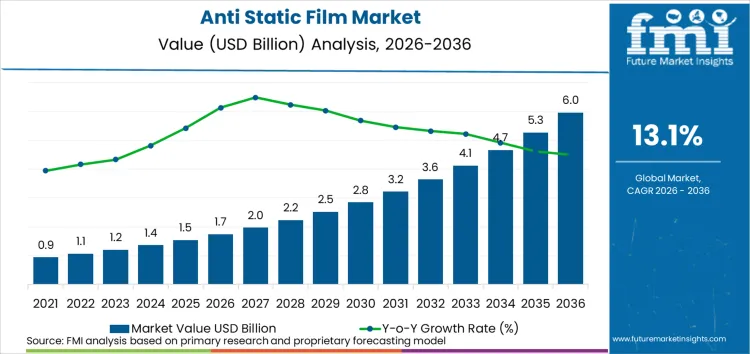
Electric vehicle electrification is the second structural accelerator. Electronic content per vehicle is described as multiplying sharply as EV architectures adopt more sensors, control modules, and power electronics, increasing the number of ESD-sensitive components shipped across tiered supply chains. Qualification requirements in automotive electronics increasingly demand surface resistivity stability under high temperature and humidity aging, consistent with the harsh environmental exposure of underhood modules and battery-management subsystems. Berry Global’s EV-grade anti static films are positioned as meeting these demands through IATF 16949 certification and extended aging validation (2,000 hours at 85°C/85% RH with resistivity drift controlled within one decade), supporting specification for battery management system packaging across major EV platforms.
A third growth pillar is the convergence of ESD control with Industry 4.0 automation. High-speed robotic pick-and-place, conveyors, and automated material handling systems amplify triboelectric charge generation during repeated contact-separation events. Anti static films are therefore being specified not only as shipping protection, but as active manufacturing-line compatible materials that must run reliably through automation equipment, maintain electrostatic performance through temperature/humidity variability, and avoid charge generation during high-speed conveyance. This shift elevates the value of transparent, stable, recyclable, automation-ready films over migratory amine-based anti static formats that lose efficacy over time or introduce contamination risks in controlled environments.
Corporate investments reflect this specification shift. TekniPlex completed a USD 45 million expansion of cleanroom extrusion capacity in Wisconsin in Q1 2026, focused on transparent conductive coated PET films for semiconductor wafer carriers and tray lidding-positioning capacity directly against demand for non-particulating, halogen-free ESD protection compatible with advanced-node device handling.
Anti Static Film Market Key Takeaways
| Metric | Value |
|---|---|
| Expected Value (2026E) | USD 1,740 million |
| Projected Value (2036F) | USD 5,960 million |
| CAGR (2026 to 2036) | 13.1% |
Source: Future Market Insights (FMI) analysis, based on proprietary forecasting model and primary research
Why is the Anti Static Film Market Growing?
Anti static film demand is rising due to four reinforcing forces: semiconductor physics scaling, EV electronics proliferation, Industry 4.0 automation triboelectric hazards, and enforcement-led standardization of ESD control programs across emerging manufacturing economies. As process nodes compress toward 3 nm, 2 nm, and below, ESD damage thresholds collapse and packaging specifications tighten around surface resistivity and static decay performance. Revised supplier packaging requirements such as surface resistivity ≤ 10⁹ Ω/sq and static decay times under two seconds for sensitive-device contact materials are accelerating the shift away from migratory anti stat films toward permanent conductive coatings and inherently dissipative polymers.
EV supply chains amplify the requirement for stable anti static performance under harsh environments. Automotive electronics packaging must maintain electrostatic protection through thermal cycling and humidity exposure that depletes migratory anti stats; qualification regimes increasingly favor permanent conductive solutions validated through long-duration aging. Automation adds a second layer of urgency: high-speed robotics and conveyors create triboelectric charging conditions that require anti static films not only as shipping protection but as automation-compatible materials used in tote liners, tray covers, and reel wraps to suppress charge generation and reduce ESD event frequency. Sustainability requirements then reshape product preference away from opaque carbon-black systems toward transparent or light-colored conductive alternatives that support recyclability and optical-sort compatibility, strengthening demand for engineered, high-reliability, recyclable anti static film architectures.
How is the Anti Static Film Market Segmented?
The anti static film market is segmented by application segment, coating type, and base film, reflecting how electrostatic risk profiles vary across semiconductor back-end handling, electronics assembly, automotive electronics logistics, and automated manufacturing environments. Segmentation in this market is fundamentally performance-led: buyers specify films based on surface resistivity range, static decay time, charge generation behavior under motion, and long-term stability under heat and humidity, rather than thickness or price alone.
As ESD control shifts from procedural safeguards to material-level risk mitigation, higher-value segments are those capable of delivering permanent or long-life electrostatic dissipation compatible with cleanroom conditions and high-speed automation. This elevates engineered film systems over migratory anti static formats whose efficacy degrades over time or introduces contamination risk in controlled manufacturing environments.
Why does Electronics Packaging dominate anti static film demand?
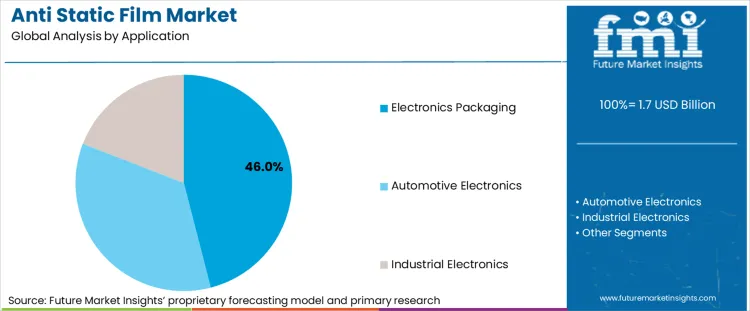
Electronics packaging accounts for 46% of total market demand, making it the largest application segment. This dominance is structurally tied to the sensitivity of modern semiconductor devices and electronic assemblies to low-voltage ESD events. As device geometries shrink and integration density increases, tolerance to electrostatic discharge collapses, elevating the importance of packaging-contact materials as part of the ESD control system rather than as passive containment.
Electronics packaging leadership is reinforced by scale and repetition. Semiconductor wafers, dies, printed circuit boards, and modules move repeatedly through automated handling steps before final assembly. Each contact-separation event introduces triboelectric risk, and anti static films are increasingly specified for tray covers, reel wraps, tote liners, and protective overwraps used throughout these workflows. The cumulative risk profile favors films with stable, predictable electrostatic performance rather than temporary solutions, sustaining electronics packaging as the anchor segment.
How are Conductive Coatings sustaining segment leadership?
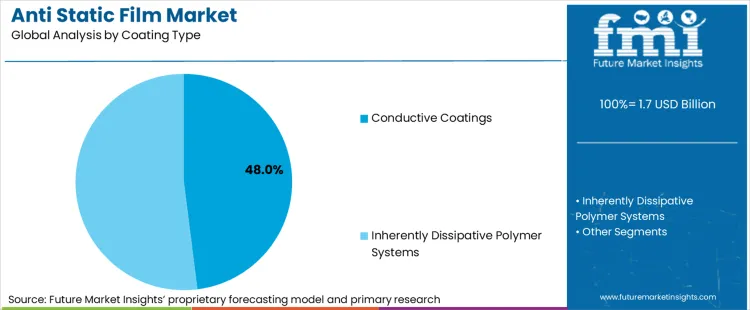
Conductive coatings represent 48% of coating-type adoption, reflecting market preference for permanent, non-migratory electrostatic control mechanisms. Unlike migratory amine-based anti stats that bloom to the surface and lose effectiveness over time, conductive coatings provide stable resistivity across a broad temperature and humidity range, which is critical for semiconductor and automotive electronics qualification.
Operational reliability under stress conditions is a key factor. Conductive-coated films maintain surface resistivity within specified ranges during prolonged exposure to 85°C / 85% RH aging, repeated flexing, and high-speed conveyance, ensuring consistent protection across long logistics and processing cycles. Their dominance is also reinforced by compatibility with cleanroom environments, as they avoid particulate generation and contamination risks associated with additive migration.
Why do PET films remain the dominant base film platform?
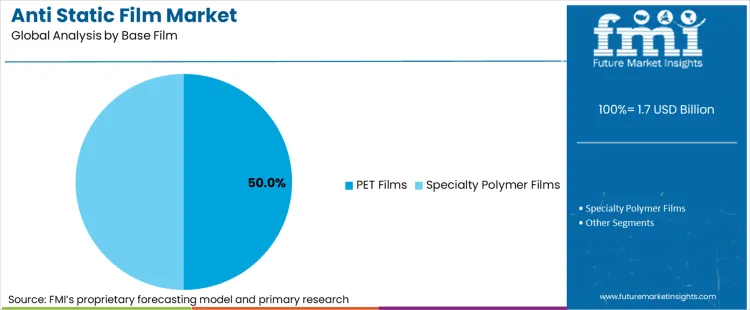
PET films account for 50% of base film usage, supported by their dimensional stability, optical clarity, and suitability for precision coating processes. PET’s low elongation and thermal stability make it particularly well suited for conductive coating deposition, enabling uniform resistivity and consistent static decay behavior across wide web widths and long production runs.
Material dominance is also driven by automation compatibility. PET films run reliably through high-speed robotic handling and machine-vision-guided systems, where clarity and flatness are essential. As manufacturers increasingly rely on optical inspection and automated pick-and-place systems, base films that support both electrostatic control and visual transparency retain structural advantage over opaque alternatives.
What Market Forces Are Shaping the Anti Static Film Industry?
The anti static film market is being shaped by a fundamental redefinition of electrostatic discharge risk management across advanced manufacturing ecosystems. Semiconductor scaling has reduced ESD damage thresholds to levels below human perception, making packaging materials a frontline defense against yield loss rather than a secondary protective layer. As device fragility increases, packaging specifications tighten around surface resistivity windows, static decay times, and charge generation limits, pushing manufacturers toward engineered film systems with permanent electrostatic properties.
Electric vehicle electrification adds a parallel demand driver. EV architectures incorporate significantly more power electronics, sensors, and control modules than internal combustion vehicles, increasing the number of ESD-sensitive components shipped across tiered global supply chains. Automotive qualification regimes emphasize long-term stability under heat and humidity, disadvantaging temporary anti static solutions and accelerating adoption of conductive-coated and inherently dissipative films validated through extended aging protocols.
Industry 4.0 automation further amplifies the need for reliable anti static films. High-speed conveyors, robotic arms, and automated storage systems increase triboelectric charge generation through repeated contact and separation. Anti static films are therefore specified not only for transport packaging but also for use within manufacturing environments, where they must suppress charge generation without compromising throughput, cleanliness, or machine compatibility.
Sustainability and recyclability expectations are reshaping product preference. Opaque carbon-black-filled films, while effective electrically, create challenges for optical sorting and recycled-content integration. This has accelerated innovation toward transparent or lightly tinted conductive coatings that deliver electrostatic performance while supporting recycling compatibility and regulatory alignment. Cost and qualification complexity remain moderating factors, particularly for smaller manufacturers, but the overall trajectory favors consolidation around suppliers capable of delivering stable, compliant, automation-ready anti static film systems at scale.
How is the Anti Static Film Market Segmented?
The anti static film market is segmented by application segment, coating type, and base film, reflecting how electrostatic risk profiles vary across semiconductor back-end handling, electronics assembly, automotive electronics logistics, and automated manufacturing environments. Segmentation in this market is fundamentally performance-led: buyers specify films based on surface resistivity range, static decay time, charge generation behavior under motion, and long-term stability under heat and humidity, rather than thickness or price alone.
As ESD control shifts from procedural safeguards to material-level risk mitigation, higher-value segments are those capable of delivering permanent or long-life electrostatic dissipation compatible with cleanroom conditions and high-speed automation. This elevates engineered film systems over migratory anti static formats whose efficacy degrades over time or introduces contamination risk in controlled manufacturing environments.
Why does Electronics Packaging dominate anti static film demand?
Electronics packaging accounts for 46% of total market demand, making it the largest application segment. This dominance is structurally tied to the sensitivity of modern semiconductor devices and electronic assemblies to low-voltage ESD events. As device geometries shrink and integration density increases, tolerance to electrostatic discharge collapses, elevating the importance of packaging-contact materials as part of the ESD control system rather than as passive containment.
Electronics packaging leadership is reinforced by scale and repetition. Semiconductor wafers, dies, printed circuit boards, and modules move repeatedly through automated handling steps before final assembly. Each contact-separation event introduces triboelectric risk, and anti static films are increasingly specified for tray covers, reel wraps, tote liners, and protective overwraps used throughout these workflows. The cumulative risk profile favors films with stable, predictable electrostatic performance rather than temporary solutions, sustaining electronics packaging as the anchor segment.
How are Conductive Coatings sustaining segment leadership?
Conductive coatings represent 48% of coating-type adoption, reflecting market preference for permanent, non-migratory electrostatic control mechanisms. Unlike migratory amine-based anti stats that bloom to the surface and lose effectiveness over time, conductive coatings provide stable resistivity across a broad temperature and humidity range, which is critical for semiconductor and automotive electronics qualification.
Operational reliability under stress conditions is a key factor. Conductive-coated films maintain surface resistivity within specified ranges during prolonged exposure to 85°C / 85% RH aging, repeated flexing, and high-speed conveyance, ensuring consistent protection across long logistics and processing cycles. Their dominance is also reinforced by compatibility with cleanroom environments, as they avoid particulate generation and contamination risks associated with additive migration.
Why do PET films remain the dominant base film platform?
PET films account for 50% of base film usage, supported by their dimensional stability, optical clarity, and suitability for precision coating processes. PET’s low elongation and thermal stability make it particularly well suited for conductive coating deposition, enabling uniform resistivity and consistent static decay behavior across wide web widths and long production runs.
Material dominance is also driven by automation compatibility. PET films run reliably through high-speed robotic handling and machine-vision-guided systems, where clarity and flatness are essential. As manufacturers increasingly rely on optical inspection and automated pick-and-place systems, base films that support both electrostatic control and visual transparency retain structural advantage over opaque alternatives.
What Market Forces Are Shaping the Anti Static Film Industry?
The anti static film market is being shaped by a fundamental redefinition of electrostatic discharge risk management across advanced manufacturing ecosystems. Semiconductor scaling has reduced ESD damage thresholds to levels below human perception, making packaging materials a frontline defense against yield loss rather than a secondary protective layer. As device fragility increases, packaging specifications tighten around surface resistivity windows, static decay times, and charge generation limits, pushing manufacturers toward engineered film systems with permanent electrostatic properties.
Electric vehicle electrification adds a parallel demand driver. EV architectures incorporate significantly more power electronics, sensors, and control modules than internal combustion vehicles, increasing the number of ESD-sensitive components shipped across tiered global supply chains. Automotive qualification regimes emphasize long-term stability under heat and humidity, disadvantaging temporary anti static solutions and accelerating adoption of conductive-coated and inherently dissipative films validated through extended aging protocols.
Industry 4.0 automation further amplifies the need for reliable anti static films. High-speed conveyors, robotic arms, and automated storage systems increase triboelectric charge generation through repeated contact and separation. Anti static films are therefore specified not only for transport packaging but also for use within manufacturing environments, where they must suppress charge generation without compromising throughput, cleanliness, or machine compatibility.
At the same time, sustainability and recyclability expectations are reshaping product preference. Opaque carbon-black-filled films, while effective electrically, create challenges for optical sorting and recycled-content integration. This has accelerated innovation toward transparent or lightly tinted conductive coatings that deliver electrostatic performance while supporting recycling compatibility and regulatory alignment. Cost and qualification complexity remain moderating factors, particularly for smaller manufacturers, but the overall trajectory favors consolidation around suppliers capable of delivering stable, compliant, automation-ready anti static film systems at scale.
Analysis of Anti Static Film Market by Key Countries
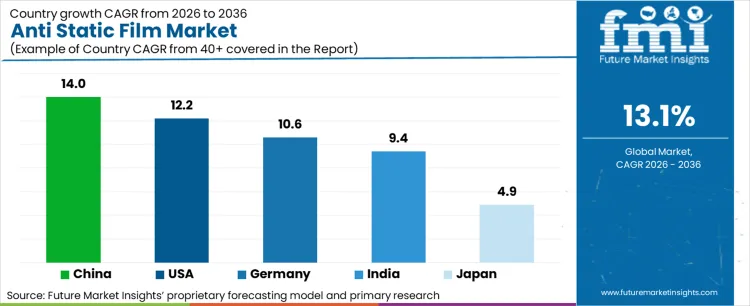
| Country | CAGR (2026 to 2036) |
|---|---|
| China | 14.0% |
| United States | 12.2% |
| Germany | 10.6% |
| India | 9.4% |
| Japan | 4.9% |
Source: Future Market Insights’ proprietary forecasting model and primary research
Why is China advancing fastest at a 14.0% CAGR?
China’s anti static film market expands at a 14.0% CAGR supported by aggressive semiconductor self-sufficiency programs and tighter enforcement of ESD control standards across electronics manufacturing. The rapid build-out of fabs, OSAT capacity, and downstream electronics assembly is elevating ESD risk management from procedural controls to material-level specifications. As device fragility increases, packaging-contact materials with stable surface resistivity and fast static decay are being standardized across handling, storage, and inter-factory logistics.
Automotive electronics adds further momentum. China’s EV production scale increases the volume of ESD-sensitive battery management systems, power modules, and sensor assemblies moving through multi-tier supply chains. Qualification requirements increasingly emphasize resistivity stability under heat and humidity, favoring permanent conductive coatings over migratory anti stats. The presence of localized cleanroom film production and rapid converter qualification cycles accelerates adoption, sustaining China’s lead growth rate.
What is driving the United States market at a 12.2% CAGR?
The United States grows at 12.2% CAGR, anchored in semiconductor fab construction, advanced packaging investment, and defense-grade electronics requirements. Backend handling specifications in USA fabs and OSATs increasingly mandate defined resistivity windows and static decay thresholds for films used in tray covers, reel wraps, and tote liners, elevating demand for engineered anti static films with validated long-term performance.
Automation intensity also plays a decisive role. High-mix, low-volume manufacturing environments rely heavily on robotic handling and automated storage, which amplifies triboelectric charging. Anti static films that suppress charge generation while remaining optically clear for machine-vision systems are preferred. Sustainability expectations further reinforce the shift toward transparent conductive coatings that align with recycling pathways, sustaining strong growth despite a relatively mature electronics base.
How is Germany sustaining 10.6% CAGR through automotive electronics?
Germany’s market advances at 10.6% CAGR, driven primarily by automotive electronics and industrial automation. The transition toward electrified drivetrains and advanced driver-assistance systems increases the density of ESD-sensitive components per vehicle, expanding the addressable market for anti static films across inbound component logistics and in-plant handling.
Automotive qualification rigor shapes material choice. Films must demonstrate electrostatic stability under extended thermal cycling and humidity exposure consistent with under-hood and power-electronics environments. This favors conductive-coated PET films validated through long-duration aging. Germany’s strong industrial automation footprint further supports adoption, as packaging and liner films are required to perform reliably within robotic systems without shedding particulates or losing electrostatic performance.
What factors are lifting India at a 9.4% CAGR?
India grows at 9.4% CAGR, reflecting rapid expansion of electronics assembly, mobile device manufacturing, and EV component production. As manufacturing scales, ESD control practices are formalizing, and packaging materials are being specified earlier in supplier qualification processes. Anti static films provide a cost-effective means to reduce yield loss without extensive infrastructure investment, making them attractive for fast-growing assembly ecosystems.
Domestic converter investment improves availability of coated and dissipative films tailored to regional conditions. Cost sensitivity remains a moderating factor, but preference is shifting away from temporary anti stats toward longer-life solutions as manufacturers experience performance degradation in high-humidity environments. This gradual up-specification supports steady growth through the forecast period.
Why is Japan’s growth more measured at 4.9% CAGR?
Japan expands at a 4.9% CAGR, reflecting a mature electronics manufacturing base with high existing penetration of ESD controls. Growth is driven less by volume expansion and more by value upgrades-transitioning from legacy opaque or carbon-filled films to transparent, cleanroom-compatible conductive coatings that support automation and recyclability goals.
Advanced materials expertise sustains niche leadership in high-performance anti static films for semiconductor and precision electronics handling. While overall unit growth is modest, continuous improvement in film performance-lower charge generation, tighter resistivity control, and enhanced optical clarity-supports incremental value growth and maintains Japan’s strategic relevance in the global supply landscape.
What is the Competition Outlook for the Anti Static Film Market?
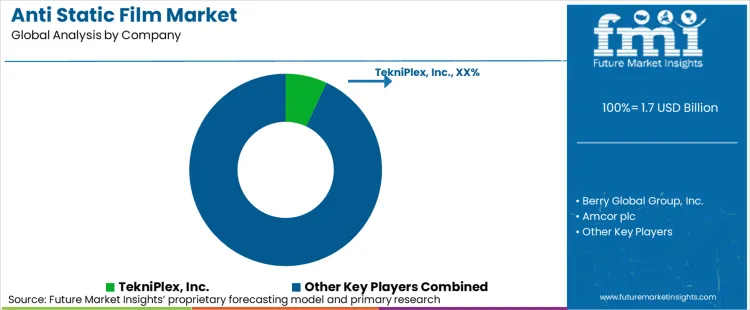
Competition in the anti static film market is increasingly shaped by performance reliability, qualification depth, and automation compatibility, rather than by film output capacity alone. As electrostatic discharge thresholds collapse for advanced semiconductors and automotive electronics, buyers are prioritizing suppliers that can guarantee stable surface resistivity, rapid static decay, and low charge generation across extended processing, storage, and transport cycles. Anti static films are now evaluated as part of a holistic ESD control architecture spanning cleanrooms, automated material handling, and global logistics.
A critical differentiator is permanence of electrostatic performance. Migratory anti static additives that rely on surface blooming are losing favor due to efficacy drift under heat and humidity and contamination risk in controlled environments. Suppliers offering conductive coatings or inherently dissipative polymer systems with documented aging stability are capturing a growing share of qualification-led contracts in semiconductor back-end packaging and EV electronics. This trend is reinforced by Industry 4.0 automation, where high-speed conveyance amplifies triboelectric charging and exposes the limitations of temporary solutions.
Sustainability considerations further influence competitive positioning. Opaque carbon-black systems, while electrically effective, complicate optical sorting and recycled-content integration. Market leaders are therefore investing in transparent or lightly tinted conductive coatings that maintain electrostatic performance while supporting recyclability and machine-vision compatibility. Over the forecast period, these dynamics are expected to concentrate share among a smaller set of global suppliers with proprietary coating chemistries, cleanroom-certified manufacturing, and multiregional technical service capabilities.
Key Players Profiled in the Anti Static Film Market
- TekniPlex, Inc.
- Berry Global Group, Inc.
- Amcor plc
- Toppan Inc.
- Toray Industries, Inc.
Market Definition
The anti static film market comprises polymeric films engineered to control electrostatic charge by maintaining defined surface and volume resistivity ranges and rapid static decay characteristics. These films prevent electrostatic discharge damage during the handling, storage, and transportation of ESD-sensitive components across semiconductor manufacturing, electronics assembly, automotive electronics, industrial automation, and consumer electronics logistics.
Within FMI’s scope, the market includes films with permanent or long-life anti static properties, achieved through conductive coatings or inherently dissipative polymers. Excluded are temporary migratory anti stat films, non-film ESD packaging formats (rigid containers, corrugated solutions), and post-processing anti static sprays.
Scope of the Report
| Attribute | Details |
|---|---|
| Base Year | 2026 |
| Forecast Period | 2026 to 2036 |
| Market Size (2026E) | USD 1,740 million |
| Market Size (2036F) | USD 5,960 million |
| CAGR (2026 to 2036) | 13.1% |
| Application Segments | Electronics Packaging; Automotive Electronics; Industrial Electronics |
| Coating Types | Conductive Coatings; Inherently Dissipative Polymers |
| Base Films | PET Films; Specialty Polymer Films |
| Regions Covered | North America; Europe; East Asia; South Asia; Japan; Rest of the World |
| Key Countries | China; United States; Germany; India; Japan |
Source: Future Market Insights (FMI)
Anti Static Film Market Key Segments
By Application Segment:
- Electronics Packaging
- Automotive Electronics
- Industrial Electronics
By Coating Type:
- Conductive Coatings
- Inherently Dissipative Polymer Systems
By Base Film:
- PET Films
- Specialty Polymer Films
By Region:
- North America
- Europe
- East Asia
- South Asia
- Japan
- Rest of the World
Bibliography
- International Electrotechnical Commission. (2024). IEC 61340-5-1: Protection of electronic devices from electrostatic phenomena. IEC.
- JEDEC Solid State Technology Association. (2025). ESD sensitivity classification and handling requirements for advanced semiconductor devices. JEDEC.
- Semiconductor Industry Association. (2025). Semiconductor manufacturing and advanced packaging outlook. SIA.
- SAE International. (2024). ESD considerations for automotive electronics and electric vehicle systems. SAE International.
- International Organization for Standardization. (2024). ISO 14644: Cleanrooms and associated controlled environments. ISO.
Frequently Asked Questions
What is the long-term growth outlook for the anti static film market?
FMI projects the market to grow at a 13.1% CAGR from 2026 to 2036, driven by semiconductor scaling, EV electronics proliferation, and Industry 4.0 automation.
How large is the market expected to be by 2036?
The market is expected to reach USD 5,960 million by 2036, up from USD 1,740 million in 2026.
Which application segment dominates demand?
Electronics packaging dominates due to rising ESD sensitivity of advanced semiconductor devices.
Which country leads growth?
China leads growth at 14.0% CAGR, supported by semiconductor capacity expansion and tighter ESD control enforcement.
Why are permanent anti static films preferred over temporary solutions?
Because they maintain stable electrostatic performance under heat, humidity, and automation stress, reducing yield loss and qualification risk across complex manufacturing environments.
Preview the report firsthand - request a free sample
Get SampleGet the brochure for pricing and purchase details.
Get PDFTable of Content
- Executive Summary
- Global Market Outlook
- Demand-side Trends
- Supply-side Trends
- Technology Roadmap Analysis
- Analysis and Recommendations
- Market Overview
- Market Coverage / Taxonomy
- Market Definition / Scope / Limitations
- Research Methodology
- Chapter Orientation
- Analytical Lens and Working Hypotheses
- Market Structure, Signals, and Trend Drivers
- Benchmarking and Cross-market Comparability
- Market Sizing, Forecasting, and Opportunity Mapping
- Research Design and Evidence Framework
- Desk Research Programme (Secondary Evidence)
- Company Annual and Sustainability Reports
- Peer-reviewed Journals and Academic Literature
- Corporate Websites, Product Literature, and Technical Notes
- Earnings Decks and Investor Briefings
- Statutory Filings and Regulatory Disclosures
- Technical White Papers and Standards Notes
- Trade Journals, Industry Magazines, and Analyst Briefs
- Conference Proceedings, Webinars, and Seminar Materials
- Government Statistics Portals and Public Data Releases
- Press Releases and Reputable Media Coverage
- Specialist Newsletters and Curated Briefings
- Sector Databases and Reference Repositories
- FMI Internal Proprietary Databases and Historical Market Datasets
- Subscription Datasets and Paid Sources
- Social Channels, Communities, and Digital Listening Inputs
- Additional Desk Sources
- Expert Input and Fieldwork (Primary Evidence)
- Primary Modes
- Qualitative Interviews and Expert Elicitation
- Quantitative Surveys and Structured Data Capture
- Blended Approach
- Why Primary Evidence is Used
- Field Techniques
- Interviews
- Surveys
- Focus Groups
- Observational and In-context Research
- Social and Community Interactions
- Stakeholder Universe Engaged
- C-suite Leaders
- Board Members
- Presidents and Vice Presidents
- R&D and Innovation Heads
- Technical Specialists
- Domain Subject-matter Experts
- Scientists
- Physicians and Other Healthcare Professionals
- Governance, Ethics, and Data Stewardship
- Research Ethics
- Data Integrity and Handling
- Primary Modes
- Tooling, Models, and Reference Databases
- Desk Research Programme (Secondary Evidence)
- Data Engineering and Model Build
- Data Acquisition and Ingestion
- Cleaning, Normalisation, and Verification
- Synthesis, Triangulation, and Analysis
- Quality Assurance and Audit Trail
- Market Background
- Market Dynamics
- Drivers
- Restraints
- Opportunity
- Trends
- Scenario Forecast
- Demand in Optimistic Scenario
- Demand in Likely Scenario
- Demand in Conservative Scenario
- Opportunity Map Analysis
- Product Life Cycle Analysis
- Supply Chain Analysis
- Investment Feasibility Matrix
- Value Chain Analysis
- PESTLE and Porter’s Analysis
- Regulatory Landscape
- Regional Parent Market Outlook
- Production and Consumption Statistics
- Import and Export Statistics
- Market Dynamics
- Global Market Analysis 2021 to 2025 and Forecast, 2026 to 2036
- Historical Market Size Value (USD Million) Analysis, 2021 to 2025
- Current and Future Market Size Value (USD Million) Projections, 2026 to 2036
- Y-o-Y Growth Trend Analysis
- Absolute $ Opportunity Analysis
- Global Market Pricing Analysis 2021 to 2025 and Forecast 2026 to 2036
- Global Market Analysis 2021 to 2025 and Forecast 2026 to 2036, By Application
- Introduction / Key Findings
- Historical Market Size Value (USD Million) Analysis By Application , 2021 to 2025
- Current and Future Market Size Value (USD Million) Analysis and Forecast By Application , 2026 to 2036
- Electronics Packaging
- Automotive Electronics
- Industrial Electronics
- Electronics Packaging
- Y-o-Y Growth Trend Analysis By Application , 2021 to 2025
- Absolute $ Opportunity Analysis By Application , 2026 to 2036
- Global Market Analysis 2021 to 2025 and Forecast 2026 to 2036, By Coating Type
- Introduction / Key Findings
- Historical Market Size Value (USD Million) Analysis By Coating Type, 2021 to 2025
- Current and Future Market Size Value (USD Million) Analysis and Forecast By Coating Type, 2026 to 2036
- Conductive Coatings
- Inherently Dissipative Polymer Systems
- Conductive Coatings
- Y-o-Y Growth Trend Analysis By Coating Type, 2021 to 2025
- Absolute $ Opportunity Analysis By Coating Type, 2026 to 2036
- Global Market Analysis 2021 to 2025 and Forecast 2026 to 2036, By Base Film
- Introduction / Key Findings
- Historical Market Size Value (USD Million) Analysis By Base Film, 2021 to 2025
- Current and Future Market Size Value (USD Million) Analysis and Forecast By Base Film, 2026 to 2036
- PET Films
- Specialty Polymer Films
- PET Films
- Y-o-Y Growth Trend Analysis By Base Film, 2021 to 2025
- Absolute $ Opportunity Analysis By Base Film, 2026 to 2036
- Global Market Analysis 2021 to 2025 and Forecast 2026 to 2036, By Region
- Introduction
- Historical Market Size Value (USD Million) Analysis By Region, 2021 to 2025
- Current Market Size Value (USD Million) Analysis and Forecast By Region, 2026 to 2036
- North America
- Latin America
- Western Europe
- Eastern Europe
- East Asia
- South Asia and Pacific
- Middle East & Africa
- Market Attractiveness Analysis By Region
- North America Market Analysis 2021 to 2025 and Forecast 2026 to 2036, By Country
- Historical Market Size Value (USD Million) Trend Analysis By Market Taxonomy, 2021 to 2025
- Market Size Value (USD Million) Forecast By Market Taxonomy, 2026 to 2036
- By Country
- USA
- Canada
- Mexico
- By Application
- By Coating Type
- By Base Film
- By Country
- Market Attractiveness Analysis
- By Country
- By Application
- By Coating Type
- By Base Film
- Key Takeaways
- Latin America Market Analysis 2021 to 2025 and Forecast 2026 to 2036, By Country
- Historical Market Size Value (USD Million) Trend Analysis By Market Taxonomy, 2021 to 2025
- Market Size Value (USD Million) Forecast By Market Taxonomy, 2026 to 2036
- By Country
- Brazil
- Chile
- Rest of Latin America
- By Application
- By Coating Type
- By Base Film
- By Country
- Market Attractiveness Analysis
- By Country
- By Application
- By Coating Type
- By Base Film
- Key Takeaways
- Western Europe Market Analysis 2021 to 2025 and Forecast 2026 to 2036, By Country
- Historical Market Size Value (USD Million) Trend Analysis By Market Taxonomy, 2021 to 2025
- Market Size Value (USD Million) Forecast By Market Taxonomy, 2026 to 2036
- By Country
- Germany
- UK
- Italy
- Spain
- France
- Nordic
- BENELUX
- Rest of Western Europe
- By Application
- By Coating Type
- By Base Film
- By Country
- Market Attractiveness Analysis
- By Country
- By Application
- By Coating Type
- By Base Film
- Key Takeaways
- Eastern Europe Market Analysis 2021 to 2025 and Forecast 2026 to 2036, By Country
- Historical Market Size Value (USD Million) Trend Analysis By Market Taxonomy, 2021 to 2025
- Market Size Value (USD Million) Forecast By Market Taxonomy, 2026 to 2036
- By Country
- Russia
- Poland
- Hungary
- Balkan & Baltic
- Rest of Eastern Europe
- By Application
- By Coating Type
- By Base Film
- By Country
- Market Attractiveness Analysis
- By Country
- By Application
- By Coating Type
- By Base Film
- Key Takeaways
- East Asia Market Analysis 2021 to 2025 and Forecast 2026 to 2036, By Country
- Historical Market Size Value (USD Million) Trend Analysis By Market Taxonomy, 2021 to 2025
- Market Size Value (USD Million) Forecast By Market Taxonomy, 2026 to 2036
- By Country
- China
- Japan
- South Korea
- By Application
- By Coating Type
- By Base Film
- By Country
- Market Attractiveness Analysis
- By Country
- By Application
- By Coating Type
- By Base Film
- Key Takeaways
- South Asia and Pacific Market Analysis 2021 to 2025 and Forecast 2026 to 2036, By Country
- Historical Market Size Value (USD Million) Trend Analysis By Market Taxonomy, 2021 to 2025
- Market Size Value (USD Million) Forecast By Market Taxonomy, 2026 to 2036
- By Country
- India
- ASEAN
- Australia & New Zealand
- Rest of South Asia and Pacific
- By Application
- By Coating Type
- By Base Film
- By Country
- Market Attractiveness Analysis
- By Country
- By Application
- By Coating Type
- By Base Film
- Key Takeaways
- Middle East & Africa Market Analysis 2021 to 2025 and Forecast 2026 to 2036, By Country
- Historical Market Size Value (USD Million) Trend Analysis By Market Taxonomy, 2021 to 2025
- Market Size Value (USD Million) Forecast By Market Taxonomy, 2026 to 2036
- By Country
- Kingdom of Saudi Arabia
- Other GCC Countries
- Turkiye
- South Africa
- Other African Union
- Rest of Middle East & Africa
- By Application
- By Coating Type
- By Base Film
- By Country
- Market Attractiveness Analysis
- By Country
- By Application
- By Coating Type
- By Base Film
- Key Takeaways
- Key Countries Market Analysis
- USA
- Pricing Analysis
- Market Share Analysis, 2025
- By Application
- By Coating Type
- By Base Film
- Canada
- Pricing Analysis
- Market Share Analysis, 2025
- By Application
- By Coating Type
- By Base Film
- Mexico
- Pricing Analysis
- Market Share Analysis, 2025
- By Application
- By Coating Type
- By Base Film
- Brazil
- Pricing Analysis
- Market Share Analysis, 2025
- By Application
- By Coating Type
- By Base Film
- Chile
- Pricing Analysis
- Market Share Analysis, 2025
- By Application
- By Coating Type
- By Base Film
- Germany
- Pricing Analysis
- Market Share Analysis, 2025
- By Application
- By Coating Type
- By Base Film
- UK
- Pricing Analysis
- Market Share Analysis, 2025
- By Application
- By Coating Type
- By Base Film
- Italy
- Pricing Analysis
- Market Share Analysis, 2025
- By Application
- By Coating Type
- By Base Film
- Spain
- Pricing Analysis
- Market Share Analysis, 2025
- By Application
- By Coating Type
- By Base Film
- France
- Pricing Analysis
- Market Share Analysis, 2025
- By Application
- By Coating Type
- By Base Film
- India
- Pricing Analysis
- Market Share Analysis, 2025
- By Application
- By Coating Type
- By Base Film
- ASEAN
- Pricing Analysis
- Market Share Analysis, 2025
- By Application
- By Coating Type
- By Base Film
- Australia & New Zealand
- Pricing Analysis
- Market Share Analysis, 2025
- By Application
- By Coating Type
- By Base Film
- China
- Pricing Analysis
- Market Share Analysis, 2025
- By Application
- By Coating Type
- By Base Film
- Japan
- Pricing Analysis
- Market Share Analysis, 2025
- By Application
- By Coating Type
- By Base Film
- South Korea
- Pricing Analysis
- Market Share Analysis, 2025
- By Application
- By Coating Type
- By Base Film
- Russia
- Pricing Analysis
- Market Share Analysis, 2025
- By Application
- By Coating Type
- By Base Film
- Poland
- Pricing Analysis
- Market Share Analysis, 2025
- By Application
- By Coating Type
- By Base Film
- Hungary
- Pricing Analysis
- Market Share Analysis, 2025
- By Application
- By Coating Type
- By Base Film
- Kingdom of Saudi Arabia
- Pricing Analysis
- Market Share Analysis, 2025
- By Application
- By Coating Type
- By Base Film
- Turkiye
- Pricing Analysis
- Market Share Analysis, 2025
- By Application
- By Coating Type
- By Base Film
- South Africa
- Pricing Analysis
- Market Share Analysis, 2025
- By Application
- By Coating Type
- By Base Film
- USA
- Market Structure Analysis
- Competition Dashboard
- Competition Benchmarking
- Market Share Analysis of Top Players
- By Regional
- By Application
- By Coating Type
- By Base Film
- Competition Analysis
- Competition Deep Dive
- TekniPlex, Inc.
- Overview
- Product Portfolio
- Profitability by Market Segments (Product/Age /Sales Channel/Region)
- Sales Footprint
- Strategy Overview
- Marketing Strategy
- Product Strategy
- Channel Strategy
- Berry Global Group, Inc.
- Amcor plc
- Toppan Inc.
- Toray Industries, Inc.
- TekniPlex, Inc.
- Competition Deep Dive
- Assumptions & Acronyms Used


