

- Industry Size (2025)
- USD 633.7 Mn
- Forecast (2035)
- USD 1022.5 Mn
- CAGR (2025 to 2035)
- 4.9%
Anti-Static Foam Pouch Market Size and Share Forecast Outlook 2025 to 2035
The Anti-Static Foam Pouch Market is estimated to be valued at USD 633.7 million in 2025 and is projected to reach USD 1022.5 million by 2035, registering a compound annual growth rate (CAGR) of 4.9% over the forecast period.
Quick Stats for Anti-Static Foam Pouch Market
- Anti-Static Foam Pouch Market Value (2025): USD 633.7 million
- Anti-Static Foam Pouch Market Forecast Value (2035): USD 1022.5 million
- Anti-Static Foam Pouch Market Forecast CAGR: 4.9%
- Leading Segment in Anti-Static Foam Pouch Market in 2025: Electronics (34.6%)
- Key Growth Regions in Anti-Static Foam Pouch Market: North America, Asia-Pacific, Europe
- Top Key Players in Anti-Static Foam Pouch Market: Sealed Air Corporation, 3M Company, BASF SE, Desco Industries, Inc., Pregis Corporation, Storopack Hans Reichenecker GmbH, Smurfit Kappa Group, Polyair Inter Pack Inc., Uline, Inc., Shenzhen Star New Material Co., Ltd., Electrotek Static Controls Pvt. Ltd., Teknis Limited, GWP Group Limited, Kao-Chia Plastics Co., Ltd.
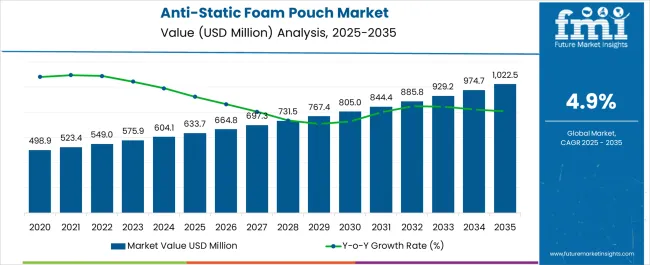
Anti-Static Foam Pouch Market Key Takeaways
| Metric | Value |
|---|---|
| Anti-Static Foam Pouch Market Estimated Value in (2025 E) | USD 633.7 million |
| Anti-Static Foam Pouch Market Forecast Value in (2035 F) | USD 1022.5 million |
| Forecast CAGR (2025 to 2035) | 4.9% |
Why is the Anti-Static Foam Pouch Market Growing?
The Anti-Static Foam Pouch market is expanding steadily, supported by the growing demand for secure and reliable packaging solutions in industries where static charge can damage sensitive products. These pouches are widely used to protect semiconductors, circuit boards, and electronic components during handling, shipping, and storage. Increasing awareness regarding electrostatic discharge and its potential to cause significant financial losses in the electronics and semiconductor industry is driving higher adoption.
Advancements in material science, including improved cushioning, durability, and static dissipation, are enhancing pouch performance and usability. Sustainability considerations, such as the use of recyclable polymers, are also shaping product innovation. Manufacturers are focusing on customized pouch designs to meet specific client requirements, which is further broadening adoption across multiple industries.
The rise of e-commerce and global electronics trade has amplified the importance of protective packaging, fueling demand growth As regulatory frameworks governing packaging safety and waste management strengthen, adoption of anti-static foam pouches is expected to accelerate, positioning the market for long-term growth across diverse sectors.
Segmental Analysis
The anti-static foam pouch market is segmented by end use, material type, sealing type, and geographic regions. By end use, anti-static foam pouch market is divided into Electronics, Automotive, Consumer Goods, Industrial Goods, and Others. In terms of material type, anti-static foam pouch market is classified into HDPE, PE, PVC, and LDPE. Based on sealing type, anti-static foam pouch market is segmented into Heat Seal, Spout Top, and Self-Adhesive Seal. Regionally, the anti-static foam pouch industry is classified into North America, Latin America, Western Europe, Eastern Europe, Balkan & Baltic Countries, Russia & Belarus, Central Asia, East Asia, South Asia & Pacific, and the Middle East & Africa.
Insights into the Electronics End Use Segment
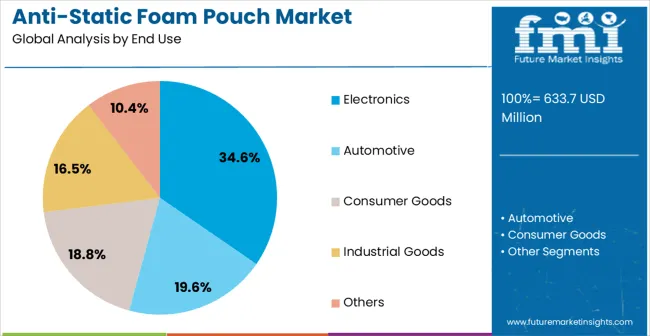
The electronics end use segment is projected to account for 34.6% of the market revenue in 2025, making it the leading category. The preference for this segment is being driven by the widespread need to protect sensitive components such as integrated circuits, microchips, and motherboards during manufacturing and logistics. Electronics manufacturers rely heavily on anti-static foam pouches to prevent electrostatic discharge, which can lead to costly failures and reduced product reliability.
The increasing miniaturization of electronic devices, coupled with the rising complexity of semiconductors, has heightened the importance of protective packaging solutions. Additionally, the expansion of consumer electronics, including smartphones, laptops, and wearables, is generating consistent demand. Electronics exporters are increasingly adopting these pouches for bulk shipments due to their proven safety and compliance with international standards.
The segment is also benefiting from collaborations between packaging providers and electronics manufacturers to develop customized designs These factors are solidifying the electronics segment’s role as the dominant end use within the anti-static foam pouch market.
Insights into the HDPE Material Type Segment
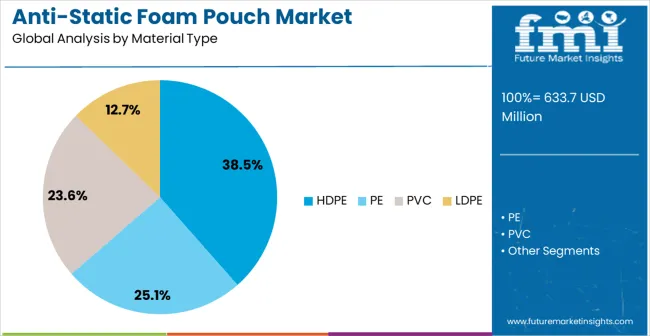
The HDPE material type segment is anticipated to hold 38.5% of the market revenue in 2025, making it the leading material preference. Growth in this segment is supported by HDPE’s superior properties, including durability, moisture resistance, and strong anti-static performance. Its lightweight nature and recyclability make it a cost-effective and sustainable choice for manufacturers.
Electronics companies are increasingly favoring HDPE-based pouches due to their ability to withstand transportation challenges while maintaining product safety. The segment is further supported by the growing adoption of eco-friendly packaging alternatives, with HDPE emerging as a preferred material that aligns with both performance and sustainability requirements. Advances in polymer processing and anti-static treatment technologies are also improving pouch efficiency, increasing demand across industries beyond electronics, including aerospace and automotive.
The scalability of HDPE production and its compatibility with large-scale manufacturing operations are strengthening its leadership in the market As global focus shifts toward robust and environmentally responsible packaging, HDPE-based anti-static pouches are expected to remain the top material segment.
Insights into the Heat Seal Sealing Type Segment
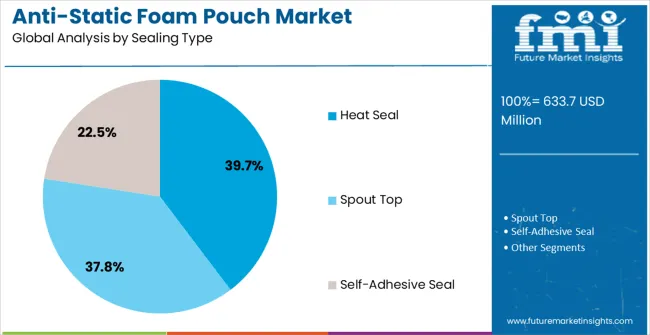
The heat seal segment is expected to contribute 39.7% of the market revenue in 2025, positioning it as the leading sealing type. This dominance is being driven by the reliability and efficiency of heat sealing in ensuring tamper-proof closures that protect sensitive components. Heat sealing creates a strong and consistent bond, reducing the risk of accidental openings during transportation and storage.
Manufacturers prefer this method for its cost-effectiveness, scalability, and compatibility with high-speed production lines. The segment’s growth is further reinforced by its widespread use in electronics packaging, where secure sealing is critical to protect against environmental factors and electrostatic discharge. The increasing demand for customized pouch sizes and bulk packaging solutions has also fueled adoption of heat seal techniques, given their flexibility in accommodating diverse designs.
Additionally, advancements in heat sealing technology are improving speed and energy efficiency, further enhancing its appeal As industries prioritize secure, reliable, and scalable packaging solutions, heat seal is projected to remain the dominant sealing type in the anti-static foam pouch market.
Market Overview
Anti-Static Foam Pouch Market Overview (2025-2035)
Expected to flourish at a 4.9% CAGR, the anti-static foam pouch market is forecast to reach a valuation of US$ 890 Million by the end of the 2025 to 2035 assessment period. As of 2025-end, demand for anti-static foam pouches is expected to total US$ 549 Million.
| Data Points | Key Statistics |
|---|---|
| Expected Market Value in 2025 | US$ 549 Million |
| Projected Market Value in 2035 | US$ 890 Million |
| Growth Rate (2025 to 2035) | 4.9% CAGR |
How Anti-Static Foam Pouch Safeguards Electronic Goods While Shipping
FMI predicts that special chemicals of anti-static foam pouches will be crucial for avoiding static discharge from electronics. Intricately manufactured electrical components can be extremely delicate, and this is particularly true of electrostatic-sensitive devices (ESDs).
Even when ESDs are being created, technicians have to take extra precautions – such as ESD workstations, humidity control, anti-static garments or anti-static wrist wraps – to avoid damaging their work.
The report from Future Market Insights suggests that the handling and shipping of such electronic goods and items can be very risky and it requires more than just standard pouch to protect them from any damage in transit. Static can cause problems within the components in a standard bag or pouch, as sealed air is used to produce cushioning in these kind of pouches that protects the fragile content.
This is because static electricity is all around us and a mild shock can be caused by almost any two surfaces coming together: your shoes and a carpet, your hair and a hat, even your hand and a door handle. The shock is due to a rapid transfer of electrons between two objects with opposing charges.
Unfortunately, even a shock as small as five volts can damage ESDs beyond repair, and with humans having natural sources of electricity within our bodies, we cannot be too careful.
The Solution: Anti-Static Foam
Foam inserts for packing, transportation and storage provide vital protection for goods, having been cut specifically for the components they house. ESDs, however, require a special type of foam.
Made using open-cell polyurethane foam, anti-static foam includes special chemicals and an anti-static agent. It is usually coloured pink during the manufacturing process, to differentiate it from other types of foam.
As well as protecting goods from static discharge, anti-static foam gives any potential electrical charges a path away from the packaging, allowing it to dissipate safely. Also, since components are housed within their own individual niches in the foam, there is no chance of frictional or triboelectric charging due to objects rubbing together.
Before such precautions could be taken, one early manufacturer of computer circuit boards found high rates of failure in their products once they left the factory and had been investigated by field service engineers. Eventually, they discovered that the field service engineers were unaware of the need for precautionary measures when handling ESDs like circuit boards and their interventions were damaging the components.
With potential sources of static electricity surrounding us and our expensive ESDs, the advent of the anti-static foam alone has saved businesses untold costs each and every day.
Analysis of Anti-Static Foam Pouch Market By Key Countries
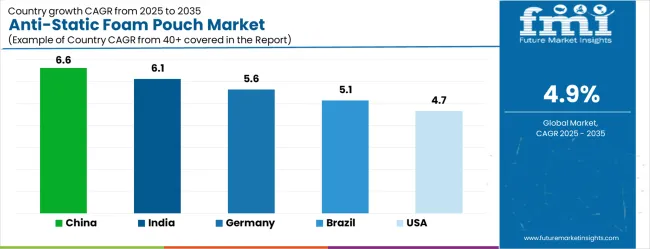
| Country | CAGR |
|---|---|
| China | 6.6% |
| India | 6.1% |
| Germany | 5.6% |
| Brazil | 5.1% |
| USA | 4.7% |
| UK | 4.2% |
| Japan | 3.7% |
Country-wise Analysis
The Anti-Static Foam Pouch Market is expected to register a CAGR of 4.9% during the forecast period, exhibiting varied country level momentum. China leads with the highest CAGR of 6.6%, followed by India at 6.1%. Developed markets such as Germany, France, and the UK continue to expand steadily, while the USA is likely to grow at consistent rates. Japan posts the lowest CAGR at 3.7%, yet still underscores a broadly positive trajectory for the global Anti-Static Foam Pouch Market. In 2024, Germany held a dominant revenue in the Western Europe market and is expected to grow with a CAGR of 5.6%. The USA Anti-Static Foam Pouch Market is estimated to be valued at USD 234.0 million in 2025 and is anticipated to reach a valuation of USD 234.0 million by 2035. Sales are projected to rise at a CAGR of 0.0% over the forecast period between 2025 and 2035. While Japan and South Korea markets are estimated to be valued at USD 30.5 million and USD 21.8 million respectively in 2025.
Key Players in the Anti-Static Foam Pouch Market
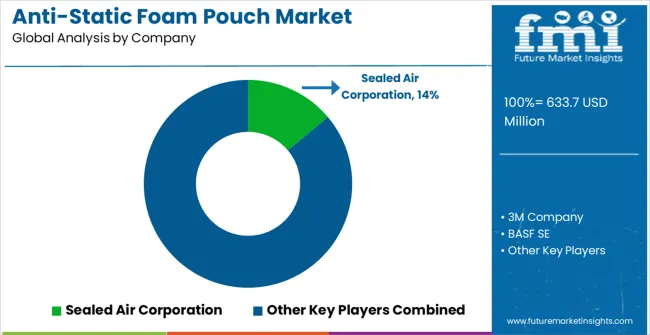
- Sealed Air Corporation
- 3M Company
- BASF SE
- Desco Industries, Inc.
- Pregis Corporation
- Storopack Hans Reichenecker GmbH
- Smurfit Kappa Group
- Polyair Inter Pack Inc.
- Uline, Inc.
- Shenzhen Star New Material Co., Ltd.
- Electrotek Static Controls Pvt. Ltd.
- Teknis Limited
- GWP Group Limited
- Kao-Chia Plastics Co., Ltd.
Scope of the Report
| Item | Value |
|---|---|
| Quantitative Units | USD 633.7 Million |
| End Use | Electronics, Automotive, Consumer Goods, Industrial Goods, and Others |
| Material Type | HDPE, PE, PVC, and LDPE |
| Sealing Type | Heat Seal, Spout Top, and Self-Adhesive Seal |
| Regions Covered | North America, Europe, Asia-Pacific, Latin America, Middle East & Africa |
| Country Covered | United States, Canada, Germany, France, United Kingdom, China, Japan, India, Brazil, South Africa |
| Key Companies Profiled | Sealed Air Corporation, 3M Company, BASF SE, Desco Industries, Inc., Pregis Corporation, Storopack Hans Reichenecker GmbH, Smurfit Kappa Group, Polyair Inter Pack Inc., Uline, Inc., Shenzhen Star New Material Co., Ltd., Electrotek Static Controls Pvt. Ltd., Teknis Limited, GWP Group Limited, and Kao-Chia Plastics Co., Ltd. |
Anti-Static Foam Pouch Market by Segments
End Use:
- Electronics
- Automotive
- Consumer Goods
- Industrial Goods
- Others
Material Type:
- HDPE
- PE
- PVC
- LDPE
Sealing Type:
- Heat Seal
- Spout Top
- Self-Adhesive Seal
Region:
- North America
- USA
- Canada
- Mexico
- Latin America
- Brazil
- Chile
- Rest of Latin America
- Western Europe
- Germany
- UK
- Italy
- Spain
- France
- Nordic
- BENELUX
- Rest of Western Europe
- Eastern Europe
- Russia
- Poland
- Hungary
- Balkan & Baltic
- Rest of Eastern Europe
- East Asia
- China
- Japan
- South Korea
- South Asia and Pacific
- India
- ASEAN
- Australia & New Zealand
- Rest of South Asia and Pacific
- Middle East & Africa
- Kingdom of Saudi Arabia
- Other GCC Countries
- Turkiye
- South Africa
- Other African Union
- Rest of Middle East & Africa
Frequently Asked Questions
How big is the anti-static foam pouch market in 2025?
The global anti-static foam pouch market is estimated to be valued at USD 633.7 million in 2025.
What will be the size of anti-static foam pouch market in 2035?
The market size for the anti-static foam pouch market is projected to reach USD 1,022.5 million by 2035.
How much will be the anti-static foam pouch market growth between 2025 and 2035?
The anti-static foam pouch market is expected to grow at a 4.9% CAGR between 2025 and 2035.
What are the key product types in the anti-static foam pouch market?
The key product types in anti-static foam pouch market are electronics, automotive, consumer goods, industrial goods and others.
Which material type segment to contribute significant share in the anti-static foam pouch market in 2025?
In terms of material type, hdpe segment to command 38.5% share in the anti-static foam pouch market in 2025.
Preview the report firsthand - request a free sample
Get SampleGet the brochure for pricing and purchase details.
Get PDFTable of Content
- Executive Summary
- Global Market Outlook
- Demand-side Trends
- Supply-side Trends
- Technology Roadmap Analysis
- Analysis and Recommendations
- Market Overview
- Market Coverage / Taxonomy
- Market Definition / Scope / Limitations
- Market Background
- Market Dynamics
- Drivers
- Restraints
- Opportunity
- Trends
- Scenario Forecast
- Demand in Optimistic Scenario
- Demand in Likely Scenario
- Demand in Conservative Scenario
- Opportunity Map Analysis
- Product Life Cycle Analysis
- Supply Chain Analysis
- Investment Feasibility Matrix
- Value Chain Analysis
- PESTLE and Porter’s Analysis
- Regulatory Landscape
- Regional Parent Market Outlook
- Production and Consumption Statistics
- Import and Export Statistics
- Market Dynamics
- Global Market Analysis 2020 to 2024 and Forecast, 2025 to 2035
- Historical Market Size Value (USD Million) Analysis, 2020 to 2024
- Current and Future Market Size Value (USD Million) Projections, 2025 to 2035
- Y-o-Y Growth Trend Analysis
- Absolute $ Opportunity Analysis
- Global Market Pricing Analysis 2020 to 2024 and Forecast 2025 to 2035
- Global Market Analysis 2020 to 2024 and Forecast 2025 to 2035, By End Use
- Introduction / Key Findings
- Historical Market Size Value (USD Million) Analysis By End Use , 2020 to 2024
- Current and Future Market Size Value (USD Million) Analysis and Forecast By End Use , 2025 to 2035
- Electronics
- Automotive
- Consumer Goods
- Industrial Goods
- Others
- Y-o-Y Growth Trend Analysis By End Use , 2020 to 2024
- Absolute $ Opportunity Analysis By End Use , 2025 to 2035
- Global Market Analysis 2020 to 2024 and Forecast 2025 to 2035, By Material Type
- Introduction / Key Findings
- Historical Market Size Value (USD Million) Analysis By Material Type, 2020 to 2024
- Current and Future Market Size Value (USD Million) Analysis and Forecast By Material Type, 2025 to 2035
- HDPE
- PE
- PVC
- LDPE
- Y-o-Y Growth Trend Analysis By Material Type, 2020 to 2024
- Absolute $ Opportunity Analysis By Material Type, 2025 to 2035
- Global Market Analysis 2020 to 2024 and Forecast 2025 to 2035, By Sealing Type
- Introduction / Key Findings
- Historical Market Size Value (USD Million) Analysis By Sealing Type, 2020 to 2024
- Current and Future Market Size Value (USD Million) Analysis and Forecast By Sealing Type, 2025 to 2035
- Heat Seal
- Spout Top
- Self-Adhesive Seal
- Y-o-Y Growth Trend Analysis By Sealing Type, 2020 to 2024
- Absolute $ Opportunity Analysis By Sealing Type, 2025 to 2035
- Global Market Analysis 2020 to 2024 and Forecast 2025 to 2035, By Region
- Introduction
- Historical Market Size Value (USD Million) Analysis By Region, 2020 to 2024
- Current Market Size Value (USD Million) Analysis and Forecast By Region, 2025 to 2035
- North America
- Latin America
- Western Europe
- Eastern Europe
- East Asia
- South Asia and Pacific
- Middle East & Africa
- Market Attractiveness Analysis By Region
- North America Market Analysis 2020 to 2024 and Forecast 2025 to 2035, By Country
- Historical Market Size Value (USD Million) Trend Analysis By Market Taxonomy, 2020 to 2024
- Market Size Value (USD Million) Forecast By Market Taxonomy, 2025 to 2035
- By Country
- USA
- Canada
- Mexico
- By End Use
- By Material Type
- By Sealing Type
- By Country
- Market Attractiveness Analysis
- By Country
- By End Use
- By Material Type
- By Sealing Type
- Key Takeaways
- Latin America Market Analysis 2020 to 2024 and Forecast 2025 to 2035, By Country
- Historical Market Size Value (USD Million) Trend Analysis By Market Taxonomy, 2020 to 2024
- Market Size Value (USD Million) Forecast By Market Taxonomy, 2025 to 2035
- By Country
- Brazil
- Chile
- Rest of Latin America
- By End Use
- By Material Type
- By Sealing Type
- By Country
- Market Attractiveness Analysis
- By Country
- By End Use
- By Material Type
- By Sealing Type
- Key Takeaways
- Western Europe Market Analysis 2020 to 2024 and Forecast 2025 to 2035, By Country
- Historical Market Size Value (USD Million) Trend Analysis By Market Taxonomy, 2020 to 2024
- Market Size Value (USD Million) Forecast By Market Taxonomy, 2025 to 2035
- By Country
- Germany
- UK
- Italy
- Spain
- France
- Nordic
- BENELUX
- Rest of Western Europe
- By End Use
- By Material Type
- By Sealing Type
- By Country
- Market Attractiveness Analysis
- By Country
- By End Use
- By Material Type
- By Sealing Type
- Key Takeaways
- Eastern Europe Market Analysis 2020 to 2024 and Forecast 2025 to 2035, By Country
- Historical Market Size Value (USD Million) Trend Analysis By Market Taxonomy, 2020 to 2024
- Market Size Value (USD Million) Forecast By Market Taxonomy, 2025 to 2035
- By Country
- Russia
- Poland
- Hungary
- Balkan & Baltic
- Rest of Eastern Europe
- By End Use
- By Material Type
- By Sealing Type
- By Country
- Market Attractiveness Analysis
- By Country
- By End Use
- By Material Type
- By Sealing Type
- Key Takeaways
- East Asia Market Analysis 2020 to 2024 and Forecast 2025 to 2035, By Country
- Historical Market Size Value (USD Million) Trend Analysis By Market Taxonomy, 2020 to 2024
- Market Size Value (USD Million) Forecast By Market Taxonomy, 2025 to 2035
- By Country
- China
- Japan
- South Korea
- By End Use
- By Material Type
- By Sealing Type
- By Country
- Market Attractiveness Analysis
- By Country
- By End Use
- By Material Type
- By Sealing Type
- Key Takeaways
- South Asia and Pacific Market Analysis 2020 to 2024 and Forecast 2025 to 2035, By Country
- Historical Market Size Value (USD Million) Trend Analysis By Market Taxonomy, 2020 to 2024
- Market Size Value (USD Million) Forecast By Market Taxonomy, 2025 to 2035
- By Country
- India
- ASEAN
- Australia & New Zealand
- Rest of South Asia and Pacific
- By End Use
- By Material Type
- By Sealing Type
- By Country
- Market Attractiveness Analysis
- By Country
- By End Use
- By Material Type
- By Sealing Type
- Key Takeaways
- Middle East & Africa Market Analysis 2020 to 2024 and Forecast 2025 to 2035, By Country
- Historical Market Size Value (USD Million) Trend Analysis By Market Taxonomy, 2020 to 2024
- Market Size Value (USD Million) Forecast By Market Taxonomy, 2025 to 2035
- By Country
- Kingdom of Saudi Arabia
- Other GCC Countries
- Turkiye
- South Africa
- Other African Union
- Rest of Middle East & Africa
- By End Use
- By Material Type
- By Sealing Type
- By Country
- Market Attractiveness Analysis
- By Country
- By End Use
- By Material Type
- By Sealing Type
- Key Takeaways
- Key Countries Market Analysis
- USA
- Pricing Analysis
- Market Share Analysis, 2024
- By End Use
- By Material Type
- By Sealing Type
- Canada
- Pricing Analysis
- Market Share Analysis, 2024
- By End Use
- By Material Type
- By Sealing Type
- Mexico
- Pricing Analysis
- Market Share Analysis, 2024
- By End Use
- By Material Type
- By Sealing Type
- Brazil
- Pricing Analysis
- Market Share Analysis, 2024
- By End Use
- By Material Type
- By Sealing Type
- Chile
- Pricing Analysis
- Market Share Analysis, 2024
- By End Use
- By Material Type
- By Sealing Type
- Germany
- Pricing Analysis
- Market Share Analysis, 2024
- By End Use
- By Material Type
- By Sealing Type
- UK
- Pricing Analysis
- Market Share Analysis, 2024
- By End Use
- By Material Type
- By Sealing Type
- Italy
- Pricing Analysis
- Market Share Analysis, 2024
- By End Use
- By Material Type
- By Sealing Type
- Spain
- Pricing Analysis
- Market Share Analysis, 2024
- By End Use
- By Material Type
- By Sealing Type
- France
- Pricing Analysis
- Market Share Analysis, 2024
- By End Use
- By Material Type
- By Sealing Type
- India
- Pricing Analysis
- Market Share Analysis, 2024
- By End Use
- By Material Type
- By Sealing Type
- ASEAN
- Pricing Analysis
- Market Share Analysis, 2024
- By End Use
- By Material Type
- By Sealing Type
- Australia & New Zealand
- Pricing Analysis
- Market Share Analysis, 2024
- By End Use
- By Material Type
- By Sealing Type
- China
- Pricing Analysis
- Market Share Analysis, 2024
- By End Use
- By Material Type
- By Sealing Type
- Japan
- Pricing Analysis
- Market Share Analysis, 2024
- By End Use
- By Material Type
- By Sealing Type
- South Korea
- Pricing Analysis
- Market Share Analysis, 2024
- By End Use
- By Material Type
- By Sealing Type
- Russia
- Pricing Analysis
- Market Share Analysis, 2024
- By End Use
- By Material Type
- By Sealing Type
- Poland
- Pricing Analysis
- Market Share Analysis, 2024
- By End Use
- By Material Type
- By Sealing Type
- Hungary
- Pricing Analysis
- Market Share Analysis, 2024
- By End Use
- By Material Type
- By Sealing Type
- Kingdom of Saudi Arabia
- Pricing Analysis
- Market Share Analysis, 2024
- By End Use
- By Material Type
- By Sealing Type
- Turkiye
- Pricing Analysis
- Market Share Analysis, 2024
- By End Use
- By Material Type
- By Sealing Type
- South Africa
- Pricing Analysis
- Market Share Analysis, 2024
- By End Use
- By Material Type
- By Sealing Type
- USA
- Market Structure Analysis
- Competition Dashboard
- Competition Benchmarking
- Market Share Analysis of Top Players
- By Regional
- By End Use
- By Material Type
- By Sealing Type
- Competition Analysis
- Competition Deep Dive
- Sealed Air Corporation
- Overview
- Product Portfolio
- Profitability by Market Segments (Product/Age /Sales Channel/Region)
- Sales Footprint
- Strategy Overview
- Marketing Strategy
- Product Strategy
- Channel Strategy
- 3M Company
- BASF SE
- Desco Industries, Inc.
- Pregis Corporation
- Storopack Hans Reichenecker GmbH
- Smurfit Kappa Group
- Polyair Inter Pack Inc.
- Uline, Inc.
- Shenzhen Star New Material Co., Ltd.
- Electrotek Static Controls Pvt. Ltd.
- Teknis Limited
- GWP Group Limited
- Kao-Chia Plastics Co., Ltd.
- Sealed Air Corporation
- Competition Deep Dive
- Assumptions & Acronyms Used
- Research Methodology


