

- Industry Size (2026)
- USD 1540 Mn
- Forecast (2036)
- USD 5120 Mn
- CAGR (2026 to 2036)
- 12.8%
Anti Smudge Coating Market Forecast and Outlook By FMI
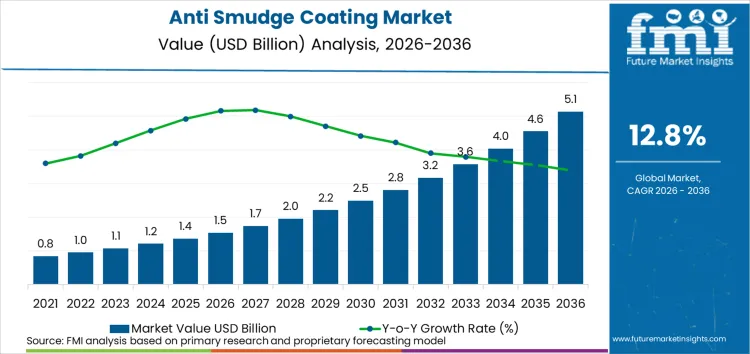
The anti smudge coating market is forecasted to total USD 1,540 million in 2026 and is expected to increase to USD 5,120 million by 2036, expanding at a 12.8% CAGR from 2026 to 2036. The category is moving from a “nice-to-have” oleophobic finish into a baseline usability requirement and a hygiene-resilience platform across consumer electronics, automotive interiors, optical components, medical displays, and public-touch interfaces. The adoption logic is no longer limited to aesthetic cleanliness; it is increasingly rooted in durability under repeated contact, frequent disinfection exposure, and performance stability under the mechanical stress associated with next-generation form factors.
Foldable device commercialization is a foundational growth engine. Foldable smartphones have crossed into mass-market scale, with annual sales exceeding 80 million units and durability expectations centered on coatings that survive 200,000+ folding cycles without crack propagation, delamination, or meaningful contact-angle collapse. This shifts anti smudge coatings from surface cosmetics to mission-critical reliability components: coating failure translates into warranty claims, brand damage, and customer dissatisfaction because fingerprints and oil films become more visible once oleophobic performance erodes. Qualification is now highly technical, including performance thresholds such as ≤5% contact-angle degradation after 200,000 dynamic folding tests, which materially reduces the pool of commercially viable formulations.
Summary of Anti Smudge Coating Market
- The anti smudge coating market comprises specialized surface treatments engineered to repel fingerprints, oils, and contaminants through hydrophobic and oleophobic mechanisms, enabling sustained optical clarity, reduced cleaning frequency, improved tactile experience, and long-term surface durability across consumer electronics displays, automotive interior touch surfaces, optical components, medical diagnostic screens, and wearables.
- The defined scope is structured under FMI taxonomy by application segment, coating function, base material, and region, focusing exclusively on coatings with intentional anti-smudge functionality. Exclusions include integrated display stack treatments applied directly during panel fabrication, aftermarket screen protectors, and non-optical industrial anti-smudge applications where user-perceived clarity is not the core value driver.
- The market is projected to expand from USD 1,540 million in 2026 to USD 5,120 million by 2036 at a 12.8% CAGR, supported by foldable device commercialization, EV cockpit display proliferation, telehealth and medical device digitization, PFAS regulatory phase-out, and electronics manufacturing localization policies.
- Country-level growth is led by India (15.4% CAGR) on localization-driven electronics manufacturing expansion, followed by China (14.4%) on foldable device coating qualification scale and broader adoption across transport and display ecosystems.
- USA (12.8%) grows on healthcare digitization and medical-grade touchscreen requirements, Germany (11.2%) advances through medical instrument modernization and durability-led coating adoption, and advanced materials specialization and multifunctional hybrid film leadership shape Japan (9.8%).
Electric vehicle cockpit digitization compounds demand. EVs increasingly deploy 4-6 displays per vehicle, totaling 0.8-1.2 m² of active touch area. These screens are high-contact surfaces subjected to skin oils, abrasion, and aggressive cleaning agents, making short-life oleophobic spray finishes commercially inadequate. In response, procurement has shifted toward application-engineered systems-plasma-enhanced deposition routes and dual-layer crosslinked architectures-that can maintain high water contact angles (often ≥100°) through prolonged humidity aging and heavy abrasion exposure.
Healthcare digitization adds a separate structural pillar. Telehealth adoption and the expansion of point-of-care digital devices have increased demand for medical-grade touchscreens and diagnostic displays that must remain easy to clean and visually clear across thousands of disinfection cycles. Coatings must demonstrate chemical resistance to alcohol, bleach, and quaternary ammonium compounds while also meeting biocompatibility expectations (often aligned to ISO 10993 testing norms in practice).
The PFAS regulatory phase-out introduces both a restraint and a technology transition pathway. Fluoropolymer-based oleophobic chemistries have historically delivered best-in-class oil repellency due to extremely low surface energy; however, regulatory momentum is forcing suppliers and OEMs to shift toward PFAS-free alternatives such as silicone-based, hydrocarbon-modified, and nano-textured architectures. The performance challenge is non-trivial: matching legacy durability and oil repellency benchmarks requires significant R&D and process innovation, accelerating premiumization of validated, compliant formulations.
Localization policy is reshaping supply chains. India’s Production Linked Incentive (PLI) push targeting USD 400 billion in domestic electronics manufacturing by 2030-has created direct pull for locally sourced advanced surface treatments as OEM assembly expands and domestic value addition thresholds rise. This is lifting investment in local sputtering and coating capacity and creating a new, policy-backed growth corridor for anti smudge coating supply ecosystems.
Anti Smudge Coating Market Key Takeaways
| Metric | Value |
|---|---|
| Expected Value (2026E) | USD 1,540 million |
| Projected Value (2036F) | USD 5,120 million |
| CAGR (2026 to 2036) | 12.8% |
Source: FMI analysis based on primary research and proprietary forecasting model
Why is the Anti Smudge Coating Market Growing?
Anti smudge coating demand is being propelled by five reinforcing forces: foldable device commercialization, EV cockpit digitization, telehealth infrastructure expansion, PFAS chemistry transition, and domestic manufacturing localization policies. These forces are converting anti-smudge performance from a premium device differentiator into a baseline specification embedded into OEM qualification libraries and procurement scorecards.
Foldables represent the strongest technical catalyst because they introduce cyclic mechanical stress conditions that rigid devices did not impose. Coatings must survive 200,000+ folding cycles on flexible substrates (transparent polyimide and ultra-thin glass) while retaining oleophobic performance and touch feel. Adhesion challenges on low-surface-energy flexible substrates require primer layers and pretreatment steps, raising the value of suppliers that have already qualified robust formulations and process recipes.
EV interiors amplify the addressable coated area and raise durability requirements. Multiple large touch displays per vehicle face frequent finger contact and aggressive cleaning chemistries; OEM specifications increasingly reference abrasion and environmental aging performance targets that commodity coatings fail to meet. Telehealth and medical device digitization adds biocompatibility expectations and disinfection-cycle stability requirements, further separating medical-grade coatings from consumer-grade finishes.
PFAS regulatory pressure is reshaping the chemistry roadmap. The transition away from traditional fluoropolymers increases R&D intensity and favors validated PFAS-free alternatives, while localization policies-especially in India-are accelerating in-country production and qualification of advanced surface treatments for domestic electronics manufacturing expansion.
How is the Anti Smudge Coating Market Segmented?
The anti smudge coating market is segmented by application, coating function, and base material, reflecting the fact that smudge resistance requirements vary widely across consumer electronics, automotive interiors, optical components, medical displays, and public-touch interfaces. Segmentation in this category is primarily performance- and durability-driven, rather than cost-led. Buyers increasingly specify coatings against measurable parameters such as initial and retained contact angle, coefficient of friction, abrasion resistance, chemical resistance, and optical clarity retention, which elevates application-engineered systems over generic oleophobic finishes.
As usage intensity increases-more touch points, more frequent cleaning, and harsher disinfectants-segment value concentrates around coatings that maintain performance under repeated mechanical and chemical stress. This dynamic is especially visible in foldable devices, automotive HMIs, and medical-grade touchscreens, where coating failure directly impacts user experience, warranty exposure, and regulatory acceptance.
Why does Consumer Electronics dominate anti smudge coating demand?
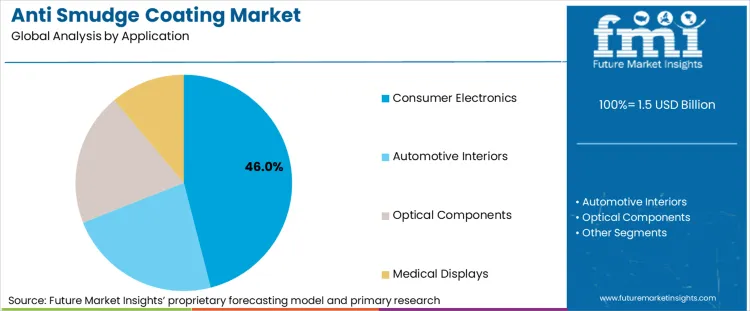
Consumer electronics account for 46% of total market demand, making it the largest application segment. This dominance is anchored in the sheer scale of smartphones, tablets, laptops, wearables, and foldable devices that rely on clean, low-friction touch surfaces for perceived quality. As device form factors evolve toward larger displays, curved glass, and flexible substrates, the visual and tactile impact of smudging becomes more pronounced, increasing the value placed on robust anti smudge performance.
Foldable smartphones are a particularly strong driver within this segment. Flexible displays introduce unique challenges-substrate elasticity, repeated bending, and ultra-thin protective layers-that require coatings capable of retaining oleophobicity through extreme mechanical cycling. OEMs now treat anti smudge coatings as integral to foldable display reliability, embedding durability thresholds into qualification protocols and favoring suppliers with validated long-cycle performance data.
How is Anti-Fingerprint functionality sustaining segment leadership?
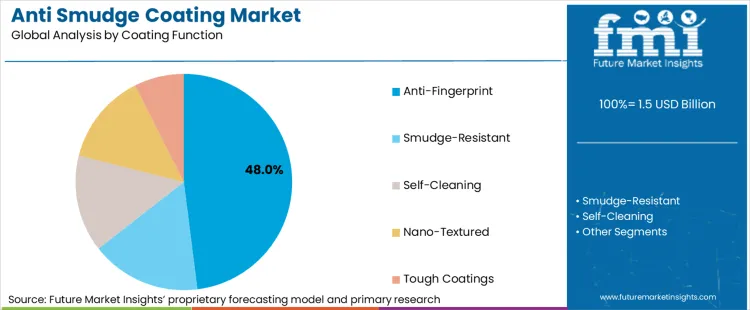
Anti-fingerprint coatings represent 48% of functional demand, reflecting their role as the primary mechanism for reducing visible oil residues and maintaining surface clarity. These coatings work by lowering surface energy, causing oils to bead rather than spread, which reduces fingerprint visibility and simplifies cleaning. Their dominance is reinforced by broad applicability across both consumer and professional devices, where clean appearance and legibility are essential.
The functional segment is evolving as regulatory and durability expectations rise. Traditional fluoropolymer-based anti-fingerprint systems delivered strong initial performance but face pressure due to PFAS phase-out and limited resistance to aggressive cleaning. Newer PFAS-free formulations-silicone-modified, hydrocarbon-based, or nano-textured-are gaining traction as they balance acceptable oil repellency with improved environmental compliance and longer service life, supporting sustained dominance of the anti-fingerprint function within the market.
Why do PET-based substrates remain the dominant base material?
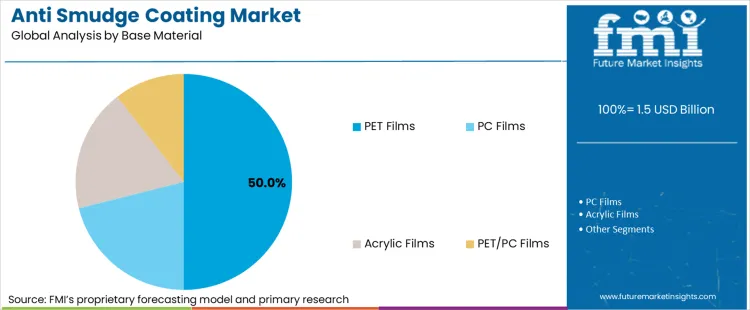
PET-based substrates account for 50% of base material usage, supported by their optical clarity, dimensional stability, and compatibility with a wide range of coating deposition techniques. PET provides a reliable platform for achieving uniform coating thickness and consistent surface properties, which is critical for maintaining predictable touch feel and visual performance across large production volumes.
Material dominance is also linked to supply-chain maturity and recyclability. PET is widely available, cost-effective, and increasingly compatible with recycled-content integration, aligning with sustainability goals without compromising coating performance. While flexible polyimide and ultra-thin glass are gaining importance in foldable devices, PET remains the dominant substrate for rigid and semi-rigid applications, sustaining its leadership across the broader anti smudge coating market.
What Market Forces Are Shaping the Anti Smudge Coating Industry?
The anti smudge coating market is being shaped by a convergence of usability expectations, durability requirements, regulatory transitions, and manufacturing localization. As touch interfaces proliferate across devices and environments, surface cleanliness and tactile consistency are no longer optional features; they are baseline user experience requirements. This shift elevates anti smudge coatings from aesthetic enhancements to functional components embedded in product design and qualification processes.
Mechanical stress is a defining force, particularly in foldable and curved displays. Repeated bending and flexing expose weaknesses in adhesion and coating elasticity, forcing OEMs to specify coatings that retain performance through extensive cycling. At the same time, increased cleaning frequency-driven by hygiene awareness in consumer, automotive, and healthcare settings-introduces chemical stress that degrades conventional coatings. Resistance to alcohols, disinfectants, and abrasive wiping has therefore become a key purchasing criterion.
Regulatory pressure around PFAS use is accelerating chemistry innovation. The transition away from fluorinated systems raises technical barriers, as alternative formulations must replicate low surface energy and durability without compromising safety or compliance. Suppliers with advanced formulation capabilities and validated PFAS-free solutions are gaining advantage as OEMs preemptively adjust to tightening regulations.
Manufacturing localization policies add another layer of influence. Programs aimed at expanding domestic electronics production encourage in-country coating capability, shortening supply chains and aligning with value-add requirements. This dynamic is particularly visible in emerging manufacturing hubs, where anti smudge coatings are being qualified locally to support large-scale assembly operations. Together, these forces are driving the market toward application-engineered, durable, and compliant anti smudge coating systems, reinforcing steady growth through 2036.
Analysis of Anti Smudge Coating Market by Key Countries
The global landscape for anti smudge coating is undergoing regional differentiation based on electronics manufacturing policy, automotive production specialization, healthcare infrastructure investment, and regulatory environmental stringency. As of early 2026, the market is characterized by India’s PLI-led acceleration, China’s domestic production scaling, the United States’ healthcare-driven conversion, Germany’s medical instrument modernization, and Japan’s advanced materials specialization.
Country-wise CAGR Snapshot (2026 to 2036)
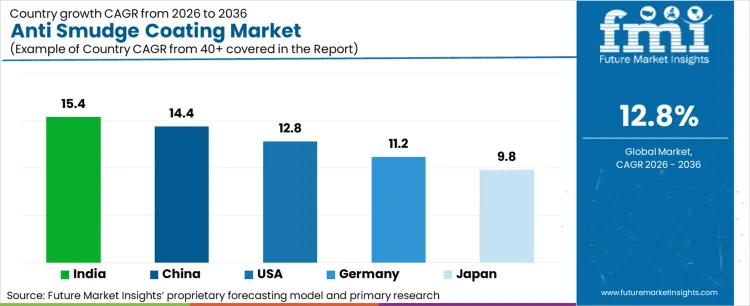
| Country | CAGR (2026 to 2036) |
|---|---|
| India | 15.4% |
| China | 14.4% |
| United States | 12.8% |
| Germany | 11.2% |
| Japan | 9.8% |
Source: Future Market Insights analysis, supported by a proprietary forecasting model and primary research
What industrial policy catalyst is accelerating anti smudge coating adoption in India at 15.4% CAGR?
India exhibits the highest market acceleration at 15.4% CAGR through 2036, primarily because anti smudge coatings are becoming embedded into the localization logic of premium electronics manufacturing. The Production Linked Incentive (PLI) program pushes progressive localization of component supply chains, including advanced surface treatments that were previously imported. This creates a structural “pull” for coating capacity and qualification inside India rather than merely importing coated components.
This localization mechanism is reinforced by the scale-up of premium smartphone assembly. Apple, Samsung, and Foxconn have expanded operations, and contract manufacturers are working toward 50-60% domestic value addition to qualify for incentives. Premium devices such as the iPhone 15/16 series; and Samsung Galaxy S24/S25 require anti-fingerprint coatings with validated optical and durability specifications, which is pushing domestic suppliers to expand capacity via technology partnerships and subsidy-backed capex. Garware Hi-Tech’s sputtering-line expansion for anti-smudge display protection films is a practical example of how this policy-driven demand converts into physical capacity, clustered around manufacturing hubs near Chennai and Noida.
A parallel volume stream comes from India’s EV transition-particularly two-wheelers-where ruggedized digital instrument clusters operate in high vibration and extreme solar exposure environments. These operating conditions increase the value placed on anti smudge coatings with enhanced UV stability and abrasion resistance, and the procurement logic increasingly prioritizes domestic sourcing for supply security and cost optimization. The combination of capital subsidies (often 25-30% of equipment cost) and fast-track clearances further lowers barriers for local coating build-out, sustaining India’s lead growth profile through the forecast period.
How is transportation safety regulation driving China’s anti smudge coating market expansion at 14.4% CAGR?
China expands at a 14.4% CAGR, supported by a combination of regulation-linked demand and manufacturing-scale advantage. A notable catalyst described is transportation safety regulation targeting glare and smudge-related efficiency losses in solar installations near airports and highways, where reflectivity thresholds and compliance enforcement create demand for dual-process solutions that combine glass texturing with smudge-resistant surface chemistry. This requirement pushes adoption beyond consumer screens into infrastructure-linked surfaces where performance is treated as compliance-critical rather than discretionary.
In parallel, China’s dominance in foldable device manufacturing materially expands the addressable volume for flexible-substrate anti smudge coatings. The country produces a large share of foldable displays through BOE, CSOT, and Visionox, and these manufacturers require coatings validated for flexible substrates and 200,000+ folding cycles-a threshold that concentrates demand toward qualified suppliers. Domestic suppliers have scaled production and now command significant shares of domestic foldable coating demand, displacing previously dominant import supply in many programs.
China’s broader consumer electronics manufacturing scale (smartphones and displays) compounds this effect because it supports continuous investment in process optimization and cost-down pathways. As Chinese brands expand exports, their internal surface-treatment specifications increasingly influence global expectations for smudge performance and durability, creating a feedback loop where domestic qualification becomes a gateway to global device wins.
What healthcare digitization catalyst is driving United States anti smudge coating demand at 12.8% CAGR?
The United States expands at a 12.8% CAGR, driven by healthcare digitization and the resulting conversion toward medical-grade touch interfaces that must withstand aggressive disinfection protocols. Telehealth adoption has stabilized at 35-40% of primary care consultations in major U.S. hospital networks, sustaining demand for medical-grade tablets and diagnostic displays across examination rooms, urgent care sites, and remote monitoring stations. These deployment environments elevate anti smudge coatings from “fingerprint reduction” into a chemical-resistance and reliability requirement.
This demand is structurally higher value because medical-grade coatings must retain oleophobic performance through 10,000+ cleaning cycles using alcohol, bleach, and quaternary ammonium compounds-exposures that degrade standard consumer coatings. The market also rewards suppliers that can document biocompatibility and durability, since hospital procurement places emphasis on standardization and liability minimization. In this context, supplier differentiation is strongly tied to regulatory infrastructure and validation depth, not just surface performance at time-zero.
Corporate and ecosystem actions reinforce this trend. The file notes examples including medical-application coating integration for optics and surgical lenses, and rapid growth in medical display coating demand with validation against extended disinfection cycling. Hospital group purchasing organizations incorporating anti smudge specifications into procurement contracts further institutionalizes adoption and reduces volatility, supporting steady expansion through 2036.
How is medical instrument modernization influencing Germany’s 11.2% anti smudge coating market growth?
Germany grows at 11.2% CAGR, shaped by modernization of medical instruments and diagnostic equipment across Europe’s largest healthcare economy. Hospitals are replacing legacy analog instruments with digital, touch-enabled devices that require easier sterilization and maintenance protocols-conditions that structurally increase coated surface area and raise durability requirements per unit.
A key differentiator in Germany is the preference for vacuum-deposited thin-film oleophobic coatings (e.g., plasma-enhanced routes) that deliver exceptional chemical resistance and maintain performance through repeated autoclave sterilization cycles, which are critical for surgical instruments and operating room displays. Capacity expansion and specialization within optical coating ecosystems (including medical imaging and surgical microscopy) reinforce Germany’s role as a high-validation market where coating durability directly influences lifetime cost of ownership, leading procurement to favor premium coatings with longer service intervals.
Germany’s luxury automotive sector adds a second reinforcement stream. OEM platforms specify coatings validated to extreme environmental protocols (examples cited: DBL 5406 and PV 3952), which filter out a large share of commercial formulations and concentrate demand among qualified suppliers. Dedicated qualification laboratories co-located with OEM engineering centers further raise barriers to entry and support the durability-led growth profile embedded in Germany’s forecast.
How does Industry 5.0 automation influence Japan’s 9.8% anti smudge coating market trajectory?
Japan grows at a 9.8% CAGR, shaped by Industry 5.0 automation initiatives and labor shortages that increase reliance on rugged, always-on digital devices across logistics, manufacturing, and infrastructure. In these environments, usability depends on screens staying functional and readable despite dust exposure, frequent touch interaction, and constrained cleaning cycles-making smudge resistance a practical requirement rather than a cosmetic preference.
Japan’s demographic structure reinforces this adoption pathway. With an aging workforce, organizations are deploying more automation interfaces and public/industrial touchscreens, where the combination of smudge resistance and hygiene is increasingly bundled into multifunctional film architectures. The file highlights hybrid solutions combining antimicrobial/antiviral performance with oleophobic properties while maintaining touch sensitivity and optical clarity, reflecting how Japan’s market evolves through feature integration and durability enhancements rather than pure unit volume expansion.
Japan’s growth rate is therefore best interpreted as value-led expansion from a mature base. Premium consumer electronics already achieved near-universal anti-fingerprint adoption earlier, so incremental growth is linked to added functionality and broader industrial deployment of rugged interfaces-consistent with the market’s high-quality specialization profile.
What is the Competition Outlook for Anti Smudge Coating Market?
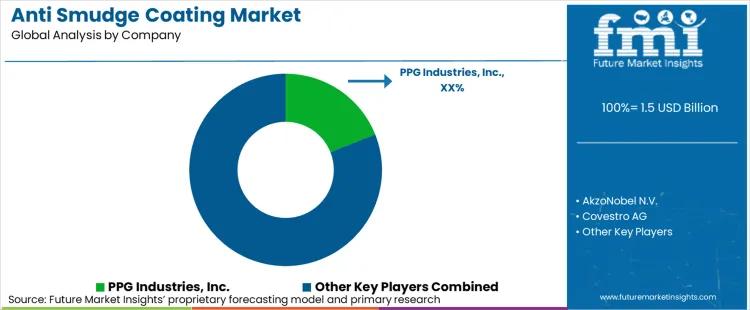
The competitive landscape for anti smudge coating has shifted from fragmented regional formulators supplying commoditized fluoropolymer spray coatings to integrated global material science corporations delivering application-engineered coating systems with validated durability, optical clarity, and compliance documentation. In 2024, the value chain was typically split between fluoropolymer raw material suppliers, independent formulators, and contract coaters, with customers managing multiple supplier touchpoints across chemistry, coating execution, and quality validation.
By early 2026, procurement behavior consolidated toward “single-supplier” solution partnerships covering polymer synthesis, formulation, precision application compatibility, global technical service, and regulatory dossiers-favoring multinational players with vertically integrated capabilities and long-cycle qualification experience in electronics, automotive, and medical supply chains.
Competitive differentiation is defined by a small set of performance-and-compliance vectors rather than geographic footprint alone. First, PFAS-free formulation velocity is becoming a central battleground as customers set 2028 to 2030 internal deadlines, rewarding suppliers who can deliver ≥110° water contact angle and ≥70° oil contact angle without fluorinated chemistry at scale. Second, foldable substrate compatibility remains scarce, with only a handful of suppliers able to sustain 200,000+ folding cycles on low-surface-energy flexible substrates while maintaining contact-angle stability and preventing crack propagation-creating multi-year lock-ins once qualified.
Third, medical-grade regulatory infrastructure (ISO 13485 readiness, ISO 10993 biocompatibility datasets, FDA-facing documentation structures) materially raises entry barriers due to time and cost burdens. Fourth, vertical integration economics (substrate + coating co-optimization) enables differentiated adhesion and durability results that non-integrated competitors struggle to reproduce, especially in automotive curved displays and harsh-use interiors.
Key Players Profiled
- PPG Industries, Inc.
- AkzoNobel N.V.
- Covestro AG
- Toray Industries Inc.
- Sumitomo Chemical Co. Ltd.
- Nitto Denko Corporation
- Shin-Etsu Chemical Co. Ltd.
- Daikin Industries, Ltd.
Market Definition
The anti smudge coating market comprises revenues generated from specialized surface treatments engineered to repel fingerprints, oils, and organic contaminants using hydrophobic and oleophobic mechanisms, thereby preserving optical clarity, reducing cleaning frequency, improving touch feel, and extending surface durability across consumer electronics displays, automotive interior surfaces, optical components, medical diagnostic screens, and wearable devices.
The market scope includes coatings segmented by application (consumer electronics, automotive interiors, optical components, medical displays, wearable devices), coating function (anti-fingerprint, smudge-resistant, self-cleaning, nano-textured, tough coatings), and base material (PET films, polycarbonate films, acrylic films, PET/PC blend films, PE films), with performance typically evaluated via contact angles, coefficient of friction, abrasion resistance, and optical transmission/haze criteria.
Excluded are revenues from display panels and modules, integrated coatings applied during panel fabrication, aftermarket screen protectors, non-optical industrial anti-smudge uses, and downstream lamination/installation services. Formulations that do not meet minimum contact-angle thresholds or lack durability validation for the intended end-use environment are outside the defined boundary, while PFAS-containing formulations remain in-scope during transition periods but are tracked for compliance trajectory.
Scope of Report
| Items | Values |
|---|---|
| Quantitative Units (2026) | USD 1,540 million |
| Application Segment | Consumer Electronics, Automotive Interiors, Optical Components, Medical Displays, Wearable Devices |
| Coating Function | Anti-Fingerprint, Smudge-Resistant, Self-Cleaning, Nano-Textured, Tough Coatings |
| Base Material | PET Films, PC Films, Acrylic Films, PET/PC Films, PE Films |
| Regions Covered | North America, Europe, East Asia, Japan, Rest of World |
| Countries Covered | United States, China, Germany, Japan, India, Canada, Mexico, United Kingdom, France, Italy, Spain, South Korea, Taiwan, Brazil, and additional regional markets |
| Key Companies Profiled | PPG Industries, AkzoNobel, Covestro, Toray, Sumitomo Chemical |
Anti Smudge Coating Market Key Segments
By Application Segment:
- Consumer Electronics
- Automotive Interiors
- Optical Components
- Medical Displays
- Wearable Devices
By Coating Function:
- Anti-Fingerprint
- Smudge-Resistant
- Self-Cleaning
- Nano-Textured
- Tough Coatings
By Base Material:
- PET Films
- PC Films
- Acrylic Films
- PET/PC Films
- PE Films
By Region:
- North America
- Europe
- East Asia
- Japan
- Rest of the World
Bibliography
- 24ChemicalResearch. (2025). Global anti-smudge coatings market research report 2025-2032. 24ChemicalResearch.
- PPG Industries. (2026). PFAS-free coating development roadmap: Sustainability commitment and commercialization timeline. PPG Investor Relations.
- Nitto Denko Corporation. (2026). Virusweeper Hybrid film: SIAA-certified antiviral and anti-smudge coating for high-traffic touchscreens. Nitto Denko Technical Review.
- Covestro AG. (2026). Makrofol® SR polycarbonate film with integrated anti-smudge hardcoat: Automotive display qualification report. Covestro Technical Marketing.
- Toray Industries Inc. (2026). Ultra-thin anti-smudge coating for foldable displays: 200,000-cycle durability validation. Toray Display Materials Division.
- Garware Hi-Tech. (2026). PLI scheme capacity expansion announcement: Sputtering lines for anti-smudge display protection films. Garware Hi-Tech Investor Relations.
- JinkoSolar. (2026). Low-reflection, anti-glare photovoltaic modules for transportation infrastructure: TÜV Rheinland certification. JinkoSolar.
- SDC Technologies. (2026). Medical display coating demand growth and 10,000-cycle disinfection validation report. SDC Technologies.
- Aculon, Inc. (2026). Easy-to-clean coatings for medical optics and surgical lenses: FDA biocompatibility compliance. Aculon.
Frequently Asked Questions
What is the projected global growth rate for the anti smudge coating market?
The global market is projected to expand at a 12.8% CAGR from 2026 to 2036, supported by foldable device commercialization (80+ million annual units with 200,000+ folding-cycle durability requirements), EV cockpit display proliferation, telehealth digitization, PFAS phase-out economics, and India’s electronics localization push.
How large is the global anti smudge coating market expected to be by 2036?
The market is expected to grow from USD 1,540 million in 2026 to approximately USD 5,120 million by 2036.
What is driving the growth of anti smudge coating?
Key drivers include foldable device requirements for flexible-substrate durability, EV cockpit digitization with high-abrasion validation protocols, medical-grade cleaning and biocompatibility expectations, PFAS regulatory pressure driving chemistry transitions, and localization-led sourcing shifts in major manufacturing hubs.
Which application segment and coating function dominate market demand?
Consumer electronics accounts for 46% of demand due to the scale of touch-enabled devices and the direct linkage between smudge visibility and perceived product quality. Anti-fingerprint coatings lead coating function demand at 48% by addressing high-frequency, high-visibility smudge accumulation through low surface-energy performance.
Which base material accounts for the largest market share?
PET films account for 50% of base material consumption, supported by optical clarity, dimensional stability, coating-process compatibility, thickness versatility, and established supply chain economics for multilayer hardcoat + anti-smudge architectures.
Preview the report firsthand - request a free sample
Get SampleGet the brochure for pricing and purchase details.
Get PDFTable of Content
- Executive Summary
- Global Market Outlook
- Demand-side Trends
- Supply-side Trends
- Technology Roadmap Analysis
- Analysis and Recommendations
- Market Overview
- Market Coverage / Taxonomy
- Market Definition / Scope / Limitations
- Research Methodology
- Chapter Orientation
- Analytical Lens and Working Hypotheses
- Market Structure, Signals, and Trend Drivers
- Benchmarking and Cross-market Comparability
- Market Sizing, Forecasting, and Opportunity Mapping
- Research Design and Evidence Framework
- Desk Research Programme (Secondary Evidence)
- Company Annual and Sustainability Reports
- Peer-reviewed Journals and Academic Literature
- Corporate Websites, Product Literature, and Technical Notes
- Earnings Decks and Investor Briefings
- Statutory Filings and Regulatory Disclosures
- Technical White Papers and Standards Notes
- Trade Journals, Industry Magazines, and Analyst Briefs
- Conference Proceedings, Webinars, and Seminar Materials
- Government Statistics Portals and Public Data Releases
- Press Releases and Reputable Media Coverage
- Specialist Newsletters and Curated Briefings
- Sector Databases and Reference Repositories
- FMI Internal Proprietary Databases and Historical Market Datasets
- Subscription Datasets and Paid Sources
- Social Channels, Communities, and Digital Listening Inputs
- Additional Desk Sources
- Expert Input and Fieldwork (Primary Evidence)
- Primary Modes
- Qualitative Interviews and Expert Elicitation
- Quantitative Surveys and Structured Data Capture
- Blended Approach
- Why Primary Evidence is Used
- Field Techniques
- Interviews
- Surveys
- Focus Groups
- Observational and In-context Research
- Social and Community Interactions
- Stakeholder Universe Engaged
- C-suite Leaders
- Board Members
- Presidents and Vice Presidents
- R&D and Innovation Heads
- Technical Specialists
- Domain Subject-matter Experts
- Scientists
- Physicians and Other Healthcare Professionals
- Governance, Ethics, and Data Stewardship
- Research Ethics
- Data Integrity and Handling
- Primary Modes
- Tooling, Models, and Reference Databases
- Desk Research Programme (Secondary Evidence)
- Data Engineering and Model Build
- Data Acquisition and Ingestion
- Cleaning, Normalisation, and Verification
- Synthesis, Triangulation, and Analysis
- Quality Assurance and Audit Trail
- Market Background
- Market Dynamics
- Drivers
- Restraints
- Opportunity
- Trends
- Scenario Forecast
- Demand in Optimistic Scenario
- Demand in Likely Scenario
- Demand in Conservative Scenario
- Opportunity Map Analysis
- Product Life Cycle Analysis
- Supply Chain Analysis
- Investment Feasibility Matrix
- Value Chain Analysis
- PESTLE and Porter’s Analysis
- Regulatory Landscape
- Regional Parent Market Outlook
- Production and Consumption Statistics
- Import and Export Statistics
- Market Dynamics
- Global Market Analysis 2021 to 2025 and Forecast, 2026 to 2036
- Historical Market Size Value (USD Million) Analysis, 2021 to 2025
- Current and Future Market Size Value (USD Million) Projections, 2026 to 2036
- Y-o-Y Growth Trend Analysis
- Absolute $ Opportunity Analysis
- Global Market Pricing Analysis 2021 to 2025 and Forecast 2026 to 2036
- Global Market Analysis 2021 to 2025 and Forecast 2026 to 2036, By Application
- Introduction / Key Findings
- Historical Market Size Value (USD Million) Analysis By Application , 2021 to 2025
- Current and Future Market Size Value (USD Million) Analysis and Forecast By Application , 2026 to 2036
- Consumer Electronics
- Automotive Interiors
- Optical Components
- Medical Displays
- Consumer Electronics
- Y-o-Y Growth Trend Analysis By Application , 2021 to 2025
- Absolute $ Opportunity Analysis By Application , 2026 to 2036
- Global Market Analysis 2021 to 2025 and Forecast 2026 to 2036, By Coating Function
- Introduction / Key Findings
- Historical Market Size Value (USD Million) Analysis By Coating Function, 2021 to 2025
- Current and Future Market Size Value (USD Million) Analysis and Forecast By Coating Function, 2026 to 2036
- Anti-Fingerprint
- Smudge-Resistant
- Self-Cleaning
- Nano-Textured
- Tough Coatings
- Anti-Fingerprint
- Y-o-Y Growth Trend Analysis By Coating Function, 2021 to 2025
- Absolute $ Opportunity Analysis By Coating Function, 2026 to 2036
- Global Market Analysis 2021 to 2025 and Forecast 2026 to 2036, By Base Material
- Introduction / Key Findings
- Historical Market Size Value (USD Million) Analysis By Base Material, 2021 to 2025
- Current and Future Market Size Value (USD Million) Analysis and Forecast By Base Material, 2026 to 2036
- PET Films
- PC Films
- Acrylic Films
- PET/PC Films
- PET Films
- Y-o-Y Growth Trend Analysis By Base Material, 2021 to 2025
- Absolute $ Opportunity Analysis By Base Material, 2026 to 2036
- Global Market Analysis 2021 to 2025 and Forecast 2026 to 2036, By Region
- Introduction
- Historical Market Size Value (USD Million) Analysis By Region, 2021 to 2025
- Current Market Size Value (USD Million) Analysis and Forecast By Region, 2026 to 2036
- North America
- Latin America
- Western Europe
- Eastern Europe
- East Asia
- South Asia and Pacific
- Middle East & Africa
- Market Attractiveness Analysis By Region
- North America Market Analysis 2021 to 2025 and Forecast 2026 to 2036, By Country
- Historical Market Size Value (USD Million) Trend Analysis By Market Taxonomy, 2021 to 2025
- Market Size Value (USD Million) Forecast By Market Taxonomy, 2026 to 2036
- By Country
- USA
- Canada
- Mexico
- By Application
- By Coating Function
- By Base Material
- By Country
- Market Attractiveness Analysis
- By Country
- By Application
- By Coating Function
- By Base Material
- Key Takeaways
- Latin America Market Analysis 2021 to 2025 and Forecast 2026 to 2036, By Country
- Historical Market Size Value (USD Million) Trend Analysis By Market Taxonomy, 2021 to 2025
- Market Size Value (USD Million) Forecast By Market Taxonomy, 2026 to 2036
- By Country
- Brazil
- Chile
- Rest of Latin America
- By Application
- By Coating Function
- By Base Material
- By Country
- Market Attractiveness Analysis
- By Country
- By Application
- By Coating Function
- By Base Material
- Key Takeaways
- Western Europe Market Analysis 2021 to 2025 and Forecast 2026 to 2036, By Country
- Historical Market Size Value (USD Million) Trend Analysis By Market Taxonomy, 2021 to 2025
- Market Size Value (USD Million) Forecast By Market Taxonomy, 2026 to 2036
- By Country
- Germany
- UK
- Italy
- Spain
- France
- Nordic
- BENELUX
- Rest of Western Europe
- By Application
- By Coating Function
- By Base Material
- By Country
- Market Attractiveness Analysis
- By Country
- By Application
- By Coating Function
- By Base Material
- Key Takeaways
- Eastern Europe Market Analysis 2021 to 2025 and Forecast 2026 to 2036, By Country
- Historical Market Size Value (USD Million) Trend Analysis By Market Taxonomy, 2021 to 2025
- Market Size Value (USD Million) Forecast By Market Taxonomy, 2026 to 2036
- By Country
- Russia
- Poland
- Hungary
- Balkan & Baltic
- Rest of Eastern Europe
- By Application
- By Coating Function
- By Base Material
- By Country
- Market Attractiveness Analysis
- By Country
- By Application
- By Coating Function
- By Base Material
- Key Takeaways
- East Asia Market Analysis 2021 to 2025 and Forecast 2026 to 2036, By Country
- Historical Market Size Value (USD Million) Trend Analysis By Market Taxonomy, 2021 to 2025
- Market Size Value (USD Million) Forecast By Market Taxonomy, 2026 to 2036
- By Country
- China
- Japan
- South Korea
- By Application
- By Coating Function
- By Base Material
- By Country
- Market Attractiveness Analysis
- By Country
- By Application
- By Coating Function
- By Base Material
- Key Takeaways
- South Asia and Pacific Market Analysis 2021 to 2025 and Forecast 2026 to 2036, By Country
- Historical Market Size Value (USD Million) Trend Analysis By Market Taxonomy, 2021 to 2025
- Market Size Value (USD Million) Forecast By Market Taxonomy, 2026 to 2036
- By Country
- India
- ASEAN
- Australia & New Zealand
- Rest of South Asia and Pacific
- By Application
- By Coating Function
- By Base Material
- By Country
- Market Attractiveness Analysis
- By Country
- By Application
- By Coating Function
- By Base Material
- Key Takeaways
- Middle East & Africa Market Analysis 2021 to 2025 and Forecast 2026 to 2036, By Country
- Historical Market Size Value (USD Million) Trend Analysis By Market Taxonomy, 2021 to 2025
- Market Size Value (USD Million) Forecast By Market Taxonomy, 2026 to 2036
- By Country
- Kingdom of Saudi Arabia
- Other GCC Countries
- Turkiye
- South Africa
- Other African Union
- Rest of Middle East & Africa
- By Application
- By Coating Function
- By Base Material
- By Country
- Market Attractiveness Analysis
- By Country
- By Application
- By Coating Function
- By Base Material
- Key Takeaways
- Key Countries Market Analysis
- USA
- Pricing Analysis
- Market Share Analysis, 2025
- By Application
- By Coating Function
- By Base Material
- Canada
- Pricing Analysis
- Market Share Analysis, 2025
- By Application
- By Coating Function
- By Base Material
- Mexico
- Pricing Analysis
- Market Share Analysis, 2025
- By Application
- By Coating Function
- By Base Material
- Brazil
- Pricing Analysis
- Market Share Analysis, 2025
- By Application
- By Coating Function
- By Base Material
- Chile
- Pricing Analysis
- Market Share Analysis, 2025
- By Application
- By Coating Function
- By Base Material
- Germany
- Pricing Analysis
- Market Share Analysis, 2025
- By Application
- By Coating Function
- By Base Material
- UK
- Pricing Analysis
- Market Share Analysis, 2025
- By Application
- By Coating Function
- By Base Material
- Italy
- Pricing Analysis
- Market Share Analysis, 2025
- By Application
- By Coating Function
- By Base Material
- Spain
- Pricing Analysis
- Market Share Analysis, 2025
- By Application
- By Coating Function
- By Base Material
- France
- Pricing Analysis
- Market Share Analysis, 2025
- By Application
- By Coating Function
- By Base Material
- India
- Pricing Analysis
- Market Share Analysis, 2025
- By Application
- By Coating Function
- By Base Material
- ASEAN
- Pricing Analysis
- Market Share Analysis, 2025
- By Application
- By Coating Function
- By Base Material
- Australia & New Zealand
- Pricing Analysis
- Market Share Analysis, 2025
- By Application
- By Coating Function
- By Base Material
- China
- Pricing Analysis
- Market Share Analysis, 2025
- By Application
- By Coating Function
- By Base Material
- Japan
- Pricing Analysis
- Market Share Analysis, 2025
- By Application
- By Coating Function
- By Base Material
- South Korea
- Pricing Analysis
- Market Share Analysis, 2025
- By Application
- By Coating Function
- By Base Material
- Russia
- Pricing Analysis
- Market Share Analysis, 2025
- By Application
- By Coating Function
- By Base Material
- Poland
- Pricing Analysis
- Market Share Analysis, 2025
- By Application
- By Coating Function
- By Base Material
- Hungary
- Pricing Analysis
- Market Share Analysis, 2025
- By Application
- By Coating Function
- By Base Material
- Kingdom of Saudi Arabia
- Pricing Analysis
- Market Share Analysis, 2025
- By Application
- By Coating Function
- By Base Material
- Turkiye
- Pricing Analysis
- Market Share Analysis, 2025
- By Application
- By Coating Function
- By Base Material
- South Africa
- Pricing Analysis
- Market Share Analysis, 2025
- By Application
- By Coating Function
- By Base Material
- USA
- Market Structure Analysis
- Competition Dashboard
- Competition Benchmarking
- Market Share Analysis of Top Players
- By Regional
- By Application
- By Coating Function
- By Base Material
- Competition Analysis
- Competition Deep Dive
- PPG Industries, Inc.
- Overview
- Product Portfolio
- Profitability by Market Segments (Product/Age /Sales Channel/Region)
- Sales Footprint
- Strategy Overview
- Marketing Strategy
- Product Strategy
- Channel Strategy
- AkzoNobel N.V.
- Covestro AG
- Toray Industries Inc.
- Sumitomo Chemical Co. Ltd.
- Nitto Denko Corporation
- Shin-Etsu Chemical Co. Ltd.
- PPG Industries, Inc.
- Competition Deep Dive
- Assumptions & Acronyms Used


