

- Market Size (2026)
- USD 84.2 Bn
- Forecast (2036)
- USD 176.3 Bn
- CAGR (2026 to 2036)
- 7.7%
How big is the colour cosmetics market in 2026?
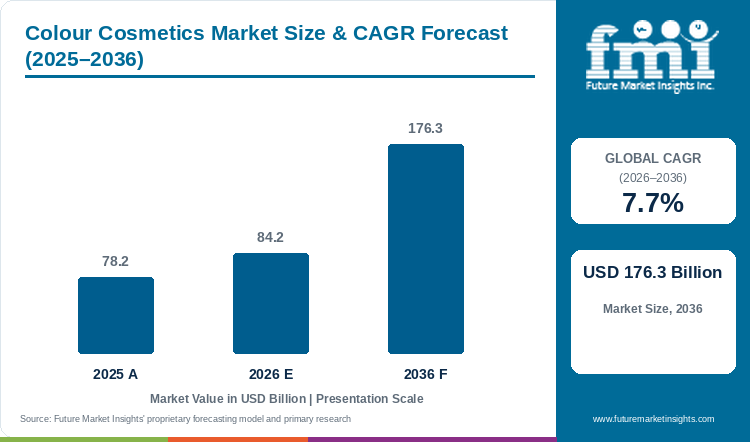
Demand is projected to expand at 7.7% CAGR from 2026 to 2036. Market value rises from USD 78.18 billion in 2025 to USD 84.2 billion in 2026 and USD 176.3 billion by 2036. [1]
FMI values the colour cosmetics market at USD 84.2 billion in 2026, compared with USD 78.18 billion in 2025, and projects USD 176.3 billion by 2036 at a 7.7% CAGR. [1] Face products account for 42.0% by product and online retail represents 34.0% by distribution channel in 2026, leading the respective classifications of finished colour cosmetics. [1] Customers compare shade, texture and intended application, with coherent descriptions of undertone and finish helping them identify the product suited to the way they plan to use it. FDA's colour-additive table distinguishes eye-area, general use including lipstick and external-use permissions, making the intended application relevant to the choice of colourant within a formulation. [2] Chromium hydroxide green is listed for eye and external use while the general category including lipstick is excluded, illustrating why permission for one application cannot be assumed for another. [2] Regulatory lists and formulation conditions need to be assessed for the actual destination and use area, with finished products remaining separate from the upstream pigments they contain. [2][3] Online presentation also needs to account for appearance under different lighting and display settings, while consistent naming helps a returning customer locate the same shade and finish. China has the fastest profiled growth rate at 9.4% CAGR from 2026 to 2036, within an outlook spanning face, eye, lip and nail products. [1] Suppliers can improve purchasing clarity through accurate shade information and product continuity, while formulators qualify the intended use early enough to support consistent ranges across different cosmetic applications.
Key Market Trends and Insights
- Face products represent 42.0% of the forecast product mix. [1]
- Online retail contributes 34.0% by distribution channel. [1]
- Colourant eligibility depends on the intended application area. [2][3]
Regional Highlights
- Fastest-growing profiled market: China at 9.4% CAGR from 2026 to 2036. [1]
- EU colourant conditions specify application fields and restrictions. Formulation decisions connect those conditions with the intended face, eye, lip or nail product. [3]
Market Size and Forecast
Table 1: Market size and forecast for the colour cosmetics market in USD billion and percentage
| Metric | Value |
|---|---|
| 2025 market size | USD 78.18 billion |
| Estimated market size in 2026 | USD 84.2 billion |
| Projected market size by 2036 | USD 176.3 billion |
| CAGR 2026 to 2036 | 7.7% |
| Added revenue 2026 to 2036 | USD 92.1 billion |
| Market expansion multiple | 2.1x |
New shades involve additional formulation and inventory decisions. Cosmetic pigments provide the colour component, while natural cosmetic colours offer another ingredient route. Stock continuity and accurate shade descriptions support replenishment.
Colourant Application and Formulation Evidence
Regulatory colourant lists set out permitted uses and conditions, and these application rules guide ingredient choice for face, eye, lip and nail formulations, alongside texture and shade requirements. [2][3]
Table 2: Evidence and adoption indicators for the colour cosmetics market
| Indicator | Data point or finding | Commercial relevance | Source |
|---|---|---|---|
| US permission categories | Eye area; general including lipstick; external use | Intended use governs additive selection | [2] |
| Chromium hydroxide green example | Eye and external use listed; general category not listed | One product permission cannot be generalized to lipstick | [2] |
| EU colourant conditions | Allowed fields and restrictions are specified | Qualification remains application-specific | [3] |
Analyst Perspective
"Colour-cosmetic selection connects the visible shade with the texture, finish and application intended for the product. A customer needs to recognize the same item across images and repeat purchases, while a formulator must assess colourant permissions for the actual use area. Lip powder offers another product form within this broader colour-cosmetic choice. Suppliers make the offer easier to compare when shade descriptions remain consistent and ingredient selection reflects the requirements applying to face, eye, lip or nail formulations."
- Rahul Pandita, Principal Consultant, FMI
How is the colour cosmetics market segmented?
The market covers 3 commercial axes and region: product type; distribution channel; end user.
By product type: Face products; Eye products; Lip products; Nail products. By distribution channel: Specialty stores; Department stores; Online retail; Supermarkets and hypermarkets. By end user: Women; Men; Unisex.
Why do face products lead demand within the product type category?
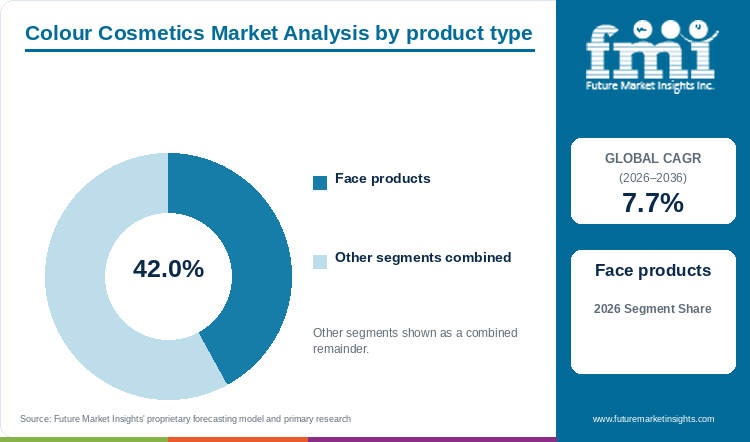
The face products segment accounts for 42.0% of product type demand in 2026. [1]
Face products combine shade matching with texture and coverage, giving customers several linked reasons to compare one formulation with another. Foundation and related products need consistent descriptions of undertone and finish so the buyer can identify the offer suited to the intended application. Product continuity also matters once a customer has selected a shade and seeks it again. Vegan cosmetics introduce an ingredient-origin preference that can coexist with these ordinary criteria, while the finished face product still needs a clear description of its shade, texture and use.
- Face products account for 42.0% of product demand in 2026, holding the leading position within the colour-cosmetic mix that also covers eye, lip and nail products across the report's retail channels. [1]
- Coherent undertone, coverage and finish descriptions help customers identify a suitable face product, with consistent shade naming and availability supporting repeat purchases after the original formulation has been selected for use.
Table 3: Leading product type share for the colour cosmetics market
| Product type | Share in 2026 |
|---|---|
| Face products | 42.0% |
| Other segments combined | 58.0% |
| Total | 100.0% |
Table 4: Segment leadership and market growth for the colour cosmetics market
| Metric | Value |
|---|---|
| Global CAGR 2026 to 2036 | 7.7% |
| Leading segment | Face products |
Why does online retail lead demand within the distribution channel category?
The online retail segment accounts for 34.0% of distribution channel demand in 2026. [1]
Online retail allows customers to compare shade variants and product forms before purchase, making the information attached to a listing central to selection. Product images provide a visual reference, although lighting and display settings can change the apparent shade shown to the viewer. Consistent wording about undertone, finish and texture helps customers interpret those images and distinguish nearby alternatives within a range. Available stock then supports a repeat purchase of the chosen product, connecting online presentation with the continuity of the actual item supplied.
- Online retail accounts for 34.0% of distribution-channel demand in 2026, leading the mix that also includes specialty stores, department stores, and supermarkets and hypermarkets supplying finished colour cosmetics. [1]
- Accurate images and consistent descriptions of undertone, finish and texture help online buyers compare shades, while product availability allows a customer to locate the same item again after the initial purchase.
What are the drivers restraints and opportunities in the colour cosmetics market?
- Driver: Customers who find a suitable shade need the product to remain identifiable and available, supporting demand through coherent naming and range continuity alongside new launches across face, eye, lip and nail formulations and their retail channels.
- Restraint: Colourant permission depends on the intended use area and destination requirements, so an additive suitable for an eye product may have different lipstick conditions that formulators need to assess before extending a shade across applications. [2][3]
- Opportunity: Sellers can improve product comparison through consistent undertone, finish and form descriptions, while early qualification of colourant uses gives formulators a clearer basis for extending a range between face, eye and lip applications without avoidable reformulation.
Shade fit and replenishment support repeat sales
A buyer who selects a suitable face or lip shade needs to identify the same product during replenishment, making coherent naming and continued availability relevant to repeat purchasing alongside the new shades introduced within a cosmetic range.
Application-specific colourant conditions constrain range expansion
An additive suitable for eye products can have different permissions for lipstick, making destination rules and formulation conditions relevant to the intended application while the shade name describes appearance separately from the colourant's eligibility for use. [2][3]
Consistent shade information can reduce selection friction
Consistent images and naming help sellers describe undertone, finish and product form, while early assessment of intended colourant uses gives formulators a basis for extending a range between face, eye and lip applications with less rework.
Which country CAGRs are profiled in the colour cosmetics market?
Table 5: Country CAGR comparison for the colour cosmetics market
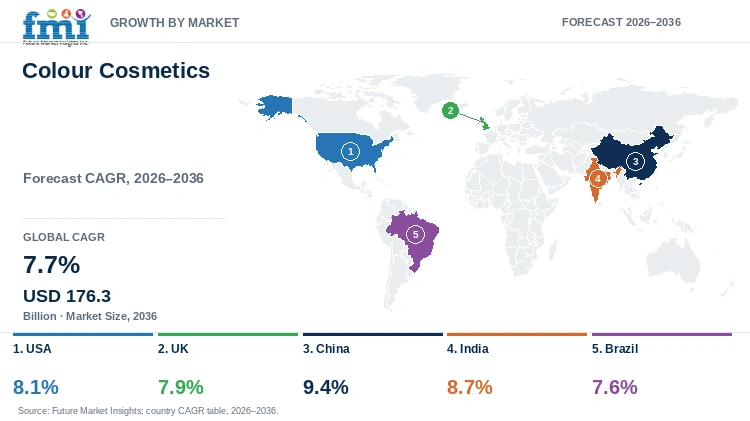
| Country | CAGR 2026 to 2036 |
|---|---|
| USA | 8.1% |
| UK | 7.9% |
| China | 9.4% |
| India | 8.7% |
| Brazil | 7.6% |
Country-wise Analysis
USA
The intended use area affects formulation choices in US colour cosmetics, particularly when a brand sells face, eye and lip products within the same range. FDA's colour-additive tables identify permissions and limitations by application, so a colourant suitable for one area cannot automatically be used in another. [2] This creates a product-development task alongside the retail task of explaining shade, texture and finish to customers choosing between formulations. Within a USA outlook projecting 8.1% CAGR from 2026 to 2036, suppliers can qualify the planned use before extending a shade across several formats. [1] Meanwhile, retailers keep product names and application instructions clear when shoppers replenish an earlier purchase. Consistent descriptions are useful across online and store channels, although a photograph cannot reproduce every lighting condition in which the customer will wear the product.
UK
Independent beauty brands and specialist retailers give UK shoppers opportunities to discover colour cosmetics through ranges with distinctive shades, textures and presentation. [1] Discovery can lead to a first purchase, while a customer's return depends partly on finding the same product and understanding whether a familiar shade or formula has changed. A retailer therefore needs consistent shade names, undertone descriptions and information about the intended finish across its store and online offer. With demand projected to expand at 7.9% CAGR from 2026 to 2036, the UK outlook connects assortment development with those practical repeat-purchase conditions. [1] Brands introducing additional shades also need to balance range breadth with availability, because an attractive selection offers limited value to a returning buyer if the previously chosen item is difficult to obtain.
China
Tmall and Douyin provide routes for international and domestic colour-cosmetics brands to reach Chinese customers beyond their existing store networks. [1] These channels make product presentation and shade availability relevant to the expansion of a range, as customers may discover an item through a demonstration and then compare its finish with alternatives in the same price band. China's 9.4% CAGR from 2026 to 2036 is the highest among the profiled markets, with suppliers serving this demand needing to connect the displayed shade with the stock actually available and distinguish the intended face, eye or lip use of each formulation. [1] Maintaining those records across successive listings can support repeat purchasing, while controlled product descriptions help avoid treating the appearance of a shade on one screen as a precise representation under every lighting condition.
India
Familiarity with botanical beauty products provides one route into India's expanding colour-cosmetics offer, alongside newer formats and locally developed ranges described in the country outlook. [1] A foundation or other face product still has to meet the buyer's ordinary requirements for undertone, texture and finish, with price and pack size affecting how the purchase fits a routine. Suppliers can make those choices clearer by relating shade descriptions to the product supplied rather than relying on an ingredient theme to explain the complete formulation. FMI projects 8.7% CAGR from 2026 to 2036 for India within this developing product and retail offer. [1] Range planning involves deciding which shades to replenish and where customers can obtain them, so growth in product discovery needs to be supported by usable selection information and continuing availability after the first purchase.
Brazil
An expanding middle-class customer base and wider digital retail access provide commercial context for colour-cosmetics demand in Brazil. [1] A brand can reach shoppers through more than one sales channel, but the product still needs a stable shade identity when the buyer returns to replace a foundation, lip colour or other item used regularly. The Brazil forecast records 7.6% CAGR from 2026 to 2036 as brands serve customers across those purchasing routes. [1] Retailers comparing range breadth consider how shades are stocked and described, because a large assortment can be difficult to navigate without clear differences in undertone, coverage and finish. Suppliers can support that comparison with product-specific information and consistent names across packaging and listings, allowing a customer to connect the advertised offer with the formulation and shade received through the chosen channel.
Who are the notable companies in the colour cosmetics market?
L'Oréal; Estée Lauder Companies; Coty; Shiseido; Revlon
Competitive Benchmarking
Table 6: Competitive positioning for the colour cosmetics market
| Company or institution | Positioning | Evidence or purchasing distinction |
|---|---|---|
| L'Oréal | Colour-cosmetics brand portfolio | Relevant finished colour-cosmetic product ranges [1] |
| Estée Lauder Companies | Multiple beauty brands | Colour cosmetics within a wider beauty portfolio [1] |
| Coty | Colour-cosmetics and beauty portfolio | Compare relevant ranges and channel availability [1] |
| Shiseido | Colour-cosmetic product range | Official makeup page describes foundation, eye and lipstick products. [4] |
| Revlon | Face and lip cosmetics | Official catalog lists concealer and lip-colour products within its wider range. [5] |
Key Developments in the Colour Cosmetics Market
- FDA's colour-additive table distinguishes eye-area, general-use and external-use permissions, with chromium hydroxide green listed for eye and external applications while the general category including lipstick is excluded from its permitted cosmetic uses. [2]
- The EU allowed-colourant framework specifies substances and applicable conditions for cosmetic formulations, giving suppliers a defined basis for assessing the ingredient and intended use of a finished product supplied to the relevant market. [3]
Key Players in the Colour Cosmetics Market
L'Oréal; Estée Lauder Companies; Coty; Shiseido; LVMH; Revlon; AmorePacific; Kao; Puig.
Colour Cosmetics Market Report Scope
The market comprises finished face, eye, lip and nail cosmetics across retail channels. Upstream colourants are ingredients in those products; permitted uses depend on the jurisdiction and intended application area.
Table 7: Report coverage for the colour cosmetics market
| Coverage field | Report scope |
|---|---|
| Market breakdown | Product type; Distribution channel; End user; region |
| Quantitative units | USD billion |
| Market definition | Finished colour cosmetics for face, eyes, lips and nails in powder, cream or liquid forms. Standalone pigment ingredients, non-colour skincare and unrelated beauty services are excluded. |
| Regions covered | North America; Latin America; Western Europe; Eastern Europe; East Asia; South Asia and Pacific; Middle East and Africa |
| Countries profiled | USA; UK; China; India; Brazil |
| Key companies profiled | L'Oréal; Estée Lauder Companies; Coty; Shiseido; LVMH; Revlon; AmorePacific; Kao; Puig |
| Forecast period | 2026 to 2036 |
Colour Cosmetics Market Research Methodology
Table 8: Research methods for the colour cosmetics market
| Method | Approach |
|---|---|
| Market definition | The study examines the colour cosmetics market through product type, distribution channel and end user, identifying the products or services and purchasing transactions covered. |
| Public documentary research | FMI market research, FDA colour-additive guidance, EU allowed-colourant information and official product descriptions inform the analysis of product characteristics, operating conditions and market context. |
| Company portfolio research | Official product pages and company disclosures describe relevant offerings, intended customers and participation within wider business portfolios. |
| Segment assessment | The product type, distribution channel and end user categories are examined through product or service characteristics, practical use and purchase conditions. |
| Country research | Local distribution, purchasing arrangements and applicable public requirements inform country analysis alongside the reported market outlook. |
| Regulatory and technical assessment | Shade, texture and intended application inform finished-product assessment, alongside the jurisdiction-specific colourant permissions applying to face, eye, lip and nail formulations. |
| Forecast coverage | The forecast considers the demand drivers, purchasing constraints and supplier opportunities affecting the market across the study period. |
Colour Cosmetics Market by Segments
By product type
- Face products
- Eye products
- Lip products
- Nail products
By distribution channel
- Specialty stores
- Department stores
- Online retail
- Supermarkets and hypermarkets
By end user
- Women
- Men
- Unisex
Colour Cosmetics Market by Region
- North America
- USA
- Canada
- Latin America
- Brazil
- Mexico
- Argentina
- Chile
- Western Europe
- Germany
- France
- UK
- Italy
- Spain
- Benelux
- Nordics
- Eastern Europe
- Poland
- Czech Republic
- Romania
- Hungary
- East Asia
- China
- Japan
- South Korea
- South Asia and Pacific
- India
- ASEAN
- Australia and New Zealand
- Middle East and Africa
- GCC countries
- South Africa
- Türkiye
- Israel
Research Sources and Bibliography
- [1] Future Market Insights. Published outlook accessed 12 October 2026. Colour Cosmetics Market.
- [2] US Food and Drug Administration. Accessed October 2026. Color Additives Permitted for Use in Cosmetics.
- [3] European Chemicals Agency. Accessed October 2026. Cosmetic Products Regulation Annex IV: Allowed Colorants.
- [4] Shiseido. Accessed October 2026. Makeup.
- [5] Revlon. Accessed October 2026. Products.
This Report Answers
- How big is the colour cosmetics market in 2026?
- What market value is projected by 2036?
- Which product type segment leads demand?
- Which other commercial categories shape the market?
- Which countries have the fastest profiled growth?
- Which companies and institutions participate in the market?
Frequently Asked Questions
How large is the colour cosmetics market in 2026?
FMI estimates market value at USD 84.2 billion in 2026. The estimated 2025 value is USD 78.18 billion. [1]
What value and CAGR are projected through 2036?
Market value is projected to reach USD 176.3 billion by 2036 at a 7.7% CAGR from 2026 to 2036. [1]
Which product type segment leads in 2026?
Face products account for 42.0% of this category. [1]
What is the report segmentation?
Product type; Distribution channel; End user, and region.
Which profiled market records the highest CAGR?
China has the highest profiled rate at 9.4% from 2026 to 2036. [1]
Who are the key participants?
L'Oréal; Estée Lauder Companies; Coty; Shiseido; LVMH; Revlon; AmorePacific; Kao; Puig.
Preview the report firsthand - request a free sample
Get SampleGet the brochure for pricing and purchase details.
Get PDFTable of Content
- Key Takeaways
- Market Size and CAGR
- Top Growth Driver
- Fastest Growing Segment
- Leading Region
- Key Companies
- Emerging Opportunities
- Executive Summary
- Global Market Outlook
- Demand-side Trends
- Supply-side Trends
- Technology Roadmap Analysis
- Analysis and Recommendations
- Analyst Perspective (What is happening? Why now? What should investors know?)
- Key Questions Answered
- How large is the market?
- What is the CAGR?
- What are key trends?
- Which region dominates?
- Who are the leaders?
- Market Overview
- Market Coverage / Taxonomy
- Market Definition / Scope / Limitations
- Research Methodology
- Chapter Orientation
- Analytical Lens and Working Hypotheses
- Market Structure, Signals, and Trend Drivers
- Benchmarking and Cross-market Comparability
- Market Sizing, Forecasting, and Opportunity Mapping
- Research Design and Evidence Framework
- Desk Research Programme (Secondary Evidence)
- Expert Input and Fieldwork (Primary Evidence)
- Tooling, Models, and Reference Databases
- Data Engineering and Model Build
- Quality Assurance and Audit Trail
- Market Background
- Market Dynamics (Drivers, Restraints, Opportunity, Trends)
- Scenario Forecast (Optimistic, Likely, Conservative)
- Impact Analysis
- AI Impact
- Sustainability Impact
- Regulatory Impact
- Technology Impact
- Consumer / Buyer Analysis
- Purchase Drivers
- Adoption Barriers
- Buyer Journey
- Opportunity Map Analysis
- Product Life Cycle Analysis
- Supply Chain Analysis
- Investment Feasibility Matrix
- Value Chain Analysis
- PESTLE and Porter's Analysis
- Regulatory Landscape
- Regional Parent Market Outlook
- Production and Consumption Statistics
- Import and Export Statistics
- Global Market Analysis and Forecast, 2021 to 2036
- Historical Market Size Value (USD Billion) Analysis, 2021 to 2025
- Current and Future Market Size Value (USD Billion) Projections, 2026 to 2036
- Y-o-Y Growth Trend Analysis
- Absolute $ Opportunity Analysis
- Global Market Pricing Analysis, 2021 to 2036
- Global Market Analysis and Forecast, By product type, 2021 to 2036
- Introduction / Key Findings
- Historical Market Size Value (USD Billion) Analysis By product type, 2021 to 2025
- Current and Future Market Size Value (USD Billion) Analysis and Forecast By product type, 2026 to 2036
- Face products
- Eye products
- Lip products
- Nail products
- Y-o-Y Growth Trend Analysis By product type, 2021 to 2025
- Absolute $ Opportunity Analysis By product type, 2026 to 2036
- Global Market Analysis and Forecast, By distribution channel, 2021 to 2036
- Introduction / Key Findings
- Historical Market Size Value (USD Billion) Analysis By distribution channel, 2021 to 2025
- Current and Future Market Size Value (USD Billion) Analysis and Forecast By distribution channel, 2026 to 2036
- Specialty stores
- Department stores
- Online retail
- Supermarkets and hypermarkets
- Y-o-Y Growth Trend Analysis By distribution channel, 2021 to 2025
- Absolute $ Opportunity Analysis By distribution channel, 2026 to 2036
- Global Market Analysis and Forecast, By end user, 2021 to 2036
- Introduction / Key Findings
- Historical Market Size Value (USD Billion) Analysis By end user, 2021 to 2025
- Current and Future Market Size Value (USD Billion) Analysis and Forecast By end user, 2026 to 2036
- Women
- Men
- Unisex
- Y-o-Y Growth Trend Analysis By end user, 2021 to 2025
- Absolute $ Opportunity Analysis By end user, 2026 to 2036
- Global Market Analysis and Forecast, By Region, 2021 to 2036
- Introduction
- Historical Market Size Value (USD Billion) Analysis By Region, 2021 to 2025
- Current Market Size Value (USD Billion) Analysis and Forecast By Region, 2026 to 2036
- North America
- Latin America
- Western Europe
- Eastern Europe
- East Asia
- South Asia and Pacific
- Middle East and Africa
- Market Attractiveness Analysis By Region
- North America Market Analysis and Forecast, By Country, 2021 to 2036
- Historical Market Size Value (USD Billion) Trend Analysis By Market Taxonomy, 2021 to 2025
- Market Size Value (USD Billion) Forecast By Market Taxonomy, 2026 to 2036
- By Country
- USA
- Canada
- By product type
- By distribution channel
- By end user
- By Country
- Market Attractiveness Analysis
- By Country
- By product type
- By distribution channel
- By end user
- Key Takeaways
- Latin America Market Analysis and Forecast, By Country
- Historical Market Size Value (USD Billion) Trend Analysis By Market Taxonomy, 2021 to 2025
- Market Size Value (USD Billion) Forecast By Market Taxonomy, 2026 to 2036
- By Country
- Brazil
- Mexico
- Argentina
- Chile
- By product type
- By distribution channel
- By end user
- By Country
- Market Attractiveness Analysis
- By Country
- By product type
- By distribution channel
- By end user
- Key Takeaways
- Western Europe Market Analysis and Forecast, By Country
- Historical Market Size Value (USD Billion) Trend Analysis By Market Taxonomy, 2021 to 2025
- Market Size Value (USD Billion) Forecast By Market Taxonomy, 2026 to 2036
- By Country
- Germany
- France
- UK
- Italy
- Spain
- Benelux
- Nordics
- By product type
- By distribution channel
- By end user
- By Country
- Market Attractiveness Analysis
- By Country
- By product type
- By distribution channel
- By end user
- Key Takeaways
- Eastern Europe Market Analysis and Forecast, By Country
- Historical Market Size Value (USD Billion) Trend Analysis By Market Taxonomy, 2021 to 2025
- Market Size Value (USD Billion) Forecast By Market Taxonomy, 2026 to 2036
- By Country
- Poland
- Czech Republic
- Romania
- Hungary
- By product type
- By distribution channel
- By end user
- By Country
- Market Attractiveness Analysis
- By Country
- By product type
- By distribution channel
- By end user
- Key Takeaways
- East Asia Market Analysis and Forecast, By Country
- Historical Market Size Value (USD Billion) Trend Analysis By Market Taxonomy, 2021 to 2025
- Market Size Value (USD Billion) Forecast By Market Taxonomy, 2026 to 2036
- By Country
- China
- Japan
- South Korea
- By product type
- By distribution channel
- By end user
- By Country
- Market Attractiveness Analysis
- By Country
- By product type
- By distribution channel
- By end user
- Key Takeaways
- South Asia and Pacific Market Analysis and Forecast, By Country
- Historical Market Size Value (USD Billion) Trend Analysis By Market Taxonomy, 2021 to 2025
- Market Size Value (USD Billion) Forecast By Market Taxonomy, 2026 to 2036
- By Country
- India
- ASEAN
- Australia and New Zealand
- By product type
- By distribution channel
- By end user
- By Country
- Market Attractiveness Analysis
- By Country
- By product type
- By distribution channel
- By end user
- Key Takeaways
- Middle East and Africa Market Analysis and Forecast, By Country
- Historical Market Size Value (USD Billion) Trend Analysis By Market Taxonomy, 2021 to 2025
- Market Size Value (USD Billion) Forecast By Market Taxonomy, 2026 to 2036
- By Country
- GCC countries
- South Africa
- Türkiye
- Israel
- By product type
- By distribution channel
- By end user
- By Country
- Market Attractiveness Analysis
- By Country
- By product type
- By distribution channel
- By end user
- Key Takeaways
- Key Countries Market Analysis
- USA
- Pricing Analysis
- Market Share Analysis, 2025
- By product type
- By distribution channel
- By end user
- Canada
- Pricing Analysis
- Market Share Analysis, 2025
- By product type
- By distribution channel
- By end user
- Mexico
- Pricing Analysis
- Market Share Analysis, 2025
- By product type
- By distribution channel
- By end user
- Brazil
- Pricing Analysis
- Market Share Analysis, 2025
- By product type
- By distribution channel
- By end user
- Chile
- Pricing Analysis
- Market Share Analysis, 2025
- By product type
- By distribution channel
- By end user
- Germany
- Pricing Analysis
- Market Share Analysis, 2025
- By product type
- By distribution channel
- By end user
- UK
- Pricing Analysis
- Market Share Analysis, 2025
- By product type
- By distribution channel
- By end user
- Italy
- Pricing Analysis
- Market Share Analysis, 2025
- By product type
- By distribution channel
- By end user
- Spain
- Pricing Analysis
- Market Share Analysis, 2025
- By product type
- By distribution channel
- By end user
- France
- Pricing Analysis
- Market Share Analysis, 2025
- By product type
- By distribution channel
- By end user
- India
- Pricing Analysis
- Market Share Analysis, 2025
- By product type
- By distribution channel
- By end user
- ASEAN
- Pricing Analysis
- Market Share Analysis, 2025
- By product type
- By distribution channel
- By end user
- Australia and New Zealand
- Pricing Analysis
- Market Share Analysis, 2025
- By product type
- By distribution channel
- By end user
- China
- Pricing Analysis
- Market Share Analysis, 2025
- By product type
- By distribution channel
- By end user
- Japan
- Pricing Analysis
- Market Share Analysis, 2025
- By product type
- By distribution channel
- By end user
- South Korea
- Pricing Analysis
- Market Share Analysis, 2025
- By product type
- By distribution channel
- By end user
- Poland
- Pricing Analysis
- Market Share Analysis, 2025
- By product type
- By distribution channel
- By end user
- Hungary
- Pricing Analysis
- Market Share Analysis, 2025
- By product type
- By distribution channel
- By end user
- Türkiye
- Pricing Analysis
- Market Share Analysis, 2025
- By product type
- By distribution channel
- By end user
- South Africa
- Pricing Analysis
- Market Share Analysis, 2025
- By product type
- By distribution channel
- By end user
- USA
- Market Structure Analysis
- Competition Dashboard
- Competition Benchmarking
- Market Share Analysis of Top Players
- By Regional
- By product type
- By distribution channel
- By end user
- Emerging Startups
- Innovation Benchmarking
- Competition Analysis
- Competition Deep Dive
- L'Oréal
- Overview
- Product Portfolio
- Profitability by Market Segments
- Sales Footprint
- Strategy Overview
- Marketing Strategy
- Product Strategy
- Channel Strategy
- Estée Lauder Companies
- Coty
- Shiseido
- Revlon
- L'Oréal
- Case Studies
- Success Stories
- Recent Developments
- Competition Deep Dive
- Assumptions & Acronyms Used


