

- Industry Size (2026)
- USD 6.11 Bn
- Forecast (2036)
- USD 21.69 Bn
- CAGR (2026 to 2036)
- 13.5%
Contact Center as a Service Market Market Size, Market Forecast and Outlook By FMI
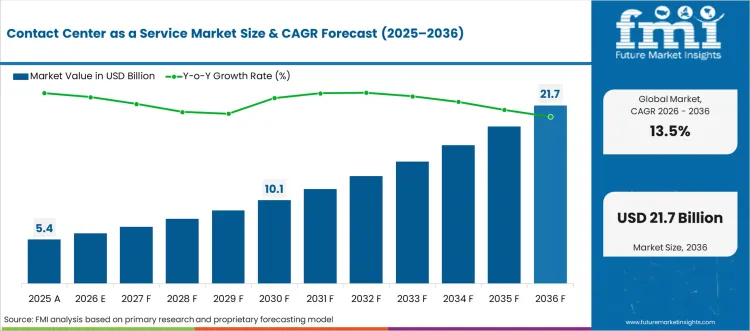
The Contact Center as a Service market was valued at USD 5.39 billion in 2025, projected to reach USD 6.11 billion in 2026, and is forecast to expand to USD 21.69 billion by 2036 at a 13.5% CAGR. As per FMI, the global migration from on-premise contact centre infrastructure to cloud-native CCaaS platforms is accelerating as enterprises seek to reduce capital expenditure, enable remote agent workforces, and integrate AI-powered customer interaction capabilities across voice, chat, email, and social media channels. FMI is of the opinion that the convergence of generative AI integration into agent assist tools, real-time sentiment analysis, and predictive routing algorithms is converting CCaaS from a cost-reduction infrastructure play into a revenue-generating customer experience platform that justifies premium subscription pricing tiers.
Summary of Contact Center as a Service Market Market
- Market Overview
- The Contact Center as a Service market is valued at USD 5.39 billion in 2025 and is projected to reach USD 21.69 billion by 2036.
- The industry is expected to grow at a 13.5% CAGR from 2026 to 2036, creating an incremental opportunity of USD 15.58 billion.
- The market is a cloud-migration-driven enterprise SaaS category where generative AI integration, multichannel routing capability, and enterprise-scale deployment capacity define competitive positioning among CCaaS platform providers globally.
- Demand and Growth Drivers
- Demand is accelerating as enterprises migrate from on-premise contact centre infrastructure to cloud-native CCaaS platforms for cost reduction and remote workforce enablement.
- Generative AI integration into agent assist tools and predictive routing is converting CCaaS from cost-reduction infrastructure into revenue-generating customer experience platforms.
- BPO operations concentration in India and e-commerce customer service scale in China are generating high-volume multichannel CCaaS deployment cycles.
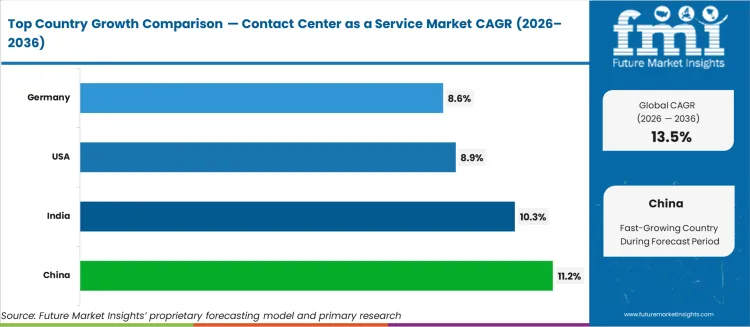
- China leads at 11.2% CAGR, followed by India at 10.3%, USA at 8.9%, and Germany at 8.6%.
- Product and Segment View
- The market includes function, enterprise, industry as primary segmentation dimensions.
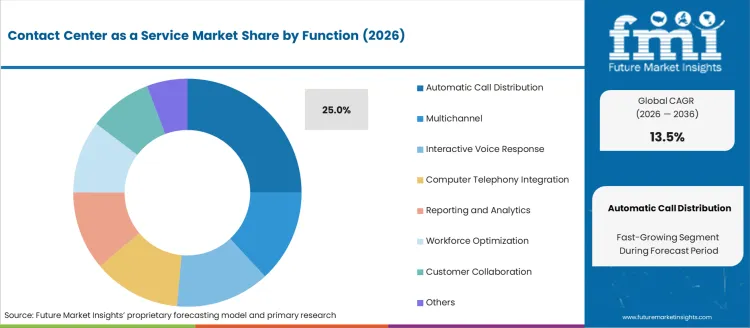
- Automatic Call Distribution leads by Function with 25% share in 2026.
- Very Large Enterprises leads by Enterprise with 35% share in 2026.
- Banking, Financial Services, and Insurance leads by Industry with 25% share in 2026.
- Geography and Competitive Outlook
- China is the fastest-growing region at 11.2% CAGR, while India anchors the second-largest demand base.
- Competition is shaped by manufacturing scale, technical specialisation, and distribution reach, with key players including Amazon Connect (AWS), NICE inContact, Five9, Talkdesk, 8x8.
- Analyst Opinion at FMI
- Sudip saha, Principal Consultant for Technology observe that: 'FMI's analysis reveals that the contact center as a service market is entering a phase where procurement decisions are increasingly shaped by regulatory compliance timelines and measurable performance thresholds. Organisations that delay investment risk falling behind competitors actively securing next-generation positions.'
- Strategic Implications / Executive Takeaways
- Solution providers must secure certified pathways with tier-1 enterprise systems to qualify for forthcoming procurement contracts.
- Capital project directors should mandate native platform compatibility in all new procurement specifications.
- Technical teams must develop specialised competencies in function validation to demonstrate compliance parameters.
Contact Center as a Service Market Market Key Takeaways
| Metric | Details |
|---|---|
| Industry Size (2026) | USD 6.11 billion |
| Industry Value (2036) | USD 21.69 billion |
| CAGR (2026 to 2036) | 13.5% |
Source: Future Market Insights, 2026
FMI analysts observe that regional growth trajectories reflect varying enterprise cloud adoption maturity and contact centre outsourcing concentration. China leads at 11.2% CAGR, driven by the scale of domestic e-commerce customer service operations migrating from legacy telephony to cloud-native multichannel platforms. India follows at 10.3%, supported by the concentration of BPO operations and the demand for multi-language AI-assisted contact centre solutions serving global clients. The USA registers 8.9% growth reflecting mature enterprise migration from legacy Avaya and Cisco on-premise systems to AWS Connect, Five9, and Genesys cloud platforms. Germany maintains 8.6% growth tied to GDPR-compliant CCaaS deployments for financial services and healthcare customer engagement. Based on FMI's report, very large enterprises account for 35.0% share as multi-site, multi-country contact centre consolidation drives large-scale CCaaS platform procurement. Future Market Insights analysis indicates BFSI leads industry vertical adoption at 25.0% share, reflecting the regulatory compliance requirements and high customer interaction volumes of financial services operations.
Contact Center as a Service Market Market Definition
Based on FMI's report, the Contact Center as a Service market covers cloud-native contact centre platforms delivering automatic call distribution, multichannel routing, interactive voice response, computer telephony integration, reporting and analytics, workforce optimization, and customer collaboration capabilities as subscription-based services to enterprises across BFSI, IT, healthcare, retail, travel, and media sectors globally.
Contact Center as a Service Market Market Inclusions
Future Market Insights analysis covers CCaaS platforms across all major functional modules, enterprise size categories, and industry verticals. The scope encompasses regional market sizes across four key countries, forecast projections from 2026 to 2036, and segmentation by function, enterprise size, and industry.
Contact Center as a Service Market Market Exclusions
The scope excludes on-premise contact centre hardware and perpetual licence software, standalone CRM platforms without integrated contact centre functionality, and unified communications platforms without dedicated contact centre routing capabilities.
Contact Center as a Service Market Market Research Methodology
- Primary Research: Analysts engaged with enterprise IT procurement directors, contact centre operations managers, and CCaaS platform vendor channel partners to map migration triggers and subscription tier selection criteria.
- Desk Research: Data collection aggregated Gartner cloud adoption benchmarks, enterprise IT expenditure surveys, and published CCaaS subscription revenue disclosures from major platform vendors.
- Market-Sizing and Forecasting: Baseline values derive from a bottom-up aggregation of CCaaS subscription revenues across four key countries, applying enterprise cloud migration curves and contact centre seat count growth projections.
- Data Validation and Update Cycle: Projections are cross-validated against quarterly SaaS revenue guidance from major CCaaS platform vendors and enterprise IT spending forecasts from industry analysts.
Key Trends Shaping the Contact Center as a Service Market
Rising Demand for Omnichannel Support Drives Contact Center as a Service Adoption
The demand for omnichannel support is rising because customers now undertake seamless communication across different platforms like phone, chat, email and social media. Businesses that offer a combined experience can better meet customer expectations and improve satisfaction. For example, a company like Starbucks allows regulars to place orders through their app, website or even social media and the involvement remains reliable no matter which channel they use. This suitability upsurges customer loyalty.
Likewise, companies using omnichannel strategies see 91% greater customer retention rates compared to those without such policies. By adopting Contact Center as a Service (CCaaS) solutions, industries can assimilate all these channels, tolerating agents to have a full view of customer interfaces, regardless of where they took place. This not only progresses response times but also decreases frustration for customers, as agents can impeccably pick up conversations from any channel.
Integration of AI and Automation Enhances Efficiency in Contact Center as a Service Solutions
The combination of AI and automation in customer service is altering the Contact Center as a Service (CCaaS) industry by illuminating proficiency and decontaminating customer experiences. Companies are increasingly using AI-driven tools, such as chatbots to handle routine inquiries, permitting human agents to focus on more elaborate issues.
For example, Sephora uses AI chatbots on its website and mobile app to help customers with product approvals and order tracking. These chatbots can answer questions directly, providing 24/7 support and declining wait times.
Business implementing AI in their customer service operations can achieve up to a 30% increase in worth and a 20% decrease in operational costs. Moreover, AI can gauge customer interactions to provide insights into preferences and behavior, allowing for more modified service. As customers endure to demand quicker and more actual solutions, the use of AI and automation in CCaaS is probable to grow, helping companies stay inexpensive in a speedily evolving industry.
Strategic Partnerships with Technology Providers Pushes Business Growth
Strategic partnerships with technology providers present an important as it allows companies to enhance their offerings and better help customers. By collaborating with foremost tech firms, CCaaS providers can assimilate progressive features and solutions that recover functionality and user experience. For example, a partnership between RingCentral and AI company Avaya allows RingCentral to include Avaya's robust AI tools into its cloud communication platform.
This incorporation helps industries utilize AI for advanced analytics and predictive customer insights. As a result, companies can make data-driven decisions that enhance service quality. Moreover, such partnerships can lead to quicker innovation and development cycles, allowing CCaaS providers to stay forward in a competitive landscape.
A report showed that organizations utilizing partnerships in their technology strategies can see revenue growth rates up to 25% higher than their competitors. By forming strategic alliances, CCaaS providers can distribute more comprehensive solutions that provide to developing customer needs, eventually pouring growth and improving customer satisfaction.
High Competition in the CCaaS Market Leads to Price Pressures and Margin Compression
High competition in the Contact Center as a Service (CCaaS) industry presents a significant challenge, leading to intense price pressures among providers. As more companies enter the industry, businesses are faced with many options, often ensuing in aggressive pricing strategies to attract customers. For example, companies like Five9 and 8x8 frequently adjust their pricing models to continue competitive, posing discounts or pushed services to detention market share.
This race to the bottom can expressively decrease profit margins, making it difficult for providers to invest in innovation and quality improvements. Research indicates that nearly 60% of CCaaS providers have practiced margin compression due to this modest landscape. While lower prices can advantage customers in the short term, it may lead to a deterioration in service quality if providers cut costs to preserve profitability.
To thrive amid this challenge, CCaaS providers need to distinguish themselves through superior customer service, exclusive features and actual promoting strategies rather than exclusively relying on price decreases.
Comparison of Historical vs Forecast Sales Outlook (2021 to 2036)
From 2021 to 2025, the global Contact Center as a Service (CCaaS) market saw stable growth drove by businesses transitioning to cloud-based solutions. Companies comprised CCaaS to improve customer service and reduce costs. During this period, demand rushed as organizations renowned the importance of flexibility and scalability in their customer support operations. Many providers improved their offerings with progressive features, making CCaaS a outstanding choice for businesses of all sizes.
Looking ahead, demand forecasts from 2026 to 2036 specify even greater growth possible for the CCaaS industry. As technology endures to advance, businesses are expected to adopt AI-driven solutions and omnichannel support, leading to more tailored customer experiences. The rising trend of remote work and the essential for efficient customer interaction will further drove the adoption of CCaaS solutions. Overall, the industry further suggests that the CCaaS will become a vital component of customer service strategies worldwide.
Key Contact Center as a Service Market Players and Concentration
Tier 1 companies in the market are major vendors with partnerships with governments and associations to provide needed forecasting services. These vendors provide wide range of contact center as a service equipped with modern technologies. The vendors in bracket hold market share around 50%-55% globally. These vendors include Genesys, NICE inContact, and Five9among more.
Tier 2 vendors in the global contact center as a service market hold decent amount of market share, but lesser in comparison with tier-1 vendors. These vendors focus on research and development to innovate technologies to increase their market share. These vendors include 8x8, Talkdesk, RingCentral among others and hold around 15%-20% market share.
Tier 3 companies represent 25% to 30% of share of total contact center as a service industry. These vendors focus on providing industry specific or personalized managed network services. The vendors in the tier include Freshdesk, Zingtree among others.
Analysis of Top Countries Using Contact Center Platforms
The below country-wise market analysis of the contact center as a service explains the recent developments and different government approaches in the market. The analysis also gives an idea of the country’s expected progress in the market landscape.
The data describes key highlights, growth factors, and CAGRs of these countries.
.webp "Top Country Growth Comparison Contact Center As A Service Market Cagr (2026 2036)")
| Countries | CAGR from 2026 to 2036 |
|---|---|
| India | 10.3% |
| China | 11.2% |
| USA | 8.9% |
| Germany | 8.6% |
United States at the Forefront of Growth in the Contact Center as a Service Market Fueled by Innovation and Customer Focus
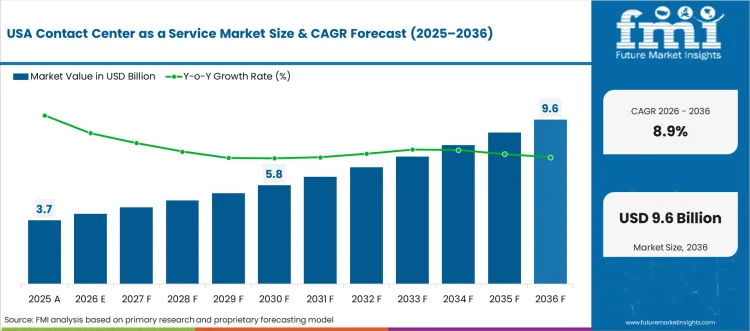
The United States is a leader in the contact center as a service (CCaaS) industry, mainly due to its innovative technology ecosystem. The demand for advanced customer engagement solutions is manifest, with industries allocating over 40% of their customer service budgets to technology developments.
Many enterprises are adopting CCaaS to gain flexibility in their operations, tolerating them to scale services according to changing customer demands without substantial investments in physical infrastructure. The CCaaS model supports remote work, which has become gradually common, with approximately 70% of organizations now managing their customer service operations distantly.
Also, the integration of artificial intelligence and analytics within CCaaS platforms is significant; around 55% of companies are using AI to personalize customer interactions and improve service effectiveness. As customer expectations grow, businesses in the USA are investing in CCaaS solutions, which is projected to surge by 23% in usage over the next few years, further fortifying the country’s position as a pouring force in the CCaaS industry. The combination of technology, skilled labor and a focus on customer-centric strategies is essential for constant growth and revolution in this sector.
India's Rise as a Global Hub for Contact Center as a Service Driven by Skilled Workforce and Competitive Costs
India has emerged in the CAAS industry due to its large pool of skilled workers and modest operational costs. With over 1.4 million specialists working in the business process outsourcing sector, the country is well-equipped to grip diverse customer service needs. The regular cost of providing customer support in India is about 30-50% lower than in Western countries, making it a striking option for companies looking to cut outlays while preserving service quality.
For example, major companies like Microsoft and Amazon have recognized customer support operations in India, progressing from the talent available in cities like Bangalore and Hyderabad. Also, the Indian government is reassuring of digital initiatives, leading to rise the country's IT infrastructure and improve connectivity.
This commitment helps CCaaS providers increase their services to both domestic businesses and international clients. As a result, India is undergoing significant growth in CCaaS adoption, with many providers now posing innovative solutions like AI-driven chatbots and omnichannel support to meet the developing demands of customers.
Germany's Strong Regulatory Framework and Data Protection Focus Propel Growth in the Contact Center Industry
Germany has stood itself as a strong contender in the contact center as a service (CCaaS), mainly due to its stringent regulatory environment and focus on data protection. With the General Data Protection Regulation (GDPR) in place, businesses are essential to highlight customer data security, which has improved the demand for compliant CCaaS solutions. Companies like SAP and Deutsche Telekom have assumed CCaaS to develop their customer interactions while certifying they meet legal requirements.
For example, SAP's cloud-based customer service platform incorporates seamlessly with CCaaS, letting businesses to maintain data security and compliance while transporting excellent service. The importance on data protection not only helps industries avoid hefty fines but also builds customer trust. In a recent survey, about 78% of German consumers expressed a preference for companies that validate a commitment to data privacy.
This trend is driving more organizations to consider CCaaS as a viable option for handling their customer interactions proficiently. With a solid infrastructure and a growing number of providers offering tailored solutions, Germany is well-resourced to foster growth in the CCaaS industry while observing to strict regulations.
Category-wise Insights in the Contact Center as a Service Market
The below section provides the category wise insights in the market with recent developments and future projections.
Interactive Voice Response (IVR) Lead in the Market
| Segment | Interactive Voice Response (IVR) (Function) |
|---|---|
| Value Share (2026) | 25.0% |
Interactive Voice Response (IVR) systems play a dynamic role in the Contact Center as a Service (CCaaS) industry due to their capability to improve customer interactions. IVR allows customers to traverse menus using their voice or keypad, rationalization the call process. For example, a bank might use IVR to let customers check account balances or report lost cards without waiting for an agent.
This computerization not only decreases call handling times but also progresses customer satisfaction by providing quick solutions. Likewise, companies using IVR have seen a 20% increase in first-call resolve rates, signifying its effectiveness. As businesses gradually seek to enhance operations, IVR's prominence in the CCaaS industry remains to grow.
Growing Demand for Efficient Customer Engagement Accelerate the BFSI Industry
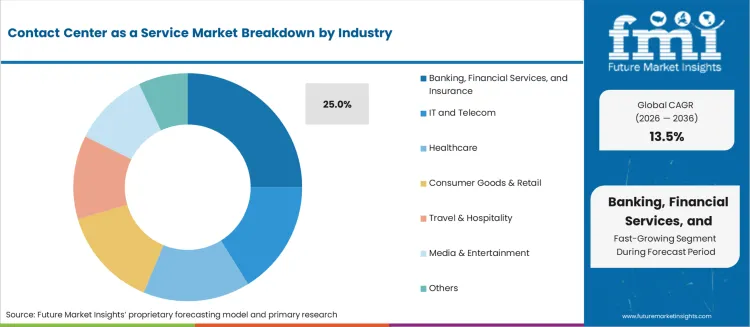
| Segment | BFSI (Industry) |
|---|---|
| Value Share (2026) | 25.0% |
The BFSI sector is a key player in the Contact Center as a Service (CCaaS) industry. This sector relies profoundly on effective communication to accomplish customer relationships and streamline operations. For example, banks often use CCaaS solutions to handle customer inquiries and transactions efficiently.
One significant case is a leading bank that integrated a CCaaS platform, resulting in a 30% reduction in call handling time and a 25% increase in customer satisfaction ratings. As digital banking grows, the need for vigorous, scalable contact center solutions in BFSI is becoming gradually dynamic, making this sector a leading force in determining the CCaaS landscape.
Competitive Landscape of the Contact Center as a Service Market
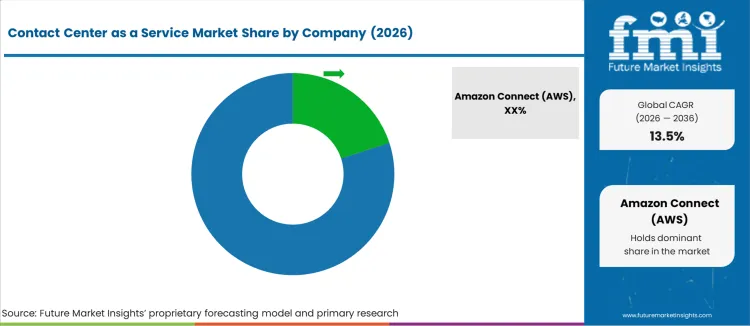
Companies are focusing on assimilating advanced technologies like AI and machine learning to provide modified service and progress efficacy. With the rise of remote work, many are adopting cloud-based solutions for flexibility and scalability.
Also, providers are discriminating themselves through features such as multichannel support and analytics tools, which help industries gain insights into customer behavior. This modest landscape inspires continuous innovation, leading to better services for customers and more options for industries observing to recover their contact center operations.
Scope of the Report
| Metric | Value |
|---|---|
| Quantitative Units | USD 6.11 billion to USD 21.69 billion, at a CAGR of 13.5% |
| Market Definition | Based on FMI's report, the Contact Center as a Service market covers cloud-native contact centre platforms delivering automatic call distribution, multichannel routing, interactive voice response, computer telephony integration, reporting and analytics, workforce optimization, and customer collaboration capabilities as subscription-based services to enterprises across BFSI, IT, healthcare, retail, travel, and media sectors globally. |
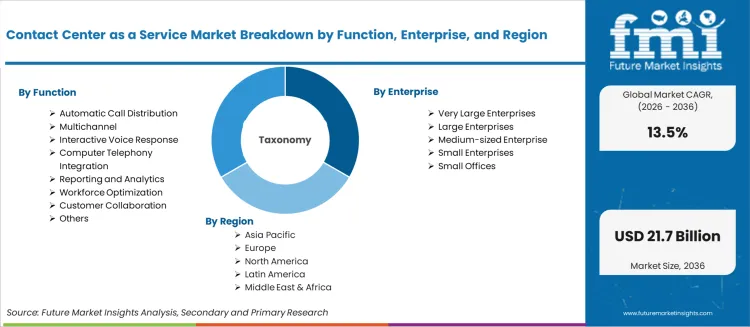
| Segmentation | Function: Automatic Call Distribution, Multichannel, Interactive Voice Response, Computer Telephony Integration, Reporting and Analytics, Workforce Optimization, Customer Collaboration, Others; Enterprise: Very Large Enterprises, Large Enterprises, Medium-sized Enterprise, Small Enterprises, Small Offices; Industry: Banking, Financial Services, and Insurance, IT and Telecom, Healthcare, Consumer Goods & Retail, Travel & Hospitality, Media & Entertainment, Others |
| Regions Covered | China, India, USA, Germany |
| Key Companies Profiled | Amazon Connect (AWS), NICE inContact, Five9, Talkdesk, 8x8, Avaya, Cisco, Genesys, RingCentral, Twilio |
| Forecast Period | 2026 to 2036 |
| Approach | Hybrid bottom-up methodology combining installed base metrics with regulatory compliance adoption curves and primary research validation. |
Top Segments Studied in the Contact Center as a Service Market Research Report
By Function:
The industry includes Interactive Voice Response (IVR), multichannel, automatic call distribution, computer telephony integration (CTI), reporting and analytics, workforce optimization, customer collaboration and others.
By Enterprise Size:
Small Offices (1-9 employees), Small Enterprises (10-99 employees), Medium-sized Enterprise (100-499 employees), Large Enterprises (500-999 employees) and Very Large Enterprises (1,000+ employees) are segmented in this category.
By Industry:
IT and Telecom, banking, financial services, and insurance (BFSI), healthcare, Consumer Goods & Retail, Travel & Hospitality, Media & Entertainment and Others Industry are segmented in this category.
By Region:
A regional analysis has been carried out in key countries of North America, Latin America, East Asia, South Asia & Pacific Western Europe, Eastern Europe and Middle East and Africa (MEA).
Bibliography
- 1. International Telecommunication Union. (2025). ICT Facts and Figures: Cloud Communications Adoption Statistics. ITU.
- 2. European Commission. (2024). General Data Protection Regulation: Cloud Services Compliance Assessment. European Commission.
- 3. National Institute of Standards and Technology. (2024). NIST SP 800-144: Guidelines on Security and Privacy in Cloud Computing. NIST.
- 4. Organisation for Economic Co-operation and Development. (2025). Digital Economy Outlook: Enterprise Cloud Adoption Indicators. OECD.
- 5. World Economic Forum. (2024). Future of Jobs Report: Contact Centre and Customer Service Transformation. WEF.
- 6. International Organization for Standardization. (2024). ISO/IEC 27017: Code of Practice for Information Security Controls for Cloud Services. ISO.
This bibliography is provided for reader reference. The full Future Market Insights report contains the complete reference list with primary research documentation.
Frequently Asked Questions
How large is the Contact Center as a Service market in 2026?
The Contact Center as a Service market is estimated to be valued at USD 6.11 billion in 2026.
What will be the market size of Contact Center as a Service by 2036?
Market size for Contact Center as a Service is projected to reach USD 21.69 billion by 2036.
What is the expected CAGR for Contact Center as a Service between 2026 and 2036?
The Contact Center as a Service market is expected to grow at a CAGR of 13.5% between 2026 and 2036.
Which Function leads the Contact Center as a Service market in 2026?
Automatic Call Distribution accounts for 25% share in 2026 by Function.
Which region is projected to grow fastest?
China is projected to grow at a CAGR of 11.2% during 2026 to 2036.
What does this report include in its scope?
The report covers market sizing, segmentation analysis, regional forecasts, competitive landscape evaluation, and forecast projections from 2026 to 2036.
How does FMI build and validate the Contact Center as a Service forecast?
Forecasting models apply a bottom-up methodology starting with installed base metrics and cross-validate projections against quarterly revenue volumes and industry data.
Preview the report firsthand - request a free sample
Get SampleGet the brochure for pricing and purchase details.
Get PDFTable of Content
- Executive Summary
- Global Market Outlook
- Demand-side Trends
- Supply-side Trends
- Technology Roadmap Analysis
- Analysis and Recommendations
- Market Overview
- Market Coverage / Taxonomy
- Market Definition / Scope / Limitations
- Research Methodology
- Chapter Orientation
- Analytical Lens and Working Hypotheses
- Market Structure, Signals, and Trend Drivers
- Benchmarking and Cross-market Comparability
- Market Sizing, Forecasting, and Opportunity Mapping
- Research Design and Evidence Framework
- Desk Research Programme (Secondary Evidence)
- Company Annual and Sustainability Reports
- Peer-reviewed Journals and Academic Literature
- Corporate Websites, Product Literature, and Technical Notes
- Earnings Decks and Investor Briefings
- Statutory Filings and Regulatory Disclosures
- Technical White Papers and Standards Notes
- Trade Journals, Industry Magazines, and Analyst Briefs
- Conference Proceedings, Webinars, and Seminar Materials
- Government Statistics Portals and Public Data Releases
- Press Releases and Reputable Media Coverage
- Specialist Newsletters and Curated Briefings
- Sector Databases and Reference Repositories
- FMI Internal Proprietary Databases and Historical Market Datasets
- Subscription Datasets and Paid Sources
- Social Channels, Communities, and Digital Listening Inputs
- Additional Desk Sources
- Expert Input and Fieldwork (Primary Evidence)
- Primary Modes
- Qualitative Interviews and Expert Elicitation
- Quantitative Surveys and Structured Data Capture
- Blended Approach
- Why Primary Evidence is Used
- Field Techniques
- Interviews
- Surveys
- Focus Groups
- Observational and In-context Research
- Social and Community Interactions
- Stakeholder Universe Engaged
- C-suite Leaders
- Board Members
- Presidents and Vice Presidents
- R&D and Innovation Heads
- Technical Specialists
- Domain Subject-matter Experts
- Scientists
- Physicians and Other Healthcare Professionals
- Governance, Ethics, and Data Stewardship
- Research Ethics
- Data Integrity and Handling
- Primary Modes
- Tooling, Models, and Reference Databases
- Desk Research Programme (Secondary Evidence)
- Data Engineering and Model Build
- Data Acquisition and Ingestion
- Cleaning, Normalisation, and Verification
- Synthesis, Triangulation, and Analysis
- Quality Assurance and Audit Trail
- Market Background
- Market Dynamics
- Drivers
- Restraints
- Opportunity
- Trends
- Scenario Forecast
- Demand in Optimistic Scenario
- Demand in Likely Scenario
- Demand in Conservative Scenario
- Opportunity Map Analysis
- Product Life Cycle Analysis
- Supply Chain Analysis
- Investment Feasibility Matrix
- Value Chain Analysis
- PESTLE and Porter’s Analysis
- Regulatory Landscape
- Regional Parent Market Outlook
- Production and Consumption Statistics
- Import and Export Statistics
- Market Dynamics
- Global Market Analysis 2021 to 2025 and Forecast, 2026 to 2036
- Historical Market Size Value (USD Million) Analysis, 2021 to 2025
- Current and Future Market Size Value (USD Million) Projections, 2026 to 2036
- Y-o-Y Growth Trend Analysis
- Absolute $ Opportunity Analysis
- Global Market Pricing Analysis 2021 to 2025 and Forecast 2026 to 2036
- Global Market Analysis 2021 to 2025 and Forecast 2026 to 2036, By Function
- Introduction / Key Findings
- Historical Market Size Value (USD Million) Analysis By Function , 2021 to 2025
- Current and Future Market Size Value (USD Million) Analysis and Forecast By Function , 2026 to 2036
- Automatic Call Distribution
- Multichannel
- Interactive Voice Response
- Computer Telephony Integration
- Reporting and Analytics
- Workforce Optimization
- Customer Collaboration
- Others
- Automatic Call Distribution
- Y-o-Y Growth Trend Analysis By Function , 2021 to 2025
- Absolute $ Opportunity Analysis By Function , 2026 to 2036
- Global Market Analysis 2021 to 2025 and Forecast 2026 to 2036, By Enterprise
- Introduction / Key Findings
- Historical Market Size Value (USD Million) Analysis By Enterprise, 2021 to 2025
- Current and Future Market Size Value (USD Million) Analysis and Forecast By Enterprise, 2026 to 2036
- Very Large Enterprises
- Large Enterprises
- Medium-sized Enterprise
- Small Enterprises
- Small Offices
- Very Large Enterprises
- Y-o-Y Growth Trend Analysis By Enterprise, 2021 to 2025
- Absolute $ Opportunity Analysis By Enterprise, 2026 to 2036
- Global Market Analysis 2021 to 2025 and Forecast 2026 to 2036, By Industry
- Introduction / Key Findings
- Historical Market Size Value (USD Million) Analysis By Industry, 2021 to 2025
- Current and Future Market Size Value (USD Million) Analysis and Forecast By Industry, 2026 to 2036
- Banking, Financial Services, and Insurance
- IT and Telecom
- Healthcare
- Consumer Goods & Retail
- Travel & Hospitality
- Media & Entertainment
- Others
- Banking, Financial Services, and Insurance
- Y-o-Y Growth Trend Analysis By Industry, 2021 to 2025
- Absolute $ Opportunity Analysis By Industry, 2026 to 2036
- Global Market Analysis 2021 to 2025 and Forecast 2026 to 2036, By Region
- Introduction
- Historical Market Size Value (USD Million) Analysis By Region, 2021 to 2025
- Current Market Size Value (USD Million) Analysis and Forecast By Region, 2026 to 2036
- North America
- Latin America
- Western Europe
- Eastern Europe
- East Asia
- South Asia and Pacific
- Middle East & Africa
- Market Attractiveness Analysis By Region
- North America Market Analysis 2021 to 2025 and Forecast 2026 to 2036, By Country
- Historical Market Size Value (USD Million) Trend Analysis By Market Taxonomy, 2021 to 2025
- Market Size Value (USD Million) Forecast By Market Taxonomy, 2026 to 2036
- By Country
- USA
- Canada
- Mexico
- By Function
- By Enterprise
- By Industry
- By Country
- Market Attractiveness Analysis
- By Country
- By Function
- By Enterprise
- By Industry
- Key Takeaways
- Latin America Market Analysis 2021 to 2025 and Forecast 2026 to 2036, By Country
- Historical Market Size Value (USD Million) Trend Analysis By Market Taxonomy, 2021 to 2025
- Market Size Value (USD Million) Forecast By Market Taxonomy, 2026 to 2036
- By Country
- Brazil
- Chile
- Rest of Latin America
- By Function
- By Enterprise
- By Industry
- By Country
- Market Attractiveness Analysis
- By Country
- By Function
- By Enterprise
- By Industry
- Key Takeaways
- Western Europe Market Analysis 2021 to 2025 and Forecast 2026 to 2036, By Country
- Historical Market Size Value (USD Million) Trend Analysis By Market Taxonomy, 2021 to 2025
- Market Size Value (USD Million) Forecast By Market Taxonomy, 2026 to 2036
- By Country
- Germany
- UK
- Italy
- Spain
- France
- Nordic
- BENELUX
- Rest of Western Europe
- By Function
- By Enterprise
- By Industry
- By Country
- Market Attractiveness Analysis
- By Country
- By Function
- By Enterprise
- By Industry
- Key Takeaways
- Eastern Europe Market Analysis 2021 to 2025 and Forecast 2026 to 2036, By Country
- Historical Market Size Value (USD Million) Trend Analysis By Market Taxonomy, 2021 to 2025
- Market Size Value (USD Million) Forecast By Market Taxonomy, 2026 to 2036
- By Country
- Russia
- Poland
- Hungary
- Balkan & Baltic
- Rest of Eastern Europe
- By Function
- By Enterprise
- By Industry
- By Country
- Market Attractiveness Analysis
- By Country
- By Function
- By Enterprise
- By Industry
- Key Takeaways
- East Asia Market Analysis 2021 to 2025 and Forecast 2026 to 2036, By Country
- Historical Market Size Value (USD Million) Trend Analysis By Market Taxonomy, 2021 to 2025
- Market Size Value (USD Million) Forecast By Market Taxonomy, 2026 to 2036
- By Country
- China
- Japan
- South Korea
- By Function
- By Enterprise
- By Industry
- By Country
- Market Attractiveness Analysis
- By Country
- By Function
- By Enterprise
- By Industry
- Key Takeaways
- South Asia and Pacific Market Analysis 2021 to 2025 and Forecast 2026 to 2036, By Country
- Historical Market Size Value (USD Million) Trend Analysis By Market Taxonomy, 2021 to 2025
- Market Size Value (USD Million) Forecast By Market Taxonomy, 2026 to 2036
- By Country
- India
- ASEAN
- Australia & New Zealand
- Rest of South Asia and Pacific
- By Function
- By Enterprise
- By Industry
- By Country
- Market Attractiveness Analysis
- By Country
- By Function
- By Enterprise
- By Industry
- Key Takeaways
- Middle East & Africa Market Analysis 2021 to 2025 and Forecast 2026 to 2036, By Country
- Historical Market Size Value (USD Million) Trend Analysis By Market Taxonomy, 2021 to 2025
- Market Size Value (USD Million) Forecast By Market Taxonomy, 2026 to 2036
- By Country
- Kingdom of Saudi Arabia
- Other GCC Countries
- Turkiye
- South Africa
- Other African Union
- Rest of Middle East & Africa
- By Function
- By Enterprise
- By Industry
- By Country
- Market Attractiveness Analysis
- By Country
- By Function
- By Enterprise
- By Industry
- Key Takeaways
- Key Countries Market Analysis
- USA
- Pricing Analysis
- Market Share Analysis, 2025
- By Function
- By Enterprise
- By Industry
- Canada
- Pricing Analysis
- Market Share Analysis, 2025
- By Function
- By Enterprise
- By Industry
- Mexico
- Pricing Analysis
- Market Share Analysis, 2025
- By Function
- By Enterprise
- By Industry
- Brazil
- Pricing Analysis
- Market Share Analysis, 2025
- By Function
- By Enterprise
- By Industry
- Chile
- Pricing Analysis
- Market Share Analysis, 2025
- By Function
- By Enterprise
- By Industry
- Germany
- Pricing Analysis
- Market Share Analysis, 2025
- By Function
- By Enterprise
- By Industry
- UK
- Pricing Analysis
- Market Share Analysis, 2025
- By Function
- By Enterprise
- By Industry
- Italy
- Pricing Analysis
- Market Share Analysis, 2025
- By Function
- By Enterprise
- By Industry
- Spain
- Pricing Analysis
- Market Share Analysis, 2025
- By Function
- By Enterprise
- By Industry
- France
- Pricing Analysis
- Market Share Analysis, 2025
- By Function
- By Enterprise
- By Industry
- India
- Pricing Analysis
- Market Share Analysis, 2025
- By Function
- By Enterprise
- By Industry
- ASEAN
- Pricing Analysis
- Market Share Analysis, 2025
- By Function
- By Enterprise
- By Industry
- Australia & New Zealand
- Pricing Analysis
- Market Share Analysis, 2025
- By Function
- By Enterprise
- By Industry
- China
- Pricing Analysis
- Market Share Analysis, 2025
- By Function
- By Enterprise
- By Industry
- Japan
- Pricing Analysis
- Market Share Analysis, 2025
- By Function
- By Enterprise
- By Industry
- South Korea
- Pricing Analysis
- Market Share Analysis, 2025
- By Function
- By Enterprise
- By Industry
- Russia
- Pricing Analysis
- Market Share Analysis, 2025
- By Function
- By Enterprise
- By Industry
- Poland
- Pricing Analysis
- Market Share Analysis, 2025
- By Function
- By Enterprise
- By Industry
- Hungary
- Pricing Analysis
- Market Share Analysis, 2025
- By Function
- By Enterprise
- By Industry
- Kingdom of Saudi Arabia
- Pricing Analysis
- Market Share Analysis, 2025
- By Function
- By Enterprise
- By Industry
- Turkiye
- Pricing Analysis
- Market Share Analysis, 2025
- By Function
- By Enterprise
- By Industry
- South Africa
- Pricing Analysis
- Market Share Analysis, 2025
- By Function
- By Enterprise
- By Industry
- USA
- Market Structure Analysis
- Competition Dashboard
- Competition Benchmarking
- Market Share Analysis of Top Players
- By Regional
- By Function
- By Enterprise
- By Industry
- Competition Analysis
- Competition Deep Dive
- Amazon Connect (AWS)
- Overview
- Product Portfolio
- Profitability by Market Segments (Product/Age /Sales Channel/Region)
- Sales Footprint
- Strategy Overview
- Marketing Strategy
- Product Strategy
- Channel Strategy
- NICE inContact
- Five9
- Talkdesk
- 8x8
- Avaya
- Cisco
- Genesys
- RingCentral
- Twilio
- Vonage
- Microsoft (Azure Communication Services)
- Lifesize
- BT Cloud Contact
- Serenova (now part of Lifesize)
- Amazon Connect (AWS)
- Competition Deep Dive
- Assumptions & Acronyms Used


