

- Market Size (2026)
- USD 52.0 Mn
- Forecast (2036)
- USD 213.0 Mn
- CAGR (2026 to 2036)
- 15.1%
How Big is the Coral Reseeding Market in 2026?
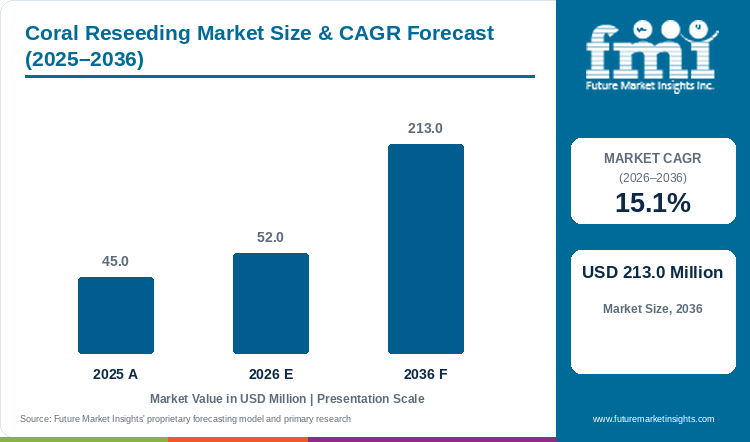
Sales of coral reseeding technology are valued at USD 52.0 million in 2026, against USD 45.0 million in 2025.
The global coral reseeding market is forecast to grow to USD 213.0 million by 2036 at a 15.1% CAGR. The market was valued at USD 45.0 million in 2025, as per FMI.The need for reef restoration is becoming more urgent as heat stress spreads across coral systems. ICRI reported in April 2025 that bleaching-level heat stress had affected 84% of the world’s reefs across 82 countries, territories and economies between January 2023 and March 2025. [11] This is increasing the need for restoration methods that can produce and place corals at a larger scale. Public funding is also moving toward technologies that can improve restoration scale and coral survival. NOAA recommended more than USD 1 million in January 2025 for coral restoration innovation projects covering thermal tolerance, coral production and outplanting. [8] In July 2025 NOAA and its partners also started work on bioprinting coral larvae in protective hydrogel and rearing young corals under higher temperatures. [12] These programs support the use of larval handling systems, deployment technologies and settlement substrates in coral restoration.
Key Takeaways
- By Product Type, Robotics is projected to account for 60.0% of market revenue in 2026.
- Within Product Type, Substrates are expected to account for 40.0% of market revenue in 2026.
- Saudi Arabia is expected to record the fastest country CAGR at 17.2% from 2026 to 2036.
- SECORE International and Reef Design Lab are among the notable organizations in the market. Coral Vita and LarvalBot also participate through coral farming and robotic larval deployment.
- The coral reseeding market is forecast to expand at a 15.1% CAGR between 2026 and 2036.
- AI-based computer vision and 3D-printed coral settlement substrates are emerging as important technology trends for larger restoration programs.
Analyst Perspective
“Coral reseeding will scale only if restoration teams can place more viable larvae during short spawning windows. Robotics can reduce the amount of manual work needed for deployment, while engineered substrates can improve settlement after release. The strongest systems will combine both parts of that workflow rather than treat them as separate technologies.”
- Nikhil Kaitwade, Principal Consultant, Future Market Insights
How is the Coral Reseeding Market Segmented?
FMI segments the coral reseeding market by product type and country.
By Product Type, the coral reseeding market is segmented into Robotics and Substrates. By Country, the market is segmented into Australia, the Philippines, the USA, the Bahamas, Saudi Arabia, the UAE, Mauritius and Mexico.
Why does Robotics lead demand within the Product Type category?
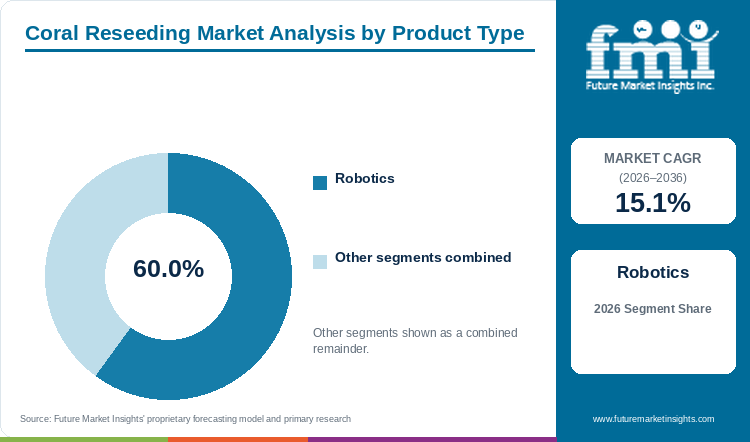
Robotics is projected to account for 60.0% of Product Type revenue in 2026.
Robotics helps restoration teams cover more reef during a short spawning period. Manual work is limited by diver time and how many larvae can be placed in one operation. Autonomous systems can navigate reef areas and release larvae with less manual effort. QUT's LarvalBot trials increased from about 500 square metres in early work to three hectares in six hours during later Philippines trials. [9] This makes robotics more useful as restoration programs move from small trials to larger reef areas.
- By Product Type, Robotics is projected to account for 60.0% of market revenue in 2026.
- Substrates are expected to account for 40.0% of Product Type revenue in 2026 and remain important for larval settlement after deployment.
What are the Drivers, Restraints, and Opportunities in the Coral Reseeding Market?
Driver: Growing reef-restoration programs are increasing demand for coral reseeding technology. Restraint: Permitting and difficult reef conditions can slow deployment. Opportunity: Better robotics and settlement substrates can improve coral survival and expand restoration scale.
- Driver: Public investment in coral genetics and heat-tolerance research is expanding the pool of coral stock available for restoration. NOAA-backed programs in Hawaii are testing assisted-evolution approaches for more heat-resistant corals. As this work moves into restoration programs, reseeding operators gain access to stock that is better suited to reefs facing repeated thermal stress.
- Restraint: Deployment is harder when autonomous systems operate inside protected reef areas. Approval processes for marine robotics are still developing and can differ by location. This adds time and operational complexity to projects that already depend on narrow weather and spawning windows.
- Opportunity: The next step is to improve survival after larvae are released. Computer vision can help identify viable spawn and suitable settlement areas while engineered calcium-carbonate substrates give larvae a more controlled surface for attachment. Combining these tools can improve the economics of reseeding by increasing the number of corals that survive each deployment.
Which country CAGRs are profiled in the Coral Reseeding Market?
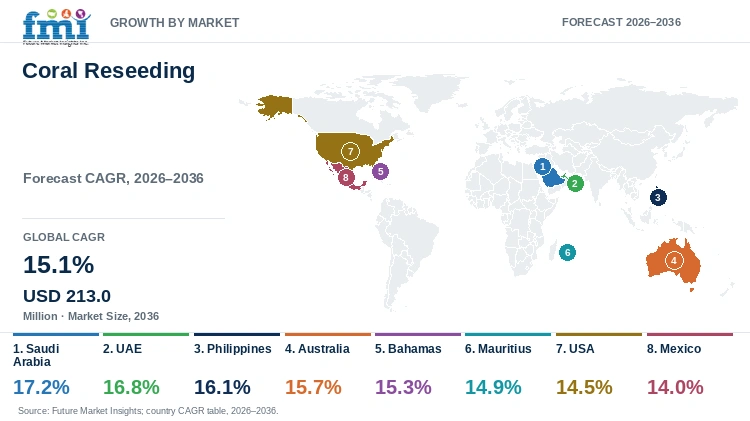
| Country | CAGR |
|---|---|
| Saudi Arabia | 17.2% |
| UAE | 16.8% |
| Philippines | 16.1% |
| Australia | 15.7% |
| Bahamas | 15.3% |
| Mauritius | 14.9% |
| USA | 14.5% |
| Mexico | 14.0% |
How do country-level CAGRs compare in the Coral Reseeding Market?
Country growth differs according to the scale of active restoration programs and how quickly new propagation capacity reaches reef deployment. Saudi Arabia and the UAE are moving toward large multi-year programs, while Australia and the Philippines are building field capacity around coral seeding and larval restoration. More established programs in the USA and Mexico are likely to expand at a steadier pace.
Saudi Arabia has the strongest growth outlook as KCRI moves from pilot work to large-scale coral production. The UAE is also expanding rapidly through Abu Dhabi's multi-million-colony rehabilitation program. Australia and the Philippines are advancing field deployment, while the Bahamas and Mauritius are adding propagation and restoration capacity.
- Saudi Arabia is moving toward industrial-scale propagation with a 100-hectare restoration program and more than two million planned coral outplants. [3]
- UAE demand is supported by Abu Dhabi's plan to restore more than four million coral colonies across more than 900 hectares by 2030. [4]
- Philippines activity is expanding through a 2025-2027 coral larval restoration network involving the University of the Philippines and Southern Cross University. [5]
- Australia is testing coral seeding at operational scale through AIMS deployments on the Great Barrier Reef. [1]
- Bahamas is adding propagation capacity through its first national Coral Gene Bank. [6]
- Mauritius has moved nursery-grown corals into field transplantation and continues to expand restored reef area. [7]
- USA demand is supported by continued NOAA funding for new coral restoration and intervention methods. [8]
- Mexico continues to build reef-restoration capacity through protected-area programs and specialized coral-response work. [14]
Full report country CAGRs cover: Saudi Arabia; UAE; Philippines; Australia; Bahamas; Mauritius; USA; Mexico.
Country-wise Analysis
- Coral reseeding demand in Saudi Arabia is projected to rise at 17.2% CAGR through 2036. KAUST is scaling the Coral Restoration Initiative across a 100-hectare restoration site and plans to outplant more than two million corals by 2030. Its main nursery is designed to produce up to 400,000 corals annually. [3] This creates demand for propagation systems and automated deployment technology.
- The UAE coral reseeding market is expected to expand at 16.8% CAGR through 2036. Abu Dhabi plans to outplant more than four million coral colonies by 2030 across more than 900 hectares. One million colonies have already been restored across eight sites. [4] Larger field programs increase the need for nursery capacity, transport systems and repeatable placement methods.
- Coral reseeding demand in the Philippines is projected to grow at 16.1% CAGR through 2036. A 2025-2027 program led through ACIAR is establishing a coral larval restoration network with Southern Cross University and the University of the Philippines. The work supports wider use of larval collection, settlement and reef deployment methods. [5]
- The Australia market is forecast to expand at 15.7% CAGR through 2036. AIMS deployed 44,608 coral seeding devices across three reefs during 2025-26 as part of its Pilot Deployments Program. [1] Moving from laboratory development to repeated field deployment increases demand for systems that can produce, transport and place young corals at scale.
- The Bahamas market is expected to grow at 15.3% CAGR through 2036. The country's first Coral Gene Bank opened in June 2025 and can house hundreds of vulnerable coral colonies. [6] Healthy samples are propagated for reef replenishment. This adds domestic capacity for coral production before material is returned to damaged reef systems.
- Coral reseeding demand in Mauritius is projected to rise at 14.9% CAGR through 2036. Nursery-grown coral transplantation began at Blue Bay Marine Park in May 2025. The program expects about 8,000 nursery-grown corals to be transplanted and has already restored around 1.5 hectares. [7] Continued outplanting creates a practical route for settlement and deployment technologies.
- The USA coral reseeding market is forecast to expand at 14.5% CAGR through 2036. NOAA recommended more than USD 1 million in 2025 for projects developing new coral restoration and intervention methods. [8] The country already has a substantial restoration research base. Growth is therefore likely to come from improving resilience and field efficiency rather than establishing basic restoration capability.
- Coral reseeding demand in Mexico is expected to grow at 14.0% CAGR through 2036. CONANP continued national ecosystem-restoration programs in 2025 and expanded training for reef-response teams. Field work includes coral-fragment fixation and the use of specialized reef-restoration tools. [14] The present project mix remains more focused on protected-area restoration than large automated reseeding programs.
Who are the Notable Companies in the Coral Reseeding Market?
SECORE International, Reef Design Lab, Coral Vita, and LarvalBot are among the notable organizations and platforms in the coral reseeding market.
SECORE International, a nonprofit marking ten years of operation in 2025, has built its program around sexual coral reproduction, using 'Seeding Units' and underwater 'Coral Seeding Tents' to settle lab-reared larvae, with a partner network spanning the Caribbean and, since 2024, Mauritius. [15] Reef Design Lab works on 3D-printed modular reef substrate structures, often in academic and NGO partnerships. [10] On the robotic and commercial-farm side, Coral Vita raised over USD 8 million in Series A funding in June 2025 to expand land-based coral farming and invest in 3D printing and robotics [13], while LarvalBot, a Queensland University of Technology platform developed with Southern Cross University, has scaled its autonomous larval-delivery trials from the Great Barrier Reef to the Philippines. [9]
- Established Marine Restoration Organizations: SECORE International and Reef Design Lab compete on partner network depth and documented substrate or larval-settlement technology.
- Startup and Academic Robotic and Farm Platforms: Coral Vita and LarvalBot compete on deployment scale and, for Coral Vita, commercial funding.
Competitive Benchmarking: Coral Reseeding Market
| Organization / Platform | Coral propagation breadth | Deployment or substrate technology | Field restoration activity | Geographic reach |
|---|---|---|---|---|
| SECORE International | High | High | High | High |
| Reef Design Lab | Low | High | Medium | Medium |
| Coral Vita | High | Medium | High | Medium |
| LarvalBot | Low | High | Medium | Medium |
High indicates broad capability, active field application, current development activity or wider deployment reach. Medium indicates a credible but more focused position. Low indicates a narrower role within the coral reseeding workflow. Ratings do not represent restoration quality or market share.
Key Developments in the Coral Reseeding Market
- In March 2026, SECORE International and the Australian Institute of Marine Science expanded the Global Coral Tech Transfer Project with FUNDEMAR. The program combines SECORE's coral breeding methods with AIMS technologies such as ReefSeed and two-part seeding devices for larger-scale restoration deployment. [2]
- In February 2026, AIMS reported the deployment of 44,608 coral seeding devices across three Great Barrier Reef sites during the first year of its Pilot Deployments Program. The project is testing whether coral production and deployment can move from research-scale work toward repeatable operations involving marine-industry crews. [1]
- In June 2025, Coral Vita raised more than USD 8 million in Series A funding to expand coral restoration operations and technology development. The company had grown more than 100,000 corals across 52 species in the Bahamas, Saudi Arabia and the UAE. [13]
Key Players
Established Marine Restoration Organizations
- SECORE International
- Reef Design Lab
Startup and Academic Robotic and Farm Platforms
- Coral Vita
- LarvalBot (Queensland University of Technology / Southern Cross University)
Report Scope and Methodology
| Coverage field | Report scope |
|---|---|
| Market breakdown | Product Type (Robotics, Substrates); Country (Saudi Arabia, UAE, Philippines, Australia, Bahamas, Mauritius, USA, Mexico) |
| Quantitative units | USD Million |
| Market definition | Revenue includes robotic larval-dispersal and spawn-identification systems plus engineered reef substrates used for coral reseeding and outplanting. This includes 3D-printed and cast settlement substrates. Land-based coral farming services are included only where revenue is directly tied to in-scope reseeding technology or substrates. General reef-monitoring robotics and non-coral marine restoration technologies are excluded. |
| Countries covered | Saudi Arabia; UAE; Philippines; Australia; Bahamas; Mauritius; USA; Mexico |
| Key organizations profiled | SECORE International; Reef Design Lab; Coral Vita; LarvalBot (Queensland University of Technology / Southern Cross University) |
| Forecast period | 2026 to 2036 |
Research Methodology
| Method | Approach |
|---|---|
| Primary and desk research | FMI combines market inputs with publications from government agencies, research institutes, universities and coral-restoration organizations. Company disclosures are used for current technology and organizational developments. |
| Market sizing and forecasting | Market sizing considers coral propagation activity, deployment technology, engineered substrate use and restoration-program scale. Forecasting also considers country-level deployment activity and the transition from field trials to repeat restoration programs. |
| Country forecasting | Country growth estimates consider restoration targets, propagation capacity, field deployment, program funding and adoption of coral-seeding technologies. Country CAGRs are FMI analyst estimates for 2026 to 2036. |
| Data validation | Market estimates are checked against documented restoration programs, field deployments and current organizational activity. Overlapping service revenue and technology outside the market definition are excluded. |
Coral Reseeding Market by Segments
Coral Reseeding Market Segmented by Product Type
- Robotics
- Substrates
Coral Reseeding Market Segmented by Country
- Saudi Arabia
- UAE
- Philippines
- Australia
- Bahamas
- Mauritius
- USA
- Mexico
Research Sources and Bibliography
- [1] Australian Institute of Marine Science (2026, February 26). AIMS Takes First Shot at Largescale Reef Restoration with Marine Industry.
- [2] SECORE International. Global Coral Tech Transfer Project.
- [3] King Abdullah University of Science and Technology (2025). 2025 to be a Critical Year for KAUST Coral Restoration Initiative.
- [4] Environment Agency - Abu Dhabi / Abu Dhabi Media Office (2025, May 12). Abu Dhabi Expands Coral Reefs Rehabilitation Project to More Than Four Million Coral Colonies.
- [5] Australian Centre for International Agricultural Research. Southeast Asia Coral Larval Restoration Network.
- [6] University of The Bahamas (2025, June 17). University of The Bahamas Students Involved in Groundbreaking Coral Gene Bank.
- [7] Government of Mauritius, Office of the Director of Environment. Projects: Biodiversity.
- [8] NOAA Fisheries (2025, January 16). More Than USD 1 Million Recommended for Ruth D. Gates Coral Restoration Innovation Grants Projects.
- [9] Queensland University of Technology (2019, November 27). Floating Nurseries and Robotic Fleet Deliver Coral Babies.
- [10] Reef Design Lab. Modular Artificial Reef Structure (MARS).
- [11] International Coral Reef Initiative (2025, April 23). 84% of the world’s coral reefs impacted in the most intense global coral bleaching event ever.
- [12] NOAA Fisheries (2025, July 21). NOAA and Partners Launch Next-Generation Coral Restoration Following Florida Coral Bleaching.
- [13] Coral Vita (2025, June 27). Coral Vita Secures Historic USD 8 Million Series A to Scale Coral Restoration.
- [14] Comisión Nacional de Áreas Naturales Protegidas (2025, May 12). La Conanp capacita a brigadistas de los arrecifes de coral de Banco Chinchorro y Arrecifes de Xcalak.
- [15] SECORE International (2025, October 8). SECORE’s Annual Report | Our wrap up for 2024.
This bibliography is provided for reader reference. The full report contains the complete reference list and supporting research.
This Report Answers
- What is the Coral Reseeding Market size in 2026?
- What value is forecast for the Coral Reseeding Market by 2036?
- Which Product Type holds the leading share of the Coral Reseeding Market in 2026?
- Which countries have notable growth outlooks in the Coral Reseeding Market through 2036?
- What factors are shaping coral reseeding adoption across major countries?
- Which organizations and technology platforms are notable in the Coral Reseeding Market?
Frequently Asked Questions
How big is the Coral Reseeding Market in 2026?
As per FMI, the coral reseeding market is valued at USD 52.0 million in 2026 compared with USD 45.0 million in 2025. Sales are forecast to reach USD 213.0 million by 2036.
What is the CAGR of the Coral Reseeding Market from 2026 to 2036?
The coral reseeding market is forecast to expand at a 15.1% CAGR between 2026 and 2036.
Which Product Type holds the largest share of the Coral Reseeding Market?
By Product Type, Robotics is projected to account for 60.0% of market revenue in 2026. Substrates are expected to account for the remaining 40.0%.
Which country has the strongest growth outlook in the Coral Reseeding Market?
FMI estimates Saudi Arabia to record a 17.2% CAGR from 2026 to 2036. Large-scale coral propagation and a planned two million-plus coral outplanting program support the country's growth outlook.
What is a major restraint on the Coral Reseeding Market?
Scaling field deployment remains difficult in protected and operationally complex reef environments. Autonomous systems must work within local permitting requirements while restoration teams also manage weather and narrow spawning windows.
Which are the notable organizations in the Coral Reseeding Market?
SECORE International, Reef Design Lab, Coral Vita and LarvalBot are among the notable organizations and technology platforms active in coral breeding, settlement substrates and reef deployment.
Preview the report firsthand - request a free sample
Get SampleGet the brochure for pricing and purchase details.
Get PDFTable of Content
- How Big is the Coral Reseeding Market in 2026?
- Key Takeaways
- Analyst Perspective
- Segmentation Analysis
- How is the Coral Reseeding Market Segmented?
- Why does Robotics lead demand within the Product Type category?
- What are the Drivers, Restraints, and Opportunities in the Coral Reseeding Market?
- Which country CAGRs are profiled in the Coral Reseeding Market?
- How do country-level CAGRs compare in the Coral Reseeding Market?
- Country-wise Analysis
- Who are the Notable Companies in the Coral Reseeding Market?
- Competitive Benchmarking: Coral Reseeding Market
- Key Developments in the Coral Reseeding Market
- Established Marine Restoration Organizations
- Startup and Academic Robotic and Farm Platforms
- Report Scope and Methodology
- Research Methodology
- Coral Reseeding Market by Segments
- Coral Reseeding Market Segmented by Product Type
- Coral Reseeding Market Segmented by Country
- Research Sources and Bibliography
- This Report Answers
- Frequently Asked Questions
- Competitive Landscape


