
- Market Size (2026)
- USD 209.0 Mn
- Forecast (2036)
- USD 494.8 Mn
- CAGR (2026 to 2036)
- 9.0%
How big is the Corneal Cross-Linking Devices Market in 2026?
FMI projects the global corneal cross-linking devices market at USD 494.8 million in 2036, a 9.0% CAGR over 2026 to 2036. The market was valued at USD 190.0 million in 2025 and is estimated at USD 209.0 million in 2026.
Corneal Cross-Linking Devices Market Size and Forecast
Table 1: Corneal Cross-Linking Devices Market Size and Forecast
| Market size and forecast | Value |
|---|---|
| Market size in 2025 | USD 190.0 million |
| Estimated market size in 2026 | USD 209.0 million |
| Projected market size by 2036 | USD 494.8 million |
| CAGR from 2026 to 2036 | 9.0% |
Source: Future Market Insights analysis of the corneal Cross-Linking devices market, 2026.
Corneal cross-linking purchasing is being reshaped by a new approved treatment platform in the United States. Glaukos received FDA approval for Epioxa in October 2025 and announced commercial availability on 19 March 2026. Its approved combination includes the O2n System and Boost Goggles. Clinics considering this treatment therefore evaluate the associated delivery system and pharmaceutical supply together.
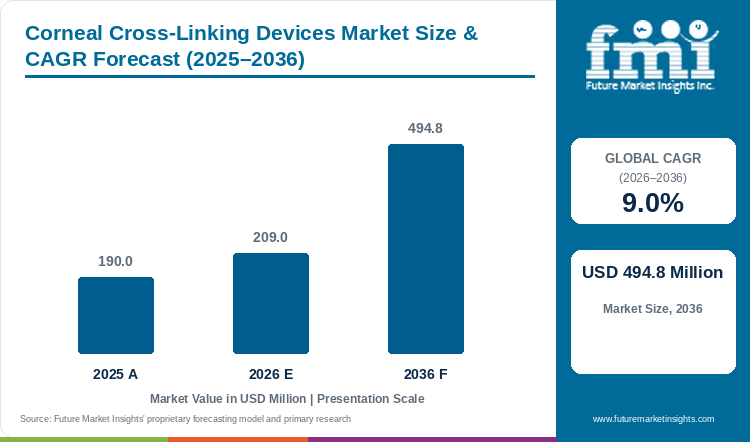
Access outside the United States follows different rules. Germany's G-BA decision requires progression to be documented through specified criteria, including comparable measurements. FMI expects competition to focus on the evidence supporting each complete combination and the ability of a corneal service to sustain activity after installation. Growth in the wider ophthalmic diagnostic equipment market provides relevant context for this diagnostic investment. FMI projects revenue to rise 2.4 times between 2026 and 2036.
Key Market Trends & Insights
- Recurring consumables gain weight in the outlook. Treatment kits increase from 48.0% of product revenue in 2026 to 52.2% in 2036, while UV light devices fall from 30.0% to 25.9%. Installed equipment and replenishment sales follow different purchasing cycles.
- The patient pathway extends beyond stabilization. Moorfields describes continued use of spectacles or contact lenses after cross-linking.
- Product compatibility creates a meaningful purchasing boundary. The Photrexa label specifies its use with the KXL System. The revenue opportunity therefore includes platform-specific supply relationships.
Regional Highlights
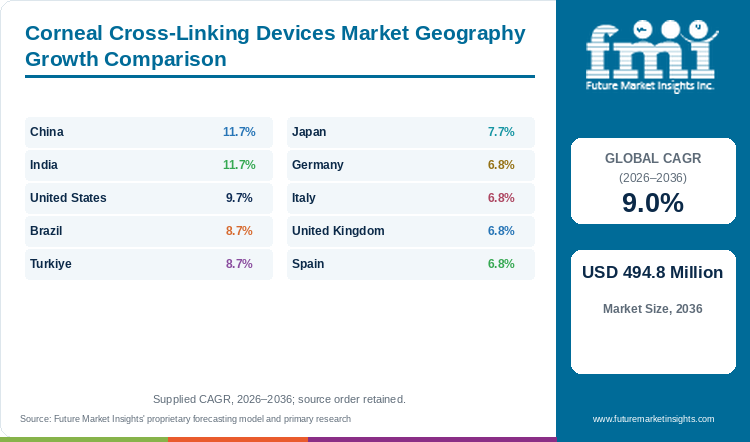
- China and India lead the named countries with CAGRs of 11.7% each over 2026 to 2036, and the United States follows at 9.7%, against 9.0% for the global market.
- Germany, Italy, the United Kingdom and Spain share the slowest CAGR at 6.8% over the same period, below the global rate. Japan follows at 7.7%.
Analyst Perspective
“The decisive commercial question is whether a cross-linking platform becomes part of a functioning corneal referral service. Equipment placement creates an initial sale. Documented eligibility, dependable consumable delivery and sustained follow-up create the recurring account. Suppliers with a new epithelial-sparing approach must establish those capabilities alongside clinical evidence. An attractive recovery proposition alone does not determine reimbursement or treatment volume.”
- Anurag Sharma, Principal Consultant, FMI
How is the Corneal Cross-Linking Devices Market segmented?
- By product: Treatment kits, Riboflavin solutions, and UV light devices.
- By procedure: Epithelium-off, Epithelium-on, and Accelerated protocols.
- By end user: Hospitals, Eye clinics, and Ambulatory surgical centres.
- By region: North America, Latin America, Western Europe, East Asia, South Asia, and the transcontinental Turkiye market, with remaining countries grouped as Rest of world.
Why does the Treatment kits segment lead by Product in the Corneal Cross-Linking Devices Market in 2026?
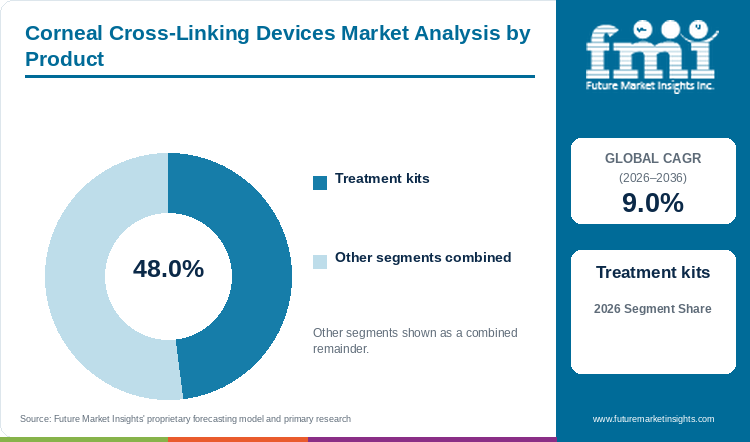
The Treatment kits segment holds 48.0% of the Corneal Cross-Linking Devices Market by product in 2026.
The treatment-kit category captures a recurring transaction that a stand-alone light source does not. A clinic can retain a functioning capital system across many treatment sessions, while single-use products are replenished as activity increases. The Photrexa cross-linking kit label identifies the pharmaceutical components as single-use and ties them to the KXL platform. The commercial benefit accrues to suppliers that maintain an active treatment relationship after installation.
That pattern supports a 9.9% treatment-kit CAGR over 2026 to 2036. Category revenue reaches USD 258.4 million by 2036 and its share rises to 52.2%.
Stocking decisions depend on the specific platform. A hospital adopting a different approved combination must consider whether an existing inventory remains relevant. Suppliers that document compatibility clearly reduce purchasing uncertainty. The transition also creates a risk for clinics that commit to long supply contracts before deciding their preferred treatment system. FMI expects replenishment planning and expiry management to receive more attention as the number of available approaches grows.
Riboflavin solutions and UV light devices together hold the remaining 52.0% by product.
Table 2: Product, 2026 Share
| Leading Share | 2026 market share |
|---|---|
| Treatment kits | 48.0% |
| All Other Segments Combined Share | 52.0% |
Source: Future Market Insights analysis of the corneal Cross-Linking devices market, 2026.
Why does the Epithelium-off segment lead by Procedure in the Corneal Cross-Linking Devices Market in 2026?
The Epithelium-off segment holds 52.0% of the Corneal Cross-Linking Devices Market by procedure in 2026.
The existing evidence base supports the initial revenue lead. The American Academy of Ophthalmology's Corneal Ectasia Preferred Practice Pattern recommends cross-linking for progressive keratoconus, while distinguishing disease stabilization from optical rehabilitation. Familiar clinical pathways and installed systems give established treatment combinations a commercial base that does not disappear when a new technique launches.
FMI nevertheless projects epi-on revenue to grow at 13.4% CAGR from 2026 to 2036. Its share increases from 38.0% to 56.3%, compared with an epithelium-off share of 35.8% in 2036. The forecast assumes that evidence, access and local commercial availability support broader adoption.
Procurement committees should therefore compare the actual treatment combination and intended use. The new category also changes conversations with referring clinicians, since the proposed patient pathway may differ. In FMI's view, an established epi-off supplier retains an important account base, while a new epi-on competitor has to convert regulatory progress into usable treatment access.
Epithelium-on and Accelerated protocols together hold the remaining 48.0% by procedure.
Table 3: Procedure, 2026 Share
| Leading Share | 2026 market share |
|---|---|
| Epithelium-off | 52.0% |
| All Other Segments Combined Share | 48.0% |
Source: Future Market Insights analysis of the corneal Cross-Linking devices market, 2026.
Why does the Eye clinics segment lead by End User in the Corneal Cross-Linking Devices Market in 2026?
The Eye clinics segment holds 43.0% of the Corneal Cross-Linking Devices Market by end user in 2026.
The narrow lead of eye clinics reflects the specialist nature of assessment and ongoing corneal care. Moorfields describes a service in which selection and subsequent assessment remain important parts of cross-linking care.
The clinic share reaches 45.4% in 2036 on a forecast 9.6% CAGR. Hospital revenue also grows, reaching USD 191.5 million by 2036, while ambulatory surgical centres reach USD 78.4 million.
A clinic's commercial requirement is a dependable referral flow alongside its device. Excess capacity can leave a well-equipped site with modest replenishment orders. Supplier support is consequently most useful when it helps the practice establish appropriate platform training and dependable product access. Optical care remains another purchase stream: the related contact lenses market serves vision correction after stabilization.
Hospitals and Ambulatory surgical centres together hold the remaining 57.0% by end user.
Table 4: End User, 2026 Share
| Leading Share | 2026 market share |
|---|---|
| Eye clinics | 43.0% |
| All Other Segments Combined Share | 57.0% |
Source: Future Market Insights analysis of the corneal Cross-Linking devices market, 2026.
What are the key drivers restraints and opportunities?
Earlier intervention and new approved treatment combinations support demand. Access conditions and clinical eligibility restrict conversion into procedures. Recurring consumables provide the main commercial opportunity after equipment placement.
Driver
Clinical identification of progressive disease gives specialist services a reason to establish cross-linking capacity before advanced corneal damage occurs.
Restraint
A diagnosis alone does not make every patient eligible for a specific approved or reimbursed procedure. Product labels and payer conditions affect the accessible patient pool
Opportunity
Suppliers can build recurring product accounts around an established referral service, supported by platform-specific consumables and treatment-site training.
How do purchasing rules and qualification affect corneal Cross-Linking devices market demand?
The strongest growth mechanism is an increase in completed treatment pathways. Additional diagnostic referrals have limited product impact if the receiving centre cannot assess progression or offer the appropriate procedure. A supplier therefore needs to understand the service around its device. The AAO's May 2025 technology assessment documents the role of cross-linking evidence in corneal ectasia management. For purchasing teams, that clinical foundation matters more than a broad claim that all new UV systems are equivalent.
FMI expects new platforms to compete first for specialists already managing keratoconus. These sites have access to the relevant patient records and can judge how a proposed system fits current care. Later expansion depends on referral access and additional treatment locations. Revenue growth can therefore precede a large change in installed systems when an existing centre increases its kit purchases.
What limits reliable corneal Cross-Linking devices market supply and quality?
Regulatory status and evidence remain product-specific. EpiSmart's 2026 follow-up completion was a research milestone, not a commercial approval. Buyers planning future equipment must retain that distinction when comparing established and prospective offers.
Patient selection imposes a separate constraint. NICE guidance places different governance requirements on epi-on and combined procedures compared with established epi-off use. A clinic cannot resolve that distinction through a lower equipment price. It needs a service that meets the applicable clinical and governance requirements. Adverse events, follow-up needs and treatment failure also affect the resources required around each procedure. The operational risk is to purchase capacity faster than the local pathway can support it.
Where can suppliers win additional business in the corneal Cross-Linking devices market?
The recurring opportunity is to supply a clearly specified treatment combination reliably. An equipment distributor may compete through access to existing corneal surgeons, while a drug-device company has a different responsibility for the complete approved platform. SCHWIND's integration of C-eye with AMARIS illustrates how a supplier can participate through a broader surgical workflow. The adjacent ophthalmic lasers market helps explain that commercial channel, although excimer laser sales are not included here.
The opportunity remains conditional on appropriate indications. Product extensions into combined corneal procedures require their own evidence and local permissions. A supplier that explains those boundaries clearly is better placed to secure a durable clinical account than one that treats every corneal procedure as addressable cross-linking revenue.
Corneal Cross-Linking Devices Market by Country (2026 to 2036)
Table 5: Corneal Cross-Linking Devices Market Country Growth Forecast
| Country | CAGR, 2026 to 2036 |
|---|---|
| China | 11.7% |
| India | 11.7% |
| United States | 9.7% |
| Brazil | 8.7% |
| Turkiye | 8.7% |
| Japan | 7.7% |
| Germany | 6.8% |
| Italy | 6.8% |
| United Kingdom | 6.8% |
| Spain | 6.8% |
Source: Future Market Insights analysis of the corneal Cross-Linking devices market, 2026.
China
Chinese clinical research is exploring how cross-linking fits the treatment of advanced disease as well as earlier stabilization. A June 2025 study from Jinan Mingshui Eye Hospital reported combined intrastromal lenticular implantation and cross-linking in nine eyes from eight patients, with six-month follow-up. This shows that some corneal specialists are evaluating treatment combinations requiring more than an isolated UV device.
China shares the highest national growth rate in the outlook at 11.7% CAGR over 2026 to 2036. Revenue reaches USD 38.0 million by 2036. FMI views the ability of specialist centres to extend appropriate treatment access as the central commercial condition. Advanced-case research broadens the technical discussion, but equipment demand still depends on the number of services adopting a supported procedure and maintaining supply. China reaches 7.7% of the global market by 2036. China compounds at 11.7%, which is 2.7 points above the global 9.0%. China's 2036 revenue of USD 38.0 million is 1.5 times India's USD 25.4 million. Japan's 7.7% CAGR sits 4.0 percentage points below China's. The United States, at 9.7%, sits between China and the global rate.
Buyers need the applicable local product registration and evidence for the intended treatment. FMI expects demand to include consumables for established cross-linking alongside selective investment in more integrated corneal workflows. Those purchases should be evaluated separately from refractive surgery equipment.
India
India's specialist purchasing case includes the management of patients outside a simple routine-treatment profile. AIIMS New Delhi's corneal service lists conventional cross-linking together with customized contact lens-assisted and lenticule-assisted approaches. Its service page was updated in July 2026. This documents advanced capability at a major tertiary centre.
At 11.7% CAGR from 2026 to 2036, India shares the fastest national growth rate in the outlook. Forecast revenue reaches USD 25.4 million in 2036. FMI expects demand to depend on the expansion of suitable corneal services and their ability to acquire recurring products within clinical budgets. A platform must fit the local patient flow. High interest in a specialized technique does not by itself establish a large annual procurement requirement. India grows at 11.7% a year, 2.7 points faster than the global rate. Its 2036 revenue equals 5.1% of the global market, or 66.8% of China's USD 38.0 million.
AIIMS also identifies detailed imaging and clinical training within the service. This supports a commercial interpretation centred on the complete corneal-care pathway. Suppliers seeking broader adoption need a practical plan for platform maintenance, product availability and clinician familiarity. The proposition differs between a tertiary research service and a clinic establishing routine care. Specialized cases may generate demand for distinct capabilities, while straightforward cases can support regular replenishment. FMI expects both to matter.
United States
An approved new combination has changed the purchasing discussion in the United States. Epioxa became commercially available in March 2026, including direct ordering and a specialty pharmaceutical distribution route. That development puts the practical transition between platforms at the centre of account management. A site considering the newer approach needs to evaluate its existing corneal service before deciding how additional equipment and pharmaceutical inventory will be used.
FMI forecasts U.S. revenue to expand at 9.7% CAGR during 2026 to 2036. The market is the largest national revenue allocation in the outlook. In its October 2026 quarterly review, Glaukos reported deployed O2n systems at locations covering roughly 90.0% of the U.S. population. The company also said that access pathways had been established for approximately 90.0% of commercially insured lives. Geographic reach and an access pathway are different from completed treatment or unconditional payer coverage. They nevertheless show that the commercial task already extends beyond initial system placement.
The product-specific J-code J2789 became effective in July 2026. One manufacturer described further work on reporting and reimbursement processes with providers and its specialty pharmacy partner. FMI consequently sees treatment conversion and repeat ordering as important measures of account development. A wide site network can create product access before every clinic reaches its eventual activity level. The practical competition concerns whether referrals move through assessment and reimbursement into a completed treatment. Counting installed systems alone is a weaker commercial test.
Brazil
Brazil has a public-service route that gives cross-linking a different commercial basis from a wholly self-pay procedure. The Ministry of Health incorporated corneal cross-linking for keratoconus into SUS in 2016. Its protocol page was updated in January 2025. These are separate milestones: an updated publication page does not represent a new 2025 technology approval. For suppliers, the established route makes service availability and institutional purchasing important parts of access.
FMI projects an 8.7% CAGR for Brazil over 2026 to 2036. The country's forecast revenue reaches USD 33.8 million in 2036. The commercial task is to translate an available service category into dependable local treatment. Public institutions need the complete product package and an operating corneal service. Suppliers cannot infer that national incorporation means every hospital has immediate capacity or equivalent purchasing volumes. Brazil posts 8.7% annual growth against 9.0% for the global market, 0.3 points below the global rate. Brazil's 2036 revenue equals 6.8% of the global total.
Brazil also has a domestic corneal-care supplier base. Mediphacos lists Keraring intracorneal rings and specialist contact lenses in its current portfolio. A clinical service may purchase optical rehabilitation and stabilization products from different suppliers. FMI expects cross-linking companies to compete on their own documented platform and support capabilities. Adjacent corneal products can strengthen a distribution relationship without becoming part of the cross-linking market's revenue denominator.
Turkiye
Clinical follow-up in adolescent patients is a concrete feature of Turkiye's research base. An April 2026 Turkish Journal of Ophthalmology study from Ankara Etlik City Hospital examined 109 eyes in adolescent patients after accelerated epi-off cross-linking. The study assessed outcomes through twelve months and reported changes in optical quality and corneal aberrations. Its contribution is a defined clinical cohort, not proof of national treatment volume.
FMI's Turkiye outlook grows at 8.7% CAGR from 2026 to 2036. Revenue is forecast to reach USD 29.0 million in 2036. A specialist service assessing younger patients needs diagnostic records and continued review after treatment. That care structure creates demand for reliable platform operation, but it also requires clinician and imaging time beyond the procedure itself. Product suppliers should distinguish treatment capacity from the ability to maintain the entire follow-up pathway. By 2036, Turkiye accounts for 5.9% of global revenue.
The Ankara study also demonstrates why protocol labels require care in market analysis. Its treatment was both accelerated and epi-off. FMI retains distinct commercial reporting groups while recognizing that clinical practice can combine these characteristics. For a supplier, the relevant opportunity is the platform's actual evidence and intended use. Broad claims about an accelerated category offer little assistance when a hospital must compare specific systems. Academic activity can support clinical familiarity, yet sales still depend on local procurement and the service's eligible patient flow.
Japan
Patient payment is a visible constraint in Japan. Nihon University Itabashi Hospital states that corneal cross-linking is domestically unapproved and provided on a self-pay basis, with charges determined by the institution. This current provider description supports a different commercial assumption from a universally reimbursed service. Patients must understand both the treatment objective and their financial commitment before product demand follows.
FMI forecasts Japan to expand at 7.7% CAGR over 2026 to 2036. Revenue is projected to reach USD 13.2 million in 2036. Specialist access exists, but the commercial route remains tied to individual services and patient decisions. A new supplier cannot infer local approval from an FDA decision or a European distribution arrangement. Product status has to be established for Japan itself. In the corneal Cross-Linking devices market, Japan's 7.7% CAGR sits 1.3 points below the global 9.0%.
Keio University's dedicated keratoconus clinic emphasizes early diagnosis and individualized assessment. Its description also distinguishes cross-linking from the lenses and other interventions used to address vision. For FMI, that separation is central to forecasting the addressable product account. Patients may continue to require optical rehabilitation after stabilization. The relevant scleral lenses market covers one related care category, but those sales are excluded here. Suppliers need to explain the purpose and evidence of the actual cross-linking offer without promising that it eliminates every subsequent purchase. A clearly described patient pathway is particularly important where the procedure is paid for directly.
Germany
Germany's purchasing framework places unusual weight on comparable longitudinal measurements. The G-BA's 2018 decision requires documented progression for its recognized outpatient method and specifies that relevant measurements be taken with the same instrument or comparable instruments. This creates a commercial connection between diagnostic continuity and treatment activity. A supplier approaching a practice must understand how the service demonstrates eligibility, since the light source is only one component of the purchasing case.
The national outlook advances at a 6.8% CAGR from 2026 to 2036. Revenue reaches USD 32.1 million in 2036. FMI expects established corneal services to remain the main route for equipment renewal and recurring consumable sales. Consistent imaging records give those services a basis for making treatment decisions. Germany's 6.8% CAGR sits 2.2 points below the global 9.0%. By 2036, Germany accounts for 6.5% of global revenue. Its CAGR sits 0.9 percentage points below Japan's 7.7% and equals the rates for Italy, the United Kingdom and Spain.
German university eye care also provides an established clinical setting. Freiburg's ophthalmology service explains that cross-linking aims to halt or slow progression and does not cure keratoconus. Promising routine restoration of normal vision would misstate the reason a clinic purchases the treatment. FMI's commercial reading is that suppliers need credible evidence and clear indication boundaries. Performance in a technically sophisticated practice is judged against existing care, not against the absence of any treatment option.
Italy
Italy offers evidence of equipment adoption outside the country's best-known academic corneal centres. In July 2024, Azienda USL Toscana nord ovest reported that a CFX-LINKER had entered service at Versilia Hospital and that more than ten treatments had already been performed. It shows the commercial sequence from capital placement to actual treatment activity at a public hospital.
The Italian market is forecast to grow at 6.8% CAGR between 2026 and 2036, reaching USD 24.1 million by the end of the period. FMI expects utilization at individual corneal services to be more informative for consumable demand than a simple count of devices sold. A new service can initially have modest replenishment orders while clinicians establish referrals. Existing services may generate repeat orders without purchasing a new instrument in the same year. Italy's 6.8% CAGR sits 2.2 points below the global 9.0%. In the corneal Cross-Linking devices market, Italy accounts for 4.9% of global revenue by 2036.
There is also a distinction between Italian manufacture and international distribution. SCHWIND identifies Italy-based CSO as the manufacturer of C-eye, while offering the device within its corneal surgery range. This arrangement gives Italian technical capability a route to customers outside Italy. FMI's national forecast concerns demand allocated to Italy. Company manufacturing geography and the location of the purchasing clinic should therefore be considered separately when evaluating competitive strength or market access.
United Kingdom
The United Kingdom separates clinical acceptance from the governance required for different treatment approaches. NICE's cross-linking guidance supports epi-off treatment under normal clinical arrangements and requires special arrangements for epi-on and combined procedures. The guidance's transfer from an interventional procedure number to a HealthTech number did not itself change its recommendations. A supplier therefore needs to address the relevant service conditions instead of treating a renamed guidance page as a new endorsement.
FMI forecasts a 6.8% CAGR for the United Kingdom during 2026 to 2036. Revenue reaches USD 20.1 million in 2036. Public specialist services give suppliers a defined purchasing setting, but the treatment decision remains connected to clinical assessment. Cambridge University Hospitals' patient information emphasizes early consideration where sufficient corneal thickness remains. That makes timing of referral commercially relevant: a late presentation does not necessarily convert into a product purchase under the same pathway.
FMI expects procurement to value a combination of treatment evidence and service fit. A hospital reviewing a new device needs to consider existing diagnostic records, staff familiarity and post-treatment review. A promising alternative protocol may require a different governance process before routine purchases follow. This creates a staggered adoption pattern. Equipment interest can arise well before a recurring consumable account is established. Suppliers that support the clinical service with precise product information have a more credible offer than those relying on broad international adoption claims.
Spain
Regional technology assessment is a useful guide to the Spanish purchasing process. Galicia's health knowledge agency evaluated iontophoresis-assisted cross-linking following a request concerning its introduction into the regional public-service portfolio. The assessment is listed within the agency's 2016 work. It should not be portrayed as a new national approval. Its commercial relevance is the scrutiny applied to a specific variation of cross-linking before service adoption.
Spain's revenue is forecast to grow at 6.8% CAGR from 2026 to 2036, reaching USD 16.1 million in 2036. FMI expects the relative merits of available systems to be assessed within regional and institutional care arrangements. A supplier needs to show how its treatment evidence and consumable requirements fit the intended service, especially when proposing a protocol that differs from an established approach. The CAGR for Spain is 6.8%, which runs 2.2 points below the 9.0% worldwide rate. In the corneal Cross-Linking devices market, Spain accounts for 3.3% of global revenue by 2036.
Public hospitals already include cross-linking within documented corneal services. Hospital Virgen de la Victoria's ophthalmology portfolio lists cross-linking for keratoconus alongside intracorneal rings and transplantation. These are separate interventions within one service. Their coexistence supports a supplier strategy based on the actual clinical pathway instead of an assumption that one procedure replaces all others. FMI sees recurring product demand arising where eligible patients are identified and treated consistently.
Who are the notable companies in the Corneal Cross-Linking Devices Market?
Notable companies in the Corneal Cross-Linking Devices Market include Glaukos, Peschke Meditrade, Schwind eye-tech-solutions, CXL Ophthalmics, now Epion Therapeutics and Mediphacos.
Competition is not a list of interchangeable UV device manufacturers. Glaukos supplies approved U.S. drug-device treatment combinations. Epion Therapeutics is the current name of CXL Ophthalmics and was advancing an investigational system through its clinical program. Their competitive positions must be assessed at their respective commercial stages.
Peschke's current corporate site identifies a specialist cross-linking business based in Switzerland SCHWIND participates through integration with its broader corneal surgery offering. Its published C-eye information identifies a separate device manufacturer, which matters when evaluating service responsibility and product provenance. Mediphacos has a documented role in related keratoconus care through rings and specialty lenses. It is included as an adjacent corneal-care participant instead of represented as a verified competing UV-system manufacturer.
For a buyer, these roles imply different contractual questions. A complete treatment-platform supplier must support the approved combination. A distributor must identify the underlying product and local support arrangements. An adjacent supplier may already serve the same clinician without competing for the same device order. FMI expects precise product scope to matter more than broad company-size comparisons.
Approved combination platform: Glaukos.
Investigational platform: Epion Therapeutics, formerly CXL Ophthalmics.
Specialist cross-linking supply: Peschke Meditrade, associated with the Peschke specialist business.
Integrated corneal surgery channel: Schwind eye-tech-solutions.
Adjacent corneal-care supply: Mediphacos.
Key Developments in the Corneal Cross-Linking Devices Market
- March 2026: Glaukos announced commercial availability of Epioxa, following its October 2025 FDA approval. The launch established an available epi-on combination instead of a development-stage alternative.
Key Players in the Corneal Cross-Linking Devices Market
- Glaukos
- Peschke Meditrade
- Schwind eye-tech-solutions
- CXL Ophthalmics, now Epion Therapeutics
- Mediphacos
Corneal Cross-Linking Devices Market Report Scope
Table 6: Corneal Cross-Linking Devices Market Report Scope
| Coverage field | Report scope |
|---|---|
| Market definition | UV light devices, treatment kits and riboflavin products used in corneal collagen cross-linking for keratoconus and corneal ectasia. |
| Quantitative Units | USD million |
| Volume basis | Product units across equipment and consumables. Not a patient or procedure count. |
| Product categories | Treatment kits, Riboflavin solutions and UV light devices. |
| Procedure categories | Epithelium-off, Epithelium-on and Accelerated protocols. Acceleration can clinically overlap epithelial-status categories, so each sale is counted once, under Accelerated protocols where the system is marketed for an accelerated protocol. |
| End users | Hospitals, Eye clinics and Ambulatory surgical centres. |
| National coverage | United States, Germany, Brazil, Italy, Turkiye, China, United Kingdom, Spain, India and Japan. Remaining demand grouped as Rest of world. |
| Company coverage | Glaukos, CXL Ophthalmics/Epion Therapeutics, Peschke Meditrade, Mediphacos and Schwind eye-tech-solutions, with role distinctions. |
| Exclusions | Procedure fees, diagnostic imaging systems, excimer lasers, contact lenses, corneal rings and transplantation products sold separately. |
Source: Future Market Insights analysis of the corneal Cross-Linking devices market, 2026.
Corneal Cross-Linking Devices Market Research Methodology
The assessment combines FMI's defined revenue and product-volume outlook with secondary review of original regulatory, clinical, government and company materials. Review distinguishes equipment from consumables, sales units from treated patients, and investigational development from commercial availability. Country analysis interprets local service evidence within the forecast scope. Separately sold diagnostic, optical rehabilitation and transplantation products are excluded from the market valuation.
Corneal Cross-Linking Devices Market by Segments
Corneal Cross-Linking Devices Market segmented by Product:
- Treatment kits
- Riboflavin solutions
- UV light devices
Corneal Cross-Linking Devices Market segmented by Procedure:
- Epithelium-off
- Epithelium-on
- Accelerated protocols
Corneal Cross-Linking Devices Market segmented by End User:
- Hospitals
- Eye clinics
- Ambulatory surgical centres
Corneal Cross-Linking Devices Market by Region
- North America
- United States
- Latin America
- Brazil
- Western Europe
- Germany
- Italy
- United Kingdom
- Spain
- East Asia
- China
- Japan
- South Asia
- India
- Transcontinental national market
- Turkiye
- Remaining country aggregate
- Rest of world
Research Sources and Bibliography
- Agencia Gallega de Conocimiento en Salud. (2016; accessed 2026, November 9). Entrecruzamiento del colágeno corneal asistido con iontoforesis: CXL-I.
- All India Institute of Medical Sciences, New Delhi. (Updated 2026, July 25). RPC Unit III: Cornea, Cataract and Refractive Surgery Services. https://www.aiims.edu/index.php/en/unit-iii
- American Academy of Ophthalmology. (2023). Corneal Ectasia Preferred Practice Pattern. https://www.aao.org/education/preferred-practice-pattern/corneal-ectasia-ppp-2023
- American Academy of Ophthalmology. (2025, May 20). AAO Technology Assessment Documents Benefits of Cross-Linking for Corneal Ectasia. https://www.aao.org/education/editors-choice/aao-technology-assessment-documents-benefits-of-cr
- Azienda USL Toscana nord ovest. (2024, July 17). Oculistica del Versilia: nuovo strumento per il cross-linking corneale. https://www.uslnordovest.toscana.it/comunicati-stampa/oculistica-del-versilia-a-disposizione-nuovo-strumento-per-il-cross-linking-corneale-effettuati-gia-piu-di-10-trattamenti-con-buoni-risultati
- Brazil Ministry of Health. (2016, September 20). Portaria No. 30: incorporation of cross-linking into SUS. https://bvsms.saude.gov.br/bvs/saudelegis/sctie/2016/prt0030_20_09_2016.html
- Brazil Ministry of Health. (Updated 2025, January 20). Cross-linking corneano no tratamento do ceratone: protocol publication page. https://www.gov.br/saude/pt-br/assuntos/pcdt/c/cross-linking-corneano-no-tratamento-do-ceratone/view
- Cambridge University Hospitals. (Accessed 2026, November 9). Corneal Cross-linking for Keratoconus. https://www.cuh.nhs.uk/patient-information/corneal-cross-linking-for-keratoconus/
- Dong, Y., Zhang, J., Xu, Y., et al. (2025, June 5). Combined femtosecond intrastromal lenticular implantation and corneal crosslinking to treat advanced keratoconus: a 6-month observation including epithelial remodeling. BMC Ophthalmology, 25, 338. doi:10.1186/s12886-025-04141-5. https://link.springer.com/article/10.1186/s12886-025-04141-5
- Epion Therapeutics. (2023, July 6). CXL Ophthalmics Announces New Name and Vision as Epion Therapeutics. Corporate press-release archive. https://www.epiontx.com/press-releases-home
- Epion Therapeutics. (2026, June 12). Epion Therapeutics Completes Phase 3 Clinical Program for EpiSmart Epithelium-On Corneal Cross-Linking. https://www.epiontx.com/news/epion-therapeutics-completes-phase-3-clinical-program
- Gemeinsamer Bundesausschuss. (2018, July 19). UV-Vernetzung mit Riboflavin bei Keratokonus: amendment to outpatient methods directive. https://www.g-ba.de/downloads/39-261-3417/2018-07-19_MVV-RL_UV-Vernetzung-Riboflavin-Keratokonus_BAnz.pdf
- Glaukos. (2025, October 20). Glaukos Announces FDA Approval of Epioxa. https://investors.glaukos.com/news/news-details/2025/Glaukos-Announces-FDA-Approval-of-Epioxa/default.aspx
- Glaukos. (2026, March 19). Glaukos Announces Commercial Availability of Epioxa. https://investors.glaukos.com/news/news-details/2026/Glaukos-Announces-Commercial-Availability-of-Epioxa-a-Transformative-Innovation-in-Interventional-Keratoconus-Care/default.aspx
- Glaukos. (2026, October 28). Third Quarter 2026 in Review. SEC Exhibit 99.2. https://www.sec.gov/Archives/edgar/data/1192448/000119312526436147/gkos-ex99_2.htm
- Hospital Universitario Virgen de la Victoria, Servicio Andaluz de Salud. (2024, November). Cartera de Servicios: Oftalmologia. https://www.sspa.juntadeandalucia.es/servicioandaluzdesalud/hospital/virgen-victoria/sites/default/files/2024-11/Cartera%20de%20Servicios%20-%20Oftalmolog%C3%ADa.pdf
- Keio University School of Medicine, Department of Ophthalmology. (Accessed 2026, November 9). Keratoconus Clinic. https://eye-keio.jp/specialty/keratoconus.php
- Mediphacos. (Accessed 2026, November 9). Produtos: corneal rings and specialist contact lenses. https://mediphacos.com/produtos/
- Moorfields Eye Hospital. (Accessed 2026, November 9). Corneal cross-linking. https://www.moorfields.nhs.uk/eye-conditions/keratoconus/corneal-cross-linking
- National Institute for Health and Care Excellence. (2013, September 25; current guidance accessed 2026, November 9). Photochemical corneal collagen cross-linkage using riboflavin and ultraviolet A for keratoconus and keratectasia. IPG466, transferred to HTG319 without a recommendation change. https://www.nice.org.uk/guidance/ipg466
- Nihon University School of Medicine, Itabashi Hospital. (Accessed 2026, November 9). Keratoconus specialist clinic: cross-linking and payment information. https://nichidai-eye.com/itabashi/senmon12/
- Peschke GmbH. (Accessed 2026, November 9). Corporate cross-linking business and contact information. https://peschkeswiss.com/
- SCHWIND eye-tech-solutions. (Accessed 2026, November 9). SCHWIND TheraCare and C-eye corneal cross-linking product information. https://www.eye-tech-solutions.com/theracare
- U.S. National Library of Medicine, DailyMed. (Accessed 2026, November 9). Photrexa Cross-Linking Kit prescribing information. https://dailymed.nlm.nih.gov/dailymed/lookup.cfm?setid=f82cfe92-1a24-11e3-8ffd-0800200c9a66
- Universitatsklinikum Freiburg. (Accessed 2026, November 9). Crosslinking. https://www.uniklinik-freiburg.de/augenklinik/bereiche/hornhaut-und-bindehauterkrankungen/therapien/crosslinking.html
- Yildirim Erdal, B. D., & Kazanci, B. (2026, April 27). Effect of Accelerated Epi-Off Crosslinking on Optical Quality, Corneal Aberrations, and Epithelial Wavefront During Adolescence. Turkish Journal of Ophthalmology, 56(2), 89-97. doi:10.4274/tjo.galenos.2026.65724. https://oftalmoloji.org/articles/effect-of-accelerated-epi-off-crosslinking-on-optical-quality-corneal-aberrations-and-epithelial-wavefront-during-adolescence/tjo.galenos.2026.65724
This bibliography is provided for reader reference and is not exhaustive. The full report contains the complete reference list and detailed citations.
Table of Content
- Key Takeaways
- Market Size and CAGR
- Top Growth Driver
- Fastest Growing Segment
- Leading Region
- Key Companies
- Emerging Opportunities
- Executive Summary
- Global Market Outlook
- Demand-side Trends
- Supply-side Trends
- Technology Roadmap Analysis
- Analysis and Recommendations
- Analyst Perspective (What is happening? Why now? What should investors know?)
- Key Questions Answered
- How large is the market?
- What is the CAGR?
- What are key trends?
- Which region dominates?
- Who are the leaders?
Read More...
- Market Overview
- Market Coverage / Taxonomy
- Market Definition / Scope / Limitations
- Research Methodology
- Chapter Orientation
- Analytical Lens and Working Hypotheses
- Market Structure, Signals, and Trend Drivers
- Benchmarking and Cross-market Comparability
- Market Sizing, Forecasting, and Opportunity Mapping
- Research Design and Evidence Framework
- Desk Research Programme (Secondary Evidence)
- Expert Input and Fieldwork (Primary Evidence)
- Tooling, Models, and Reference Databases
- Data Engineering and Model Build
- Quality Assurance and Audit Trail
- Market Background
- Market Dynamics (Drivers, Restraints, Opportunity, Trends)
- Scenario Forecast (Optimistic, Likely, Conservative)
- Impact Analysis
- AI Impact
- Sustainability Impact
- Regulatory Impact
- Technology Impact
- Consumer / Buyer Analysis
- Purchase Drivers
- Adoption Barriers
- Buyer Journey
- Opportunity Map Analysis
- Product Life Cycle Analysis
- Supply Chain Analysis
- Investment Feasibility Matrix
- Value Chain Analysis
- PESTLE and Porter's Analysis
- Regulatory Landscape
- Regional Parent Market Outlook
- Production and Consumption Statistics
- Import and Export Statistics
- Global Market Analysis and Forecast, 2021 to 2036
- Historical Market Size Value (USD Million) Analysis, 2021 to 2025
- Current and Future Market Size Value (USD Million) Projections, 2026 to 2036
- Y-o-Y Growth Trend Analysis
- Absolute $ Opportunity Analysis
- Global Market Pricing Analysis, 2021 to 2036
- Global Market Analysis and Forecast, By Product, 2021 to 2036
- Introduction / Key Findings
- Historical Market Size Value (USD Million) Analysis By Product, 2021 to 2025
- Current and Future Market Size Value (USD Million) Analysis and Forecast By Product, 2026 to 2036
- Treatment kits
- Riboflavin solutions
- UV light devices
- Y-o-Y Growth Trend Analysis By Product, 2021 to 2025
- Absolute $ Opportunity Analysis By Product, 2026 to 2036
- Global Market Analysis and Forecast, By Procedure, 2021 to 2036
- Introduction / Key Findings
- Historical Market Size Value (USD Million) Analysis By Procedure, 2021 to 2025
- Current and Future Market Size Value (USD Million) Analysis and Forecast By Procedure, 2026 to 2036
- Epithelium-off
- Epithelium-on
- Accelerated protocols
- Y-o-Y Growth Trend Analysis By Procedure, 2021 to 2025
- Absolute $ Opportunity Analysis By Procedure, 2026 to 2036
- Global Market Analysis and Forecast, By End User, 2021 to 2036
- Introduction / Key Findings
- Historical Market Size Value (USD Million) Analysis By End User, 2021 to 2025
- Current and Future Market Size Value (USD Million) Analysis and Forecast By End User, 2026 to 2036
- Hospitals
- Eye clinics
- Ambulatory surgical centres
- Y-o-Y Growth Trend Analysis By End User, 2021 to 2025
- Absolute $ Opportunity Analysis By End User, 2026 to 2036
- Global Market Analysis and Forecast, By Region, 2021 to 2036
- Introduction
- Historical Market Size Value (USD Million) Analysis By Region, 2021 to 2025
- Current Market Size Value (USD Million) Analysis and Forecast By Region, 2026 to 2036
- North America
- Latin America
- Western Europe
- East Asia
- South Asia
- Market Attractiveness Analysis By Region
- North America Market Analysis and Forecast, By Country, 2021 to 2036
- Historical Market Size Value (USD Million) Trend Analysis By Market Taxonomy, 2021 to 2025
- Market Size Value (USD Million) Forecast By Market Taxonomy, 2026 to 2036
- By Country
- United States
- By Product
- By Procedure
- By End User
- By Country
- Market Attractiveness Analysis
- By Country
- By Product
- By Procedure
- By End User
- Key Takeaways
- Latin America Market Analysis and Forecast, By Country
- Historical Market Size Value (USD Million) Trend Analysis By Market Taxonomy, 2021 to 2025
- Market Size Value (USD Million) Forecast By Market Taxonomy, 2026 to 2036
- By Country
- Brazil
- By Product
- By Procedure
- By End User
- By Country
- Market Attractiveness Analysis
- By Country
- By Product
- By Procedure
- By End User
- Key Takeaways
- Western Europe Market Analysis and Forecast, By Country
- Historical Market Size Value (USD Million) Trend Analysis By Market Taxonomy, 2021 to 2025
- Market Size Value (USD Million) Forecast By Market Taxonomy, 2026 to 2036
- By Country
- Germany
- Italy
- United Kingdom
- Spain
- By Product
- By Procedure
- By End User
- By Country
- Market Attractiveness Analysis
- By Country
- By Product
- By Procedure
- By End User
- Key Takeaways
- East Asia Market Analysis and Forecast, By Country
- Historical Market Size Value (USD Million) Trend Analysis By Market Taxonomy, 2021 to 2025
- Market Size Value (USD Million) Forecast By Market Taxonomy, 2026 to 2036
- By Country
- China
- Japan
- By Product
- By Procedure
- By End User
- By Country
- Market Attractiveness Analysis
- By Country
- By Product
- By Procedure
- By End User
- Key Takeaways
- South Asia Market Analysis and Forecast, By Country
- Historical Market Size Value (USD Million) Trend Analysis By Market Taxonomy, 2021 to 2025
- Market Size Value (USD Million) Forecast By Market Taxonomy, 2026 to 2036
- By Country
- India
- Transcontinental national market
- Turkiye
- Remaining country aggregate
- Rest of world
- By Product
- By Procedure
- By End User
- By Country
- Market Attractiveness Analysis
- By Country
- By Product
- By Procedure
- By End User
- Key Takeaways
- Key Countries Market Analysis
- United States
- Pricing Analysis
- Market Share Analysis, 2025
- By Product
- By Procedure
- By End User
- Brazil
- Pricing Analysis
- Market Share Analysis, 2025
- By Product
- By Procedure
- By End User
- Germany
- Pricing Analysis
- Market Share Analysis, 2025
- By Product
- By Procedure
- By End User
- United Kingdom
- Pricing Analysis
- Market Share Analysis, 2025
- By Product
- By Procedure
- By End User
- Italy
- Pricing Analysis
- Market Share Analysis, 2025
- By Product
- By Procedure
- By End User
- Spain
- Pricing Analysis
- Market Share Analysis, 2025
- By Product
- By Procedure
- By End User
- India
- Pricing Analysis
- Market Share Analysis, 2025
- By Product
- By Procedure
- By End User
- China
- Pricing Analysis
- Market Share Analysis, 2025
- By Product
- By Procedure
- By End User
- Japan
- Pricing Analysis
- Market Share Analysis, 2025
- By Product
- By Procedure
- By End User
- Turkiye
- Pricing Analysis
- Market Share Analysis, 2025
- By Product
- By Procedure
- By End User
- United States
- Market Structure Analysis
- Competition Dashboard
- Competition Benchmarking
- Market Share Analysis of Top Players
- By Regional
- By Product
- By Procedure
- By End User
- Emerging Startups
- Innovation Benchmarking
- Competition Analysis
- Competition Deep Dive
- Glaukos
- Overview
- Product Portfolio
- Profitability by Market Segments
- Sales Footprint
- Strategy Overview
- Marketing Strategy
- Product Strategy
- Channel Strategy
- CXL Ophthalmics / Epion Therapeutics
- Peschke Meditrade
- Mediphacos
- Schwind eye-tech-solutions
- CXL Ophthalmics, now Epion Therapeutics
- Glaukos
- Case Studies
- Success Stories
- Recent Developments
- Competition Deep Dive
- Assumptions & Acronyms Used
List of Tables
- Table 1: Global Market Value (USD Million) Forecast by Region, 2021 to 2036
- Table 2: Global Market Value (USD Million) Forecast by Product, 2021 to 2036
- Table 3: Global Market Value (USD Million) Forecast by Procedure, 2021 to 2036
- Table 4: Global Market Value (USD Million) Forecast by End User, 2021 to 2036
- Table 5: North America Market Value (USD Million) Forecast by Country, 2021 to 2036
- Table 6: North America Market Value (USD Million) Forecast by Product, 2021 to 2036
- Table 7: North America Market Value (USD Million) Forecast by Procedure, 2021 to 2036
- Table 8: North America Market Value (USD Million) Forecast by End User, 2021 to 2036
- Table 9: Latin America Market Value (USD Million) Forecast by Country, 2021 to 2036
- Table 10: Latin America Market Value (USD Million) Forecast by Product, 2021 to 2036
- Table 11: Latin America Market Value (USD Million) Forecast by Procedure, 2021 to 2036
- Table 12: Latin America Market Value (USD Million) Forecast by End User, 2021 to 2036
- Table 13: Western Europe Market Value (USD Million) Forecast by Country, 2021 to 2036
- Table 14: Western Europe Market Value (USD Million) Forecast by Product, 2021 to 2036
- Table 15: Western Europe Market Value (USD Million) Forecast by Procedure, 2021 to 2036
- Table 16: Western Europe Market Value (USD Million) Forecast by End User, 2021 to 2036
- Table 17: East Asia Market Value (USD Million) Forecast by Country, 2021 to 2036
- Table 18: East Asia Market Value (USD Million) Forecast by Product, 2021 to 2036
- Table 19: East Asia Market Value (USD Million) Forecast by Procedure, 2021 to 2036
- Table 20: East Asia Market Value (USD Million) Forecast by End User, 2021 to 2036
- Table 21: South Asia Market Value (USD Million) Forecast by Country, 2021 to 2036
- Table 22: South Asia Market Value (USD Million) Forecast by Product, 2021 to 2036
- Table 23: South Asia Market Value (USD Million) Forecast by Procedure, 2021 to 2036
- Table 24: South Asia Market Value (USD Million) Forecast by End User, 2021 to 2036
List of Figures
- Figure 1: Global Market Pricing Analysis
- Figure 2: Global Market Value (USD Million) Forecast 2021-2036
- Figure 3: Global Market Value Share and BPS Analysis by Product, 2026 and 2036
- Figure 4: Global Market Y-o-Y Growth Comparison by Product, 2026-2036
- Figure 5: Global Market Attractiveness Analysis by Product
- Figure 6: Global Market Value Share and BPS Analysis by Procedure, 2026 and 2036
- Figure 7: Global Market Y-o-Y Growth Comparison by Procedure, 2026-2036
- Figure 8: Global Market Attractiveness Analysis by Procedure
- Figure 9: Global Market Value Share and BPS Analysis by End User, 2026 and 2036
- Figure 10: Global Market Y-o-Y Growth Comparison by End User, 2026-2036
- Figure 11: Global Market Attractiveness Analysis by End User
- Figure 12: Global Market Value (USD Million) Share and BPS Analysis by Region, 2026 and 2036
- Figure 13: Global Market Y-o-Y Growth Comparison by Region, 2026-2036
- Figure 14: Global Market Attractiveness Analysis by Region
- Figure 15: North America Market Incremental Dollar Opportunity, 2026-2036
- Figure 16: Latin America Market Incremental Dollar Opportunity, 2026-2036
- Figure 17: Western Europe Market Incremental Dollar Opportunity, 2026-2036
- Figure 18: East Asia Market Incremental Dollar Opportunity, 2026-2036
- Figure 19: South Asia Market Incremental Dollar Opportunity, 2026-2036
- Figure 20: North America Market Value Share and BPS Analysis by Country, 2026 and 2036
- Figure 21: North America Market Value Share and BPS Analysis by Product, 2026 and 2036
- Figure 22: North America Market Y-o-Y Growth Comparison by Product, 2026-2036
- Figure 23: North America Market Attractiveness Analysis by Product
- Figure 24: North America Market Value Share and BPS Analysis by Procedure, 2026 and 2036
- Figure 25: North America Market Y-o-Y Growth Comparison by Procedure, 2026-2036
- Figure 26: North America Market Attractiveness Analysis by Procedure
- Figure 27: North America Market Value Share and BPS Analysis by End User, 2026 and 2036
- Figure 28: North America Market Y-o-Y Growth Comparison by End User, 2026-2036
- Figure 29: North America Market Attractiveness Analysis by End User
- Figure 30: Latin America Market Value Share and BPS Analysis by Country, 2026 and 2036
- Figure 31: Latin America Market Value Share and BPS Analysis by Product, 2026 and 2036
- Figure 32: Latin America Market Y-o-Y Growth Comparison by Product, 2026-2036
- Figure 33: Latin America Market Attractiveness Analysis by Product
- Figure 34: Latin America Market Value Share and BPS Analysis by Procedure, 2026 and 2036
- Figure 35: Latin America Market Y-o-Y Growth Comparison by Procedure, 2026-2036
- Figure 36: Latin America Market Attractiveness Analysis by Procedure
- Figure 37: Latin America Market Value Share and BPS Analysis by End User, 2026 and 2036
- Figure 38: Latin America Market Y-o-Y Growth Comparison by End User, 2026-2036
- Figure 39: Latin America Market Attractiveness Analysis by End User
- Figure 40: Western Europe Market Value Share and BPS Analysis by Country, 2026 and 2036
- Figure 41: Western Europe Market Value Share and BPS Analysis by Product, 2026 and 2036
- Figure 42: Western Europe Market Y-o-Y Growth Comparison by Product, 2026-2036
- Figure 43: Western Europe Market Attractiveness Analysis by Product
- Figure 44: Western Europe Market Value Share and BPS Analysis by Procedure, 2026 and 2036
- Figure 45: Western Europe Market Y-o-Y Growth Comparison by Procedure, 2026-2036
- Figure 46: Western Europe Market Attractiveness Analysis by Procedure
- Figure 47: Western Europe Market Value Share and BPS Analysis by End User, 2026 and 2036
- Figure 48: Western Europe Market Y-o-Y Growth Comparison by End User, 2026-2036
- Figure 49: Western Europe Market Attractiveness Analysis by End User
- Figure 50: East Asia Market Value Share and BPS Analysis by Country, 2026 and 2036
- Figure 51: East Asia Market Value Share and BPS Analysis by Product, 2026 and 2036
- Figure 52: East Asia Market Y-o-Y Growth Comparison by Product, 2026-2036
- Figure 53: East Asia Market Attractiveness Analysis by Product
- Figure 54: East Asia Market Value Share and BPS Analysis by Procedure, 2026 and 2036
- Figure 55: East Asia Market Y-o-Y Growth Comparison by Procedure, 2026-2036
- Figure 56: East Asia Market Attractiveness Analysis by Procedure
- Figure 57: East Asia Market Value Share and BPS Analysis by End User, 2026 and 2036
- Figure 58: East Asia Market Y-o-Y Growth Comparison by End User, 2026-2036
- Figure 59: East Asia Market Attractiveness Analysis by End User
- Figure 60: South Asia Market Value Share and BPS Analysis by Country, 2026 and 2036
- Figure 61: South Asia Market Value Share and BPS Analysis by Product, 2026 and 2036
- Figure 62: South Asia Market Y-o-Y Growth Comparison by Product, 2026-2036
- Figure 63: South Asia Market Attractiveness Analysis by Product
- Figure 64: South Asia Market Value Share and BPS Analysis by Procedure, 2026 and 2036
- Figure 65: South Asia Market Y-o-Y Growth Comparison by Procedure, 2026-2036
- Figure 66: South Asia Market Attractiveness Analysis by Procedure
- Figure 67: South Asia Market Value Share and BPS Analysis by End User, 2026 and 2036
- Figure 68: South Asia Market Y-o-Y Growth Comparison by End User, 2026-2036
- Figure 69: South Asia Market Attractiveness Analysis by End User
- Figure 70: Global Market - Tier Structure Analysis
- Figure 71: Global Market - Company Share Analysis
Frequently Asked Questions
How big is the corneal Cross-Linking devices market in 2026?
FMI estimates the market at USD 209.0 million in 2026, up from USD 190.0 million in 2025. It is forecast to reach USD 494.8 million by 2036 at a 9.0% CAGR.
Which product leads the corneal Cross-Linking devices market in 2026?
Treatment kits leads by product with 48.0% in 2026. All other segments together hold 52.0%.
Which procedure and end user lead in 2026?
Epithelium-off holds 52.0% by procedure and Eye clinics holds 43.0% by end user in FMI's 2026 assessment.
Which market is forecast to grow fastest through 2036?
China and India tie for the highest forecast CAGR at 11.7% during 2026 to 2036, followed by United States at 9.7%.
Does the product volume equal the number of treated patients?
No. Volume combines equipment and consumable product units. A patient or procedure count cannot be inferred from that total.
Preview the report firsthand - request a free sample
Get SampleGet the brochure for pricing and purchase details.
Get PDF
