

- Market Size (2026)
- USD 34.0 Mn
- Forecast (2036)
- USD 60.4 Mn
- CAGR (2026 to 2036)
- 5.9%
Lacrimal Devices Market Size, Market Forecast and Outlook By FMI
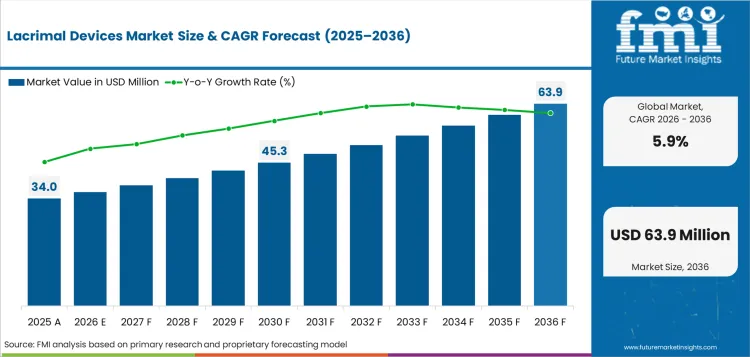
The lacrimal devices market was valued at USD 32.1 million in 2025. The market is anticipated to reach USD 34.0 million by 2026-end and grow at a CAGR of 5.9% between 2026 and 2036 to reach USD 60.4 million by 2036. Punctal plugs will dominate with a 38.0% product type share, while silicone will lead the material segment with a 61.0% share in 2026.
Summary of the Lacrimal Devices Market
- Demand and Growth Drivers
- Dry eye care supports demand for lacrimal devices as clinicians use punctal plugs when tear retention needs direct support.
- Obstructed tear drainage is expected to support use of stents and intubation tubes because post-procedure healing depends on stable duct patency.
- Outpatient ophthalmology care supports adoption as clinics handle diagnosis, plug placement and follow-up for tear drainage conditions.
- Product and Segment View
- Punctal plugs lead product demand, supported by use in dry eye care and simple outpatient placement.
- Silicone is expected to lead material demand because surgeons prefer flexible devices for intubation and drainage support.
- Bicanalicular stents dominate stent type because DCR procedures often require support across both canaliculi.
- Geography and Competitive Outlook
- India can record high growth owing to wider ophthalmology access and higher treatment movement across large patient pools.
- China is expected to expand steadily as specialty eye hospitals and outpatient eye care services increase procedure coverage.
- Companies combining clinical familiarity and ophthalmology channel access are likely to gain better acceptance during the forecast period.
- Analyst Opinion
- Sabyasachi Ghosh, Principal Consultant at FMI says, “Demand for lacrimal devices is likely to grow through better diagnosis of dry eye and tear drainage disorders. Companies that offer comfortable plugs, dependable silicone stents, and strong surgeon support are expected to strengthen their position.”
- Lacrimal Devices Market Value Analysis
- The lacrimal devices market is developing as a focused ophthalmic device category linked to dry eye care and tear drainage procedures.
- Adoption is being driven by punctal plugs used for tear retention in selected dry eye patients.
- Demand is supported by lacrimal stents and tubes used during DCR and canalicular repair.
- Market growth is tied to clinic access, surgeon training and availability of sterile ophthalmic consumables.
Key Takeaways
| Metric | Value |
|---|---|
| Market Size (2025) | USD 32.1 Million |
| Market Size (2036) | USD 60.4 Million |
| CAGR (2026–2036) | 5.9% |
| Incremental Opportunity (2026–2036) | USD 26.4 Million |
| Leading Product Type (2026) | Punctal Plugs |
| Punctal Plugs Share (2026) | 38.0% |
| Leading Material (2026) | Silicone |
| Silicone Share (2026) | 61.0% |
| Highlight | India (7.0%) and China (6.8%) are expected to rank among the faster-growing national markets through 2036 |
Lacrimal Devices Market Definition
The lacrimal devices market includes products used to manage tear retention and tear drainage problems in ophthalmic care. It covers punctal plugs used for dry eye support and lacrimal stents used for drainage pathway repair.
Lacrimal Devices Market Inclusions
Market scope includes all commercially traded lacrimal devices used for punctal occlusion, lacrimal intubation, duct dilation, probing support, and drainage pathway maintenance. It includes silicone stents, collagen plugs, hydrogel plugs, intubation sets, lacrimal cannulas, punctal dilators, and balloon catheters.
Lacrimal Devices Market Exclusions
Outside scope covers general ophthalmic eye drops, artificial tears, broad diagnostic machines, and surgical microscopes. Cataract implants, retinal implants, contact lenses, surgical lasers, and standard ophthalmic instruments without lacrimal use are outside the revenue base.
Lacrimal Devices Market Research Methodology
- Primary Research: FMI analysts assessed inputs from ophthalmologists, oculoplastic surgeons, eye clinic managers, and distributors active in lacrimal products. Interviews focused on device use across dry eye care, DCR procedures, canalicular repair, and outpatient treatment decisions.
- Desk Research: Research covered public clinical guidance, product catalogs, regulatory records, and healthcare access indicators. Related dry eye syndrome treatment data was used to understand the treatment pathway behind punctal plug demand.
- Market Sizing and Forecasting: The model used procedure volume estimates, device pricing, product replacement cycles, and country-level ophthalmology access. Segment shares were built from clinical use patterns and supplier positioning across plugs, stents, and intubation products.
- Data Validation: Forecasts were cross-checked against company portfolios, distributor coverage, and device use across ophthalmic clinics. FMI compared lacrimal device assumptions with ophthalmic surgical activity to assess procedure-linked demand.
Why is the Lacrimal Devices Market Growing?
- Dry eye diagnosis is increasing device use because punctal plugs help retain tears when topical therapy needs extra support.
- Tear duct obstruction drives stent demand because surgical repair often needs temporary support during healing.
- Ophthalmic clinics are expanding access to outpatient procedures, which supports faster use of plugs and minor lacrimal devices.
The market for lacrimal devices grows as dry eye care moves beyond lubricating drops for patients with persistent tear loss. Punctal plugs help clinicians reduce tear drainage and improve surface moisture in selected cases. These devices are simple to place during clinic visits and fit well into routine ophthalmology practice. Demand is high where eye specialists assess tear film quality and punctal anatomy before treatment. Broader diagnosis supports the use of temporary plugs before longer-term options are selected.
Surgical treatment for tear drainage disorders supports demand for stents, intubation tubes, and cannulas. The ophthalmic surgical need is clear because DCR and canalicular repair depend on small sterile devices that support healing. Surgeons use stents to keep the drainage pathway open after repair. Bicanalicular designs lead where both canaliculi need support. Monocanalicular systems fit selected trauma cases. Device choice depends on anatomy and expected healing time.
Market Segmentation Analysis
- Punctal plugs lead product type demand with 38.0% share in 2026.
- Bicanalicular stents lead stent type demand with 52.0% share in 2026.
- Silicone leads material demand with 61.0% share in 2026.
- Dry eye leads application demand with 35.0% share in 2026.
- DCR procedures lead procedure type demand with 41.0% share in 2026.
- Ophthalmic clinics lead end-user demand with 44.0% share in 2026.
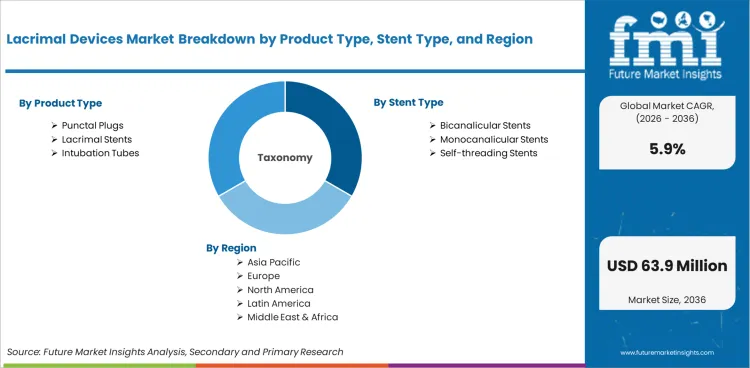
The lacrimal devices market is segmented by product type, stent type, material, application, procedure type, end user, and region. Product type includes punctal plugs, lacrimal stents, intubation tubes, lacrimal cannulas, balloon catheters, and punctal dilators. Stent type covers bicanalicular stents, monocanalicular stents, self-threading stents, and mini stents. Material includes silicone, collagen, hydrogel, polypropylene and metal. Application covers dry eye, epiphora, duct obstruction, canalicular trauma, punctal stenosis and postoperative support. Procedure type includes DCR procedures, punctal occlusion, lacrimal intubation, balloon dacryoplasty and canalicular repair. End user covers ophthalmic clinics, hospitals, surgery centers, eye hospitals and specialty centers. Demand is linked to dry eye care, tear drainage repair and post-surgical support. Segment leaders are driven by clinical familiarity, patient comfort and procedure fit across ophthalmic care settings.
Insights into the Punctal Plugs Product Type Segment
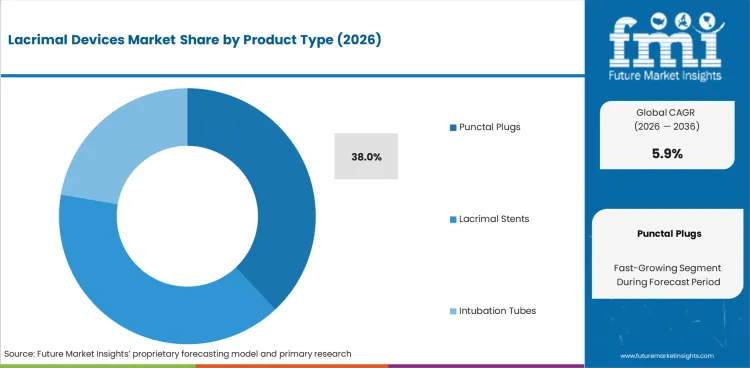
- Punctal plugs are expected to account for 38.0% share in 2026 because it supports tear retention in dry eye patients and can be placed during outpatient visits.
- Punctal plugs are widely used by ophthalmologists when eye drops need added support. Their simple placement and follow-up make them suitable for routine clinic-based care.
Insights into the Bicanalicular Stents Stent Type Segment
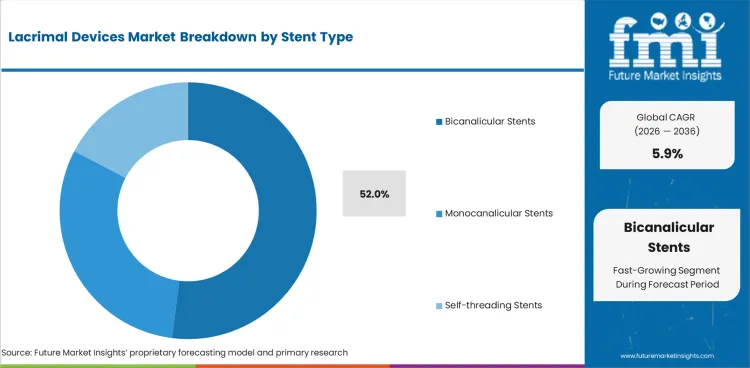
- Bicanalicular stents are projected to hold 52.0% share in 2026 as they supports both canaliculi during DCR and tear drainage repair procedures.
- Surgeons prefer bicanalicular stents where full drainage pathway support is needed after repair. Their use supports stable healing and better post-procedure duct patency.
Insights into the Silicone Material Segment
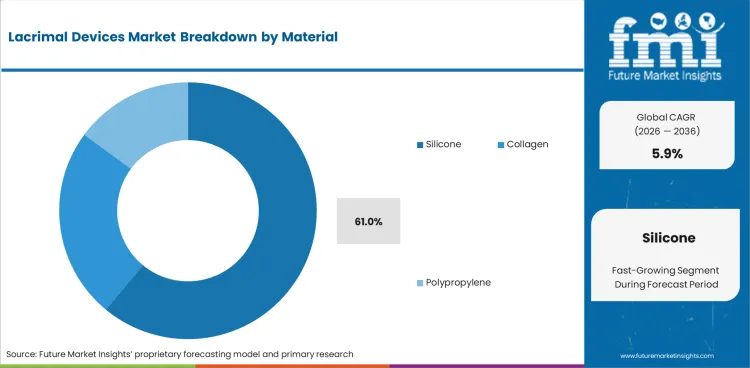
- Silicone is expected to account for 61.0% share in 2026. The material leads because it is flexible and suitable for delicate lacrimal tissue contact.
- Silicone is widely used in lacrimal stents and intubation tubes. Its soft handling helps during placement and removal, which supports adoption in surgical and outpatient settings.
Insights into the Dry Eye Application Segment
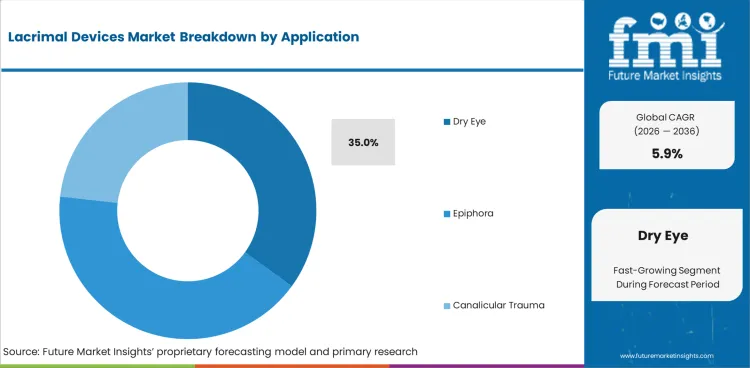
- Dry eye is projected to hold 35.0% share in 2026. Punctal plugs help retain tears when topical treatment needs added clinical support.
- Dry eye patients often move from lubricating drops to punctal occlusion when symptoms persist. This creates steady demand for temporary and longer-use plug options.
Insights into the DCR Procedures Procedure Type Segment
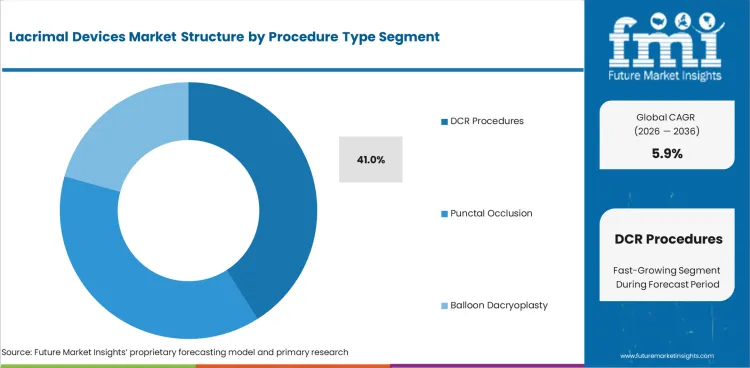
- DCR procedures are estimated to account for 41.0% share in 2026. They lead because tear duct obstruction often requires surgical drainage repair with device support.
- Stents and intubation tubes are used during DCR to help maintain drainage pathway opening during healing. Device selection depends on anatomy and surgeon preference during follow up.
Insights into the Ophthalmic Clinics End User Segment
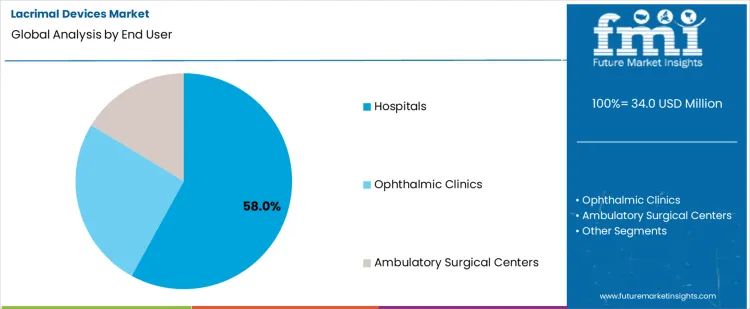
- Ophthalmic clinics are expected to hold 44.0% share in 2026. The end-user segment leads because dry eye assessment and punctal plug placement.
- Clinics also manage follow-up for tear drainage symptoms and refer complex cases for surgery. Their strong patient flow supports regular use of plugs and basic lacrimal devices.
Lacrimal Devices Market Drivers, Restraints, and Opportunities
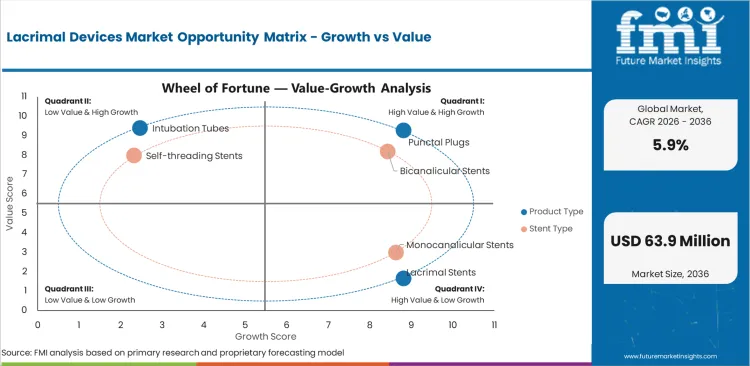
- Dry eye care supports punctal plug use as clinicians look for device-based tear retention options.
- Specialist training needs can slow procedure-linked device adoption in smaller care networks.
- Product improvement is creating better plug comfort and easier stent placement for ophthalmic users.
The market is expanding through better diagnosis of dry eye and drainage disorders. Patient symptoms such as watering, irritation and dryness often lead to clinical evaluation. Once the cause is confirmed or intubation products based on the condition. Growth depends on access to trained ophthalmologists and product availability. Device suppliers need to support clinical confidence because each product is used in a small and sensitive anatomical area.
Dry Eye Treatment Demand
Demand is supported by dry eye patients who need support beyond lubricating drops. Temporary plugs give clinicians a practical way to test benefit before longer-term occlusion. Patient comfort is important because plug irritation can affect follow-up decisions. This keeps product design focused on size range and ease of placement. Growth is likely to come from clinics that actively manage chronic ocular surface symptoms.
Procedure Training Needs
Procedure-linked adoption depends on trained surgeons and careful post-operative follow-up. Stents and intubation tubes must be placed correctly to support duct patency and patient recovery. A 2024 ophthalmology workforce study projected a 30% ophthalmologist workforce inadequacy in the United States by 2035, with supply expected to decline by 12% and demand expected to rise by 24%. Suppliers can improve acceptance through training materials and dependable product guidance. Hospitals and specialty eye centers are likely to account for higher-value procedure demand.
Product Improvement
Product improvement centers on comfort, retention, and simple handling. The therapeutic contact lenses shows how eye-contact products must balance function with patient comfort. Lacrimal plug makers focus on better sizing and reduced extrusion. Stent suppliers focus on atraumatic tips and easier removal after healing. Silicone devices lead because clinicians know how they behave during insertion. Product gains are expected to support repeat use where ophthalmologists trust the device and patients tolerate placement well.
Lacrimal Devices Market CAGR Analysis by Country
.webp "Top Country Growth Comparison Lacrimal Devices Market Cagr (2026 2036)")
| Country | CAGR |
|---|---|
| India | 7.0% |
| China | 6.8% |
| Brazil | 5.8% |
| United States | 5.5% |
| Germany | 4.9% |
| United Kingdom | 4.7% |
| Japan | 4.3% |
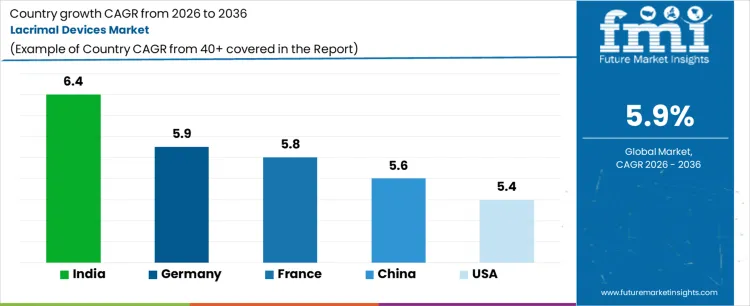
Source: FMI analysis based on primary research and proprietary forecasting model
Lacrimal Devices Market Analysis by Country
- India is expected to lead major country growth with 7.0% CAGR through 2036.
- China follows with 6.8% CAGR, helped by wider specialty eye care access.
- Brazil is forecast to post 5.8% CAGR as private ophthalmology networks expand device use.
- The United States is likely to grow at 5.5% CAGR through 2036, led by established ophthalmology practices.
- Germany is projected to record 4.9% CAGR, while the United Kingdom may grow at 4.7% CAGR.
- Japan is expected to grow at 4.3% CAGR from 2026 to 2036, reflecting steady specialist care use.
- The global market is projected to rise at a CAGR of 5.9% over the forecast period.
Demand Outlook for Lacrimal Devices Market in the United States
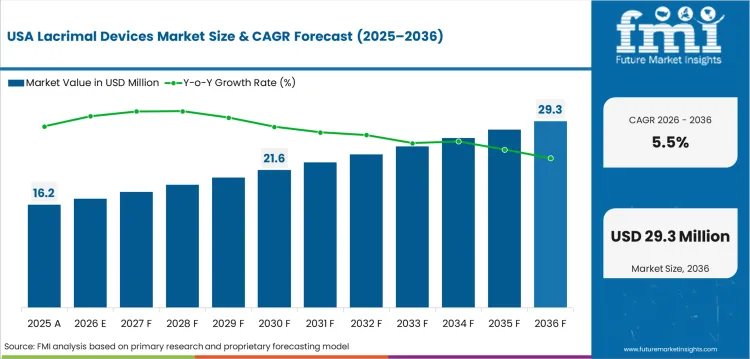
Established ophthalmology practices keep the United States an important market for lacrimal devices. The market is forecast to record a CAGR of 5.5% through 2036 as punctal plugs expand in dry eye care and stents support tear duct repair. Oculoplastic surgeons continue to use intubation products during DCR and canalicular procedures. Product familiarity and sterile quality influence supplier selection across clinics and hospitals.
- Outpatient clinics use punctal plugs regularly for dry eye symptom management.
- Oculoplastic surgeons use stents to support tear duct repair procedures.
- Established supply channels improve access to sterile lacrimal products.
Future Outlook for Lacrimal Devices Market in the United Kingdom
Ophthalmology referrals and dry eye management are expected to support steady lacrimal device use in the United Kingdom. The U.K. market is likely to expand at a CAGR of 4.7% from 2026 to 2036. Punctal plugs will support tear retention care, while stents and intubation tubes will be used in specialist tear duct procedures. Public and private care pathways will influence treatment timing and product access.
- Specialist referrals guide suitable use of plugs and lacrimal stents.
- Procedure capacity affects the timing of surgical device demand.
- Tender access helps suppliers reach public and private care networks.
Opportunity Analysis of Lacrimal Devices Market in Germany
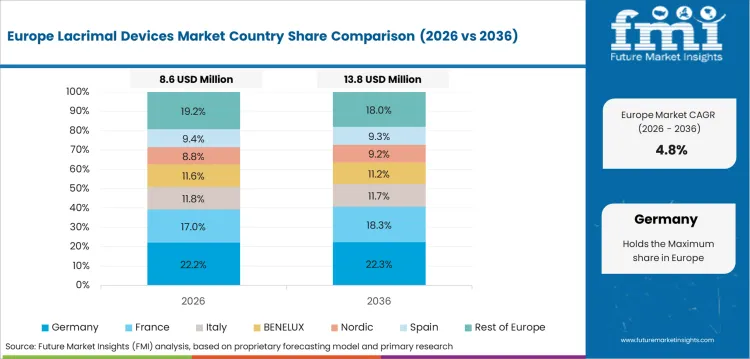
Germany has a structured eye care base with trained ophthalmic specialists and established surgical pathways. Lacrimal devices market in Germany is forecast to grow at a CAGR of 4.9% through 2036. Clinics and hospitals will use punctal plugs for dry eye care and stents for duct obstruction procedures. Suppliers will need clear product documentation, quality consistency, and reliable supply to improve acceptance.
- Specialist clinics improve diagnosis of tear drainage disorders.
- CE-compliant products support smoother supplier acceptance across facilities.
- Hospital-based care sustains use of stents and cannulas.
In-depth Analysis of Lacrimal Devices Market in Japan
Aging-related eye care needs support steady lacrimal device use across Japan. The Japan lacrimal devices market is expected to grow at a CAGR of 4.3% by 2036. Dry eye management will support punctal plugs in routine specialist care. Surgeon preference and procedure volume will guide stent demand. Product consistency and simple placement will influence supplier selection.
- Aging patients increase demand for specialist lacrimal care.
- Product consistency supports clinician confidence during repeat procedures.
- Surgeon preference guides adoption of stents and punctal plugs.
Sales Analysis of Lacrimal Devices Market in China
Lacrimal devices market in China is projected to advance at 6.8% CAGR from 2026 to 2036. Specialty eye hospitals expand access to dry eye and tear drainage treatment in China. Punctal plugs can increase use as dry eye diagnosis improves. Stent demand can rise in advanced clinical centers where DCR and obstruction procedures are performed frequently.
- Urban eye hospitals increase use of stents and intubation tubes.
- Dry eye diagnosis improves demand for punctal plug treatment.
- Surgeon training supports broader acceptance of procedure-based devices.
In-depth Analysis of Lacrimal Devices Market in India
Private eye hospitals and specialty clinics are improving access to lacrimal care in India. The country is expected to lead with 7.0% CAGR through 2036. Punctal plugs will see adoption as clinicians manage chronic dry eye symptoms. Stents and intubation tubes will benefit from wider DCR access in large cities. Distributor coverage will influence product availability across tier two urban centers.
- Private eye hospitals increase use of plugs and stents.
- Wider diagnosis improves referrals for duct obstruction treatment.
- Distributor reach supports product availability beyond large cities.
Competitive Landscape and Strategic Positioning
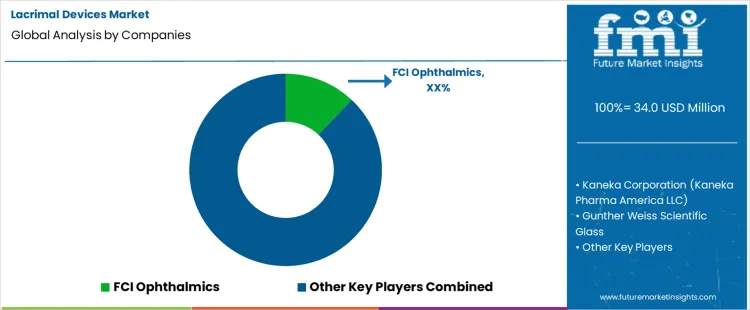
- The market is moderately concentrated with specialist ophthalmic suppliers leading product availability.
- Leading companies compete on product quality, sterile supply and clinician familiarity.
- Smaller suppliers can gain traction through niche plug designs and focused surgeon support.
Competition in lacrimal devices depends on clinical trust and product handling. FCI Ophthalmics, BVI Medical, Kaneka, Lacrimedics, Rumex, Bess Medizintechnik and Gunther Weiss Scientific are active suppliers. Surgeons assess devices by ease of placement and removal. Product portfolios that include plugs and stents have an advantage because clinics may prefer fewer suppliers for related lacrimal needs. Reliable sterile supply also affects purchasing decisions in hospitals and surgery centers.
Large ophthalmic suppliers benefit from existing relationships with surgeons and healthcare facilities. BVI Medical has wider ophthalmic surgical reach. FCI Ophthalmics has a clear association with lacrimal plugs and stents. Kaneka brings medical polymer and device experience. These companies can compete where hospitals need documented quality and consistent supply.
Specialist companies can gain share through focused product design and surgeon education. Lacrimedics has a position in punctal plug products. Rumex and Bess Medizintechnik serve ophthalmic specialists through instruments and related procedure products. Gunther Weiss Scientific supports specialist surgical users. Smaller suppliers can build demand where products solve a specific handling concern.
Key Companies in the Lacrimal Devices Market
Key global companies leading the lacrimal devices market include:
- FCI Ophthalmics, BVI Medical and Kaneka are major suppliers with wider ophthalmic device reach. These companies compete through product documentation and access to hospital purchasing systems.
- Lacrimedics, Rumex, and Bess Medizintechnik are specialist suppliers with strong relevance in plugs, instruments, and procedure-linked products. Their value comes from focused product lines and close engagement with ophthalmic users.
- Gunther Weiss Scientific, Cook Medical and EagleVision serve selected lacrimal or ophthalmic procedure needs. These companies support the market through niche products and surgeon-focused device access.
Competitive Benchmarking: Lacrimal Devices Market
| Company | Product Breadth | Clinical Familiarity | Channel Reach | Geographic Footprint |
|---|---|---|---|---|
| FCI Ophthalmics | High | Strong | High | Global |
| BVI Medical | High | Strong | High | Global |
| Kaneka | Medium | Medium | High | Multi-region |
| Lacrimedics | Medium | Strong | Medium | Multi-region |
| Rumex | Medium | Medium | Medium | Multi-region |
| Bess Medizintechnik | Medium | Medium | Medium | Europe |
| Gunther Weiss Scientific | Medium | Medium | Medium | Europe |
| Cook Medical | Low | Medium | High | Global |
| MedOne Surgical | Low | Medium | Medium | North America |
| EagleVision | Medium | Strong | Medium | North America |
Source: Future Market Insights competitive analysis, 2026.
Key Developments in Lacrimal Devices Market
In March 2025, BVI Medical strengthened its ophthalmic surgery portfolio through specialty procedure products, supporting its role across clinical consumables.
In March 2025, FCI Ophthalmics kept its focus on lacrimal plugs and stents, supporting demand across dry eye and tear drainage care.
Key Players in the Lacrimal Devices Market
Major Global Players
- FCI Ophthalmics
- BVI Medical
- Kaneka
- Cook Medical
- EagleVision
Emerging Players/Startups
- Lacrimedics
- Rumex
- Bess Medizintechnik
- Gunther Weiss Scientific
- MedOne Surgical
Report Scope and Coverage
| Parameter | Details |
|---|---|
| Quantitative Units | USD 34.0 million to USD 60.4 million, at a CAGR of 5.9% |
| Market Definition | Lacrimal devices include plugs, stents, tubes, cannulas, dilators, and balloon devices used for tear retention and tear drainage management. |
| Regions Covered | North America, Latin America, Europe, East Asia, South Asia and Pacific, Middle East and Africa |
| Countries Covered | United States, Germany, United Kingdom, Japan, China, India, Brazil, and 30 plus countries |
| Key Companies Profiled | FCI Ophthalmics, BVI Medical, Kaneka, Lacrimedics, Rumex, Bess Medizintechnik, Gunther Weiss Scientific, Cook Medical, MedOne Surgical, EagleVision |
| Forecast Period | 2026 to 2036 |
| Approach | Bottom-up device sizing based on procedure use, product pricing, clinical adoption and country-level ophthalmology access. |
Lacrimal Devices Market by Segments
Lacrimal Devices Market Segmented by Product Type
- Punctal Plugs
- Lacrimal Stents
- Intubation Tubes
- Lacrimal Cannulas
- Balloon Catheters
- Punctal Dilators
Lacrimal Devices Market Segmented by Stent Type
- Bicanalicular Stents
- Monocanalicular Stents
- Self-threading Stents
- Mini Stents
Lacrimal Devices Market Segmented by Material
- Silicone
- Collagen
- Hydrogel
- Polypropylene
- Metal
Lacrimal Devices Market Segmented by Application
- Dry Eye
- Epiphora
- Duct Obstruction
- Canalicular Trauma
- Punctal Stenosis
- Postoperative Support
Lacrimal Devices Market Segmented by Procedure Type
- DCR Procedures
- Punctal Occlusion
- Lacrimal Intubation
- Balloon Dacryoplasty
- Canalicular Repair
Lacrimal Devices Market Segmented by End User
- Ophthalmic Clinics
- Hospitals
- Surgery Centers
- Eye Hospitals
- Specialty Centers
Lacrimal Devices Market by Region
- North America
- USA
- Canada
- Mexico
- Latin America
- Brazil
- Chile
- Rest of Latin America
- Western Europe
- Germany
- UK
- Italy
- Spain
- France
- Nordic
- BENELUX
- Rest of Western Europe
- Eastern Europe
- Russia
- Poland
- Hungary
- Balkan & Baltic
- Rest of Eastern Europe
- East Asia
- China
- Japan
- South Korea
- South Asia and Pacific
- India
- ASEAN
- Australia & New Zealand
- Rest of South Asia and Pacific
- Middle East & Africa
- Kingdom of Saudi Arabia
- Other GCC Countries
- Turkiye
- South Africa
- Other African Union
- Rest of Middle East & Africa
Bibliography
- FCI Ophthalmics. (2025, March). Do your eyes feel dry?
- BVI Medical. (2025, March 10). BVI Medical secures strategic capital raise to fuel global growth and innovation.
- Berkowitz, S. T., Finn, A. P., Parikh, R., Kuriyan, A. E., Patel, S., & Oke, I. (2024). Ophthalmology workforce projections in the United States, 2020 to 2035. Ophthalmology.
- Kaneka Corporation. (2025, November 12). Kaneka signs business transfer agreement for Zeon Corporation’s medical device business.
- American Academy of Ophthalmology. (2024, September 30). Punctal plugs.
- National Eye Institute. (2025, August 6). Dry eye.
This Report Answers
- What is the current and future size of the lacrimal devices market?
- How fast is the lacrimal devices market expected to grow between 2026 and 2036?
- Which product type is likely to lead the market by 2026?
- Which material segment is expected to account for the highest demand by 2026?
- What factors are driving demand for lacrimal devices globally?
- How are dry eye care pathways influencing punctal plug adoption?
- Why are DCR procedures supporting use of lacrimal stents?
- Which countries are projected to show the fastest growth through 2036?
- What is driving market expansion in India and China?
- Who are the key companies active in the lacrimal devices market?
- How does FMI estimate and validate the market forecast?
Frequently Asked Questions
What is the global market demand for Lacrimal Devices in 2026?
In 2026, the global Lacrimal Devices Market is expected to reach USD 34.0 million and remain tied to tear drainage care.
How big will the Lacrimal Devices Market be in 2036?
By 2036, the Lacrimal Devices Market is expected to reach USD 60.4 million as outpatient lacrimal procedures keep widening.
How much will demand for Lacrimal Devices grow between 2026 and 2036?
Between 2026 and 2036, demand for Lacrimal Devices is expected to expand at a 5.9% CAGR across the base forecast.
Which product type segment is likely to lead Lacrimal Devices demand by 2026?
Bicanalicular Stents are expected to lead Lacrimal Devices demand by 2026 with 52.0% share due to DCR support use.
Which material segment is expected to lead Lacrimal Devices demand by 2026?
Silicone is expected to lead Lacrimal Devices material demand by 2026 with 64.0% share because tubing behavior is familiar.
What is causing Lacrimal Devices demand to rise in India?
India is expected to grow at 7.2% CAGR through 2036 because private eye care access is expanding.
What is causing Lacrimal Devices demand to rise in China?
China is expected to grow at 6.8% CAGR through 2036 because outpatient ophthalmology capacity continues to broaden.
What does this report mean by Lacrimal Devices Market definition?
The Lacrimal Devices Market includes stents, plugs, tubes, catheters, and cannulas used in lacrimal drainage care.
Preview the report firsthand - request a free sample
Get SampleGet the brochure for pricing and purchase details.
Get PDFTable of Content
- Executive Summary
- Global Market Outlook
- Demand-side Trends
- Supply-side Trends
- Technology Roadmap Analysis
- Analysis and Recommendations
- Market Overview
- Market Coverage / Taxonomy
- Market Definition / Scope / Limitations
- Research Methodology
- Chapter Orientation
- Analytical Lens and Working Hypotheses
- Market Structure, Signals, and Trend Drivers
- Benchmarking and Cross-market Comparability
- Market Sizing, Forecasting, and Opportunity Mapping
- Research Design and Evidence Framework
- Desk Research Programme (Secondary Evidence)
- Company Annual and Sustainability Reports
- Peer-reviewed Journals and Academic Literature
- Corporate Websites, Product Literature, and Technical Notes
- Earnings Decks and Investor Briefings
- Statutory Filings and Regulatory Disclosures
- Technical White Papers and Standards Notes
- Trade Journals, Industry Magazines, and Analyst Briefs
- Conference Proceedings, Webinars, and Seminar Materials
- Government Statistics Portals and Public Data Releases
- Press Releases and Reputable Media Coverage
- Specialist Newsletters and Curated Briefings
- Sector Databases and Reference Repositories
- FMI Internal Proprietary Databases and Historical Market Datasets
- Subscription Datasets and Paid Sources
- Social Channels, Communities, and Digital Listening Inputs
- Additional Desk Sources
- Expert Input and Fieldwork (Primary Evidence)
- Primary Modes
- Qualitative Interviews and Expert Elicitation
- Quantitative Surveys and Structured Data Capture
- Blended Approach
- Why Primary Evidence is Used
- Field Techniques
- Interviews
- Surveys
- Focus Groups
- Observational and In-context Research
- Social and Community Interactions
- Stakeholder Universe Engaged
- C-suite Leaders
- Board Members
- Presidents and Vice Presidents
- R&D and Innovation Heads
- Technical Specialists
- Domain Subject-matter Experts
- Scientists
- Physicians and Other Healthcare Professionals
- Governance, Ethics, and Data Stewardship
- Research Ethics
- Data Integrity and Handling
- Primary Modes
- Tooling, Models, and Reference Databases
- Desk Research Programme (Secondary Evidence)
- Data Engineering and Model Build
- Data Acquisition and Ingestion
- Cleaning, Normalisation, and Verification
- Synthesis, Triangulation, and Analysis
- Quality Assurance and Audit Trail
- Market Background
- Market Dynamics
- Drivers
- Restraints
- Opportunity
- Trends
- Scenario Forecast
- Demand in Optimistic Scenario
- Demand in Likely Scenario
- Demand in Conservative Scenario
- Opportunity Map Analysis
- Product Life Cycle Analysis
- Supply Chain Analysis
- Investment Feasibility Matrix
- Value Chain Analysis
- PESTLE and Porter’s Analysis
- Regulatory Landscape
- Regional Parent Market Outlook
- Production and Consumption Statistics
- Import and Export Statistics
- Market Dynamics
- Global Market Analysis 2021 to 2025 and Forecast, 2026 to 2036
- Historical Market Size Value (USD Million) Analysis, 2021 to 2025
- Current and Future Market Size Value (USD Million) Projections, 2026 to 2036
- Y-o-Y Growth Trend Analysis
- Absolute $ Opportunity Analysis
- Global Market Pricing Analysis 2021 to 2025 and Forecast 2026 to 2036
- Global Market Analysis 2021 to 2025 and Forecast 2026 to 2036, By Product Type
- Introduction / Key Findings
- Historical Market Size Value (USD Million) Analysis By Product Type , 2021 to 2025
- Current and Future Market Size Value (USD Million) Analysis and Forecast By Product Type , 2026 to 2036
- Punctal Plugs
- Lacrimal Stents
- Intubation Tubes
- Punctal Plugs
- Y-o-Y Growth Trend Analysis By Product Type , 2021 to 2025
- Absolute $ Opportunity Analysis By Product Type , 2026 to 2036
- Global Market Analysis 2021 to 2025 and Forecast 2026 to 2036, By Stent Type
- Introduction / Key Findings
- Historical Market Size Value (USD Million) Analysis By Stent Type, 2021 to 2025
- Current and Future Market Size Value (USD Million) Analysis and Forecast By Stent Type, 2026 to 2036
- Bicanalicular Stents
- Monocanalicular Stents
- Self-threading Stents
- Bicanalicular Stents
- Y-o-Y Growth Trend Analysis By Stent Type, 2021 to 2025
- Absolute $ Opportunity Analysis By Stent Type, 2026 to 2036
- Global Market Analysis 2021 to 2025 and Forecast 2026 to 2036, By Material
- Introduction / Key Findings
- Historical Market Size Value (USD Million) Analysis By Material, 2021 to 2025
- Current and Future Market Size Value (USD Million) Analysis and Forecast By Material, 2026 to 2036
- Silicone
- Collagen
- Polypropylene
- Silicone
- Y-o-Y Growth Trend Analysis By Material, 2021 to 2025
- Absolute $ Opportunity Analysis By Material, 2026 to 2036
- Global Market Analysis 2021 to 2025 and Forecast 2026 to 2036, By Application
- Introduction / Key Findings
- Historical Market Size Value (USD Million) Analysis By Application, 2021 to 2025
- Current and Future Market Size Value (USD Million) Analysis and Forecast By Application, 2026 to 2036
- Dry Eye
- Epiphora
- Canalicular Trauma
- Dry Eye
- Y-o-Y Growth Trend Analysis By Application, 2021 to 2025
- Absolute $ Opportunity Analysis By Application, 2026 to 2036
- Global Market Analysis 2021 to 2025 and Forecast 2026 to 2036, By Procedure Type
- Introduction / Key Findings
- Historical Market Size Value (USD Million) Analysis By Procedure Type, 2021 to 2025
- Current and Future Market Size Value (USD Million) Analysis and Forecast By Procedure Type, 2026 to 2036
- DCR Procedures
- Punctal Occlusion
- Balloon Dacryoplasty
- DCR Procedures
- Y-o-Y Growth Trend Analysis By Procedure Type, 2021 to 2025
- Absolute $ Opportunity Analysis By Procedure Type, 2026 to 2036
- Global Market Analysis 2021 to 2025 and Forecast 2026 to 2036, By End User
- Introduction / Key Findings
- Historical Market Size Value (USD Million) Analysis By End User, 2021 to 2025
- Current and Future Market Size Value (USD Million) Analysis and Forecast By End User, 2026 to 2036
- Ophthalmic Clinics
- Hospitals
- Eye Hospitals
- Ophthalmic Clinics
- Y-o-Y Growth Trend Analysis By End User, 2021 to 2025
- Absolute $ Opportunity Analysis By End User, 2026 to 2036
- Global Market Analysis 2021 to 2025 and Forecast 2026 to 2036, By Region
- Introduction
- Historical Market Size Value (USD Million) Analysis By Region, 2021 to 2025
- Current Market Size Value (USD Million) Analysis and Forecast By Region, 2026 to 2036
- North America
- Latin America
- Western Europe
- Eastern Europe
- East Asia
- South Asia and Pacific
- Middle East & Africa
- Market Attractiveness Analysis By Region
- North America Market Analysis 2021 to 2025 and Forecast 2026 to 2036, By Country
- Historical Market Size Value (USD Million) Trend Analysis By Market Taxonomy, 2021 to 2025
- Market Size Value (USD Million) Forecast By Market Taxonomy, 2026 to 2036
- By Country
- USA
- Canada
- Mexico
- By Product Type
- By Stent Type
- By Material
- By Application
- By Procedure Type
- By End User
- By Country
- Market Attractiveness Analysis
- By Country
- By Product Type
- By Stent Type
- By Material
- By Application
- By Procedure Type
- By End User
- Key Takeaways
- Latin America Market Analysis 2021 to 2025 and Forecast 2026 to 2036, By Country
- Historical Market Size Value (USD Million) Trend Analysis By Market Taxonomy, 2021 to 2025
- Market Size Value (USD Million) Forecast By Market Taxonomy, 2026 to 2036
- By Country
- Brazil
- Chile
- Rest of Latin America
- By Product Type
- By Stent Type
- By Material
- By Application
- By Procedure Type
- By End User
- By Country
- Market Attractiveness Analysis
- By Country
- By Product Type
- By Stent Type
- By Material
- By Application
- By Procedure Type
- By End User
- Key Takeaways
- Western Europe Market Analysis 2021 to 2025 and Forecast 2026 to 2036, By Country
- Historical Market Size Value (USD Million) Trend Analysis By Market Taxonomy, 2021 to 2025
- Market Size Value (USD Million) Forecast By Market Taxonomy, 2026 to 2036
- By Country
- Germany
- UK
- Italy
- Spain
- France
- Nordic
- BENELUX
- Rest of Western Europe
- By Product Type
- By Stent Type
- By Material
- By Application
- By Procedure Type
- By End User
- By Country
- Market Attractiveness Analysis
- By Country
- By Product Type
- By Stent Type
- By Material
- By Application
- By Procedure Type
- By End User
- Key Takeaways
- Eastern Europe Market Analysis 2021 to 2025 and Forecast 2026 to 2036, By Country
- Historical Market Size Value (USD Million) Trend Analysis By Market Taxonomy, 2021 to 2025
- Market Size Value (USD Million) Forecast By Market Taxonomy, 2026 to 2036
- By Country
- Russia
- Poland
- Hungary
- Balkan & Baltic
- Rest of Eastern Europe
- By Product Type
- By Stent Type
- By Material
- By Application
- By Procedure Type
- By End User
- By Country
- Market Attractiveness Analysis
- By Country
- By Product Type
- By Stent Type
- By Material
- By Application
- By Procedure Type
- By End User
- Key Takeaways
- East Asia Market Analysis 2021 to 2025 and Forecast 2026 to 2036, By Country
- Historical Market Size Value (USD Million) Trend Analysis By Market Taxonomy, 2021 to 2025
- Market Size Value (USD Million) Forecast By Market Taxonomy, 2026 to 2036
- By Country
- China
- Japan
- South Korea
- By Product Type
- By Stent Type
- By Material
- By Application
- By Procedure Type
- By End User
- By Country
- Market Attractiveness Analysis
- By Country
- By Product Type
- By Stent Type
- By Material
- By Application
- By Procedure Type
- By End User
- Key Takeaways
- South Asia and Pacific Market Analysis 2021 to 2025 and Forecast 2026 to 2036, By Country
- Historical Market Size Value (USD Million) Trend Analysis By Market Taxonomy, 2021 to 2025
- Market Size Value (USD Million) Forecast By Market Taxonomy, 2026 to 2036
- By Country
- India
- ASEAN
- Australia & New Zealand
- Rest of South Asia and Pacific
- By Product Type
- By Stent Type
- By Material
- By Application
- By Procedure Type
- By End User
- By Country
- Market Attractiveness Analysis
- By Country
- By Product Type
- By Stent Type
- By Material
- By Application
- By Procedure Type
- By End User
- Key Takeaways
- Middle East & Africa Market Analysis 2021 to 2025 and Forecast 2026 to 2036, By Country
- Historical Market Size Value (USD Million) Trend Analysis By Market Taxonomy, 2021 to 2025
- Market Size Value (USD Million) Forecast By Market Taxonomy, 2026 to 2036
- By Country
- Kingdom of Saudi Arabia
- Other GCC Countries
- Turkiye
- South Africa
- Other African Union
- Rest of Middle East & Africa
- By Product Type
- By Stent Type
- By Material
- By Application
- By Procedure Type
- By End User
- By Country
- Market Attractiveness Analysis
- By Country
- By Product Type
- By Stent Type
- By Material
- By Application
- By Procedure Type
- By End User
- Key Takeaways
- Key Countries Market Analysis
- USA
- Pricing Analysis
- Market Share Analysis, 2025
- By Product Type
- By Stent Type
- By Material
- By Application
- By Procedure Type
- By End User
- Canada
- Pricing Analysis
- Market Share Analysis, 2025
- By Product Type
- By Stent Type
- By Material
- By Application
- By Procedure Type
- By End User
- Mexico
- Pricing Analysis
- Market Share Analysis, 2025
- By Product Type
- By Stent Type
- By Material
- By Application
- By Procedure Type
- By End User
- Brazil
- Pricing Analysis
- Market Share Analysis, 2025
- By Product Type
- By Stent Type
- By Material
- By Application
- By Procedure Type
- By End User
- Chile
- Pricing Analysis
- Market Share Analysis, 2025
- By Product Type
- By Stent Type
- By Material
- By Application
- By Procedure Type
- By End User
- Germany
- Pricing Analysis
- Market Share Analysis, 2025
- By Product Type
- By Stent Type
- By Material
- By Application
- By Procedure Type
- By End User
- UK
- Pricing Analysis
- Market Share Analysis, 2025
- By Product Type
- By Stent Type
- By Material
- By Application
- By Procedure Type
- By End User
- Italy
- Pricing Analysis
- Market Share Analysis, 2025
- By Product Type
- By Stent Type
- By Material
- By Application
- By Procedure Type
- By End User
- Spain
- Pricing Analysis
- Market Share Analysis, 2025
- By Product Type
- By Stent Type
- By Material
- By Application
- By Procedure Type
- By End User
- France
- Pricing Analysis
- Market Share Analysis, 2025
- By Product Type
- By Stent Type
- By Material
- By Application
- By Procedure Type
- By End User
- India
- Pricing Analysis
- Market Share Analysis, 2025
- By Product Type
- By Stent Type
- By Material
- By Application
- By Procedure Type
- By End User
- ASEAN
- Pricing Analysis
- Market Share Analysis, 2025
- By Product Type
- By Stent Type
- By Material
- By Application
- By Procedure Type
- By End User
- Australia & New Zealand
- Pricing Analysis
- Market Share Analysis, 2025
- By Product Type
- By Stent Type
- By Material
- By Application
- By Procedure Type
- By End User
- China
- Pricing Analysis
- Market Share Analysis, 2025
- By Product Type
- By Stent Type
- By Material
- By Application
- By Procedure Type
- By End User
- Japan
- Pricing Analysis
- Market Share Analysis, 2025
- By Product Type
- By Stent Type
- By Material
- By Application
- By Procedure Type
- By End User
- South Korea
- Pricing Analysis
- Market Share Analysis, 2025
- By Product Type
- By Stent Type
- By Material
- By Application
- By Procedure Type
- By End User
- Russia
- Pricing Analysis
- Market Share Analysis, 2025
- By Product Type
- By Stent Type
- By Material
- By Application
- By Procedure Type
- By End User
- Poland
- Pricing Analysis
- Market Share Analysis, 2025
- By Product Type
- By Stent Type
- By Material
- By Application
- By Procedure Type
- By End User
- Hungary
- Pricing Analysis
- Market Share Analysis, 2025
- By Product Type
- By Stent Type
- By Material
- By Application
- By Procedure Type
- By End User
- Kingdom of Saudi Arabia
- Pricing Analysis
- Market Share Analysis, 2025
- By Product Type
- By Stent Type
- By Material
- By Application
- By Procedure Type
- By End User
- Turkiye
- Pricing Analysis
- Market Share Analysis, 2025
- By Product Type
- By Stent Type
- By Material
- By Application
- By Procedure Type
- By End User
- South Africa
- Pricing Analysis
- Market Share Analysis, 2025
- By Product Type
- By Stent Type
- By Material
- By Application
- By Procedure Type
- By End User
- USA
- Market Structure Analysis
- Competition Dashboard
- Competition Benchmarking
- Market Share Analysis of Top Players
- By Regional
- By Product Type
- By Stent Type
- By Material
- By Application
- By Procedure Type
- By End User
- Competition Analysis
- Competition Deep Dive
- FCI Ophthalmics
- Overview
- Product Portfolio
- Profitability by Market Segments (Product/Age /Sales Channel/Region)
- Sales Footprint
- Strategy Overview
- Marketing Strategy
- Product Strategy
- Channel Strategy
- BVI Medical
- Kaneka
- Cook Medical
- EagleVision
- Lacrimedics
- FCI Ophthalmics
- Competition Deep Dive
- Assumptions & Acronyms Used


