

- Industry Size (2026)
- USD 9.27 Bn
- Forecast (2036)
- USD 13.99 Bn
- CAGR (2026 to 2036)
- 4.2%
Orthotic Devices, Orthotic Splints, and Orthopedic Braces and Support Market Size, Market Forecast and Outlook By FMI
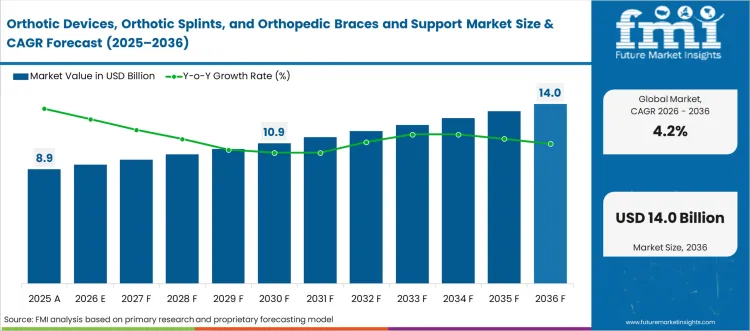
The orthotic devices, orthotic splints, and orthopedic braces and support market was valued at USD 8.90 billion in 2025, projected to reach USD 9.27 billion in 2026, and is forecast to expand to USD 13.99 billion by 2036 at a 4.2% CAGR. Based on FMI's analysis, FMI analysts observe that the orthotic devices and braces market is a mature, volume-driven category where growth tracks aging demographics and rising sports injury incidence across global populations. The market sits at the intersection of medical device regulation and consumer retail, with prescription braces sold through hospital channels coexisting alongside over-the-counter knee sleeves and wrist supports sold through pharmacies and e-commerce platforms.
Summary of Orthotic Devices, Orthotic Splints, and Orthopedic Braces and Support Market
- Market Snapshot
- The orthotic devices, orthotic splints, and orthopedic braces and support market is valued at USD 8.90 billion in 2025 and is projected to reach USD 13.99 billion by 2036.
- The industry is expected to grow at a 4.2% CAGR from 2026 to 2036, creating an incremental opportunity of USD 4.72 billion.
- The market is positioned within the orthopedic devices and rehabilitation equipment sector, where regulatory requirements, technology adoption cycles, and procurement consolidation define competitive entry barriers.
- Demand and Growth Drivers
- Aging population and osteoarthritis prevalence: The WHO estimates that over 500 million people globally live with osteoarthritis, with prevalence increasing directly with age.
- Sports injury incidence and youth athletics participation: Rising youth participation in organized sports across India, China, and Brazil is increasing the incidence of ligament sprains, fractures, and overuse injuries that require bracing during recovery.
- Reimbursement expansion in developing markets: India's Ayushman Bharat health insurance scheme and China's National Healthcare Security Administration (NHSA) have expanded coverage lists to include select orthotic devices for post-surgical rehabilitation.
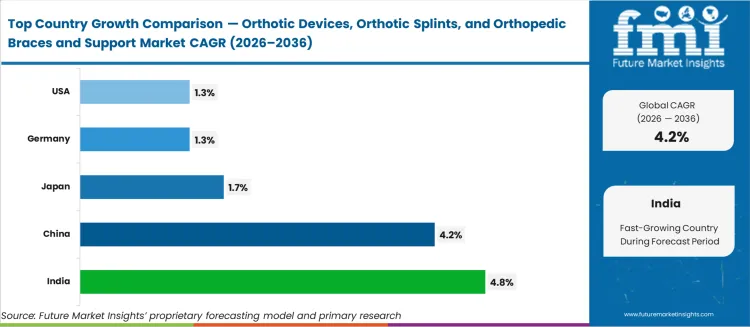
- As per FMI, among key countries, India leads at 4.8% CAGR, followed by China at 4.2%, Japan at 1.7%, and USA at 1.3%.
- Product and Segment View
- The market includes orthotic devices, orthotic splints, and orthopedic braces and supports are external medical devices applied to the body to correct alignment, stabilize joints, redistribute load, and support musculoskeletal structures during injury recovery or chronic condition management.
- Knee leads by Product with 15.5% share in 2026.
- Ligament leads by Application with 43.6% share in 2026.
- Scope includes orthotic devices, splints, braces, and supports sold globally across hospital, ambulatory, and homecare channels. The scope excludes prosthetic limbs and prosthetic components, surgical implants such as internal fixation plates and screws, powered exoskeletons used for rehabilitation robotics, and custom-molded orthotics manufactured exclusively by podiatric laboratories for foot correction.
- Geography and Competitive Outlook
- India and China are the fastest-growing markets, while Germany and USA represent mature demand bases.
- Competition is shaped by DeRoyal Industries competes primarily in the US hospital supply channel.
- Key companies include Otto Bock Holding GmbH & Co., DeRoyal Industries, Bauerfeind AG.
- Analyst Opinion at FMI
- Sabyasachi Ghosh, Principal Consultant for Orthopedic Devices, opines: 'The shift underway is the growing penetration of prefabricated, adjustable orthoses that replace custom-molded devices for a widening range of clinical indications. Prefabricated braces now offer sufficient adjustability to serve 60% to 70% of patients who previously required custom fabrication, reducing both cost per device and lead time from weeks to same-day fitting. This substitution compresses margins for custom orthotic manufacturers while expanding the addressable market for prefabricated device companies.'
- Strategic Implications / Executive Takeaways
- Procurement directors should evaluate supplier qualification timelines against planned capacity expansion schedules to avoid delays tied to single-source dependencies in the orthotic devices, orthotic splints, and orthopedic braces and support category.
- Capital project planners must integrate orthotic devices, orthotic splints, and orthopedic braces and support specifications into facility design phases rather than retrofitting, reducing commissioning time and total qualification costs.
- Technology officers should benchmark current system performance against next-generation specifications to identify upgrade windows aligned with competitive capability requirements.
Orthotic Devices, Orthotic Splints, and Orthopedic Braces and Support Market Key Takeaways
| Metric | Details |
|---|---|
| Industry Size (2026) | USD 9.27 Billion |
| Industry Value (2036) | USD 13.99 Billion |
| CAGR (2026-2036) | 4.2% |
Source: Future Market Insights, 2026
The shift underway is the growing penetration of prefabricated, adjustable orthoses that replace custom-molded devices for a widening range of clinical indications. Prefabricated braces now offer sufficient adjustability to serve 60% to 70% of patients who previously required custom fabrication, reducing both cost per device and lead time from weeks to same-day fitting. This substitution compresses margins for custom orthotic manufacturers while expanding the addressable market for prefabricated device companies. As per FMI, country-level growth trajectories reflect distinct end-market structures. India leads at 4.8% CAGR, China registers at 4.2% CAGR, Japan registers at 1.7% CAGR, Germany registers at 1.3% CAGR, USA registers at 1.3% CAGR.
Orthotic Devices, Orthotic Splints, and Orthopedic Braces and Support Market Definition
Orthotic devices, orthotic splints, and orthopedic braces and supports are external medical devices applied to the body to correct alignment, stabilize joints, redistribute load, and support musculoskeletal structures during injury recovery or chronic condition management. Product categories span knee braces, ankle supports, hip orthoses, spinal braces, shoulder immobilizers, neck collars, elbow supports, hand splints, and wrist orthoses. These devices serve preventive, rehabilitative, and therapeutic functions across hospital, outpatient, and home care settings.
Orthotic Devices, Orthotic Splints, and Orthopedic Braces and Support Market Inclusions
Market scope covers orthotic devices, splints, braces, and supports sold globally across hospital, ambulatory, and homecare channels. The report includes regional and country-level market sizes, forecast values from 2026 to 2036, segmentation by product type and application, along with competitive landscape and reimbursement trend analysis.
Orthotic Devices, Orthotic Splints, and Orthopedic Braces and Support Market Exclusions
The scope excludes prosthetic limbs and prosthetic components, surgical implants such as internal fixation plates and screws, powered exoskeletons used for rehabilitation robotics, and custom-molded orthotics manufactured exclusively by podiatric laboratories for foot correction. Compression garments without rigid or semi-rigid structural support elements are also omitted.
Orthotic Devices, Orthotic Splints, and Orthopedic Braces and Support Market Research Methodology
- Primary Research: Analysts engaged with orthopedic devices and rehabilitation equipment procurement specialists, facility operators, and clinical or engineering directors to map decision triggers for system upgrades and new installations.
- Desk Research: Data collection aggregated regulatory filings, trade body publications, company annual reports, and government procurement records across all covered regions.
- Market-Sizing and Forecasting: Baseline values derive from a bottom-up aggregation of product shipments and license volumes, applying region-specific adoption curves to project forward demand through 2036.
- Data Validation and Update Cycle: Projections are cross-validated against publicly reported expenditure guidance from leading industry participants and government statistical agencies.
Key Industry Highlights
Reshaping Healthcare with 3D Printing in Personalized Orthotic Devices and Patient Recovery
Scientific breakthroughs in the Medicare sector have affected the market positively. The industry-academia collaboration has paved the way for a multitude of new technologies to enter the market. 3D printing, for instance, has transformed the production of orthotic devices significantly. It also allows for the creation of customized devices tailored to individual patient needs. This technology enables rapid prototyping, which reduces the time from design to delivery.
For instance, in October, 2026, Imaginarium announced the successful use of its customized 3D printed orthotic device in aiding the recovery of 15-year-old Anamta Ahmad, the youngest recipient of a shoulder-level hand transplant. This innovative device enhances post-surgery care, offering precise customization and comfort, significantly improving the recovery process.
Beyond the Basics: Next-Gen Orthotics to Redefine Comfort and Durability with Cutting-edge Materials
Well-established players in the market are investing significant funds in the development of orthotic devices and splints made from new materials. These new materials, such as carbon fiber and thermoplastics, are lighter, stronger, and more flexible than the conventional ones.
They also provide more comfort and are comparatively more durable. Patients are also preferring them over the older ones as they are less bulky and easier to wear. Their demand in the healthcare sector is also witnessing an upsurge as they provide better shock absorption, reducing impact during activities.
Factors Impeding Market Growth
- The initial setup for advanced manufacturing is expensive as 3D printing equipment requires significant investment. Many healthcare facilities struggle with budget constraints.
- A significant number of patients are unaware of available orthotic solutions. This limits patient access to innovative devices.
- The orthotic device market faces strict regulatory requirements. This can delay the introduction of new products.
- There is a shortage of skilled professionals in the field. This limits the production capacity of orthotic devices as companies struggle to find qualified personnel to meet demand.
2021 to 2025 Global Orthotic Devices, Orthotic Splints, and Orthopedic Braces and Support Sales Analysis Compared to Demand Forecast for 2026 to 2036
The global orthotic devices, orthotic splints, and orthopedic braces and support industry was valued at USD 6.7 billion in 2019. It grew at a CAGR of 3.8% during the historical period to reach a size of USD 8.2 billion in 2023.
The recent pandemic had a crucial role in the performance of various industries associated with healthcare. The same was observed in the case of this market. During the first quarter of 2020, numerous elective procedures were postponed or canceled. This significantly reduced demand for orthotic devices.
Healthcare facilities, all over the world, focused on mitigating the spread of the virus. Patients, too, prioritized urgent medical needs over orthotic care. Supply chain disruptions due to several governments closing their international borders for trade, also affected the market negatively.
By 2021, the market began to recover as healthcare systems adapted to new safety protocols. Elective procedures gradually resumed, increasing demand for orthotics. It was also during this period when telehealth services emerged as a valuable alternative.
The third phase brought with itself increased awareness of musculoskeletal health. Patients sought preventive care and rehabilitation solutions. Innovations in telehealth also continued to support patient access. The demand for customized orthotic devices surged. Responding to this, manufacturers, too, ramped up production to meet this need.
The pandemic highlighted the importance of orthotic solutions for many. This growth trend is expected to continue in the future.
Market Concentration
Tier-one companies in the market are the ones that have a well-established consumer base across the world. These companies also invest hefty part of their financial resources in research and development. It is because of this, they are able to bring new materials and technology to the market. This has helped them maintain a competitive edge as well as set industry standards.
Companies in the second tier, though, are the ones that usually have a consumer base confined to a specific country or a region. These entities lack the financial resources but do bring effective and affordable products to the market. They also sometimes tie-up with government bodies to provide orthotic devices and splints at affordable rates. Their marketing campaigns also are very limited due to their smaller budgets.
Third-tier companies are local manufacturers of orthotic devices and splints. These companies take their ideas from visiting international exhibitions. They also have to depend upon third-party platforms for delivery of their products. However, consumers in the underdeveloped parts of the world are often seen choosing them because of their affordability and fast-paced service.
Country-wise Insights
The below section provides companies with an overview of the industry. It comprises a detailed analysis of the emerging trends and opportunities on a country-by-country basis. This country-specific examination of the industry dynamics is estimated to help businesses understand the industry's complex nature.
India is estimated to dominate the country-wise growth in the industry during the forecast period with a predicted CAGR of 4.8%. China, Japan, and Germany are projected to follow behind India to become the key countries in the industry with anticipated CAGRs of 4.2%, 1.7%, and 2.1% respectively.
.webp "Top Country Growth Comparison Orthotic Devices Orthotic Splints And Orthopedic Braces And Support Market Cagr (2026 2036)")
| Countries | CAGR |
|---|---|
| India | 4.8% |
| China | 4.2% |
| Japan | 1.7% |
| Germany | 1.3% |
| The United States | 1.3% |
Source: FMI analysis based on primary research and proprietary forecasting model
From Recovery to Reinvention: India’s Leap in Healthcare Industry Powered by Innovation and Investments
India is poised to emerge as the leading country in the orthotic devices, orthotic splints, and orthopedic braces and support market over the assessment period with a CAGR of 4.8%
Post-pandemic, the Indian government has invested billions of dollars into improving the healthcare infrastructure in the country. This has brought new technologies and machinery from the abroad to the existing structure. The result of which, healthcare facilities, both public and private, are now equipped with state-of-the-art orthotic devices.
For instance, in October, 2026, Imaginarium announced the successful use of its customized 3D printed orthotic device in aiding the recovery of 15-year-old Anamta Ahmad, the youngest recipient of a shoulder-level hand transplant. This innovative device enhances post-surgery care, offering precise customization and comfort, significantly improving the recovery process.
Aging Population to Create an Excellent Demand for Orthotic Implants in China
The orthotic devices, orthotic splints, and orthopedic braces and support market in China is estimated to grow at a CAGR of 4.2% from 2026 to 2036.
China is home to one of the largest geriatric populations in the world. This demographic creates an excellent demand for orthotic implants as they are highly susceptible to musculoskeletal disorders. Healthcare facilities in China have to, thus, adapt to this growing need for orthopedic care.
The government is implementing policies to support geriatric care. This includes funding for orthotic devices and rehabilitation services. Collaborations between manufacturers and healthcare providers are strengthening. Such partnerships have enhanced the quality and accessibility of products in the country.
Mergers and Acquisitions to Support Market Expansion in the United States
The United States orthotic devices, orthotic splints, and orthopedic braces and support market is anticipated to grow at a CAGR of 1.3% during the forecast period.
The United States is blessed with a well-established healthcare system. This is due to the presence of numerous industry giants in the country. These companies, to take advantage of each other’s expertise, often partner with each other. Such partnerships help leads to advanced technologies and materials while enhancing product quality and effectiveness.
For instance, in January 2026, OrthoPediatrics Corp. announced its acquisition of Boston Orthotics & Prosthetics. The deal aimed to enhance pediatric orthotic management and expand the Specialty Bracing Division.
Category-wise Insights
The section offers companies with insightful data and analysis of the two leading segments. Segmentation of these categories is predicted to help organizations understand the dynamics of the industry and invest in beneficial zones.
Orthotic Devices for Knees to Generate More Revenue
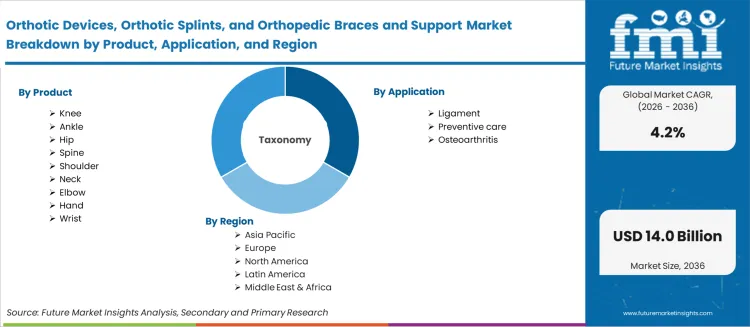
In terms of products, the market is segmented into knee, ankle, hip, spine, shoulder, neck, elbow, hand, and wrist. Among these, the knee segment holds a majority share of 15.5%, as of 2026.
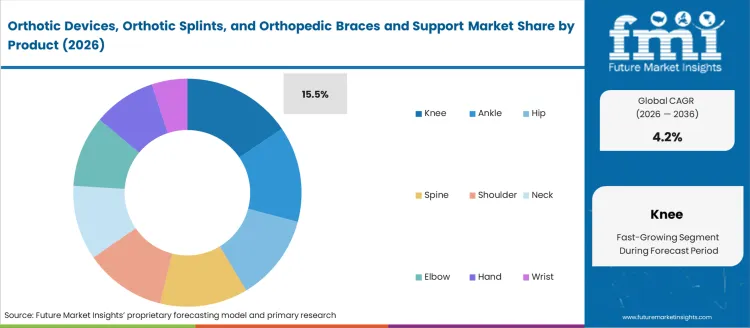
| Segment | Knee (Product) |
|---|---|
| Value Share (2026) | 15.5% |
Knee injuries are one of the most common injuries in the world. They happen primarily due to accidents, sports activities, and age-related wear and tear. Obesity also increases stress on knee joints, leading to injuries. It is because of this reason, the demand for orthotic devices and implants for knees is very likely to see a surge in the coming years.
Moreover, technological advancements in the market have enhanced product effectiveness and comfort. Brands have now introduced more customized solutions tailored to individual needs. These new implants are lightweight as well as more durable, which have made orthotic knee devices more appealing to consumers.
Orthotic Devices for Ligament Treatments to Gain Prominence in the Coming Decade
In terms of applications, ligament support for ACL and LCL injuries, preventive measures, and osteoarthritis (OA) management. Among these, the ligament one holds a majority share of 43.6%, as of 2026.
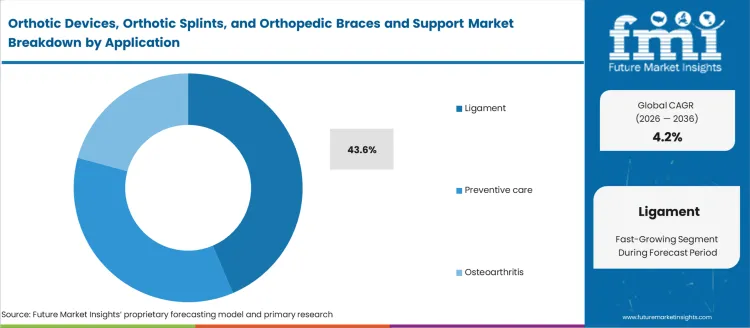
| Segment | Ligament (Application) |
|---|---|
| Value Share (2026) | 43.6% |
The increasing incidence of ligament injuries, particularly in sports like football, cricket, and running is driving a significant demand for orthotic implants. Thanks to medicare advancements, customization options are now also being easily accessible. These options provide tailored support for individual needs.
With the awareness of non-surgical treatment options rising in the general populace, patients are more likely to seek these devices.
Competition Outlook
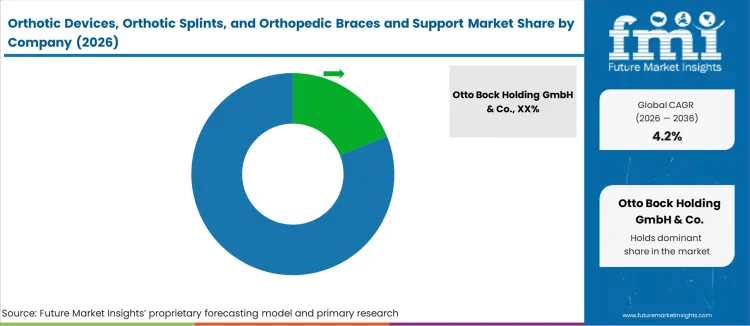
Orthotic devices and implants are not a thing of future these days. The advent of more lightweight, flexible, and durable devices have accelerated the adoption among the general populace. Companies are also taking steps to make their products more affordable.
Telemedicine platforms and home care services are often seen collaborating with these companies for their needs. These companies also cater to government hospitals and other healthcare facilities. The competition is very fierce, as new innovations come to the fore every now and then.
Some of the prominent companies in the market are DeRoyal Industries, Otto Bock Holding GmbH& Co., Bauerfeind AG, DJO Inc., and others.
Industry Updates
- In March 2026, the USA Army Medical Research and Development Command announced the adoption of the FastCast spray foam cast for rehabilitation exoskeletons. This innovation allows for rapid immobilization of injured limbs, enhancing mobility and recovery for injured Warfighters in combat situations, addressing limitations of traditional splints.
- In November, 2026, the Department of Empowerment of Persons with Disabilities (DEPwD) launched a nationwide awareness campaign on prosthetic and orthotic devices for the Divyangjan community. Following International Prosthetics and Orthotics Day, the initiative aims to enhance mobility and quality of life through various programs across India.
- In October, 2026, Imaginarium announced the successful use of its customized 3D printed orthotic device in aiding the recovery of 15-year-old Anamta Ahmad, the youngest recipient of a shoulder-level hand transplant. This innovative device enhances post-surgery care, offering precise customization and comfort, significantly improving the recovery process.
- In February, 2026, Hanger Inc. announced the acquisition of Fillauer, a global manufacturer in the orthotic and prosthetic (O&P) industry. This strategic move aims to enhance Hanger's O&P ecosystem by integrating Fillauer’s manufacturing capabilities in the USA and Europe. Hanger, with its extensive network of clinics and commitment to patient care, looks to leverage this acquisition to improve outcomes in the O&P field.
- In May, 2026, Polish startup Wimba announced a partnership with Intrauma to advance veterinary orthotics using HP's Multi Jet Fusion 3D printing technology. This collaboration aims to enhance orthopedic interventions for pets by providing custom-fit, lightweight orthotic devices.
- In December, 2023, Singapore General Hospital (SGH) announced a collaboration with Nanyang Technological University (NTU) to establish a Joint Research & Development Laboratory focused on additive manufacturing (3D printing) for customized medical devices and implants. This partnership aims to leverage SGH's 3D Printing Centre and NTU's Singapore Centre for 3D printing to develop innovative solutions in prosthetics, orthotics, and regenerative medicine.
- In March, 2026, Glenrose Rehabilitation Hospital in Edmonton introduced a new seven-axis robotic carver that significantly enhances the fitting process for artificial limbs, braces, and other orthotic devices. This advanced machine replaces traditional plaster methods with a faster, digital approach, utilizing 3D shape capture and automated model carving.
Scope of the Report
| Metric | Value |
|---|---|
| Quantitative Units | USD 9.27 Billion to USD 13.99 Billion, at a CAGR of 4.2% |
| Market Definition | Orthotic devices, orthotic splints, and orthopedic braces and supports are external medical devices applied to the body to correct alignment, stabilize joints, redistribute load, and support musculoskeletal structures during injury recovery or chronic condition management. Product categories span knee braces, ankle supports, hip orthoses, spinal braces, shoulder immobilizers, neck collars, elbow supports, hand splints, and wrist orthoses. |
| Product Segmentation | Knee, Ankle, Hip, Spine, Shoulder, Neck, Elbow, Hand, Wrist |
| Application Segmentation | Ligament, Preventive care, Osteoarthritis |
| Regions Covered | North America, Latin America, Europe, East Asia, South Asia, Oceania, Middle East & Africa |
| Countries Covered | India, China, Japan, Germany, USA, and 40 plus countries |
| Key Companies Profiled | Otto Bock Holding GmbH & Co., DeRoyal Industries, Bauerfeind AG |
| Forecast Period | 2026 to 2036 |
| Approach | Forecasting models apply a bottom-up methodology starting with global installed base metrics and projecting conversion rates based on regulatory and technology adoption curves. |
Key Segments of Market Report
By Product:
By product, the market is categorized into casting supplies and equipment, splinting supplies and equipment, and orthopedic braces and supports. The orthopedic braces and supports segment is further divided into upper extremity and lower extremity.
By Distribution Channel:
The distribution channels include orthopedic clinics, retail pharmacies, drug stores, and e-commerce platforms.
By Region:
The market is analyzed across key regions, including North America, Latin America, East Asia, South Asia and Pacific, Western Europe, Eastern Europe, and the Middle East and Africa.
Bibliography
- 1. World Health Organization. (2024). Musculoskeletal Conditions Fact Sheet. WHO.
- 2. Ministry of Youth Affairs and Sports, Government of India. (2024). Annual Report 2023-24. MoYAS.
- 3. National Health Authority, Government of India. (2024). Ayushman Bharat Health Benefit Packages. NHA.
- 4. National Healthcare Security Administration, China. (2024). Medical Device Reimbursement Catalogue Update. NHSA.
- 5. Ottobock SE & Co. KGaA. (2024). Annual Report 2023. Ottobock.
- 6. Bauerfeind AG. (2024). Annual Report 2023. Bauerfeind.
This bibliography is provided for reader reference. The full Future Market Insights report contains the complete reference list with primary research documentation.
Frequently Asked Questions
How large is the demand for Orthotic Devices, Orthotic Splints, and Orthopedic Braces and Support in the global market in 2026?
Demand for orthotic devices, orthotic splints, and orthopedic braces and support in the global market is estimated to be valued at USD 9.27 billion in 2026.
What will be the market size of Orthotic Devices, Orthotic Splints, and Orthopedic Braces and Support in the global market by 2036?
Market size for orthotic devices, orthotic splints, and orthopedic braces and support is projected to reach USD 13.99 billion by 2036.
What is the expected demand growth for Orthotic Devices, Orthotic Splints, and Orthopedic Braces and Support in the global market between 2026 and 2036?
Demand for orthotic devices, orthotic splints, and orthopedic braces and support is expected to grow at a CAGR of 4.2% between 2026 and 2036.
Which Product is poised to lead global sales by 2026?
Knee accounts for 15.5% share in 2026, driven by established adoption patterns and buyer preference across primary end-use applications.
What is driving demand in India?
India leads with a 4.8% CAGR through 2036, driven by expanding industrial capacity and increasing regulatory alignment with international standards.
What is the China growth outlook in this report?
China is projected to grow at a CAGR of 4.2% during 2026 to 2036.
What is Orthotic Devices, Orthotic Splints, and Orthopedic Braces and Support and what is it mainly used for?
Orthotic devices, orthotic splints, and orthopedic braces and supports are external medical devices applied to the body to correct alignment, stabilize joints, redistribute load, and support musculoskeletal structures during injury recovery or chronic condition management. Product categories span knee braces, ankle supports, hip orthoses, spinal braces, shoulder immobilizers, neck collars, elbow supports, hand splints, and wrist orthoses.
How does FMI build and validate the Orthotic Devices, Orthotic Splints, and Orthopedic Braces and Support forecast?
Future Market Insights analysis applies a bottom-up methodology starting with global installed base metrics and cross-validates projections against reported industry expenditure and regulatory compliance data.
Preview the report firsthand - request a free sample
Get SampleGet the brochure for pricing and purchase details.
Get PDFTable of Content
- Executive Summary
- Global Market Outlook
- Demand-side Trends
- Supply-side Trends
- Technology Roadmap Analysis
- Analysis and Recommendations
- Market Overview
- Market Coverage / Taxonomy
- Market Definition / Scope / Limitations
- Research Methodology
- Chapter Orientation
- Analytical Lens and Working Hypotheses
- Market Structure, Signals, and Trend Drivers
- Benchmarking and Cross-market Comparability
- Market Sizing, Forecasting, and Opportunity Mapping
- Research Design and Evidence Framework
- Desk Research Programme (Secondary Evidence)
- Company Annual and Sustainability Reports
- Peer-reviewed Journals and Academic Literature
- Corporate Websites, Product Literature, and Technical Notes
- Earnings Decks and Investor Briefings
- Statutory Filings and Regulatory Disclosures
- Technical White Papers and Standards Notes
- Subscription Datasets and Paid Sources
- Social Channels, Communities, and Digital Listening Inputs
- Additional Desk Sources
- Expert Input and Fieldwork (Primary Evidence)
- Primary Modes
- Qualitative Interviews and Expert Elicitation
- Quantitative Surveys and Structured Data Capture
- Blended Approach
- Why Primary Evidence is Used
- Field Techniques
- Interviews
- Surveys
- Focus Groups
- Observational and In-context Research
- Social and Community Interactions
- Stakeholder Universe Engaged
- C-suite Leaders
- Board Members
- Presidents and Vice Presidents
- R&D and Innovation Heads
- Technical Specialists
- Domain Subject-matter Experts
- Scientists
- Physicians and Other Healthcare Professionals
- Governance, Ethics, and Data Stewardship
- Research Ethics
- Data Integrity and Handling
- Primary Modes
- Tooling, Models, and Reference Databases
- Desk Research Programme (Secondary Evidence)
- Data Engineering and Model Build
- Data Acquisition and Ingestion
- Cleaning, Normalisation, and Verification
- Synthesis, Triangulation, and Analysis
- Quality Assurance and Audit Trail
- Market Background
- Market Dynamics
- Drivers
- Restraints
- Opportunity
- Trends
- Scenario Forecast
- Demand in Optimistic Scenario
- Demand in Likely Scenario
- Demand in Conservative Scenario
- Opportunity Map Analysis
- Product Life Cycle Analysis
- Supply Chain Analysis
- Investment Feasibility Matrix
- Value Chain Analysis
- PESTLE and Porter’s Analysis
- Regulatory Landscape
- Regional Parent Market Outlook
- Production and Consumption Statistics
- Import and Export Statistics
- Market Dynamics
- Global Market Analysis 2021 to 2025 and Forecast, 2026 to 2036
- Historical Market Size Value (USD Million) Analysis, 2021 to 2025
- Current and Future Market Size Value (USD Million) Projections, 2026 to 2036
- Y-o-Y Growth Trend Analysis
- Absolute $ Opportunity Analysis
- Global Market Pricing Analysis 2021 to 2025 and Forecast 2026 to 2036
- Global Market Analysis 2021 to 2025 and Forecast 2026 to 2036, By Product
- Introduction / Key Findings
- Historical Market Size Value (USD Million) Analysis By Product , 2021 to 2025
- Current and Future Market Size Value (USD Million) Analysis and Forecast By Product , 2026 to 2036
- Knee
- Ankle
- Hip
- Spine
- Shoulder
- Neck
- Elbow
- Hand
- Wrist
- Knee
- Y-o-Y Growth Trend Analysis By Product , 2021 to 2025
- Absolute $ Opportunity Analysis By Product , 2026 to 2036
- Global Market Analysis 2021 to 2025 and Forecast 2026 to 2036, By Application
- Introduction / Key Findings
- Historical Market Size Value (USD Million) Analysis By Application, 2021 to 2025
- Current and Future Market Size Value (USD Million) Analysis and Forecast By Application, 2026 to 2036
- Ligament
- Preventive care
- Osteoarthritis
- Ligament
- Y-o-Y Growth Trend Analysis By Application, 2021 to 2025
- Absolute $ Opportunity Analysis By Application, 2026 to 2036
- Global Market Analysis 2021 to 2025 and Forecast 2026 to 2036, By Region
- Introduction
- Historical Market Size Value (USD Million) Analysis By Region, 2021 to 2025
- Current Market Size Value (USD Million) Analysis and Forecast By Region, 2026 to 2036
- North America
- Latin America
- Western Europe
- Eastern Europe
- East Asia
- South Asia and Pacific
- Middle East & Africa
- Market Attractiveness Analysis By Region
- North America Market Analysis 2021 to 2025 and Forecast 2026 to 2036, By Country
- Historical Market Size Value (USD Million) Trend Analysis By Market Taxonomy, 2021 to 2025
- Market Size Value (USD Million) Forecast By Market Taxonomy, 2026 to 2036
- By Country
- USA
- Canada
- Mexico
- By Product
- By Application
- By Country
- Market Attractiveness Analysis
- By Country
- By Product
- By Application
- Key Takeaways
- Latin America Market Analysis 2021 to 2025 and Forecast 2026 to 2036, By Country
- Historical Market Size Value (USD Million) Trend Analysis By Market Taxonomy, 2021 to 2025
- Market Size Value (USD Million) Forecast By Market Taxonomy, 2026 to 2036
- By Country
- Brazil
- Chile
- Rest of Latin America
- By Product
- By Application
- By Country
- Market Attractiveness Analysis
- By Country
- By Product
- By Application
- Key Takeaways
- Western Europe Market Analysis 2021 to 2025 and Forecast 2026 to 2036, By Country
- Historical Market Size Value (USD Million) Trend Analysis By Market Taxonomy, 2021 to 2025
- Market Size Value (USD Million) Forecast By Market Taxonomy, 2026 to 2036
- By Country
- Germany
- UK
- Italy
- Spain
- France
- Nordic
- BENELUX
- Rest of Western Europe
- By Product
- By Application
- By Country
- Market Attractiveness Analysis
- By Country
- By Product
- By Application
- Key Takeaways
- Eastern Europe Market Analysis 2021 to 2025 and Forecast 2026 to 2036, By Country
- Historical Market Size Value (USD Million) Trend Analysis By Market Taxonomy, 2021 to 2025
- Market Size Value (USD Million) Forecast By Market Taxonomy, 2026 to 2036
- By Country
- Russia
- Poland
- Hungary
- Balkan & Baltic
- Rest of Eastern Europe
- By Product
- By Application
- By Country
- Market Attractiveness Analysis
- By Country
- By Product
- By Application
- Key Takeaways
- East Asia Market Analysis 2021 to 2025 and Forecast 2026 to 2036, By Country
- Historical Market Size Value (USD Million) Trend Analysis By Market Taxonomy, 2021 to 2025
- Market Size Value (USD Million) Forecast By Market Taxonomy, 2026 to 2036
- By Country
- China
- Japan
- South Korea
- By Product
- By Application
- By Country
- Market Attractiveness Analysis
- By Country
- By Product
- By Application
- Key Takeaways
- South Asia and Pacific Market Analysis 2021 to 2025 and Forecast 2026 to 2036, By Country
- Historical Market Size Value (USD Million) Trend Analysis By Market Taxonomy, 2021 to 2025
- Market Size Value (USD Million) Forecast By Market Taxonomy, 2026 to 2036
- By Country
- India
- ASEAN
- Australia & New Zealand
- Rest of South Asia and Pacific
- By Product
- By Application
- By Country
- Market Attractiveness Analysis
- By Country
- By Product
- By Application
- Key Takeaways
- Middle East & Africa Market Analysis 2021 to 2025 and Forecast 2026 to 2036, By Country
- Historical Market Size Value (USD Million) Trend Analysis By Market Taxonomy, 2021 to 2025
- Market Size Value (USD Million) Forecast By Market Taxonomy, 2026 to 2036
- By Country
- Kingdom of Saudi Arabia
- Other GCC Countries
- Turkiye
- South Africa
- Other African Union
- Rest of Middle East & Africa
- By Product
- By Application
- By Country
- Market Attractiveness Analysis
- By Country
- By Product
- By Application
- Key Takeaways
- Key Countries Market Analysis
- USA
- Pricing Analysis
- Market Share Analysis, 2025
- By Product
- By Application
- Canada
- Pricing Analysis
- Market Share Analysis, 2025
- By Product
- By Application
- Mexico
- Pricing Analysis
- Market Share Analysis, 2025
- By Product
- By Application
- Brazil
- Pricing Analysis
- Market Share Analysis, 2025
- By Product
- By Application
- Chile
- Pricing Analysis
- Market Share Analysis, 2025
- By Product
- By Application
- Germany
- Pricing Analysis
- Market Share Analysis, 2025
- By Product
- By Application
- UK
- Pricing Analysis
- Market Share Analysis, 2025
- By Product
- By Application
- Italy
- Pricing Analysis
- Market Share Analysis, 2025
- By Product
- By Application
- Spain
- Pricing Analysis
- Market Share Analysis, 2025
- By Product
- By Application
- France
- Pricing Analysis
- Market Share Analysis, 2025
- By Product
- By Application
- India
- Pricing Analysis
- Market Share Analysis, 2025
- By Product
- By Application
- ASEAN
- Pricing Analysis
- Market Share Analysis, 2025
- By Product
- By Application
- Australia & New Zealand
- Pricing Analysis
- Market Share Analysis, 2025
- By Product
- By Application
- China
- Pricing Analysis
- Market Share Analysis, 2025
- By Product
- By Application
- Japan
- Pricing Analysis
- Market Share Analysis, 2025
- By Product
- By Application
- South Korea
- Pricing Analysis
- Market Share Analysis, 2025
- By Product
- By Application
- Russia
- Pricing Analysis
- Market Share Analysis, 2025
- By Product
- By Application
- Poland
- Pricing Analysis
- Market Share Analysis, 2025
- By Product
- By Application
- Hungary
- Pricing Analysis
- Market Share Analysis, 2025
- By Product
- By Application
- Kingdom of Saudi Arabia
- Pricing Analysis
- Market Share Analysis, 2025
- By Product
- By Application
- Turkiye
- Pricing Analysis
- Market Share Analysis, 2025
- By Product
- By Application
- South Africa
- Pricing Analysis
- Market Share Analysis, 2025
- By Product
- By Application
- USA
- Market Structure Analysis
- Competition Dashboard
- Competition Benchmarking
- Market Share Analysis of Top Players
- By Regional
- By Product
- By Application
- Competition Analysis
- Competition Deep Dive
- Otto Bock Holding GmbH & Co.
- Overview
- Product Portfolio
- Profitability by Market Segments (Product/Age /Sales Channel/Region)
- Sales Footprint
- Strategy Overview
- Marketing Strategy
- Product Strategy
- Channel Strategy
- DeRoyal Industries
- Bauerfeind AG
- Otto Bock Holding GmbH & Co.
- Competition Deep Dive
- Assumptions & Acronyms Used


