

- Industry Size (2026)
- USD 1.2 Bn
- Forecast (2036)
- USD 4.1 Bn
- CAGR (2026 to 2036)
- 13.0%
Orthopedic Brace Packaging Market Forecast and Outlook 2026 to 2036
The global orthopedic brace packaging market reached USD 1.2 billion in 2026 and is forecast to reach USD 4.1 billion by 2036, expanding at 13.0% CAGR. As per Future Market Insights, expansion is primarily fueled by a demographic crisis involving musculoskeletal health and the consequent surge in demand for sterile barrier systems. As healthcare providers increasingly mandate recyclability alongside sterility, converters are compelled to innovate rapidly in material science.
Momentum is further underpinned by historic consolidation to secure supply chain dominance; the February 2025 merger between Amcor and Berry Global created an USD 8.4 billion giant capable of dictating global healthcare packaging standards. Andrew King, Group CEO of Mondi, validated this growth capability in March 2025 stating: "The demand for sustainable products is providing many opportunities for Mondi and is a key driver of our future growth. Our investment over the last few years, enhancing our unique packaging and paper platform and product offering for our customers, will support this growth."
Sector holds revenue potential for entities that can solve the automation challenge. Sealed Air marked a pivotal shift in January 2025 by installing its 4,000th rotary vacuum system, signaling that high-throughput, automated sterile packaging is becoming the industrial standard. This operational evolution signals a decisive implication: companies that successfully scale automated, fiber-first packaging solutions will dominate market share through 2036.
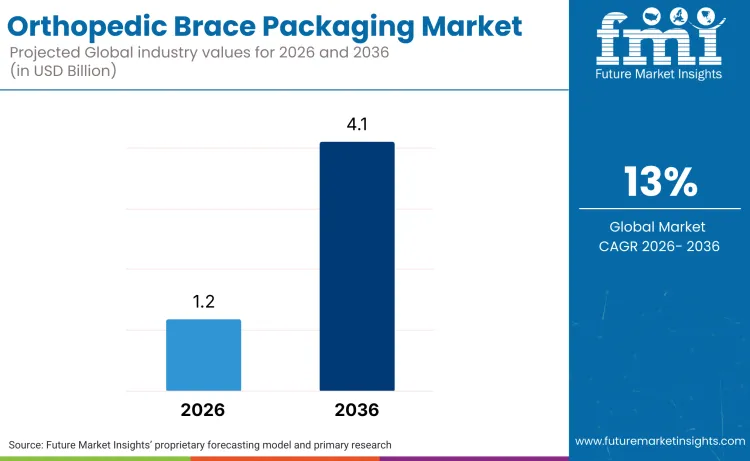
Summary of Orthopedic Brace Packaging Market
What Is the Growth Outlook for the Orthopedic Brace Packaging Market as per Future Market Insights Projection?
Future Market Insights projects the global Orthopedic Brace Packaging Market to grow from USD 1.2 billion in 2026 to USD 4.1 billion by 2036, representing a strong 13.00% CAGR over the forecast period.
FMI Research Approach: Based on FMI’s proprietary global modeling framework incorporating procedural volume data for joint reconstruction, sterilization modality shifts from EtO to Radiation/NO2, and hospital procurement trends validated by GPO contracts.
How Do FMI Analysts Perceive the Orthopedic Brace Packaging Market to Evolve?
FMI analysts perceive the market transitioning away from multi-layer mixed plastics toward mono-material films and functional paper barriers that are compatible with novel sterilization methods.
FMI Research Approach: Developed using analysis of FDA sterilization guidance updates, examination of material innovation pipelines such as Huhtamaki’s Omnilock Ultra Paper, and facility expansion disclosures from major medical packaging converters.
Which Country Holds the Largest Share in the Global Orthopedic Brace Packaging Market?
The United States holds one of the highest value shares globally, supported by high reimbursement rates for orthopedic procedures and a mature regulatory framework that drives continuous demand for advanced sterile barrier systems.
FMI Research Approach: Built using country-level procedural volumes from CMS data, analysis of packaging material shifts driven by FDA mandates, and mapping of supplier concentration among North America’s integrated medical device packagers.
How Large Will the Orthopedic Brace Packaging Market Be by 2036?
The global orthopedic brace packaging market is expected to reach USD 4.1 billion by 2036, supported by sustained demand from hospital settings, which currently command a 44% share.
FMI Research Approach: Long-term forecasts rely on demographic aging trends in the US and Japan, industrial capacity expansion data supporting global medical paper availability, and channel-specific scaling assumptions for non-sterile retail packaging.
What Is the Definition of the Orthopedic Brace Packaging Market?
The orthopedic brace packaging market encompasses all revenue generated from purpose-designed primary and secondary packaging solutions used for enclosing supports, splints, and casts. It includes pouches, trays, blister packs, clamshells, and folding cartons that utilize medical-grade Tyvek, paper, or plastic films, explicitly excluding general transport boxes and packaging for non-medical athletic gear.
FMI Research Approach: Definition structured using FMI’s segmentation taxonomy covering product types, end-use channels, and material compositions. The classification draws from operational inclusion criteria for sterile barrier systems and retail-ready rehab packaging.
What Are Globally Unique Trends Shaping the Orthopedic Brace Packaging Market?
Globally, the sector is shaped by an ongoing shift toward "Paper-First" sterile barriers and vertical consolidation, driven by tightening environmental regulations like EU 2025/40 and the need for supply chain resilience.
FMI Research Approach: Insights derived from global regulatory tracking, sustainability performance disclosures from major manufacturers, portfolio-level innovations in fiber-based barriers, and assessment of competitive M&A activity across Europe and North America.
Orthopedic Brace Packaging Market Key Takeaways
| Metric | Details |
|---|---|
| Industry Size (2026) | USD 1.2 billion |
| Industry Value (2036) | USD 4.1 billion |
| CAGR (2026-2036) | 13.0% |
Source: Future Market Insights (FMI) analysis, based on proprietary forecasting model and primary research.
What is Driving the Market?
A fundamental demographic crisis is fueling volume demand as evidenced by CDC data from February 2025 revealing that 21.3% of US adults now suffer from arthritis which directly correlates to increased brace usage. Regulatory headwinds are simultaneously reshaping the type of packaging required. The FDA November 2024 guidance on sterilization has compelled manufacturers to pivot away from EtO-dependent materials toward novel barrier systems like sterile medical packaging. In response to these dual pressures, Huhtamaki secured a shortlist position for the 2025 CPHI Pharma Awards with its "Omnilock Ultra Paper" proving that the industry is successfully innovating to meet strict sterility standards while adhering to new sustainability mandates.
Segmentation Outlook
The orthopedic brace packaging market is segmented by care setting, sterility level, and material composition. It is segmented by care setting into hospitals, orthopedic clinics, and retail pharmacies, each requiring distinct levels of barrier protection and shelf appeal. The material landscape spans medical-grade paper, Tyvek, and plastic films, illustrating the industry’s balance between cost-efficient retail utility and the absolute necessity of microbial integrity for surgical applications. These segmentation layers define how manufacturers supply medical device packaging solutions tailored to both high-acuity trauma cases and consumer-grade rehabilitation.
Why do Hospitals hold a dominant share?
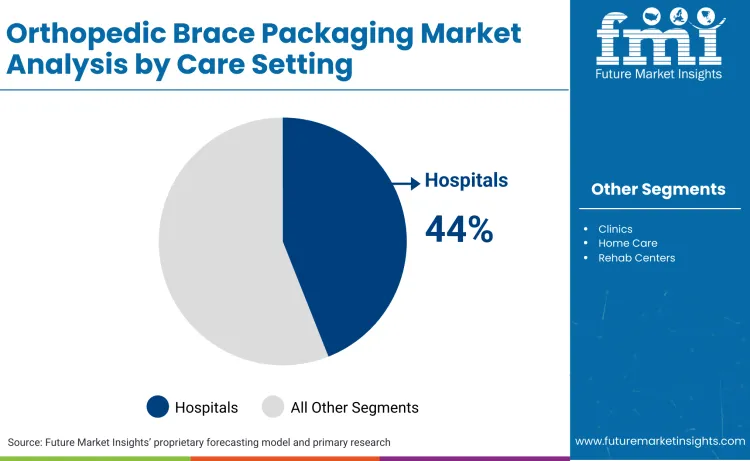
Hospitals command the dominant share at 44%, fueled primarily by the acute nature of post-operative care and trauma management. Facilities utilize high-grade sterile pouches and trays to meet this demand, ensuring patient safety during the critical post-surgical window. This trend is reinforced by UK government data from April 2025 showing 17.9% of adults managing long-term musculoskeletal conditions, sustaining high demand for hospital-grade packaging. Manufacturers are consequently optimizing production lines for medical devices secondary packaging to ensure efficient sterile transfer in operating rooms.
Why do Non-Sterile Packs lead the sterility segment?
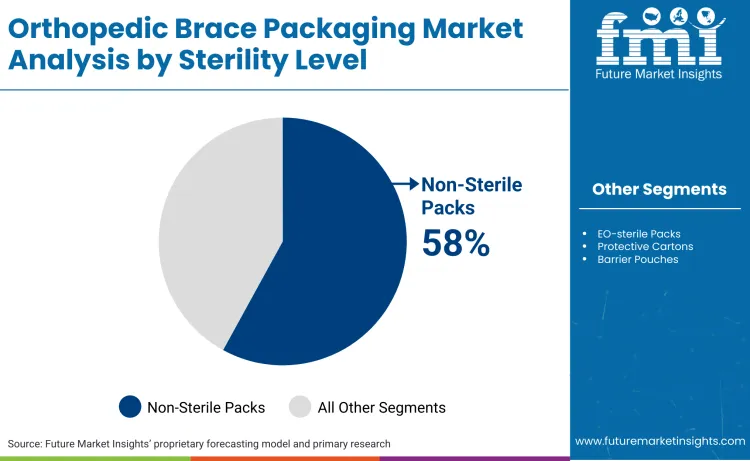
Non-sterile packs lead the segment with 58% share, a direct response to the massive volume of prophylactic supports and over-the-counter rehabilitation gear sold through retail channels. While surgical implants require strict sterility, the vast majority of soft goods such as knee sleeves and wrist supports rely on tamper-evident, retail-ready packaging. This segment drives the consumption of cost-effective folding cartons and clamshells, allowing brands to focus on shelf visibility and consumer education rather than microbial barrier properties.
Why is Material Composition evolving toward Fiber-Based solutions?
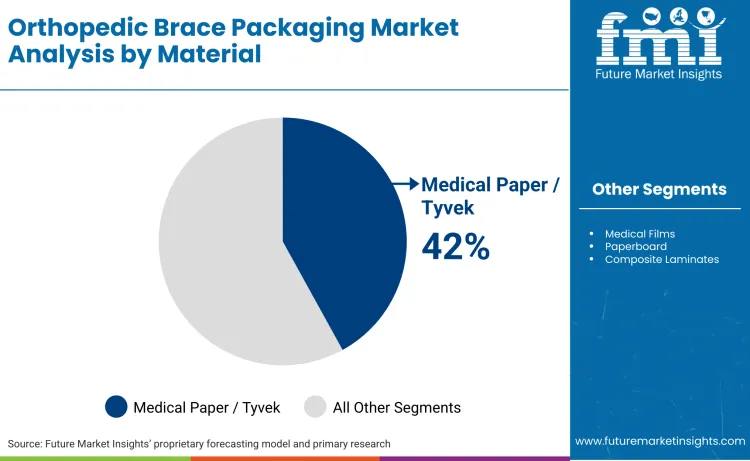
While plastic films have historically dominated, the Medical Paper/Tyvek segment with 42% share is rapidly gaining traction due to the need for breathability during gas sterilization and superior puncture resistance. Mondi debuted at LUXE PACK Shanghai in March 2025 showcasing a strategic pivot toward functional paper barriers, signaling a broader industry move to replace traditional films in high-value applications. This transition is critical for complying with emerging global waste regulations while satisfying the technical requirements of modern sterilization modalities.
Why Is the Transition to
Supply chain sustainability is moving beyond simple material choices to functional performance forcing companies to rethink how they engineer sterile barriers. Huhtamaki was recognized in late 2025 for its "Omnilock Ultra Paper" highlighting the industry's success in creating sterile packaging that maintains microbial barrier properties without relying on non-recyclable plastics. This technical shift forces brands to adopt fiber-based solutions that can withstand rigorous sterilization cycles effectively reducing the carbon footprint associated with medical waste. Manufacturers are increasingly integrating these advanced papers to meet scope 3 emission targets while maintaining robust protection for high-value devices.
How Are Mega-Mergers Reshaping Supply Chain Control?
Profitability in the medical packaging sector is increasingly tied to scale and vertical integration as evidenced by the massive Amcor-Berry Global merger in February 2025. This consolidation allows the combined entity to control raw material supply and dictate global distribution networks creating unprecedented leverage in healthcare packaging procurement. Companies leveraging this scale are outperforming competitors who remain reliant on fragmented supply chains proving that supply security is a primary driver of operational profitability in the modern pouch equipment sector.
Why Is Smart Validation Technology Becoming Standard?
As per FMI analyst, manual inspection was once the norm, automated smart validation is reclaiming the production floor as brands seek zero-defect assurance at high speeds. Sealed Air reached a milestone installation of digital rotary systems in January 2025 pointing to a future where manual inspection is obsolete. This trend impacts the efficiency of packaging lines providing manufacturers with real-time data on seal integrity that enhances patient safety. This resurgence of automation allows premium converters to offer guaranteed sterility levels justifying higher price points for critical care packaging.
How is Regional Expansion Across Key Markets?
The global orthopedic brace packaging market exhibits a clear regional divide, with emerging markets expanding primarily on the strength of infrastructure modernization, while developed markets grow through procedure-driven premiumization. In Asia, India and China serve as the primary growth engines, propelled by rapid hospital network expansion and local manufacturing mandates. Western regions such as the USA and Germany are undergoing a structural pivot toward automated and sustainable solutions, driven by reimbursement standards and stringent waste regulations. Such regional patterns highlight a maturing global market where volume growth remains concentrated in Asia, while value growth is increasingly shaped by regulatory clarity and demand for high-tech sterile barriers.
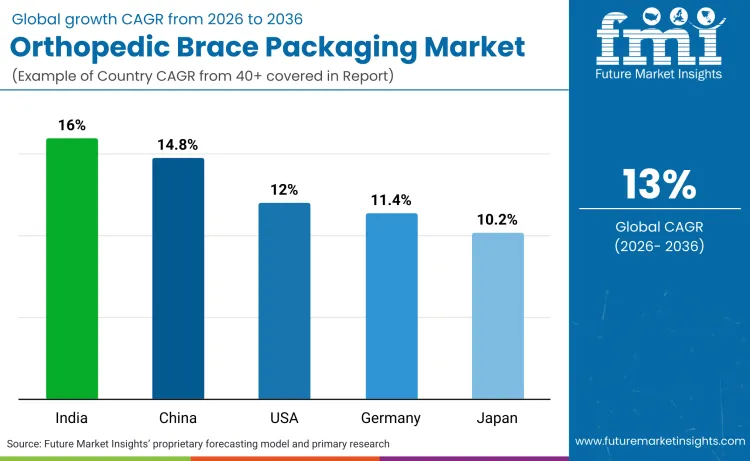
| Country | CAGR (2026 to 2036) |
|---|---|
| India | 16.00% |
| China | 14.80% |
| USA | 12.00% |
| Germany | 11.40% |
| Japan | 10.20% |
Source: FMI historical analysis and forecast data.
Why is India emerging as the Volume Engine?
Expansion in India is forecast at a stellar 16.00% CAGR through 2036, primarily anchored by the expansion of private hospital chains and rising domestic manufacturing of orthopedic splints. As the healthcare infrastructure modernizes, the demand for standardized, sterile packaging is decoupling from broader economic volatility. Sonoco TEQ signaled a definitive interest in this pharmaceutical and med-tech expansion during late 2024. Graham French, European Sales Director at Sonoco TEQ, emphasized this focus stating: "We look forward to engaging with pharmaceutical industry stakeholders at Pharmapack 2025. Our extensive product portfolio ensures we can meet the evolving needs of the pharma and medical technology sectors." FMI analysis suggests that the domestic contract manufacturing sector will become the primary engine for volume creation, as global brands increasingly use India as a hub for cost-effective, high-volume device packaging.
Why is China Pivoting to Higher Standards?
Demand for orthopedic brace packaging in China is projected at 14.80% CAGR, driven largely by the NMPA's heightened standards for sterile barrier integrity. The release of the "China Medical Device Standards Catalogue 2024" has effectively mandated a quality upgrade for orthotic devices casts and splints packaging. Bernhard Cantzler of Mondi emphasized the strategic importance of this shift in March 2025: "The Asian market holds significant importance for Mondi, and we are excited to connect with partners and present our sustainable and innovative solutions alongside leading global brands and companies in this vibrant region." Chinese manufacturers are consequently positioned to integrate advanced barrier technologies, transforming compliance burdens into a competitive advantage for export-grade medical devices.
Why is the USA the Innovation Bedrock?
Growth in the USA is estimated to register a 12.00% CAGR, reflecting a mature market that is aggressively pivoting toward automation to maintain value despite cost pressures. High reimbursement rates for medical packaging intensive procedures sustain this growth. Sealed Air continued investment in automation validates the trend toward reducing labor costs in sterile packing. The industry here is increasingly defined by its focus on high-speed, error-free packaging lines rather than just material volume, allowing converters to command significant margins on complex, kit-based packaging solutions.
How is Regulation Driving Germany's Market?
The market in Germany is anticipated to surge at an 11.40% CAGR, sustained by stringent EU directives on packaging waste. Regulation (EU) 2025/40 has effectively mandated recyclability for secondary surgical instruments packaging, forcing local manufacturers to adopt mono-material solutions. This regulatory clarity drives innovation in recyclable films and papers, ensuring Germany remains the European hub for sustainable medical packaging. Domestic manufacturers leverage this compliance leadership to offer premium, eco-certified packaging solutions that competitors outside the EU struggle to match.
What Role Does Demographics Play in Japan?
Sales in Japan are expected to expand at a 10.20% CAGR, making it a key frontier for user-centric design due to its ultra-aging population. Japan's Statistics Bureau reports that as of October 1, 2024, the population aged 65 and over reached 36,243 thousand (29.3% of the total), highlighting the surge in mobility challenges. As the prevalence of mobility issues rises, the demand for easy-open, ergonomic packaging for orthopedic prosthetic devices becomes critical. This demographic reality is creating a unique ecosystem for senior-friendly packaging designs, where functionality and accessibility guarantee a baseline of recurring volume growth for rehabilitation devices.
How Is Competition Evolving in the Orthopedic Brace Packaging Market?
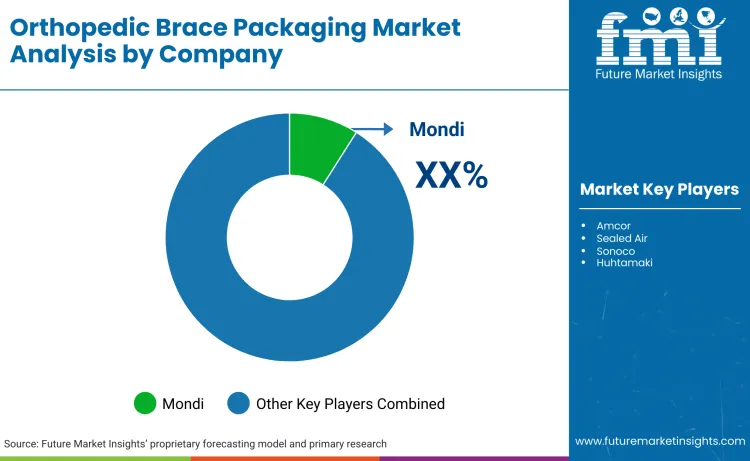
The competitive outlook is shifting toward Faction Warfare propelled by three distinct strategies which are empire building, green innovation, and precision engineering. Amcor has effectively redrawn the map with its USD 8.4 billion acquisition of Berry Global in February 2025, creating an "Empire Builder" capable of dictating global pricing for pharmaceuticals pouch and film capacity. This consolidation forces smaller players to seek specialized niches.
Green Innovators such as Mondi and Huhtamaki are weaponizing sustainability regulations to steal market share. By debuting award-winning paper-based sterile barriers in early 2025, they position themselves as the only viable partners for device manufacturers facing plastic taxes. This strategy directly challenges the dominance of traditional plastic incumbents.
Precision Engineers like Sonoco are refining their portfolios. Sonoco divested its TFP business to TOPPAN in April 2025 signaling a retreat from broad flexible packaging to focus on core competencies. This allows TOPPAN to bring Japanese precision manufacturing standards into the Western medical specialty bag sector, creating a new high-end competitor for complex thermoformed trays.
Recent Developments:
- In November 2025, Sealed Air Corporation agreed to be acquired by funds affiliated with CD&R in a $10.3 billion all-cash transaction. This deal positions Sealed Air to accelerate investments in sustainable packaging technologies, including those for medical and life science applications, potentially advancing protective solutions for orthopedic braces and other devices.
- In April 2025, Huhtamaki acquired Zellwin Farms Company for approximately $18 million, expanding its molded fiber packaging capabilities in North America. This move enhances Huhtamaki's portfolio of sustainable, protective packaging options suitable for medical and orthopedic applications, such as custom trays and inserts for braces.
- In April 2025, Mondi Group completed the acquisition of Schumacher Packaging's Western Europe operations, adding over 1 billion square meters of additional packaging capacity and enhancing its corrugated and solid board offerings. This expansion strengthens Mondi's ability to provide sustainable, high-performance packaging solutions for medical devices, including orthopedic braces, improving supply chain reliability and innovation in protective packaging.
Key Players in Orthopedic Brace Packaging Market
- Mondi
- Amcor
- Sealed Air
- Sonoco Products Company
- Huhtamaki
- Berry Global
- TOPPAN Holdings
- DS Smith
- WestRock
- Oliver Healthcare Packaging
- Steripack Contract Manufacturing
- Beacon Converters
Market Definition
The orthopedic brace packaging market represents the total revenue generated from purpose designed primary and secondary packaging solutions used to enclose, protect, and distribute orthopedic braces, supports, splints, and casts across hospital, clinical, and retail channels. The scope includes sterile and non sterile pouches, thermoformed trays, blister packs, clamshells, folding cartons, and protective wrapping films manufactured using medical grade paper, Tyvek, plastic films, molded fiber, and foam materials. These packaging formats are engineered to meet sterility assurance, tamper evidence, durability, and regulatory compliance requirements specific to orthopedic applications. The market explicitly excludes general corrugated transport cartons, bulk logistics packaging, packaging for non medical athletic or fitness gear, and packaging used for orthopedic implants, prosthetics, or surgical instruments not classified as braces or supports.
Report Scope Table
| Items | Values |
|---|---|
| Quantitative Units (2026) | USD 1.2 billion |
| Product Type | Pouches, Trays, Blister Packs, Clamshells, Folding Cartons, Wrapping Films |
| End-Use Channel | Hospitals (44%), Orthopedic Clinics, Retail Pharmacies, Online Sales |
| Material Type | Plastic Films, Medical Grade Paper, Tyvek (42%), Foam, Molded Fiber |
| Regions Covered | North America, Europe, Asia Pacific, Latin America, Middle East & Africa |
| Countries Covered | United States, Germany, China, Japan, India, Brazil, and 35+ countries |
| Key Companies Profiled | Amcor, Mondi, Sealed Air, Sonoco, Huhtamaki, Toppan, Berry Global |
| Additional Attributes | Revenue analysis by channel and material, regulatory impact assessment (FDA/EU Sterility), sustainable barrier penetration, automation adoption trends, competitive consolidation analysis |
Source: FMI historical analysis and forecast data.
Orthopedic Brace Packaging Market by Segments
-
By End-Use Channel:
- Hospitals
- Orthopedic Clinics
- Retail Pharmacies
- Online Sales/DTC
-
By Material Composition:
- Plastic Films (PE, PP, PET)
- Medical Grade Paper
- Tyvek
- Foam & Molded Fiber
-
By Product Format:
- Pouches & Bags
- Thermoformed Trays
- Blister Packs
- Clamshells
- Folding Cartons
-
By Sterility:
- Sterile Packaging
- Non-Sterile Packaging
-
By Region:
- North America
- Europe
- Asia Pacific
- Latin America
- Middle East & Africa
Bibliography
- Institute for Health Metrics and Evaluation. (2024). Global Burden of Disease results: Musculoskeletal disorders. IHME.
- Association for the Advancement of Medical Instrumentation. (2024). AAMI ST79: Comprehensive guide to steam sterilization and sterility assurance. AAMI.
- National Medical Products Administration. (2024). Catalogue of medical device standards and YY/T references. NMPA.
- Standardization Administration of China. (2024). GB standards for sterile barrier systems and device packaging. SAC.
- European Environment Agency. (2024). Healthcare and packaging waste streams in the EU. EEA.
- Organisation for Economic Co-operation and Development. (2024). Health at a Glance: Medical device utilization indicators. OECD.
- TAPPI. (2023). Properties of medical-grade paper and sterile barrier materials. TAPPI Standards (technical body, non-commercial).
Frequently Asked Questions
What is the current global market size for Orthopedic Brace Packaging?
The global market is valued at USD 1.2 billion in 2026, driven by rising arthritis prevalence and the need for advanced sterile barrier systems.
What is the projected CAGR for the Orthopedic Brace Packaging market?
Market revenues are projected to grow at a robust 13.00% CAGR from 2026 to 2036, significantly outpacing broader packaging indices due to the shift toward automated and sustainable formats.
Which segment currently dominates the industry?
Hospitals hold the dominant 44% market share, supported by the critical need for sterile packaging in post-operative and trauma care settings.
What are the primary drivers for adoption in emerging markets?
Infrastructure modernization and manufacturing expansion in markets like India and China are the primary volume drivers, creating demand for standardized, export-grade packaging.
Who are the leading players in the Orthopedic Brace Packaging market?
Amcor, Mondi, and Sealed Air lead the sector, leveraging massive industrial scale and vertical integration to control costs and innovation.
Preview the report firsthand - request a free sample
Get SampleGet the brochure for pricing and purchase details.
Get PDFTable of Content
- Executive Summary
- Global Market Outlook
- Demand Side Trends
- Supply Side Trends
- Technology Roadmap Analysis
- Analysis and Recommendations
- Market Overview
- Market Coverage / Taxonomy
- Market Definition / Scope / Limitations
- Research Methodology
- Chapter Orientation
- Analytical Lens and Working Hypotheses
- Market Structure, Signals, and Trend Drivers
- Benchmarking and Cross-market Comparability
- Market Sizing, Forecasting, and Opportunity Mapping
- Research Design and Evidence Framework
- Desk Research Programme (Secondary Evidence)
- Company Annual and Sustainability Reports
- Peer-reviewed Journals and Academic Literature
- Corporate Websites, Product Literature, and Technical Notes
- Earnings Decks and Investor Briefings
- Statutory Filings and Regulatory Disclosures
- Technical White Papers and Standards Notes
- Trade Journals, Industry Magazines, and Analyst Briefs
- Conference Proceedings, Webinars, and Seminar Materials
- Government Statistics Portals and Public Data Releases
- Press Releases and Reputable Media Coverage
- Specialist Newsletters and Curated Briefings
- Sector Databases and Reference Repositories
- FMI Internal Knowledge Base and Historical Datasets
- Subscription Datasets and Paid Sources
- Social Channels, Communities, and Digital Listening Inputs
- Additional Desk Sources
- Expert Input and Fieldwork (Primary Evidence)
- Primary Modes
- Qualitative Interviews and Expert Elicitation
- Quantitative Surveys and Structured Data Capture
- Blended Approach
- Why Primary Evidence is Used
- Field Techniques
- Interviews
- Surveys
- Focus Groups
- Observational and In-context Research
- Social and Community Interactions
- Stakeholder Universe Engaged
- C-suite Leaders
- Board Members
- Presidents and Vice Presidents
- R&D and Innovation Heads
- Technical Specialists
- Domain Subject-matter Experts
- Scientists
- Physicians and Other Healthcare Professionals
- Governance, Ethics, and Data Stewardship
- Research Ethics
- Data Integrity and Handling
- Primary Modes
- Tooling, Models, and Reference Databases
- Desk Research Programme (Secondary Evidence)
- Data Engineering and Model Build
- Data Acquisition and Ingestion
- Cleaning, Normalisation, and Verification
- Synthesis, Triangulation, and Analysis
- Quality Assurance and Audit Trail
- Market Background
- Market Dynamics
- Drivers
- Restraints
- Opportunity
- Trends
- Scenario Forecast
- Demand in Optimistic Scenario
- Demand in Likely Scenario
- Demand in Conservative Scenario
- Opportunity Map Analysis
- Product Life Cycle Analysis
- Supply Chain Analysis
- Investment Feasibility Matrix
- Value Chain Analysis
- PESTLE and Porter's Analysis
- Regulatory Landscape
- Regional Parent Market Outlook
- Production and Consumption Statistics
- Import and Export Statistics
- Market Dynamics
- Global Market Analysis 2021 to 2025 and Forecast, 2026 to 2036
- Historical Market Size Value (USD Billion) Analysis, 2021 to 2025
- Current and Future Market Size Value (USD Billion) Projections, 2026 to 2036
- Y-o-Y Growth Trend Analysis
- Absolute $ Opportunity Analysis
- Global Market Pricing Analysis 2021 to 2025 and Forecast 2026 to 2036
- Y-o-Y Growth Trend Analysis 2021 to 2025
- Absolute $ Opportunity Analysis 2026 to 2036
- Global Market Analysis 2021 to 2025 and Forecast 2026 to 2036, By Product Format
- Introduction / Key Findings
- Historical Market Size Value (USD Billion) Analysis By Product Format, 2021 to 2025
- Current and Future Market Size Value (USD Billion) Analysis and Forecast By Product Format, 2026 to 2036
- Pouches & Bags
- Thermoformed Trays
- Blister Packs
- Clamshells
- Folding Cartons
- Y-o-Y Growth Trend Analysis By Product Format, 2021 to 2025
- Absolute $ Opportunity Analysis By Product Format, 2026 to 2036
- Global Market Analysis 2021 to 2025 and Forecast 2026 to 2036, By Material Composition
- Introduction / Key Findings
- Historical Market Size Value (USD Billion) Analysis By Material Composition, 2021 to 2025
- Current and Future Market Size Value (USD Billion) Analysis and Forecast By Material Composition, 2026 to 2036
- Plastic Films
- Medical Grade Paper
- Tyvek
- Foam & Molded Fiber
- Y-o-Y Growth Trend Analysis By Material Composition, 2021 to 2025
- Absolute $ Opportunity Analysis By Material Composition, 2026 to 2036
- Global Market Analysis 2021 to 2025 and Forecast 2026 to 2036, By Sterility
- Introduction / Key Findings
- Historical Market Size Value (USD Billion) Analysis By Sterility, 2021 to 2025
- Current and Future Market Size Value (USD Billion) Analysis and Forecast By Sterility, 2026 to 2036
- Sterile Packaging
- Non-Sterile Packaging
- Y-o-Y Growth Trend Analysis By Sterility, 2021 to 2025
- Absolute $ Opportunity Analysis By Sterility, 2026 to 2036
- Global Market Analysis 2021 to 2025 and Forecast 2026 to 2036, By End-Use Channel
- Introduction / Key Findings
- Historical Market Size Value (USD Billion) Analysis By End-Use Channel, 2021 to 2025
- Current and Future Market Size Value (USD Billion) Analysis and Forecast By End-Use Channel, 2026 to 2036
- Hospitals
- Orthopedic Clinics
- Retail Pharmacies
- Online Sales/DTC
- Y-o-Y Growth Trend Analysis By End-Use Channel, 2021 to 2025
- Absolute $ Opportunity Analysis By End-Use Channel, 2026 to 2036
- Global Market Analysis 2021 to 2025 and Forecast 2026 to 2036, By Region
- Introduction
- Historical Market Size Value (USD Billion) Analysis By Region, 2021 to 2025
- Current Market Size Value (USD Billion) Analysis and Forecast By Region, 2026 to 2036
- North America
- Latin America
- Western Europe
- Eastern Europe
- East Asia
- South Asia and Pacific
- Middle East & Africa
- Market Attractiveness Analysis By Region
- North America Market Analysis 2021 to 2025 and Forecast 2026 to 2036, By Country
- Historical Market Size Value (USD Billion) Trend Analysis By Market Taxonomy, 2021 to 2025
- Market Size Value (USD Billion) Forecast By Market Taxonomy, 2026 to 2036
- By Country
- USA
- Canada
- Mexico
- By Product Format
- By Material Composition
- By Sterility
- By End-Use Channel
- By Country
- Market Attractiveness Analysis
- By Country
- By Product Format
- By Material Composition
- By Sterility
- By End-Use Channel
- Key Takeaways
- Latin America Market Analysis 2021 to 2025 and Forecast 2026 to 2036, By Country
- Historical Market Size Value (USD Billion) Trend Analysis By Market Taxonomy, 2021 to 2025
- Market Size Value (USD Billion) Forecast By Market Taxonomy, 2026 to 2036
- By Country
- Brazil
- Chile
- Rest of Latin America
- By Product Format
- By Material Composition
- By Sterility
- By End-Use Channel
- By Country
- Market Attractiveness Analysis
- By Country
- By Product Format
- By Material Composition
- By Sterility
- By End-Use Channel
- Key Takeaways
- Western Europe Market Analysis 2021 to 2025 and Forecast 2026 to 2036, By Country
- Historical Market Size Value (USD Billion) Trend Analysis By Market Taxonomy, 2021 to 2025
- Market Size Value (USD Billion) Forecast By Market Taxonomy, 2026 to 2036
- By Country
- Germany
- UK
- Italy
- Spain
- France
- Nordic
- BENELUX
- Rest of Western Europe
- By Product Format
- By Material Composition
- By Sterility
- By End-Use Channel
- By Country
- Market Attractiveness Analysis
- By Country
- By Product Format
- By Material Composition
- By Sterility
- By End-Use Channel
- Key Takeaways
- Eastern Europe Market Analysis 2021 to 2025 and Forecast 2026 to 2036, By Country
- Historical Market Size Value (USD Billion) Trend Analysis By Market Taxonomy, 2021 to 2025
- Market Size Value (USD Billion) Forecast By Market Taxonomy, 2026 to 2036
- By Country
- Russia
- Poland
- Hungary
- Balkan & Baltic
- Rest of Eastern Europe
- By Product Format
- By Material Composition
- By Sterility
- By End-Use Channel
- By Country
- Market Attractiveness Analysis
- By Country
- By Product Format
- By Material Composition
- By Sterility
- By End-Use Channel
- Key Takeaways
- East Asia Market Analysis 2021 to 2025 and Forecast 2026 to 2036, By Country
- Historical Market Size Value (USD Billion) Trend Analysis By Market Taxonomy, 2021 to 2025
- Market Size Value (USD Billion) Forecast By Market Taxonomy, 2026 to 2036
- By Country
- China
- Japan
- South Korea
- By Product Format
- By Material Composition
- By Sterility
- By End-Use Channel
- By Country
- Market Attractiveness Analysis
- By Country
- By Product Format
- By Material Composition
- By Sterility
- By End-Use Channel
- Key Takeaways
- South Asia and Pacific Market Analysis 2021 to 2025 and Forecast 2026 to 2036, By Country
- Historical Market Size Value (USD Billion) Trend Analysis By Market Taxonomy, 2021 to 2025
- Market Size Value (USD Billion) Forecast By Market Taxonomy, 2026 to 2036
- By Country
- India
- ASEAN
- Australia & New Zealand
- Rest of South Asia and Pacific
- By Product Format
- By Material Composition
- By Sterility
- By End-Use Channel
- By Country
- Market Attractiveness Analysis
- By Country
- By Product Format
- By Material Composition
- By Sterility
- By End-Use Channel
- Key Takeaways
- Middle East & Africa Market Analysis 2021 to 2025 and Forecast 2026 to 2036, By Country
- Historical Market Size Value (USD Billion) Trend Analysis By Market Taxonomy, 2021 to 2025
- Market Size Value (USD Billion) Forecast By Market Taxonomy, 2026 to 2036
- By Country
- Kingdom of Saudi Arabia
- Other GCC Countries
- Turkiye
- South Africa
- Other African Union
- Rest of Middle East & Africa
- By Product Format
- By Material Composition
- By Sterility
- By End-Use Channel
- By Country
- Market Attractiveness Analysis
- By Country
- By Product Format
- By Material Composition
- By Sterility
- By End-Use Channel
- Key Takeaways
- Key Countries Market Analysis
- USA
- Pricing Analysis
- Market Share Analysis, 2025
- By Product Format
- By Material Composition
- By Sterility
- By End-Use Channel
- Canada
- Pricing Analysis
- Market Share Analysis, 2025
- By Product Format
- By Material Composition
- By Sterility
- By End-Use Channel
- Mexico
- Pricing Analysis
- Market Share Analysis, 2025
- By Product Format
- By Material Composition
- By Sterility
- By End-Use Channel
- Brazil
- Pricing Analysis
- Market Share Analysis, 2025
- By Product Format
- By Material Composition
- By Sterility
- By End-Use Channel
- Germany
- Pricing Analysis
- Market Share Analysis, 2025
- By Product Format
- By Material Composition
- By Sterility
- By End-Use Channel
- UK
- Pricing Analysis
- Market Share Analysis, 2025
- By Product Format
- By Material Composition
- By Sterility
- By End-Use Channel
- Italy
- Pricing Analysis
- Market Share Analysis, 2025
- By Product Format
- By Material Composition
- By Sterility
- By End-Use Channel
- Spain
- Pricing Analysis
- Market Share Analysis, 2025
- By Product Format
- By Material Composition
- By Sterility
- By End-Use Channel
- France
- Pricing Analysis
- Market Share Analysis, 2025
- By Product Format
- By Material Composition
- By Sterility
- By End-Use Channel
- India
- Pricing Analysis
- Market Share Analysis, 2025
- By Product Format
- By Material Composition
- By Sterility
- By End-Use Channel
- ASEAN
- Pricing Analysis
- Market Share Analysis, 2025
- By Product Format
- By Material Composition
- By Sterility
- By End-Use Channel
- China
- Pricing Analysis
- Market Share Analysis, 2025
- By Product Format
- By Material Composition
- By Sterility
- By End-Use Channel
- Japan
- Pricing Analysis
- Market Share Analysis, 2025
- By Product Format
- By Material Composition
- By Sterility
- By End-Use Channel
- Kingdom of Saudi Arabia
- Pricing Analysis
- Market Share Analysis, 2025
- By Product Format
- By Material Composition
- By Sterility
- By End-Use Channel
- South Africa
- Pricing Analysis
- Market Share Analysis, 2025
- By Product Format
- By Material Composition
- By Sterility
- By End-Use Channel
- USA
- Market Structure Analysis
- Competition Dashboard
- Competition Benchmarking
- Market Share Analysis of Top Players
- By Regional
- By Product Format
- By Material Composition
- By Sterility
- By End-Use Channel
- Competition Analysis
- Competition Deep Dive
- Mondi
- Amcor
- Sealed Air
- Sonoco Products Company
- Huhtamaki
- Berry Global
- TOPPAN Holdings
- DS Smith
- WestRock
- Oliver Healthcare Packaging
- Steripack Contract Manufacturing
- Beacon Converters
- Competition Deep Dive
- Assumptions & Acronyms Used


