

- Market Size (2026)
- USD 980.6 Mn
- Forecast (2036)
- USD 2258.3 Mn
- CAGR (2026 to 2036)
- 8.7%
How big is the Crew Transfer Safety System Market?
The crew transfer safety system market was valued at USD 902.1 million in 2025. It is expected to grow from USD 980.6 million in 2026 to USD 2,258.3 million by 2036 at a CAGR of 8.7%.
Crew transfer safety systems are moving from deck-level support equipment into planned offshore access infrastructure, supported by global offshore wind capacity of 83 GW in 2024 and enough offshore wind output to power 73 million households. Offshore wind farms and crew transfer vessels need safer transfer routes between moving vessels and fixed structures. Access planning now begins before vessel mobilization, allowing operators to choose equipment before crews reach a turbine or platform.
Offshore operators now compare transfer systems as part of service readiness, reinforced by Global Wind Energy Council projections that annual offshore wind installations could rise from 8 GW in 2024 to 34 GW in 2030. Equipment buyers want systems that protect personnel and document offshore movement for safety review. Walk-to-work suppliers must prove motion response and trained operator coverage before commercial award.
Commercial decisions increasingly rest on reliability across repeated transfers, helped by a 2024 safety workshop that brought more than 50 experts together to review walk-to-work deficiencies and improvement needs. Motion-compensated gangways lead higher-value purchases through controlled personnel movement. Transfer baskets and fall-arrest kits remain needed for rescue coverage and vessel-to-vessel tasks across crew transfer safety systems.
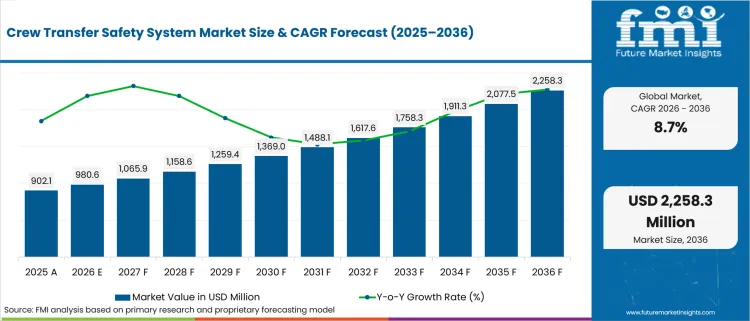
| Metric | Value |
|---|---|
| 2025 Market Size | USD 902.1 million |
| 2026 Market Size | USD 980.6 million |
| 2036 Market Size | USD 2,258.3 million |
| Forecast CAGR (2026-2036) | 8.7% |
| Leading System Type | Motion-compensated Gangways |
| Motion-compensated Gangways Share (2026) | 47.0% |
| Leading Application | Offshore Wind |
| Offshore Wind Share (2026) | 44.0% |
| Leading Sales Channel | Direct OEM |
| Direct OEM Share (2026) | 52.0% |
| Fastest-growing Country | United States |
| United States CAGR by 2036 | 9.6% |
Summary of the Crew Transfer Safety System Market
| Market Signal | Commercial Impact |
|---|---|
| Demand and Growth Drivers | Demand for crew transfer safety systems is increasing as offshore wind expansion, oil & gas maintenance activities, and stricter offshore safety standards require safer and more reliable personnel transfer solutions.
|
| Product and Segment View | Direct OEM sales, motion-compensated gangways, and offshore wind applications continue to represent the leading commercial opportunities across the market.
|
| Geography and Growth Outlook | North America, Asia, and Europe continue to expand market opportunities through offshore wind development, vessel modernization, and offshore maintenance activities.
|
| Competitive Landscape | Competition increasingly focuses on motion-compensation technology, offshore safety expertise, and comprehensive lifecycle service support.
|
| Analyst Perspective | Crew transfer safety systems are evolving from specialized offshore equipment into critical risk management solutions that improve personnel safety, vessel utilization, and operational continuity.
- Nikhil Kaitwade, Principal Consultant at Future Market Insights |
How is the Crew Transfer Safety System Market segmented?
The crew transfer safety system industry is segmented by 5 parent categories covering system type, application, vessel type, sales model and sales channel, with regional analysis across 8 profiled countries.
The Crew Transfer Safety System Market is segmented by system type, application, vessel type, sales model, sales channel and region. By system type, coverage includes 4 equipment groups: motion-compensated gangways, personnel transfer baskets, daughter craft transfer systems and fall-arrest transfer kits. By application, coverage includes 4 use settings: offshore wind, oil and gas platforms, vessel-to-vessel transfer and port or harbor transfer. By vessel type, demand comes from 4 vessel classes: crew transfer vessels, service operation vessels, offshore support vessels and workboats. By sales model, coverage includes 3 purchase structures: equipment sale, rental or service and O&M contract. By sales channel, demand comes from 3 routes: direct OEM, marine integrators and service providers, with regional coverage across North America, Latin America, Europe, East Asia, South Asia and Pacific and the Middle East and Africa.
Why do Motion-compensated Gangways lead the system type segment?
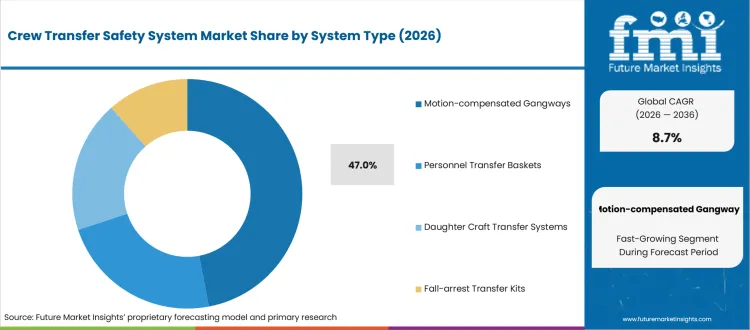
Motion-compensated gangways lead by turning vessel movement into a controlled transfer event. IMCA M254 Revision 1 in 2025 covers 4 practical areas. Buyers use that guidance to compare whether a gangway can support technician movement across repeated offshore visits instead of a single demonstration.
- Motion-compensated Gangways are expected to account for 47.0% share in 2026, backed by offshore operators preferring controlled walk-to-work movement between vessels and fixed assets. Equipment behavior forms a central part of supplier selection once crews must transfer repeatedly during a service campaign.
- Controlled transfer capability protects service plans during scheduled turbine work and platform maintenance, reinforced by HSE’s 2025 safety notice citing 3 IMCA guidance references around walk-to-work operations and personnel transfer. A well-supported gangway can reduce aborted transfer attempts and keep technician movement aligned to vessel-day planning.
What supports demand for Offshore Wind within the application segment?
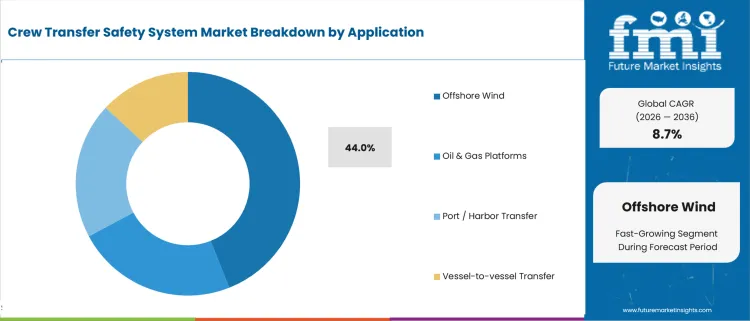
Offshore Wind gains priority from repeated service visits to turbines across the operating life of each asset. GWEC reported a 24% downward adjustment in its short-term offshore wind outlook during 2025, and that project-timing pressure moves into inspection and maintenance planning after commissioning. Access equipment moves into daily production support instead of one-time project mobilization.
- Offshore Wind is anticipated to hold 44.0% share in 2026, led by maintenance campaigns that require repeated movement from service vessels to towers and substations. Transfer logs and safe-return procedures move into routine operating planning instead of optional safety paperwork.
- Turbine service work creates a recurring operating need after project handover, reinforced by GWEC’s view that annual offshore wind installations could reach 34 GW in 2030. Developers select access systems that protect maintenance schedules and reduce avoidable delays during uncertain project cycles.
How do Crew Transfer Vessels shape the vessel type segment?
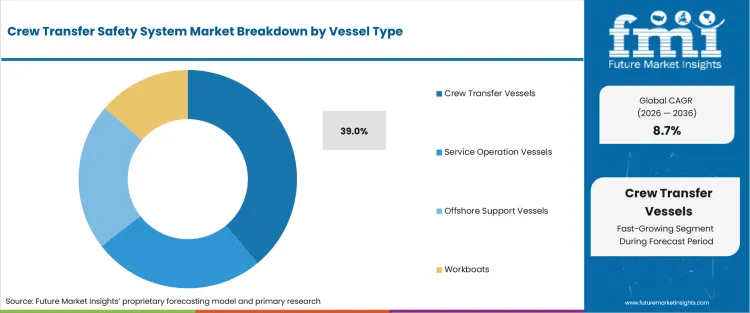
Crew Transfer Vessels shape access demand for nearshore routes and daily technician transfers. Vessel planners assess 3 practical constraints during access-package selection and sea-state exposure. Those choices influence boarding arrangements and transfer interfaces before daily vessel efficiency is tested offshore.
- Crew Transfer Vessels are projected to represent 39.0% share in 2026, helped by nearshore service routes that favor smaller craft and regular crew movement. Equipment selection must protect deck layout before boarding arrangements affect daily vessel efficiency.
- CTV-based access remains practical for sites closer to shore, and route planning often narrows transfer-package decisions around 3 factors, travel distance along with deck capacity and weather exposure. Route length guides equipment selection before sea-state conditions determine whether buyers need a lighter boarding arrangement or a more controlled access package.
What supports Rental / Service demand within the sales model segment?
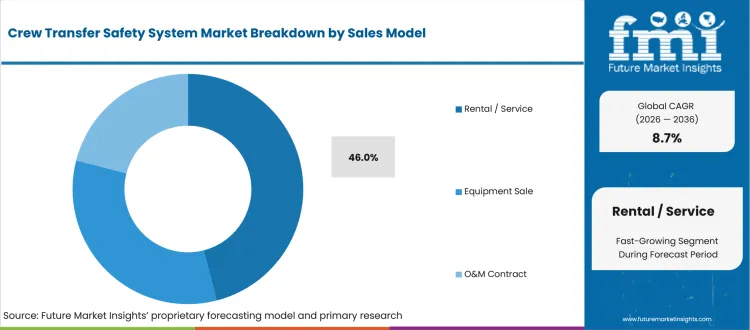
Rental and service demand rises from uneven utilization across offshore access assets. A 2024 offshore wind vessel study found that permanent SOV stationing can increase whole-wind-farm availability by up to 20%, showing why service capacity affects energy production. Project teams compare equipment rental and maintenance support as one operating package.
- Rental / Service is forecast to capture 46.0% share in 2026, supported by project teams aligning certified access capacity to mobilization schedules. Weather-limited work periods make flexible access capacity commercially useful during short offshore campaigns.
- Rental demand gains strength during uncertain construction and maintenance programs, especially as Vestdavit cited a global offshore wind SOV fleet moving from 32 vessels toward nearly 100 vessels by 2030. Operators can access trained crews and certified transfer systems without committing capital to equipment that may remain idle between campaigns.
How is Direct OEM positioned within the sales-channel segment?
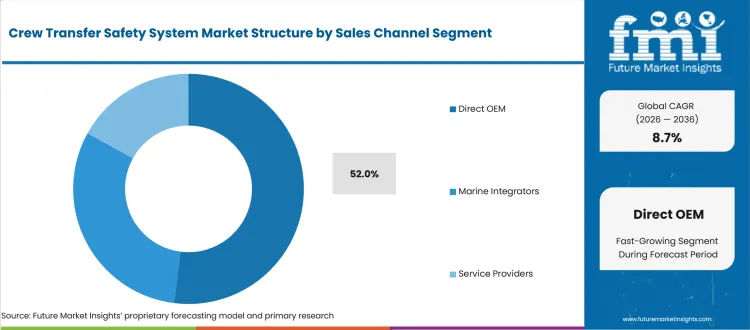
Direct OEM buying draws priority from early vessel-design influence. Vard Marine confirmed in 2026 that HOS Rocinante had been converted from a platform supply vessel into a CSOV, showing how access systems increasingly form part of vessel conversion and offshore wind readiness. Early technical decisions shape deck arrangement and class documentation.
- Direct OEM is set to secure 52.0% share in 2026, driven by shipyards and vessel builders specifying gangways and control interfaces during design. Early selection supports class documentation first and then helps engineering teams finalize deck arrangement and electrical interfaces before commissioning.
- OEM-led buying offers one clearer accountability route from configuration to service support, strengthened by Safeway’s 2025 specification set that lists 6 degrees of freedom, wind speeds above 45 knots and crane lifting up to 1,000 kg. Marine integrators remain useful in retrofit work, while direct OEM selection lowers handoff risk during newbuild and conversion programs.
What are the drivers, restraints, and opportunities in the Crew Transfer Safety System Market?
Near-term purchases are being shaped by the access requirement, safety constraint and service-expansion route outlined below, while the market adds USD 1,277.7 million in incremental opportunity between 2026 and 2036.
- Driver: Offshore wind service programs drive system demand once developers need repeat access during construction and maintenance. GWEC reported global offshore wind capacity of 83 GW in 2024, creating a larger installed asset base for walk-to-work and transfer-basket planning.
- Restraint: Safety assurance can delay purchasing if buyers are unsure how gangways behave during disconnection or power loss. HSE’s 2025 notice described auto-retraction risk and pointed operators toward 3 IMCA references for walk-to-work and personnel transfer control.
- Opportunity: Vessel-service packages create an expansion route among offshore wind operators that need certified access without full equipment ownership. Vestdavit cited an SOV fleet expansion from 32 operating vessels to nearly 100 vessels by 2030, supporting service-led sales around davits and daughter craft systems.
Offshore wind access demand rises once service teams treat crew movement as a production-support function. GWEC reported 117 GW of new wind capacity installed worldwide in 2024, and offshore wind projects add a transfer layer once technicians must reach assets in marine conditions. Suppliers that prove transfer reliability and operator training can support longer service programs.
Safety assurance remains a practical constraint until gangway behavior is trusted before technicians step onto a structure. The 2024 IMCA and G+ workshop involved more than 50 experts and examined deficiencies in system design and maintenance. Suppliers gain an advantage once testing evidence and alarm procedures are clear before mobilization.
Service-package models create value beyond single equipment sales as offshore wind fleets spread into deeper waters and longer service routes. Global Energy Monitor reported 67 GW of offshore wind projects in China’s development pipeline and 28 GW already under construction in early 2025. Such project density supports packages combining crew transfer systems and field maintenance.
Which country CAGRs are profiled in the Crew Transfer Safety System Market?
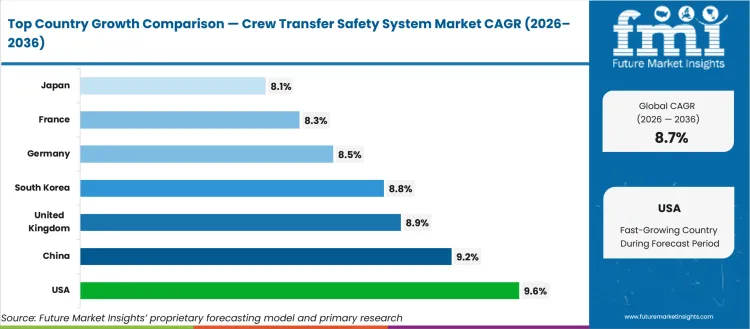
| Country | CAGR |
|---|---|
| United States | 9.6% |
| China | 9.2% |
| United Kingdom | 8.9% |
| South Korea | 8.8% |
| Germany | 8.5% |
| France | 8.3% |
| Japan | 8.1% |
| India | 7.4% |
Source: Future Market Insights analysis, 2026.
How do country-level CAGRs compare in the Crew Transfer Safety System Market?
Country growth in crew transfer safety systems is expected to be led by offshore wind scale, vessel availability and safety documentation requirements. The United States and China connect demand with project pipelines and vessel localization. The United Kingdom, Germany and France connect demand with commissioned wind fleets and North Sea service experience. Japan, South Korea and India connect adoption with policy targets and early-stage offshore service planning across 8 profiled markets.
- United States is estimated at 9.6% CAGR through 2036, supported by offshore wind construction and vessel localization that can create access-system demand near coastal project clusters. GAO reported 39 commercial offshore wind leases in January 2025, giving suppliers a defined project base while federal review continues to influence order timing.
- China is forecast to rise at 9.2% CAGR by 2036, helped by offshore wind scale across coastal provinces and inspection activity after commissioning. Global Energy Monitor reported 42.7 GW of China offshore wind capacity by March 2025, equal to 50% of global capacity and a large operating base for safer crew movement.
- United Kingdom is projected to post 8.9% CAGR through 2036, reinforced by operating wind farms and North Sea vessel service practices. The Crown Estate reported 46 fully commissioned offshore wind farms, 2,820 turbines and 42 substations in 2025, creating frequent transfer needs for SOVs, CTVs and walk-to-work systems.
- South Korea is expected to record 8.8% CAGR by 2036, aided by tender activity and offshore wind policy reform. GWEC Market Intelligence reported 1.9 GW of offshore wind awards during the second half of 2024, while the special offshore wind law passed in February 2025 supports site selection and tender execution.
- Germany is anticipated to expand at 8.5% CAGR through 2036, backed by North Sea turbine operations and SOV-based maintenance demand. Deutsche WindGuard reported 1,680 offshore wind turbines and about 9.7 GW in operation at year-end 2025, giving access suppliers a stable service base.
- France is forecast to grow at 8.3% CAGR by 2036, strengthened by offshore wind awards moving into long-term service planning. WindEurope reported that the Centre-Manche 2 project off Normandy has 1.5 GW of capacity and is located more than 40 km from the coast, creating future crew movement needs from installation into maintenance work.
- Japan is set to advance at 8.1% CAGR through 2036, helped by national offshore wind goals and port-service planning. Japan’s energy agency stated in March 2025 that national targets remain 10 GW by 2030 and 30 GW to 45 GW by 2040, while projects totaling 5.1 GW were under development in 2024.
- India is projected to record 7.4% CAGR by 2036, reflecting early-stage offshore wind commercialization and project preparation. SECI issued a 500 MW offshore wind project request in September 2024, while central support approved Rs. 7,453 crore for 1 GW of offshore wind projects and port upgrades in June 2024.
Who are the notable companies in the Crew Transfer Safety System Market?
Ampelmann, SMST, Uptime International, Reflex Marine, Vestdavit, Safeway, Osbit and PALFINGER Marine are the notable companies shaping crew transfer safety systems across 5 core equipment areas with access towers and daughter craft systems being among them.
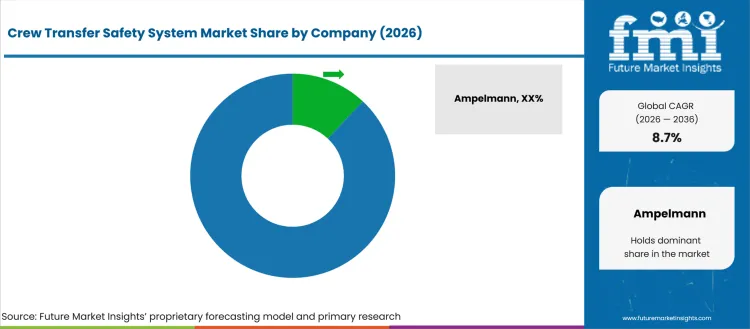
Competition in crew transfer safety systems is grouped by how buyers want access control to work across a USD 980.6 million opportunity in 2026. Ampelmann, SMST, Uptime International, Safeway and Osbit are stronger in walk-to-work programs that require motion-response evidence. Reflex Marine supports basket-based transfer and emergency coverage for legacy platforms or restricted landing zones. Vestdavit and PALFINGER Marine support davit and daughter craft handling across service vessel programs. Supplier selection is guided by motion-compensation depth and proof from post-2024 projects.
- Ampelmann has an advantage through active motion-compensated gangway experience and service continuity. Its 2-year Solstad Offshore contract extension for Petrobras operations in 2025 supports buyer confidence in oil and gas platform access programs that need repeat personnel transfer.
- SMST is positioned around integrated mission equipment for SOVs and CSOVs, including gangways, access towers and compensated cranes. The company’s USA offshore wind package for a newbuild SOV included a Telescopic Access Bridge L-Series with tower and integrated crane function.
- Uptime International competes through safe walk-to-work access systems for wind and oil and gas vessels. The company shipped the UPTIME 150 system in 2024 for HOS Rocinante, a USA Jones Act-compliant SOV conversion scheduled for service entry in 2025.
- Reflex Marine is positioned in personnel transfer carriers used for crane-based movement, emergency access and legacy platform transfer. The FROG-XT range includes 2-, 4-, 6- and 10-person carriers, giving buyers capacity options beside gangway-led access.
- Vestdavit participates through davit and daughter craft launch-and-recovery systems. Its offshore wind guidance highlights SOV fleet expansion as a demand driver for craft handling and recovery capability.
Competitive Benchmarking: Crew Transfer Safety System Market
| Company | Motion Compensation Depth | Offshore Transfer Record | Vessel Integration Support | Geographic Footprint Rating |
|---|---|---|---|---|
| Ampelmann | High | High | High | High |
| SMST | High | High | High | High |
| Uptime International | High | High | High | Medium |
| Reflex Marine | Low | High | Medium | High |
| Vestdavit | Low | High | High | High |
| Safeway | High | Medium | High | Medium |
| Osbit | Medium | Medium | High | Medium |
| PALFINGER Marine | Low | Medium | High | High |
Source: Future Market Insights competitive analysis, 2026.
Key Developments in the Crew Transfer Safety System Market
- In March 2025, Ampelmann extended its Solstad Offshore contract for Petrobras operations by 2 years. Contract continuity supports demand for motion-compensated gangways in oil and gas platform access programs that need safe personnel movement and service assurance across offshore Brazil.
- In October 2024, Uptime International shipped the UPTIME 150 system for installation on HOS Rocinante. Service entry in 2025 positioned the vessel as a Jones Act-compliant SOV conversion for the USA offshore renewables market, supporting local walk-to-work capability.
- In August 2024, Vestdavit highlighted flexible SOV solutions for offshore wind maintenance activity. Vestdavit highlighted SOV fleet growth as a demand driver for daughter craft handling and recovery planning.
Key Players in the Crew Transfer Safety System Market
Motion-compensated Access Suppliers
- Ampelmann
- SMST
- Uptime International
- Safeway
- Osbit
Transfer Basket and Rescue Specialists
- Reflex Marine
- FROG-XT
Davit and Daughter Craft Specialists
- Vestdavit
- PALFINGER Marine
Crew Transfer Safety System Market - Report Scope
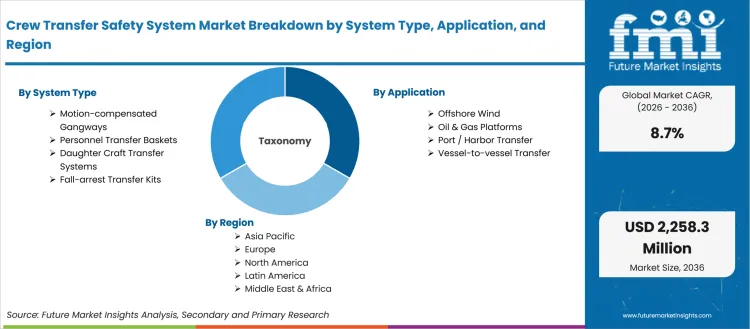
| Coverage field | Report scope |
|---|---|
| Market breakdown | Crew Transfer Safety System Market Breakdown By System Type, Application, Vessel Type, Sales Model, Sales Channel, and Region |
| Market Definition | Motion-compensated gangways, personnel transfer baskets, daughter craft transfer systems, and fall-arrest transfer kits used to move workers between vessels and offshore assets |
| Regions Covered | North America, Latin America, Europe, East Asia, South Asia and Pacific, Middle East and Africa |
| Countries Covered | United States, China, United Kingdom, South Korea, Germany, France, Japan, India and 30+ countries |
| Key Companies Profiled | 8 key companies profiled: Ampelmann, SMST, Uptime International, Reflex Marine, Vestdavit, Safeway, Osbit, PALFINGER Marine |
| Forecast Period | 2026 to 2036 |
| Approach | Hybrid bottom-up and top-down methodology using vessel programs, verified project activity, supplier evidence, rental utilization and segment use rates |
Source: Future Market Insights analysis, 2026.
Crew Transfer Safety System Market - Research Methodology
| Method | Approach |
|---|---|
| Primary Research | FMI analysts reviewed inputs from vessel owners, offshore wind operators, oil and gas service teams, marine safety buyers and offshore access suppliers across 5 segment groups. Supplier discussions covered gangway specification, basket use, davit handling, rental models and service contract terms. |
| Desk Research | Desk research covered post-2024 safety guidance, offshore wind project data, regulator references, vessel-classification signals and company product information. Product coverage was checked against 4 main transfer system types and 4 application settings. |
| Market Sizing and Forecasting | The model combined system volume, average selling price, rental utilization, vessel activity, application mix and country-level offshore project signals from 2026 to 2036. Forecast assumptions were adjusted for vessel type, access frequency, project phasing and channel structure. |
| Data Validation | Forecasts were checked against offshore wind capacity additions, vessel conversion signals, SOV and CTV programs, supplier portfolios and safety guidance across 8 profiled countries. Company portfolios were reviewed to avoid counting adjacent marine equipment without crew transfer safety use. |
Crew Transfer Safety System Market by Segments
Crew Transfer Safety System Market segmented by System Type:
- Motion-compensated Gangways
- Personnel Transfer Baskets
- Daughter Craft Transfer Systems
- Fall-arrest Transfer Kits
Crew Transfer Safety System Market segmented by Application:
- Offshore Wind
- Oil & Gas Platforms
- Vessel-to-vessel Transfer
- Port / Harbor Transfer
Crew Transfer Safety System Market segmented by Vessel Type:
- Crew Transfer Vessels
- Service Operation Vessels
- Offshore Support Vessels
- Workboats
Crew Transfer Safety System Market segmented by Sales Model:
- Equipment Sale
- Rental / Service
- O&M Contract
Crew Transfer Safety System Market segmented by Sales Channel:
- Direct OEM
- Marine Integrators
- Service Providers
Crew Transfer Safety System Market by Region:
- North America
- United States
- Canada
- Mexico
- Latin America
- Brazil
- Chile
- Rest of Latin America
- Western Europe
- Germany
- UK
- Italy
- Spain
- France
- Nordic
- BENELUX
- Rest of Western Europe
- Eastern Europe
- Russia
- Poland
- Hungary
- Balkan & Baltic
- Rest of Eastern Europe
- East Asia
- China
- Japan
- South Korea
- South Asia and Pacific
- India
- ASEAN
- Australia & New Zealand
- Rest of South Asia and Pacific
- Middle East & Africa
- Kingdom of Saudi Arabia
- Other GCC Countries
- Türkiye
- South Africa
- Other African Union
- Rest of Middle East & Africa
Research Sources and Bibliography
- Global Wind Energy Council. (2025, June 25). Offshore wind installed capacity reaches 83 GW as new report finds 2024 a record year for construction and auctions. Global Wind Energy Council.
- Global Wind Energy Council. (2025, April 23). Wind industry installs record capacity in 2024 despite policy instability. Global Wind Energy Council.
- International Marine Contractors Association. (2025, September 9). IMCA publishes revised guidance on walk-to-work operations. International Marine Contractors Association.
- International Marine Contractors Association. (2024, May 2). Collaborative workshop advances safety for Walk to Work. International Marine Contractors Association.
- Health and Safety Executive. (2025, August 8). Motion compensated gangways: Auto-retraction. Health and Safety Executive.
- United States Government Accountability Office. (2025, April 10). Offshore wind energy: Actions needed to address gaps in Interior’s oversight of development. United States Government Accountability Office.
- The Crown Estate. (2026, May 13). Offshore wind hits new heights, accounting for nearly a fifth of UK electricity generation. The Crown Estate.
- Deutsche WindGuard. (2026, January 27). Status of offshore wind energy development in Germany: Year 2025. Deutsche WindGuard.
- WindEurope. (2025, October 1). France awards Centre-Manche 2 offshore wind project. WindEurope.
- Agency for Natural Resources and Energy. (2025, March 28). Japan’s offshore wind power generation now and the future. Ministry of Economy, Trade and Industry.
- Global Energy Monitor. (2025). China’s solar and onshore wind capacity reaches new heights while offshore wind shows scale. Global Energy Monitor.
- GWEC Market Intelligence. (2025, May). Q1 2025 auctions and tender update. Global Wind Energy Council.
- Solar Energy Corporation of India. (2024, September 13). Request for Selection for 500 MW ISTS-connected offshore wind power project in India. Solar Energy Corporation of India.
- Ministry of New and Renewable Energy. (2024, June 19). Cabinet approves Viability Gap Funding scheme for implementation of offshore wind energy projects. Press Information Bureau.
- Ampelmann. (2025, March 17). Ampelmann signs two-year contract extension with Solstad Offshore in Brazil. Ampelmann.
- Uptime International. (2024, October 29). Uptime International marks a milestone with the delivery of UPTIME 150 to Hornbeck Offshore. Uptime International.
- Vestdavit. (2024, August 29). Offshore wind expansion powers demand for flexible SOV solutions to meet maintenance challenges. Vestdavit.
- Safeway. (2025, July 1). Safeway celebrates 10 years of offshore innovation. Safeway.
- Vard Marine. (2026, February 12). Vard Marine congratulates Eastern Shipbuilding Group and Hornbeck Offshore Services on the HOS Rocinante CSOV conversion. Vard Marine.
This bibliography is provided for reader reference and is not exhaustive. The full report contains the complete reference list and detailed citations.
This Report Answers
- What is the expected global value of the Crew Transfer Safety System Market in 2026 and 2036?
- What CAGR is forecast for crew transfer safety systems during the 2026 to 2036 period?
- Which system type is used to assess motion-compensated gangway demand in 2026?
- Why do offshore wind operators buy controlled crew transfer safety systems?
- How do motion-compensated gangways and transfer baskets shape offshore access choices?
- Which countries are compared in the crew transfer safety system forecast?
- Which companies compete across gangways, transfer baskets, davits and daughter craft systems?
- What equipment systems and applications are included within the crew transfer safety system definition?
- How does FMI size and forecast crew transfer safety system demand across segments and countries?
- What implementation and supplier-selection factors should executives assess?
Frequently Asked Questions
What is driving growth in the Crew Transfer Safety System Market?
Growth is driven by safety documentation needs, offshore wind service activity, and demand for certified crew access systems across construction and maintenance campaigns.
Why should executives track the Crew Transfer Safety System Market?
Executives should track crew transfer safety systems because access-system choices affect project delays, crew safety, vessel utilization, and service readiness.
What business problem does the Crew Transfer Safety System Market address?
It helps operators move personnel between vessels and offshore assets more safely, reducing access uncertainty across offshore wind, oil and gas platform, vessel-to-vessel, and port or harbor transfer use cases.
What should sourcing leaders evaluate before selecting suppliers?
Sourcing leaders should compare motion-compensation depth, offshore transfer record, vessel integration support, certification readiness, and service response.
What can limit return on investment for buyers?
Return on investment can be delayed if project timing, weather limits, vessel readiness, and certification checks reduce usable transfer days. Buyers can reduce this risk by matching equipment models to route length and campaign duration.
How can suppliers build executive confidence?
Suppliers build confidence through proven transfer records, documented alarm procedures, service response, operator training, and field support.
Preview the report firsthand - request a free sample
Get SampleGet the brochure for pricing and purchase details.
Get PDFTable of Content
- Key Takeaways
- Market Size and CAGR
- Top Growth Driver
- Fastest Growing Segment
- Leading Region
- Key Companies
- Emerging Opportunities
- Executive Summary
- Global Market Outlook
- Demand-side Trends
- Supply-side Trends
- Technology Roadmap Analysis
- Analysis and Recommendations
- Analyst Perspective (What is happening? Why now? What should investors know?)
- Key Questions Answered
- How large is the market?
- What is the CAGR?
- What are key trends?
- Which region dominates?
- Who are the leaders?
- Market Overview
- Market Coverage / Taxonomy
- Market Definition / Scope / Limitations
- Research Methodology
- Chapter Orientation
- Analytical Lens and Working Hypotheses
- Market Structure, Signals, and Trend Drivers
- Benchmarking and Cross-market Comparability
- Market Sizing, Forecasting, and Opportunity Mapping
- Research Design and Evidence Framework
- Desk Research Programme (Secondary Evidence)
- Expert Input and Fieldwork (Primary Evidence)
- Tooling, Models, and Reference Databases
- Data Engineering and Model Build
- Quality Assurance and Audit Trail
- Market Background
- Market Dynamics (Drivers, Restraints, Opportunity, Trends)
- Scenario Forecast (Optimistic, Likely, Conservative)
- Impact Analysis
- AI Impact
- Sustainability Impact
- Regulatory Impact
- Technology Impact
- Consumer / Buyer Analysis
- Purchase Drivers
- Adoption Barriers
- Buyer Journey
- Opportunity Map Analysis
- Product Life Cycle Analysis
- Supply Chain Analysis
- Investment Feasibility Matrix
- Value Chain Analysis
- PESTLE and Porter's Analysis
- Regulatory Landscape
- Regional Parent Market Outlook
- Production and Consumption Statistics
- Import and Export Statistics
- Global Market Analysis and Forecast, 2021 to 2036
- Historical Market Size Value (USD Million) & Volume (Unit) Analysis, 2021 to 2025
- Current and Future Market Size Value (USD Million) & Volume (Unit) Projections, 2026 to 2036
- Y-o-Y Growth Trend Analysis
- Absolute $ Opportunity Analysis
- Global Market Pricing Analysis, 2021 to 2036
- Global Market Analysis and Forecast, By System Type, 2021 to 2036
- Introduction / Key Findings
- Historical Market Size Value (USD Million) & Volume (Unit) Analysis By System Type, 2021 to 2025
- Current and Future Market Size Value (USD Million) & Volume (Unit) Analysis and Forecast By System Type, 2026 to 2036
- Motion-compensated Gangways
- Personnel Transfer Baskets
- Daughter Craft Transfer Systems
- Fall-arrest Transfer Kits
- Motion-compensated Gangways
- Y-o-Y Growth Trend Analysis By System Type, 2021 to 2025
- Absolute $ Opportunity Analysis By System Type, 2026 to 2036
- Global Market Analysis and Forecast, By Application, 2021 to 2036
- Introduction / Key Findings
- Historical Market Size Value (USD Million) & Volume (Unit) Analysis By Application, 2021 to 2025
- Current and Future Market Size Value (USD Million) & Volume (Unit) Analysis and Forecast By Application, 2026 to 2036
- Offshore Wind
- Oil & Gas Platforms
- Port / Harbor Transfer
- Vessel-to-vessel Transfer
- Offshore Wind
- Y-o-Y Growth Trend Analysis By Application, 2021 to 2025
- Absolute $ Opportunity Analysis By Application, 2026 to 2036
- Global Market Analysis and Forecast, By Vessel Type, 2021 to 2036
- Introduction / Key Findings
- Historical Market Size Value (USD Million) & Volume (Unit) Analysis By Vessel Type, 2021 to 2025
- Current and Future Market Size Value (USD Million) & Volume (Unit) Analysis and Forecast By Vessel Type, 2026 to 2036
- Crew Transfer Vessels
- Service Operation Vessels
- Offshore Support Vessels
- Workboats
- Crew Transfer Vessels
- Y-o-Y Growth Trend Analysis By Vessel Type, 2021 to 2025
- Absolute $ Opportunity Analysis By Vessel Type, 2026 to 2036
- Global Market Analysis and Forecast, By Sales Model, 2021 to 2036
- Introduction / Key Findings
- Historical Market Size Value (USD Million) & Volume (Unit) Analysis By Sales Model, 2021 to 2025
- Current and Future Market Size Value (USD Million) & Volume (Unit) Analysis and Forecast By Sales Model, 2026 to 2036
- Rental / Service
- Equipment Sale
- O&M Contract
- Rental / Service
- Y-o-Y Growth Trend Analysis By Sales Model, 2021 to 2025
- Absolute $ Opportunity Analysis By Sales Model, 2026 to 2036
- Global Market Analysis and Forecast, By Sales Channel, 2021 to 2036
- Introduction / Key Findings
- Historical Market Size Value (USD Million) & Volume (Unit) Analysis By Sales Channel, 2021 to 2025
- Current and Future Market Size Value (USD Million) & Volume (Unit) Analysis and Forecast By Sales Channel, 2026 to 2036
- Direct OEM
- Marine Integrators
- Service Providers
- Direct OEM
- Y-o-Y Growth Trend Analysis By Sales Channel, 2021 to 2025
- Absolute $ Opportunity Analysis By Sales Channel, 2026 to 2036
- Global Market Analysis and Forecast, By Region, 2021 to 2036
- Introduction
- Historical Market Size Value (USD Million) & Volume (Unit) Analysis By Region, 2021 to 2025
- Current Market Size Value (USD Million) & Volume (Unit) Analysis and Forecast By Region, 2026 to 2036
- North America
- Latin America
- Western Europe
- Eastern Europe
- East Asia
- South Asia and Pacific
- Middle East & Africa
- Market Attractiveness Analysis By Region
- North America Market Analysis and Forecast, By Country, 2021 to 2036
- Historical Market Size Value (USD Million) & Volume (Unit) Trend Analysis By Market Taxonomy, 2021 to 2025
- Market Size Value (USD Million) & Volume (Unit) Forecast By Market Taxonomy, 2026 to 2036
- By Country
- USA
- Canada
- Mexico
- By System Type
- By Application
- By Vessel Type
- By Sales Model
- By Sales Channel
- By Country
- Market Attractiveness Analysis
- By Country
- By System Type
- By Application
- By Vessel Type
- By Sales Model
- By Sales Channel
- Key Takeaways
- Latin America Market Analysis and Forecast, By Country
- Historical Market Size Value (USD Million) & Volume (Unit) Trend Analysis By Market Taxonomy, 2021 to 2025
- Market Size Value (USD Million) & Volume (Unit) Forecast By Market Taxonomy, 2026 to 2036
- By Country
- Brazil
- Chile
- Rest of Latin America
- By System Type
- By Application
- By Vessel Type
- By Sales Model
- By Sales Channel
- By Country
- Market Attractiveness Analysis
- By Country
- By System Type
- By Application
- By Vessel Type
- By Sales Model
- By Sales Channel
- Key Takeaways
- Western Europe Market Analysis and Forecast, By Country
- Historical Market Size Value (USD Million) & Volume (Unit) Trend Analysis By Market Taxonomy, 2021 to 2025
- Market Size Value (USD Million) & Volume (Unit) Forecast By Market Taxonomy, 2026 to 2036
- By Country
- Germany
- UK
- Italy
- Spain
- France
- Nordic
- BENELUX
- Rest of Western Europe
- By System Type
- By Application
- By Vessel Type
- By Sales Model
- By Sales Channel
- By Country
- Market Attractiveness Analysis
- By Country
- By System Type
- By Application
- By Vessel Type
- By Sales Model
- By Sales Channel
- Key Takeaways
- Eastern Europe Market Analysis and Forecast, By Country
- Historical Market Size Value (USD Million) & Volume (Unit) Trend Analysis By Market Taxonomy, 2021 to 2025
- Market Size Value (USD Million) & Volume (Unit) Forecast By Market Taxonomy, 2026 to 2036
- By Country
- Russia
- Poland
- Hungary
- Balkan & Baltic
- Rest of Eastern Europe
- By System Type
- By Application
- By Vessel Type
- By Sales Model
- By Sales Channel
- By Country
- Market Attractiveness Analysis
- By Country
- By System Type
- By Application
- By Vessel Type
- By Sales Model
- By Sales Channel
- Key Takeaways
- East Asia Market Analysis and Forecast, By Country
- Historical Market Size Value (USD Million) & Volume (Unit) Trend Analysis By Market Taxonomy, 2021 to 2025
- Market Size Value (USD Million) & Volume (Unit) Forecast By Market Taxonomy, 2026 to 2036
- By Country
- China
- Japan
- South Korea
- By System Type
- By Application
- By Vessel Type
- By Sales Model
- By Sales Channel
- By Country
- Market Attractiveness Analysis
- By Country
- By System Type
- By Application
- By Vessel Type
- By Sales Model
- By Sales Channel
- Key Takeaways
- South Asia and Pacific Market Analysis and Forecast, By Country
- Historical Market Size Value (USD Million) & Volume (Unit) Trend Analysis By Market Taxonomy, 2021 to 2025
- Market Size Value (USD Million) & Volume (Unit) Forecast By Market Taxonomy, 2026 to 2036
- By Country
- India
- ASEAN
- Australia & New Zealand
- Rest of South Asia and Pacific
- By System Type
- By Application
- By Vessel Type
- By Sales Model
- By Sales Channel
- By Country
- Market Attractiveness Analysis
- By Country
- By System Type
- By Application
- By Vessel Type
- By Sales Model
- By Sales Channel
- Key Takeaways
- Middle East & Africa Market Analysis and Forecast, By Country
- Historical Market Size Value (USD Million) & Volume (Unit) Trend Analysis By Market Taxonomy, 2021 to 2025
- Market Size Value (USD Million) & Volume (Unit) Forecast By Market Taxonomy, 2026 to 2036
- By Country
- Kingdom of Saudi Arabia
- Other GCC Countries
- Türkiye
- South Africa
- Other African Union
- Rest of Middle East & Africa
- By System Type
- By Application
- By Vessel Type
- By Sales Model
- By Sales Channel
- By Country
- Market Attractiveness Analysis
- By Country
- By System Type
- By Application
- By Vessel Type
- By Sales Model
- By Sales Channel
- Key Takeaways
- Key Countries Market Analysis
- USA
- Pricing Analysis
- Market Share Analysis, 2025
- By System Type
- By Application
- By Vessel Type
- By Sales Model
- By Sales Channel
- Canada
- Pricing Analysis
- Market Share Analysis, 2025
- By System Type
- By Application
- By Vessel Type
- By Sales Model
- By Sales Channel
- Mexico
- Pricing Analysis
- Market Share Analysis, 2025
- By System Type
- By Application
- By Vessel Type
- By Sales Model
- By Sales Channel
- Brazil
- Pricing Analysis
- Market Share Analysis, 2025
- By System Type
- By Application
- By Vessel Type
- By Sales Model
- By Sales Channel
- Chile
- Pricing Analysis
- Market Share Analysis, 2025
- By System Type
- By Application
- By Vessel Type
- By Sales Model
- By Sales Channel
- Germany
- Pricing Analysis
- Market Share Analysis, 2025
- By System Type
- By Application
- By Vessel Type
- By Sales Model
- By Sales Channel
- UK
- Pricing Analysis
- Market Share Analysis, 2025
- By System Type
- By Application
- By Vessel Type
- By Sales Model
- By Sales Channel
- Italy
- Pricing Analysis
- Market Share Analysis, 2025
- By System Type
- By Application
- By Vessel Type
- By Sales Model
- By Sales Channel
- Spain
- Pricing Analysis
- Market Share Analysis, 2025
- By System Type
- By Application
- By Vessel Type
- By Sales Model
- By Sales Channel
- France
- Pricing Analysis
- Market Share Analysis, 2025
- By System Type
- By Application
- By Vessel Type
- By Sales Model
- By Sales Channel
- India
- Pricing Analysis
- Market Share Analysis, 2025
- By System Type
- By Application
- By Vessel Type
- By Sales Model
- By Sales Channel
- ASEAN
- Pricing Analysis
- Market Share Analysis, 2025
- By System Type
- By Application
- By Vessel Type
- By Sales Model
- By Sales Channel
- Australia & New Zealand
- Pricing Analysis
- Market Share Analysis, 2025
- By System Type
- By Application
- By Vessel Type
- By Sales Model
- By Sales Channel
- China
- Pricing Analysis
- Market Share Analysis, 2025
- By System Type
- By Application
- By Vessel Type
- By Sales Model
- By Sales Channel
- Japan
- Pricing Analysis
- Market Share Analysis, 2025
- By System Type
- By Application
- By Vessel Type
- By Sales Model
- By Sales Channel
- South Korea
- Pricing Analysis
- Market Share Analysis, 2025
- By System Type
- By Application
- By Vessel Type
- By Sales Model
- By Sales Channel
- Russia
- Pricing Analysis
- Market Share Analysis, 2025
- By System Type
- By Application
- By Vessel Type
- By Sales Model
- By Sales Channel
- Poland
- Pricing Analysis
- Market Share Analysis, 2025
- By System Type
- By Application
- By Vessel Type
- By Sales Model
- By Sales Channel
- Hungary
- Pricing Analysis
- Market Share Analysis, 2025
- By System Type
- By Application
- By Vessel Type
- By Sales Model
- By Sales Channel
- Kingdom of Saudi Arabia
- Pricing Analysis
- Market Share Analysis, 2025
- By System Type
- By Application
- By Vessel Type
- By Sales Model
- By Sales Channel
- Türkiye
- Pricing Analysis
- Market Share Analysis, 2025
- By System Type
- By Application
- By Vessel Type
- By Sales Model
- By Sales Channel
- South Africa
- Pricing Analysis
- Market Share Analysis, 2025
- By System Type
- By Application
- By Vessel Type
- By Sales Model
- By Sales Channel
- USA
- Market Structure Analysis
- Competition Dashboard
- Competition Benchmarking
- Market Share Analysis of Top Players
- By Regional
- By System Type
- By Application
- By Vessel Type
- By Sales Model
- By Sales Channel
- Emerging Startups
- Innovation Benchmarking
- Competition Analysis
- Competition Deep Dive
- Ampelmann
- Overview
- Product Portfolio
- Profitability by Market Segments (Product/Region/Sales Channel)
- Sales Footprint
- Strategy Overview
- Marketing Strategy
- Product Strategy
- Channel Strategy
- SMST
- Uptime International
- Safeway
- Osbit
- Reflex Marine
- Ampelmann
- Case Studies
- Success Stories
- Recent Developments
- Competition Deep Dive
- Assumptions & Acronyms Used


