

- Market Size (2026)
- USD 1860.6 Mn
- Forecast (2036)
- USD 3943.1 Mn
- CAGR (2026 to 2036)
- 7.8%
How big is the offshore gas detection system market in 2026?
USD 1860.6 million in 2026 and USD 3943.1 million by 2036 at a 7.8% CAGR.
The offshore gas detection system market was valued at USD 1,726.0 million in 2025. It is expected to grow from USD 1,860.6 million in 2026 to USD 3,943.1 million in 2036 at a 7.8% CAGR. The forecast is supported by offshore production assets that need fixed detection and portable clearance checks. Hydrocarbon Gas is estimated to hold 46.0% share in 2026 while Offshore Production contributes 58.0% share as operators prioritize compliance and uptime.
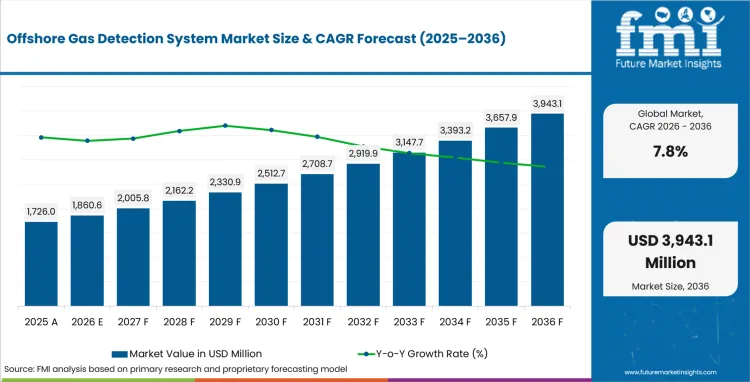
| Metric | Value |
|---|---|
| 2026 Market Size | USD 1,860.6 million |
| 2036 Market Size | USD 3,943.1 million |
| Forecast CAGR (2026-2036) | 7.8% |
| Leading Gas Type | Hydrocarbon Gas |
| Hydrocarbon Gas Share (2026) | 46.0% |
| Leading Detection Technology | Infrared |
| Infrared Share (2026) | 38.5% |
| Fastest-growing Country | China |
| China CAGR by 2036 | 8.8% |
Summary of the Offshore Gas Detection System Market
| Market Signal | Commercial Impact |
|---|---|
| Demand and Growth Drivers | Offshore gas detection system demand is expanding as operators strengthen process safety, continuous monitoring, and regulatory compliance across offshore production assets.
|
| Product and Segment View | Hydrocarbon Gas detection, Infrared sensing, Fixed Platform Systems, Offshore Production, and Direct OEM channels dominate their respective market segments.
|
| Geography and Growth Outlook | China, India, and South Korea are expected to remain key growth markets as offshore energy projects and safety compliance investments expand.
|
| Competitive Landscape | Competition is increasingly focused on certified detection technologies, integrated monitoring systems, and lifecycle service capabilities.
|
| Analyst Perspective | Offshore gas detection systems are evolving into comprehensive safety management platforms that improve operational reliability, compliance, and workforce protection.
- Nikhil Kaitwade, Principal Analyst at Future Market Insights |
Demand for gas leak detectors is driven by active hydrocarbon production and the need to verify safety conditions during entry and maintenance activities. According to the U.S. Department of the Interior, offshore oil production exceeded 714 million barrels in 2025, as reported in April 2026, maintaining continuous exposure to combustible gas risks across producing assets. Reflecting these operating conditions, Emerson expanded the capabilities of its Rosemount 928 detector in June 2026 to support 0% to 100% LEL combustible gas monitoring. These factors explain why operators prioritize gas detectors that can function reliably across active production facilities as well as remote or infrastructure‑constrained areas.
Which factors support expansion in the offshore gas detection system market?
Expansion is supported by safety-critical maintenance budgets and contractor entry checks. Fixed systems protect process modules while portable monitors document short-duration work.
- Replacement revenue is expected to improve during fixed detector renewals around process modules and utility spaces.
- Portable monitor demand benefits from vessel crews that must clear tanks and rooms before entry.
- Service income is strengthened by calibration records that show detector readiness during audits and inspections.
- EPC / Integrator channels gain relevance in new projects that bundle detectors with safety controls and alarms.
Why is the offshore gas detection system market growing?
Offshore buyers are spending more on gas detection because the equipment now supports both release prevention and work-permit evidence.
Growth in offshore gas detection demand is concentrated on producing assets where gas monitoring is inseparable from safe work execution. Offshore acreage continues to expand; the U.S. Department of the Interior reported in March 2026 that BBG2 covered 25 blocks spanning approximately 141 thousand acres, increasing the number of dispersed and difficult‑to‑wire locations requiring gas monitoring. This operating base keeps both fixed gas detectors and portable gas detection equipment closely aligned with inspection planning and permit‑to‑work processes.
Audit trails help industrial workplace safety programs connect each instrument to calibration and permit records. Sensor upgrades also support adjacent gas sensors in industrial hazard monitoring. Digital records fit digital oilfield solutions when operators need maintenance visibility before audits.
How is the offshore gas detection system market segmented?
The offshore gas detection system industry is first split by gas hazard and sensing technology. Installation type, end use and sales channel then show how buyers specify and purchase systems.
- Hydrocarbon Gas is projected to secure 46.0% share in 2026 due to flammable-gas risk that keeps the category central on production assets.
- Infrared is estimated to hold 38.5% share in 2026 supported by stable combustible-gas sensing that helps buyers manage harsh offshore conditions.
- Fixed Platform Systems are anticipated to hold 52.0% share in 2026 owing to continuous coverage needs in offshore safety planning.
- Offshore Production is forecast to represent 58.0% share in 2026 driven by producing platforms that require tested alarms and service contracts.
- Direct OEM is projected to account for 44.0% share in 2026 attributable to certified supply and accountable service support.
Which gas type category holds a notable share in the offshore gas detection system market?
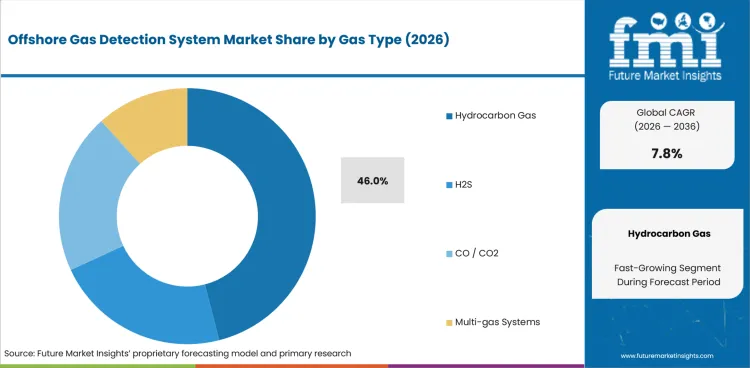
- Hydrocarbon Gas is projected to account for 46.0% share in 2026 supported by offshore process modules that need combustible leak detection near alarm design.
- H2S and CO / CO2 detection remain relevant for toxic-gas safety in confined spaces and production streams that require targeted alarms.
How does the detection technology segment perform in the offshore gas detection system market?
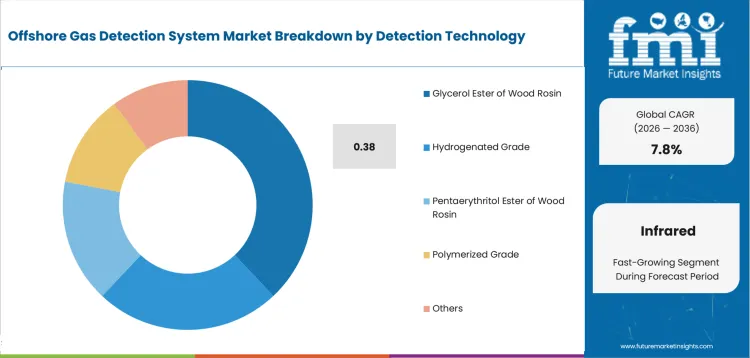
- Infrared is estimated to hold 38.5% share in 2026 due to buyer use in areas exposed to salt and vibration.
- Electrochemical sensors gain relevance in portable units owing to field crews needing simple toxic-gas and oxygen checks during entry work.
What drives selection across installation options in the offshore gas detection system market?
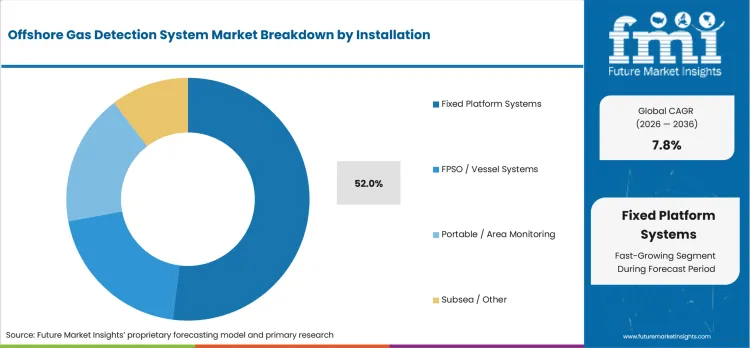
- Fixed Platform Systems are anticipated to hold 52.0% share in 2026 driven by permanent hazard zones that require detectors tied to alarm panels.
- Portable / Area Monitoring systems gain attention during maintenance campaigns due to temporary work zones that need movable alarms crews can reposition.
Which end-use segment shows a prominent position in the offshore gas detection system market?
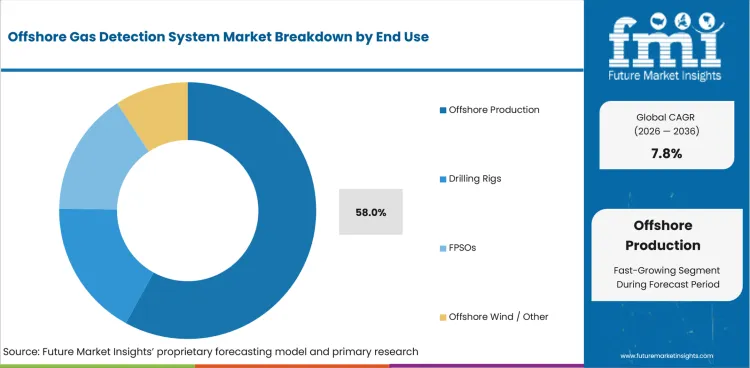
- Offshore Production is expected to represent 58.0% share in 2026 owing to continuous gas-risk exposure on producing assets.
- Drilling rigs and FPSOs create added demand due to mobile assets needing both installed alarms and portable monitors.
How are buyers selecting across sales channels in the offshore gas detection system market?
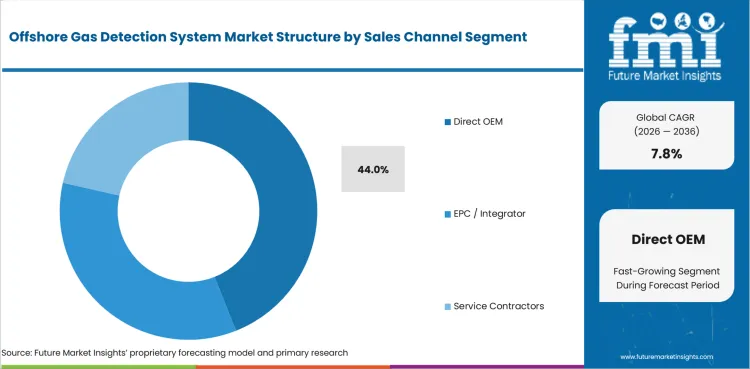
- Direct OEM is projected to account for 44.0% share in 2026 from certified detector packages and service accountability.
- EPC / Integrator channels gain influence during newbuild projects owing to detector connection needs across fire panels and control rooms.
What are the drivers, restraints and opportunities in the offshore gas detection system market?
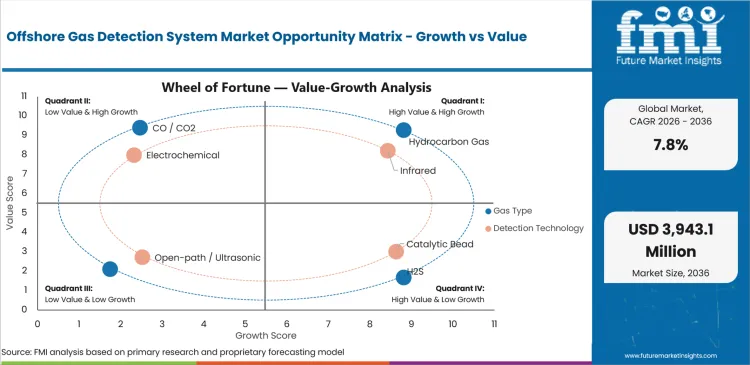
Demand is supported by release prevention and enclosed-space entry testing. Calibration burden still limits suppliers that cannot support maintenance records.
- Driver: Hydrocarbon-release prevention is expected to drive fixed detector upgrades around offshore process equipment.
- Restraint: Harsh offshore conditions can raise maintenance cost and slow replacement for smaller operators due to limited service capacity.
- Opportunity: Managed service and rental models can help contractors prove detector readiness without owning large fleets.
Hydrocarbon Release Control Sets Fixed-System Priorities
Fixed offshore gas detection remains inside safety-case budgets due to the speed at which releases can move across process modules. According to HSE in September 2025, UK offshore operators recorded 92 hydrocarbon releases in 2024. HSE separately warned in December 2025 that isolation failures remained a main cause of offshore hydrocarbon releases. Those findings explain why operators keep detector coverage and alarm mapping close to high-risk areas. They also support flame detector integration in modules that carry release risk for offshore buyers.
Enclosed-Space Testing Expands Portable Monitor Demand
Portable and multi-gas monitors now fit permit-to-work routines after the June 2025 IMO enclosed-space recommendation. Under the IMO guidance issued in June 2025, ships should carry at least two sets of gas detection equipment. The same guidance set safe-entry readings at 20.9% oxygen and below 0.5% carbon dioxide. These thresholds clarify why buyers include toxic gas detector functions inside instruments used before enclosed-space entry.
Calibration Burden Pushes Buyers Toward Service Contracts
Calibration burden turns equipment sales into service demand because offshore air and vibration can weaken detector reliability between maintenance cycles. Emerson added 0% to 100% LEL combustible monitoring to Rosemount 928 in June 2026. MSA Safety then agreed to acquire Autronica for USD 555 million in May 2026. These moves show how suppliers are building recordkeeping and oil and gas terminal automation interfaces around safety-critical monitoring.
Which countries are growing fastest in the offshore gas detection system market?
China 8.8% CAGR, India 8.4% CAGR, South Korea 8.1% CAGR, United States 7.7% CAGR, United Kingdom 7.5% CAGR, Germany 7.2% CAGR, France 7.0% CAGR, and Japan 6.8% CAGR through 2036
.webp "Top Country Growth Comparison Offshore Gas Detection System Market Cagr (2026 2036)")
| Country | CAGR |
|---|---|
| China | 8.8% |
| India | 8.4% |
| South Korea | 8.1% |
| United States | 7.7% |
| United Kingdom | 7.5% |
| Germany | 7.2% |
| France | 7.0% |
| Japan | 6.8% |
Source: Future Market Insights, 2026.
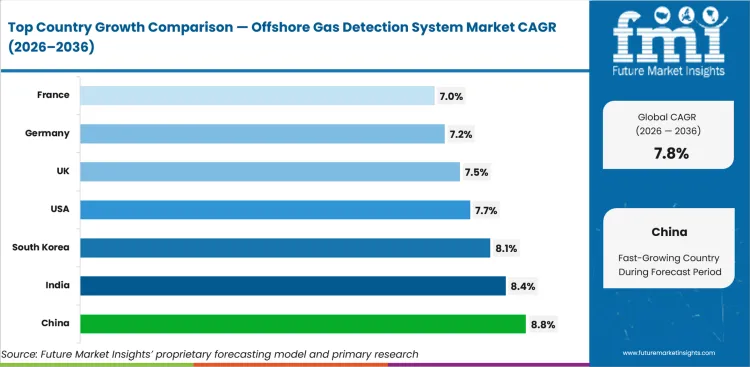
How do country-level CAGRs compare in the offshore gas detection system market?
China and India show the most material country outlooks. Japan records the most measured expansion profile among the profiled markets.
- China is forecast to record 8.8% CAGR by 2036 due to offshore production scale that guides national operator procurement.
- India is expected to expand at 8.4% CAGR by 2036 supported by offshore service programs that keep approved vendor routes active.
- South Korea is projected to advance at 8.1% CAGR by 2036 owing to infrastructure reuse that supports wind service activity.
- The United States is forecast to grow at 7.7% CAGR by 2036 due to Gulf of America production assets that anchor demand.
- The United Kingdom is estimated to rise at 7.5% CAGR by 2036 from North Sea asset integrity programs.
- Germany is projected to post 7.2% CAGR by 2036 supported by offshore wind service that raises marine safety demand.
- France is expected to record 7.0% CAGR by 2036 from offshore wind buildout and service-vessel activity.
- Japan is forecast to expand at 6.8% CAGR by 2036 attributable to selective offshore gas assets that keep vessel safety requirements active.
How fast is the offshore gas detection system market growing in the United States?
A 7.7% CAGR through 2036 reflects Gulf of America production exposure and weather-sensitive offshore safety workflows.
Country Market Snapshot Table
| Parameter | Value |
|---|---|
| Market Size in 2025 (Value) | USD 380.7 million |
| Market Size in 2026 (Value) | USD 410.0 million |
| Market Forecast in 2036 (Value) | USD 860.9 million |
| CAGR (2026 to 2036) | 7.7% |
| Years Considered | 2021 to 2036 |
| Base Year | 2025 |
| Forecast Period | 2026 to 2036 |
| Units Considered | Value (USD million) |
| Leading Sub-Region | Gulf of America production corridors |
United States Offshore Gas Detection System Market Outlook
United States demand starts in Gulf of America production platforms and drilling assets. Buyers need fixed detectors for process modules and portable monitors for contractor entry checks.
Procurement follows BSEE oversight and operator service standards. Suppliers gain access by proving hazardous-area approvals, calibration support and fast Gulf Coast response.
Key Growth Drivers
- Gulf of America production supports recurring fixed detector replacement on platforms that operate around process modules. In September 2024, the U.S. Energy Information Administration forecast Gulf offshore crude production at 1.9 million barrels per day in 2025. That output base keeps installed alarms and calibration work inside planned maintenance budgets.
- Weather exposure turns restart checks into recurring detector work after storms disrupt manned platforms. BSEE's September 2024 update showed 31.81% of manned Gulf platforms still evacuated after Hurricane Francine. That disruption explains why operators need fast gas-test routines before production restarts.
- Contractor-heavy maintenance supports portable multi-gas monitors for permit-to-work routines on platforms and vessels.
- Wireless and direct OEM channels gain relevance for operators that need lower installation disruption and clear service records.
Key Restraints
- Hurricane interruptions can defer scheduled detector servicing and complicate field logistics. NOAA's November 2024 season review recorded 18 named storms in the Atlantic season. That storm load keeps spare instruments and local calibration support important during offshore recovery.
- High documentation expectations raise the cost of serving smaller offshore contractors due to added training and recordkeeping effort.
- Legacy alarm panels can slow full-system upgrades until scheduled turnaround windows become available for safer integration work.
What makes United States unique
The United States stands out for deepwater production and weather-driven restart checks that test detector reliability.
Key Companies
- MSA Safety
- Emerson
- Honeywell Analytics
- Industrial Scientific
- RKI Instruments
Sales & Marketing Channels
- Direct OEM supply
- EPC / Integrator packages
- Safety distributor networks
- Rental fleets
- Calibration service providers
Country Segment Breakdown Table
| Segment | Sub-Segments |
|---|---|
| By Gas Type | Hydrocarbon Gas, H2S, CO / CO2, Multi-gas Systems |
| By Detection Technology | Infrared, Catalytic Bead, Electrochemical, Open-path / Ultrasonic |
| By Installation | Fixed Platform Systems, FPSO / Vessel Systems, Portable / Area Monitoring, Subsea / Other |
| By End Use | Offshore Production, Drilling Rigs, FPSOs, Offshore Wind / Other |
| By Sales Channel | Direct OEM, EPC / Integrator, Service Contractors |
| Key Sub-Regions Covered, Offshore and service corridors | Gulf of America, North Sea, Bohai Bay, South China Sea, Mumbai High, Donghae, Atlantic offshore wind corridors |
Frequently Asked Questions
How fast is United States offshore gas detection system market growing?
A 7.7% CAGR through 2036 reflects Gulf of America production exposure and weather-sensitive offshore safety workflows.
Who competes in United States offshore gas detection system market?
MSA Safety and Emerson compete on local product access. Honeywell Analytics and Industrial Scientific support service coverage.
What is driving adoption in United States offshore gas detection system market?
Adoption improves as Gulf operators pair fixed detector coverage with restart checks and portable monitors during maintenance work.
What is the offshore gas detection system market outlook in the United Kingdom?
A 7.5% CAGR through 2036 reflects North Sea safety reviews and service-led detector replacement.
Country Market Snapshot Table
| Parameter | Value |
|---|---|
| Market Size in 2025 (Value) | USD 153.5 million |
| Market Size in 2026 (Value) | USD 165.0 million |
| Market Forecast in 2036 (Value) | USD 340.1 million |
| CAGR (2026 to 2036) | 7.5% |
| Years Considered | 2021 to 2036 |
| Base Year | 2025 |
| Forecast Period | 2026 to 2036 |
| Units Considered | Value (USD million) |
| Leading Sub-Region | North Sea service bases |
United Kingdom Offshore Gas Detection System Market Outlook
United Kingdom demand comes from mature North Sea infrastructure and safety-case scrutiny. Operators use gas detection to keep hydrocarbon-release risk visible during maintenance and production.
Channel behavior is service-led because buyers require portable fleets and calibration histories. UK-based suppliers add faster technical response for North Sea accounts.
Key Growth Drivers
- Hydrocarbon-release visibility keeps fixed detector coverage inside asset-integrity reviews. HSE's September 2025 offshore statistics recorded 92 UK offshore hydrocarbon releases in 2024. This evidence gives buyers a practical reason to review alarm placement and service records together.
- Service contracts support portable monitor renewal across contractor crews that need accountable fleet records. Dräger Marine & Offshore secured a five-year UK North Sea operator contract in May 2025. That award shows why buyers value portable detector supply with fleet management support.
- North Sea production assets need reliable alarm records during shutdown and restart workflows due to audit exposure.
- Fleet management demand improves for contractors that need traceable bump tests and user accountability across offshore crews.
Key Restraints
- Aging assets can make detector upgrades more difficult on legacy wiring and control interfaces. The same September 2025 HSE report documented 21 offshore improvement notices during 2024. That enforcement backdrop slows rushed changeovers and favors planned upgrade windows.
- Maintenance windows remain tight on producing assets and can slow full-system replacement during busy turnaround periods.
- Specialist offshore service coverage can raise cost for smaller operators outside core North Sea hubs.
What makes United Kingdom unique
The United Kingdom stands apart because public offshore inspection data shapes attention to proof and maintenance closure.
Key Companies
- Dräger Marine & Offshore
- Crowcon Detection Instruments
- Honeywell Analytics
- Industrial Scientific
- Teledyne Gas & Flame Detection
Sales & Marketing Channels
- Direct OEM supply
- Offshore safety contractors
- North Sea service bases
- Distributor-led portable monitor supply
- Calibration fleet management
Country Segment Breakdown Table
| Segment | Sub-Segments |
|---|---|
| By Gas Type | Hydrocarbon Gas, H2S, CO / CO2, Multi-gas Systems |
| By Detection Technology | Infrared, Catalytic Bead, Electrochemical, Open-path / Ultrasonic |
| By Installation | Fixed Platform Systems, FPSO / Vessel Systems, Portable / Area Monitoring, Subsea / Other |
| By End Use | Offshore Production, Drilling Rigs, FPSOs, Offshore Wind / Other |
| By Sales Channel | Direct OEM, EPC / Integrator, Service Contractors |
| Key Sub-Regions Covered, Offshore and service corridors | Gulf of America, North Sea, Bohai Bay, South China Sea, Mumbai High, Donghae, Atlantic offshore wind corridors |
Frequently Asked Questions
How fast is United Kingdom offshore gas detection system market growing?
A 7.5% CAGR through 2036 reflects North Sea safety reviews and service-led detector replacement.
Who competes in United Kingdom offshore gas detection system market?
Dräger Marine & Offshore and Crowcon Detection Instruments compete on local product access. Honeywell Analytics and Industrial Scientific support service coverage.
What is driving adoption in United Kingdom offshore gas detection system market?
Adoption is reinforced by North Sea safety-case reviews and contractor fleet management requirements.
How is Germany performing in the offshore gas detection system market?
A 7.2% CAGR through 2036 reflects offshore wind service demand and selective marine safety buying.
Country Market Snapshot Table
| Parameter | Value |
|---|---|
| Market Size in 2025 (Value) | USD 88.6 million |
| Market Size in 2026 (Value) | USD 95.0 million |
| Market Forecast in 2036 (Value) | USD 190.4 million |
| CAGR (2026 to 2036) | 7.2% |
| Years Considered | 2021 to 2036 |
| Base Year | 2025 |
| Forecast Period | 2026 to 2036 |
| Units Considered | Value (USD million) |
| Leading Sub-Region | North Sea and Baltic Sea service corridors |
Germany Offshore Gas Detection System Market Outlook
Germany demand is driven by offshore wind service vessels and industrial marine assets. Fixed gas detection remains more selective than in oil-heavy offshore markets.
Buyers prioritize domestic service access and certified products for vessel maintenance routines. Local manufacturers and regional distributors improve calibration and replacement support.
Key Growth Drivers
- Offshore wind service activity expands vessel-based gas testing requirements in maintenance and transfer work. Bundesnetzagentur's January 2025 update listed German offshore wind capacity at 9.2 GW by the end of 2024. That fleet base widens the need for portable monitors across marine service routes.
- Policy targets keep offshore wind contractors planning safety equipment beyond near-term vessel work. Germany targets at least 30 GW of offshore wind capacity by 2030. That pipeline supports distributor stocking and long-cycle service planning.
- Domestic detector manufacturing supports faster access to fixed and portable gas detection equipment for service-led offshore buyers.
- Battery rooms and enclosed service spaces create portable monitor demand during offshore maintenance due to crew-entry risk.
Key Restraints
- Fixed gas detector volume remains narrower than oil-heavy markets due to fewer hydrocarbon process modules. The January 2025 Bundesnetzagentur update also showed 0.7 GW of new German offshore wind capacity in 2024. The figure supports a vessel-service opportunity more than a large fixed-platform detector pool.
- Seasonal wind-service demand can complicate distributor inventory planning due to project-led ordering and variable vessel activity.
- Approval requirements can slow supplier changes for operators that standardize equipment across service fleets and offshore platforms.
What makes Germany unique
Germany stands out because offshore wind service work creates portable gas testing demand outside oil-platform settings.
Key Companies
- Dräger
- GfG Instrumentation
- MSA Safety Germany
- Honeywell Analytics Germany
- Riken Keiki Germany
Sales & Marketing Channels
- Marine safety distributors
- Direct OEM supply
- Offshore wind contractors
- Calibration service centers
- EPC / Integrator packages
Country Segment Breakdown Table
| Segment | Sub-Segments |
|---|---|
| By Gas Type | Hydrocarbon Gas, H2S, CO / CO2, Multi-gas Systems |
| By Detection Technology | Infrared, Catalytic Bead, Electrochemical, Open-path / Ultrasonic |
| By Installation | Fixed Platform Systems, FPSO / Vessel Systems, Portable / Area Monitoring, Subsea / Other |
| By End Use | Offshore Production, Drilling Rigs, FPSOs, Offshore Wind / Other |
| By Sales Channel | Direct OEM, EPC / Integrator, Service Contractors |
| Key Sub-Regions Covered, Offshore and service corridors | Gulf of America, North Sea, Bohai Bay, South China Sea, Mumbai High, Donghae, Atlantic offshore wind corridors |
Frequently Asked Questions
How fast is Germany offshore gas detection system market growing?
A 7.2% CAGR through 2036 reflects offshore wind service demand and selective marine safety buying.
Who competes in Germany offshore gas detection system market?
Dräger and GfG Instrumentation compete on local product access. MSA Safety Germany and Honeywell Analytics Germany support service coverage.
What is driving adoption in Germany offshore gas detection system market?
Adoption is shaped by offshore wind service work and vessel-based confined-space testing.
What supports offshore gas detection system growth in France?
A 7.0% CAGR through 2036 reflects offshore wind service buildout and marine contractor safety needs.
Country Market Snapshot Table
| Parameter | Value |
|---|---|
| Market Size in 2025 (Value) | USD 65.4 million |
| Market Size in 2026 (Value) | USD 70.0 million |
| Market Forecast in 2036 (Value) | USD 137.7 million |
| CAGR (2026 to 2036) | 7.0% |
| Years Considered | 2021 to 2036 |
| Base Year | 2025 |
| Forecast Period | 2026 to 2036 |
| Units Considered | Value (USD million) |
| Leading Sub-Region | Atlantic and Channel offshore wind corridors |
France Offshore Gas Detection System Market Outlook
France demand is concentrated around offshore wind maintenance and marine service bases. Portable and area monitors carry more weight than large fixed platform packages.
Supplier access depends on distributor reach and compatibility with contractor safety routines. Buyers compare ruggedness, maintenance support and training availability before fleet selection.
Key Growth Drivers
- Offshore wind planning broadens future marine safety demand for installation vessels and service bases. The French government set a 15 GW offshore wind objective for 2035 in April 2026. That target makes portable gas testing more relevant to long-cycle marine contractor planning.
- Large tender planning increases visibility for service-vessel safety equipment before offshore projects reach construction. France announced AO10 for 8 GW to 10 GW of offshore wind capacity in April 2026. That tender scale gives suppliers a reason to prepare portable fleets and calibration services early.
- Distributor rental models support short-term portable detector needs during maintenance campaigns and vessel service work.
- Fixed detection is used selectively in electrical and industrial service spaces that carry gas or battery hazards.
Key Restraints
- Project phasing can slow near-term orders during the move from award to construction. France added about 25 MW of offshore wind capacity in 2024 according to the April 2026 roadmap. That limited installed base explains why demand may arrive in waves rather than evenly.
- Lower offshore oil exposure limits large fixed detector packages compared with production-led countries that run more process modules.
- Multiple contractor layers can complicate standardization of portable gas monitor fleets due to uneven service-vessel coordination.
What makes France unique
France stands out because offshore wind and marine service activity provide clearer demand signals than large oil platform clusters.
Key Companies
- Teledyne Gas & Flame Detection
- GazDetect
- Dräger France
- MSA Safety France
- Honeywell Analytics France
Sales & Marketing Channels
- Specialist safety distributors
- Offshore wind contractors
- Direct OEM supply
- Rental and calibration providers
- EPC / Integrator packages
Country Segment Breakdown Table
| Segment | Sub-Segments |
|---|---|
| By Gas Type | Hydrocarbon Gas, H2S, CO / CO2, Multi-gas Systems |
| By Detection Technology | Infrared, Catalytic Bead, Electrochemical, Open-path / Ultrasonic |
| By Installation | Fixed Platform Systems, FPSO / Vessel Systems, Portable / Area Monitoring, Subsea / Other |
| By End Use | Offshore Production, Drilling Rigs, FPSOs, Offshore Wind / Other |
| By Sales Channel | Direct OEM, EPC / Integrator, Service Contractors |
| Key Sub-Regions Covered, Offshore and service corridors | Gulf of America, North Sea, Bohai Bay, South China Sea, Mumbai High, Donghae, Atlantic offshore wind corridors |
Frequently Asked Questions
How fast is France offshore gas detection system market growing?
A 7.0% CAGR through 2036 reflects offshore wind service buildout and marine contractor safety needs.
Who competes in France offshore gas detection system market?
Teledyne Gas & Flame Detection and GazDetect compete on local product access. Dräger France and MSA Safety France support service coverage.
What is driving adoption in France offshore gas detection system market?
Adoption gains support from offshore wind service vessels and distributor-led calibration access.
How is the offshore gas detection system forecast developing in Japan?
A 6.8% CAGR through 2036 reflects selective offshore energy work and strict industrial safety expectations.
Country Market Snapshot Table
| Parameter | Value |
|---|---|
| Market Size in 2025 (Value) | USD 103.0 million |
| Market Size in 2026 (Value) | USD 110.0 million |
| Market Forecast in 2036 (Value) | USD 212.4 million |
| CAGR (2026 to 2036) | 6.8% |
| Years Considered | 2021 to 2036 |
| Base Year | 2025 |
| Forecast Period | 2026 to 2036 |
| Units Considered | Value (USD million) |
| Leading Sub-Region | Tokyo Bay, Osaka Bay and offshore energy service corridors |
Japan Offshore Gas Detection System Market Outlook
Japan demand is tied to energy security and offshore gas handling. Buyers favor reliable detectors with stable maintenance support over low-cost substitutions.
Purchasing moves through established industrial safety channels and local service partners. Portable multi-gas monitors gain use in enclosed-space and vessel maintenance work.
Key Growth Drivers
- Upstream asset participation keeps gas handling safety relevant for detector buyers and marine service teams. METI's February 2026 release gave Japan’s independent oil and natural gas development ratio as 42.1% in fiscal 2024. That exposure supports continued use of detectors around offshore energy handling.
- Domestic detector manufacturing supports local supply and maintenance credibility for offshore buyers. New Cosmos Electric identifies itself as a Japanese gas sensor and alarm manufacturer. That local base improves trust around servicing and replacement in safety-critical projects.
- Portable monitors gain relevance during vessel entry checks and contractor maintenance work across Japanese offshore assets.
- Infrared fixed detectors remain favored in combustible-gas zones that require stable alarm behavior under marine exposure.
Key Restraints
- Selective offshore production limits large fixed-system volume compared with production-heavy countries. The February 2026 METI release showed a 4.9-point rise in Japan’s independent development ratio for fiscal 2024. The improvement supports relevance without creating a broad fixed-platform replacement pool.
- Stringent buyer qualification can lengthen vendor approval cycles for new suppliers seeking local offshore projects.
- Higher service expectations can make low-cost imports less attractive for critical offshore use across Japanese projects.
What makes Japan unique
Japan stands out because local gas detector manufacturers serve buyers that value reliability and documented service.
Key Companies
- Riken Keiki
- New Cosmos Electric
- RKI Instruments
- Dräger Japan
- MSA Safety Japan
Sales & Marketing Channels
- Direct OEM supply
- Industrial safety distributors
- Marine service contractors
- Calibration service centers
- EPC / Integrator packages
Country Segment Breakdown Table
| Segment | Sub-Segments |
|---|---|
| By Gas Type | Hydrocarbon Gas, H2S, CO / CO2, Multi-gas Systems |
| By Detection Technology | Infrared, Catalytic Bead, Electrochemical, Open-path / Ultrasonic |
| By Installation | Fixed Platform Systems, FPSO / Vessel Systems, Portable / Area Monitoring, Subsea / Other |
| By End Use | Offshore Production, Drilling Rigs, FPSOs, Offshore Wind / Other |
| By Sales Channel | Direct OEM, EPC / Integrator, Service Contractors |
| Key Sub-Regions Covered, Offshore and service corridors | Gulf of America, North Sea, Bohai Bay, South China Sea, Mumbai High, Donghae, Atlantic offshore wind corridors |
Frequently Asked Questions
How fast is Japan offshore gas detection system market growing?
A 6.8% CAGR through 2036 reflects selective offshore energy work and strict industrial safety expectations.
Who competes in Japan offshore gas detection system market?
Riken Keiki and New Cosmos Electric compete on local product access. RKI Instruments and Dräger Japan support service coverage.
What is driving adoption in Japan offshore gas detection system market?
Adoption reflects selective offshore gas exposure and domestic sensor supplier credibility.
What is shaping offshore gas detection system demand in China?
An 8.8% CAGR through 2036 reflects national offshore production scale and EPC-led detector procurement.
Country Market Snapshot Table
| Parameter | Value |
|---|---|
| Market Size in 2025 (Value) | USD 330.9 million |
| Market Size in 2026 (Value) | USD 360.0 million |
| Market Forecast in 2036 (Value) | USD 836.7 million |
| CAGR (2026 to 2036) | 8.8% |
| Years Considered | 2021 to 2036 |
| Base Year | 2025 |
| Forecast Period | 2026 to 2036 |
| Units Considered | Value (USD million) |
| Leading Sub-Region | Bohai Bay, South China Sea and Yangtze River Delta service corridors |
China Offshore Gas Detection System Market Outlook
China demand is anchored in offshore production growth and large operator procurement. Fixed combustible-gas detectors and portable monitors remain central to platform safety programs.
Channels follow EPC packaging, local service expectations and domestic supplier participation. Foreign suppliers compete best with visible certification and field support.
Key Growth Drivers
- Offshore production scale supports continuous detector deployment on platforms and FPSOs. CNOOC's March 2025 annual results recorded net oil and gas production of 726.8 million BOE during 2024. That operating base keeps fixed alarms and service routines tied to national offshore procurement.
- Domestic upstream growth widens service needs for detector calibration and spare parts. The same March 2025 CNOOC results showed 5.6% growth in China net production during 2024. That growth supports local service teams that can maintain detectors across offshore bases.
- EPC-led packages create demand for detectors connected to alarms, panels and control systems across offshore production projects.
- Local service access remains important due to operators needing fast support across offshore bases and maintenance yards.
Key Restraints
- Vendor qualification can slow new supplier entry into national operator projects. CNOOC's March 2025 disclosure put capital expenditure at about RMB 132.5 billion during 2024. That spending scale makes approvals important before suppliers can enter major offshore packages.
- Price pressure from domestic alternatives can limit premium detector penetration among cost-sensitive offshore buyers and contractors.
- Certification and localization requirements can extend sales cycles for imported fixed systems in national operator projects.
What makes China unique
China stands out because national offshore operator activity concentrates large detector packages and service requirements.
Key Companies
- Hanwei Electronics
- Focused Photonics
- MSA China
- Dräger China
- Honeywell China
Sales & Marketing Channels
- National operator procurement
- EPC / Integrator packages
- Local distributor networks
- Domestic safety-system integrators
- Calibration service partners
Country Segment Breakdown Table
| Segment | Sub-Segments |
|---|---|
| By Gas Type | Hydrocarbon Gas, H2S, CO / CO2, Multi-gas Systems |
| By Detection Technology | Infrared, Catalytic Bead, Electrochemical, Open-path / Ultrasonic |
| By Installation | Fixed Platform Systems, FPSO / Vessel Systems, Portable / Area Monitoring, Subsea / Other |
| By End Use | Offshore Production, Drilling Rigs, FPSOs, Offshore Wind / Other |
| By Sales Channel | Direct OEM, EPC / Integrator, Service Contractors |
| Key Sub-Regions Covered, Offshore and service corridors | Gulf of America, North Sea, Bohai Bay, South China Sea, Mumbai High, Donghae, Atlantic offshore wind corridors |
Frequently Asked Questions
How fast is China offshore gas detection system market growing?
An 8.8% CAGR through 2036 reflects national offshore production scale and EPC-led detector procurement.
Who competes in China offshore gas detection system market?
Hanwei Electronics and Focused Photonics compete on local product access. MSA China and Dräger China support service coverage.
What is driving adoption in China offshore gas detection system market?
Adoption is strengthened by EPC-led platform packages and national operator service requirements.
How does South Korea compare in the offshore gas detection system market?
An 8.1% CAGR through 2036 reflects offshore infrastructure reuse and project-specific monitoring needs.
Country Market Snapshot Table
| Parameter | Value |
|---|---|
| Market Size in 2025 (Value) | USD 78.6 million |
| Market Size in 2026 (Value) | USD 85.0 million |
| Market Forecast in 2036 (Value) | USD 185.2 million |
| CAGR (2026 to 2036) | 8.1% |
| Years Considered | 2021 to 2036 |
| Base Year | 2025 |
| Forecast Period | 2026 to 2036 |
| Units Considered | Value (USD million) |
| Leading Sub-Region | Ulsan and Donghae offshore energy corridors |
South Korea Offshore Gas Detection System Market Outlook
South Korea demand is shaped by offshore energy reuse and marine service projects. Gas detection needs remain project-specific compared with larger production markets.
Purchasing depends on EPC relationships, operator approvals and local maintenance access. Portable detectors fit conversion work and vessel entry checks around offshore structures.
Key Growth Drivers
- Donghae infrastructure reuse creates atmospheric testing needs during conversion work. KNOC described the floating offshore wind project in April 2026 as being near the Donghae gas field. That setting makes gas testing relevant during reuse and marine service activity.
- Domestic gas detector suppliers improve local service and replacement access for offshore buyers. Gastron lists fixed, wireless and portable gas detectors in its product portfolio. That range supports project teams that need both installed alarms and temporary monitors.
- CCS planning increases attention to CO2 monitoring around offshore facilities and support vessels during conversion work.
- Offshore wind service work is expected to increase portable monitor use during enclosed-space checks.
Key Restraints
- Limited active offshore hydrocarbon production narrows large fixed combustible detector volume. KNOC places the Donghae project around a former gas-field setting in its April 2026 project description. That reuse profile supports project-specific monitoring more than broad production-platform replacement.
- Project-based demand can create uneven ordering patterns for specialist detector suppliers during offshore infrastructure reuse.
- Certification and EPC approval processes can lengthen market entry for imported products seeking Korean offshore projects.
What makes South Korea unique
South Korea stands out because gas detection demand is tied to offshore reuse and conversion work.
Key Companies
- Gastron
- SENKO
- Teledyne Gas & Flame Detection Korea
- Honeywell Korea
- Riken Keiki Korea
Sales & Marketing Channels
- Operator-approved EPC channels
- Marine safety distributors
- Offshore wind contractors
- CCS project contractors
- Calibration service providers
Country Segment Breakdown Table
| Segment | Sub-Segments |
|---|---|
| By Gas Type | Hydrocarbon Gas, H2S, CO / CO2, Multi-gas Systems |
| By Detection Technology | Infrared, Catalytic Bead, Electrochemical, Open-path / Ultrasonic |
| By Installation | Fixed Platform Systems, FPSO / Vessel Systems, Portable / Area Monitoring, Subsea / Other |
| By End Use | Offshore Production, Drilling Rigs, FPSOs, Offshore Wind / Other |
| By Sales Channel | Direct OEM, EPC / Integrator, Service Contractors |
| Key Sub-Regions Covered, Offshore and service corridors | Gulf of America, North Sea, Bohai Bay, South China Sea, Mumbai High, Donghae, Atlantic offshore wind corridors |
Frequently Asked Questions
How fast is South Korea offshore gas detection system market growing?
An 8.1% CAGR through 2036 reflects offshore infrastructure reuse and project-specific monitoring needs.
Who competes in South Korea offshore gas detection system market?
Gastron and SENKO compete on local product access. Teledyne Gas & Flame Detection Korea and Honeywell Korea support service coverage.
What is driving adoption in South Korea offshore gas detection system market?
Adoption follows offshore infrastructure reuse and local detector service availability.
What supports offshore gas detection system growth in India?
An 8.4% CAGR through 2036 reflects Mumbai High service work and approved-channel detector demand.
Country Market Snapshot Table
| Parameter | Value |
|---|---|
| Market Size in 2025 (Value) | USD 87.6 million |
| Market Size in 2026 (Value) | USD 95.0 million |
| Market Forecast in 2036 (Value) | USD 212.8 million |
| CAGR (2026 to 2036) | 8.4% |
| Years Considered | 2021 to 2036 |
| Base Year | 2025 |
| Forecast Period | 2026 to 2036 |
| Units Considered | Value (USD million) |
| Leading Sub-Region | Mumbai High and western offshore service corridors |
India Offshore Gas Detection System Market Outlook
India demand is anchored in producing offshore assets and national energy-security priorities. Buyers need reliable fixed detectors and portable monitors at cost-conscious price points.
Procurement follows public-sector operator requirements and tender documentation. Approved vendors with local calibration and repair support are better placed than import-only suppliers.
Key Growth Drivers
- Offshore gas handling keeps detector demand tied to production and maintenance planning. PPAC's February 2024 snapshot showed gross natural gas production of 3,139 MMSCM in January 2024. That operating base supports fixed detectors and portable monitors in offshore service routines.
- Mumbai High work supports renewed safety-system attention on producing assets. ONGC and bp signed a production enhancement contract in February 2025 for the Mumbai High field. That development keeps detector replacement and service planning tied to active offshore work.
- Offshore wind planning can widen future demand for vessel-based portable monitors. MNRE identified offshore wind as a renewable energy focus for India in December 2024. That policy direction supports early planning for marine service safety equipment.
- Local manufacturers improve access to fixed and portable gas detection products for industrial and offshore buyers.
Key Restraints
- Price sensitivity can slow full fleet replacement until maintenance risk becomes visible. The same PPAC snapshot recorded total natural gas consumption of 5,494 MMSCM in January 2024. The consumption base shows energy need but does not remove cost pressure for certified detectors.
- Tender documentation and vendor approvals can extend sales cycles for specialist detection suppliers in Indian offshore projects.
- Imported certified systems can face service delays if spare parts and calibration support are not local.
What makes India unique
India stands out because active offshore oilfield service work is developing alongside early offshore wind planning.
Key Companies
- Uniphos Envirotronic
- Ambetronics Engineers
- Honeywell Automation India
- Dräger India
- MSA Safety India
Sales & Marketing Channels
- Public-sector operator procurement
- EPC / Integrator channels
- Industrial safety distributors
- Offshore service contractors
- Calibration and repair centers
Country Segment Breakdown Table
| Segment | Sub-Segments |
|---|---|
| By Gas Type | Hydrocarbon Gas, H2S, CO / CO2, Multi-gas Systems |
| By Detection Technology | Infrared, Catalytic Bead, Electrochemical, Open-path / Ultrasonic |
| By Installation | Fixed Platform Systems, FPSO / Vessel Systems, Portable / Area Monitoring, Subsea / Other |
| By End Use | Offshore Production, Drilling Rigs, FPSOs, Offshore Wind / Other |
| By Sales Channel | Direct OEM, EPC / Integrator, Service Contractors |
| Key Sub-Regions Covered, Offshore and service corridors | Gulf of America, North Sea, Bohai Bay, South China Sea, Mumbai High, Donghae, Atlantic offshore wind corridors |
Frequently Asked Questions
How fast is India offshore gas detection system market growing?
An 8.4% CAGR through 2036 reflects Mumbai High service work and approved-channel detector demand.
Who competes in India offshore gas detection system market?
Uniphos Envirotronic and Ambetronics Engineers compete on local product access. Honeywell Automation India and Dräger India support service coverage.
What is driving adoption in India offshore gas detection system market?
Adoption benefits from Mumbai High maintenance work and approved local calibration channels.
Who are the leading companies in the offshore gas detection system market?
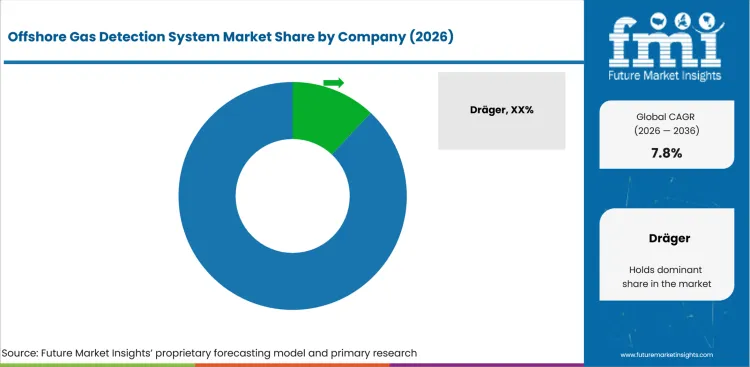
Dräger and MSA Safety are profiled alongside Honeywell Analytics. Emerson, Teledyne Gas & Flame Detection and Crowcon Detection Instruments are covered as system and specialist suppliers.
- Competition is shaped by hazardous-area approvals and offshore support for both fixed and portable detectors.
- Large suppliers compete on certified product breadth and alarm integration supported by lifecycle service coverage that strengthens account positions with operators.
- Specialist suppliers gain accounts by pairing portable monitor fleets with rental options and faster calibration response.
- Regional suppliers win contractor access in service hubs that value local inventory and short repair cycles.
Established suppliers compete are focusing on detector coverage and lifecycle service. Companies such as MSA Safety, Dräger and Honeywell Analytics are better placed for operators that want product supply and calibration records from one vendor group. That buying pattern resembles demand for adjacent oil and gas sensor systems in safety-critical assets.
Capability depth is moving toward connected records and lower-disruption installation. Emerson added combustible gas detection to the Rosemount 928 wireless gas monitor in June 2026. The product update matters for offshore buyers that need hazardous-area monitoring without long wiring work.
Portable detector suppliers get accounts by making contractor workflows easier to document. Dräger’s UK North Sea contract points to demand for fleet management and user accountability. Suppliers that combine instruments with machine safety systems practices can hold a clearer service advantage.
How do top offshore gas detection system market companies compare?
Companies differ by certification depth, fixed alarm integration and portable fleet management. Service reach then determines how well each supplier supports offshore accounts.
| Company | Portfolio / Focus | Account Access | Footprint / Service Reach |
|---|---|---|---|
| Dräger | Portable and fixed gas detection | Strong | Global |
| MSA Safety | Fire, gas and alarm systems | Strong | Global |
| Honeywell Analytics | Fixed and portable detection | Strong | Global |
| Emerson | Wireless gas monitoring and process integration | Strong | Global |
| Teledyne Gas & Flame Detection | Fixed gas and flame detection | Medium | Global |
| Crowcon Detection Instruments | Portable and fixed detectors | Medium | Europe-led global |
| Industrial Scientific | Portable multi-gas monitors | Strong | Global |
| GfG Instrumentation | Portable and fixed systems | Medium | North America and Europe |
Source: Future Market Insights competitive analysis, 2026.
Who are the key players in the offshore gas detection system market?
The market includes global gas detection suppliers, specialist detector companies and regional safety-system providers that support offshore operators.
Key global companies leading the offshore gas detection system market include:
- Dräger
- MSA Safety
- Honeywell Analytics
- Emerson
- Teledyne Gas & Flame Detection
- Crowcon Detection Instruments
- Industrial Scientific
- GfG Instrumentation
- Riken Keiki
- Hanwei Electronics
Key Developments in Offshore Gas Detection System Market
- In May 2026, MSA Safety agreed to acquire Autronica for USD 555 million to expand fire and gas alarm system depth for critical infrastructure buyers.
- In June 2026, Emerson added combustible gas detection to the Rosemount 928 wireless gas monitor to extend lower-explosive-limit monitoring into wireless hazardous-area workflows.
- In May 2025, Dräger Marine & Offshore secured a five-year UK North Sea operator contract covering portable gas detectors and fleet management support for offshore users.
Key Players in the Offshore Gas Detection System Market
Global Detection Leaders
- Dräger
- MSA Safety
- Honeywell Analytics
- Emerson
Specialist Detection Suppliers
- Teledyne Gas & Flame Detection
- Crowcon Detection Instruments
- Industrial Scientific
- GfG Instrumentation
Regional and Local Suppliers
- Riken Keiki
- New Cosmos Electric
- Hanwei Electronics
- Focused Photonics
- Gastron
- Uniphos Envirotronic
- Ambetronics Engineers
Offshore Gas Detection System Market - Report Scope
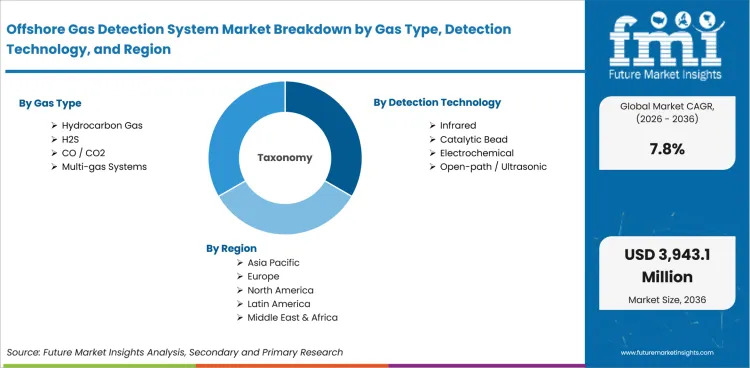
| Parameter | Details |
|---|---|
| Forecast period | 2026 to 2036 |
| Historical period | 2021 to 2025 |
| Quantitative unit | Value (USD million) |
| Segmentation by Gas Type | Hydrocarbon Gas, H2S, CO / CO2, Multi-gas Systems |
| Segmentation by Detection Technology | Infrared, Catalytic Bead, Electrochemical, Open-path / Ultrasonic |
| Segmentation by Installation | Fixed Platform Systems, FPSO / Vessel Systems, Portable / Area Monitoring, Subsea / Other |
| Segmentation by End Use | Offshore Production, Drilling Rigs, FPSOs, Offshore Wind / Other |
| Segmentation by Sales Channel | Direct OEM, EPC / Integrator, Service Contractors |
| Regions covered | North America, Europe, East Asia, South Asia and Pacific |
| Countries covered | United States, United Kingdom, Germany, France, Japan, China, South Korea, India |
| Key companies profiled | Dräger, MSA Safety, Honeywell Analytics, Emerson, Teledyne Gas & Flame Detection, Crowcon Detection Instruments, Industrial Scientific, GfG Instrumentation |
| Approach | Hybrid bottom-up and top-down methodology using detector volumes, offshore asset activity, replacement cycles, pricing and service intensity |
Source: Future Market Insights, 2026.
Offshore Gas Detection System Market - Scope & Definition
| Attribute | Detail |
|---|---|
| Market Definition | Fixed, portable and area-monitoring systems used to detect flammable or toxic gases on offshore assets. |
| Functions Covered | Gas detection, alarm generation, area monitoring, portable clearance checks, calibration records and detector maintenance. |
| Applications Covered | Process modules, FPSOs, drilling rigs, service vessels, enclosed spaces, offshore wind service areas and maintenance zones. |
| End-Use Industries | Offshore oil and gas production, drilling, FPSO operations, marine services and offshore wind service operations. |
| Grades Covered | Hazardous-area fixed detectors, portable multi-gas monitors, infrared sensors, electrochemical sensors and open-path or ultrasonic systems. |
| Inclusions | Hydrocarbon gas, H2S, CO / CO2 and multi-gas systems used in offshore environments. |
| Exclusions | Household gas alarms, onshore-only refinery systems, laboratory analyzers and software sold without detector hardware. |
Offshore Gas Detection System Market - Research Methodology
| Method | Description |
|---|---|
| Primary Research | FMI analysts reviewed offshore operator requirements, safety-system buying practices and service contractor feedback. |
| Desk Research | Desk research covered offshore safety guidance, regulator publications, maritime enclosed-space rules and official company product information. |
| Market Sizing & Forecasting | The model combined detector volumes, average system pricing and replacement frequency across fixed, portable and area-monitoring systems. |
| Forecast Basis | Forecasts reflect offshore production signals, hydrocarbon-release records and verified supplier portfolios. |
Offshore Gas Detection System Market Breakdown by Gas Type, Detection Technology, Installation, End Use, Sales Channel, and Region
Offshore Gas Detection System Market Segmented by Gas Type:
- Hydrocarbon Gas
- H2S
- CO / CO2
- Multi-gas Systems
Offshore Gas Detection System Market Segmented by Detection Technology:
- Infrared
- Catalytic Bead
- Electrochemical
- Open-path / Ultrasonic
Offshore Gas Detection System Market Segmented by Installation:
- Fixed Platform Systems
- FPSO / Vessel Systems
- Portable / Area Monitoring
- Subsea / Other
Offshore Gas Detection System Market Segmented by End Use:
- Offshore Production
- Drilling Rigs
- FPSOs
- Offshore Wind / Other
Offshore Gas Detection System Market Segmented by Sales Channel:
- Direct OEM
- EPC / Integrator
- Service Contractors
Offshore Gas Detection System Market by Region:
- North America
- United States
- Canada
- Europe
- Germany
- United Kingdom
- France
- Italy
- Spain
- Asia Pacific
- China
- Japan
- South Korea
- Taiwan
- Singapore
- Latin America
- Brazil
- Mexico
- Argentina
- Middle East & Africa
- GCC Countries
- South Africa
- Israel
Research Sources and Bibliography
- Bureau of Safety and Environmental Enforcement. (2024, September). BSEE monitors Gulf of Mexico oil and gas activities after Hurricane Francine. U.S. Department of the Interior.
- Bundesnetzagentur. (2025, January). Growth in renewable energy in 2024. Bundesnetzagentur.
- CNOOC Limited. (2025, March). 2024 annual results. CNOOC Limited.
- Crowcon Detection Instruments. (2024, November). New Crowcon gas detector IR Plus. Crowcon Detection Instruments.
- Dräger Marine & Offshore. (2025, May). Dräger Marine & Offshore wins five-year contract with UK North Sea operator. Dräger.
- Emerson Electric Co. (2026, June). Emerson adds combustible gas detection to Rosemount 928 wireless gas monitor. Emerson Electric Co.
- Energy Information Administration. (2024, September). Development of new fields in Gulf of Mexico to offset production declines. U.S. Energy Information Administration.
- U.S. Department of the Interior. (2026, April). Interior highlights record U.S. energy production under President Trump’s American Energy Dominance Agenda. U.S. Department of the Interior.
- U.S. Department of the Interior. (2026, March). Interior holds second lease sale in the Gulf of America under One Big Beautiful Bill Act. U.S. Department of the Interior.
- Government of France. (2026, April). France’s roadmap for transitioning away from fossil fuels. Government of France.
- Health and Safety Executive. (2025, September). Annual offshore statistics and regulatory activity report 2024. Health and Safety Executive.
- International Maritime Organization. (2025, June). Revised recommendations for entering enclosed spaces aboard ships. International Maritime Organization.
- Korea National Oil Corporation. (2026, April). Floating offshore wind farm project. Korea National Oil Corporation.
- Ministry of Economy, Trade and Industry. (2026, February). FY2024 independent development ratio of oil and natural gas in Japan released. Government of Japan.
- Ministry of New and Renewable Energy. (2024, December). Offshore wind. Government of India.
- MSA Safety Incorporated. (2026, May). MSA Safety agrees to acquire Autronica for USD 555 million. MSA Safety Incorporated.
- NOAA. (2024, November). Atlantic hurricane season races to finish within range of predicted number of named storms. National Oceanic and Atmospheric Administration.
- North Sea Transition Authority. (2025, March). UK oil and gas reserves and resources report 2024. North Sea Transition Authority.
- Petroleum Planning & Analysis Cell. (2024, February). Snapshot of India’s oil and gas data: January 2024. Government of India.
- bp p.l.c. (2025, February). ONGC and bp sign contract to enhance production from Mumbai High. bp p.l.c.
This Report Answers
- The report explains how large the offshore gas detection system market is expected to be in 2026 and 2036.
- The report identifies gas type and technology segments and then explains installation, end-use and sales-channel demand.
- The report compares country CAGRs across the United States, Europe and Asia-Pacific markets to show relative expansion.
- The report explains why fixed systems, portable monitors and service contracts are gaining buyer attention.
- The report profiles companies that compete on certified detectors, service coverage and regional distribution across offshore assets.
- The report defines market inclusions, exclusions and the research methodology used for the forecast period.
Frequently Asked Questions
How large is the Offshore Gas Detection System Market expected to be in the near term?
The market is expanding as offshore operators increase investment in fixed and portable gas detection to support safety compliance and uninterrupted production.
What is the long term outlook for the Offshore Gas Detection System Market?
The outlook remains strong as gas detection shifts from periodic device replacement to continuous coverage supported by calibration and audit records.
How fast is the Offshore Gas Detection System Market expected to grow?
Growth is driven by offshore production activity, stricter safety audits, and wider use of detection systems in maintenance and entry workflows.
What is the main driver of offshore gas detection system demand?
Demand is driven by the need to detect hydrocarbon releases and verify safe conditions during production, maintenance, and confined space entry.
Which gas type dominates the market?
Hydrocarbon gas detection dominates because flammable gas risk remains central around offshore process equipment.
Which detection technology is most widely preferred?
Infrared detection is preferred due to stable performance in salt laden, high vibration offshore environments.
Which installation type generates the significant demand?
Fixed platform systems lead demand because permanent hazard zones require continuous gas monitoring tied to alarm systems.
Which end use segment contributes the most?
Offshore production leads adoption as producing assets require constant gas risk visibility and documented safety assurance.
Which sales channel is most important in this market?
Direct OEM channels lead because certified equipment supply and lifecycle service accountability are critical for offshore operators.
Which regions show strong offshore gas detection system demand?
East Asia, South Asia, Europe, and North America show strong demand due to offshore production activity and expanding marine service work.
Which countries are key markets for offshore gas detection systems?
China, India, South Korea, the United States, the United Kingdom, Germany, France, and Japan are key markets.
What supports China’s leading growth momentum?
Large scale offshore production and EPC led platform projects drive sustained demand for certified detection systems.
Why is India an important growth market?
Active offshore fields and expanding service programs support steady demand for approved gas detection equipment.
What drives demand in the United States?
Gulf offshore production and weather driven restart checks increase reliance on fixed detectors and portable gas monitors.
What restrains faster growth in the offshore gas detection system market?
Harsh operating conditions and the burden of calibration and documentation can slow adoption for smaller operators.
Who are the leading companies in the Offshore Gas Detection System Market?
Leading companies include Dräger, MSA Safety, Honeywell Analytics, Emerson, Teledyne Gas & Flame Detection, Crowcon Detection Instruments, and Industrial Scientific.
Preview the report firsthand - request a free sample
Get SampleGet the brochure for pricing and purchase details.
Get PDFTable of Content
- Key Takeaways
- Market Size and CAGR
- Top Growth Driver
- Fastest Growing Segment
- Leading Region
- Key Companies
- Emerging Opportunities
- Executive Summary
- Global Market Outlook
- Demand-side Trends
- Supply-side Trends
- Technology Roadmap Analysis
- Analysis and Recommendations
- Analyst Perspective (What is happening? Why now? What should investors know?)
- Key Questions Answered
- How large is the market?
- What is the CAGR?
- What are key trends?
- Which region dominates?
- Who are the leaders?
- Market Overview
- Market Coverage / Taxonomy
- Market Definition / Scope / Limitations
- Research Methodology
- Chapter Orientation
- Analytical Lens and Working Hypotheses
- Market Structure, Signals, and Trend Drivers
- Benchmarking and Cross-market Comparability
- Market Sizing, Forecasting, and Opportunity Mapping
- Research Design and Evidence Framework
- Desk Research Programme (Secondary Evidence)
- Expert Input and Fieldwork (Primary Evidence)
- Tooling, Models, and Reference Databases
- Data Engineering and Model Build
- Quality Assurance and Audit Trail
- Market Background
- Market Dynamics (Drivers, Restraints, Opportunity, Trends)
- Scenario Forecast (Optimistic, Likely, Conservative)
- Impact Analysis
- AI Impact
- Sustainability Impact
- Regulatory Impact
- Technology Impact
- Consumer / Buyer Analysis
- Purchase Drivers
- Adoption Barriers
- Buyer Journey
- Opportunity Map Analysis
- Product Life Cycle Analysis
- Supply Chain Analysis
- Investment Feasibility Matrix
- Value Chain Analysis
- PESTLE and Porter's Analysis
- Regulatory Landscape
- Regional Parent Market Outlook
- Production and Consumption Statistics
- Import and Export Statistics
- Global Market Analysis and Forecast, 2021 to 2036
- Historical Market Size Value (USD Million) & Volume (Unit) Analysis, 2021 to 2025
- Current and Future Market Size Value (USD Million) & Volume (Unit) Projections, 2026 to 2036
- Y-o-Y Growth Trend Analysis
- Absolute $ Opportunity Analysis
- Global Market Pricing Analysis, 2021 to 2036
- Global Market Analysis and Forecast, By Gas Type, 2021 to 2036
- Introduction / Key Findings
- Historical Market Size Value (USD Million) & Volume (Unit) Analysis By Gas Type, 2021 to 2025
- Current and Future Market Size Value (USD Million) & Volume (Unit) Analysis and Forecast By Gas Type, 2026 to 2036
- Hydrocarbon Gas
- H2S
- CO / CO2
- Multi-gas Systems
- Hydrocarbon Gas
- Y-o-Y Growth Trend Analysis By Gas Type, 2021 to 2025
- Absolute $ Opportunity Analysis By Gas Type, 2026 to 2036
- Global Market Analysis and Forecast, By Detection Technology, 2021 to 2036
- Introduction / Key Findings
- Historical Market Size Value (USD Million) & Volume (Unit) Analysis By Detection Technology, 2021 to 2025
- Current and Future Market Size Value (USD Million) & Volume (Unit) Analysis and Forecast By Detection Technology, 2026 to 2036
- Infrared
- Catalytic Bead
- Electrochemical
- Open-path / Ultrasonic
- Infrared
- Y-o-Y Growth Trend Analysis By Detection Technology, 2021 to 2025
- Absolute $ Opportunity Analysis By Detection Technology, 2026 to 2036
- Global Market Analysis and Forecast, By Installation, 2021 to 2036
- Introduction / Key Findings
- Historical Market Size Value (USD Million) & Volume (Unit) Analysis By Installation, 2021 to 2025
- Current and Future Market Size Value (USD Million) & Volume (Unit) Analysis and Forecast By Installation, 2026 to 2036
- Fixed Platform Systems
- FPSO / Vessel Systems
- Portable / Area Monitoring
- Subsea / Other
- Fixed Platform Systems
- Y-o-Y Growth Trend Analysis By Installation, 2021 to 2025
- Absolute $ Opportunity Analysis By Installation, 2026 to 2036
- Global Market Analysis and Forecast, By End Use, 2021 to 2036
- Introduction / Key Findings
- Historical Market Size Value (USD Million) & Volume (Unit) Analysis By End Use, 2021 to 2025
- Current and Future Market Size Value (USD Million) & Volume (Unit) Analysis and Forecast By End Use, 2026 to 2036
- Offshore Production
- Drilling Rigs
- FPSOs
- Offshore Wind / Other
- Offshore Production
- Y-o-Y Growth Trend Analysis By End Use, 2021 to 2025
- Absolute $ Opportunity Analysis By End Use, 2026 to 2036
- Global Market Analysis and Forecast, By Sales Channel, 2021 to 2036
- Introduction / Key Findings
- Historical Market Size Value (USD Million) & Volume (Unit) Analysis By Sales Channel, 2021 to 2025
- Current and Future Market Size Value (USD Million) & Volume (Unit) Analysis and Forecast By Sales Channel, 2026 to 2036
- Direct OEM
- EPC / Integrator
- Service Contractors
- Direct OEM
- Y-o-Y Growth Trend Analysis By Sales Channel, 2021 to 2025
- Absolute $ Opportunity Analysis By Sales Channel, 2026 to 2036
- Global Market Analysis and Forecast, By Region, 2021 to 2036
- Introduction
- Historical Market Size Value (USD Million) & Volume (Unit) Analysis By Region, 2021 to 2025
- Current Market Size Value (USD Million) & Volume (Unit) Analysis and Forecast By Region, 2026 to 2036
- North America
- Latin America
- Western Europe
- Eastern Europe
- East Asia
- South Asia and Pacific
- Middle East & Africa
- Market Attractiveness Analysis By Region
- North America Market Analysis and Forecast, By Country, 2021 to 2036
- Historical Market Size Value (USD Million) & Volume (Unit) Trend Analysis By Market Taxonomy, 2021 to 2025
- Market Size Value (USD Million) & Volume (Unit) Forecast By Market Taxonomy, 2026 to 2036
- By Country
- USA
- Canada
- Mexico
- By Gas Type
- By Detection Technology
- By Installation
- By End Use
- By Sales Channel
- By Country
- Market Attractiveness Analysis
- By Country
- By Gas Type
- By Detection Technology
- By Installation
- By End Use
- By Sales Channel
- Key Takeaways
- Latin America Market Analysis and Forecast, By Country
- Historical Market Size Value (USD Million) & Volume (Unit) Trend Analysis By Market Taxonomy, 2021 to 2025
- Market Size Value (USD Million) & Volume (Unit) Forecast By Market Taxonomy, 2026 to 2036
- By Country
- Brazil
- Chile
- Rest of Latin America
- By Gas Type
- By Detection Technology
- By Installation
- By End Use
- By Sales Channel
- By Country
- Market Attractiveness Analysis
- By Country
- By Gas Type
- By Detection Technology
- By Installation
- By End Use
- By Sales Channel
- Key Takeaways
- Western Europe Market Analysis and Forecast, By Country
- Historical Market Size Value (USD Million) & Volume (Unit) Trend Analysis By Market Taxonomy, 2021 to 2025
- Market Size Value (USD Million) & Volume (Unit) Forecast By Market Taxonomy, 2026 to 2036
- By Country
- Germany
- UK
- Italy
- Spain
- France
- Nordic
- BENELUX
- Rest of Western Europe
- By Gas Type
- By Detection Technology
- By Installation
- By End Use
- By Sales Channel
- By Country
- Market Attractiveness Analysis
- By Country
- By Gas Type
- By Detection Technology
- By Installation
- By End Use
- By Sales Channel
- Key Takeaways
- Eastern Europe Market Analysis and Forecast, By Country
- Historical Market Size Value (USD Million) & Volume (Unit) Trend Analysis By Market Taxonomy, 2021 to 2025
- Market Size Value (USD Million) & Volume (Unit) Forecast By Market Taxonomy, 2026 to 2036
- By Country
- Russia
- Poland
- Hungary
- Balkan & Baltic
- Rest of Eastern Europe
- By Gas Type
- By Detection Technology
- By Installation
- By End Use
- By Sales Channel
- By Country
- Market Attractiveness Analysis
- By Country
- By Gas Type
- By Detection Technology
- By Installation
- By End Use
- By Sales Channel
- Key Takeaways
- East Asia Market Analysis and Forecast, By Country
- Historical Market Size Value (USD Million) & Volume (Unit) Trend Analysis By Market Taxonomy, 2021 to 2025
- Market Size Value (USD Million) & Volume (Unit) Forecast By Market Taxonomy, 2026 to 2036
- By Country
- China
- Japan
- South Korea
- By Gas Type
- By Detection Technology
- By Installation
- By End Use
- By Sales Channel
- By Country
- Market Attractiveness Analysis
- By Country
- By Gas Type
- By Detection Technology
- By Installation
- By End Use
- By Sales Channel
- Key Takeaways
- South Asia and Pacific Market Analysis and Forecast, By Country
- Historical Market Size Value (USD Million) & Volume (Unit) Trend Analysis By Market Taxonomy, 2021 to 2025
- Market Size Value (USD Million) & Volume (Unit) Forecast By Market Taxonomy, 2026 to 2036
- By Country
- India
- ASEAN
- Australia & New Zealand
- Rest of South Asia and Pacific
- By Gas Type
- By Detection Technology
- By Installation
- By End Use
- By Sales Channel
- By Country
- Market Attractiveness Analysis
- By Country
- By Gas Type
- By Detection Technology
- By Installation
- By End Use
- By Sales Channel
- Key Takeaways
- Middle East & Africa Market Analysis and Forecast, By Country
- Historical Market Size Value (USD Million) & Volume (Unit) Trend Analysis By Market Taxonomy, 2021 to 2025
- Market Size Value (USD Million) & Volume (Unit) Forecast By Market Taxonomy, 2026 to 2036
- By Country
- Kingdom of Saudi Arabia
- Other GCC Countries
- Türkiye
- South Africa
- Other African Union
- Rest of Middle East & Africa
- By Gas Type
- By Detection Technology
- By Installation
- By End Use
- By Sales Channel
- By Country
- Market Attractiveness Analysis
- By Country
- By Gas Type
- By Detection Technology
- By Installation
- By End Use
- By Sales Channel
- Key Takeaways
- Key Countries Market Analysis
- USA
- Pricing Analysis
- Market Share Analysis, 2025
- By Gas Type
- By Detection Technology
- By Installation
- By End Use
- By Sales Channel
- Canada
- Pricing Analysis
- Market Share Analysis, 2025
- By Gas Type
- By Detection Technology
- By Installation
- By End Use
- By Sales Channel
- Mexico
- Pricing Analysis
- Market Share Analysis, 2025
- By Gas Type
- By Detection Technology
- By Installation
- By End Use
- By Sales Channel
- Brazil
- Pricing Analysis
- Market Share Analysis, 2025
- By Gas Type
- By Detection Technology
- By Installation
- By End Use
- By Sales Channel
- Chile
- Pricing Analysis
- Market Share Analysis, 2025
- By Gas Type
- By Detection Technology
- By Installation
- By End Use
- By Sales Channel
- Germany
- Pricing Analysis
- Market Share Analysis, 2025
- By Gas Type
- By Detection Technology
- By Installation
- By End Use
- By Sales Channel
- UK
- Pricing Analysis
- Market Share Analysis, 2025
- By Gas Type
- By Detection Technology
- By Installation
- By End Use
- By Sales Channel
- Italy
- Pricing Analysis
- Market Share Analysis, 2025
- By Gas Type
- By Detection Technology
- By Installation
- By End Use
- By Sales Channel
- Spain
- Pricing Analysis
- Market Share Analysis, 2025
- By Gas Type
- By Detection Technology
- By Installation
- By End Use
- By Sales Channel
- France
- Pricing Analysis
- Market Share Analysis, 2025
- By Gas Type
- By Detection Technology
- By Installation
- By End Use
- By Sales Channel
- India
- Pricing Analysis
- Market Share Analysis, 2025
- By Gas Type
- By Detection Technology
- By Installation
- By End Use
- By Sales Channel
- ASEAN
- Pricing Analysis
- Market Share Analysis, 2025
- By Gas Type
- By Detection Technology
- By Installation
- By End Use
- By Sales Channel
- Australia & New Zealand
- Pricing Analysis
- Market Share Analysis, 2025
- By Gas Type
- By Detection Technology
- By Installation
- By End Use
- By Sales Channel
- China
- Pricing Analysis
- Market Share Analysis, 2025
- By Gas Type
- By Detection Technology
- By Installation
- By End Use
- By Sales Channel
- Japan
- Pricing Analysis
- Market Share Analysis, 2025
- By Gas Type
- By Detection Technology
- By Installation
- By End Use
- By Sales Channel
- South Korea
- Pricing Analysis
- Market Share Analysis, 2025
- By Gas Type
- By Detection Technology
- By Installation
- By End Use
- By Sales Channel
- Russia
- Pricing Analysis
- Market Share Analysis, 2025
- By Gas Type
- By Detection Technology
- By Installation
- By End Use
- By Sales Channel
- Poland
- Pricing Analysis
- Market Share Analysis, 2025
- By Gas Type
- By Detection Technology
- By Installation
- By End Use
- By Sales Channel
- Hungary
- Pricing Analysis
- Market Share Analysis, 2025
- By Gas Type
- By Detection Technology
- By Installation
- By End Use
- By Sales Channel
- Kingdom of Saudi Arabia
- Pricing Analysis
- Market Share Analysis, 2025
- By Gas Type
- By Detection Technology
- By Installation
- By End Use
- By Sales Channel
- Türkiye
- Pricing Analysis
- Market Share Analysis, 2025
- By Gas Type
- By Detection Technology
- By Installation
- By End Use
- By Sales Channel
- South Africa
- Pricing Analysis
- Market Share Analysis, 2025
- By Gas Type
- By Detection Technology
- By Installation
- By End Use
- By Sales Channel
- USA
- Market Structure Analysis
- Competition Dashboard
- Competition Benchmarking
- Market Share Analysis of Top Players
- By Regional
- By Gas Type
- By Detection Technology
- By Installation
- By End Use
- By Sales Channel
- Emerging Startups
- Innovation Benchmarking
- Competition Analysis
- Competition Deep Dive
- Dräger
- Overview
- Product Portfolio
- Profitability by Market Segments (Product/Region/Sales Channel)
- Sales Footprint
- Strategy Overview
- Marketing Strategy
- Product Strategy
- Channel Strategy
- MSA Safety
- Honeywell Analytics
- Emerson
- Teledyne Gas & Flame Detection
- Crowcon Detection Instruments
- Industrial Scientific
- GfG Instrumentation
- Dräger
- Case Studies
- Success Stories
- Recent Developments
- Competition Deep Dive
- Assumptions & Acronyms Used


