

- Market Size (2026)
- USD 1460.7 Mn
- Forecast (2036)
- USD 2793.9 Mn
- CAGR (2026 to 2036)
- 6.7%
How big is the offshore fall protection market in 2026?
USD 1,460.7 million in 2026 and USD 2,793.9 million by 2036 at a 6.7% CAGR.
The offshore fall protection market is projected to grow from USD 1,369.0 million in 2025 to USD 2,793.9 million by 2036 at a 6.7% CAGR. That increase reflects a shift from separate PPE orders toward documented arrest systems that support work permits and rescue planning. Harnesses & Lanyards are forecast to hold 41.0% share in 2026. Rig / Platform Work is estimated to contribute 36.0% share because platforms require repeated inspection and maintenance access. Crew safety and inspection readiness explain why buyers are reviewing complete systems before mobilization.
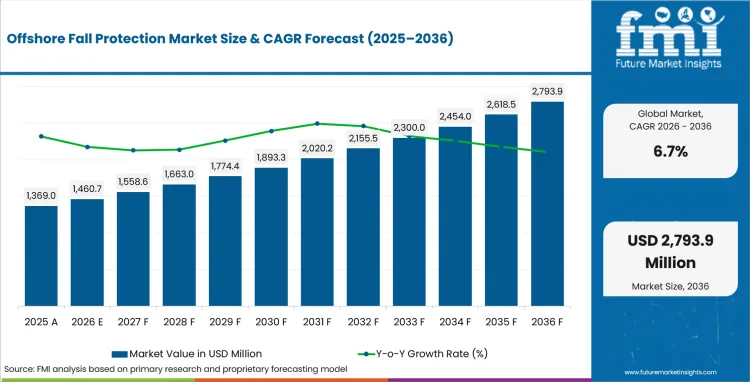
| Metric | Value |
|---|---|
| 2026 Market Size | USD 1460.7 million |
| 2036 Market Size | USD 2793.9 million |
| Forecast CAGR (2026-2036) | 6.7% |
| Leading Product Type | Harnesses & Lanyards |
| Harnesses & Lanyards Share (2026) | 41.0% |
| Leading Application | Rig / Platform Work |
| Rig / Platform Work Share (2026) | 36.0% |
| Fastest-growing Country | China |
| China CAGR by 2036 | 7.4% |
Summary of the Offshore Fall Protection Market
| Market Signal | Commercial Impact |
|---|---|
| Demand and Growth Drivers | Offshore fall protection equipment demand is expanding as operators strengthen worker safety, regulatory compliance, and planned maintenance across offshore energy assets.
|
| Product and Segment View | Harnesses & Lanyards, Rig / Platform Work, Oil & Gas, and Safety Distributors dominate their respective market segments.
|
| Geography and Growth Outlook | China, India, and South Korea are expected to remain key growth markets as offshore wind and offshore energy investments accelerate.
|
| Competitive Landscape | Competition is increasingly focused on certified safety systems, product compatibility, and regional service capabilities for offshore operations.
|
| Analyst Perspective | Offshore fall protection equipment is evolving into a strategic safety management solution that improves workforce protection, operational compliance, and maintenance readiness.
- Nikhil Kaitwade, Principal Analyst for Oil & Gas at Future Market Insights |
Demand is shifting toward audit‑ready fall‑protection systems as offshore budgets increasingly combine wind‑access work and oilfield maintenance within a single safety planning framework. Offshore activity levels remain high across both segments. The Energy Institute reported in June 2026 that G+ members logged 69.2 million offshore wind work hours in 2025, while the U.S. Bureau of Safety and Environmental Enforcement (BSEE) reported in April 2026 that Outer Continental Shelf oil production reached 714 million barrels in 2025. As these activities converge, inspection expectations are becoming more standardized across work types. Reflecting this, FallTech updated its full‑body harness guidance in June 2025 to clarify selection criteria and inspection checkpoints for work at height. These developments point to a buyer preference for equipment that can be verified and inspection‑ready before crews mobilize. Fleet buyers are expected to align personal protective equipment budgets with certification records and local inspection support.
Which factors support expansion in the offshore fall protection market?
Certified equipment replacement and offshore access planning support market value across wind and oil.
- Complete arrest kits are expected to support base market value since rescue systems add incremental account value.
- Certification requirements and corrosion-resistant materials shape supplier pricing by encouraging accessory bundling that affects repeat orders.
- Mixed offshore crews need common inspection routines, so standardized harness models help suppliers win repeat revenue.
- Inspection tags and training records are expected to keep approved products on contract by making equipment status easier for safety managers to verify. Demand for offshore wind energy buildouts is expected to widen the installed base that needs rescue-ready height access equipment.
Why is the offshore fall protection market growing?
Offshore operators are replacing isolated PPE purchases with audited fall-arrest systems that support permit-to-work decisions.
Growth is expected to come from offshore employers treating fall protection as a documented control before work permits are issued. The Energy Institute reported in June 2026 that the G+ Total Recordable Injury Rate reached 3.48 in 2025. This evidence gives buyers a practical reason to check harness condition and rescue drills before offshore work begins. Procurement teams are treating industrial safety products as auditable operating controls instead of routine site consumables.
How is the offshore fall protection market segmented?
The offshore fall protection industry is segmented by product type and application. It also includes end use and certification. Sales channel is included as a separate parent segment.
- Harnesses & Lanyards are projected to secure 41.0% share in 2026 reflecting assigned gear needs in daily inspection routines.
- Rig / Platform Work is anticipated to hold 36.0% share in 2026 since repeated maintenance access keeps this application close to core demand.
- Oil & Gas is forecast to account for 48.0% share in 2026 supported by operating assets that keep certified fall protection in replacement cycles.
- ANSI / OSHA is estimated to represent 38.0% share in 2026 as North American documentation practices guide product selection before mobilization.
- Safety Distributors are projected to capture 44.0% share in 2026 as port-proximate stock helps operators replace failed gear without delays.
Which product type category holds a notable share in the offshore fall protection market?
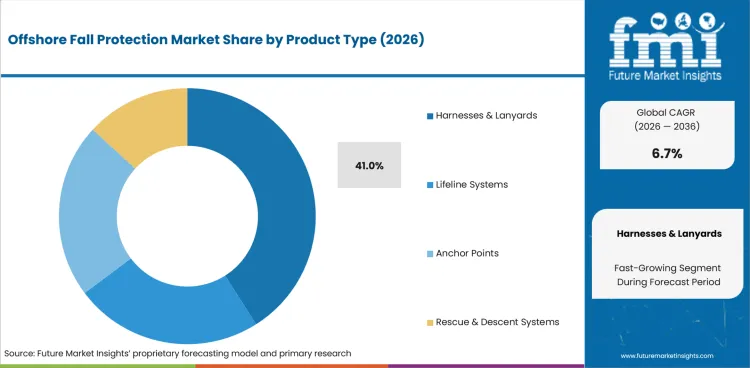
- Harnesses & Lanyards are projected to account for 41.0% share in 2026 owing to assigned gear needs before tower access begins.
- Lifeline Systems gain relevance in turbine tower access and fixed-ladder work that requires controlled vertical movement.
How does the application segment perform in the offshore fall protection market?
- Rig / Platform Work is estimated to hold 36.0% share in 2026 owing to inspection and repair activity that anchors offshore safety purchasing.
- Wind Turbine Access is expected to expand use of descent devices and rope-compatible rescue kits owing to nacelle and transition-piece tasks.
What drives demand across end-use options in the offshore fall protection market?
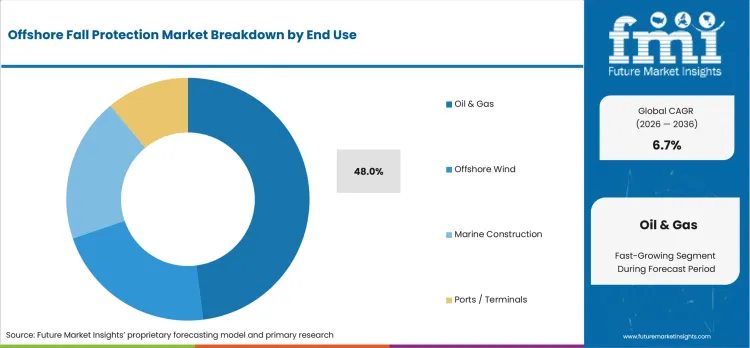
- Oil & Gas is anticipated to represent 48.0% share in 2026 supported by mature platforms that keep equipment replacement outside new-build cycles.
- Offshore Wind is likely to gain share as service teams standardize height-access kits for repeated crew transfers.
Which certification segment shows a prominent position in the offshore fall protection market?
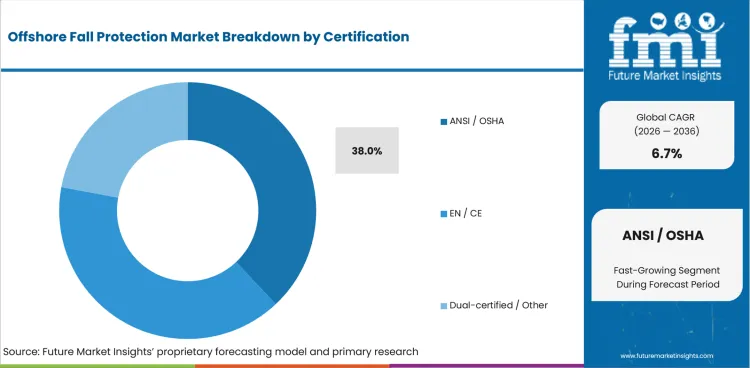
- ANSI / OSHA products are expected to account for 38.0% share in 2026 as North American audits guide work-at-height product selection.
- European certification requirements keep EN / CE products important across wind vessel and marine construction tasks.
How are buyers selecting across sales channel options in the offshore fall protection market?
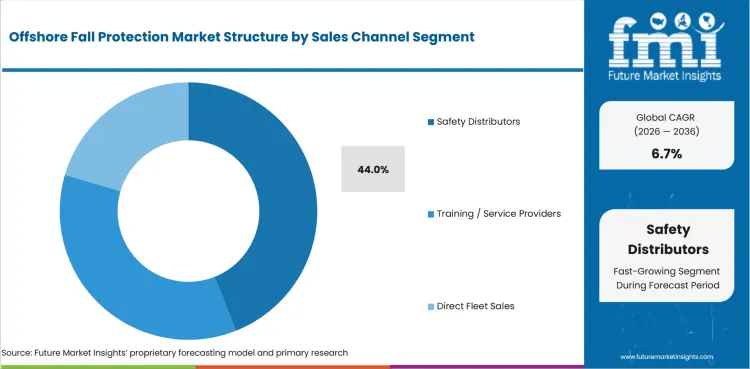
- Safety Distributors are forecast to hold 44.0% share in 2026 as nearby stock lowers replacement delays after inspection failures.
- Direct Fleet Sales remain relevant as large operators standardize product models and service records across offshore crews. Service teams working around offshore wind turbine access are expected to buy more vertical lifeline and rescue-ready descent systems.
What drivers and restraints create opportunities in the offshore fall protection market?
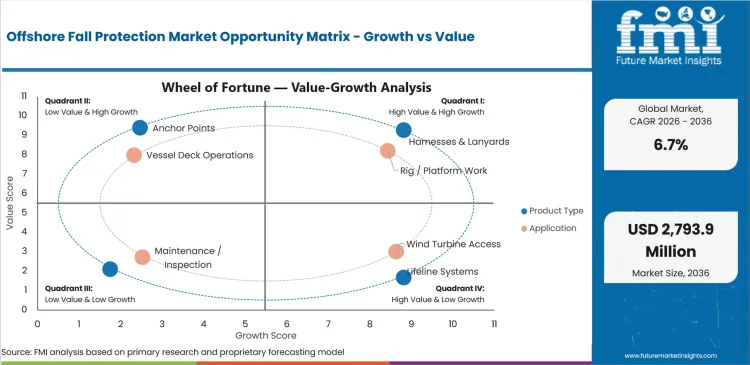
Offshore access demand supports growth, whereas Certification complexity and rescue training gaps limit faster conversion.
- Driver: Offshore wind and rig maintenance are increasing the need for certified harnesses and lifelines supported by anchors and rescue devices that complete the system package.
- Restraint: Certification variation across ANSI / OSHA and EN / CE systems can slow product standardization for multinational fleets.
- Opportunity: Training-backed service packages can raise repeat sales by pairing rescue drills with inspection records.
Offshore Wind Access Raises Rescue Planning Requirements
Offshore wind access is changing safety procurement because tower entry and transition-piece work require rescue planning before the climb begins. Energy Institute reported in June 2026 that G+ members worked 69.2 million offshore wind hours in 2025. That exposure base supports lifeline compatibility checks and rescue drills before technicians enter turbine structures.
Oil and Gas Maintenance Protects Replacement Demand
Oil and gas maintenance keeps equipment replacement active because repair crews still work on elevated decks and exposed process areas. BOEM stated in May 2026 that 474 active OCS leases were producing oil and gas. That operating base supports regular harness and lifeline checks before shutdown and repair crews mobilize offshore.
Distributor Support Becomes a Service Differentiator
Distributor support matters after inspections find missing tags or equipment that cannot be cleared for use. HSE reported in September 2025 that 616 non-compliance issues were raised with offshore operators in 2024. This helps explain why port-area distributors can win repeat accounts through replacement stock and inspection records. Safety managers are connecting industrial and workplace safety programs with formal fall-arrest inspection and rescue planning. Rig maintenance keeps oil and gas field services work tied to certified harness and lifeline replacement cycles.
Which countries are growing fastest in the offshore fall protection market?
China 7.4% CAGR, India 7.2% CAGR, South Korea 7.1% CAGR, United States 6.8% CAGR, France 6.6% CAGR, United Kingdom 6.5% CAGR, Germany 6.4% CAGR, and Japan 6.1% CAGR through 2036.
.webp "Top Country Growth Comparison Offshore Fall Protection Market Cagr (2026 2036)")
| Country | CAGR |
|---|---|
| China | 7.4% |
| India | 7.2% |
| South Korea | 7.1% |
| United States | 6.8% |
| France | 6.6% |
| United Kingdom | 6.5% |
| Germany | 6.4% |
| Japan | 6.1% |
Source: Future Market Insights, 2026.
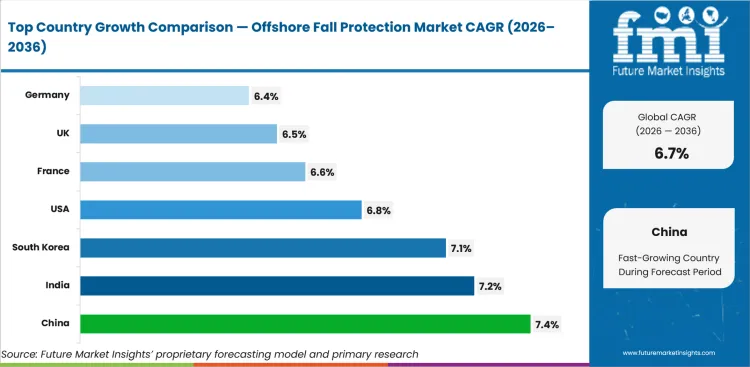
How do country-level CAGRs compare in the offshore fall protection market?
- China is forecast to record 7.4% CAGR by 2036 due to coastal wind construction that gives suppliers a wider service base.
- India is projected to expand at 7.2% CAGR through 2036 owing to wind zoning that creates early supplier planning demand.
- South Korea is estimated to rise at 7.1% CAGR by 2036 as auction activity begins to widen contractor demand.
- The United States is anticipated to advance at 6.8% CAGR by 2036 as Gulf maintenance protects recurring replacement demand.
- France is forecast to post 6.6% CAGR by 2036 supported by offshore wind tenders that create a visible project pipeline.
- The United Kingdom is projected to grow at 6.5% CAGR by 2036 reflecting North Sea maintenance and offshore wind service activity.
- Germany is estimated to register 6.4% CAGR by 2036 driven by installed turbine service needs that sustain replacement demand.
- Japan is forecast to expand at 6.1% CAGR by 2036 attributable to staged project development and cautious procurement timing.
How fast is the offshore fall protection market growing in China?
A 7.4% CAGR through 2036 reflects offshore wind construction scale and coastal industrial safety procurement.
Country Market Snapshot Table
| Parameter | Value |
|---|---|
| Market Size in 2025 (Value) | USD 237.4 million |
| Market Size in 2026 (Value) | USD 255.0 million |
| Market Forecast in 2036 (Value) | USD 520.7 million |
| CAGR (2026 to 2036) | 7.4% |
| Years Considered | 2021 to 2036 |
| Base Year | 2025 |
| Forecast Period | 2026 to 2036 |
| Units Considered | Value (USD million) |
| Leading Sub-Region | Jiangsu, Guangdong, Fujian and Zhejiang offshore wind clusters |
China Offshore Fall Protection Market Outlook
China offshore fall protection demand is influenced by coastal wind construction and offshore service vessel activity. Buyers need certified systems before technicians enter turbine towers or transfer across exposed decks.
Procurement is expected to favor distributors and global subsidiaries that can support EN / CE products near coastal project hubs. Local connector stock and inspection help make these suppliers more useful to operators.
Key Growth Drivers
- Coastal wind construction is expected to widen the height-access equipment base before suppliers scale lifeline and rescue kit stock. GWEC reported in June 2026 that China connected 6.6 GW of new offshore wind capacity in 2025. That buildout gives safety distributors a clearer service reason near coastal project ports.
- New turbine installation is expected to create recurring service visits that require compatible harnesses and descent devices. In June 2026, GWEC recorded 9.3 GW of global offshore wind additions in 2025. The additions create inspection and service tasks after commissioning for every new offshore turbine.
- State-owned energy developers are expected to prefer documented supplier systems to reduce project inspection delays.
- Port-side maintenance activity is likely to support replacement stock for lanyards and anchors since rescue kits remain part of the same account need.
Key Restraints
- Certification matching can restrain faster procurement by forcing buyers to reconcile domestic and international requirements across ANSI / OSHA and EN / CE specifications.
- Long coastal project distances can raise service delays since inspection and recertification work need support across provincial hubs.
- Imported premium systems face price pressure in markets served by lower-cost local harness and lanyard packages.
What makes China unique
China is distinct for large coastal offshore wind construction and rapid service-base formation.
Key Companies
- 3M China
- MSA Safety
- Honeywell China
- Petzl China
- Delta Plus China
- KStrong Asia
Sales & Marketing Channels
- Direct fleet sales
- Safety distributors
- Wind contractor channels
- Training providers
- Marine supply stores
Country Segment Breakdown Table
| Segment | Sub-Segments |
|---|---|
| By Product Type | Harnesses & Lanyards, Lifeline Systems, Anchor Points, Rescue & Descent Systems |
| By Application | Rig / Platform Work, Wind Turbine Access, Vessel Deck Operations, Maintenance / Inspection |
| By End Use | Oil & Gas, Offshore Wind, Marine Construction, Ports / Terminals |
| By Certification | ANSI / OSHA, EN / CE, Dual-certified / Other |
| By Sales Channel | Direct Fleet Sales, Safety Distributors, Training / Service Providers |
| Key Sub-Regions Covered, Offshore Service Corridors | Jiangsu, Guangdong, Fujian, Zhejiang, Shandong, Shanghai |
Frequently Asked Questions
How fast is the China offshore fall protection market growing?
Sales in China are forecast to expand at 7.4% CAGR from 2026 to 2036.
Who leads China offshore fall protection market?
3M China and MSA Safety have verified local or regional fall protection presence. Honeywell China adds broader industrial safety reach.
What is driving adoption in China offshore fall protection market?
Offshore wind construction and coastal service activity are moving buyers toward documented fall-arrest systems. Certification-led replacement reinforces supplier selection.
What supports offshore fall protection market growth in India?
A 7.2% CAGR through 2036 reflects early offshore wind preparation and established domestic PPE manufacturing.
Country Market Snapshot Table
| Parameter | Value |
|---|---|
| Market Size in 2025 (Value) | USD 57.8 million |
| Market Size in 2026 (Value) | USD 62.0 million |
| Market Forecast in 2036 (Value) | USD 124.3 million |
| CAGR (2026 to 2036) | 7.2% |
| Years Considered | 2021 to 2036 |
| Base Year | 2025 |
| Forecast Period | 2026 to 2036 |
| Units Considered | Value (USD million) |
| Leading Sub-Region | Gujarat and Tamil Nadu offshore wind zones |
India Offshore Fall Protection Market Outlook
India offshore fall protection demand is still forming around early offshore wind preparation. Port activity and marine construction create the first buyer base before larger turbine projects scale.
Domestic manufacturers and safety distributors are expected to matter because buyers need certified gear at practical price points. Local training access will help crews move from basic harness buying to rescue-ready systems.
Key Growth Drivers
- Offshore wind zoning is expected to move Indian buyers from basic PPE planning toward certified system planning. MNRE reported in December 2024 that Gujarat has 36 GW of offshore wind potential. That corridor gives domestic suppliers a clear reason to prepare harness and rescue packages before tender activity scales.
- Tamil Nadu creates a second coastal route for future tower access and marine transfer purchases. MNRE reported in December 2024 that the state has nearly 35 GW of offshore wind potential. The regional opportunity supports early distributor planning before large project volumes begin.
- Domestic PPE manufacturers are expected to shorten replenishment cycles by keeping harnesses and lanyards closer to buyers.
- Oil and gas service bases in western India are likely to keep certified fall protection in regular maintenance use during recurring asset work.
Key Restraints
- Large-volume purchasing can remain delayed until offshore wind moves from resource mapping into construction. MNRE's December 2024 offshore wind framework did not identify operating offshore wind capacity in India. That gap keeps near-term fall protection demand tied to ports and oilfield work.
- Imported rescue systems can face price resistance from cost-sensitive marine contractors.
- Training availability may slow the shift to complete rescue-ready systems while buyers still choose basic harnesses before packaged solutions.
What makes India unique
India is distinct for large offshore wind potential and an established domestic industrial PPE supply base.
Key Companies
- KARAM Safety
- Udyogi Safety
- Sure Safety
- Garware Technical Fibres
- 3M India
- MSA Safety India
Sales & Marketing Channels
- Direct fleet sales
- Safety distributors
- Marine contractors
- Training providers
- Industrial PPE dealers
Country Segment Breakdown Table
| Segment | Sub-Segments |
|---|---|
| By Product Type | Harnesses & Lanyards, Lifeline Systems, Anchor Points, Rescue & Descent Systems |
| By Application | Rig / Platform Work, Wind Turbine Access, Vessel Deck Operations, Maintenance / Inspection |
| By End Use | Oil & Gas, Offshore Wind, Marine Construction, Ports / Terminals |
| By Certification | ANSI / OSHA, EN / CE, Dual-certified / Other |
| By Sales Channel | Direct Fleet Sales, Safety Distributors, Training / Service Providers |
| Key Sub-Regions Covered, Offshore Service Corridors | Gujarat, Tamil Nadu, Mumbai offshore belt, Kandla, Chennai, Kochi |
Frequently Asked Questions
How fast is the India offshore fall protection market growing?
Sales in India are forecast to expand at 7.2% CAGR from 2026 to 2036.
Who leads India offshore fall protection market?
KARAM Safety and Udyogi Safety have verified local fall protection presence. Sure Safety adds regional system support.
What is driving adoption in India offshore fall protection market?
Early tender preparation is creating planning demand for certified fall protection. Domestic PPE suppliers make harnesses easier to source at practical price points.
How is South Korea performing in the offshore fall protection market?
A 7.1% CAGR through 2036 reflects offshore wind auction activity and service access needs.
Country Market Snapshot Table
| Parameter | Value |
|---|---|
| Market Size in 2025 (Value) | USD 88.7 million |
| Market Size in 2026 (Value) | USD 95.0 million |
| Market Forecast in 2036 (Value) | USD 188.6 million |
| CAGR (2026 to 2036) | 7.1% |
| Years Considered | 2021 to 2036 |
| Base Year | 2025 |
| Forecast Period | 2026 to 2036 |
| Units Considered | Value (USD million) |
| Leading Sub-Region | Ulsan, Jeonnam, Jeju and South Chungcheong offshore corridors |
South Korea Offshore Fall Protection Market Outlook
South Korea offshore fall protection demand is shaped by offshore wind auctions and shipyard-linked industrial safety channels. Service crews need gear that supports vessel transfer and tower access.
Buyers are expected to value global brands with Korean distribution and regional Asia suppliers. Local access to inspection and rescue training will influence repeat orders.
Key Growth Drivers
- Auction planning is expected to convert long-term wind targets into early safety specifications. The U.S. International Trade Administration reported in September 2024 that South Korea targets 14 GW of offshore wind by 2030. That target gives suppliers a measurable reason to build Korean channel partnerships.
- Existing deployment keeps the market at an early stage before large service volumes form. The U.S. International Trade Administration reported in September 2024 that South Korea had about 200 MW of offshore wind deployed. This smaller base means fall protection suppliers still need project-by-project account development.
- Shipbuilding and marine construction channels are expected to help certified gear reach offshore project crews through established industrial safety purchasing.
- Floating wind activity is likely to increase demand for rescue kits and vessel transfer protection under harder access conditions.
Key Restraints
- Policy revisions can slow purchases before developers commit to construction schedules and crew mobilization. Industry reporting showed 1.25 GW was tendered in the first half of 2025. That tender activity supports opportunity but can still delay bulk fall protection orders until awards progress.
- Local-content expectations can complicate supplier selection for imported systems.
- Floating projects require higher training intensity before standard harness packages are accepted in rescue plans.
What makes South Korea unique
South Korea is distinct for offshore wind growth and shipbuilding-centered service capability.
Key Companies
- 3M Korea
- MSA Safety
- Honeywell Korea
- Petzl Korea
- Tractel
- KStrong Asia
Sales & Marketing Channels
- Direct fleet sales
- Safety distributors
- Shipyard supply channels
- Training providers
- Marine service partners
Country Segment Breakdown Table
| Segment | Sub-Segments |
|---|---|
| By Product Type | Harnesses & Lanyards, Lifeline Systems, Anchor Points, Rescue & Descent Systems |
| By Application | Rig / Platform Work, Wind Turbine Access, Vessel Deck Operations, Maintenance / Inspection |
| By End Use | Oil & Gas, Offshore Wind, Marine Construction, Ports / Terminals |
| By Certification | ANSI / OSHA, EN / CE, Dual-certified / Other |
| By Sales Channel | Direct Fleet Sales, Safety Distributors, Training / Service Providers |
| Key Sub-Regions Covered, Offshore Service Corridors | Ulsan, Jeonnam, Jeju, Busan, South Chungcheong, Incheon |
Frequently Asked Questions
How fast is the South Korea offshore fall protection market growing?
Sales in South Korea are forecast to expand at 7.1% CAGR from 2026 to 2036.
Who leads South Korea offshore fall protection market?
3M Korea and MSA Safety have verified local or regional fall protection presence. Honeywell Korea adds industrial safety channel access.
What is driving adoption in South Korea offshore fall protection market?
Auction activity and shipyard-linked channels are creating new buyer routes. Floating wind planning adds demand for rescue training and compatible harness systems.
What is shaping offshore fall protection demand in the United States?
A 6.8% CAGR through 2036 reflects Gulf maintenance demand and selective offshore wind project execution.
Country Market Snapshot Table
| Parameter | Value |
|---|---|
| Market Size in 2025 (Value) | USD 313.7 million |
| Market Size in 2026 (Value) | USD 335.0 million |
| Market Forecast in 2036 (Value) | USD 646.8 million |
| CAGR (2026 to 2036) | 6.8% |
| Years Considered | 2021 to 2036 |
| Base Year | 2025 |
| Forecast Period | 2026 to 2036 |
| Units Considered | Value (USD million) |
| Leading Sub-Region | Gulf Coast and Northeast offshore wind corridors |
United States Offshore Fall Protection Market Outlook
United States offshore fall protection demand is anchored in Gulf oil and gas maintenance. Offshore wind projects add a second demand stream for tower access and vessel transfer protection.
Buyers tend to prioritize ANSI / OSHA compliance and local distributor stock. Large operators also favor fleet-level product standardization before offshore mobilization.
Key Growth Drivers
- Wind permitting gives suppliers a second planning route beyond Gulf oil and gas maintenance accounts. The U.S. Department of the Interior reported in December 2024 that eleven commercial-scale offshore wind projects had been approved. That pipeline supports early technician access planning before offshore construction and service work expands.
- Rig maintenance keeps the United States market anchored in recurring offshore operating work. BSEE reported in April 2026 that Outer Continental Shelf oil production reached 714 million barrels in 2025. That production base explains why certified harnesses remain part of routine maintenance budgets.
- Compliance documentation makes ANSI / OSHA purchasing practices favor traceable inspection records and tested connector compatibility.
- Distributor networks near Gulf and Atlantic ports are likely to reduce downtime by replacing failed gear faster after inspections.
Key Restraints
- Marine and shipyard work keeps compliance strict outside turbine or platform settings. OSHA states that fall protection is required at 5 feet in shipyards for exposed workers. This rule keeps documented harness and anchor choices central to marine contractor procurement.
- Offshore wind pauses can delay project-driven bulk orders until construction notices restart and procurement teams regain schedule certainty.
- Premium rescue systems can face budget pressure from smaller vessel and marine construction contractors managing stricter equipment costs.
What makes United States unique
The United States is distinct for its Gulf oil base and regulated offshore wind corridor demand.
Key Companies
- 3M
- MSA Safety
- Honeywell
- FallTech
- Guardian Fall Protection
- Werner
Sales & Marketing Channels
- Direct fleet sales
- Safety distributors
- Oilfield supply houses
- Training providers
- Marine safety dealers
Country Segment Breakdown Table
| Segment | Sub-Segments |
|---|---|
| By Product Type | Harnesses & Lanyards, Lifeline Systems, Anchor Points, Rescue & Descent Systems |
| By Application | Rig / Platform Work, Wind Turbine Access, Vessel Deck Operations, Maintenance / Inspection |
| By End Use | Oil & Gas, Offshore Wind, Marine Construction, Ports / Terminals |
| By Certification | ANSI / OSHA, EN / CE, Dual-certified / Other |
| By Sales Channel | Direct Fleet Sales, Safety Distributors, Training / Service Providers |
| Key Sub-Regions Covered, Offshore Service Corridors | Gulf Coast, Northeast Atlantic, California ports, Louisiana, Texas, New Jersey |
Frequently Asked Questions
How fast is the United States offshore fall protection market growing?
Sales in the United States are forecast to expand at 6.8% CAGR from 2026 to 2036.
Who leads United States offshore fall protection market?
3M and MSA Safety have verified fall protection presence. Honeywell adds broad industrial safety access.
What is driving adoption in United States offshore fall protection market?
Gulf maintenance keeps replacement demand active. ANSI / OSHA documentation makes certified harness and lifeline systems a recurring purchase.
What is the offshore fall protection market outlook in France?
A 6.6% CAGR through 2036 reflects offshore wind tender scale and European certification requirements.
Country Market Snapshot Table
| Parameter | Value |
|---|---|
| Market Size in 2025 (Value) | USD 73.2 million |
| Market Size in 2026 (Value) | USD 78.0 million |
| Market Forecast in 2036 (Value) | USD 147.8 million |
| CAGR (2026 to 2036) | 6.6% |
| Years Considered | 2021 to 2036 |
| Base Year | 2025 |
| Forecast Period | 2026 to 2036 |
| Units Considered | Value (USD million) |
| Leading Sub-Region | Normandy, Brittany, South Atlantic and Mediterranean offshore zones |
France Offshore Fall Protection Market Outlook
France offshore fall protection demand is moving toward turbine access and port preparation. Floating wind zones increase the need for rescue-ready systems and training-supported equipment selection.
EN / CE product selection is expected to guide purchasing. French suppliers and global subsidiaries can gain accounts by supporting coastal project hubs and inspection documentation.
Key Growth Drivers
- Tender scale gives suppliers a clear reason to plan EN / CE fall protection packages for future projects. CRE listed eleven offshore wind projects under AO10 in June 2026 for France's next offshore wind development round. That tender base supports early channel planning for harnesses and rescue systems near French ports.
- Installed offshore wind capacity is now creating a service market after initial project commissioning. France's ecological transition ministry reported in May 2026 that offshore wind capacity reached 2.3 GW at the end of March 2026. This installed base supports replacement demand across serviced turbine assets and coastal contractor networks.
- Floating wind areas are expected to increase demand for rescue devices and vertical lifeline planning under more complex access conditions.
- French PPE distributors are likely to support EN / CE product access near port clusters.
Key Restraints
- Grid timing can delay offshore mobilization even after developers show interest in equipment standards. CRE cited 22 GW of offshore wind connection capacity in the 2040 reference scenario in June 2026. That long network horizon can push bulk safety orders closer to construction milestones.
- Floating project complexity may extend training timelines before standard rescue kits receive clearer task acceptance.
- Cost-sensitive contractors can delay premium harness replacement until inspection failures occur.
What makes France unique
France is distinct through its mix of fixed-bottom and floating offshore wind tender zones.
Key Companies
- Petzl
- Tractel
- Kratos Safety
- 3M France
- MSA Safety
- Honeywell Safety Products
Sales & Marketing Channels
- Direct fleet sales
- Safety distributors
- Wind contractor channels
- Training providers
- Marine supply stores
Country Segment Breakdown Table
| Segment | Sub-Segments |
|---|---|
| By Product Type | Harnesses & Lanyards, Lifeline Systems, Anchor Points, Rescue & Descent Systems |
| By Application | Rig / Platform Work, Wind Turbine Access, Vessel Deck Operations, Maintenance / Inspection |
| By End Use | Oil & Gas, Offshore Wind, Marine Construction, Ports / Terminals |
| By Certification | ANSI / OSHA, EN / CE, Dual-certified / Other |
| By Sales Channel | Direct Fleet Sales, Safety Distributors, Training / Service Providers |
| Key Sub-Regions Covered, Offshore Service Corridors | Normandy, Brittany, Charente-Maritime, Gulf of Lion, Saint-Nazaire, Marseille-Fos |
Frequently Asked Questions
How fast is the France offshore fall protection market growing?
Sales in France are forecast to expand at 6.6% CAGR from 2026 to 2036.
Who leads France offshore fall protection market?
Petzl and Tractel have verified local or regional fall protection presence. Kratos Safety adds French fall protection manufacturing depth.
What is driving adoption in France offshore fall protection market?
Tender activity and floating wind planning are steering buyers toward EN / CE systems. Local service support helps distributors win accounts.
How does the United Kingdom compare in the offshore fall protection market?
A 6.5% CAGR through 2036 reflects North Sea activity and a large offshore wind service base.
Country Market Snapshot Table
| Parameter | Value |
|---|---|
| Market Size in 2025 (Value) | USD 154.9 million |
| Market Size in 2026 (Value) | USD 165.0 million |
| Market Forecast in 2036 (Value) | USD 309.7 million |
| CAGR (2026 to 2036) | 6.5% |
| Years Considered | 2021 to 2036 |
| Base Year | 2025 |
| Forecast Period | 2026 to 2036 |
| Units Considered | Value (USD million) |
| Leading Sub-Region | North Sea and East Coast offshore hubs |
United Kingdom Offshore Fall Protection Market Outlook
North Sea oil and gas work and a large offshore wind service base shape United Kingdom offshore fall protection demand. Buyers need equipment that can pass site checks and rescue drills.
Local suppliers matter because inspection support and replacement stock must stay close to ports. GWO-linked training channels also influence equipment selection.
Key Growth Drivers
- Regulatory activity keeps documentation central to supplier selection and equipment inspection routines. HSE reported in September 2025 that offshore regulators completed 125 inspections during 2024. That inspection base gives buyers a clear reason to prefer traceable harnesses and lifelines.
- Offshore wind work hours show why height-access exposure is not limited to oil platforms. Energy Institute reported in June 2026 that G+ members worked 69.2 million offshore wind hours in 2025. This activity base supports demand for rescue-ready tower access equipment across access and transfer routines.
- North Sea maintenance is expected to keep repeat demand active for harnesses and lanyards as inspection work continues.
- Training providers are likely to support sales of rescue kits by documenting drill requirements.
Key Restraints
- Non-compliance findings keep operators cautious about undocumented or poorly matched fall protection systems. HSE reported in September 2025 that regulators identified 616 non-compliance issues in 2024. That finding supports stronger demand for supplier records and inspection help from distributors.
- Project cost reviews can slow wind-driven bulk orders until final investment decisions provide clearer cost certainty.
- Mixed fleets from older rigs and newer turbines can complicate connector compatibility across access systems and work-permit checks.
What makes United Kingdom unique
The United Kingdom is distinct through its North Sea operating base and established offshore wind training ecosystem.
Key Companies
- 3M UK
- MSA Safety
- Honeywell Safety Products
- Petzl UK
- Globestock Safety
- RidgeGear
Sales & Marketing Channels
- Direct fleet sales
- Safety distributors
- Training providers
- Oilfield supply houses
- Marine safety dealers
Country Segment Breakdown Table
| Segment | Sub-Segments |
|---|---|
| By Product Type | Harnesses & Lanyards, Lifeline Systems, Anchor Points, Rescue & Descent Systems |
| By Application | Rig / Platform Work, Wind Turbine Access, Vessel Deck Operations, Maintenance / Inspection |
| By End Use | Oil & Gas, Offshore Wind, Marine Construction, Ports / Terminals |
| By Certification | ANSI / OSHA, EN / CE, Dual-certified / Other |
| By Sales Channel | Direct Fleet Sales, Safety Distributors, Training / Service Providers |
| Key Sub-Regions Covered, Offshore Service Corridors | Aberdeen, Grimsby, Hull, Great Yarmouth, Teesside, Lowestoft |
Frequently Asked Questions
How fast is the United Kingdom offshore fall protection market growing?
Sales in the United Kingdom are forecast to expand at 6.5% CAGR from 2026 to 2036.
Who leads United Kingdom offshore fall protection market?
3M UK and MSA Safety have verified local or regional fall protection presence. Honeywell Safety Products adds broad industrial channel reach.
What is driving adoption in United Kingdom offshore fall protection market?
North Sea inspection work keeps documentation central to procurement. Offshore wind service hours raise demand for rescue-ready tower access equipment.
How is the offshore fall protection forecast developing in Germany?
A 6.4% CAGR through 2036 reflects installed turbine service needs and cautious project timing.
Country Market Snapshot Table
| Parameter | Value |
|---|---|
| Market Size in 2025 (Value) | USD 126.9 million |
| Market Size in 2026 (Value) | USD 135.0 million |
| Market Forecast in 2036 (Value) | USD 251.0 million |
| CAGR (2026 to 2036) | 6.4% |
| Years Considered | 2021 to 2036 |
| Base Year | 2025 |
| Forecast Period | 2026 to 2036 |
| Units Considered | Value (USD million) |
| Leading Sub-Region | North Sea ports and Baltic service corridors |
Germany Offshore Fall Protection Market Outlook
Germany offshore fall protection demand is shaped by a large installed turbine base and North Sea service logistics. Buyers need EN / CE equipment that can handle corrosion and repeated ladder access.
Procurement is expected to favor German and European suppliers with documented system testing. Distributor access near service ports is important for inspection-driven replacement.
Key Growth Drivers
- Installed turbines create a maintenance base that needs repeated tower access and rescue readiness. Deutsche WindGuard reported in January 2026 that 1680 offshore turbines were operating in Germany at year-end 2025. This service base makes replacement lifelines and inspected harnesses recurring requirements for technicians.
- New grid feed-ins add technician work after turbines move from construction into service routines. Deutsche WindGuard recorded in January 2026 that 518 MW of offshore wind capacity first fed power in 2025. That commissioning flow supports demand for access gear and rescue checks during service planning.
- EN / CE certification is expected to support supplier qualification for offshore contractors that need documented European compliance.
- North Sea service ports are likely to sustain demand for rescue devices and replacement lifelines across recurring offshore maintenance routes.
Key Restraints
- Project timing can restrain volume growth before new turbines enter regular service. Deutsche WindGuard reported in January 2026 that 72 turbines were still awaiting first grid feed-in at year-end 2025. This delay can hold bulk equipment orders until technicians begin recurring maintenance routes.
- Harsh offshore corrosion requirements can raise specification and inspection costs.
- Tender design uncertainty may slow large standardized orders from wind developers.
What makes Germany unique
Germany is distinct for its large installed offshore turbine base and specification-led safety procurement culture.
Key Companies
- Skylotec
- ABS Safety
- IKAR
- 3M Germany
- MSA Safety
- Petzl
Sales & Marketing Channels
- Direct fleet sales
- Safety distributors
- Wind service channels
- Training providers
- Industrial PPE dealers
Country Segment Breakdown Table
| Segment | Sub-Segments |
|---|---|
| By Product Type | Harnesses & Lanyards, Lifeline Systems, Anchor Points, Rescue & Descent Systems |
| By Application | Rig / Platform Work, Wind Turbine Access, Vessel Deck Operations, Maintenance / Inspection |
| By End Use | Oil & Gas, Offshore Wind, Marine Construction, Ports / Terminals |
| By Certification | ANSI / OSHA, EN / CE, Dual-certified / Other |
| By Sales Channel | Direct Fleet Sales, Safety Distributors, Training / Service Providers |
| Key Sub-Regions Covered, Offshore Service Corridors | Hamburg, Bremerhaven, Cuxhaven, Emden, Rostock, Baltic service ports |
Frequently Asked Questions
How fast is the Germany offshore fall protection market growing?
Sales in Germany are forecast to expand at 6.4% CAGR from 2026 to 2036.
Who leads Germany offshore fall protection market?
Skylotec and ABS Safety have verified local fall protection presence. IKAR adds German rescue and fall-arrest equipment depth.
What is driving adoption in Germany offshore fall protection market?
Installed turbines create recurring service demand. German safety suppliers and EN / CE documentation support specification-led buying.
What supports offshore fall protection adoption in Japan?
A 6.1% CAGR through 2036 reflects staged offshore wind development and strict service quality expectations.
Country Market Snapshot Table
| Parameter | Value |
|---|---|
| Market Size in 2025 (Value) | USD 77.3 million |
| Market Size in 2026 (Value) | USD 82.0 million |
| Market Forecast in 2036 (Value) | USD 148.2 million |
| CAGR (2026 to 2036) | 6.1% |
| Years Considered | 2021 to 2036 |
| Base Year | 2025 |
| Forecast Period | 2026 to 2036 |
| Units Considered | Value (USD million) |
| Leading Sub-Region | Akita, Chiba, Nagasaki and Hokkaido project areas |
Japan Offshore Fall Protection Market Outlook
Japan offshore fall protection demand remains project-led. Offshore wind deployment is still staged and recurring replacement volumes have not fully formed.
Domestic safety suppliers and global subsidiaries are expected to support early project work. Floating wind planning may raise demand for rescue and descent systems over time.
Key Growth Drivers
- Project development creates early procurement channels before Japan builds a larger offshore service fleet. ANRE reported in March 2025 that 5.1 GW of offshore wind projects were under development in 2024. That pipeline supports selective fall protection planning before larger projects reach construction.
- National targets give buyers a long planning horizon for certified fall protection systems. METI's March 2025 offshore wind vision aims for 10 GW of offshore wind capacity by 2030. That target supports early supplier qualification across developers and contractor procurement teams.
- Domestic fall protection makers are expected to support buyer confidence by making harness quality and inspection practice easier to verify locally.
- Floating wind planning is likely to increase interest in rescue kits and marine transfer protection under harder vessel access conditions.
Key Restraints
- Rising project costs can slow bulk purchases until developers confirm construction decisions. Japan's offshore wind vision includes a 30 GW to 45 GW capacity goal by 2040. This long-term target can attract suppliers but near-term orders remain tied to individual project timing.
- Limited installed offshore wind scale can keep replacement demand smaller since fewer mature service cycles exist than in European markets.
- Importer and distributor coverage may vary by port region before the service base becomes broader.
What makes Japan unique
Japan is distinct for quality-focused safety purchasing and a staged offshore wind development pathway.
Key Companies
- Fujii Denko
- Sanko Titan
- 3M Japan
- MSA Safety
- Petzl Japan
- Tractel
Sales & Marketing Channels
- Direct fleet sales
- Safety distributors
- Wind contractor channels
- Training providers
- Industrial PPE dealers
Country Segment Breakdown Table
| Segment | Sub-Segments |
|---|---|
| By Product Type | Harnesses & Lanyards, Lifeline Systems, Anchor Points, Rescue & Descent Systems |
| By Application | Rig / Platform Work, Wind Turbine Access, Vessel Deck Operations, Maintenance / Inspection |
| By End Use | Oil & Gas, Offshore Wind, Marine Construction, Ports / Terminals |
| By Certification | ANSI / OSHA, EN / CE, Dual-certified / Other |
| By Sales Channel | Direct Fleet Sales, Safety Distributors, Training / Service Providers |
| Key Sub-Regions Covered, Offshore Service Corridors | Akita, Chiba, Nagasaki, Hokkaido, Aomori, Fukuoka |
Frequently Asked Questions
How fast is the Japan offshore fall protection market growing?
Sales in Japan are forecast to expand at 6.1% CAGR from 2026 to 2036.
Who leads Japan offshore fall protection market?
Fujii Denko and Sanko Titan have verified local fall protection presence. 3M Japan adds global product access.
What is driving adoption in Japan offshore fall protection market?
Staged wind projects keep buying selective. Domestic harness makers and global subsidiaries support early service preparation.
Who are the leading companies in the offshore fall protection market?
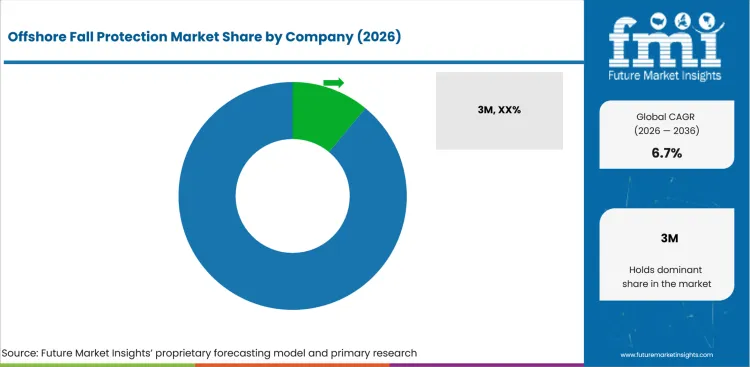
3M and MSA Safety are profiled for broad fall protection portfolios while Honeywell and Petzl add industrial safety and work-at-height coverage. FallTech and Skylotec strengthen specialist system depth and Tractel and KARAM Safety add rescue and regional supplier reach.
- Competition is based on certification breadth across ANSI / OSHA and EN / CE requirements.
- Product compatibility matters for offshore crews because harnesses and lifelines must work with anchors and descent devices in one system.
- Distributor reach matters when failed items need replacement before crew mobilization.
- Training support differentiates suppliers since rescue drills and inspection records influence repeat contracts.
The market includes global safety manufacturers and specialist fall protection brands. Regional PPE suppliers serve local replacement needs. Companies compete on certified product ranges and corrosion-resistant hardware. Rescue compatibility and account support near offshore ports also matter.
Official product pages show that 3M and MSA Safety cover broad fall protection portfolios while Honeywell covers harnesses and lifelines. Petzl and Skylotec add work-at-height depth and Tractel and FallTech support rescue system depth. KARAM Safety strengthens regional distributor programs for safety equipment buyers.
Companies with certified gear and service coverage near offshore hubs are better positioned to defend repeat contracts. Suppliers that combine product stock and inspection support can reduce downtime for operators. Training records strengthen repeat account retention.
Offshore buyers connect oil and gas flow control maintenance with shutdown work that needs certified access equipment.
Contractors using aerial work platform rental often follow similar documentation discipline for at-height safety controls.
Turbine owners adding wind turbine automation service routines are expected to require compatible access and rescue procedures.
How do top offshore fall protection companies compare?
Global suppliers lead portfolio breadth while specialist brands compete on work-at-height depth and rescue support.
| Company | Relevance to Market Title | Portfolio / Focus | Rescue System Compatibility | Distributor and Training Reach | Channel Reach | Footprint |
|---|---|---|---|---|---|---|
| 3M | High relevance | Broad harness, lanyard, lifeline and rescue range | Strong DBI-SALA compatibility | Global distributor and training reach | Direct and distributor | Global |
| MSA Safety | High relevance | Harnesses, SRLs, confined-space and rescue systems | Strong system coverage | Industrial safety channel depth | Direct and distributor | Global |
| Honeywell | High relevance | Miller harnesses, lifelines and connectors | Broad work-at-height portfolio | Large industrial channel base | Direct and distributor | Global |
| Petzl | High relevance | Harnesses and rescue devices for wind work | Strong rope and rescue focus | Specialist training ecosystem | Distributor-led | Global |
| FallTech | Medium relevance | Harnesses, SRLs, lanyards and anchors | Strong North American range | Distributor and technical guidance | Distributor-led | North America |
| Skylotec | High relevance | Lifelines, harnesses and rescue systems | Strong EN / CE coverage | European service and training reach | Direct and distributor | Europe and global |
| Tractel | High relevance | Fall arrest, lifelines and rescue lifting systems | Strong rescue system depth | European industrial channel base | Direct and distributor | Global |
| KARAM Safety | Medium relevance | Harnesses, lanyards and lifeline systems | Strong regional manufacturing depth | India and export channels | Direct and distributor | Asia and global |
Source: Future Market Insights, company product literature, and official company sources, 2026.
Who are the key players in the offshore fall protection market?
The market includes global safety companies and specialist fall protection suppliers with verified product relevance.
Key global companies leading the Offshore Fall Protection Market include:
- 3M
- MSA Safety
- Honeywell
- Petzl
- FallTech
- Skylotec
- Tractel
- KARAM Safety
Key Developments in Offshore Fall Protection Market
- In June 2025, FallTech published updated full-body harness guidance that explains inspection and selection requirements for work-at-height users.
- In November 2024, KStrong Asia described its T-Line safety system for combined lifeline and fall arrest functionality in work-at-height applications.
- In January 2026, Deutsche WindGuard reported Germany had 1680 offshore turbines in operation. The figure gives certified access equipment suppliers a clearer service-base signal for inspection planning.
Key Players in the Offshore Fall Protection Market
Global fall protection manufacturers
- 3M
- MSA Safety
- Honeywell
- Petzl
- Skylotec
- Tractel
Regional and specialist suppliers
- FallTech
- KARAM Safety
- Guardian Fall Protection
- Werner
- Globestock Safety
- RidgeGear
- Kratos Safety
- Fujii Denko
- Udyogi Safety
- ABS Safety
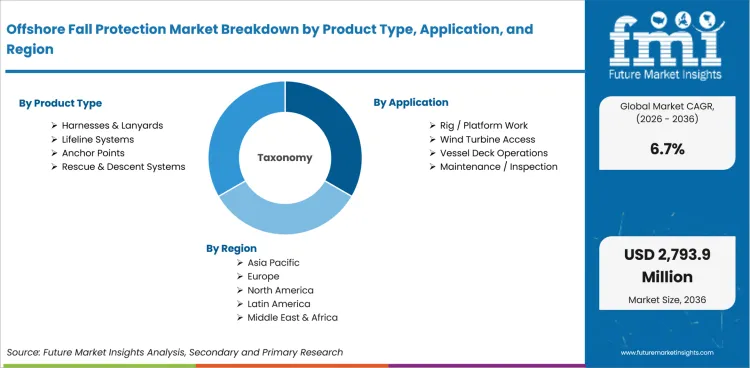
Offshore Fall Protection Market - Report Scope
| Parameter | Scope |
|---|---|
| Forecast period | 2026 to 2036 |
| Historical period | 2021 to 2025 |
| Quantitative unit | Value in USD million |
| By Product Type | Harnesses & Lanyards, Lifeline Systems, Anchor Points, Rescue & Descent Systems |
| By Application | Rig / Platform Work, Wind Turbine Access, Vessel Deck Operations, Maintenance / Inspection |
| By End Use | Oil & Gas, Offshore Wind, Marine Construction, Ports / Terminals |
| By Certification | ANSI / OSHA, EN / CE, Dual-certified / Other |
| By Sales Channel | Direct Fleet Sales, Safety Distributors, Training / Service Providers |
| Regions covered | North America, Latin America, Western Europe, Eastern Europe, East Asia, South Asia Pacific, Middle East and Africa |
| Countries covered | United States, United Kingdom, Germany, France, Japan, China, South Korea, India |
| Key companies profiled | 3M, MSA Safety, Honeywell, Petzl, FallTech, Skylotec, Tractel, KARAM Safety |
| Approach | Top-down and bottom-up forecasting validated with source checks and company portfolio review |
Source: Future Market Insights, 2026.
Offshore Fall Protection Market - Scope & Definition
| Scope Item | Definition |
|---|---|
| Market Definition | The market covers certified personal and fixed fall-arrest products used on offshore rigs, platforms, vessels, terminals, and wind assets. |
| Functions Covered | Fall arrest, Fall restraint, Work positioning, Vertical access, Rescue and descent |
| Applications Covered | Rig / Platform Work, Wind Turbine Access, Vessel Deck Operations, Maintenance / Inspection |
| End-Use Industries | Oil & Gas, Offshore Wind, Marine Construction, Ports / Terminals |
| Grades Covered | ANSI / OSHA, EN / CE, Dual-certified / Other certified offshore-use products |
| Inclusions | Harnesses, lanyards, lifeline systems, anchor points, rescue kits, descent systems, and related inspection-support products. |
| Exclusions | Life jackets, immersion suits, marine firefighting systems, inland construction-only fall gear, and rope access labor services without equipment sale. |
Offshore Fall Protection Market - Research Methodology
| Methodology Item | Approach |
|---|---|
| Primary Research | Interviews with offshore safety managers, vessel operators, wind access trainers, rig maintenance contractors, and safety distributors. |
| Desk Research | Review of regulator reports, offshore wind safety datasets, company product portfolios, and standards-linked product information. |
| Market Sizing & Forecasting | Forecasting combined equipment volumes, average selling prices, certification mix, replacement timing, and country-level offshore activity. |
| Data Validation | Estimates were checked against work-hour trends, offshore inspection data, wind capacity additions, and verified company portfolios. |
Offshore Fall Protection Market Breakdown by Product Type, Application, End Use, Certification, Sales Channel, and Region
Offshore Fall Protection Market Segmented by Product Type:
- Harnesses & Lanyards
- Lifeline Systems
- Anchor Points
- Rescue & Descent Systems
Offshore Fall Protection Market Segmented by Application:
- Rig / Platform Work
- Wind Turbine Access
- Vessel Deck Operations
- Maintenance / Inspection
Offshore Fall Protection Market Segmented by End Use:
- Oil & Gas
- Offshore Wind
- Marine Construction
- Ports / Terminals
Offshore Fall Protection Market Segmented by Certification:
- ANSI / OSHA
- EN / CE
- Dual-certified / Other
Offshore Fall Protection Market Segmented by Sales Channel:
- Direct Fleet Sales
- Safety Distributors
- Training / Service Providers
Offshore Fall Protection Market by Region:
- North America
- Latin America
- Western Europe
- Eastern Europe
- East Asia
- South Asia Pacific
- Middle East and Africa
Research Sources and Bibliography
- Bureau of Ocean Energy Management. (December 2024). Biden-Harris Administration approves eleventh offshore wind project in U.S. history. U.S. Department of the Interior.
- Bureau of Safety and Environmental Enforcement. (April 2026). Outer Continental Shelf energy production in 2025. U.S. Department of the Interior.
- Bureau of Ocean Energy Management. (May 2026). Oil and gas energy. U.S. Department of the Interior.
- Commission de Régulation de l’Énergie. (June 2026). Cahier des charges AO10 offshore wind tender. CRE.
- Deutsche WindGuard. (January 2026). Status of offshore wind energy development in Germany in 2025. Deutsche WindGuard GmbH.
- Energy Institute. (June 2026). G+ 2025 incident data report. Energy Institute.
- Global Wind Energy Council. (June 2026). Global offshore wind report 2026. GWEC.
- Health and Safety Executive. (September 2025). Offshore Statistics and Regulatory Activity Report 2024. HSE.
- Ministère de la Transition écologique. (May 2026). Éolien en mer. Government of France.
- Ministry of Economy, Trade and Industry. (March 2025). Japan’s offshore wind power generation now and the future. Agency for Natural Resources and Energy.
- Ministry of New and Renewable Energy. (December 2024). Offshore wind. Government of India.
- Occupational Safety and Health Administration. (2026). Fall protection overview and personal fall protection systems. U.S. Department of Labor.
- U.S. International Trade Administration. (September 2024). South Korea offshore wind. U.S. Department of Commerce.
- 3M. (2026). DBI-SALA fall protection for personal safety. 3M Personal Safety Division.
- MSA Safety. (2026). Fall protection equipment and rescue systems. MSA Safety.
- Honeywell. (2026). Miller fall protection products. Honeywell Safety Products.
- Petzl. (2026). VOLT WIND harness and professional rescue equipment. Petzl.
- FallTech. (June 2025). The complete guide to full-body safety harnesses. FallTech.
- Skylotec. (2026). Vertical fall arrest and offshore wind access systems. Skylotec GmbH.
- KARAM Safety. (2026). Fall protection products and authorized service centers. KARAM Safety.
- Fujii Denko. (2026). Full harness and fall arresting system products. Fujii Denko Co., Ltd.
- Udyogi Safety. (October 2024). Full body safety harness technical datasheet. Udyogi Safety.
- Delta Plus. (2026). Fall protection system solutions and China operations. Delta Plus Group.
- Garware Technical Fibres. (2026). PPE fall protection solutions. Garware Technical Fibres Ltd.
- Sanko Titan. (2026). Harness and fall arrest products. Sanko Titan Co., Ltd.
- ABS Safety. (2026). Fall protection systems and anchorage devices. ABS Safety GmbH.
- RidgeGear. (2026). Harnesses and lanyards manufactured in the United Kingdom. RidgeGear Ltd.
- Globestock Safety. (2026). Fall protection and confined space rescue products. Globestock Ltd.
- Werner. (2026). Fall protection equipment and safety harnesses. WernerCo.
- Guardian Fall Protection. (2026). Harnesses and fall arrest equipment. Guardian.
This Report Answers
- It explains the 2026 market size and 2036 forecast by clarifying product assumptions.
- It identifies product and application segments shaping demand across end use certification and sales channel options.
- It compares country CAGR outlooks across offshore operating and wind development markets.
- It reviews competition by comparing portfolio breadth and service reach for global and regional suppliers.
- It outlines source-backed drivers and restraints affecting offshore safety procurement.
- It defines inclusions and exclusions by explaining the forecast model and methodology.
Frequently Asked Questions
How large is the Offshore Fall Protection Market expected to be in the near term?
The market is expanding as offshore operators standardize certified fall arrest systems before crew mobilization.
What is the long term outlook for the Offshore Fall Protection Market?
The outlook remains steady as fall protection shifts from ad hoc PPE buying to planned and safety systems.
How fast is the Offshore Fall Protection Market expected to grow?
Growth is driven by offshore wind expansion and ongoing oil and gas maintenance that require audited work at height controls.
What is the main driver of offshore fall protection demand?
Demand is driven by permit to work requirements that require certified harnesses, anchors, and rescue compatibility.
Which product type dominates the market?
Harnesses and lanyards dominate because assigned personal gear is the first item checked during offshore inspections.
Which application generates the highest demand?
Rig and platform work leads demand due to repeated inspection and shutdown access needs.
Which end use segment contributes the most?
Oil and gas leads adoption as mature offshore assets keep certified fall protection in recurring replacement cycles.
Which certification category is most influential?
ANSI and OSHA certification holds strong influence as audit practices guide product selection before offshore work begins.
Which sales channel is most important in this market?
Safety distributors lead because port side stock and inspection support reduce delays after failed equipment checks.
How do suppliers differentiate offshore fall protection systems?
Suppliers differentiate through certification breadth and local inspection support.
Preview the report firsthand - request a free sample
Get SampleGet the brochure for pricing and purchase details.
Get PDFTable of Content
- Key Takeaways
- Market Size and CAGR
- Top Growth Driver
- Fastest Growing Segment
- Leading Region
- Key Companies
- Emerging Opportunities
- Executive Summary
- Global Market Outlook
- Demand-side Trends
- Supply-side Trends
- Technology Roadmap Analysis
- Analysis and Recommendations
- Analyst Perspective (What is happening? Why now? What should investors know?)
- Key Questions Answered
- How large is the market?
- What is the CAGR?
- What are key trends?
- Which region dominates?
- Who are the leaders?
- Market Overview
- Market Coverage / Taxonomy
- Market Definition / Scope / Limitations
- Research Methodology
- Chapter Orientation
- Analytical Lens and Working Hypotheses
- Market Structure, Signals, and Trend Drivers
- Benchmarking and Cross-market Comparability
- Market Sizing, Forecasting, and Opportunity Mapping
- Research Design and Evidence Framework
- Desk Research Programme (Secondary Evidence)
- Expert Input and Fieldwork (Primary Evidence)
- Tooling, Models, and Reference Databases
- Data Engineering and Model Build
- Quality Assurance and Audit Trail
- Market Background
- Market Dynamics (Drivers, Restraints, Opportunity, Trends)
- Scenario Forecast (Optimistic, Likely, Conservative)
- Impact Analysis
- AI Impact
- Sustainability Impact
- Regulatory Impact
- Technology Impact
- Consumer / Buyer Analysis
- Purchase Drivers
- Adoption Barriers
- Buyer Journey
- Opportunity Map Analysis
- Product Life Cycle Analysis
- Supply Chain Analysis
- Investment Feasibility Matrix
- Value Chain Analysis
- PESTLE and Porter's Analysis
- Regulatory Landscape
- Regional Parent Market Outlook
- Production and Consumption Statistics
- Import and Export Statistics
- Global Market Analysis and Forecast, 2021 to 2036
- Historical Market Size Value (USD Million) & Volume (Unit) Analysis, 2021 to 2025
- Current and Future Market Size Value (USD Million) & Volume (Unit) Projections, 2026 to 2036
- Y-o-Y Growth Trend Analysis
- Absolute $ Opportunity Analysis
- Global Market Pricing Analysis, 2021 to 2036
- Global Market Analysis and Forecast, By Product Type, 2021 to 2036
- Introduction / Key Findings
- Historical Market Size Value (USD Million) & Volume (Unit) Analysis By Product Type, 2021 to 2025
- Current and Future Market Size Value (USD Million) & Volume (Unit) Analysis and Forecast By Product Type, 2026 to 2036
- Harnesses & Lanyards
- Lifeline Systems
- Anchor Points
- Rescue & Descent Systems
- Harnesses & Lanyards
- Y-o-Y Growth Trend Analysis By Product Type, 2021 to 2025
- Absolute $ Opportunity Analysis By Product Type, 2026 to 2036
- Global Market Analysis and Forecast, By Application, 2021 to 2036
- Introduction / Key Findings
- Historical Market Size Value (USD Million) & Volume (Unit) Analysis By Application, 2021 to 2025
- Current and Future Market Size Value (USD Million) & Volume (Unit) Analysis and Forecast By Application, 2026 to 2036
- Rig / Platform Work
- Wind Turbine Access
- Vessel Deck Operations
- Maintenance / Inspection
- Rig / Platform Work
- Y-o-Y Growth Trend Analysis By Application, 2021 to 2025
- Absolute $ Opportunity Analysis By Application, 2026 to 2036
- Global Market Analysis and Forecast, By End Use, 2021 to 2036
- Introduction / Key Findings
- Historical Market Size Value (USD Million) & Volume (Unit) Analysis By End Use, 2021 to 2025
- Current and Future Market Size Value (USD Million) & Volume (Unit) Analysis and Forecast By End Use, 2026 to 2036
- Oil & Gas
- Offshore Wind
- Marine Construction
- Ports / Terminals
- Oil & Gas
- Y-o-Y Growth Trend Analysis By End Use, 2021 to 2025
- Absolute $ Opportunity Analysis By End Use, 2026 to 2036
- Global Market Analysis and Forecast, By Certification, 2021 to 2036
- Introduction / Key Findings
- Historical Market Size Value (USD Million) & Volume (Unit) Analysis By Certification, 2021 to 2025
- Current and Future Market Size Value (USD Million) & Volume (Unit) Analysis and Forecast By Certification, 2026 to 2036
- ANSI / OSHA
- EN / CE
- Dual-certified / Other
- ANSI / OSHA
- Y-o-Y Growth Trend Analysis By Certification, 2021 to 2025
- Absolute $ Opportunity Analysis By Certification, 2026 to 2036
- Global Market Analysis and Forecast, By Sales Channel, 2021 to 2036
- Introduction / Key Findings
- Historical Market Size Value (USD Million) & Volume (Unit) Analysis By Sales Channel, 2021 to 2025
- Current and Future Market Size Value (USD Million) & Volume (Unit) Analysis and Forecast By Sales Channel, 2026 to 2036
- Safety Distributors
- Training / Service Providers
- Direct Fleet Sales
- Safety Distributors
- Y-o-Y Growth Trend Analysis By Sales Channel, 2021 to 2025
- Absolute $ Opportunity Analysis By Sales Channel, 2026 to 2036
- Global Market Analysis and Forecast, By Region, 2021 to 2036
- Introduction
- Historical Market Size Value (USD Million) & Volume (Unit) Analysis By Region, 2021 to 2025
- Current Market Size Value (USD Million) & Volume (Unit) Analysis and Forecast By Region, 2026 to 2036
- North America
- Latin America
- Western Europe
- Eastern Europe
- East Asia
- South Asia and Pacific
- Middle East & Africa
- Market Attractiveness Analysis By Region
- North America Market Analysis and Forecast, By Country, 2021 to 2036
- Historical Market Size Value (USD Million) & Volume (Unit) Trend Analysis By Market Taxonomy, 2021 to 2025
- Market Size Value (USD Million) & Volume (Unit) Forecast By Market Taxonomy, 2026 to 2036
- By Country
- USA
- Canada
- Mexico
- By Product Type
- By Application
- By End Use
- By Certification
- By Sales Channel
- By Country
- Market Attractiveness Analysis
- By Country
- By Product Type
- By Application
- By End Use
- By Certification
- By Sales Channel
- Key Takeaways
- Latin America Market Analysis and Forecast, By Country
- Historical Market Size Value (USD Million) & Volume (Unit) Trend Analysis By Market Taxonomy, 2021 to 2025
- Market Size Value (USD Million) & Volume (Unit) Forecast By Market Taxonomy, 2026 to 2036
- By Country
- Brazil
- Chile
- Rest of Latin America
- By Product Type
- By Application
- By End Use
- By Certification
- By Sales Channel
- By Country
- Market Attractiveness Analysis
- By Country
- By Product Type
- By Application
- By End Use
- By Certification
- By Sales Channel
- Key Takeaways
- Western Europe Market Analysis and Forecast, By Country
- Historical Market Size Value (USD Million) & Volume (Unit) Trend Analysis By Market Taxonomy, 2021 to 2025
- Market Size Value (USD Million) & Volume (Unit) Forecast By Market Taxonomy, 2026 to 2036
- By Country
- Germany
- UK
- Italy
- Spain
- France
- Nordic
- BENELUX
- Rest of Western Europe
- By Product Type
- By Application
- By End Use
- By Certification
- By Sales Channel
- By Country
- Market Attractiveness Analysis
- By Country
- By Product Type
- By Application
- By End Use
- By Certification
- By Sales Channel
- Key Takeaways
- Eastern Europe Market Analysis and Forecast, By Country
- Historical Market Size Value (USD Million) & Volume (Unit) Trend Analysis By Market Taxonomy, 2021 to 2025
- Market Size Value (USD Million) & Volume (Unit) Forecast By Market Taxonomy, 2026 to 2036
- By Country
- Russia
- Poland
- Hungary
- Balkan & Baltic
- Rest of Eastern Europe
- By Product Type
- By Application
- By End Use
- By Certification
- By Sales Channel
- By Country
- Market Attractiveness Analysis
- By Country
- By Product Type
- By Application
- By End Use
- By Certification
- By Sales Channel
- Key Takeaways
- East Asia Market Analysis and Forecast, By Country
- Historical Market Size Value (USD Million) & Volume (Unit) Trend Analysis By Market Taxonomy, 2021 to 2025
- Market Size Value (USD Million) & Volume (Unit) Forecast By Market Taxonomy, 2026 to 2036
- By Country
- China
- Japan
- South Korea
- By Product Type
- By Application
- By End Use
- By Certification
- By Sales Channel
- By Country
- Market Attractiveness Analysis
- By Country
- By Product Type
- By Application
- By End Use
- By Certification
- By Sales Channel
- Key Takeaways
- South Asia and Pacific Market Analysis and Forecast, By Country
- Historical Market Size Value (USD Million) & Volume (Unit) Trend Analysis By Market Taxonomy, 2021 to 2025
- Market Size Value (USD Million) & Volume (Unit) Forecast By Market Taxonomy, 2026 to 2036
- By Country
- India
- ASEAN
- Australia & New Zealand
- Rest of South Asia and Pacific
- By Product Type
- By Application
- By End Use
- By Certification
- By Sales Channel
- By Country
- Market Attractiveness Analysis
- By Country
- By Product Type
- By Application
- By End Use
- By Certification
- By Sales Channel
- Key Takeaways
- Middle East & Africa Market Analysis and Forecast, By Country
- Historical Market Size Value (USD Million) & Volume (Unit) Trend Analysis By Market Taxonomy, 2021 to 2025
- Market Size Value (USD Million) & Volume (Unit) Forecast By Market Taxonomy, 2026 to 2036
- By Country
- Kingdom of Saudi Arabia
- Other GCC Countries
- Türkiye
- South Africa
- Other African Union
- Rest of Middle East & Africa
- By Product Type
- By Application
- By End Use
- By Certification
- By Sales Channel
- By Country
- Market Attractiveness Analysis
- By Country
- By Product Type
- By Application
- By End Use
- By Certification
- By Sales Channel
- Key Takeaways
- Key Countries Market Analysis
- USA
- Pricing Analysis
- Market Share Analysis, 2025
- By Product Type
- By Application
- By End Use
- By Certification
- By Sales Channel
- Canada
- Pricing Analysis
- Market Share Analysis, 2025
- By Product Type
- By Application
- By End Use
- By Certification
- By Sales Channel
- Mexico
- Pricing Analysis
- Market Share Analysis, 2025
- By Product Type
- By Application
- By End Use
- By Certification
- By Sales Channel
- Brazil
- Pricing Analysis
- Market Share Analysis, 2025
- By Product Type
- By Application
- By End Use
- By Certification
- By Sales Channel
- Chile
- Pricing Analysis
- Market Share Analysis, 2025
- By Product Type
- By Application
- By End Use
- By Certification
- By Sales Channel
- Germany
- Pricing Analysis
- Market Share Analysis, 2025
- By Product Type
- By Application
- By End Use
- By Certification
- By Sales Channel
- UK
- Pricing Analysis
- Market Share Analysis, 2025
- By Product Type
- By Application
- By End Use
- By Certification
- By Sales Channel
- Italy
- Pricing Analysis
- Market Share Analysis, 2025
- By Product Type
- By Application
- By End Use
- By Certification
- By Sales Channel
- Spain
- Pricing Analysis
- Market Share Analysis, 2025
- By Product Type
- By Application
- By End Use
- By Certification
- By Sales Channel
- France
- Pricing Analysis
- Market Share Analysis, 2025
- By Product Type
- By Application
- By End Use
- By Certification
- By Sales Channel
- India
- Pricing Analysis
- Market Share Analysis, 2025
- By Product Type
- By Application
- By End Use
- By Certification
- By Sales Channel
- ASEAN
- Pricing Analysis
- Market Share Analysis, 2025
- By Product Type
- By Application
- By End Use
- By Certification
- By Sales Channel
- Australia & New Zealand
- Pricing Analysis
- Market Share Analysis, 2025
- By Product Type
- By Application
- By End Use
- By Certification
- By Sales Channel
- China
- Pricing Analysis
- Market Share Analysis, 2025
- By Product Type
- By Application
- By End Use
- By Certification
- By Sales Channel
- Japan
- Pricing Analysis
- Market Share Analysis, 2025
- By Product Type
- By Application
- By End Use
- By Certification
- By Sales Channel
- South Korea
- Pricing Analysis
- Market Share Analysis, 2025
- By Product Type
- By Application
- By End Use
- By Certification
- By Sales Channel
- Russia
- Pricing Analysis
- Market Share Analysis, 2025
- By Product Type
- By Application
- By End Use
- By Certification
- By Sales Channel
- Poland
- Pricing Analysis
- Market Share Analysis, 2025
- By Product Type
- By Application
- By End Use
- By Certification
- By Sales Channel
- Hungary
- Pricing Analysis
- Market Share Analysis, 2025
- By Product Type
- By Application
- By End Use
- By Certification
- By Sales Channel
- Kingdom of Saudi Arabia
- Pricing Analysis
- Market Share Analysis, 2025
- By Product Type
- By Application
- By End Use
- By Certification
- By Sales Channel
- Türkiye
- Pricing Analysis
- Market Share Analysis, 2025
- By Product Type
- By Application
- By End Use
- By Certification
- By Sales Channel
- South Africa
- Pricing Analysis
- Market Share Analysis, 2025
- By Product Type
- By Application
- By End Use
- By Certification
- By Sales Channel
- USA
- Market Structure Analysis
- Competition Dashboard
- Competition Benchmarking
- Market Share Analysis of Top Players
- By Regional
- By Product Type
- By Application
- By End Use
- By Certification
- By Sales Channel
- Emerging Startups
- Innovation Benchmarking
- Competition Analysis
- Competition Deep Dive
- 3M
- Overview
- Product Portfolio
- Profitability by Market Segments (Product/Region/Sales Channel)
- Sales Footprint
- Strategy Overview
- Marketing Strategy
- Product Strategy
- Channel Strategy
- MSA Safety
- Honeywell
- Petzl
- FallTech
- Skylotec
- Tractel
- KARAM Safety
- 3M
- Case Studies
- Success Stories
- Recent Developments
- Competition Deep Dive
- Assumptions & Acronyms Used


