

- Market Size (2026)
- USD 620.6 Mn
- Forecast (2036)
- USD 1010.9 Mn
- CAGR (2026 to 2036)
- 5.0%
How big is Drilling Detergents Market in 2026?
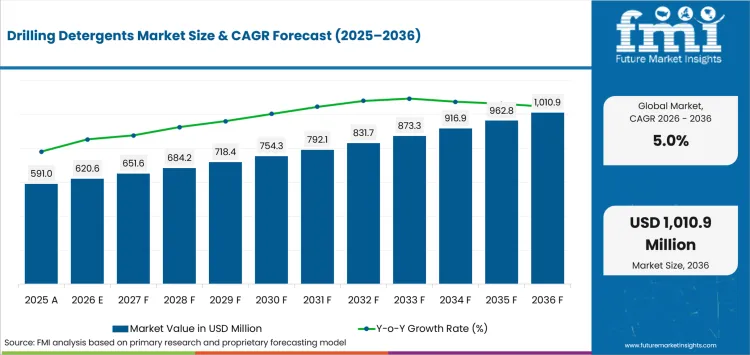
USD 620.6 million in 2026 and USD 1,010.9 million by 2036 at a 5.0% CAGR.
Demand for drilling detergents is projected to expand at 5.0% CAGR between 2026 and 2036 and increase valuation from USD 620.6 million in 2026 to USD 1,010.9 million by 2036. Longer horizontal sections expose more metal and cuttings to reactive formations. EIA recorded super-laterals above 15,000 feet at 15% of new Permian completions in 2025. A detergent earns repeat use only if the treatment improves cleaning without upsetting the mud properties already under control.
Norway's offshore qualification route differs from the USA land-basin route. Operators must address environmental handling alongside fluid compatibility. Aker BP drilled a 10.7-kilometre exploration wellbore on the Norwegian shelf in 2025 according to the Norwegian Offshore Directorate. The 10.7-kilometre wellbore increases cleaning exposure and keeps compatibility checks central during qualification for rig use.
Key Takeaways
- Demand rises where longer or more complex wells make bit accretion and poor wetting expensive enough to justify targeted treatment.
- Based on detergent type, anionic detergents are projected to account for 32.0% in 2026 owing to strong wetting and cleaning performance at practical dosage.
- By mud system, water-based mud is estimated to hold 58.0% in 2026 driven by its broad operating base and need for compatible treatment chemistry.
- In 2026, bit balling prevention is expected to lead application demand with 28.0% share attributable to the direct drilling cost of accreted cuttings.
- Environmental screening and full-fluid compatibility testing can delay switching even after a detergent performs well in a laboratory test.
- Some of the key players in this market include Innospec, Clariant, SNF Group, Nouryon, Stepan, Halliburton, SLB, Baker Hughes, Aubin Group, and TETRA Technologies.
Analyst Perspective
"Mud engineers should judge a drilling detergent against the whole fluid system and the cost of the problem it is meant to remove. Low dosage has little value if the treatment destabilizes polymers or complicates offshore handling."
- Nikhil Kaitwade, Principal Consultant, Future Market Insights
How is the drilling detergents market segmented?
Detergent Type, Mud System, Application, Well Type and Sales Channel define the commercial segmentation used in this analysis.
The market is segmented by detergent type, mud system, application, well type and sales channel. Detergent type includes anionic detergents, non-ionic detergents, wetting detergents, emulsifying detergents and high-salinity detergents. Mud systems include water-based mud, oil-based mud support, synthetic mud support and completion - workover fluids. Applications include bit balling prevention, cuttings dispersion, wetting control, emulsion support and surface tension reduction. Well types include onshore wells, offshore wells, directional wells, shale wells and HPHT wells. Sales channels include mud service companies, oilfield chemical distributors, direct E&P supply and regional formulators.
What makes anionic detergents central to the detergent type category?
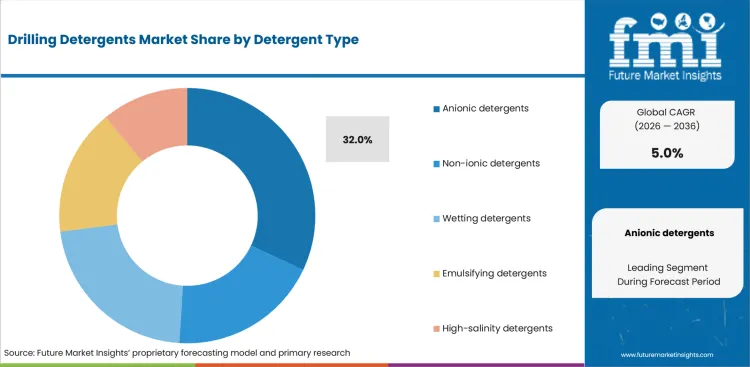
Anionic chemistry fits programs that need a strong wetting change at low treatment volume. Formulators use the wider surfactant chemistry context to judge how a detergent will release sticky solids from metal. Salt tolerance and polymer response still decide whether the formulation reaches field use.
- By detergent type, anionic detergents are forecast to represent 32.0% in 2026 supported by familiar formulation routes and effective surface cleaning at practical dosage.
- Stepan expanded North American alpha olefin sulfonate capacity by 25% in June 2025. The action increases supply flexibility for an anionic surfactant family used in oilfield formulations.
Why does water-based mud lead the mud system category?
Water-based systems let mud engineers adjust cleaning chemistry without replacing the continuous phase. Mud engineers evaluate detergent inside the broader drilling and completion fluids program. A useful treatment improves wetting but leaves foam and polymer behavior within approved control limits.
- Water-based mud is projected to hold 58.0% of mud system demand in 2026 attributable to broad use in wells that can retain aqueous fluid properties during treatment.
- Innospec disclosed in its February 2026 annual filing that it introduced additives to improve drilling muds during 2025. The sits work inside its current oilfield-services research program.
How does bit balling prevention lead the application category?
Bit balling turns a surface-chemistry problem into lost cutting action at the bit. Detergent performance therefore has to improve release of reactive solids without damaging the mud. The selection also affects drilling tool performance during long reactive intervals.
- Bit balling prevention is set to lead the application category with 28.0% share in 2026 driven by the direct effect of accretion on bit cleanliness and drilling efficiency.
- The Society of Petroleum Engineers' November 2025 review listed a field paper on a highly inhibitive anti-accretion drilling-fluid system in Egypt, connecting anti-accretion chemistry directly to field drilling conditions.
What supports onshore wells as the leading well type?
Onshore programs allow fluid treatments to change between formations with shorter logistics than offshore work. The economics of onshore drilling fluids also expose weak detergent performance quickly because treatment cost is reviewed at the well level. Local stock and field response therefore carry unusual weight.
- Onshore wells are likely to capture 39.0% share in 2026 owing to high well counts and faster fluid-program adjustments at the rig.
- ADNOC Drilling stated in July 2026 that its unconventional program drilled more than 100 wells during the first half. The same release recorded active directional-drilling and drilling-fluid work.
What drives mud service companies in the sales channel category?
Mud service companies make daily treatment decisions inside active fluid programs. Their commercial position mirrors the wider oil and gas field services model because field engineers test dosage against solids loading and mud response. Direct product supply carries less influence if the seller cannot support troubleshooting at the rig.
- By sales channel, mud service companies are estimated to hold 44.0% in 2026 owing to their control of formulation changes and field troubleshooting during drilling.
- Baker Hughes filed its 2025 annual report in February 2026 and placed water-based plus specialty fluids inside Well Construction. The filing also documents integrated well services.
What are the drivers, restraints and opportunities in the drilling detergents market?
Longer well sections raise the cost of poor cleaning. Environmental qualification can delay switching, while regional testing can shorten the route from formulation work to field approval.
- Driver: Longer horizontal and deep wells increase the cost of poor cuttings transport and bit accretion during active drilling.
- Restraint: Environmental screening plus compatibility testing can delay a chemistry change ahead of field deployment.
- Opportunity: Regional testing and formulation support can reduce repeated qualification work for low-dose detergents in demanding fluid systems.
Longer drilled intervals increase exposure to cuttings transport and surface-wetting problems. EIA forecast Permian gas production at 29.2 Bcf/d for 2026 and described oil-directed drilling as a major contributor to basin activity. A detergent earns budget in those wells only if low-dose treatment protects rate of penetration at a lower cost than repeated cleaning or avoidable nonproductive time.
Offshore chemistry cannot switch on performance alone. Environmental review comes first. Offshore Norge recorded about 70,000 tonnes of water-based drill-cutting discharges in 2024 and noted that Norwegian operators need permission for those releases. Detergents therefore need environmental documentation matched with full-fluid compatibility data for offshore field acceptance.
Regional testing is most useful where local fluid programs need quick compatibility decisions. Nouryon opened a Houston oilfield innovation center in June 2025 for drilling and completion research with customer testing plus training. Local testing can reduce repeated sample cycles and resolve salinity or polymer issues during qualification for active mud-service programs.
Which country CAGRs are profiled in the drilling detergents market?
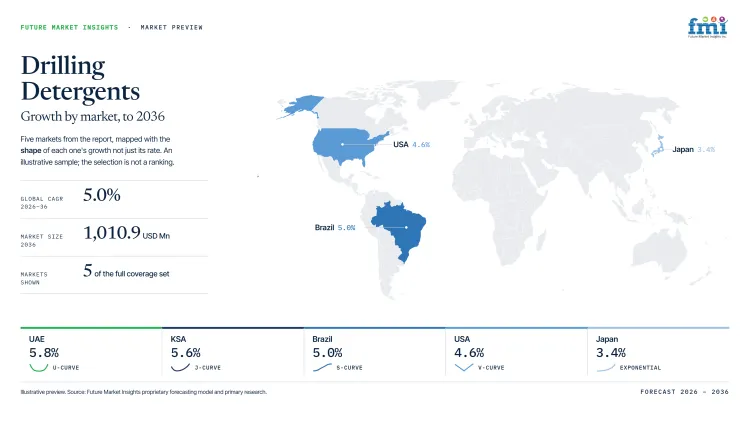
| Country | CAGR |
|---|---|
| UAE | 5.8% |
| KSA | 5.6% |
| Brazil | 5.0% |
| Mexico | 4.9% |
| USA | 4.6% |
| Norway | 4.3% |
| Japan | 3.4% |
How do country-level CAGRs compare in the drilling detergents market?
The 2.4 percentage-point range separates Gulf markets from a lower band. UAE and KSA have large unconventional programs that keep service intensity high. USA and Norway retain substantial drilling bases but face tighter cost or environmental screens. Japan stays project-led.
- The UAE repeats detergent-treatment decisions across each unconventional drilling campaign.
- Saudi Arabia concentrates national drilling demand within centrally managed operator programs.
- Brazil faces offshore chemical-mobilization demands regularly across deepwater drilling campaigns.
- Mexico depends on imported service capacity to support deepwater drilling activity.
- The USA combines dense oilfield services with close scrutiny of treatment costs.
- Norway places greater weight on environmental substitution records before chemical approval.
- Japan's geothermal budgets support specialist drilling fluids and treatment programs.
Similar CAGRs mask different entry conditions. The full report provides country-level CAGR analysis across North America, Latin America, Western Europe, Eastern Europe, East Asia, South Asia and Pacific and the Middle East and Africa.
Country-wise Analysis
- UAE unconventional programs now use longer laterals inside integrated service packages that keep fluid design close to field execution. Drilling detergent demand in UAE is forecast to rise at 5.8% CAGR over the forecast period, driven by repeat multiwell work that puts mud performance under regular review. ADNOC Drilling reported in May 2026 that Turnwell delivered the country's first 10,000-foot lateral unconventional gas wells. Local laboratories shorten compatibility checks, but saline water and strict program approval can still slow a new formulation. New entrants need local inventory plus rapid compatibility work for shale gas development without weakening the incumbent mud system during long lateral sections.
- KSA places much of its drilling chemistry inside large service programs tied to national unconventional gas development plans. Aramco announced in February 2026 that Jafurah had started production and its 2030 sales-gas capacity target is about 80% above 2021. The KSA drilling detergents sector is projected to record 5.6% CAGR during the assessment period, supported by a larger unconventional well program that can spread one approval over many wells. High temperatures and brine exposure raise the testing burden at depth. Market entry depends on fast local technical response and credible oilfield chemical programs that can support extended high-temperature field campaigns.
- Brazilian detergent sales depend on offshore fluid programs that carry strict discharge conditions and long marine supply chains. Brazil's drilling detergents outlook is anticipated to advance at 5.0% CAGR over the assessment period, attributable to technically demanding pre-salt work. Ibama opened a January 2026 consultation covering marine use and discharge of drilling fluids plus cuttings and cement pastes. Environmental documentation can block a formulation before field trials, while marine logistics raise the cost of repeated offshore mobilization. Large service contracts provide repeat volume after approval if companies pair offshore compatibility data with a clear drilling waste handling plan for the complete fluid program.
- Mexico is entering a multiwell ultra-deepwater phase in which a failed fluid change is expensive to reverse. ASEA inspected Woodside Energy's Deepwater Thalassa drillship at Trion in August 2026 and confirmed active oversight of the offshore program. Mexico is estimated to post 4.9% CAGR over the forecast period, supported by integrated deepwater execution that gives proven formulations a route to the well. Traceable chemical handling must be documented before a new batch reaches the rig and long supply lines increase the cost of correction. New entrants need consistent batch quality plus records that fit oil and gas analytics used inside service-controlled offshore programs.
- USA operators judge drilling detergent against cost per well in mature shale basins with dense local service coverage. EIA reported in June 2026 that Permian marketed gas output rose 60% between 2021 and 2025. Drilling detergent sales in USA are forecast to expand at 4.6% CAGR by 2036, driven by continued unconventional activity. Basin laboratories and warehouses make trials easier than remote offshore work, but price pressure rejects treatments without measurable low-dose benefit. Winning programs require fast field response and disciplined onshore drilling waste management plus clear proof of dosage economics at active locations before another well receives the treatment.
- Norwegian offshore programs give environmental qualification almost equal weight with technical cleaning performance. Norway is estimated to post 4.3% CAGR over the forecast period, supported by continued well construction on a mature shelf. The Norwegian Offshore Directorate stated in August 2026 that more than 60% of 2025 oil production came from wells drilled after 2020. Experienced laboratories can run complex offshore compatibility programs close to the operating base and document local fluid response before field use. Chemical substitution rules still slow new surfactants, so entrants need low-risk chemistry and a local handling route that protects rig logistics during weather-sensitive campaigns.
- Japan has a selective drilling base where geothermal projects can require difficult hole-cleaning work without producing broad oilfield volumes. JOGMEC selected Kamikawa in Hokkaido for its geothermal frontier project in July 2026. The program plans drilling investigations with steam testing and will pass survey data or drilled wells to developers if the site proceeds. Adoption of drilling detergents in Japan is estimated to expand at 3.4% CAGR through 2036, driven by technically demanding project work. Long project lead times limit repeat volume, so companies need application evidence and flexible supply for specialized wells under uneven regional schedules rather than a continuous volume channel.
Who are the notable companies in the drilling detergents market?
Innospec, Clariant, SNF Group, Nouryon, Stepan, Halliburton, SLB, Baker Hughes, Aubin Group and TETRA Technologies are the notable companies profiled in this market.
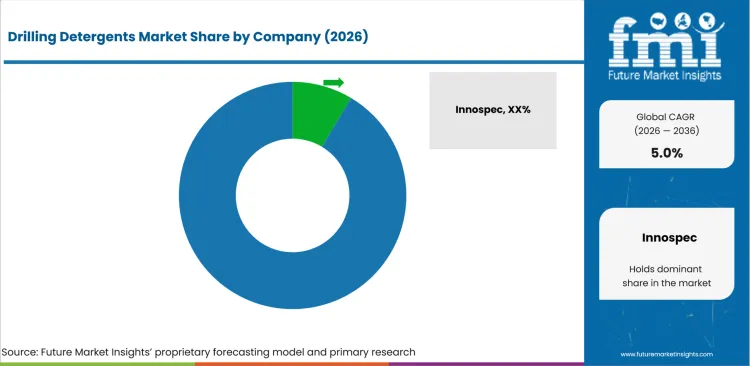
Competition separates integrated drilling-fluid services from specialty chemistry. Halliburton and SLB can qualify detergent inside broader mud programs. Innospec and Nouryon sell current oilfield chemistry. TETRA and Aubin compete near the completion and wellbore-cleanup boundary.
- Halliburton, SLB and Baker Hughes provide integrated well-construction or drilling-fluid services with field execution capability.
- Innospec and Clariant supply oilfield chemistry. SNF Group and Nouryon cover broader additives. Stepan supplies surfactant capacity.
- Aubin Group and TETRA Technologies participate where wellbore cleanup or completion-fluid work influences chemical selection.
Competitive Benchmarking: Drilling Detergents Market
| Company | Drilling-fluid Chemistry Evidence | Fluid-system Integration | Field Application Support | Geographic Reach |
|---|---|---|---|---|
| Innospec | High | Medium | Medium | Americas, Europe, Middle East, Africa and Asia-Pacific |
| Clariant | Medium | Low | High | Europe, Latin America, North America, Middle East and Asia |
| SNF Group | Medium | Low | Medium | Global oilfield-chemistry network |
| Nouryon | High | Medium | High | North America, Europe and Middle East |
| Stepan | Medium | Low | Low | North America with global manufacturing |
| Halliburton | High | High | High | Global |
| SLB | High | High | High | Global |
| Baker Hughes | High | High | High | Global |
| Aubin Group | Medium | Medium | Medium | United Kingdom and Middle East |
| TETRA Technologies | Medium | High | High | North America with international deepwater coverage |
Scoring basis: High chemistry evidence requires current documentation for several drilling or completion-fluid functions. Medium requires one direct drilling or wellbore-fluid route. Low indicates an adjacent oilfield-chemistry role. High integration requires integrated fluid delivery with adjacent well services. Medium covers one connected service context. Low means component chemistry without service integration. Field-support ratings use current field delivery or dedicated testing evidence. Breadth determines the High to Low level.
Key Developments in the drilling detergents market
- In January 2026, SNF Group completed its acquisition of Syensqo's Oil & Gas division. The acquired business covers oilfield chemistry from drilling through production and expands SNF's technical portfolio.
- In March 2025, SLB received an 18-well Trion award from Woodside Energy. The ultra-deepwater scope includes drilling and completion fluids inside an integrated well program.
- In January 2025, Halliburton won a three-year integrated drilling-services award from Petrobras. The Brazil scope includes BaraLogix support for drilling-fluid performance in offshore wells.
Key Players in the drilling detergents market
Integrated Drilling-Fluid Service Providers
- Halliburton
- SLB
- Baker Hughes
Specialty Oilfield Chemistry Suppliers
- Innospec
- Clariant
- SNF Group
- Nouryon
- Stepan
Completion and Wellbore Fluid Specialists
- Aubin Group
- TETRA Technologies
Drilling Detergents Market - Report Scope
| Coverage field | Report scope |
|---|---|
| Market breakdown | By detergent type, mud system, application, well type, sales channel and region. |
| Quantitative Units | USD million. |
| Market Definition | Revenue from drilling-detergent and surfactant additives used for detergency, wetting, dispersion, bit balling prevention, emulsion support and surface-tension control within defined drilling and completion - workover fluid systems. |
| Regions Covered | North America; Latin America; Western Europe; Eastern Europe; East Asia; South Asia and Pacific; Middle East and Africa. |
| Countries Covered | UAE, KSA, Brazil, Mexico, USA, Norway, Japan and more than twenty-five additional countries in the full report. |
| Key Companies Profiled | Innospec, Clariant, SNF Group, Nouryon, Stepan, Halliburton, SLB, Baker Hughes, Aubin Group, TETRA Technologies. |
| Forecast Period | 2026 to 2036. |
| Approach | Primary and secondary research with market triangulation. |
Drilling Detergents Market - Research Methodology
| Method | Approach |
|---|---|
| Primary Research | FMI analysts gathered input from manufacturers, service providers, technology developers, distributors, end users, procurement teams, and subject-matter experts. Interviews examined purchasing decisions, product or service evaluation, adoption barriers, approval requirements, pricing considerations, and expectations for technical or commercial support. Respondents were also asked what evidence is required before a trial, pilot, or initial order develops into regular purchasing. |
| Desk Research | Desk research covered government statistics, regulatory publications, trade data, industry associations, technical literature, standards, company filings, product information, and official corporate announcements. Sources were reviewed for relevance, publication date, geographic coverage, and consistency with the defined market scope. Claims relating to performance, applications, approvals, capacity, investment, and commercial activity were retained only when supported by credible public evidence. |
| Market Sizing and Forecasting | The market model combined the baseline value with historical performance, segment structure, pricing and volume indicators, adoption levels, company participation, and country-level demand conditions. Forecast assumptions considered economic activity, investment trends, regulatory developments, technology adoption, purchasing cycles, supply availability, and barriers to wider market use. Segment and regional estimates were reconciled before the final market total was calculated. |
| Data Validation | Estimates were checked against multiple independent indicators, including public data, company activity, trade patterns, industry developments, and findings from primary interviews. Validation also tested whether products, services, applications, and company revenues fell within the defined market boundaries. Adjacent categories, unsupported claims, overlapping revenues, and activities without direct market relevance were excluded to reduce double counting and maintain consistency across segments and countries. |
Drilling Detergents Market by Segments
Drilling Detergents Market segmented by Detergent Type:
- Anionic detergents
- Non-ionic detergents
- Wetting detergents
- Emulsifying detergents
- High-salinity detergents
Drilling Detergents Market segmented by Mud System:
- Water-based mud
- Oil-based mud support
- Synthetic mud support
- Completion - workover fluids
Drilling Detergents Market segmented by Application:
- Bit balling prevention
- Cuttings dispersion
- Wetting control
- Emulsion support
- Surface tension reduction
Drilling Detergents Market segmented by Well Type:
- Onshore wells
- Offshore wells
- Directional wells
- Shale wells
- HPHT wells
Drilling Detergents Market segmented by Sales Channel:
- Mud service companies
- Oilfield chemical distributors
- Direct E&P supply
- Regional formulators
Drilling Detergents Market by Region:
- North America
- United States
- Canada
- Latin America
- Brazil
- Mexico
- Argentina
- Chile
- Western Europe
- Germany
- France
- United Kingdom
- Italy
- Spain
- Benelux
- Nordics
- Eastern Europe
- Poland
- Czech Republic
- Romania
- Hungary
- East Asia
- China
- Japan
- South Korea
- South Asia and Pacific
- India
- ASEAN
- Australia and New Zealand
- Middle East and Africa
- GCC Countries
- South Africa
- Türkiye
- Israel
Research Sources and Bibliography
- USA Energy Information Administration. (2026, August 19). Longer wells boost Permian crude oil and natural gas production
- Norwegian Offshore Directorate. (2026, August 1). Oil and gas on the NCS moving forward
- Stepan Company. (2025, June 3). Stepan Company Boosts AOS Production Capacity by 25% Annually
- Innospec Inc.. (2026, February 18). Annual report on Form 10-K for the year ended December 31, 2025
- Society of Petroleum Engineers. (2025, November 1). Drilling and Completion Fluids
- ADNOC Drilling. (2026, July 30). ADNOC Drilling Delivers Record 1H Revenue and Profits, with Dividends Exceeding Half Billion USD
- Baker Hughes Company. (2026, February 5). Annual report on Form 10-K for the year ended December 31, 2025
- USA Energy Information Administration. (2026, August 12). United States on track for record natural gas production in 2026
- Offshore Norge. (2025, September 25). Climate and Environmental Report 2025: Discharge to sea
- Nouryon. (2025, June 18). Nouryon launches Innovation Center for oilfield solutions in Texas, US
- ADNOC Drilling. (2026, May 11). ADNOC Drilling Delivers Best-Ever 1Q Performance, Driven by High Utilization, Integrated Services and Contracted Growth
- Aramco. (2026, February 26). Aramco’s gas strategy builds momentum with major progress towards growth target
- Instituto Brasileiro do Meio Ambiente e dos Recursos Naturais Renováveis. (2026, January 13). Ibama abre consulta pública sobre norma de uso e descarga marítima de materiais em atividades de petróleo e gás
- Agencia de Seguridad, Energía y Ambiente. (2026, August 5). La ASEA realiza visitas de inspección en aguas ultraprofundas
- USA Energy Information Administration. (2026, June 18). Permian natural gas production increased faster than crude oil
- Norwegian Offshore Directorate. (2026, August 20). The Resource Report 2026: Summary
- Japan Organization for Metals and Energy Security. (2026, July 10). 地熱フロンティアプロジェクト、候補地として北海道上川町を選定
- SNF Group. (2026, January 2). SNF GROUP COMPLETES THE ACQUISITION OF THE OIL & GAS DIVISION OF SYENSQO
- SLB. (2025, March 31). SLB Awarded Major Drilling Contract by Woodside Energy for Ultra-deepwater Trion Development, Offshore Mexico
- Halliburton. (2025, January 30). Halliburton secures major offshore drilling contract with Petrobras
- Clariant. (2025, November 3). Clariant Oil Services recognized by Petrobras with Best Suppliers Award for Chemical Products
- Halliburton. (2026, February 6). Annual report on Form 10-K for the year ended December 31, 2025
- TETRA Technologies, Inc.. (2026, February 25). Annual report on Form 10-K for the year ended December 31, 2025
- Aubin Group. (n.d.). Aubin Group: Developing and delivering reliable chemical solutions for over 30 years Retrieved September 8, 2026.
- Clariant. (2025, September 2). Clariant Oil Services and Swire Energy Services open new supply base in Norway supporting European energy production
- Baker Hughes. (2025, October 24). Baker Hughes, Aramco to Expand Integrated Coiled Tubing Drilling Operations Across Saudi Arabia
- TETRA Technologies, Inc.. (2026, June 29). TETRA TECHNOLOGIES INTRODUCES TETRA NEPTUNE Z-LITE DEEPWATER COMPLETIONS FLUID
- Halliburton. (2026, July 13). Halliburton Wins Integrated Drilling and Completions Contracts for GranMorgu Deepwater Project Offshore Suriname, Operated by TotalEnergies
- SLB. (2026, February 12). SLB Awarded Multiple Offshore Drilling Contracts by Mubadala Energy for Tangkulo Deepwater Development in Indonesia
- Baker Hughes. (2026, May 26). Baker Hughes Extends and Expands Integrated Well Construction Contract with Petrobras
- Italmatch Chemicals. (2024, March 25). Aubin Xmax: Barrier technology for water shut-off - New case history out now
This bibliography is provided for reader reference and is not exhaustive. The full report contains the complete reference list and detailed citations.
This Report Answers
- What is the drilling detergents market size in 2026 and 2036?
- What CAGR is projected from 2026 to 2036?
- Why do anionic detergents hold the leading detergent type share?
- Why does water-based mud represent the largest mud-system share?
- Why does bit balling prevention lead application demand?
- How do growth rates differ among the profiled countries?
- What operating factors raise or delay drilling detergent qualification?
- Which companies supply drilling-detergent chemistry or adjacent fluid services?
- How does the complete segmentation structure shape demand?
Frequently Asked Questions
How big is the drilling detergents market in 2026?
The drilling detergents market is valued at USD 620.6 million in 2026 and is projected to reach USD 1,010.9 million by 2036. Growth is driven by longer well sections that make poor cleaning more expensive.
What is the CAGR of the drilling detergents market from 2026 to 2036?
The drilling detergents market is projected to grow at a CAGR of 5.0% between 2026 and 2036. Expansion is supported by unconventional and deepwater drilling that requires repeat control of wetting and cuttings behavior.
Which detergent type leads the drilling detergents market?
The anionic detergents segment is expected to hold 32.0% of the drilling detergents market in 2026, attributable to strong wetting performance at practical field dosage. Its position also depends on compatibility with salts and mud polymers.
Which mud system leads the drilling detergents market?
The water-based mud segment is projected to account for 58.0% of mud-system demand in 2026, driven by its broad operating base. Detergent chemistry must improve cleaning without pushing foam or polymer behavior outside approved limits.
Which application leads the drilling detergents market?
The bit balling prevention segment is expected to represent 28.0% of application demand in 2026, supported by the direct drilling cost of accreted cuttings. Treatment value rises when cleaner cutting surfaces preserve effective drilling action.
Which countries are projected to record the highest growth in the drilling detergents market?
UAE is projected to grow at 5.8% CAGR followed by KSA at 5.6% and Brazil at 5.0% through 2036. Their higher rates come from intensive unconventional programs in the Gulf and demanding offshore work in Brazil.
Which companies are active in the drilling detergents market?
Key companies operating in the market include Innospec, Clariant, SNF Group, Nouryon, Stepan, Halliburton, SLB, Baker Hughes, Aubin Group and TETRA Technologies. Their field access comes from integrated fluid services plus specialty chemistry and regional support for wellbore cleanup.
Preview the report firsthand - request a free sample
Get SampleGet the brochure for pricing and purchase details.
Get PDFTable of Content
- Key Takeaways
- Market Size and CAGR
- Top Growth Driver
- Fastest Growing Segment
- Leading Region
- Key Companies
- Emerging Opportunities
- Executive Summary
- Global Market Outlook
- Demand-side Trends
- Supply-side Trends
- Technology Roadmap Analysis
- Analysis and Recommendations
- Analyst Perspective (What is happening? Why now? What should investors know?)
- Key Questions Answered
- How large is the market?
- What is the CAGR?
- What are key trends?
- Which region dominates?
- Who are the leaders?
- Market Overview
- Market Coverage / Taxonomy
- Market Definition / Scope / Limitations
- Research Methodology
- Chapter Orientation
- Analytical Lens and Working Hypotheses
- Market Structure, Signals, and Trend Drivers
- Benchmarking and Cross-market Comparability
- Market Sizing, Forecasting, and Opportunity Mapping
- Research Design and Evidence Framework
- Desk Research Programme (Secondary Evidence)
- Expert Input and Fieldwork (Primary Evidence)
- Tooling, Models, and Reference Databases
- Data Engineering and Model Build
- Quality Assurance and Audit Trail
- Market Background
- Market Dynamics (Drivers, Restraints, Opportunity, Trends)
- Scenario Forecast (Optimistic, Likely, Conservative)
- Impact Analysis
- AI Impact
- Sustainability Impact
- Regulatory Impact
- Technology Impact
- Consumer / Buyer Analysis
- Purchase Drivers
- Adoption Barriers
- Buyer Journey
- Opportunity Map Analysis
- Product Life Cycle Analysis
- Supply Chain Analysis
- Investment Feasibility Matrix
- Value Chain Analysis
- PESTLE and Porter's Analysis
- Regulatory Landscape
- Regional Parent Market Outlook
- Production and Consumption Statistics
- Import and Export Statistics
- Global Market Analysis and Forecast, 2021 to 2036
- Historical Market Size Value (USD Million) Analysis, 2021 to 2025
- Current and Future Market Size Value (USD Million) Projections, 2026 to 2036
- Y-o-Y Growth Trend Analysis
- Absolute $ Opportunity Analysis
- Global Market Pricing Analysis, 2021 to 2036
- Global Market Analysis and Forecast, By Detergent Type, 2021 to 2036
- Introduction / Key Findings
- Historical Market Size Value (USD Million) Analysis By Detergent Type, 2021 to 2025
- Current and Future Market Size Value (USD Million) Analysis and Forecast By Detergent Type, 2026 to 2036
- Anionic detergents
- Non-ionic detergents
- Wetting detergents
- Emulsifying detergents
- High-salinity detergents
- Anionic detergents
- Y-o-Y Growth Trend Analysis By Detergent Type, 2021 to 2025
- Absolute $ Opportunity Analysis By Detergent Type, 2026 to 2036
- Global Market Analysis and Forecast, By Mud System, 2021 to 2036
- Introduction / Key Findings
- Historical Market Size Value (USD Million) Analysis By Mud System, 2021 to 2025
- Current and Future Market Size Value (USD Million) Analysis and Forecast By Mud System, 2026 to 2036
- Water-based mud
- Oil-based mud support
- Synthetic mud support
- Completion / workover fluids
- Water-based mud
- Y-o-Y Growth Trend Analysis By Mud System, 2021 to 2025
- Absolute $ Opportunity Analysis By Mud System, 2026 to 2036
- Global Market Analysis and Forecast, By Application, 2021 to 2036
- Introduction / Key Findings
- Historical Market Size Value (USD Million) Analysis By Application, 2021 to 2025
- Current and Future Market Size Value (USD Million) Analysis and Forecast By Application, 2026 to 2036
- Bit balling prevention
- Cuttings dispersion
- Wetting control
- Emulsion support
- Surface tension reduction
- Bit balling prevention
- Y-o-Y Growth Trend Analysis By Application, 2021 to 2025
- Absolute $ Opportunity Analysis By Application, 2026 to 2036
- Global Market Analysis and Forecast, By Well Type, 2021 to 2036
- Introduction / Key Findings
- Historical Market Size Value (USD Million) Analysis By Well Type, 2021 to 2025
- Current and Future Market Size Value (USD Million) Analysis and Forecast By Well Type, 2026 to 2036
- Onshore wells
- Offshore wells
- Directional wells
- Shale wells
- HPHT wells
- Onshore wells
- Y-o-Y Growth Trend Analysis By Well Type, 2021 to 2025
- Absolute $ Opportunity Analysis By Well Type, 2026 to 2036
- Global Market Analysis and Forecast, By Sales Channel, 2021 to 2036
- Introduction / Key Findings
- Historical Market Size Value (USD Million) Analysis By Sales Channel, 2021 to 2025
- Current and Future Market Size Value (USD Million) Analysis and Forecast By Sales Channel, 2026 to 2036
- Mud service companies
- Oilfield chemical distributors
- Direct E&P supply
- Regional formulators
- Mud service companies
- Y-o-Y Growth Trend Analysis By Sales Channel, 2021 to 2025
- Absolute $ Opportunity Analysis By Sales Channel, 2026 to 2036
- Global Market Analysis and Forecast, By Region, 2021 to 2036
- Introduction
- Historical Market Size Value (USD Million) Analysis By Region, 2021 to 2025
- Current Market Size Value (USD Million) Analysis and Forecast By Region, 2026 to 2036
- North America
- Latin America
- Western Europe
- Eastern Europe
- East Asia
- South Asia and Pacific
- Middle East & Africa
- Market Attractiveness Analysis By Region
- North America Market Analysis and Forecast, By Country, 2021 to 2036
- Historical Market Size Value (USD Million) Trend Analysis By Market Taxonomy, 2021 to 2025
- Market Size Value (USD Million) Forecast By Market Taxonomy, 2026 to 2036
- By Country
- USA
- Canada
- By Detergent Type
- By Mud System
- By Application
- By Well Type
- By Sales Channel
- By Country
- Market Attractiveness Analysis
- By Country
- By Detergent Type
- By Mud System
- By Application
- By Well Type
- By Sales Channel
- Key Takeaways
- Latin America Market Analysis and Forecast, By Country
- Historical Market Size Value (USD Million) Trend Analysis By Market Taxonomy, 2021 to 2025
- Market Size Value (USD Million) Forecast By Market Taxonomy, 2026 to 2036
- By Country
- Brazil
- Mexico
- Chile
- Rest of Latin America
- By Detergent Type
- By Mud System
- By Application
- By Well Type
- By Sales Channel
- By Country
- Market Attractiveness Analysis
- By Country
- By Detergent Type
- By Mud System
- By Application
- By Well Type
- By Sales Channel
- Key Takeaways
- Western Europe Market Analysis and Forecast, By Country
- Historical Market Size Value (USD Million) Trend Analysis By Market Taxonomy, 2021 to 2025
- Market Size Value (USD Million) Forecast By Market Taxonomy, 2026 to 2036
- By Country
- Germany
- UK
- Italy
- Spain
- France
- Nordic
- BENELUX
- Rest of Western Europe
- By Detergent Type
- By Mud System
- By Application
- By Well Type
- By Sales Channel
- By Country
- Market Attractiveness Analysis
- By Country
- By Detergent Type
- By Mud System
- By Application
- By Well Type
- By Sales Channel
- Key Takeaways
- Eastern Europe Market Analysis and Forecast, By Country
- Historical Market Size Value (USD Million) Trend Analysis By Market Taxonomy, 2021 to 2025
- Market Size Value (USD Million) Forecast By Market Taxonomy, 2026 to 2036
- By Country
- Russia
- Poland
- Hungary
- Balkan & Baltic
- Rest of Eastern Europe
- By Detergent Type
- By Mud System
- By Application
- By Well Type
- By Sales Channel
- By Country
- Market Attractiveness Analysis
- By Country
- By Detergent Type
- By Mud System
- By Application
- By Well Type
- By Sales Channel
- Key Takeaways
- East Asia Market Analysis and Forecast, By Country
- Historical Market Size Value (USD Million) Trend Analysis By Market Taxonomy, 2021 to 2025
- Market Size Value (USD Million) Forecast By Market Taxonomy, 2026 to 2036
- By Country
- China
- Japan
- South Korea
- By Detergent Type
- By Mud System
- By Application
- By Well Type
- By Sales Channel
- By Country
- Market Attractiveness Analysis
- By Country
- By Detergent Type
- By Mud System
- By Application
- By Well Type
- By Sales Channel
- Key Takeaways
- South Asia and Pacific Market Analysis and Forecast, By Country
- Historical Market Size Value (USD Million) Trend Analysis By Market Taxonomy, 2021 to 2025
- Market Size Value (USD Million) Forecast By Market Taxonomy, 2026 to 2036
- By Country
- India
- ASEAN
- Australia & New Zealand
- Rest of South Asia and Pacific
- By Detergent Type
- By Mud System
- By Application
- By Well Type
- By Sales Channel
- By Country
- Market Attractiveness Analysis
- By Country
- By Detergent Type
- By Mud System
- By Application
- By Well Type
- By Sales Channel
- Key Takeaways
- Middle East & Africa Market Analysis and Forecast, By Country
- Historical Market Size Value (USD Million) Trend Analysis By Market Taxonomy, 2021 to 2025
- Market Size Value (USD Million) Forecast By Market Taxonomy, 2026 to 2036
- By Country
- Kingdom of Saudi Arabia
- Other GCC Countries
- Türkiye
- South Africa
- Other African Union
- Rest of Middle East & Africa
- By Detergent Type
- By Mud System
- By Application
- By Well Type
- By Sales Channel
- By Country
- Market Attractiveness Analysis
- By Country
- By Detergent Type
- By Mud System
- By Application
- By Well Type
- By Sales Channel
- Key Takeaways
- Key Countries Market Analysis
- USA
- Pricing Analysis
- Market Share Analysis, 2025
- By Detergent Type
- By Mud System
- By Application
- By Well Type
- By Sales Channel
- Canada
- Pricing Analysis
- Market Share Analysis, 2025
- By Detergent Type
- By Mud System
- By Application
- By Well Type
- By Sales Channel
- Mexico
- Pricing Analysis
- Market Share Analysis, 2025
- By Detergent Type
- By Mud System
- By Application
- By Well Type
- By Sales Channel
- Brazil
- Pricing Analysis
- Market Share Analysis, 2025
- By Detergent Type
- By Mud System
- By Application
- By Well Type
- By Sales Channel
- Chile
- Pricing Analysis
- Market Share Analysis, 2025
- By Detergent Type
- By Mud System
- By Application
- By Well Type
- By Sales Channel
- Germany
- Pricing Analysis
- Market Share Analysis, 2025
- By Detergent Type
- By Mud System
- By Application
- By Well Type
- By Sales Channel
- UK
- Pricing Analysis
- Market Share Analysis, 2025
- By Detergent Type
- By Mud System
- By Application
- By Well Type
- By Sales Channel
- Italy
- Pricing Analysis
- Market Share Analysis, 2025
- By Detergent Type
- By Mud System
- By Application
- By Well Type
- By Sales Channel
- Spain
- Pricing Analysis
- Market Share Analysis, 2025
- By Detergent Type
- By Mud System
- By Application
- By Well Type
- By Sales Channel
- France
- Pricing Analysis
- Market Share Analysis, 2025
- By Detergent Type
- By Mud System
- By Application
- By Well Type
- By Sales Channel
- India
- Pricing Analysis
- Market Share Analysis, 2025
- By Detergent Type
- By Mud System
- By Application
- By Well Type
- By Sales Channel
- ASEAN
- Pricing Analysis
- Market Share Analysis, 2025
- By Detergent Type
- By Mud System
- By Application
- By Well Type
- By Sales Channel
- Australia & New Zealand
- Pricing Analysis
- Market Share Analysis, 2025
- By Detergent Type
- By Mud System
- By Application
- By Well Type
- By Sales Channel
- China
- Pricing Analysis
- Market Share Analysis, 2025
- By Detergent Type
- By Mud System
- By Application
- By Well Type
- By Sales Channel
- Japan
- Pricing Analysis
- Market Share Analysis, 2025
- By Detergent Type
- By Mud System
- By Application
- By Well Type
- By Sales Channel
- South Korea
- Pricing Analysis
- Market Share Analysis, 2025
- By Detergent Type
- By Mud System
- By Application
- By Well Type
- By Sales Channel
- Russia
- Pricing Analysis
- Market Share Analysis, 2025
- By Detergent Type
- By Mud System
- By Application
- By Well Type
- By Sales Channel
- Poland
- Pricing Analysis
- Market Share Analysis, 2025
- By Detergent Type
- By Mud System
- By Application
- By Well Type
- By Sales Channel
- Hungary
- Pricing Analysis
- Market Share Analysis, 2025
- By Detergent Type
- By Mud System
- By Application
- By Well Type
- By Sales Channel
- Kingdom of Saudi Arabia
- Pricing Analysis
- Market Share Analysis, 2025
- By Detergent Type
- By Mud System
- By Application
- By Well Type
- By Sales Channel
- Türkiye
- Pricing Analysis
- Market Share Analysis, 2025
- By Detergent Type
- By Mud System
- By Application
- By Well Type
- By Sales Channel
- South Africa
- Pricing Analysis
- Market Share Analysis, 2025
- By Detergent Type
- By Mud System
- By Application
- By Well Type
- By Sales Channel
- USA
- Market Structure Analysis
- Competition Dashboard
- Competition Benchmarking
- Market Share Analysis of Top Players
- By Regional
- By Detergent Type
- By Mud System
- By Application
- By Well Type
- By Sales Channel
- Emerging Startups
- Innovation Benchmarking
- Competition Analysis
- Competition Deep Dive
- Innospec
- Overview
- Product Portfolio
- Profitability by Market Segments
- Sales Footprint
- Strategy Overview
- Marketing Strategy
- Product Strategy
- Channel Strategy
- Clariant
- Solvay
- Nouryon
- Stepan
- Halliburton
- SLB
- Baker Hughes
- Aubin Group
- TETRA Technologies
- Innospec
- Case Studies
- Success Stories
- Recent Developments
- Competition Deep Dive
- Assumptions & Acronyms Used


