

- Market Size (2026)
- USD 913.5 Mn
- Forecast (2036)
- USD 1418.6 Mn
- CAGR (2026 to 2036)
- 4.5%
How big is Marine Shaft Grounding Systems Market in 2026?
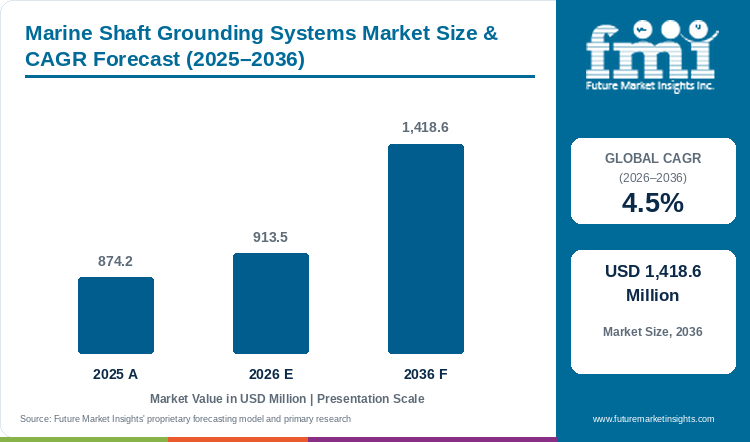
At USD 913.5 million in 2026, the marine shaft grounding systems market is up from USD 874.2 million in 2025 and on course for USD 1,418.6 million by 2036. Sales are projected to expand at a 4.5% CAGR between 2026 and 2036, adding USD 505.1 million of value as electric ships enter service.
Demand for propeller shaft grounding systems is rising with the electric ships fleet, as drives and converters push stray voltage into propulsion bearings. At the start of 2025, DNV counted 1,072 hybrid or battery-powered vessels in service and 468 more on order for delivery by end-2028 [1]. In May 2025, Wärtsilä secured the full electric propulsion scope for three battery-electric ferries for San Francisco Bay Ferry [2]. As per FMI, shipyards will fit grounding kits on more drive-based shaft lines as these orders reach delivery through 2036.
Key Market Trends & Insights
- By system type, silver brush grounding systems lead with 34% of sales in 2026, as owners want a low-resistance contact lasting between dockings.
- By vessel type, commercial vessels account for 38% of sales in 2026, backed by a busy newbuild order book. World yards booked about 45 million CGT of new ships from January to November 2025 [3].
- By shaft size, the 100-250 mm class takes 37% of sales in 2026, as one standard ring, holder and brush kit fits many ships in this range.
- By sales channel, shipyards hold 36% of sales in 2026, as fitting a kit before the shaft line is closed costs less than a later retrofit. FMI expects the shipyard lead to last through 2036 as electric newbuilds reach delivery.
- By function, bearing current mitigation takes 39% of demand in 2026, as owners mainly want to keep stray current out of propulsion bearings. Cathwell notes that an ungrounded shaft leaves bearings and gears open to spark erosion [4].
Regional Highlights
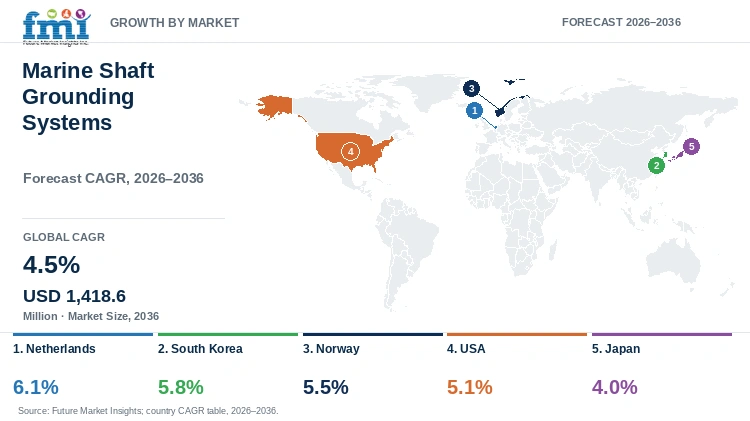
- Fastest-growing profiled country: the Netherlands, at a 6.1% CAGR from 2026 to 2036, backed by state-funded clean-fuel retrofits.
- By country: South Korea (5.8%) and Norway (5.5%) come next, and Japan grows slowest of the five at a 4% CAGR during the forecast period.
- Dutch retrofit orders are set to rise after the European Commission approved a EUR 103 million aid scheme in July 2026 for methanol and hydrogen short-sea vessels [5].
Market Size & Forecast
Table 1: Market Size and Forecast for the Marine Shaft Grounding Systems Market (USD million and percentage), 2025 to 2036
| Metric | Value |
|---|---|
| 2025 Market Size | USD 874.2 million |
| Estimated Market Size in 2026 | USD 913.5 million |
| Projected Market Size by 2036 | USD 1,418.6 million |
| CAGR, 2026 to 2036 | 4.5% |
| Added Revenue, 2026 to 2036 | USD 505.1 million |
| Market Expansion Multiple | 1.6x |
Newbuild yards and owners refitting ships at planned dockings generate most sales of marine shaft grounding systems today. Owners buy the kits to protect propulsion bearings, as drives and converters on electric ships push stray voltage down the shaft. Naval buyers add a second stream of orders, and HENSOLDT's MAMALA active system cuts shaft-to-hull voltage to a few millivolts on ships and submarines [6]. The U.S. Navy's FY2027 plan also requested USD 65.8 billion for shipbuilding [7]. However, the U.S. Geological Survey estimates the 2025 silver price at USD 38 per troy ounce against USD 28.37 in 2024, raising the cost of silver tracks and brushes [8]. Monitored kits letting crews check shaft voltage without opening the shaft tunnel are expected to gain a larger part of new orders through 2036.
Electric Fleet, Shipyard Orders and Silver Costs
Shaft grounding kits are bought ship by ship, so the electric fleet and the yard order book set the pace of sales. Drives, converters and shore charging links on electric shaft lines can push stray current into the bearings. DNV counted 1,072 hybrid or battery vessels in service at the start of 2025, with 468 more on order for delivery by end-2028 [1]. In May 2025, Wärtsilä secured an order for three 150-passenger battery-electric ferries in San Francisco, covering motors, batteries, transformers, a DC hub and shore charging [2]. Ship designers now write bearing protection into the propulsion specification from the first drawings. Enova expects battery-electric ships and shore power to play an important role in short-sea and coastal shipping [9]. Due to this, demand for ship shaft grounding devices will rise fastest on ferries, coastal ships and harbour craft. The Netherlands is set to grow fastest at a 6.1% CAGR through 2036, after the European Commission approved a EUR 103 million Dutch aid scheme in July 2026 [5]. Norway follows at a 5.5% CAGR over the same period, as Enova awarded NOK 1.3 billion to ten zero-emission shipping projects in June 2026 [9]. Japan grows slowest at a 4% CAGR through 2036. Yards there are still preparing for ammonia- and hydrogen-fuelled ships, and MLIT's August 2026 additions take facility investment to about JPY 205 billion [10].
World yards booked about 45 million CGT of new ships from January to November 2025 [3]. Chinese yards took just over 26.6 million CGT of that total, and South Korean yards just over 10 million CGT, or about 22%, up from 17% in 2024 [3]. South Korea is set to grow at a 5.8% CAGR through 2036 on batch orders for standard kits. Market growth stays moderate next to fleet growth, as many new ships come from Chinese yards buying local hardware. Each kit is also small in value next to the full propulsion package. According to FMI, shaft grounding sales will gain USD 505.1 million of new value from 2026 to 2036. Revenue from shaft earthing brushes will rise faster in value than in units, owing to higher silver prices. Evac's Cathelco brushes use 80% silver and 20% graphite on a copper slipring with a solid silver track [11]. Cathwell sizes the inlaid silver track to each shaft diameter [4]. With costlier silver in every brush and track, suppliers will pass part of the metal cost on to owners. Some small-shaft owners will stay with carbon contacts to limit spend. Warships add a slower second stream of orders, as naval grounding also needs to cut the hull's electrical signature. Active systems such as HENSOLDT's MAMALA can be retrofitted [6], giving navies an upgrade path for ships already in service.
Table 2: Electric Fleet and Shipyard Order Indicators for the Marine Shaft Grounding Systems Market (vessels, CGT, prices, budgets and voltages), mixed reporting years from 2025 to 2026
| Indicator | Data Point | Why This Matters | Source |
|---|---|---|---|
| Hybrid and battery fleet | 1,072 in service; 468 on order for delivery by end-2028 | More drive-based shaft lines need bearing protection at delivery. | [1] |
| World newbuild orders | About 45 million CGT, January to November 2025; South Korea about 22% | Large yard order books support batch orders for standard kits. | [3] |
| Silver price | USD 38 per troy ounce in 2025 vs USD 28.37 in 2024 | Silver brushes and tracks cost more at every replacement. | [8] |
| Brush material | 80% silver and 20% graphite on a silver-inlay copper slipring | Each replacement brush order carries more silver value for suppliers. | [11] |
| Active shaft grounding | Shaft-to-hull voltage cut to a few mV; 30, 35 and 60 A ratings | Naval buyers pay more for active systems with lower shaft voltage. | [6] |
| U.S. Navy FY2027 request | USD 65.8 billion for shipbuilding | Naval orders for grounding kits hold steady in the USA. | [7] |
| Dutch clean vessel aid | EUR 103 million approved, grants from 2027 to 2031 | Dutch retrofits bundle grounding with new propulsion work at yards. | [5] |
| Dutch Maritime Masterplan round | EUR 33.6 million second round within a EUR 210 million plan | Funded newbuild and retrofit projects add Dutch kit orders. | [12] |
| Norway Enova awards | NOK 1.3 billion to ten zero-emission shipping projects, June 2026 | Electric and low-carbon ship orders keep flowing in Norway. | [9] |
| Japan next-generation ship program | Four projects added, total facility investment of about JPY 205 billion | Japanese yards prepare for new propulsion types over the decade. | [10] |
Table 3: Electric Fleet and Shipbuilding Pipeline Benchmarks for the Marine Shaft Grounding Systems Market (mixed currencies and units), 2024-2026, mixed years
| Indicator | Value | Source |
|---|---|---|
| Global marine shaft grounding systems market, 2026 | USD 913.5 million | Future Market Insights |
| Added market value, 2026-2036 | USD 505.1 million | Future Market Insights |
| Hybrid and battery vessels in service | 1,072 | [1] |
| Hybrid and battery vessels on order to end-2028 | 468 | [1] |
| Battery-electric ferries in the San Francisco Bay Ferry order, May 2025 | 3 | [2] |
| World newbuilding orders, January to November 2025 | About 45 million CGT | [3] |
| South Korea share of 2025 orders | About 22% (just over 10 million CGT) | [3] |
| China newbuilding orders, January to November 2025 | Just over 26.6 million CGT | [3] |
| U.S. Navy FY2027 shipbuilding request | USD 65.8 billion | [7] |
| Dutch clean vessel aid approved, July 2026 | EUR 103 million | [5] |
| Silver price, 2024 vs 2025 (per troy ounce) | USD 28.37 vs USD 38 | [8] |
Analyst Perspective
“Shipowners will choose grounding kits that keep shaft voltage low between dockings and let crews read the value from the bridge. Suppliers pairing silver contacts with simple monitoring will gain the most repeat orders as electric ferries and coastal ships enter service through 2036.”
- Nikhil Kaitwade, Principal Consultant, Future Market Insights.
How is the marine shaft grounding systems market segmented?
The marine shaft grounding systems market is segmented across five commercial axes and region, namely system type, vessel type, shaft size, sales channel and function. Shares for 2026 stand at 34% for silver brush grounding systems, 38% for commercial vessels, 37% for 100-250 mm shafts, 36% for shipyards and 39% for bearing current mitigation.
By system type: silver brush grounding systems, carbon brush systems, shaft earthing rings, monitoring-integrated systems, and hybrid grounding assemblies.
By vessel type: commercial vessels, naval vessels, offshore vessels, cruise/ferries, and yachts.
By shaft size: 100-250 mm, below 100 mm, 250-500 mm, and above 500 mm.
By sales channel: shipyards, MRO/drydock, marine electrical distributors, and direct OEM supply.
By function: bearing current mitigation, corrosion prevention, EMI reduction, and condition monitoring support.
By region: North America, Latin America, Western Europe, Eastern Europe, East Asia, South Asia and Pacific, and Middle East and Africa.
Why do silver brush grounding systems hold the top system type position?
Silver brush grounding systems will account for 34% of sales by system type in 2026, as silver contacts keep shaft-to-hull resistance low.
Table 4: System Type Share for the Marine Shaft Grounding Systems Market (percentage share), 2026
| System Type | Share (2026) |
|---|---|
| Silver Brush Grounding Systems | 34% |
| Other Segments Combined | 66% |
| Total | 100% |
Table 5: System Type Leadership and Market Growth for the Marine Shaft Grounding Systems Market (segment and CAGR percentage), 2026 to 2036
| Metric | Value |
|---|---|
| Global CAGR (2026 to 2036) | 4.5% |
| Leading Segment | Silver Brush Grounding Systems |
Silver brush grounding systems hold the top system type position with 34% of sales in 2026, as silver keeps shaft-to-hull resistance low on long voyages. Owners wanting a shaft contact that stays reliable between dockings account for most of these orders. Evac makes Cathelco shaft earthing brushes from 80% silver and 20% graphite, running on a copper slipring with a solid silver track [11]. Lower-cost carbon brush systems remain common on small shafts and budget refits. Silver brush systems are expected to keep the lead through 2036 as owners of older ships move from carbon to silver contacts at the next docking.
- Silver brush grounding systems hold 34% of sales by system type in 2026. Evac's Cathelco brushes use 80% silver and 20% graphite for a steady low-resistance contact [11].
- Buyers should compare brush silver content and track material, as both shape contact life and replacement cost.
What keeps commercial vessels at the front of vessel type demand?
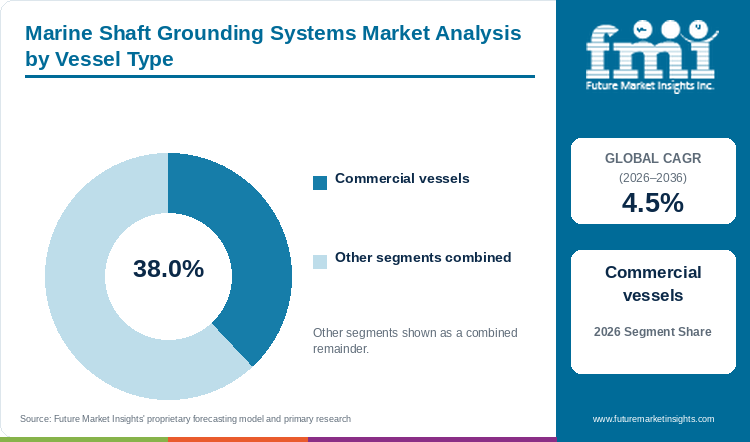
Commercial vessels are estimated to take 38% of sales by vessel type in 2026, led by repeat orders across sister ships.
Commercial vessels lead vessel type with 38% of demand in 2026, as each docking brings a reorder of brushes, holders and rings for sister ships. Sales follow the survey calendar of container, bulk and tanker fleets. World yards booked about 45 million CGT of new ships in the first eleven months of 2025 [3]. Naval vessels buy fewer kits at higher values, and cruise ships and ferries are adding grounding with battery-electric drives. Commercial fleets are expected to keep the largest share by vessel type as newbuild deliveries add more ships to the survey cycle.
- Fixed survey dockings bring regular reorders, keeping commercial vessels at a 38% share in 2026.
- Fleet managers can cut stock costs by using one kit design across a class of sister ships, and FMI expects more fleets to standardise this way through 2036.
Why are mid-size shafts of 100-250 mm central to shaft size demand?
Mid-size shafts of 100-250 mm are set to account for 37% of demand by shaft size in 2026, owing to standard kit fit.
The 100-250 mm class accounts for 37% of demand by shaft size in 2026, as one standard ring, holder and brush set fits many hull types. Shafts of 250-500 mm and above 500 mm need custom contact hardware on fewer and larger vessels. Propulsion makers are also using modular designs, and in May 2025 Kongsberg Maritime built the TTH tunnel thruster series around one core module for several propeller diameters [13]. Mid-size kits are expected to stay the volume choice for retrofit buyers through 2036.
- Shafts of 100-250 mm hold a 37% share in 2026, and this class will remain the volume pick for retrofits through 2036.
- Retrofit buyers can fit mid-size kits during a routine docking without redesigning the shaft line.
Why do shipyards lead sales channel demand?
Shipyards are expected to capture 36% of channel sales in 2026, as grounding costs least to fit at the build stage.
Shipyards lead sales channel with 36% of demand in 2026, as fitting a kit before the shaft line is closed costs less than opening the shaft tunnel later. Shipyard purchases of grounding kits are tied to the propulsion order for each new ship. Yards often buy grounding inside one marine propulsion systems package. In May 2025, Wärtsilä agreed to supply motors, batteries, transformers, a DC hub and shore charging for three battery-electric ferries in one contract [2]. MRO and drydock buyers order smaller lots of brushes and holders, and the repair share is expected to rise as the electric fleet ages.
- Shipyards hold a 36% share in 2026, owing to lower fitting cost before the shaft line is closed.
- Specifying grounding at the design stage spares owners extra cable runs and shaft access work later.
Why does bearing current mitigation lead the function category?
Bearing current mitigation is projected to represent 39% of demand by function in 2026, driven by the cost of damaged propulsion bearings.
Bearing current mitigation leads the function category with 39% of demand in 2026, as owners buy a ship shaft grounding device mainly to keep current out of propulsion bearings. Cathwell notes that the bearing oil film insulates an ungrounded shaft from the hull and leaves bearings and gears open to spark erosion [4]. Corrosion prevention ranks second, as many owners already buy cathodic protection for the hull through separate contracts. FMI notes that bearing protection will stay the main reason for purchase as more drives and converters reach the shaft line.
- Eroded bearings are costly to repair, so bearing current mitigation accounts for a 39% share in 2026.
- Operators adding electric drives in a retrofit can order bearing protection in the same work package. This saves crews a second visit to the shaft tunnel at the next docking.
What are the drivers, restraints, and opportunities in the marine shaft grounding systems market?
Electric propulsion is widening the need for shaft grounding on new ships. Silver prices and cramped shaft tunnels slow retrofits, and kits with voltage monitoring give suppliers the best new revenue line.
- Driver: Ships with drive-based electric propulsion are raising sales of marine shaft grounding systems. DNV counted 468 hybrid or battery vessels on order for delivery by end-2028 [1].
- Restraint: Top challenges faced by marine shaft grounding systems market players include brush wear, higher silver prices and cramped shaft tunnels, which delay retrofits.
- Opportunity: Crews want shaft voltage readings without entering the shaft tunnel, so monitored grounding kits that log voltage and brush wear will open higher-value sales for suppliers.
Electric Drives Widen Bearing Protection Needs
Key drivers of the marine shaft grounding systems market include electric drives, as every drive added to a ship can push stray current along the shaft. FMI expects sales of marine inverter modules to rise from USD 1.7 billion in 2026 to USD 3.8 billion by 2036. Norway's World Heritage fjords have required zero-emission operation for cruise ships, tourist boats and ferries under 10,000 gross tonnage since 1 January 2026 [14]. Each battery-electric ferry built for these routes needs bearing protection on the shaft line. Grounding orders are expected to grow with each new electric ferry and coastal ship through 2036.
Silver Costs and Shaft Access Slow Retrofits
Retrofit orders are slowed by the cost and effort of working inside a shaft tunnel. Silver prices rose sharply in 2025, according to the U.S. Geological Survey [8], so silver brushes and tracks cost more at each replacement. Owners with tight docking plans often wait for the next planned yard visit before adding grounding. Some owners of small shafts are likely to keep buying lower-cost carbon contacts.
Voltage Monitoring Adds Higher-value Sales
Monitored grounding kits let crews read shaft voltage and brush wear without entering the shaft tunnel. Evac already sells millivolt meters with alarms and a 4-20 mA output for remote readings [11]. In July 2026, Helwig Carbon and Carbex expanded the i-BRUSH remote monitoring system, tracking brush wear, temperature, current density, humidity and vibration [15]. Owners can link these readings to ship alarm systems and plan brush changes for the next docking. Key trends in the marine shaft grounding systems market point to monitored kits gaining more new orders on electric ships through 2036.
Which country CAGRs are profiled in the marine shaft grounding systems market?
The Netherlands tops the country table, with marine shaft grounding system sales rising at a 6.1% CAGR over 2026 to 2036. Japan grows slowest at 4% over the same period. Across all five countries, orders grow fastest once public money pays for electric or new-fuel propulsion and yards can fit the kit with the shaft line still open.
Table 6: Country CAGRs and Primary Growth Levers for the Marine Shaft Grounding Systems Market (CAGR percentage), 2026 to 2036
| Country | CAGR (2026-2036) | Primary Growth Lever |
|---|---|---|
| Netherlands | 6.1% | State-funded clean-fuel retrofits at Dutch yards |
| South Korea | 5.8% | Batch kits for busy newbuild yards |
| Norway | 5.5% | Zero-emission ferries for the World Heritage fjords |
| USA | 5.1% | Navy budgets and federal ferry grants |
| Japan | 4% | Yard upgrades for ammonia- and hydrogen-fuelled ships |
Source: Future Market Insights
Netherlands Marine Shaft Grounding Systems Market Outlook (2026-2036)
Dutch short-sea owners can get state grants to convert vessels to renewable methanol or hydrogen, after the European Commission approved a EUR 103 million scheme in July 2026 [5]. Each conversion changes the engines and drives along the shaft line, and the yard can fit a new grounding kit during the same visit. A second Maritime Masterplan round of EUR 33.6 million is open until 3 November 2026, with up to EUR 8 million for each newbuild or retrofit project [12]. FMI forecasts sales in the Netherlands to grow at a 6.1% CAGR from 2026 to 2036, the quickest pace in this group. Grants under the EU-approved scheme are paid only from 2027 to 2031, however, so many owners will hold retrofit orders until funding is confirmed.
Key takeaway: Clean-fuel retrofit grants set the pace of Dutch grounding orders through 2036.
South Korea Marine Shaft Grounding Systems Market Outlook (2026-2036)
South Korea ranks second, with sales of shaft grounding kits projected to grow at a 5.8% CAGR from 2026 to 2036. Korean yards took about 22% of world newbuild orders in the first eleven months of 2025, up from 17% in 2024 [3]. Due to this, yards buy standard grounding kits in batches for series of sister ships. Yard labour is tight, and temporary-visa workers from Southeast Asia fill part of the gap [16]. The trade ministry agreed in June 2026 to link the Daebul, Myeongji Noksan and Gunsan shipbuilding complexes in one AI system for design, production and quality [17]. Kit makers able to share digital test records stand to gain from this shared system.
Key takeaway: Korean business goes to suppliers delivering standard kits in volume with digital test records.
Norway Marine Shaft Grounding Systems Market Outlook (2026-2036)
Cruise ships, tourist boats and ferries under 10,000 gross tonnage need zero-emission operation in Norway's World Heritage fjords from 1 January 2026, and larger passenger ships from 2032 [14]. Demand for shaft earthing brushes in Norway is set to grow at a 5.5% CAGR through 2036, as each battery-electric ferry built for these routes needs bearing protection. Enova awarded NOK 1.3 billion to ten zero-emission shipping projects in June 2026 [9]. An Enova report also found battery-electric propulsion unable to meet the range needs of ocean-going ships, so most Norwegian orders will come from ferries, fjord boats and coastal vessels [9].
Key takeaway: The fjord zero-emission rule keeps Norwegian ferry yards ordering grounding kits.
USA Marine Shaft Grounding Systems Market Outlook (2026-2036)
Federal ferry grants are funding low- and no-emission vessels, with the FTA selecting five Low-No ferry projects worth USD 107.3 million in the FY2026 round [18]. San Francisco Bay Ferry's three battery-electric ferries, with Wärtsilä supplying the full electric propulsion system, will be the first battery-electric high-speed passenger ferries in the country [2]. Shipbuilding funds in the Navy's FY2027 plan [7] add a naval route, though naval buyers need long qualification paperwork before approving a new grounding supplier. The USA is set to post a 5.1% CAGR in sales of marine shaft grounding systems through 2036. Korean builders are opening another route in, as Seoul pledged USD 150 billion for U.S. shipbuilding in 2025 and Hanwha Ocean already owns Philly Shipyard [16].
Key takeaway: Navy and ferry grant budgets shape U.S. order volumes, and Korean-owned yards offer kit suppliers a new route in.
Japan Marine Shaft Grounding Systems Market Outlook (2026-2036)
Ship construction in Japan costs about 20% more than in China, and Japan's share of world shipbuilding fell below 10% in 2024 [19]. Sales of marine shaft grounding systems in Japan are projected to grow at a 4% CAGR through 2036, behind every other profiled country. The government plans to double shipbuilding output by 2035 against 2024 [19]. MLIT added four zero-emission ship projects in August 2026, taking facility investment to about JPY 205 billion [10]. Grounding suppliers qualifying early with yards preparing ammonia- and hydrogen-fuelled ships can secure contracts once new-fuel ships reach the order book.
Key takeaway: Japanese sales hinge on yards finishing new-fuel production lines and choosing suppliers early.
Who are the notable companies in the marine shaft grounding systems market?
MERSEN, Cathwell, Wärtsilä, SKF Marine, Morgan Advanced Materials, Helwig Carbon, Kongsberg Maritime, Sohre Turbomachinery, DEIF, and Marine Electricals form the supplier group covered in this report.
Supply of marine shaft grounding systems is split among contact makers, propulsion integrators and shipboard power specialists. MERSEN, Cathwell, Helwig Carbon and Morgan Advanced Materials compete on brush materials, rings and shaft fit. Wärtsilä, SKF Marine and Kongsberg Maritime often fold grounding into larger propulsion and bearing packages. DEIF and Marine Electricals supply power control and monitoring systems that can carry grounding alarms to the bridge. FMI notes that leading suppliers are adding remote monitoring and full electric propulsion scope to reach more vessel classes.
- Grounding contact and earthing specialists: MERSEN, Cathwell, Morgan Advanced Materials, Helwig Carbon, and Sohre Turbomachinery compete on brush materials, silver tracks and shaft fit.
- Shaft-line and propulsion integrators: Wärtsilä, SKF Marine, and Kongsberg Maritime often place grounding inside larger propulsion and bearing packages for shipyards.
- Marine power and monitoring integrators: DEIF and Marine Electricals supply switchboards and control systems that can carry shaft voltage alarms to the crew.
Competitive Benchmarking: Marine Shaft Grounding Systems Market
Table 7: Competitive Benchmarking for the Marine Shaft Grounding Systems Market (qualitative capability ratings), 2026
| Company | Contacts | Shaft Line | Monitoring | Reach |
|---|---|---|---|---|
| MERSEN | High | Low | Low | High |
| Cathwell | High | Medium | High | Medium |
| Wärtsilä | Low | High | High | High |
| SKF Marine | Low | High | High | High |
| Morgan Advanced Materials | Medium | Low | Low | High |
| Helwig Carbon | High | Medium | High | Medium |
| Kongsberg Maritime | Low | High | High | High |
| Sohre Turbomachinery | High | Medium | High | Medium |
| DEIF | Low | Medium | High | High |
| Marine Electricals | Low | Medium | High | Medium |
High marks broad public documentation of the capability in marine or related shaft grounding work, Medium marks a narrower documented role, and Low marks limited public documentation.
Key Developments in the Marine Shaft Grounding Systems Market
- In July 2026, Helwig Carbon and Carbex expanded the i-BRUSH carbon brush remote monitoring system to three models. Helwig serves as exclusive North American distributor for select segments [15].
- In May 2026, Marine Electricals (India) secured an order worth INR 209 crore for marine electrical equipment, adding to shipboard power work [20].
- In January 2026, Mersen reported 2025 sales of EUR 1,186 million. Electrical Power sales grew 6% on an organic basis over the year [21].
- In May 2025, Wärtsilä agreed to supply the complete electric propulsion system for three battery-electric high-speed ferries for San Francisco Bay Ferry [2].
Key Players in the Marine Shaft Grounding Systems Market
Grounding Contact and Earthing Specialists
- Mersen S.A.
- Cathwell AS
- Morgan Advanced Materials plc
- Helwig Carbon Products, Inc.
- Sohre Turbomachinery, Inc.
Shaft-Line and Propulsion Integrators
- Wärtsilä Corporation
- SKF Marine GmbH
- Kongsberg Maritime AS
Marine Power and Monitoring Integrators
- DEIF A/S
- Marine Electricals (India) Ltd.
Marine Shaft Grounding Systems Market - Report Scope
Table 8: Report Scope for the Marine Shaft Grounding Systems Market (coverage fields and definitions), 2026 to 2036
| Coverage field | Report scope |
|---|---|
| Market breakdown | System type; vessel type; shaft size; sales channel; function; region |
| Quantitative units | USD million |
| Market definition | First-sale revenue from grounding and earthing assemblies for marine propeller and drive shafts, covering brushes, brush holders, shaft rings, monitoring units and integrated modules. Vessel revenue, standalone shafts and bearings, hull cathodic protection and non-marine grounding products are excluded. |
| Regions covered | North America; Latin America; Western Europe; Eastern Europe; East Asia; South Asia and Pacific; Middle East and Africa |
| Countries covered | Netherlands; South Korea; Norway; USA; Japan |
| Key companies profiled | MERSEN, Cathwell, Wärtsilä, SKF Marine, Morgan Advanced Materials, Helwig Carbon, Kongsberg Maritime, Sohre Turbomachinery, DEIF, Marine Electricals |
| Forecast period | 2026 to 2036 |
| Approach | Kit and spare-part volumes per vessel class are multiplied by average prices, then reconciled with newbuild deliveries, retrofit dockings, electric fleet counts and yard order books in the profiled countries. |
Marine Shaft Grounding Systems Market - Research Methodology
Table 9: Research Methodology for the Marine Shaft Grounding Systems Market (research methods and approach), 2026 edition
| Method | Approach |
|---|---|
| Primary Research | Interviews with marine electrical suppliers, shaft-line specialists, shipyard buyers, vessel technical managers and drydock service teams covered purchase criteria, brush replacement cycles, installation limits and channel roles. |
| Desk Research | Maritime authority rules, shipbuilding and fleet statistics, naval budgets, commodity price data, supplier technical pages and dated company releases. |
| Market Sizing and Forecasting | Sizing combines the 2025 base value, segment shares, kit and brush prices, newbuild and retrofit volumes, electric fleet growth and country shipbuilding conditions. |
| Data Validation | Figures are cross-checked with company disclosures, official statistics and interview findings. Double counting between complete kits and spare brushes is removed, and propulsion and hull cathodic protection revenue is excluded. |
Marine Shaft Grounding Systems Market by Segments
Marine Shaft Grounding Systems Market segmented by System Type:
- Silver brush grounding systems
- Carbon brush systems
- Shaft earthing rings
- Monitoring-integrated systems
- Hybrid grounding assemblies
Marine Shaft Grounding Systems Market segmented by Vessel Type:
- Commercial vessels
- Naval vessels
- Offshore vessels
- Cruise/ferries
- Yachts
Marine Shaft Grounding Systems Market segmented by Shaft Size:
- 100-250 mm
- Below 100 mm
- 250-500 mm
- Above 500 mm
Marine Shaft Grounding Systems Market segmented by Sales Channel:
- Shipyards
- MRO/drydock
- Marine electrical distributors
- Direct OEM supply
Marine Shaft Grounding Systems Market segmented by Function:
- Bearing current mitigation
- Corrosion prevention
- EMI reduction
- Condition monitoring support
Marine Shaft Grounding Systems Market by Region
- North America
- United States
- Canada
- Latin America
- Brazil
- Mexico
- Argentina
- Chile
- Western Europe
- Germany
- France
- United Kingdom
- Italy
- Spain
- Benelux
- Nordics
- Eastern Europe
- Poland
- Czech Republic
- Romania
- Hungary
- East Asia
- Japan
- South Korea
- South Asia and Pacific
- ASEAN
- Australia and New Zealand
- Middle East and Africa
- GCC Countries
- South Africa
- Türkiye
- Israel
Research Sources and Bibliography
- [1] The Motorship. (2025, October 9). Batteries growing bigger and energy options multiply.https://www.motorship.com/?p=126881
- [2] Wärtsilä Corporation. (2025, May 28). Wärtsilä to supply the electric propulsion system for USA's first battery-electric, zero-emission high-speed passenger ferries.https://www.wartsila.com/media/news/28-05-2025-wartsila-to-supply-the-electric-propulsion-system-for-usa-s-first-battery-electric-zero-emission-high-speed-passenger-ferries-3590753
- [3] The Maritime Executive (reporting Clarksons Research data). (2026, January 5). South Korean Shipbuilders Achieve Market Share Gains for 2025.https://maritime-executive.com/article/south-korean-shipbuilders-achieve-market-share-gains-for-2025
- [4] Cathwell AS. (n.d.; accessed 2026, October). Shaft grounding (Ships).https://cathwell.com/industries/ships/shaft-grounding/
- [5] Shipping Telegraph. (2026, July 30). EU backs €103m Dutch aid for methanol and hydrogen ships.https://shippingtelegraph.com/decarbonisation/eu-backs-e103m-dutch-aid-for-methanol-and-hydrogen-ships/
- [6] HENSOLDT. (n.d.; accessed 2026, October). MAMALA Active Shaft Grounding System.https://www.hensoldt.net/products/mamala-active-shaft-grounding-system
- [7] Marine Log (reporting U.S. Department of the Navy). (2026, May 13). Navy releases its FY 2027 Shipbuilding Plan.https://www.marinelog.com/news/navy-releases-its-fy-2027-shipbuilding-plan/
- [8] U.S. Geological Survey. (2026). Mineral Commodity Summaries 2026: Silver.https://pubs.usgs.gov/periodicals/mcs2026/mcs2026-silver.pdf
- [9] Hellenic Shipping News (reporting ENGINE and Enova). (2026, June 29). Enova sees hydrogen and ammonia role as electric shipping hits range limits.https://hellenicshippingnews.com/enova-sees-hydrogen-and-ammonia-role-as-electric-shipping-hits-range-limits-2
- [10] Ministry of Land, Infrastructure, Transport and Tourism of Japan. (2026, August 17). Aiming for a top global share of next-generation ships, promoting further facility investment (four projects selected under the Zero-Emission Ship Construction Promotion Project).https://www.mlit.go.jp/report/press/kaiji05_hh_000342.html
- [11] Evac (Cathelco). (n.d.; accessed 2026, October). Shaft Earthing.https://evac.com/products/shaft-earthing/
- [12] Argus Media. (2026, February 23). Netherlands opens €33.6mn clean shipping subsidy round.https://www.argusmedia.com/en/news/2791736-netherlands-opens-eu33.6mn-clean-shipping-subsidy-round
- [13] Kongsberg Maritime. (2025, May 27). Kongsberg Maritime launches the TTH tunnel thruster series for improved performance and maintenance.https://www.kongsberg.com/maritime/news-and-events/news-archive/2025/kongsberg-maritime-launches-the-tth-tunnel-thruster-series-for-improved-performance-and-maintenance
- [14] Norwegian Maritime Authority. (2025, April 14). Adoption of zero emission requirements for cruise ships, tourist boats and ferries in the World Heritage fjords (Circular RSR 04-2025).https://www.sdir.no/en/legislation/circulars/adoption-of-zero-emission-requirements-for-cruise-ships-tourist-boats-and-ferries-in-the-world-heritage-fjords/
- [15] Wind Systems Magazine. (2026, July 14). Helwig, Carbex expand condition monitoring system.https://www.windsystemsmag.com/helwig-carbex-expand-condition-monitoring-system/
- [16] The Maritime Executive. (2025, August 3). South Korea Gets Ready to Roll Out MASGA Shipbuilding Investments.https://maritime-executive.com/article/south-korea-gets-ready-to-roll-out-masga-shipbuilding-investments
- [17] The Asia Business Daily (Asia Economy). (2026, June 22). Ministry of Trade, Industry and Energy links Daebul, Myeongji Noksan and Gunsan shipbuilding complexes under M.AX.https://view.asiae.co.kr/en/article/2026062210254827718
- [18] Federal Transit Administration, U.S. Department of Transportation. (2026, August). FY26 Ferry Project Selections and Implementation Guidance.https://www.transit.dot.gov/sites/fta.dot.gov/files/2026-08/FY26-Ferry-Project-Selections-and-Implementation-Guidance.pdf
- [19] Adnkronos (reporting Jiji Press). (2026, August 10). TOKYO REPORT: Japan Makes Public-Private Efforts to Revive Shipbuilding.https://english.adnkronos.com/2026/08/10/tokyo-report-japan-makes-public-private-efforts-to-revive-shipbuilding/
- [20] Sahi. (2026, May 18). Marine Electricals wins ₹209 crore order strengthening marine electrical segment order book.https://sahi.com/news/marine-electricals-wins-209-crore-order-strengthening-marine-electrical-segment-order-book-3935-PE1_COR
- [21] Mersen. (2026, January 28). Mersen: Sales of €1.2 billion in 2025, in line with expectations.https://mersen.com/en/group/news-and-events/mersen-sales-eu12-billion-2025-line-expectations
- [22] Morgan Advanced Materials plc. (2026, March 3). Full Year Results (RNS Number 0265V).https://data.fca.org.uk/artefacts/NSM/RNS/8108ed0b-dd47-4596-9dc7-4d46adf3c009.html
This bibliography is provided for reader reference. The full report contains the complete reference list and detailed citations.
This Report Answers
- What value will the marine shaft grounding systems market hold in 2026?
- What value will marine shaft grounding systems reach by 2036, and at what CAGR?
- Which system type holds the largest share of marine shaft grounding sales?
- Do shipyards or MRO buyers place more grounding kit orders, and on which vessel types?
- Which profiled country is set to grow fastest in shaft grounding sales?
- Which contact makers and propulsion integrators lead the market?
Frequently Asked Questions
How large is the marine shaft grounding systems market expected in 2026?
Shipowners and yards will spend USD 913.5 million on marine shaft grounding systems in 2026, up from USD 874.2 million in 2025, FMI estimates. Sales will reach USD 1,418.6 million by 2036, with electric ships and retrofit dockings adding orders.
What CAGR is projected for the marine shaft grounding systems market through 2036?
Growth is projected at a 4.5% CAGR from 2026 to 2036. Newbuild electric propulsion, retrofits and spare brush orders will each add to this pace.
Which system type holds a notable market share in 2026?
Silver brush grounding systems will account for 34% of sales by system type in 2026. Owners will keep choosing silver contacts for low shaft-to-hull resistance and simple millivolt checks.
Which function holds a notable share in 2026?
Bearing current mitigation will take 39% of demand by function in 2026. A damaged propulsion bearing costs far more to repair than a grounding kit, so bearing protection will stay the main purchase reason.
Which country has a notable expansion outlook through 2036?
In FMI's outlook, the Netherlands will post a 6.1% CAGR through 2036, the fastest of the five profiled countries. State grants for methanol and hydrogen short-sea vessels will bring retrofit work that includes new grounding kits.
Who are the key companies in the marine shaft grounding systems market?
MERSEN, Cathwell, Wärtsilä, SKF Marine, Morgan Advanced Materials, Helwig Carbon, Kongsberg Maritime, Sohre Turbomachinery, DEIF, and Marine Electricals are the key companies. These suppliers will compete on contact materials, propulsion packages and monitoring links.
Preview the report firsthand - request a free sample
Get SampleGet the brochure for pricing and purchase details.
Get PDFTable of Content
- Key Takeaways
- Market Size and CAGR
- Top Growth Driver
- Fastest Growing Segment
- Leading Region
- Key Companies
- Emerging Opportunities
- Executive Summary
- Global Market Outlook
- Demand-side Trends
- Supply-side Trends
- Technology Roadmap Analysis
- Analysis and Recommendations
- Analyst Perspective (What is happening? Why now? What should investors know?)
- Key Questions Answered
- How large is the market?
- What is the CAGR?
- What are key trends?
- Which region dominates?
- Who are the leaders?
- Market Overview
- Market Coverage / Taxonomy
- Market Definition / Scope / Limitations
- Research Methodology
- Chapter Orientation
- Analytical Lens and Working Hypotheses
- Market Structure, Signals, and Trend Drivers
- Benchmarking and Cross-market Comparability
- Market Sizing, Forecasting, and Opportunity Mapping
- Research Design and Evidence Framework
- Desk Research Programme (Secondary Evidence)
- Expert Input and Fieldwork (Primary Evidence)
- Tooling, Models, and Reference Databases
- Data Engineering and Model Build
- Quality Assurance and Audit Trail
- Market Background
- Market Dynamics (Drivers, Restraints, Opportunity, Trends)
- Scenario Forecast (Optimistic, Likely, Conservative)
- Impact Analysis
- AI Impact
- Sustainability Impact
- Regulatory Impact
- Technology Impact
- Consumer / Buyer Analysis
- Purchase Drivers
- Adoption Barriers
- Buyer Journey
- Opportunity Map Analysis
- Product Life Cycle Analysis
- Supply Chain Analysis
- Investment Feasibility Matrix
- Value Chain Analysis
- PESTLE and Porter's Analysis
- Regulatory Landscape
- Regional Parent Market Outlook
- Production and Consumption Statistics
- Import and Export Statistics
- Global Market Analysis and Forecast, 2021 to 2036
- Historical Market Size Value (USD Million) Analysis, 2021 to 2025
- Current and Future Market Size Value (USD Million) Projections, 2026 to 2036
- Y-o-Y Growth Trend Analysis
- Absolute $ Opportunity Analysis
- Global Market Pricing Analysis, 2021 to 2036
- Global Market Analysis and Forecast, By System Type, 2021 to 2036
- Introduction / Key Findings
- Historical Market Size Value (USD Million) Analysis By System Type, 2021 to 2025
- Current and Future Market Size Value (USD Million) Analysis and Forecast By System Type, 2026 to 2036
- Silver brush grounding systems
- Carbon brush systems
- Shaft earthing rings
- Monitoring-integrated systems
- Hybrid grounding assemblies
- Y-o-Y Growth Trend Analysis By System Type, 2021 to 2025
- Absolute $ Opportunity Analysis By System Type, 2026 to 2036
- Global Market Analysis and Forecast, By Vessel Type, 2021 to 2036
- Introduction / Key Findings
- Historical Market Size Value (USD Million) Analysis By Vessel Type, 2021 to 2025
- Current and Future Market Size Value (USD Million) Analysis and Forecast By Vessel Type, 2026 to 2036
- Commercial vessels
- Naval vessels
- Offshore vessels
- Cruise/ferries
- Yachts
- Y-o-Y Growth Trend Analysis By Vessel Type, 2021 to 2025
- Absolute $ Opportunity Analysis By Vessel Type, 2026 to 2036
- Global Market Analysis and Forecast, By Shaft Size, 2021 to 2036
- Introduction / Key Findings
- Historical Market Size Value (USD Million) Analysis By Shaft Size, 2021 to 2025
- Current and Future Market Size Value (USD Million) Analysis and Forecast By Shaft Size, 2026 to 2036
- 100-250 mm
- Below 100 mm
- 250-500 mm
- Above 500 mm
- Y-o-Y Growth Trend Analysis By Shaft Size, 2021 to 2025
- Absolute $ Opportunity Analysis By Shaft Size, 2026 to 2036
- Global Market Analysis and Forecast, By Sales Channel, 2021 to 2036
- Introduction / Key Findings
- Historical Market Size Value (USD Million) Analysis By Sales Channel, 2021 to 2025
- Current and Future Market Size Value (USD Million) Analysis and Forecast By Sales Channel, 2026 to 2036
- Shipyards
- MRO/drydock
- Marine electrical distributors
- Direct OEM supply
- Y-o-Y Growth Trend Analysis By Sales Channel, 2021 to 2025
- Absolute $ Opportunity Analysis By Sales Channel, 2026 to 2036
- Global Market Analysis and Forecast, By Function, 2021 to 2036
- Introduction / Key Findings
- Historical Market Size Value (USD Million) Analysis By Function, 2021 to 2025
- Current and Future Market Size Value (USD Million) Analysis and Forecast By Function, 2026 to 2036
- Bearing current mitigation
- Corrosion prevention
- EMI reduction
- Condition monitoring support
- Y-o-Y Growth Trend Analysis By Function, 2021 to 2025
- Absolute $ Opportunity Analysis By Function, 2026 to 2036
- Global Market Analysis and Forecast, By Region, 2021 to 2036
- Introduction
- Historical Market Size Value (USD Million) Analysis By Region, 2021 to 2025
- Current Market Size Value (USD Million) Analysis and Forecast By Region, 2026 to 2036
- North America
- Latin America
- Western Europe
- Eastern Europe
- East Asia
- South Asia and Pacific
- Middle East and Africa
- Market Attractiveness Analysis By Region
- North America Market Analysis and Forecast, By Country, 2021 to 2036
- Historical Market Size Value (USD Million) Trend Analysis By Market Taxonomy, 2021 to 2025
- Market Size Value (USD Million) Forecast By Market Taxonomy, 2026 to 2036
- By Country
- United States
- Canada
- By System Type
- By Vessel Type
- By Shaft Size
- By Sales Channel
- By Function
- By Country
- Market Attractiveness Analysis
- By Country
- By System Type
- By Vessel Type
- By Shaft Size
- By Sales Channel
- By Function
- Key Takeaways
- Latin America Market Analysis and Forecast, By Country
- Historical Market Size Value (USD Million) Trend Analysis By Market Taxonomy, 2021 to 2025
- Market Size Value (USD Million) Forecast By Market Taxonomy, 2026 to 2036
- By Country
- Brazil
- Mexico
- Argentina
- Chile
- By System Type
- By Vessel Type
- By Shaft Size
- By Sales Channel
- By Function
- By Country
- Market Attractiveness Analysis
- By Country
- By System Type
- By Vessel Type
- By Shaft Size
- By Sales Channel
- By Function
- Key Takeaways
- Western Europe Market Analysis and Forecast, By Country
- Historical Market Size Value (USD Million) Trend Analysis By Market Taxonomy, 2021 to 2025
- Market Size Value (USD Million) Forecast By Market Taxonomy, 2026 to 2036
- By Country
- Germany
- France
- United Kingdom
- Italy
- Spain
- Benelux
- Nordics
- By System Type
- By Vessel Type
- By Shaft Size
- By Sales Channel
- By Function
- By Country
- Market Attractiveness Analysis
- By Country
- By System Type
- By Vessel Type
- By Shaft Size
- By Sales Channel
- By Function
- Key Takeaways
- Eastern Europe Market Analysis and Forecast, By Country
- Historical Market Size Value (USD Million) Trend Analysis By Market Taxonomy, 2021 to 2025
- Market Size Value (USD Million) Forecast By Market Taxonomy, 2026 to 2036
- By Country
- Poland
- Czech Republic
- Romania
- Hungary
- By System Type
- By Vessel Type
- By Shaft Size
- By Sales Channel
- By Function
- By Country
- Market Attractiveness Analysis
- By Country
- By System Type
- By Vessel Type
- By Shaft Size
- By Sales Channel
- By Function
- Key Takeaways
- East Asia Market Analysis and Forecast, By Country
- Historical Market Size Value (USD Million) Trend Analysis By Market Taxonomy, 2021 to 2025
- Market Size Value (USD Million) Forecast By Market Taxonomy, 2026 to 2036
- By Country
- Japan
- South Korea
- By System Type
- By Vessel Type
- By Shaft Size
- By Sales Channel
- By Function
- By Country
- Market Attractiveness Analysis
- By Country
- By System Type
- By Vessel Type
- By Shaft Size
- By Sales Channel
- By Function
- Key Takeaways
- South Asia and Pacific Market Analysis and Forecast, By Country
- Historical Market Size Value (USD Million) Trend Analysis By Market Taxonomy, 2021 to 2025
- Market Size Value (USD Million) Forecast By Market Taxonomy, 2026 to 2036
- By Country
- ASEAN
- Australia and New Zealand
- By System Type
- By Vessel Type
- By Shaft Size
- By Sales Channel
- By Function
- By Country
- Market Attractiveness Analysis
- By Country
- By System Type
- By Vessel Type
- By Shaft Size
- By Sales Channel
- By Function
- Key Takeaways
- Middle East and Africa Market Analysis and Forecast, By Country
- Historical Market Size Value (USD Million) Trend Analysis By Market Taxonomy, 2021 to 2025
- Market Size Value (USD Million) Forecast By Market Taxonomy, 2026 to 2036
- By Country
- GCC Countries
- South Africa
- Türkiye
- Israel
- By System Type
- By Vessel Type
- By Shaft Size
- By Sales Channel
- By Function
- By Country
- Market Attractiveness Analysis
- By Country
- By System Type
- By Vessel Type
- By Shaft Size
- By Sales Channel
- By Function
- Key Takeaways
- Key Countries Market Analysis
- United States
- Pricing Analysis
- Market Share Analysis, 2025
- By System Type
- By Vessel Type
- By Shaft Size
- By Sales Channel
- By Function
- Canada
- Pricing Analysis
- Market Share Analysis, 2025
- By System Type
- By Vessel Type
- By Shaft Size
- By Sales Channel
- By Function
- Mexico
- Pricing Analysis
- Market Share Analysis, 2025
- By System Type
- By Vessel Type
- By Shaft Size
- By Sales Channel
- By Function
- Brazil
- Pricing Analysis
- Market Share Analysis, 2025
- By System Type
- By Vessel Type
- By Shaft Size
- By Sales Channel
- By Function
- Chile
- Pricing Analysis
- Market Share Analysis, 2025
- By System Type
- By Vessel Type
- By Shaft Size
- By Sales Channel
- By Function
- Germany
- Pricing Analysis
- Market Share Analysis, 2025
- By System Type
- By Vessel Type
- By Shaft Size
- By Sales Channel
- By Function
- United Kingdom
- Pricing Analysis
- Market Share Analysis, 2025
- By System Type
- By Vessel Type
- By Shaft Size
- By Sales Channel
- By Function
- Italy
- Pricing Analysis
- Market Share Analysis, 2025
- By System Type
- By Vessel Type
- By Shaft Size
- By Sales Channel
- By Function
- Spain
- Pricing Analysis
- Market Share Analysis, 2025
- By System Type
- By Vessel Type
- By Shaft Size
- By Sales Channel
- By Function
- France
- Pricing Analysis
- Market Share Analysis, 2025
- By System Type
- By Vessel Type
- By Shaft Size
- By Sales Channel
- By Function
- ASEAN
- Pricing Analysis
- Market Share Analysis, 2025
- By System Type
- By Vessel Type
- By Shaft Size
- By Sales Channel
- By Function
- Australia and New Zealand
- Pricing Analysis
- Market Share Analysis, 2025
- By System Type
- By Vessel Type
- By Shaft Size
- By Sales Channel
- By Function
- Japan
- Pricing Analysis
- Market Share Analysis, 2025
- By System Type
- By Vessel Type
- By Shaft Size
- By Sales Channel
- By Function
- South Korea
- Pricing Analysis
- Market Share Analysis, 2025
- By System Type
- By Vessel Type
- By Shaft Size
- By Sales Channel
- By Function
- Poland
- Pricing Analysis
- Market Share Analysis, 2025
- By System Type
- By Vessel Type
- By Shaft Size
- By Sales Channel
- By Function
- Hungary
- Pricing Analysis
- Market Share Analysis, 2025
- By System Type
- By Vessel Type
- By Shaft Size
- By Sales Channel
- By Function
- Türkiye
- Pricing Analysis
- Market Share Analysis, 2025
- By System Type
- By Vessel Type
- By Shaft Size
- By Sales Channel
- By Function
- South Africa
- Pricing Analysis
- Market Share Analysis, 2025
- By System Type
- By Vessel Type
- By Shaft Size
- By Sales Channel
- By Function
- Netherlands
- Pricing Analysis
- Market Share Analysis, 2025
- By System Type
- By Vessel Type
- By Shaft Size
- By Sales Channel
- By Function
- Norway
- Pricing Analysis
- Market Share Analysis, 2025
- By System Type
- By Vessel Type
- By Shaft Size
- By Sales Channel
- By Function
- United States
- Market Structure Analysis
- Competition Dashboard
- Competition Benchmarking
- Market Share Analysis of Top Players
- By Regional
- By System Type
- By Vessel Type
- By Shaft Size
- By Sales Channel
- By Function
- Emerging Startups
- Innovation Benchmarking
- Competition Analysis
- Competition Deep Dive
- MERSEN
- Overview
- Product Portfolio
- Profitability by Market Segments
- Sales Footprint
- Strategy Overview
- Marketing Strategy
- Product Strategy
- Channel Strategy
- Cathwell
- Wärtsilä
- SKF Marine
- Morgan Advanced Materials
- Helwig Carbon
- Kongsberg Maritime
- Sohre Turbomachinery
- DEIF
- Marine Electricals
- Mersen S.A.
- Cathwell AS
- Morgan Advanced Materials plc
- Helwig Carbon Products, Inc.
- Wärtsilä Corporation
- SKF Marine GmbH
- Kongsberg Maritime AS
- DEIF A/S
- Marine Electricals (India) Ltd.
- MERSEN
- Case Studies
- Success Stories
- Recent Developments
- Competition Deep Dive
- Assumptions & Acronyms Used


