

- Market Size (2026)
- USD 2.1 Bn
- Forecast (2036)
- USD 3.3 Bn
- CAGR (2026 to 2036)
- 4.7%
How Big is the Marine Shaft Brackets Market in 2026?
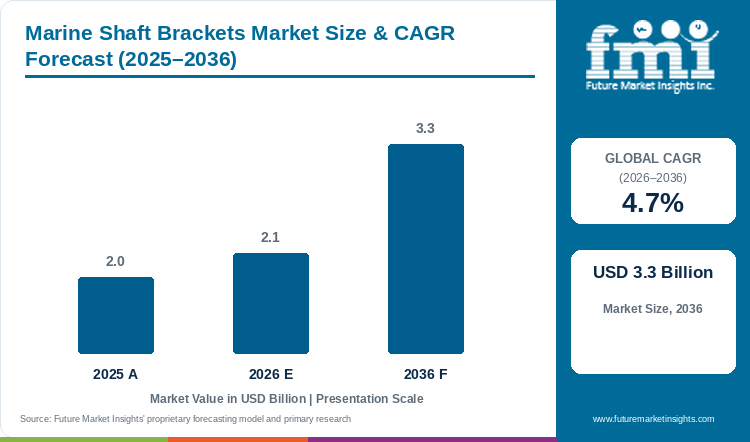
Boatyard and OEM spending on marine shaft brackets will compound at a 4.7% CAGR from 2026 to 2036. Starting at USD 2.0 Billion in 2025, value steps up to USD 2.1 Billion in 2026 and reaches USD 3.3 Billion by 2036.
Revenue from marine shaft brackets is projected to grow at 4.7% CAGR between 2026 and 2036, as per FMI. Industry value is estimated to increase from USD 2.0 Billion in 2025 to USD 2.1 Billion in 2026 and is projected to reach USD 3.3 Billion by 2036. The forecast decade adds USD 1.2 Billion of sales for foundries, stern-gear makers and refit yards.
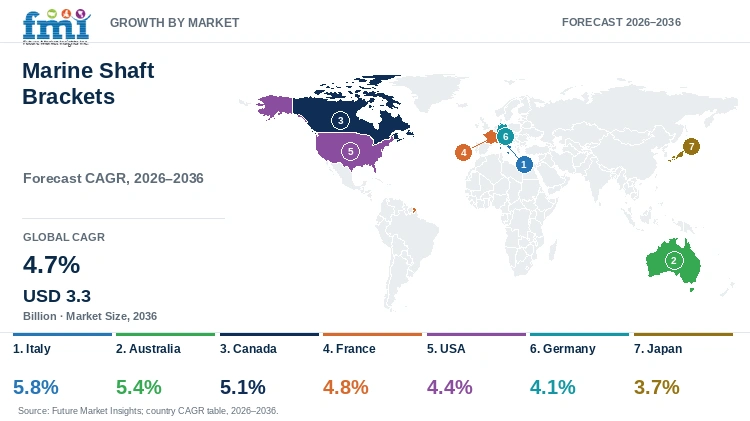
Increasing repair and refit work on hulls already afloat is supporting the demand for marine shaft brackets, as each fixed-shaft vessel needs bracket work several times across a service life. The U.S. Coast Guard counted 11,674,073 registered recreational vessels in 2024, up from 11,546,512 in 2023 [1]. Due to this, repowers, grounding repairs, corrosion remediation and stern-gear renewal on the inboard part of the fleet are generating replacement orders each season, and a newbuild bracket sells only once per hull. Replacement orders also carry firmer pricing than OEM supply, as a bracket for an aging hull has to match a shaft line set years earlier. Demand for marine shaft brackets is rising fastest in Italy at 5.8% CAGR on superyacht construction for export, and Japan is projected at 3.7%, the slowest among the seven profiled countries.
Sales of marine shaft brackets are highest through boat OEMs, expected to hold 34% of demand by sales channel in 2026, as production builders repeat one bracket pattern across a model run. Shipyards buy project by project, and the marine aftermarket is growing on refit orders from the installed fleet. CJR Propulsion issues 3D bracket models for import into hull geometry files, a service that shortens quoting time for refit yards [2]. Neighbouring shaftline categories are also growing at a similar pace, as per FMI's analysis. Sales in the marine drive shaft market are projected to rise from USD 1.3 Billion in 2026 to USD 2.0 Billion in 2036 at 4.8% CAGR. Revenue from marine bearings is estimated to increase from USD 6.54 Billion to USD 10.65 Billion at 5%, an opportunity of USD 4.11 Billion. However, refit budgets moving toward shaftline packages that combine brackets, shafts and bearings will decide which suppliers receive the larger bracket orders through 2036.
Key Takeaways
- Based on bracket type, P-brackets are projected to account for 31% in 2026, owing to broad fit across inboard layouts, and bronze is expected to hold 33% by material.
- By vessel type, recreational boats are estimated at 28% in 2026 on repowers and refits across leisure fleets, and single-shaft layouts are projected to account for 42% by propulsion layout.
- Notable companies in the marine shaft brackets market include Teignbridge Propellers, CJR Propulsion, Buck Algonquin, Reggiani Nautica, Vetus, Hélices France, Michigan Wheel, Tides Marine, Solas Science & Engineering and Centek Industries.
- Italy is projected at 5.8% CAGR through 2036, followed by Australia at 5.4%, as superyacht exports and commercial vessel repairs keep bracket orders rising, and Japan is forecast at 3.7%.
Analyst Perspective
“Refit work on the existing fixed-shaft fleet will offer the clearest revenue opportunity in marine shaft brackets through 2036. Bracket makers pairing stocked patterns with fast 3D design files and CFD-shaped struts will convert the largest share of yard enquiries into firm orders.”
- Nikhil Kaitwade, Principal Consultant, Future Market Insights
How is the Marine Shaft Brackets Market Segmented?
The marine shaft brackets market is segmented into bracket type, material, vessel type, propulsion layout, sales channel and region.
The market is segmented by bracket type into P-brackets, A-brackets, V-brackets, strut brackets and custom shaft supports. By material, the market is segmented into bronze, stainless steel, ductile iron, aluminum bronze and composite-reinforced supports. By vessel type, the market is segmented into recreational boats, commercial workboats, patrol vessels, fishing vessels and yachts. By propulsion layout, the market is segmented into single shaft, twin shaft, stern gear integrated and high-speed craft layouts. By sales channel, the market is segmented into boat OEMs, shipyards, the marine aftermarket and custom foundries. The regional analysis covers seven regions and more than 30 countries.
Why Do P-brackets Lead the Marine Shaft Brackets Market by Bracket Type?
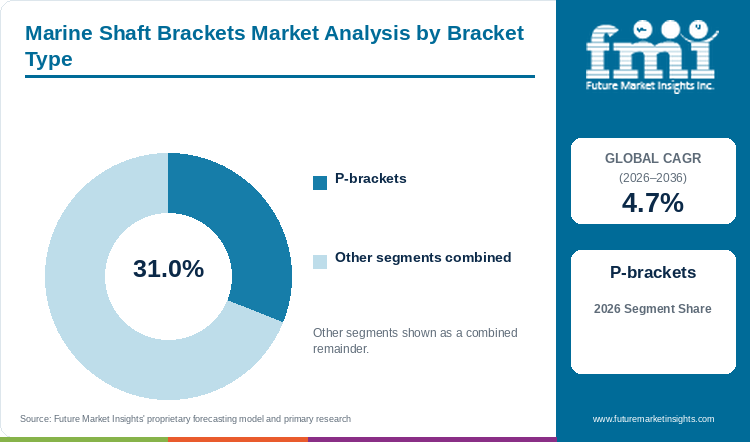
By bracket type, P-brackets will account for 31% of market share in 2026.
Conventional inboard boats are widely fitted with P-brackets, according to FMI, as one strut supports the shaft with very little hardware below the hull. Builders and refit yards look to cut drag and casting cost on each boat, due to which the single-leg design is the standard pick for production and repair jobs. Demand for A-brackets is growing at a slower pace, as the extra leg adds resistance and metal weight. V-brackets suit only a limited range of hull shapes built for twin-leg castings. Stock-size strut brackets are fitted mainly on compact series-built boats at modest unit prices. Custom shaft supports need a fresh drawing and casting pattern for each job, so order numbers stay low. Teignbridge Propellers uses StarCCM+ CFD software to shape shaft brackets and rudders, and such flow modelling is giving single-leg designs extra value [3]. However, heavier shaft loads on bigger, faster hulls will decide the point at which yards switch to A-brackets.
- P-brackets are projected to account for 31% of demand by bracket type in 2026, owing to broad fit across production and custom inboard layouts.
- CJR Propulsion designs every set of A or P brackets individually with CFD and FEA tools before casting and machining [2].
Why Does Bronze Lead the Marine Shaft Brackets Market by Material?
Based on material, bronze will account for 33% of market share in 2026.
Bronze is widely used for shaft bracket castings, as foundries and boatyards have long experience pouring, machining and repairing the alloy in seawater service. Yards face costly rework when a bracket corrodes below the hull, due to which buyers stay with a familiar alloy for new and replacement parts. CJR Propulsion produces A and P brackets from high-grade nickel aluminium bronze at the company's own foundry, under casting control set to IACS requirements [2]. Stainless steel is growing at a slower pace, as intricate shapes cost more to pour and finish. Ductile iron calls for protective coatings and more frequent corrosion checks, and aluminum bronze goes into heavier commercial service at a higher metal price. Composite-reinforced supports are finding buyers among builders of lightweight craft, though every design has to clear structural and bearing tests before approval. However, metal prices and foundry delivery times will decide the grade selected for each refit order.
- Bronze is expected to hold 33% of demand by material in 2026, supported by established casting practice and seawater corrosion performance.
- CJR Propulsion adds material analysis and NDT testing to the casting process when required by a project [2].
Why Do Recreational Boats Lead the Marine Shaft Brackets Market by Vessel Type?
In 2026, recreational boats will account for 28% of market share by vessel type.
Engine swaps, grounding damage and worn propeller gear on pleasure craft are supporting the demand for marine shaft brackets in recreational boats. Owners run these boats for many seasons after the first sale, due to which repair shops see a large installed fleet coming back for bracket work each season. In France, about 1.064 million recreational boats were registered in metropolitan maritime waters as of August 31, 2025, and about 0.791 million of these used motor propulsion [4]. Shaft-driven inboard craft in that count, part of the broader small boats market, are projected to give repair yards steady stern-gear jobs. Commercial workboats and fishing vessels use sturdier brackets, though far fewer of these hulls are in service. Patrol vessels are bought through state purchasing rounds, and yachts order custom supports for a small number of hulls at higher value. However, the proportion of leisure boats running a fixed propeller shaft will decide bracket replacement volumes.
- Recreational boats are estimated to account for 28% of demand by vessel type in 2026, owing to newbuild and repair activity in the fixed-shaft part of leisure fleets.
- The U.S. registered recreational fleet grew by 1.1% in 2024, adding to the installed base that refit yards service [1].
Why Do Single-Shaft Layouts Lead the Marine Shaft Brackets Market by Propulsion Layout?
By propulsion layout, single-shaft layouts will account for 42% of market share in 2026.
Most inboard hulls are built with a single motor turning a single propeller, and this simple drive line is supporting the demand for marine shaft brackets in single-shaft layouts. Builders fit one bracket set with one group of bearings and seals and align the shaft once, due to which the installation bill per boat stays low. Twin-shaft layouts are growing at a slower pace, as every part and every hour of fitting work is doubled. Stern gear integrated layouts bundle the bracket inside a bigger assembly that carries one package price. Fast ferries and similar high-speed craft reviewed in the passenger vessel propeller study need stronger supports shaped for water flow, but the fleet count is small. However, combined supply of brackets, propellers and flap rudders will decide supplier choice for higher-margin twin-shaft and fast-craft contracts.
- Single-shaft layouts are projected to hold 42% of demand by propulsion layout in 2026, supported by lower component counts on one-shaft inboard installations.
- CJR Propulsion reports that CFD-modelled propellers with flow-aligned struts and rudders typically deliver up to 10% efficiency gains over standard stern gear [5].
Why Do Boat OEMs Lead the Marine Shaft Brackets Market by Sales Channel?
Based on sales channel, boat OEMs will account for 34% of market share in 2026.
Series boat production is supporting the demand for marine shaft brackets through the boat OEM channel, as one approved design is copied across every hull in a model line. Engineers settle palm shape, shaft angle and bearing location early in development, due to which OEMs reorder an identical bracket with low risk of poor fit. Shipyards purchase job by job and need more bespoke engineering for each vessel. The marine aftermarket is growing at a steady pace, though every replacement part needs measuring and matching before a price is offered. Custom foundries produce single castings to order at small volumes. However, annual OEM build numbers for each model will decide repeat pattern volumes.
- Boat OEMs are expected to account for 34% of demand by sales channel in 2026, owing to design-stage specification that cuts fitment risk across a production run.
- Michigan Wheel said in May 2025 that sale proceeds would fund expanded production and service for government, commercial and recreational customers [6].
What are the Drivers, Restraints, and Opportunities in the Marine Shaft Brackets Market?
As per FMI's analysis, refit work on the fixed-shaft fleet will drive bracket sales, fit and alignment checks will slow supplier switching, and CFD-shaped and composite-reinforced supports will open a higher-value pool till 2036.
- Driver: Each newbuild, repower, repair or refit on a fixed-shaft vessel creates a bracket order, due to which the installed fleet keeps generating orders every season.
- Restraint: Shaft angle, bore, bearing position and hull interface need exact matching, and this increases engineering effort and extends lead times.
- Opportunity: CFD-shaped and composite-reinforced supports can reduce drag or weight once suppliers validate strength, wear and alignment.
Fleets keeping conventional shafts in service are the key drivers of demand for marine shaft brackets. Australia's maritime regulator puts the domestic commercial vessel fleet at around 32,000 vessels, ranging from hire-and-drive craft to tugs, trawlers and ferries [7]. Key challenges in the marine shaft brackets market come from engineering validation, as a support missing shaft angle or bearing location passes vibration into couplings and seals. Due to this, buyers with hauled-out vessels are paying for proven dimensions.
Electric drivelines are opening a lightweight niche for suppliers ready to qualify new materials. Teignbridge Propellers received a Seawork Innovation Award in June 2025 for a carbon fibre Clamp on Blade propeller built for a 10-meter electric vessel, citing lower driveline vibration and noise [8]. Increasing sales in the electric boats market are expected to give qualified composite-reinforced brackets early buyers among quiet, efficiency-focused craft.
Which Country CAGRs are Profiled in the Marine Shaft Brackets Market?
| Country | CAGR, 2026 to 2036 |
|---|---|
| Italy | 5.8% |
| Australia | 5.4% |
| Canada | 5.1% |
| France | 4.8% |
| USA | 4.4% |
| Germany | 4.1% |
| Japan | 3.7% |
How do Country-level CAGRs Compare in the Marine Shaft Brackets Market?
Demand for marine shaft brackets is growing faster in Italy, Australia and Canada, at 5.1% or above, as per FMI's country analysis, and France, the USA, Germany and Japan are projected between 3.7% and 4.8%. US boatyards are expected to grow at a slower pace on a large installed fleet, though the USA will continue to generate sizable bracket revenue through 2036.
- Italy leads at 5.8% on the strength of superyacht construction for export.
- Australia follows at 5.4%, drawing on a dispersed commercial vessel fleet.
- Canada grows at 5.1% and France at 4.8%, both supported by large recreational fleets.
- The USA at 4.4%, Germany at 4.1% and Japan at 3.7% will rely more on replacement and OEM programs.
Outside these seven boatbuilding markets, the full report models bracket CAGRs for over 30 countries grouped into seven regions.
Country Outlook
- Italian shipyards held 568 superyacht orders, 52% of the global order book, according to Confindustria Nautica in March 2026 [9]. Italian marine accessories and equipment turnover reached EUR 2.03 billion, as reported in October 2026 [10]. In Italian boatyards, custom supports for export-bound yacht projects are expected to increase demand for brackets at 5.8% CAGR, the quickest pace in the country set.
- Distance from foundries shapes purchasing in Australia, as a trawler or ferry waiting on a replacement bracket in a regional port loses earning days. Australia is projected at 5.4% CAGR through 2036, owing to ferry and trawler repairs at regional ports. Suppliers holding stock near working ports are expected to receive the faster replacement orders.
- Transport Canada announced on January 6, 2026 that Pleasure Craft Licences issued or renewed from December 31, 2025 carry five-year validity, citing about 12 million boaters [11]. Canadian yards work within a short haul-out season, so a late replacement bracket can cost an owner the summer. Demand will grow at 5.1% a year, led by repowers of older inboard boats needing stocked geometries or a quick custom quote.
- Motor boats form the main French pool of demand for brackets, with about 0.791 million of 1.064 million recreational registrations in metropolitan waters motor-propelled as of August 31, 2025 [4]. Not every motor boat runs a fixed shaft, and France is forecast at 4.8% CAGR, with growth will come from refit yards able to measure and match legacy geometry.
- Demand for marine shaft brackets in the USA is projected at 4.4% a year, supported mainly by replacement selling. Registered recreational vessels rose by 1.1% to 11,674,073 in 2024 [1]. Refit yards servicing that fleet need dimensional matching for legacy struts, due to which bracket makers pairing OEM pattern coverage with fast matching are expected to hold the steadiest US order books.
- Demand for marine shaft brackets in Germany is projected at 4.1% a year, coming mainly from planned refits within a mature, dealer-led leisure channel. A cautious macro environment is delaying discretionary projects, owing to which suppliers are focusing on OEM and refit jobs with shaftline work already budgeted.
- Japan is forecast at 3.7%, the slowest among the profiled markets, as yards and propulsion integrators expect detailed drawings, material traceability and consistent machining from any new bracket source. Incumbent supplier relationships are slowing conversion, and new entrants will need a local technical partner.
Who are the Notable Companies in the Marine Shaft Brackets Market?
Competition is fragmented, and FMI profiles CJR Propulsion, Teignbridge Propellers, Buck Algonquin, Reggiani Nautica, Vetus and Michigan Wheel, with validated geometry and fast replacement matching holding pricing power.
A few UK, Italian and North American specialists offer CFD-designed or stock struts, and many local foundries cast brackets to a yard's pattern, due to which supply of marine shaft brackets remains fragmented. Yards choose suppliers on fit accuracy, lead time and drawings, and CJR Propulsion reaches OEM design teams early with 3D models and in-house casting controlled to IACS requirements [2]. Casting a bracket is easy to start, but validated geometry takes years to build, and a yard with a hauled-out vessel seldom risks an unproven source. Owing to this, suppliers owning patterns and design files for a hull family hold the strongest pricing power, and foundries quoting on metal weight compete mainly on price. Propulsion groups are also consolidating, as Nakashima Propeller acquired the UK operation of Michigan Wheel in May 2025 [6]. However, shaftline groups are expected to bundle brackets with propellers and rudders through 2036, and refit orders will go to the fastest matched quote.
- Direct Bracket and External Support Specialists: Teignbridge Propellers, CJR Propulsion, Buck Algonquin and Reggiani Nautica compete on bracket geometry, materials, custom manufacture and replacement matching.
- Integrated Shaftline and Propulsion Suppliers: Vetus, Hélices France and Michigan Wheel place bracket decisions inside shaft, propeller and stern-gear packages.
- Adjacent Marine Component and Channel Participants: Tides Marine, Solas Science & Engineering and Centek Industries reach boatbuilders through shaft seals, propellers, exhaust and other marine components.
Competitive Benchmarking
| Company | Dedicated Bracket Offering | Integrated Shaftline Engineering | Custom Manufacturing Capability | Geographic Reach |
|---|---|---|---|---|
| Teignbridge Propellers | High | High | High | UK, international offices and agents |
| CJR Propulsion | High | High | High | UK, leisure, commercial and patrol projects worldwide |
| Buck Algonquin | High | Medium | High | North America |
| Reggiani Nautica | High | Medium | High | Italy |
| Vetus | Low | High | Medium | Europe, international dealer network |
| Hélices France | Low | High | Medium | France, international projects |
| Michigan Wheel | High | High | High | North America |
| Tides Marine | Low | Medium | Medium | North America, international distribution |
| Solas Science & Engineering | Low | Low | Medium | Global propeller dealer network |
| Centek Industries | Low | Low | Medium | USA, global boatbuilder exposure |
Scoring basis: Dedicated Bracket Offering scores documented bracket or strut products. Integrated Shaftline Engineering scores the ability to design or supply several connected propulsion-line elements. Custom Manufacturing Capability scores documented casting, machining, composite or custom-fabrication depth. A High grade signals wide, well-evidenced bracket or shaftline capability, Medium a narrower evidenced range, and Low thin public evidence. The Geographic Reach column lists the plants, dealers, offices or yard projects verified in October 2026.
Key Developments
- In May 2025, Michigan Wheel sold the company's United Kingdom sales, repair and manufacturing operation to Nakashima Propeller, which now runs the unit under the Nakashima brand [6].
- In June 2025, Teignbridge Propellers received a Seawork Innovation Award in the Marine Power and Propulsion category for a carbon fibre Clamp on Blade propeller developed for a 10-meter electric vessel [8].
- In November 2025, CJR Propulsion launched the Sailfish propeller and stated a vessel-efficiency gain of up to 13% when the design is supplied within a complete flow-aligned stern-gear package [5].
Key Players
Direct Bracket and External Support Specialists
- Teignbridge Propellers
- CJR Propulsion
- Buck Algonquin
- Reggiani Nautica
Integrated Shaftline and Propulsion Suppliers
- Vetus
- Hélices France
- Michigan Wheel
Adjacent Marine Component and Channel Participants
- Tides Marine
- Solas Science & Engineering
- Centek Industries
Report Scope and Methodology
| Coverage field | Report scope |
|---|---|
| Market breakdown | 5 categories: Bracket Type (P-brackets, A-brackets, V-brackets, Strut brackets, Custom shaft supports), Material (Bronze, Stainless steel, Ductile iron, Aluminum bronze, Composite-reinforced), Vessel Type (Recreational boats, Commercial workboats, Patrol vessels, Fishing vessels, Yachts), Propulsion Layout (Single shaft, Twin shaft, Stern gear integrated, High-speed craft), Sales Channel (Boat OEMs, Shipyards, Marine aftermarket, Custom foundries), and Region |
| Quantitative units | USD Billion |
| Market definition | Covers revenue from marine shaft support brackets and struts across five bracket types, namely P-brackets, A-brackets, V-brackets, strut brackets and custom shaft supports. Finished-vessel revenue and adjacent propulsion components sold separately are excluded. |
| Regions covered | North America, Latin America, Western Europe, Eastern Europe, East Asia, South Asia and Pacific, Middle East and Africa |
| Countries covered | More than 30 countries, including Italy, the USA, Japan, France, Australia, Canada, and Germany |
| Key companies profiled | Vetus, Tides Marine, Buck Algonquin, Centek Industries, Teignbridge Propellers, CJR Propulsion, Hélices France, Solas Science & Engineering, Reggiani Nautica, and Michigan Wheel, selected from a larger roster of bracket, stern-gear and shaftline suppliers |
| Forecast period | 2026 to 2036 |
| Approach | Vessel and channel indicators, company and trade evidence and demand for brackets at product level feed an FMI model that sizes upward from product data and downward from market totals, then reconciles both with market-level forecast assumptions, excluding adjacent categories and duplicate revenue. |
Research Methodology
| Method | Approach |
|---|---|
| Primary research | The primary-research framework engages marine component manufacturers, foundries, distributors, boatbuilders, shipyards, propulsion specialists and technical experts to test product scope, specification criteria, channel behavior, replacement triggers, material preferences and adoption frictions. |
| Desk research | The analysis reviews company technical literature, announcements, maritime regulators, classification sources, national boating and vessel statistics and trade associations. The study retains sources that define the product boundary, buyer workflow, country conditions, company roles or dated developments. |
| Market sizing and forecasting | The sizing framework combines product and company evidence with vessel production, installed-fleet, replacement, channel and regional indicators. Forecasts consider newbuild and refit activity, propulsion-layout mix, material substitution, engineering qualification and supplier capacity. |
| Data validation | Estimates are cross-checked across independent source types and reviewed for scope consistency. Propellers, shafts, seals and bearings sold separately, complete propulsion systems, installation labor, finished vessels and duplicate revenue are excluded before final reconciliation. |
Marine Shaft Brackets Market by Segments
Marine Shaft Brackets Market Segmented by Bracket Type
- P-brackets
- A-brackets
- V-brackets
- Strut brackets
- Custom shaft supports
Marine Shaft Brackets Market Segmented by Material
- Bronze
- Stainless steel
- Ductile iron
- Aluminum bronze
- Composite-reinforced
Marine Shaft Brackets Market Segmented by Vessel Type
- Recreational boats
- Commercial workboats
- Patrol vessels
- Fishing vessels
- Yachts
Marine Shaft Brackets Market Segmented by Propulsion Layout
- Single shaft
- Twin shaft
- Stern gear integrated
- High-speed craft
Marine Shaft Brackets Market Segmented by Sales Channel
- Boat OEMs
- Shipyards
- Marine aftermarket
- Custom foundries
Marine Shaft Brackets Market Segmented by Region
- North America
- Latin America
- Western Europe
- Eastern Europe
- East Asia
- South Asia and Pacific
- Middle East and Africa
Research Sources and Bibliography
- [1] U.S. Coast Guard (2025, June 24). 2024 Recreational Boating Statistics.
- [2] CJR Propulsion (2026, October). Shaft Brackets product page.
- [3] Teignbridge Propellers (2026, October). Technical Solutions and Innovation.
- [4] French Ministry for the Sea (2026, February). La plaisance en quelques chiffres.
- [5] CJR Propulsion (2025, November 17). Inspired by Nature: New Sailfish Propeller Improves Vessel Efficiency by 13%.
- [6] Michigan Wheel (2025, May 14). Michigan Wheel Announces Strategic Sale of UK Operations to Nakashima Propeller Co, Ltd.
- [7] Australian Maritime Safety Authority (2025). 2025-26 Corporate Plan.
- [8] Seawork (2025, June 11). Teignbridge Propellers Drive Innovation to Win at Seawork.
- [9] Confindustria Nautica (2026, March 6). Boating Remains a Key Sector for Made in Italy Industry.
- [10] Nautech News (2026, October 2). Italian Boating Industry Turnover Hits New Record.
- [11] Transport Canada (2026, January 6). Minister of Transport Announces Changes to Make Boating Safer for Canadians.
This bibliography is provided for reader reference and is not exhaustive. The full report contains the complete reference list and detailed citations.
This Report Answers
- What will boatyards and OEMs spend on marine shaft brackets in 2026, and what total will repowers and newbuilds push that spend to by 2036?
- Which newbuild, repower and refit occasions will keep generating bracket orders across fixed-shaft fleets?
- Why will single-strut P-brackets stay the most specified bracket type on inboard hulls in 2026?
- In what ways will bronze shape casting, corrosion performance and shaftline specification through 2036?
- Why will recreational boats and single-shaft layouts lead the vessel type and propulsion layout categories?
- Which boatbuilding market among Japan, Germany, the USA, France, Canada, Australia and Italy will expand demand for brackets fastest till 2036, and which slowest?
- Which profiled companies will compete through direct bracket products, integrated shaftline packages or adjacent marine components?
- Which alignment, geometry and material qualification factors will slow supplier switching?
- What will boat OEMs, shipyards and propulsion engineers need to check before buying a shaft bracket?
Frequently Asked Questions
How Big Is the Marine Shaft Brackets Market Expected to Be in 2026?
For 2026, FMI sizes marine shaft bracket sales at USD 2.1 Billion, a step up from USD 2.0 Billion in 2025, with revenue heading to USD 3.3 Billion by 2036. Newbuild programs and refit work on fixed-shaft fleets will keep replacing external supports across that decade.
What Is the CAGR of the Marine Shaft Brackets Market from 2026 to 2036?
Between 2026 and 2036, bracket revenue is forecast to compound at a 4.7% CAGR. Boatyards adopt a new bracket design only after geometry and material clear verification for the full shaft line, so fit and alignment checks will hold the pace.
Which Bracket Type Holds the Largest Share of the Marine Shaft Brackets Market?
In 2026, P-brackets will lead with 31% of market share by bracket type. On conventional inboard layouts with moderate shaft loads, the single-strut form will keep the underwater appendage small.
Which Material Leads the Marine Shaft Brackets Market?
Bronze will hold 33% of market share by material in 2026, the largest share in the category. Familiar casting practice and seawater corrosion performance will keep the alloy ahead of steel, iron and composite options.
Which Country Is Expected to Grow Fastest in the Marine Shaft Brackets Market?
Through 2036, Italy will post the quickest bracket growth at a 5.8% CAGR, with Australia next at 5.4%. Japan rounds out the profiled group at 3.7%, the lowest pace of the seven countries.
What Notable Restraint Affects the Marine Shaft Brackets Market?
At refit yards, fitment risk and lead time will be the main restraints on bracket sales. Shaft angle, bore, bearing position and hull interface will need exact matching, and custom casting or machining will extend delivery for refit jobs.
Which Are the Key Companies in the Marine Shaft Brackets Market?
Across boatyard supply chains, FMI tracks Teignbridge Propellers, CJR Propulsion, Buck Algonquin, Reggiani Nautica, Vetus, Hélices France, Michigan Wheel, Tides Marine, Solas Science & Engineering, and Centek Industries as notable bracket and shaftline suppliers. The study files every supplier under direct bracket, integrated shaftline or adjacent component strategies.
Preview the report firsthand - request a free sample
Get SampleGet the brochure for pricing and purchase details.
Get PDFTable of Content
- Key Takeaways
- Market Size and CAGR
- Top Growth Driver
- Fastest Growing Segment
- Leading Region
- Key Companies
- Emerging Opportunities
- Executive Summary
- Global Market Outlook
- Demand-side Trends
- Supply-side Trends
- Technology Roadmap Analysis
- Analysis and Recommendations
- Analyst Perspective (What is happening? Why now? What should investors know?)
- Key Questions Answered
- How large is the market?
- What is the CAGR?
- What are key trends?
- Which region dominates?
- Who are the leaders?
- Market Overview
- Market Coverage / Taxonomy
- Market Definition / Scope / Limitations
- Research Methodology
- Chapter Orientation
- Analytical Lens and Working Hypotheses
- Market Structure, Signals, and Trend Drivers
- Benchmarking and Cross-market Comparability
- Market Sizing, Forecasting, and Opportunity Mapping
- Research Design and Evidence Framework
- Desk Research Programme (Secondary Evidence)
- Expert Input and Fieldwork (Primary Evidence)
- Tooling, Models, and Reference Databases
- Data Engineering and Model Build
- Quality Assurance and Audit Trail
- Market Background
- Market Dynamics (Drivers, Restraints, Opportunity, Trends)
- Scenario Forecast (Optimistic, Likely, Conservative)
- Impact Analysis
- AI Impact
- Sustainability Impact
- Regulatory Impact
- Technology Impact
- Consumer / Buyer Analysis
- Purchase Drivers
- Adoption Barriers
- Buyer Journey
- Opportunity Map Analysis
- Product Life Cycle Analysis
- Supply Chain Analysis
- Investment Feasibility Matrix
- Value Chain Analysis
- PESTLE and Porter's Analysis
- Regulatory Landscape
- Regional Parent Market Outlook
- Production and Consumption Statistics
- Import and Export Statistics
- Global Market Analysis and Forecast, 2021 to 2036
- Historical Market Size Value (USD Billion) Analysis, 2021 to 2025
- Current and Future Market Size Value (USD Billion) Projections, 2026 to 2036
- Y-o-Y Growth Trend Analysis
- Absolute $ Opportunity Analysis
- Global Market Pricing Analysis, 2021 to 2036
- Global Market Analysis and Forecast, By Bracket Type, 2021 to 2036
- Introduction / Key Findings
- Historical Market Size Value (USD Billion) Analysis By Bracket Type, 2021 to 2025
- Current and Future Market Size Value (USD Billion) Analysis and Forecast By Bracket Type, 2026 to 2036
- P-brackets
- A-brackets
- V-brackets
- Strut brackets
- Custom shaft supports
- Y-o-Y Growth Trend Analysis By Bracket Type, 2021 to 2025
- Absolute $ Opportunity Analysis By Bracket Type, 2026 to 2036
- Global Market Analysis and Forecast, By Material, 2021 to 2036
- Introduction / Key Findings
- Historical Market Size Value (USD Billion) Analysis By Material, 2021 to 2025
- Current and Future Market Size Value (USD Billion) Analysis and Forecast By Material, 2026 to 2036
- Bronze
- Stainless steel
- Ductile iron
- Aluminum bronze
- Composite-reinforced
- Y-o-Y Growth Trend Analysis By Material, 2021 to 2025
- Absolute $ Opportunity Analysis By Material, 2026 to 2036
- Global Market Analysis and Forecast, By Vessel Type, 2021 to 2036
- Introduction / Key Findings
- Historical Market Size Value (USD Billion) Analysis By Vessel Type, 2021 to 2025
- Current and Future Market Size Value (USD Billion) Analysis and Forecast By Vessel Type, 2026 to 2036
- Recreational boats
- Commercial workboats
- Patrol vessels
- Fishing vessels
- Yachts
- Y-o-Y Growth Trend Analysis By Vessel Type, 2021 to 2025
- Absolute $ Opportunity Analysis By Vessel Type, 2026 to 2036
- Global Market Analysis and Forecast, By Propulsion Layout, 2021 to 2036
- Introduction / Key Findings
- Historical Market Size Value (USD Billion) Analysis By Propulsion Layout, 2021 to 2025
- Current and Future Market Size Value (USD Billion) Analysis and Forecast By Propulsion Layout, 2026 to 2036
- Single shaft
- Twin shaft
- Stern gear integrated
- High-speed craft
- Y-o-Y Growth Trend Analysis By Propulsion Layout, 2021 to 2025
- Absolute $ Opportunity Analysis By Propulsion Layout, 2026 to 2036
- Global Market Analysis and Forecast, By Sales Channel, 2021 to 2036
- Introduction / Key Findings
- Historical Market Size Value (USD Billion) Analysis By Sales Channel, 2021 to 2025
- Current and Future Market Size Value (USD Billion) Analysis and Forecast By Sales Channel, 2026 to 2036
- Boat OEMs
- Shipyards
- Marine aftermarket
- Custom foundries
- Y-o-Y Growth Trend Analysis By Sales Channel, 2021 to 2025
- Absolute $ Opportunity Analysis By Sales Channel, 2026 to 2036
- Global Market Analysis and Forecast, By Region, 2021 to 2036
- Introduction
- Historical Market Size Value (USD Billion) Analysis By Region, 2021 to 2025
- Current Market Size Value (USD Billion) Analysis and Forecast By Region, 2026 to 2036
- North America
- Latin America
- Western Europe
- Eastern Europe
- East Asia
- South Asia and Pacific
- Middle East and Africa
- Market Attractiveness Analysis By Region
- North America Market Analysis and Forecast, By Country, 2021 to 2036
- Historical Market Size Value (USD Billion) Trend Analysis By Market Taxonomy, 2021 to 2025
- Market Size Value (USD Billion) Forecast By Market Taxonomy, 2026 to 2036
- By Country
- By Bracket Type
- By Material
- By Vessel Type
- By Propulsion Layout
- By Sales Channel
- Market Attractiveness Analysis
- By Country
- By Bracket Type
- By Material
- By Vessel Type
- By Propulsion Layout
- By Sales Channel
- Key Takeaways
- Latin America Market Analysis and Forecast, By Country
- Historical Market Size Value (USD Billion) Trend Analysis By Market Taxonomy, 2021 to 2025
- Market Size Value (USD Billion) Forecast By Market Taxonomy, 2026 to 2036
- By Country
- By Bracket Type
- By Material
- By Vessel Type
- By Propulsion Layout
- By Sales Channel
- Market Attractiveness Analysis
- By Country
- By Bracket Type
- By Material
- By Vessel Type
- By Propulsion Layout
- By Sales Channel
- Key Takeaways
- Western Europe Market Analysis and Forecast, By Country
- Historical Market Size Value (USD Billion) Trend Analysis By Market Taxonomy, 2021 to 2025
- Market Size Value (USD Billion) Forecast By Market Taxonomy, 2026 to 2036
- By Country
- By Bracket Type
- By Material
- By Vessel Type
- By Propulsion Layout
- By Sales Channel
- Market Attractiveness Analysis
- By Country
- By Bracket Type
- By Material
- By Vessel Type
- By Propulsion Layout
- By Sales Channel
- Key Takeaways
- Eastern Europe Market Analysis and Forecast, By Country
- Historical Market Size Value (USD Billion) Trend Analysis By Market Taxonomy, 2021 to 2025
- Market Size Value (USD Billion) Forecast By Market Taxonomy, 2026 to 2036
- By Country
- By Bracket Type
- By Material
- By Vessel Type
- By Propulsion Layout
- By Sales Channel
- Market Attractiveness Analysis
- By Country
- By Bracket Type
- By Material
- By Vessel Type
- By Propulsion Layout
- By Sales Channel
- Key Takeaways
- East Asia Market Analysis and Forecast, By Country
- Historical Market Size Value (USD Billion) Trend Analysis By Market Taxonomy, 2021 to 2025
- Market Size Value (USD Billion) Forecast By Market Taxonomy, 2026 to 2036
- By Country
- By Bracket Type
- By Material
- By Vessel Type
- By Propulsion Layout
- By Sales Channel
- Market Attractiveness Analysis
- By Country
- By Bracket Type
- By Material
- By Vessel Type
- By Propulsion Layout
- By Sales Channel
- Key Takeaways
- South Asia and Pacific Market Analysis and Forecast, By Country
- Historical Market Size Value (USD Billion) Trend Analysis By Market Taxonomy, 2021 to 2025
- Market Size Value (USD Billion) Forecast By Market Taxonomy, 2026 to 2036
- By Country
- By Bracket Type
- By Material
- By Vessel Type
- By Propulsion Layout
- By Sales Channel
- Market Attractiveness Analysis
- By Country
- By Bracket Type
- By Material
- By Vessel Type
- By Propulsion Layout
- By Sales Channel
- Key Takeaways
- Middle East and Africa Market Analysis and Forecast, By Country
- Historical Market Size Value (USD Billion) Trend Analysis By Market Taxonomy, 2021 to 2025
- Market Size Value (USD Billion) Forecast By Market Taxonomy, 2026 to 2036
- By Country
- By Bracket Type
- By Material
- By Vessel Type
- By Propulsion Layout
- By Sales Channel
- Market Attractiveness Analysis
- By Country
- By Bracket Type
- By Material
- By Vessel Type
- By Propulsion Layout
- By Sales Channel
- Key Takeaways
- Key Countries Market Analysis
- Italy
- Pricing Analysis
- Market Share Analysis, 2025
- By Bracket Type
- By Material
- By Vessel Type
- By Propulsion Layout
- By Sales Channel
- Australia
- Pricing Analysis
- Market Share Analysis, 2025
- By Bracket Type
- By Material
- By Vessel Type
- By Propulsion Layout
- By Sales Channel
- Canada
- Pricing Analysis
- Market Share Analysis, 2025
- By Bracket Type
- By Material
- By Vessel Type
- By Propulsion Layout
- By Sales Channel
- France
- Pricing Analysis
- Market Share Analysis, 2025
- By Bracket Type
- By Material
- By Vessel Type
- By Propulsion Layout
- By Sales Channel
- USA
- Pricing Analysis
- Market Share Analysis, 2025
- By Bracket Type
- By Material
- By Vessel Type
- By Propulsion Layout
- By Sales Channel
- Germany
- Pricing Analysis
- Market Share Analysis, 2025
- By Bracket Type
- By Material
- By Vessel Type
- By Propulsion Layout
- By Sales Channel
- Japan
- Pricing Analysis
- Market Share Analysis, 2025
- By Bracket Type
- By Material
- By Vessel Type
- By Propulsion Layout
- By Sales Channel
- Italy
- Market Structure Analysis
- Competition Dashboard
- Competition Benchmarking
- Market Share Analysis of Top Players
- By Regional
- By Bracket Type
- By Material
- By Vessel Type
- By Propulsion Layout
- By Sales Channel
- Emerging Startups
- Innovation Benchmarking
- Competition Analysis
- Competition Deep Dive
- Teignbridge Propellers
- Overview
- Product Portfolio
- Profitability by Market Segments
- Sales Footprint
- Strategy Overview
- Marketing Strategy
- Product Strategy
- Channel Strategy
- CJR Propulsion
- Buck Algonquin
- Reggiani Nautica
- Vetus
- Hélices France
- Michigan Wheel
- Tides Marine
- Solas Science & Engineering
- Centek Industries
- Teignbridge Propellers
- Case Studies
- Success Stories
- Recent Developments
- Competition Deep Dive
- Assumptions & Acronyms Used


