

- Market Size (2026)
- USD 1.3 Bn
- Forecast (2036)
- USD 2.0 Bn
- CAGR (2026 to 2036)
- 4.8%
How big is Marine Drive Shaft Market in 2026?
USD 1.3 billion in 2026 and USD 2.0 billion by 2036 at a 4.8% CAGR.
Demand for marine drive shafts is projected to grow at a 4.8% CAGR between 2026 and 2036. The forecast is expected to lift valuation from USD 1.3 billion in 2026 to USD 2.0 billion by 2036. Fleet expansion and vessel maintenance continue to support demand for propulsion-system components across commercial shipping, offshore and marine-service applications. UNCTAD counted 112,500 vessels in the world fleet during January 2025, which sustains a large base for newbuild and replacement specification. Orders also depend on how marine propulsion engines and shaft geometry are reconciled before machining begins.
Country demand diverges because shipbuilding programs and installed fleets reach the shaft specification stage through different routes. Japan targets annual shipbuilding capacity of 18 million gross tons by 2035 under its December 2025 revitalization roadmap. Brazil instead links demand more closely to offshore construction and repair programs, so local yard access carries greater weight than propulsion system design scale alone.
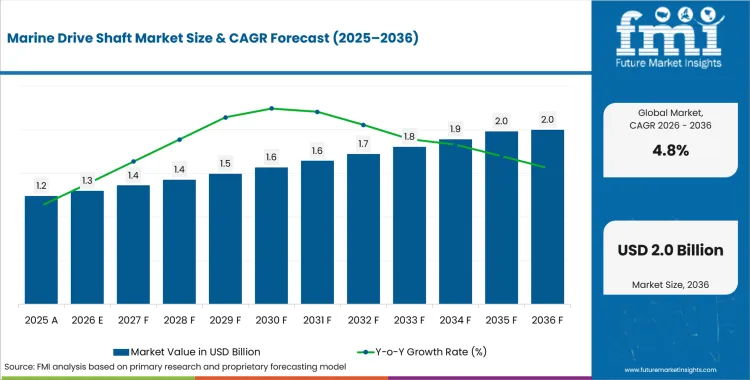
Key Takeaways of Marine Drive Shaft Market
- Vessel renewal and propulsion redesign raise shaft demand whenever a new powertrain changes torque, shaft speed or interface geometry.
- By product type, propeller shafts are estimated to hold 33.0% in 2026 owing to their direct role between the gearbox and propeller.
- In 2026, stainless steel is expected to lead material with 37.0% share because corrosion resistance fits common marine machining requirements.
- Recreational boats are projected to hold 29.0% share in 2026 attributable to a large installed fleet and frequent refit access.
- Alignment accuracy and fixed haul-out schedules can delay ordering because dimensional errors transfer directly into bearing and coupling problems.
- Some of the key players in this market include Wärtsilä, Berg Propulsion, Brunvoll, CJR Propulsion, SCHOTTEL, Kongsberg Maritime, Twin Disc, and ZF Marine.
Analyst Perspective
"Marine drive shaft purchasing should begin with verified torque duty and interface geometry rather than a quoted bar price. Commercial value is earned when machining records and alignment support let a yard install the shaft without extending the vessel milestone."
- Nikhil Kaitwade, Principal Consultant, Future Market Insights
How is the Marine Drive Shaft Market segmented?
The marine drive shaft market is segmented by product type, material, boat type, sales channel and type.
Market taxonomy covers product type, material, boat type, sales channel and type. Product types include propeller shafts, intermediate shafts, cardan shafts, line shafts and tail shafts. Materials include stainless steel, carbon steel, duplex steel, composite shafts and bronze or alloy shafts. Boat types cover recreational boats, workboats, fishing vessels, offshore vessels and naval or patrol craft. Sales channels include shipyards, marine repair yards, propulsion system OEMs and aftermarket distributors. Type separates newbuild, replacement, repower and custom fabrication.
What makes Propeller Shafts central to the Product Type category?
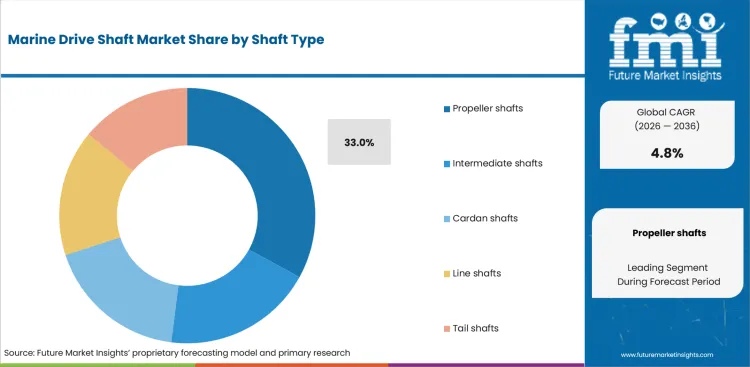
Propeller shafts carry the final rotating load into conventional propellers, so straightness and taper geometry directly affect installed performance. Wärtsilä confirmed in November 2025 that its Aasen Shipping package includes a controllable pitch propeller with shaft line. The package keeps shaft specification tied to integrated marine engines and gearbox selection.
- Based on product type, propeller shafts are projected to account for 33.0% in 2026 due to their direct gearbox-to-propeller power-transfer role.
- Shipyards check coupling fit and bearing support before installation because small geometric errors can convert machining work into alignment rework.
Why does Stainless Steel lead the Material category?
Stainless steel fits marine shafts that need corrosion resistance without giving up familiar machining routes. Lloyd’s Register published its January 2025 MQPS Book C with a dedicated approval procedure for steelworks manufacturing stainless steels, which keeps material origin and manufacturing control visible during class review.
- By material, stainless steel is estimated to hold 37.0% in 2026 owing to corrosion resistance and established machining practice for marine shafting.
- Grade selection changes with duty and exposure, so yards compare strength and corrosion performance before matching the shaft to marine reciprocating engines and bearing loads.
How do Recreational Boats Shape the Boat Type category?
Recreational boat fleets produce frequent replacement opportunities because inboard vessels cycle through damage repair and repower work outside large fleet programs. The USA Coast Guard counted 11,674,073 registered recreational vessels for 2024 in its 2025 statistics, giving recreational boating channels a broad installed base for shaft measurement and replacement.
- In 2026, recreational boats are expected to lead boat type with 29.0% share because their installed base supports frequent refit transactions.
- Marine repair yards convert that installed base into orders by reproducing existing tapers and coupling dimensions within scheduled haul-out periods.
What supports shipyards in the sales channel category?
Shipyards control shaft centerlines while hull geometry and propulsion equipment are still being coordinated. Petrobras signed contracts in May 2026 covering four offshore support vessels to be built at Navship. The contracts place propulsion component selection inside a defined construction program rather than a later repair event.
- Shipyards are set to lead the sales channel with 35.0% share in 2026 due to direct control over installation measurements and interfaces.
- Major conversions also return work to yards because ship repair services need measurement access before a replacement shaft can be released for machining.
What are the drivers, restraints and opportunities in the Marine Drive Shaft Market?
Fleet renewal raises shaft specification activity, class-controlled interfaces slow conversion, and precision sterngear packages give manufacturers a practical route into newbuild and retrofit programs.
- Driver: Newbuild and propulsion-renewal programs create defined points where shaft duty must be recalculated before installation.
- Restraint: Class requirements and alignment tolerances extend approval work because shaft geometry must match propeller and bearing interfaces.
- Opportunity: Complete sterngear packages convert engineering support into orders by reducing interface work for shipyards and repair yards.
Fleet renewal is widening the number of propulsion decisions that reach shaft specification. DNV reported in July 2025 that alternative-fuel vessel orders rose 78% during the first half of 2025, which increases the number of newbuild powertrains requiring matched shaft duty. Manufacturers that coordinate shaft design with fuel-flexible propulsion can enter the specification earlier.
Technical approval slows conversion when revised propulsion equipment changes propeller or thruster interfaces. DNV published 119 class-rule documents in July 2025 and revised propeller assessment methods before their January 2026 effective date. That revision gives yards another reason to freeze shaft dimensions only after class assumptions and interface loads are settled.
Packaged sterngear gives shaft manufacturers a route to reduce engineering handoffs at the yard. CJR Propulsion signed an October 2025 deal to supply complete sterngear packages for 16 search-and-rescue vessels, moving shafts and associated interfaces into one coordinated scope. Similar packages can shorten technical review for repeat vessel series and planned replacements.
Which country CAGRs are profiled in the Marine Drive Shaft Market?
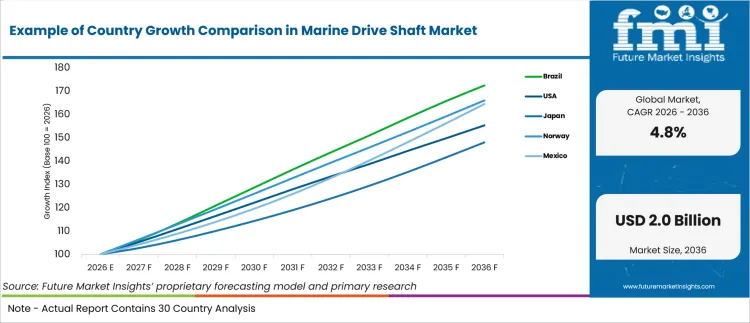
| Country | CAGR |
|---|---|
| Brazil | 6.2% |
| Norway | 5.9% |
| Mexico | 5.5% |
| Canada | 5.2% |
| Italy | 4.9% |
| USA | 4.5% |
| Japan | 4.0% |
How do country-level CAGRs compare in the Marine Drive Shaft Market?
Profiled CAGRs span 2.2 percentage points from Brazil at 6.2% to Japan at 4.0%. Brazil and Norway form the upper band as offshore work and propulsion renewal trigger shaft specifications. Mexico and Canada join Italy in the middle range while USA and Japan grow more steadily from mature fleets.
- Brazilian offshore construction routes shaft specification and repair work into local yards.
- Norway's low-emission vessel rules require propulsion redesign and revised shaft duty.
- Mexican naval fleet activity channels construction and repair work toward domestic programs.
- Canadian fleet renewal introduces domestic-content rules during early propulsion-interface decisions.
- Italian leisure-craft refits sustain varied shaft work across a dense specialist-yard network.
- USA replacement demand is spread across shipyards instead of following one national fleet cycle.
- Japan's yard relationships put qualification and capacity planning at the center of shaft procurement.
The full report applies the CAGRs alongside country-specific vessel mix and sales routes, so similar rates do not imply equivalent market size.
Country-wise Analysis
- Norway: Norwegian ferry and service-craft operators increasingly reassess shaft performance requirements as fleets transition toward electric and low-emission propulsion technologies. The Ministry of Climate and Environment confirmed in April 2025 that zero-emission regulations would extend to smaller passenger vessels operating in World Heritage fjords from 2026. Consequently, the market is expected to register a 5.9% CAGR during the assessment period, driven by retrofit and conversion projects. Specialized engineering requirements and limited retrofit infrastructure continue to concentrate opportunities among vessel-specific solution providers.
- Mexico: Mexican naval construction and maintenance programs typically source components through approved public-sector procurement channels, where local service capabilities remain highly valued. The Secretaría de Marina reported 18 newly flagged vessels in June 2026, including 16 dredgers. This fleet renewal activity is expected to support a 5.5% CAGR between 2026 and 2036, reflecting steady replacement and maintenance demand. In addition, proximity to customers allows engineering teams to respond more efficiently to geometry modifications during compressed maintenance schedules.
- Canada: Canadian fleet renewal programs define domestic participation requirements early in the procurement cycle, increasing the importance of local engineering and design support. Public Services and Procurement Canada announced in April 2026 that engagement activities for up to six mid-shore multi-mission vessels would commence later in the year. As a result, the marine drive shaft market is anticipated to expand at a 5.2% CAGR over the outlook period. Growth is further reinforced by the 80% Canadian-content requirement, which strengthens opportunities for domestic machining companies and service partnerships.
- Italy: Italian demand is spread across recreational vessel refits and specialized commercial marine applications, making customization capabilities more important than standardized fleet production. According to the Ministry of Infrastructure and Transport, Italy had 79,724 registered recreational vessels at the end of 2024, as reported in its September 2025 boating compendium. Backed by this sizeable installed base, the market is forecast to record a 4.9% CAGR during the forecast period, with refit activity sustaining replacement demand. Nevertheless, short machining lead times remain a critical competitive factor near key maritime centers.
- United States: Demand in the United States is distributed across recreational repair yards, commercial shipbuilders, and government-supported marine programs rather than a single centralized procurement cycle. The Maritime Administration awarded Small Shipyard Grant Program funding to 17 recipients in July 2025, highlighting continued investment across a broad shipyard network. This extensive service infrastructure is expected to support a 4.5% CAGR over the next ten years, as widespread yard coverage helps shorten custom-machining lead times and accelerate replacement-part delivery.
Who are the notable companies in the Marine Drive Shaft Market?
Wärtsilä, Berg Propulsion, Brunvoll, CJR Propulsion, SCHOTTEL, Kongsberg Maritime, Twin Disc and ZF Marine are the notable companies profiled in this market.
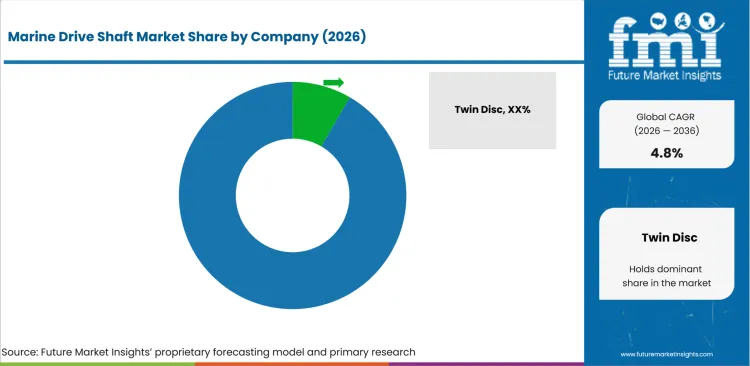
Competition separates direct shaft and sterngear specialists from integrated propulsion groups that influence shaft duty through gearboxes, propellers and controls. Berg Propulsion and CJR Propulsion compete closest to standalone shaft and sterngear supply. Wärtsilä and Brunvoll package shaftline equipment with wider propulsion scopes that place them earlier in vessel specifications. SCHOTTEL, Kongsberg Maritime, Twin Disc and ZF Marine exert greater specification influence through interfaces around marine diesel engines or alternative propulsion architectures.
- Direct shaft and sterngear scope: Berg Propulsion and CJR Propulsion manufacture shaft-related hardware where machining depth and dimensional control influence award decisions.
- Integrated shaftline packages: Wärtsilä and Brunvoll link propellers and gearboxes to controls as low-carbon ammonia propulsion moves into newbuild powertrains.
- Adjacent propulsion influence: SCHOTTEL, Kongsberg Maritime, Twin Disc and ZF Marine shape interface assumptions as passenger vessel propellers or pod-based architectures change conventional shaft requirements.
Competitive Benchmarking: Marine Drive Shaft Market
| Company | Direct Shaftline Scope | Propulsion Integration | Current Service Access | Geographic Reach |
|---|---|---|---|---|
| Wärtsilä | High | High | High | Global |
| Berg Propulsion | High | High | High | Europe, Asia and Americas |
| Brunvoll | High | High | High | Europe with international vessel support |
| CJR Propulsion | High | Medium | Medium | Europe, Middle East and international project sales |
| SCHOTTEL | Medium | High | High | Global |
| Kongsberg Maritime | Medium | High | High | Global |
| Twin Disc | Low | High | High | Global |
| ZF Marine | Low | High | High | Global |
Scoring basis: High direct shaftline scope requires current evidence of shaft or shaftline supply while Medium covers propulsion hardware that controls shaft interfaces. Low identifies adjacent propulsion without standalone shaft supply. High integration covers three or more propulsion elements, Medium covers a narrower package and Low covers one documented interface. High service access requires broad current support reach, while Medium is regionally narrower and Low is project-specific.
Key Developments in the Marine Drive Shaft Market
- In March 2025, Berg Propulsion introduced GreenForge propeller shafts for three Louis Dreyfus Armateurs Ro-Ro vessels, with six shafts scheduled for delivery by June.
- In June 2026, SCHOTTEL secured an ONEX Shipyards order for twenty RAstar 2800 tugs, including forty rudderpropellers and associated shafts.
- In February 2025, Twin Disc completed its acquisition of Kobelt Manufacturing, extending its marine controls and after-sales scope around propulsion-system integration.
Key Players in the Marine Drive Shaft Market
Direct Shaft and Sterngear Specialists
- Berg Propulsion
- CJR Propulsion
Integrated Shaftline and Propulsion Platforms
- Wärtsilä
- Brunvoll
- SCHOTTEL
- Kongsberg Maritime
Transmission and Pod-Propulsion Platforms
- Twin Disc
- ZF Marine
Marine Drive Shaft Market - Report Scope
| Coverage field | Report scope |
|---|---|
| Market breakdown | By product type, material, boat type, sales channel, type and region. |
| Quantitative Units | USD Billion. |
| Market Definition | Revenue from standalone marine drive shafts and named shaft sections sold within the defined taxonomy. Finished-vessel revenue and separate engines, gearboxes, propellers, pods, seals, bearings, couplings, controls and unrelated services are excluded. |
| Regions Covered | North America, Latin America, Western Europe, Eastern Europe, East Asia, South Asia and Pacific, Middle East and Africa. |
| Countries Covered | Brazil, Norway, Mexico, Canada, Italy, USA, Japan, and 20+ countries included in the full report. |
| Key Companies Profiled | Wärtsilä, Berg Propulsion, Brunvoll, CJR Propulsion, SCHOTTEL, Kongsberg Maritime, Twin Disc, ZF Marine. |
| Forecast Period | 2026 to 2036. |
| Approach | Primary and secondary research with market triangulation. |
Marine Drive Shaft Market - Research Methodology
| Method | Approach |
|---|---|
| Primary Research | FMI analysts gathered input from manufacturers, service providers, technology developers, distributors, end users, procurement teams, and subject-matter experts. Interviews examined purchasing decisions, product or service evaluation, adoption barriers, approval requirements, pricing considerations, and expectations for technical or commercial support. Respondents were also asked what evidence is required before a trial, pilot, or initial order develops into regular purchasing. |
| Desk Research | Desk research covered government statistics, regulatory publications, trade data, industry associations, technical literature, standards, company filings, product information, and official corporate announcements. Sources were reviewed for relevance, publication date, geographic coverage, and consistency with the defined market scope. Claims relating to performance, applications, approvals, capacity, investment, and commercial activity were retained only when supported by credible public evidence. |
| Market Sizing and Forecasting | The market model combined the baseline value with historical performance, segment structure, pricing and volume indicators, adoption levels, company participation, and country-level demand conditions. Forecast assumptions considered economic activity, investment trends, regulatory developments, technology adoption, purchasing cycles, supply availability, and barriers to wider market use. Segment and regional estimates were reconciled before the final market total was calculated. |
| Data Validation | Estimates were checked against multiple independent indicators, including public data, company activity, trade patterns, industry developments, and findings from primary interviews. Validation also tested whether products, services, applications, and company revenues fell within the defined market boundaries. Adjacent categories, unsupported claims, overlapping revenues, and activities without direct market relevance were excluded to reduce double counting and maintain consistency across segments and countries. |
Marine Drive Shaft Market by Segments
Marine Drive Shaft Market segmented by Product Type:
- Propeller shafts
- Intermediate shafts
- Cardan shafts
- Line shafts
- Tail shafts
Marine Drive Shaft Market segmented by Material:
- Stainless steel
- Carbon steel
- Duplex steel
- Composite shafts
- Bronze / alloy shafts
Marine Drive Shaft Market segmented by Boat Type:
- Recreational boats
- Workboats
- Fishing vessels
- Offshore vessels
- Naval / patrol craft
Marine Drive Shaft Market segmented by Sales Channel:
- Shipyards
- Marine repair yards
- Propulsion system OEMs
- Aftermarket distributors
Marine Drive Shaft Market segmented by Type:
- Newbuild
- Replacement
- Repower
- Custom fabrication
Marine Drive Shaft Market by Region:
- North America
- United States
- Canada
- Latin America
- Brazil
- Mexico
- Argentina
- Chile
- Western Europe
- Germany
- France
- United Kingdom
- Italy
- Spain
- Benelux
- Nordics
- Eastern Europe
- Poland
- Czech Republic
- Romania
- Hungary
- East Asia
- China
- Japan
- South Korea
- South Asia and Pacific
- India
- ASEAN
- Australia and New Zealand
- Middle East and Africa
- GCC Countries
- South Africa
- Türkiye
- Israel
Research Sources and Bibliography
- UN Trade and Development. (2025, September 24). Review of Maritime Transport 2025: Staying the course in turbulent waters.
- Ministry of Land, Infrastructure, Transport and Tourism of Japan. (2025, December 26). 2035年に必要な我が国の船舶建造能力確保を目指します ~「造船業再生ロードマップ」の策定~.
- Wärtsilä. (2025, November 20). Repeat order emphasises strength of Wärtsilä hybrid propulsion system for Aasen Shipping’s bulk carrier series.
- Lloyd's Register. (2025, January 30). LR-MQ-003 MQPS Book C - Procedures for Approval of a Works for Steelmaking and Rolled Steel Products.
- USA Coast Guard. (2025, June 24). Recreational Boating Statistics 2024.
- Petrobras. (2026, May 15). Petrobras assina contrato de R$ 11 bilhões para construção e operação de 4 embarcações de apoio offshore.
- DNV. (2025, July 1). Alternative fuels orderbook shows resilience amid overall decline in newbuild market.
- DNV. (2025, July 1). Now available: July 2025 edition of DNV class rules and documents for ship and offshore.
- CJR Propulsion. (2025, October 20). New deal to supply sterngear for 16 SAR vessels.
- Ministry of Ports and Airports of Brazil. (2026, March 24). Modais de transportes terão investimentos de R$ 41,7 bilhões do Fundo da Marinha Mercante.
- Ministry of Climate and Environment of Norway. (2025, April 22). Zero-Emission Requirements for Passenger Ships in World Heritage Fjords.
- Secretaría de Marina, Mexico. (2026, June 1). En el marco del 84 Aniversario del Día de la Marina Nacional se fortalece el Sector Marítimo.
- Public Services and Procurement Canada. (2026, April 7). Government of Canada awards design contract for Canadian Coast Guard’s mid-shore multi-mission vessels.
- Ministero delle Infrastrutture e dei Trasporti. (2025, September 18). Il Diporto Nautico in Italia - Anno 2024.
- USA Maritime Administration. (2025, July 21). President Trump’s Transportation Secretary Sean P. Duffy Announces $8.75 Million in Grants to Revitalize USA Shipyards, Support Maritime Dominance.
- Berg Propulsion. (2025, March 20). BERG Introduces the World’s First GreenForge® Shafts to the Maritime Industry.
- SCHOTTEL. (2026, June 3). 20 new ONEX escort/terminal tugs with SCHOTTEL.
- Twin Disc. (2025, February 18). Twin Disc, Inc. Announces Acquisition of Kobelt.
- Berg Propulsion. (2026, July 10). Berg Propulsion expands footprint in China with six-vessel Jiangsu Dajin contract for Carisbrooke.
- Brunvoll. (2025, September 18). Brunvoll Chosen Again for Trident Aqua Services’ Growing Fleet.
- CJR Propulsion. (2026, January 9). NEW YEAR, NEW MAZAK.
- SCHOTTEL. (2026, June 1). SCHOTTEL expands presence in India with new subsidiary.
- KONGSBERG. (2026, April 10). KONGSBERG Vanguard LP awarded federal contract to design the Canadian Coast Guard’s future Mid-Shore Multi-Mission vessels.
- Twin Disc. (2026, May 6). Form 10-Q for Twin Disc Inc..
- ZF Group. (2025, September 9). Powered-Up Propulsion: ZF Marine Unveils new POD 4900.
- Berg Propulsion. (2026, June 1). Berg Propulsion and Stone Marine formalise service and support agreement for the UK and Ireland.
- Kongsberg Maritime. (2026, July 12). Kongsberg Maritime to strengthen marine propulsion offering through acquisition of Berg Propulsion.
- Wärtsilä. (2026, July 16). Two new gas carriers to stay ahead of environmental standards with Wärtsilä 25 Ammonia engine.
This bibliography is provided for reader reference and is not exhaustive. The full report contains the complete reference list and detailed citations.
This Report Answers
- How large is the marine drive shaft market in 2026 and 2036?
- Which fleet-renewal conditions create new marine drive shaft specification events?
- Why do propeller shafts account for 33.0% of product type revenue in 2026?
- How does stainless steel influence marine shaft material selection and machining?
- Why do recreational boats account for 29.0% of boat type revenue in 2026?
- How do shipyards convert vessel construction programs into shaft orders?
- How do country growth rates differ among Brazil, Norway, Mexico, Canada, Italy, USA and Japan?
- Which companies compete through direct shaft supply and integrated propulsion interfaces?
- What limits marine drive shaft ordering during newbuild, replacement and repower work?
Frequently Asked Questions
Which product type leads the marine drive shaft market?
The propeller shafts segment is expected to hold 33.0% of the marine drive shaft market in 2026, driven by its direct gearbox-to-propeller power-transfer role. Shipyards also require tight geometry so bearing loads and coupling interfaces remain within the approved shaftline design.
Which material leads the marine drive shaft market?
The stainless steel segment is expected to hold 37.0% of the marine drive shaft market in 2026, supported by corrosion resistance and familiar machining practice. Grade choice still depends on shaft duty and seawater exposure because corrosion allowance changes with operating conditions.
How much value will the marine drive shaft market add between 2026 and 2036?
The marine drive shaft market is expected to add USD 754.1 million in value between 2026 and 2036. Growth reflects new vessel construction plus replacement and repower work that changes shaft duty or geometry.
Which countries are projected to record the highest growth in the marine drive shaft market?
Brazil is projected to grow at 6.2% CAGR, followed by Norway at 5.9% and Mexico at 5.5% through 2036. Growth follows offshore construction and fleet-renewal programs that bring new shaft specifications into active vessel design work.
Which companies are active in the marine drive shaft market?
Key companies operating in the marine drive shaft market include Wärtsilä, Berg Propulsion, Brunvoll, CJR Propulsion, SCHOTTEL, Kongsberg Maritime, Twin Disc, and ZF Marine. Competitive positions differ mainly by shaft machining depth and the extent of propulsion-system integration around each vessel program.
Preview the report firsthand - request a free sample
Get SampleGet the brochure for pricing and purchase details.
Get PDFTable of Content
- Key Takeaways
- Market Size and CAGR
- Top Growth Driver
- Fastest Growing Segment
- Leading Region
- Key Companies
- Emerging Opportunities
- Executive Summary
- Global Market Outlook
- Demand-side Trends
- Supply-side Trends
- Technology Roadmap Analysis
- Analysis and Recommendations
- Analyst Perspective (What is happening? Why now? What should investors know?)
- Key Questions Answered
- How large is the market?
- What is the CAGR?
- What are key trends?
- Which region dominates?
- Who are the leaders?
- Market Overview
- Market Coverage / Taxonomy
- Market Definition / Scope / Limitations
- Research Methodology
- Chapter Orientation
- Analytical Lens and Working Hypotheses
- Market Structure, Signals, and Trend Drivers
- Benchmarking and Cross-market Comparability
- Market Sizing, Forecasting, and Opportunity Mapping
- Research Design and Evidence Framework
- Desk Research Programme (Secondary Evidence)
- Expert Input and Fieldwork (Primary Evidence)
- Tooling, Models, and Reference Databases
- Data Engineering and Model Build
- Quality Assurance and Audit Trail
- Market Background
- Market Dynamics (Drivers, Restraints, Opportunity, Trends)
- Scenario Forecast (Optimistic, Likely, Conservative)
- Impact Analysis
- AI Impact
- Sustainability Impact
- Regulatory Impact
- Technology Impact
- Consumer / Buyer Analysis
- Purchase Drivers
- Adoption Barriers
- Buyer Journey
- Opportunity Map Analysis
- Product Life Cycle Analysis
- Supply Chain Analysis
- Investment Feasibility Matrix
- Value Chain Analysis
- PESTLE and Porter's Analysis
- Regulatory Landscape
- Regional Parent Market Outlook
- Production and Consumption Statistics
- Import and Export Statistics
- Global Market Analysis and Forecast, 2021 to 2036
- Historical Market Size Value (USD Billion) Analysis, 2021 to 2025
- Current and Future Market Size Value (USD Billion) Projections, 2026 to 2036
- Y-o-Y Growth Trend Analysis
- Absolute $ Opportunity Analysis
- Global Market Pricing Analysis, 2021 to 2036
- Global Market Analysis and Forecast, By Shaft Type, 2021 to 2036
- Introduction / Key Findings
- Historical Market Size Value (USD Billion) Analysis By Shaft Type, 2021 to 2025
- Current and Future Market Size Value (USD Billion) Analysis and Forecast By Shaft Type, 2026 to 2036
- Propeller shafts
- Intermediate shafts
- Cardan shafts
- Line shafts
- Tail shafts
- Propeller shafts
- Y-o-Y Growth Trend Analysis By Shaft Type, 2021 to 2025
- Absolute $ Opportunity Analysis By Shaft Type, 2026 to 2036
- Global Market Analysis and Forecast, By Material, 2021 to 2036
- Introduction / Key Findings
- Historical Market Size Value (USD Billion) Analysis By Material, 2021 to 2025
- Current and Future Market Size Value (USD Billion) Analysis and Forecast By Material, 2026 to 2036
- Stainless steel
- Carbon steel
- Duplex steel
- Composite shafts
- Bronze / alloy shafts
- Stainless steel
- Y-o-Y Growth Trend Analysis By Material, 2021 to 2025
- Absolute $ Opportunity Analysis By Material, 2026 to 2036
- Global Market Analysis and Forecast, By Vessel Type, 2021 to 2036
- Introduction / Key Findings
- Historical Market Size Value (USD Billion) Analysis By Vessel Type, 2021 to 2025
- Current and Future Market Size Value (USD Billion) Analysis and Forecast By Vessel Type, 2026 to 2036
- Recreational boats
- Workboats
- Fishing vessels
- Offshore vessels
- Naval / patrol craft
- Recreational boats
- Y-o-Y Growth Trend Analysis By Vessel Type, 2021 to 2025
- Absolute $ Opportunity Analysis By Vessel Type, 2026 to 2036
- Global Market Analysis and Forecast, By Sales Channel, 2021 to 2036
- Introduction / Key Findings
- Historical Market Size Value (USD Billion) Analysis By Sales Channel, 2021 to 2025
- Current and Future Market Size Value (USD Billion) Analysis and Forecast By Sales Channel, 2026 to 2036
- Shipyards
- Propulsion system OEMs
- Marine repair yards
- Aftermarket distributors
- Shipyards
- Y-o-Y Growth Trend Analysis By Sales Channel, 2021 to 2025
- Absolute $ Opportunity Analysis By Sales Channel, 2026 to 2036
- Global Market Analysis and Forecast, By Installation, 2021 to 2036
- Introduction / Key Findings
- Historical Market Size Value (USD Billion) Analysis By Installation, 2021 to 2025
- Current and Future Market Size Value (USD Billion) Analysis and Forecast By Installation, 2026 to 2036
- Newbuild
- Replacement
- Repower
- Custom fabrication
- Newbuild
- Y-o-Y Growth Trend Analysis By Installation, 2021 to 2025
- Absolute $ Opportunity Analysis By Installation, 2026 to 2036
- Global Market Analysis and Forecast, By Region, 2021 to 2036
- Introduction
- Historical Market Size Value (USD Billion) Analysis By Region, 2021 to 2025
- Current Market Size Value (USD Billion) Analysis and Forecast By Region, 2026 to 2036
- North America
- Latin America
- Western Europe
- Eastern Europe
- East Asia
- South Asia and Pacific
- Middle East & Africa
- Market Attractiveness Analysis By Region
- North America Market Analysis and Forecast, By Country, 2021 to 2036
- Historical Market Size Value (USD Billion) Trend Analysis By Market Taxonomy, 2021 to 2025
- Market Size Value (USD Billion) Forecast By Market Taxonomy, 2026 to 2036
- By Country
- USA
- Canada
- By Shaft Type
- By Material
- By Vessel Type
- By Sales Channel
- By Installation
- By Country
- Market Attractiveness Analysis
- By Country
- By Shaft Type
- By Material
- By Vessel Type
- By Sales Channel
- By Installation
- Key Takeaways
- Latin America Market Analysis and Forecast, By Country
- Historical Market Size Value (USD Billion) Trend Analysis By Market Taxonomy, 2021 to 2025
- Market Size Value (USD Billion) Forecast By Market Taxonomy, 2026 to 2036
- By Country
- Brazil
- Mexico
- Chile
- Rest of Latin America
- By Shaft Type
- By Material
- By Vessel Type
- By Sales Channel
- By Installation
- By Country
- Market Attractiveness Analysis
- By Country
- By Shaft Type
- By Material
- By Vessel Type
- By Sales Channel
- By Installation
- Key Takeaways
- Western Europe Market Analysis and Forecast, By Country
- Historical Market Size Value (USD Billion) Trend Analysis By Market Taxonomy, 2021 to 2025
- Market Size Value (USD Billion) Forecast By Market Taxonomy, 2026 to 2036
- By Country
- Germany
- UK
- Italy
- Spain
- France
- Nordic
- BENELUX
- Rest of Western Europe
- By Shaft Type
- By Material
- By Vessel Type
- By Sales Channel
- By Installation
- By Country
- Market Attractiveness Analysis
- By Country
- By Shaft Type
- By Material
- By Vessel Type
- By Sales Channel
- By Installation
- Key Takeaways
- Eastern Europe Market Analysis and Forecast, By Country
- Historical Market Size Value (USD Billion) Trend Analysis By Market Taxonomy, 2021 to 2025
- Market Size Value (USD Billion) Forecast By Market Taxonomy, 2026 to 2036
- By Country
- Russia
- Poland
- Hungary
- Balkan & Baltic
- Rest of Eastern Europe
- By Shaft Type
- By Material
- By Vessel Type
- By Sales Channel
- By Installation
- By Country
- Market Attractiveness Analysis
- By Country
- By Shaft Type
- By Material
- By Vessel Type
- By Sales Channel
- By Installation
- Key Takeaways
- East Asia Market Analysis and Forecast, By Country
- Historical Market Size Value (USD Billion) Trend Analysis By Market Taxonomy, 2021 to 2025
- Market Size Value (USD Billion) Forecast By Market Taxonomy, 2026 to 2036
- By Country
- China
- Japan
- South Korea
- By Shaft Type
- By Material
- By Vessel Type
- By Sales Channel
- By Installation
- By Country
- Market Attractiveness Analysis
- By Country
- By Shaft Type
- By Material
- By Vessel Type
- By Sales Channel
- By Installation
- Key Takeaways
- South Asia and Pacific Market Analysis and Forecast, By Country
- Historical Market Size Value (USD Billion) Trend Analysis By Market Taxonomy, 2021 to 2025
- Market Size Value (USD Billion) Forecast By Market Taxonomy, 2026 to 2036
- By Country
- India
- ASEAN
- Australia & New Zealand
- Rest of South Asia and Pacific
- By Shaft Type
- By Material
- By Vessel Type
- By Sales Channel
- By Installation
- By Country
- Market Attractiveness Analysis
- By Country
- By Shaft Type
- By Material
- By Vessel Type
- By Sales Channel
- By Installation
- Key Takeaways
- Middle East & Africa Market Analysis and Forecast, By Country
- Historical Market Size Value (USD Billion) Trend Analysis By Market Taxonomy, 2021 to 2025
- Market Size Value (USD Billion) Forecast By Market Taxonomy, 2026 to 2036
- By Country
- Kingdom of Saudi Arabia
- Other GCC Countries
- Türkiye
- South Africa
- Other African Union
- Rest of Middle East & Africa
- By Shaft Type
- By Material
- By Vessel Type
- By Sales Channel
- By Installation
- By Country
- Market Attractiveness Analysis
- By Country
- By Shaft Type
- By Material
- By Vessel Type
- By Sales Channel
- By Installation
- Key Takeaways
- Key Countries Market Analysis
- USA
- Pricing Analysis
- Market Share Analysis, 2025
- By Shaft Type
- By Material
- By Vessel Type
- By Sales Channel
- By Installation
- Canada
- Pricing Analysis
- Market Share Analysis, 2025
- By Shaft Type
- By Material
- By Vessel Type
- By Sales Channel
- By Installation
- Mexico
- Pricing Analysis
- Market Share Analysis, 2025
- By Shaft Type
- By Material
- By Vessel Type
- By Sales Channel
- By Installation
- Brazil
- Pricing Analysis
- Market Share Analysis, 2025
- By Shaft Type
- By Material
- By Vessel Type
- By Sales Channel
- By Installation
- Chile
- Pricing Analysis
- Market Share Analysis, 2025
- By Shaft Type
- By Material
- By Vessel Type
- By Sales Channel
- By Installation
- Germany
- Pricing Analysis
- Market Share Analysis, 2025
- By Shaft Type
- By Material
- By Vessel Type
- By Sales Channel
- By Installation
- UK
- Pricing Analysis
- Market Share Analysis, 2025
- By Shaft Type
- By Material
- By Vessel Type
- By Sales Channel
- By Installation
- Italy
- Pricing Analysis
- Market Share Analysis, 2025
- By Shaft Type
- By Material
- By Vessel Type
- By Sales Channel
- By Installation
- Spain
- Pricing Analysis
- Market Share Analysis, 2025
- By Shaft Type
- By Material
- By Vessel Type
- By Sales Channel
- By Installation
- France
- Pricing Analysis
- Market Share Analysis, 2025
- By Shaft Type
- By Material
- By Vessel Type
- By Sales Channel
- By Installation
- India
- Pricing Analysis
- Market Share Analysis, 2025
- By Shaft Type
- By Material
- By Vessel Type
- By Sales Channel
- By Installation
- ASEAN
- Pricing Analysis
- Market Share Analysis, 2025
- By Shaft Type
- By Material
- By Vessel Type
- By Sales Channel
- By Installation
- Australia & New Zealand
- Pricing Analysis
- Market Share Analysis, 2025
- By Shaft Type
- By Material
- By Vessel Type
- By Sales Channel
- By Installation
- China
- Pricing Analysis
- Market Share Analysis, 2025
- By Shaft Type
- By Material
- By Vessel Type
- By Sales Channel
- By Installation
- Japan
- Pricing Analysis
- Market Share Analysis, 2025
- By Shaft Type
- By Material
- By Vessel Type
- By Sales Channel
- By Installation
- South Korea
- Pricing Analysis
- Market Share Analysis, 2025
- By Shaft Type
- By Material
- By Vessel Type
- By Sales Channel
- By Installation
- Russia
- Pricing Analysis
- Market Share Analysis, 2025
- By Shaft Type
- By Material
- By Vessel Type
- By Sales Channel
- By Installation
- Poland
- Pricing Analysis
- Market Share Analysis, 2025
- By Shaft Type
- By Material
- By Vessel Type
- By Sales Channel
- By Installation
- Hungary
- Pricing Analysis
- Market Share Analysis, 2025
- By Shaft Type
- By Material
- By Vessel Type
- By Sales Channel
- By Installation
- Kingdom of Saudi Arabia
- Pricing Analysis
- Market Share Analysis, 2025
- By Shaft Type
- By Material
- By Vessel Type
- By Sales Channel
- By Installation
- Türkiye
- Pricing Analysis
- Market Share Analysis, 2025
- By Shaft Type
- By Material
- By Vessel Type
- By Sales Channel
- By Installation
- South Africa
- Pricing Analysis
- Market Share Analysis, 2025
- By Shaft Type
- By Material
- By Vessel Type
- By Sales Channel
- By Installation
- USA
- Market Structure Analysis
- Competition Dashboard
- Competition Benchmarking
- Market Share Analysis of Top Players
- By Regional
- By Shaft Type
- By Material
- By Vessel Type
- By Sales Channel
- By Installation
- Emerging Startups
- Innovation Benchmarking
- Competition Analysis
- Competition Deep Dive
- Twin Disc
- Overview
- Product Portfolio
- Profitability by Market Segments
- Sales Footprint
- Strategy Overview
- Marketing Strategy
- Product Strategy
- Channel Strategy
- ZF Marine
- Centek Industries
- Halyard
- Tides Marine
- R&D Marine
- Buck Algonquin
- Shaftmaster
- Kobelt Manufacturing
- Twin Disc
- Case Studies
- Success Stories
- Recent Developments
- Competition Deep Dive
- Assumptions & Acronyms Used


