

- Market Size (2026)
- USD 1.7 Bn
- Forecast (2036)
- USD 3.8 Bn
- CAGR (2026 to 2036)
- 8.5%
How big is Marine Inverter Modules Market in 2026?
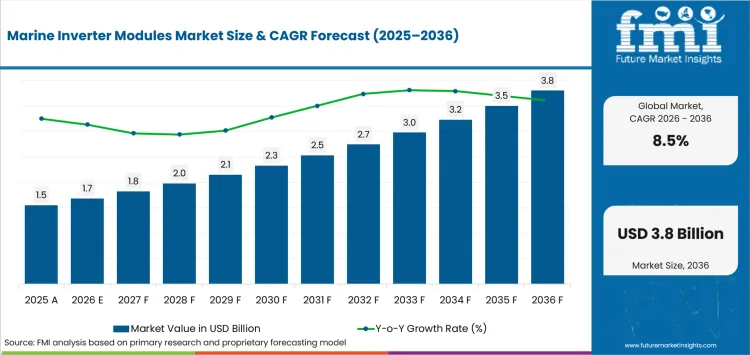
USD 1.7 billion in 2026 and USD 3.8 billion by 2036 at an 8.5% CAGR.
Demand for marine inverter modules is projected to expand at 8.5% CAGR between 2026 and 2036 and lift valuation from USD 1.7 billion in 2026 to USD 3.8 billion by 2036. Vessel electrification brings propulsion motors and batteries into one power-conversion design with shore interfaces. FuelEU Maritime began applying a 2% GHG-intensity reduction requirement to covered ships in January 2025 according to the European Commission. The rule increases scrutiny of conversion losses because operators must document vessel energy performance.
Short-route ferries produce a different equipment cycle because terminal charging can be matched to predictable crossings. Trafikverket documented in March 2025 that its ferry business plans a new series of electric ferries through 2045 with classes designed for full electric operation, as part of its Vision 45 program targeting climate-neutral ferry service by 2045. Repeated charging makes cooling capacity and shore compatibility part of module selection before shipyards freeze switchboard interfaces.
Key Takeaways of Marine Inverter Modules Market
- Vessel electrification moves marine inverter modules into earlier decisions on power flow and cooling responsibility.
- Based on inverter type, traction inverter modules are projected to account for 31.0% in 2026 due to continuous propulsion duty.
- By voltage class, below 100 V units are estimated to hold 18.0% in 2026 owing to smaller-vessel auxiliary architectures.
- In 2026, IGBT modules are expected to represent 32.0% of semiconductor because familiar converter designs reduce redesign work.
- Classification review extends purchasing cycles because converter changes may alter vessel protection settings and harmonic performance.
- Some of the key players in this market include Danfoss Editron, ABB, Siemens, Yaskawa, Semikron Danfoss, Infineon Technologies, Wolfspeed, Victron Energy, Mastervolt, and Kongsberg Maritime.
Analyst Perspective
"Marine inverter value depends on thermal limits and class documentation because either can reopen propulsion interfaces. Module platforms earn repeat work if shipyards can change ratings without rebuilding protection systems."
- Nikhil Kaitwade, Principal Consultant, Future Market Insights
How is the Marine Inverter Modules Market segmented?
The marine inverter modules market is segmented by inverter type, voltage class, semiconductor, application and sales channel.
Inverter types span traction through shore-power modules while voltage classes run from below 100 V to above 800 V. Semiconductor, application and sales-channel categories follow the detailed taxonomy listed later in this article.
What makes traction inverter modules central to the inverter type category?
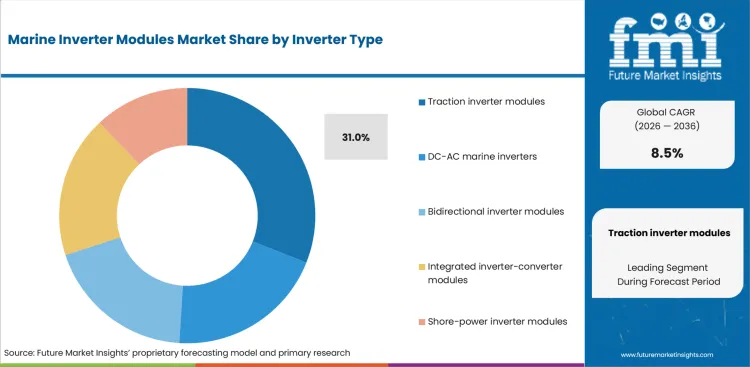
Traction modules operate inside the propulsion control loop so switching losses and fault behavior affect maneuvering and vessel availability. Shipyards review cooling layout and protection logic before finalizing motor and switchboard interfaces for qualified propulsion packages.
- Based on inverter type, traction inverter modules are projected to account for 31.0% in 2026 due to continuous propulsion duty and availability requirements.
- ABB documented in May 2025 that M/S Suomenlinna II received a module-based ACS880LC propulsion-drive retrofit that retained existing cabinets, busbars, and cables. The project preserved usable electrical assets and shows why electric motor systems with replaceable converter modules can extend vessel service without rebuilding the full installation.
Why do below 100 V systems retain the voltage class share position?
Lower-voltage systems serve house loads and smaller propulsion packages where technicians value compact equipment and simpler service procedures. Distributor availability also broadens replacement access for smaller vessels that do not require project-specific high-voltage propulsion packages.
- By voltage class, below 100 V systems are estimated to hold 18.0% in 2026 owing to smaller vessels and auxiliary battery architectures.
- Victron Energy documented in November 2025 that its METSTRADE marine display included the Multi RS 48/6000 high-frequency inverter and new 48 V Smart IP43 charger equipment. The release keeps power inverter systems relevant below propulsion-scale voltages where installation space and service access shape equipment selection.
Why do IGBT modules retain the semiconductor share position?
Marine drive teams change semiconductor technology after a new package passes thermal protection and electromagnetic compatibility work for its intended converter. IGBT modules retain an engineering advantage where gate control and cooling behavior already have qualified service records.
- The IGBT modules segment is likely to capture 32.0% share in 2026 attributable to established high-power converter architectures and familiar qualification work.
- Semikron Danfoss and CRRC Times Semiconductor signed a May 2025 memorandum covering chip development and supply for IGBT and SiC power modules. The agreement keeps IGBT switching platforms under active development beside SiC alternatives for high-power conversion.
What supports propulsion drives within the application category?
Propulsion drives carry converter losses and fault consequences directly into vessel maneuvering during normal and degraded operating conditions. Engineering teams therefore test inverter behavior with motors and energy storage before accepting a propulsion package for regular service.
- By application, propulsion drives are forecast to represent 38.0% in 2026 driven by continuous power conversion and availability requirements.
- Kongsberg Maritime reported in March 2025 that the MF Hamlet conversion will install four 1530 kW permanent-magnet propulsion motors with high-voltage port charging. The project requires electric ship programs to resolve converter sizing and control interfaces before retrofit commissioning.
Why do propulsion OEMs hold the sales channel share position?
Propulsion OEMs influence inverter selection because motor control and protection responsibilities are fixed early inside larger propulsion packages. One package owner can carry commissioning responsibility through the vessel electrical interfaces and final system acceptance.
- Propulsion OEMs are set to lead the sales channel with 39.0% share in 2026 due to early control over propulsion interfaces and performance guarantees.
- ABB disclosed in December 2025 that Washington State Ferries selected integrated hybrid-electric propulsion packages for two 160-auto ferries. The order places marine power batteries with distribution and automation under one vessel-level responsibility before commissioning begins.
What are the drivers, restraints and opportunities in the Marine Inverter Modules Market?
Fleet electrification and carbon rules increase converter specification work while class review slows approval. Modular high-efficiency platforms can reduce redesign once vessel interfaces are documented.
- Driver: Hybrid propulsion and shore charging route more vessel energy through controllable inverter stages that engineers must specify before construction begins.
- Restraint: Classification review and harmonic validation can reopen electrical design work if a converter changes late inside a vessel program.
- Opportunity: Modular high-efficiency power stages can reduce cooling demand and redesign work once marine documentation covers the intended vessel architecture.
Carbon-intensity rules make propulsion efficiency more visible in vessel operating decisions and increase attention to controllable electrical conversion. IMO MEPC 83 adopted revised CII reduction factors for 2027-2030 in April 2025 and continued review of EEXI and CII measures. Shipowners therefore have more reason to test hybrid or battery-assisted propulsion against measured vessel efficiency.
Classification work slows purchasing because an inverter change can alter protection settings and harmonic behavior beyond the converter cabinet. DNV published its July 2025 rule edition with revised electrical-system requirements aligned to ship rules and IACS standards. Engineering teams need shore-to-ship power documentation that closes protection review before vessel commissioning and class acceptance.
Higher-efficiency semiconductor modules become commercially useful only if lower switching losses justify another marine validation cycle. Wolfspeed documented a February 2025 partnership with AVL and DEIF to apply SiC power modules in marine electrification. Silicon carbide devices gain a practical route where lower losses reduce cooling work enough to offset fresh validation.
Which country CAGRs are covered in the Marine Inverter Modules Market?
| Country | CAGR |
|---|---|
| Sweden | 9.1% |
| Norway | 8.8% |
| Finland | 8.5% |
| South Korea | 8.0% |
| USA | 7.8% |
| Germany | 7.4% |
| Japan | 6.7% |
How do country-level CAGRs compare in the Marine Inverter Modules Market?
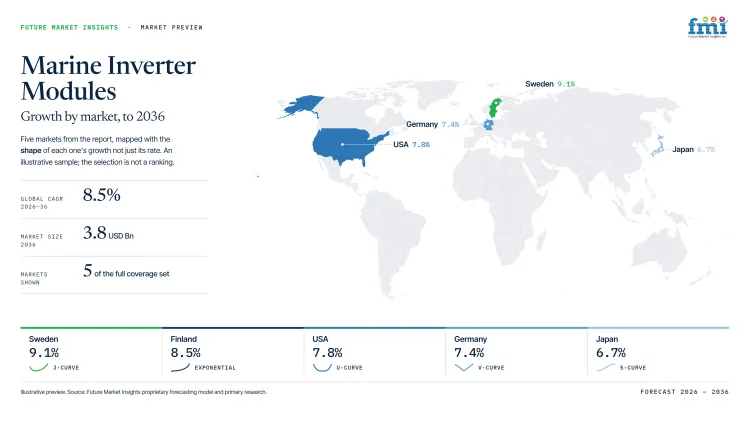
Nordic ferry programs form the upper CAGR band because short routes pair vessel renewal with repeatable terminal charging. Sweden reaches 9.1% and Norway 8.8% while Finland records 8.5% as ferry electrification keeps converter work close to route infrastructure. South Korea and the USA follow through shipyard or public-fleet programs while Germany and Japan face longer interface qualification.
- Sweden’s ferry-renewal programs increasingly align vessel upgrades with investments in terminal charging infrastructure.
- Norway’s experience in electric ferry operations is accelerating the conversion of existing vessels to cleaner propulsion systems.
- Finland extends vessel service life through modular retrofit strategies that allow phased technology integration.
- South Korea often incorporates semiconductor and power-electronics expertise early in the vessel development process.
- USA fleet operators are coordinating vessel deployment schedules more closely with utility and grid-readiness planning.
- Germany emphasizes port-compatibility testing before advancing shore-power and vessel-connection projects.
- Japan continues to support multiple non-fossil propulsion pathways through targeted funding and demonstration initiatives.
The 2.4 percentage-point spread measures forecast pace rather than project value within the report's regional coverage of North America, Latin America, Western Europe, Eastern Europe, East Asia, South Asia and Pacific, and Middle East and Africa.
Country-wise Analysis
- Swedish road-ferry routes need compact conversion hardware that tolerates frequent charging without taking scarce machinery space during repeated daily crossings. Marine inverter module demand in Sweden is forecast to rise at 9.1% CAGR through 2036 due to public ferry programs designed for electric operation and fixed terminal charging. Trafikverket documented in December 2025 that Alvaret completed its first charging-system tests on Ljusteröleden and began tuning charging-robot software for regular ferry service. Electric boat platforms gain a defined route into fleet renewals once charging interfaces stabilize, yet commissioning software and vessel-grid coordination can delay final equipment acceptance on high-frequency public ferry routes.
- Norwegian passenger routes use an experienced electric-ferry operating base that makes shore connection and redundancy routine design questions for new conversions. Adoption of marine inverter modules in Norway is estimated to expand at 8.8% CAGR through 2036 owing to scheduled zero-emission requirements in protected fjords. The Norwegian Maritime Authority confirmed in April 2025 that rules starting in January 2026 cover passenger ships below 10,000 gross tonnage and require shore power where available. Clear requirements give equipment companies a defined electrification program, although operators still need redundant propulsion and charging arrangements that can handle winter weather and intensive seasonal schedules.
- Finnish ferry operators often modernize existing vessels and landing infrastructure instead of replacing every electrical asset during fleet renewal. Finferries announced in October 2025 that its Lakeland contract covers twelve routes and fourteen new ferries using reused hulls before full equipment renewal by summer 2028. Marine inverter module sales in Finland are forecast to expand at 8.5% CAGR by 2036 attributable to electrified ferry renewal and retrofit engineering for existing route assets. Reused structures lower replacement scope for fleet owners, but converter packages must fit existing machinery spaces and cable routes without weakening service access over the remaining vessel life.
- South Korean shipyards bring component specialists into propulsion development before final construction releases freeze electrical interfaces for high-capacity commercial vessels. The South Korean marine inverter modules sector is projected to record 8.0% CAGR during the assessment period driven by shipyard-led work on battery systems and propulsion power management for hybrid commercial vessels. Korean Register documented in December 2025 that it granted approval in principle for HD Hyundai Mipo hybrid battery operation technology that optimizes real-time power flow. Early engineering access gives module companies a path into serial vessel designs, but large-capacity drives still require system-level reliability evidence before hardware is committed to repeat construction programs.
- US fleet electrification depends on public construction schedules and utility work because new ferries cannot use full battery capability without terminal charging. WSDOT published a December 2025 terminal-electrification solicitation for charging infrastructure at two Colman Dock slips with coordination between vessel and charging-system contractors. In the USA, marine inverter module demand is predicted to advance at 7.8% CAGR through 2036 supported by state ferry modernization and terminal charging investment for current public ferry fleets. Marine electronics companies must hold interfaces stable through long public-project cycles, since vessel delivery and utility commissioning can follow different schedules before regular electric service begins.
- Port compatibility governs German converter purchasing because shore-power equipment must match existing ship grids before regular connection becomes practical. Germany's marine inverter modules outlook is anticipated to advance at 7.4% CAGR over the assessment period owing to terminal electrification and vessel-integration testing at major ports. The Port of Hamburg stated in June 2025 that shore power operated at two container terminals while two additional facilities were being installed. Marine propulsion engines and converters still need compatible controls for each connection, so terminal voltage work can expose late differences in protection or harmonic behavior during port commissioning inside vessel electrical designs.
- Funding for several Japanese efficiency and non-fossil shipping routes prevents converter companies from assuming one battery-only architecture will dominate qualification. Japan is estimated to post 6.7% CAGR over the forecast period attributable to domestic shipping programs that include batteries beside other low-carbon systems. Japan's transport ministry opened a July 2025 call supporting ship efficiency and non-fossil equipment including batteries and hydrogen fuel cells for coastal shipping operators under domestic support programs. Funding broadens the set of power architectures entering engineering programs and demonstration work, yet conservative reliability proof can extend evaluation before new inverter stages reach commercial vessel service.
Who are the notable companies in the Marine Inverter Modules Market?
Danfoss Editron, ABB, Siemens, Yaskawa, Semikron Danfoss, Infineon Technologies, Wolfspeed, Victron Energy, Mastervolt, and Kongsberg Maritime are notable companies active in this market.
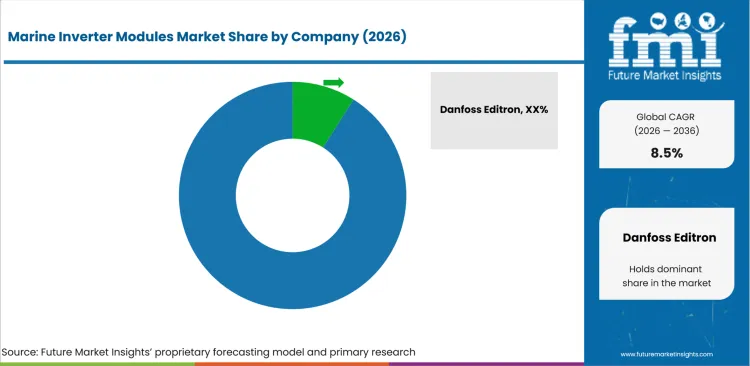
Competition depends on where each company accepts responsibility inside the vessel electrical design and qualification process for shipyard delivery work. Danfoss Editron, ABB and Kongsberg Maritime participate at propulsion-system level while Siemens covers marine design software. Yaskawa addresses marine-class drives while Victron Energy and Mastervolt concentrate on onboard conversion systems. Semikron Danfoss, Infineon Technologies and Wolfspeed enter upstream through power modules or semiconductors for high-power converters.
- Danfoss Editron and ABB join Siemens and Kongsberg Maritime in integrated propulsion or vessel-power engineering roles.
- Yaskawa joins Victron Energy and Mastervolt in marine drive or onboard inverter-charger roles within documented application scopes.
- Semikron Danfoss joins Infineon Technologies and Wolfspeed in supplying power-module technology upstream of qualified marine converter assemblies.
Competitive Benchmarking: Marine Inverter Modules Market
| Company | Marine Integration Depth | Power-Conversion Breadth | Qualification Evidence | Geographic Reach |
|---|---|---|---|---|
| Danfoss Editron | High | High | High | Global |
| ABB | High | High | High | Global |
| Siemens | Medium | High | Medium | Global |
| Yaskawa | Medium | Medium | High | Global |
| Semikron Danfoss | Low | High | Medium | Global |
| Infineon Technologies | Low | High | Medium | Global |
| Wolfspeed | Low | High | Medium | Americas, Europe and Asia |
| Victron Energy | Medium | High | Medium | Global marine distribution |
| Mastervolt | Medium | High | Medium | Europe, Americas and Asia-Pacific |
| Kongsberg Maritime | High | High | High | Global |
Key Developments in the Marine Inverter Modules Market
- In October 2025, ABB secured an order for propulsion and power-distribution systems covering seven all-electric Caledonian Maritime Assets ferries plus shore connection equipment.
- In June 2025, Siemens announced that Arc adopted Xcelerator software to design and manufacture fully electric recreational and commercial boats with in-house powertrains.
- In March 2025, Danfoss Editron signed an agreement for a Lappeenranta production and engineering facility that will manufacture high-voltage electrification systems used in marine vessels.
Key Players in the Marine Inverter Modules Market
Integrated Marine Propulsion and Vessel-Power Platforms
- Danfoss Editron
- ABB
- Siemens
- Kongsberg Maritime
Marine Drive and Onboard Power Specialists
- Yaskawa
- Victron Energy
- Mastervolt
Power Semiconductor and Module Technology
- Semikron Danfoss
- Infineon Technologies
- Wolfspeed
Marine Inverter Modules Market - Report Scope
| Coverage field | Report scope |
|---|---|
| Market breakdown | By inverter type, voltage class, semiconductor, application, sales channel and region. |
| Quantitative Units | Revenue in USD billionand CAGR in %. |
| Market Definition | Marine-rated inverter modules and converter hardware used for propulsion, charging, onboard AC supply and bidirectional vessel power flow. |
| Regions Covered | North America, Latin America, Western Europe, Eastern Europe, East Asia, South Asia and Pacific, and Middle East and Africa. |
| Countries Covered | Sweden, Norway, Finland, South Korea, USA, Germany, Japan, and 30+ countries included in the full report. |
| Key Companies | Danfoss Editron, ABB, Siemens, Yaskawa, Semikron Danfoss, Infineon Technologies, Wolfspeed, Victron Energy, Mastervolt, Kongsberg Maritime. |
| Forecast Period | 2026 to 2036. |
| Approach | Primary and secondary research with market triangulation. |
Marine Inverter Modules Market - Research Methodology
| Method | Approach |
|---|---|
| Primary Research | FMI analysts gathered input from manufacturers, service providers, technology developers, distributors, end users, procurement teams, and subject-matter experts. Interviews examined purchasing decisions, product or service evaluation, adoption barriers, approval requirements, pricing considerations, and expectations for technical or commercial support. Respondents were also asked what evidence is required before a trial, pilot, or initial order develops into regular purchasing. |
| Desk Research | Desk research covered government statistics, regulatory publications, trade data, industry associations, technical literature, standards, company filings, product information, and official corporate announcements. Sources were reviewed for relevance, publication date, geographic coverage, and consistency with the defined market scope. Claims relating to performance, applications, approvals, capacity, investment, and commercial activity were retained only when supported by credible public evidence. |
| Market Sizing and Forecasting | The market model combined the baseline value with historical performance, segment structure, pricing and volume indicators, adoption levels, company participation, and country-level demand conditions. Forecast assumptions considered economic activity, investment trends, regulatory developments, technology adoption, purchasing cycles, supply availability, and barriers to wider market use. Segment and regional estimates were reconciled before the final market total was calculated. |
| Data Validation | Estimates were checked against multiple independent indicators, including public data, company activity, trade patterns, industry developments, and findings from primary interviews. Validation also tested whether products, services, applications, and company revenues fell within the defined market boundaries. Adjacent categories, unsupported claims, overlapping revenues, and activities without direct market relevance were excluded to reduce double counting and maintain consistency across segments and countries. |
Marine Inverter Modules Market by Segments
Marine Inverter Modules Market segmented by Inverter Type:
- Traction inverter modules
- DC-AC marine inverters
- Bidirectional inverter modules
- Integrated inverter-converter modules
- Shore-power inverter modules
Marine Inverter Modules Market segmented by Voltage Class:
- Below 100 V
- 100-400 V
- 400-800 V
- Above 800 V
Marine Inverter Modules Market segmented by Semiconductor:
- IGBT modules
- SiC MOSFET modules
- Silicon MOSFET modules
- Hybrid power modules
Marine Inverter Modules Market segmented by Application:
- Propulsion drives
- Battery charging
- Hotel loads
- Hybrid-electric systems
- Auxiliary drives
Marine Inverter Modules Market segmented by Sales Channel:
- Propulsion OEMs
- Power electronics integrators
- Marine electrical distributors
- Shipyard project supply
Marine Inverter Modules Market by Region:
- North America
- United States
- Canada
- Latin America
- Brazil
- Mexico
- Argentina
- Chile
- Western Europe
- Germany
- France
- United Kingdom
- Italy
- Spain
- Benelux
- Nordics
- Eastern Europe
- Poland
- Czech Republic
- Romania
- Hungary
- East Asia
- China
- Japan
- South Korea
- South Asia and Pacific
- India
- ASEAN
- Australia and New Zealand
- Middle East and Africa
- GCC Countries
- South Africa
- Türkiye
- Israel
Research Sources and Bibliography
- European Commission, Directorate-General for Mobility and Transport. (2025, January 10). New EU rules aiming to decarbonise the maritime sector take effect
- Trafikverket. (2025, March 27). Namngivning av våra färjor
- ABB. (2025, May 27). ABB extends lifespan of Helsinki ferry by retrofitting propulsion drive
- Victron Energy. (2025, November 14). Victron Energy at Metstrade 2025
- Semikron Danfoss. (2025, May 5). Semikron Danfoss and CRRC Times Semiconductor Sign Memorandum of Understanding to Collaborate on Chip Supply for Power Modules
- Kongsberg Maritime. (2025, March 6). Kongsberg Maritime to be key player in hybrid conversion of MF Hamlet for Öresundlinjen
- ABB. (2025, December 1). Washington State Ferries selects ABB to power their first hybrid-electric newbuild vessels
- International Maritime Organization. (2025, April 11). Marine Environment Protection Committee (MEPC 83), 7 to 11 April 2025
- DNV. (2025, July 1). Now available: July 2025 edition of DNV class rules and documents for ship and offshore
- Wolfspeed. (2025, February 19). Waves of Innovation: Partnering to Electrify Marine Mobility
- Trafikverket. (2025, December 9). Färjerederiets klimat- och miljöarbete - Vision 45
- Norwegian Maritime Authority. (2025, April 15). Zero-emission requirements for the World Heritage fjords adopted
- Finferries. (2025, October 6). Suomen Lauttaliikenne Oy has signed an agreement with the ELY Centre concerning ferry traffic in the Finnish Lakeland region
- Korean Register. (2025, December 9). KR Grants AIP for HD Hyundai Mipo’s Hybrid Battery Operation Technology
- Washington State Department of Transportation. (2025, December 12). SR 519, Seattle Trm - Terminal Electrification
- Port of Hamburg. (2025, June 4). Hamburg Port Authority and Ocean Network Express Sign Agreement to Supply Container ships with shore power
- Ministry of Land, Infrastructure, Transport and Tourism, Japan. (2025, July 17). Second call for the coastal shipping innovative operational efficiency and non-fossil energy transition program
- ABB. (2025, October 28). Caledonian Maritime Assets relies on ABB to power multiple all-electric ferries on board and ashore
- Siemens. (2025, June 2). Arc adopts Siemens Xcelerator to electrify the marine industry
- Danfoss. (2025, March 19). Danfoss Editron and Lappeenrannan Yritystila agree on the construction of a new production facility in Lappeenranta
- Brunswick Corporation. (2025, January 6). Brunswick Corporation Adds “Boating Intelligence” to Technology Portfolio at 2025 Consumer Electronics Show
- ABB. (2026, January 12). ABB chosen to supply technology for BC Ferries’ New Major Vessels
- Siemens. (2026, February 16). HD Hyundai selects Siemens Xcelerator for integrated digital shipbuilding platform
- Victron Energy. (2025, April 25). Redefining marine power onboard brand new vessel
- Saxdor Yachts. (2025, December 18). Saxdor continues its upward trajectory with the global debut of the 460 GTC at boot Düsseldorf 2026
- ABB. (2026, March 31). Delaware River and Bay Authority takes electric route in Cape May-Lewes ferry modernization project
- Danfoss. (2026, August 10). From power to performance: A new era of marine efficiency
- ABB. (2026, September 2). ABB to power New Zealand’s new generation rail-enabled ferries for Cook Strait
- Siemens. (2026, July 24). Siemens and HD Hyundai sign multi-million-dollar deal to pioneer AI-powered shipbuilding
- Yaskawa Europe. (2025, December 18). Release of U1000 Free Standing Panel Solution
- Danfoss. (2026, March 9). Danfoss strengthens its electrification business with full ownership of Semikron Danfoss
- Infineon Technologies. (2026, July 8). Infineon supplies SiC technology to ADVANTICS, enhancing efficiency in power converters for megawatt charging
- Wolfspeed. (2026, May 21). Wolfspeed Introduces New 3.3 kV SiC Power Modules in Two Industry-Standard Footprints to Address the Surging Demand for Energy
- Victron Energy. (2025, June 10). Introducing Venus OS 3.60
- Saxdor Yachts. (2025, January 15). Saxdor Yachts to Introduce Trailblazing Innovations at boot Düsseldorf 2025
- Kongsberg Maritime. (2025, January 30). Kongsberg Maritime selected for hybrid and propulsion upgrade of Norwegian Coastal Administration’s vessel OV Bøkfjord
- Danfoss. (2026, March 17). Future of VFD tech: New iC7-Hybrid and iC7-Marine features
This bibliography is provided for reader reference and is not exhaustive. The full report contains the complete reference list and detailed citations.
This Report Answers
- How does vessel electrification move inverter specification earlier in propulsion design?
- Which inverter type accounts for 31.0% of the category in 2026?
- Why do below 100 V systems retain a role on smaller vessels?
- How do IGBT modules compete with SiC alternatives during converter qualification?
- Which application carries direct propulsion availability requirements for marine inverter modules?
- How do class rules and harmonic review affect converter selection?
- Why do Nordic forecasts exceed Germany and Japan in the country comparison?
- Which companies operate at vessel-system and power-module levels in this market?
- How do shore-power projects change vessel and terminal converter interfaces?
- Where can modular power stages reduce redesign work in inverter projects?
Frequently Asked Questions
How big is the Marine Inverter Modules Market in 2026?
The marine inverter modules market is valued at USD 1.7 billion in 2026 and is projected to reach USD 3.8 billion by 2036. Vessel electrification moves conversion hardware into propulsion and shore-charging architecture earlier in vessel design.
What is the CAGR of the Marine Inverter Modules Market from 2026 to 2036?
The marine inverter modules market is projected to grow at a CAGR of 8.5% between 2026 and 2036. Hybrid propulsion and shore charging increase specification work for marine-rated high-power conversion hardware during vessel design.
Which inverter type leads the Marine Inverter Modules Market?
The traction inverter modules segment is expected to hold 31.0% of the marine inverter modules market in 2026, driven by continuous propulsion duty and vessel availability requirements. Shipyards therefore validate cooling and fault behavior before final motor and switchboard interfaces are frozen.
Which semiconductor category leads the Marine Inverter Modules Market?
The IGBT modules segment is expected to hold 32.0% of the marine inverter modules market in 2026, attributable to familiar high-power converter designs and qualification records. SiC alternatives require fresh thermal and protection validation before engineers approve substitution in marine converters.
Which countries are projected to record the country growth comparison in the Marine Inverter Modules Market?
Sweden is projected to grow at 9.1% CAGR, followed by Norway at 8.8% and Finland at 8.5% through 2036. Ferry renewal and route charging give these Nordic markets earlier converter-integration work than slower covered countries.
Which companies are active in the Marine Inverter Modules Market?
Key companies operating in the marine inverter modules market include Danfoss Editron, ABB, Siemens, Yaskawa, Semikron Danfoss, Infineon Technologies, Wolfspeed, Victron Energy, Mastervolt, and Kongsberg Maritime. Their roles span vessel integration and marine drives plus onboard inverter-chargers and power modules within documented scopes.
Preview the report firsthand - request a free sample
Get SampleGet the brochure for pricing and purchase details.
Get PDFTable of Content
- Key Takeaways
- Market Size and CAGR
- Top Growth Driver
- Fastest Growing Segment
- Leading Region
- Key Companies
- Emerging Opportunities
- Executive Summary
- Global Market Outlook
- Demand-side Trends
- Supply-side Trends
- Technology Roadmap Analysis
- Analysis and Recommendations
- Analyst Perspective (What is happening? Why now? What should investors know?)
- Key Questions Answered
- How large is the market?
- What is the CAGR?
- What are key trends?
- Which region dominates?
- Who are the leaders?
- Market Overview
- Market Coverage / Taxonomy
- Market Definition / Scope / Limitations
- Research Methodology
- Chapter Orientation
- Analytical Lens and Working Hypotheses
- Market Structure, Signals, and Trend Drivers
- Benchmarking and Cross-market Comparability
- Market Sizing, Forecasting, and Opportunity Mapping
- Research Design and Evidence Framework
- Desk Research Programme (Secondary Evidence)
- Expert Input and Fieldwork (Primary Evidence)
- Tooling, Models, and Reference Databases
- Data Engineering and Model Build
- Quality Assurance and Audit Trail
- Market Background
- Market Dynamics (Drivers, Restraints, Opportunity, Trends)
- Scenario Forecast (Optimistic, Likely, Conservative)
- Impact Analysis
- AI Impact
- Sustainability Impact
- Regulatory Impact
- Technology Impact
- Consumer / Buyer Analysis
- Purchase Drivers
- Adoption Barriers
- Buyer Journey
- Opportunity Map Analysis
- Product Life Cycle Analysis
- Supply Chain Analysis
- Investment Feasibility Matrix
- Value Chain Analysis
- PESTLE and Porter's Analysis
- Regulatory Landscape
- Regional Parent Market Outlook
- Production and Consumption Statistics
- Import and Export Statistics
- Global Market Analysis and Forecast, 2021 to 2036
- Historical Market Size Value (USD Billion) Analysis, 2021 to 2025
- Current and Future Market Size Value (USD Billion) Projections, 2026 to 2036
- Y-o-Y Growth Trend Analysis
- Absolute $ Opportunity Analysis
- Global Market Pricing Analysis, 2021 to 2036
- Global Market Analysis and Forecast, By Inverter Type, 2021 to 2036
- Introduction / Key Findings
- Historical Market Size Value (USD Billion) Analysis By Inverter Type, 2021 to 2025
- Current and Future Market Size Value (USD Billion) Analysis and Forecast By Inverter Type, 2026 to 2036
- Traction inverter modules
- DC-AC marine inverters
- Bidirectional inverter modules
- Integrated inverter-converter modules
- Shore-power inverter modules
- Traction inverter modules
- Y-o-Y Growth Trend Analysis By Inverter Type, 2021 to 2025
- Absolute $ Opportunity Analysis By Inverter Type, 2026 to 2036
- Global Market Analysis and Forecast, By Voltage Class, 2021 to 2036
- Introduction / Key Findings
- Historical Market Size Value (USD Billion) Analysis By Voltage Class, 2021 to 2025
- Current and Future Market Size Value (USD Billion) Analysis and Forecast By Voltage Class, 2026 to 2036
- Below 100 V
- 100-400 V
- 400-800 V
- Above 800 V
- Below 100 V
- Y-o-Y Growth Trend Analysis By Voltage Class, 2021 to 2025
- Absolute $ Opportunity Analysis By Voltage Class, 2026 to 2036
- Global Market Analysis and Forecast, By Semiconductor, 2021 to 2036
- Introduction / Key Findings
- Historical Market Size Value (USD Billion) Analysis By Semiconductor, 2021 to 2025
- Current and Future Market Size Value (USD Billion) Analysis and Forecast By Semiconductor, 2026 to 2036
- IGBT modules
- SiC MOSFET modules
- Silicon MOSFET modules
- Hybrid power modules
- IGBT modules
- Y-o-Y Growth Trend Analysis By Semiconductor, 2021 to 2025
- Absolute $ Opportunity Analysis By Semiconductor, 2026 to 2036
- Global Market Analysis and Forecast, By Application, 2021 to 2036
- Introduction / Key Findings
- Historical Market Size Value (USD Billion) Analysis By Application, 2021 to 2025
- Current and Future Market Size Value (USD Billion) Analysis and Forecast By Application, 2026 to 2036
- Propulsion drives
- Battery charging
- Hotel loads
- Hybrid-electric systems
- Auxiliary drives
- Propulsion drives
- Y-o-Y Growth Trend Analysis By Application, 2021 to 2025
- Absolute $ Opportunity Analysis By Application, 2026 to 2036
- Global Market Analysis and Forecast, By Sales Channel, 2021 to 2036
- Introduction / Key Findings
- Historical Market Size Value (USD Billion) Analysis By Sales Channel, 2021 to 2025
- Current and Future Market Size Value (USD Billion) Analysis and Forecast By Sales Channel, 2026 to 2036
- Propulsion OEMs
- Power electronics integrators
- Marine electrical distributors
- Shipyard project supply
- Propulsion OEMs
- Y-o-Y Growth Trend Analysis By Sales Channel, 2021 to 2025
- Absolute $ Opportunity Analysis By Sales Channel, 2026 to 2036
- Global Market Analysis and Forecast, By Region, 2021 to 2036
- Introduction
- Historical Market Size Value (USD Billion) Analysis By Region, 2021 to 2025
- Current Market Size Value (USD Billion) Analysis and Forecast By Region, 2026 to 2036
- North America
- Latin America
- Western Europe
- Eastern Europe
- East Asia
- South Asia and Pacific
- Middle East & Africa
- Market Attractiveness Analysis By Region
- North America Market Analysis and Forecast, By Country, 2021 to 2036
- Historical Market Size Value (USD Billion) Trend Analysis By Market Taxonomy, 2021 to 2025
- Market Size Value (USD Billion) Forecast By Market Taxonomy, 2026 to 2036
- By Country
- USA
- Canada
- By Inverter Type
- By Voltage Class
- By Semiconductor
- By Application
- By Sales Channel
- By Country
- Market Attractiveness Analysis
- By Country
- By Inverter Type
- By Voltage Class
- By Semiconductor
- By Application
- By Sales Channel
- Key Takeaways
- Latin America Market Analysis and Forecast, By Country
- Historical Market Size Value (USD Billion) Trend Analysis By Market Taxonomy, 2021 to 2025
- Market Size Value (USD Billion) Forecast By Market Taxonomy, 2026 to 2036
- By Country
- Brazil
- Mexico
- Chile
- Rest of Latin America
- By Inverter Type
- By Voltage Class
- By Semiconductor
- By Application
- By Sales Channel
- By Country
- Market Attractiveness Analysis
- By Country
- By Inverter Type
- By Voltage Class
- By Semiconductor
- By Application
- By Sales Channel
- Key Takeaways
- Western Europe Market Analysis and Forecast, By Country
- Historical Market Size Value (USD Billion) Trend Analysis By Market Taxonomy, 2021 to 2025
- Market Size Value (USD Billion) Forecast By Market Taxonomy, 2026 to 2036
- By Country
- Germany
- UK
- Italy
- Spain
- France
- Nordic
- BENELUX
- Rest of Western Europe
- By Inverter Type
- By Voltage Class
- By Semiconductor
- By Application
- By Sales Channel
- By Country
- Market Attractiveness Analysis
- By Country
- By Inverter Type
- By Voltage Class
- By Semiconductor
- By Application
- By Sales Channel
- Key Takeaways
- Eastern Europe Market Analysis and Forecast, By Country
- Historical Market Size Value (USD Billion) Trend Analysis By Market Taxonomy, 2021 to 2025
- Market Size Value (USD Billion) Forecast By Market Taxonomy, 2026 to 2036
- By Country
- Russia
- Poland
- Hungary
- Balkan & Baltic
- Rest of Eastern Europe
- By Inverter Type
- By Voltage Class
- By Semiconductor
- By Application
- By Sales Channel
- By Country
- Market Attractiveness Analysis
- By Country
- By Inverter Type
- By Voltage Class
- By Semiconductor
- By Application
- By Sales Channel
- Key Takeaways
- East Asia Market Analysis and Forecast, By Country
- Historical Market Size Value (USD Billion) Trend Analysis By Market Taxonomy, 2021 to 2025
- Market Size Value (USD Billion) Forecast By Market Taxonomy, 2026 to 2036
- By Country
- China
- Japan
- South Korea
- By Inverter Type
- By Voltage Class
- By Semiconductor
- By Application
- By Sales Channel
- By Country
- Market Attractiveness Analysis
- By Country
- By Inverter Type
- By Voltage Class
- By Semiconductor
- By Application
- By Sales Channel
- Key Takeaways
- South Asia and Pacific Market Analysis and Forecast, By Country
- Historical Market Size Value (USD Billion) Trend Analysis By Market Taxonomy, 2021 to 2025
- Market Size Value (USD Billion) Forecast By Market Taxonomy, 2026 to 2036
- By Country
- India
- ASEAN
- Australia & New Zealand
- Rest of South Asia and Pacific
- By Inverter Type
- By Voltage Class
- By Semiconductor
- By Application
- By Sales Channel
- By Country
- Market Attractiveness Analysis
- By Country
- By Inverter Type
- By Voltage Class
- By Semiconductor
- By Application
- By Sales Channel
- Key Takeaways
- Middle East & Africa Market Analysis and Forecast, By Country
- Historical Market Size Value (USD Billion) Trend Analysis By Market Taxonomy, 2021 to 2025
- Market Size Value (USD Billion) Forecast By Market Taxonomy, 2026 to 2036
- By Country
- Kingdom of Saudi Arabia
- Other GCC Countries
- Türkiye
- South Africa
- Other African Union
- Rest of Middle East & Africa
- By Inverter Type
- By Voltage Class
- By Semiconductor
- By Application
- By Sales Channel
- By Country
- Market Attractiveness Analysis
- By Country
- By Inverter Type
- By Voltage Class
- By Semiconductor
- By Application
- By Sales Channel
- Key Takeaways
- Key Countries Market Analysis
- USA
- Pricing Analysis
- Market Share Analysis, 2025
- By Inverter Type
- By Voltage Class
- By Semiconductor
- By Application
- By Sales Channel
- Canada
- Pricing Analysis
- Market Share Analysis, 2025
- By Inverter Type
- By Voltage Class
- By Semiconductor
- By Application
- By Sales Channel
- Mexico
- Pricing Analysis
- Market Share Analysis, 2025
- By Inverter Type
- By Voltage Class
- By Semiconductor
- By Application
- By Sales Channel
- Brazil
- Pricing Analysis
- Market Share Analysis, 2025
- By Inverter Type
- By Voltage Class
- By Semiconductor
- By Application
- By Sales Channel
- Chile
- Pricing Analysis
- Market Share Analysis, 2025
- By Inverter Type
- By Voltage Class
- By Semiconductor
- By Application
- By Sales Channel
- Germany
- Pricing Analysis
- Market Share Analysis, 2025
- By Inverter Type
- By Voltage Class
- By Semiconductor
- By Application
- By Sales Channel
- UK
- Pricing Analysis
- Market Share Analysis, 2025
- By Inverter Type
- By Voltage Class
- By Semiconductor
- By Application
- By Sales Channel
- Italy
- Pricing Analysis
- Market Share Analysis, 2025
- By Inverter Type
- By Voltage Class
- By Semiconductor
- By Application
- By Sales Channel
- Spain
- Pricing Analysis
- Market Share Analysis, 2025
- By Inverter Type
- By Voltage Class
- By Semiconductor
- By Application
- By Sales Channel
- France
- Pricing Analysis
- Market Share Analysis, 2025
- By Inverter Type
- By Voltage Class
- By Semiconductor
- By Application
- By Sales Channel
- India
- Pricing Analysis
- Market Share Analysis, 2025
- By Inverter Type
- By Voltage Class
- By Semiconductor
- By Application
- By Sales Channel
- ASEAN
- Pricing Analysis
- Market Share Analysis, 2025
- By Inverter Type
- By Voltage Class
- By Semiconductor
- By Application
- By Sales Channel
- Australia & New Zealand
- Pricing Analysis
- Market Share Analysis, 2025
- By Inverter Type
- By Voltage Class
- By Semiconductor
- By Application
- By Sales Channel
- China
- Pricing Analysis
- Market Share Analysis, 2025
- By Inverter Type
- By Voltage Class
- By Semiconductor
- By Application
- By Sales Channel
- Japan
- Pricing Analysis
- Market Share Analysis, 2025
- By Inverter Type
- By Voltage Class
- By Semiconductor
- By Application
- By Sales Channel
- South Korea
- Pricing Analysis
- Market Share Analysis, 2025
- By Inverter Type
- By Voltage Class
- By Semiconductor
- By Application
- By Sales Channel
- Russia
- Pricing Analysis
- Market Share Analysis, 2025
- By Inverter Type
- By Voltage Class
- By Semiconductor
- By Application
- By Sales Channel
- Poland
- Pricing Analysis
- Market Share Analysis, 2025
- By Inverter Type
- By Voltage Class
- By Semiconductor
- By Application
- By Sales Channel
- Hungary
- Pricing Analysis
- Market Share Analysis, 2025
- By Inverter Type
- By Voltage Class
- By Semiconductor
- By Application
- By Sales Channel
- Kingdom of Saudi Arabia
- Pricing Analysis
- Market Share Analysis, 2025
- By Inverter Type
- By Voltage Class
- By Semiconductor
- By Application
- By Sales Channel
- Türkiye
- Pricing Analysis
- Market Share Analysis, 2025
- By Inverter Type
- By Voltage Class
- By Semiconductor
- By Application
- By Sales Channel
- South Africa
- Pricing Analysis
- Market Share Analysis, 2025
- By Inverter Type
- By Voltage Class
- By Semiconductor
- By Application
- By Sales Channel
- USA
- Market Structure Analysis
- Competition Dashboard
- Competition Benchmarking
- Market Share Analysis of Top Players
- By Regional
- By Inverter Type
- By Voltage Class
- By Semiconductor
- By Application
- By Sales Channel
- Emerging Startups
- Innovation Benchmarking
- Competition Analysis
- Competition Deep Dive
- Danfoss Editron
- Overview
- Product Portfolio
- Profitability by Market Segments
- Sales Footprint
- Strategy Overview
- Marketing Strategy
- Product Strategy
- Channel Strategy
- ABB
- Siemens
- Yaskawa
- Semikron Danfoss
- Infineon Technologies
- Wolfspeed
- Victron Energy
- Mastervolt
- Kongsberg Maritime
- Danfoss Editron
- Case Studies
- Success Stories
- Recent Developments
- Competition Deep Dive
- Assumptions & Acronyms Used


