

- Market Size (2026)
- USD 1.1 Bn
- Forecast (2036)
- USD 2.0 Bn
- CAGR (2026 to 2036)
- 5.7%
How big is Current Monitoring Relays Market in 2026?
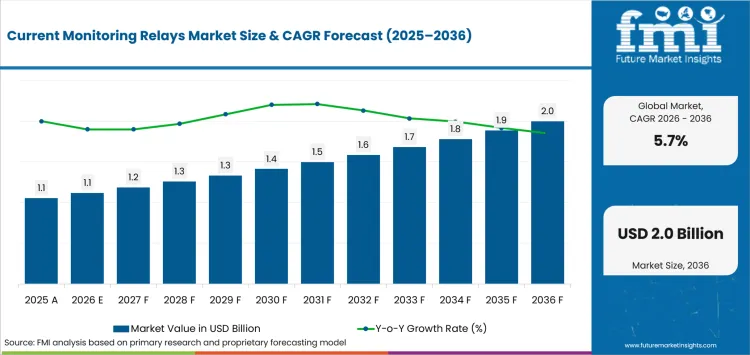
USD 1.1 billion in 2026 and USD 2.0 billion by 2036 at a 5.7% CAGR.
Current monitoring relay demand is projected to expand at a 5.7% CAGR between 2026 and 2036, raising valuation from USD 1.1 billion to USD 2.0 billion. Panel builders compare a dedicated industrial relay with broader power monitoring functions once abnormal current needs a local alarm without controller redesign. Carlo Gavazzi's June 2025 results recorded stronger performance for monitoring relays and timers than several other control lines. The company evidence supports repeat protection purchases without treating one manufacturer's result as proof of the market forecast.
Country conversion depends on how much active industrial equipment still needs panel-level protection. Federal Reserve data released in August 2026 showed USA manufacturing output increased 0.2% in July and rose 0.4% after excluding motor vehicles. Those figures do not measure relay orders but confirm continued operation inside a large industrial equipment base. Current monitoring therefore competes with power management systems and other protection devices for each available panel function.
Key Takeaways of Current Monitoring Relays Market
- Motor and pump operators specify current monitoring relays after a defined current deviation can warn of overload, dry running or mechanical binding before downtime expands.
- By relay type, overcurrent relays are estimated to hold 25.0% in 2026 owing to a high-current threshold that maps directly to familiar overload protection decisions.
- In 2026, DIN-rail mounting is expected to lead mounting with 56.0% share because modular cabinets use standard rail spacing for replaceable control devices.
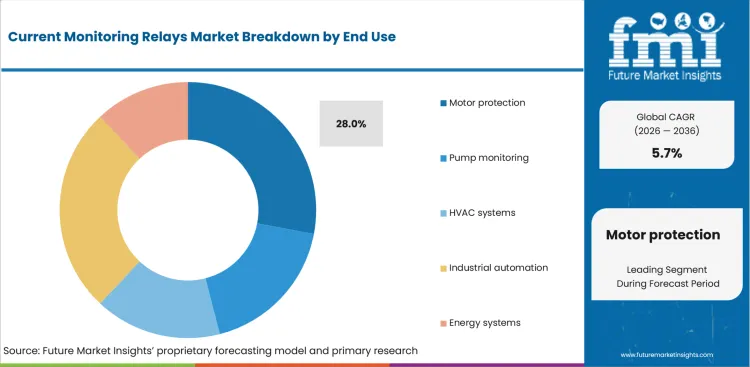
- Motor protection is projected to hold 28.0% share in 2026 due to current changes that give technicians immediate electrical evidence of rotating-equipment loading.
- Inrush current, variable-speed drives and existing overload protection can lengthen commissioning because engineers must prove that trip settings separate real faults from normal operating transients.
- Some of the key players in this market include Schneider Electric, Siemens, ABB, Eaton, Carlo Gavazzi, Omron, Finder, and Littelfuse.
Analyst Perspective
"A current monitoring relay earns its own panel position after engineers confirm that the overload relay or drive does not already cover the target fault. Stronger offers pair repeatable trip behavior with stocked replacement access and diagnostics that shorten commissioning or fault isolation."
- Nikhil Kaitwade, Principal Consultant, Future Market Insights
How is the Current Monitoring Relays Market segmented?
The current monitoring relays market is segmented by relay type, current range, mounting, end use and sales channel.
The market taxonomy covers relay type, current range, mounting, end use and sales channel. Relay types include overcurrent, undercurrent, window current, phase current and ground-fault monitoring relays. Current ranges include below 5 A, 5-20 A, 20-100 A and above 100 A. Mounting covers DIN-rail, panel, plug-in and PCB formats. End uses include motor protection, pump monitoring, HVAC systems, industrial automation and energy systems. Sales channels include electrical distributors, automation distributors, direct OEM supply and panel builders.
What supports Motor protection within the End use category?
Motor current gives maintenance teams a fast signal of overload or loss of load before the control system identifies a fault. Eaton introduced motor analytics software in April 2026 using current signature analysis to detect motor and pump problems without mounted sensors. The software extends beyond current relays but confirms the diagnostic value of current on rotating equipment.
- Motor protection is projected to hold 28.0% share in 2026 owing to current thresholds that fit pumps and other rotating machinery exposed to electrical faults.
- Operators compare current relays with condition monitoring systems because local trip logic must complement diagnostics without duplicating the same fault response.
What makes Overcurrent relays central to the Relay type category?
Overcurrent relays give maintenance teams a direct threshold for abnormal load before a machine fault becomes prolonged downtime. Schneider Electric launched TeSys Tera in April 2026 with current-based protection and monitoring for motor and pump applications that need integrated fault handling on industrial equipment.
- Based on relay type, overcurrent relays are projected to account for 25.0% in 2026 due to direct use against excessive current in overloaded or mechanically constrained equipment.
- Overcurrent settings also fit industrial power monitoring work because a local contact can isolate a defined fault without dedicating controller logic to every monitored load.
Why do Electrical distributors lead the Sales channel category?
Electrical distributors matter after a relay function is standardized because maintenance teams often need an exact replacement without another engineering cycle. Carlo Gavazzi's November 2025 results said medium-sized European distributors outperformed other channels under dedicated programs. Lower inventories also stabilized distribution sales in the Americas, reinforcing stocked access for routine industrial automation components.
- By sales channel, electrical distributors are estimated to hold 38.0% in 2026 owing to stocked access that shortens replacement lead times for standard panel devices.
- Distributors also let panel builders compare compatible voltages and contact formats quickly, which reduces downtime if the original relay family is unavailable.
How does DIN-rail mounting influence selection within the Mounting category?
DIN-rail mounting keeps monitoring relays aligned with the modular cabinet architecture used beside contactors and terminal blocks. Siemens issued a June 2025 sales release for the second delivery stage of SIRIUS 3UG5 monitoring relays, retaining higher function density in the same device footprint. The unchanged footprint lets technicians extend monitoring functions without redesigning adjacent cabinet hardware.
- In 2026, DIN-rail mounting is expected to lead the mounting category with 56.0% share because technicians can replace modular devices without redesigning cabinet hardware.
- Current relays also fit beside factory automation controls where standardized spacing and front access reduce wiring changes during service or panel expansion.
What are the drivers, restraints and opportunities in the Current Monitoring Relays Market?
Installed motorized equipment sustains protection demand, integrated control functions can displace standalone relays and clearer digital diagnostics create a route to higher-value specifications.
- Driver: Motorized and automated assets need local abnormal-current detection where a fast relay output can protect equipment without waiting for higher-level control logic.
- Restraint: Integrated motor-control functions can reduce the need for a separate current relay if the same fault is already detected elsewhere.
- Opportunity: Digital configuration and readable fault information can shorten commissioning provided the relay stays simple enough for routine panel replacement.
Motor and pump protection demand rises as electrical measurements reveal load changes before a process shutdown becomes necessary. ABB launched embedded Electrical Signature Analysis for selected legacy drives in November 2025 to identify bearing wear, misalignment and pump cavitation from electrical data. The method extends beyond standalone relays but confirms why current sensors and relay thresholds retain value for early rotating-asset fault evidence.
Standalone relays lose specification space if the motor-control device already detects overload and handles the required trip logic. Schneider Electric launched TeSys Deca Advanced in March 2025 with simplified wiring and a wide-band coil for motor-control applications. The integrated route reduces added panel work, so a separate current relay needs a fault function that the contactor or drive does not already provide.
Digital configuration becomes commercially useful once maintenance teams can read fault information without adding a controller retrofit. Omron announced Sysmac-Edge DX1 in September 2025 for no-code collection and visualization of factory-device data from existing equipment. Relay manufacturers can win higher-value specifications by exposing clear settings and fault records that fit these workflows beside solid state relays.
Which country CAGRs are profiled in the Current Monitoring Relays Market?
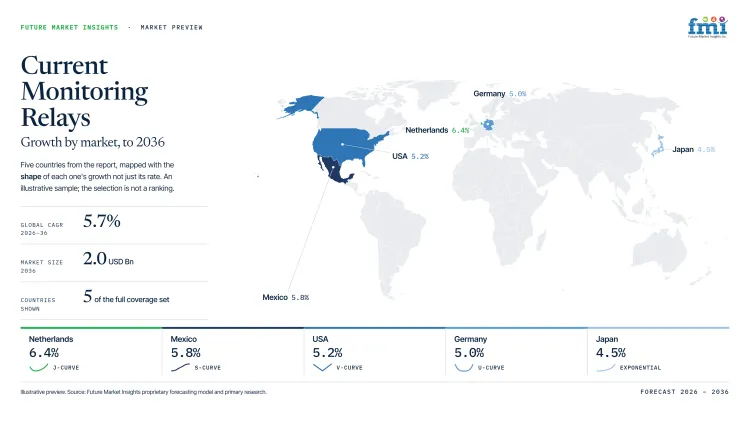
| Country | CAGR |
|---|---|
| Netherlands | 6.4% |
| Mexico | 5.8% |
| USA | 5.2% |
| Germany | 5.0% |
| Japan | 4.5% |
How do country-level CAGRs compare in the Current Monitoring Relays Market?
The profiled CAGRs span 1.9 percentage points, with the Netherlands leading at 6.4%, followed by Mexico at 5.8%. The USA and Germany occupy the middle range at 5.2% and 5.0%, respectively, while Japan records the lowest CAGR at 4.5%. The spread indicates that replacement demand, industrial automation intensity, and installed equipment diversity influence country-level growth differently.
- Benelux distributor density gives Dutch panel builders faster access to replacement control components.
- Mexico's export factories repeat machine platforms across automotive and appliance production lines.
- USA panel shops handle mixed legacy voltages that complicate relay family standardization.
- Germany’s mature industrial base supports steady automation-related replacement demand.
- Japan’s established equipment base moderates incremental relay market expansion.
Comparable CAGRs therefore mask different service routes and qualification burdens behind repeat orders. The full report carries country CAGR estimates for North America, Latin America, Europe, East Asia, South Asia, Oceania and the Middle East and Africa.
Country-wise Analysis
- Dutch factories often extend existing panels because grid congestion can delay projects that require larger electrical connections. An October 2025 government industrial-policy letter identified grid congestion as a material constraint and placed network capacity among immediate competitiveness concerns. Current monitoring relay demand in the Netherlands is forecast to rise at 6.4% CAGR over the forecast period, tied to retrofit work. Retrofitting lets plants improve asset protection without waiting for larger grid connections or major cabinet changes. Dense electrical distribution and familiar DIN-rail practice ease replacement work, but capacity-dependent expansions can slip and favor relays justified by asset protection during planned maintenance.
- Mexican panel builders often reuse machine designs at automotive and appliance plants serving export programs with short commissioning schedules. The Mexican current monitoring relays sector is projected to record 5.8% CAGR during the assessment period, driven by repeated factory equipment demand. Plan México set a January 2025 goal to raise national content by 15% and track 100 industrial parks every month. The policy gives manufacturers a clearer route toward domestic equipment investment without eliminating cross-border component dependence. Local component inventory reduces lead-time risk, but approval cycles can delay substitutions. OEMs holding compatible stock near manufacturing corridors can convert repeated machine platforms into steadier replacement orders.
- USA plants run a mature mix of motors, overload relays and PLCs that gives engineers several established routes for abnormal-current protection. Existing protection alternatives can make a standalone relay redundant on some loads, especially if variable-speed drives already provide current diagnostics. Federal Reserve data released in June 2026 showed manufacturing output in May stood 1.4% above its year-earlier level. The figure confirms steady use of a large industrial equipment base without measuring relay orders. The USA is estimated to post 5.2% CAGR over the forecast period given replacement work on installed machinery. National distribution favors relays that shorten fault isolation on older equipment where replacement speed outweighs added diagnostics.
- Germany’s machinery-intensive manufacturing sector maintains broad use of motor protection, contactors, overload devices, and industrial control systems. Modernization of production lines creates recurring requirements for monitoring relays where equipment upgrades retain existing electrical architectures. Strong engineering standards and established automation practices favor reliable protection components that integrate into established control cabinets. Germany is estimated to post a 5.0% CAGR over the forecast period, supported by replacement demand across automotive, machinery, chemical, and process industries.
- Japan’s industrial base is characterized by highly automated factories and long-lived production equipment, supporting a steady replacement market for current-monitoring components. Compact control panels and space-efficient machinery designs favor relays that provide localized current detection without requiring major cabinet modifications. Demand is further supported by maintenance of robotics, machine tools, semiconductor equipment, and factory automation systems. Japan is estimated to record a 4.5% CAGR over the forecast period, reflecting stable replacement activity but comparatively moderate incremental expansion in a mature automation market.
Who are the notable companies in the Current Monitoring Relays Market?
Schneider Electric, Siemens, ABB, Eaton, Carlo Gavazzi, Omron, Finder, and Littelfuse.
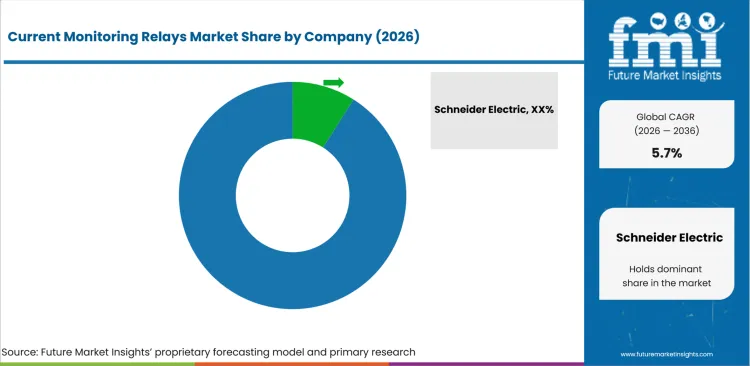
Competition separates broad automation platforms from focused relay manufacturers and motor-protection specialists. Schneider Electric, Siemens and ABB place monitoring functions beside wider control architectures. Eaton and Littelfuse bring deeper motor-protection logic for pumps and other rotating industrial equipment. Carlo Gavazzi, Omron and Finder compete nearer the panel-component decision with focused relay families. Entry depends on documented current ranges, predictable trip behavior and local stock because repeated machine platforms often standardize one approved relay family.
- Schneider Electric, Siemens and ABB serve global automation programs where relay selection is often tied to standardized cabinet architectures and wider control-system support.
- Carlo Gavazzi, Omron and Finder compete with focused monitoring and relay families that panel builders can specify independently of a larger automation platform.
- Eaton and Littelfuse concentrate on motor and pump protection where current measurement is evaluated beside overload, ground-fault and diagnostic functions.
Competitive Benchmarking: Current Monitoring Relays Market
| Company | Current / window monitoring breadth | Diagnostics and commissioning | Panel integration flexibility | Geographic reach |
|---|---|---|---|---|
| Schneider Electric | High | High | High | Global |
| Siemens | High | High | High | Global |
| ABB | High | Medium | High | Global |
| Eaton | High | High | Medium | Global |
| Carlo Gavazzi | High | Medium | Medium | Europe, Americas and Asia-Pacific |
| Omron | High | Medium | High | Japan, Asia-Pacific, North America and Europe |
| Finder | Medium | Medium | High | Europe with worldwide distribution |
| Littelfuse | High | High | Medium | North America, Europe and Asia-Pacific |
Scoring basis: High monitoring breadth requires documented overcurrent and undercurrent functions plus window or multi-range coverage. Medium monitoring breadth requires two directly documented functions that address separate current-monitoring conditions. Low monitoring breadth identifies one narrow current-monitoring route with limited functional coverage. High diagnostics requires digital configuration or communication paired with readable fault information during commissioning. Medium diagnostics covers local configuration without connected fault records for remote troubleshooting or analysis. Low diagnostics reflects basic adjustment using local dials or setpoints without connected fault data. High panel integration requires several mounting or wiring options plus documented transformer compatibility. Medium panel integration covers fewer installation choices with some adaptation to different cabinet designs. Low panel integration reflects one fixed installation route with limited adaptation to alternate cabinet layouts. Geographic reach uses documented sales or support regions and is not scored.
Key Developments in the Current Monitoring Relays Market
- In December 2025, Littelfuse completed its acquisition of Basler Electric to expand industrial controls and protection capabilities in power-intensive applications.
- In May 2025, ABB introduced Relion REC615 for secondary distribution protection with monitoring and IEC 61850 communication functions.
- In March 2025, Schneider Electric launched One Digital Grid and included the PowerLogic P7 relay platform for protection and control applications.
Key Players in the Current Monitoring Relays Market
Integrated Automation and Electrification Platforms
- Schneider Electric
- Siemens
- ABB
- Eaton
Panel Monitoring Specialists
- Carlo Gavazzi
- Omron
- Finder
Protection Specialist
- Littelfuse
Current Monitoring Relays Market - Report Scope
| Coverage field | Report scope |
|---|---|
| Market breakdown | By relay type, current range, mounting, end use, sales channel and region. |
| Quantitative Units | USD Billion. |
| Market Definition | Commercial current monitoring relays that measure current conditions and provide alarm, trip or switching outputs within the defined control and protection scope. |
| Regions Covered | North America, Latin America, Europe, East Asia, South Asia and Pacific, and Middle East and Africa. |
| Countries Covered | Netherlands, Mexico, South Korea, Brazil, USA, and 20+ countries included in the full report. |
| Key Companies Profiled | Schneider Electric, Siemens, ABB, Eaton, Carlo Gavazzi, Omron, Finder, and Littelfuse. |
| Forecast Period | 2026 to 2036. |
| Approach | Primary and secondary research with market triangulation. |
Current Monitoring Relays Market - Research Methodology
| Method | Approach |
|---|---|
| Primary Research | FMI analysts gathered input from manufacturers, service providers, technology developers, distributors, end users, procurement teams, and subject-matter experts. Interviews examined purchasing decisions, product or service evaluation, adoption barriers, approval requirements, pricing considerations, and expectations for technical or commercial support. Respondents were also asked what evidence is required before a trial, pilot, or initial order develops into regular purchasing. |
| Desk Research | Desk research covered government statistics, regulatory publications, trade data, industry associations, technical literature, standards, company filings, product information, and official corporate announcements. Sources were reviewed for relevance, publication date, geographic coverage, and consistency with the defined market scope. Claims relating to performance, applications, approvals, capacity, investment, and commercial activity were retained only when supported by credible public evidence. |
| Market Sizing and Forecasting | The market model combined the baseline value with historical performance, segment structure, pricing and volume indicators, adoption levels, company participation, and country-level demand conditions. Forecast assumptions considered economic activity, investment trends, regulatory developments, technology adoption, purchasing cycles, supply availability, and barriers to wider market use. Segment and regional estimates were reconciled before the final market total was calculated. |
| Data Validation | Estimates were checked against multiple independent indicators, including public data, company activity, trade patterns, industry developments, and findings from primary interviews. Validation also tested whether products, services, applications, and company revenues fell within the defined market boundaries. Adjacent categories, unsupported claims, overlapping revenues, and activities without direct market relevance were excluded to reduce double counting and maintain consistency across segments and countries. |
Current Monitoring Relays Market by Segments
Current Monitoring Relays Market segmented by Relay Type:
- Overcurrent relays
- Undercurrent relays
- Window current relays
- Phase current relays
- Ground fault monitoring relays
Current Monitoring Relays Market segmented by Current Range:
- Below 5 A
- 5-20 A
- 20-100 A
- Above 100 A
Current Monitoring Relays Market segmented by Mounting:
- DIN-rail
- Panel mount
- Plug-in
- PCB mount
Current Monitoring Relays Market segmented by End Use:
- Motor protection
- Pump monitoring
- HVAC systems
- Industrial automation
- Energy systems
Current Monitoring Relays Market segmented by Sales Channel:
- Electrical distributors
- Automation distributors
- Direct OEM supply
- Panel builders
Current Monitoring Relays Market by Region:
- North America
- United States
- Canada
- Latin America
- Brazil
- Mexico
- Argentina
- Chile
- Rest of Latin America
- Western Europe
- Germany
- United Kingdom
- Italy
- Spain
- France
- Nordics
- Benelux
- Rest of Western Europe
- Eastern Europe
- Russia
- Poland
- Hungary
- Balkan and Baltic States
- Rest of Eastern Europe
- East Asia
- China
- Japan
- South Korea
- South Asia and Pacific
- India
- ASEAN
- Australia and New Zealand
- Rest of South Asia and Pacific
- Middle East and Africa
- Kingdom of Saudi Arabia
- Other GCC Countries
- Türkiye
- South Africa
- Other African Union Countries
- Rest of Middle East and Africa
Research Sources and Bibliography
- Carlo Gavazzi. (2025, June 26). 2024/25 result mirrors general market slowdown.
- Board of Governors of the Federal Reserve System. (2026, August 18). Industrial Production and Capacity Utilization - G.17.
- Schneider Electric. (2026, April 27). Schneider Electric Launches Next-Generation Motor Management System for Industrial Applications.
- Carlo Gavazzi. (2025, November 20). HY results impacted by restructuring costs, business operations on track.
- Siemens. (2025, June 12). Sales Release - SIRIUS 3UG5 Monitoring Relays (Delivery Stage 2).
- Eaton. (2026, April 22). New Eaton predictive maintenance software significantly boosts uptime, energy efficiency across industrial applications.
- ABB. (2025, November 3). ABB launches embedded ESA technology in drives, turning modernization into a digital catalyst.
- Schneider Electric. (2025, March 17). Schneider Electric Unveils TeSys Deca Advanced: The Future of Motor Management.
- OMRON Corporation. (2025, September 9). OMRON to launch Sysmac-Edge DX1 Data Flow Controller, an edge controller that accelerates on-site data utilization.
- Government of the Netherlands. (2025, October 17). Letter to the House of Representatives on industrial policy.
- Presidency of Mexico. (2025, January 13). Presidenta Claudia Sheinbaum presenta el Plan México que contempla un portafolio de inversiones de 277 mmdd.
- Ministry of Trade, Industry and Energy, Republic of Korea. (2025, May 28).
- Brazilian Institute of Geography and Statistics. (2026, March 6). Industrial production up 1.8% in January.
- Board of Governors of the Federal Reserve System. (2026, June 15). Industrial Production and Capacity Utilization - G.17.
- Littelfuse. (2025, December 11). Littelfuse Completes Acquisition of Basler Electric.
- ABB. (2025, May 19). ABB introduces Relion REC615: A comprehensive relay solution for grid automation.
- Schneider Electric. (2025, March 25). Schneider Electric Unveils the Future of Energy Intelligence with One Digital Grid Platform.
- Schneider Electric. (2025, June 26). Schneider Electric Opens Robotics and Motion Center of Excellence in Raleigh.
- Siemens. (2025, October 10). From frying oil to coupling relays: Siemens and Envalior collaborate on more sustainable electrical products.
- OMRON Corporation. (2025, October 14). OMRON and NTT DOCOMO BUSINESS partner to provide secure data collaboration solutions based on Catena-X standards.
- Carlo Gavazzi. (2025, August 29). Carlo Gavazzi Limited Announces Progressive Reduction of Production in Malta.
- Eaton. (2025, June 23). Eaton's Factories as a Grid approach helps manufacturing companies advance energy security for more affordable, resilient power.
- Schneider Electric. (2025, March 17). Schneider Electric Introduces Modicon Edge I/O NTS, the Future-Ready I/O Solution.
- Siemens. (2026, April 15). Siemens launches groundbreaking portfolio for the era of direct current technology.
- ABB. (2025, May 2). RXplore release 1.11.
- Eaton. (2025, October). Product announcements: Introducing the Eaton compact dual feeder in low-voltage motor control centers.
- Carlo Gavazzi. (2025). Sustainability Report 2024.
- OMRON Electronic Components. (2025, April 17). OMRON Announces G9EK Relay for Next-Gen Energy Applications.
- Finder. (2025, February 17). Finder expands OPTA range with Codesys®.
- Phoenix Contact. (2025, October 1). Reinventing automation with relays: The network-capable PLC-Interface Ethernet Gateway remote relay system with multi-protocol connection to the controller.
- Finder. (2025, April 4). Finder achieves ISO/IEC 27001 and 27701 certification.
This bibliography is provided for reader reference and is not exhaustive. The full report contains the complete reference list and detailed citations
This Report Answers
- What is the current monitoring relays market size in 2026 and what value is forecast for 2036?
- Which equipment-protection conditions support current monitoring relay demand in industrial control panels?
- Why do overcurrent relays hold the leading share within relay type?
- Why do electrical distributors hold the leading share within the sales channel category?
- How does DIN-rail mounting influence panel assembly and replacement decisions?
- How do the profiled country CAGRs differ between the Netherlands and the USA?
- Which specification frictions can limit standardization on motors and variable-speed drives?
- How do eight notable companies differ in monitoring breadth and commissioning support?
- Which recent relay and automation developments are changing competitive positioning in the current monitoring relays market?
Frequently Asked Questions
How big is the Current Monitoring Relays Market in 2026?
The current monitoring relays market is valued at USD 1.1 billion in 2026 and is projected to reach USD 2.0 billion by 2036. Growth follows continued protection needs in motorized equipment and industrial control panels.
What is the CAGR of the Current Monitoring Relays Market from 2026 to 2036?
The current monitoring relays market is projected to grow at a CAGR of 5.7% between 2026 and 2036. Expansion is supported by equipment protection, panel modernization and clearer local fault diagnostics.
Which relay type leads the Current Monitoring Relays Market?
The overcurrent relays segment is expected to hold 25.0% of the current monitoring relays market in 2026, driven by direct overload thresholds on motorized equipment. Panel engineers can commission that trip logic without redesigning the wider controller architecture.
Which countries are projected to record the highest growth in the Current Monitoring Relays Market?
The Netherlands is projected to grow at 6.4% CAGR, followed by Mexico at 5.8% and South Korea at 5.6% through 2036. Their growth paths differ because grid capacity, manufacturing investment and factory digitalization change order timing in each country.
Which companies are active in the Current Monitoring Relays Market?
Key companies in the current monitoring relays market include Schneider Electric, Siemens, ABB, Eaton, Carlo Gavazzi, Omron, Finder, and Littelfuse. These companies compete on monitoring breadth and diagnostic depth while panel integration and distribution reach separate their portfolios.
Preview the report firsthand - request a free sample
Get SampleGet the brochure for pricing and purchase details.
Get PDFTable of Content
- Key Takeaways
- Market Size and CAGR
- Top Growth Driver
- Fastest Growing Segment
- Leading Region
- Key Companies
- Emerging Opportunities
- Executive Summary
- Global Market Outlook
- Demand-side Trends
- Supply-side Trends
- Technology Roadmap Analysis
- Analysis and Recommendations
- Analyst Perspective (What is happening? Why now? What should investors know?)
- Key Questions Answered
- How large is the market?
- What is the CAGR?
- What are key trends?
- Which region dominates?
- Who are the leaders?
- Market Overview
- Market Coverage / Taxonomy
- Market Definition / Scope / Limitations
- Research Methodology
- Chapter Orientation
- Analytical Lens and Working Hypotheses
- Market Structure, Signals, and Trend Drivers
- Benchmarking and Cross-market Comparability
- Market Sizing, Forecasting, and Opportunity Mapping
- Research Design and Evidence Framework
- Desk Research Programme (Secondary Evidence)
- Expert Input and Fieldwork (Primary Evidence)
- Tooling, Models, and Reference Databases
- Data Engineering and Model Build
- Quality Assurance and Audit Trail
- Market Background
- Market Dynamics (Drivers, Restraints, Opportunity, Trends)
- Scenario Forecast (Optimistic, Likely, Conservative)
- Impact Analysis
- AI Impact
- Sustainability Impact
- Regulatory Impact
- Technology Impact
- Consumer / Buyer Analysis
- Purchase Drivers
- Adoption Barriers
- Buyer Journey
- Opportunity Map Analysis
- Product Life Cycle Analysis
- Supply Chain Analysis
- Investment Feasibility Matrix
- Value Chain Analysis
- PESTLE and Porter's Analysis
- Regulatory Landscape
- Regional Parent Market Outlook
- Production and Consumption Statistics
- Import and Export Statistics
- Global Market Analysis and Forecast, 2021 to 2036
- Historical Market Size Value (USD Billion) Analysis, 2021 to 2025
- Current and Future Market Size Value (USD Billion) Projections, 2026 to 2036
- Y-o-Y Growth Trend Analysis
- Absolute $ Opportunity Analysis
- Global Market Pricing Analysis, 2021 to 2036
- Global Market Analysis and Forecast, By Relay Type, 2021 to 2036
- Introduction / Key Findings
- Historical Market Size Value (USD Billion) Analysis By Relay Type, 2021 to 2025
- Current and Future Market Size Value (USD Billion) Analysis and Forecast By Relay Type, 2026 to 2036
- Overcurrent relays
- Undercurrent relays
- Window current relays
- Phase current relays
- Ground fault monitoring relays
- Overcurrent relays
- Y-o-Y Growth Trend Analysis By Relay Type, 2021 to 2025
- Absolute $ Opportunity Analysis By Relay Type, 2026 to 2036
- Global Market Analysis and Forecast, By Current Range, 2021 to 2036
- Introduction / Key Findings
- Historical Market Size Value (USD Billion) Analysis By Current Range, 2021 to 2025
- Current and Future Market Size Value (USD Billion) Analysis and Forecast By Current Range, 2026 to 2036
- Below 5 A
- 5-20 A
- 20-100 A
- Above 100 A
- Below 5 A
- Y-o-Y Growth Trend Analysis By Current Range, 2021 to 2025
- Absolute $ Opportunity Analysis By Current Range, 2026 to 2036
- Global Market Analysis and Forecast, By Mounting, 2021 to 2036
- Introduction / Key Findings
- Historical Market Size Value (USD Billion) Analysis By Mounting, 2021 to 2025
- Current and Future Market Size Value (USD Billion) Analysis and Forecast By Mounting, 2026 to 2036
- DIN-rail
- Panel mount
- Plug-in
- PCB mount
- DIN-rail
- Y-o-Y Growth Trend Analysis By Mounting, 2021 to 2025
- Absolute $ Opportunity Analysis By Mounting, 2026 to 2036
- Global Market Analysis and Forecast, By End Use, 2021 to 2036
- Introduction / Key Findings
- Historical Market Size Value (USD Billion) Analysis By End Use, 2021 to 2025
- Current and Future Market Size Value (USD Billion) Analysis and Forecast By End Use, 2026 to 2036
- Motor protection
- Pump monitoring
- HVAC systems
- Industrial automation
- Energy systems
- Motor protection
- Y-o-Y Growth Trend Analysis By End Use, 2021 to 2025
- Absolute $ Opportunity Analysis By End Use, 2026 to 2036
- Global Market Analysis and Forecast, By Sales Channel, 2021 to 2036
- Introduction / Key Findings
- Historical Market Size Value (USD Billion) Analysis By Sales Channel, 2021 to 2025
- Current and Future Market Size Value (USD Billion) Analysis and Forecast By Sales Channel, 2026 to 2036
- Electrical distributors
- Automation distributors
- Direct OEM supply
- Panel builders
- Electrical distributors
- Y-o-Y Growth Trend Analysis By Sales Channel, 2021 to 2025
- Absolute $ Opportunity Analysis By Sales Channel, 2026 to 2036
- Global Market Analysis and Forecast, By Region, 2021 to 2036
- Introduction
- Historical Market Size Value (USD Billion) Analysis By Region, 2021 to 2025
- Current Market Size Value (USD Billion) Analysis and Forecast By Region, 2026 to 2036
- North America
- Latin America
- Western Europe
- Eastern Europe
- East Asia
- South Asia and Pacific
- Middle East & Africa
- Market Attractiveness Analysis By Region
- North America Market Analysis and Forecast, By Country, 2021 to 2036
- Historical Market Size Value (USD Billion) Trend Analysis By Market Taxonomy, 2021 to 2025
- Market Size Value (USD Billion) Forecast By Market Taxonomy, 2026 to 2036
- By Country
- USA
- Canada
- By Relay Type
- By Current Range
- By Mounting
- By End Use
- By Sales Channel
- By Country
- Market Attractiveness Analysis
- By Country
- By Relay Type
- By Current Range
- By Mounting
- By End Use
- By Sales Channel
- Key Takeaways
- Latin America Market Analysis and Forecast, By Country
- Historical Market Size Value (USD Billion) Trend Analysis By Market Taxonomy, 2021 to 2025
- Market Size Value (USD Billion) Forecast By Market Taxonomy, 2026 to 2036
- By Country
- Brazil
- Mexico
- Chile
- Rest of Latin America
- By Relay Type
- By Current Range
- By Mounting
- By End Use
- By Sales Channel
- By Country
- Market Attractiveness Analysis
- By Country
- By Relay Type
- By Current Range
- By Mounting
- By End Use
- By Sales Channel
- Key Takeaways
- Western Europe Market Analysis and Forecast, By Country
- Historical Market Size Value (USD Billion) Trend Analysis By Market Taxonomy, 2021 to 2025
- Market Size Value (USD Billion) Forecast By Market Taxonomy, 2026 to 2036
- By Country
- Germany
- UK
- Italy
- Spain
- France
- Nordic
- BENELUX
- Rest of Western Europe
- By Relay Type
- By Current Range
- By Mounting
- By End Use
- By Sales Channel
- By Country
- Market Attractiveness Analysis
- By Country
- By Relay Type
- By Current Range
- By Mounting
- By End Use
- By Sales Channel
- Key Takeaways
- Eastern Europe Market Analysis and Forecast, By Country
- Historical Market Size Value (USD Billion) Trend Analysis By Market Taxonomy, 2021 to 2025
- Market Size Value (USD Billion) Forecast By Market Taxonomy, 2026 to 2036
- By Country
- Russia
- Poland
- Hungary
- Balkan & Baltic
- Rest of Eastern Europe
- By Relay Type
- By Current Range
- By Mounting
- By End Use
- By Sales Channel
- By Country
- Market Attractiveness Analysis
- By Country
- By Relay Type
- By Current Range
- By Mounting
- By End Use
- By Sales Channel
- Key Takeaways
- East Asia Market Analysis and Forecast, By Country
- Historical Market Size Value (USD Billion) Trend Analysis By Market Taxonomy, 2021 to 2025
- Market Size Value (USD Billion) Forecast By Market Taxonomy, 2026 to 2036
- By Country
- China
- Japan
- South Korea
- By Relay Type
- By Current Range
- By Mounting
- By End Use
- By Sales Channel
- By Country
- Market Attractiveness Analysis
- By Country
- By Relay Type
- By Current Range
- By Mounting
- By End Use
- By Sales Channel
- Key Takeaways
- South Asia and Pacific Market Analysis and Forecast, By Country
- Historical Market Size Value (USD Billion) Trend Analysis By Market Taxonomy, 2021 to 2025
- Market Size Value (USD Billion) Forecast By Market Taxonomy, 2026 to 2036
- By Country
- India
- ASEAN
- Australia & New Zealand
- Rest of South Asia and Pacific
- By Relay Type
- By Current Range
- By Mounting
- By End Use
- By Sales Channel
- By Country
- Market Attractiveness Analysis
- By Country
- By Relay Type
- By Current Range
- By Mounting
- By End Use
- By Sales Channel
- Key Takeaways
- Middle East & Africa Market Analysis and Forecast, By Country
- Historical Market Size Value (USD Billion) Trend Analysis By Market Taxonomy, 2021 to 2025
- Market Size Value (USD Billion) Forecast By Market Taxonomy, 2026 to 2036
- By Country
- Kingdom of Saudi Arabia
- Other GCC Countries
- Türkiye
- South Africa
- Other African Union
- Rest of Middle East & Africa
- By Relay Type
- By Current Range
- By Mounting
- By End Use
- By Sales Channel
- By Country
- Market Attractiveness Analysis
- By Country
- By Relay Type
- By Current Range
- By Mounting
- By End Use
- By Sales Channel
- Key Takeaways
- Key Countries Market Analysis
- USA
- Pricing Analysis
- Market Share Analysis, 2025
- By Relay Type
- By Current Range
- By Mounting
- By End Use
- By Sales Channel
- Canada
- Pricing Analysis
- Market Share Analysis, 2025
- By Relay Type
- By Current Range
- By Mounting
- By End Use
- By Sales Channel
- Mexico
- Pricing Analysis
- Market Share Analysis, 2025
- By Relay Type
- By Current Range
- By Mounting
- By End Use
- By Sales Channel
- Brazil
- Pricing Analysis
- Market Share Analysis, 2025
- By Relay Type
- By Current Range
- By Mounting
- By End Use
- By Sales Channel
- Chile
- Pricing Analysis
- Market Share Analysis, 2025
- By Relay Type
- By Current Range
- By Mounting
- By End Use
- By Sales Channel
- Germany
- Pricing Analysis
- Market Share Analysis, 2025
- By Relay Type
- By Current Range
- By Mounting
- By End Use
- By Sales Channel
- UK
- Pricing Analysis
- Market Share Analysis, 2025
- By Relay Type
- By Current Range
- By Mounting
- By End Use
- By Sales Channel
- Italy
- Pricing Analysis
- Market Share Analysis, 2025
- By Relay Type
- By Current Range
- By Mounting
- By End Use
- By Sales Channel
- Spain
- Pricing Analysis
- Market Share Analysis, 2025
- By Relay Type
- By Current Range
- By Mounting
- By End Use
- By Sales Channel
- France
- Pricing Analysis
- Market Share Analysis, 2025
- By Relay Type
- By Current Range
- By Mounting
- By End Use
- By Sales Channel
- India
- Pricing Analysis
- Market Share Analysis, 2025
- By Relay Type
- By Current Range
- By Mounting
- By End Use
- By Sales Channel
- ASEAN
- Pricing Analysis
- Market Share Analysis, 2025
- By Relay Type
- By Current Range
- By Mounting
- By End Use
- By Sales Channel
- Australia & New Zealand
- Pricing Analysis
- Market Share Analysis, 2025
- By Relay Type
- By Current Range
- By Mounting
- By End Use
- By Sales Channel
- China
- Pricing Analysis
- Market Share Analysis, 2025
- By Relay Type
- By Current Range
- By Mounting
- By End Use
- By Sales Channel
- Japan
- Pricing Analysis
- Market Share Analysis, 2025
- By Relay Type
- By Current Range
- By Mounting
- By End Use
- By Sales Channel
- South Korea
- Pricing Analysis
- Market Share Analysis, 2025
- By Relay Type
- By Current Range
- By Mounting
- By End Use
- By Sales Channel
- Russia
- Pricing Analysis
- Market Share Analysis, 2025
- By Relay Type
- By Current Range
- By Mounting
- By End Use
- By Sales Channel
- Poland
- Pricing Analysis
- Market Share Analysis, 2025
- By Relay Type
- By Current Range
- By Mounting
- By End Use
- By Sales Channel
- Hungary
- Pricing Analysis
- Market Share Analysis, 2025
- By Relay Type
- By Current Range
- By Mounting
- By End Use
- By Sales Channel
- Kingdom of Saudi Arabia
- Pricing Analysis
- Market Share Analysis, 2025
- By Relay Type
- By Current Range
- By Mounting
- By End Use
- By Sales Channel
- Türkiye
- Pricing Analysis
- Market Share Analysis, 2025
- By Relay Type
- By Current Range
- By Mounting
- By End Use
- By Sales Channel
- South Africa
- Pricing Analysis
- Market Share Analysis, 2025
- By Relay Type
- By Current Range
- By Mounting
- By End Use
- By Sales Channel
- USA
- Market Structure Analysis
- Competition Dashboard
- Competition Benchmarking
- Market Share Analysis of Top Players
- By Regional
- By Relay Type
- By Current Range
- By Mounting
- By End Use
- By Sales Channel
- Emerging Startups
- Innovation Benchmarking
- Competition Analysis
- Competition Deep Dive
- Schneider Electric
- Overview
- Product Portfolio
- Profitability by Market Segments
- Sales Footprint
- Strategy Overview
- Marketing Strategy
- Product Strategy
- Channel Strategy
- Siemens
- ABB
- Eaton
- Carlo Gavazzi
- Phoenix Contact
- Omron
- Finder
- Littelfuse
- Telemecanique Sensors
- Schneider Electric
- Case Studies
- Success Stories
- Recent Developments
- Competition Deep Dive
- Assumptions & Acronyms Used


