

- Market Size (2026)
- USD 267.96 Mn
- Forecast (2036)
- USD 4584.38 Mn
- CAGR (2026 to 2036)
- 32.8%
How big is the Dapagliflozin market in 2026?
USD 267.96 million in 2026 and USD 4,584.38 million by 2036 at a 32.8% CAGR.
The dapagliflozin market was valued at USD 218.84 million in 2025. It is expected to grow from USD 267.96 million in 2026 to USD 4,584.38 million in 2036 at a CAGR of 32.8% as generic tablet approvals shift API buying toward launch-grade supply. Type 2 Diabetes is expected to hold 62.0% share in 2026, supported by chronic-care prescribing across regulated channels. Powder is projected to secure 61.0% share in 2026, guided by blending and compression needs in high-volume tablet manufacturing.
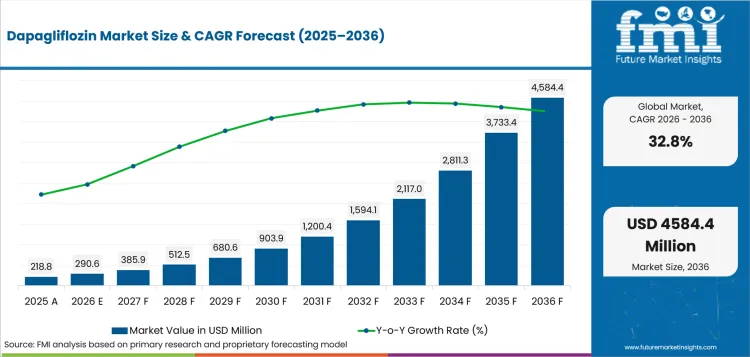
| Metric | Value |
|---|---|
| 2026 Market Size | USD 267.96 million |
| 2036 Market Size | USD 4,584.38 million |
| Forecast CAGR (2026-2036) | 32.8% |
| Leading Application | Type 2 Diabetes |
| Type 2 Diabetes Share (2026) | 62.0% |
| Leading Form | Powder |
| Powder Share (2026) | 61.0% |
| Fastest-growing Country | India |
| India CAGR by 2036 | 36.9% |
Summary of the Dapagliflozin Market
| Market Signal | Commercial Impact |
|---|---|
| Demand and Growth Drivers | Demand for dapagliflozin API is projected to expand through 2036 as generic finished-dose launches accelerate and regulated pharmaceutical markets require stronger regulatory documentation and supply assurance.
|
| Product and Segment View | Type 2 diabetes applications, powder formulations, and direct sales channels continue to lead their respective market segments.
|
| Geography and Growth Outlook | Asia continues to strengthen its position as the primary manufacturing base while regulated pharmaceutical markets support long-term API demand.
|
| Competitive Landscape | Competition increasingly emphasizes regulatory readiness, manufacturing quality, and dependable API supply.
|
| Analyst Perspective | Dapagliflozin API is transitioning from development-stage procurement toward commercial manufacturing, making regulatory compliance and supply reliability increasingly important competitive factors.
- Anurag Sharma, Principal Consultant for Healthcare at Future Market Insights |
Cardio-metabolic therapy demand, generic entry, and kidney-disease treatment use are influencing value outlook. International Diabetes Federation reported 589 million adults aged 20 to 79 living with diabetes in 2024, while projections reach 853 million by 2050. United States regulators approved first generic dapagliflozin tablets in April 2026, confirming commercial entry for multiple applicants across type 2 diabetes, heart failure, and chronic kidney disease uses. United States kidney-disease reporting estimated 37 million adults with chronic kidney disease in 2026, and 38% of adults with diabetes had chronic kidney disease, strengthening long-term cardio-renal API demand.
Which factors support expansion in the Dapagliflozin market?
Finished-dose competition and cardio-renal use support API value across regulated and emerging pharmaceutical channels.
- Generic entry increases commercial API buying as approved tablet makers need repeatable batch release and stable documentation.
- Chronic treatment use supports longer supply planning across diabetes and chronic kidney disease applications.
- Powder API gains preference as tablet producers prioritize blend uniformity and particle-size consistency.
- High-purity grades support regulated launches as impurity data and residual-solvent records shape supplier qualification.
Why is the Dapagliflozin market growing?
Generic tablet entry is turning dapagliflozin API buying into a launch-sensitive commercial supply decision.
Finished-dose demand is rising as diabetes treatment spending expands through prescription channels. NHS prescribing data for England reported more than 58 million anti-diabetic prescription items in 2024/25, while total anti-diabetic drug cost reached GBP 1.1 billion after an 18% cost increase from 2023/24. Dapagliflozin API suppliers benefit as payers and formulation buyers look for dependable generic supply able to support lower-cost chronic-care access. Commercial selection will favor producers with validated high-purity material and complete regulatory files.
How is the Dapagliflozin Market segmented?
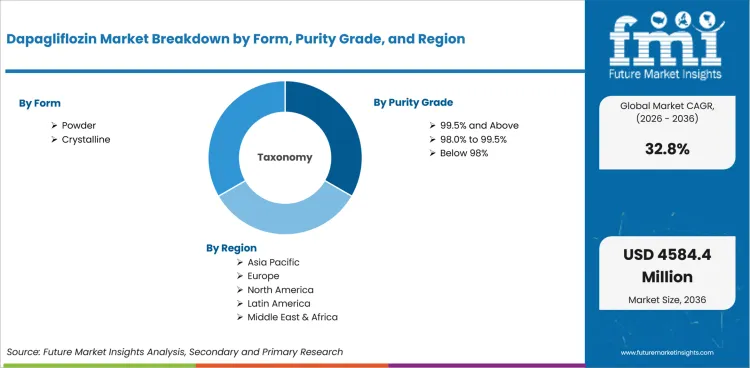
Dapagliflozin Market is segmented by form, purity grade, application, sales channel, and buyer type.
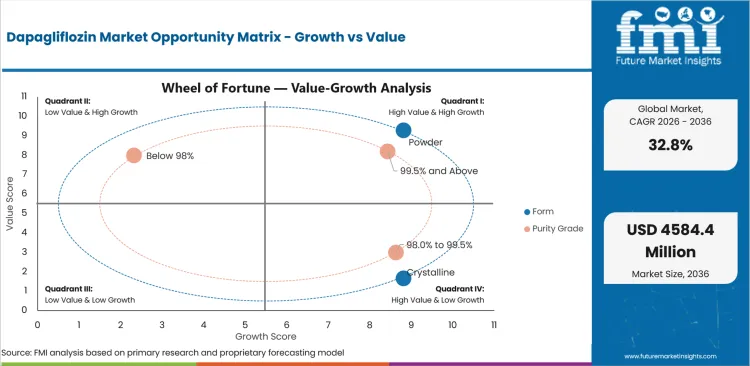
- Powder is projected to account for 61.0% share in 2026, influenced by tablet manufacturers needing controlled blending and compression behavior during generic scale-up.
- 99.5% and above is expected to hold 54.0% share in 2026, supported by impurity-control expectations across regulated finished-dose filings.
- Type 2 diabetes is anticipated to account for 62.0% share in 2026, led by chronic-care prescribing and repeat formulation demand.
- Direct sales is projected to represent 58.0% share in 2026, guided by buyer preference for supplier audits and filing support.
- Generic formulation manufacturers are expected to lead by 56.0% share in 2026, supported by tablet-launch timing and commercial API reservation.
Why does powder lead the Dapagliflozin market by form?
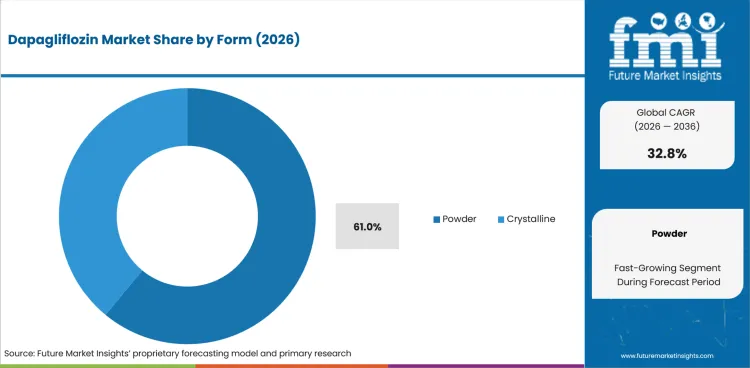
- Powder is projected to account for 61.0% share in 2026, driven by tablet producers needing flow control and compression support during launch-scale manufacturing.
- Crystalline API retains use in qualification programs and storage-focused workflows, Commercial tablet makers often prefer powder for faster scale-up flexibility.
Which purity grade leads the Dapagliflozin market?
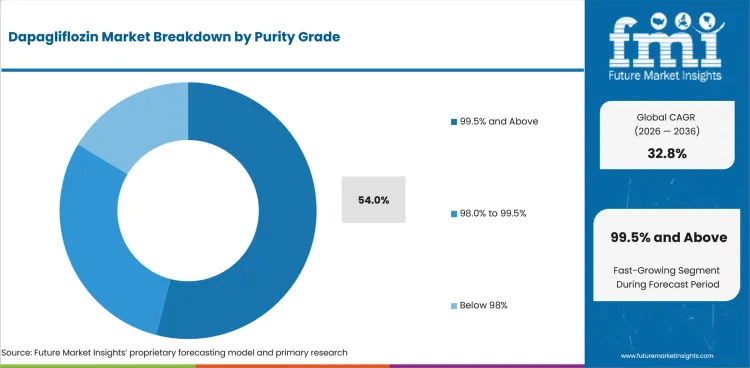
- 99.5% and above is expected to hold 54.0% share in 2026, reflected by regulated buyers placing high weight on impurity profiles and stability records.
- Lower purity grades support development batches and early qualification work. Commercial approvals require stronger documentation before repeat supply.
Which application leads the Dapagliflozin Market?
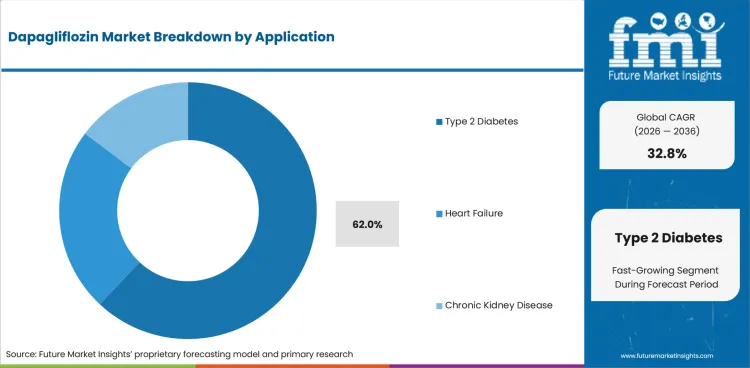
- Type 2 diabetes is anticipated to account for 62.0% share in 2026, led by chronic-care finished-dose demand and a wide treatment base.
- Heart failure and chronic kidney disease add value as cardio-renal labeling expands commercial planning beyond glucose-control channels.
Which sales channel leads the Dapagliflozin Market?
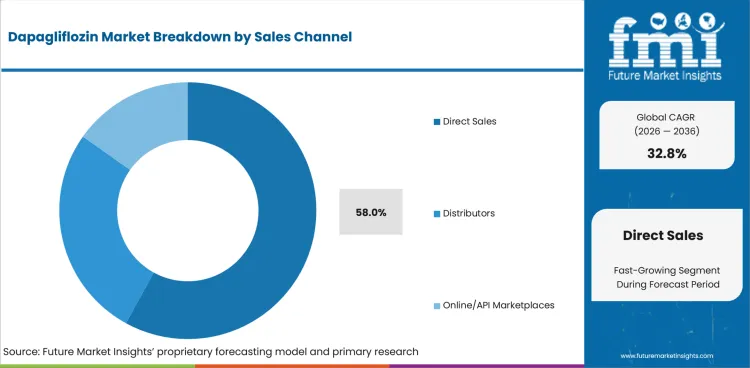
- Direct sales is expected to represent 58.0% share in 2026, guided by buyer need for audit rights, regulatory-file access, and batch reservation.
- Distributor supply remains active for smaller buyers and regional channels needing lower-volume sourcing.
Which buyer type leads the Dapagliflozin Market?
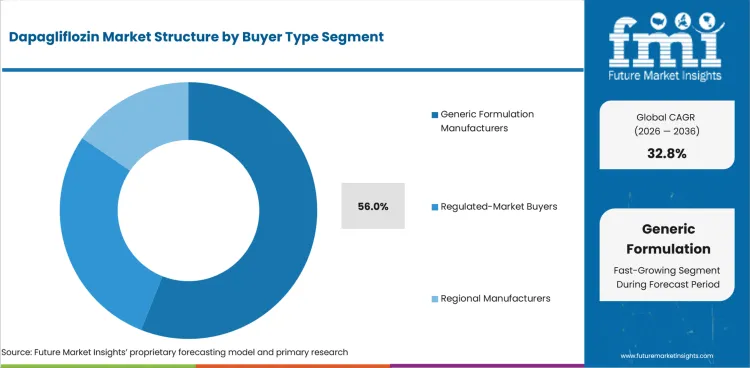
- Generic formulation manufacturers are expected to lead by 56.0% share in 2026, shaped by approved tablet launches and regulated-market filing requirements.
- Regional manufacturers remain active as local chronic-care treatment demand creates opportunities for qualified API suppliers.
What are the drivers, restraints, and opportunities in the Dapagliflozin Market?
Generic launch timing and payer-driven affordability are shaping dapagliflozin API buying decisions.
- Driver: Generic tablet makers need dependable API supply as commercial launches move beyond pilot batches.
- Restraint: Quality documentation and inspection readiness can delay supplier approvals for regulated channels.
- Opportunity: High-purity API producers can secure longer contracts by linking impurity control with buyer filing support.
Generic Launch Demand Raises API Reservation
Generic manufacturers need commercial API planning as diabetes and cardio-renal patient pools expand. United States diabetes reporting issued in 2026 estimated 40.1 million people with diabetes and 115.2 million adults with prediabetes, showing a large chronic-care base for SGLT2 medicine demand. API producers with validated powder behavior and stable high-purity release can convert finished-dose approvals into multi-year supply commitments.
Quality Scrutiny Raises Supplier Qualification Burden
Regulated markets require stronger evidence before commercial API approval. United States pharmaceutical quality reporting recorded 972 human-drug manufacturing inspections in FY2024, up from 766 in FY2023, increasing attention on quality systems and manufacturing readiness. Smaller API suppliers may face delays if impurity files or change-control records remain incomplete.
Generic Savings Create Contract Opportunities
Payer savings targets create stronger openings for qualified dapagliflozin API suppliers. NHS England guidance estimated cumulative savings of GBP 560 million across 2025/26 and 2026/27 linked to generic dapagliflozin availability. Finished-dose companies can use qualified API supply to support lower-cost access, while API makers gain from direct contracts tied to continuity and batch reliability.
Which countries are growing at higher rates in the Dapagliflozin market?
India 36.9% CAGR, China 35.8% CAGR, United States 33.5% CAGR, South Korea 32.9% CAGR, United Kingdom 30.1% CAGR, Germany 29.6% CAGR, France 28.9% CAGR, and Japan 27.8% CAGR through 2036.
.webp "Top Country Growth Comparison Dapagliflozin Market Cagr (2026 2036)")
| Country | CAGR |
|---|---|
| India | 36.9% |
| China | 35.8% |
| United States | 33.5% |
| South Korea | 32.9% |
| United Kingdom | 30.1% |
| Germany | 29.6% |
| France | 28.9% |
| Japan | 27.8% |
Source: Future Market Insights, 2026.
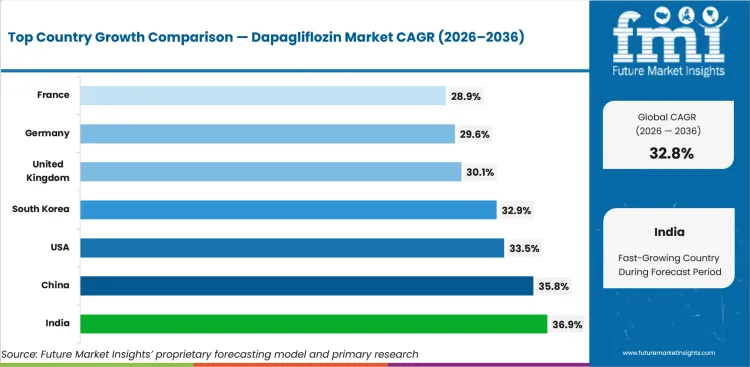
How do country-level CAGRs compare in the Dapagliflozin Market?
India leads country expansion while Japan records a more cautious pace among profiled markets.
- India is forecast to record 36.9% CAGR by 2036 as API manufacturing scale and generic tablet capacity support commercial supply.
- China is expected to expand at 35.8% CAGR from 2026 to 2036, led by chronic-care demand and local production depth.
- United States is projected to grow at 33.5% CAGR through 2036, reflected by first generic approvals and regulated launch timing.
- South Korea is estimated to rise at 32.9% CAGR by 2036, supported by diabetes treatment demand and local generic manufacturing.
- United Kingdom is expected to advance at 30.1% CAGR over the forecast period as payer savings and generic prescribing reshape demand.
- Germany is forecast to grow at 29.6% CAGR by 2036, backed by diabetes prevalence and generic medicine use.
- France is projected to post 28.9% CAGR by 2036, guided by medicated diabetes prevalence and reimbursement controls.
- Japan is expected to record 27.8% CAGR by 2036, driven by mature chronic-care prescribing and local generic substitution needs.
How fast is the Dapagliflozin market growing in India?
A 36.9% CAGR through 2036 reflects API manufacturing scale and domestic generic tablet launches.
Country Market Snapshot Table
| Parameter | Value |
|---|---|
| Market Size in 2025 (Value) | USD 25.7 million |
| Market Size in 2026 (Value) | USD 35.2 million |
| Market Forecast in 2036 (Value) | USD 805.9 million |
| CAGR (2026 to 2036) | 36.9% |
| Years Considered | 2021 to 2036 |
| Base Year | 2025 |
| Forecast Period | 2026 to 2036 |
| Units Considered | Value (USD million) |
| Leading Sub-Region | Hyderabad, Gujarat, and western pharmaceutical clusters |
India Dapagliflozin Market Outlook
India Dapagliflozin demand advances through API manufacturing depth and generic finished-dose capacity. Local suppliers are positioned to support filing-linked commercial supply across regulated and domestic channels.
Buyers are expected to favor companies offering high-purity material, DMF support and repeatable powder handling. Local service access will remain useful as formulation makers prepare commercial batches and regulatory submissions.
Key Growth Drivers
- API producers benefit from a large chronic-care treatment base, supported by International Diabetes Federation data showing 89.8 million adults with diabetes in India in 2024 and 156.7 million projected by 2050.
- Finished-dose activity is supported by regulatory review momentum, reinforced by a January 2025 expert committee recommendation for manufacturing and marketing permission for dapagliflozin tablets in 5 mg and 10 mg strengths.
- Domestic formulation companies need stable powder API as tablet launch windows require faster batch transfer from validation to commercial production.
- Export-oriented buyers favor suppliers with impurity controls and filing documentation aligned to regulated-market expectations.
Key Restraints
- Price competition can compress API margins as multiple formulation companies qualify suppliers for similar tablet launches.
- Regulatory review can require added clinical or chemistry data for complex fixed-dose combinations, shown by a 2025 committee request for a Phase III protocol before approval of a proposed dapagliflozin combination strength.
- Smaller API producers may face qualification delays if residual-solvent records or stability packages remain incomplete.
What makes India unique
India differs through integrated API production and filing-support experience across regulated channels.
Key Companies
- Dr. Reddy’s Laboratories
- Aurobindo Pharma
- Lupin
- Biocon
- MSN Laboratories
- Hetero Drugs
- Optimus Drugs
- MetroChem API
Sales & Marketing Channels
- Direct technical sales to formulation manufacturers
- Regulatory-file support for export-focused tablet makers
- Distributor supply for smaller domestic buyers
- Contract supply agreements with launch-linked batch reservation
- Tender-linked supply through qualified finished-dose partners
Country Segment Breakdown Table
| Segment | Sub-Segments |
|---|---|
| By Form | Powder · Crystalline |
| By Purity Grade | 99.5% and Above · 98.0% to 99.5% · Below 98% |
| By Application | Type 2 Diabetes · Heart Failure · Chronic Kidney Disease |
| By Sales Channel | Direct Sales · Distributors · Online/API Marketplaces |
| By Buyer Type | Generic Formulation Manufacturers · Regulated-Market Buyers · Regional Manufacturers |
| Key Sub-Regions Covered, Pharmaceutical Corridors | Hyderabad · Gujarat · Maharashtra · Himachal Pradesh · Goa · Sikkim |
Frequently Asked Questions
How fast is India Dapagliflozin market growing?
Industry in India is projected to rise at 36.9% CAGR from 2026 to 2036, driven by export-ready API production and finished-dose launch planning.
Who leads India Dapagliflozin market?
Dr. Reddy’s Laboratories, Aurobindo Pharma, Lupin, Biocon, MSN Laboratories, and Hetero Drugs compete through API depth and tablet manufacturing scale.
What is driving adoption in India Dapagliflozin market?
Regulated-market filings and launch-grade powder API needs are moving buyers toward qualified local suppliers.
What is the Dapagliflozin market outlook in China?
A 35.8% CAGR through 2036 reflects large diabetes treatment demand and domestic pharmaceutical scale.
Country Market Snapshot Table
| Parameter | Value |
|---|---|
| Market Size in 2025 (Value) | USD 30.2 million |
| Market Size in 2026 (Value) | USD 41.0 million |
| Market Forecast in 2036 (Value) | USD 874.9 million |
| CAGR (2026 to 2036) | 35.8% |
| Years Considered | 2021 to 2036 |
| Base Year | 2025 |
| Forecast Period | 2026 to 2036 |
| Units Considered | Value (USD million) |
| Leading Sub-Region | Zhejiang, Jiangsu, Shandong, and Shanghai pharmaceutical corridors |
China Dapagliflozin Market Outlook
China Dapagliflozin API buying reflects a large diabetes population and local finished-dose manufacturing capacity. Domestic suppliers benefit from chronic-care demand and local medicine access programs.
Manufacturers are expected to prioritize price discipline and stable supply. API qualification will depend on impurity control and alignment with national drug approval expectations.
Key Growth Drivers
- Diabetes treatment demand provides a large addressable base, as International Diabetes Federation data placed China at 148.0 million adults with diabetes in 2024 and 168.3 million projected by 2050.
- Drug review efficiency supports local chronic-care launches, indicated by NMPA reporting 110 drug approval applications across 74 categories under priority review in 2024, marking a 29% year-on-year increase.
- Local pharmaceutical producers can qualify dapagliflozin API for domestic tablet lines as chronic-care demand expands across hospitals and retail channels.
- Regional production networks support supply continuity as buyers compare local documentation and price stability.
Key Restraints
- Volume-based purchasing can pressure finished-dose prices and reduce flexibility for higher-cost API suppliers.
- Domestic review expectations can increase filing work as manufacturers align chemistry and control records with approval pathways.
- Tender pressure remains visible, measured by recent national medicine purchasing rounds covering 55 drugs across 14 therapeutic areas.
What makes China unique
China stands apart through a large chronic-care treatment pool and domestic formulation manufacturing density.
Key Companies
- Zhejiang Huahai Pharmaceutical
- Jiangsu Hansoh Pharmaceutical
- Qilu Pharmaceutical
- CSPC Pharmaceutical Group
- Hengrui Pharma
- China Resources Double-Crane
- Zhejiang Hisun Pharmaceutical
- Livzon Pharmaceutical
Sales & Marketing Channels
- Direct sales to domestic formulation manufacturers
- Hospital-linked tender supply through finished-dose partners
- Regional distributor networks for chronic-care medicines
- Contract supply agreements with local quality documentation
- API qualification support through regulatory affairs teams
Country Segment Breakdown Table
| Segment | Sub-Segments |
|---|---|
| By Form | Powder · Crystalline |
| By Purity Grade | 99.5% and Above · 98.0% to 99.5% · Below 98% |
| By Application | Type 2 Diabetes · Heart Failure · Chronic Kidney Disease |
| By Sales Channel | Direct Sales · Distributors · Online/API Marketplaces |
| By Buyer Type | Generic Formulation Manufacturers · Regulated-Market Buyers · Regional Manufacturers |
| Key Sub-Regions Covered, Pharmaceutical Corridors | Zhejiang · Jiangsu · Shandong · Shanghai · Guangdong · Hebei |
Frequently Asked Questions
How fast is China Dapagliflozin market growing?
Industry in China is projected to rise at 35.8% CAGR from 2026 to 2036, guided by chronic-care treatment needs and local tablet production.
Who leads China Dapagliflozin market?
Zhejiang Huahai Pharmaceutical, Jiangsu Hansoh Pharmaceutical, Qilu Pharmaceutical, CSPC Pharmaceutical Group, and Hengrui Pharma compete through domestic manufacturing and local approval support.
What is driving adoption in China Dapagliflozin market?
Drug review reform and domestic generic production are moving buyers toward qualified dapagliflozin API supply.
How is the Dapagliflozin market performing in the United States?
A 33.5% CAGR through 2036 reflects first generic approvals and regulated launch timing.
Country Market Snapshot Table
| Parameter | Value |
|---|---|
| Market Size in 2025 (Value) | USD 46.0 million |
| Market Size in 2026 (Value) | USD 61.4 million |
| Market Forecast in 2036 (Value) | USD 1,105.4 million |
| CAGR (2026 to 2036) | 33.5% |
| Years Considered | 2021 to 2036 |
| Base Year | 2025 |
| Forecast Period | 2026 to 2036 |
| Units Considered | Value (USD million) |
| Leading Sub-Region | New Jersey, Pennsylvania, North Carolina, and New York pharmaceutical corridors |
United States Dapagliflozin Market Outlook
United States Dapagliflozin API orders are guided by generic tablet approvals and chronic cardio-metabolic treatment demand. Commercial API buying moves toward validated suppliers as approved applicants prepare finished-dose supply.
Formulation buyers are expected to prioritize DMF access and change-control discipline. Suppliers with stable high-purity powder and audit support will hold better contract positions.
Key Growth Drivers
- Diabetes treatment demand supports generic tablet planning, as International Diabetes Federation data recorded 38.5 million adults with diabetes in the United States in 2024.
- Generic entry increases commercial API reservation, evidenced by FDA approval of first generic dapagliflozin tablets in April 2026 and CDC-linked reporting of more than 40 million Americans with diabetes, of whom 90% to 95% have type 2 diabetes.
- Generic tablet approvals increase commercial API reservation as approved applicants need batch continuity for chronic-care supply.
- Cardio-renal labeling supports repeat demand across diabetes and kidney-disease finished-dose channels.
Key Restraints
- Supplier qualification remains strict as buyers require impurity files and inspection-ready quality systems.
- Undiagnosed disease can complicate demand estimation, since United States reporting counted 11.0 million undiagnosed diabetes cases, equal to 27.6% of all diabetes cases in 2026.
- Price competition can intensify once multiple approved generic applicants compete across the same dosage strengths.
What makes United States unique
United States differs through DMF-based supplier screening and strict quality-system expectations.
Key Companies
- Viatris
- Amneal Pharmaceuticals
- Rising Pharma
- Solco Healthcare U.S.
- Slate Run Pharmaceuticals
- Alembic Pharmaceuticals Inc.
- Laurus Generics Inc.
- Lupin Pharmaceuticals Inc.
Sales & Marketing Channels
- Direct API supply to approved tablet manufacturers
- DMF-linked sourcing through regulatory affairs teams
- Distributor-led supply for smaller development programs
- Contract manufacturing partnerships for finished-dose launches
- Commercial batch reservation tied to launch timing
Country Segment Breakdown Table
| Segment | Sub-Segments |
|---|---|
| By Form | Powder · Crystalline |
| By Purity Grade | 99.5% and Above · 98.0% to 99.5% · Below 98% |
| By Application | Type 2 Diabetes · Heart Failure · Chronic Kidney Disease |
| By Sales Channel | Direct Sales · Distributors · Online/API Marketplaces |
| By Buyer Type | Generic Formulation Manufacturers · Regulated-Market Buyers · Regional Manufacturers |
| Key Sub-Regions Covered, Pharmaceutical Corridors | New Jersey · Pennsylvania · North Carolina · New York · California · Illinois |
Frequently Asked Questions
How fast is United States Dapagliflozin market growing?
Industry in the United States is projected to rise at 33.5% CAGR from 2026 to 2036, driven by generic approvals and regulated chronic-care supply.
Who leads United States Dapagliflozin market?
Viatris, Amneal Pharmaceuticals, Rising Pharma, Solco Healthcare U.S., and Lupin Pharmaceuticals Inc. compete through local commercialization and generic-launch execution.
What is driving adoption in United States Dapagliflozin market?
Chronic cardio-metabolic treatment volume and DMF-linked sourcing are moving buyers toward approved API suppliers.
What is the Dapagliflozin Market outlook in South Korea?
A 32.9% CAGR through 2036 reflects diabetes treatment demand and local generic manufacturing capability.
Country Market Snapshot Table
| Parameter | Value |
|---|---|
| Market Size in 2025 (Value) | USD 13.4 million |
| Market Size in 2026 (Value) | USD 17.8 million |
| Market Forecast in 2036 (Value) | USD 305.6 million |
| CAGR (2026 to 2036) | 32.9% |
| Years Considered | 2021 to 2036 |
| Base Year | 2025 |
| Forecast Period | 2026 to 2036 |
| Units Considered | Value (USD million) |
| Leading Sub-Region | Seoul, Gyeonggi, Incheon, and Osong pharmaceutical corridors |
South Korea Dapagliflozin Market Outlook
South Korea Dapagliflozin demand develops through chronic-care prescribing and domestic generic production. Local companies can support tablet launches through quality documentation and established pharmacy access.
Buyers are expected to focus on supply dependability and approval readiness. API suppliers with Korean regulatory support and stable powder behavior can gain stronger buyer acceptance.
Key Growth Drivers
- Diabetes treatment demand supports finished-dose planning, as International Diabetes Federation data recorded 5.0 million adults with diabetes in South Korea in 2024 and 5.1 million projected by 2050.
- Drug approval transparency strengthens local launch planning, supported by MFDS publication of its 2024 Drug Approval Report on July 1, 2025, for overseas review of Korean drug approval trends.
- Local generic companies can expand dapagliflozin tablet output as chronic disease treatment remains a core pharmaceutical channel.
- Pharmacy and hospital channels support repeat finished-dose demand once supplier qualification and batch release are stabilized.
Key Restraints
- Quality and dossier demands can slow API switching as buyers compare impurity profiles and supplier change-control practices.
- Treatment management gaps can affect demand conversion, as Korean diabetes reporting showed only 15.9% of adults with diabetes achieved integrated management goals.
- Price controls can limit premium realization for suppliers offering higher-cost documentation and service support.
What makes South Korea unique
South Korea is distinguished by local pharmaceutical companies and structured regulatory review.
Key Companies
- Hanmi Pharmaceutical
- Chong Kun Dang
- Daewoong Pharmaceutical
- Dong-A ST
- HK inno.N
- Yuhan
- Celltrion Pharm
- JW Pharmaceutical
Sales & Marketing Channels
- Direct sales to local generic tablet makers
- Distributor supply through pharmaceutical wholesalers
- Hospital formulary-linked finished-dose access
- Contract supply with local quality documentation
- Regulatory-support selling through Korean filing partners
Country Segment Breakdown Table
| Segment | Sub-Segments |
|---|---|
| By Form | Powder · Crystalline |
| By Purity Grade | 99.5% and Above · 98.0% to 99.5% · Below 98% |
| By Application | Type 2 Diabetes · Heart Failure · Chronic Kidney Disease |
| By Sales Channel | Direct Sales · Distributors · Online/API Marketplaces |
| By Buyer Type | Generic Formulation Manufacturers · Regulated-Market Buyers · Regional Manufacturers |
| Key Sub-Regions Covered, Pharmaceutical Corridors | Seoul · Gyeonggi · Incheon · Osong · Daejeon · Busan |
Frequently Asked Questions
How fast is South Korea Dapagliflozin market growing?
Industry in South Korea is projected to rise at 32.9% CAGR from 2026 to 2036, supported by domestic tablet makers and chronic-care prescriptions.
Who leads South Korea Dapagliflozin market?
Hanmi Pharmaceutical, Chong Kun Dang, Daewoong Pharmaceutical, Dong-A ST, and HK inno.N compete through local formulation strength and regulatory familiarity.
What is driving adoption in South Korea Dapagliflozin market?
Diabetes treatment volume, local generic capacity, and approval-report transparency are moving buyers toward qualified dapagliflozin API partners.
How is the Dapagliflozin Market performing in the United Kingdom?
A 30.1% CAGR through 2036 reflects payer savings pressure and generic prescribing demand.
Country Market Snapshot Table
| Parameter | Value |
|---|---|
| Market Size in 2025 (Value) | USD 14.9 million |
| Market Size in 2026 (Value) | USD 19.4 million |
| Market Forecast in 2036 (Value) | USD 268.5 million |
| CAGR (2026 to 2036) | 30.1% |
| Years Considered | 2021 to 2036 |
| Base Year | 2025 |
| Forecast Period | 2026 to 2036 |
| Units Considered | Value (USD million) |
| Leading Sub-Region | England pharmacy and wholesaler channels |
United Kingdom Dapagliflozin Market Outlook
United Kingdom Dapagliflozin buying is guided by chronic-care medicine spending and generic affordability goals. Finished-dose suppliers need qualified API support as payer systems push lower-cost alternatives.
Buying decisions are expected to focus on dependable release and supply continuity. Suppliers with strong documentation can support local generic availability across diabetes and cardio-renal indications.
Key Growth Drivers
- Diabetes burden supports chronic-care demand, as International Diabetes Federation data counted 4.5 million adults with diabetes in the United Kingdom in 2024 and 4.9 million projected by 2050.
- Dapagliflozin cost exposure creates strong generic interest, as NHS prescription data identified dapagliflozin as the top-cost chemical substance in England in 2024/25 at GBP 333 million.
- Generic supply can support payer savings as pharmacy systems shift toward lower-cost chronic-care prescribing.
- Formulation buyers prioritize direct API supply to protect launch timing and reduce documentation gaps.
Key Restraints
- Reimbursement scrutiny can limit price flexibility for finished-dose suppliers and API makers.
- Adult type 2 diabetes prevalence creates long-term treatment pressure, shown by England reporting 7.0% GP-recorded prevalence in March 2024.
- Supply interruptions can face higher scrutiny as chronic-care medicines require steady pharmacy availability.
What makes United Kingdom unique
United Kingdom stands out through payer savings goals and strong generic substitution pressure.
Key Companies
- Accord Healthcare UK
- Advanz Pharma
- Milpharm
- Zentiva UK
- Teva UK
- Sandoz UK
- Viatris UK
- Morningside Pharmaceuticals
Sales & Marketing Channels
- Direct supply to finished-dose marketers
- Wholesaler-led pharmacy distribution
- Tender-linked generic medicine supply
- Hospital and community pharmacy access routes
- Regulatory-file support through local market authorization teams
Country Segment Breakdown Table
| Segment | Sub-Segments |
|---|---|
| By Form | Powder · Crystalline |
| By Purity Grade | 99.5% and Above · 98.0% to 99.5% · Below 98% |
| By Application | Type 2 Diabetes · Heart Failure · Chronic Kidney Disease |
| By Sales Channel | Direct Sales · Distributors · Online/API Marketplaces |
| By Buyer Type | Generic Formulation Manufacturers · Regulated-Market Buyers · Regional Manufacturers |
| Key Sub-Regions Covered, Pharmaceutical Corridors | England · Scotland · Wales · Northern Ireland · Midlands · North West England |
Frequently Asked Questions
How fast is United Kingdom Dapagliflozin market growing?
Industry in the United Kingdom is projected to rise at 30.1% CAGR from 2026 to 2036, aided by payer savings and generic chronic-care prescribing.
Who leads United Kingdom Dapagliflozin market?
Accord Healthcare UK, Advanz Pharma, Milpharm, Zentiva UK, and Teva UK compete through pharmacy distribution, reimbursement access, and local generic medicine supply.
What is driving adoption in United Kingdom Dapagliflozin market?
Generic savings pressure and reimbursed chronic-care demand are moving buyers toward qualified API-backed tablet supply.
What is the Dapagliflozin Market forecast for Germany?
A 29.6% CAGR through 2036 reflects diabetes prevalence, generic medicine use, and payer control.
Country Market Snapshot Table
| Parameter | Value |
|---|---|
| Market Size in 2025 (Value) | USD 12.8 million |
| Market Size in 2026 (Value) | USD 16.6 million |
| Market Forecast in 2036 (Value) | USD 219.1 million |
| CAGR (2026 to 2036) | 29.6% |
| Years Considered | 2021 to 2036 |
| Base Year | 2025 |
| Forecast Period | 2026 to 2036 |
| Units Considered | Value (USD million) |
| Leading Sub-Region | North Rhine-Westphalia, Hesse, Bavaria, and Baden-Württemberg |
Germany Dapagliflozin Market Outlook
Germany Dapagliflozin sourcing is influenced by diabetes burden and structured payer negotiations. Finished-dose suppliers need consistent API support to compete in reimbursed chronic-care channels.
Buyers are expected to evaluate purity and dossier quality before approving commercial supply. Local generic companies and branded-generic suppliers will prefer API partners able to support repeat release and low-defect manufacturing.
Key Growth Drivers
- Chronic-care demand remains firm, with International Diabetes Federation data recording 6.5 million adults with diabetes in Germany in 2024.
- National surveillance confirms treatment need, as Robert Koch Institute reporting found 10.3% of adults in Germany had physician-diagnosed diabetes mellitus in 2024.
- Generic medicine competition supports API demand as suppliers qualify powder material for repeat tablet production.
- Pharmacy and payer systems reward dependable supply as chronic-care medicines require steady availability.
Key Restraints
- Reference pricing and reimbursement controls can restrict premium pricing for higher-cost API supply.
- Generic price discipline limits margin flexibility, indicated by OECD reporting that generics accounted for more than 75% of pharmaceutical market volume in Germany in 2023.
- Supplier changes can move slowly as buyers assess impurity profiles and quality agreements before commercial release.
What makes Germany unique
Germany is set apart by detailed diabetes surveillance and established generic medicine distribution.
Key Companies
- STADA Arzneimittel
- Aristo Pharma
- Hexal
- 1A Pharma
- Ratiopharm
- Zentiva Germany
- Aliud Pharma
- Betapharm Arzneimittel
Sales & Marketing Channels
- Direct supply to generic medicine companies
- Wholesaler distribution through pharmacy networks
- Health-insurance-linked contract supply
- Regulatory-file support for German marketing authorization holders
- Batch reservation for chronic-care tablet production
Country Segment Breakdown Table
| Segment | Sub-Segments |
|---|---|
| By Form | Powder · Crystalline |
| By Purity Grade | 99.5% and Above · 98.0% to 99.5% · Below 98% |
| By Application | Type 2 Diabetes · Heart Failure · Chronic Kidney Disease |
| By Sales Channel | Direct Sales · Distributors · Online/API Marketplaces |
| By Buyer Type | Generic Formulation Manufacturers · Regulated-Market Buyers · Regional Manufacturers |
| Key Sub-Regions Covered, Pharmaceutical Corridors | North Rhine-Westphalia · Hesse · Bavaria · Baden-Württemberg · Berlin · Hamburg |
Frequently Asked Questions
How fast is Germany Dapagliflozin market growing?
Industry in Germany is projected to rise at 29.6% CAGR from 2026 to 2036, reflected by diabetes treatment need and generic substitution.
Who leads Germany Dapagliflozin market?
STADA Arzneimittel, Aristo Pharma, Hexal, 1A Pharma, and Ratiopharm compete due to local generic portfolios and pharmacy reach.
What is driving adoption in Germany Dapagliflozin market?
Diabetes surveillance and high-purity sourcing are moving German buyers toward validated dapagliflozin API supply.
What is driving Dapagliflozin Market expansion in France?
A 28.9% CAGR through 2036 reflects medicated diabetes prevalence and reimbursement-linked generic demand.
Country Market Snapshot Table
| Parameter | Value |
|---|---|
| Market Size in 2025 (Value) | USD 10.6 million |
| Market Size in 2026 (Value) | USD 13.7 million |
| Market Forecast in 2036 (Value) | USD 173.8 million |
| CAGR (2026 to 2036) | 28.9% |
| Years Considered | 2021 to 2036 |
| Base Year | 2025 |
| Forecast Period | 2026 to 2036 |
| Units Considered | Value (USD million) |
| Leading Sub-Region | Île-de-France, Auvergne-Rhône-Alpes, and Grand Est |
France Dapagliflozin Market Outlook
France Dapagliflozin adoption is supported by medicated diabetes prevalence and reimbursement-led medicine access. Generic suppliers need qualified API support to compete in chronic-care pharmacy channels.
Buyer decisions are expected to focus on purity grade and documentation quality. Local generic firms can gain from validated API sourcing as payer systems support substitution and affordability.
Key Growth Drivers
- Chronic treatment demand is supported by International Diabetes Federation data showing 4.1 million adults with diabetes in France in 2024 and 4.2 million projected by 2050.
- Medicated diabetes prevalence supports finished-dose demand, as national public health reporting counted more than 3.8 million people treated pharmacologically for diabetes in 2023, equal to 5.6% of the population.
- Generic substitution supports API demand as finished-dose suppliers seek qualified high-purity dapagliflozin material.
- Local pharmacy distribution strengthens repeat demand for chronic-care products once reimbursement access is established.
Key Restraints
- Medicine spending controls can limit price flexibility for generic suppliers and API manufacturers.
- Pharmaceutical spending pressure remains high, as French health accounts reported medicine consumption of EUR 34.5 billion in 2024, up 4.6% from the prior year.
- Supplier qualification can take longer if dossier data or impurity evidence does not meet buyer expectations.
What makes France unique
France is distinct through reimbursed medicine access and formal generic substitution controls.
Key Companies
- Biogaran
- Viatris Santé
- Zentiva France
- Teva Santé
- Sandoz France
- EG Labo
- Arrow Génériques
- Bouchara-Recordati
Sales & Marketing Channels
- Direct supply to local generic medicine marketers
- Wholesaler-led pharmacy distribution
- Reimbursement-linked chronic-care medicine access
- Hospital and community pharmacy sales support
- Regulatory documentation support for marketing authorization holders
Country Segment Breakdown Table
| Segment | Sub-Segments |
|---|---|
| By Form | Powder · Crystalline |
| By Purity Grade | 99.5% and Above · 98.0% to 99.5% · Below 98% |
| By Application | Type 2 Diabetes · Heart Failure · Chronic Kidney Disease |
| By Sales Channel | Direct Sales · Distributors · Online/API Marketplaces |
| By Buyer Type | Generic Formulation Manufacturers · Regulated-Market Buyers · Regional Manufacturers |
| Key Sub-Regions Covered, Pharmaceutical Corridors | Île-de-France · Auvergne-Rhône-Alpes · Grand Est · Normandy · Hauts-de-France · Occitanie |
Frequently Asked Questions
How fast is France Dapagliflozin market growing?
Industry in France is projected to rise at 28.9% CAGR from 2026 to 2036, supported by reimbursed diabetes therapy and generic medicine access.
Who leads France Dapagliflozin market?
Biogaran, Viatris Santé, Zentiva France, Teva Santé, and Sandoz France compete through pharmacy-channel access and chronic-care distribution.
What is driving adoption in France Dapagliflozin market?
Medicated diabetes prevalence and high-purity API needs are supporting dapagliflozin tablet supply.
What is the Dapagliflozin market forecast for Japan?
A 27.8% CAGR through 2036 reflects mature chronic-care prescribing and local generic substitution.
Country Market Snapshot Table
| Parameter | Value |
|---|---|
| Market Size in 2025 (Value) | USD 8.7 million |
| Market Size in 2026 (Value) | USD 11.1 million |
| Market Forecast in 2036 (Value) | USD 128.6 million |
| CAGR (2026 to 2036) | 27.8% |
| Years Considered | 2021 to 2036 |
| Base Year | 2025 |
| Forecast Period | 2026 to 2036 |
| Units Considered | Value (USD million) |
| Leading Sub-Region | Kanto, Kansai, and Chubu pharmaceutical channels |
Japan Dapagliflozin Market Outlook
Japan Dapagliflozin supply is shaped by mature diabetes treatment demand and established generic medicine channels. Local suppliers and sellers need dependable API support for chronic-care tablet availability.
Buyer evaluation is expected to focus on consistency and documentation. Qualified powder API can support local formulation needs as chronic-care medicine demand stays steady.
Key Growth Drivers
- Chronic-care demand is supported by International Diabetes Federation data showing 10.8 million adults with diabetes in Japan in 2024 and 9.4 million projected by 2050.
- Adult disease prevalence supports sustained treatment need, with International Diabetes Federation member data listing Japan’s adult diabetes prevalence at 8.1%.
- Local generic companies need high-purity API to support tablet supply in a mature quality-sensitive market.
- Stable wholesaler channels support repeat orders as chronic-care medicines require dependable pharmacy availability.
Key Restraints
- Mature generic pricing can limit premium capture for API suppliers offering higher-cost quality support.
- Generic supply confidence remains a buyer concern, reinforced by company reporting that Japan’s generic volume share reached 89.0% in January to March 2025 amid continued supply and quality-related pressure.
- Supplier changes can require extended qualification as buyers assess stability and change-control procedures.
What makes Japan unique
Japan is characterized by mature chronic-care medicine access and strict quality expectations.
Key Companies
- Sawai Pharmaceutical
- Towa Pharmaceutical
- Nichi-Iko Pharmaceutical
- Meiji Seika Pharma
- Daiichi Sankyo Espha
- Nipro Pharma
- Fuji Pharma
- Kyowa Pharmaceutical Industry
Sales & Marketing Channels
- Direct supply to local generic tablet makers
- Wholesaler distribution through pharmacy networks
- Hospital-linked chronic-care medicine supply
- Quality-focused supplier qualification programs
- Regulatory documentation support for local marketing authorization holders
Country Segment Breakdown Table
| Segment | Sub-Segments |
|---|---|
| By Form | Powder · Crystalline |
| By Purity Grade | 99.5% and Above · 98.0% to 99.5% · Below 98% |
| By Application | Type 2 Diabetes · Heart Failure · Chronic Kidney Disease |
| By Sales Channel | Direct Sales · Distributors · Online/API Marketplaces |
| By Buyer Type | Generic Formulation Manufacturers · Regulated-Market Buyers · Regional Manufacturers |
| Key Sub-Regions Covered, Pharmaceutical Corridors | Kanto · Kansai · Chubu · Kyushu · Tohoku · Setouchi industrial belt |
Frequently Asked Questions
How fast is Japan Dapagliflozin market growing?
Industry in Japan is projected to rise at 27.8% CAGR from 2026 to 2036, led by chronic-care treatment demand and generic substitution.
Who leads Japan Dapagliflozin market?
Sawai Pharmaceutical, Towa Pharmaceutical, Nichi-Iko Pharmaceutical, Meiji Seika Pharma, and Daiichi Sankyo Espha compete through local generic manufacturing and quality-focused supply.
What is driving adoption in Japan Dapagliflozin market?
Mature diabetes treatment demand and stringent supplier qualification are moving buyers toward stable dapagliflozin API programs.
Who are the leading companies in the Dapagliflozin Market?
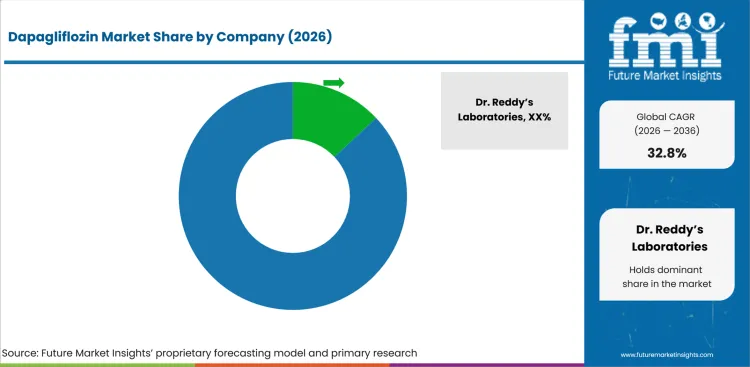
Dr. Reddy’s Laboratories, Aurobindo Pharma, Lupin, Biocon, and MSN Laboratories.
- Established Indian API and formulation companies hold an advantage depending on regulated-market filings and commercial tablet supply.
- Powder-focused API suppliers gain stronger acceptance by connecting impurity control with finished-dose manufacturing behavior.
- Regional generic companies win in country markets by offering local authorization support and pharmacy-channel access.
- Service-ready suppliers improve renewal chances through stability data and change-control discipline.
Dapagliflozin suppliers compete by combining high-purity API with documentation support. Dr. Reddy’s Laboratories has a strong position through regulated-market experience and chronic-care portfolios. Aurobindo Pharma competes through finished-dose scale and United States generic approvals. Lupin has launch readiness in regulated channels and direct customer access.
Manufacturing and regulatory depth have become stronger competitive separators as dapagliflozin moves into generic commercial supply. Biocon and Hetero Drugs compete through formulation and API capabilities. MSN Laboratories, Glenmark Life Sciences, Laurus Labs, and Optimus Drugs strengthen competition through process chemistry and buyer-specific supply support. Buyers compare supplier performance through impurity profiles and release reliability.
Smaller and regional suppliers can profit through local dossier knowledge and faster customer response. India and China create opportunities for suppliers with API scale and regulatory teams. United States and Europe create stronger demand for documentation quality and launch timing. Companies that prove batch consistency under regulated buyer audits should gain more durable annual supply contracts.
How do top Dapagliflozin companies compare?
Dr. Reddy’s Laboratories and Aurobindo Pharma score strongest on regulated-market launch depth while Lupin leads through United States generic launch readiness.
| Company | Relevance to Market Title | API Portfolio Depth | Regulatory Filing Strength | Finished-Dose Support | Channel Reach | Geographic Footprint |
|---|---|---|---|---|---|---|
| Dr. Reddy’s Laboratories | Very High | Very Strong | Very Strong | Very Strong | Very Strong | Global |
| Aurobindo Pharma | Very High | Very Strong | Very Strong | Very Strong | Strong | Global |
| Lupin | Very High | Strong | Very Strong | Very Strong | Strong | Global |
| Biocon | High | Strong | Strong | Strong | Moderate | India and International |
| MSN Laboratories | High | Very Strong | Strong | Strong | Moderate | India and International |
| Hetero Drugs | High | Very Strong | Strong | Very Strong | Strong | Global |
| Glenmark Life Sciences | High | Very Strong | Strong | Moderate | Moderate | India and International |
| Laurus Labs | High | Strong | Strong | Moderate | Moderate | Global |
| Optimus Drugs | Moderate to High | Strong | Moderate | Moderate | Moderate | India and International |
| Zhejiang Huahai Pharmaceutical | Moderate to High | Strong | Strong | Moderate | Strong | China and International |
Source: Future Market Insights competitive analysis, 2026.
Who are the key players in the Dapagliflozin Market?
Dr. Reddy’s Laboratories, Aurobindo Pharma and Lupin are listed with Biocon and MSN Laboratories among other suppliers.
Key global companies leading the Dapagliflozin Market include:
- Dr. Reddy’s Laboratories
- Aurobindo Pharma
- Lupin
- Biocon
- MSN Laboratories
- Hetero Drugs
- Glenmark Life Sciences
- Laurus Labs
- Optimus Drugs
- MetroChem API
Key Developments in Dapagliflozin Market
- In April 2026, Lupin received United States approval for dapagliflozin tablets in 5 mg and 10 mg strengths, supporting launch-linked API demand.
- In April 2026, Aurobindo Pharma received United States approval for dapagliflozin and metformin hydrochloride extended-release tablets across 5 mg/500 mg, 5 mg/1000 mg, 10 mg/500 mg, and 10 mg/1000 mg strengths.
- In April 2026, Biocon received United States approval for its abbreviated new drug application for dapagliflozin tablets in 5 mg and 10 mg strengths.
Key Players in the Dapagliflozin Market
API and Formulation Leaders
- Dr. Reddy’s Laboratories
- Aurobindo Pharma
- Lupin
- Hetero Drugs
High-Purity API Suppliers
- MSN Laboratories
- Glenmark Life Sciences
- Laurus Labs
- Optimus Drugs
Country-Level Generic Companies
- Zhejiang Huahai Pharmaceutical
- Hanmi Pharmaceutical
- STADA Arzneimittel
- Sawai Pharmaceutical
Regulated-Market Sellers
- Viatris
- Accord Healthcare UK
- Biogaran
- Towa Pharmaceutical
Dapagliflozin Market - Report Scope
| Parameter | Details |
|---|---|
| Forecast period | 2026 to 2036 |
| Historical period | 2021 to 2025 |
| Quantitative unit | Revenue in USD million |
| By form | Powder, crystalline |
| By purity grade | 99.5% and Above, 98.0% to 99.5%, below 98% |
| By application | Type 2 Diabetes, Heart Failure, Chronic Kidney Disease |
| By sales channel | Direct sales, distributors, online/API marketplaces |
| By buyer type | Generic formulation manufacturers, regulated-market buyers, regional manufacturers |
| Regions covered | North America, Latin America, Europe, East Asia, South Asia and Pacific, Middle East and Africa |
| Countries covered | India, China, United States, South Korea, United Kingdom, Germany, France, Japan |
| Key companies profiled | Dr. Reddy’s Laboratories, Aurobindo Pharma, Lupin, Biocon, MSN Laboratories, Hetero Drugs, Glenmark Life Sciences, Laurus Labs, Optimus Drugs, MetroChem API |
| Approach | Bottom-up API revenue approach using finished-dose launch timing, purity-grade demand, buyer qualification, country chronic-care demand, and regulated-market filing exposure |
Source: Future Market Insights competitive analysis, 2026.
Dapagliflozin Market - Scope & Definition
| Attribute | Detail |
|---|---|
| Market Definition | Dapagliflozin API supplied to finished-dose manufacturers for products used across type 2 diabetes, heart failure, and chronic kidney disease treatment. |
| Functions Covered | Glycemic-control API supply, cardio-renal therapy API supply, finished-dose formulation support, impurity control, batch release support, and filing documentation support. |
| Applications Covered | Type 2 Diabetes, Heart Failure, and Chronic Kidney Disease finished-dose manufacturing. |
| End-Use Industries | Generic formulation companies, regulated-market medicine suppliers, regional pharmaceutical manufacturers, and chronic-care tablet marketers. |
| Grades Covered | Commercial-grade powder API, crystalline API, 99.5% and Above purity grade, 98.0% to 99.5% grade, and development-grade material below 98%. |
| Inclusions | All commercially traded dapagliflozin API across form, purity grade, application, sales channel, buyer type, and country-level finished-dose use. |
| Exclusions | Finished branded tablets, retail pharmacy dispensing, clinical services, fixed-dose combinations outside API valuation, other SGLT2 inhibitor APIs, packaging materials, and patient treatment guidance. |
Dapagliflozin Market - Research Methodology
| Method | Description |
|---|---|
| Primary Research | FMI analyst interviews with API buyers, generic formulation manufacturers, regulatory affairs teams, quality auditors, distributor networks, and finished-dose sourcing managers across selected markets. |
| Desk Research | Review of regulatory approvals, official diabetes statistics, drug approval reports, company disclosures, API listings, prescribing evidence, and public chronic-care medicine data. |
| Market Sizing & Forecasting | Bottom-up API revenue approach using country launch timing, purity-grade demand, finished-dose manufacturing volume, buyer qualification timing, application mix, and sales-channel behavior. |
| Data Validation | Cross-verification using company portfolios, official diabetes data, generic approval timing, API supplier presence, regulated-market filing evidence, and country-level chronic-care demand checks. |
Dapagliflozin Market Breakdown by Form, Purity Grade, Application, Sales Channel, Buyer Type, and Region
Dapagliflozin Market Segmented by Form:
- Powder
- Crystalline
Dapagliflozin Market Segmented by Purity Grade:
- 99.5% and Above
- 98.0% to 99.5%
- Below 98%
Dapagliflozin Market Segmented by Application:
- Type 2 Diabetes
- Heart Failure
- Chronic Kidney Disease
Dapagliflozin Market Segmented by Sales Channel:
- Direct Sales
- Distributors
- Online/API Marketplaces
Dapagliflozin Market Segmented by Buyer Type:
- Generic Formulation Manufacturers
- Regulated-Market Buyers
- Regional Manufacturers
Dapagliflozin Market by Region:
- North America
- Latin America
- Europe
- East Asia
- South Asia and Pacific
- Middle East and Africa
Research Sources and Bibliography
- Aurobindo Pharma Limited. (2026, April). Aurobindo receives final approval for dapagliflozin and metformin hydrochloride extended-release tablets.
- Biocon Limited. (2026, April). Biocon receives approval for dapagliflozin tablets abbreviated new drug application.
- Centers for Disease Control and Prevention. (2026, January). National diabetes statistics report.
- Centers for Disease Control and Prevention. (2026, March). Chronic kidney disease in the United States.
- Central Drugs Standard Control Organisation. (2025, January). Subject expert committee recommendation for endocrinology and metabolism products.
- Central Drugs Standard Control Organisation. (2025). Subject expert committee recommendation for dapagliflozin combination product review.
- DREES. (2025). Health expenditure results for 2024.
- International Diabetes Federation. (2025). IDF diabetes atlas 2025.
- International Diabetes Federation. (2025). Diabetes data in China.
- International Diabetes Federation. (2025). Diabetes data in France.
- International Diabetes Federation. (2025). Diabetes data in Germany.
- International Diabetes Federation. (2025). Diabetes data in India.
- International Diabetes Federation. (2025). Diabetes data in Japan.
- International Diabetes Federation. (2025). Diabetes data in Republic of Korea.
- International Diabetes Federation. (2025). Diabetes data in United Kingdom.
- International Diabetes Federation. (2025). Diabetes data in United States.
- Lupin Limited. (2026, April). Lupin receives approval for dapagliflozin tablets.
- Ministry of Food and Drug Safety. (2025, July). 2024 drug approval report.
- National Medical Products Administration. (2025, March). Measures facilitate approval of 48 first-in-class innovative drugs.
- NHS Business Services Authority. (2025). Prescription cost analysis, England 2024/25.
- NHS Business Services Authority. (2025). Prescribing for diabetes in England 2015/16 to 2024/25.
- NHS England. (2025). Commissioning recommendations linked to generic dapagliflozin savings.
- Organisation for Economic Co-operation and Development. (2025, November). Health at a glance 2025: Generics and biosimilars.
- Robert Koch Institute. (2025). Physician-diagnosed diabetes mellitus among adults in Germany, 2024.
- Santé publique France. (2024). Diabetes prevalence treated pharmacologically in France.
- State Council of the People’s Republic of China. (2025). Opinions on deepening regulatory reform of drugs and medical devices.
- Towa Pharmaceutical Co., Ltd. (2025). Integrated report 2025.
- U.S. Food and Drug Administration. (2026, April). FDA approves first generic dapagliflozin tablets.
- U.S. Food and Drug Administration. (2026). Drug master files list.
- U.S. Food and Drug Administration. (2025). State of pharmaceutical quality report fiscal year 2024.
This bibliography is provided for reader reference and is not exhaustive. The full report contains the complete reference list and detailed citations.
This Report Answers
- Market size estimates for 2026 and forecasts through 2036 for the Dapagliflozin Market.
- Insights across regional and country-level dapagliflozin API demand.
- Analysis of demand drivers and purchasing behavior.
- Evaluation of form, purity grade, application, sales channel, and buyer type.
- Assessment of generic approvals and regulated-market filing impacts.
- Identification of opportunities across high-purity powder API and direct sales contracts.
- Evaluation of supplier qualification models and technical sales channels.
- Country-level analysis covering India, China, United States, South Korea, United Kingdom, Germany, France, and Japan.
- Assessment of competition and country-level generic medicine sellers.
- Analysis of plant-level decision drivers and renewal criteria.
- Regional outlooks across North America, Europe, East Asia, South Asia and Pacific, Latin America, and Middle East and Africa.
- Delivery of market data, forecasts, and supporting analysis in report-ready format.
Frequently Asked Questions
What is the growth prospect for Dapagliflozin?
Demand for dapagliflozin API is expected to rise at a considerable pace as generic tablet makers expand commercial supply across diabetes and cardio-renal therapy channels.
Which companies are expected to shape the Dapagliflozin market?
Dr. Reddy’s Laboratories, Aurobindo Pharma, Lupin, Biocon, MSN Laboratories, Hetero Drugs, Glenmark Life Sciences, and Laurus Labs are expected to shape market competition through API scale and regulated-market documentation.
Why are pharmaceutical companies investing in Dapagliflozin API?
Pharmaceutical companies are investing in dapagliflozin API to support generic tablet launches and lower-cost access across regulated and regional markets.
Why are direct sales channels important in the Dapagliflozin market?
Direct sales channels support buyer audits and change-control communication across launch-sensitive finished-dose programs.
Which API formats are gaining attention in Dapagliflozin?
Powder API and 99.5% and Above purity grade are gaining attention as formulation buyers prioritize compression behavior and impurity control.
How do regulations influence Dapagliflozin API demand?
Regulations influence demand through quality documentation needs and filing support requirements.
Why is purity grade important for Dapagliflozin?
Purity grade is important since regulated-market buyers need consistent impurity profiles and residual-solvent evidence before approving commercial supply.
What role does Direct Sales play in Dapagliflozin adoption?
Direct Sales supports adoption by combining API supply with audit support commercial batch reservation, and supplier change-control discipline.
Preview the report firsthand - request a free sample
Get SampleGet the brochure for pricing and purchase details.
Get PDFTable of Content
- Key Takeaways
- Market Size and CAGR
- Top Growth Driver
- Fastest Growing Segment
- Leading Region
- Key Companies
- Emerging Opportunities
- Executive Summary
- Global Market Outlook
- Demand-side Trends
- Supply-side Trends
- Technology Roadmap Analysis
- Analysis and Recommendations
- Analyst Perspective (What is happening? Why now? What should investors know?)
- Key Questions Answered
- How large is the market?
- What is the CAGR?
- What are key trends?
- Which region dominates?
- Who are the leaders?
- Market Overview
- Market Coverage / Taxonomy
- Market Definition / Scope / Limitations
- Research Methodology
- Chapter Orientation
- Analytical Lens and Working Hypotheses
- Market Structure, Signals, and Trend Drivers
- Benchmarking and Cross-market Comparability
- Market Sizing, Forecasting, and Opportunity Mapping
- Research Design and Evidence Framework
- Desk Research Programme (Secondary Evidence)
- Expert Input and Fieldwork (Primary Evidence)
- Tooling, Models, and Reference Databases
- Data Engineering and Model Build
- Quality Assurance and Audit Trail
- Market Background
- Market Dynamics (Drivers, Restraints, Opportunity, Trends)
- Scenario Forecast (Optimistic, Likely, Conservative)
- Impact Analysis
- AI Impact
- Sustainability Impact
- Regulatory Impact
- Technology Impact
- Consumer / Buyer Analysis
- Purchase Drivers
- Adoption Barriers
- Buyer Journey
- Opportunity Map Analysis
- Product Life Cycle Analysis
- Supply Chain Analysis
- Investment Feasibility Matrix
- Value Chain Analysis
- PESTLE and Porter's Analysis
- Regulatory Landscape
- Regional Parent Market Outlook
- Production and Consumption Statistics
- Import and Export Statistics
- Global Market Analysis and Forecast, 2021 to 2036
- Historical Market Size Value (USD Million) Analysis, 2021 to 2025
- Current and Future Market Size Value (USD Million) Projections, 2026 to 2036
- Y-o-Y Growth Trend Analysis
- Absolute $ Opportunity Analysis
- Global Market Pricing Analysis, 2021 to 2036
- Global Market Analysis and Forecast, By Form, 2021 to 2036
- Introduction / Key Findings
- Historical Market Size Value (USD Million) Analysis By Form, 2021 to 2025
- Current and Future Market Size Value (USD Million) Analysis and Forecast By Form, 2026 to 2036
- Powder
- Crystalline
- Powder
- Y-o-Y Growth Trend Analysis By Form, 2021 to 2025
- Absolute $ Opportunity Analysis By Form, 2026 to 2036
- Global Market Analysis and Forecast, By Purity Grade, 2021 to 2036
- Introduction / Key Findings
- Historical Market Size Value (USD Million) Analysis By Purity Grade, 2021 to 2025
- Current and Future Market Size Value (USD Million) Analysis and Forecast By Purity Grade, 2026 to 2036
- 99.5% and Above
- 98.0% to 99.5%
- Below 98%
- 99.5% and Above
- Y-o-Y Growth Trend Analysis By Purity Grade, 2021 to 2025
- Absolute $ Opportunity Analysis By Purity Grade, 2026 to 2036
- Global Market Analysis and Forecast, By Application, 2021 to 2036
- Introduction / Key Findings
- Historical Market Size Value (USD Million) Analysis By Application, 2021 to 2025
- Current and Future Market Size Value (USD Million) Analysis and Forecast By Application, 2026 to 2036
- Type 2 Diabetes
- Heart Failure
- Chronic Kidney Disease
- Type 2 Diabetes
- Y-o-Y Growth Trend Analysis By Application, 2021 to 2025
- Absolute $ Opportunity Analysis By Application, 2026 to 2036
- Global Market Analysis and Forecast, By Sales Channel, 2021 to 2036
- Introduction / Key Findings
- Historical Market Size Value (USD Million) Analysis By Sales Channel, 2021 to 2025
- Current and Future Market Size Value (USD Million) Analysis and Forecast By Sales Channel, 2026 to 2036
- Direct Sales
- Distributors
- Online/API Marketplaces
- Direct Sales
- Y-o-Y Growth Trend Analysis By Sales Channel, 2021 to 2025
- Absolute $ Opportunity Analysis By Sales Channel, 2026 to 2036
- Global Market Analysis and Forecast, By Buyer Type, 2021 to 2036
- Introduction / Key Findings
- Historical Market Size Value (USD Million) Analysis By Buyer Type, 2021 to 2025
- Current and Future Market Size Value (USD Million) Analysis and Forecast By Buyer Type, 2026 to 2036
- Generic Formulation Manufacturers
- Regulated-Market Buyers
- Regional Manufacturers
- Generic Formulation Manufacturers
- Y-o-Y Growth Trend Analysis By Buyer Type, 2021 to 2025
- Absolute $ Opportunity Analysis By Buyer Type, 2026 to 2036
- Global Market Analysis and Forecast, By Region, 2021 to 2036
- Introduction
- Historical Market Size Value (USD Million) Analysis By Region, 2021 to 2025
- Current Market Size Value (USD Million) Analysis and Forecast By Region, 2026 to 2036
- North America
- Latin America
- Western Europe
- Eastern Europe
- East Asia
- South Asia and Pacific
- Middle East & Africa
- Market Attractiveness Analysis By Region
- North America Market Analysis and Forecast, By Country, 2021 to 2036
- Historical Market Size Value (USD Million) Trend Analysis By Market Taxonomy, 2021 to 2025
- Market Size Value (USD Million) Forecast By Market Taxonomy, 2026 to 2036
- By Country
- USA
- Canada
- Mexico
- By Form
- By Purity Grade
- By Application
- By Sales Channel
- By Buyer Type
- By Country
- Market Attractiveness Analysis
- By Country
- By Form
- By Purity Grade
- By Application
- By Sales Channel
- By Buyer Type
- Key Takeaways
- Latin America Market Analysis and Forecast, By Country
- Historical Market Size Value (USD Million) Trend Analysis By Market Taxonomy, 2021 to 2025
- Market Size Value (USD Million) Forecast By Market Taxonomy, 2026 to 2036
- By Country
- Brazil
- Chile
- Rest of Latin America
- By Form
- By Purity Grade
- By Application
- By Sales Channel
- By Buyer Type
- By Country
- Market Attractiveness Analysis
- By Country
- By Form
- By Purity Grade
- By Application
- By Sales Channel
- By Buyer Type
- Key Takeaways
- Western Europe Market Analysis and Forecast, By Country
- Historical Market Size Value (USD Million) Trend Analysis By Market Taxonomy, 2021 to 2025
- Market Size Value (USD Million) Forecast By Market Taxonomy, 2026 to 2036
- By Country
- Germany
- UK
- Italy
- Spain
- France
- Nordic
- BENELUX
- Rest of Western Europe
- By Form
- By Purity Grade
- By Application
- By Sales Channel
- By Buyer Type
- By Country
- Market Attractiveness Analysis
- By Country
- By Form
- By Purity Grade
- By Application
- By Sales Channel
- By Buyer Type
- Key Takeaways
- Eastern Europe Market Analysis and Forecast, By Country
- Historical Market Size Value (USD Million) Trend Analysis By Market Taxonomy, 2021 to 2025
- Market Size Value (USD Million) Forecast By Market Taxonomy, 2026 to 2036
- By Country
- Russia
- Poland
- Hungary
- Balkan & Baltic
- Rest of Eastern Europe
- By Form
- By Purity Grade
- By Application
- By Sales Channel
- By Buyer Type
- By Country
- Market Attractiveness Analysis
- By Country
- By Form
- By Purity Grade
- By Application
- By Sales Channel
- By Buyer Type
- Key Takeaways
- East Asia Market Analysis and Forecast, By Country
- Historical Market Size Value (USD Million) Trend Analysis By Market Taxonomy, 2021 to 2025
- Market Size Value (USD Million) Forecast By Market Taxonomy, 2026 to 2036
- By Country
- China
- Japan
- South Korea
- By Form
- By Purity Grade
- By Application
- By Sales Channel
- By Buyer Type
- By Country
- Market Attractiveness Analysis
- By Country
- By Form
- By Purity Grade
- By Application
- By Sales Channel
- By Buyer Type
- Key Takeaways
- South Asia and Pacific Market Analysis and Forecast, By Country
- Historical Market Size Value (USD Million) Trend Analysis By Market Taxonomy, 2021 to 2025
- Market Size Value (USD Million) Forecast By Market Taxonomy, 2026 to 2036
- By Country
- India
- ASEAN
- Australia & New Zealand
- Rest of South Asia and Pacific
- By Form
- By Purity Grade
- By Application
- By Sales Channel
- By Buyer Type
- By Country
- Market Attractiveness Analysis
- By Country
- By Form
- By Purity Grade
- By Application
- By Sales Channel
- By Buyer Type
- Key Takeaways
- Middle East & Africa Market Analysis and Forecast, By Country
- Historical Market Size Value (USD Million) Trend Analysis By Market Taxonomy, 2021 to 2025
- Market Size Value (USD Million) Forecast By Market Taxonomy, 2026 to 2036
- By Country
- Kingdom of Saudi Arabia
- Other GCC Countries
- Türkiye
- South Africa
- Other African Union
- Rest of Middle East & Africa
- By Form
- By Purity Grade
- By Application
- By Sales Channel
- By Buyer Type
- By Country
- Market Attractiveness Analysis
- By Country
- By Form
- By Purity Grade
- By Application
- By Sales Channel
- By Buyer Type
- Key Takeaways
- Key Countries Market Analysis
- USA
- Pricing Analysis
- Market Share Analysis, 2025
- By Form
- By Purity Grade
- By Application
- By Sales Channel
- By Buyer Type
- Canada
- Pricing Analysis
- Market Share Analysis, 2025
- By Form
- By Purity Grade
- By Application
- By Sales Channel
- By Buyer Type
- Mexico
- Pricing Analysis
- Market Share Analysis, 2025
- By Form
- By Purity Grade
- By Application
- By Sales Channel
- By Buyer Type
- Brazil
- Pricing Analysis
- Market Share Analysis, 2025
- By Form
- By Purity Grade
- By Application
- By Sales Channel
- By Buyer Type
- Chile
- Pricing Analysis
- Market Share Analysis, 2025
- By Form
- By Purity Grade
- By Application
- By Sales Channel
- By Buyer Type
- Germany
- Pricing Analysis
- Market Share Analysis, 2025
- By Form
- By Purity Grade
- By Application
- By Sales Channel
- By Buyer Type
- UK
- Pricing Analysis
- Market Share Analysis, 2025
- By Form
- By Purity Grade
- By Application
- By Sales Channel
- By Buyer Type
- Italy
- Pricing Analysis
- Market Share Analysis, 2025
- By Form
- By Purity Grade
- By Application
- By Sales Channel
- By Buyer Type
- Spain
- Pricing Analysis
- Market Share Analysis, 2025
- By Form
- By Purity Grade
- By Application
- By Sales Channel
- By Buyer Type
- France
- Pricing Analysis
- Market Share Analysis, 2025
- By Form
- By Purity Grade
- By Application
- By Sales Channel
- By Buyer Type
- India
- Pricing Analysis
- Market Share Analysis, 2025
- By Form
- By Purity Grade
- By Application
- By Sales Channel
- By Buyer Type
- ASEAN
- Pricing Analysis
- Market Share Analysis, 2025
- By Form
- By Purity Grade
- By Application
- By Sales Channel
- By Buyer Type
- Australia & New Zealand
- Pricing Analysis
- Market Share Analysis, 2025
- By Form
- By Purity Grade
- By Application
- By Sales Channel
- By Buyer Type
- China
- Pricing Analysis
- Market Share Analysis, 2025
- By Form
- By Purity Grade
- By Application
- By Sales Channel
- By Buyer Type
- Japan
- Pricing Analysis
- Market Share Analysis, 2025
- By Form
- By Purity Grade
- By Application
- By Sales Channel
- By Buyer Type
- South Korea
- Pricing Analysis
- Market Share Analysis, 2025
- By Form
- By Purity Grade
- By Application
- By Sales Channel
- By Buyer Type
- Russia
- Pricing Analysis
- Market Share Analysis, 2025
- By Form
- By Purity Grade
- By Application
- By Sales Channel
- By Buyer Type
- Poland
- Pricing Analysis
- Market Share Analysis, 2025
- By Form
- By Purity Grade
- By Application
- By Sales Channel
- By Buyer Type
- Hungary
- Pricing Analysis
- Market Share Analysis, 2025
- By Form
- By Purity Grade
- By Application
- By Sales Channel
- By Buyer Type
- Kingdom of Saudi Arabia
- Pricing Analysis
- Market Share Analysis, 2025
- By Form
- By Purity Grade
- By Application
- By Sales Channel
- By Buyer Type
- Türkiye
- Pricing Analysis
- Market Share Analysis, 2025
- By Form
- By Purity Grade
- By Application
- By Sales Channel
- By Buyer Type
- South Africa
- Pricing Analysis
- Market Share Analysis, 2025
- By Form
- By Purity Grade
- By Application
- By Sales Channel
- By Buyer Type
- USA
- Market Structure Analysis
- Competition Dashboard
- Competition Benchmarking
- Market Share Analysis of Top Players
- By Regional
- By Form
- By Purity Grade
- By Application
- By Sales Channel
- By Buyer Type
- Emerging Startups
- Innovation Benchmarking
- Competition Analysis
- Competition Deep Dive
- Dr. Reddy’s Laboratories
- Overview
- Product Portfolio
- Profitability by Market Segments (Product/Region/Sales Channel)
- Sales Footprint
- Strategy Overview
- Marketing Strategy
- Product Strategy
- Channel Strategy
- Aurobindo Pharma
- Lupin
- Biocon
- MSN Laboratories
- Hetero Drugs
- Glenmark Life Sciences
- Dr. Reddy’s Laboratories
- Case Studies
- Success Stories
- Recent Developments
- Competition Deep Dive
- Assumptions & Acronyms Used


