

- Market Size (2026)
- USD 6.8 Bn
- Forecast (2036)
- USD 14.7 Bn
- CAGR (2026 to 2036)
- 8.0%
How big is the Abuse Deterrent Formulations Market in 2026?
USD 6.8 billion in 2026 and USD 14.7 billion by 2036 at an 8.0% CAGR.
Demand for abuse deterrent formulations is projected to expand at an 8.0% CAGR between 2026 and 2036, increasing valuation from USD 6.8 billion in 2026 to USD 14.7 billion by 2036. Developers serving the opioid analgesics market must align manipulation resistance with reliable release under ordinary dosing conditions. Controlled-release delivery platforms need evidence that likely tampering does not cause dose dumping or inconsistent exposure.
Current labeling policy places formulation evidence inside a broader prescribing decision for long-acting opioid treatment. FDA required stronger opioid risk information in July 2025 and restricted long-acting use to cases with inadequate alternatives. Prescribers therefore compare deterrence with analgesic fit and dosing conditions across pain therapeutic solutions used for severe persistent pain.
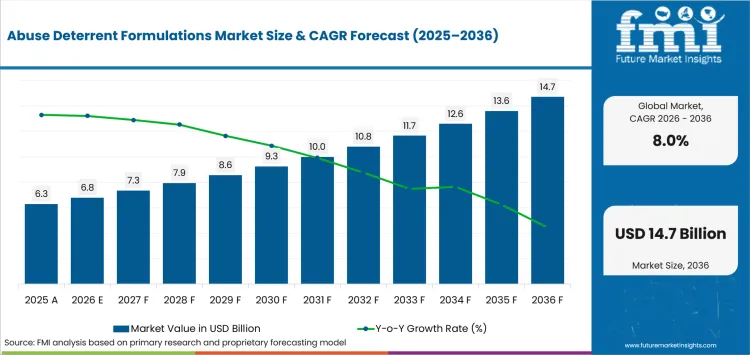
Key Takeaways of Abuse Deterrent Formulations Market
- Regulatory and institutional demand rises as manufacturers prove manipulation resistance without weakening analgesic performance or ordinary administration requirements.
- Opioid abuse deterrent formulations are projected to represent 54.0% of product demand in 2026 due to established route-specific evidence requirements.
- Chronic pain management is estimated to account for 49.0% of application demand in 2026 owing to repeated dosing and monitoring needs.
- Hospitals are forecast to capture 46.0% of end-user demand in 2026 through supervised prescribing and coordinated medication review.
- Abuse deterrence cannot prevent addiction or intact oral overuse, and formulation changes can redirect misuse toward another harmful route.
- Collegium Pharmaceutical, Knoa Pharma, Protega Pharmaceuticals, Acura Pharmaceuticals, Teva Pharmaceutical Industries, Pfizer, Camurus and Ensysce Biosciences form the profiled company set.
Analyst Perspective
"An abuse-deterrent label carries commercial value if the finished dosage form resists likely tampering without changing pain control during ordinary use. Durable value depends on a clear treatment role and post-market evidence that misuse has not shifted toward a more dangerous route."
- Anurag Sharma, Principal Consultant, Future Market Insights
How is the Abuse Deterrent Formulations Market segmented?
The abuse deterrent formulations industry is segmented by product, application, end user, distribution channel, technology and region.
Product covers opioid and non-opioid abuse deterrent formulations alongside physical and chemical barrier designs used across controlled medicines. Application includes chronic pain, postoperative pain, neuropathic pain and palliative care across distinct treatment durations and monitoring needs. End users include hospitals, retail pharmacies, specialty pain clinics and ambulatory surgical centers with different dispensing controls. Distribution channels cover hospital pharmacies, retail pharmacies, online pharmacies and direct institutional supply across dispensing routes. Technology includes physical barriers, antagonist combinations, aversion systems and prodrug approaches that address different misuse routes.
Why does chronic pain management remain central to application demand?
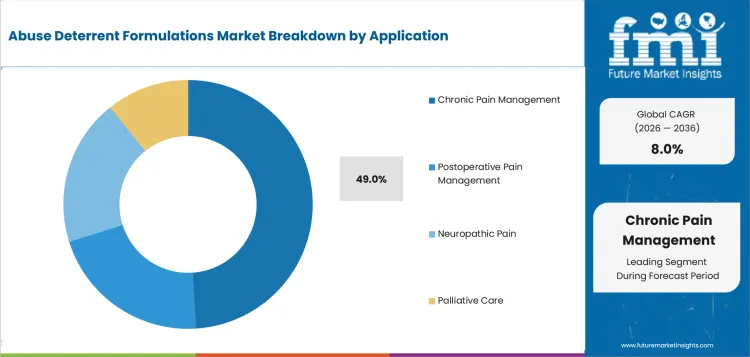
Chronic pain exposes patients to controlled medicines over repeated treatment cycles and increases the importance of scheduled specialist review. Prescribers balance reliable analgesia with storage controls and clear continuation criteria across pain medicines used for persistent conditions.
- In 2026, chronic pain management is expected to lead application with 49.0% share because prolonged therapy requires repeated monitoring and secure dispensing.
- Health Canada’s 2025 survey found chronic pain accounted for 33% of prescription opioid use nationally. That finding connects repeated treatment with medical-system dispensing and clearly defined continuation criteria across monitored outpatient pathways and specialist clinical review schedules.
Why do opioid abuse deterrent formulations account for the largest product share?
Opioid products present the clearest formulation use case because crushing or extraction can release concentrated active ingredients outside intended dosing conditions. FDA approved a 10 mg RoxyBond strength in September 2024 and retained the same manipulation-resistance evidence requirements across the finished formulation.
- By product, opioid abuse deterrent formulations are estimated to hold 54.0% in 2026 owing to established regulatory expectations for manipulated opioids.
- Immediate-release and extended-release oral solid dosage formulations require distinct testing plans across likely tools and solvents used during manipulation. Wider acceptance depends on each strength preserving therapeutic release and producing consistent exposure under ordinary administration.
What supports hospitals within the end user category?
Hospitals connect opioid initiation with medication reconciliation and discharge planning during complex pain episodes that require supervised treatment changes. Pharmaceutical unit-dose packaging supports controlled storage and traceable dispensing across inpatient wards and clinical units sharing institutional pharmacy oversight.
- Hospitals are set to lead the end user category with 46.0% share in 2026 due to coordinated clinical review and pharmacy controls.
- Hospital pharmacies verify formulary status and administration instructions through secure controlled systems prior to inpatient dispensing. Discharge teams then communicate duration limits and safe storage requirements to clinicians and patients continuing treatment outside the facility.
How do physical and mechanical barriers shape technology selection?
Physical barriers alter a dosage form through crush resistance or gel formation without adding an active antagonist. Pharmaceutical excipients must preserve ordinary release and avoid harmful properties following unintended manipulation across several extraction conditions.
- The technology category is forecast to be led by physical and mechanical barrier technology at 41.0% share in 2026 due to direct tablet integration.
- Sponsors need laboratory results that connect resistance across relevant tools and solvents with exposure and human abuse-potential findings. FDA guidance makes that sequence product-specific, so manufacturing changes require evidence that the finished formulation retains its claimed performance.
What are the drivers, restraints and opportunities in the Abuse Deterrent Formulations Market?
Defined regulatory pathways support formulation differentiation, route-specific limitations restrain adoption, and multi-mechanism or long-acting designs provide narrower commercial openings.
- Driver: Product-specific regulatory pathways define the laboratory and clinical sequence required for abuse-deterrent labeling review.
- Restraint: Route-specific protection does not prevent addiction or intact oral overuse and can redirect misuse toward another harmful route.
- Opportunity: Multi-mechanism formulations and long-acting delivery can reduce take-home dosing across carefully selected treatment pathways.
Regulatory pathways give development teams a clear sequence for proving manipulation resistance without weakening safety or efficacy during ordinary use. Each drug formulation must pass product-specific testing and clinical review to support differentiated product labeling.
Commercial adoption remains limited by the narrow meaning of abuse deterrence and the possibility that misuse changes route. FDA documented that reformulated Opana ER redirected some misuse toward injection, which contributed to severe public-health harms and preceded withdrawal.
Long-acting delivery extends competition beyond conventional crush-resistant tablets within supervised opioid-dependence treatment routes and specialist clinics. Weekly or monthly injectable drugs reduce frequent take-home dosing, but treatment sites need trained staff and reimbursement that supports repeated clinical administration.
Which country CAGRs are profiled in the Abuse Deterrent Formulations Market?
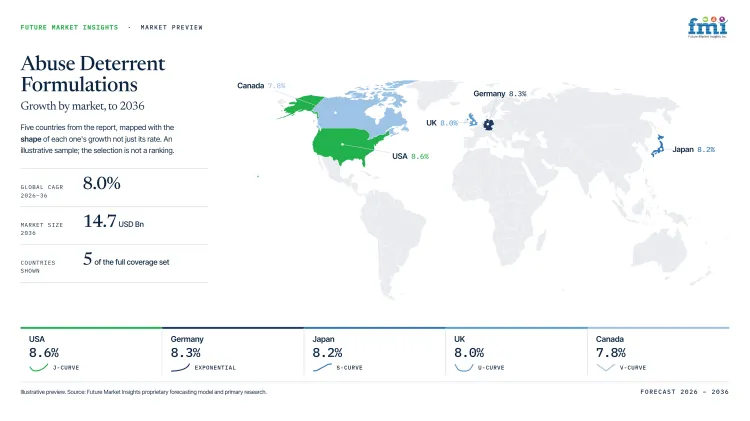
| Country | CAGR |
|---|---|
| USA | 8.6% |
| Germany | 8.3% |
| Japan | 8.2% |
| United Kingdom | 8.0% |
| Canada | 7.8% |
How do country-level CAGRs compare in the Abuse Deterrent Formulations Market?
The displayed country CAGRs span 0.8 percentage point across five regulated medicine systems and describe forecast pace instead of current market size.
- A 0.3 percentage-point gap separates USA and Germany because the United States pathway combines explicit labeling rules with several marketed products.
- Germany and Japan differ by 0.1 percentage point as both systems restrict opioid use through specialist review and controlled dispensing.
- Japan and the United Kingdom show a 0.2 percentage-point gap across hospital-led channels with different narcotic handling requirements.
- The United Kingdom and Canada also differ by 0.2 percentage point despite dedicated national rules for prolonged-release or tamper-resistant products.
- Canada closes the profiled range through provincial reimbursement controls that vary more widely than the displayed national forecast pace.
Comparable CAGRs can produce materially different entry conditions across national regulatory systems and pharmaceutical packaging networks.
The full report covers North America, Latin America, Western Europe, Eastern Europe, East Asia, South Asia and Pacific, and the Middle East and Africa.
Country-wise Analysis
- United States pain care combines a formal FDA labeling route with hospital and retail channels that manage controlled medicines under varied state prescribing rules and commercial formularies for patients requiring severe persistent pain treatment. Adoption of abuse deterrent formulations in the United States is estimated to expand at an 8.6% CAGR through 2036, supported by current labeled products despite demanding post-market studies and premium-formulary review across health plans. CDC reported in February 2026 that opioid dispensing declined from 46.8 prescriptions per 100 persons in 2019 to 35.4 during 2024, reinforcing scrutiny of long-term outpatient use and differentiated national coverage decisions.
- Germany uses controlled prescribing and statutory reimbursement review to restrict opioid treatment within defined pain pathways supported by specialist clinics and pharmacies that serve long-term patients under national clinical guidance and secure dispensing rules. BfArM reported in March 2025 that opioid prescriptions declined 19% between 2005 and 2020 among roughly 25 million insured people, while one-fifth of newly treated users met long-term-use criteria during the study period. Germany is estimated to post an 8.3% CAGR over the forecast period, reinforced by specialist pain care despite conservative prescribing and limited payer tolerance for formulation premiums without documented direct local clinical justification.
- Japan channels strong opioids through specialist hospitals and regulated narcotic systems that require translated documentation and coordinated distribution for selected severe-pain patients served by metropolitan treatment centers and scheduled medicine supply routes nationwide. Japan’s abuse deterrent formulations outlook is anticipated to advance at an 8.2% CAGR over the assessment period, supported by institutional oversight despite limited differentiation from approved analgesic alternatives during national hospital formulary review. Ministry of Health deliberations in December 2025 found no clear superiority for oliceridine over approved intravenous opioids, illustrating the comparative evidence expected during domestic hospital selection and formulary review of new controlled pain medicines.
- United Kingdom pain pathways use national medicine guidance and hospital discharge controls to limit prolonged opioid exposure in acute and chronic settings across public reimbursement networks and regional prescribing support systems. MHRA removed postoperative pain from prolonged-release opioid licences in March 2025 due to persistent-use and ventilatory-impairment risks, directing these medicines toward selected severe chronic pain pathways under tighter discharge controls and prescribing review. Abuse deterrent formulation sales in the United Kingdom are forecast to expand at an 8.0% CAGR by 2036, aided by established pharmacy channels despite narrower postoperative use and strong dependence warnings within NHS formularies.
- Canada combines federal controlled-drug review with provincial formularies and licensed pharmacy systems that govern opioid access under different reimbursement rules and established public monitoring programs serving urban and remote communities across all provinces. The Canadian abuse deterrent formulations sector is projected to record a 7.8% CAGR during the assessment period, supported by dedicated tamper-resistance guidance despite fragmented reimbursement and cautious prescribing during provincial public coverage review. PHAC reported in June 2026 that Canada recorded 5,608 opioid-related deaths during 2025 and a 23% decline from 2024 while maintaining pressure for careful prescribing and consistent safety communication throughout provincial health systems.
Who are the notable companies in the Abuse Deterrent Formulations Market?
Collegium Pharmaceutical, Knoa Pharma, Protega Pharmaceuticals, Acura Pharmaceuticals, Teva Pharmaceutical Industries, Pfizer, Camurus and Ensysce Biosciences are the notable companies serving this market.
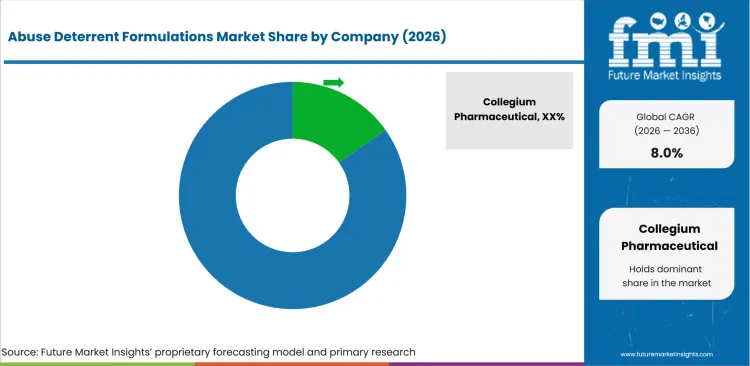
The field is moderately concentrated around four current FDA-listed oral products and several specialized formulation programs. Competition depends on approved label evidence, manufacturing consistency and a credible treatment role rather than corporate scale alone.
- Collegium Pharmaceutical, Knoa Pharma and Protega Pharmaceuticals compete through current FDA-listed oral products using distinct extended-release or immediate-release architectures.
- Acura Pharmaceuticals and Ensysce Biosciences develop active platforms, while Teva Pharmaceutical Industries and Pfizer retain documented historical approval experience.
- Camurus broadens competition through weekly and monthly buprenorphine depots used within supervised opioid-dependence treatment routes across several regulated regions.
Competitive Benchmarking: Abuse Deterrent Formulations Market
| Company | Exact-Market Evidence | Current Portfolio Visibility | Technology Breadth | Geographic Reach |
|---|---|---|---|---|
| Collegium Pharmaceutical | High | High | Medium | United States |
| Knoa Pharma | Medium | High | Medium | United States |
| Protega Pharmaceuticals | High | High | Medium | United States |
| Acura Pharmaceuticals | Medium | Medium | High | United States |
| Teva Pharmaceutical Industries | Medium | Low | Medium | United States |
| Pfizer | Medium | Low | Medium | United States |
| Camurus | Medium | High | High | Europe, Australia and United States |
| Ensysce Biosciences | Medium | Medium | High | United States |
Key Developments in the Abuse Deterrent Formulations Market
- In June 2026, Ensysce Biosciences enrolled the first participant in the final phase of PF614-MPAR-102 and advanced oral overdose-protection testing.
- In February 2025, Protega Pharmaceuticals collaborated with Wellgistics to support pharmacist education and patient access for RoxyBond.
- In January 2025, Camurus launched weekly and monthly Buvidal formulations for opioid-dependence treatment in Switzerland.
Key Players in the Abuse Deterrent Formulations Market
Current FDA-Listed Oral Platforms
- Collegium Pharmaceutical
- Knoa Pharma
- Protega Pharmaceuticals
Active and Historical Formulation Platforms
- Acura Pharmaceuticals
- Ensysce Biosciences
- Teva Pharmaceutical Industries
- Pfizer
Long-Acting Opioid-Dependence Platforms
- Camurus
Abuse Deterrent Formulations Market - Report Scope
| Coverage field | Report scope |
|---|---|
| Market breakdown | By product, application, end user, distribution channel, technology and region. |
| Quantitative Units | Revenue in USD billion and CAGR in %. |
| Market Definition | Pharmaceutical formulations intended to deter manipulation, extraction or rapid release across opioid and other controlled-substance applications. |
| Regions Covered | North America, Latin America, Western Europe, Eastern Europe, East Asia, South Asia and Pacific, and Middle East and Africa. |
| Countries Covered | USA, Germany, Japan, United Kingdom, Canada, and 20+ countries included in the full report. |
| Key Companies Profiled | Collegium Pharmaceutical, Knoa Pharma, Protega Pharmaceuticals, Acura Pharmaceuticals, Teva Pharmaceutical Industries, Pfizer, Camurus and Ensysce Biosciences. |
| Forecast Period | 2026 to 2036. |
| Approach | Primary and secondary research with market triangulation. |
Abuse Deterrent Formulations Market - Research Methodology
| Method | Approach |
|---|---|
| Primary Research | FMI analysts gathered input from manufacturers, service providers, technology developers, distributors, end users, procurement teams, and subject-matter experts. Interviews examined purchasing decisions, product or service evaluation, adoption barriers, approval requirements, pricing considerations, and expectations for technical or commercial support. Respondents were also asked what evidence is required before a trial, pilot, or initial order develops into regular purchasing. |
| Desk Research | Desk research covered government statistics, regulatory publications, trade data, industry associations, technical literature, standards, company filings, product information, and official corporate announcements. Sources were reviewed for relevance, publication date, geographic coverage, and consistency with the defined market scope. Claims relating to performance, applications, approvals, capacity, investment, and commercial activity were retained only when supported by credible public evidence. |
| Market Sizing and Forecasting | The market model combined the baseline value with historical performance, segment structure, pricing and volume indicators, adoption levels, company participation, and country-level demand conditions. Forecast assumptions considered economic activity, investment trends, regulatory developments, technology adoption, purchasing cycles, supply availability, and barriers to wider market use. Segment and regional estimates were reconciled before the final market total was calculated. |
| Data Validation | Estimates were checked against multiple independent indicators, including public data, company activity, trade patterns, industry developments, and findings from primary interviews. Validation also tested whether products, services, applications, and company revenues fell within the defined market boundaries. Adjacent categories, unsupported claims, overlapping revenues, and activities without direct market relevance were excluded to reduce double counting and maintain consistency across segments and countries. |
Abuse Deterrent Formulations Market by Segments
Abuse Deterrent Formulations Market segmented by Product:
- Opioid Abuse Deterrent Formulations
- Extended Release Opioids
- Immediate Release Opioids
- Non-Opioid Abuse Deterrent Formulations
- Central Nervous System Drugs
- Controlled Substance Formulations
- Physical Barrier Formulations
- Crush Resistant Tablets
- Gel Forming Tablets
- Chemical Barrier Formulations
- Antagonist Combination Products
- Aversion Agent Formulations
Abuse Deterrent Formulations Market segmented by Application:
- Chronic Pain Management
- Cancer Pain
- Musculoskeletal Pain
- Postoperative Pain Management
- Orthopedic Surgery
- General Surgery
- Neuropathic Pain
- Diabetic Neuropathy
- Postherpetic Neuralgia
- Palliative Care
- End-of-Life Pain Management
- Hospice Care
Abuse Deterrent Formulations Market segmented by End User:
- Hospitals
- Public Hospitals
- Private Hospitals
- Retail Pharmacies
- Chain Pharmacies
- Independent Pharmacies
- Specialty Pain Clinics
- Multidisciplinary Pain Centers
- Outpatient Pain Clinics
- Ambulatory Surgical Centers
- Day Surgery Centers
- Specialty Surgical Facilities
Abuse Deterrent Formulations Market segmented by Distribution Channel:
- Hospital Pharmacies
- Inpatient Pharmacies
- Outpatient Hospital Pharmacies
- Retail Pharmacies
- Community Pharmacy Chains
- Independent Drug Stores
- Online Pharmacies
- Licensed E-Pharmacies
- Hospital Digital Pharmacies
- Direct Institutional Supply
- Group Purchasing Organizations
- Healthcare Procurement Contracts
Abuse Deterrent Formulations Market segmented by Technology:
- Physical and Mechanical Barrier Technology
- Crush Resistant Technology
- Gel Formation Technology
- Agonist and Antagonist Combination Technology
- Naloxone Combination
- Naltrexone Combination
- Aversion Technology
- Irritant Based Formulations
- Bittering Agent Formulations
- Prodrug Technology
- Enzyme Activated Molecules
- Modified Drug Release Systems
Abuse Deterrent Formulations Market by Region:
- North America
- United States
- Canada
- Mexico
- Latin America
- Brazil
- Chile
- Rest of Latin America
- Western Europe
- Germany
- United Kingdom
- Italy
- Spain
- France
- Nordics
- Benelux
- Rest of Western Europe
- Eastern Europe
- Russia
- Poland
- Hungary
- Balkan and Baltic States
- Rest of Eastern Europe
- East Asia
- China
- Japan
- South Korea
- South Asia and Pacific
- India
- ASEAN
- Australia and New Zealand
- Rest of South Asia and Pacific
- Middle East and Africa
- Kingdom of Saudi Arabia
- Other GCC Countries
- Türkiye
- South Africa
- Other African Union Countries
- Rest of Middle East and Africa
Research Sources and Bibliography
- USA Food and Drug Administration. (2025, July 31). FDA Requires Major Changes to Opioid Pain Medication Labeling to Emphasize Risks.
- USA Food and Drug Administration. (2024, September 5). Approval Letter: NDA 209777/S-011.
- Health Canada. (2026, June 15). Canadian Substance Use Survey: Summary.
- USA Food and Drug Administration. (2015, April). Abuse-Deterrent Opioids-Evaluation and Labeling: Guidance for Industry.
- USA Food and Drug Administration. (2024, January 2). Understanding Safety Concerns with Intravenous (IV) Misuse and Abuse of Opioids in Deterrent Formulations.
- Centers for Disease Control and Prevention. (2026, February 11). Opioid Dispensing Rate Maps.
- Federal Institute for Drugs and Medical Devices. (2025, March 11). Keine Hinweise auf "Opioid-Krise" in Deutschland: Verordnung von opioidhaltigen Schmerzmitteln ist rückläufig.
- Ministry of Health, Labour and Welfare. (2025, December 12).
- Medicines and Healthcare products Regulatory Agency. (2025, March 12). Prolonged-release opioids: Removal of indication for relief of post-operative pain.
- Health Canada. (2016, March 30). Guidance Document: Tamper-resistance Formulations of Opioid Drug Products.
- Public Health Agency of Canada. (2026, June 15). Statement from the Council of Chief Medical Officers of Health - Latest National Data on Substance-Related Harms.
- USA Food and Drug Administration. (2026). Abuse-Deterrent Opioid Analgesics. Retrieved August 4, 2026.
- Knoa Pharma LLC. (2026, May 1). Knoa Pharma Begins Operations as a New, Public Health-Focused Company Dedicated to Supporting Patients and Abating the Opioid Crisis.
- Acura Pharmaceuticals, Inc. (2026, June 29). Form 8-K.
- Teva Pharmaceutical Industries Ltd. (2017, January 18). Teva Receives FDA Approval for VANTRELA™ ER (Hydrocodone Bitartrate) Extended-Release Tablets [CII] Formulated with Proprietary Abuse Deterrence Technology.
- Pfizer Inc. (2014, October 17). FDA Approves Abuse Deterrent Labeling for EMBEDA® (morphine sulfate and naltrexone hydrochloride) Extended-Release (ER) Capsules CII.
- Camurus AB. (2025, January 17). Buvidal® weekly and monthly - now available to patients in Switzerland.
- Ensysce Biosciences, Inc. (2026, June 26). Ensysce Biosciences Enrolls First Patient in Final Phase of PF614-MPAR-102 Clinical Study.
- Protega Pharmaceuticals. (2025, February 26). Protega Pharmaceuticals collaborates with Wellgistics to support pharmacist education and increase patient access to the first and only FDA-approved abuse-deterrent immediate-release opioid, ROXYBOND™.
- Ensysce Biosciences, Inc. (2026, January 28). Ensysce Biosciences Provides Enrollment Update on Pivotal Phase 3 Trial of PF614, Its Next-Generation Opioid for Severe Acute Pain.
- Collegium Pharmaceutical, Inc. (2026, February 26). Collegium Reports Fourth Quarter and Full-Year 2025 Financial Results.
This bibliography is provided for reader reference and is not exhaustive. The full report contains the complete reference list and detailed citations.
This Report Answers
- How large is the abuse deterrent formulations market in 2026 and 2036?
- Which regulatory conditions support demand for abuse deterrent formulations?
- Which product category accounts for the largest 2026 share?
- Why does chronic pain management shape application demand?
- How do hospitals influence adoption across controlled medicine pathways?
- How do physical barriers shape technology selection?
- How do country growth rates differ across the profiled markets?
- Which companies provide current, historical or adjacent formulation capabilities?
Frequently Asked Questions
How big is the abuse deterrent formulations market in 2026?
In 2026, the abuse deterrent formulations market is valued at USD 6.8 billion across products designed to resist selected manipulation routes. Commercial use depends on approved labeling and reliable therapeutic release under ordinary administration conditions within controlled pain-treatment pathways nationwide.
What is the CAGR of the abuse deterrent formulations market from 2026 to 2036?
The abuse deterrent formulations market is projected to expand at an 8.0% CAGR from 2026 to 2036. Regulatory evidence pathways support that forecast, although route-specific testing and limited payer premiums constrain wider conversion from conventional controlled medicines across major regulated systems.
Which product category is projected to lead the abuse deterrent formulations market?
Opioid abuse deterrent formulations are projected to account for 54.0% of product demand in the abuse deterrent formulations market during 2026. Concentrated active ingredients and established regulatory guidance provide the clearest development case for route-specific manipulation resistance across regulated pain pathways.
Which application category is projected to dominate f the abuse deterrent formulations market?
Chronic pain management is estimated to account for 49.0% of application demand in the abuse deterrent formulations market during 2026. Repeated treatment cycles increase the value of scheduled monitoring and clearly defined continuation criteria for controlled medicines used during prolonged outpatient care.
Which end user is projected to account for leading share in the abuse deterrent formulations market?
Hospitals are forecast to capture 46.0% of end-user demand in the abuse deterrent formulations market during 2026. Institutional pharmacy controls connect supervised treatment changes with medication reconciliation and discharge instructions across complex inpatient and outpatient pain episodes requiring monitored treatment changes.
Which technology is projected to account for 41.0% of the abuse deterrent formulations market?
Physical and mechanical barrier technology is forecast to represent 41.0% of technology demand in the abuse deterrent formulations market during 2026. Direct tablet integration supports established manufacturing while laboratory testing must preserve therapeutic release across common manipulation and extraction conditions.
What limits wider adoption of the abuse deterrent formulations market?
Route-specific protection remains the principal commercial restraint across the abuse deterrent formulations market during wider adoption. Deterrent properties do not prevent addiction or intact oral overuse, and manufacturers must fund demanding evidence programs to secure payer acceptance for a differentiated formulation premium.
Which companies are active in the abuse deterrent formulations market?
Companies are active or retain verified capabilities within the abuse deterrent formulations market. Collegium Pharmaceutical, Knoa Pharma, Protega Pharmaceuticals, Acura Pharmaceuticals, Teva Pharmaceutical Industries, Pfizer, Camurus and Ensysce Biosciences span current products and development platforms across oral and long-acting delivery routes.
Preview the report firsthand - request a free sample
Get SampleGet the brochure for pricing and purchase details.
Get PDFTable of Content
- Key Takeaways
- Market Size and CAGR
- Top Growth Driver
- Fastest Growing Segment
- Leading Region
- Key Companies
- Emerging Opportunities
- Executive Summary
- Global Market Outlook
- Demand-side Trends
- Supply-side Trends
- Technology Roadmap Analysis
- Analysis and Recommendations
- Analyst Perspective (What is happening? Why now? What should investors know?)
- Key Questions Answered
- How large is the market?
- What is the CAGR?
- What are key trends?
- Which region dominates?
- Who are the leaders?
- Market Overview
- Market Coverage / Taxonomy
- Market Definition / Scope / Limitations
- Research Methodology
- Chapter Orientation
- Analytical Lens and Working Hypotheses
- Market Structure, Signals, and Trend Drivers
- Benchmarking and Cross-market Comparability
- Market Sizing, Forecasting, and Opportunity Mapping
- Research Design and Evidence Framework
- Desk Research Programme (Secondary Evidence)
- Expert Input and Fieldwork (Primary Evidence)
- Tooling, Models, and Reference Databases
- Data Engineering and Model Build
- Quality Assurance and Audit Trail
- Market Background
- Market Dynamics (Drivers, Restraints, Opportunity, Trends)
- Scenario Forecast (Optimistic, Likely, Conservative)
- Impact Analysis
- AI Impact
- Sustainability Impact
- Regulatory Impact
- Technology Impact
- Consumer / Buyer Analysis
- Purchase Drivers
- Adoption Barriers
- Buyer Journey
- Opportunity Map Analysis
- Product Life Cycle Analysis
- Supply Chain Analysis
- Investment Feasibility Matrix
- Value Chain Analysis
- PESTLE and Porter's Analysis
- Regulatory Landscape
- Regional Parent Market Outlook
- Production and Consumption Statistics
- Import and Export Statistics
- Global Market Analysis and Forecast, 2021 to 2036
- Historical Market Size Value (USD Billion) Analysis, 2021 to 2025
- Current and Future Market Size Value (USD Billion) Projections, 2026 to 2036
- Y-o-Y Growth Trend Analysis
- Absolute $ Opportunity Analysis
- Global Market Pricing Analysis, 2021 to 2036
- Global Market Analysis and Forecast, By Product, 2021 to 2036
- Introduction / Key Findings
- Historical Market Size Value (USD Billion) Analysis By Product, 2021 to 2025
- Current and Future Market Size Value (USD Billion) Analysis and Forecast By Product, 2026 to 2036
- Opioid Abuse Deterrent Formulations
- Extended Release Opioids
- Immediate Release Opioids
- Non-Opioid Abuse Deterrent Formulations
- Central Nervous System Drugs
- Controlled Substance Formulations
- Physical Barrier Formulations
- Crush Resistant Tablets
- Gel Forming Tablets
- Chemical Barrier Formulations
- Antagonist Combination Products
- Aversion Agent Formulations
- Opioid Abuse Deterrent Formulations
- Y-o-Y Growth Trend Analysis By Product, 2021 to 2025
- Absolute $ Opportunity Analysis By Product, 2026 to 2036
- Global Market Analysis and Forecast, By Application, 2021 to 2036
- Introduction / Key Findings
- Historical Market Size Value (USD Billion) Analysis By Application, 2021 to 2025
- Current and Future Market Size Value (USD Billion) Analysis and Forecast By Application, 2026 to 2036
- Chronic Pain Management
- Cancer Pain
- Musculoskeletal Pain
- Postoperative Pain Management
- Orthopedic Surgery
- General Surgery
- Neuropathic Pain
- Diabetic Neuropathy
- Postherpetic Neuralgia
- Palliative Care
- End-of-Life Pain Management
- Hospice Care
- Chronic Pain Management
- Y-o-Y Growth Trend Analysis By Application, 2021 to 2025
- Absolute $ Opportunity Analysis By Application, 2026 to 2036
- Global Market Analysis and Forecast, By End User, 2021 to 2036
- Introduction / Key Findings
- Historical Market Size Value (USD Billion) Analysis By End User, 2021 to 2025
- Current and Future Market Size Value (USD Billion) Analysis and Forecast By End User, 2026 to 2036
- Hospitals
- Public Hospitals
- Private Hospitals
- Retail Pharmacies
- Chain Pharmacies
- Independent Pharmacies
- Specialty Pain Clinics
- Multidisciplinary Pain Centers
- Outpatient Pain Clinics
- Ambulatory Surgical Centers
- Day Surgery Centers
- Specialty Surgical Facilities
- Hospitals
- Y-o-Y Growth Trend Analysis By End User, 2021 to 2025
- Absolute $ Opportunity Analysis By End User, 2026 to 2036
- Global Market Analysis and Forecast, By Distribution Channel, 2021 to 2036
- Introduction / Key Findings
- Historical Market Size Value (USD Billion) Analysis By Distribution Channel, 2021 to 2025
- Current and Future Market Size Value (USD Billion) Analysis and Forecast By Distribution Channel, 2026 to 2036
- Hospital Pharmacies
- Inpatient Pharmacies
- Outpatient Hospital Pharmacies
- Retail Pharmacies
- Community Pharmacy Chains
- Independent Drug Stores
- Online Pharmacies
- Licensed E-Pharmacies
- Hospital Digital Pharmacies
- Direct Institutional Supply
- Group Purchasing Organizations
- Healthcare Procurement Contracts
- Hospital Pharmacies
- Y-o-Y Growth Trend Analysis By Distribution Channel, 2021 to 2025
- Absolute $ Opportunity Analysis By Distribution Channel, 2026 to 2036
- Global Market Analysis and Forecast, By Technology, 2021 to 2036
- Introduction / Key Findings
- Historical Market Size Value (USD Billion) Analysis By Technology, 2021 to 2025
- Current and Future Market Size Value (USD Billion) Analysis and Forecast By Technology, 2026 to 2036
- Physical and Mechanical Barrier Technology
- Crush Resistant Technology
- Gel Formation Technology
- Agonist and Antagonist Combination Technology
- Naloxone Combination
- Naltrexone Combination
- Aversion Technology
- Irritant Based Formulations
- Bittering Agent Formulations
- Prodrug Technology
- Enzyme Activated Molecules
- Modified Drug Release Systems
- Physical and Mechanical Barrier Technology
- Y-o-Y Growth Trend Analysis By Technology, 2021 to 2025
- Absolute $ Opportunity Analysis By Technology, 2026 to 2036
- Global Market Analysis and Forecast, By Region, 2021 to 2036
- Introduction
- Historical Market Size Value (USD Billion) Analysis By Region, 2021 to 2025
- Current Market Size Value (USD Billion) Analysis and Forecast By Region, 2026 to 2036
- North America
- Latin America
- Western Europe
- Eastern Europe
- East Asia
- South Asia and Pacific
- Middle East & Africa
- Market Attractiveness Analysis By Region
- North America Market Analysis and Forecast, By Country, 2021 to 2036
- Historical Market Size Value (USD Billion) Trend Analysis By Market Taxonomy, 2021 to 2025
- Market Size Value (USD Billion) Forecast By Market Taxonomy, 2026 to 2036
- By Country
- USA
- Canada
- By Product
- By Application
- By End User
- By Distribution Channel
- By Technology
- By Country
- Market Attractiveness Analysis
- By Country
- By Product
- By Application
- By End User
- By Distribution Channel
- By Technology
- Key Takeaways
- Latin America Market Analysis and Forecast, By Country
- Historical Market Size Value (USD Billion) Trend Analysis By Market Taxonomy, 2021 to 2025
- Market Size Value (USD Billion) Forecast By Market Taxonomy, 2026 to 2036
- By Country
- Brazil
- Mexico
- Chile
- Rest of Latin America
- By Product
- By Application
- By End User
- By Distribution Channel
- By Technology
- By Country
- Market Attractiveness Analysis
- By Country
- By Product
- By Application
- By End User
- By Distribution Channel
- By Technology
- Key Takeaways
- Western Europe Market Analysis and Forecast, By Country
- Historical Market Size Value (USD Billion) Trend Analysis By Market Taxonomy, 2021 to 2025
- Market Size Value (USD Billion) Forecast By Market Taxonomy, 2026 to 2036
- By Country
- Germany
- UK
- Italy
- Spain
- France
- Nordic
- BENELUX
- Rest of Western Europe
- By Product
- By Application
- By End User
- By Distribution Channel
- By Technology
- By Country
- Market Attractiveness Analysis
- By Country
- By Product
- By Application
- By End User
- By Distribution Channel
- By Technology
- Key Takeaways
- Eastern Europe Market Analysis and Forecast, By Country
- Historical Market Size Value (USD Billion) Trend Analysis By Market Taxonomy, 2021 to 2025
- Market Size Value (USD Billion) Forecast By Market Taxonomy, 2026 to 2036
- By Country
- Russia
- Poland
- Hungary
- Balkan & Baltic
- Rest of Eastern Europe
- By Product
- By Application
- By End User
- By Distribution Channel
- By Technology
- By Country
- Market Attractiveness Analysis
- By Country
- By Product
- By Application
- By End User
- By Distribution Channel
- By Technology
- Key Takeaways
- East Asia Market Analysis and Forecast, By Country
- Historical Market Size Value (USD Billion) Trend Analysis By Market Taxonomy, 2021 to 2025
- Market Size Value (USD Billion) Forecast By Market Taxonomy, 2026 to 2036
- By Country
- China
- Japan
- South Korea
- By Product
- By Application
- By End User
- By Distribution Channel
- By Technology
- By Country
- Market Attractiveness Analysis
- By Country
- By Product
- By Application
- By End User
- By Distribution Channel
- By Technology
- Key Takeaways
- South Asia and Pacific Market Analysis and Forecast, By Country
- Historical Market Size Value (USD Billion) Trend Analysis By Market Taxonomy, 2021 to 2025
- Market Size Value (USD Billion) Forecast By Market Taxonomy, 2026 to 2036
- By Country
- India
- ASEAN
- Australia & New Zealand
- Rest of South Asia and Pacific
- By Product
- By Application
- By End User
- By Distribution Channel
- By Technology
- By Country
- Market Attractiveness Analysis
- By Country
- By Product
- By Application
- By End User
- By Distribution Channel
- By Technology
- Key Takeaways
- Middle East & Africa Market Analysis and Forecast, By Country
- Historical Market Size Value (USD Billion) Trend Analysis By Market Taxonomy, 2021 to 2025
- Market Size Value (USD Billion) Forecast By Market Taxonomy, 2026 to 2036
- By Country
- Kingdom of Saudi Arabia
- Other GCC Countries
- Türkiye
- South Africa
- Other African Union
- Rest of Middle East & Africa
- By Product
- By Application
- By End User
- By Distribution Channel
- By Technology
- By Country
- Market Attractiveness Analysis
- By Country
- By Product
- By Application
- By End User
- By Distribution Channel
- By Technology
- Key Takeaways
- Key Countries Market Analysis
- USA
- Pricing Analysis
- Market Share Analysis, 2025
- By Product
- By Application
- By End User
- By Distribution Channel
- By Technology
- Canada
- Pricing Analysis
- Market Share Analysis, 2025
- By Product
- By Application
- By End User
- By Distribution Channel
- By Technology
- Mexico
- Pricing Analysis
- Market Share Analysis, 2025
- By Product
- By Application
- By End User
- By Distribution Channel
- By Technology
- Brazil
- Pricing Analysis
- Market Share Analysis, 2025
- By Product
- By Application
- By End User
- By Distribution Channel
- By Technology
- Chile
- Pricing Analysis
- Market Share Analysis, 2025
- By Product
- By Application
- By End User
- By Distribution Channel
- By Technology
- Germany
- Pricing Analysis
- Market Share Analysis, 2025
- By Product
- By Application
- By End User
- By Distribution Channel
- By Technology
- UK
- Pricing Analysis
- Market Share Analysis, 2025
- By Product
- By Application
- By End User
- By Distribution Channel
- By Technology
- Italy
- Pricing Analysis
- Market Share Analysis, 2025
- By Product
- By Application
- By End User
- By Distribution Channel
- By Technology
- Spain
- Pricing Analysis
- Market Share Analysis, 2025
- By Product
- By Application
- By End User
- By Distribution Channel
- By Technology
- France
- Pricing Analysis
- Market Share Analysis, 2025
- By Product
- By Application
- By End User
- By Distribution Channel
- By Technology
- India
- Pricing Analysis
- Market Share Analysis, 2025
- By Product
- By Application
- By End User
- By Distribution Channel
- By Technology
- ASEAN
- Pricing Analysis
- Market Share Analysis, 2025
- By Product
- By Application
- By End User
- By Distribution Channel
- By Technology
- Australia & New Zealand
- Pricing Analysis
- Market Share Analysis, 2025
- By Product
- By Application
- By End User
- By Distribution Channel
- By Technology
- China
- Pricing Analysis
- Market Share Analysis, 2025
- By Product
- By Application
- By End User
- By Distribution Channel
- By Technology
- Japan
- Pricing Analysis
- Market Share Analysis, 2025
- By Product
- By Application
- By End User
- By Distribution Channel
- By Technology
- South Korea
- Pricing Analysis
- Market Share Analysis, 2025
- By Product
- By Application
- By End User
- By Distribution Channel
- By Technology
- Russia
- Pricing Analysis
- Market Share Analysis, 2025
- By Product
- By Application
- By End User
- By Distribution Channel
- By Technology
- Poland
- Pricing Analysis
- Market Share Analysis, 2025
- By Product
- By Application
- By End User
- By Distribution Channel
- By Technology
- Hungary
- Pricing Analysis
- Market Share Analysis, 2025
- By Product
- By Application
- By End User
- By Distribution Channel
- By Technology
- Kingdom of Saudi Arabia
- Pricing Analysis
- Market Share Analysis, 2025
- By Product
- By Application
- By End User
- By Distribution Channel
- By Technology
- Türkiye
- Pricing Analysis
- Market Share Analysis, 2025
- By Product
- By Application
- By End User
- By Distribution Channel
- By Technology
- South Africa
- Pricing Analysis
- Market Share Analysis, 2025
- By Product
- By Application
- By End User
- By Distribution Channel
- By Technology
- USA
- Market Structure Analysis
- Competition Dashboard
- Competition Benchmarking
- Market Share Analysis of Top Players
- By Regional
- By Product
- By Application
- By End User
- By Distribution Channel
- By Technology
- Emerging Startups
- Innovation Benchmarking
- Competition Analysis
- Competition Deep Dive
- Collegium Pharmaceutical
- Overview
- Product Portfolio
- Profitability by Market Segments
- Sales Footprint
- Strategy Overview
- Marketing Strategy
- Product Strategy
- Channel Strategy
- Teva Pharmaceutical Industries
- Pfizer Inc.
- Purdue Pharma
- Assertio Holdings
- Egalet Corporation
- Mallinckrodt Pharmaceuticals
- Sun Pharmaceutical Industries
- Endo International
- Camurus AB
- Collegium Pharmaceutical
- Case Studies
- Success Stories
- Recent Developments
- Competition Deep Dive
- Assumptions & Acronyms Used


