

- Market Size (2026)
- USD 720.7 Mn
- Forecast (2036)
- USD 1404.5 Mn
- CAGR (2026 to 2036)
- 6.9%
How big is Data Bus Couplers Market in 2026?
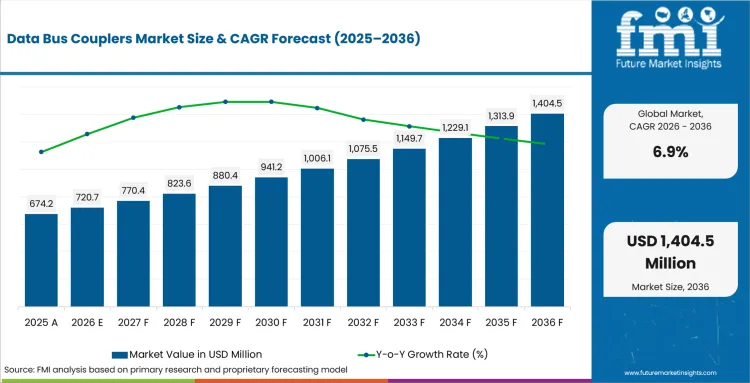
USD 720.7 million in 2026 and USD 1,404.5 million by 2036 at a 6.9% CAGR.
Demand for data bus couplers is projected to expand at 6.9% CAGR between 2026 and 2036, increasing valuation from USD 720.7 million in 2026 to USD 1,404.5 million by 2036. Military aircraft modernization adds hardware and instrumentation within aerospace avionics architectures that retain qualified legacy buses. The integration burden appeared in April 2025 as the United States Air Force reported six F-16 aircraft undergoing VENOM hardware and software modifications. Each added device requires documented couplers that preserve network behavior and configuration traceability during platform changes.
Retrofit engineers preserve legacy impedance and connector geometry across existing harnesses during every approved system change. Controlled drawings reduce repeated integration work across aircraft wire and cable packages during depot maintenance. Matching records also align aviation connectors with couplers without reopening each aircraft-specific interface decision during technical review.
Key Takeaways of Data Bus Couplers Market
- Defense modernization sustains coupler demand as legacy buses require qualified branching hardware during long-service platform upgrades.
- MIL-STD-1553 couplers are projected to represent 48.0% share in 2026 due to deterministic communication across established aerospace platforms.
- Stub couplers are estimated to capture 27.0% share in 2026 owing to adaptable branch connections across installed bus layouts.
- Dual-channel products are forecast to account for 43.0% share in 2026 driven by redundant architecture across critical avionics platforms.
- Platform-specific qualification limits substitution as minor hardware changes can reopen signal integrity and environmental validation across an installed network.
- Data Device Corporation, TE Connectivity and Amphenol compete through documented coupler families covering several aerospace installation formats.
Analyst Perspective
"Program engineers judge a coupler through the installed bus record rather than the component price. Manufacturers protect recurring retrofit orders by preserving impedance evidence and configuration traceability across maintenance decisions for long-service aircraft."
- Sudip Saha, Principal Consultant, Future Market Insights
How is the Data Bus Couplers Market segmented?
The data bus couplers industry is segmented by bus protocol, coupler type, channel count, application, end use and region.
Global market segmentation covers bus protocol, coupler type, channel count, application, end use and region. Bus protocol includes MIL-STD-1553, ARINC 429, CAN aerospace and Ethernet or AFDX, while coupler type includes stub, inline, transformer-coupled, multi-stub and rack-mounted units. Channel count includes single, dual and multi-channel configurations, while applications cover flight-control networks, mission systems, avionics test benches and ground-support equipment. End uses include defense aerospace, commercial aerospace, space systems and test or simulation programs across the regional assessment.
What makes MIL-STD-1553 couplers central to the bus protocol category?
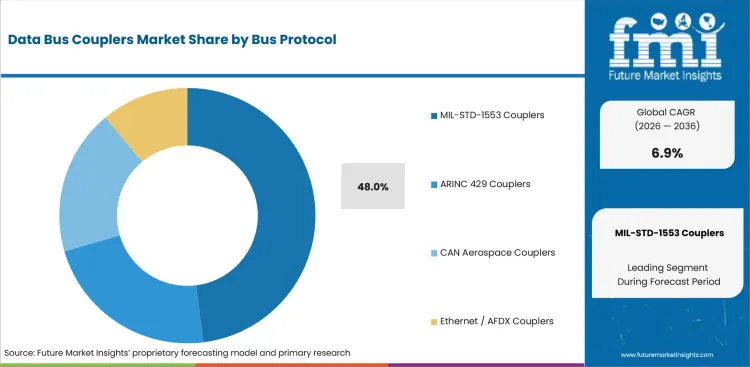
MIL-STD-1553 networks use deterministic command-response communication across aircraft and spacecraft that retain extensive qualification records. Data Device Corporation documents in-line couplers with one through four stubs and optional internal termination, giving engineers verified choices for extending approved layouts without rebuilding every branch.
- MIL-STD-1553 couplers are set to lead the bus protocol category with 48.0% share in 2026 due to deterministic communication across long-service aerospace platforms.
- Program engineers compare stub count and termination style across aerospace couplers during branch approval work. Stable drawings reduce repeated signal reviews during equipment additions and scheduled depot maintenance across qualified aircraft programs.
Why do stub couplers hold a notable position within the coupler type category?
Stub couplers connect terminals to a main bus without rebuilding the complete backbone during aircraft or laboratory integration. The branch route isolates one equipment change while preserving the terminated ends of the primary cable.
- By coupler type, stub couplers are estimated to hold 27.0% in 2026 owing to adaptable branch connections across established bus layouts.
- Test engineers qualify standard assemblies through aviation test equipment that replicates the intended network under realistic loading conditions. MilesTek described box-style and inline couplers in June 2025, giving laboratories consistent formats that reduce wiring variation during scheduled aircraft depot maintenance.
How does the dual-channel segment support the channel count category?
Dual-channel couplers support separate primary and secondary paths that preserve communication during a bus fault. Data Device Corporation explains that MIL-STD-1553 operates as a standby-redundant bus and transfers activity to the secondary bus following a primary-bus failure.
- The channel count category is forecast to be led by dual-channel products at 43.0% share in 2026 due to paired communication paths across redundant avionics networks.
- System integrators validate both routes through aircraft interface devices during complete configuration approval and testing. Standardized kits reduce topology variation between development benches and deployed support locations across approved maintenance programs and technical training environments.
What supports flight control networks within the application category?
Flight-control networks require predictable communication among sensors and computers that coordinate aircraft response throughout critical maneuvers. Every branch change must preserve timing and signal quality across connected control devices under the platform's qualified operating envelope.
- By application, flight control networks are forecast to represent 32.0% in 2026 driven by deterministic exchange across safety-critical platform functions.
- Qualification teams examine coupler impedance against aircraft sensors and computer requirements during installation approval for every connected branch. Data Device Corporation identifies MIL-STD-1553 components within A350 XWB flight-control systems, making deterministic bus behavior and documented interface control central to coupler selection across commercial avionics.
What are the drivers, restraints and opportunities in the Data Bus Couplers Market?
Driver: Aircraft modernization increases qualified branching requirements. Restraint: Platform approval makes component substitution costly. Opportunity: Documented bus kits reduce integration work across retrofit programs.
- Driver: Aircraft modernization adds network changes that require qualified signal branching and documented installation performance across long-service platforms.
- Restraint: Platform-specific testing slows substitution as impedance or connector changes can reopen electrical and environmental approval work.
- Opportunity: Complete bus kits reduce assembly uncertainty by combining compatible couplers and cables under one traceable configuration.
Aircraft modernization adds radiation-hardened electronics and mission computers to platforms that retain qualified legacy buses. Integrators use couplers to add branches without changing the signal behavior already approved for aircraft communication systems.
Qualification slows substitution as engineers examine impedance and environmental performance across the complete installed network. Lower-priced couplers cannot offset schedule risk from repeated electrical testing and revised aircraft drawing work.
Documented kits help maintenance teams reproduce approved configurations reliably across laboratories and field support locations. Manufacturers support military avionics programs by pairing couplers with terminators and compatible cables under traceable part numbers.
Which country CAGRs are profiled in the Data Bus Couplers Market?
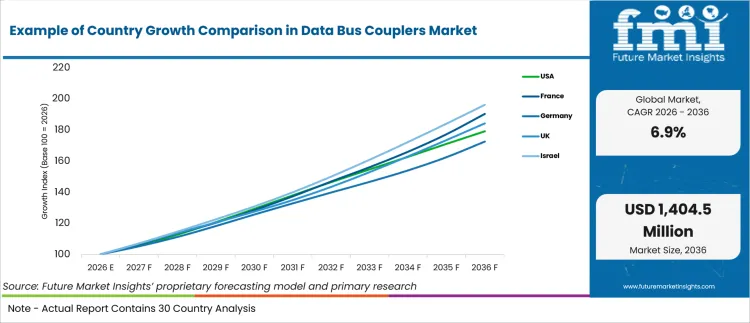
| Country | CAGR |
|---|---|
| United States | 6.0% |
| France | 6.7% |
| Germany | 5.6% |
| United Kingdom | 6.3% |
| Israel | 7.0% |
How do country-level CAGRs compare in the Data Bus Couplers Market?
The displayed range spans 1.4 percentage points across five aerospace markets with different platform schedules. Current scale depends on approval routes and technical support, so CAGR spacing does not establish market size.
- Israel's growth reflects concentrated integration expertise, although limited platform volumes restrain absolute revenue across imported aircraft programs.
- France remains 0.3 percentage point behind Israel as centralized Rafale testing supports a comparable qualification pace.
- United Kingdom growth follows funded radar integration through established modification routes across the existing Typhoon fleet.
- United States growth remains close to the United Kingdom as broad service access offsets aircraft-block approval work.
- Germany's multinational configuration controls lengthen qualification despite deep engineering capacity across Eurofighter production and support.
Comparable CAGRs can produce different market entry conditions. The full report provides country-level CAGR analysis across North America, Latin America, Europe, East Asia, South Asia and Pacific, and the Middle East and Africa.
Country-wise Analysis
- United States F-16 programs rely on established supply and maintenance systems that connect avionics upgrades with trained personnel across operational bases and depot routes serving long-service aircraft and distributed maintenance organizations. The United States Air Force reported in July 2025 that upgraded aircraft at Osan retained logistics and training support while receiving newer avionics capabilities for regional readiness and interoperability across deployed squadrons. Data bus coupler sales in the United States are forecast to expand at 6.0% CAGR by 2036, supported by broad technical access from domestic manufacturers and testing hubs while aircraft-specific drawings and base-level change control extend approvals across separate configurations and technical orders for each aircraft block.
- French Rafale programs route connected mission functions through national testing facilities at dedicated domestic sites, and the Direction générale de l'armement reported seven F4.3 missions in July 2025 covering scenarios centered on connectivity and weapons systems. France's data bus coupler market outlook is anticipated to advance at 6.7% CAGR over the assessment period, supported by continued platform validation and access to domestic aerospace engineers and specialized test resources. Established service organizations support controlled retrofit trials across national program channels. Each aircraft standard requires separate wiring evidence and qualified troubleshooting under long-duration support contracts and formal configuration approvals for each production standard.
- German Eurofighter programs connect final assembly in Manching with a national engineering network that supports radar and electronic-warfare integration across long-duration aircraft production and maintenance programs with specialized test facilities. The German data bus coupler sector is projected to record 5.6% CAGR during the assessment period, influenced by scheduled production and local integration depth across approved program partners and established supply routes. Airbus confirmed an October 2025 order for 20 aircraft involving 120 domestic suppliers, yet multinational configuration control and extended delivery calendars restrict direct access for smaller coupler manufacturers through formal design authority reviews and documented platform qualification steps across production tiers.
- United Kingdom Typhoon upgrades connect radar development with mission-system changes through domestic integration sites under centralized program oversight and coordinated support planning, and the Ministry of Defence committed funding in January 2026 for 40 ECRS Mk2 radars. Adoption of data bus couplers in the United Kingdom is estimated to expand at 6.3% CAGR through 2036, shaped by funded radar integration and established engineering routes across national modification programs. Prime contractor relationships support qualified technical work across the existing fleet while coordinated radar and platform delivery can delay component approval during formal interface-control changes and contract revisions across several verification stages.
- Israeli helicopter fleet renewal concentrates avionics and electronic-warfare integration within major aerospace programs supported by specialized domestic engineering and testing facilities and established integrator relationships for imported platforms. The Israel Ministry of Defense signed a February 2026 agreement covering Israeli systems for 12 CH-53K helicopters through a dedicated installation route and local deployment preparation across the planned fleet support cycle. Israel is estimated to post 7.0% CAGR over the forecast period, driven by concentrated defense-electronics expertise and direct coordination even as limited platform volumes make coupler orders sensitive to foreign military sales schedules alongside budget releases and contract milestones during fleet introduction.
Who are the notable companies in the Data Bus Couplers Market?
Data Device Corporation, TE Connectivity, Amphenol, MilesTek, AIM GmbH, Alta Data Technologies, Excalibur Systems and Astronics are the notable companies shaping this market.
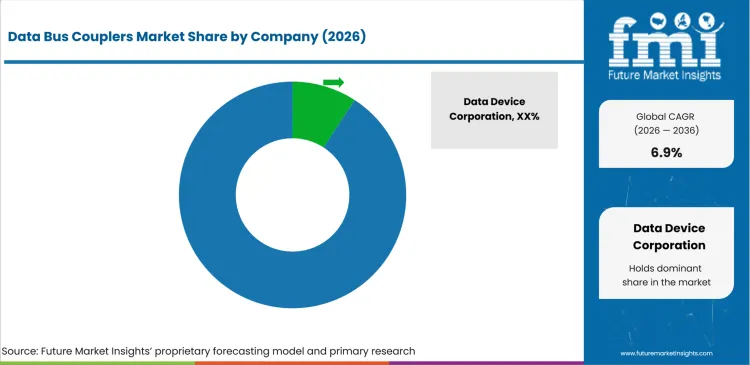
Competition is moderately fragmented as complete coupler manufacturers coexist with interface specialists serving different stages of MIL-STD-1553 integration. Airborne entry remains narrow as program qualification and environmental records outweigh a company's general electronics scale.
- Data Device Corporation, TE Connectivity and Amphenol compete through complete coupler families covering several aerospace installation formats.
- MilesTek, Excalibur Systems and Astronics address stocked couplers or connection hardware for laboratory and airborne applications.
- AIM GmbH and Alta Data Technologies support bus construction through accessories and interface hardware for laboratory or embedded integration.
Competitive Benchmarking: Data Bus Couplers Market
| Company | Coupler Breadth | Integration Support | Qualification Evidence | Geographic Reach |
|---|---|---|---|---|
| Data Device Corporation | High | High | High | Global or multi-region |
| TE Connectivity | High | Medium | High | Global or multi-region |
| Amphenol | High | Medium | High | Global or multi-region |
| MilesTek | High | High | Medium | North America and selected export markets |
| AIM GmbH | High | Medium | Medium | Europe and international partners |
| Alta Data Technologies | Medium | High | Medium | North America and selected export markets |
| Excalibur Systems | High | High | Medium | North America and selected export markets |
| Astronics | Medium | High | Medium | Global or multi-region |
Key Developments in the Data Bus Couplers Market
- In October 2025, Alta Data Technologies released the MP2-1553 card with one or two channels inside a compact M.2 2280 form factor.
- In March 2025, Cinch Connectivity Solutions introduced space-grade Trompeter connectors that support MIL-STD-1553B data bus systems across military and commercial space applications.
Data Bus Couplers Market - Report Scope
| Coverage field | Report scope |
|---|---|
| Market breakdown | By bus protocol, coupler type, channel count, application, end use and region. |
| Quantitative Units | Revenue in USD million ans CAGR in %. |
| Market Definition | The market covers commercial revenue from complete data bus couplers and directly integrated coupling units used in aerospace, defense and test-system data networks. |
| Regions Covered | North America, Latin America, Europe, East Asia, South Asia and Pacific, and Middle East and Africa. |
| Countries Covered | United States, France, Germany, United Kingdom, Israel and more than twenty-five additional countries in the full report. |
| Key Companies Profiled | Data Device Corporation, TE Connectivity, Amphenol, MilesTek, AIM GmbH, Alta Data Technologies, Excalibur Systems and Astronics. |
| Forecast Period | 2026 to 2036. |
| Approach | Primary and secondary research with market triangulation. |
Data Bus Couplers Market - Research Methodology
| Method | Approach |
|---|---|
| Primary Research | FMI analysts gathered input from manufacturers, service providers, technology developers, distributors, end users, procurement teams, and subject-matter experts. Interviews examined purchasing decisions, product or service evaluation, adoption barriers, approval requirements, pricing considerations, and expectations for technical or commercial support. Respondents were also asked what evidence is required before a trial, pilot, or initial order develops into regular purchasing. |
| Desk Research | Desk research covered government statistics, regulatory publications, trade data, industry associations, technical literature, standards, company filings, product information, and official corporate announcements. Sources were reviewed for relevance, publication date, geographic coverage, and consistency with the defined market scope. Claims relating to performance, applications, approvals, capacity, investment, and commercial activity were retained only when supported by credible public evidence. |
| Market Sizing and Forecasting | The market model combined the baseline value with historical performance, segment structure, pricing and volume indicators, adoption levels, company participation, and country-level demand conditions. Forecast assumptions considered economic activity, investment trends, regulatory developments, technology adoption, purchasing cycles, supply availability, and barriers to wider market use. Segment and regional estimates were reconciled before the final market total was calculated. |
| Data Validation | Estimates were checked against multiple independent indicators, including public data, company activity, trade patterns, industry developments, and findings from primary interviews. Validation also tested whether products, services, applications, and company revenues fell within the defined market boundaries. Adjacent categories, unsupported claims, overlapping revenues, and activities without direct market relevance were excluded to reduce double counting and maintain consistency across segments and countries. |
Data Bus Couplers Market by Segments
Data Bus Couplers Market segmented by bus protocol:
- MIL-STD-1553 Couplers
- ARINC 429 Couplers
- CAN Aerospace Couplers
- Ethernet / AFDX Couplers
Data Bus Couplers Market segmented by coupler type:
- Stub Couplers
- Inline Couplers
- Transformer Coupled Units
- Multi-stub Couplers
- Rack-mounted Couplers
Data Bus Couplers Market segmented by channel count:
- Dual Channel
- Single Channel
- Multi-channel
Data Bus Couplers Market segmented by application:
- Flight Control Networks
- Mission Systems
- Avionics Test Benches
- Ground Support Equipment
Data Bus Couplers Market segmented by end use:
- Defense Aerospace
- Commercial Aerospace
- Space Systems
- Test & Simulation
Data Bus Couplers Market by Region:
- North America
- United States
- Canada
- Latin America
- Brazil
- Mexico
- Argentina
- Chile
- Western Europe
- Germany
- France
- United Kingdom
- Italy
- Spain
- Benelux
- Nordics
- Eastern Europe
- Poland
- Czech Republic
- Romania
- Hungary
- East Asia
- China
- Japan
- South Korea
- South Asia and Pacific
- India
- ASEAN
- Australia and New Zealand
- Middle East and Africa
- GCC Countries
- South Africa
- Türkiye
- Israel
Research Sources and Bibliography
- United States Air Force. (2025, April 2). Autonomous F-16 program advances with modifications, simulations.
- United States Air Force. (2025, July 11). 51st Fighter Wing enhances readiness through F-16 upgrades.
- Direction générale de l'armement. (2025, July 29). Envol vers le nouveau standard F4.3 du Rafale.
- Airbus. (2025, October 15). Germany orders 20 new Eurofighters to strengthen air superiority.
- Ministry of Defence. (2026, January 22). Half a billion investment to upgrade RAF Typhoons and secure 1,500 British jobs.
- Israel Ministry of Defense. (2026, February 5). Israel Ministry of Defense Signs Approx $130 Million Deal with Elbit Systems to Integrate Israeli Systems on CH-53K Helicopters.
- Data Device Corporation. (n.d.). Ultra-Compact MIL-STD-1553 Transformers & Couplers.
- Data Device Corporation. (n.d.). Flight Control.
- TE Connectivity. (n.d.). Data Bus Couplers: Compact, Lightweight.
- Amphenol-Air LB. (n.d.). JN1168 | JN1042 / 711.
- MilesTek. (2025, June 10). Enhancing Network Reliability with MIL-STD-1553 Couplers.
- AIM GmbH. (n.d.). AIM Adapter Cables and 3rd Party MIL-STD-1553 Accessories.
- Alta Data Technologies. (n.d.). Bus Kits and Cable Accessories.
- Excalibur Systems. (n.d.). Excalibur | Couplers.
- Astronics. (n.d.). Mil-STD-1553 Accessories.
- Cinch Connectivity Solutions. (2025, March 26). Cinch Connectivity Solutions unveils new space-grade Trompeter connectors for military and commercial applications.
- Holt Integrated Circuits. (2026, May 11). Holt introduces 3.3V pin-configurable 10 or 1 MBit/s MIL-STD-1553 BC/RT/MT.
- Alta Data Technologies. (2025, September 9). Alta Data Technologies Enhances MIL-STD-1553 Analysis with New Time View Feature.
- Alta Data Technologies. (2025, December 16). Alta Data Technologies Appoints Dimac Red as New Distributor for France.
- Alta Data Technologies. (2025, October 9). Alta Data Technologies Announces New 1-2 Channel MIL-STD-1553 M.2 Card.
This bibliography is provided for reader reference and is not exhaustive. The full report contains the complete reference list and detailed citations
This Report Answers
- How large is the data bus couplers market in 2026 and 2036?
- Which operating conditions support demand for data bus couplers?
- Why do MIL-STD-1553 couplers hold the largest bus protocol share in 2026?
- How do stub couplers influence installation decisions across established networks?
- Why are dual-channel products important for redundant platform architecture?
- How do country growth rates differ across the five profiled countries?
- Which companies provide complete couplers or supporting interface components?
- What currently limits substitution across qualified aerospace platforms?
- What should engineering teams evaluate before approving a data bus coupler?
Frequently Asked Questions
How big is the Data Bus Couplers Market in 2026?
The data bus couplers market is valued at USD 720.7 million in 2026 and is forecast to reach USD 1404.5 million by 2036. Growth is supported by military aircraft modernization programs that sustain recurring demand for qualified branching hardware across legacy bus architectures during long-service platform upgrades and depot maintenance cycles worldwide.
What is the CAGR of the Data Bus Couplers Market from 2026 to 2036?
The data bus couplers market grows at a CAGR of 6.9% between 2026 and 2036, supported by defense and commercial aerospace programs adopting qualified coupler families once impedance evidence and configuration traceability preserve approved network behavior across aircraft modernization, retrofit integration, and scheduled maintenance replacement cycles.
Which bus protocol leads the Data Bus Couplers Market?
MIL-STD-1553 couplers account for 48.0% of the data bus couplers market by bus protocol in 2026, driven by deterministic command-response communication requirements across long-service aerospace platforms that retain extensive qualification records and require documented branching hardware during avionics upgrades and platform modifications.
How much will the Data Bus Couplers Market add between 2026 and 2036?
The data bus couplers market is set to add USD 683.8 million between 2026 and 2036, growing from USD 720.7 million to USD 1404.5 million as aircraft modernization programs, redundant avionics architecture requirements, and documented bus kit adoption expand qualified coupler demand across defense, commercial aerospace, and space system programs globally.
Who are the leading companies in the Data Bus Couplers Market?
Eight companies shape competition in the data bus couplers market, including Data Device Corporation, TE Connectivity, Amphenol, MilesTek, AIM GmbH, Alta Data Technologies, Excalibur Systems, and Astronics, competing through complete coupler families, integration support hardware, flight-approved qualification evidence, and distributed service coverage across aerospace, defense, and test-system data network programs worldwide.
Preview the report firsthand - request a free sample
Get SampleGet the brochure for pricing and purchase details.
Get PDFTable of Content
- Key Takeaways
- Market Size and CAGR
- Top Growth Driver
- Fastest Growing Segment
- Leading Region
- Key Companies
- Emerging Opportunities
- Executive Summary
- Global Market Outlook
- Demand-side Trends
- Supply-side Trends
- Technology Roadmap Analysis
- Analysis and Recommendations
- Analyst Perspective (What is happening? Why now? What should investors know?)
- Key Questions Answered
- How large is the market?
- What is the CAGR?
- What are key trends?
- Which region dominates?
- Who are the leaders?
- Market Overview
- Market Coverage / Taxonomy
- Market Definition / Scope / Limitations
- Research Methodology
- Chapter Orientation
- Analytical Lens and Working Hypotheses
- Market Structure, Signals, and Trend Drivers
- Benchmarking and Cross-market Comparability
- Market Sizing, Forecasting, and Opportunity Mapping
- Research Design and Evidence Framework
- Desk Research Programme (Secondary Evidence)
- Expert Input and Fieldwork (Primary Evidence)
- Tooling, Models, and Reference Databases
- Data Engineering and Model Build
- Quality Assurance and Audit Trail
- Market Background
- Market Dynamics (Drivers, Restraints, Opportunity, Trends)
- Scenario Forecast (Optimistic, Likely, Conservative)
- Impact Analysis
- AI Impact
- Sustainability Impact
- Regulatory Impact
- Technology Impact
- Consumer / Buyer Analysis
- Purchase Drivers
- Adoption Barriers
- Buyer Journey
- Opportunity Map Analysis
- Product Life Cycle Analysis
- Supply Chain Analysis
- Investment Feasibility Matrix
- Value Chain Analysis
- PESTLE and Porter's Analysis
- Regulatory Landscape
- Regional Parent Market Outlook
- Production and Consumption Statistics
- Import and Export Statistics
- Global Market Analysis and Forecast, 2021 to 2036
- Historical Market Size Value (USD Million) Analysis, 2021 to 2025
- Current and Future Market Size Value (USD Million) Projections, 2026 to 2036
- Y-o-Y Growth Trend Analysis
- Absolute $ Opportunity Analysis
- Global Market Pricing Analysis, 2021 to 2036
- Global Market Analysis and Forecast, By Bus Protocol, 2021 to 2036
- Introduction / Key Findings
- Historical Market Size Value (USD Million) Analysis By Bus Protocol, 2021 to 2025
- Current and Future Market Size Value (USD Million) Analysis and Forecast By Bus Protocol, 2026 to 2036
- MIL-STD-1553 Couplers
- ARINC 429 Couplers
- CAN Aerospace Couplers
- Ethernet / AFDX Couplers
- MIL-STD-1553 Couplers
- Y-o-Y Growth Trend Analysis By Bus Protocol, 2021 to 2025
- Absolute $ Opportunity Analysis By Bus Protocol, 2026 to 2036
- Global Market Analysis and Forecast, By Coupler Type, 2021 to 2036
- Introduction / Key Findings
- Historical Market Size Value (USD Million) Analysis By Coupler Type, 2021 to 2025
- Current and Future Market Size Value (USD Million) Analysis and Forecast By Coupler Type, 2026 to 2036
- Stub Couplers
- Inline Couplers
- Transformer Coupled Units
- Multi-stub Couplers
- Rack-mounted Couplers
- Stub Couplers
- Y-o-Y Growth Trend Analysis By Coupler Type, 2021 to 2025
- Absolute $ Opportunity Analysis By Coupler Type, 2026 to 2036
- Global Market Analysis and Forecast, By Channel Count, 2021 to 2036
- Introduction / Key Findings
- Historical Market Size Value (USD Million) Analysis By Channel Count, 2021 to 2025
- Current and Future Market Size Value (USD Million) Analysis and Forecast By Channel Count, 2026 to 2036
- Dual Channel
- Single Channel
- Multi-channel
- Dual Channel
- Y-o-Y Growth Trend Analysis By Channel Count, 2021 to 2025
- Absolute $ Opportunity Analysis By Channel Count, 2026 to 2036
- Global Market Analysis and Forecast, By Application, 2021 to 2036
- Introduction / Key Findings
- Historical Market Size Value (USD Million) Analysis By Application, 2021 to 2025
- Current and Future Market Size Value (USD Million) Analysis and Forecast By Application, 2026 to 2036
- Flight Control Networks
- Mission Systems
- Avionics Test Benches
- Ground Support Equipment
- Flight Control Networks
- Y-o-Y Growth Trend Analysis By Application, 2021 to 2025
- Absolute $ Opportunity Analysis By Application, 2026 to 2036
- Global Market Analysis and Forecast, By End Use, 2021 to 2036
- Introduction / Key Findings
- Historical Market Size Value (USD Million) Analysis By End Use, 2021 to 2025
- Current and Future Market Size Value (USD Million) Analysis and Forecast By End Use, 2026 to 2036
- Defense Aerospace
- Commercial Aerospace
- Space Systems
- Test & Simulation
- Defense Aerospace
- Y-o-Y Growth Trend Analysis By End Use, 2021 to 2025
- Absolute $ Opportunity Analysis By End Use, 2026 to 2036
- Global Market Analysis and Forecast, By Region, 2021 to 2036
- Introduction
- Historical Market Size Value (USD Million) Analysis By Region, 2021 to 2025
- Current Market Size Value (USD Million) Analysis and Forecast By Region, 2026 to 2036
- North America
- Latin America
- Western Europe
- Eastern Europe
- East Asia
- South Asia and Pacific
- Middle East & Africa
- Market Attractiveness Analysis By Region
- North America Market Analysis and Forecast, By Country, 2021 to 2036
- Historical Market Size Value (USD Million) Trend Analysis By Market Taxonomy, 2021 to 2025
- Market Size Value (USD Million) Forecast By Market Taxonomy, 2026 to 2036
- By Country
- USA
- Canada
- By Bus Protocol
- By Coupler Type
- By Channel Count
- By Application
- By End Use
- By Country
- Market Attractiveness Analysis
- By Country
- By Bus Protocol
- By Coupler Type
- By Channel Count
- By Application
- By End Use
- Key Takeaways
- Latin America Market Analysis and Forecast, By Country
- Historical Market Size Value (USD Million) Trend Analysis By Market Taxonomy, 2021 to 2025
- Market Size Value (USD Million) Forecast By Market Taxonomy, 2026 to 2036
- By Country
- Brazil
- Mexico
- Chile
- Rest of Latin America
- By Bus Protocol
- By Coupler Type
- By Channel Count
- By Application
- By End Use
- By Country
- Market Attractiveness Analysis
- By Country
- By Bus Protocol
- By Coupler Type
- By Channel Count
- By Application
- By End Use
- Key Takeaways
- Western Europe Market Analysis and Forecast, By Country
- Historical Market Size Value (USD Million) Trend Analysis By Market Taxonomy, 2021 to 2025
- Market Size Value (USD Million) Forecast By Market Taxonomy, 2026 to 2036
- By Country
- Germany
- UK
- Italy
- Spain
- France
- Nordic
- BENELUX
- Rest of Western Europe
- By Bus Protocol
- By Coupler Type
- By Channel Count
- By Application
- By End Use
- By Country
- Market Attractiveness Analysis
- By Country
- By Bus Protocol
- By Coupler Type
- By Channel Count
- By Application
- By End Use
- Key Takeaways
- Eastern Europe Market Analysis and Forecast, By Country
- Historical Market Size Value (USD Million) Trend Analysis By Market Taxonomy, 2021 to 2025
- Market Size Value (USD Million) Forecast By Market Taxonomy, 2026 to 2036
- By Country
- Russia
- Poland
- Hungary
- Balkan & Baltic
- Rest of Eastern Europe
- By Bus Protocol
- By Coupler Type
- By Channel Count
- By Application
- By End Use
- By Country
- Market Attractiveness Analysis
- By Country
- By Bus Protocol
- By Coupler Type
- By Channel Count
- By Application
- By End Use
- Key Takeaways
- East Asia Market Analysis and Forecast, By Country
- Historical Market Size Value (USD Million) Trend Analysis By Market Taxonomy, 2021 to 2025
- Market Size Value (USD Million) Forecast By Market Taxonomy, 2026 to 2036
- By Country
- China
- Japan
- South Korea
- By Bus Protocol
- By Coupler Type
- By Channel Count
- By Application
- By End Use
- By Country
- Market Attractiveness Analysis
- By Country
- By Bus Protocol
- By Coupler Type
- By Channel Count
- By Application
- By End Use
- Key Takeaways
- South Asia and Pacific Market Analysis and Forecast, By Country
- Historical Market Size Value (USD Million) Trend Analysis By Market Taxonomy, 2021 to 2025
- Market Size Value (USD Million) Forecast By Market Taxonomy, 2026 to 2036
- By Country
- India
- ASEAN
- Australia & New Zealand
- Rest of South Asia and Pacific
- By Bus Protocol
- By Coupler Type
- By Channel Count
- By Application
- By End Use
- By Country
- Market Attractiveness Analysis
- By Country
- By Bus Protocol
- By Coupler Type
- By Channel Count
- By Application
- By End Use
- Key Takeaways
- Middle East & Africa Market Analysis and Forecast, By Country
- Historical Market Size Value (USD Million) Trend Analysis By Market Taxonomy, 2021 to 2025
- Market Size Value (USD Million) Forecast By Market Taxonomy, 2026 to 2036
- By Country
- Kingdom of Saudi Arabia
- Other GCC Countries
- Türkiye
- South Africa
- Other African Union
- Rest of Middle East & Africa
- By Bus Protocol
- By Coupler Type
- By Channel Count
- By Application
- By End Use
- By Country
- Market Attractiveness Analysis
- By Country
- By Bus Protocol
- By Coupler Type
- By Channel Count
- By Application
- By End Use
- Key Takeaways
- Key Countries Market Analysis
- USA
- Pricing Analysis
- Market Share Analysis, 2025
- By Bus Protocol
- By Coupler Type
- By Channel Count
- By Application
- By End Use
- Canada
- Pricing Analysis
- Market Share Analysis, 2025
- By Bus Protocol
- By Coupler Type
- By Channel Count
- By Application
- By End Use
- Mexico
- Pricing Analysis
- Market Share Analysis, 2025
- By Bus Protocol
- By Coupler Type
- By Channel Count
- By Application
- By End Use
- Brazil
- Pricing Analysis
- Market Share Analysis, 2025
- By Bus Protocol
- By Coupler Type
- By Channel Count
- By Application
- By End Use
- Chile
- Pricing Analysis
- Market Share Analysis, 2025
- By Bus Protocol
- By Coupler Type
- By Channel Count
- By Application
- By End Use
- Germany
- Pricing Analysis
- Market Share Analysis, 2025
- By Bus Protocol
- By Coupler Type
- By Channel Count
- By Application
- By End Use
- UK
- Pricing Analysis
- Market Share Analysis, 2025
- By Bus Protocol
- By Coupler Type
- By Channel Count
- By Application
- By End Use
- Italy
- Pricing Analysis
- Market Share Analysis, 2025
- By Bus Protocol
- By Coupler Type
- By Channel Count
- By Application
- By End Use
- Spain
- Pricing Analysis
- Market Share Analysis, 2025
- By Bus Protocol
- By Coupler Type
- By Channel Count
- By Application
- By End Use
- France
- Pricing Analysis
- Market Share Analysis, 2025
- By Bus Protocol
- By Coupler Type
- By Channel Count
- By Application
- By End Use
- India
- Pricing Analysis
- Market Share Analysis, 2025
- By Bus Protocol
- By Coupler Type
- By Channel Count
- By Application
- By End Use
- ASEAN
- Pricing Analysis
- Market Share Analysis, 2025
- By Bus Protocol
- By Coupler Type
- By Channel Count
- By Application
- By End Use
- Australia & New Zealand
- Pricing Analysis
- Market Share Analysis, 2025
- By Bus Protocol
- By Coupler Type
- By Channel Count
- By Application
- By End Use
- China
- Pricing Analysis
- Market Share Analysis, 2025
- By Bus Protocol
- By Coupler Type
- By Channel Count
- By Application
- By End Use
- Japan
- Pricing Analysis
- Market Share Analysis, 2025
- By Bus Protocol
- By Coupler Type
- By Channel Count
- By Application
- By End Use
- South Korea
- Pricing Analysis
- Market Share Analysis, 2025
- By Bus Protocol
- By Coupler Type
- By Channel Count
- By Application
- By End Use
- Russia
- Pricing Analysis
- Market Share Analysis, 2025
- By Bus Protocol
- By Coupler Type
- By Channel Count
- By Application
- By End Use
- Poland
- Pricing Analysis
- Market Share Analysis, 2025
- By Bus Protocol
- By Coupler Type
- By Channel Count
- By Application
- By End Use
- Hungary
- Pricing Analysis
- Market Share Analysis, 2025
- By Bus Protocol
- By Coupler Type
- By Channel Count
- By Application
- By End Use
- Kingdom of Saudi Arabia
- Pricing Analysis
- Market Share Analysis, 2025
- By Bus Protocol
- By Coupler Type
- By Channel Count
- By Application
- By End Use
- Türkiye
- Pricing Analysis
- Market Share Analysis, 2025
- By Bus Protocol
- By Coupler Type
- By Channel Count
- By Application
- By End Use
- South Africa
- Pricing Analysis
- Market Share Analysis, 2025
- By Bus Protocol
- By Coupler Type
- By Channel Count
- By Application
- By End Use
- USA
- Market Structure Analysis
- Competition Dashboard
- Competition Benchmarking
- Market Share Analysis of Top Players
- By Regional
- By Bus Protocol
- By Coupler Type
- By Channel Count
- By Application
- By End Use
- Emerging Startups
- Innovation Benchmarking
- Competition Analysis
- Competition Deep Dive
- Data Device Corporation
- Overview
- Product Portfolio
- Profitability by Market Segments
- Sales Footprint
- Strategy Overview
- Marketing Strategy
- Product Strategy
- Channel Strategy
- TE Connectivity
- Amphenol
- MilesTek
- AIM GmbH
- Alta Data Technologies
- Excalibur Systems
- Astronics
- North Atlantic Industries
- Holt Integrated Circuits
- Data Device Corporation
- Case Studies
- Success Stories
- Recent Developments
- Competition Deep Dive
- Assumptions & Acronyms Used


