
- Market Size (2026)
- USD 383.8 Mn
- Forecast (2036)
- USD 424.0 Mn
- CAGR (2026 to 2036)
- 1.0%
How big is the Decamethylcyclopentasiloxane (D5) Market in 2026?
The global decamethylcyclopentasiloxane market should reach USD 424.0 million by 2036 at a 1.0% CAGR across 2026 to 2036. The market was valued at USD 380.0 million in 2025, and FMI estimates USD 383.8 million for 2026.
Substitution in cosmetics and continued industrial conversion pull D5 demand in different directions. The European restriction extends beyond the wash-off products already covered since 2020. Other cosmetics become subject to the restriction after 6 June 2027. The rule also retains exemptions for specified industrial uses, including silicone-polymer production. A forecast for D5 therefore depends on the destination and use of each shipment.
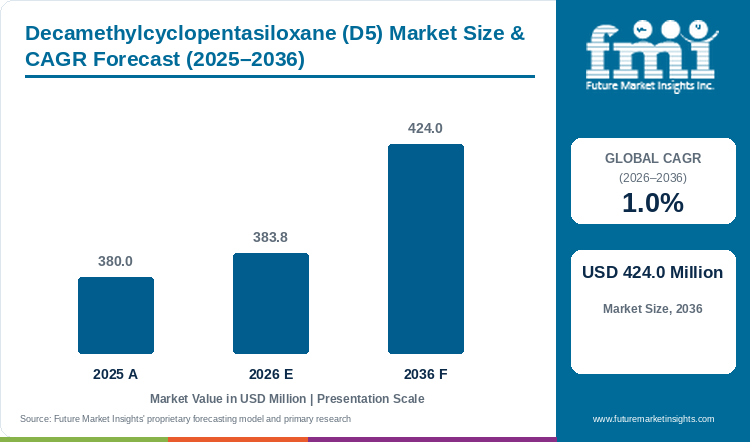
Suppliers are already offering alternative formulations. Elkem introduced low-cyclic silicone cosmetic formulations in July 2025. That is competitive pressure on direct D5 use, even though it supports the wider silicone business. The majority of Elkem's Silicones division was sold to Bluestar on 30 April 2026. FMI expects limited global value growth as industrial demand and selected national markets offset part of the substitution pressure. The commercial question is which D5 uses remain addressable through the decade. Demand in the broader silicone fluid market should be assessed separately from this single cyclic substance.
Key Market Trends & Insights
- Product identity and residual content require separate specifications. Dow's SH 245 technical literature identifies Cyclopentasiloxane and reports typical D4 content below 0.1%. A low concentration of D4 leaves the restriction on intentionally used D5 in place.
- Removing cyclic residues from finished polymers involves process choices. HSE's July 2025 technical review describes vacuum stripping and enhanced distillation, while noting that treatment may affect some uncured polymers. The cost and performance of residue reduction therefore matter beyond the price of bulk D5.
- Supplier portfolios increasingly include competing routes to a cosmetic brief. Shin-Etsu lists both cyclic KF-995 and non-cyclic volatile silicone products. A supplier may retain the customer while selling less D5 into the approved formulation.
Regional Highlights
- China and India are gaining share of global revenue. FMI projects China at 24.7% against 23.0% in 2026 and India at 5.9% against 5.0% in 2026 by 2036.
- Share slips for Germany, the United States and Japan as revenue grows. The 2036 outlook has Germany at 5.6% against 6.0% in 2026, the United States at 23.3% against 24.0% in 2026 and Japan at 7.4% against 8.0% in 2026.
Decamethylcyclopentasiloxane (D5) Market Size and Forecast
Table 1: Decamethylcyclopentasiloxane (D5) Market Size and Forecast
| Market size and forecast | Value |
|---|---|
| Market size in 2025 | USD 380.0 million |
| Estimated market size in 2026 | USD 383.8 million |
| Projected market size by 2036 | USD 424.0 million |
| CAGR from 2026 to 2036 | 1.0% |
Source: Future Market Insights analysis of the decamethylcyclopentasiloxane (D5) market, 2026.
Analyst Perspective
“D5 suppliers face a portfolio decision before a capacity decision. The most defensible sales base consists of applications with a clear legal route and a customer specification that still requires this molecule. Maintaining cosmetic accounts may involve supplying alternative silicone chemistry. That protects the wider customer relationship while reducing D5 revenue. Industrial conversion and country-specific product demand should therefore be evaluated separately from the success of a manufacturer's overall silicone portfolio.”
- Nikhil Kaitwade, Principal Consultant, FMI
How is the Decamethylcyclopentasiloxane (D5) Market segmented?
- By application: Personal Care and Cosmetics, Silicone Polymer Intermediates, Household and Industrial Care, and Electronics and Other.
- By grade: Cosmetic Grade, Technical Grade, and Industrial Grade.
- By sales route: Direct Supply Agreements and Distributor Supply.
- By region: North America, Latin America, Western Europe, East Asia, South Asia, and Rest of world.
Why does the Personal Care and Cosmetics segment lead by Application in the Decamethylcyclopentasiloxane (D5) Market in 2026?
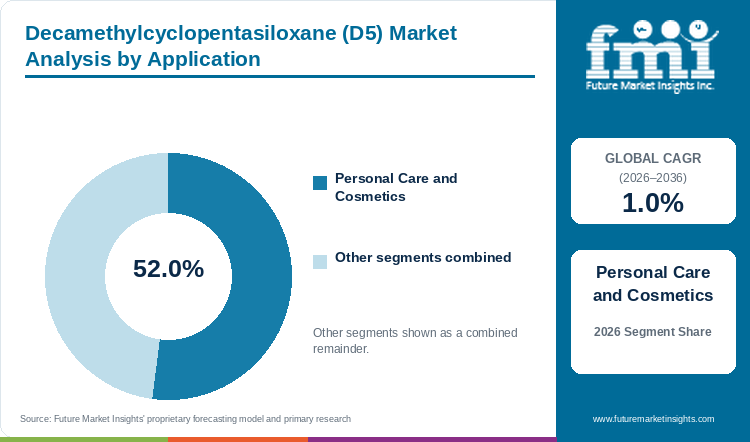
The Personal Care and Cosmetics segment holds 52.0% of the Decamethylcyclopentasiloxane (D5) Market by application in 2026.
The leading application remains exposed to a gradual change in approved formulations. D5 has established positions in cosmetic carrier systems, with manufacturers such as Dow and Shin-Etsu maintaining identifiable product literature. These existing technical references support a continuing formulation base.
The European timetable limits the scope of a simple replacement argument. D4 and D5 in wash-off cosmetics were already restricted before the current forecast begins. The later transition for other cosmetics affects a different set of formulations. Suppliers therefore need to distinguish replacement of a remaining leave-on carrier from business already removed from the European wash-off market. Outside Europe, a customer's export destinations may still influence its formula choice.
FMI projects Personal Care and Cosmetics revenue of USD 211.4 million in 2036, with its application share declining to 49.9%. Revenue grows slowly while other uses gain relative importance. A 2025 low-cyclic formulation introduction shows a supplier responding through a broader portfolio. That response is commercially credible and adds no direct D5 consumption. Customers may stay with a silicone supplier while qualifying a different carrier.
Silicone Polymer Intermediates, Household and Industrial Care and Electronics and Other together hold the remaining 48.0% by application.
Table 2: Application, 2026 Share
| Leading Share | 2026 market share |
|---|---|
| Personal Care and Cosmetics | 52.0% |
| All Other Segments Combined Share | 48.0% |
Source: Future Market Insights analysis of the decamethylcyclopentasiloxane (D5) market, 2026.
Why does the Cosmetic Grade segment lead by Grade in the Decamethylcyclopentasiloxane (D5) Market in 2026?
The Cosmetic Grade segment holds 50.0% of the Decamethylcyclopentasiloxane (D5) Market by grade in 2026.
Cosmetic Grade leads the grade split with exactly half of 2026 revenue. Purchasing in this category depends on a documented composition and suitability for the intended formulation. SH 245 literature describes typical viscosity and D4 content separately and states that typical properties are not purchasing specifications. A buyer consequently needs an agreed specification for the actual shipment.
Purity is one measure among several in a commercial comparison. Gelest's published D5 offering has a typical purity of 97.0%. Industrial conversion can involve a different specification and a different impurity tolerance. Comparing grades only on a headline purity number would hide those differences.
Cosmetic Grade revenue reaches USD 202.4 million in FMI's 2036 outlook, while its share declines to 47.7%. Industrial Grade advances to USD 93.9 million and a 22.1% share. This change points to a larger contribution from industrial demand within a slowly growing market. Suppliers must still separate D5 used as a raw material from unwanted D5 residues in finished silicone polymers. Evonik's low-cyclic silicone additive offering illustrates the latter issue and is not a direct cosmetic D5 grade.
Technical Grade and Industrial Grade together hold the remaining 50.0% by grade.
Table 3: Grade, 2026 Share
| Leading Share | 2026 market share |
|---|---|
| Cosmetic Grade | 50.0% |
| All Other Segments Combined Share | 50.0% |
Source: Future Market Insights analysis of the decamethylcyclopentasiloxane (D5) market, 2026.
Why does the Direct Supply Agreements segment lead by Sales Route in the Decamethylcyclopentasiloxane (D5) Market in 2026?
The Direct Supply Agreements segment holds 66.0% of the Decamethylcyclopentasiloxane (D5) Market by sales route in 2026.
Direct supply agreements lead because D5 is bought against a specification by silicone-polymer makers and by cosmetic and household-care formulators that need documented composition and consistent availability. The European restriction retains exemptions for specified industrial uses, including silicone-polymer production, which makes the destination of each shipment a compliance question that producers prefer to manage with named customers.
Distributors serve smaller formulators and regional converters that buy by the drum and need quick delivery without a negotiated annual volume. Producers' portfolios increasingly include competing routes to a cosmetic brief, so a distributor customer can change formulation without a contract renegotiation.
FMI's 2026 assessment values Direct Supply Agreements at USD 253.3 million. A shift of cosmetic demand to non-cyclic fluids would reduce distributor-sold volume first, since small formulators change formulation fastest. Suppliers should record the intended use of each shipment on every channel.
Distributor Supply together hold the remaining 34.0% by sales route.
Table 4: Sales Route, 2026 Share
| Leading Share | 2026 market share |
|---|---|
| Direct Supply Agreements | 66.0% |
| All Other Segments Combined Share | 34.0% |
Source: Future Market Insights analysis of the decamethylcyclopentasiloxane (D5) market, 2026.
What are the key drivers restraints and opportunities?
Continuing industrial conversion supports D5 demand, while cosmetic substitution limits expansion. Commercial opportunity depends on preserving suitable uses and supplying customers with accurate composition and end-use documentation.
Driver
Specified industrial uses, including silicone-polymer manufacture, retain a distinct purchasing route under the European restriction.
Restraint
Cosmetic reformulation can remove intentionally added D5 from an approved product even when the overall silicone supplier retains the account.
Opportunity
Producers can develop supply programmes around documented industrial uses and grade-specific composition requirements, while offering alternative materials for applications changing away from D5.
How do purchasing rules and qualification affect decamethylcyclopentasiloxane (D5) market demand?
The industrial opportunity concerns the molecule's place in a production chain. The EU restriction makes explicit provision for certain industrial uses. This leaves a commercial basis for supply to customers whose actual activities fall within the relevant provisions. It also changes the evidence required when a supplier serves several customer types from the same distribution network.
FMI forecasts Silicone Polymer Intermediates revenue of USD 112.2 million by 2036, compared with USD 96.0 million in 2026. Its application share rises from 25.0% to 26.5%. The development of the wider silicone elastomer market is relevant context, but finished polymer sales are outside the D5 valuation. A manufacturer's investment in elastomers or specialty fluids is separate from D5 capacity. Wacker's 2025 investments covered several specialty product families and sites.
What limits reliable decamethylcyclopentasiloxane (D5) market supply and quality?
The principal risk is that successful downstream innovation reduces the requirement for D5. Alternatives are offered within existing silicone portfolios, so a customer can switch molecules and keep its supplier. One producer's catalogue places KF-995 alongside other volatile silicone chemistry. The commercial impact is a change in the molecule purchased and not a general withdrawal from silicone ingredients. D5 is one cyclomethicone grade, and the wider volatile fluid category is covered in FMI's cyclomethicone market.
Residual content creates another distinction. HSE identifies technical and cost considerations when reducing cyclic residues in polymers. Those residues are different from D5 intentionally added as a carrier.
Where can suppliers win additional business in the decamethylcyclopentasiloxane (D5) market?
Suppliers can compete through a precise offer for each remaining application. An industrial customer needs composition, availability and an applicable end-use route. A cosmetic manufacturer changing its carrier needs documented alternatives and comparative application support. These are separate commercial programmes, even when supplied by the same company.
2025 cosmetic formulations from one producer and 2025 personal-care introductions from another demonstrate this portfolio approach. The latter included water-compatible silicone products and elastomer gels. FMI expects the broader cosmetic chemicals market to provide useful context for these formulation choices. The D5 opportunity remains narrower and rests on the uses that still require D5.
Decamethylcyclopentasiloxane (D5) Market by Country (2026 to 2036)
Table 5: Decamethylcyclopentasiloxane (D5) Market Country Growth Forecast
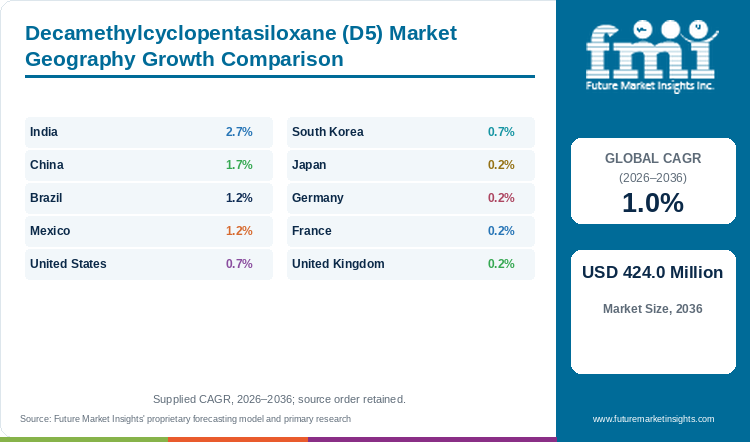
| Country | CAGR, 2026 to 2036 |
|---|---|
| India | 2.7% |
| China | 1.7% |
| Brazil | 1.2% |
| Mexico | 1.2% |
| United States | 0.7% |
| South Korea | 0.7% |
| Japan | 0.2% |
| Germany | 0.2% |
| France | 0.2% |
| United Kingdom | 0.2% |
Source: Future Market Insights analysis of the decamethylcyclopentasiloxane (D5) market, 2026.
India
India records the highest forecast D5 growth among the ten named countries. Revenue increases from USD 19.2 million to USD 25.1 million between 2026 and 2036, at a 2.7% CAGR. The starting base is relatively small, beside the larger US and Chinese markets. It represents a greater contribution from Indian demand within a slowly expanding global total.
The regulatory route for finished cosmetics requires careful separation from the purchase of a chemical ingredient. CDSCO's guidance explains registration of imported cosmetic products and the responsibilities of manufacturers, authorised agents and importers under the Cosmetics Rules, 2020. A raw-material sale of D5 is separate from approval of the finished cosmetic, and an import registration is separate from acceptance of every formula or intended use.
Indian customers serving both domestic and overseas brands face different formulation briefs. The European extension to other cosmetics can influence an export product even when the manufacturer operates outside Europe. An industrial buyer converting D5 into another silicone substance faces a separate specification and use question. These differences make domestic personal-care output a weak single indicator of D5 demand.
The commercial opportunity lies in matching the actual grade and documentation to those customers. A distributor with a cosmetic-grade offer and an industrial customer base must keep the two offers distinct. FMI expects continued national expansion, with the strongest supplier relationships tied to identifiable repeat formulations or industrial requirements.
China
China combines identifiable D5 production offers with a wider silicone manufacturing chain. Dongyue's official catalogue separates isolated D5 from DMC and D4. Hoshine also publishes a dedicated D5 technical document. These are more useful indicators of relevant supplier participation than a producer's total silicon-metal or silicone-polymer revenue. They establish a product position in D5.
FMI forecasts China's D5 revenue at USD 88.3 million in 2026 and USD 104.7 million in 2036. The 1.7% CAGR over 2026 to 2036 takes the country ahead of the United States by forecast value. Industrial conversion contributes a distinct outlet from direct cosmetic formulation. The customer and final use therefore matter when judging whether additional domestic processing supports D5 sales or consumes cyclic material within an integrated chain.
Export exposure also changes the grade conversation. A D5 product offered for industrial conversion needs separate suitability checks for a cosmetic formula exported to Europe. The buyer must distinguish intentionally added D5 from permitted residual content in a polymer and from an industrial-use exemption. That classification rests on the specific product and not on the broad catalogue.
The 2026 transfer of most of a silicones business to Bluestar is relevant to supplier comparisons. The transaction reporting identifies Jiangxi Bluestar Xinghuo within the transferred silicone assets. Purchasing records may show it under both commercial names. China's opportunity is broader supply-chain participation with accurate product and ownership identification.
Brazil
Hair-care manufacturing provides a more specific commercial context for Brazilian D5 demand than a general beauty-market ranking. ABIHPEC reported in January 2026 that Brazilian beauty and personal-care exports reached USD 1,061.0 million in 2025. Hair products accounted for USD 301.0 million and grew 29.8%. Those values concern finished products and not D5, and they identify a customer category in which carrier and conditioning-system choices have commercial importance.
FMI projects Brazil's D5 market at USD 15.4 million in 2026 and USD 17.3 million by 2036. The 1.2% CAGR from 2026 to 2036 reflects continued demand with limited growth in the molecule's content per finished product. Brazilian manufacturers supplying several countries need to evaluate each destination's requirements. An export order for a hair treatment can create a formulation change and more than an additional purchase of the existing D5 carrier.
The country's export pattern also matters. ABIHPEC identified Latin America as the principal destination for Brazilian beauty exports. This helps distinguish the immediate regional customer base from the requirements of products intended for Europe.
Ingredient suppliers can compete by supporting the approved product composition and maintaining dependable repeat supply. A producer offering both D5 and alternative silicone materials has a broader customer-retention route than a seller of the single cyclic substance. The D5 forecast counts the in-scope raw material only.
Mexico
Mexican formulators and importers need a product description that remains consistent from ingredient procurement to the finished pack. The official NOM-141 cosmetic-labelling text requires sanitary and commercial information for prepackaged cosmetics, including Spanish-language information for products sold nationally. It also permits INCI nomenclature for ingredient declaration. This makes the identity Cyclopentasiloxane commercially relevant when a D5-containing formulation is prepared for sale.
FMI forecasts Mexican D5 revenue of USD 11.5 million in 2026 and USD 13.0 million in 2036. Its CAGR is 1.2% over 2026 to 2036. This is a modest expansion from a smaller national base. Its 1.2% CAGR runs 0.2 percentage points above the 1.0% global rate, and its global share edges up from 3.0% to 3.1%. The opportunity should be evaluated through actual formulation programmes and industrial demand.
Documentation becomes especially important where an imported ingredient or finished cosmetic passes through several businesses. A trade name for a silicone blend leaves the quantity of isolated D5 unstated. Suppliers need a clear description of composition and intended use at the point of sale.
Mexican manufacturers serving export customers may receive a different carrier brief from that used for a domestic product. This creates opportunities for formulation support, but an alternative silicone sale remains outside the D5 market unless D5 itself is part of the transaction. The national outlook therefore combines gradual demand growth with increasingly product-specific purchasing decisions.
United States
The United States has the largest opening revenue base, but its purchasing environment rewards a clearer distinction between commercial documentation and regulatory approval. In September 2026, the FDA reminded the cosmetics industry that facility registration and product listing do not constitute approval. It also stated that it does not issue certificates to verify registration compliance. This affects how a beauty manufacturer evaluates the records accompanying an ingredient and the claims made about its finished product.
D5 revenue is forecast to increase from USD 92.1 million in 2026 to USD 99.0 million in 2036, at a 0.7% CAGR. The modest rate is consistent with an established market in which formula retention matters more than the number of new brands entering retail. A brand serving multiple destinations may choose a common alternative formulation. Another may continue a D5-containing product for a different customer base. Those decisions should be assessed at product level.
The specialty channel adds another purchasing route. Gelest lists D5 in packages ranging from laboratory quantities to a 190.0 kg pack, with pricing dependent on quotation. This illustrates the difference between specialty procurement and a bulk-market average. FMI's US outlook includes in-scope D5 sales and uses no specialty catalogue price as a benchmark. Suppliers need to maintain composition records and describe the intended commercial grade accurately.
South Korea
South Korea's beauty exports are expanding much faster than the D5 market in FMI's outlook. In May 2026, the government reported that cosmetic exports reached USD 11.4 billion in 2025, increasing 11.8%. The United States was the largest destination, followed by China and Japan. This gives ingredient suppliers a substantial export-oriented customer base, and destination-specific formulation decisions shape how finished-product growth reaches D5 demand.
The Korean D5 market is projected to advance at a 0.7% CAGR from 2026 to 2036. Revenue increases from USD 19.2 million to USD 20.6 million. A manufacturer can increase exports through a formulation that contains less D5 or uses a different volatile carrier. It may also choose a common formula suitable for several destinations, reducing the need to maintain separate ingredient purchases. Global revenue share for South Korea decreases from 5.0% to 4.9%.
Regional specialty-silicone supply is becoming broader. One producer commissioned its Jincheon specialty facility in the first half of 2025. Buyers should evaluate the actual material offered and not infer product scope from a plant announcement.
Suppliers serving Korean manufacturers need to understand the brand's destination mix and specification. The commercial value of technical support may increase even as D5 tonnage grows slowly. Producers relying on direct cosmetic D5 sales therefore face a different opportunity from suppliers offering a range of alternative silicone ingredients.
Japan
Japanese suppliers demonstrate how a strong silicone business can offer customers choices that lead to different outcomes for D5. KF-995 is listed as Cyclopentasiloxane, alongside methyl trimethicone and ethyl methicone products, in a volatile-silicone catalogue. The same supplier can therefore participate in an existing D5 formulation and a revised formula using different chemistry.
Japan's D5 market is forecast at USD 30.7 million in 2026 and USD 31.4 million in 2036. Its CAGR is 0.2% from 2026 to 2036. That limited progression reflects a mature formulation and specialty-material market in the FMI outlook. A 0.2% CAGR leaves Japan 0.8 points below the 1.0% global pace.
In 2025, one silicones producer introduced personal-care materials including water-compatible silicone wax and an emulsifier suited to oil-in-water formulations. These introductions broaden the choices available to cosmetic developers. They are competing or complementary formulation options outside the D5 category. A silicones producer also commissioned a specialty facility in Tsukuba in the first half of 2025. The facility's product scope extends beyond D5.
Commercially, Japanese buyers can preserve an established raw-material specification where it remains suitable while selecting a different carrier for another product. Suppliers with both options can protect application support relationships. D5 producers face a narrower task: retain the formulations and industrial processes for which this particular cyclic substance remains required.
Germany
Germany's industrial exposure makes the distinction between D5 conversion and direct consumer use particularly relevant. The European restriction retains specified industrial-use exemptions, including monomer use in silicone-polymer production. A purchasing programme serving such an activity has a different commercial basis from a leave-on cosmetic formulation approaching its transition date.
The country reaches USD 23.6 million in 2036 from USD 23.0 million in 2026, with a 0.2% CAGR through the forecast period. This is a restrained D5 outlook despite the breadth of Germany's silicone industry. One producer's 2025 Silicones sales fell 2.6% to EUR 2,733.2 million. Its annual report attributed weakness to several downstream sectors and reported EUR 201.9 million of division capital expenditure. Its 0.2% CAGR runs 0.8 percentage points below the 1.0% global rate. In the decamethylcyclopentasiloxane market, Germany's 2026 revenue ranks fourth of ten.
The same producer commissioned a hybrid-polymer facility in Nünchritz during 2025. That activity shows continued investment in higher-value materials which sits outside D5 demand. Procurement must identify whether D5 is bought for conversion or is an unwanted residue in the downstream product.
For suppliers, the remaining opportunity concerns documented industrial contracts and consistent grade delivery. Expanding a polymer customer relationship may support D5 supply, but only where the actual chemistry and commercial transaction fall within the market boundary.
France
French cosmetic and silicone buyers are managing both a formulation transition and a change in supplier identity. Low-cyclic cosmetic formulations were introduced from Lyon in July 2025. The majority of that supplier's Silicones division subsequently transferred to Bluestar in April 2026. Purchasing teams comparing historical product files with current offers need to follow the business and specification through that change.
FMI forecasts French D5 revenue of USD 19.2 million in 2026 and USD 19.6 million in 2036. The 0.2% CAGR for 2026 to 2036 indicates limited net expansion. The national REACH helpdesk explains that the amended siloxane restriction covers more sectors and contains different application dates and exemptions. That is a more accurate basis for commercial planning than a claim that every French D5 use ends in 2026.
For cosmetic formulators, the relevant question concerns the finished product and its placing-on-market date. For an industrial customer, it concerns the specific use and the applicable provision. A low-cyclic replacement formulation may protect the supplier's relationship with a French beauty brand while reducing its direct D5 sales.
Existing D5 offers and replacement ingredients can coexist during qualification and product changes. The commercial implication is a need to manage customer orders by formulation and destination. Regulatory-oriented innovation by a supplier can reduce the D5 content of an account.
United Kingdom
The UK requires a jurisdictional distinction before a demand conclusion. HSE explains that UK REACH and EU REACH operate independently. UK REACH applies to Great Britain, while EU REACH continues to apply in Northern Ireland. The European 2024 restriction therefore bears on UK sales differently by territory. Export destinations and the particular UK territory remain relevant to a supplier's offer.
The forecast is nearly flat: D5 revenue rises from USD 11.5 million in 2026 to USD 11.8 million in 2036. The 2026 to 2036 CAGR is 0.2%. That rate runs 0.8 percentage points below the 1.0% global rate. The global share eases from 3.0% to 2.8%. HSE published a dedicated technical review of D4, D5 and D6 in July 2025. That review documents uses, emissions and alternatives. It provides evidence of active national assessment.
This environment creates two distinct purchasing considerations. A British cosmetic manufacturer selling into Europe may choose a formulation aligned with European requirements. A domestic industrial customer may purchase D5 under a different legal and technical context. Their supplier should identify these activities separately for each account.
The HSE review also describes challenges in removing cyclic residues from some polymers. For the raw-material supplier, reliable end-use identification and clear separation of intentional use from residues are central to maintaining an accurate commercial position through the decade.
Who are the notable companies in the Decamethylcyclopentasiloxane (D5) Market?
Notable companies in the Decamethylcyclopentasiloxane (D5) Market include Dow, Wacker Chemie, Shin-Etsu Chemical, Elkem and Momentive Performance Materials.
Dow, Shin-Etsu Chemical and Dongyue Group have identifiable D5 or Cyclopentasiloxane product documentation. Gelest offers a specialty D5 product with its own typical purity and package choices. These offers should be compared through the actual grade and commercial specification. They differ in scale, market share and application suitability.
Wacker Chemie participates through a broad silicone manufacturing and application portfolio. Its 2025 division report documents specialty investments across several countries. Momentive Performance Materials' technical literature identifies SF1202 as Cyclopentasiloxane within its compatibility information. This supports a documented product association.
Ownership and adjacent chemistry also need explicit treatment. Most of Elkem's former Silicones business transferred to Bluestar in 2026. Jiangxi Bluestar Xinghuo Silicones belongs within the transferred chain instead of representing an unrelated competitor to the former Elkem business. Evonik's low-cyclic silicone additives address a downstream requirement to limit cyclic content. That is a relevant competitive position, but it is different from selling pure D5. Hoshine Silicon Industry publishes a dedicated D5 technical document.
Documented D5 and specialty offers: Dow, Shin-Etsu Chemical, Gelest, Hoshine Silicon Industry, and Dongyue Group.
Broader silicone portfolios and historical product associations: Wacker Chemie and Momentive Performance Materials.
Transferred business and related operating identity: Elkem and Jiangxi Bluestar Xinghuo Silicones within the Bluestar transition.
Adjacent low-cyclic materials: Evonik.
Key Developments in the Decamethylcyclopentasiloxane (D5) Market
- April 2026: Elkem completed the sale of the majority of its Silicones division to Bluestar on 30 April. The transaction changes the ownership context for historical silicone product offers and customer relationships.
Key Players in the Decamethylcyclopentasiloxane (D5) Market
- Dow
- Wacker Chemie
- Shin-Etsu Chemical
- Elkem, with the majority of its former Silicones business transferred to Bluestar
- Momentive Performance Materials
- Evonik
- Gelest
- Hoshine Silicon Industry
- Jiangxi Bluestar Xinghuo Silicones
- Dongyue Group
Decamethylcyclopentasiloxane (D5) Market Report Scope
Table 6: Decamethylcyclopentasiloxane (D5) Market Report Scope
| Coverage field | Report scope |
|---|---|
| Market definition | D5 sold for personal care, household products, industrial use and silicone-intermediate applications. |
| Substance boundary | Decamethylcyclopentasiloxane, CAS 541-02-6. Other cyclic siloxanes and DMC mixtures are not automatically treated as isolated D5. |
| Exclusions | Finished cosmetic retail value, complete downstream polymer sales and unrelated silicone products. |
| Quantitative Units | USD million |
| Volume and realization | Tonnes of D5 and a 2026 average market realization in USD per tonne. |
| Application coverage | Personal Care and Cosmetics. Silicone Polymer Intermediates. Household and Industrial Care. Electronics and Other. |
| Grade coverage | Cosmetic Grade. Technical Grade. Industrial Grade. |
| Geographic coverage | United States, China, Japan, Germany, France, South Korea, India, Brazil, United Kingdom, Mexico and Rest of world aggregate. |
| Competitive coverage | Ten named companies and operating identities, with direct, former, related and adjacent roles distinguished. |
| Sales Route coverage | Direct Supply Agreements, Distributor Supply. |
Source: Future Market Insights analysis of the decamethylcyclopentasiloxane (D5) market, 2026.
Decamethylcyclopentasiloxane (D5) Market Research Methodology
The D5 assessment combines FMI's market outlook with secondary review of regulatory texts, national guidance, manufacturer technical literature and corporate disclosures. The analysis separates isolated D5 from other siloxanes, downstream polymers and finished cosmetic revenue. Country and segment comparisons retain the same valuation boundary. Company evidence is interpreted according to its actual product, ownership and date, with historical and adjacent roles distinguished from direct D5 supply.
Decamethylcyclopentasiloxane (D5) Market by Segments
Decamethylcyclopentasiloxane (D5) Market segmented by Application:
- Personal Care and Cosmetics
- Silicone Polymer Intermediates
- Household and Industrial Care
- Electronics and Other
Decamethylcyclopentasiloxane (D5) Market segmented by Grade:
- Cosmetic Grade
- Technical Grade
- Industrial Grade
Decamethylcyclopentasiloxane (D5) Market segmented by Sales Route:
- Direct Supply Agreements
- Distributor Supply
Decamethylcyclopentasiloxane (D5) Market by Region
- North America
- United States
- Mexico
- Latin America
- Brazil
- Western Europe
- Germany
- France
- United Kingdom
- East Asia
- China
- Japan
- South Korea
- South Asia
- India
- Rest of world aggregate
Research Sources and Bibliography
- ABIHPEC. (2026, January 19). Setor de Beleza e Cuidados Pessoais bate recorde de exportações e ultrapassa US$ 1 bi.
- Central Drugs Standard Control Organization. (Accessed November 9, 2026). Frequently Asked Questions on Registration and Import of Cosmetics into India under the Cosmetics Rules, 2020.
- Dongyue Group. (Accessed November 9, 2026). Decamethylcyclopentasiloxane (D5), Shandong Dongyue Silicone Material.
- Dow. (2020, November). DOWSIL SH 245 Fluid Technical Data Sheet, Form 27-2977-01-1120.
- Elkem. (2025, July 23). Elkem unveils high-performance, low-cyclic silicone solutions for a more sustainable cosmetics industry. https://www.elkem.com/media/news-articles/elkem-unveils-high-performance-low-cyclic-silicone-solutions-for-a-more-sustainable-cosmetics-industry/
- Elkem. (2026, February). Fourth Quarter Report 2025, Note 13: Events after the reporting period. Corporate financial report, transferred silicone entities. https://mb.cision.com/Main/16930/4306937/3932562.pdf
- Elkem. (2026; accessed November 9). Elkem has sold majority of Silicones division to Bluestar. Transaction completed 30 April 2026. https://www.elkem.com/media/news-articles/transaction
- European Commission. (2024, May 16). Commission Regulation (EU) 2024/1328 amending REACH Annex XVII concerning D4, D5 and D6. Official Journal, 17 May 2024. https://eur-lex.europa.eu/legal-content/EN/TXT/HTML/?uri=CELEX%3A32024R1328
- Evonik. (Accessed November 9, 2026). TEGOSIL MOD 651 product information. https://www.evonik.com/en/products/ou/pr_52058570.html
- Gelest. (Accessed November 9, 2026). Decamethylcyclopentasiloxane, SID2650.0. https://www.gelest.com/product/SID2650.0/
- Health and Safety Executive. (2025, July). Agency Technical Report: D4, D5 and D6. https://www.hse.gov.uk/REACH/assets/docs/technical-report-siloxanes.pdf
- Health and Safety Executive. (Accessed November 9, 2026). UK REACH explained. https://www.hse.gov.uk/reach/about.htm
- Hoshine Silicon Industry. (2025). Decamethylcyclopentasiloxane product technical document. https://www.hoshinesilicon.com/uploadfiles/2025/03/20250307131112467.pdf
- Ineris, French national REACH helpdesk. (Accessed November 9, 2026). Restriction siloxanes. https://reach-info.ineris.fr/actualites/restriction-siloxanes
- Mexico, Ministry of Health and Ministry of Economy. (2012). NOM-141-SSA1/SCFI-2012: Etiquetado para productos cosméticos preenvasados. Official national standard text. https://sidof.segob.gob.mx/notas/docFuente/5269348
- Momentive Performance Materials. (2021, May 11 revision). CF1251 Technical Data Sheet. Cyclopentasiloxane SF1202 compatibility reference, page 3. https://www.momentive.com/content/dam/momentive/ko-kr/products/tds/cf1251.pdf
- Norwegian Environment Agency. (2026, June 1). D4, D5 og D6: Forbud begynner å gjelde. https://www.miljodirektoratet.no/aktuelt/fagmeldinger/2026/juni-2026/d4-d5-og-d6-forbud-begynner-a-gjelde/
- Republic of Korea, Ministry of Culture, Sports and Tourism. (2026, May 26). Cosmetics surplus breaks USD 10B, exports ranked 2nd worldwide. Reporting Ministry of Food and Drug Safety data of 22 May 2026. https://www.korea.net/NewsFocus/Business/view?articleId=292940
- Shin-Etsu Chemical. (2025). Shin-Etsu Chemical develops new silicone products for personal care use that will improve texture and functionality in cosmetics. https://www.shinetsusilicone-global.com/news/2025/05.shtml
- Shin-Etsu Chemical. (2026, May 17). Announcement of the Release of the Cosmetic Silicone Selection Guide. https://www.shinetsusilicone-global.com/guide/cosme/information/20260517/
- Shin-Etsu Chemical. (Accessed November 9, 2026). Shin-Etsu Personal Care Silicones: Volatile Silicones. https://www.shinetsusilicone-global.com/products/personalcare/products/volatile_silicone.shtml
- Swedish Chemicals Agency. (2026, October 30 update). Begränsning av tre cykliska siloxaner - D4, D5 och D6. https://www.kemi.se/lagar-och-regler/lagstiftningar-inom-kemikalieomradet/eu-gemensam-lagstiftning/reach-forordningen/begransningar-i-reach-forordningen---eu-regler-for-vissa-kemikalier/begransning-av-tre-cykliska-siloxaner---d4-d5-och-d6
- US Food and Drug Administration. (2026, September 9). FDA Clarifies It Does Not Provide Certificates or Other Documents to Verify Compliance for Cosmetic Product Facility Registration. https://www.fda.gov/cosmetics/cosmetics-news-events/fda-clarifies-it-does-not-provide-certificates-or-other-documents-verify-compliance-cosmetic-product
- Wacker Chemie. (2026). Annual Report 2025: Silicones. https://reports.wacker.com/2025/annual-report/management-report/segments/silicones.html
Table of Content
- Key Takeaways
- Market Size and CAGR
- Top Growth Driver
- Fastest Growing Segment
- Leading Region
- Key Companies
- Emerging Opportunities
- Executive Summary
- Global Market Outlook
- Demand-side Trends
- Supply-side Trends
- Technology Roadmap Analysis
- Analysis and Recommendations
- Analyst Perspective (What is happening? Why now? What should investors know?)
- Key Questions Answered
- How large is the market?
- What is the CAGR?
- What are key trends?
- Which region dominates?
- Who are the leaders?
Read More...
- Market Overview
- Market Coverage / Taxonomy
- Market Definition / Scope / Limitations
- Research Methodology
- Chapter Orientation
- Analytical Lens and Working Hypotheses
- Market Structure, Signals, and Trend Drivers
- Benchmarking and Cross-market Comparability
- Market Sizing, Forecasting, and Opportunity Mapping
- Research Design and Evidence Framework
- Desk Research Programme (Secondary Evidence)
- Expert Input and Fieldwork (Primary Evidence)
- Tooling, Models, and Reference Databases
- Data Engineering and Model Build
- Quality Assurance and Audit Trail
- Market Background
- Market Dynamics (Drivers, Restraints, Opportunity, Trends)
- Scenario Forecast (Optimistic, Likely, Conservative)
- Impact Analysis
- AI Impact
- Sustainability Impact
- Regulatory Impact
- Technology Impact
- Consumer / Buyer Analysis
- Purchase Drivers
- Adoption Barriers
- Buyer Journey
- Opportunity Map Analysis
- Product Life Cycle Analysis
- Supply Chain Analysis
- Investment Feasibility Matrix
- Value Chain Analysis
- PESTLE and Porter's Analysis
- Regulatory Landscape
- Regional Parent Market Outlook
- Production and Consumption Statistics
- Import and Export Statistics
- Global Market Analysis and Forecast, 2021 to 2036
- Historical Market Size Value (USD Million) Analysis, 2021 to 2025
- Current and Future Market Size Value (USD Million) Projections, 2026 to 2036
- Y-o-Y Growth Trend Analysis
- Absolute $ Opportunity Analysis
- Global Market Pricing Analysis, 2021 to 2036
- Global Market Analysis and Forecast, By Application, 2021 to 2036
- Introduction / Key Findings
- Historical Market Size Value (USD Million) Analysis By Application, 2021 to 2025
- Current and Future Market Size Value (USD Million) Analysis and Forecast By Application, 2026 to 2036
- Personal Care and Cosmetics
- Silicone Polymer Intermediates
- Household and Industrial Care
- Electronics and Other
- Y-o-Y Growth Trend Analysis By Application, 2021 to 2025
- Absolute $ Opportunity Analysis By Application, 2026 to 2036
- Global Market Analysis and Forecast, By Grade, 2021 to 2036
- Introduction / Key Findings
- Historical Market Size Value (USD Million) Analysis By Grade, 2021 to 2025
- Current and Future Market Size Value (USD Million) Analysis and Forecast By Grade, 2026 to 2036
- Cosmetic Grade
- Technical Grade
- Industrial Grade
- Y-o-Y Growth Trend Analysis By Grade, 2021 to 2025
- Absolute $ Opportunity Analysis By Grade, 2026 to 2036
- Global Market Analysis and Forecast, By Sales Route, 2021 to 2036
- Introduction / Key Findings
- Historical Market Size Value (USD Million) Analysis By Sales Route, 2021 to 2025
- Current and Future Market Size Value (USD Million) Analysis and Forecast By Sales Route, 2026 to 2036
- Direct Supply Agreements
- Distributor Supply
- Y-o-Y Growth Trend Analysis By Sales Route, 2021 to 2025
- Absolute $ Opportunity Analysis By Sales Route, 2026 to 2036
- Global Market Analysis and Forecast, By Region, 2021 to 2036
- Introduction
- Historical Market Size Value (USD Million) Analysis By Region, 2021 to 2025
- Current Market Size Value (USD Million) Analysis and Forecast By Region, 2026 to 2036
- North America
- Latin America
- Western Europe
- East Asia
- South Asia
- Market Attractiveness Analysis By Region
- North America Market Analysis and Forecast, By Country, 2021 to 2036
- Historical Market Size Value (USD Million) Trend Analysis By Market Taxonomy, 2021 to 2025
- Market Size Value (USD Million) Forecast By Market Taxonomy, 2026 to 2036
- By Country
- United States
- Mexico
- By Application
- By Grade
- By Sales Route
- By Country
- Market Attractiveness Analysis
- By Country
- By Application
- By Grade
- By Sales Route
- Key Takeaways
- Latin America Market Analysis and Forecast, By Country
- Historical Market Size Value (USD Million) Trend Analysis By Market Taxonomy, 2021 to 2025
- Market Size Value (USD Million) Forecast By Market Taxonomy, 2026 to 2036
- By Country
- Brazil
- By Application
- By Grade
- By Sales Route
- By Country
- Market Attractiveness Analysis
- By Country
- By Application
- By Grade
- By Sales Route
- Key Takeaways
- Western Europe Market Analysis and Forecast, By Country
- Historical Market Size Value (USD Million) Trend Analysis By Market Taxonomy, 2021 to 2025
- Market Size Value (USD Million) Forecast By Market Taxonomy, 2026 to 2036
- By Country
- Germany
- France
- United Kingdom
- By Application
- By Grade
- By Sales Route
- By Country
- Market Attractiveness Analysis
- By Country
- By Application
- By Grade
- By Sales Route
- Key Takeaways
- East Asia Market Analysis and Forecast, By Country
- Historical Market Size Value (USD Million) Trend Analysis By Market Taxonomy, 2021 to 2025
- Market Size Value (USD Million) Forecast By Market Taxonomy, 2026 to 2036
- By Country
- China
- Japan
- South Korea
- By Application
- By Grade
- By Sales Route
- By Country
- Market Attractiveness Analysis
- By Country
- By Application
- By Grade
- By Sales Route
- Key Takeaways
- South Asia Market Analysis and Forecast, By Country
- Historical Market Size Value (USD Million) Trend Analysis By Market Taxonomy, 2021 to 2025
- Market Size Value (USD Million) Forecast By Market Taxonomy, 2026 to 2036
- By Country
- India
- Rest of world aggregate
- By Application
- By Grade
- By Sales Route
- By Country
- Market Attractiveness Analysis
- By Country
- By Application
- By Grade
- By Sales Route
- Key Takeaways
- Key Countries Market Analysis
- United States
- Pricing Analysis
- Market Share Analysis, 2025
- By Application
- By Grade
- By Sales Route
- Mexico
- Pricing Analysis
- Market Share Analysis, 2025
- By Application
- By Grade
- By Sales Route
- Brazil
- Pricing Analysis
- Market Share Analysis, 2025
- By Application
- By Grade
- By Sales Route
- Germany
- Pricing Analysis
- Market Share Analysis, 2025
- By Application
- By Grade
- By Sales Route
- United Kingdom
- Pricing Analysis
- Market Share Analysis, 2025
- By Application
- By Grade
- By Sales Route
- France
- Pricing Analysis
- Market Share Analysis, 2025
- By Application
- By Grade
- By Sales Route
- India
- Pricing Analysis
- Market Share Analysis, 2025
- By Application
- By Grade
- By Sales Route
- China
- Pricing Analysis
- Market Share Analysis, 2025
- By Application
- By Grade
- By Sales Route
- Japan
- Pricing Analysis
- Market Share Analysis, 2025
- By Application
- By Grade
- By Sales Route
- South Korea
- Pricing Analysis
- Market Share Analysis, 2025
- By Application
- By Grade
- By Sales Route
- United States
- Market Structure Analysis
- Competition Dashboard
- Competition Benchmarking
- Market Share Analysis of Top Players
- By Regional
- By Application
- By Grade
- By Sales Route
- Emerging Startups
- Innovation Benchmarking
- Competition Analysis
- Competition Deep Dive
- Dow
- Overview
- Product Portfolio
- Profitability by Market Segments
- Sales Footprint
- Strategy Overview
- Marketing Strategy
- Product Strategy
- Channel Strategy
- Wacker Chemie
- Shin-Etsu Chemical
- Elkem
- Momentive Performance Materials
- Evonik
- Gelest
- Hoshine Silicon Industry
- Jiangxi Bluestar Xinghuo Silicones
- Dongyue Group
- Elkem, with the majority of its former Silicones business transferred to Bluestar
- Dow
- Case Studies
- Success Stories
- Recent Developments
- Competition Deep Dive
- Assumptions & Acronyms Used
List of Tables
- Table 1: Global Market Value (USD Million) Forecast by Region, 2021 to 2036
- Table 2: Global Market Value (USD Million) Forecast by Application, 2021 to 2036
- Table 3: Global Market Value (USD Million) Forecast by Grade, 2021 to 2036
- Table 4: Global Market Value (USD Million) Forecast by Sales Route, 2021 to 2036
- Table 5: North America Market Value (USD Million) Forecast by Country, 2021 to 2036
- Table 6: North America Market Value (USD Million) Forecast by Application, 2021 to 2036
- Table 7: North America Market Value (USD Million) Forecast by Grade, 2021 to 2036
- Table 8: North America Market Value (USD Million) Forecast by Sales Route, 2021 to 2036
- Table 9: Latin America Market Value (USD Million) Forecast by Country, 2021 to 2036
- Table 10: Latin America Market Value (USD Million) Forecast by Application, 2021 to 2036
- Table 11: Latin America Market Value (USD Million) Forecast by Grade, 2021 to 2036
- Table 12: Latin America Market Value (USD Million) Forecast by Sales Route, 2021 to 2036
- Table 13: Western Europe Market Value (USD Million) Forecast by Country, 2021 to 2036
- Table 14: Western Europe Market Value (USD Million) Forecast by Application, 2021 to 2036
- Table 15: Western Europe Market Value (USD Million) Forecast by Grade, 2021 to 2036
- Table 16: Western Europe Market Value (USD Million) Forecast by Sales Route, 2021 to 2036
- Table 17: East Asia Market Value (USD Million) Forecast by Country, 2021 to 2036
- Table 18: East Asia Market Value (USD Million) Forecast by Application, 2021 to 2036
- Table 19: East Asia Market Value (USD Million) Forecast by Grade, 2021 to 2036
- Table 20: East Asia Market Value (USD Million) Forecast by Sales Route, 2021 to 2036
- Table 21: South Asia Market Value (USD Million) Forecast by Country, 2021 to 2036
- Table 22: South Asia Market Value (USD Million) Forecast by Application, 2021 to 2036
- Table 23: South Asia Market Value (USD Million) Forecast by Grade, 2021 to 2036
- Table 24: South Asia Market Value (USD Million) Forecast by Sales Route, 2021 to 2036
List of Figures
- Figure 1: Global Market Pricing Analysis
- Figure 2: Global Market Value (USD Million) Forecast 2021-2036
- Figure 3: Global Market Value Share and BPS Analysis by Application, 2026 and 2036
- Figure 4: Global Market Y-o-Y Growth Comparison by Application, 2026-2036
- Figure 5: Global Market Attractiveness Analysis by Application
- Figure 6: Global Market Value Share and BPS Analysis by Grade, 2026 and 2036
- Figure 7: Global Market Y-o-Y Growth Comparison by Grade, 2026-2036
- Figure 8: Global Market Attractiveness Analysis by Grade
- Figure 9: Global Market Value Share and BPS Analysis by Sales Route, 2026 and 2036
- Figure 10: Global Market Y-o-Y Growth Comparison by Sales Route, 2026-2036
- Figure 11: Global Market Attractiveness Analysis by Sales Route
- Figure 12: Global Market Value (USD Million) Share and BPS Analysis by Region, 2026 and 2036
- Figure 13: Global Market Y-o-Y Growth Comparison by Region, 2026-2036
- Figure 14: Global Market Attractiveness Analysis by Region
- Figure 15: North America Market Incremental Dollar Opportunity, 2026-2036
- Figure 16: Latin America Market Incremental Dollar Opportunity, 2026-2036
- Figure 17: Western Europe Market Incremental Dollar Opportunity, 2026-2036
- Figure 18: East Asia Market Incremental Dollar Opportunity, 2026-2036
- Figure 19: South Asia Market Incremental Dollar Opportunity, 2026-2036
- Figure 20: North America Market Value Share and BPS Analysis by Country, 2026 and 2036
- Figure 21: North America Market Value Share and BPS Analysis by Application, 2026 and 2036
- Figure 22: North America Market Y-o-Y Growth Comparison by Application, 2026-2036
- Figure 23: North America Market Attractiveness Analysis by Application
- Figure 24: North America Market Value Share and BPS Analysis by Grade, 2026 and 2036
- Figure 25: North America Market Y-o-Y Growth Comparison by Grade, 2026-2036
- Figure 26: North America Market Attractiveness Analysis by Grade
- Figure 27: North America Market Value Share and BPS Analysis by Sales Route, 2026 and 2036
- Figure 28: North America Market Y-o-Y Growth Comparison by Sales Route, 2026-2036
- Figure 29: North America Market Attractiveness Analysis by Sales Route
- Figure 30: Latin America Market Value Share and BPS Analysis by Country, 2026 and 2036
- Figure 31: Latin America Market Value Share and BPS Analysis by Application, 2026 and 2036
- Figure 32: Latin America Market Y-o-Y Growth Comparison by Application, 2026-2036
- Figure 33: Latin America Market Attractiveness Analysis by Application
- Figure 34: Latin America Market Value Share and BPS Analysis by Grade, 2026 and 2036
- Figure 35: Latin America Market Y-o-Y Growth Comparison by Grade, 2026-2036
- Figure 36: Latin America Market Attractiveness Analysis by Grade
- Figure 37: Latin America Market Value Share and BPS Analysis by Sales Route, 2026 and 2036
- Figure 38: Latin America Market Y-o-Y Growth Comparison by Sales Route, 2026-2036
- Figure 39: Latin America Market Attractiveness Analysis by Sales Route
- Figure 40: Western Europe Market Value Share and BPS Analysis by Country, 2026 and 2036
- Figure 41: Western Europe Market Value Share and BPS Analysis by Application, 2026 and 2036
- Figure 42: Western Europe Market Y-o-Y Growth Comparison by Application, 2026-2036
- Figure 43: Western Europe Market Attractiveness Analysis by Application
- Figure 44: Western Europe Market Value Share and BPS Analysis by Grade, 2026 and 2036
- Figure 45: Western Europe Market Y-o-Y Growth Comparison by Grade, 2026-2036
- Figure 46: Western Europe Market Attractiveness Analysis by Grade
- Figure 47: Western Europe Market Value Share and BPS Analysis by Sales Route, 2026 and 2036
- Figure 48: Western Europe Market Y-o-Y Growth Comparison by Sales Route, 2026-2036
- Figure 49: Western Europe Market Attractiveness Analysis by Sales Route
- Figure 50: East Asia Market Value Share and BPS Analysis by Country, 2026 and 2036
- Figure 51: East Asia Market Value Share and BPS Analysis by Application, 2026 and 2036
- Figure 52: East Asia Market Y-o-Y Growth Comparison by Application, 2026-2036
- Figure 53: East Asia Market Attractiveness Analysis by Application
- Figure 54: East Asia Market Value Share and BPS Analysis by Grade, 2026 and 2036
- Figure 55: East Asia Market Y-o-Y Growth Comparison by Grade, 2026-2036
- Figure 56: East Asia Market Attractiveness Analysis by Grade
- Figure 57: East Asia Market Value Share and BPS Analysis by Sales Route, 2026 and 2036
- Figure 58: East Asia Market Y-o-Y Growth Comparison by Sales Route, 2026-2036
- Figure 59: East Asia Market Attractiveness Analysis by Sales Route
- Figure 60: South Asia Market Value Share and BPS Analysis by Country, 2026 and 2036
- Figure 61: South Asia Market Value Share and BPS Analysis by Application, 2026 and 2036
- Figure 62: South Asia Market Y-o-Y Growth Comparison by Application, 2026-2036
- Figure 63: South Asia Market Attractiveness Analysis by Application
- Figure 64: South Asia Market Value Share and BPS Analysis by Grade, 2026 and 2036
- Figure 65: South Asia Market Y-o-Y Growth Comparison by Grade, 2026-2036
- Figure 66: South Asia Market Attractiveness Analysis by Grade
- Figure 67: South Asia Market Value Share and BPS Analysis by Sales Route, 2026 and 2036
- Figure 68: South Asia Market Y-o-Y Growth Comparison by Sales Route, 2026-2036
- Figure 69: South Asia Market Attractiveness Analysis by Sales Route
- Figure 70: Global Market - Tier Structure Analysis
- Figure 71: Global Market - Company Share Analysis
Frequently Asked Questions
How big is the decamethylcyclopentasiloxane (D5) market in 2026?
FMI estimates the market at USD 383.8 million in 2026, up from USD 380.0 million in 2025. It is forecast to reach USD 424.0 million by 2036 at a 1.0% CAGR.
Which application leads the decamethylcyclopentasiloxane (D5) market in 2026?
Personal Care and Cosmetics leads by application with 52.0% in 2026. All other segments together hold 48.0%.
Which grade and sales route lead in 2026?
Cosmetic Grade holds 50.0% by grade and Direct Supply Agreements holds 66.0% by sales route in FMI's 2026 assessment.
Which market is forecast to grow fastest through 2036?
India has the highest forecast CAGR at 2.7% during 2026 to 2036, followed by China at 1.7%.
Does the European restriction remove all D5 demand?
No. The restriction contains different transition dates and exemptions for specified uses. Other cosmetics become subject to it after 6 June 2027, while certain industrial uses retain exemptions.[2]
Preview the report firsthand - request a free sample
Get SampleGet the brochure for pricing and purchase details.
Get PDF
