

- Market Size (2026)
- USD 760.70 Mn
- Forecast (2036)
- USD 1553.30 Mn
- CAGR (2026 to 2036)
- 7.4%
How big is the Denim Finishing Enzymes Market in 2026?
USD 760.70 million in 2026 and USD 1,553.30 million by 2036 at a 7.4% CAGR.
The denim finishing enzymes industry value was valued at USD 708.29 million in 2025. It is expected to grow from USD 760.70 million in 2026 to USD 1,553.30 million in 2036 at a 7.4% CAGR as garment laundries shift stonewash recipes toward controlled cellulase and laccase systems. Batch processing is expected to hold 68.0% share in 2026, supported by garment-level shade approvals across varied denim programs. Direct to mills is projected to secure 62.0% share in 2026, guided by on-site recipe trials and confidential wash settings.
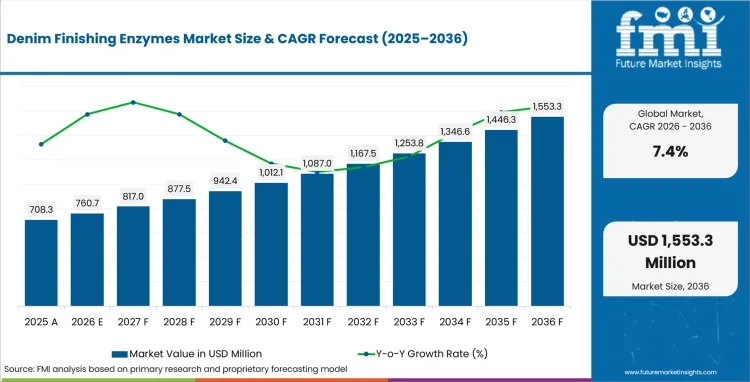
| Metric | Value |
|---|---|
| 2026 Market Size | USD 760.70 million |
| 2036 Market Size | USD 1,553.30 million |
| Forecast CAGR (2026-2036) | 7.4% |
| Leading Process | Batch Processing |
| Batch Processing Share (2026) | 68.0% |
| Leading Sales Channel | Direct to Mills |
| Direct to Mills Share (2026) | 62.0% |
| Fastest-growing Country | China |
| China CAGR by 2036 | 8.2% |
Summary of the Denim Finishing Enzymes Market
| Market Signal | Commercial Impact |
|---|---|
| Demand and Growth Drivers | Demand for denim finishing enzymes is expected to expand steadily through 2036 as textile manufacturers prioritize sustainable finishing processes, consistent fabric appearance, and technical service support.
|
| Product and Segment View | Batch processing, direct-to-mill sales, and cellulase enzymes continue to lead their respective market segments.
|
| Geography and Growth Outlook | Asia continues to lead market expansion through strong textile manufacturing capabilities and export-oriented denim production.
|
| Competitive Landscape | Competition increasingly focuses on enzyme performance, textile processing expertise, and mill-level technical support.
|
| Analyst Perspective | Denim finishing enzymes are evolving from simple chemical substitutes into essential process-control solutions that improve product quality, sustainability, and operational efficiency.
- Nikhil Kaitwade, Principal Consultant for Industrial Automation at Future Market Insights |
Denim finishing enzyme adoption is influenced by textile waste pressure and supplier application support. International Labour Organization stated in March 2025 that textiles and clothing provide jobs to over 90 million people, showing the labor base linked to wet-processing decisions. United Nations Environment Programme reported in March 2025 that 92 million tonnes of textile waste is produced each year, while only 8.0% of textile fibers in 2023 came from recycled sources. BASF and IFF announced in October 2025 a collaboration focused on enzyme systems and biobased polymers, strengthening the formulation signal around lower-resource textile processing.
Which factors support expansion in the Denim Finishing Enzymes Market?
Wash recipe control and lower stone handling support market value across denim laundries and textile finishing units.
- Market value rises as bio-stoning recipes help mills reduce pumice sludge and manage indigo shade consistency.
- Batch processing supports adoption as laundries can adjust enzyme dose and temperature for each buyer program.
- Stretch denim encourages milder cellulase selection as garment recovery and hand feel influence approval decisions.
- Direct mill engagement promotes demand as suppliers protect trial data and convert enzyme qualification into repeat supply.
Why is the Denim Finishing Enzymes Market growing?
High-repeat denim washing increases enzyme demand as mills need controlled abrasion and clean-up steps that reduce harsh process loads.
European Environment Agency reported in March 2025 that EU Member States generated about 6.94 million tonnes of textile waste in 2022, equal to 16kg per person. Waste scrutiny pushes brands to review finishing choices, while mills need process aids that support lower sludge burden and better repeatability. Suppliers linking cellulase action with trial support gain stronger acceptance in export denim programs.
How is the Denim Finishing Enzymes Market segmented?
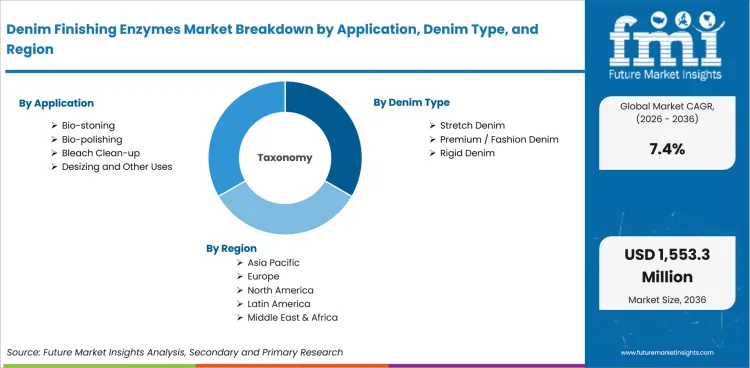
Denim Finishing Enzymes Market is segmented by enzyme type, application, denim type, process, and sales channel.
- Cellulases are projected to account for 57.0% share in 2026, influenced by surface-fiber removal and indigo fade control.
- Bio-stoning is expected to hold 46.0% share in 2026, shaped by lower pumice burden and repeatable worn-denim looks.
- Stretch denim is anticipated to account for 48.0% share in 2026, led by elastane-protection needs during abrasion.
- Batch processing is projected to hold 68.0% share in 2026, guided by varied shade targets and garment-level flexibility.
- Direct to mills is expected to represent 62.0% share in 2026, supported by confidential recipes and supplier trial support.
Why do cellulases dominate the Denim Finishing Enzymes Market by enzyme type?
- Cellulases are projected to account for 57.0% share in 2026, driven by controlled removal of surface microfibrils from indigo-dyed cotton fibers.
- Laccases and amylases gain demand as mills widen enzyme packages into bio-polishing, desizing, and shade-adjustment support.
Which application leads the Denim Finishing Enzymes Market?
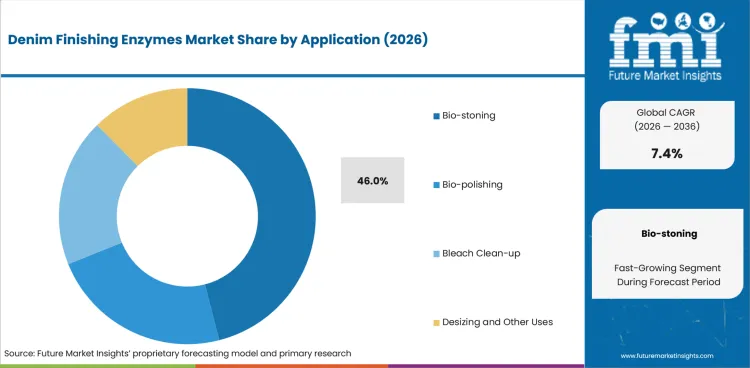
- Bio-stoning is expected to hold 46.0% share in 2026, shaped by the need to create worn effects without heavy pumice damage.
- Bio-polishing and bleach clean-up remain active as mills remove residual peroxide and stabilize later dyeing steps.
Which denim type leads the Denim Finishing Enzymes Market?
- Stretch denim is anticipated to account for 48.0% share in 2026, backed by demand for softer abrasion that protects elastane recovery.
- Rigid denim remains active as classic stonewashed styles still need controlled fade and surface-cleaning performance.
Which process leads the Denim Finishing Enzymes Market?
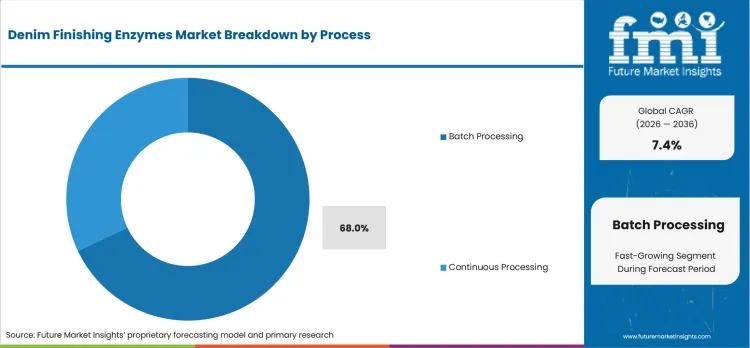
- Batch processing is projected to hold 68.0% share in 2026, reflected by buyer-specific garment programs and changing shade approvals.
- Continuous processing gains use in upstream fabric finishing, though garment laundries keep batch routes for flexible wash recipes.
Which sales channel leads the Denim Finishing Enzymes Market?
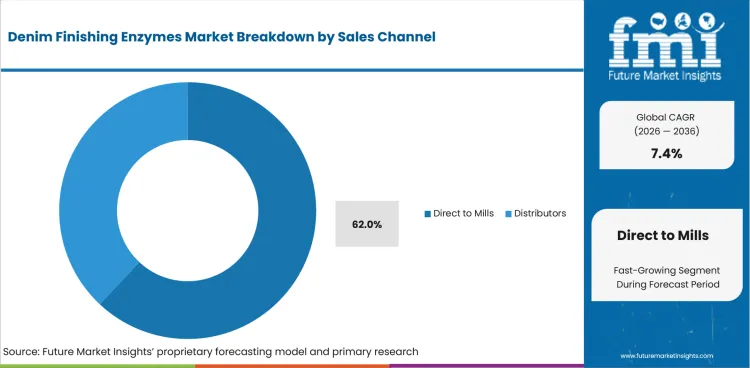
- Direct to mills is expected to represent 62.0% share in 2026, guided by buyer preference for application support and recipe confidentiality.
- Distributors remain active across smaller denim clusters requiring shorter lead times and lower minimum order quantities.
What are the drivers, restraints, and opportunities in the Denim Finishing Enzymes Market?
Denim abrasion control and technical service programs are shaping enzyme buying decisions.
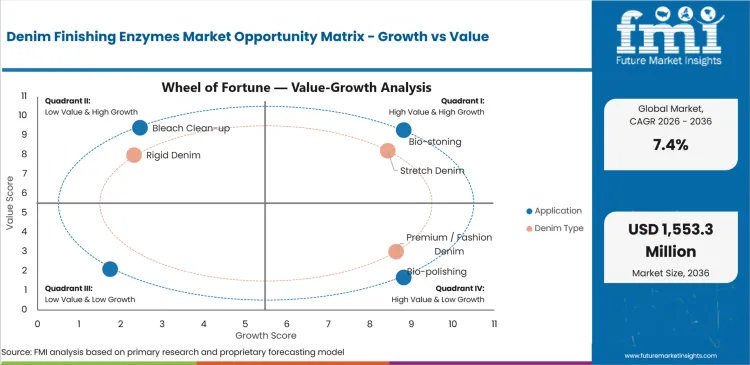
- Driver: Bio-stoning recipes require controlled cellulase action before shade approval can be repeated across garment lots.
- Restraint: Higher specialty enzyme pricing can limit switching in domestic laundries focused on cost per garment.
- Opportunity: Catalase and laccase packages can raise supplier account depth after cellulase qualification.
Cellulase Abrasion Control Strengthens Mill Demand
Cellulase abrasion remains a core demand driver as mills need worn effects without unpredictable stone damage. Novonesis states that DeniSafe® can completely eliminate pumice stones and reduce water and energy consumption by up to 90% in denim abrasion. Such measurable process savings help mills compare enzyme recipes through shade repeatability and fabric-strength retention. Suppliers gain demand as bio-stoning shifts from a sustainability claim into a production-control tool backed by lower resource use.
Cost and Recipe Change Burden Limit Adoption
Domestic laundries can face slower switching if frequent style changes require repeated dosing and temperature trials. United Kingdom resource-efficiency research reported fabric waste of 26.5% for a T-shirt, 16.0% for a shirt, and 18.8% for trousers during clothing manufacturing, showing how cutting and process losses can already weigh on garment economics. Denim laundries may delay specialized enzyme blends until suppliers prove fewer rewash lots and stable shade outcomes on actual buyer fabrics.
Multi-Enzyme Packages Create Expansion
Direct mill support creates a stronger route for enzyme suppliers as catalase and laccase products can build on cellulase qualification. Textile Exchange reported that global fiber production increased from 125 million tonnes in 2023 to 132 million tonnes in 2024 and could reach around 169 million tonnes in 2030 under current conditions. Higher fiber throughput increases the need for coordinated desizing and bio-polishing packages. Mills benefit from fewer isolated chemical decisions and more integrated wet-processing recipes.
Which countries are growing in the Denim Finishing Enzymes Market?
China 8.2% CAGR, India 8.0% CAGR, South Korea 7.5% CAGR, Germany 6.9% CAGR, United States 6.8% CAGR, France 6.7% CAGR, United Kingdom 6.6% CAGR, and Japan 6.4% CAGR through 2036.
.webp "Top Country Growth Comparison Denim Finishing Enzymes Market Cagr (2026 2036)")
| Country | CAGR |
|---|---|
| China | 8.2% |
| India | 8.0% |
| South Korea | 7.5% |
| Germany | 6.9% |
| United States | 6.8% |
| France | 6.7% |
| United Kingdom | 6.6% |
| Japan | 6.4% |
Source: Future Market Insights, 2026.
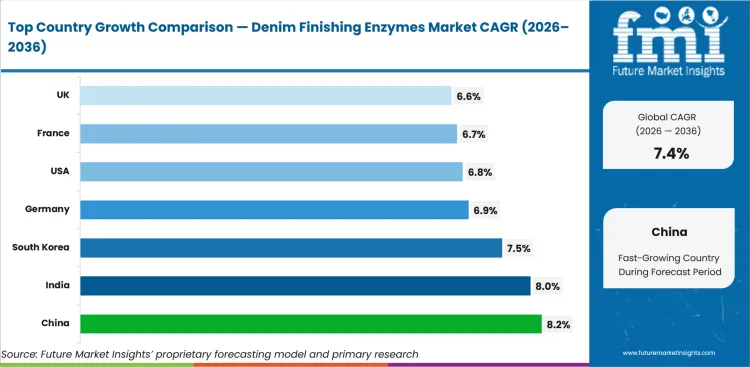
How do country-level CAGRs compare in the Denim Finishing Enzymes Market?
China leads country expansion while Japan records the most cautious pace among profiled markets.
- China is projected to record 8.2% CAGR by 2036, driven by denim clusters and export-scale garment washing.
- India is projected to record 8.0% CAGR by 2036, led by textile capacity and local enzyme supply.
- South Korea is projected to record 7.5% CAGR by 2036, reflected by quality-sensitive garment programs and fashion-linked textile demand.
- Germany is projected to record 6.9% CAGR by 2036, influenced by European chemical expectations and technical textile know-how.
- United States is projected to record 6.8% CAGR by 2036, backed by brand-led compliance programs and specialty apparel sourcing.
- France is projected to record 6.7% CAGR by 2036, guided by premium apparel influence and product-policy pressure.
- United Kingdom is projected to record 6.6% CAGR by 2036, supported by resource-efficiency programs and brand specification influence.
- Japan is projected to record 6.4% CAGR by 2036, aided by quality-led denim culture and resource-circulation policy.
How fast is the Denim Finishing Enzymes Market growing in China?
An 8.2% CAGR through 2036 reflects large denim washing clusters and export-oriented garment supply chains.
Country Market Snapshot Table
| Parameter | Value |
|---|---|
| Market Size in 2025 (Value) | USD 149.4 million |
| Market Size in 2026 (Value) | USD 161.7 million |
| Market Forecast in 2036 (Value) | USD 355.0 million |
| CAGR (2026 to 2036) | 8.2% |
| Years Considered | 2021 to 2036 |
| Base Year | 2025 |
| Forecast Period | 2026 to 2036 |
| Units Considered | Revenue in USD million |
| Segments Covered | Enzyme Type · Application · Denim Type · Process · Sales Channel |
China Denim Finishing Enzymes Market Outlook
China denim finishing enzyme industry is shaped by large garment washing clusters and value-driven chemical supply. Domestic laundries need cellulase systems reducing pumice load while keeping export shades stable.
Buyers are expected to favor suppliers combining local formulation access and trial support. Export-facing mills are likely to keep comparing enzyme activity and cost per garment before scaling new recipes.
Key Growth Drivers
- Textile export scale supports enzyme trials, customs reporting placed China’s textile and apparel exports at USD 301.1 billion in 2024.
- Apparel washing capacity sustains repeat denim recipes, and 2025 customs data showed 35.65 billion apparel pieces exported during the year.
- Denim clusters need cellulase packages reducing rewash risk across domestic and export programs.
- Local formulators gain access as mills ask for quick sample supply and bath-condition support.
Key Restraints
- Unit-price pressure can limit premium enzyme adoption in value denim programs.
- Export qualification cycles can slow recipe changes as brands review strength and residue performance.
- Apparel price compression remains a challenge, 2025 customs data placed the average export unit price at USD 3.5 per piece, down 8.6%.
What makes China unique
China is unique due to large denim washing clusters and export-oriented garment supply chains.
Key Companies
- Sunson Industry Group
- VTR Bio-Tech
- Habio Bioengineering
- Challenge Group
- Longda Bio-products
- Guangdong VTR Bio-Tech
- Shandong Sukahan Bio-Technology
Sales & Marketing Channels
- Direct enzyme sales to denim laundries
- Textile chemical distributor networks
- Garment cluster technical trials
- Formulator-led sampling programs
- Export mill qualification programs
- Factory wet-processing seminars
Country Segment Breakdown Table
| Segment | Sub-Segments |
|---|---|
| By Enzyme Type | Cellulases · Laccases · Amylases · Catalases and Other Blends |
| By Application | Bio-stoning · Bio-polishing · Bleach Clean-up · Desizing and Other Uses |
| By Denim Type | Rigid Denim · Stretch Denim · Premium / Fashion Denim |
| By Process | Batch Processing · Continuous Processing |
| By Sales Channel | Direct to Mills · Distributors |
| Key Sub-Regions Covered, Denim and Textile Clusters | Guangdong · Zhejiang · Jiangsu · Shandong · Fujian · Shanghai |
Frequently Asked Questions
How fast is China Denim Finishing Enzymes Market growing?
China records an estimated 8.2% CAGR, driven by large denim washing clusters and export-oriented garment supply chains.
Who leads China Denim Finishing Enzymes Market?
Sunson Industry Group leads China Denim Finishing Enzymes Market among local enzyme or textile chemical suppliers, supported by VTR Bio-Tech and Habio Bioengineering across mill-facing supply channels.
What is driving adoption in China Denim Finishing Enzymes Market?
Bio-stoning control and recipe-backed technical service are moving denim laundries toward enzyme packages.
What is the Denim Finishing Enzymes Market outlook in India?
An 8.0% CAGR through 2036 reflects domestic enzyme suppliers and a wide base of garment laundries.
Country Market Snapshot Table
| Parameter | Value |
|---|---|
| Market Size in 2025 (Value) | USD 111.6 million |
| Market Size in 2026 (Value) | USD 120.5 million |
| Market Forecast in 2036 (Value) | USD 260.1 million |
| CAGR (2026 to 2036) | 8.0% |
| Years Considered | 2021 to 2036 |
| Base Year | 2025 |
| Forecast Period | 2026 to 2036 |
| Units Considered | Revenue in USD million |
| Segments Covered | Enzyme Type · Application · Denim Type · Process · Sales Channel |
India Denim Finishing Enzymes Market Outlook
India denim finishing enzyme demand is driven by garment-processing clusters and local enzyme formulators. Mills need reliable cellulase abrasion and catalase clean-up support across export and domestic jeans programs.
Factories are expected to begin with bio-stoning recipes before adding multi-enzyme packages. Local service response and cost per garment is expected to remain central to supplier selection.
Key Growth Drivers
- Textile capacity supports enzyme adoption. Ministry of Textiles reported direct employment around 45 million people and indirect livelihood for over 100 million people.
- Export momentum supports finishing trials after Ministry of Textiles reported T&A exports including handicrafts grew 7.0% from USD 22,578 million in Apr-Nov 2023 to USD 24,064 million in Apr-Nov 2024.
- Denim washing clusters need technical support across cellulase dose and bath temperature.
- Local enzyme makers gain scope as mills prefer faster troubleshooting in Gujarat along with Maharashtra, and Tamil Nadu.
Key Restraints
- Cost sensitivity can slow premium blend adoption across domestic denim programs.
- Smaller laundries may delay recipe changes if trial failures increase rewash lots.
- Export volatility can delay chemical trials. Ministry of Textiles data showed T&A exports including handicrafts fell 2.0% from USD 36,686 million in FY 2022-23 to USD 35,874 million in FY 2023-24.
What makes India unique
India is unique due to domestic enzyme suppliers and a wide base of garment laundries.
Key Companies
- Advanced Enzyme Technologies
- AET
- Maps Enzymes
- Rossari Biotech
- Zytex Biotech
- Tex Biosciences
- Kcat Enzymatic
Sales & Marketing Channels
- Direct sales to mills
- Ahmedabad and Mumbai distributor channels
- Garment laundry trials
- Textile chemical dealer networks
- Brand-nominated wash-house programs
- Technical service visits
Country Segment Breakdown Table
| Segment | Sub-Segments |
|---|---|
| By Enzyme Type | Cellulases · Laccases · Amylases · Catalases and Other Blends |
| By Application | Bio-stoning · Bio-polishing · Bleach Clean-up · Desizing and Other Uses |
| By Denim Type | Rigid Denim · Stretch Denim · Premium / Fashion Denim |
| By Process | Batch Processing · Continuous Processing |
| By Sales Channel | Direct to Mills · Distributors |
| Key Sub-Regions Covered, Denim and Textile Clusters | Gujarat · Maharashtra · Tamil Nadu · Karnataka · Delhi NCR · Rajasthan |
Frequently Asked Questions
How fast is India Denim Finishing Enzymes Market growing?
India records an estimated 8.0% CAGR, driven by denim clusters and a wide base of garment laundries.
Who leads India Denim Finishing Enzymes Market?
Advanced Enzyme Technologies leads India Denim Finishing Enzymes Market among local enzyme or textile chemical suppliers, supported by AET and Maps Enzymes across mill-facing supply channels.
What is driving adoption in India Denim Finishing Enzymes Market?
Lower pumice burden and recipe-backed technical service are moving denim laundries toward enzyme packages.
What is the Denim Finishing Enzymes Market outlook in South Korea?
An 7.5% CAGR through 2036 reflects compact textile operations and strong quality expectations.
Country Market Snapshot Table
| Parameter | Value |
|---|---|
| Market Size in 2025 (Value) | USD 58.7 million |
| Market Size in 2026 (Value) | USD 63.1 million |
| Market Forecast in 2036 (Value) | USD 130.2 million |
| CAGR (2026 to 2036) | 7.5% |
| Years Considered | 2021 to 2036 |
| Base Year | 2025 |
| Forecast Period | 2026 to 2036 |
| Units Considered | Revenue in USD million |
| Segments Covered | Enzyme Type · Application · Denim Type · Process · Sales Channel |
South Korea Denim Finishing Enzymes Market Outlook
South Korea denim finishing enzyme industry is influenced by quality-sensitive apparel buyers and fashion-linked textile programs. Mills need consistent shade and chemical documentation.
Suppliers are expected to use distributor access and proof-driven trials. Compact wash houses are anticipated to favor enzyme systems that shorten validation effort and protect fabric quality.
Key Growth Drivers
- Fashion industry depth supports quality-led finishing, according to Invest Korea, which reported 44,931 textile and fashion companies and 268,918 employees in domestic textile and fashion manufacturing.
- Export strength supports premium textile program, reflecting the trade ministry having reported national exports surpassed USD 700 billion in 2025.
- Quality-focused buyers need controlled abrasion across smaller denim programs and premium apparel lines.
- Local distributors gain scope as mills ask for technical samples and Korean-language service.
Key Restraints
- Limited denim washing scale can slow volume conversion for specialty enzyme blends.
- Qualification cycles can extend if buyers require repeat shade panels before approving a new recipe.
- Soft apparel import demand can restrain discretionary finishing trials with 2025 industry reporting indicating South Korea apparel imports slipped 1.0% to USD 9.1 billion in the first nine months.
What makes South Korea unique
South Korea is unique due to compact textile operations and strong quality expectations.
Key Companies
- Kolon Industries
- Hyosung TNC
- Duksan Pure Chemicals
- AK ChemTech
- Youngjin Chemtex
- KCI Limited
- Daeheung Chemical
Sales & Marketing Channels
- Textile chemical distributors
- Direct technical trials
- Fashion supply-chain referrals
- Premium wash-house partnerships
- Local formulation resellers
- Brand compliance programs
Country Segment Breakdown Table
| Segment | Sub-Segments |
|---|---|
| By Enzyme Type | Cellulases · Laccases · Amylases · Catalases and Other Blends |
| By Application | Bio-stoning · Bio-polishing · Bleach Clean-up · Desizing and Other Uses |
| By Denim Type | Rigid Denim · Stretch Denim · Premium / Fashion Denim |
| By Process | Batch Processing · Continuous Processing |
| By Sales Channel | Direct to Mills · Distributors |
| Key Sub-Regions Covered, Denim and Textile Clusters | Seoul · Gyeonggi · Daegu · Busan · Incheon · Gwangju |
Frequently Asked Questions
How fast is South Korea Denim Finishing Enzymes Market growing?
South Korea records an estimated 7.5% CAGR, driven by premium fashion influence and strong quality expectations.
Who leads South Korea Denim Finishing Enzymes Market?
Kolon Industries leads South Korea Denim Finishing Enzymes Market among local enzyme or textile chemical suppliers, supported by Hyosung TNC and Duksan Pure Chemicals across mill-facing supply channels.
What is driving adoption in South Korea Denim Finishing Enzymes Market?
Bio-stoning control, lower pumice burden, and recipe-backed technical service are moving denim laundries toward enzyme packages.
What is the Denim Finishing Enzymes Market outlook in Germany?
An 6.9% CAGR through 2036 reflects textile chemical expertise and European compliance influence.
Country Market Snapshot Table
| Parameter | Value |
|---|---|
| Market Size in 2025 (Value) | USD 65.3 million |
| Market Size in 2026 (Value) | USD 69.8 million |
| Market Forecast in 2036 (Value) | USD 136.0 million |
| CAGR (2026 to 2036) | 6.9% |
| Years Considered | 2021 to 2036 |
| Base Year | 2025 |
| Forecast Period | 2026 to 2036 |
| Units Considered | Revenue in USD million |
| Segments Covered | Enzyme Type · Application · Denim Type · Process · Sales Channel |
Germany Denim Finishing Enzymes Market Outlook
Germany denim finishing enzyme demand is reflected by European chemical expectations and technical textile know-how. Buyers value documented performance and consistent product support.
Suppliers are expected to position cellulase and catalase systems through quality evidence. German formulators can influence wider European textile finishing decisions.
Key Growth Drivers
- European apparel import demand supports finishing specifications having CBI reported for Europe importing EUR 180.5 billion of apparel in 2024.
- EU sourcing scale supports German brand influence, given CBI reporting that the EU accounted for 34.3% of world apparel imports by value in 2024.
- Technical textile knowledge helps suppliers explain enzyme behavior across temperature and fabric blends.
- Local formulators gain demand as mills and brands ask for chemical documentation and application files.
Key Restraints
- European production pressure can limit discretionary chemical upgrades.
- High documentation requirements can slow supplier qualification for smaller enzyme formulators.
- European textile pressure remains a restraint, reflected by European Environment Agency having reported the EU textile and clothing sector recording EUR 170 billion turnover in 2023 and employed about 1.3 million people across 197,000 companies.
What makes Germany unique
Germany is unique due to enzyme-company depth and European compliance influence.
Key Companies
- AB Enzymes
- CHT Germany
- Rudolf GmbH
- Zschimmer & Schwarz
- Pulcra Chemicals
- Wacker Chemie
- Südwest Chemie
Sales & Marketing Channels
- Direct technical selling
- Chemical distributor partnerships
- European brand specification programs
- Application laboratory trials
- Sustainability documentation packages
- Trade-fair sampling programs
Country Segment Breakdown Table
| Segment | Sub-Segments |
|---|---|
| By Enzyme Type | Cellulases · Laccases · Amylases · Catalases and Other Blends |
| By Application | Bio-stoning · Bio-polishing · Bleach Clean-up · Desizing and Other Uses |
| By Denim Type | Rigid Denim · Stretch Denim · Premium / Fashion Denim |
| By Process | Batch Processing · Continuous Processing |
| By Sales Channel | Direct to Mills · Distributors |
| Key Sub-Regions Covered, Denim and Textile Clusters | North Rhine-Westphalia · Bavaria · Baden-Wurttemberg · Saxony · Lower Saxony · Hesse |
Frequently Asked Questions
How fast is Germany Denim Finishing Enzymes Market growing?
Germany records an estimated 6.9% CAGR, driven by enzyme-company depth and European compliance influence.
Who leads Germany Denim Finishing Enzymes Market?
AB Enzymes leads Germany denim finishing enzymes market among local enzyme or textile chemical suppliers, supported by CHT Germany and Rudolf GmbH across mill-facing supply channels.
What is driving adoption in Germany Denim Finishing Enzymes Market?
Bio-stoning control and recipe-backed technical service are moving denim laundries toward enzyme packages.
What is the Denim Finishing Enzymes Market outlook in the United States?
An 6.8% CAGR through 2036 reflects brand specification power and North American enzyme suppliers.
Country Market Snapshot Table
| Parameter | Value |
|---|---|
| Market Size in 2025 (Value) | USD 94.9 million |
| Market Size in 2026 (Value) | USD 101.3 million |
| Market Forecast in 2036 (Value) | USD 195.9 million |
| CAGR (2026 to 2036) | 6.8% |
| Years Considered | 2021 to 2036 |
| Base Year | 2025 |
| Forecast Period | 2026 to 2036 |
| Units Considered | Revenue in USD million |
| Segments Covered | Enzyme Type · Application · Denim Type · Process · Sales Channel |
United States Denim Finishing Enzymes Market Outlook
United States denim finishing enzyme demand is influenced by brand-led sourcing programs and specialty apparel factories. Enzyme use often occurs abroad, yet domestic brands shape shade and sustainability requirements.
Suppliers are expected to support North American buyers through technical documentation and global mill trials. Local application teams are anticipated to remain useful for compliance-linked sourcing programs.
Key Growth Drivers
- Specialty apparel factories support technical selling after BLS reported 72.8 thousand apparel manufacturing employees in May 2026.
- Operator skill scarcity supports process control, as BLS counted 25,280 sewing machine operators in apparel manufacturing during 2025.
- Brand sourcing teams need enzyme documentation for overseas mills handling denim wash approvals.
- Technical service programs gain value as buyers require shade panels and fabric-strength evidence.
Key Restraints
- Domestic denim washing volume is smaller than Asian mill demand, limiting local consumption scale.
- Import cost movement can affect buyer willingness to fund recipe changes across supply chains.
- Input price pressure persists, with BLS reporting the apparel manufacturing import price index reached 114.8 in May 2026, up 1.2% from a year earlier.
What makes United States unique
United States is unique due to brand specification power and North American enzyme suppliers.
Key Companies
- IFF
- Kemin Industries
- Enzyme Innovation
- Specialty Enzymes & Probiotics
- Genencor legacy operations
- TRI-K Industries
- Textile Chemical Company
Sales & Marketing Channels
- Brand-led sourcing programs
- Direct technical support
- Textile chemical distributors
- Specialty garment laundry trials
- Compliance documentation packages
- North American application labs
Country Segment Breakdown Table
| Segment | Sub-Segments |
|---|---|
| By Enzyme Type | Cellulases · Laccases · Amylases · Catalases and Other Blends |
| By Application | Bio-stoning · Bio-polishing · Bleach Clean-up · Desizing and Other Uses |
| By Denim Type | Rigid Denim · Stretch Denim · Premium / Fashion Denim |
| By Process | Batch Processing · Continuous Processing |
| By Sales Channel | Direct to Mills · Distributors |
| Key Sub-Regions Covered, Denim and Textile Clusters | Southeast · California · New York · Texas · Midwest · Northeast |
Frequently Asked Questions
How fast is United States Denim Finishing Enzymes Market growing?
United States records an estimated 6.8% CAGR, driven by specialty apparel production and North American enzyme suppliers.
Who leads United States Denim Finishing Enzymes Market?
IFF leads United States Denim Finishing Enzymes Market among local enzyme or textile chemical suppliers, supported by Kemin Industries and Enzyme Innovation across mill-facing supply channels.
What is driving adoption in United States Denim Finishing Enzymes Market?
Bio-stoning control and recipe-backed technical service are moving denim laundries toward enzyme packages.
What is the Denim Finishing Enzymes Market outlook in France?
An 6.7% CAGR through 2036 reflects product-policy pressure and selective wash-program approvals.
Country Market Snapshot Table
| Parameter | Value |
|---|---|
| Market Size in 2025 (Value) | USD 45.1 million |
| Market Size in 2026 (Value) | USD 48.1 million |
| Market Forecast in 2036 (Value) | USD 92.0 million |
| CAGR (2026 to 2036) | 6.7% |
| Years Considered | 2021 to 2036 |
| Base Year | 2025 |
| Forecast Period | 2026 to 2036 |
| Units Considered | Revenue in USD million |
| Segments Covered | Enzyme Type · Application · Denim Type · Process · Sales Channel |
France Denim Finishing Enzymes Market Outlook
France denim finishing enzyme demand is backed by premium apparel influence and European product-policy pressure. Fashion buyers value soft hand feel and supplier compliance records.
Suppliers are expected to link bio-stoning and bio-polishing to garment quality rather than bulk mill scale. European sourcing programs are likely to guide enzyme qualification.
Key Growth Drivers
- European apparel demand supports French buyer influence after CBI reported knitted and woven apparel represented 50.7% of Europe’s 2024 apparel import value.
- Textile waste policy supports lower-impact finishing. EEA reported 4.0% to 9.0% of textile products placed on the European market are destroyed before use.
- Premium denim programs need controlled abrasion that protects fabric hand feel and fashion finish.
- Chemical formulators gain scope as brands review finishing inputs and wash-house documentation.
Key Restraints
- Small domestic denim processing scale can limit direct enzyme volumes.
- Premium buyers may extend approval cycles through repeated wash panels and lab checks.
- EU waste capture gaps add compliance pressure, since EEA reported the textile waste capture rate was just under 15.0% in 2022.
What makes France unique
France is unique due to product-policy pressure and selective wash-program approvals.
Key Companies
- Protex International
- Seppic
- HTS Bio
- SNF Group
- Bluestar Silicones France
- Bozzetto France
- Axyntis
Sales & Marketing Channels
- Brand specification programs
- Textile chemical distributors
- Premium wash-house trials
- Direct technical visits
- European compliance packages
- Fashion sourcing networks
Country Segment Breakdown Table
| Segment | Sub-Segments |
|---|---|
| By Enzyme Type | Cellulases · Laccases · Amylases · Catalases and Other Blends |
| By Application | Bio-stoning · Bio-polishing · Bleach Clean-up · Desizing and Other Uses |
| By Denim Type | Rigid Denim · Stretch Denim · Premium / Fashion Denim |
| By Process | Batch Processing · Continuous Processing |
| By Sales Channel | Direct to Mills · Distributors |
| Key Sub-Regions Covered, Denim and Textile Clusters | Auvergne-Rhone-Alpes · Hauts-de-France · Paris Region · Grand Est · Occitanie · Normandy |
Frequently Asked Questions
How fast is France Denim Finishing Enzymes Market growing?
France records an estimated 6.7% CAGR, driven by product-policy pressure and selective wash-program approvals.
Who leads France Denim Finishing Enzymes Market?
Protex International leads France denim finishing enzymes market among local enzyme or textile chemical suppliers, supported by Seppic and HTS Bio across mill-facing supply channels.
What is driving adoption in France Denim Finishing Enzymes Market?
Lower pumice burden and recipe-backed technical service are moving denim laundries toward enzyme packages.
What is the Denim Finishing Enzymes Market outlook in the United Kingdom?
An 6.6% CAGR through 2036 reflects brand specification influence and active textile resource-efficiency programs.
Country Market Snapshot Table
| Parameter | Value |
|---|---|
| Market Size in 2025 (Value) | USD 40.2 million |
| Market Size in 2026 (Value) | USD 42.9 million |
| Market Forecast in 2036 (Value) | USD 81.3 million |
| CAGR (2026 to 2036) | 6.6% |
| Years Considered | 2021 to 2036 |
| Base Year | 2025 |
| Forecast Period | 2026 to 2036 |
| Units Considered | Revenue in USD million |
| Segments Covered | Enzyme Type · Application · Denim Type · Process · Sales Channel |
United Kingdom Denim Finishing Enzymes Market Outlook
United Kingdom denim finishing enzyme demand is influenced by resource-efficiency programs and brand specification control. Domestic volume is limited, yet buyers can shape wash recipes in overseas mills.
Suppliers are expected to present enzyme systems as part of lower-impact garment finishing. Local distributors and technical consultants are likely to remain important for smaller textile and apparel buyers.
Key Growth Drivers
- Resource-efficiency programs support enzyme narratives, and WRAP reported 62.0% of textiles placed on the market by signatories had reduced environmental impacts in 2024-25.
- Circular fiber targets support lower-impact processing, shown by WRAP reporting 16.0% of fibers used by signatories having been recycled in 2024-25.
- Brand sourcing teams need wash-house evidence for shade consistency and chemical-use reduction.
- Local advisers gain scope as mills and brands ask for documented recipe comparisons.
Key Restraints
- Limited domestic denim washing scale can restrain direct enzyme consumption.
- Small-batch orders can raise recipe-change costs for laundries and textile finishers.
- Volume pressure can offset efficiency gains, since WRAP reported 17.0% higher textile volumes placed on the market in 2024 compared with 2019.
What makes United Kingdom unique
United Kingdom is unique due to brand specification influence and active textile resource-efficiency programs.
Key Companies
- Biocatalysts Ltd
- Croda International
- Surfachem
- Whaley Chemical
- Thomas Swan
- Brenntag UK
- Airedale Chemical
Sales & Marketing Channels
- Brand sourcing programs
- Textile chemical distributors
- Direct mill adviser networks
- Circularity reporting partnerships
- Specialty laundry trials
- Technical consultancy referrals
Country Segment Breakdown Table
| Segment | Sub-Segments |
|---|---|
| By Enzyme Type | Cellulases · Laccases · Amylases · Catalases and Other Blends |
| By Application | Bio-stoning · Bio-polishing · Bleach Clean-up · Desizing and Other Uses |
| By Denim Type | Rigid Denim · Stretch Denim · Premium / Fashion Denim |
| By Process | Batch Processing · Continuous Processing |
| By Sales Channel | Direct to Mills · Distributors |
| Key Sub-Regions Covered, Denim and Textile Clusters | Midlands · North West · Yorkshire · London · Scotland · Wales |
Frequently Asked Questions
How fast is United Kingdom Denim Finishing Enzymes Market growing?
United Kingdom records an estimated 6.6% CAGR, driven by brand specification influence and active textile resource-efficiency programs.
Who leads United Kingdom Denim Finishing Enzymes Market?
Biocatalysts Ltd leads United Kingdom Denim Finishing Enzymes Market among local enzyme or textile chemical suppliers, supported by Croda International and Surfachem across mill-facing supply channels.
What is driving adoption in United Kingdom Denim Finishing Enzymes Market?
Bio-stoning control and recipe-backed technical service are moving denim laundries toward enzyme packages.
What is the Denim Finishing Enzymes Market outlook in Japan?
An 6.4% CAGR through 2036 reflects detailed quality expectations and resource-circulation policy activity.
Country Market Snapshot Table
| Parameter | Value |
|---|---|
| Market Size in 2025 (Value) | USD 55.0 million |
| Market Size in 2026 (Value) | USD 58.5 million |
| Market Forecast in 2036 (Value) | USD 108.9 million |
| CAGR (2026 to 2036) | 6.4% |
| Years Considered | 2021 to 2036 |
| Base Year | 2025 |
| Forecast Period | 2026 to 2036 |
| Units Considered | Revenue in USD million |
| Segments Covered | Enzyme Type · Application · Denim Type · Process · Sales Channel |
Japan Denim Finishing Enzymes Market Outlook
Japan denim finishing enzyme demand is guided by quality-led denim culture and resource-circulation policy. Buyers value fabric character and dependable finishing chemistry.
Suppliers are expected to rely on local partners and detailed documentation. Smaller premium programs will reward enzyme stability and careful abrasion control.
Key Growth Drivers
- Resource-circulation policy supports textile process review. METI’s 2024 textile roadmap listed 11 design-for-environment items covering water resource considerations and recycling.
- Digital apparel purchasing helps brands request documented wash information. Statistics Bureau’s 2025 handbook reported 55.3% of two-or-more-person households used Internet shopping in 2024, and clothing and footwear represented 10.2% of online goods and services spending.
- Premium denim buyers need mild cellulase systems that protect fabric hand feel and long-term wear character.
- Local distributors gain opportunity through Japanese-language technical files and careful sample programs.
Key Restraints
- Smaller domestic volume can restrict specialty enzyme scale compared with China and India.
- Premium programs can require longer tests across pH tolerance and fading panels.
- Imported apparel cost pressure can slow premium recipe approval. Japan Customs’ April 2025 tariff schedule listed knitted cotton shirts under 10.9% and 11.2% rates.
What makes Japan unique
Japan is unique due to detailed quality expectations and resource-circulation policy activity.
Key Companies
- Amano Enzyme
- Nagase & Co.
- Shin Nihon Chemical
- Meisei Chemical Works
- Daiwa Kasei
- Mikuni Color
- Yushiro Chemical Industry
Sales & Marketing Channels
- Specialty chemical distributors
- Premium denim wash trials
- Direct technical documentation
- Local partner sampling
- Textile association networks
- Brand-approved laundries
Country Segment Breakdown Table
| Segment | Sub-Segments |
|---|---|
| By Enzyme Type | Cellulases · Laccases · Amylases · Catalases and Other Blends |
| By Application | Bio-stoning · Bio-polishing · Bleach Clean-up · Desizing and Other Uses |
| By Denim Type | Rigid Denim · Stretch Denim · Premium / Fashion Denim |
| By Process | Batch Processing · Continuous Processing |
| By Sales Channel | Direct to Mills · Distributors |
| Key Sub-Regions Covered, Denim and Textile Clusters | Osaka · Tokyo · Aichi · Okayama · Hiroshima · Fukuoka |
Frequently Asked Questions
How fast is Japan Denim Finishing Enzymes Market growing?
Japan records an estimated 6.4% CAGR, driven by premium denim culture and resource-circulation policy activity.
Who leads Japan Denim Finishing Enzymes Market?
Amano Enzyme leads Japan Denim Finishing Enzymes Market among local enzyme or textile chemical suppliers, supported by Nagase & Co. and Shin Nihon Chemical across mill-facing supply channels.
What is driving adoption in Japan Denim Finishing Enzymes Market?
Bio-stoning control and recipe-backed technical service are moving denim laundries toward enzyme packages.
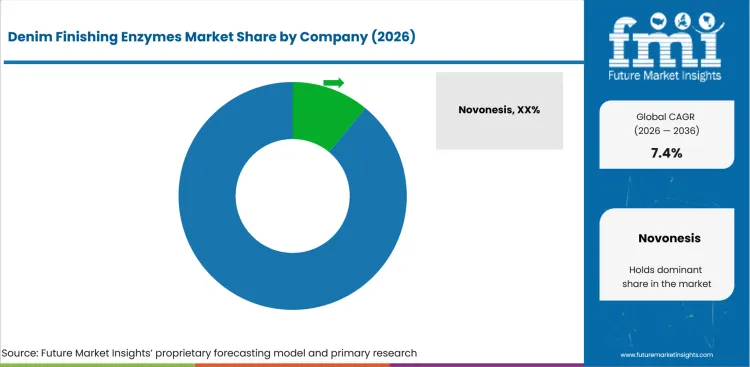
Who are the leading companies in the Denim Finishing Enzymes Market?
Novonesis, IFF, AB Enzymes, Kemin Industries and BASF.
- Established enzyme companies hold an advantage depending on cellulase portfolios and denim abrasion application data.
- Textile processing suppliers gain stronger acceptance by combining enzyme supply and mill recipe support.
- Regional formulators win in country markets through faster sample supply and local troubleshooting.
- Service-ready suppliers improve renewal chances through shade trials and wet-processing adjustments.
Industrial enzyme companies compete by combining denim abrasion enzymes and service programs. Novonesis has a strong position led by denim biosolutions and cellulase product depth. IFF competes through textile processing enzymes and catalase clean-up systems. AB Enzymes holds value across ECOSTONE cellulases for denim treatment and textile biofinishing.
Manufacturing and technical service depth have become stronger competitive separators as denim laundries move beyond simple chemical substitution. Kemin Industries competes through KEMZYME PRO textile enzymes across biopolishing and bleach clean-up. BASF strengthens formulation reach through textile chemicals and biotechnology-linked collaborations.
Smaller and regional suppliers are anticipated to profit through local wet-processing knowledge and faster field support. China and India create opportunities for suppliers operating sampling programs and cluster-based textile chemical channels. Europe and North America create demand for documented enzyme performance tied to compliance and brand specifications. Companies proving lower rewash risk across changing fabric lots should gain more durable mill relationships.
How do top Denim Finishing Enzymes companies compare?
Novonesis and IFF score on enzyme portfolio depth, with AB Enzymes and Kemin leading through textile application support.
| Company | Relevance to Market Title | Denim Abrasion Enzyme Depth | Wet-Processing Technical Support | Channel Reach | Geographic Footprint |
|---|---|---|---|---|---|
| Novonesis | Very High | Very Strong | Very Strong | Very Strong | Global |
| IFF | Very High | Very Strong | Very Strong | Very Strong | Global |
| AB Enzymes | Very High | Strong | Strong | Strong | Europe and global |
| Kemin Industries | High | Strong | Strong | Strong | United States and global |
| BASF | High | Moderate | Strong | Very Strong | Global |
| AET | High | Moderate | Strong | Strong | India and export markets |
| Maps Enzymes | High | Moderate | Strong | Moderate | India and South Asia |
| Rossari Biotech | Moderate | Moderate | Strong | Strong | India and selected export markets |
Source: Future Market Insights competitive analysis, 2026.
Who are the key players in the Denim Finishing Enzymes Market?
Novonesis, IFF and AB Enzymes are listed with Kemin Industries and BASF among other suppliers.
Key global companies leading the Denim Finishing Enzymes Market include:
- Novonesis
- IFF
- AB Enzymes
- Kemin Industries
- BASF
- AET
- Maps Enzymes
- Rossari Biotech
- Advanced Enzyme Technologies
- Sunson Industry Group
Key Developments in Denim Finishing Enzymes Market
- In January 2024, Novozymes and Chr. Hansen completed their combination to form Novonesis, creating a biosolutions company with around 10,000 employees and expertise across above 30 industries.
- In October 2025, BASF and IFF announced a strategic collaboration focused on enzyme systems and biobased polymers for industrial customers.
- In March 2026, Kemin described KEMZYME PRO as a textile enzyme range covering biopolishing, desizing, bioscouring, stone washing, and bleach clean-up.
Key Players in the Denim Finishing Enzymes Market
Global Enzyme Leaders
- Novonesis
- IFF
- AB Enzymes
- Kemin Industries
- BASF
Regional Formulators and Mill Specialists
- AET
- Maps Enzymes
- Rossari Biotech
- Advanced Enzyme Technologies
- Sunson Industry Group
- Amano Enzyme
Channel and Technical Service Partners
- Textile chemical distributors
- Garment laundry service partners
- Brand-approved wash-house support teams
Denim Finishing Enzymes Market - Report Scope
| Parameter | Details |
|---|---|
| Forecast period | 2026 to 2036 |
| Historical period | 2021 to 2025 |
| Quantitative unit | Revenue in USD million |
| By enzyme type | Cellulases, Laccases, Amylases, Catalases and Other Blends |
| By application | Bio-stoning, Bio-polishing, Bleach Clean-up, Desizing and Other Uses |
| By denim type | Rigid Denim, Stretch Denim, Premium / Fashion Denim |
| By process | Batch Processing, Continuous Processing |
| By sales channel | Direct to Mills, Distributors |
| Regions covered | North America, Latin America, Europe, East Asia, South Asia and Pacific, Middle East and Africa |
| Countries covered | China, India, South Korea, Germany, United States, France, United Kingdom, Japan |
| Key companies profiled | Novonesis, IFF, AB Enzymes, Kemin Industries, AET, Maps Enzymes, Rossari Biotech, BASF |
| Approach | Bottom-up enzyme revenue approach using denim finishing volume, dosage ranges, process mix, regional mill activity, channel margins, fabric blend mix, and supplier portfolio evidence |
Source: Future Market Insights competitive analysis, 2026.
Denim Finishing Enzymes Market - Scope & Definition
| Attribute | Detail |
|---|---|
| Market Definition | Biocatalysts used during denim garment washing and fabric finishing to alter surface appearance, reduce fuzz, support desizing, and clean up peroxide after bleaching |
| Functions Covered | Abrasion control, bio-polishing, peroxide removal, desizing support, shade control, and fabric surface improvement |
| Applications Covered | Bio-stoning, bio-polishing, bleach clean-up, desizing, stretch denim finishing, and premium denim wash support |
| End-Use Industries | Denim mills, garment laundries, textile chemical formulators, apparel exporters, fashion denim brands, and distributor channels |
| Grades Covered | Acid cellulases, neutral cellulases, low-temperature cellulases, catalases, amylases, laccases, and blended enzyme systems |
| Inclusions | All commercially traded denim finishing enzymes across enzyme type, application, denim type, process, sales channel, and country-level textile finishing use |
| Exclusions | Standalone pumice stones, dyes, silicone softeners, non-enzymatic auxiliaries, consumer laundry detergents, and enzymes used outside denim or textile finishing |
Denim Finishing Enzymes Market - Research Methodology
| Method | Description |
|---|---|
| Primary Research | FMI analyst interviews with denim mills, garment laundries, textile chemical distributors, enzyme formulators, apparel sourcing teams, and compliance teams serving branded denim buyers across selected markets |
| Desk Research | Review of official company product pages, textile resource-efficiency references, apparel sourcing evidence, public textile policy sources, and country-level textile capacity signals |
| Market Sizing & Forecasting | Bottom-up enzyme revenue approach using denim finishing volume, dosage ranges, process mix, regional mill activity, channel margins, fabric blend mix, and supplier portfolio evidence |
| Forecast Basis | Forecasts reflect company portfolios, official trade data, garment output indicators, policy signals, channel checks, and country-level apparel processing evidence |
Denim Finishing Enzymes Market Breakdown by Enzyme Type, Application, Denim Type, Process, Sales Channel, and Region
Denim Finishing Enzymes Market Segmented by Enzyme Type
- Cellulases
- Laccases
- Amylases
- Catalases and Other Blends
Denim Finishing Enzymes Market Segmented by Application
- Bio-stoning
- Bio-polishing
- Bleach Clean-up
- Desizing and Other Uses
Denim Finishing Enzymes Market Segmented by Denim Type
- Rigid Denim
- Stretch Denim
- Premium / Fashion Denim
Denim Finishing Enzymes Market Segmented by Process
- Batch Processing
- Continuous Processing
Denim Finishing Enzymes Market Segmented by Sales Channel
- Direct to Mills
- Distributors
Denim Finishing Enzymes Market by Region
- North America
- Latin America
- Europe
- East Asia
- South Asia and Pacific
- Middle East and Africa
Research Sources and Bibliography
- AB Enzymes. (2026). Textile enzymes: ECOSTONE cellulases for denim treatment and textile biofinishing.
- BASF. (2025, October 21). BASF and IFF announce strategic collaboration to drive innovation in enzyme systems and biobased polymers.
- Bureau of Labor Statistics. (2026, May). Apparel manufacturing: NAICS 315.
- Bureau of Labor Statistics. (2026, June 16). USA import price indexes by NAICS.
- CBI Ministry of Foreign Affairs. (2026, March 11). What is the demand for apparel on the European market?
- China Customs Administration. (2025, December 8). China’s major exports by quantity and value, November 2025.
- Department for Energy Security and Net Zero. (2024, April). Unlocking resource efficiency: Phase 2 textiles report.
- European Environment Agency. (2025, March 26). Circularity of the EU textiles value chain in numbers.
- EURATEX. (2025, December). EU textile and clothing industry outlook 2024-2025.
- International Labour Organization. (2025, March 28). Decent work challenges and opportunities in the textiles and clothing sector.
- International Flavors & Fragrances. (2026). Textile processing solutions.
- Invest Korea. (2025). Fashion industry profile.
- Kemin Industries. (2026, March 9). How enzymes are reshaping the future of sustainable textile processing.
- Ministry of Economy, Trade and Industry, Japan. (2024, February 29). Establishing resource circulation systems for textile products.
- Ministry of Textiles, Government of India. (2025, December 31). Annual report 2024-2025.
- Ministry of Trade, Industry and Energy, Republic of Korea. (2026, January 2). Korea’s annual exports reach new highs in 2025.
- Novonesis. (2024, January 29). Combination of Novozymes and Chr. Hansen is completed.
- Novonesis. (2025, February 26). Annual report 2024.
- Novonesis. (2026). Denimax for denim abrasion.
- Novonesis. (2026). Enzymes for denim abrasion.
- United Nations Environment Programme. (2025, March 27). Unsustainable fashion and textiles in focus for International Day of Zero Waste 2025.
- Waste and Resources Action Programme. (2025, October 28). UK Textiles Pact annual progress update 2024-25.
This bibliography is provided for reader reference and is not exhaustive. The full report contains the complete reference list and detailed citations.
This Report Answers
- Market size estimates for 2026 and forecasts through 2036 for the Denim Finishing Enzymes Market.
- Insights across regional and country-level denim finishing enzyme markets.
- Analysis of demand drivers and purchasing behavior.
- Evaluation of enzyme types, applications, denim types, processes, and sales channels.
- Assessment of denim wash recipe control and bio-stoning requirements.
- Identification of opportunities across cellulases and multi-enzyme wet-processing packages.
- Evaluation of direct mill sales and distributor-led textile chemical channels.
- Country-level analysis covering China, India, South Korea, Germany, United States, France, United Kingdom, and Japan.
- Assessment of competition, including leading enzyme companies and regional textile chemical formulators.
- Analysis of mill-level decision drivers and application-service criteria.
- Regional outlooks across North America, Europe, East Asia, South Asia and Pacific, Latin America, and Middle East and Africa.
- Delivery of market data, forecasts, and supporting analysis in report-ready format.
Frequently Asked Questions
What is the growth prospect for denim finishing enzymes?
Demand for denim finishing enzymes is expected to rise at a considerable pace as laundries replace harsh stonewashing steps with controlled cellulase and clean-up systems.
Which companies are expected to shape the Denim Finishing Enzymes Market?
Novonesis, IFF, AB Enzymes, Kemin Industries, BASF, AET, Maps Enzymes, and Rossari Biotech are expected to shape market competition based on enzyme depth and technical support.
Why are textile chemical suppliers investing in denim finishing enzymes?
Textile chemical suppliers are investing in denim finishing enzymes to support bio-stoning and fabric-surface improvement across export wash programs.
Why are direct mill sales channels important in the Denim Finishing Enzymes Market?
Direct mill sales channels support bath-condition tuning and confidential recipe development across denim finishing programs.
Which enzyme formats are gaining attention in denim finishing?
Cellulases and amylases are gaining attention as mills build multi-step wet-processing recipes.
How does denim wash control influence enzyme demand?
Denim wash control influences demand through shade repeatability and improved fabric-strength protection.
Why is denim type important for enzyme selection?
Denim type is important as stretch denim and premium denim need different abrasion intensity and fabric-care settings.
What role does Direct to Mills play in enzyme adoption?
Direct to Mills supports adoption by combining enzyme supply and troubleshooting.
Preview the report firsthand - request a free sample
Get SampleGet the brochure for pricing and purchase details.
Get PDFTable of Content
- Key Takeaways
- Market Size and CAGR
- Top Growth Driver
- Fastest Growing Segment
- Leading Region
- Key Companies
- Emerging Opportunities
- Executive Summary
- Global Market Outlook
- Demand-side Trends
- Supply-side Trends
- Technology Roadmap Analysis
- Analysis and Recommendations
- Analyst Perspective (What is happening? Why now? What should investors know?)
- Key Questions Answered
- How large is the market?
- What is the CAGR?
- What are key trends?
- Which region dominates?
- Who are the leaders?
- Market Overview
- Market Coverage / Taxonomy
- Market Definition / Scope / Limitations
- Research Methodology
- Chapter Orientation
- Analytical Lens and Working Hypotheses
- Market Structure, Signals, and Trend Drivers
- Benchmarking and Cross-market Comparability
- Market Sizing, Forecasting, and Opportunity Mapping
- Research Design and Evidence Framework
- Desk Research Programme (Secondary Evidence)
- Expert Input and Fieldwork (Primary Evidence)
- Tooling, Models, and Reference Databases
- Data Engineering and Model Build
- Quality Assurance and Audit Trail
- Market Background
- Market Dynamics (Drivers, Restraints, Opportunity, Trends)
- Scenario Forecast (Optimistic, Likely, Conservative)
- Impact Analysis
- AI Impact
- Sustainability Impact
- Regulatory Impact
- Technology Impact
- Consumer / Buyer Analysis
- Purchase Drivers
- Adoption Barriers
- Buyer Journey
- Opportunity Map Analysis
- Product Life Cycle Analysis
- Supply Chain Analysis
- Investment Feasibility Matrix
- Value Chain Analysis
- PESTLE and Porter's Analysis
- Regulatory Landscape
- Regional Parent Market Outlook
- Production and Consumption Statistics
- Import and Export Statistics
- Global Market Analysis and Forecast, 2021 to 2036
- Historical Market Size Value (USD Million) & Volume (Unit) Analysis, 2021 to 2025
- Current and Future Market Size Value (USD Million) & Volume (Unit) Projections, 2026 to 2036
- Y-o-Y Growth Trend Analysis
- Absolute $ Opportunity Analysis
- Global Market Pricing Analysis, 2021 to 2036
- Global Market Analysis and Forecast, By Application, 2021 to 2036
- Introduction / Key Findings
- Historical Market Size Value (USD Million) & Volume (Unit) Analysis By Application, 2021 to 2025
- Current and Future Market Size Value (USD Million) & Volume (Unit) Analysis and Forecast By Application, 2026 to 2036
- Bio-stoning
- Bio-polishing
- Bleach Clean-up
- Desizing and Other Uses
- Bio-stoning
- Y-o-Y Growth Trend Analysis By Application, 2021 to 2025
- Absolute $ Opportunity Analysis By Application, 2026 to 2036
- Global Market Analysis and Forecast, By Denim Type, 2021 to 2036
- Introduction / Key Findings
- Historical Market Size Value (USD Million) & Volume (Unit) Analysis By Denim Type, 2021 to 2025
- Current and Future Market Size Value (USD Million) & Volume (Unit) Analysis and Forecast By Denim Type, 2026 to 2036
- Stretch Denim
- Premium / Fashion Denim
- Rigid Denim
- Stretch Denim
- Y-o-Y Growth Trend Analysis By Denim Type, 2021 to 2025
- Absolute $ Opportunity Analysis By Denim Type, 2026 to 2036
- Global Market Analysis and Forecast, By Process, 2021 to 2036
- Introduction / Key Findings
- Historical Market Size Value (USD Million) & Volume (Unit) Analysis By Process, 2021 to 2025
- Current and Future Market Size Value (USD Million) & Volume (Unit) Analysis and Forecast By Process, 2026 to 2036
- Batch Processing
- Continuous Processing
- Batch Processing
- Y-o-Y Growth Trend Analysis By Process, 2021 to 2025
- Absolute $ Opportunity Analysis By Process, 2026 to 2036
- Global Market Analysis and Forecast, By Sales Channel, 2021 to 2036
- Introduction / Key Findings
- Historical Market Size Value (USD Million) & Volume (Unit) Analysis By Sales Channel, 2021 to 2025
- Current and Future Market Size Value (USD Million) & Volume (Unit) Analysis and Forecast By Sales Channel, 2026 to 2036
- Direct to Mills
- Distributors
- Direct to Mills
- Y-o-Y Growth Trend Analysis By Sales Channel, 2021 to 2025
- Absolute $ Opportunity Analysis By Sales Channel, 2026 to 2036
- Global Market Analysis and Forecast, By Region, 2021 to 2036
- Introduction
- Historical Market Size Value (USD Million) & Volume (Unit) Analysis By Region, 2021 to 2025
- Current Market Size Value (USD Million) & Volume (Unit) Analysis and Forecast By Region, 2026 to 2036
- North America
- Latin America
- Western Europe
- Eastern Europe
- East Asia
- South Asia and Pacific
- Middle East & Africa
- Market Attractiveness Analysis By Region
- North America Market Analysis and Forecast, By Country, 2021 to 2036
- Historical Market Size Value (USD Million) & Volume (Unit) Trend Analysis By Market Taxonomy, 2021 to 2025
- Market Size Value (USD Million) & Volume (Unit) Forecast By Market Taxonomy, 2026 to 2036
- By Country
- USA
- Canada
- Mexico
- By Application
- By Denim Type
- By Process
- By Sales Channel
- By Country
- Market Attractiveness Analysis
- By Country
- By Application
- By Denim Type
- By Process
- By Sales Channel
- Key Takeaways
- Latin America Market Analysis and Forecast, By Country
- Historical Market Size Value (USD Million) & Volume (Unit) Trend Analysis By Market Taxonomy, 2021 to 2025
- Market Size Value (USD Million) & Volume (Unit) Forecast By Market Taxonomy, 2026 to 2036
- By Country
- Brazil
- Chile
- Rest of Latin America
- By Application
- By Denim Type
- By Process
- By Sales Channel
- By Country
- Market Attractiveness Analysis
- By Country
- By Application
- By Denim Type
- By Process
- By Sales Channel
- Key Takeaways
- Western Europe Market Analysis and Forecast, By Country
- Historical Market Size Value (USD Million) & Volume (Unit) Trend Analysis By Market Taxonomy, 2021 to 2025
- Market Size Value (USD Million) & Volume (Unit) Forecast By Market Taxonomy, 2026 to 2036
- By Country
- Germany
- UK
- Italy
- Spain
- France
- Nordic
- BENELUX
- Rest of Western Europe
- By Application
- By Denim Type
- By Process
- By Sales Channel
- By Country
- Market Attractiveness Analysis
- By Country
- By Application
- By Denim Type
- By Process
- By Sales Channel
- Key Takeaways
- Eastern Europe Market Analysis and Forecast, By Country
- Historical Market Size Value (USD Million) & Volume (Unit) Trend Analysis By Market Taxonomy, 2021 to 2025
- Market Size Value (USD Million) & Volume (Unit) Forecast By Market Taxonomy, 2026 to 2036
- By Country
- Russia
- Poland
- Hungary
- Balkan & Baltic
- Rest of Eastern Europe
- By Application
- By Denim Type
- By Process
- By Sales Channel
- By Country
- Market Attractiveness Analysis
- By Country
- By Application
- By Denim Type
- By Process
- By Sales Channel
- Key Takeaways
- East Asia Market Analysis and Forecast, By Country
- Historical Market Size Value (USD Million) & Volume (Unit) Trend Analysis By Market Taxonomy, 2021 to 2025
- Market Size Value (USD Million) & Volume (Unit) Forecast By Market Taxonomy, 2026 to 2036
- By Country
- China
- Japan
- South Korea
- By Application
- By Denim Type
- By Process
- By Sales Channel
- By Country
- Market Attractiveness Analysis
- By Country
- By Application
- By Denim Type
- By Process
- By Sales Channel
- Key Takeaways
- South Asia and Pacific Market Analysis and Forecast, By Country
- Historical Market Size Value (USD Million) & Volume (Unit) Trend Analysis By Market Taxonomy, 2021 to 2025
- Market Size Value (USD Million) & Volume (Unit) Forecast By Market Taxonomy, 2026 to 2036
- By Country
- India
- ASEAN
- Australia & New Zealand
- Rest of South Asia and Pacific
- By Application
- By Denim Type
- By Process
- By Sales Channel
- By Country
- Market Attractiveness Analysis
- By Country
- By Application
- By Denim Type
- By Process
- By Sales Channel
- Key Takeaways
- Middle East & Africa Market Analysis and Forecast, By Country
- Historical Market Size Value (USD Million) & Volume (Unit) Trend Analysis By Market Taxonomy, 2021 to 2025
- Market Size Value (USD Million) & Volume (Unit) Forecast By Market Taxonomy, 2026 to 2036
- By Country
- Kingdom of Saudi Arabia
- Other GCC Countries
- Türkiye
- South Africa
- Other African Union
- Rest of Middle East & Africa
- By Application
- By Denim Type
- By Process
- By Sales Channel
- By Country
- Market Attractiveness Analysis
- By Country
- By Application
- By Denim Type
- By Process
- By Sales Channel
- Key Takeaways
- Key Countries Market Analysis
- USA
- Pricing Analysis
- Market Share Analysis, 2025
- By Application
- By Denim Type
- By Process
- By Sales Channel
- Canada
- Pricing Analysis
- Market Share Analysis, 2025
- By Application
- By Denim Type
- By Process
- By Sales Channel
- Mexico
- Pricing Analysis
- Market Share Analysis, 2025
- By Application
- By Denim Type
- By Process
- By Sales Channel
- Brazil
- Pricing Analysis
- Market Share Analysis, 2025
- By Application
- By Denim Type
- By Process
- By Sales Channel
- Chile
- Pricing Analysis
- Market Share Analysis, 2025
- By Application
- By Denim Type
- By Process
- By Sales Channel
- Germany
- Pricing Analysis
- Market Share Analysis, 2025
- By Application
- By Denim Type
- By Process
- By Sales Channel
- UK
- Pricing Analysis
- Market Share Analysis, 2025
- By Application
- By Denim Type
- By Process
- By Sales Channel
- Italy
- Pricing Analysis
- Market Share Analysis, 2025
- By Application
- By Denim Type
- By Process
- By Sales Channel
- Spain
- Pricing Analysis
- Market Share Analysis, 2025
- By Application
- By Denim Type
- By Process
- By Sales Channel
- France
- Pricing Analysis
- Market Share Analysis, 2025
- By Application
- By Denim Type
- By Process
- By Sales Channel
- India
- Pricing Analysis
- Market Share Analysis, 2025
- By Application
- By Denim Type
- By Process
- By Sales Channel
- ASEAN
- Pricing Analysis
- Market Share Analysis, 2025
- By Application
- By Denim Type
- By Process
- By Sales Channel
- Australia & New Zealand
- Pricing Analysis
- Market Share Analysis, 2025
- By Application
- By Denim Type
- By Process
- By Sales Channel
- China
- Pricing Analysis
- Market Share Analysis, 2025
- By Application
- By Denim Type
- By Process
- By Sales Channel
- Japan
- Pricing Analysis
- Market Share Analysis, 2025
- By Application
- By Denim Type
- By Process
- By Sales Channel
- South Korea
- Pricing Analysis
- Market Share Analysis, 2025
- By Application
- By Denim Type
- By Process
- By Sales Channel
- Russia
- Pricing Analysis
- Market Share Analysis, 2025
- By Application
- By Denim Type
- By Process
- By Sales Channel
- Poland
- Pricing Analysis
- Market Share Analysis, 2025
- By Application
- By Denim Type
- By Process
- By Sales Channel
- Hungary
- Pricing Analysis
- Market Share Analysis, 2025
- By Application
- By Denim Type
- By Process
- By Sales Channel
- Kingdom of Saudi Arabia
- Pricing Analysis
- Market Share Analysis, 2025
- By Application
- By Denim Type
- By Process
- By Sales Channel
- Türkiye
- Pricing Analysis
- Market Share Analysis, 2025
- By Application
- By Denim Type
- By Process
- By Sales Channel
- South Africa
- Pricing Analysis
- Market Share Analysis, 2025
- By Application
- By Denim Type
- By Process
- By Sales Channel
- USA
- Market Structure Analysis
- Competition Dashboard
- Competition Benchmarking
- Market Share Analysis of Top Players
- By Regional
- By Application
- By Denim Type
- By Process
- By Sales Channel
- Emerging Startups
- Innovation Benchmarking
- Competition Analysis
- Competition Deep Dive
- Novonesis
- Overview
- Product Portfolio
- Profitability by Market Segments (Product/Region/Sales Channel)
- Sales Footprint
- Strategy Overview
- Marketing Strategy
- Product Strategy
- Channel Strategy
- IFF
- AB Enzymes
- Kemin Industries
- BASF
- AET
- Maps Enzymes
- Rossari Biotech
- Novonesis
- Case Studies
- Success Stories
- Recent Developments
- Competition Deep Dive
- Assumptions & Acronyms Used


