

- Market Size (2026)
- USD 72.8 Mn
- Forecast (2036)
- USD 132.9 Mn
- CAGR (2026 to 2036)
- 6.2%
How big is Desiccant Canister Inserters Market in 2026?
Demand for desiccant canister inserters is projected to expand at a 6.2% CAGR between 2026 and 2036. Industry value is estimated to rise from USD 68.5 Million in 2025 to USD 72.8 Million in 2026 and reach USD 132.9 Million by 2036.
Spending on desiccant canister inserters reached USD 68.5 Million in 2025 and is estimated at USD 72.8 Million in 2026, as per FMI. Revenue is projected to reach USD 132.9 Million by 2036 at a 6.2% CAGR, adding USD 60.1 Million in absolute dollar opportunity. These systems sort and place rigid desiccant canisters into bottles or other compatible containers. Their use is closely tied to the wider pharmaceutical packaging equipment market, particularly on solid-dose bottle lines where moisture protection has to be added without disrupting packaging throughput. FDA requirements also state that container closure systems must protect drug products from foreseeable external factors that could cause deterioration or contamination [1].
Throughput compatibility is becoming a more important purchasing criterion as pharmaceutical bottle lines move toward higher sustained operating speeds. FMI’s demand analysis shows that a line running at 150 bottles per minute processes 72,000 bottles over an eight-hour operating period. At one canister per bottle, insertion demand is also 72,000 units. A three-canister configuration raises that requirement to 216,000 placements without any increase in bottle output. At 200 bottles per minute, insertion demand can reach 288,000 canisters over the same period.
The 100-200 bottles per minute category is therefore emerging as the main commercial operating range for desiccant canister inserters. Current equipment portfolios support this positioning. CVC markets systems around 150 and 200 bottles per minute [3][4], while Cremer’s BF 200 covers applications from 50 to 200 bottles per minute and supports single, double or triple canister drops [5]. Uhlmann also specifies a 150 bottles per minute solids bottle line with modular feeding for desiccant sachets or canisters [6]. The purchasing decision is increasingly shaped by line compatibility, dose configuration and sustained feeding performance. Higher rated speed has limited value if the inserter cannot maintain stable synchronization with the existing counting and capping equipment.
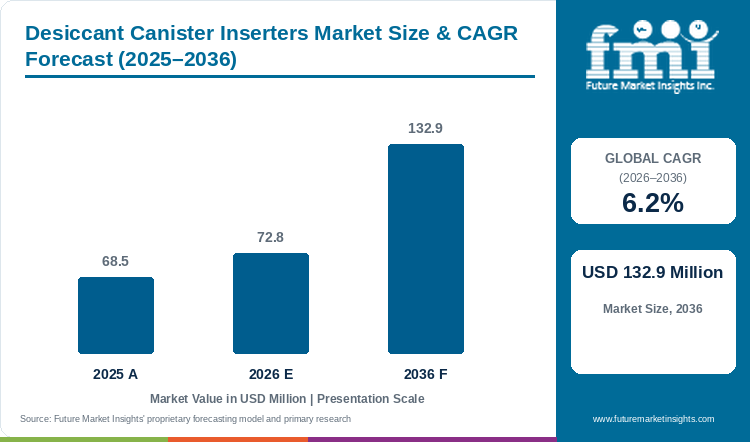
Desiccant Canister Inserters Market Size & CAGR Forecast (2025-2036)
| Year | Basis | Market value (USD million) |
|---|---|---|
| 2025 | Actual | 68.5 |
| 2026 | Estimate | 72.8 |
| 2036 | Forecast | 132.9 |
| CAGR, 2026 to 2036 | 6.2% | |
Source: Future Market Insights proprietary forecasting model and primary research.
Key Takeaways
- Fully Automatic systems are estimated to account for 78.0% of Automation demand in 2026. Their advantage comes from controlled feeding, no-bottle/no-fill functions and placement verification that reduce manual intervention.
- The 100-200 bottles/min range is estimated to hold 46.0% of Line Speed demand in 2026. This range matches several current pharmaceutical bottle-line platforms offered by CVC, Cremer, Uhlmann and Countec [3][5][6][19].
- Pharmaceutical applications are estimated to account for 68.0% of End Use demand in 2026. Solid-dose manufacturers have a stronger need for controlled moisture protection as packaging performance forms part of product stability and quality control.
- Profiled companies include CVC Technologies, Uhlmann Pac-Systeme / Cremer, Omega Design, BellatRx, Countec Group, PHARMAPACK Technologies, SED Pharma and YOKO.
Analyst Perspective
“Line reliability is central to the buying decision. When an inserter handles tens of thousands of bottles in a shift, buyers pay close attention to placement checks, changeover time and how well the machine fits the existing conveyor and bottle line.”
- Nandini Roy Choudhury, Principal Consultant, FMI
How is the desiccant canister inserters market segmented?
Desiccant canister inserters market is segmented by five primary commercial axes and region: automation, line speed, canister count, end use, installation architecture, and region.
- By automation: Fully Automatic and Semi-Automatic / Benchtop.
- By line speed: Below 100 Bottles/min, 100-200 Bottles/min, and Above 200 Bottles/min.
- By canister count: Single-Drop and Multi-Drop.
- By end use: Pharmaceuticals, Nutraceuticals, Diagnostics and Other Healthcare, and Food / Consumer Health.
- By installation architecture: Standalone / Overline Inline and Integrated Bottle-Line Module.
- By region: North America, Latin America, Western Europe, Eastern Europe, East Asia, South Asia and Pacific, and Middle East and Africa.
Why do Fully Automatic systems lead the Automation category?
Based on automation, Fully Automatic systems are projected to account for 78.0% of demand in 2026.
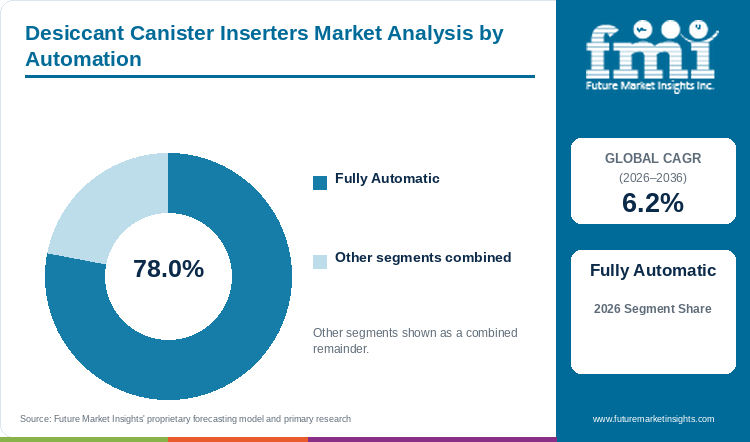
| Automation type | Share (2026) |
|---|---|
| Fully Automatic | 78.0% |
| Other segments combined | 22.0%* |
| Total | 100.0% |
| Metric | Value |
|---|---|
| Global CAGR (2026-2036) | 6.2% |
| Leading segment | Fully Automatic |
A canister inserter must release the desiccant at the right point in the bottle flow. Fully automatic systems handle this through PLC or servo controls that coordinate feeding with bottle position. CVC lists no-bottle/no-fill logic and pneumatic gating on its current models [3], while BellatRx uses automatic feeding with infrared counting and stored recipes [9]. These features help the inserter maintain a consistent cycle as the bottle line continues to run.
- Fully Automatic systems are projected to account for 78.0% of Automation demand in 2026.
- Their main advantage is line continuity. The inserter has to match the pace of tablet counting, capping and inspection without becoming a frequent source of stoppages.
What supports 100-200 Bottles/min as the leading Line Speed category?
The 100-200 Bottles/min range is estimated to account for 46.0% of Line Speed demand in 2026.
Canister inserters form one stage of a bottle packaging line and normally operate at a speed that is compatible with the equipment before and after them. This includes tablet counters, cappers and inspection systems. As a result, the required speed of the inserter depends in part on the speed of the complete line.
Several current machines fall within the 100-200 bottles/min range. CVC lists models at about 150 and 200 bottles/min [3][4]. Cremer's BF 200 covers speeds from 50 to 200 bottles/min [5], while Countec offers a canister inserter rated at 200 bottles/min [19]. These examples place the 100-200 bottles/min category within the normal working range of several commercial systems.
Machines with higher rated speeds are available for lines that require them, but excess inserter capacity does not raise output when another part of the line operates more slowly. This makes speed matching an important part of equipment selection.
- The 100-200 Bottles/min range is estimated to account for 46.0% of Line Speed demand in 2026.
- The range corresponds with the rated speeds of several canister inserters used with current bottle packaging lines.
Why does Single-Drop lead the Canister Count category?
Single-Drop is projected to account for 62.0% of Canister Count demand in 2026.
A Single-Drop system places one desiccant canister in each bottle. The feeder therefore completes one insertion for every bottle that passes through the station. Where two or three canisters are required, the machine must complete several insertions while the bottle remains within the same production flow.
The number of canisters used depends on the moisture-control requirement of the packaged product. A single canister may be sufficient for some bottle sizes and formulations, while products with a greater moisture load may require more desiccant. Equipment suppliers therefore provide both single- and multiple-drop settings. Cremer lists single, double and triple drops, while CVC supports programmable multiple insertions [5][7].
Single-Drop has an operating advantage because it requires fewer insertion cycles for a given number of bottles. Multi-Drop systems remain necessary where one canister does not provide the amount of desiccant specified for the package.
- Single-Drop is projected to account for 62.0% of Canister Count demand in 2026.
- Multi-Drop is used where the required desiccant quantity cannot be provided by one canister.
Why do Pharmaceuticals lead End Use demand?
Pharmaceuticals are projected to account for 68.0% of End Use demand in 2026.
Many pharmaceutical products are sensitive to moisture during storage. Tablets and capsules packed in bottles may therefore use a desiccant to limit the amount of water vapour inside the package. The canister is placed in the bottle before it is closed and remains with the product during its shelf life.
This use is linked to the wider requirements for pharmaceutical packaging. FDA rules require drug container closure systems to provide adequate protection against external factors that may cause deterioration or contamination [1]. Sanner also identifies drop-in desiccant canisters as moisture-control components for pharmaceutical and nutraceutical bottles [10].
A canister inserter is required only when the package uses a separate canister. Other designs place the desiccant in the closure or in another part of the container and do not require a separate insertion stage. Demand for inserters therefore depends on the packaging format selected for the product as well as the volume of bottled medicines produced. The equipment forms part of the wider pharmaceutical packaging market.
- Pharmaceuticals are projected to account for 68.0% of End Use demand in 2026.
- Nutraceuticals are another source of demand because many supplements are sold as tablets or capsules in bottles that may require moisture control.
Why do Standalone / Overline Inline systems lead Installation Architecture?
Standalone / Overline Inline systems are projected to account for 61.0% of Installation Architecture demand in 2026.
A standalone inserter operates as a separate station on the packaging line. In an overline arrangement, the feeding unit can be positioned above an existing conveyor so that bottles pass below it for canister insertion. This allows the insertion stage to be added without replacing the other machines on the line.
Cremer states that its BF 200 overline system can be installed over either a new or an existing conveyor [5]. This type of arrangement is suited to plants that already have bottle handling, counting and capping equipment in place and need to add a desiccant insertion step.
Integrated systems combine canister feeding with another machine. Omega, for example, offers canister feeding within selected bottle unscramblers as well as separate feeding systems [7]. Integration can reduce the number of machines required on a line and may reduce the floor space used. It is generally easier to consider this arrangement when a new line is being designed. Standalone equipment remains more flexible when the inserter is being added to an existing line.
- Standalone / Overline Inline systems are projected to account for 61.0% of Installation Architecture demand in 2026.
- Integrated systems combine the insertion function with other bottle-handling equipment and can reduce the number of separate machines required [7].
What are the drivers, restraints and opportunities in the desiccant canister inserters market?
Higher solid-dose bottle throughput raises the value of reliable insertion. Integrated desiccant packaging can remove a separate filling step. Retrofit systems with verification and electronic records create the clearest upgrade opportunity.
- Driver: High-throughput pharmaceutical and nutraceutical bottle lines increase the cost of a missed canister because one insertion station can affect the output of the entire packaging sequence.
- Restraint: Integrated desiccant closures can eliminate the separate canister insertion step, reducing equipment demand for products that adopt built-in moisture management [10].
- Opportunity: Retrofit projects can add drop verification, recipe control, audit-trail functions, and reject handling without replacing the entire bottle line [5][7][9].
Which country CAGRs are profiled in the desiccant canister inserters market?
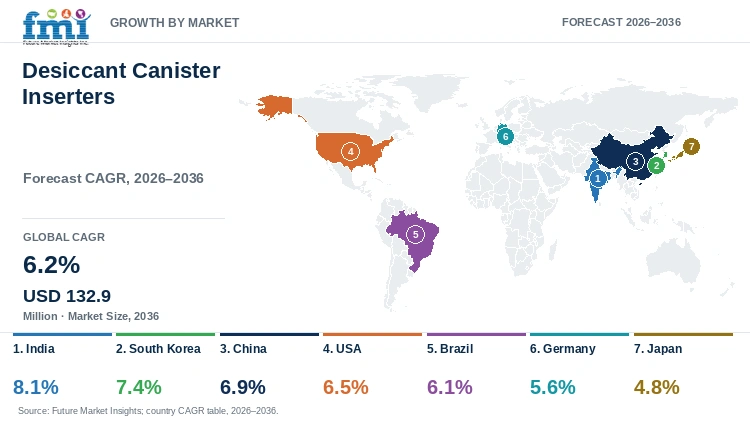
| Country | CAGR |
|---|---|
| India | 8.1% |
| South Korea | 7.4% |
| China | 6.9% |
| USA | 6.5% |
| Brazil | 6.1% |
| Germany | 5.6% |
| Japan | 4.8% |
Country-wise Analysis
- India: 8.1% CAGR through 2036. India’s pharmaceutical exports rose from USD 27.75 billion in 2024 to USD 30.45 billion in 2025, an increase of about 9.7% according to the Department of Pharmaceuticals [11]. Export growth increases the volume of medicines moving through regulated packing operations. Canister inserters are relevant to the part of this output that is packed in bottles and requires a separate desiccant. Demand will therefore depend on the mix of solid-dose products as well as continued investment in bottle lines.
- South Korea: 7.4% CAGR through 2036. Pharmaceutical production in South Korea passed KRW 33 trillion in 2025, the highest level reported by the Ministry of Food and Drug Safety [12]. This gives the country a large base of regulated drug production in which automated packing equipment is already required. Growth in canister inserters will depend mainly on bottled products that use loose desiccants.
- China: 6.9% CAGR through 2036. Capacity utilization in medicine manufacturing averaged 72.5% in 2025 according to the National Bureau of Statistics [17]. China has also tightened rules for contract drug manufacturing. The NMPA now places clearer duties on both marketing authorization holders and contract manufacturers for quality control and production records [18]. For bottle lines, this raises the value of equipment that can repeat the same insertion process and document it across different products.
- USA: 6.5% CAGR through 2036. The FDA launched its PreCheck pilot in 2026 to support the development of new pharmaceutical manufacturing facilities. Seven companies were selected for the first group in June 2026 [16]. New plants may create demand for complete bottle lines where oral solid drugs are part of the production mix. Existing plants form a separate market because a canister inserter can also be added to a line that already has its counting and capping equipment in place.
- Brazil: 6.1% CAGR through 2036. Anvisa reported that 6.3 billion medicine packages were sold in Brazil in 2025, up 3.7% from 2024 [13]. This volume gives Brazil a large base of finished medicines that must pass through packaging operations before sale. Canister inserters address only the share packed in bottles that use loose desiccants, but the scale of the market leaves room for both new equipment and replacement units.
- Germany: 5.6% CAGR through 2036. German pharmaceutical production rose 10.0% from the previous month in May 2025 according to Destatis [15]. The monthly increase does not by itself show a long-term rise in canister use, but it sits within a well-established pharmaceutical manufacturing base. In this market, demand is more closely linked to replacement of older equipment and changes to existing bottle lines than to rapid expansion of basic production capacity.
- Japan: 4.8% CAGR through 2036. Japan produced JPY 10.2485 trillion of pharmaceuticals in 2024, up 2.1% from the previous year according to the Ministry of Health, Labour and Welfare [14]. Japan already has a large pharmaceutical production base, which limits the role of simple capacity expansion as a source of equipment demand. Canister inserter sales are therefore more closely tied to replacement cycles and upgrades to automated bottle lines.
Who are the notable companies in the desiccant canister inserters market?
CVC Technologies, Uhlmann Pac-Systeme / Cremer, and Omega Design are among the notable suppliers. BellatRx and Countec Group add flexible standalone systems. PHARMAPACK Technologies, SED Pharma, and YOKO broaden the supplier base across Asia and international export markets.
CVC Technologies supplies dedicated desiccant canister inserters for pharmaceutical bottle lines. Its current range includes the CVC 1111, CVC 1112 and CVC 1112H [3][4][7]. The models cover different line speeds, giving manufacturers a choice based on the output of the existing bottle line.
Uhlmann and Cremer place canister insertion within a wider bottle-packaging system. Cremer's BF 200 can use either pouch or canister modules and can be installed over an existing conveyor [5]. Uhlmann takes a more integrated approach with the IBC 150, where desiccant feeding can be included with tablet counting and bottle closing on the same line [6]. The two designs address different plant needs: one can be added to an existing line, while the other forms part of a complete bottle system.
Omega Design also supplies both standalone and integrated canister feeding [7][8]. Its integrated units can place the feeding function within selected bottle unscramblers. This can reduce the number of separate machines required on a new line. A standalone feeder remains useful when canister insertion has to be added to equipment already in use. BellatRx offers another option for plants that need a smaller system, with manual through fully automatic operating modes [9].
Countec supplies canister inserters with output up to 200 bottles/min [19]. PHARMAPACK lists systems in the 200 to 300 bottles/min range [20], while SED Pharma and YOKO offer machines for lower and medium line speeds [21][22]. The supplier base therefore covers both high-output pharmaceutical lines and smaller retrofit installations.
- CVC Technologies supplies a range of dedicated canister insertion machines, while Uhlmann / Cremer also cover canister feeding as part of wider bottle-line systems.
- Omega Design offers both standalone and integrated feeding layouts. BellatRx and Countec provide additional options for plants using separate insertion equipment.
- PHARMAPACK Technologies, SED Pharma and YOKO broaden the available range across different line speeds and equipment budgets.
Competitive Benchmarking: Desiccant Canister Inserters Market
| Company | High-Speed Capability | Multi-Drop Flexibility | Integrated Line Option | Geographic Reach |
|---|---|---|---|---|
| CVC Technologies | High | High | High | International |
| Uhlmann / Cremer | High | High | High | Global |
| Omega Design | High | High | High | North America and international |
| BellatRx | Medium | High | Medium | North America and export markets |
| Countec Group | High | High | High | Asia and international |
| PHARMAPACK Technologies | High | High | High | China and international |
| SED Pharma | Medium | Medium | High | China and international |
| YOKO | Medium | Medium | High | China and international |
Scoring basis: High-Speed Capability reflects documented canister insertion at or near 200 bottles/min or higher. Multi-Drop Flexibility reflects documented support for more than one canister per bottle. Integrated Line Option reflects the ability to work as part of a broader bottle-line architecture. High means wider documented capability. Medium means narrower documented capability. Low means limited documented capability. These ratings do not indicate product quality or market share.
Key Developments in the Desiccant Canister Inserters Market
- In May 2024, Uhlmann Pac-Systeme and Cremer introduced modular equipment for solid-dose bottle packaging. The system can combine bottle handling with desiccant insertion and tablet counting, while allowing individual machines to be added or reconfigured. This is directly relevant to canister inserters because it moves desiccant feeding into a modular bottle-line architecture.
- In June 2025, Sanner started production at its new 60,500-square-foot facility in Greensboro, North Carolina. The site includes automated high-speed desiccant filling lines and produces desiccant packaging for pharmaceutical and nutraceutical customers in North America. The investment increases regional supply of the canisters and other desiccant formats handled by insertion equipment.
- In April 2026, Colorcon launched OneLock, a closure with the desiccant built directly into the cap. The design removes the need for a separate canister or packet and can be used on existing filling lines. This is relevant to canister inserter suppliers because wider use of integrated desiccant closures can remove the separate insertion step from some bottle lines.
Key Players in the Desiccant Canister Inserters Market
High-Speed Pharmaceutical Bottle-Line Specialists
- CVC Technologies
- Uhlmann Pac-Systeme / Cremer
- Omega Design
Flexible Standalone and Mid-Speed Suppliers
a
- BellatRx
- Countec Group
Asia-Based Packaging Equipment Suppliers
- PHARMAPACK Technologies
- SED Pharma
- YOKO
Desiccant Canister Inserters Market - Report Scope
| Coverage field | Report scope |
|---|---|
| Market breakdown | Automation; Line Speed; Canister Count; End Use; Installation Architecture |
| Quantitative Units | USD Million; shares and CAGR in percent |
| Market Definition | Revenue from equipment and directly bundled canister-feeding modules that sort, orient, verify, and insert rigid desiccant canisters into bottles or defined containers. Desiccant consumables, pouch-only inserters, cotton inserters, tablet counters, cappers, and complete bottle lines are excluded unless the canister-inserter value is separately identifiable. |
| Regions Covered | North America; Latin America; Western Europe; Eastern Europe; East Asia; South Asia and Pacific; Middle East and Africa |
| Countries Covered | India; South Korea; China; USA; Brazil; Germany; Japan; and additional countries in the full report |
| Key Companies Profiled | CVC Technologies; Uhlmann Pac-Systeme / Cremer; Omega Design; BellatRx; Countec Group; PHARMAPACK Technologies; SED Pharma; YOKO |
| Forecast Period | 2026 to 2036 |
Desiccant Canister Inserters Market - Research Methodology
| Method | Approach |
|---|---|
| FMI Synthetic Demand Survey | Scenario testing covers 60, 100, 150, and 200 bottles/min. It models one to three canisters per bottle across an eight-hour continuous shift and uses 0.5 g to 1.0 g assumed desiccant fill per canister. The purpose is to test how insertion count scales with line speed and canister count. |
| Desk Research | FMI reviews FDA packaging and electronic-record requirements with government pharmaceutical production data. First-party equipment specifications are used for machine speeds, canister formats, verification functions, integration options, and product positioning. |
| Market Sizing and Forecasting | Market sizing uses supplier-side equipment ranges, installed bottle-line proxies, replacement cycles, retrofit activity, end-use production, automation intensity, and pricing bands for canister-specific equipment. Forecasts consider pharmaceutical and nutraceutical bottle demand with line-speed upgrades and substitution from integrated desiccant packaging. |
| Data Validation | Values are checked for scope consistency so pouch-only inserters and desiccant consumables are excluded. Company claims are used only where the supplier documents the capability. Country evidence is used to explain the direction of demand rather than treated as a direct market-size input. |
Desiccant Canister Inserters Market by Segments
Desiccant Canister Inserters Market Segmented by Automation:
- Fully Automatic
- Semi-Automatic / Benchtop
Desiccant Canister Inserters Market Segmented by Line Speed:
- Below 100 Bottles/min
- 100-200 Bottles/min
- Above 200 Bottles/min
Desiccant Canister Inserters Market Segmented by Canister Count:
- Single-Drop
- Multi-Drop
Desiccant Canister Inserters Market Segmented by End Use:
- Pharmaceuticals
- Nutraceuticals
- Diagnostics and Other Healthcare
- Food / Consumer Health
Desiccant Canister Inserters Market Segmented by Installation Architecture:
- Standalone / Overline Inline
- Integrated Bottle-Line Module
Desiccant Canister Inserters Market by Region:
- North America
- United States
- Canada
- Latin America
- Brazil
- Mexico
- Argentina
- Chile
- Western Europe
- Germany
- France
- United Kingdom
- Italy
- Spain
- Benelux
- Nordics
- Eastern Europe
- Poland
- Czech Republic
- Romania
- Hungary
- East Asia
- China
- Japan
- South Korea
- South Asia and Pacific
- India
- ASEAN
- Australia and New Zealand
- Middle East and Africa
- GCC Countries
- South Africa
- Türkiye
- Israel
Research Sources and Bibliography
- 1. U.S. Electronic Code of Federal Regulations. 21 CFR 211.94, Drug product containers and closures. eCFR drug container rule
- 2. U.S. Electronic Code of Federal Regulations. 21 CFR Part 11, Electronic Records; Electronic Signatures. eCFR Part 11
- 3. CVC Technologies. CVC 1112H Desiccant Canister Inserter. CVC 1112H specifications
- 4. CVC Technologies. CVC 1112 Desiccant Canister Inserter. CVC 1112 specifications
- 5. Cremer Speciaalmachines. BF 200 flexible bottle filler. Cremer BF 200
- 6. Uhlmann Pac-Systeme. IBC 150 bottle line factsheet, 04/2025. Uhlmann IBC 150
- 7. Omega Design. Integrated Canister Feeding. Omega integrated feeding
- 8. Omega Design. OMNI-Feeder, Pouch and Canister Feeder. Omega OMNI-Feeder
- 9. BellatRx. Rx-Desiccant Canister Desiccant Inserter. BellatRx Rx-Desiccant
- 10. Sanner. Desiccant Packets, Canisters and Capsules. Sanner canister guidance
- 11. Press Information Bureau, Government of India. Pharmaceutical exports post-Sigachi industrial accident, 27 March 2026. India pharma export data
- 12. Ministry of Food and Drug Safety, Republic of Korea. 2025 domestic pharmaceutical production exceeds KRW 33 trillion, 2 July 2026. Korea pharmaceutical production
- 13. ANVISA / CMED. 2025 Statistical Yearbook of the Pharmaceutical Market, 28 September 2026. Brazil pharmaceutical market
- 14. Ministry of Health, Labour and Welfare, Japan. 2024 Pharmaceutical Industry Production Statistics, published 2026. Japan production statistics
- 15. German Federal Statistical Office. Production in May 2025, pharmaceutical industry +10.0% month on month. Germany production release
- 16. U.S. Food and Drug Administration. FDA Selects Seven Participants for PreCheck Pilot Program, 29 June 2026. FDA PreCheck participants
- 17. National Bureau of Statistics of China. Industrial Capacity Utilization Rate in the Fourth Quarter of 2025. China capacity utilization
- 18. National Medical Products Administration, China. Strengthening Supervision and Administration of Contract Manufacturing of Drugs, 2026. NMPA contract manufacturing
- 19. Countec Group. CG-200 Canister Desiccant Inserter. Countec CG-200
- 20. PHARMAPACK Technologies. LFIS-20/30 Canister Desiccant Inserter. PHARMAPACK LFIS-20/30
- 21. SED Pharma. SED-ZGS Automatic Desiccant Canister Inserter. SED-ZGS specifications
- 22. YOKO. Automatic Desiccant Canister Inserter. YOKO canister inserter
This bibliography is provided for reader reference. Market values, shares, and country CAGRs remain Future Market Insights estimates. External sources support operating specifications, regulation, and dated market context.
This Report Answers
- What is the Desiccant Canister Inserters Market worth during 2026?
- What value is the Desiccant Canister Inserters Market projected to reach by 2036?
- Which automation category holds notable Desiccant Canister Inserters Market share in 2026?
- Which line-speed band holds notable Desiccant Canister Inserters Market share in 2026?
- Which countries have notable Desiccant Canister Inserters Market growth?
- Which companies are active in the Desiccant Canister Inserters Market today?
Frequently Asked Questions
How large is the Desiccant Canister Inserters Market expected to be in 2026?
Future Market Insights estimates the Desiccant Canister Inserters Market at USD 72.8 Million in 2026. Revenue is projected to reach USD 132.9 Million by 2036 as pharmaceutical and nutraceutical bottle lines add automation and replace older insertion equipment.
What CAGR is forecast for the Desiccant Canister Inserters Market through 2036?
The market is projected to expand at a 6.2% CAGR from 2026 to 2036. Growth is supported by bottle-line automation, retrofit activity, and demand for verified canister placement in moisture-sensitive solid-dose products.
Which automation category holds a notable market share in 2026?
Fully Automatic systems are projected to account for 78.0% of Automation demand in 2026. PLC and servo control help the inserter keep pace with continuous packaging lines while supporting verification and recipe-based operation.
Which line-speed band holds a notable market share in 2026?
The 100–200 Bottles/min range is estimated to account for 46.0% of Line Speed demand in 2026. This band overlaps with several current solid-dose bottle-line platforms from major equipment suppliers.
Which country has a notable expansion outlook during the forecast period?
India is projected to expand at an 8.1% CAGR from 2026 to 2036. Pharmaceutical export growth and finished-dose manufacturing support investment in automated packaging equipment.
Which companies are active in the Desiccant Canister Inserters Market during 2026?
Notable companies include CVC Technologies, Uhlmann Pac-Systeme / Cremer, Omega Design, BellatRx, Countec Group, PHARMAPACK Technologies, SED Pharma, and YOKO. Their offerings span high-speed canister insertion, standalone retrofits, and integrated bottle-line modules.
Preview the report firsthand - request a free sample
Get SampleGet the brochure for pricing and purchase details.
Get PDFTable of Content
- Key Takeaways
- Market Size and CAGR
- Top Growth Driver
- Fastest Growing Segment
- Leading Region
- Key Companies
- Emerging Opportunities
- Executive Summary
- Global Market Outlook
- Demand-side Trends
- Supply-side Trends
- Technology Roadmap Analysis
- Analysis and Recommendations
- Analyst Perspective (What is happening? Why now? What should investors know?)
- Key Questions Answered
- How large is the market?
- What is the CAGR?
- What are key trends?
- Which region dominates?
- Who are the leaders?
- Market Overview
- Market Coverage / Taxonomy
- Market Definition / Scope / Limitations
- Research Methodology
- Chapter Orientation
- Analytical Lens and Working Hypotheses
- Market Structure, Signals, and Trend Drivers
- Benchmarking and Cross-market Comparability
- Market Sizing, Forecasting, and Opportunity Mapping
- Research Design and Evidence Framework
- Desk Research Programme (Secondary Evidence)
- Expert Input and Fieldwork (Primary Evidence)
- Tooling, Models, and Reference Databases
- Data Engineering and Model Build
- Quality Assurance and Audit Trail
- Market Background
- Market Dynamics (Drivers, Restraints, Opportunity, Trends)
- Scenario Forecast (Optimistic, Likely, Conservative)
- Impact Analysis
- AI Impact
- Sustainability Impact
- Regulatory Impact
- Technology Impact
- Consumer / Buyer Analysis
- Purchase Drivers
- Adoption Barriers
- Buyer Journey
- Opportunity Map Analysis
- Product Life Cycle Analysis
- Supply Chain Analysis
- Investment Feasibility Matrix
- Value Chain Analysis
- PESTLE and Porter's Analysis
- Regulatory Landscape
- Regional Parent Market Outlook
- Production and Consumption Statistics
- Import and Export Statistics
- Global Market Analysis and Forecast, 2021 to 2036
- Historical Market Size Value (USD Million) Analysis, 2021 to 2025
- Current and Future Market Size Value (USD Million) Projections, 2026 to 2036
- Y-o-Y Growth Trend Analysis
- Absolute $ Opportunity Analysis
- Global Market Pricing Analysis, 2021 to 2036
- Global Market Analysis and Forecast, By Automation, 2021 to 2036
- Introduction / Key Findings
- Historical Market Size Value (USD Million) Analysis By Automation, 2021 to 2025
- Current and Future Market Size Value (USD Million) Analysis and Forecast By Automation, 2026 to 2036
- Fully Automatic
- Semi-Automatic / Benchtop
- Y-o-Y Growth Trend Analysis By Automation, 2021 to 2025
- Absolute $ Opportunity Analysis By Automation, 2026 to 2036
- Global Market Analysis and Forecast, By Line Speed, 2021 to 2036
- Introduction / Key Findings
- Historical Market Size Value (USD Million) Analysis By Line Speed, 2021 to 2025
- Current and Future Market Size Value (USD Million) Analysis and Forecast By Line Speed, 2026 to 2036
- Below 100 Bottles/min
- 100-200 Bottles/min
- Above 200 Bottles/min
- Y-o-Y Growth Trend Analysis By Line Speed, 2021 to 2025
- Absolute $ Opportunity Analysis By Line Speed, 2026 to 2036
- Global Market Analysis and Forecast, By Canister Count, 2021 to 2036
- Introduction / Key Findings
- Historical Market Size Value (USD Million) Analysis By Canister Count, 2021 to 2025
- Current and Future Market Size Value (USD Million) Analysis and Forecast By Canister Count, 2026 to 2036
- Single-Drop
- Multi-Drop
- Y-o-Y Growth Trend Analysis By Canister Count, 2021 to 2025
- Absolute $ Opportunity Analysis By Canister Count, 2026 to 2036
- Global Market Analysis and Forecast, By End Use, 2021 to 2036
- Introduction / Key Findings
- Historical Market Size Value (USD Million) Analysis By End Use, 2021 to 2025
- Current and Future Market Size Value (USD Million) Analysis and Forecast By End Use, 2026 to 2036
- Pharmaceuticals
- Nutraceuticals
- Diagnostics and Other Healthcare
- Food / Consumer Health
- Y-o-Y Growth Trend Analysis By End Use, 2021 to 2025
- Absolute $ Opportunity Analysis By End Use, 2026 to 2036
- Global Market Analysis and Forecast, By Installation Architecture, 2021 to 2036
- Introduction / Key Findings
- Historical Market Size Value (USD Million) Analysis By Installation Architecture, 2021 to 2025
- Current and Future Market Size Value (USD Million) Analysis and Forecast By Installation Architecture, 2026 to 2036
- Standalone / Overline Inline
- Integrated Bottle-Line Module
- Y-o-Y Growth Trend Analysis By Installation Architecture, 2021 to 2025
- Absolute $ Opportunity Analysis By Installation Architecture, 2026 to 2036
- Global Market Analysis and Forecast, By Region, 2021 to 2036
- Introduction
- Historical Market Size Value (USD Million) Analysis By Region, 2021 to 2025
- Current Market Size Value (USD Million) Analysis and Forecast By Region, 2026 to 2036
- North America
- Latin America
- Western Europe
- Eastern Europe
- East Asia
- South Asia and Pacific
- Middle East and Africa
- Market Attractiveness Analysis By Region
- North America Market Analysis and Forecast, By Country, 2021 to 2036
- Historical Market Size Value (USD Million) Trend Analysis By Market Taxonomy, 2021 to 2025
- Market Size Value (USD Million) Forecast By Market Taxonomy, 2026 to 2036
- By Country
- United States
- Canada
- By Automation
- By Line Speed
- By Canister Count
- By End Use
- By Installation Architecture
- By Country
- Market Attractiveness Analysis
- By Country
- By Automation
- By Line Speed
- By Canister Count
- By End Use
- By Installation Architecture
- Key Takeaways
- Latin America Market Analysis and Forecast, By Country
- Historical Market Size Value (USD Million) Trend Analysis By Market Taxonomy, 2021 to 2025
- Market Size Value (USD Million) Forecast By Market Taxonomy, 2026 to 2036
- By Country
- Brazil
- Mexico
- Argentina
- Chile
- By Automation
- By Line Speed
- By Canister Count
- By End Use
- By Installation Architecture
- By Country
- Market Attractiveness Analysis
- By Country
- By Automation
- By Line Speed
- By Canister Count
- By End Use
- By Installation Architecture
- Key Takeaways
- Western Europe Market Analysis and Forecast, By Country
- Historical Market Size Value (USD Million) Trend Analysis By Market Taxonomy, 2021 to 2025
- Market Size Value (USD Million) Forecast By Market Taxonomy, 2026 to 2036
- By Country
- Germany
- France
- United Kingdom
- Italy
- Spain
- Benelux
- Nordics
- By Automation
- By Line Speed
- By Canister Count
- By End Use
- By Installation Architecture
- By Country
- Market Attractiveness Analysis
- By Country
- By Automation
- By Line Speed
- By Canister Count
- By End Use
- By Installation Architecture
- Key Takeaways
- Eastern Europe Market Analysis and Forecast, By Country
- Historical Market Size Value (USD Million) Trend Analysis By Market Taxonomy, 2021 to 2025
- Market Size Value (USD Million) Forecast By Market Taxonomy, 2026 to 2036
- By Country
- Poland
- Czech Republic
- Romania
- Hungary
- By Automation
- By Line Speed
- By Canister Count
- By End Use
- By Installation Architecture
- By Country
- Market Attractiveness Analysis
- By Country
- By Automation
- By Line Speed
- By Canister Count
- By End Use
- By Installation Architecture
- Key Takeaways
- East Asia Market Analysis and Forecast, By Country
- Historical Market Size Value (USD Million) Trend Analysis By Market Taxonomy, 2021 to 2025
- Market Size Value (USD Million) Forecast By Market Taxonomy, 2026 to 2036
- By Country
- China
- Japan
- South Korea
- By Automation
- By Line Speed
- By Canister Count
- By End Use
- By Installation Architecture
- By Country
- Market Attractiveness Analysis
- By Country
- By Automation
- By Line Speed
- By Canister Count
- By End Use
- By Installation Architecture
- Key Takeaways
- South Asia and Pacific Market Analysis and Forecast, By Country
- Historical Market Size Value (USD Million) Trend Analysis By Market Taxonomy, 2021 to 2025
- Market Size Value (USD Million) Forecast By Market Taxonomy, 2026 to 2036
- By Country
- India
- ASEAN
- Australia and New Zealand
- By Automation
- By Line Speed
- By Canister Count
- By End Use
- By Installation Architecture
- By Country
- Market Attractiveness Analysis
- By Country
- By Automation
- By Line Speed
- By Canister Count
- By End Use
- By Installation Architecture
- Key Takeaways
- Middle East and Africa Market Analysis and Forecast, By Country
- Historical Market Size Value (USD Million) Trend Analysis By Market Taxonomy, 2021 to 2025
- Market Size Value (USD Million) Forecast By Market Taxonomy, 2026 to 2036
- By Country
- GCC Countries
- South Africa
- Türkiye
- Israel
- By Automation
- By Line Speed
- By Canister Count
- By End Use
- By Installation Architecture
- By Country
- Market Attractiveness Analysis
- By Country
- By Automation
- By Line Speed
- By Canister Count
- By End Use
- By Installation Architecture
- Key Takeaways
- Key Countries Market Analysis
- United States
- Pricing Analysis
- Market Share Analysis, 2025
- By Automation
- By Line Speed
- By Canister Count
- By End Use
- By Installation Architecture
- Canada
- Pricing Analysis
- Market Share Analysis, 2025
- By Automation
- By Line Speed
- By Canister Count
- By End Use
- By Installation Architecture
- Mexico
- Pricing Analysis
- Market Share Analysis, 2025
- By Automation
- By Line Speed
- By Canister Count
- By End Use
- By Installation Architecture
- Brazil
- Pricing Analysis
- Market Share Analysis, 2025
- By Automation
- By Line Speed
- By Canister Count
- By End Use
- By Installation Architecture
- Chile
- Pricing Analysis
- Market Share Analysis, 2025
- By Automation
- By Line Speed
- By Canister Count
- By End Use
- By Installation Architecture
- Germany
- Pricing Analysis
- Market Share Analysis, 2025
- By Automation
- By Line Speed
- By Canister Count
- By End Use
- By Installation Architecture
- United Kingdom
- Pricing Analysis
- Market Share Analysis, 2025
- By Automation
- By Line Speed
- By Canister Count
- By End Use
- By Installation Architecture
- Italy
- Pricing Analysis
- Market Share Analysis, 2025
- By Automation
- By Line Speed
- By Canister Count
- By End Use
- By Installation Architecture
- Spain
- Pricing Analysis
- Market Share Analysis, 2025
- By Automation
- By Line Speed
- By Canister Count
- By End Use
- By Installation Architecture
- France
- Pricing Analysis
- Market Share Analysis, 2025
- By Automation
- By Line Speed
- By Canister Count
- By End Use
- By Installation Architecture
- India
- Pricing Analysis
- Market Share Analysis, 2025
- By Automation
- By Line Speed
- By Canister Count
- By End Use
- By Installation Architecture
- ASEAN
- Pricing Analysis
- Market Share Analysis, 2025
- By Automation
- By Line Speed
- By Canister Count
- By End Use
- By Installation Architecture
- Australia and New Zealand
- Pricing Analysis
- Market Share Analysis, 2025
- By Automation
- By Line Speed
- By Canister Count
- By End Use
- By Installation Architecture
- China
- Pricing Analysis
- Market Share Analysis, 2025
- By Automation
- By Line Speed
- By Canister Count
- By End Use
- By Installation Architecture
- Japan
- Pricing Analysis
- Market Share Analysis, 2025
- By Automation
- By Line Speed
- By Canister Count
- By End Use
- By Installation Architecture
- South Korea
- Pricing Analysis
- Market Share Analysis, 2025
- By Automation
- By Line Speed
- By Canister Count
- By End Use
- By Installation Architecture
- Poland
- Pricing Analysis
- Market Share Analysis, 2025
- By Automation
- By Line Speed
- By Canister Count
- By End Use
- By Installation Architecture
- Hungary
- Pricing Analysis
- Market Share Analysis, 2025
- By Automation
- By Line Speed
- By Canister Count
- By End Use
- By Installation Architecture
- Türkiye
- Pricing Analysis
- Market Share Analysis, 2025
- By Automation
- By Line Speed
- By Canister Count
- By End Use
- By Installation Architecture
- South Africa
- Pricing Analysis
- Market Share Analysis, 2025
- By Automation
- By Line Speed
- By Canister Count
- By End Use
- By Installation Architecture
- United States
- Market Structure Analysis
- Competition Dashboard
- Competition Benchmarking
- Market Share Analysis of Top Players
- By Regional
- By Automation
- By Line Speed
- By Canister Count
- By End Use
- By Installation Architecture
- Emerging Startups
- Innovation Benchmarking
- Competition Analysis
- Competition Deep Dive
- CVC Technologies
- Overview
- Product Portfolio
- Profitability by Market Segments
- Sales Footprint
- Strategy Overview
- Marketing Strategy
- Product Strategy
- Channel Strategy
- Uhlmann / Cremer
- Omega Design
- BellatRx
- Countec Group
- PHARMAPACK Technologies
- SED Pharma
- YOKO
- CVC Technologies
- Case Studies
- Success Stories
- Recent Developments
- Competition Deep Dive
- Assumptions & Acronyms Used


