

- Market Size (2026)
- USD 538.4 Mn
- Forecast (2036)
- USD 937.2 Mn
- CAGR (2026 to 2036)
- 5.7%
How big is Desiccant Closures Market in 2026?
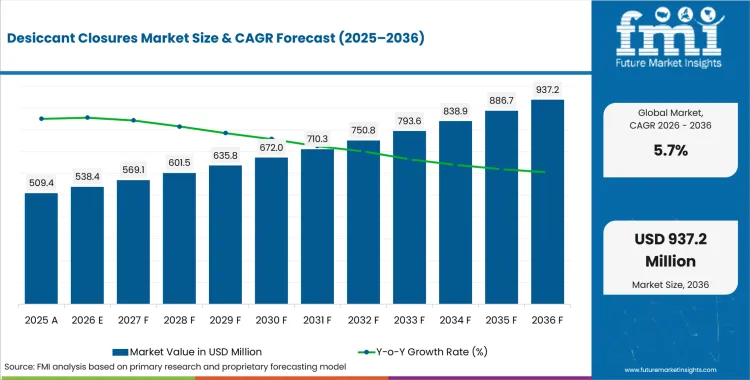
USD 538.4 million in 2026 and USD 937.2 million by 2036 at a 5.7% CAGR.
The desiccant closures market is projected to rise from USD 538.4 million in 2026 to USD 937.2 million by 2036 at 5.7% CAGR. Pharmaceutical programs gain value from closures that absorb headspace moisture without adding a separate desiccant-insertion step to the filling line. FDA's August 2026 draft guidance treats container-closure quality as a complete package-system question instead of testing each component in isolation. System-level review makes bottle fit, stability evidence and line performance part of the commercial case for an integrated closure.
Country adoption is fastest where new medicine registrations create packaging decisions before a bottle format becomes entrenched. The Emirates Drug Establishment directory listed 17,107 registered medical products after its August 2026 refresh. The registration base gives Gulf packaging teams more opportunities to qualify closure systems alongside new products. Mature markets move more slowly because existing line settings and stability history raise the cost of changing an approved cap.
Key Takeaways
- Moisture-sensitive solid medicines increase demand for integrated closures that protect bottle headspace after repeated opening.
- By product type, screw closures are estimated to hold 32.0% in 2026 owing to familiar neck finishes that simplify qualification.
- In 2026, polymer systems are expected to lead material with 29.0% share because molded structures protect desiccant elements during repeated use.
- Child-resistant formats are set to lead the compliance feature category with 29.0% share in 2026 due to combined safety and barrier requirements.
- Packaging changes lengthen validation schedules because a new closure requires fresh review of torque and stability evidence before release.
- Some of the key players in this market include Sanner, Colorcon, Aptar CSP Technologies, Xinfuda Medical Packaging, ALPLApharma, Gerresheimer, West Pharmaceutical Services, and Amcor.
Analyst Perspective
"Desiccant closures justify a premium when moisture uptake survives the bottle geometry and capping conditions already qualified for the medicine. Packaging teams should compare sorbent capacity with reclosure performance and change-control evidence because cheaper caps can introduce stability work that erases unit-price savings."
- Nandini Roy Choudhury, Principal Consultant, Future Market Insights
How is the Desiccant Closures Market segmented?
The desiccant closures market is segmented by product type, material, compliance feature, end use, sales channel and region.
Market taxonomy covers product type, material, compliance feature, end use, sales channel and region. Product types include screw, dispensing, child-resistant and tamper-evident closures. Materials include polymer systems, glass, aluminium and foil, and fiber-based formats. Compliance features include child-resistant, tamper-evident, serialization-ready and cold-chain-assured designs. End uses include retail pharmacy, hospital and clinical, clinical trials, and OTC and D2C health. Sales channels include direct pharma contracts, specialty distributors and online B2B.
Why do screw closures lead demand within the product type category?
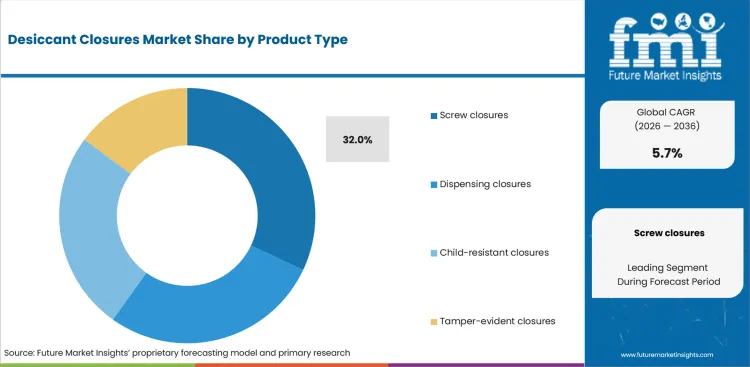
Screw closures fit regulated oral-solid bottles because the threaded interface supports repeated opening without changing basic user handling. Colorcon launched OneLock in April 2026 with integrated desiccant protection and SP 400 bottle compatibility. The closure runs on existing filling lines so moisture control stays inside a familiar commercial capping architecture.
- By product type, the screw closures segment is estimated to hold 32.0% in 2026 owing to repeat opening and familiar bottle-neck interfaces.
- Packaging engineers favor screw formats because they incorporate moisture protection and safety features without rebuilding standard capper settings during routine commercial qualification work.
Why do polymer systems lead demand within the material category?
Polymer systems give closure engineers molded geometry for threads and protected active-material chambers without a separate metal assembly. Aptar stated in June 2026 that N-Sorb supports bottle formats and other active packaging configurations after USPTO allowance. Protective chemistry becomes part of a molded component already used for sealing and reliable reclosure during commercial use.
- Polymer systems are projected to hold 29.0% share in 2026 owing to molded structures that retain active material inside the closure.
- Polymer designs gain adoption after qualification confirms stable torque and seal performance with the protective material integrated inside the closure assembly.
Why do child-resistant formats lead demand within the compliance feature category?
Child-resistant formats must limit young-child access without making routine adult use impractical on reclosable medicine packs. Sanner's May 2025 TabTec CR launch paired certified push-and-flip safety with integrated desiccant protection for oral solid doses. The design makes child-resistant containers and moisture control part of one complete package qualification process on established packaging lines.
- The child-resistant segment is likely to capture 29.0% share in 2026 attributable to safety requirements for repeatedly opened medicine bottles.
- Pharmaceutical programs favor certified opening mechanisms after repeated-use tests confirm moisture protection and acceptable adult usability over the intended commercial pack life.
Why does retail pharmacy lead demand within the end use category?
Retail pharmacy puts moisture-resistant packaging under repeated in-use exposure because multidose bottles reopen after dispensing. NHSBSA reported in June 2026 that England dispensed 1.30 billion community prescription items during 2025/26. That dispensing scale keeps reclosure performance commercially relevant for oral medicines selected for multidose bottle formats in community dispensing.
- In 2026, retail pharmacy is expected to lead end use with 30.0% share because multidose packs face repeated ambient exposure after dispensing.
- Retail formats gain adoption after the cap proves easy reclosure and the bottle retains qualified barrier performance during repeated commercial opening cycles after dispensing.
What are the drivers, restraints and opportunities in the Desiccant Closures Market?
Moisture-sensitive oral medicines raise demand for integrated protection, packaging requalification slows switching, and multifunction closure designs widen the addressable value per package.
- Driver: Drug owners need moisture control that protects sensitive tablets and capsules after the patient begins opening a multidose bottle.
- Restraint: Closure changes require fresh stability work and line trials because the cap is part of the qualified primary package.
- Opportunity: Integrated desiccant and safety functions remove separate packaging steps once the complete package passes line and stability qualification.
Repeated opening raises moisture-control demand
Moisture-sensitive oral medicines need protection after each bottle opening because fresh headspace air can raise humidity during routine patient use after repeated access. FDA's 2025 first-generic list closed with 91 approvals and included numerous tablet products entering new commercial supply programs. New oral-solid launches give pharmaceutical packaging teams a qualification point before legacy stability records make closure changes more expensive. pharmaceutical packaging
Requalification slows closure switching
Established medicines resist closure conversion once stability records and line settings are tied to the approved pack. EMA's revised Variations Guidelines apply from January 15 2026 and require updated procedures and documentation for post-authorisation changes. The lifecycle work makes plastic medicine bottles harder to reconfigure unless the new cap offers a measurable stability or handling benefit on an approved commercial line.
Local production shortens qualification support
Integrated closures gain commercial value once local production shortens sample and line-support cycles without changing the qualified bottle interface. Sanner opened its Greensboro operation in June 2025 with pharmaceutical packaging and desiccant production that includes the DASG-1 closure. North American output gives plastic caps programs a closer technical route for fit questions during validation and routine early commercial production scale-up. plastic caps
Which country CAGRs are profiled in the Desiccant Closures Market?
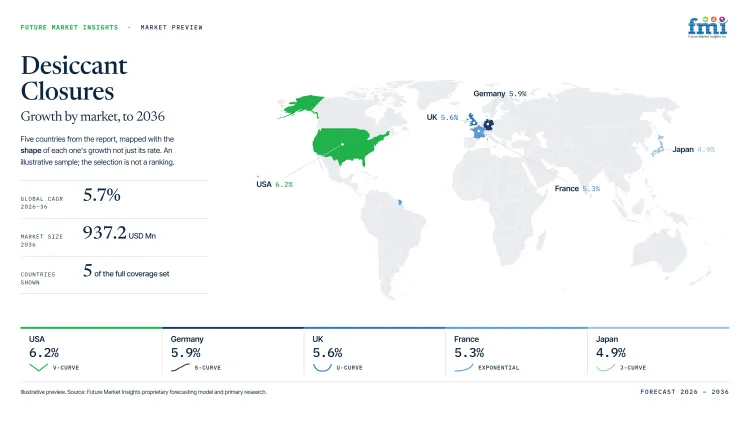
| Country | CAGR |
|---|---|
| UAE | 7.1% |
| Saudi Arabia | 6.8% |
| South Korea | 6.5% |
| USA | 6.2% |
| Germany | 5.9% |
| UK | 5.6% |
| France | 5.3% |
| Japan | 4.9% |
How do country-level CAGRs compare in the Desiccant Closures Market?
The 2.2-point spread separates faster Gulf conversion from mature European and East Asian packaging systems. UAE and Saudi Arabia form the upper band. South Korea and USA follow through faster pharmaceutical product turnover as Germany and UK occupy the middle before France and Japan close the range.
- UAE import-led supply rewards companies that keep closure samples and engineering support near pharmaceutical packaging trials.
- Saudi traceability requirements favor closures that preserve coding space and package accountability during local fill-finish expansion.
- South Korea rewards rapid technical response because imported packaging changes must clear local documentation before distribution begins.
- USA contract packagers give new oral-solid programs line access before closure specifications become fixed in stability records.
- German plants prioritize controlled change because mature filling lines leave little tolerance for unnecessary capper adjustments.
- UK prescription throughput makes reclosure consistency commercially important before packaging teams change qualified bottle specifications.
- French packagers value continuity because late packaging substitutions can disrupt medicine availability through linked pharmacy channels.
- Japanese qualification gives adult usability extra weight on reclosable oral-solid bottles serving mature pharmacy networks.
CAGR ranks conversion speed instead of revenue size because mature markets still sustain premium moisture-control replacement programs. The full report provides country-level CAGR analysis across North America, Latin America, Europe, East Asia, South Asia, Oceania and the Middle East and Africa.
Country-wise Analysis
- UAE pharmaceutical packaging teams qualify products against a fast-changing registration base and often source specialized closure components from outside the country. Desiccant closure demand in UAE is forecast to expand at 7.1% CAGR by 2036 because new registrations keep creating primary-packaging decisions. The Emirates Drug Establishment directory records a UAE-manufactured VONACAB 20 mg tablet registration dated May 26 2025. Local registrations give closure companies a direct route into new bottle programs though imported tooling complicates smaller trials. Local dossier support becomes valuable before formal stability work begins on newly registered oral-solid medicines during commercial dispensing and local launch preparation locally.
- Saudi pharmaceutical companies are adding local production and warehouse capacity but specialized closure tooling remains concentrated in a smaller technical supply base. SFDA reported in January 2026 that the drug sector included 9 licensed factories and 568 warehouses during 2025. Saudi Arabia is projected to grow at 6.8% CAGR by 2036 tied to more local drug programs moving through packaging qualification. Domestic capacity brings more trials near filling operations. Service coverage outside major industrial centers remains uneven. Commercial entry depends on rapid technical response and replacement components during validation for smaller local pharmaceutical fill-finish programs and first commercial batches.
- South Korean drug manufacturers work inside a fast approval environment that also keeps imported medical products under close regulator control. MFDS documented in December 2025 that 45 unapproved overseas medical products received emergency introduction during the year including 15 medicines. Rapid access pathways move specialized products into local channels before conventional supply routes become available within the domestic system. Adoption of desiccant closures in South Korea is estimated to expand at 6.5% CAGR through 2036 propelled by compact moisture protection for sensitive solid-dose products. Overseas sourcing extends qualification schedules so Korean technical support can answer regulator questions without waiting for distant engineering teams during trial preparation.
- USA oral-solid packaging programs operate through contract packagers that can test new closures on commercial equipment before launch specifications become fixed. FDA reported in 2026 that CDER approved 46 novel drugs during the 2025 calendar year. The USA is estimated to post 6.2% CAGR over the forecast period attributable to fresh product launches and primary-packaging qualification. Domestic engineering coverage gives packaging teams faster access to line support during initial bottle-and-closure trials. Legacy medicines are harder to convert because stability history favors the existing cap so integrated desiccant formats move fastest on programs that preserve bottle geometry and capper settings during qualification.
- German pharmaceutical plants work with mature pharmacy channels and long-used bottle specifications that limit unnecessary packaging changes. ABDA reported in January 2026 that Germany ended 2025 with 16,601 pharmacies after 502 closures and 62 openings. Desiccant closure sales in Germany are forecast to expand at 5.9% CAGR by 2036 given steady medicine demand and strict container-closure expectations. The shrinking outlet base reduces greenfield packaging demand but raises the value of reliable lifecycle supply. Closure companies gain ground through validated conversions on existing medicine lines instead of treating outlet expansion as the primary route for regulated oral-solid products and routine supply.
- UK retail medicine supply runs through a dense community pharmacy network with little tolerance for unstable packaging changes after commercial launch. NHSBSA reported in October 2025 that 10,407 community pharmacies were open in England at March 31 2025. The UK desiccant closures sector is projected to record 5.6% CAGR during the assessment period because repeated dispensing keeps reclosable bottle performance commercially relevant. Post-approval marketing-authorisation work slows closure conversion once a medicine already carries accepted stability records and fixed line settings. Companies with local line support can reduce trial delays by resolving cap fit and reclosure issues before stability work expands for oral-solid medicines.
- French medicine supply links community pharmacies closely with manufacturers through national shortage-reporting infrastructure and mature dispensing procedures. France's desiccant closures outlook is anticipated to advance at 5.3% CAGR over the assessment period helped by tighter coordination of medicine availability and pack planning. The National Council of the Order of Pharmacists stated in March 2025 that DP-Ruptures links 99% of pharmacies with manufacturers producing more than 84% of medicines available in France. The network improves supply visibility but does not remove requalification work for a changed pharmaceutical package. Entry becomes easier for closure companies that pair dependable supply with disciplined change-control practice locally.
- Japanese medicine retail places strong weight on controlled sale procedures and clear patient information for products handled in pharmacies. The Ministry of Health Labour and Welfare reported in August 2026 that written information accompanied 76.7% of in-store category-one OTC medicine sales in its latest survey. Desiccant closure demand in Japan is forecast to rise at 4.9% CAGR over the forecast period reflecting stable medicine use and conservative packaging change. Usability therefore becomes a commercial qualification condition for reclosable packs that patients handle repeatedly after dispensing. Mature packaging practices limit opportunistic replacement which favors closures that document simple handling and moisture protection without changing familiar dispensing routines.
Who are the notable companies in the Desiccant Closures Market?
Sanner, Colorcon, Aptar CSP Technologies, Xinfuda Medical Packaging, ALPLApharma, Gerresheimer, West Pharmaceutical Services, and Amcor are the notable companies serving this market.
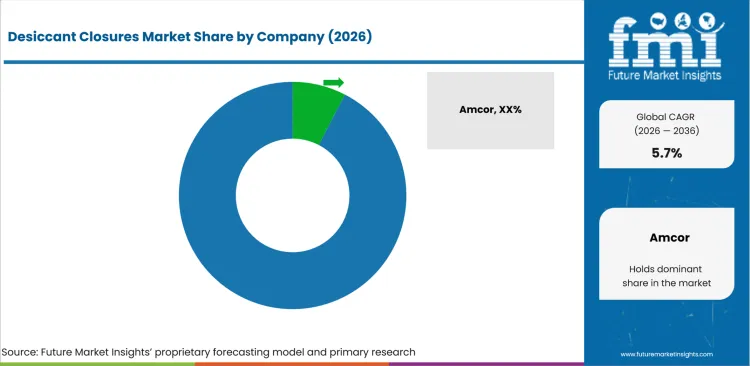
Direct desiccant specialists compete beside larger pharmaceutical packaging groups controlling adjacent container and closure interfaces. Entry barriers come from validated material performance and line support during commercial qualification instead of corporate scale alone.
- Sanner, Colorcon, Aptar CSP Technologies and Xinfuda Medical Packaging provide the closest documented routes to active moisture protection for solid-dose packs.
- ALPLApharma and Gerresheimer cover broader pharmaceutical container-and-closure programs where bottle fit and package qualification shape purchasing.
- West Pharmaceutical Services and Amcor operate at adjacent regulated closure interfaces with validated containment or high-volume healthcare packaging.
Competitive Benchmarking: Desiccant Closures Market
| Company | Active moisture-control depth | Safety and compliance depth | Container-closure integration | Geographic reach |
|---|---|---|---|---|
| Sanner | High | High | High | Europe and North America |
| Colorcon | High | High | High | Global |
| Aptar CSP Technologies | High | Medium | High | Global |
| Xinfuda Medical Packaging | High | Medium | Medium | Asia and export markets |
| ALPLApharma | Low | Medium | High | Europe and international |
| Gerresheimer | Low | Medium | High | Europe, Americas and Asia |
| West Pharmaceutical Services | Low | High | High | Global |
| Amcor | Low | Medium | High | Global |
Scoring basis: High moisture-control depth requires a current integrated desiccant or active-protection route and Medium identifies adjacent active-packaging integration. Low identifies closure activity without a desiccant-led platform. High safety depth requires multiple verified qualification routes and Medium identifies one clear route. Low marks basic compliance. High integration spans container and closure interfaces and Medium identifies a narrower platform. Low marks limited integration evidence.
Key Developments in the Desiccant Closures Market
- In June 2025, Xinfuda Medical Packaging launched a GMP upgrade project for pharmaceutical packaging materials before tighter production requirements took effect.
- In January 2025, West Pharmaceutical Services introduced Daikyo PLASCAP RUV closures in a nested ready-to-use format for pharmaceutical fill-finish lines.
- In April 2025, Amcor completed its combination with Berry Global and broadened the group's healthcare containers-and-closures manufacturing base.
Key Players in the Desiccant Closures Market
Integrated desiccant and active-protection closures
- Sanner
- Colorcon
- Aptar CSP Technologies
- Xinfuda Medical Packaging
Pharmaceutical closure and container platforms
- ALPLApharma
- Gerresheimer
- West Pharmaceutical Services
- Amcor
Desiccant Closures Market - Report Scope
| Coverage field | Report scope |
|---|---|
| Market breakdown | By product type, material, compliance feature, end use, sales channel and region. |
| Quantitative Units | USD Million. |
| Market Definition | Revenue includes standalone or integrated desiccant closures sold as primary-packaging closure assemblies. The scope includes the closure body and integrated moisture-scavenging element when sold as one system. It excludes loose desiccant sachets or canisters, container bodies sold without the closure, blisters, secondary cartons and cold-chain shippers. |
| Regions Covered | North America; Latin America; Western Europe; Eastern Europe; East Asia; South Asia and Pacific; Middle East and Africa. |
| Countries Covered | USA, Germany, France, UK, Japan, South Korea, Saudi Arabia, UAE and more than twenty-five additional countries in the full report. |
| Key Companies Profiled | Sanner, Colorcon, Aptar CSP Technologies, Xinfuda Medical Packaging, ALPLApharma, Gerresheimer, West Pharmaceutical Services, and Amcor. |
| Forecast Period | 2026 to 2036. |
| Approach | Hybrid bottom-up and top-down sizing that reconciles closure value signals with application conditions and country-level packaging requirements. |
Desiccant Closures Market - Research Methodology
| Method | Approach |
|---|---|
| Primary Research | FMI analysts gathered input from manufacturers, service providers, technology developers, distributors, end users, procurement teams, and subject-matter experts. Interviews examined purchasing decisions, product or service evaluation, adoption barriers, approval requirements, pricing considerations, and expectations for technical or commercial support. Respondents were also asked what evidence is required before a trial, pilot, or initial order develops into regular purchasing. |
| Desk Research | Desk research covered government statistics, regulatory publications, trade data, industry associations, technical literature, standards, company filings, product information, and official corporate announcements. Sources were reviewed for relevance, publication date, geographic coverage, and consistency with the defined market scope. Claims relating to performance, applications, approvals, capacity, investment, and commercial activity were retained only when supported by credible public evidence. |
| Market Sizing and Forecasting | The market model combined the baseline value with historical performance, segment structure, pricing and volume indicators, adoption levels, company participation, and country-level demand conditions. Forecast assumptions considered economic activity, investment trends, regulatory developments, technology adoption, purchasing cycles, supply availability, and barriers to wider market use. Segment and regional estimates were reconciled before the final market total was calculated. |
| Data Validation | Estimates were checked against multiple independent indicators, including public data, company activity, trade patterns, industry developments, and findings from primary interviews. Validation also tested whether products, services, applications, and company revenues fell within the defined market boundaries. Adjacent categories, unsupported claims, overlapping revenues, and activities without direct market relevance were excluded to reduce double counting and maintain consistency across segments and countries. |
Desiccant Closures Market by Segments
Desiccant Closures Market segmented by Product Type:
- Screw closures
- Dispensing closures
- Child-resistant closures
- Tamper-evident closures
Desiccant Closures Market segmented by Material:
- Polymer systems
- Glass
- Aluminium & foil
- Fiber-based
Desiccant Closures Market segmented by Compliance Feature:
- Child-resistant
- Tamper-evident
- Serialization-ready
- Cold chain assured
Desiccant Closures Market segmented by End Use:
- Retail pharmacy
- Hospital & clinical
- Clinical trials
- OTC & D2C health
Desiccant Closures Market segmented by Sales Channel:
- Direct pharma contracts
- Specialty distributors
- Online B2B
Desiccant Closures Market by Region:
- North America
- USA
- Canada
- Latin America
- Brazil
- Mexico
- Argentina
- Chile
- Western Europe
- Germany
- France
- UK
- Italy
- Spain
- Benelux
- Nordics
- Eastern Europe
- Poland
- Czech Republic
- Romania
- Hungary
- East Asia
- China
- Japan
- South Korea
- South Asia and Pacific
- India
- ASEAN
- Australia and New Zealand
- Middle East and Africa
- GCC Countries
- South Africa
- Türkiye
- Israel
Research Sources and Bibliography
- USA Food and Drug Administration (2026, August 14). Container Closure Systems for Human Drugs and Biological Products.
- Emirates Drug Establishment (2026, August 30). Registered medical product directory - Drug Directory.
- Colorcon (2026, April 13). Colorcon Launches Exclusive All-in-One Closure System for Pharmaceutical and Nutraceutical Applications.
- AptarGroup, Inc. (2026, June 10). Aptar Active Material Science Secures USPTO Allowance for N-Sorb Technology, Establishing First-of-Its-Kind Packaging-Delivered Approach to Nitrosamine Risk Mitigation.
- Sanner (2025, May 5). Sanner launches optimized TabTec CR patient-friendly packaging.
- European Medicines Agency (2025, December 12). Stability testing for applications for variations to marketing authorisation - Scientific guideline.
- Sanner (2025, June 18). Sanner starts manufacturing in Greensboro, USA.
- ABDA - Federal Union of German Associations of Pharmacists (2026, January 13). 2025: Apothekenzahl sinkt auf 16.601 Betriebsstätten.
- USA Food and Drug Administration (2026). 2025 First Generic Drug Approvals.
- NHS Business Services Authority (2026, June 4). Prescription Cost Analysis - England 2025/26.
- Conseil national de l’Ordre des pharmaciens (2025, March 20). DP-Ruptures : l’outil de l’Ordre consacré par la loi.
- Ministry of Health, Labour and Welfare, Japan (2026, August 7). Results of the FY2025 survey on the pharmaceutical sales system.
- Ministry of Food and Drug Safety, Republic of Korea (2025, December 16). 2026 Work Report.
- Saudi Food and Drug Authority (2026, January 26). SFDA Reports 18% Growth in Licensed Factories and Warehouses During 2025.
- Shijiazhuang Xinfuda Medical Packaging Co., Ltd. (2025, November 18). Why the Integrated Desiccant Cap is Revolutionizing Pharmaceutical Packaging.
- Shijiazhuang Xinfuda Medical Packaging Co., Ltd. (2025, June 9). Welcome to GMP for pharmaceutical packaging materials.
- ALPLA Group (2025, June 24). ALPLA acquires closure specialist KM Packaging.
- Gerresheimer AG (2025, January 20). Two Stories - One Future: Gerresheimer and Bormioli Pharma at Pharmapack 2025.
- West Pharmaceutical Services, Inc. (2025, January 22). West Introduces Daikyo PLASCAP RUV Closures in New Nested Format at Pharmapack.
- Amcor plc (2025, April 30). Amcor completes combination with Berry Global; Positioned to significantly enhance value for customers and shareholders.
- SCHOTT Pharma (2025, May 14). SCHOTT Pharma expands ready-to-use portfolio with sterile 1.5 ml cartridge.
- AptarGroup, Inc. (2025, July 15). Aptar Pharma Bolsters Clinical Trial Capabilities with Strategic Materials Manufacturing Acquisition.
- Colorcon (2025, July 24). Colorcon Celebrates Grand Opening of New Manufacturing Facility in Malaysia.
- USA Food and Drug Administration (2026, January). Advancing Health Through Innovation: New Drug Therapy Approvals 2025. Advancing Health Through Innovation: New Drug Therapy Approvals 2025
- Sanner (2026, July 22). Sanner establishes presence in Belfast.
- West Pharmaceutical Services, Inc. (2026, March 31). West Expands Dublin Facility to Support High-Volume Injectable Therapies, Including Diabetes and Obesity.
- Amcor plc (2026, June 3). Amcor expands production capability in India to meet growing healthcare packaging demand.
- NHS Business Services Authority (2025, October 16). General Pharmaceutical Services in England 2015/16 - 2024/25.
- Gerresheimer AG (2026, March 17). Gerresheimer introduces Gx InMonit - patient support for autoinjector-based home therapies.
- Amcor plc (2026, March 16). Amcor Winterbourne achieves ISO 13485:2016 certification, strengthening its commitment to healthcare packaging.
- This bibliography is provided for reader reference and is not exhaustive. The full report contains the complete reference list and detailed citations.
This Report Answers
- What are 2026 and 2036 values?
- Why do moisture-sensitive medicines increase closure demand?
- Why do screw closures lead?
- Why do polymer systems lead?
- Why do child-resistant formats lead compliance feature?
- How do the eight country CAGRs compare?
- Which companies supply integrated desiccant closures?
- Why does package validation slow closure switching?
Frequently Asked Questions
How big is the Desiccant Closures Market in 2026?
The desiccant closures market is valued at USD 538.4 million in 2026 and is projected to reach USD 937.2 million by 2036. Moisture-sensitive oral medicines sustain demand because repeated bottle opening exposes the headspace to ambient humidity.
What is the CAGR of the Desiccant Closures Market from 2026 to 2036?
The desiccant closures market is projected to grow at a CAGR of 5.7% between 2026 and 2036. Integrated moisture control supports expansion because qualified closures protect sensitive products without disrupting existing bottle lines.
Which product type leads the Desiccant Closures Market?
The screw closures segment is expected to hold 32.0% of the desiccant closures market in 2026. Repeat opening and familiar bottle-neck interfaces support integrated moisture protection on standard pharmaceutical packaging lines.
Which material leads the Desiccant Closures Market?
The polymer systems segment is projected to hold 29.0% of the desiccant closures market in 2026. Molded structures protect active material and carry threads needed for repeatable opening and reclosure performance.
Which companies are active in the Desiccant Closures Market?
Key companies operating in the desiccant closures market include Sanner, Colorcon, Aptar CSP Technologies, Xinfuda Medical Packaging, ALPLApharma, Gerresheimer, West Pharmaceutical Services, and Amcor. These companies compete through moisture-control technology and regulated packaging support for qualified pharmaceutical container systems.
Preview the report firsthand - request a free sample
Get SampleGet the brochure for pricing and purchase details.
Get PDFTable of Content
- Key Takeaways
- Market Size and CAGR
- Top Growth Driver
- Fastest Growing Segment
- Leading Region
- Key Companies
- Emerging Opportunities
- Executive Summary
- Global Market Outlook
- Demand-side Trends
- Supply-side Trends
- Technology Roadmap Analysis
- Analysis and Recommendations
- Analyst Perspective (What is happening? Why now? What should investors know?)
- Key Questions Answered
- How large is the market?
- What is the CAGR?
- What are key trends?
- Which region dominates?
- Who are the leaders?
- Market Overview
- Market Coverage / Taxonomy
- Market Definition / Scope / Limitations
- Research Methodology
- Chapter Orientation
- Analytical Lens and Working Hypotheses
- Market Structure, Signals, and Trend Drivers
- Benchmarking and Cross-market Comparability
- Market Sizing, Forecasting, and Opportunity Mapping
- Research Design and Evidence Framework
- Desk Research Programme (Secondary Evidence)
- Expert Input and Fieldwork (Primary Evidence)
- Tooling, Models, and Reference Databases
- Data Engineering and Model Build
- Quality Assurance and Audit Trail
- Market Background
- Market Dynamics (Drivers, Restraints, Opportunity, Trends)
- Scenario Forecast (Optimistic, Likely, Conservative)
- Impact Analysis
- AI Impact
- Sustainability Impact
- Regulatory Impact
- Technology Impact
- Consumer / Buyer Analysis
- Purchase Drivers
- Adoption Barriers
- Buyer Journey
- Opportunity Map Analysis
- Product Life Cycle Analysis
- Supply Chain Analysis
- Investment Feasibility Matrix
- Value Chain Analysis
- PESTLE and Porter's Analysis
- Regulatory Landscape
- Regional Parent Market Outlook
- Production and Consumption Statistics
- Import and Export Statistics
- Global Market Analysis and Forecast, 2021 to 2036
- Historical Market Size Value (USD Million) Analysis, 2021 to 2025
- Current and Future Market Size Value (USD Million) Projections, 2026 to 2036
- Y-o-Y Growth Trend Analysis
- Absolute $ Opportunity Analysis
- Global Market Pricing Analysis, 2021 to 2036
- Global Market Analysis and Forecast, By Product Type, 2021 to 2036
- Introduction / Key Findings
- Historical Market Size Value (USD Million) Analysis By Product Type, 2021 to 2025
- Current and Future Market Size Value (USD Million) Analysis and Forecast By Product Type, 2026 to 2036
- Screw closures
- Dispensing closures
- Child-resistant closures
- Tamper-evident closures
- Screw closures
- Y-o-Y Growth Trend Analysis By Product Type, 2021 to 2025
- Absolute $ Opportunity Analysis By Product Type, 2026 to 2036
- Global Market Analysis and Forecast, By Material, 2021 to 2036
- Introduction / Key Findings
- Historical Market Size Value (USD Million) Analysis By Material, 2021 to 2025
- Current and Future Market Size Value (USD Million) Analysis and Forecast By Material, 2026 to 2036
- Polymer systems
- Glass
- Aluminium & foil
- Fiber-based
- Polymer systems
- Y-o-Y Growth Trend Analysis By Material, 2021 to 2025
- Absolute $ Opportunity Analysis By Material, 2026 to 2036
- Global Market Analysis and Forecast, By Compliance Feature, 2021 to 2036
- Introduction / Key Findings
- Historical Market Size Value (USD Million) Analysis By Compliance Feature, 2021 to 2025
- Current and Future Market Size Value (USD Million) Analysis and Forecast By Compliance Feature, 2026 to 2036
- Child-resistant
- Tamper-evident
- Serialization-ready
- Cold chain assured
- Child-resistant
- Y-o-Y Growth Trend Analysis By Compliance Feature, 2021 to 2025
- Absolute $ Opportunity Analysis By Compliance Feature, 2026 to 2036
- Global Market Analysis and Forecast, By End Use, 2021 to 2036
- Introduction / Key Findings
- Historical Market Size Value (USD Million) Analysis By End Use, 2021 to 2025
- Current and Future Market Size Value (USD Million) Analysis and Forecast By End Use, 2026 to 2036
- Retail pharmacy
- Hospital & clinical
- Clinical trials
- OTC & D2C health
- Retail pharmacy
- Y-o-Y Growth Trend Analysis By End Use, 2021 to 2025
- Absolute $ Opportunity Analysis By End Use, 2026 to 2036
- Global Market Analysis and Forecast, By Sales Channel, 2021 to 2036
- Introduction / Key Findings
- Historical Market Size Value (USD Million) Analysis By Sales Channel, 2021 to 2025
- Current and Future Market Size Value (USD Million) Analysis and Forecast By Sales Channel, 2026 to 2036
- Direct pharma contracts
- Specialty distributors
- Online B2B
- Direct pharma contracts
- Y-o-Y Growth Trend Analysis By Sales Channel, 2021 to 2025
- Absolute $ Opportunity Analysis By Sales Channel, 2026 to 2036
- Global Market Analysis and Forecast, By Region, 2021 to 2036
- Introduction
- Historical Market Size Value (USD Million) Analysis By Region, 2021 to 2025
- Current Market Size Value (USD Million) Analysis and Forecast By Region, 2026 to 2036
- North America
- Latin America
- Western Europe
- Eastern Europe
- East Asia
- South Asia and Pacific
- Middle East & Africa
- Market Attractiveness Analysis By Region
- North America Market Analysis and Forecast, By Country, 2021 to 2036
- Historical Market Size Value (USD Million) Trend Analysis By Market Taxonomy, 2021 to 2025
- Market Size Value (USD Million) Forecast By Market Taxonomy, 2026 to 2036
- By Country
- USA
- Canada
- By Product Type
- By Material
- By Compliance Feature
- By End Use
- By Sales Channel
- By Country
- Market Attractiveness Analysis
- By Country
- By Product Type
- By Material
- By Compliance Feature
- By End Use
- By Sales Channel
- Key Takeaways
- Latin America Market Analysis and Forecast, By Country
- Historical Market Size Value (USD Million) Trend Analysis By Market Taxonomy, 2021 to 2025
- Market Size Value (USD Million) Forecast By Market Taxonomy, 2026 to 2036
- By Country
- Brazil
- Mexico
- Chile
- Rest of Latin America
- By Product Type
- By Material
- By Compliance Feature
- By End Use
- By Sales Channel
- By Country
- Market Attractiveness Analysis
- By Country
- By Product Type
- By Material
- By Compliance Feature
- By End Use
- By Sales Channel
- Key Takeaways
- Western Europe Market Analysis and Forecast, By Country
- Historical Market Size Value (USD Million) Trend Analysis By Market Taxonomy, 2021 to 2025
- Market Size Value (USD Million) Forecast By Market Taxonomy, 2026 to 2036
- By Country
- Germany
- UK
- Italy
- Spain
- France
- Nordic
- BENELUX
- Rest of Western Europe
- By Product Type
- By Material
- By Compliance Feature
- By End Use
- By Sales Channel
- By Country
- Market Attractiveness Analysis
- By Country
- By Product Type
- By Material
- By Compliance Feature
- By End Use
- By Sales Channel
- Key Takeaways
- Eastern Europe Market Analysis and Forecast, By Country
- Historical Market Size Value (USD Million) Trend Analysis By Market Taxonomy, 2021 to 2025
- Market Size Value (USD Million) Forecast By Market Taxonomy, 2026 to 2036
- By Country
- Russia
- Poland
- Hungary
- Balkan & Baltic
- Rest of Eastern Europe
- By Product Type
- By Material
- By Compliance Feature
- By End Use
- By Sales Channel
- By Country
- Market Attractiveness Analysis
- By Country
- By Product Type
- By Material
- By Compliance Feature
- By End Use
- By Sales Channel
- Key Takeaways
- East Asia Market Analysis and Forecast, By Country
- Historical Market Size Value (USD Million) Trend Analysis By Market Taxonomy, 2021 to 2025
- Market Size Value (USD Million) Forecast By Market Taxonomy, 2026 to 2036
- By Country
- China
- Japan
- South Korea
- By Product Type
- By Material
- By Compliance Feature
- By End Use
- By Sales Channel
- By Country
- Market Attractiveness Analysis
- By Country
- By Product Type
- By Material
- By Compliance Feature
- By End Use
- By Sales Channel
- Key Takeaways
- South Asia and Pacific Market Analysis and Forecast, By Country
- Historical Market Size Value (USD Million) Trend Analysis By Market Taxonomy, 2021 to 2025
- Market Size Value (USD Million) Forecast By Market Taxonomy, 2026 to 2036
- By Country
- India
- ASEAN
- Australia & New Zealand
- Rest of South Asia and Pacific
- By Product Type
- By Material
- By Compliance Feature
- By End Use
- By Sales Channel
- By Country
- Market Attractiveness Analysis
- By Country
- By Product Type
- By Material
- By Compliance Feature
- By End Use
- By Sales Channel
- Key Takeaways
- Middle East & Africa Market Analysis and Forecast, By Country
- Historical Market Size Value (USD Million) Trend Analysis By Market Taxonomy, 2021 to 2025
- Market Size Value (USD Million) Forecast By Market Taxonomy, 2026 to 2036
- By Country
- Kingdom of Saudi Arabia
- Other GCC Countries
- Türkiye
- South Africa
- Other African Union
- Rest of Middle East & Africa
- By Product Type
- By Material
- By Compliance Feature
- By End Use
- By Sales Channel
- By Country
- Market Attractiveness Analysis
- By Country
- By Product Type
- By Material
- By Compliance Feature
- By End Use
- By Sales Channel
- Key Takeaways
- Key Countries Market Analysis
- USA
- Pricing Analysis
- Market Share Analysis, 2025
- By Product Type
- By Material
- By Compliance Feature
- By End Use
- By Sales Channel
- Canada
- Pricing Analysis
- Market Share Analysis, 2025
- By Product Type
- By Material
- By Compliance Feature
- By End Use
- By Sales Channel
- Mexico
- Pricing Analysis
- Market Share Analysis, 2025
- By Product Type
- By Material
- By Compliance Feature
- By End Use
- By Sales Channel
- Brazil
- Pricing Analysis
- Market Share Analysis, 2025
- By Product Type
- By Material
- By Compliance Feature
- By End Use
- By Sales Channel
- Chile
- Pricing Analysis
- Market Share Analysis, 2025
- By Product Type
- By Material
- By Compliance Feature
- By End Use
- By Sales Channel
- Germany
- Pricing Analysis
- Market Share Analysis, 2025
- By Product Type
- By Material
- By Compliance Feature
- By End Use
- By Sales Channel
- UK
- Pricing Analysis
- Market Share Analysis, 2025
- By Product Type
- By Material
- By Compliance Feature
- By End Use
- By Sales Channel
- Italy
- Pricing Analysis
- Market Share Analysis, 2025
- By Product Type
- By Material
- By Compliance Feature
- By End Use
- By Sales Channel
- Spain
- Pricing Analysis
- Market Share Analysis, 2025
- By Product Type
- By Material
- By Compliance Feature
- By End Use
- By Sales Channel
- France
- Pricing Analysis
- Market Share Analysis, 2025
- By Product Type
- By Material
- By Compliance Feature
- By End Use
- By Sales Channel
- India
- Pricing Analysis
- Market Share Analysis, 2025
- By Product Type
- By Material
- By Compliance Feature
- By End Use
- By Sales Channel
- ASEAN
- Pricing Analysis
- Market Share Analysis, 2025
- By Product Type
- By Material
- By Compliance Feature
- By End Use
- By Sales Channel
- Australia & New Zealand
- Pricing Analysis
- Market Share Analysis, 2025
- By Product Type
- By Material
- By Compliance Feature
- By End Use
- By Sales Channel
- China
- Pricing Analysis
- Market Share Analysis, 2025
- By Product Type
- By Material
- By Compliance Feature
- By End Use
- By Sales Channel
- Japan
- Pricing Analysis
- Market Share Analysis, 2025
- By Product Type
- By Material
- By Compliance Feature
- By End Use
- By Sales Channel
- South Korea
- Pricing Analysis
- Market Share Analysis, 2025
- By Product Type
- By Material
- By Compliance Feature
- By End Use
- By Sales Channel
- Russia
- Pricing Analysis
- Market Share Analysis, 2025
- By Product Type
- By Material
- By Compliance Feature
- By End Use
- By Sales Channel
- Poland
- Pricing Analysis
- Market Share Analysis, 2025
- By Product Type
- By Material
- By Compliance Feature
- By End Use
- By Sales Channel
- Hungary
- Pricing Analysis
- Market Share Analysis, 2025
- By Product Type
- By Material
- By Compliance Feature
- By End Use
- By Sales Channel
- Kingdom of Saudi Arabia
- Pricing Analysis
- Market Share Analysis, 2025
- By Product Type
- By Material
- By Compliance Feature
- By End Use
- By Sales Channel
- Türkiye
- Pricing Analysis
- Market Share Analysis, 2025
- By Product Type
- By Material
- By Compliance Feature
- By End Use
- By Sales Channel
- South Africa
- Pricing Analysis
- Market Share Analysis, 2025
- By Product Type
- By Material
- By Compliance Feature
- By End Use
- By Sales Channel
- USA
- Market Structure Analysis
- Competition Dashboard
- Competition Benchmarking
- Market Share Analysis of Top Players
- By Regional
- By Product Type
- By Material
- By Compliance Feature
- By End Use
- By Sales Channel
- Emerging Startups
- Innovation Benchmarking
- Competition Analysis
- Competition Deep Dive
- Amcor
- Overview
- Product Portfolio
- Profitability by Market Segments
- Sales Footprint
- Strategy Overview
- Marketing Strategy
- Product Strategy
- Channel Strategy
- Berry Global
- Sonoco ThermoSafe
- Schott
- Aptar Pharma
- Nelipak
- Gerresheimer
- va-Q-tec
- SGD Pharma
- West Pharmaceutical
- Amcor
- Case Studies
- Success Stories
- Recent Developments
- Competition Deep Dive
- Assumptions & Acronyms Used


