

- Market Size (2026)
- USD 197.8 Mn
- Forecast (2036)
- USD 508.4 Mn
- CAGR (2026 to 2036)
- 9.9%
How big is Dialysis-Friendly Snack Market in 2026?
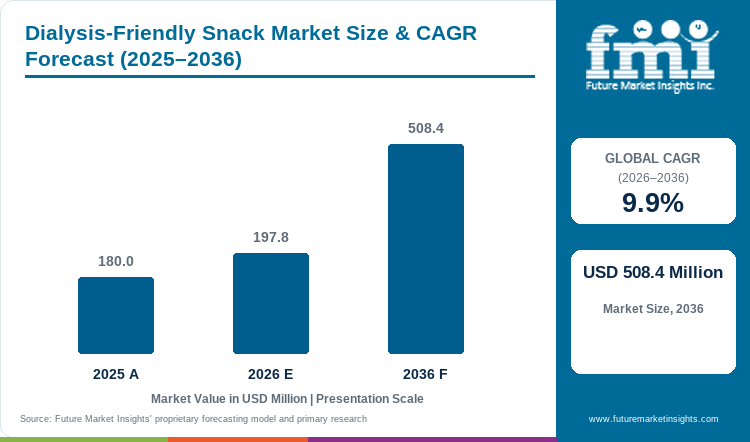
USD 197.8 million in 2026 and USD 508.4 million by 2036, expanding at 9.9% CAGR.
Demand for dialysis-friendly snacks is projected to expand at 9.9% CAGR between 2026 and 2036, growing from USD 180.0 million in 2025 to USD 197.8 million in 2026, and escalating to USD 508.4 million by 2036. Dialysis care directly links higher protein needs with individualized mineral control. A 2025 multicenter cohort reported protein-energy wasting in 16.8% of 1,206 chronic hemodialysis patients, and affected patients had 1.8 times the hospitalization rate of those without it. This clinical burden strengthens the case for compact, protein-rich snacks that kidney care teams can match to each patient’s potassium, phosphorus, sodium and fluid limits. Food-like oral clinical nutrition can provide targeted support without requiring a full meal.
The USA is projected at 9.3% CAGR through 2036. Japan is projected at 7.8%. Japan's dialysis registry counted 337,414 patients at the end of 2024. It also reported fewer patients than the year before and a mean age of 70.27 years. The mature base favors repeat use and small portions. US brands face a different route because center rules and bundled payment shape care.
Key Takeaways
- Dialysis can raise protein needs while care plans still limit minerals and fluid. Small snacks can meet both needs in one serving.
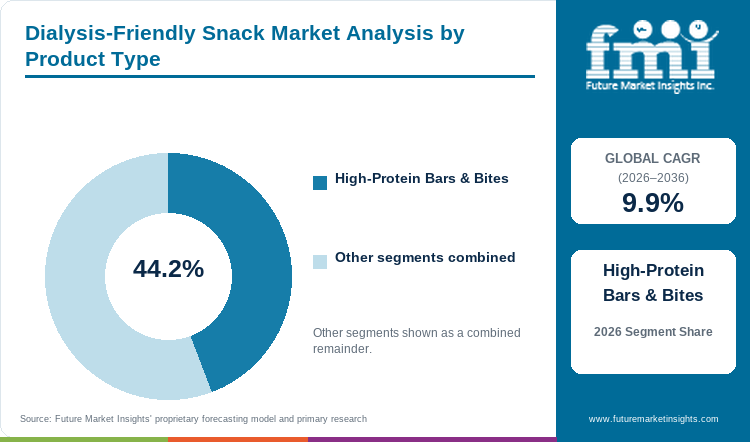
- High-protein bars and bites are expected to represent 44.2% of product type demand in 2026, supported by easy portion control.
- High-protein products are likely to capture 54.7% of protein-level demand in 2026, driven by more protein in a small serving.
- Intra-dialysis use is set to lead the consumption occasion category with 45.4% share in 2026, reinforced by a set treatment-time eating window.
- Patient potassium and phosphorus limits can change with lab results. This makes one standard kidney snack hard to use for every patient.
- Some of the key players in this market include Medtrition, Abbott, Fresenius Kabi, Global Health Products, Danone Nutricia, and Dr. Schär (Flavis).
Analyst Perspective
“Dialysis-friendly snacks gain repeat use when kidney care teams can match protein with each patient's mineral limits. Common food formats and clear label details can make care-team review and repeat orders easier.”
- Nandini Roy Choudhury, Principal Consultant, Future Market Insights
How is the dialysis-friendly snack market segmented?
The dialysis-friendly snack market is segmented by Product Type, Protein Level, Consumption Occasion, End User, Sales Channel, and Region.
The market uses five main segments plus region. Product type covers bars and bites, low-K low-P crisps and crackers, renal protein gels and puddings, cookies and wafers, and other formats. Protein level covers high, moderate, and standard products. Consumption occasion covers intra-dialysis, between-meal, and meal-companion use. End user covers dialysis centers, home or self-care, long-term care, and others. Sales channel covers hospital pharmacy, retail pharmacy, online, institutional tender, and others.
How do high-protein bars and bites shape demand within the product type category?
Bars and bite-sized foods give patients a fixed portion without adding a large drink. The solid form lets makers change flavor and texture for repeat use. The format uses the portion control found in nutritional bars, while kidney care teams apply tighter mineral and fluid limits.
- By product type, high-protein bars and bites are estimated to hold 44.2% in 2026, supported by simple portion control.
- Kidney care teams can use a packaged solid during treatment or at home. Patients do not need to mix a powder or drink an extra beverage.
What supports high-protein products within the protein level category?
Dialysis changes earlier low-protein plans because treatment can raise protein needs. A serving with at least 10 g of protein can help without creating an extra large meal. Kidney care teams use protein supplements for concentrated protein, while these snacks keep a food-like format.
- Within protein level, high-protein products are anticipated to take 54.7% share in 2026, attributable to more protein in smaller portions.
- The National Kidney Foundation says dialysis patients usually need more protein. Food choices still need to match each patient's lab results.
What role does intra-dialysis use play within the consumption occasion category?
Dialysis sessions give staff a set time to offer food and watch how patients respond. This differs from an unsupervised snack because intake can follow the dialysis plan. Care teams may use medical food products under staff care. Dialysis snacks still need to be easy to eat during a long session.
- In 2026, intra-dialysis use is expected to lead consumption occasion with 45.4% share, reinforced by a set chairside eating window.
- South Korean guidance notes that food intake can fall on dialysis days. It allows calorie-supplement snacks when a patient is not eating enough.
How do dialysis centers evaluate snacks within the end user category?
Dialysis centers see patients often and have care staff plus lab results. Staff can check potassium or phosphorus limits before adding a snack to repeat care. The same care team may select clinical nutrition products. Product fit and steady supply both affect repeat use.
- By end user, dialysis centers are forecast to represent 45.9% in 2026, influenced by care-team review and repeat treatment visits.
- CMS keeps a US payment system for ESRD centers in 2026. Food choices therefore stay inside each center's care and buying routine.
What drives hospital pharmacy within the sales channel category?
Hospital pharmacy and care channels use controlled order systems. Staff can review food details before a product reaches patients. Hospital pharmacy is a common route for medical nutrition products. Repeat case orders and professional review matter more than impulse buying.
- Based on sales channel, hospital pharmacy is projected to account for 47.3% in 2026, shaped by care review and repeat center orders.
- In January 2026, Global Health Products said Gordon Food Service began stocking selected food-support products. This gave care sites a new order route.
What are the drivers, restraints and opportunities in the Dialysis-Friendly Snack Market?
Higher protein needs support demand, individualized mineral limits slow broad standardization, and food-like formats can widen repeat use in supervised and home settings.
- Driver: Dialysis can raise protein needs while patients may eat less on treatment days. Compact foods can help patients finish the food and protein they need.
- Restraint: Mineral and fluid limits differ by patient. Broad kidney claims are harder to use safely in routine dialysis care.
- Opportunity: Better-tasting snacks can carry a staff-led care plan into home use without adding a full extra meal.
Protein needs keep compact nutrition tied to dialysis care
Dialysis can remove protein while patients may eat less on treatment days. The National Kidney Foundation revised its kidney-friendly plate guidance in June 2026. It says people on dialysis usually need more protein. Kidney care teams still adjust food choices to lab results and how much patients can eat. Compact snacks give them a new way to add protein or calories. Care teams may use enteral nutrition for patients who cannot meet needs by mouth. Food-like snacks meet a new need because no feeding equipment is required. Repeat sales are more likely when serving size and label details match the care plan. Small portions can also help on days when appetite is low.
Individual mineral limits make one-formula positioning difficult
Potassium and phosphorus limits can change with lab results and kidney function. Sodium and fluid limits add one more check for snacks used during dialysis. National Kidney Foundation guidance revised in August 2024 puts these limits inside each patient's meal plan. A high-protein snack can still be wrong for a patient with other mineral limits. General protein snacks cannot claim a kidney-care role based on protein alone. Brands need clear label data for each serving. Care sites also need care-team review before a product becomes routine stock. That review slows first use but can support steady repeat orders. Clear review steps can then support repeat orders across the same care site.
Food-like formats can reduce taste fatigue without losing clinical control
Taste and texture matter during long dialysis sessions and repeat use. Some patients may reject one more liquid drink but accept a small solid or gummy. The sales opening is not a general snacking claim. Brands still need clear mineral data and enough protein in each serving. Portable meal replacement bars show how food can carry concentrated support. Dialysis-friendly products face tighter rules because kidney teams also check potassium and phosphorus. Brands can support repeat use with clear care details and common food textures. This can extend use beyond the treatment chair without weakening the diet plan. Pack size must also work during treatment and in normal daily home routines.
Which country CAGRs are profiled in the Dialysis-Friendly Snack Market?
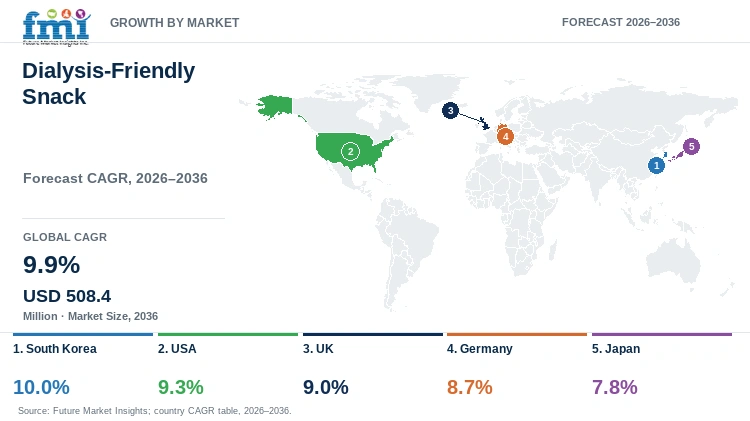
| Country | CAGR |
|---|---|
| South Korea | 10.0% |
| USA | 9.3% |
| UK | 9.0% |
| Germany | 8.7% |
| Japan | 7.8% |
How do country-level CAGRs compare in the Dialysis-Friendly Snack Market?
South Korea and the USA have the higher rates during the forecast. The UK and Germany are close behind. Japan grows more slowly but has a mature dialysis base. The 2.2-point spread shows a gap in growth speed. It does not show current country values.
- South Korea links dialysis diet guidance with calorie-supplement snacks for patients whose food intake falls during treatment days.
- US care plans span dialysis centers and home routines, so packages must work in both center care and self-care.
- UK kidney care teams use clear food details and patient education to choose a suitable snack.
- Germany's outpatient dialysis system uses many care groups, so brand reach and local account review affect broad access.
- Japan serves an older long-term dialysis population, so small portions and known taste matter for repeat use.
Similar CAGRs can still lead to other sales conditions because each country uses its own care and buying system. The full report provides country-level CAGR analysis across North America, Latin America, Western Europe, Eastern Europe, East Asia, South Asia and Pacific, and the Middle East and Africa.
Country-wise Analysis
- South Korean dialysis care uses country diet guidance that links protein intake with treatment. South Korea is projected to record 10.0% CAGR through 2036, supported by clear diet advice for dialysis patients. The Korea Disease Control and Prevention Agency revised its dialysis diet guidance in May 2026. It recommends about 1.2 g of protein per kg of average body weight for hemodialysis patients. The guidance also allows calorie-supplement snacks when food intake falls. Brands still need local flavors and clear mineral details. Diabetes and personal diet limits can change which snacks are suitable. Care teams also need practical pack sizes for repeat counseling.
- US dialysis centers work inside a US payment system and a fixed treatment schedule. The USA is estimated to post 9.3% CAGR over the forecast period, influenced by repeat care visits and formal center routines. CMS revised the ESRD payment system for services starting in January 2026. The rule covers dialysis services in both free-standing and hospital-based ESRD centers. Food-like snacks compete with liquid feeds and meal replacement products for limited treatment-day intake. Brands need steady case supply and clear food files before routine center use. Wide distributor reach can then support repeat orders. The fixed schedule also creates a clear use window.
- UK kidney care teams use country registry data to compare care by treatment type and center. The UK dialysis-friendly snack market is projected to record 9.0% CAGR during the assessment period, shaped by care-team review and patient education. The UK Kidney Association's 28th annual report uses country data through the end of 2024. It separates in-center hemodialysis from home hemodialysis and peritoneal dialysis. Brands therefore need products that work in more than one care setting. Clear labels and low-waste packs can support local product review. Buying rules can still differ between kidney units. Steady case sizes can make repeat ordering easier. Home care adds another use setting.
- German outpatient kidney care serves many patients through many care groups. Dialysis-friendly snack demand in Germany is forecast to rise at 8.7% CAGR through 2036, linked to repeated food needs during long-term care. Versorgungsatlas published a countrywide claims study in September 2024. It used data from all 17 regional physician groups and tracked dialysis use through 2022. Product review can still happen account by account. Products need German food labels and steady distributor supply. Reliable restocking matters once a kidney team accepts a product. Local product lists also depend on dependable regional supply. Each care group can set its own buying steps.
- Japanese dialysis care serves a large and older patient group under long-running center routines. Japan is estimated to post 7.8% CAGR over the forecast period, constrained by a mature patient base rather than weak food-support needs. The Japanese Society for Dialysis Therapy counted 337,414 dialysis patients at the end of 2024. The same registry gave a mean age of 70.27 years. It also counted fewer patients than the year before. Brands cannot depend on growth in patient numbers for sales. Small portions and easy-open packs matter for repeat use. Stable taste and clear mineral details can support long-term use.
Who are the notable companies in the Dialysis-Friendly Snack Market?
Medtrition, Abbott, Fresenius Kabi, Global Health Products, Danone Nutricia, and Dr. Schär (Flavis) are active in the defined dialysis-friendly snack market.
The field includes dialysis snack brands and kidney food groups. Global Health Products has direct snack proof. Abbott and Danone Nutricia sell kidney care products. Fresenius Kabi also sells kidney care products. Medtrition sells compact protein products. Dr. Schär serves kidney foods under Flavis. New entrants need clear records and steady supply.
- Direct dialysis snack and compact-protein routes: Global Health Products and Medtrition serve small-format protein needs.
- Kidney care product groups: Abbott and Fresenius Kabi provide broader kidney product ranges. Danone Nutricia does the same.
- Specialized kidney-food route: Dr. Schär (Flavis) supplies restricted-diet foods that influence expectations for kidney-friendly food formats.
Competitive Benchmarking: Dialysis-Friendly Snack Market
| Company | Dialysis-Specific Nutrient Fit | Food-Like or Snack Format | Institutional Channel Access | Geographic Reach |
|---|---|---|---|---|
| Medtrition | Medium | High | High | USA and international clinical channels |
| Abbott | High | Low | High | Global |
| Fresenius Kabi | High | Low | High | Global |
| Global Health Products | High | High | High | North America with institutional distribution |
| Danone Nutricia | High | Low | High | Global |
| Dr. Schär (Flavis) | Medium | High | Medium | Europe-centered international |
Scoring basis: High nutrient fit needs direct dialysis or kidney proof. Medium needs a close kidney-care match. Low covers broad food support. High food-like format needs a solid or gummy format. A cup also counts. Medium covers fewer food-like forms. Low covers liquids. High channel access needs broad care-site proof. Medium shows narrower access. Low means limited public proof.
Key Developments in the Dialysis-Friendly Snack Market
- In July 2026, Dr. Schär opened a pilot plant in Trieste. The firm named chronic kidney disease as one focus of its special-food research.
- In March 2026, Global Health Products introduced LiquaCel Protein Gummies. The firm described them as protein snack support for dialysis patients.
- In March 2026, Fresenius Kabi opened applications for its 2026/2027 JUMPstart Renal Nutrition Therapy program. The program supports research on food support for chronic kidney disease.
Key Players in the Dialysis-Friendly Snack Market
Direct dialysis snack and compact protein suppliers
- Global Health Products
- Medtrition
Renal and clinical nutrition platforms
- Abbott
- Fresenius Kabi
- Danone Nutricia
Specialized kidney-food supplier
- Dr. Schär (Flavis)
Dialysis-Friendly Snack Market - Report Scope
| Coverage field | Report scope |
|---|---|
| Market breakdown | By product type, protein level, consumption occasion, end user, sales channel, and region. |
| Quantitative Units | USD million. |
| Market Definition | Commercial food-like snacks and compact oral nutrition products formulated for dialysis-related protein and energy support are included when electrolyte and fluid limits remain integral to selection. General snacks without renal positioning and non-food supplements are excluded. |
| Regions Covered | North America, Latin America, Western Europe, Eastern Europe, East Asia, South Asia and Pacific, and Middle East and Africa. |
| Countries Covered | South Korea, USA, UK, Germany, Japan, and 20+ countries included in the full report. |
| Key Companies Profiled | Medtrition, Abbott, Fresenius Kabi, Global Health Products, Danone Nutricia, and Dr. Schär (Flavis). |
| Forecast Period | 2026 to 2036. |
| Approach | Primary and secondary research with market triangulation. |
Dialysis-Friendly Snack Market - Research Methodology
| Method | Approach |
|---|---|
| Primary Research | FMI analysts gathered input from manufacturers, service providers, technology developers, distributors, end users, procurement teams, and subject-matter experts. Interviews examined purchasing decisions, product or service evaluation, adoption barriers, approval requirements, pricing considerations, and expectations for technical or commercial support. Respondents were also asked what evidence is required before a trial, pilot, or initial order develops into regular purchasing. |
| Desk Research | Desk research covered government statistics, regulatory publications, trade data, industry associations, technical literature, standards, company filings, product information, and official corporate announcements. Sources were reviewed for relevance, publication date, geographic coverage, and consistency with the defined market scope. Claims relating to performance, applications, approvals, capacity, investment, and commercial activity were retained only when supported by credible public evidence. |
| Market Sizing and Forecasting | The market model combined the baseline value with historical performance, segment structure, pricing and volume indicators, adoption levels, company participation, and country-level demand conditions. Forecast assumptions considered economic activity, investment trends, regulatory developments, technology adoption, purchasing cycles, supply availability, and barriers to wider market use. Segment and regional estimates were reconciled before the final market total was calculated. |
| Data Validation | Estimates were checked against multiple independent indicators, including public data, company activity, trade patterns, industry developments, and findings from primary interviews. Validation also tested whether products, services, applications, and company revenues fell within the defined market boundaries. Adjacent categories, unsupported claims, overlapping revenues, and activities without direct market relevance were excluded to reduce double counting and maintain consistency across segments and countries. |
Dialysis-Friendly Snack Market by Segments
Dialysis-Friendly Snack Market segmented by Product Type:
- High-Protein Bars & Bites
- Low-K Low-P Crisps & Crackers
- Renal Protein Gels & Puddings
- Cookies & Wafers
- Others
Dialysis-Friendly Snack Market segmented by Protein Level:
- High-Protein (>=10 g)
- Moderate (5-10 g)
- Standard (<5 g)
Dialysis-Friendly Snack Market segmented by Consumption Occasion:
- Intra-Dialysis
- Between-Meal
- Meal Companion
Dialysis-Friendly Snack Market segmented by End User:
- Dialysis Centers
- Home - Self-Care
- Long-Term Care
- Others
Dialysis-Friendly Snack Market segmented by Sales Channel:
- Hospital Pharmacy
- Retail Pharmacy
- Online
- Institutional Tender
- Others
Dialysis-Friendly Snack Market by Region:
- North America
- United States
- Canada
- Latin America
- Brazil
- Mexico
- Chile
- Rest of Latin America
- Western Europe
- Germany
- United Kingdom
- Italy
- Spain
- France
- Nordics
- Benelux
- Rest of Western Europe
- Eastern Europe
- Russia
- Poland
- Hungary
- Balkan and Baltic States
- Rest of Eastern Europe
- East Asia
- China
- Japan
- South Korea
- South Asia and Pacific
- India
- ASEAN
- Australia and New Zealand
- Rest of South Asia and Pacific
- Middle East and Africa
- Kingdom of Saudi Arabia
- Other GCC Countries
- Türkiye
- South Africa
- Other African Union Countries
- Rest of Middle East and Africa
Research Sources and Bibliography
- National Institute of Diabetes and Digestive and Kidney Diseases. (n.d.). Eating & Nutrition for Hemodialysis.
- Japanese Society for Dialysis Therapy. (2025). 2024 Annual Dialysis Data Report, JSDT Renal Data Registry.
- National Kidney Foundation. (2026, June 5). Creating a Kidney Friendly Plate.
- National Kidney Foundation. (2024, August 28). Hemodialysis and Your Diet.
- Korea Disease Control and Prevention Agency. (2026, May 8). Dietary therapy for dialysis patients.
- Centers for Medicare & Medicaid Services. (2025, November 20). Calendar Year (CY) 2026 End-Stage Renal Disease (ESRD) Prospective Payment System Final Rule.
- Global Health Products. (2026, January 26). Gordon Food Service Now Stocking Select Products.
- UK Kidney Association. (n.d.). Annual Reports.
- Zentralinstitut für die kassenärztliche Versorgung in Deutschland. (2024, September 24). Trends der Prävalenz diagnostizierter chronischer Nierenkrankheiten und der Inanspruchnahme der Dialyse in der vertragsärztlichen Versorgung.
- Dr. Schär. (2026, July 22). In Trieste (Italy), a new plant to shape the future of nutrition.
- Global Health Products. (2026, March 27). Beyond the Dialysis Chair: Introducing LiquaCel Protein Gummies.
- Fresenius Kabi. (2026, March 16). Applications Open: JUMPstart Renal Nutrition Therapy 2026/2027.
- Abbott Laboratories. (2026, February 20). 2025 Annual Report.
- Instituto Nacional de Vigilancia de Medicamentos y Alimentos. (2026, August 26-27). Acta No. 10, Sala Especializada de Alimentos y Bebidas.
- Doria, C., Simon, C., Marin, M., Sanabria, M., Rivera, A., & Rutherford, P. (2025, February). WCN25-919 Protein-energy wasting in hemodialysis and its relationship with mortality and hospitalization: A cohort study. Kidney International Reports, 10(2 Suppl.), S379.
This bibliography is provided for reader reference and is not exhaustive. The full report contains the complete reference list and detailed citations.
This Report Answers
- How large is the dialysis-friendly snack market in 2026 and 2036?
- Which dialysis care needs support repeat use of small food-like products?
- Why do high-protein bars and bites hold 44.2% of product type sales in 2026?
- How does the high-protein tier affect serving size and product design?
- Why does intra-dialysis use hold 45.4% of consumption occasions in 2026?
- Why do growth rates differ in South Korea, the USA, the UK, Germany, and Japan?
- Which firms sell direct dialysis snacks or closely related kidney care products?
- How do patient mineral and fluid limits affect product review and routine use?
- Which sales channels matter for care-site orders and repeat patient use?
Frequently Asked Questions
How big is the dialysis-friendly snack market in 2026?
The dialysis-friendly snack market is valued at USD 197.8 million in 2026 and projected at USD 508.4 million by 2036. Small high-protein foods support demand during repeat dialysis care.
What is the CAGR of the dialysis-friendly snack market from 2026 to 2036?
The dialysis-friendly snack market is projected to grow at 9.9% CAGR between 2026 and 2036. Higher protein needs support growth while mineral and fluid limits shape product use.
Which product type leads the dialysis-friendly snack market in 2026?
High-protein bars and bites are projected to account for 44.2% of product type sales in the dialysis-friendly snack market in 2026. Small packs make serving and portion control easier.
Which consumption occasion leads the dialysis-friendly snack market in 2026?
Intra-dialysis use is expected to represent 45.4% of consumption occasion sales in the dialysis-friendly snack market in 2026. Scheduled treatment gives patients a clear time to eat.
Which additional end user segment leads the dialysis-friendly snack market in 2026?
Dialysis centers are forecast to represent 45.9% of end user sales in the dialysis-friendly snack market in 2026. Dietitian review supports safe product choice and repeat use.
Which countries are projected to record the highest growth in the dialysis-friendly snack market?
South Korea is projected at 10.0% CAGR through 2036. The USA follows at 9.3% and the UK at 9.0%. Each care system creates its own order route.
Which companies are active in the dialysis-friendly snack market?
Key companies include Medtrition, Abbott, Fresenius Kabi, Global Health Products, Danone Nutricia, and Dr. Schär (Flavis). They compete on kidney-care fit, food-like formats, clear product records, and care-site access.
Preview the report firsthand - request a free sample
Get SampleGet the brochure for pricing and purchase details.
Get PDFTable of Content
- Key Takeaways
- Market Size and CAGR
- Top Growth Driver
- Fastest Growing Segment
- Leading Region
- Key Companies
- Emerging Opportunities
- Executive Summary
- Global Market Outlook
- Demand-side Trends
- Supply-side Trends
- Technology Roadmap Analysis
- Analysis and Recommendations
- Analyst Perspective (What is happening? Why now? What should investors know?)
- Key Questions Answered
- How large is the market?
- What is the CAGR?
- What are key trends?
- Which region dominates?
- Who are the leaders?
- Market Overview
- Market Coverage / Taxonomy
- Market Definition / Scope / Limitations
- Research Methodology
- Chapter Orientation
- Analytical Lens and Working Hypotheses
- Market Structure, Signals, and Trend Drivers
- Benchmarking and Cross-market Comparability
- Market Sizing, Forecasting, and Opportunity Mapping
- Research Design and Evidence Framework
- Desk Research Programme (Secondary Evidence)
- Expert Input and Fieldwork (Primary Evidence)
- Tooling, Models, and Reference Databases
- Data Engineering and Model Build
- Quality Assurance and Audit Trail
- Market Background
- Market Dynamics (Drivers, Restraints, Opportunity, Trends)
- Scenario Forecast (Optimistic, Likely, Conservative)
- Impact Analysis
- AI Impact
- Sustainability Impact
- Regulatory Impact
- Technology Impact
- Consumer / Buyer Analysis
- Purchase Drivers
- Adoption Barriers
- Buyer Journey
- Opportunity Map Analysis
- Product Life Cycle Analysis
- Supply Chain Analysis
- Investment Feasibility Matrix
- Value Chain Analysis
- PESTLE and Porter's Analysis
- Regulatory Landscape
- Regional Parent Market Outlook
- Production and Consumption Statistics
- Import and Export Statistics
- Global Market Analysis and Forecast, 2021 to 2036
- Historical Market Size Value (USD Million) Analysis, 2021 to 2025
- Current and Future Market Size Value (USD Million) Projections, 2026 to 2036
- Y-o-Y Growth Trend Analysis
- Absolute $ Opportunity Analysis
- Global Market Pricing Analysis, 2021 to 2036
- Global Market Analysis and Forecast, By Product Type, 2021 to 2036
- Introduction / Key Findings
- Historical Market Size Value (USD Million) Analysis By Product Type, 2021 to 2025
- Current and Future Market Size Value (USD Million) Analysis and Forecast By Product Type, 2026 to 2036
- High-Protein Bars & Bites
- Low-K Low-P Crisps & Crackers
- Renal Protein Gels & Puddings
- Cookies & Wafers
- Others
- Y-o-Y Growth Trend Analysis By Product Type, 2021 to 2025
- Absolute $ Opportunity Analysis By Product Type, 2026 to 2036
- Global Market Analysis and Forecast, By Protein Level, 2021 to 2036
- Introduction / Key Findings
- Historical Market Size Value (USD Million) Analysis By Protein Level, 2021 to 2025
- Current and Future Market Size Value (USD Million) Analysis and Forecast By Protein Level, 2026 to 2036
- High-Protein (>=10 g)
- Moderate (5-10 g)
- Standard (<5 g)
- Y-o-Y Growth Trend Analysis By Protein Level, 2021 to 2025
- Absolute $ Opportunity Analysis By Protein Level, 2026 to 2036
- Global Market Analysis and Forecast, By Consumption Occasion, 2021 to 2036
- Introduction / Key Findings
- Historical Market Size Value (USD Million) Analysis By Consumption Occasion, 2021 to 2025
- Current and Future Market Size Value (USD Million) Analysis and Forecast By Consumption Occasion, 2026 to 2036
- Intra-Dialysis
- Between-Meal
- Meal Companion
- Y-o-Y Growth Trend Analysis By Consumption Occasion, 2021 to 2025
- Absolute $ Opportunity Analysis By Consumption Occasion, 2026 to 2036
- Global Market Analysis and Forecast, By End User, 2021 to 2036
- Introduction / Key Findings
- Historical Market Size Value (USD Million) Analysis By End User, 2021 to 2025
- Current and Future Market Size Value (USD Million) Analysis and Forecast By End User, 2026 to 2036
- Dialysis Centers
- Home - Self-Care
- Long-Term Care
- Others
- Y-o-Y Growth Trend Analysis By End User, 2021 to 2025
- Absolute $ Opportunity Analysis By End User, 2026 to 2036
- Global Market Analysis and Forecast, By Sales Channel, 2021 to 2036
- Introduction / Key Findings
- Historical Market Size Value (USD Million) Analysis By Sales Channel, 2021 to 2025
- Current and Future Market Size Value (USD Million) Analysis and Forecast By Sales Channel, 2026 to 2036
- Hospital Pharmacy
- Retail Pharmacy
- Online
- Institutional Tender
- Others
- Y-o-Y Growth Trend Analysis By Sales Channel, 2021 to 2025
- Absolute $ Opportunity Analysis By Sales Channel, 2026 to 2036
- Global Market Analysis and Forecast, By Region, 2021 to 2036
- Introduction
- Historical Market Size Value (USD Million) Analysis By Region, 2021 to 2025
- Current Market Size Value (USD Million) Analysis and Forecast By Region, 2026 to 2036
- North America
- Latin America
- Western Europe
- Eastern Europe
- East Asia
- South Asia and Pacific
- Middle East and Africa
- Market Attractiveness Analysis By Region
- North America Market Analysis and Forecast, By Country, 2021 to 2036
- Historical Market Size Value (USD Million) Trend Analysis By Market Taxonomy, 2021 to 2025
- Market Size Value (USD Million) Forecast By Market Taxonomy, 2026 to 2036
- By Country
- United States
- Canada
- By Product Type
- By Protein Level
- By Consumption Occasion
- By End User
- By Sales Channel
- By Country
- Market Attractiveness Analysis
- By Country
- By Product Type
- By Protein Level
- By Consumption Occasion
- By End User
- By Sales Channel
- Key Takeaways
- Latin America Market Analysis and Forecast, By Country
- Historical Market Size Value (USD Million) Trend Analysis By Market Taxonomy, 2021 to 2025
- Market Size Value (USD Million) Forecast By Market Taxonomy, 2026 to 2036
- By Country
- Brazil
- Mexico
- Chile
- Rest of Latin America
- By Product Type
- By Protein Level
- By Consumption Occasion
- By End User
- By Sales Channel
- By Country
- Market Attractiveness Analysis
- By Country
- By Product Type
- By Protein Level
- By Consumption Occasion
- By End User
- By Sales Channel
- Key Takeaways
- Western Europe Market Analysis and Forecast, By Country
- Historical Market Size Value (USD Million) Trend Analysis By Market Taxonomy, 2021 to 2025
- Market Size Value (USD Million) Forecast By Market Taxonomy, 2026 to 2036
- By Country
- Germany
- United Kingdom
- Italy
- Spain
- France
- Nordics
- Benelux
- Rest of Western Europe
- By Product Type
- By Protein Level
- By Consumption Occasion
- By End User
- By Sales Channel
- By Country
- Market Attractiveness Analysis
- By Country
- By Product Type
- By Protein Level
- By Consumption Occasion
- By End User
- By Sales Channel
- Key Takeaways
- Eastern Europe Market Analysis and Forecast, By Country
- Historical Market Size Value (USD Million) Trend Analysis By Market Taxonomy, 2021 to 2025
- Market Size Value (USD Million) Forecast By Market Taxonomy, 2026 to 2036
- By Country
- Russia
- Poland
- Hungary
- Balkan and Baltic States
- Rest of Eastern Europe
- By Product Type
- By Protein Level
- By Consumption Occasion
- By End User
- By Sales Channel
- By Country
- Market Attractiveness Analysis
- By Country
- By Product Type
- By Protein Level
- By Consumption Occasion
- By End User
- By Sales Channel
- Key Takeaways
- East Asia Market Analysis and Forecast, By Country
- Historical Market Size Value (USD Million) Trend Analysis By Market Taxonomy, 2021 to 2025
- Market Size Value (USD Million) Forecast By Market Taxonomy, 2026 to 2036
- By Country
- China
- Japan
- South Korea
- By Product Type
- By Protein Level
- By Consumption Occasion
- By End User
- By Sales Channel
- By Country
- Market Attractiveness Analysis
- By Country
- By Product Type
- By Protein Level
- By Consumption Occasion
- By End User
- By Sales Channel
- Key Takeaways
- South Asia and Pacific Market Analysis and Forecast, By Country
- Historical Market Size Value (USD Million) Trend Analysis By Market Taxonomy, 2021 to 2025
- Market Size Value (USD Million) Forecast By Market Taxonomy, 2026 to 2036
- By Country
- India
- ASEAN
- Australia and New Zealand
- Rest of South Asia and Pacific
- By Product Type
- By Protein Level
- By Consumption Occasion
- By End User
- By Sales Channel
- By Country
- Market Attractiveness Analysis
- By Country
- By Product Type
- By Protein Level
- By Consumption Occasion
- By End User
- By Sales Channel
- Key Takeaways
- Middle East and Africa Market Analysis and Forecast, By Country
- Historical Market Size Value (USD Million) Trend Analysis By Market Taxonomy, 2021 to 2025
- Market Size Value (USD Million) Forecast By Market Taxonomy, 2026 to 2036
- By Country
- Kingdom of Saudi Arabia
- Other GCC Countries
- Türkiye
- South Africa
- Other African Union Countries
- Rest of Middle East and Africa
- By Product Type
- By Protein Level
- By Consumption Occasion
- By End User
- By Sales Channel
- By Country
- Market Attractiveness Analysis
- By Country
- By Product Type
- By Protein Level
- By Consumption Occasion
- By End User
- By Sales Channel
- Key Takeaways
- Key Countries Market Analysis
- United States
- Pricing Analysis
- Market Share Analysis, 2025
- By Product Type
- By Protein Level
- By Consumption Occasion
- By End User
- By Sales Channel
- Canada
- Pricing Analysis
- Market Share Analysis, 2025
- By Product Type
- By Protein Level
- By Consumption Occasion
- By End User
- By Sales Channel
- Mexico
- Pricing Analysis
- Market Share Analysis, 2025
- By Product Type
- By Protein Level
- By Consumption Occasion
- By End User
- By Sales Channel
- Brazil
- Pricing Analysis
- Market Share Analysis, 2025
- By Product Type
- By Protein Level
- By Consumption Occasion
- By End User
- By Sales Channel
- Chile
- Pricing Analysis
- Market Share Analysis, 2025
- By Product Type
- By Protein Level
- By Consumption Occasion
- By End User
- By Sales Channel
- Germany
- Pricing Analysis
- Market Share Analysis, 2025
- By Product Type
- By Protein Level
- By Consumption Occasion
- By End User
- By Sales Channel
- United Kingdom
- Pricing Analysis
- Market Share Analysis, 2025
- By Product Type
- By Protein Level
- By Consumption Occasion
- By End User
- By Sales Channel
- Italy
- Pricing Analysis
- Market Share Analysis, 2025
- By Product Type
- By Protein Level
- By Consumption Occasion
- By End User
- By Sales Channel
- Spain
- Pricing Analysis
- Market Share Analysis, 2025
- By Product Type
- By Protein Level
- By Consumption Occasion
- By End User
- By Sales Channel
- France
- Pricing Analysis
- Market Share Analysis, 2025
- By Product Type
- By Protein Level
- By Consumption Occasion
- By End User
- By Sales Channel
- India
- Pricing Analysis
- Market Share Analysis, 2025
- By Product Type
- By Protein Level
- By Consumption Occasion
- By End User
- By Sales Channel
- ASEAN
- Pricing Analysis
- Market Share Analysis, 2025
- By Product Type
- By Protein Level
- By Consumption Occasion
- By End User
- By Sales Channel
- Australia and New Zealand
- Pricing Analysis
- Market Share Analysis, 2025
- By Product Type
- By Protein Level
- By Consumption Occasion
- By End User
- By Sales Channel
- China
- Pricing Analysis
- Market Share Analysis, 2025
- By Product Type
- By Protein Level
- By Consumption Occasion
- By End User
- By Sales Channel
- Japan
- Pricing Analysis
- Market Share Analysis, 2025
- By Product Type
- By Protein Level
- By Consumption Occasion
- By End User
- By Sales Channel
- South Korea
- Pricing Analysis
- Market Share Analysis, 2025
- By Product Type
- By Protein Level
- By Consumption Occasion
- By End User
- By Sales Channel
- Russia
- Pricing Analysis
- Market Share Analysis, 2025
- By Product Type
- By Protein Level
- By Consumption Occasion
- By End User
- By Sales Channel
- Poland
- Pricing Analysis
- Market Share Analysis, 2025
- By Product Type
- By Protein Level
- By Consumption Occasion
- By End User
- By Sales Channel
- Hungary
- Pricing Analysis
- Market Share Analysis, 2025
- By Product Type
- By Protein Level
- By Consumption Occasion
- By End User
- By Sales Channel
- Kingdom of Saudi Arabia
- Pricing Analysis
- Market Share Analysis, 2025
- By Product Type
- By Protein Level
- By Consumption Occasion
- By End User
- By Sales Channel
- Türkiye
- Pricing Analysis
- Market Share Analysis, 2025
- By Product Type
- By Protein Level
- By Consumption Occasion
- By End User
- By Sales Channel
- South Africa
- Pricing Analysis
- Market Share Analysis, 2025
- By Product Type
- By Protein Level
- By Consumption Occasion
- By End User
- By Sales Channel
- United States
- Market Structure Analysis
- Competition Dashboard
- Competition Benchmarking
- Market Share Analysis of Top Players
- By Regional
- By Product Type
- By Protein Level
- By Consumption Occasion
- By End User
- By Sales Channel
- Emerging Startups
- Innovation Benchmarking
- Competition Analysis
- Competition Deep Dive
- Medtrition
- Overview
- Product Portfolio
- Profitability by Market Segments
- Sales Footprint
- Strategy Overview
- Marketing Strategy
- Product Strategy
- Channel Strategy
- Abbott
- Fresenius Kabi
- Global Health Products
- Danone Nutricia
- Dr. Schär (Flavis)
- Medtrition
- Case Studies
- Success Stories
- Recent Developments
- Competition Deep Dive
- Assumptions & Acronyms Used


