

- Market Size (2026)
- USD 2860.7 Mn
- Forecast (2036)
- USD 6710.4 Mn
- CAGR (2026 to 2036)
- 8.9%
Die-Attach Adhesives Market Size, Market Forecast and Outlook By FMI
USD 2,860.7 million in 2026 and USD 6,710.4 million by 2036 at an 8.9% CAGR.
The die-attach adhesives market is predicted to grow from USD 2,626.9 million in 2025 to USD 6,710.4 million by 2036 at 8.9% CAGR. Conductive adhesives are expected to account for 39.0% share in 2026 because power packages need bonding materials that move heat and current. Direct to OSAT / IDM sales are projected to represent 68.0% share in 2026 as package qualification depends on supplier engineers and process documentation.
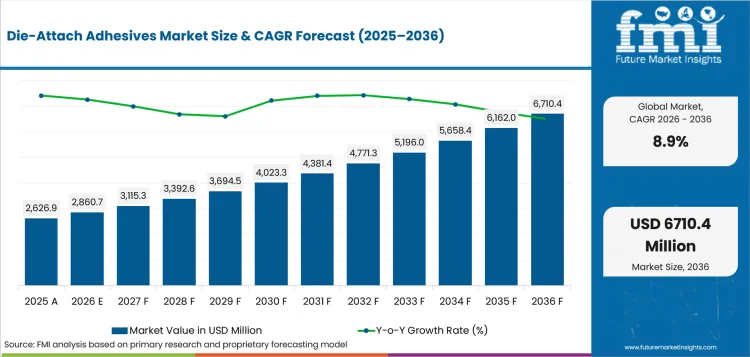
Die-Attach Adhesives Market Overview: Size and Forecast
- 2025 Market Size: USD 2,626.9 million
- 2026 Market Size: USD 2,860.7 million
- 2036 Market Size: USD 6,710.4 million
- Forecast CAGR: 8.9% from 2026 to 2036
- Leading Adhesive Type: Conductive Adhesives
- Conductive Adhesives Share in 2026: 39.0%
- Leading Chemistry: Epoxy-based
- Epoxy-based Share in 2026: 48.0%
- Leading Package Type: Leadframe Packages
- Leadframe Packages Share in 2026: 34.0%
- Leading End Use: Consumer Electronics
- Consumer Electronics Share in 2026: 36.0%
- Leading Sales Channel: Direct to OSAT / IDM
- Direct to OSAT / IDM Share in 2026: 68.0%
- Fastest-growing Country: India
- India CAGR: 9.7% by 2036
Summary of the Die-Attach Adhesives Market
- Demand and Growth Drivers
- Rising semiconductor production volumes across consumer electronics, automotive electronics, and industrial devices are directly driving higher demand for die attach adhesives in advanced packaging and assembly processes.
- Accelerated adoption of electric vehicles (EVs) and power electronics is increasing sales of high‑reliability die attach adhesives capable of withstanding high temperatures and thermal cycling.
- Growth in miniaturized and high‑performance chips (including 5G, AI, and IoT applications) is boosting industry adoption of advanced die attach materials with superior thermal and electrical conductivity.
- Expansion of semiconductor manufacturing capacity in Asia‑Pacific is translating into sustained commercial demand and volume sales for die attach adhesives from both IDMs and OSATs.
- Product and Segment View
- Conductive Adhesives are projected to lead adhesive type with 39.0% share as buyers need heat flow and electrical contact.
- Epoxy-based materials are expected to lead chemistry with 48.0% share because leadframe packages use stable curing profiles.
- Leadframe Packages are projected to lead package type with 34.0% share as discrete and analog devices keep high-volume demand.
- Consumer Electronics are expected to lead end use with 36.0% share due to volume support from phones and connected devices.
- Direct to OSAT / IDM is forecast to lead sales channel with 68.0% share through direct qualification and process support.
- Geography and Competitive Outlook
- India is projected to record the highest country CAGR at 9.7% through 2036 due to packaging investment and new ATMP projects.
- China is expected to expand at 9.4% CAGR through 2036 as local IC output supports packaging material demand.
- South Korea is forecast to grow at 9.2% CAGR through 2036 as memory and AI chip packaging drive material use.
- Henkel, MacDermid Alpha, NAMICS, Dow, Shin-Etsu Chemical, Resonac, H.B. Fuller, and Master Bond shape supplier choice.
- Competitive advantage is expected to rest on thermal conductivity proof, low-void processing, and application engineering near package lines.
- Analyst Opinion
- Nikhil Kaitwade, Associate Vice President at FMI says, “Die-attach adhesives are shifting from a costed consumable into a yield-sensitive process material. Power packages need heat to leave the die without bondline failure. Stacked package formats leave less room for process drift. Suppliers with thermal data, application engineers, and package-level failure knowledge should win stronger accounts.”
Semiconductor packaging suppliers are becoming stricter about thermal data and application support before a die-attach material enters production. The Semiconductor Industry Association reported global semiconductor sales of USD 791.7 billion in 2025 after a 25.6% annual increase. The U.S. Department of Commerce finalized USD 1.4 billion in advanced packaging awards in January 2025. These signals push adhesive suppliers to support package engineers with dispense control and thermal evidence before release.
Which factors support expansion in the die-attach adhesives market?
Thermal reliability, package qualification, and direct technical selling support market value across semiconductor assembly channels.
- Market value is supported by die bonding material revenue before distributor and prototype channels add incremental sales.
- Supplier pricing reflects conductive filler cost and thermal reliability testing before cure profile affects repeat buying.
- Revenue improves as power device makers shift from standard epoxy toward sintering pastes and conductive hybrids.
- Buyer trust rises as suppliers document bondline thickness, void behavior, and package-level failure results.
Why is the die-attach adhesives market growing?
Power device packaging is becoming a stronger buying center for die-attach adhesives as heat removal becomes part of package design.
Buyers reviewing semiconductor packaging materials compare adhesives by thermal flow and reliability proof. MacDermid Alpha described ATROX 800HT2VX in June 2024 as a PFAS-free hybrid silver sintered die attach paste for GaN and SiC semiconductor power devices. Advanced packaging is changing adhesive selection because thin die and stacked layouts reduce process tolerance. The USA CHIPS advanced packaging awards support the environment where semiconductor and IC packaging materials are qualified before volume manufacturing. Adhesive suppliers must prove dispense stability, film uniformity, and compatibility with bonding equipment.
Higher package heat also raises demand for high-temperature adhesives for SiC and GaN power module packaging and adjacent thermal interface material categories. Suppliers that can connect adhesive behavior with junction temperature and reliability evidence should gain priority in package trials.
How is the die-attach adhesives market segmented?
The die-attach adhesives industry is segmented by adhesive type, chemistry, package type, end use, and sales channel.
- Conductive Adhesives are projected to secure 39.0% share in 2026 as power packages need bonding and heat flow in the same material.
- Epoxy-based systems are expected to hold 48.0% share in 2026 because leadframe and discrete packages use established cure windows.
- Leadframe Packages are anticipated to represent 34.0% share in 2026 with continued demand from analog and discrete devices.
- Consumer Electronics are forecast to account for 36.0% share in 2026 due to high unit volumes and short device cycles.
- Direct to OSAT / IDM is expected to represent 68.0% share in 2026 as material approval needs direct engineering support.
Why do conductive adhesives lead the die-attach adhesives market?
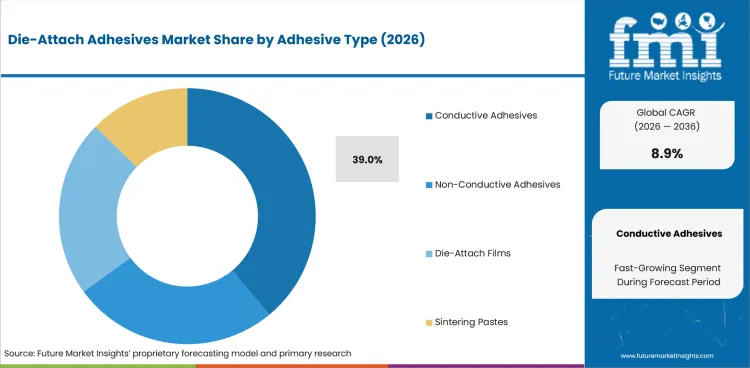
- Conductive Adhesives are projected to account for 39.0% share in 2026, influenced by power package need for electrical and thermal paths.
- Sintering pastes gain use when high junction temperatures make standard epoxy bonding less suitable for power modules.
Which chemistry leads the die-attach adhesives market?
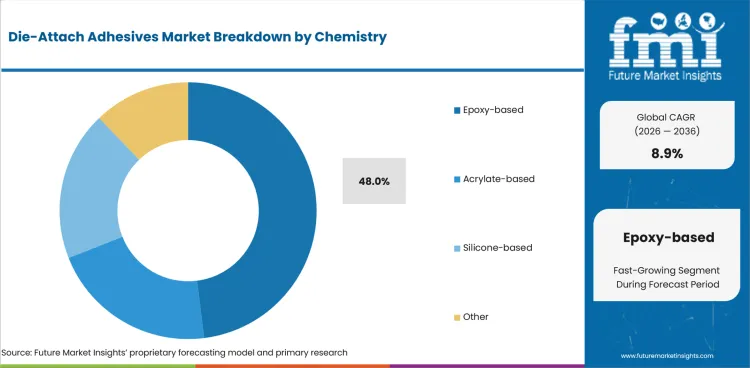
- Epoxy-based systems are anticipated to hold 48.0% share in 2026 through stable curing and broad leadframe process fit.
- Silicone-based systems gain value in stress-sensitive package designs where flexibility and thermal cycling behavior matter.
Which package type leads the die-attach adhesives market?
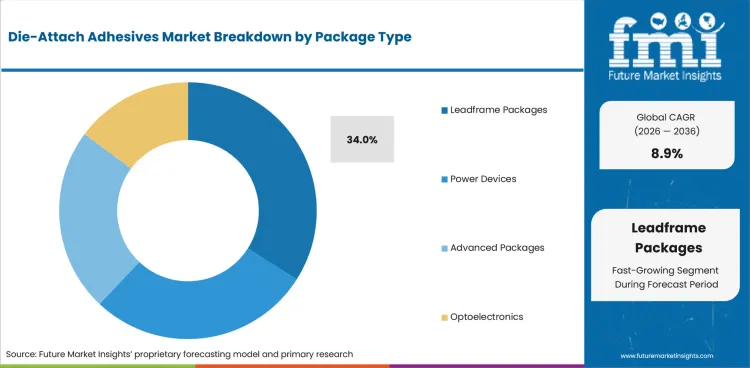
- Leadframe Packages are forecast to secure 34.0% share in 2026, reflected by analog, discrete, and exposed-pad device demand.
- Advanced Packages add value through thinner die handling and tighter tolerance requirements for film and low-void paste systems.
Which end use leads the die-attach adhesives market?
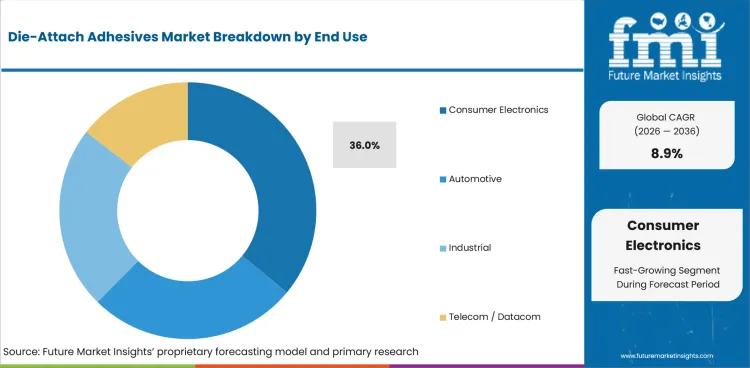
- Consumer Electronics are expected to represent 36.0% share in 2026 because smartphones and connected devices keep high package throughput.
- Automotive applications gain importance as inverters, sensors, and power control units require longer reliability profiles.
Which sales channel leads the die-attach adhesives market?
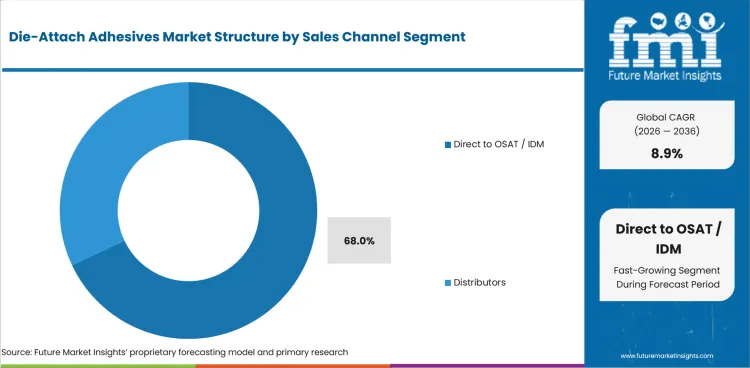
- Direct to OSAT / IDM is projected to account for 68.0% share in 2026, shaped by qualification cycles and process documentation.
- Distributors serve prototype work and smaller regional buyers before qualified materials shift into direct supply agreements.
What are the drivers, restraints, and opportunities in the die-attach adhesives market?
Power package heat, complex assembly formats, and qualification discipline support growth while chemical revalidation and cost pressure limit switching.
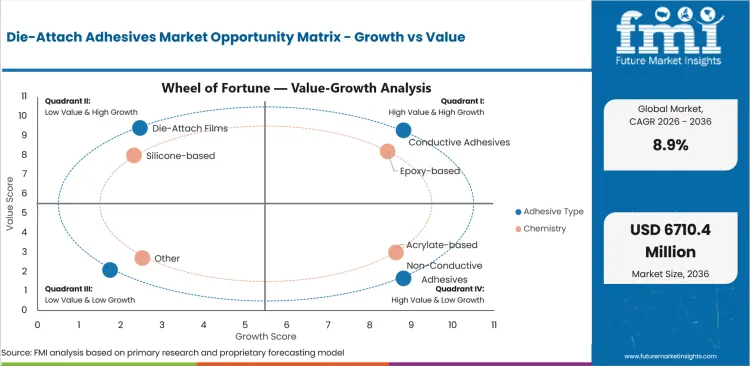
- Driver: Power die heat flow raises conductive paste demand as wide-bandgap devices need stable thermal contact under high operating temperatures.
- Driver: Stacked package assembly supports film demand because thin die handling needs clean placement and predictable bondline thickness.
- Restraint: PFAS reformulation creates near-term cost pressure as suppliers must revalidate chemistry without losing performance.
- Opportunity: India and South Korea create new openings as packaging investment and AI memory demand strengthen backend material pull.
Die-Attach Adhesives Market Demand Outlook
Power device packaging is likely to remain the main demand pull for die-attach adhesives because SiC and GaN packages need bonds that move heat out of smaller device footprints. In June 2024, MacDermid Alpha issued the ATROX 800HT2VX technical data sheet for a PFAS-free hybrid silver sintered die attach paste designed for GaN and SiC power devices. The same data sheet lists 175 W/mK bulk thermal conductivity and low resin bleed. This gives buyers a clear product reference for the shift from general epoxy die attach to higher-value sintered and conductive hybrid systems. In January 2025, the USA Department of Commerce finalized USD 1.4 billion in advanced packaging awards. These awards focused on scale validation and transition to USA manufacturing. Adhesive suppliers therefore need to compete on process windows and thermal proof rather than catalog breadth alone.
Qualified Buyer Route and Package-release Analysis
OSATs, IDMs, power module assemblers and electronics manufacturers form the core buyer base for die-attach adhesives. These buyers usually qualify materials directly because adhesive choice affects die shear, voiding, cure profile and package reliability. In February 2025, ASE launched its fifth plant in Penang to improve advanced packaging manufacturing capability for next-generation applications. That matters because higher packaging throughput increases the need for materials that can move from engineering lots into controlled production without changing dispense behavior. Distributors remain useful for prototypes and smaller regional programs. Once a package moves toward release, approved materials usually shift toward direct supply and tighter technical-service support.
Reliability Evidence and Process-fit Decision Analysis
Packaging engineers compare die-attach adhesives through thermal conductivity, resin bleed, void content, shelf life and compatibility with dispense or film placement equipment. The buying decision becomes stricter when the package serves automotive, industrial or power electronics use cases. MacDermid Alpha’s June 2024 ATROX 800HT2VX data sheet gives the type of evidence buyers check because it lists shelf life, pot life, cure profile, die shear strength and MSL1 reliability performance. These details matter because field-failure cost can exceed material savings in high-power packages. Suppliers that support process trials and failure analysis can defend premium pricing after the material passes reliability review.
Which countries are growing fastest in the die-attach adhesives market?
India 9.7% CAGR, China 9.4% CAGR, South Korea 9.2% CAGR, Japan 8.6% CAGR, United States 8.4% CAGR, Germany 8.1% CAGR, France 7.8% CAGR, and United Kingdom 7.6% CAGR through 2036.
.webp "Top Country Growth Comparison Die Attach Adhesives Market Cagr (2026 2036)")
| Country | CAGR |
|---|---|
| India | 9.7% |
| China | 9.4% |
| South Korea | 9.2% |
| Japan | 8.6% |
| United States | 8.4% |
| Germany | 8.1% |
| France | 7.8% |
| United Kingdom | 7.6% |
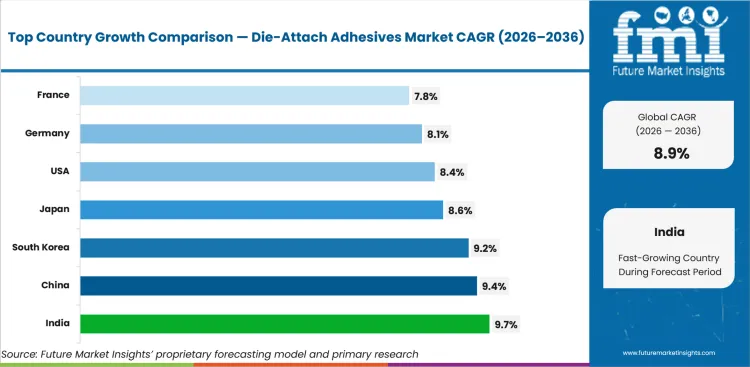
Source: Future Market Insights, 2026.
How do country-level CAGRs compare in the die-attach adhesives market?
India leads country growth while the United Kingdom records the most cautious expansion outlook among profiled markets.
- India is forecast to record 9.7% CAGR by 2036 as new ATMP and packaging projects widen supplier access.
- China is expected to expand at 9.4% CAGR from 2026 to 2036 because local IC output sustains large package material demand.
- South Korea is projected to grow at 9.2% CAGR through 2036 as AI memory packaging increases material performance needs.
- Japan is estimated to rise at 8.6% CAGR by 2036 with materials expertise and policy-backed chip projects supporting demand.
- The United States is expected to advance at 8.4% CAGR over the forecast period as packaging programs raise qualification activity.
- Germany is forecast to grow at 8.1% CAGR through 2036 as automotive power electronics support die-attach reliability demand.
- France is projected to post 7.8% CAGR by 2036 as wafer capacity and European programs sustain selected package flows.
- The United Kingdom is anticipated to register 7.6% CAGR through 2036 as compound semiconductor clusters support specialist demand.
How fast is the die-attach adhesives market growing in United States?
A 8.4% CAGR through 2036 reflects USA advanced packaging funding and direct OSAT qualification activity.
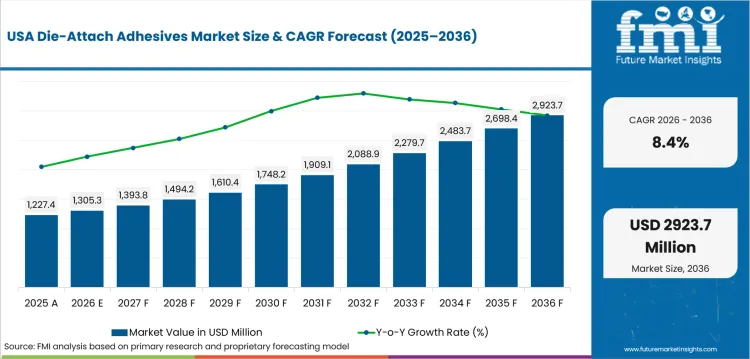
Country Market Snapshot Table
| Parameter | Value |
|---|---|
| Market Size in 2025 (Value) | USD 566.7 million |
| Market Size in 2026 (Value) | USD 614.3 million |
| Market Forecast in 2036 (Value) | USD 1,376.9 million |
| CAGR (2026 to 2036) | 8.4% |
| Years Considered | 2021 to 2036 |
| Base Year | 2025 |
| Forecast Period | 2026 to 2036 |
| Units Considered | Value (USD million) |
| Leading Sub-Region | Arizona, Texas, New York, and California package corridors |
United States Die-Attach Adhesives Market Outlook
United States die-attach adhesive demand is influenced by domestic advanced packaging programs and direct qualification with OSAT and IDM buyers. Material suppliers must prove thermal performance before package engineers move from trial lots into approved production.
Power device and AI package demand are expected to support conductive paste, sintering paste, and die-attach film requirements. Suppliers with local field engineers should gain stronger access to funded packaging pilots and high-reliability package programs.
Key Growth Drivers
- USA demand is supported by public packaging validation. The USA Department of Commerce finalized USD 1.4 billion in advanced packaging awards in January 2025.
- Advanced substrates remain a direct route for package materials. NIST said NAPMP finalized USD 300.0 million for advanced substrates and material research.
- Power modules and AI accelerator packages are expected to lift demand for low-void conductive pastes with stronger thermal evidence.
- Direct sales to OSATs and IDMs are expected to stay important as process engineers need adhesive support during die shear testing.
Key Restraints
- PFAS chemistry review can slow reformulation work. The USA EPA designated 2 PFAS as hazardous substances under CERCLA in April 2024.
- Long package qualification cycles can delay supplier switching because adhesive change affects yield and bondline reliability.
- Supply-chain security reviews can narrow vendor lists for defense and critical infrastructure packages using specialty die bonding materials.
What makes United States unique
The United States is distinct because public packaging programs and direct OSAT qualification concentrate adhesive approval near domestic package pilots.
Key Companies
- Henkel Corporation
- MacDermid Alpha Electronics Solutions
- Master Bond Inc.
- Dow Inc.
- H.B. Fuller
- AI Technology Inc.
- Indium Corporation
Sales & Marketing Channels
- Direct OSAT and IDM programs
- Application engineering centers
- Specialty electronics distributors
- Power module assemblers
- Government-backed packaging pilots
- Automotive electronics suppliers
Country Segment Breakdown Table
| Segment | Sub-Segments |
|---|---|
| By Adhesive Type | Conductive Adhesives · Non-Conductive Adhesives · Die-Attach Films · Sintering Pastes |
| By Chemistry | Epoxy-based · Acrylate-based · Silicone-based · Other |
| By Package Type | Leadframe Packages · Power Devices · Advanced Packages · Optoelectronics |
| By End Use | Consumer Electronics · Automotive · Industrial · Telecom / Datacom |
| By Sales Channel | Direct to OSAT / IDM · Distributors |
| Key Sub-Regions Covered, Semiconductor and electronics clusters | Arizona · Texas · New York · California · Oregon · Idaho |
Frequently Asked Questions
How fast is the die-attach adhesives market growing in United States?
United States is projected to grow at 8.4% CAGR from 2026 to 2036 as local semiconductor packaging demand broadens.
What makes United States important for die-attach adhesives suppliers?
The United States is distinct because public packaging programs and direct OSAT qualification concentrate adhesive approval near domestic package pilots.
Which channels matter most in United States?
Direct technical selling, qualified distributors, and package engineering programs matter most in United States.
How fast is the die-attach adhesives market growing in United Kingdom?
A 7.6% CAGR through 2036 reflects compound semiconductor clusters and power electronics pilot-line activity.
Country Market Snapshot Table
| Parameter | Value |
|---|---|
| Market Size in 2025 (Value) | USD 139.5 million |
| Market Size in 2026 (Value) | USD 150.1 million |
| Market Forecast in 2036 (Value) | USD 312.4 million |
| CAGR (2026 to 2036) | 7.6% |
| Years Considered | 2021 to 2036 |
| Base Year | 2025 |
| Forecast Period | 2026 to 2036 |
| Units Considered | Value (USD million) |
| Leading Sub-Region | South Wales, Cambridge, and compound semiconductor clusters |
United Kingdom Die-Attach Adhesives Market Outlook
United Kingdom demand is influenced by compound semiconductor clusters and power electronics pilot lines. The market remains smaller than mainland European peers, but technical selling is concentrated around specialist package and testing programs.
Suppliers are expected to compete through application support for SiC, GaN, and low-volume high-reliability assemblies. Distribution remains important when buyers need prototype quantities before direct qualification starts.
Key Growth Drivers
- United Kingdom demand is supported by compound semiconductor funding. GOV.UK announced GBP 16.6 million for chip testing and making equipment in March 2024.
- The buyer base is widening across domestic clusters. GOV.UK’s 2026 semiconductor study identified 705 UK semiconductor companies.
- Power electronics programs are expected to create demand for adhesives that handle thermal cycling in SiC and GaN package work.
- Local cluster selling is likely to help specialist formulators reach pilot lines before larger OSAT volumes are committed.
Key Restraints
- Scale-up capacity remains a constraint for local packaging materials. CSA Catapult said a GBP 9.0 million line was needed to bring advanced packaging capability to Scotland in March 2025.
- Fragmented pilot demand can keep adhesive orders below the scale needed for dedicated local inventory programs.
- Smaller domestic packaging capacity can push some buyers to qualify materials through overseas OSAT networks.
What makes United Kingdom unique
The United Kingdom is distinct because compound semiconductor clusters link power electronics, test capability, and materials qualification in a smaller supplier network.
Key Companies
- IQE plc
- Plessey Semiconductors
- Pragmatic Semiconductor
- Clas-SiC Wafer Fab
- CSA Catapult
- Marl International
- Gooch & Housego
Sales & Marketing Channels
- Compound semiconductor clusters
- Power electronics pilots
- University-linked packaging labs
- Specialty adhesive distributors
- Electronics manufacturing services
- Direct technical selling
Country Segment Breakdown Table
| Segment | Sub-Segments |
|---|---|
| By Adhesive Type | Conductive Adhesives · Non-Conductive Adhesives · Die-Attach Films · Sintering Pastes |
| By Chemistry | Epoxy-based · Acrylate-based · Silicone-based · Other |
| By Package Type | Leadframe Packages · Power Devices · Advanced Packages · Optoelectronics |
| By End Use | Consumer Electronics · Automotive · Industrial · Telecom / Datacom |
| By Sales Channel | Direct to OSAT / IDM · Distributors |
| Key Sub-Regions Covered, Semiconductor and electronics clusters | South Wales · Cambridge · Bristol · Scotland · Manchester · Oxford |
Frequently Asked Questions
How fast is the die-attach adhesives market growing in United Kingdom?
United Kingdom is projected to grow at 7.6% CAGR from 2026 to 2036 as local semiconductor packaging demand broadens.
What makes United Kingdom important for die-attach adhesives suppliers?
The United Kingdom is distinct because compound semiconductor clusters link power electronics, test capability, and materials qualification in a smaller supplier network.
Which channels matter most in United Kingdom?
Direct technical selling, qualified distributors, and package engineering programs matter most in United Kingdom.
How fast is the die-attach adhesives market growing in Germany?
A 8.1% CAGR through 2036 reflects automotive electronics demand and long power-semiconductor qualification cycles.
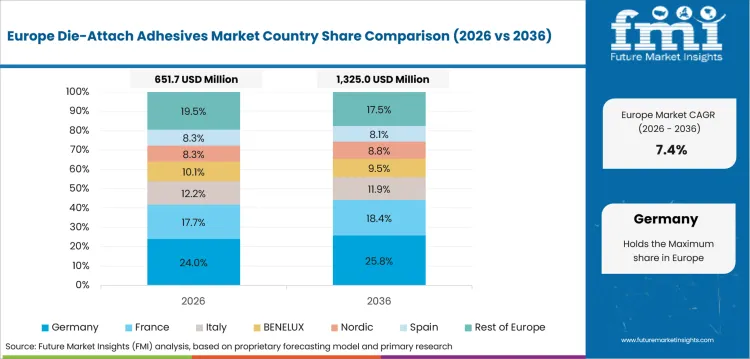
Country Market Snapshot Table
| Parameter | Value |
|---|---|
| Market Size in 2025 (Value) | USD 202.7 million |
| Market Size in 2026 (Value) | USD 219.1 million |
| Market Forecast in 2036 (Value) | USD 477.5 million |
| CAGR (2026 to 2036) | 8.1% |
| Years Considered | 2021 to 2036 |
| Base Year | 2025 |
| Forecast Period | 2026 to 2036 |
| Units Considered | Value (USD million) |
| Leading Sub-Region | Saxony, Bavaria, Baden-Wuerttemberg, and automotive electronics hubs |
Germany Die-Attach Adhesives Market Outlook
Germany die-attach adhesive demand is influenced by automotive electronics, power modules, and IDM-led qualification routines. Material approval is often tied to long reliability cycles and platform release schedules.
Conductive paste and sintering materials are expected to gain value where EV inverters and industrial power modules require better thermal paths. Suppliers with German technical service should be better placed during qualification.
Key Growth Drivers
- German demand is supported by Dresden capacity. The European Commission approved a EUR 5.0 billion German measure for the ESMC microchip plant in August 2024.
- Smart power capacity supports die-attach material demand. The European Commission approved EUR 920.0 million in German aid for Infineon in February 2025.
- Power module buyers are expected to favor silver sintering and conductive paste systems with proven thermal cycling data.
- Local IDM and automotive qualification routines are likely to strengthen direct selling by suppliers with German application engineers.
Key Restraints
- Subsidy approval can delay capacity benefits. The Infineon measure required European Commission clearance before Germany could grant up to EUR 920.0 million.
- Automotive buyers can delay formulation changes when a qualified die attach material is already tied to a released module platform.
- Energy-intensive process validation can pressure local cost structures for suppliers running extended reliability and thermal testing.
What makes Germany unique
Germany is distinct because automotive electronics and power semiconductor production keep die-attach qualification tied to long reliability cycles.
Key Companies
- Henkel AG & Co. KGaA
- Infineon Technologies AG
- Bosch Semiconductors
- Vishay Semiconductor GmbH
- Wacker Chemie AG
- Panacol-Elosol GmbH
- Fraunhofer IISB
Sales & Marketing Channels
- Automotive electronics suppliers
- Power module makers
- Direct IDM engineering teams
- Specialty chemical distributors
- Saxony semiconductor clusters
- Industrial electronics assemblers
Country Segment Breakdown Table
| Segment | Sub-Segments |
|---|---|
| By Adhesive Type | Conductive Adhesives · Non-Conductive Adhesives · Die-Attach Films · Sintering Pastes |
| By Chemistry | Epoxy-based · Acrylate-based · Silicone-based · Other |
| By Package Type | Leadframe Packages · Power Devices · Advanced Packages · Optoelectronics |
| By End Use | Consumer Electronics · Automotive · Industrial · Telecom / Datacom |
| By Sales Channel | Direct to OSAT / IDM · Distributors |
| Key Sub-Regions Covered, Semiconductor and electronics clusters | Saxony · Bavaria · Baden-Wuerttemberg · North Rhine-Westphalia · Hesse · Hamburg |
Frequently Asked Questions
How fast is the die-attach adhesives market growing in Germany?
Germany is projected to grow at 8.1% CAGR from 2026 to 2036 as local semiconductor packaging demand broadens.
What makes Germany important for die-attach adhesives suppliers?
Germany is distinct because automotive electronics and power semiconductor production keep die-attach qualification tied to long reliability cycles.
Which channels matter most in Germany?
Direct technical selling, qualified distributors, and package engineering programs matter most in Germany.
How fast is the die-attach adhesives market growing in France?
A 7.8% CAGR through 2036 reflects domestic wafer capacity and high-reliability package development.
Country Market Snapshot Table
| Parameter | Value |
|---|---|
| Market Size in 2025 (Value) | USD 126.3 million |
| Market Size in 2026 (Value) | USD 136.2 million |
| Market Forecast in 2036 (Value) | USD 288.9 million |
| CAGR (2026 to 2036) | 7.8% |
| Years Considered | 2021 to 2036 |
| Base Year | 2025 |
| Forecast Period | 2026 to 2036 |
| Units Considered | Value (USD million) |
| Leading Sub-Region | Crolles, Grenoble, Tours, and southern electronics clusters |
France Die-Attach Adhesives Market Outlook
France die-attach adhesive demand is influenced by Crolles wafer capacity, FD-SOI activity, and research-linked package development. The market is shaped by selected high-reliability programs rather than broad OSAT scale.
Local buyers are expected to value low-stress bonding and thermal performance evidence for automotive, industrial, and defense-linked electronic packages. European program participation can help suppliers reach early validation work.
Key Growth Drivers
- French demand is supported by Crolles capacity work. The EIB said Project Liberty targets 360,000 300mm wafer starts per year.
- French package materials gain from European localization policy. The European Chips Act targets a 20.0% global semiconductor share for Europe.
- FD-SOI and power electronics programs are expected to require die-attach adhesives with stronger stress control and thermal data.
- Research-linked qualification at CEA-Leti and local IDMs is likely to help specialist suppliers enter prototype package flows earlier.
Key Restraints
- Output volatility can delay package material releases. INSEE said computer and electronic product output stabilized after a 1.4% fall in January 2026.
- France has fewer high-volume OSAT sites than East Asia, which can move some adhesive qualification and repeat purchasing offshore.
- European compliance screening can lengthen approval for conductive fillers and specialty resin systems used in high-reliability packages.
What makes France unique
France is distinct because domestic wafer capacity, FD-SOI activity, and European policy support create adhesive demand around selected high-reliability programs.
Key Companies
- STMicroelectronics France
- Soitec SA
- Aledia
- Dolphin Design
- Lacroix Electronics
- CEA-Leti
- Radiall
Sales & Marketing Channels
- Direct IDM qualification
- R&D pilot lines
- Electronics manufacturing services
- Power electronics programs
- Specialty material distributors
- European research consortia
Country Segment Breakdown Table
| Segment | Sub-Segments |
|---|---|
| By Adhesive Type | Conductive Adhesives · Non-Conductive Adhesives · Die-Attach Films · Sintering Pastes |
| By Chemistry | Epoxy-based · Acrylate-based · Silicone-based · Other |
| By Package Type | Leadframe Packages · Power Devices · Advanced Packages · Optoelectronics |
| By End Use | Consumer Electronics · Automotive · Industrial · Telecom / Datacom |
| By Sales Channel | Direct to OSAT / IDM · Distributors |
| Key Sub-Regions Covered, Semiconductor and electronics clusters | Crolles · Grenoble · Tours · Bordeaux · Sophia Antipolis · Toulouse |
Frequently Asked Questions
How fast is the die-attach adhesives market growing in France?
France is projected to grow at 7.8% CAGR from 2026 to 2036 as local semiconductor packaging demand broadens.
What makes France important for die-attach adhesives suppliers?
France is distinct because domestic wafer capacity, FD-SOI activity, and European policy support create adhesive demand around selected high-reliability programs.
Which channels matter most in France?
Direct technical selling, qualified distributors, and package engineering programs matter most in France.
How fast is the die-attach adhesives market growing in Japan?
A 8.6% CAGR through 2036 reflects materials know-how and frontier-node package reliability requirements.
Country Market Snapshot Table
| Parameter | Value |
|---|---|
| Market Size in 2025 (Value) | USD 251.8 million |
| Market Size in 2026 (Value) | USD 273.5 million |
| Market Forecast in 2036 (Value) | USD 623.2 million |
| CAGR (2026 to 2036) | 8.6% |
| Years Considered | 2021 to 2036 |
| Base Year | 2025 |
| Forecast Period | 2026 to 2036 |
| Units Considered | Value (USD million) |
| Leading Sub-Region | Kyushu, Hokkaido, Kansai, and Greater Tokyo electronics corridors |
Japan Die-Attach Adhesives Market Outlook
Japan die-attach adhesive demand is shaped by specialty material suppliers, power devices, and frontier-node policy projects. Buyers place high weight on process consistency and long-term reliability evidence.
Domestic suppliers are expected to remain influential because many package engineers prefer materials with detailed technical data and local troubleshooting. Power semiconductor and automotive programs should keep conductive systems relevant.
Key Growth Drivers
- Japan demand is supported by semiconductor market scale. The USA International Trade Administration said Japan’s semiconductor market is estimated to exceed USD 51.0 billion by 2025.
- Japan is increasing frontier chip support. METI said it planned to invest JPY 100.0 billion in Rapidus through the fiscal 2025 initial budget.
- Domestic material suppliers are expected to gain from buyer preference for tight process control and detailed package-level reliability data.
- Power semiconductor and automotive electronics programs are likely to keep conductive paste and low-stress epoxy demand active.
Key Restraints
- Frontier-node funding can pull engineering resources from backend materials. METI said Rapidus had already received about JPY 1.0 trillion in government support.
- High material standards can lengthen approval because buyers require die shear and thermal cycling evidence before release.
- Some high-volume assembly work remains offshore, limiting repeat die-attach purchases made through domestic channels.
What makes Japan unique
Japan is distinct because materials know-how, power device supply, and 2nm policy projects keep package reliability central to supplier selection.
Key Companies
- NAMICS Corporation
- Shin-Etsu Chemical Co. Ltd.
- Resonac Holdings Corporation
- ThreeBond Co. Ltd.
- Sumitomo Bakelite Co. Ltd.
- Toray Industries
- DIC Corporation
Sales & Marketing Channels
- Direct IDM programs
- Semiconductor material distributors
- Power device assemblers
- Research consortia
- Automotive electronics suppliers
- Prototype package houses
Country Segment Breakdown Table
| Segment | Sub-Segments |
|---|---|
| By Adhesive Type | Conductive Adhesives · Non-Conductive Adhesives · Die-Attach Films · Sintering Pastes |
| By Chemistry | Epoxy-based · Acrylate-based · Silicone-based · Other |
| By Package Type | Leadframe Packages · Power Devices · Advanced Packages · Optoelectronics |
| By End Use | Consumer Electronics · Automotive · Industrial · Telecom / Datacom |
| By Sales Channel | Direct to OSAT / IDM · Distributors |
| Key Sub-Regions Covered, Semiconductor and electronics clusters | Kyushu · Hokkaido · Tokyo · Osaka · Nagoya · Ibaraki |
Frequently Asked Questions
How fast is the die-attach adhesives market growing in Japan?
Japan is projected to grow at 8.6% CAGR from 2026 to 2036 as local semiconductor packaging demand broadens.
What makes Japan important for die-attach adhesives suppliers?
Japan is distinct because materials know-how, power device supply, and 2nm policy projects keep package reliability central to supplier selection.
Which channels matter most in Japan?
Direct technical selling, qualified distributors, and package engineering programs matter most in Japan.
How fast is the die-attach adhesives market growing in China?
A 9.4% CAGR through 2036 reflects domestic IC output and large local adhesive qualification volumes.
Country Market Snapshot Table
| Parameter | Value |
|---|---|
| Market Size in 2025 (Value) | USD 672.8 million |
| Market Size in 2026 (Value) | USD 736.0 million |
| Market Forecast in 2036 (Value) | USD 1,805.5 million |
| CAGR (2026 to 2036) | 9.4% |
| Years Considered | 2021 to 2036 |
| Base Year | 2025 |
| Forecast Period | 2026 to 2036 |
| Units Considered | Value (USD million) |
| Leading Sub-Region | Yangtze River Delta, Pearl River Delta, Beijing-Tianjin, and inland electronics clusters |
China Die-Attach Adhesives Market Outlook
China die-attach adhesive demand is influenced by large IC output, local OSAT capacity, and electronics manufacturing scale. Buyer requirements vary between high-volume leadframe packages and higher-reliability power packages.
Domestic substitution and export-control exposure are expected to shape supplier selection. Imported material brands need local application support and price discipline to protect positions in qualified package flows.
Key Growth Drivers
- China demand is supported by electronics output. The State Council reported integrated circuit output of 484.3 billion units in 2025.
- China’s electronics manufacturing scale supports local adhesive qualification. The State Council reported sector operating revenue of 17.4 trillion yuan in 2025.
- Large OSAT networks are expected to raise direct qualification volumes for conductive adhesives and die-attach films.
- Automotive and consumer electronics assembly scale is likely to keep leadframe and power-device adhesive consumption high.
Key Restraints
- Domestic capacity growth can pressure imported material prices. The State Council reported integrated circuit output rose 10.9% year on year in 2025.
- Export controls can limit access to foreign equipment and specialty inputs used in high-reliability package qualification.
- Domestic supplier substitution can create price pressure for imported adhesive brands with limited local technical service.
What makes China unique
China is distinct because domestic IC output, local packaging scale, and equipment localization drive large adhesive qualification volumes.
Key Companies
- JCET Group
- Tongfu Microelectronics
- Huatian Technology
- SMIC
- Hua Hong Semiconductor
- Wuhan Xinxin Semiconductor Manufacturing
- Shenzhen Xingsen Fast Circuit
Sales & Marketing Channels
- OSAT purchasing teams
- Local semiconductor material distributors
- Power device assemblers
- Consumer electronics EMS networks
- Automotive electronics suppliers
- Provincial semiconductor clusters
Country Segment Breakdown Table
| Segment | Sub-Segments |
|---|---|
| By Adhesive Type | Conductive Adhesives · Non-Conductive Adhesives · Die-Attach Films · Sintering Pastes |
| By Chemistry | Epoxy-based · Acrylate-based · Silicone-based · Other |
| By Package Type | Leadframe Packages · Power Devices · Advanced Packages · Optoelectronics |
| By End Use | Consumer Electronics · Automotive · Industrial · Telecom / Datacom |
| By Sales Channel | Direct to OSAT / IDM · Distributors |
| Key Sub-Regions Covered, Semiconductor and electronics clusters | Shanghai · Jiangsu · Guangdong · Beijing · Hubei · Sichuan |
Frequently Asked Questions
How fast is the die-attach adhesives market growing in China?
China is projected to grow at 9.4% CAGR from 2026 to 2036 as local semiconductor packaging demand broadens.
What makes China important for die-attach adhesives suppliers?
China is distinct because domestic IC output, local packaging scale, and equipment localization drive large adhesive qualification volumes.
Which channels matter most in China?
Direct technical selling, qualified distributors, and package engineering programs matter most in China.
How fast is the die-attach adhesives market growing in South Korea?
A 9.2% CAGR through 2036 reflects memory packaging demand and high-bandwidth package reliability requirements.
Country Market Snapshot Table
| Parameter | Value |
|---|---|
| Market Size in 2025 (Value) | USD 349.1 million |
| Market Size in 2026 (Value) | USD 381.2 million |
| Market Forecast in 2036 (Value) | USD 919.8 million |
| CAGR (2026 to 2036) | 9.2% |
| Years Considered | 2021 to 2036 |
| Base Year | 2025 |
| Forecast Period | 2026 to 2036 |
| Units Considered | Value (USD million) |
| Leading Sub-Region | Gyeonggi, Chungcheong, Incheon, and memory packaging corridors |
South Korea Die-Attach Adhesives Market Outlook
South Korea die-attach adhesive demand is influenced by memory packaging, AI server hardware, and direct IDM purchasing. Package materials are evaluated through warpage, thermal behavior, and equipment compatibility.
HBM and advanced memory flows are expected to raise interest in low-void adhesive systems and die-attach films. Suppliers with local technical teams should remain better positioned with memory IDMs.
Key Growth Drivers
- South Korean demand is supported by AI semiconductor investment. The USA International Trade Administration said the K-On-Device AI Semiconductor project plans to invest USD 664.0 million from 2026 to 2030.
- Cluster expansion supports backend material demand. The USA International Trade Administration said Korea’s semiconductor mega cluster aims to attract USD 413.0 billion in private investment by 2047.
- HBM and AI memory packages are expected to increase demand for low-void adhesive systems with stronger thermal control.
- Direct IDM qualification is likely to support suppliers that can provide local process troubleshooting for memory package lines.
Key Restraints
- Capability gaps can delay some package material localization. The USA International Trade Administration said Korea remains less developed in AI chips, advanced packaging, and core materials.
- Memory cycles can create uneven order timing for high-value die-attach films and sintering materials.
- Large IDMs can pressure suppliers on price once a material moves from pilot qualification to repeated high-volume purchasing.
What makes South Korea unique
South Korea is distinct because memory packaging and AI chip exports connect adhesive demand with high-bandwidth package reliability.
Key Companies
- Samsung Electronics
- SK hynix
- Nepes Corporation
- LB Semicon
- SFA Semicon
- Soulbrain Co. Ltd.
- Dongjin Semichem
Sales & Marketing Channels
- Memory IDM procurement
- OSAT engineering teams
- Material distributors
- AI accelerator package programs
- Automotive electronics assemblers
- Government-supported research projects
Country Segment Breakdown Table
| Segment | Sub-Segments |
|---|---|
| By Adhesive Type | Conductive Adhesives · Non-Conductive Adhesives · Die-Attach Films · Sintering Pastes |
| By Chemistry | Epoxy-based · Acrylate-based · Silicone-based · Other |
| By Package Type | Leadframe Packages · Power Devices · Advanced Packages · Optoelectronics |
| By End Use | Consumer Electronics · Automotive · Industrial · Telecom / Datacom |
| By Sales Channel | Direct to OSAT / IDM · Distributors |
| Key Sub-Regions Covered, Semiconductor and electronics clusters | Gyeonggi · Chungcheong · Incheon · Seoul · Gumi · Busan |
Frequently Asked Questions
How fast is the die-attach adhesives market growing in South Korea?
South Korea is projected to grow at 9.2% CAGR from 2026 to 2036 as local semiconductor packaging demand broadens.
What makes South Korea important for die-attach adhesives suppliers?
South Korea is distinct because memory packaging and AI chip exports connect adhesive demand with high-bandwidth package reliability.
Which channels matter most in South Korea?
Direct technical selling, qualified distributors, and package engineering programs matter most in South Korea.
How fast is the die-attach adhesives market growing in India?
A 9.7% CAGR through 2036 reflects new ATMP and OSAT projects moving from approval into implementation.
Country Market Snapshot Table
| Parameter | Value |
|---|---|
| Market Size in 2025 (Value) | USD 166.5 million |
| Market Size in 2026 (Value) | USD 182.6 million |
| Market Forecast in 2036 (Value) | USD 460.9 million |
| CAGR (2026 to 2036) | 9.7% |
| Years Considered | 2021 to 2036 |
| Base Year | 2025 |
| Forecast Period | 2026 to 2036 |
| Units Considered | Value (USD million) |
| Leading Sub-Region | Gujarat, Assam, Odisha, Uttar Pradesh, and Karnataka corridors |
India Die-Attach Adhesives Market Outlook
India die-attach adhesive demand is influenced by new ATMP, OSAT, and fab projects moving from approval into implementation. The market starts from a smaller installed base, but qualification windows are opening.
Suppliers are expected to focus on training, distributor stocking, and engineering support as new package lines stabilize. Early approval can create durable positions once domestic packaging volumes rise.
Key Growth Drivers
- Indian demand is supported by new project approvals. PIB reported 10 approved semiconductor projects with about INR 1.6 lakh crore in envisaged investment in February 2026.
- India’s demand base is widening. The USA International Trade Administration valued India’s semiconductor market at USD 52.0 billion in 2024 to 2025.
- New ATMP and OSAT facilities are expected to create first-time qualification windows for die-attach paste and film suppliers.
- Local electronics manufacturing clusters are likely to increase demand for distributor support and supplier training around adhesive handling.
Key Restraints
- Project execution remains the main constraint. PIB reported pilot production had started in 4 units while other approved projects were still under implementation.
- A smaller installed packaging base can delay repeat adhesive demand until new lines reach stable utilization.
- Imported specialty chemicals and equipment support may keep qualification costs high for early domestic package builders.
What makes India unique
India is distinct because new ATMP, OSAT, and fab projects are creating supplier access from a small starting base.
Key Companies
- Tata Electronics
- Kaynes Semicon
- CG Semi
- Micron Semiconductor India
- SPEL Semiconductor
- HCL-Foxconn Semiconductor
- SicSem Pvt. Ltd.
Sales & Marketing Channels
- ATMP project tenders
- OSAT engineering teams
- Electronics manufacturing clusters
- Specialty chemical distributors
- Government-backed supplier programs
- Direct supplier training
Country Segment Breakdown Table
| Segment | Sub-Segments |
|---|---|
| By Adhesive Type | Conductive Adhesives · Non-Conductive Adhesives · Die-Attach Films · Sintering Pastes |
| By Chemistry | Epoxy-based · Acrylate-based · Silicone-based · Other |
| By Package Type | Leadframe Packages · Power Devices · Advanced Packages · Optoelectronics |
| By End Use | Consumer Electronics · Automotive · Industrial · Telecom / Datacom |
| By Sales Channel | Direct to OSAT / IDM · Distributors |
| Key Sub-Regions Covered, Semiconductor and electronics clusters | Gujarat · Assam · Odisha · Uttar Pradesh · Karnataka · Tamil Nadu |
Frequently Asked Questions
How fast is the die-attach adhesives market growing in India?
India is projected to grow at 9.7% CAGR from 2026 to 2036 as local semiconductor packaging demand broadens.
What makes India important for die-attach adhesives suppliers?
India is distinct because new ATMP, OSAT, and fab projects are creating supplier access from a small starting base.
Which channels matter most in India?
Direct technical selling, qualified distributors, and package engineering programs matter most in India.
Competitive Landscape and Strategic Positioning
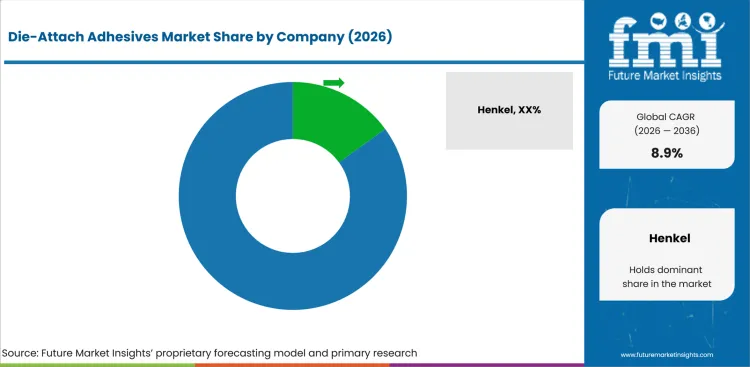
The market is moderately concentrated because leading suppliers hold stronger access to package qualification and technical service programs. Established companies compete by proving thermal performance, low-void bonding, and supply stability across global package sites. Specialist companies compete in epoxy, silicone, die-attach film, and sintering formats where a narrow material problem creates measurable value.
Supplier competition is shaped by proof inside the package rather than adhesive catalog size. Henkel, MacDermid Alpha, NAMICS, Resonac, Shin-Etsu Chemical, Dow, H.B. Fuller, and Master Bond are better positioned when buyers require thermal data and application engineers. Smaller firms can win prototype work, but volume supply needs documentation and process control.
Key Companies in the Die-Attach Adhesives Market
-
Paste and Sintering Formulators: Henkel, MacDermid Alpha, NAMICS, and Resonac compete through conductive paste, hybrid sintering, silver sintering, and copper sintering expertise.
- Film and Backend Materials Specialists: Resonac and AI Technology address die-attach film and backend bonding formats used in wafer singulation and die bonding workflows.
- Silicone and Epoxy Adhesive Suppliers: Dow, Shin-Etsu Chemical, H.B. Fuller, and Master Bond compete through silicone, epoxy, and specialty adhesive platforms.
Competitive Benchmarking: Die-Attach Adhesives Market
| Company | Thermal Conductivity Range | Die Attach Format Depth | Automotive Reliability Fit | Geographic Footprint |
|---|---|---|---|---|
| Henkel | High | Strong | Strong | Global |
| MacDermid Alpha | High | High | Strong | Global |
| NAMICS | High | Strong | Strong | Japan and global |
| Resonac | High | High | Strong | Asia Pacific and global |
| Shin-Etsu Chemical | Medium | Strong | Strong | Japan and global |
| Dow | Medium | Medium | Moderate | Global |
| H.B. Fuller | Medium | Medium | Moderate | Global |
| Master Bond | Medium | Medium | Moderate | North America and global |
| AI Technology | Medium | Strong | Moderate | North America and Asia |
| Panacol-Elosol | Medium | Medium | Moderate | Europe and global |
Source: Future Market Insights competitive analysis, 2026. Ratings reflect relative positioning based on thermal conductivity range, die attach format depth, and automotive reliability fit.
Key Developments in Die-Attach Adhesives Market
- In June 2024, MacDermid Alpha issued the ATROX 800HT2VX technical data sheet. The PFAS-free hybrid silver sintered die attach paste targets GaN and SiC power devices.
- In February 2026, Rapidus secured JPY 267.6 billion in funding from the Japan government and private companies. The funding supports its path toward 2nm logic semiconductor mass production by 2027.
Die-Attach Adhesives Market - Report Scope
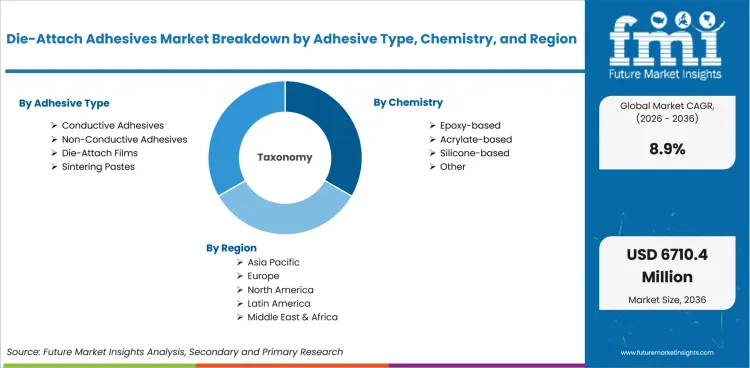
| Parameter | Details |
|---|---|
| Forecast period | 2026 to 2036 |
| Historical period | 2021 to 2025 |
| Quantitative unit | Revenue in USD million |
| By adhesive type | Conductive adhesives, non-conductive adhesives, die-attach films, sintering pastes |
| By chemistry | Epoxy-based, acrylate-based, silicone-based, other |
| By package type | Leadframe packages, power devices, advanced packages, optoelectronics |
| By end use | Consumer electronics, automotive, industrial, telecom / datacom |
| By sales channel | Direct to OSAT / IDM, distributors |
| Regions covered | North America, Latin America, Europe, East Asia, South Asia and Pacific, Middle East and Africa |
| Countries covered | United States, United Kingdom, Germany, France, Japan, China, South Korea, India |
| Key companies profiled | Henkel, MacDermid Alpha, NAMICS, Dow, Shin-Etsu Chemical, Resonac, H.B. Fuller, Master Bond, AI Technology, Panacol-Elosol |
| Approach | Bottom-up packaging-material approach using package type demand, adhesive use rates, channel mix, material pricing, and country-level semiconductor investment signals |
Die-Attach Adhesives Market - Scope & Definition
| Attribute | Detail |
|---|---|
| Market Definition | Materials used to bond a semiconductor die to a leadframe, substrate, package base, or power module carrier during semiconductor assembly |
| Functions Covered | Electrical conduction, thermal transfer, mechanical fixation, stress control, bondline stability, and package reliability support |
| Applications Covered | Leadframe packages, power devices, advanced packages, optoelectronics, semiconductor assembly, and power module packaging |
| End-Use Industries | Consumer electronics, automotive electronics, industrial electronics, telecom / datacom hardware, power devices, and semiconductor packaging services |
| Grades Covered | Conductive adhesives, non-conductive adhesives, die-attach films, sintering pastes, epoxy-based systems, acrylate-based systems, and silicone-based systems |
| Inclusions | Commercial die-bonding adhesives and films used in semiconductor package assembly across adhesive type, chemistry, package type, end use, sales channel, and country demand |
| Exclusions | Temporary wafer bonding adhesives, underfills, encapsulants, solder materials, dicing tapes without die-bonding function, PCB mounting glues, and general industrial adhesives outside die attach |
Die-Attach Adhesives Market - Research Methodology
| Method | Description |
|---|---|
| Primary Research | FMI analyst interviews with OSATs, IDMs, power module assemblers, electronics manufacturers, adhesive distributors, and application engineering teams across key markets |
| Desk Research | Review of semiconductor packaging references, government semiconductor programs, company product documentation, trade association data, and supplier technical literature related to die attach materials |
| Market Sizing & Forecasting | Bottom-up model using package production indicators, adhesive use rates, average material pricing, sales channel mix, package type demand, and country-level semiconductor investment signals |
| Data Validation | Cross-verification using buyer qualification behavior, power device growth indicators, advanced packaging investment, supplier portfolios, and adjacent backend assembly material patterns |
Die-Attach Adhesives Market Breakdown by Adhesive Type, Chemistry, Package Type, End Use, Sales Channel, and Region
Die-Attach Adhesives Market Segmented by Adhesive Type
- Conductive Adhesives
- Non-Conductive Adhesives
- Die-Attach Films
- Sintering Pastes
Die-Attach Adhesives Market Segmented by Chemistry
- Epoxy-based
- Acrylate-based
- Silicone-based
- Other
Die-Attach Adhesives Market Segmented by Package Type
- Leadframe Packages
- Power Devices
- Advanced Packages
- Optoelectronics
Die-Attach Adhesives Market Segmented by End Use
- Consumer Electronics
- Automotive
- Industrial
- Telecom / Datacom
Die-Attach Adhesives Market Segmented by Sales Channel
- Direct to OSAT / IDM
- Distributors
Die-Attach Adhesives Market by Region
- North America
- Latin America
- Europe
- East Asia
- South Asia and Pacific
- Middle East and Africa
Research Sources and Bibliography
- Semiconductor Industry Association. (2026, February 6). Global annual semiconductor sales increase 25.6% to $791.7 billion in 2025. Semiconductor Industry Association.
- National Institute of Standards and Technology. (2025, January 16). USA Department of Commerce announces $1.4 billion in final awards to support the next generation of USA semiconductor advanced packaging. NIST.
- National Institute of Standards and Technology. (2025, January 16). Notice of funding opportunity: CHIPS National Advanced Packaging Manufacturing Program. NIST.
- MacDermid Alpha Electronics Solutions. (2024, June 27). ATROX 800HT2VX technical data sheet. MacDermid Alpha.
- Department for Science, Innovation and Technology. (2024, March 28). £16.6 million boost to power up chips used in electric cars and green energy industry. GOV.UK.
- Department for Science, Innovation and Technology. (2026, June 12). Semiconductor sector study 2026. GOV.UK.
- Compound Semiconductor Applications Catapult. (2025, March 20). £9 million funding boost to bring key semiconductor manufacturing capability to Scotland. CSA Catapult.
- European Commission. (2024, July 24). Chips Act. European Commission.
- European Commission. (2024, August 20). Commission approves €5 billion German State aid measure to support ESMC in setting up a new semiconductor manufacturing facility. European Commission.
- European Commission. (2025, February 19). Commission approves €920 million German State aid measure to support Infineon. European Commission.
- European Investment Bank. (2024, January 25). Project Liberty semiconductor fab. European Investment Bank.
- Institut national de la statistique et des études économiques. (2026, April 3). In February 2026, manufacturing output was virtually stable. INSEE.
- Ministry of Economy, Trade and Industry. (2025, November 21). Press conference by Minister Akazawa. METI.
- USA International Trade Administration. (2025, November 20). Japan semiconductors. USA Department of Commerce.
- State Council of the People’s Republic of China. (2026, January 30). China’s electronic information manufacturing sector posts stable growth in 2025. Government of China.
- USA International Trade Administration. (2026, June 8). South Korea AI semiconductor. USA Department of Commerce.
- Press Information Bureau. (2026, February 4). Semicon India Programme advances with approval of 10 semiconductor projects. Government of India.
- USA International Trade Administration. (2025, September 30). India semiconductor. USA Department of Commerce.
- USA Environmental Protection Agency. (2024, April 17). Designation of PFOA and PFOS as hazardous substances under CERCLA release reporting requirements factsheet. EPA.
- Henkel AG & Co. KGaA. (2025, February 19). Henkel reports fiscal 2024 results. Henkel.
- Resonac Holdings Corporation. (2025, February 13). Consolidated financial results for fiscal year 2024. Resonac.
- Dow Inc. (2025, January 30). Dow reports fourth quarter 2024 results. Dow.
- Shin-Etsu Chemical Co., Ltd. (2025, April 25). Consolidated financial results for fiscal year ended March 31, 2025. Shin-Etsu Chemical.
This bibliography is provided for reader reference and is not exhaustive. The full report contains the complete reference list and detailed citations.
This Report Answers
- Market size estimates for 2026 and forecasts through 2036 for the die-attach adhesives market.
- Insights across more than 30 regional and country-level markets.
- Analysis of demand drivers, semiconductor packaging trends, adhesive qualification behavior, and purchasing decisions.
- Evaluation of key adhesive types and package formats including conductive adhesives, die-attach films, and sintering pastes.
- Assessment of regulatory and material reformulation pressures affecting PFAS-free and lower-risk adhesive systems.
- Identification of growth opportunities across chemistry, package type, end use, and sales channel segments.
- Evaluation of supply chain dynamics, technical service needs, and direct OSAT / IDM qualification routes.
- Country-level growth analysis covering the United States, United Kingdom, Germany, France, Japan, China, South Korea, and India.
- Assessment of the competitive landscape including leading adhesive manufacturers and backend packaging material suppliers.
- Analysis of thermal conductivity requirements, bondline control, resin bleed risk, and low-void processing needs.
- Regional outlooks across North America, Europe, East Asia, South Asia and Pacific, and other global regions.
- Delivery of market data, forecasts, and supporting analysis in PDF and Excel formats.
Frequently Asked Questions
What is the growth prospect for die-attach adhesives?
Demand for die-attach adhesives is expected to rise as power packages and advanced packages require better thermal paths and lower assembly risk.
Which companies are expected to shape the die-attach adhesives market?
Henkel, MacDermid Alpha, NAMICS, Dow, Shin-Etsu Chemical, Resonac, H.B. Fuller, and Master Bond are expected to shape competition through paste, film, epoxy, and silicone portfolios.
Why are semiconductor suppliers investing in die-attach adhesive qualification?
Suppliers are investing in qualification because adhesive failure can affect package yield, thermal performance, and long-term reliability.
Why are direct OSAT and IDM channels important in the die-attach adhesives market?
Direct OSAT and IDM channels support material approval because package engineers need supplier data during dispense, cure, shear, and reliability testing.
Which adhesive formats are gaining attention in die-attach applications?
Conductive adhesives, die-attach films, and sintering pastes are gaining attention as power and stacked packages need better heat flow and bondline control.
How do regulations influence die-attach adhesive launches?
Regulations influence product development through PFAS scrutiny, chemical disclosure expectations, and customer requests for lower-risk material alternatives.
Why is thermal conductivity important for die-attach adhesives?
Thermal conductivity is important because the bondline helps move heat away from the semiconductor die during package operation.
What role do die-attach films play in advanced packages?
Die-attach films support thin die handling and stable bondline thickness when stacked package layouts leave limited process tolerance.
How do distributors support die-attach adhesive demand?
Distributors support prototype lots and regional buyers before larger direct contracts are approved through OSAT or IDM qualification programs.
Preview the report firsthand - request a free sample
Get SampleGet the brochure for pricing and purchase details.
Get PDFTable of Content
- Executive Summary
- Global Market Outlook
- Demand-side Trends
- Supply-side Trends
- Technology Roadmap Analysis
- Analysis and Recommendations
- Market Overview
- Market Coverage / Taxonomy
- Market Definition / Scope / Limitations
- Research Methodology
- Research Design
- Primary Research
- Desk Research
- Market Sizing and Forecasting
- Data Validation
- Global Market Analysis 2021 to 2025 and Forecast, 2026 to 2036
- Historical Market Size Value (USD Million) Analysis, 2021 to 2025
- Current and Future Market Size Value (USD Million) Projections, 2026 to 2036
- Y-o-Y Growth Trend Analysis
- Absolute $ Opportunity Analysis
- Global Market Pricing Analysis 2021 to 2025 and Forecast 2026 to 2036
- Global Market Analysis 2021 to 2025 and Forecast 2026 to 2036, By Adhesive Type
- Introduction / Key Findings
- Historical Market Size Value (USD Million) Analysis By Adhesive Type, 2021 to 2025
- Current and Future Market Size Value (USD Million) Analysis By Adhesive Type, 2026 to 2036
- Global Market Analysis 2021 to 2025 and Forecast 2026 to 2036, By Chemistry
- Introduction / Key Findings
- Historical Market Size Value (USD Million) Analysis By Chemistry, 2021 to 2025
- Current and Future Market Size Value (USD Million) Analysis By Chemistry, 2026 to 2036
- Global Market Analysis 2021 to 2025 and Forecast 2026 to 2036, By Package Type
- Introduction / Key Findings
- Historical Market Size Value (USD Million) Analysis By Package Type, 2021 to 2025
- Current and Future Market Size Value (USD Million) Analysis By Package Type, 2026 to 2036
- Global Market Analysis 2021 to 2025 and Forecast 2026 to 2036, By End Use
- Introduction / Key Findings
- Historical Market Size Value (USD Million) Analysis By End Use, 2021 to 2025
- Current and Future Market Size Value (USD Million) Analysis By End Use, 2026 to 2036
- Global Market Analysis 2021 to 2025 and Forecast 2026 to 2036, By Sales Channel
- Introduction / Key Findings
- Historical Market Size Value (USD Million) Analysis By Sales Channel, 2021 to 2025
- Current and Future Market Size Value (USD Million) Analysis By Sales Channel, 2026 to 2036
- Global Market Analysis 2021 to 2025 and Forecast 2026 to 2036, By Region
- Introduction / Key Findings
- Historical Market Size Value (USD Million) Analysis By Region, 2021 to 2025
- Current and Future Market Size Value (USD Million) Analysis By Region, 2026 to 2036
- North America Market Analysis 2021 to 2025 and Forecast 2026 to 2036
- Pricing Analysis
- Market Share Analysis, 2025
- By Country
- By Adhesive Type
- By Chemistry
- By Package Type
- By End Use
- By Sales Channel
- Country-level Analysis
- United States
- Canada
- Latin America Market Analysis 2021 to 2025 and Forecast 2026 to 2036
- Pricing Analysis
- Market Share Analysis, 2025
- By Country
- By Adhesive Type
- By Chemistry
- By Package Type
- By End Use
- By Sales Channel
- Country-level Analysis
- Brazil
- Mexico
- Rest of Latin America
- Western Europe Market Analysis 2021 to 2025 and Forecast 2026 to 2036
- Pricing Analysis
- Market Share Analysis, 2025
- By Country
- By Adhesive Type
- By Chemistry
- By Package Type
- By End Use
- By Sales Channel
- Country-level Analysis
- Germany
- France
- United Kingdom
- Italy
- Spain
- BENELUX
- Nordics
- Rest of Western Europe
- Eastern Europe Market Analysis 2021 to 2025 and Forecast 2026 to 2036
- Pricing Analysis
- Market Share Analysis, 2025
- By Country
- By Adhesive Type
- By Chemistry
- By Package Type
- By End Use
- By Sales Channel
- Country-level Analysis
- Russia
- Poland
- Rest of Eastern Europe
- East Asia Market Analysis 2021 to 2025 and Forecast 2026 to 2036
- Pricing Analysis
- Market Share Analysis, 2025
- By Country
- By Adhesive Type
- By Chemistry
- By Package Type
- By End Use
- By Sales Channel
- Country-level Analysis
- China
- Japan
- South Korea
- South Asia and Pacific Market Analysis 2021 to 2025 and Forecast 2026 to 2036
- Pricing Analysis
- Market Share Analysis, 2025
- By Country
- By Adhesive Type
- By Chemistry
- By Package Type
- By End Use
- By Sales Channel
- Country-level Analysis
- India
- ASEAN
- Australia & New Zealand
- Rest of South Asia and Pacific
- Middle East & Africa Market Analysis 2021 to 2025 and Forecast 2026 to 2036
- Pricing Analysis
- Market Share Analysis, 2025
- By Country
- By Adhesive Type
- By Chemistry
- By Package Type
- By End Use
- By Sales Channel
- Country-level Analysis
- GCC Countries
- South Africa
- Turkey
- Rest of Middle East & Africa
- Market Structure Analysis
- Competition Dashboard
- Competition Benchmarking
- Market Share Analysis of Top Players
- By Region
- By Adhesive Type
- By Chemistry
- By Package Type
- By End Use
- By Sales Channel
- Emerging Startups
- Innovation Benchmarking
- Competition Analysis
- Competition Deep Dive
- Company Profiles
- Case Studies
- Success Stories
- Recent Developments
- Assumptions & Acronyms Used
- List of Tables: Die-Attach Adhesives Market
- List of Figures: Die-Attach Adhesives Market


