

- Market Size (2026)
- USD 419.9 Mn
- Forecast (2036)
- USD 766.3 Mn
- CAGR (2026 to 2036)
- 6.2%
How big is Dip Powder Nail Systems Market in 2026?
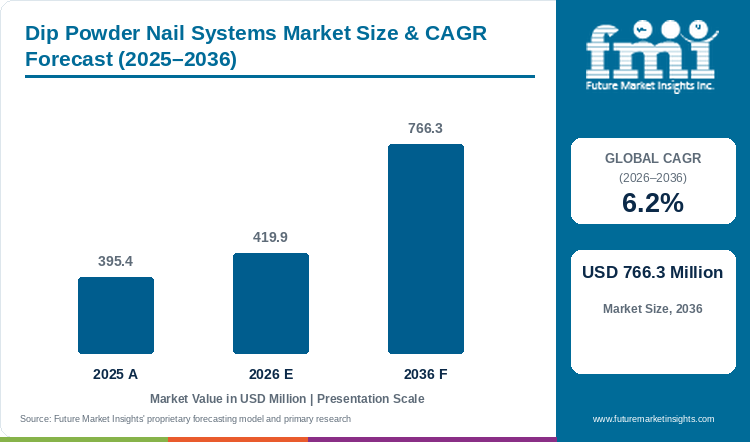
The dip powder nail systems market is estimated at USD 395.4 million in 2025 and is projected to reach USD 419.9 million in 2026. Sales of dip powder nail systems are expected to grow at a 6.2% CAGR between 2026 and 2036 and reach USD 766.3 million by 2036.
Dip powder nail systems market share rests with color powders and the liquids that salons reorder with each shade drop. Repeat powder and liquid orders are expected to carry sales of dip powder nail systems to USD 766.3 million by 2036 at a 6.2% CAGR, from a projected USD 419.9 million in 2026 and an estimated USD 395.4 million in 2025. For instance, Wella Company matched all 12 shades of the OPI Trip to the Brite Side summer collection in Nail Lacquer, GelColor and Powder Perfection in May 2026.[1] As a result, each new season color can now go on as a no-lamp dip service, turning every collection into a powder reorder.
Recent rules and launches change what buyers pay for. First, France banned TPO in artificial nail products from 1 September 2025, with no sell-off period for salons.[2] An immediate ban left French salons replacing gel stock at once, which favours lamp-free services. Great Britain follows from 15 August 2026 for products placed on the market, and professionals lose the right to buy TPO products after 14 February 2027.[3] For salon owners, a cyanoacrylate dip system that sets without a lamp becomes a ready second service beside reformulated gels, and suppliers with TPO-free paperwork gain the stronger hand in contract talks.
Over the forecast period, FMI analysis shows salon buyers asking for one shade card across lacquer, gel and powder, and dip brands without a matched card losing shelf space at professional distributors.
Key Market Trends & Insights
- Within product type, color powders are expected to lead at 35% in 2026, with liquids and activators at 28% and starter kits at 25%. Among color launches, the OPI Fall 2026 collection matched 12 permanent shades across GelColor, Nail Lacquer and Powder Perfection.[4] Each fully matched drop adds powder jars to salon orders alongside gel and lacquer.
- Salons buy full shade walls and remain the larger end user, at a likely 53% of 2026 demand, with home users close behind at 47%. Supporting the salon lead, Powder Perfection is sold as an in-salon professional service only.[1] Keeping a leading professional powder out of retail steers that volume through salon orders.
- Specialty beauty retail is projected to take 24% of channel demand for 2026, half a point over professional nail supply, as shoppers compare shade walls in beauty chains. At those counters, The GelBottle Inc. reached 487 CosmoProf stores in May 2026, widening the gel range at the same counters.[5] A larger gel range on the same counters raises the competition dip brands face for shelf space.
Regional Highlights
- On the FMI outlook, GCC Countries grow fastest at 7.4%, with Gulf mall salons and beauty chains adding dip stations.
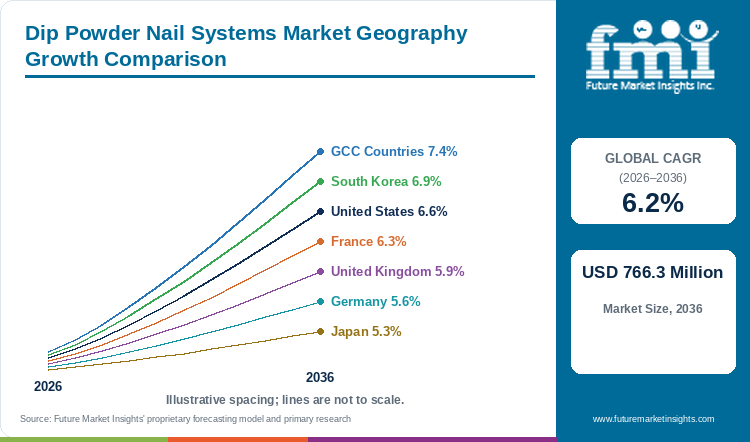
- South Korea (6.9%) and the United States (6.6%) run ahead of the 6.2% global rate, and France, at 6.3%, stays close to the global pace. The United Kingdom (5.9%), Germany (5.6%) and Japan (5.3%) expand more slowly as gel services keep most salon bookings.
- Korean beauty brands are gaining scale abroad. South Korean cosmetics exports reached USD 11.43 billion in 2025, 12.3% above 2024, according to the Ministry of Food and Drug Safety.[6] Export scale of that kind gives Korean nail brands the distribution to push powders and nail art kits overseas, which supports growth at home as well.
Market Size & Forecast
Table 1: Market Size and Forecast for the Dip Powder Nail Systems Market (USD million and percentage), 2025 to 2036
| Metric | Value |
|---|---|
| 2025 Market Size | USD 395.4 million |
| Estimated Market Size in 2026 | USD 419.9 million |
| Projected Market Size by 2036 | USD 766.3 million |
| CAGR, 2026 to 2036 | 6.2% |
| Added Revenue, 2026 to 2036 | USD 346.4 million |
| Market Expansion Multiple | 1.8x |
Seasonal shade launches in powder are keeping salon reorders frequent. The Fall 2026 OPI collection arrived in Powder Perfection alongside lacquer and gel, which keeps salons ordering new jars.[4] Brands that match each drop in powder therefore hold the steadiest part of salon purchases. At category level, nail products form a growing slice of the colour cosmetics market, projected at a 7.7% CAGR. By 2036, sales of dip powder nail systems are likely to be close to 1.8 times the 2026 figure, with about USD 346.4 million added over the period on the FMI outlook. Even so, press-on nails sold at mass prices are the main threat to home dip kits.
Shade Drops, Lamp Rules and Home Kits
Shade drops set the reorder rhythm. For instance, Wella Company matched 12 Fall 2026 OPI shades across powder, lacquer and gel, and the range brought back cult shades for the 45th anniversary.[4] Consequently, a salon that stocks every season adds 12 jars at each drop.
Lamp rules, in turn, set the service mix. EU distributors stopped supplying TPO products from 1 September 2025, and Irish regulator HPRA advised salons to check ingredient lists and confirm TPO-free stock with suppliers.[7] A sudden supply stop left salons across Europe auditing gel shelves. By contrast, dip systems set with an activator and need no curing lamp. Salons in Europe will therefore keep a dip station as a hedge against further gel rules.
Table 2: Shade, Rule and Channel Indicators for the Dip Powder Nail Systems Market (shades, dates and stores), 2025 to 2026
| Indicator | Data Point | Relevance | Source |
|---|---|---|---|
| OPI summer collection, May 2026 | 12 shades matched across lacquer, gel and powder | Seasonal powder reorders | [1] |
| OPI fall collection, August 2026 | 12 permanent shades matched | Permanent shade card depth | [4] |
| France TPO ban, September 2025 | No sell-off period for salons | Shift in salon service mix | [2] |
| Great Britain TPO ban, 2026 and 2027 | Market ban 15 August 2026; trade purchase ends 14 February 2027 | Salon stock planning | [3] |
| KISS press-on relaunch, January 2026 | 32 nails per kit; up to 14-day wear | Substitute for home dip kits | [8] |
| CosmoProf gel rollout, May 2026 | 487 stores | Competition at professional counters | [5] |
Analyst Perspective
“Dip is the one long-wear manicure that sets without a lamp, and that matters to every salon that has had to audit a gel shelf over the past year. The brands that match each seasonal shade in powder, sell base and activator in the same box and publish clear removal steps will keep the reorder, unlocking a lamp-free refill cycle in salons that once ran gel only. I would advise dip suppliers to print the full ingredient list on every liquid and to train technicians on file-down removal, since damaged nails are the main reason clients leave dip.”
- Rahul Pandita, Principal Consultant, Future Market Insights.
How is the dip powder nail systems market segmented?
The market is segmented into product type, end user, sales channel, and region. Color powders are expected to lead product type with 35% share in 2026, and nail salons lead end user with 53%.
By product type: color powders, liquids and activators, starter kits, and removal products.
By end user: nail salons and home users.
By sales channel: specialty beauty retail, professional nail supply, online marketplaces, mass merchandisers and drugstores, and brand websites.
By region: nail salons, nail technicians and home users in North America, Latin America, Western Europe, Eastern Europe, East Asia, South Asia and Pacific, and Middle East and Africa.
Why do color powders lead dip powder nail systems sales by product type?
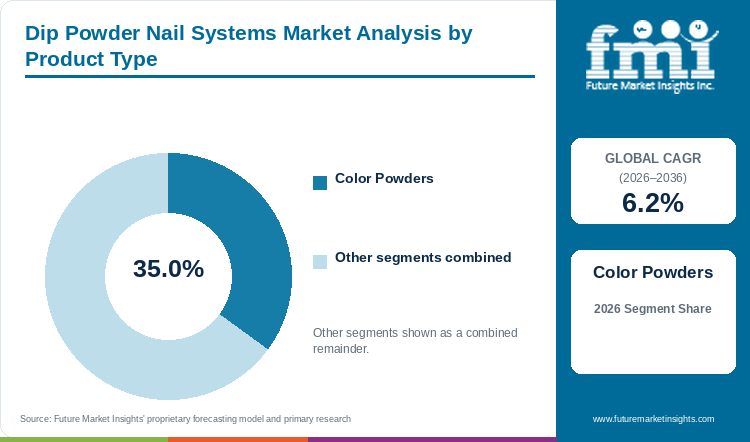
Color powders are expected to lead product type sales with 35% share in 2026, ahead of liquids and activators at 28%, starter kits at 25% and removal products at 12%.
Table 3: Product Type Share for the Dip Powder Nail Systems Market (percentage share), 2026
| Product Type | Estimated Share (2026) |
|---|---|
| Color Powders | 35% |
| Liquids and Activators | 28% |
| Starter Kits | 25% |
| Removal Products | 12% |
| Total | 100.0% |
Table 4: Product Type Leadership and Market Growth for the Dip Powder Nail Systems Market (segment and CAGR percentage), 2026 to 2036
| Metric | Value |
|---|---|
| Global CAGR (2026 to 2036) | 6.2% |
| Leading Segment | Color Powders |
Color powders, the part of the system clients choose by shade, are expected to account for 35% of 2026 product type demand. Next, liquids and activators, about 28%, are bought once per system and refilled less often than powders, though every service uses base, activator and top coat. Meanwhile, starter kits, an estimated 25%, bundle powders, liquids and tools for first-time home users and new salon stations. Finally, removal products hold 12%, covering acetone soaks, foils and files. Nail care routines around the service belong to the nail care products market, and personalised shade services show up in the custom nail polish market. Matched seasonal launches keep powder at the top of the mix. Wella Company matched 12 Fall 2026 shades in Powder Perfection.[4] Twelve new jars per collection keep color powders ahead of liquids, which salons refill less often.
- Solid creams, glitters, French pinks and whites, and clear builder powders make up most color powder sales.
- Hero shades now launch in powder on day one. The OPI summer 2026 hero shade, Go with the Floatie, was released in Nail Lacquer, GelColor and Powder Perfection.[1] A same-day powder release lets salons sell the lead shade of the season as a dip service from the start.
Why do nail salons lead dip powder nail systems sales by end user?
Nail salons are likely to lead end user sales with 53% share in 2026, with home users at 47%.
Table 5: End User Share for the Dip Powder Nail Systems Market (percentage share), 2026
| End User | Estimated Share (2026) |
|---|---|
| Nail Salons | 53% |
| Home Users | 47% |
| Total | 100.0% |
Nail salons will hold 53% of 2026 end user demand, as salons buy full shade walls and use powder on every dip client. A salon jar serves many clients, and professional lines such as Powder Perfection are sold for in-salon service only.[1] Salon-only distribution keeps premium powder volume inside the professional segment. By comparison, home users, about 47%, buy starter kits and a few shades, and many switch between dip, press-ons and lacquer. Of the rival formats, press-on kits compete hardest for home buyers, and the press-on nails market is forecast at a 7.1% CAGR.
- Full-service nail salons, express nail bars and salon suites carry most professional dip volume.
- Regulation is pushing salons toward lamp-free services. France bans professional use of TPO products in nail services, with no stock sell-off period.[2] French salons have to replace TPO gels at once, which adds dip stations to service menus.
Why does specialty beauty retail lead dip powder nail systems sales by sales channel?
Specialty beauty retail is projected to lead sales channel sales with 24% share in 2026, ahead of professional nail supply at 23.5%, online marketplaces at 22.5%, mass merchandisers and drugstores at 19% and brand websites at 11%.
Table 6: Sales Channel Share for the Dip Powder Nail Systems Market (percentage share), 2026
| Sales Channel | Estimated Share (2026) |
|---|---|
| Specialty Beauty Retail | 24% |
| Professional Nail Supply | 23.5% |
| Online Marketplaces | 22.5% |
| Mass Merchandisers and Drugstores | 19% |
| Brand Websites | 11% |
| Total | 100.0% |
Specialty beauty retail is projected to carry 24% of 2026 channel sales, as beauty chains stock both salon-grade and home dip lines and show the full shade wall. Close behind, professional nail supply, about 23.5%, serves technicians through licensed counters and distributor reps. Competition on those professional counters is rising. CosmoProf began selling The GelBottle Inc. in 487 locations in May 2026, so dip brands now share those counters with a larger gel range.[5] Online marketplaces, an estimated 22.5%, then carry low-priced home kits and refills. Beyond these, mass merchandisers and drugstores hold 19%, and brand websites 11%.
- Beauty chains, salon-grade retail counters and nail specialist stores make up specialty beauty retail.
- Gel brands are deepening ranges at professional counters. The GelBottle Inc. range at 96 CosmoProf stores runs to 108 SKUs, including lamps and gel colours.[5] A 108-SKU gel offer competes directly with dip for counter space and technician time.
What are the drivers, restraints, and opportunities in the dip powder nail systems market?
Long wear without a curing lamp keeps salons and home users buying dip. Removal damage and cheap press-ons hold back repeat use, and matched shade cards with clean ingredient files open new salon accounts.
- Driver: Salons and home users want a manicure that lasts two weeks or more and sets without a lamp.
- Restraint: Filing and acetone removal can thin the natural nail, and low-cost press-ons offer long wear with no chemistry.
- Opportunity: Brands can match seasonal shades across lacquer, gel and powder and supply full ingredient files to salons reviewing gel stock.
No-Lamp Wear Keeps Dip on the Service Menu
Clients who want long wear without a lamp choose dip. OPI describes Powder Perfection as a quick, no-light application with more than two weeks of wear.[1] A no-light claim with two-week wear gives salons an easy service to sell as gel rules tighten. In addition, each seasonal drop in powder gives salons a reason to add new jars.[4] Regular shade drops therefore turn lamp-free wear into recurring powder orders.
Removal Damage and Press-Ons Hold Back Repeat Use
Dip removal needs filing and an acetone soak, and poor technique leaves thin, sore nails. Cheaper long-wear options are also improving. KISS relaunched press-on kits in January 2026 with 32 nails per kit and up to 14-day wear from USD 10.99.[8] For this reason, FMI analysis shows home users most likely to drop dip for press-ons after a first removal goes wrong. In response, dip kit makers will add removal tools and step cards to every kit.
Ingredient Files Open New Salon Accounts
Gel rules are opening salon accounts to new suppliers. Salons in Great Britain face a TPO purchase cut-off on 14 February 2027 and are checking every product on the shelf.[3] In this review, dip suppliers that hand over full ingredient lists and safety files make the review easy. Likewise, matched shade cards across lacquer, gel and powder will gain shelf space at salons rebuilding the service menu.
Which country CAGRs are profiled in the dip powder nail systems market?
Table 7: Country CAGR Comparison for the Dip Powder Nail Systems Market (CAGR percentage), 2026 to 2036
| Country | CAGR (2026 to 2036) |
|---|---|
| GCC Countries | 7.4% |
| South Korea | 6.9% |
| United States | 6.6% |
| France | 6.3% |
| United Kingdom | 5.9% |
| Germany | 5.6% |
| Japan | 5.3% |
How do country-level CAGRs compare in the dip powder nail systems market?
FMI analysis shows GCC Countries growing fastest, at 7.4%, as mall salons and beauty chains in the Gulf add dip services. Next, South Korea follows at 6.9% on nail art demand and a strong cosmetics export base. The United States, at 6.6%, has the largest installed base of salon dip stations. Meanwhile, France grows at 6.3% as salons rework services after the TPO ban. Japan, at 5.3%, falls short of the 6.2% rate for the market as a whole, and the United Kingdom (5.9%) leads Germany (5.6%) by 0.3 points.
- New mall salons in the Gulf install dip stations from opening day, so powder demand rises with each salon added, and suppliers with Arabic-labelled salon lines gain early accounts.
- Korean nail art culture and export-ready beauty brands give powders a home market and an overseas route at once; local brands selling online abroad benefit most.
- The largest installed base of salon dip stations keeps US powder reorders high. Press-ons at USD 10.99 draw home users away, though, so kit makers need removal tools and refills to keep buyers.
- With TPO gels off French shelves since September 2025, salons are rebuilding menus around lamp-free services, giving dip suppliers with clean ingredient files a rare opening.
- The British cut-off comes in two steps, 2026 for sale and 2027 for trade purchase, which spreads salon switching over two years and gives dip brands time to sign distributors.
- German nail studios check every supplier for TPO-free stock under EU rules. Brands able to show complete safety files move to the front of buying lists.
- Japanese salons sell detailed gel art, which leaves dip a narrow service, so suppliers gain more from quick long-wear menus than from nail art lines.
Full report country CAGRs cover: all standard countries in the seven regions. GCC Countries head the range of key markets, and Japan closes the range on 5.3%.
Country-wise Analysis
GCC Countries Dip Powder Nail Systems Market Outlook (2026 to 2036)
Salons in malls across the United Arab Emirates and Saudi Arabia offer dip as a long-wear service for clients who visit less often in summer. To serve them, beauty chains import salon-grade and home dip lines with Arabic labels. Demand in GCC Countries is projected by FMI to grow at 7.4%, the top country rate, as new salons open with dip stations from the start.
Key takeaway: Each new Gulf salon adds a dip station from day one.
South Korea Dip Powder Nail Systems Market Outlook (2026 to 2036)
South Korean beauty exports give local nail brands scale. Korean cosmetics exports reached USD 11.43 billion in 2025, with the United States the largest buyer at USD 2.2 billion.[6] Within that trade, Korean nail brands sell powders and nail art products at home and abroad. Korean demand, led by nail art salons and online home kit sales, is expected to expand 6.9% a year.
Key takeaway: Export reach gives Korean nail brands a second growth route.
United States Dip Powder Nail Systems Market Outlook (2026 to 2036)
Professional and mass brands split US demand by price and channel. OPI sells Nail Lacquer at USD 11.99 a bottle and keeps Powder Perfection for in-salon service.[1] Keeping powder in salons protects professional pricing. At the same time, KISS sells press-on kits at USD 10.99 to USD 18.99, with retailer exclusives at Ulta and Walmart.[8] Press-on kits at that price compete head-on with home dip kits. On FMI's forecast the United States grows at 6.6%, with salon dip stations and home kits both adding volume.
Key takeaway: US growth comes from salon stations and home kits together.
France Dip Powder Nail Systems Market Outlook (2026 to 2036)
France enforced the TPO ban with no transition for salons. The DGCCRF confirmed in September 2025 that TPO products may no longer be sold or used in France, including by salon professionals.[2] As a result, French salons that relied on gel now review each product and add services that need no lamp. French dip sales are likely to rise 6.3% a year, just above the global rate.
Key takeaway: Gel rule changes favour dip in France.
United Kingdom Dip Powder Nail Systems Market Outlook (2026 to 2036)
Great Britain is phasing out TPO in two steps. TPO products may not be placed on the market in Great Britain from 15 August 2026, and nail technicians cannot buy them after 14 February 2027.[3] Salons can use stock already bought, so the change is gradual. On this basis, British salons adding dip beside reformulated gels point to 5.9% annual growth.
Key takeaway: A two-step TPO cut-off spreads British salon switching over two years.
Germany Dip Powder Nail Systems Market Outlook (2026 to 2036)
German salons fall under the EU-wide TPO rule. EU distributors stopped supplying TPO products from 1 September 2025.[7] German salons therefore follow the same rule and check suppliers for TPO-free stock. German nail studios are adding dip as an option for clients who want long wear without a lamp, and sales there are forecast to rise 5.6% a year.
Key takeaway: Safety files decide salon buying in Germany.
Japan Dip Powder Nail Systems Market Outlook (2026 to 2036)
Japan is a large buyer of Korean beauty products. Japan bought USD 1.1 billion of Korean cosmetics in 2025, half the United States figure of USD 2.2 billion.[6] That trade gives Korean nail products a ready route into Japanese stores. In Japan itself, salons favour gel and detailed nail art, and dip remains a smaller service. Japan is likely to see 5.3% growth, the slowest of the seven country rates, as gel menus hold the bulk of salon bookings.
Key takeaway: Gel and nail art habits limit dip in Japan.
Who are the notable companies in the dip powder nail systems market?
Wella Company, SNS Nails, Kiara Sky, Nugenesis, DND, Hand & Nail Harmony, Cuccio, Revel Nail and Kiss Products are the profiled companies.
Suppliers fall into professional dip brands, salon and home dip brands and mass home kit makers. Wella Company matched the summer and fall 2026 OPI collections in Powder Perfection.[1][4] Matching both collections gives Wella the deepest seasonal shade card in salon dip. In mass retail, Kiss Products relaunched press-on nails in January 2026.[8] The same company also sells Salon Dip starter kits for home use, so Kiss Products gains whichever format home users pick. FMI analysis places SNS Nails, Kiara Sky, Nugenesis, DND, Hand & Nail Harmony, Cuccio and Revel Nail in the same supplier group.
- Professional dip brands: Wella Company, SNS Nails, Nugenesis, DND, Hand & Nail Harmony and Cuccio.
- Salon and home dip brands: Kiara Sky and Revel Nail.
- Mass home kit maker: Kiss Products.
Competitive Benchmarking: Dip Powder Nail Systems Market
Table 8: Competitive Benchmarking for the Dip Powder Nail Systems Market (qualitative ratings), 2026
| Company | Matched Shade Cards | Salon Education | Home Kit Range | Recent Activity |
|---|---|---|---|---|
| Wella Company | High | High | Low | High |
| Kiss Products | Low | Low | High | High |
| SNS Nails | Medium | Medium | Low | Low |
| Kiara Sky | Medium | Medium | Medium | Low |
| Revel Nail | Low | Low | High | Low |
Ratings compare the companies on matched shade cards, salon education and home kit range.
Key Developments in the Dip Powder Nail Systems Market
- Wella Company's OPI Fall 2026 collection, announced on 31 August 2026, brought 12 permanent shades to GelColor, Nail Lacquer and Powder Perfection, adding powder jars to salon orders for the season.[4]
- The GelBottle Inc. went live in 487 CosmoProf stores in a rollout reported on 18 May 2026, which raises gel competition at professional counters.[5]
- On 1 May 2026, Wella Company launched the OPI Trip to the Brite Side collection in 12 shades matched across lacquer, gel and powder; for salons, this means one shade card for every service.[1]
- Kiss Products relaunched press-on nails on 22 January 2026 with 32 nails per kit and up to 14-day wear, a cheaper long-wear option for home dip users.[8]
- On 3 September 2025, the DGCCRF confirmed the French ban on TPO in nail products from 1 September 2025, which pushed French salons toward lamp-free services.[2]
Key Players in the Dip Powder Nail Systems Market
Professional Dip Brands
- Wella Company
- SNS Nails
- Nugenesis
- DND
- Hand & Nail Harmony
- Cuccio
Salon and Home Dip Brands
- Kiara Sky
- Revel Nail
Mass Home Kit Maker
- Kiss Products
Dip Powder Nail Systems Market - Report Scope
Table 9: Report Scope for the Dip Powder Nail Systems Market (coverage fields and definitions), 2026 to 2036
| Coverage field | Report scope |
|---|---|
| Market breakdown | Product type; end user; sales channel; region |
| Quantitative units | USD million |
| Market definition | Dip color powders, base, activator, top coat and bond liquids, dip starter kits and dip removal products sold to nail salons and home users for powder-and-resin manicures that set without a curing lamp. Nail services, gel polish, lacquer, acrylic liquid and powder for sculpting, press-on nails, lamps and general hand care are excluded. |
| Regions covered | North America; Latin America; Western Europe; Eastern Europe; East Asia; South Asia and Pacific; Middle East and Africa |
| Countries covered | United States; Canada; Brazil; Mexico; Argentina; Chile; Germany; France; United Kingdom; Italy; Spain; Benelux; Nordics; Poland; Czech Republic; Romania; Hungary; China; Japan; South Korea; India; ASEAN; Australia and New Zealand; GCC Countries; South Africa; Türkiye; Israel |
| Key companies profiled | Wella Company, SNS Nails, Kiara Sky, Nugenesis, DND, Hand & Nail Harmony, Cuccio, Revel Nail, Kiss Products |
| Forecast period | 2026 to 2036 |
Dip Powder Nail Systems Market - Research Methodology
Table 10: Research Methodology for the Dip Powder Nail Systems Market (research methods and approach), 2026 edition
| Method | Approach |
|---|---|
| Data Sources | Company results, industry associations, government statistics and trade publications. |
| Desk Research | Desk research covers shade launches, salon service rules, home kit prices and retail distribution. |
| Market Sizing and Forecasting | Sizing starts from the 2026 base of USD 419.9 million and the 6.2% CAGR for 2026 to 2036. |
| Data Validation | Figures are cross-checked across company, industry and government sources. |
Dip Powder Nail Systems Market by Segments
Dip Powder Nail Systems Market segmented by Product Type:
- Color Powders
- Liquids and Activators
- Starter Kits
- Removal Products
Dip Powder Nail Systems Market segmented by End User:
- Nail Salons
- Home Users
Dip Powder Nail Systems Market segmented by Sales Channel:
- Specialty Beauty Retail
- Professional Nail Supply
- Online Marketplaces
- Mass Merchandisers and Drugstores
- Brand Websites
Dip Powder Nail Systems Market by Region
- North America
- United States
- Canada
- Latin America
- Brazil
- Mexico
- Argentina
- Chile
- Western Europe
- Germany
- France
- United Kingdom
- Italy
- Spain
- Benelux
- Nordics
- Eastern Europe
- Poland
- Czech Republic
- Romania
- Hungary
- East Asia
- China
- Japan
- South Korea
- South Asia and Pacific
- India
- ASEAN
- Australia and New Zealand
- Middle East and Africa
- GCC Countries
- South Africa
- Türkiye
- Israel
Research Sources and Bibliography
- [1] Wella Company. (2026, May 1). Sky Blue's the Limit with OPI's NEW Summer Collection, Trip to the Brite Side Featuring Bright & Neon Shades. https://www.wellacompany.com/news/sky-blues-the-limit-with-opis-new-summer-collection-trip-to-the-brite-side-featuring-bright
- [2] Direction générale de la concurrence, de la consommation et de la répression des fraudes. (2025, September 3). Produits cosmétiques : depuis le 1er septembre 2025, l'oxyde de diphényl triméthylbenzoyl phosphine (TPO) est interdit. https://www.economie.gouv.fr/dgccrf/actualites-dgccrf/produits-cosmetiques-depuis-le-1er-septembre-2025-loxyde-de-diphenyl-trimethylbenzoyl-phosphine-tpo-est-interdit
- [3] Scratch Magazine. (2026, March 9). Great Britain's TPO ban: key dates & what it means for nail products, suppliers & techs. https://www.scratchmagazine.co.uk/news/great-britains-tpo-ban-what-it-means-for-nail-products-suppliers-techs
- [4] Wella Company. (2026, August 31). OPI Rereleases Celebrated Cult Classic Shades Plus New Remixes of Iconic Hues with OPI's Most Requested Collection for Fall 2026. https://www.wellacompany.com/news/opi-rereleases-celebrated-cult-classic-shades-plus-new-remixes-of-iconic-hues-with-opis-most
- [5] Beauty Launchpad. (2026, May 18). Beauty Systems Group and The GelBottle Inc. Go Nationwide. https://www.beautylaunchpad.com/business/brands/news/22966956/the-gelbottle-the-gelbottle-inc-announces-expansion-with-bsg-to-us
- [6] Personal Care Magazine. (2026, January 12). Korean cosmetics exports hit $11 billion record high in 2025. https://www.personalcaremagazine.com/story/50378/korean-cosmetics-exports-hit-11-billion-record-high-in-2025
- [7] ABC7 Los Angeles. (2025, September 3). European Union bans key ingredient in gel nail polish: What to know. https://abc7.com/post/european-union-bans-key-ingredient-gel-nail-polish-what-know/17729171/
- [8] Mass Market Retailers. (2026, January 22). KISS unveils new line up for 2026. https://massmarketretailers.com/kiss-unveils-new-line-up-for-2026/
This bibliography is provided for reader reference. The full report contains the complete reference list and detailed citations.
This Report Answers
- How big is the dip powder nail systems market during 2026?
- What market size is projected by 2036?
- Which product type holds notable share?
- Which end user holds notable share?
- Which countries have notable growth?
- Which companies are notable in the market?
Frequently Asked Questions
How large is the dip powder nail systems market expected in 2026?
The dip powder nail systems market is projected at USD 419.9 million in 2026, up from an estimated USD 395.4 million in 2025. FMI expects sales of dip powder nail systems to reach USD 766.3 million by 2036.
What CAGR is projected for the dip powder nail systems market through 2036?
Sales of dip powder nail systems are expected to grow at a 6.2% CAGR through 2036. Seasonal shade drops in powder and salon demand for long wear without a lamp support that pace.
Which product type holds a notable market share in 2026?
Color powders are expected to hold 35% of product type sales in 2026, seven points ahead of liquids and activators.
Which end user holds a notable market share in 2026?
Nail salons are likely to account for 53% of end user sales in 2026, against 47% for home users.
Which country has a notable expansion outlook through 2036?
FMI projects the fastest growth for GCC Countries, at a 7.4% CAGR. South Korea follows at 6.9%.
Who are the key companies in the dip powder nail systems market?
Wella Company, SNS Nails, Nugenesis, DND, Hand & Nail Harmony and Cuccio form the professional dip brands. Kiara Sky, Revel Nail and Kiss Products make up the salon, home and mass kit brands.
Preview the report firsthand - request a free sample
Get SampleGet the brochure for pricing and purchase details.
Get PDFTable of Content
- Key Takeaways
- Market Size and CAGR
- Top Growth Driver
- Fastest Growing Segment
- Leading Region
- Key Companies
- Emerging Opportunities
- Executive Summary
- Global Market Outlook
- Demand-side Trends
- Supply-side Trends
- Technology Roadmap Analysis
- Analysis and Recommendations
- Analyst Perspective (What is happening? Why now? What should investors know?)
- Key Questions Answered
- How large is the market?
- What is the CAGR?
- What are key trends?
- Which region dominates?
- Who are the leaders?
- Market Overview
- Market Coverage / Taxonomy
- Market Definition / Scope / Limitations
- Research Methodology
- Chapter Orientation
- Analytical Lens and Working Hypotheses
- Market Structure, Signals, and Trend Drivers
- Benchmarking and Cross-market Comparability
- Market Sizing, Forecasting, and Opportunity Mapping
- Research Design and Evidence Framework
- Desk Research Programme (Secondary Evidence)
- Expert Input and Fieldwork (Primary Evidence)
- Tooling, Models, and Reference Databases
- Data Engineering and Model Build
- Quality Assurance and Audit Trail
- Market Background
- Market Dynamics (Drivers, Restraints, Opportunity, Trends)
- Scenario Forecast (Optimistic, Likely, Conservative)
- Impact Analysis
- AI Impact
- Sustainability Impact
- Regulatory Impact
- Technology Impact
- Consumer / Buyer Analysis
- Purchase Drivers
- Adoption Barriers
- Buyer Journey
- Opportunity Map Analysis
- Product Life Cycle Analysis
- Supply Chain Analysis
- Investment Feasibility Matrix
- Value Chain Analysis
- PESTLE and Porter's Analysis
- Regulatory Landscape
- Regional Parent Market Outlook
- Production and Consumption Statistics
- Import and Export Statistics
- Global Market Analysis and Forecast, 2021 to 2036
- Historical Market Size Value (USD Million) Analysis, 2021 to 2025
- Current and Future Market Size Value (USD Million) Projections, 2026 to 2036
- Y-o-Y Growth Trend Analysis
- Absolute $ Opportunity Analysis
- Global Market Pricing Analysis, 2021 to 2036
- Global Market Analysis and Forecast, By Product Type, 2021 to 2036
- Introduction / Key Findings
- Historical Market Size Value (USD Million) Analysis By Product Type, 2021 to 2025
- Current and Future Market Size Value (USD Million) Analysis and Forecast By Product Type, 2026 to 2036
- Color Powders
- Liquids and Activators
- Starter Kits
- Removal Products
- Y-o-Y Growth Trend Analysis By Product Type, 2021 to 2025
- Absolute $ Opportunity Analysis By Product Type, 2026 to 2036
- Global Market Analysis and Forecast, By End User, 2021 to 2036
- Introduction / Key Findings
- Historical Market Size Value (USD Million) Analysis By End User, 2021 to 2025
- Current and Future Market Size Value (USD Million) Analysis and Forecast By End User, 2026 to 2036
- Nail Salons
- Home Users
- Y-o-Y Growth Trend Analysis By End User, 2021 to 2025
- Absolute $ Opportunity Analysis By End User, 2026 to 2036
- Global Market Analysis and Forecast, By Sales Channel, 2021 to 2036
- Introduction / Key Findings
- Historical Market Size Value (USD Million) Analysis By Sales Channel, 2021 to 2025
- Current and Future Market Size Value (USD Million) Analysis and Forecast By Sales Channel, 2026 to 2036
- Specialty Beauty Retail
- Professional Nail Supply
- Online Marketplaces
- Mass Merchandisers and Drugstores
- Brand Websites
- Y-o-Y Growth Trend Analysis By Sales Channel, 2021 to 2025
- Absolute $ Opportunity Analysis By Sales Channel, 2026 to 2036
- Global Market Analysis and Forecast, By Region, 2021 to 2036
- Introduction
- Historical Market Size Value (USD Million) Analysis By Region, 2021 to 2025
- Current Market Size Value (USD Million) Analysis and Forecast By Region, 2026 to 2036
- North America
- Latin America
- Western Europe
- Eastern Europe
- East Asia
- South Asia and Pacific
- Middle East and Africa
- Market Attractiveness Analysis By Region
- North America Market Analysis and Forecast, By Country, 2021 to 2036
- Historical Market Size Value (USD Million) Trend Analysis By Market Taxonomy, 2021 to 2025
- Market Size Value (USD Million) Forecast By Market Taxonomy, 2026 to 2036
- By Country
- United States
- Canada
- By Product Type
- By End User
- By Sales Channel
- By Country
- Market Attractiveness Analysis
- By Country
- By Product Type
- By End User
- By Sales Channel
- Key Takeaways
- Latin America Market Analysis and Forecast, By Country
- Historical Market Size Value (USD Million) Trend Analysis By Market Taxonomy, 2021 to 2025
- Market Size Value (USD Million) Forecast By Market Taxonomy, 2026 to 2036
- By Country
- Brazil
- Mexico
- Argentina
- Chile
- By Product Type
- By End User
- By Sales Channel
- By Country
- Market Attractiveness Analysis
- By Country
- By Product Type
- By End User
- By Sales Channel
- Key Takeaways
- Western Europe Market Analysis and Forecast, By Country
- Historical Market Size Value (USD Million) Trend Analysis By Market Taxonomy, 2021 to 2025
- Market Size Value (USD Million) Forecast By Market Taxonomy, 2026 to 2036
- By Country
- Germany
- France
- United Kingdom
- Italy
- Spain
- Benelux
- Nordics
- By Product Type
- By End User
- By Sales Channel
- By Country
- Market Attractiveness Analysis
- By Country
- By Product Type
- By End User
- By Sales Channel
- Key Takeaways
- Eastern Europe Market Analysis and Forecast, By Country
- Historical Market Size Value (USD Million) Trend Analysis By Market Taxonomy, 2021 to 2025
- Market Size Value (USD Million) Forecast By Market Taxonomy, 2026 to 2036
- By Country
- Poland
- Czech Republic
- Romania
- Hungary
- By Product Type
- By End User
- By Sales Channel
- By Country
- Market Attractiveness Analysis
- By Country
- By Product Type
- By End User
- By Sales Channel
- Key Takeaways
- East Asia Market Analysis and Forecast, By Country
- Historical Market Size Value (USD Million) Trend Analysis By Market Taxonomy, 2021 to 2025
- Market Size Value (USD Million) Forecast By Market Taxonomy, 2026 to 2036
- By Country
- China
- Japan
- South Korea
- By Product Type
- By End User
- By Sales Channel
- By Country
- Market Attractiveness Analysis
- By Country
- By Product Type
- By End User
- By Sales Channel
- Key Takeaways
- South Asia and Pacific Market Analysis and Forecast, By Country
- Historical Market Size Value (USD Million) Trend Analysis By Market Taxonomy, 2021 to 2025
- Market Size Value (USD Million) Forecast By Market Taxonomy, 2026 to 2036
- By Country
- India
- ASEAN
- Australia and New Zealand
- By Product Type
- By End User
- By Sales Channel
- By Country
- Market Attractiveness Analysis
- By Country
- By Product Type
- By End User
- By Sales Channel
- Key Takeaways
- Middle East and Africa Market Analysis and Forecast, By Country
- Historical Market Size Value (USD Million) Trend Analysis By Market Taxonomy, 2021 to 2025
- Market Size Value (USD Million) Forecast By Market Taxonomy, 2026 to 2036
- By Country
- GCC Countries
- South Africa
- Türkiye
- Israel
- By Product Type
- By End User
- By Sales Channel
- By Country
- Market Attractiveness Analysis
- By Country
- By Product Type
- By End User
- By Sales Channel
- Key Takeaways
- Key Countries Market Analysis
- United States
- Pricing Analysis
- Market Share Analysis, 2025
- By Product Type
- By End User
- By Sales Channel
- Canada
- Pricing Analysis
- Market Share Analysis, 2025
- By Product Type
- By End User
- By Sales Channel
- Mexico
- Pricing Analysis
- Market Share Analysis, 2025
- By Product Type
- By End User
- By Sales Channel
- Brazil
- Pricing Analysis
- Market Share Analysis, 2025
- By Product Type
- By End User
- By Sales Channel
- Chile
- Pricing Analysis
- Market Share Analysis, 2025
- By Product Type
- By End User
- By Sales Channel
- Germany
- Pricing Analysis
- Market Share Analysis, 2025
- By Product Type
- By End User
- By Sales Channel
- United Kingdom
- Pricing Analysis
- Market Share Analysis, 2025
- By Product Type
- By End User
- By Sales Channel
- Italy
- Pricing Analysis
- Market Share Analysis, 2025
- By Product Type
- By End User
- By Sales Channel
- Spain
- Pricing Analysis
- Market Share Analysis, 2025
- By Product Type
- By End User
- By Sales Channel
- France
- Pricing Analysis
- Market Share Analysis, 2025
- By Product Type
- By End User
- By Sales Channel
- India
- Pricing Analysis
- Market Share Analysis, 2025
- By Product Type
- By End User
- By Sales Channel
- ASEAN
- Pricing Analysis
- Market Share Analysis, 2025
- By Product Type
- By End User
- By Sales Channel
- Australia and New Zealand
- Pricing Analysis
- Market Share Analysis, 2025
- By Product Type
- By End User
- By Sales Channel
- China
- Pricing Analysis
- Market Share Analysis, 2025
- By Product Type
- By End User
- By Sales Channel
- Japan
- Pricing Analysis
- Market Share Analysis, 2025
- By Product Type
- By End User
- By Sales Channel
- South Korea
- Pricing Analysis
- Market Share Analysis, 2025
- By Product Type
- By End User
- By Sales Channel
- Poland
- Pricing Analysis
- Market Share Analysis, 2025
- By Product Type
- By End User
- By Sales Channel
- Hungary
- Pricing Analysis
- Market Share Analysis, 2025
- By Product Type
- By End User
- By Sales Channel
- Türkiye
- Pricing Analysis
- Market Share Analysis, 2025
- By Product Type
- By End User
- By Sales Channel
- South Africa
- Pricing Analysis
- Market Share Analysis, 2025
- By Product Type
- By End User
- By Sales Channel
- GCC Countries
- Pricing Analysis
- Market Share Analysis, 2025
- By Product Type
- By End User
- By Sales Channel
- United States
- Market Structure Analysis
- Competition Dashboard
- Competition Benchmarking
- Market Share Analysis of Top Players
- By Regional
- By Product Type
- By End User
- By Sales Channel
- Emerging Startups
- Innovation Benchmarking
- Competition Analysis
- Competition Deep Dive
- Wella Company
- Overview
- Product Portfolio
- Profitability by Market Segments
- Sales Footprint
- Strategy Overview
- Marketing Strategy
- Product Strategy
- Channel Strategy
- Kiss Products
- SNS Nails
- Kiara Sky
- Revel Nail
- Nugenesis
- DND
- Hand & Nail Harmony
- Cuccio
- Wella Company
- Case Studies
- Success Stories
- Recent Developments
- Competition Deep Dive
- Assumptions & Acronyms Used


