

- Market Size (2026)
- USD 277.5 Mn
- Forecast (2036)
- USD 435.1 Mn
- CAGR (2026 to 2036)
- 4.6%
How big is Nail Polish Removers Market in 2026?
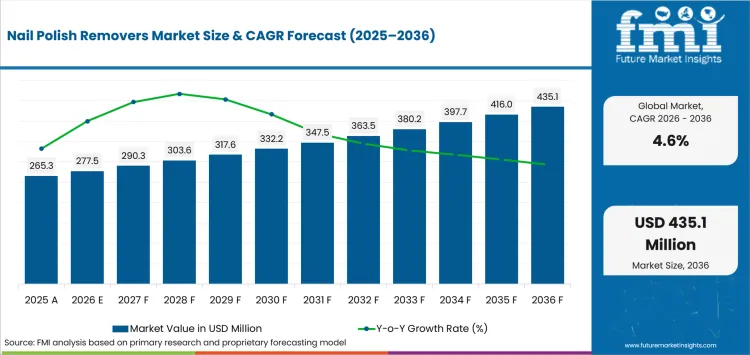
USD 277.5 million in 2026 and USD 435.1 million by 2036 at a 4.6% CAGR.
Demand for nail polish removers is projected to expand at 4.6% CAGR from 2026 to 2036, pushing valuation from USD 277.5 million in 2026 to USD 435.1 million by 2036. Repeated color changes keep removal tied to nail care products. Glamnetic refreshed its press-on remover format in July 2026 with a lighter travel-ready pack. The adjacent launch shows how removal convenience remains part of routine switching.
Country conversion varies because cosmetic compliance affects formulation and channel access. FDA data as of June 30 2026 recorded 1,298,361 active cosmetic product listings under MoCRA. The USA listing volume raises the documentation burden for brands competing for attention. Other markets add local safety and claims rules before a remover reaches the shelf.
Key Takeaways
- Repeat manicure changes support demand because every repaint or coating switch creates another removal occasion.
- Based on product type, core - classic lines are projected to account for 37.0% in 2026 due to broad-use familiarity.
- By nature, conventional products are estimated to hold 49.0% in 2026 owing to familiar solvent performance and accessible pricing.
- In 2026 cream & balm is expected to lead format with 30.0% share because controlled application can reduce spill and runoff.
- Safety failures can interrupt repeat purchase because prohibited chemistry or weak instructions expose suppliers to recalls and retailer screening.
- Some of the key players in this market include L'Oreal, Estee Lauder Companies, Church & Dwight, Olive & June, Glamnetic, Coty, e.l.f. Beauty, Kiss Products, Wella Company and Unilever.
Analyst Perspective
"Nail polish removers earn repeat purchase after a formula proves it can remove the intended coating without adding unnecessary handling risk. Strong offers make compatibility and ingredient controls easy to understand before the next manicure change."
- Rahul Pandita, Principal Consultant, Future Market Insights
How is the nail polish removers market segmented?
The market is assessed by Product Type, Nature, Format, Price Positioning and Sales Channel.
The nail polish removers market is segmented by product type, nature, format, price positioning and sales channel. Product type covers core - classic lines, targeted treatment lines, sensitive & gentle lines, premium & clinical lines and kits & sets. Nature, format, price positioning and sales channel define the remaining purchase choices used throughout the report.
What makes core - classic lines central to the product type category?
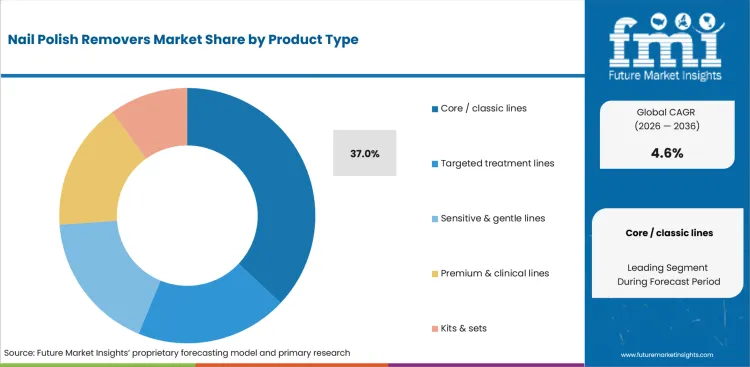
Core - classic lines address routine polish removal with the least explanation before purchase. Buyers already understand the trade-off between fast action and gentler handling. Coty listed Sally Hansen inside its Consumer Beauty portfolio in its August 2025 annual filing. Established nail brands keep mainstream removal linked to colour cosmetics systems.
- Core - classic lines account for 37.0% of product type in 2026 due to broad compatibility with routine manicure changes.
- Large nail portfolios lower education friction because consumers can match removal products with familiar polish systems.
Why does conventional lead the nature category?
Conventional formulations give developers the widest room to balance cosmetic chemicals and application feel. Specialty claims can narrow ingredient choices before performance is established. L'Oreal published its 2025 annual report in March 2026 and continued to frame beauty growth around scaled research and portfolio execution. That operating model favors formulas that can meet performance and compliance requirements across large channels.
- Conventional holds 49.0% of the nature category in 2026 owing to familiar performance and accessible price architecture.
- Vegan cosmetics and sensitivity-led variants need a clear consumer benefit without weakening removal speed or coating compatibility.
How does cream & balm shape the format category?
Cream & balm formats give users more control over placement than free-flowing liquids. Controlled dosing can reduce runoff around the cuticle and support skincare cues. Glamnetic refreshed its Press-On Nail Remover in July 2026 with a lighter and more compact pack. The adjacent development shows that format handling remains part of removal product design.
- Cream & balm represents 30.0% of the format category in 2026 as controlled application can reduce spill and runoff.
- Format value depends on practical coating removal rather than texture alone.
What supports mass in the price positioning category?
Mass positioning fits a replenishment product purchased beside polish in familiar personal care packaging and with basic manicure tools. Frequent use limits the premium buyers accept unless a higher-priced formula solves a clear removal problem. Ulta Beauty reported cosmetics as 39% of fiscal 2024 net sales in its March 2025 filing. Broad beauty retail keeps routine nail purchases exposed to price comparison and easy substitution.
- Mass accounts for 41.0% of price positioning in 2026 due to repeat-purchase economics that favor accessible price points.
- Premium pricing needs a measurable gain in removal time, handling comfort or aftercare.
What drives specialty beauty retail in the sales channel category?
Specialty beauty retail lets shoppers compare coatings and remover formats within one nail routine. The channel also supports salon services guidance when removal differs between classic lacquer and longer-wear systems. Olive & June announced a January 2026 debut in 600 Ulta Beauty stores with a complete DIY nail destination. System-led merchandising gives remover products more context than an isolated shelf placement.
- Specialty beauty retail holds 27.0% of the sales channel category in 2026 because shoppers can compare compatibility and instructions at purchase.
- Specialty placement is considerable when the remover sits beside the coating and tools that determine its use.
What are the drivers, restraints and opportunities in the nail polish removers market?
Repeat manicure change supports remover demand, while solvent safety and compliance can slow purchase and controlled gentler formats create room for differentiation.
- Driver: More frequent switching across classic, long-wear and gel-like manicure systems sustains repeat need for compatible removal.
- Restraint: Solvent safety, irritation concerns and non-compliant chemistry raise the burden of formulation control and consumer trust.
- Opportunity: Treatment-enhanced and controlled-dose formats can reduce mess or harshness while preserving removal performance.
Repeat manicure changes create a recurring removal step as users switch colors or replace worn coatings. Glamnetic documented another removal-led switching use in April 2025 by pairing its press-on collections with a dedicated remover. The product sits outside core polish-remover revenue but confirms that easy removal influences nail-system reuse. Mainstream remover suppliers benefit when coating instructions define the removal method clearly.
The main restraint in the market is formula safety. In April 2026 the FDA posted a recall of Morovan Gel Nail Polish Remover after methylene chloride and chloroform were detected. The notice covered about 4,000 units sold through Amazon from August 2025 to January 2026. Retailers and consumers therefore need performance claims backed by traceable personal care ingredients and clear handling instructions.
Cosmetic packaging and controlled-dose formats can reduce handling friction without changing the basic removal job. FDA updated its Cosmetics Direct materials in February 2026 as facilities prepared for biennial registration renewal under MoCRA. Stronger documentation systems raise the value of formats that combine practical use with traceable ingredient information. Suppliers can differentiate through dosing and aftercare only after compliance is secure.
Which country CAGRs are profiled in the nail polish removers market?
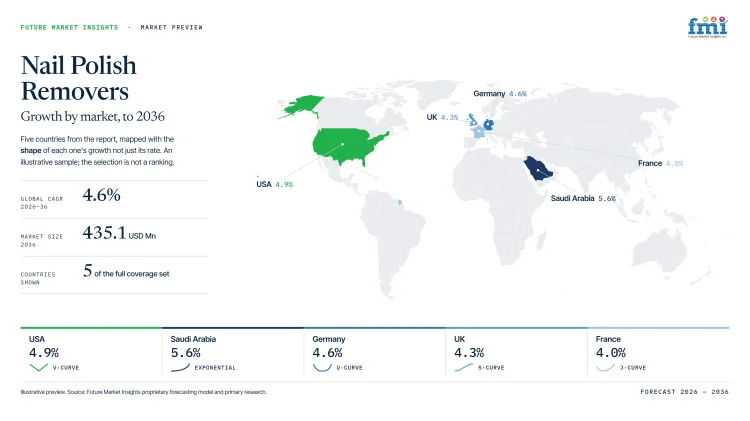
| Country | CAGR |
|---|---|
| USA | 4.9% |
| Germany | 4.6% |
| France | 4.0% |
| UK | 4.3% |
| Saudi Arabia | 5.6% |
| UAE | 5.9% |
| Japan | 3.6% |
| South Korea | 5.2% |
How do country-level CAGRs compare in the nail polish removers market?
The growth rates span 2.3 percentage points from UAE at 5.9% to Japan at 3.6% between 2026 and 2036. UAE and Saudi Arabia form the notable band. South Korea and USA are positioned just below them. Germany and UK occupy a mature middle band, while France and Japan expand more slowly.
- Saudi Arabia continues to offer robust opportunities, with commercial performance increasingly linked to regulatory execution and channel discipline.
- South Korea combines rapid product refresh cycles with heightened oversight, increasing the importance of strong safety credentials and well-substantiated product claims.
- The USA supports innovation and assortment expansion but requires clear documentation and product-level validation to maintain market credibility.
- Germany rewards suppliers that deliver consistent compliance and reliable execution within a highly mature retail environment.
- The UK presents opportunities through format innovation and stronger repeat-purchase dynamics rather than basic category expansion.
- France places greater emphasis on differentiated value propositions, precise claims and clear consumer benefits.
CAGR should be combined with channel structure and regulatory burden when evaluating opportunity. Price architecture and buyer behavior also matter. The full report provides country-level CAGR analysis across North America, Latin America, Western Europe, Eastern Europe, East Asia, South Asia and Pacific and the Middle East and Africa.
Country-wise Analysis
- USA buyers can move between mass retail and e-commerce while comparing speed and coating compatibility. The USA nail polish removers market is projected to expand at 4.9% CAGR from 2026 to 2036. In April 2026, the FDA posted the Morovan Gel Nail Polish Remover recall after prohibited methylene chloride and chloroform were detected. Online assortment breadth therefore creates a channel-screening challenge as well as convenience. Suppliers need clear ingredient disclosure, retailer compliance controls and removal instructions that distinguish classic polish from gel or builder systems.
- Germany combines mature cosmetic retail with formal post-market safety obligations. Sales of nail polish removers in Germany are expected to rise at 4.6% CAGR during the forecast period. On June 5, 2025, the German Federal Portal updated guidance for companies that manufacture, import or trade cosmetics. It states that these businesses must assess and report serious undesirable effects when they become aware of them. That raises the cost of weak vigilance processes for formula suppliers and distributors. Winning offers need dependable documentation, clear handling language and product claims that remain credible after purchase rather than only at the shelf.
- French consumers and professionals buy removers within a cosmetics system that places visible emphasis on adverse-effect vigilance. In France, demand for nail polish removers is set to advance at 4.0% CAGR over the assessment period. In February 2025, ANSES said it had taken responsibility for cosmetics vigilance from the start of 2024 and reported 378 cosmetics notifications during 2024, including 129 serious cases across the broader category. Nail varnishes fall within its cosmetics definition. Suppliers therefore need tolerability claims that are proportionate, instructions that limit misuse and formats that do not trade perceived gentleness for poor removal performance.
- UK purchasing is shaped by familiar beauty channels plus a defined pre-market responsibility framework in Great Britain. Nail polish remover adoption in the UK is forecast to expand at 4.3% CAGR through 2036. In July 2025, the Office for Product Safety and Standards stated that new cosmetics must be safety assessed and notified before being made available to consumers in Great Britain. Products also require a named Responsible Person and specified label information. The friction is administrative as well as chemical. Suppliers need compliant local responsibility arrangements, readable instructions and packaging that supports consumers in checking ingredients before purchase.
- Saudi Arabia offers faster growth but places formula and claims conformity inside the route-to-market decision. The Saudi Arabian nail polish removers market is projected to grow at 5.6% CAGR between 2026 and 2036. In June 2025, the Saudi Food and Drug Authority adopted updated Gulf technical regulations covering cosmetic safety and cosmetic claims. The update also moved controlled ingredient lists to the authority’s online system. Suppliers therefore need local regulatory ownership before accelerating assortment. Clear Arabic and English documentation, disciplined claims review and importer coordination can shorten the distance between consumer interest and compliant shelf availability.
- UAE beauty retail supports frequent product discovery, but registration and surveillance remain central to commercial execution. Nail polish remover sales in the UAE are forecast to increase at 5.9% CAGR across 2026 to 2036. In October 2025, Dubai Municipality highlighted its system for cosmetic evaluation and registration. The same system also covers shipment release and local market monitoring. It also presented the updated Montaji Plus platform and a smart-salon initiative. The friction is therefore not demand generation alone. Suppliers need accurate registration records, efficient shipment documentation and channel partners that can keep fast-moving assortments aligned with local compliance requirements.
- Japan buyers tend to reward precise product communication and reliable performance rather than broad ingredient storytelling. Japan’s nail polish removers demand is projected to expand at 3.6% CAGR for 2026-2036. In March 2025, the Ministry of Health, Labour and Welfare issued a notice on prominently featuring specific cosmetic ingredients. The notice requires the ingredient purpose to be stated and objectively substantiated when such highlighting is used. That raises the proof threshold for treatment-led remover claims. Suppliers should emphasize clear function, conservative claim wording and a removal experience that justifies switching in a mature market.
- South Korea combines rapid beauty product refresh with increasing formalization of cosmetics safety documentation. The South Korea nail polish removers market is expected to post 5.2% CAGR over 2026-2036. In June 2026, the Ministry of Food and Drug Safety issued guidance for preparing cosmetic safety-assessment materials. A July 2026 proposed rule then detailed qualifications, retention periods and recall-related provisions for the new system. This increases the value of structured technical files. Suppliers need trend-responsive formats, disciplined safety substantiation and local partners that can translate product refresh into compliant launches without documentation lag.
Who are the notable companies in the nail polish removers market?
L'Oreal, Estee Lauder Companies, Church & Dwight, Olive & June, Glamnetic, Coty, e.l.f. Beauty, Kiss Products, Wella Company and Unilever are the notable companies profiled in this market.
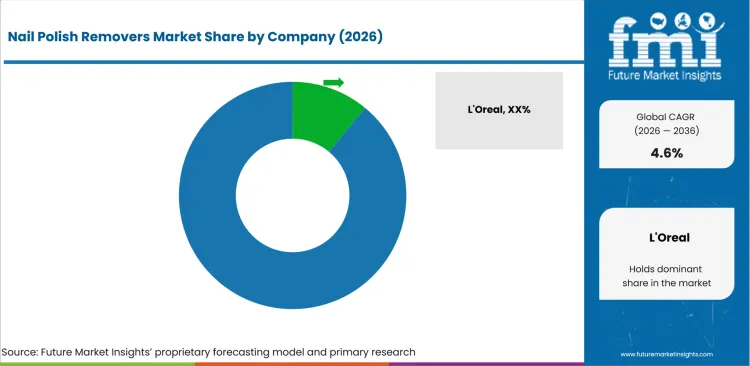
The competitive field is uneven because remover-specific public disclosure differs materially across the approved companies. Nail-system specialists and beauty groups with nail brands can influence the market through compatibility, accessories and retail education and beauty subscriptions. Olive & June has strengthened specialty beauty distribution, while Glamnetic and Kiss Products show how removal is packaged into adjacent press-on and extension workflows. Wella Company links remover behavior to OPI long-wear lacquer design. Coty places Sally Hansen within its Consumer Beauty portfolio, giving it established nail-category relevance. Larger beauty and consumer-care groups bring broad channel capabilities, but remover-specific evidence is less visible in reviewed public materials. Competitive assessment therefore favors documented nail workflow capability over assumptions based on corporate scale alone.
- Nail-system and removal-workflow specialists: Olive & June, Glamnetic, Kiss Products, Wella Company and Coty compete closest to manicure routines where removal compatibility can influence repeat purchase.
- Global color-cosmetics platforms: L'Oreal, Estee Lauder Companies and e.l.f. Beauty can use broader beauty-channel reach, although public remover-specific evidence varies and should not be inferred from company size.
- Diversified consumer-care platforms: Church & Dwight and Unilever bring broad consumer-product capabilities. Their role in this market is best treated qualitatively where remover-specific public documentation is limited.
Competitive Benchmarking: Nail Polish Removers Market
| Company | Removal-Workflow Integration | Nail-Specific Route to Market | Formula - Format Evidence | Geographic Reach |
|---|---|---|---|---|
| L'Oreal | Low | Medium | Low | Global beauty reach; remover-specific nail reach is not separately disclosed in reviewed dated materials. |
| Estee Lauder Companies | Low | Low | Low | Remover-specific reach not established in reviewed public materials. |
| Church & Dwight | Low | Low | Low | Remover-specific reach not established in reviewed public materials. |
| Olive & June | High | High | Medium | USA DTC, mass and specialty beauty retail; January 2026 expansion added 600 Ulta Beauty stores. |
| Glamnetic | High | Medium | High | North America-led DTC and retail context; removal evidence centers on adjacent press-on workflows. |
| Coty | Medium | High | Low | Global Consumer Beauty reach; Coty identifies Sally Hansen as an owned Consumer Beauty brand. |
| e.l.f. Beauty | Low | Low | Low | Remover-specific reach not established in reviewed public materials. |
| Kiss Products | High | High | Medium | USA online, mass and drugstore distribution with documented extension-removal workflow. |
| Wella Company | High | Medium | Medium | Major-market professional and consumer beauty context through OPI; dated evidence links long-wear lacquer to solvent release. |
| Unilever | Low | Low | Low | Remover-specific reach not established in reviewed public materials. |
Scoring basis: Removal-Workflow Integration measures dated evidence that removal is designed into a manicure or nail-system workflow. Nail-Specific Route to Market measures documented access through nail-focused retail or distribution. Formula - Format Evidence measures public evidence of a remover formulation or delivery format. High indicates broad direct evidence, Medium indicates credible but narrower evidence and Low indicates limited public evidence against the criterion.
Key Developments in the Nail Polish Removers Market
- In January 2026, Olive & June announced its debut at Ulta Beauty with a complete DIY nail assortment across 600 USA stores and Ulta.com. The expansion gives remover and care products more context beside the coatings that determine removal needs.
- In July 2026, Glamnetic refreshed its Press-On Nail Remover with a lighter and more compact travel-ready pack. The product serves an adjacent adhesive-removal workflow but demonstrates continued investment in low-friction nail switching.
- In August 2025, Coty filed its annual report listing Sally Hansen within Consumer Beauty and documenting pressure across USA color cosmetics. The filing shows established nail portfolios competing under tighter category economics rather than relying on brand breadth alone.
Key Players in the Nail Polish Removers Market
Nail-System and Removal-Workflow Specialists
- Olive & June
- Glamnetic
- Kiss Products
- Wella Company
- Coty
Global Color-Cosmetics Platforms
- L'Oreal
- Estee Lauder Companies
- e.l.f. Beauty
Diversified Consumer-Care Platforms
- Church & Dwight
- Unilever
Nail Polish Removers Market - Report Scope
| Coverage field | Report scope |
|---|---|
| Market breakdown | Product Type; Nature; Format; Price Positioning; Sales Channel |
| Quantitative Units | USD million |
| Market Definition | Revenue from nail polish remover products and remover kits sold for the primary purpose of removing nail lacquer, gel polish and closely related cosmetic nail coatings within the stated segmentation universe. Revenue from nail polish, nail services, press-on nails, adhesive-only removers, separate accessories, general-purpose solvents and other adjacent or substitute products is excluded. |
| Regions Covered | North America; Latin America; Western Europe; Eastern Europe; East Asia; South Asia and Pacific; Middle East and Africa |
| Countries Covered | USA, Germany, France, UK, Saudi Arabia, UAE, Japan, South Korea and more than twenty-five additional countries in the full report |
| Key Companies Profiled | L'Oreal; Estee Lauder Companies; Church & Dwight; Olive & June; Glamnetic; Coty; e.l.f. Beauty; Kiss Products; Wella Company; Unilever |
| Forecast Period | 2026 to 2036 |
| Approach | FMI applies a hybrid bottom-up and top-down sizing approach using product-level revenue indicators, channel checks, category structure, country conditions and forecast assumptions that are reconciled to the defined revenue boundary. |
Nail Polish Removers Market - Research Methodology
| Method | Approach |
|---|---|
| Primary Research | Structured discussions with manufacturers, distributors, specialty beauty retailers, salon professionals, procurement participants and subject-matter experts focus on formula positioning, channel behavior, pricing, replacement frequency, purchase triggers and adoption frictions. No respondent count or weighting claim is stated in this report. |
| Desk Research | Public regulatory guidance, national authority publications, company filings, dated company announcements, product documentation and other authoritative material are reviewed for scope-relevant facts. Adjacent categories are used only to explain workflows or buying behavior and are not counted as market revenue. |
| Market Sizing and Forecasting | Market sizing reconciles product and channel indicators with the defined revenue boundary. Forecasting considers repeat-use behavior, coating-system evolution, channel mix, regulatory conditions, pricing architecture and country-specific adoption constraints while preserving the stated forecast period and quantitative units. |
| Data Validation | Findings are cross-checked across source types and tested for scope fit. Validation removes double counting between kits and components where necessary, excludes unsupported claims, separates adjacent adhesive-removal products from nail polish remover revenue and retains cautious language where public evidence is incomplete. |
Nail Polish Removers Market by Segments
Nail Polish Removers Market segmented by Product Type:
- Core - classic lines
- Targeted treatment lines
- Sensitive & gentle lines
- Premium & clinical lines
- Kits & sets
Nail Polish Removers Market segmented by Nature:
- Conventional
- Vegan & cruelty-free
- Natural & organic
- Dermocosmetic - clinical
- Fragrance-free & sensitive
Nail Polish Removers Market segmented by Format:
- Cream & balm
- Liquid & serum
- Stick & solid
- Spray & mist
- Sheet & patch
- Powder
Nail Polish Removers Market segmented by Price Positioning:
- Mass
- Masstige
- Premium
- Professional
Nail Polish Removers Market segmented by Sales Channel:
- Specialty beauty retail
- E-commerce & DTC
- Pharmacies & drugstores
- Supermarkets & hypermarkets
- Salons & spas
Nail Polish Removers Market by Region:
- North America
- United States
- Canada
- Latin America
- Brazil
- Mexico
- Argentina
- Chile
- Western Europe
- Germany
- France
- United Kingdom
- Italy
- Spain
- Benelux
- Nordics
- Eastern Europe
- Poland
- Czech Republic
- Romania
- Hungary
- East Asia
- China
- Japan
- South Korea
- South Asia and Pacific
- India
- ASEAN
- Australia and New Zealand
- Middle East and Africa
- GCC Countries
- South Africa
- Türkiye
- Israel
Research Sources and Bibliography
- USA Food and Drug Administration (2026, April 13). Product Recall.
- Office for Product Safety and Standards (2025, July 10). Consumer products: cosmetics.
- ANSES (2025, February 3). Cosmétiques : comment mieux protéger la santé des consommateurs ?
- Bundesministerium der Justiz und für Verbraucherschutz / Bundesportal (2025, June 5). Unerwünschte Wirkungen und Gesundheitsschäden bei Kosmetik melden.
- Saudi Food and Drug Authority (2025, June 24). SFDA adopts updated Gulf technical regulations for cosmetic products.
- Dubai Municipality (2025, October 27). Dubai Municipality participation at Beautyworld Middle East 2025.
- Ministry of Health, Labour and Welfare, Japan (2025, March 10). Notice on special labeling of specific ingredients in cosmetics.
- Ministry of Food and Drug Safety, Republic of Korea (2026, June 10). Guideline for preparation of cosmetic safety assessment data.
- Ministry of Food and Drug Safety, Republic of Korea (2026, July 8). Advance notice of partial amendment to the Enforcement Rule of the Cosmetics Act (Notice No. 2026-331).
- Olive & June (2026, January 13). Olive & June Expands Retail Distribution in the USA With Debut at Ulta Beauty.
- Glamnetic (2026, July 23). Time For Your Routine Refresh: New Press-On Nails & Accessories.
- Coty Inc. (2025, August 21). Annual Report on Form 10-K for the fiscal year ended June 30, 2025.
- L'Oreal Finance (2026, March 23). Dive into the beauty of performance with the 2025 Annual Report.
- USA Food and Drug Administration. (2026, February 11). Registration & Listing of Cosmetic Product Facilities and Products.
- Ulta Beauty, Inc. (2025). Annual Report for fiscal year ended February 1, 2025.
- Glamnetic. (2025, April 10). Meet Your Happily Ever After.
This bibliography is provided for reader reference and is not exhaustive. The full report contains the complete reference list and detailed citations.
This Report Answers
- What is the Nail Polish Removers Market size in 2026 and what value is forecast for 2036?
- Which manicure-use and coating-system pressures support demand for nail polish removers?
- Why do Core - classic lines hold the leading position within Product Type?
- How does Conventional positioning influence purchase behavior across the Nature category?
- Why does Cream & balm hold the leading position within Format?
- How do forecast growth rates differ across USA, Germany, France, UK, Saudi Arabia, UAE, Japan and South Korea?
- Which approved companies are closest to nail-system, color-cosmetics and diversified consumer-care roles?
- How do solvent safety and compliance requirements constrain adoption or repeat purchase?
- What should beauty retailers, distributors and nail-care product managers evaluate before purchasing or listing a remover?
Frequently Asked Questions
How big is the nail polish removers market in 2026?
The nail polish removers market is valued at USD 277.5 million in 2026 and is projected to reach USD 435.1 million by 2036. Repeat manicure changes keep removal tied to recurring nail-care purchases.
What is the CAGR of the nail polish removers market from 2026 to 2036?
The nail polish removers market is projected to grow at a CAGR of 4.6% between 2026 and 2036. Expansion depends on coating compatibility and safe formulations that support repeat use.
Which product type leads the nail polish removers market?
The core - classic lines segment is expected to hold 37.0% of the nail polish removers market in 2026 due to broad-use familiarity. Routine polish changes keep mainstream remover compatibility commercially important.
Which nature segment leads the nail polish removers market?
The conventional segment is expected to hold 49.0% of the nail polish removers market in 2026 because familiar chemistry supports accessible pricing. Specialty claims must preserve practical removal performance.
Which companies are active in the nail polish removers market?
Key companies operating in the nail polish removers market include L'Oreal, Estee Lauder Companies, Church & Dwight, Olive & June, Glamnetic, Coty, e.l.f. Beauty, Kiss Products, Wella Company and Unilever. Their roles differ by nail-system depth and beauty-channel reach.
Preview the report firsthand - request a free sample
Get SampleGet the brochure for pricing and purchase details.
Get PDFTable of Content
- Key Takeaways
- Market Size and CAGR
- Top Growth Driver
- Fastest Growing Segment
- Leading Region
- Key Companies
- Emerging Opportunities
- Executive Summary
- Global Market Outlook
- Demand-side Trends
- Supply-side Trends
- Technology Roadmap Analysis
- Analysis and Recommendations
- Analyst Perspective (What is happening? Why now? What should investors know?)
- Key Questions Answered
- How large is the market?
- What is the CAGR?
- What are key trends?
- Which region dominates?
- Who are the leaders?
- Market Overview
- Market Coverage / Taxonomy
- Market Definition / Scope / Limitations
- Research Methodology
- Chapter Orientation
- Analytical Lens and Working Hypotheses
- Market Structure, Signals, and Trend Drivers
- Benchmarking and Cross-market Comparability
- Market Sizing, Forecasting, and Opportunity Mapping
- Research Design and Evidence Framework
- Desk Research Programme (Secondary Evidence)
- Expert Input and Fieldwork (Primary Evidence)
- Tooling, Models, and Reference Databases
- Data Engineering and Model Build
- Quality Assurance and Audit Trail
- Market Background
- Market Dynamics (Drivers, Restraints, Opportunity, Trends)
- Scenario Forecast (Optimistic, Likely, Conservative)
- Impact Analysis
- AI Impact
- Sustainability Impact
- Regulatory Impact
- Technology Impact
- Consumer / Buyer Analysis
- Purchase Drivers
- Adoption Barriers
- Buyer Journey
- Opportunity Map Analysis
- Product Life Cycle Analysis
- Supply Chain Analysis
- Investment Feasibility Matrix
- Value Chain Analysis
- PESTLE and Porter's Analysis
- Regulatory Landscape
- Regional Parent Market Outlook
- Production and Consumption Statistics
- Import and Export Statistics
- Global Market Analysis and Forecast, 2021 to 2036
- Historical Market Size Value (USD Million) Analysis, 2021 to 2025
- Current and Future Market Size Value (USD Million) Projections, 2026 to 2036
- Y-o-Y Growth Trend Analysis
- Absolute $ Opportunity Analysis
- Global Market Pricing Analysis, 2021 to 2036
- Global Market Analysis and Forecast, By Product Type, 2021 to 2036
- Introduction / Key Findings
- Historical Market Size Value (USD Million) Analysis By Product Type, 2021 to 2025
- Current and Future Market Size Value (USD Million) Analysis and Forecast By Product Type, 2026 to 2036
- Core / classic lines
- Targeted treatment lines
- Sensitive & gentle lines
- Premium & clinical lines
- Kits & sets
- Core / classic lines
- Y-o-Y Growth Trend Analysis By Product Type, 2021 to 2025
- Absolute $ Opportunity Analysis By Product Type, 2026 to 2036
- Global Market Analysis and Forecast, By Nature, 2021 to 2036
- Introduction / Key Findings
- Historical Market Size Value (USD Million) Analysis By Nature, 2021 to 2025
- Current and Future Market Size Value (USD Million) Analysis and Forecast By Nature, 2026 to 2036
- Conventional
- Vegan & cruelty-free
- Natural & organic
- Dermocosmetic / clinical
- Fragrance-free & sensitive
- Conventional
- Y-o-Y Growth Trend Analysis By Nature, 2021 to 2025
- Absolute $ Opportunity Analysis By Nature, 2026 to 2036
- Global Market Analysis and Forecast, By Format, 2021 to 2036
- Introduction / Key Findings
- Historical Market Size Value (USD Million) Analysis By Format, 2021 to 2025
- Current and Future Market Size Value (USD Million) Analysis and Forecast By Format, 2026 to 2036
- Cream & balm
- Liquid & serum
- Stick & solid
- Spray & mist
- Sheet & patch
- Powder
- Cream & balm
- Y-o-Y Growth Trend Analysis By Format, 2021 to 2025
- Absolute $ Opportunity Analysis By Format, 2026 to 2036
- Global Market Analysis and Forecast, By Price Positioning, 2021 to 2036
- Introduction / Key Findings
- Historical Market Size Value (USD Million) Analysis By Price Positioning, 2021 to 2025
- Current and Future Market Size Value (USD Million) Analysis and Forecast By Price Positioning, 2026 to 2036
- Mass
- Masstige
- Premium
- Professional
- Mass
- Y-o-Y Growth Trend Analysis By Price Positioning, 2021 to 2025
- Absolute $ Opportunity Analysis By Price Positioning, 2026 to 2036
- Global Market Analysis and Forecast, By Sales Channel, 2021 to 2036
- Introduction / Key Findings
- Historical Market Size Value (USD Million) Analysis By Sales Channel, 2021 to 2025
- Current and Future Market Size Value (USD Million) Analysis and Forecast By Sales Channel, 2026 to 2036
- Specialty beauty retail
- E-commerce & DTC
- Pharmacies & drugstores
- Supermarkets & hypermarkets
- Salons & spas
- Specialty beauty retail
- Y-o-Y Growth Trend Analysis By Sales Channel, 2021 to 2025
- Absolute $ Opportunity Analysis By Sales Channel, 2026 to 2036
- Global Market Analysis and Forecast, By Region, 2021 to 2036
- Introduction
- Historical Market Size Value (USD Million) Analysis By Region, 2021 to 2025
- Current Market Size Value (USD Million) Analysis and Forecast By Region, 2026 to 2036
- North America
- Latin America
- Western Europe
- Eastern Europe
- East Asia
- South Asia and Pacific
- Middle East & Africa
- Market Attractiveness Analysis By Region
- North America Market Analysis and Forecast, By Country, 2021 to 2036
- Historical Market Size Value (USD Million) Trend Analysis By Market Taxonomy, 2021 to 2025
- Market Size Value (USD Million) Forecast By Market Taxonomy, 2026 to 2036
- By Country
- USA
- Canada
- By Product Type
- By Nature
- By Format
- By Price Positioning
- By Sales Channel
- By Country
- Market Attractiveness Analysis
- By Country
- By Product Type
- By Nature
- By Format
- By Price Positioning
- By Sales Channel
- Key Takeaways
- Latin America Market Analysis and Forecast, By Country
- Historical Market Size Value (USD Million) Trend Analysis By Market Taxonomy, 2021 to 2025
- Market Size Value (USD Million) Forecast By Market Taxonomy, 2026 to 2036
- By Country
- Brazil
- Mexico
- Chile
- Rest of Latin America
- By Product Type
- By Nature
- By Format
- By Price Positioning
- By Sales Channel
- By Country
- Market Attractiveness Analysis
- By Country
- By Product Type
- By Nature
- By Format
- By Price Positioning
- By Sales Channel
- Key Takeaways
- Western Europe Market Analysis and Forecast, By Country
- Historical Market Size Value (USD Million) Trend Analysis By Market Taxonomy, 2021 to 2025
- Market Size Value (USD Million) Forecast By Market Taxonomy, 2026 to 2036
- By Country
- Germany
- UK
- Italy
- Spain
- France
- Nordic
- BENELUX
- Rest of Western Europe
- By Product Type
- By Nature
- By Format
- By Price Positioning
- By Sales Channel
- By Country
- Market Attractiveness Analysis
- By Country
- By Product Type
- By Nature
- By Format
- By Price Positioning
- By Sales Channel
- Key Takeaways
- Eastern Europe Market Analysis and Forecast, By Country
- Historical Market Size Value (USD Million) Trend Analysis By Market Taxonomy, 2021 to 2025
- Market Size Value (USD Million) Forecast By Market Taxonomy, 2026 to 2036
- By Country
- Russia
- Poland
- Hungary
- Balkan & Baltic
- Rest of Eastern Europe
- By Product Type
- By Nature
- By Format
- By Price Positioning
- By Sales Channel
- By Country
- Market Attractiveness Analysis
- By Country
- By Product Type
- By Nature
- By Format
- By Price Positioning
- By Sales Channel
- Key Takeaways
- East Asia Market Analysis and Forecast, By Country
- Historical Market Size Value (USD Million) Trend Analysis By Market Taxonomy, 2021 to 2025
- Market Size Value (USD Million) Forecast By Market Taxonomy, 2026 to 2036
- By Country
- China
- Japan
- South Korea
- By Product Type
- By Nature
- By Format
- By Price Positioning
- By Sales Channel
- By Country
- Market Attractiveness Analysis
- By Country
- By Product Type
- By Nature
- By Format
- By Price Positioning
- By Sales Channel
- Key Takeaways
- South Asia and Pacific Market Analysis and Forecast, By Country
- Historical Market Size Value (USD Million) Trend Analysis By Market Taxonomy, 2021 to 2025
- Market Size Value (USD Million) Forecast By Market Taxonomy, 2026 to 2036
- By Country
- India
- ASEAN
- Australia & New Zealand
- Rest of South Asia and Pacific
- By Product Type
- By Nature
- By Format
- By Price Positioning
- By Sales Channel
- By Country
- Market Attractiveness Analysis
- By Country
- By Product Type
- By Nature
- By Format
- By Price Positioning
- By Sales Channel
- Key Takeaways
- Middle East & Africa Market Analysis and Forecast, By Country
- Historical Market Size Value (USD Million) Trend Analysis By Market Taxonomy, 2021 to 2025
- Market Size Value (USD Million) Forecast By Market Taxonomy, 2026 to 2036
- By Country
- Kingdom of Saudi Arabia
- Other GCC Countries
- Türkiye
- South Africa
- Other African Union
- Rest of Middle East & Africa
- By Product Type
- By Nature
- By Format
- By Price Positioning
- By Sales Channel
- By Country
- Market Attractiveness Analysis
- By Country
- By Product Type
- By Nature
- By Format
- By Price Positioning
- By Sales Channel
- Key Takeaways
- Key Countries Market Analysis
- USA
- Pricing Analysis
- Market Share Analysis, 2025
- By Product Type
- By Nature
- By Format
- By Price Positioning
- By Sales Channel
- Canada
- Pricing Analysis
- Market Share Analysis, 2025
- By Product Type
- By Nature
- By Format
- By Price Positioning
- By Sales Channel
- Mexico
- Pricing Analysis
- Market Share Analysis, 2025
- By Product Type
- By Nature
- By Format
- By Price Positioning
- By Sales Channel
- Brazil
- Pricing Analysis
- Market Share Analysis, 2025
- By Product Type
- By Nature
- By Format
- By Price Positioning
- By Sales Channel
- Chile
- Pricing Analysis
- Market Share Analysis, 2025
- By Product Type
- By Nature
- By Format
- By Price Positioning
- By Sales Channel
- Germany
- Pricing Analysis
- Market Share Analysis, 2025
- By Product Type
- By Nature
- By Format
- By Price Positioning
- By Sales Channel
- UK
- Pricing Analysis
- Market Share Analysis, 2025
- By Product Type
- By Nature
- By Format
- By Price Positioning
- By Sales Channel
- Italy
- Pricing Analysis
- Market Share Analysis, 2025
- By Product Type
- By Nature
- By Format
- By Price Positioning
- By Sales Channel
- Spain
- Pricing Analysis
- Market Share Analysis, 2025
- By Product Type
- By Nature
- By Format
- By Price Positioning
- By Sales Channel
- France
- Pricing Analysis
- Market Share Analysis, 2025
- By Product Type
- By Nature
- By Format
- By Price Positioning
- By Sales Channel
- India
- Pricing Analysis
- Market Share Analysis, 2025
- By Product Type
- By Nature
- By Format
- By Price Positioning
- By Sales Channel
- ASEAN
- Pricing Analysis
- Market Share Analysis, 2025
- By Product Type
- By Nature
- By Format
- By Price Positioning
- By Sales Channel
- Australia & New Zealand
- Pricing Analysis
- Market Share Analysis, 2025
- By Product Type
- By Nature
- By Format
- By Price Positioning
- By Sales Channel
- China
- Pricing Analysis
- Market Share Analysis, 2025
- By Product Type
- By Nature
- By Format
- By Price Positioning
- By Sales Channel
- Japan
- Pricing Analysis
- Market Share Analysis, 2025
- By Product Type
- By Nature
- By Format
- By Price Positioning
- By Sales Channel
- South Korea
- Pricing Analysis
- Market Share Analysis, 2025
- By Product Type
- By Nature
- By Format
- By Price Positioning
- By Sales Channel
- Russia
- Pricing Analysis
- Market Share Analysis, 2025
- By Product Type
- By Nature
- By Format
- By Price Positioning
- By Sales Channel
- Poland
- Pricing Analysis
- Market Share Analysis, 2025
- By Product Type
- By Nature
- By Format
- By Price Positioning
- By Sales Channel
- Hungary
- Pricing Analysis
- Market Share Analysis, 2025
- By Product Type
- By Nature
- By Format
- By Price Positioning
- By Sales Channel
- Kingdom of Saudi Arabia
- Pricing Analysis
- Market Share Analysis, 2025
- By Product Type
- By Nature
- By Format
- By Price Positioning
- By Sales Channel
- Türkiye
- Pricing Analysis
- Market Share Analysis, 2025
- By Product Type
- By Nature
- By Format
- By Price Positioning
- By Sales Channel
- South Africa
- Pricing Analysis
- Market Share Analysis, 2025
- By Product Type
- By Nature
- By Format
- By Price Positioning
- By Sales Channel
- USA
- Market Structure Analysis
- Competition Dashboard
- Competition Benchmarking
- Market Share Analysis of Top Players
- By Regional
- By Product Type
- By Nature
- By Format
- By Price Positioning
- By Sales Channel
- Emerging Startups
- Innovation Benchmarking
- Competition Analysis
- Competition Deep Dive
- L'Oreal
- Overview
- Product Portfolio
- Profitability by Market Segments
- Sales Footprint
- Strategy Overview
- Marketing Strategy
- Product Strategy
- Channel Strategy
- Estee Lauder Companies
- Church & Dwight
- Olive & June
- Glamnetic
- Coty
- e.l.f. Beauty
- Kiss Products
- Wella Company
- Unilever
- L'Oreal
- Case Studies
- Success Stories
- Recent Developments
- Competition Deep Dive
- Assumptions & Acronyms Used


