

- Market Size (2026)
- USD 60.5 Bn
- Forecast (2036)
- USD 110.3 Bn
- CAGR (2026 to 2036)
- 6.2%
How big is Dog Food Market in 2026?
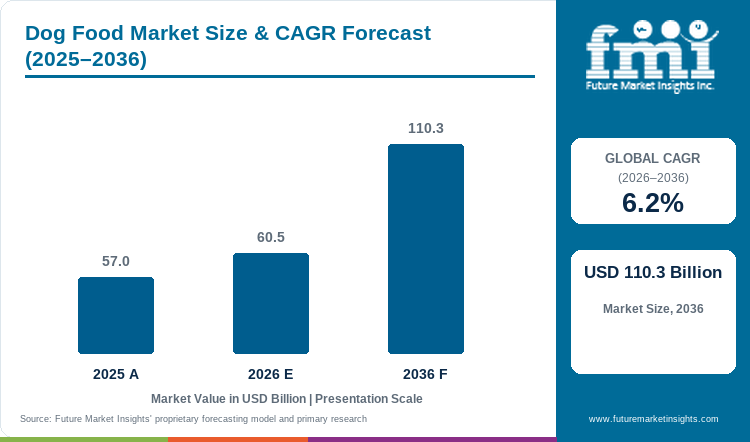
USD 60.5 Billion in 2026 and USD 110.3 Billion by 2036, expanding at a 6.2% CAGR.
Sales of dog food are estimated to grow at 6.2% from USD 60.5 Billion in 2026 to USD 110.3 Billion by 2036. The market was valued at USD 57.0 Billion in 2025. Repeat feeding creates a recurring purchase base, while the size of the dog-owning household population keeps demand increasing. The American Pet Products Association reported 68 million dog-owning U.S. households in its 2025 industry release, giving companies in this market opportunities to compete on specialized nutrition and treats.
Germany has a large dog population with strong grocery and online routes, while the UK has a 15.5 million dog population in 2026. South Korea has a smaller ownership base but a high share of dogs within pet-owning households. Japan depends more heavily on value per animal as dog numbers stabilize.
Key Takeaways
- Recurring feeding demand is supported by a large dog-owning household base, but growth increasingly depends on earning higher-value repeat purchases through credible nutrition and format differentiation.
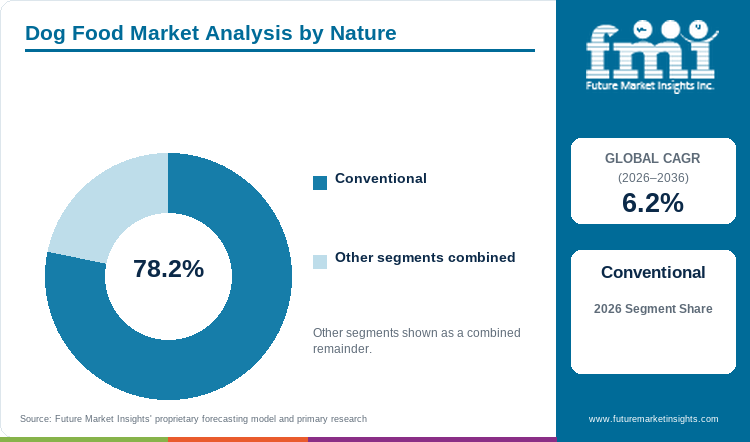
- Conventional leads with 78.2% in 2026 because broad availability and familiar price points support routine replenishment.
- Animal Derived leads with 43.6% in 2026 because familiar meat proteins remain central to palatability and protein-forward positioning.
- Kibble/Dry leads with 23.7% in 2026 because shelf stability, shipping efficiency and broad life-stage coverage support high-frequency household use.
- Germany records the highest CAGR at 8.0% from 2026 to 2036. Adoption can still slow when food-safety, labeling or household affordability requirements make a reformulation difficult to sustain.
- Profiled companies include Mars Petcare, Nestlé Purina PetCare, General Mills (Blue Buffalo), Hill's Pet Nutrition, J.M. Smucker, Diamond Pet Foods, Wellness Pet Company, Simmons Pet Food, Champion Petfoods, and Affinity Petcare.
Analyst Perspective
“Dog food revenue is built on repeat feeding, so a new claim or format has to survive the second and third purchase, not only win the first trial. Brands that connect a clear nutritional benefit with dependable palatability, channel availability and an acceptable feeding cost are better positioned to retain the household.”
- Nandini Roy Choudhury, Principal Consultant, Future Market Insights
How is the dog food market segmented?
The market is segmented by Nature, Source, Product Type, Pet Type, Distribution Channel, Packaging Type, and Region.
Nature includes Conventional, Organic, and Monoprotein. Source includes Animal Derived, Plant-derived, Chicken, Beef, Fish, Lamb, Duck, and Insect-derived. Product Type includes Kibble/Dry, Treats and Chews, Freeze-Dried Raw, Wet Food, Extruded, Coated, Frozen, and Powder. Pet Type covers Adult, Puppy, and Senior. Distribution Channel includes Store-based Retailing, Hypermarkets/Supermarkets, Pet Stores, Online Retailers, Discounters, Convenience Stores, Independent Grocery Retailers, and Mom and Pop Stores. Packaging Type covers Bags, Pouches, Folding Cartons, Cans, Tubs & Cups, and Bottles & Jars. Region covers North America, Latin America, Western Europe, Eastern Europe, East Asia, South Asia and Pacific, and Middle East and Africa.
Why does Conventional lead demand within the Nature category?
Conventional products benefit from long-established manufacturing systems and broad shelf access. They span entry-price recipes through specialized mainstream formulas, which reduces switching friction for owners who want predictable feeding routines. Organic pet food and monoprotein options can win specific need states, but they must justify a higher ingredient or formulation cost through a benefit that remains credible at repeat purchase.
- Conventional holds 78.2% of the Nature category in 2026 because mainstream availability and a wide price ladder make routine replenishment easier to sustain.
- APPA reported 68 million dog-owning U.S. households in its 2025 industry release. That scale supports a broad mainstream feeding base while leaving room for owners to trade up when a differentiated claim is easy to understand and repurchase.
Why does Animal Derived lead demand within the Source category?
Animal Derived recipes remain central because meat proteins connect directly with established palatability expectations and protein-led product positioning. Chicken and beef are familiar anchors, while fish, lamb and duck allow brands to build more distinct recipes. Plant-derived options can address dietary or sustainability preferences, while insect-based pet food requires stronger consumer education before it can displace familiar animal-protein choices at scale.
- Animal Derived accounts for 43.6% of Source in 2026 because familiar proteins support palatability and allow suppliers to serve both everyday and premium recipes.
- In March 2025, Wellness described CORE+ kibble with freeze-dried raw meat pieces. The format shows how visible animal protein can work as a premium cue rather than only a back-of-pack ingredient.
Why does Kibble/Dry lead demand within the Product Type category?
Kibble/Dry aligns with high-frequency replenishment because it is shelf-stable, easy to portion and efficient to store. Large pack sizes support household value calculations, while dry manufacturing accommodates broad life-stage portfolios. Wet, frozen and freeze-dried formats can command a higher price through palatability or perceived freshness. Pet treats add another repeat-purchase occasion, but core dry meals remain easier to integrate into everyday feeding routines.
- Kibble/Dry holds 23.7% of Product Type in 2026 because shelf stability and scaled production support wide distribution and routine household feeding.
- In May 2025, Mars opened a USD 450 million Royal Canin facility in Ohio designed around dry pet food. The investment shows that major suppliers continue to commit large manufacturing capital to dry-format capacity.
Why does Adult lead demand within the Pet Type category?
Adult dogs represent the longest recurring feeding phase between puppy growth and senior care. That gives adult formulas a larger window for repeat purchasing and creates room for weight, digestion and activity claims. Puppy and Senior products address narrower life-stage needs, so suppliers use adult portfolios as the volume base while specialized recipes deepen household retention.
- Adult represents 56.6% of Pet Type in 2026 because the adult feeding period supports sustained repeat purchasing across a broad range of household needs.
- In April 2025, Hill's extended ActivBiome+ Multi-Benefit technology into adult and senior Science Diet dry products. The launch shows how suppliers layer functional claims onto established life-stage platforms.
Why does Store-based Retailing lead demand within the Distribution Channel category?
Store-based Retailing remains important because owners can compare pack size, price and availability during routine shopping trips. Pet specialty stores also support advice and assortment discovery. Online retail adds convenience and scheduled replenishment, but physical access still matters for immediate purchase and bulky packs. The strongest route-to-market models increasingly treat physical and digital channels as complements.
- Store-based Retailing accounts for 48.1% of Distribution Channel in 2026 because immediate availability and physical assortment remain valuable for routine food replenishment.
- ZZF reported in April 2026 that grocery retail, including drugstores and discounters, represented 66% of stationary prepared-pet-food sales in Germany in 2025. The same release placed online pet-product sales above EUR 1.5 billion, reinforcing an omnichannel rather than store-only route to market.
Why do Bags lead demand within the Packaging Type category?
Bags fit dry and coated products particularly well because they combine pack-size flexibility with efficient storage and transport. Larger formats support household value calculations based on cost per feeding, while pouches and cans serve wet meals and portioned convenience. Pet care packaging therefore has to protect food quality while keeping handling, resealability and disposal practical for the household.
- Bags hold 33.8% of Packaging Type in 2026 because they match dry-food economics and allow suppliers to offer multiple pack sizes for different household purchasing patterns.
- In May 2025, Mars said its Royal Canin industrial pilot in Aimargues would test monomaterial and other circular packaging options. That work shows packaging design is being treated as a product-system issue rather than only a graphics decision.
What are the drivers, restraints and opportunities in the dog food market?
Dog ownership and recurring feeding support demand, while safety and affordability constrain conversion. Specialized nutrition and newer formats create room for higher-value repeat purchasing.
- Driver: Large dog-owning household bases create recurring replenishment and support trade-up when product benefits remain understandable and credible.
- Restraint: Food-safety controls and labeling requirements can slow reformulation or supplier switching. Ingredient cost and household price sensitivity add another barrier.
- Opportunity: Fresh and single-protein products can capture value when claims are documented. Functional and weight-management formats also need a practical route to repeat purchase.
The strongest demand mechanism is the recurring nature of feeding across a broad installed base of dogs. APPA reported 68 million dog-owning U.S. households in its 2025 industry release, while UK Pet Food estimated 15.5 million dogs in British homes in 2026. That scale supports frequent replenishment. The commercial upside appears when a brand adds a clear reason to trade up without disrupting the owner’s normal feeding routine.
The main restraint sits at the intersection of compliance and household economics. Pet food manufacturers have to manage ingredient control, food-safety systems and truthful label claims before a reformulated product reaches the shelf. Owners then apply a separate test: whether the incremental benefit is worth paying for every week or month. A technically stronger formula can still struggle if the feeding cost or storage requirement makes repeat purchase inconvenient.
The clearest opportunity is to make specialized nutrition easier to repurchase. Hill's entered refrigerated single-protein dog food in June 2026, Champion Petfoods launched ORIJEN FRESHPREY in March 2026, and Wellness Pet Company reported feeding-study results for weight-management recipes in June 2026. These moves show how natural pet food and fresh-style formats are being tied to specific protein, weight or wellness outcomes. The opportunity becomes revenue when palatability, storage practicality and channel availability support routine feeding rather than one-time trial.
Which country CAGRs are profiled in the dog food market?
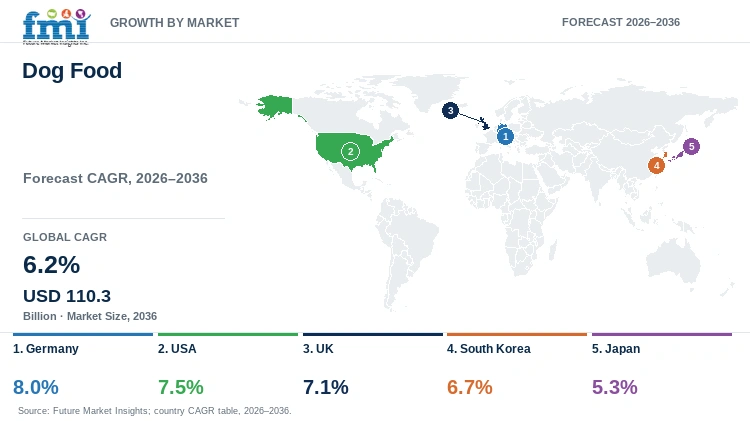
| Country | CAGR |
|---|---|
| Germany | 8.0% |
| USA | 7.5% |
| UK | 7.1% |
| South Korea | 6.7% |
| Japan | 5.3% |
How do country-level CAGRs compare in the dog food market?
Germany is the fastest profiled country at 8.0%, followed by the USA at 7.5% and the UK at 7.1%. South Korea is profiled at 6.7%, while Japan is at 5.3%. The 2.7 percentage-point spread reflects different combinations of ownership, channel development, product premiumization and value per animal.
- Germany: A large dog population combines with a strong grocery route and meaningful online spending, giving suppliers room to serve both mainstream and premium demand.
- USA: A very large dog-owning household base supports scale, while intense assortment competition raises the value of manufacturing capacity and clear product differentiation.
- UK: Rising dog ownership expands the replenishment base, particularly among younger adults, while price and convenience continue to shape format choice.
- South Korea: Dogs dominate pet ownership among pet-owning households, creating room for targeted nutrition even as monthly care budgets constrain premium conversion.
- Japan: Stable dog numbers shift the commercial focus toward value per animal through treats, functional nutrition and premium formulations rather than rapid household expansion.
Commercial planning needs to pair these growth rates with ownership patterns, route-to-market economics and the willingness of households to sustain a higher feeding cost. Faster growth does not remove the need for local channel fit or repeat-purchase discipline.
Country-wise Analysis
- Germany combines a large installed dog base with mature retail infrastructure. The country is profiled at an 8.0% CAGR from 2026 to 2036. ZZF reported 10.0 million dogs in 20% of German households in 2025. Its April 2026 market release also said grocery retail, including drugstores and discounters, generated 66% of stationary prepared-pet-food sales in 2025, while online pet-product sales exceeded EUR 1.5 billion. That combination favors suppliers that can manage mainstream availability and premium positioning at the same time.
- The USA has the broadest household demand signal among the profiled countries. APPA reported 68 million dog-owning households in its 2025 industry release. From 2026 to 2036, the country is profiled at a 7.5% CAGR. That base supports dry and wet feeding across multiple channels. It also gives treats, veterinary diets and newer fresh formats room to scale. It also attracts substantial manufacturing investment from large suppliers. Competition therefore occurs as much through portfolio architecture and route to market as through individual recipes. FDA food-safety and labeling rules create a clear qualification floor, so commercial differentiation must sit on top of consistent compliance and dependable supply.
- Dog ownership is a strong demand base in the UK. UK Pet Food estimated 15.5 million dogs in British homes in 2026. The Dog Food Market is profiled to grow at a 7.1% CAGR from 2026 to 2036 in the UK. The size of the ownership base supports routine food demand and creates opportunities for life-stage or convenience-led formats. Younger adults show particularly high dog ownership in the association's data. Suppliers still need to balance premium benefits with household budgets, while retail availability and easy replenishment remain important for recurring branded demand.
- South Korea offers a dog-heavy pet ownership structure with a growing formal pet economy. From 2026 to 2036, South Korea carries a 6.7% CAGR profile. The Ministry of Agriculture, Food and Rural Affairs reported that 29.2% of surveyed households kept pets in 2025. Dogs were present in 80.5% of pet-owning households. The same government survey placed average monthly dog-care spending at 135,000 won. That creates room for specialized nutrition, but it also gives owners a visible monthly budget constraint. Suppliers need to show why a functional or premium recipe earns recurring wallet share rather than assuming pet ownership alone supports trade-up.
- Japan's growth case is more dependent on value per animal than rapid dog-population expansion. The Japan Pet Food Association's 2025 survey estimated about 6.82 million dogs and described the population as stabilizing after earlier declines. Japan carries a 5.3% CAGR profile from 2026 to 2036. Industry materials also point to growth in treats and premium or functional products. That makes portioning and palatability important revenue levers. Age-related needs and perceived quality add further ways to raise value per animal. Suppliers that rely only on household expansion face a weaker structural tailwind than in faster-growing ownership markets. Product value must therefore do more of the commercial work.
Who are the notable companies in the dog food market?
Mars Petcare, Nestlé Purina PetCare, General Mills (Blue Buffalo), Hill's Pet Nutrition, J.M. Smucker, Diamond Pet Foods, Wellness Pet Company, Simmons Pet Food, Champion Petfoods, and Affinity Petcare are the notable companies profiled in this market.
Scaled branded suppliers use broad meal portfolios to cover more feeding occasions and price points. Science-led or premium specialists compete through therapeutic nutrition, ingredient architecture or tightly positioned brand systems. A third group competes through category specialization or manufacturing service. J.M. Smucker remains concentrated in dog snacks within its current pet exposure, while Simmons Pet Food focuses on private-label and contract wet pet food.
- Scaled branded multi-format portfolios: Mars Petcare, Nestlé Purina PetCare, General Mills (Blue Buffalo), and Wellness Pet Company.
- Science-led and specialized nutrition: Hill's Pet Nutrition, Diamond Pet Foods, Champion Petfoods, and Affinity Petcare.
- Treat-focused and private-label wet manufacturing: J.M. Smucker and Simmons Pet Food.
Competitive Benchmarking: Dog Food Market
| Company | Core Meal Format Breadth | Specialized Nutrition Depth | Treat & Emerging Format Breadth | Geographic Reach |
|---|---|---|---|---|
| Mars Petcare | High | High | High | Global brand and manufacturing footprint |
| Nestlé Purina PetCare | High | High | High | United States and international markets |
| General Mills (Blue Buffalo) | High | Medium | High | North America |
| Hill's Pet Nutrition | High | High | Medium | United States and international pet nutrition markets |
| J.M. Smucker | Low | Low | High | North America |
| Diamond Pet Foods | High | Medium | Low | United States and authorized international distributors |
| Wellness Pet Company | High | Medium | High | North America and Europe |
| Simmons Pet Food | Medium | Low | Low | North America |
| Champion Petfoods | Medium | Medium | High | International ORIJEN and ACANA distribution |
| Affinity Petcare | High | High | Low | Europe and international markets |
Scoring basis: Core Meal Format Breadth is High when broad dry and wet meal coverage is documented, Medium when one major format is complemented by narrower meal forms, and Low when the documented focus is materially narrower. Specialized Nutrition Depth is High for broad therapeutic or condition-specific nutrition and Medium for credible but narrower targeted-needs ranges. Treat & Emerging Format Breadth is High when a company covers treats plus newer formats such as fresh or freeze-dried, Medium for a developed adjacent format, and Low where the portfolio is concentrated more tightly around core meals.
Key Developments in the Dog Food Market
- In August 2026, Nestlé Purina PetCare opened a new pet food factory in Batavia, Ohio after an investment of more than USD 550 million. The site produces dry products including Purina Pro Plan, Purina ONE, and Dog Chow. The added capacity supports high-volume replenishment while giving Purina more manufacturing flexibility for a broad dry-food portfolio.
- In June 2026, Hill's Pet Nutrition announced Science Diet Single Protein Dog Food Rolls as its entry into refrigerated dog food. The products use single animal proteins and extend Hill's beyond conventional shelf-stable formats. The move gives the company a route into fresh-style feeding occasions without abandoning its science-led nutrition positioning.
- In June 2025, General Mills announced the national expansion of Blue Buffalo Love Made Fresh and the U.S. launch of Edgard & Cooper. Blue Buffalo was positioned across dry, wet and fresh formats, broadening the company’s ability to follow households across feeding occasions instead of competing only in established dry and wet aisles.
Key Players in the Dog Food Market
Scaled branded multi-format portfolios
- Mars Petcare
- Nestlé Purina PetCare
- General Mills (Blue Buffalo)
- Wellness Pet Company
Science-led and specialized nutrition
- Hill's Pet Nutrition
- Diamond Pet Foods
- Champion Petfoods
- Affinity Petcare
Treat-focused and private-label wet manufacturing
- J.M. Smucker
- Simmons Pet Food
Dog Food Market - Report Scope
| Coverage field | Report scope |
|---|---|
| Market breakdown | Nature; Source; Product Type; Pet Type; Distribution Channel; Packaging Type; Region |
| Quantitative Units | USD Billion |
| Market Definition | Includes revenue from dog food, treats, and chews sold as dog-feeding products within the stated segmentation universe. Excludes cat and other-species food, standalone supplements or veterinary drugs, pet accessories, separate service revenue, and ingredient sales that would create double counting. |
| Regions Covered | North America; Latin America; Western Europe; Eastern Europe; East Asia; South Asia and Pacific; Middle East and Africa |
| Countries Covered | USA; UK; Germany; Japan; South Korea |
| Key Companies Profiled | Mars Petcare; Nestlé Purina PetCare; General Mills (Blue Buffalo); Hill's Pet Nutrition; J.M. Smucker; Diamond Pet Foods; Wellness Pet Company; Simmons Pet Food; Champion Petfoods; Affinity Petcare |
| Forecast Period | 2026 to 2036 |
| Approach | Primary and secondary research with market triangulation. |
Dog Food Market - Research Methodology
| Method | Approach |
|---|---|
| Primary Research | FMI analysts gathered input from manufacturers, service providers, technology developers, distributors, end users, procurement teams and subject-matter experts. Interviews examined purchasing decisions, product or service evaluation, adoption barriers, approval requirements, pricing considerations and expectations for technical or commercial support. Respondents were also asked what evidence is required before a trial, pilot, or initial order develops into regular purchasing. |
| Desk Research | Desk research covered government statistics, regulatory publications, trade data, industry associations, technical literature, standards, company filings, product information and official corporate announcements. Sources were reviewed for relevance, publication date, geographic coverage and consistency with the defined market scope. Claims relating to performance, applications, approvals, capacity, investment and commercial activity were retained only when supported by credible public evidence. |
| Market Sizing and Forecasting | The market model combined the baseline value with historical performance, segment structure, pricing and volume indicators, adoption levels, company participation and country-level demand conditions. Forecast assumptions considered economic activity, investment trends, regulatory developments, technology adoption, purchasing cycles, supply availability and barriers to wider market use. Segment and regional estimates were reconciled before the final market total was calculated. |
| Data Validation | Estimates were checked against multiple independent indicators, including public data, company activity, trade patterns, industry developments and findings from primary interviews. Validation also tested whether products, services, applications and company revenues fell within the defined market boundaries. Adjacent categories, unsupported claims, overlapping revenues and activities without direct market relevance were excluded to reduce double counting and maintain consistency across segments and countries. |
Dog Food Market by Segments
Dog Food Market segmented by Nature:
- Conventional
- Organic
- Monoprotein
Dog Food Market segmented by Source:
- Animal Derived
- Plant-derived
- Chicken
- Beef
- Fish
- Lamb
- Duck
- Insect-derived
Dog Food Market segmented by Product Type:
- Kibble/Dry
- Treats and Chews
- Freeze-Dried Raw
- Wet Food
- Extruded
- Coated
- Frozen
- Powder
Dog Food Market segmented by Pet Type:
- Adult
- Puppy
- Senior
Dog Food Market segmented by Distribution Channel:
- Store-based Retailing
- Hypermarkets/Supermarkets
- Pet Stores
- Online Retailers
- Discounters
- Convenience Stores
- Independent Grocery Retailers
- Mom and Pop Stores
Dog Food Market segmented by Packaging Type:
- Bags
- Pouches
- Folding Cartons
- Cans
- Tubs & Cups
- Bottles & Jars
Dog Food Market by Region:
- North America
- United States
- Canada
- Latin America
- Brazil
- Mexico
- Argentina
- Chile
- Western Europe
- Germany
- France
- United Kingdom
- Italy
- Spain
- Benelux
- Nordics
- Eastern Europe
- Poland
- Czech Republic
- Romania
- Hungary
- East Asia
- China
- Japan
- South Korea
- South Asia and Pacific
- India
- ASEAN
- Australia and New Zealand
- Middle East and Africa
- GCC Countries
- South Africa
- Türkiye
- Israel
Research Sources and Bibliography
- American Pet Products Association (2025). The American Pet Products Association Releases 2025 State of the Industry Report.
- UK Pet Food (2026, March 31). Britain’s dog ownership boom as 15.5 million dogs now live in UK homes.
- ZZF (2026, April 23). The German pet market 2025: sales remain at a high level; pets in 43 percent of households.
- Ministry of Agriculture, Food and Rural Affairs, Republic of Korea (2026). 2025 companion animal ownership survey results.
- Japan Pet Food Association (2025). 2025 National Dog and Cat Ownership Survey.
- U.S. Food and Drug Administration (n.d.). FDA’s Regulation of Pet Food.
- Association of American Feed Control Officials (2025). Official Publication and Pet Food Labeling Guide resources.
- Mars (2025, May 14). Mars opens new USD 450 million Royal Canin facility in Ohio.
- Mars (2025, May 19). Mars continues investment in France, including Royal Canin manufacturing and packaging work.
- Mars (2026, May 5). Mars to invest AUD 200 million in Australian manufacturing.
- Nestlé Purina PetCare (2026, August 31). Purina opens new pet food factory in Ohio.
- General Mills (2025, June 23). General Mills accelerates growth with Blue Buffalo expansion into fresh and Edgard & Cooper U.S. launch.
- Hill's Pet Nutrition (2025, April 22). Hill's Science Diet portfolio expansion with microbiome innovation.
- Hill's Pet Nutrition (2026, June 30). Hill's rolls out Science Diet refrigerated dog food.
- The J.M. Smucker Co. (2026, June 9). Fiscal year 2026 fourth-quarter results and fiscal 2027 outlook.
- Diamond Pet Foods (n.d.). Dog food portfolio and Diamond CARE product information.
- Wellness Pet Company (2025, March 13). Why Wellness CORE+ is different.
- Wellness Pet Company (2026, January 8). Wellness Protein Bowls launch.
- Wellness Pet Company (2026, June 15). CORE Healthy Weight feeding-study results.
- Simmons Foods (n.d.). Pet food manufacturing and industries information.
- Mars (2026, March 5). ORIJEN launches FRESHPREY fresh pet food.
- Affinity Petcare (n.d.). Company and brand portfolio information.
This bibliography is provided for reader reference. Detailed citations and the complete reference list are included in the full report.
This Report Answers
- How large is the Dog Food Market in 2025 and 2026, and what value is forecast for 2036?
- Why does Conventional lead the Nature category?
- Why does Animal Derived lead the Source category?
- Why does Kibble/Dry lead the Product Type category?
- How do Adult dogs, Store-based Retailing and Bags shape their respective categories?
- How do the profiled country growth rates differ from 2026 to 2036?
- Which companies supply core meals, specialized nutrition, treats or private-label wet products?
- What limits adoption of specialized dog food and slows supplier or formulation switching?
Frequently Asked Questions
How big is the Dog Food Market in 2026, and what is forecast for 2036?
The market was valued at USD 57.0 Billion in 2025 and is valued at USD 60.5 Billion in 2026. It is forecast to reach USD 110.3 Billion by 2036 at a 6.2% CAGR.
What is the Dog Food Market CAGR from 2026 to 2036?
The market is forecast to grow at a 6.2% CAGR from 2026 to 2036. That rate describes the pace of market expansion and should not be interpreted as a segment share or a country market size.
Which Nature segment leads the Dog Food Market?
Conventional leads Nature with 78.2% in 2026. Its position reflects broad availability and mainstream price architecture that support routine replenishment.
Which Source segment leads the Dog Food Market?
Animal Derived leads Source with 43.6% in 2026. Familiar animal proteins support palatability cues and allow suppliers to differentiate recipes across mainstream and premium positions.
Which profiled countries have the highest growth rates in the Dog Food Market?
Germany has the highest profiled CAGR at 8.0%, followed by the USA at 7.5% and the UK at 7.1% from 2026 to 2036. South Korea is profiled at 6.7% and Japan at 5.3%, which indicates different growth speeds rather than absolute market ranking.
Which companies are active in the Dog Food Market?
Profiled companies are Mars Petcare, Nestlé Purina PetCare, General Mills (Blue Buffalo), Hill's Pet Nutrition, J.M. Smucker, Diamond Pet Foods, Wellness Pet Company, Simmons Pet Food, Champion Petfoods, and Affinity Petcare. Their roles range from broad branded portfolios to specialized nutrition, dog snacks and private-label wet manufacturing.
Preview the report firsthand - request a free sample
Get SampleGet the brochure for pricing and purchase details.
Get PDFTable of Content
- How big is Dog Food Market in 2026?
- Key Takeaways
- Analyst Perspective
- How is the dog food market segmented?
- Why does Conventional lead demand within the Nature category?
- Why does Animal Derived lead demand within the Source category?
- Why does Kibble/Dry lead demand within the Product Type category?
- Why does Adult lead demand within the Pet Type category?
- Why does Store-based Retailing lead demand within the Distribution Channel category?
- Why do Bags lead demand within the Packaging Type category?
- What are the drivers, restraints and opportunities in the dog food market?
- Which country CAGRs are profiled in the dog food market?
- How do country-level CAGRs compare in the dog food market?
- Country-wise Analysis
- Who are the notable companies in the dog food market?
- Competitive Benchmarking: Dog Food Market
- Key Developments in the Dog Food Market
- Key Players in the Dog Food Market
- Scaled branded multi-format portfolios
- Science-led and specialized nutrition
- Treat-focused and private-label wet manufacturing
- Dog Food Market - Report Scope
- Dog Food Market - Research Methodology
- Dog Food Market by Segments
- Dog Food Market segmented by Nature:
- Dog Food Market segmented by Source:
- Dog Food Market segmented by Product Type:
- Dog Food Market segmented by Pet Type:
- Dog Food Market segmented by Distribution Channel:
- Dog Food Market segmented by Packaging Type:
- Dog Food Market by Region:
- Research Sources and Bibliography
- This Report Answers
- Frequently Asked Questions
- Competitive Landscape


