

- Market Size (2026)
- USD 3.2 Bn
- Forecast (2036)
- USD 5.7 Bn
- CAGR (2026 to 2036)
- 5.9%
How big is Dust Collector Bags Market in 2026?
USD 3.2 billion in 2026 and USD 5.7 billion by 2036 at a 5.9% CAGR.
Dust collector bag demand is projected to rise at 5.9% CAGR, with valuation expected to reach USD 5.7 billion by 2036 from USD 3.2 billion in 2026 as cement plants maintain particulate controls. BWF Envirotec’s Turkish team illustrated replacement demand in April 2025 by replacing over 2,200 glass filter bags and cages at one baghouse. The changeout ties industrial air filtration demand to equipment because worn elements require planned replacement.
Brazil and Japan separate project activity from replacement-led orders despite a narrow forecast spread. Brazil’s 5.5% CAGR outlook exceeds Japan’s 4.3% as cement throughput remains more expansionary. SNIC reported in June 2026 that Brazilian first-half cement sales reached 32.9 million tonnes and increased 2.3% year over year. Higher throughput lengthens kiln-filter operating hours, while filter bag supply in Japan depends more on planned replacement cycles across an established plant base.
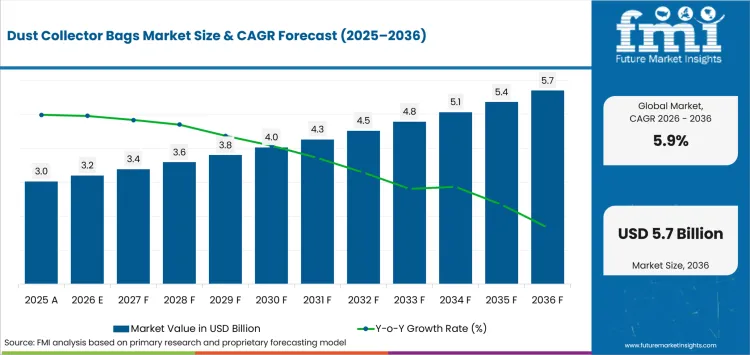
Key Takeaways of Dust Collector Bags Market
- Recurring bag replacement follows particulate-control duties across kiln and cooling systems plus milling and material handling throughout cement production.
- By fabric, polyester is estimated to hold 30.0% in 2026 owing to broad use across lower-temperature cement dust points.
- In 2026, pulse jet bags are expected to lead bag type with 52.0% share because online cleaning maintains filtration during dust-cake removal.
- The application category is forecast to be led by cement kiln / cooler at 29.0% share in 2026 due to concentrated thermal and particulate-control duties.
- Moisture exposure and temperature excursions can shorten bag life and increase qualification work before a cement plant changes media.
- Notable companies include Donaldson, BWF Envirotec, Parker Hannifin, Micronics (a Cleanova brand), Albarrie, Menardi Filters, Testori and Hien Powertech.
Analyst Perspective
"Cement plants should qualify dust collector bags against actual gas temperature and moisture exposure before comparing unit prices across competing media. The stronger commercial offer documents expected service life and keeps replacement stock close enough to complete changeouts inside scheduled kiln outages."
- Nikhil Kaitwade, Principal Consultant, Future Market Insights
How is the Dust Collector Bags Market segmented?
The dust collector bags market is segmented by fabric, bag type, application, temperature class, demand type and sales channel.
The fabric category covers polyester, aramid / Nomex, PTFE membrane, fiberglass, P84 / polyimide, acrylic and PPS. Bag type covers pulse jet bags, reverse air bags, shaker bags and pleated filter bags. Application covers cement kiln / cooler, raw mill, coal mill, clinker handling and packing plant. Temperature class covers <120°C, 120-200°C and >200°C. Demand type separates replacement / aftermarket from new installation. Within the temperature class category, 120-200°C is estimated to account for 43.0% in 2026 because many industrial dust-collection duties operate within this thermal range.
What makes polyester central to the fabric category?
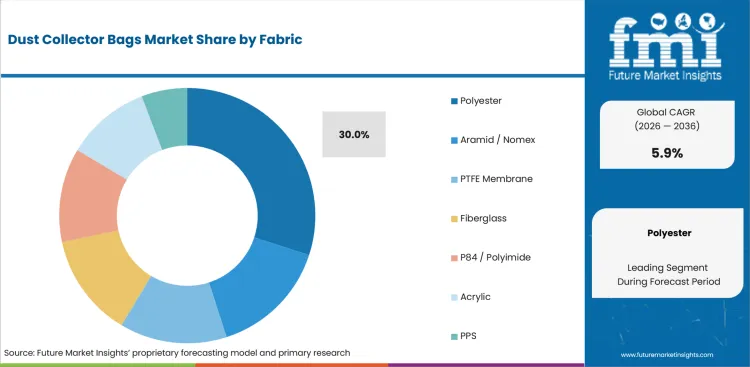
Polyester remains a familiar choice for lower-temperature fabric filter systems that stay within its thermal and chemical limits. Plant maintenance teams check moisture exposure and abrasion before repeating the existing fabric specification during scheduled changeouts.
- By fabric, polyester is estimated to hold 30.0% in 2026 owing to its broad fit across dry lower-temperature collection duties.
- Regional media availability directly protects planned changeouts from extended material lead times across multinational cement groups. Ahlstrom reported in April 2025 that fifteen filtration-material facilities supplied localized grades across North America, Europe and Asia for industrial uses including dust collectors.
Why do pulse jet bags lead the bag type category?
Pulse jet cleaning removes dust cake from selected bag rows without stopping airflow across the collector. EPA reported in April 2026 that fabric filters generally exceed 99% collection efficiency and pulse-jet cleaning leaves other bags filtering during each pulse. Cement dust control systems therefore preserve gas handling during frequent cleaning as the bag surface returns to particulate capture.
- Pulse jet bags are set to lead the bag type category with 52.0% share in 2026 due to online compressed-air cleaning.
- Continuous filtering during cleaning reduces production interruption and suits high dust loading at cement lines that cannot pause the full collector for each cleaning cycle.
How does cement kiln / cooler anchor the application category?
Kiln and cooler bag positions place air pollution control equipment beside abrasive clinker dust and temperature swings that repeatedly test fabric strength and seam integrity.
- Based on application, cement kiln / cooler is projected to account for 29.0% in 2026 due to concentrated particulate-control duty near clinker production.
- Higher kiln utilization increases filter exposure without proving the modeled application share across the category. TürkÇimento reported in March 2026 that Turkish cement production increased 10.5% during 2025 and reached a record annual level. Longer operating hours raise abrasion exposure and tighten replacement planning around clinker-line maintenance windows across integrated plants.
Why does replacement / aftermarket lead demand within the demand type category?
Replacement / aftermarket demand follows normal bag wear across operating collectors as dust loading, temperature and cleaning cycles reduce usable media life. Plant teams replace bags during planned outages to maintain collection performance without disrupting production schedules.
- By demand type, replacement / aftermarket is estimated to hold 78.0% in 2026 because installed baghouses require recurring filter-media renewal.
- Suppliers gain repeat orders when they can match bag dimensions, media specification and delivery timing for the installed collector. Local stock and changeout support help plants complete replacement campaigns within available shutdown windows.
What are the drivers, restraints and opportunities in the Dust Collector Bags Market?
Recurring maintenance sustains replacement demand while uneven project timing constrains new orders and connected monitoring adds an aftermarket service route.
- Driver: Scheduled baghouse maintenance converts particulate-control duty into repeat orders as worn bags and failed seals require planned replacement during operating shutdowns.
- Restraint: New bag orders can remain uneven when industrial projects are delayed even as operating plants continue routine emissions-control maintenance.
- Opportunity: Connected monitoring can add aftermarket service revenue by identifying baghouse changes before planned inspection and replacement decisions.
Installed Baghouse Maintenance Sustains Replacement Demand
Installed baghouses generate repeat orders as pressure loss and failed elements force maintenance inside planned shutdown windows across air pollution control systems that run during continuous cement production at plants. Donaldson reported in December 2025 that Industrial Filtration Solutions sales rose 1.6% as dust collection replacement parts contributed alongside new power-generation systems and recurring aftermarket activity between major industrial projects.
Uneven Dust-Collection Orders Limit Near-Term Conversion
Donaldson reported in June 2026 that Industrial Filtration Solutions sales rose 2.3% during its fiscal third quarter even as dust collection volumes declined. The split leaves industrial filtration orders exposed to project timing while installed collectors continue generating routine maintenance work. Bag manufacturers therefore need replacement programs that absorb softer project periods without assuming every equipment cycle converts into fresh baghouse demand.
Connected Monitoring Expands Aftermarket Service Routes
Connected monitoring gives maintenance teams pressure and performance signals across flat bag dust collectors before scheduled inspection or an emissions event requires attention at cement sites with dispersed field teams. Cleanova introduced Sentinel Connect in February 2026 for real-time baghouse monitoring, linking remote operating data with subscription support that guides inspection timing and replacement planning without requiring new collector installation.
Which country CAGRs are profiled in the Dust Collector Bags Market?
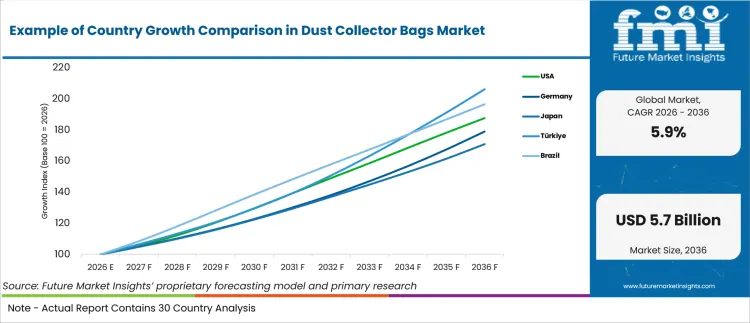
| Country | CAGR |
|---|---|
| Türkiye | 5.7% |
| Brazil | 5.5% |
| USA | 5.0% |
| Germany | 4.6% |
| Japan | 4.3% |
How do country-level CAGRs compare in the Dust Collector Bags Market?
The 1.4-percentage-point spread from Türkiye to Japan forms one compact forecast band across profiled countries. Türkiye and Brazil combine heavier cement production with recurring kiln filtration duty across export-oriented and dispersed plant networks. USA, Germany and Japan rely more on established baghouse fleets, making service access and shutdown execution more important than CAGR alone.
- Türkiye pairs export cement output with sustained kiln duty and baghouse loading.
- Brazil’s dispersed cement plants make regional inventory essential for scheduled bag changeouts.
- USA replacement demand depends on outage access across mature regulated cement plants.
- Germany’s plant network raises qualification requirements for premium-media replacement across existing baghouses.
- Japan’s compact installed base favors service-life improvements over greenfield collector projects.
Similar CAGRs produce different order patterns as local conditions shape replacement timing.
The full report provides country-level CAGR analysis across North America, Latin America, Europe, East Asia, South Asia, Oceania and the Middle East and Africa.
Country-wise Analysis
- TürkÇimento reported in June 2026 that Türkiye produced 97.8 million tonnes of cement in 2025 and exported 15.6 million tonnes to external markets worldwide. Export-oriented integrated plants therefore run long kiln schedules that expose filter bags to abrasive clinker dust and repeated cleaning across several collection points. Dust collector bag sales in Türkiye are forecast to expand at 5.7% CAGR by 2036, supported by sustained kiln use and recurring shutdown-based replacement work. High energy costs make premium media harder to justify, so manufacturers with local stock and field service must document longer bag life within planned maintenance windows for operators.
- Brazilian cement plants span long service corridors that make regional bag inventory and trained field crews central to reliable shutdown execution across dispersed operating sites nationwide. Adoption of dust collector bags in Brazil is estimated to expand at 5.5% CAGR through 2036, owing to continuing plant utilization and recurring aftermarket work. SNIC reported in May 2026 that cement sales reached 5.7 million tonnes and daily sales per working day rose 3.5% year over year. Long travel distances raise emergency changeout costs outside major industrial corridors, which favors manufacturers that can stage stock near operating clusters and dispatch application support quickly.
- The American Cement Association forecast in April 2026 that domestic cement consumption would decline 2.5% during 2026, reinforcing a mature replacement-led environment for operating cement baghouses. Cement plants therefore rely on planned outages within established industrial dust treatment networks more than on broad greenfield collector construction during softer equipment investment cycles. USA’s dust collector bags market outlook is anticipated to advance at 5.0% CAGR over the assessment period, supported by recurring maintenance across installed particulate-control systems. Plant engineers favor manufacturers that can verify bag life and deliver replacement inventory within scheduled kiln outages, since an extended changeout directly consumes valuable production time.
- German cement plants operate inside an established emissions-control network that makes documented pressure drop and service history central to current domestic filter-bag replacement decisions. Germany is estimated to post 4.6% CAGR over the forecast period, shaped by recurring filtration maintenance across an installed plant base with limited greenfield expansion. Technical support is readily available across a concentrated plant network, allowing engineering teams to compare media performance against established collector operating records. VDZ reported in May 2026 that roughly twenty cement manufacturers operated fifty sites, while five-year cement sales had fallen about one-third and raised the evidence bar for premium media.
- Japanese cement operators manage a compact mature plant base where reliable replacement intervals carry more commercial weight than large new-collector programs across existing kiln lines. The Japan Cement Association reported in October 2025 that fifteen companies operated twenty-six plants with 47.062 million tonnes of clinker capacity as of July 2025. The Japan dust collector bags sector is projected to record 4.3% CAGR during the assessment period, aided by recurring particulate-control maintenance across existing kiln lines. Subdued domestic construction limits new equipment pull, so manufacturers need dependable local technical support and service-life gains that justify replacing proven bag specifications during planned outages.
Who are the notable companies in the Dust Collector Bags Market?
Donaldson, BWF Envirotec, Parker Hannifin, Micronics (a Cleanova brand) , Albarrie, Menardi Filters, Testori and Hien Powertech are the notable companies serving this market.
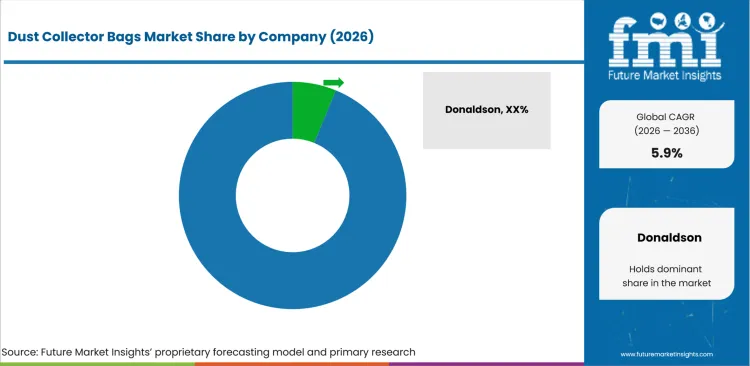
Competition is fragmented across global filtration groups and specialist fabricators that finish bags for specific collector geometries. Entry depends on repeatable sewing or pleating plus field evidence from cement baghouse duty. Broader air filter technologies carry little weight unless the finished bag matches process temperature and service teams can support a planned changeout.
- Donaldson, BWF Envirotec and Parker Hannifin combine broad filtration platforms with engineered baghouse products and international service networks.
- Micronics (a Cleanova brand) , Albarrie and Menardi Filters compete around finished-bag engineering plus field support for planned inspections and changeouts.
- Testori and Hien Powertech compete in technical-textile manufacturing, where fabric range and regional response shape cement-plant qualification decisions.
Competitive Benchmarking: Dust Collector Bags Market
| Company | Finished Bag Breadth | High-Temperature & Membrane Depth | Baghouse Service Depth | Geographic Reach |
|---|---|---|---|---|
| Donaldson | High | Medium | High | Global |
| BWF Envirotec | High | High | High | Europe with global production and service |
| Parker Hannifin | Medium | High | Medium | Global |
| Micronics (a Cleanova brand) | High | High | High | Americas, Europe, Asia and Australia |
| Albarrie | High | High | High | North America with international projects |
| Menardi Filters | High | High | High | North America with international supply |
| Testori | High | High | Medium | Europe, Asia, Americas and Australia |
| Hien Powertech | High | High | Medium | India with export-market supply |
Key Developments in the Dust Collector Bags Market
- In April 2026, Testori announced its acquisition of Tessitura Fratelli Fontana, adding technical-textile manufacturing capacity for industrial gas and process filtration applications.
- In March 2026, BWF Envirotec inaugurated a production facility in Rayong, adding Southeast Asian manufacturing and local service capacity for industrial filtration customers.
- In March 2025, PX3 Partners signed a definitive agreement for Cleanova to acquire Micronics (a Cleanova brand) Engineered Filtration Group, a transaction intended to combine complementary industrial-filtration portfolios.
Key Players in the Dust Collector Bags Market
Integrated Dust Collection and Filtration Platforms
- Donaldson
- BWF Envirotec
- Parker Hannifin
Engineered Baghouse and Field-Service Specialists
- Micronics (a Cleanova brand)
- Albarrie
- Menardi Filters
Technical Textile and Regional Bag Manufacturers
- Testori
- Hien Powertech
Dust Collector Bags Market - Report Scope
| Coverage field | Report scope |
|---|---|
| Market breakdown | By fabric, bag type, application, temperature class, demand type, sales channel and region. |
| Quantitative Units | USD million. |
| Market Definition | Revenue from finished dust collector bags and pleated bag-format elements used for cement-plant baghouse filtration. The scope excludes complete baghouses, cages sold alone, cartridge-only products, liquid filtration and non-cement applications. |
| Regions Covered | North America, Latin America, Europe, East Asia, South Asia and Pacific and Middle East and Africa. |
| Countries Covered | Türkiye, Brazil, USA, Germany, Japan, and 20+ countries included in the full report. |
| Key Companies Profiled | Donaldson, BWF Envirotec, Parker Hannifin, Micronics (a Cleanova brand), Albarrie, Menardi Filters, Testori, Hien Powertech. |
| Forecast Period | 2026 to 2036. |
| Approach | Primary and secondary research with market triangulation. |
Dust Collector Bags Market - Research Methodology
| Method | Approach |
|---|---|
| Primary Research | FMI analysts gathered input from manufacturers, service providers, technology developers, distributors, end users, procurement teams, and subject-matter experts. Interviews examined purchasing decisions, product or service evaluation, adoption barriers, approval requirements, pricing considerations, and expectations for technical or commercial support. Respondents were also asked what evidence is required before a trial, pilot, or initial order develops into regular purchasing. |
| Desk Research | Desk research covered government statistics, regulatory publications, trade data, industry associations, technical literature, standards, company filings, product information, and official corporate announcements. Sources were reviewed for relevance, publication date, geographic coverage, and consistency with the defined market scope. Claims relating to performance, applications, approvals, capacity, investment, and commercial activity were retained only when supported by credible public evidence. |
| Market Sizing and Forecasting | The market model combined the baseline value with historical performance, segment structure, pricing and volume indicators, adoption levels, company participation, and country-level demand conditions. Forecast assumptions considered economic activity, investment trends, regulatory developments, technology adoption, purchasing cycles, supply availability, and barriers to wider market use. Segment and regional estimates were reconciled before the final market total was calculated. |
| Data Validation | Estimates were checked against multiple independent indicators, including public data, company activity, trade patterns, industry developments, and findings from primary interviews. Validation also tested whether products, services, applications, and company revenues fell within the defined market boundaries. Adjacent categories, unsupported claims, overlapping revenues, and activities without direct market relevance were excluded to reduce double counting and maintain consistency across segments and countries. |
Dust Collector Bags Market by Segments
Dust Collector Bags Market segmented by Fabric:
- Polyester
- Aramid / Nomex
- PTFE Membrane
- Fiberglass
- P84 / Polyimide
- Acrylic
- PPS
Dust Collector Bags Market segmented by Bag Type:
- Pulse Jet Bags
- Reverse Air Bags
- Shaker Bags
- Pleated Filter Bags
Dust Collector Bags Market segmented by Application:
- Cement Kiln / Cooler
- Raw Mill
- Coal Mill
- Clinker Handling
- Packing Plant
Dust Collector Bags Market segmented by Temperature Class:
- <120°C
- 1200-200°C
- >200°C
Dust Collector Bags Market segmented by Demand Type:
- New Installation
- Replacement / Aftermarket
Dust Collector Bags Market segmented by Sales Channel:
- Direct OEM
- Plant MRO Supply
- Filtration Service Providers
- Distributors
Dust Collector Bags Market by Region:
- North America
- United States
- Canada
- Latin America
- Brazil
- Mexico
- Chile
- Rest of Latin America
- Western Europe
- Germany
- United Kingdom
- Italy
- Spain
- France
- Nordics
- Benelux
- Rest of Western Europe
- Eastern Europe
- Russia
- Poland
- Hungary
- Balkan and Baltic States
- Rest of Eastern Europe
- East Asia
- China
- Japan
- South Korea
- South Asia and Pacific
- India
- ASEAN
- Australia and New Zealand
- Rest of South Asia and Pacific
- Middle East and Africa
- Kingdom of Saudi Arabia
- Other GCC Countries
- Türkiye
- South Africa
- Other African Union Countries
- Rest of Middle East and Africa
Research Sources and Bibliography
- BWF Envirotec. (2025, April 3). Successful Project Completion by BWF Envirotec, Turkey!
- Sindicato Nacional da Indústria do Cimento. (2026, June). Resultados Preliminares Junho 2026.
- Ahlstrom. (2025, April 14). Ahlstrom's high-quality specialty materials and product localization cater to diverse filtration applications globally.
- USA Environmental Protection Agency. (2026, April 6). Monitoring by Control Technique - Fabric Filters.
- TÜRKÇİMENTO. (2026, March 9). Çimento ve Klinker İstatistikleri.
- Micronics (a Cleanova brand) Engineered Filtration Group. (2025, March 3). Inauguration of our India Center of Excellence in Chennai.
- Donaldson Company, Inc. (2025, December 4). Donaldson Reports Record First Quarter Fiscal Year 2026 Sales and Earnings.
- Donaldson Company, Inc. (2026, June 2). Donaldson Reports Record Third Quarter Fiscal 2026 Sales and Earnings.
- Cleanova. (2026, February 10). Cleanova Introduces Sentinel Connect™ to Deliver Real-Time Operational Intelligence for Industrial Filtration.
- TÜRKÇİMENTO. (2026, June 5). ADİL SANİ KONUKOĞLU ELECTED CHAIRMAN OF TOBB CEMENT AND CEMENT PRODUCTS COUNCIL.
- Sindicato Nacional da Indústria do Cimento. (2026, May). Resultados Preliminares Maio 2026.
- American Cement Association. (2026, April 30). USA Cement Industry’s Economic Forecast Reflects Uncertainty of War’s Future; Recession Still Unlikely.
- VDZ. (2026, May 5). Dr Dirk Spenner elected as new VDZ president.
- Japan Cement Association. (2025, October). The Cement Industry in Japan 2026.
- Testori Group. (2026, April 9). Acqusizione di Tessitura Fratelli Fontana.
- BWF Envirotec. (2026, April 22). A proud milestone for BWF Envirotec in Thailand.
- PX3 Partners. (2025, March 5). PX3 Enters Definitive Agreement for Cleanova to Acquire Micronics (a Cleanova brand) , creating a $1.3 billion global leader in industrial filtration.
This bibliography is provided for reader reference and is not exhaustive. The full report contains the complete reference list and detailed citations.
This Report Answers
- How does planned baghouse maintenance convert particulate duty into recurring filter-bag replacement demand?
- Which gas conditions force cement plants beyond standard polyester filter media?
- How does online pulse-jet cleaning affect operating continuity in high-dust cement baghouses?
- Which kiln and cooler conditions raise requirements for bag construction and sealing?
- How do project schedules affect new-bag orders even as installed baghouses continue generating replacement work?
- How do forecast conditions differ across Türkiye, Brazil, USA, Germany and Japan during the 2026 to 2036 period?
- Which capability thresholds distinguish the eight companies included in the competitive benchmark for dust collector bags?
- Which 2025 and 2026 developments changed manufacturing capacity, ownership plans or monitoring capability across industrial filtration suppliers?
Frequently Asked Questions
How big is the Dust Collector Bags Market in 2026?
The Dust Collector Bags Market is valued at USD 3.2 billion in 2026 and is projected to reach USD 5.7 billion by 2036. Operating baghouses require recurring bag replacement to sustain particulate-control performance.
What is the CAGR of the Dust Collector Bags Market from 2026 to 2036?
The Dust Collector Bags Market is projected to grow at a CAGR of 5.9% between 2026 and 2036. Replacement cycles and new filtration projects support demand across dust-intensive industrial operations.
Which fabric leads the Dust Collector Bags Market?
Polyester is projected to account for 30.0% of the Dust Collector Bags Market in 2026. Its broad suitability for lower-temperature dry collection duties supports its current share.
Which demand type holds the largest share of the Dust Collector Bags Market?
Replacement / aftermarket is projected to account for 78.0% of the Dust Collector Bags Market in 2026. Installed baghouses require recurring media replacement as fabric wears under operating conditions.
Which companies are active in the Dust Collector Bags Market?
Key companies include Donaldson, BWF Envirotec, Parker Hannifin, Micronics, Albarrie, Menardi Filters, Testori and Hien Powertech. They compete through bag breadth, high-temperature media and field-service capability.
Preview the report firsthand - request a free sample
Get SampleGet the brochure for pricing and purchase details.
Get PDFTable of Content
- Key Takeaways
- Market Size and CAGR
- Top Growth Driver
- Fastest Growing Segment
- Leading Region
- Key Companies
- Emerging Opportunities
- Executive Summary
- Global Market Outlook
- Demand-side Trends
- Supply-side Trends
- Technology Roadmap Analysis
- Analysis and Recommendations
- Analyst Perspective (What is happening? Why now? What should investors know?)
- Key Questions Answered
- How large is the market?
- What is the CAGR?
- What are key trends?
- Which region dominates?
- Who are the leaders?
- Market Overview
- Market Coverage / Taxonomy
- Market Definition / Scope / Limitations
- Research Methodology
- Chapter Orientation
- Analytical Lens and Working Hypotheses
- Market Structure, Signals, and Trend Drivers
- Benchmarking and Cross-market Comparability
- Market Sizing, Forecasting, and Opportunity Mapping
- Research Design and Evidence Framework
- Desk Research Programme (Secondary Evidence)
- Expert Input and Fieldwork (Primary Evidence)
- Tooling, Models, and Reference Databases
- Data Engineering and Model Build
- Quality Assurance and Audit Trail
- Market Background
- Market Dynamics (Drivers, Restraints, Opportunity, Trends)
- Scenario Forecast (Optimistic, Likely, Conservative)
- Impact Analysis
- AI Impact
- Sustainability Impact
- Regulatory Impact
- Technology Impact
- Consumer / Buyer Analysis
- Purchase Drivers
- Adoption Barriers
- Buyer Journey
- Opportunity Map Analysis
- Product Life Cycle Analysis
- Supply Chain Analysis
- Investment Feasibility Matrix
- Value Chain Analysis
- PESTLE and Porter's Analysis
- Regulatory Landscape
- Regional Parent Market Outlook
- Production and Consumption Statistics
- Import and Export Statistics
- Global Market Analysis and Forecast, 2021 to 2036
- Historical Market Size Value (USD Billion) Analysis, 2021 to 2025
- Current and Future Market Size Value (USD Billion) Projections, 2026 to 2036
- Y-o-Y Growth Trend Analysis
- Absolute $ Opportunity Analysis
- Global Market Pricing Analysis, 2021 to 2036
- Global Market Analysis and Forecast, By Fabric, 2021 to 2036
- Introduction / Key Findings
- Historical Market Size Value (USD Billion) Analysis By Fabric, 2021 to 2025
- Current and Future Market Size Value (USD Billion) Analysis and Forecast By Fabric, 2026 to 2036
- Polyester
- Aramid / Nomex
- PTFE Membrane
- Fiberglass
- P84 / Polyimide
- Acrylic
- PPS
- Polyester
- Y-o-Y Growth Trend Analysis By Fabric, 2021 to 2025
- Absolute $ Opportunity Analysis By Fabric, 2026 to 2036
- Global Market Analysis and Forecast, By Bag Type, 2021 to 2036
- Introduction / Key Findings
- Historical Market Size Value (USD Billion) Analysis By Bag Type, 2021 to 2025
- Current and Future Market Size Value (USD Billion) Analysis and Forecast By Bag Type, 2026 to 2036
- Pulse Jet Bags
- Reverse Air Bags
- Shaker Bags
- Pleated Filter Bags
- Pulse Jet Bags
- Y-o-Y Growth Trend Analysis By Bag Type, 2021 to 2025
- Absolute $ Opportunity Analysis By Bag Type, 2026 to 2036
- Global Market Analysis and Forecast, By Application, 2021 to 2036
- Introduction / Key Findings
- Historical Market Size Value (USD Billion) Analysis By Application, 2021 to 2025
- Current and Future Market Size Value (USD Billion) Analysis and Forecast By Application, 2026 to 2036
- Cement Kiln / Cooler
- Raw Mill
- Coal Mill
- Clinker Handling
- Packing Plant
- Cement Kiln / Cooler
- Y-o-Y Growth Trend Analysis By Application, 2021 to 2025
- Absolute $ Opportunity Analysis By Application, 2026 to 2036
- Global Market Analysis and Forecast, By Temperature Class, 2021 to 2036
- Introduction / Key Findings
- Historical Market Size Value (USD Billion) Analysis By Temperature Class, 2021 to 2025
- Current and Future Market Size Value (USD Billion) Analysis and Forecast By Temperature Class, 2026 to 2036
- 120-200°C
- <120°C
- >200°C
- 120-200°C
- Y-o-Y Growth Trend Analysis By Temperature Class, 2021 to 2025
- Absolute $ Opportunity Analysis By Temperature Class, 2026 to 2036
- Global Market Analysis and Forecast, By Demand Type, 2021 to 2036
- Introduction / Key Findings
- Historical Market Size Value (USD Billion) Analysis By Demand Type, 2021 to 2025
- Current and Future Market Size Value (USD Billion) Analysis and Forecast By Demand Type, 2026 to 2036
- Replacement / Aftermarket
- New Installation
- Replacement / Aftermarket
- Y-o-Y Growth Trend Analysis By Demand Type, 2021 to 2025
- Absolute $ Opportunity Analysis By Demand Type, 2026 to 2036
- Global Market Analysis and Forecast, By Region, 2021 to 2036
- Introduction
- Historical Market Size Value (USD Billion) Analysis By Region, 2021 to 2025
- Current Market Size Value (USD Billion) Analysis and Forecast By Region, 2026 to 2036
- North America
- Latin America
- Western Europe
- Eastern Europe
- East Asia
- South Asia and Pacific
- Middle East & Africa
- Market Attractiveness Analysis By Region
- North America Market Analysis and Forecast, By Country, 2021 to 2036
- Historical Market Size Value (USD Billion) Trend Analysis By Market Taxonomy, 2021 to 2025
- Market Size Value (USD Billion) Forecast By Market Taxonomy, 2026 to 2036
- By Country
- USA
- Canada
- By Fabric
- By Bag Type
- By Application
- By Temperature Class
- By Demand Type
- By Country
- Market Attractiveness Analysis
- By Country
- By Fabric
- By Bag Type
- By Application
- By Temperature Class
- By Demand Type
- Key Takeaways
- Latin America Market Analysis and Forecast, By Country
- Historical Market Size Value (USD Billion) Trend Analysis By Market Taxonomy, 2021 to 2025
- Market Size Value (USD Billion) Forecast By Market Taxonomy, 2026 to 2036
- By Country
- Brazil
- Mexico
- Chile
- Rest of Latin America
- By Fabric
- By Bag Type
- By Application
- By Temperature Class
- By Demand Type
- By Country
- Market Attractiveness Analysis
- By Country
- By Fabric
- By Bag Type
- By Application
- By Temperature Class
- By Demand Type
- Key Takeaways
- Western Europe Market Analysis and Forecast, By Country
- Historical Market Size Value (USD Billion) Trend Analysis By Market Taxonomy, 2021 to 2025
- Market Size Value (USD Billion) Forecast By Market Taxonomy, 2026 to 2036
- By Country
- Germany
- UK
- Italy
- Spain
- France
- Nordic
- BENELUX
- Rest of Western Europe
- By Fabric
- By Bag Type
- By Application
- By Temperature Class
- By Demand Type
- By Country
- Market Attractiveness Analysis
- By Country
- By Fabric
- By Bag Type
- By Application
- By Temperature Class
- By Demand Type
- Key Takeaways
- Eastern Europe Market Analysis and Forecast, By Country
- Historical Market Size Value (USD Billion) Trend Analysis By Market Taxonomy, 2021 to 2025
- Market Size Value (USD Billion) Forecast By Market Taxonomy, 2026 to 2036
- By Country
- Russia
- Poland
- Hungary
- Balkan & Baltic
- Rest of Eastern Europe
- By Fabric
- By Bag Type
- By Application
- By Temperature Class
- By Demand Type
- By Country
- Market Attractiveness Analysis
- By Country
- By Fabric
- By Bag Type
- By Application
- By Temperature Class
- By Demand Type
- Key Takeaways
- East Asia Market Analysis and Forecast, By Country
- Historical Market Size Value (USD Billion) Trend Analysis By Market Taxonomy, 2021 to 2025
- Market Size Value (USD Billion) Forecast By Market Taxonomy, 2026 to 2036
- By Country
- China
- Japan
- South Korea
- By Fabric
- By Bag Type
- By Application
- By Temperature Class
- By Demand Type
- By Country
- Market Attractiveness Analysis
- By Country
- By Fabric
- By Bag Type
- By Application
- By Temperature Class
- By Demand Type
- Key Takeaways
- South Asia and Pacific Market Analysis and Forecast, By Country
- Historical Market Size Value (USD Billion) Trend Analysis By Market Taxonomy, 2021 to 2025
- Market Size Value (USD Billion) Forecast By Market Taxonomy, 2026 to 2036
- By Country
- India
- ASEAN
- Australia & New Zealand
- Rest of South Asia and Pacific
- By Fabric
- By Bag Type
- By Application
- By Temperature Class
- By Demand Type
- By Country
- Market Attractiveness Analysis
- By Country
- By Fabric
- By Bag Type
- By Application
- By Temperature Class
- By Demand Type
- Key Takeaways
- Middle East & Africa Market Analysis and Forecast, By Country
- Historical Market Size Value (USD Billion) Trend Analysis By Market Taxonomy, 2021 to 2025
- Market Size Value (USD Billion) Forecast By Market Taxonomy, 2026 to 2036
- By Country
- Kingdom of Saudi Arabia
- Other GCC Countries
- Türkiye
- South Africa
- Other African Union
- Rest of Middle East & Africa
- By Fabric
- By Bag Type
- By Application
- By Temperature Class
- By Demand Type
- By Country
- Market Attractiveness Analysis
- By Country
- By Fabric
- By Bag Type
- By Application
- By Temperature Class
- By Demand Type
- Key Takeaways
- Key Countries Market Analysis
- USA
- Pricing Analysis
- Market Share Analysis, 2025
- By Fabric
- By Bag Type
- By Application
- By Temperature Class
- By Demand Type
- Canada
- Pricing Analysis
- Market Share Analysis, 2025
- By Fabric
- By Bag Type
- By Application
- By Temperature Class
- By Demand Type
- Mexico
- Pricing Analysis
- Market Share Analysis, 2025
- By Fabric
- By Bag Type
- By Application
- By Temperature Class
- By Demand Type
- Brazil
- Pricing Analysis
- Market Share Analysis, 2025
- By Fabric
- By Bag Type
- By Application
- By Temperature Class
- By Demand Type
- Chile
- Pricing Analysis
- Market Share Analysis, 2025
- By Fabric
- By Bag Type
- By Application
- By Temperature Class
- By Demand Type
- Germany
- Pricing Analysis
- Market Share Analysis, 2025
- By Fabric
- By Bag Type
- By Application
- By Temperature Class
- By Demand Type
- UK
- Pricing Analysis
- Market Share Analysis, 2025
- By Fabric
- By Bag Type
- By Application
- By Temperature Class
- By Demand Type
- Italy
- Pricing Analysis
- Market Share Analysis, 2025
- By Fabric
- By Bag Type
- By Application
- By Temperature Class
- By Demand Type
- Spain
- Pricing Analysis
- Market Share Analysis, 2025
- By Fabric
- By Bag Type
- By Application
- By Temperature Class
- By Demand Type
- France
- Pricing Analysis
- Market Share Analysis, 2025
- By Fabric
- By Bag Type
- By Application
- By Temperature Class
- By Demand Type
- India
- Pricing Analysis
- Market Share Analysis, 2025
- By Fabric
- By Bag Type
- By Application
- By Temperature Class
- By Demand Type
- ASEAN
- Pricing Analysis
- Market Share Analysis, 2025
- By Fabric
- By Bag Type
- By Application
- By Temperature Class
- By Demand Type
- Australia & New Zealand
- Pricing Analysis
- Market Share Analysis, 2025
- By Fabric
- By Bag Type
- By Application
- By Temperature Class
- By Demand Type
- China
- Pricing Analysis
- Market Share Analysis, 2025
- By Fabric
- By Bag Type
- By Application
- By Temperature Class
- By Demand Type
- Japan
- Pricing Analysis
- Market Share Analysis, 2025
- By Fabric
- By Bag Type
- By Application
- By Temperature Class
- By Demand Type
- South Korea
- Pricing Analysis
- Market Share Analysis, 2025
- By Fabric
- By Bag Type
- By Application
- By Temperature Class
- By Demand Type
- Russia
- Pricing Analysis
- Market Share Analysis, 2025
- By Fabric
- By Bag Type
- By Application
- By Temperature Class
- By Demand Type
- Poland
- Pricing Analysis
- Market Share Analysis, 2025
- By Fabric
- By Bag Type
- By Application
- By Temperature Class
- By Demand Type
- Hungary
- Pricing Analysis
- Market Share Analysis, 2025
- By Fabric
- By Bag Type
- By Application
- By Temperature Class
- By Demand Type
- Kingdom of Saudi Arabia
- Pricing Analysis
- Market Share Analysis, 2025
- By Fabric
- By Bag Type
- By Application
- By Temperature Class
- By Demand Type
- Türkiye
- Pricing Analysis
- Market Share Analysis, 2025
- By Fabric
- By Bag Type
- By Application
- By Temperature Class
- By Demand Type
- South Africa
- Pricing Analysis
- Market Share Analysis, 2025
- By Fabric
- By Bag Type
- By Application
- By Temperature Class
- By Demand Type
- USA
- Market Structure Analysis
- Competition Dashboard
- Competition Benchmarking
- Market Share Analysis of Top Players
- By Regional
- By Fabric
- By Bag Type
- By Application
- By Temperature Class
- By Demand Type
- Emerging Startups
- Innovation Benchmarking
- Competition Analysis
- Competition Deep Dive
- Donaldson
- Overview
- Product Portfolio
- Profitability by Market Segments
- Sales Footprint
- Strategy Overview
- Marketing Strategy
- Product Strategy
- Channel Strategy
- BWF Envirotec
- Filtration Group
- Ahlstrom
- Parker Hannifin
- Micronics (a Cleanova brand)
- Albarrie
- Menardi Filters
- Testori
- Hien Powertech
- Donaldson
- Case Studies
- Success Stories
- Recent Developments
- Competition Deep Dive
- Assumptions & Acronyms Used


