

- Market Size (2026)
- USD 0.5 Bn
- Forecast (2036)
- USD 1.4 Bn
- CAGR (2026 to 2036)
- 10.8%
Electro-Mechanical Brake Caliper Systems Market Size, Market Forecast and Outlook By FMI
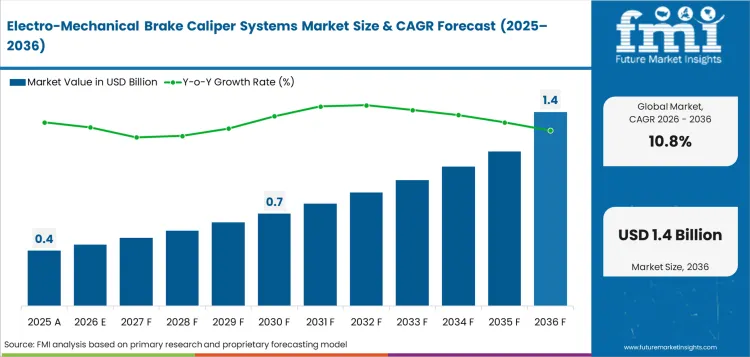
The electro-mechanical brake caliper systems market was valued at USD 0.4 billion in 2025 and is projected to reach USD 0.5 billion by the end of 2026. Demand is forecast to expand at a 10.8% CAGR from 2026 to 2036, taking the market to USD 1.4 billion by 2036. Rear calipers are expected to dominate with a 61.0% caliper type share, and motor gear actuators are expected to lead the actuation type segment with a 48.0% share.
Summary of the Electro-Mechanical Brake Caliper Systems Market
- Demand and Growth Drivers
- Electric vehicle architecture is raising demand for electric calipers as automakers reduce hydraulic lines and wheel drag.
- Brake-by-wire development is increasing use of electronic actuation as vehicle control units handle braking signals.
- Safety rules reinforce demand for faster brake response as automated emergency braking becomes standard on light vehicles.
- Product and Segment View
- Rear calipers are projected to hold 61.0% share in 2026 as rear axle placement reduces early EMB integration risk for automakers.
- Battery electric vehicles are forecast to account for 54.0% of propulsion-linked sales in 2026, with energy recovery control strengthening their use case.
- OEM integration is projected to account for the leading sales value, since brake system validation and software calibration must be completed inside vehicle platform programs.
- Geography and Competitive Outlook
- China is expected to record a CAGR of 14.2% by 2036 as EV platform turnover accelerates local testing.
- Germany is projected to expand at 12.6% CAGR through 2036, as chassis engineering depth favors early dry-brake programs.
- Companies combining actuator design with brake control software are strengthening their market position during the forecast period.
- Analyst Opinion
- Nikhil Kaitwade, Principal Consultant for Automotive at FMI, says, “Electro-mechanical brake calipers are becoming a controlled platform step for automakers seeking dry braking and cleaner wheel-end packaging. Buyers want actuator reliability and brake control software inside one validated program plan. Suppliers with fault-safe electronics and OEM testing access can reduce vehicle launch risk.”
- Electro-Mechanical Brake Caliper Systems Market Value Analysis
- The electro-mechanical brake caliper systems market is shifting from early test programs toward OEM platform integration.
- Electric vehicle programs are creating stronger demand for calipers able to reduce wheel drag and improve braking energy recovery.
- Premium electric vehicles are increasing the use of X-by-Wire systems as automakers move braking control into electronic architectures.
- Vehicle approval programs are placing higher value on validated braking records for safety compliance and launch readiness.
- Pricing pressure is most visible in redundant actuator design and durability testing for electronic brake assemblies.
Key Takeaways, Market Size and Forecast
- The electro-mechanical brake caliper systems market was valued at USD 0.4 billion in 2025 through platform-based bottom-up sizing.
- By 2036, the electro-mechanical brake caliper systems market is expected to be worth USD 1.4 billion.
- From 2026 to 2036, the market is projected to expand at a CAGR of 10.8%.
- The market is projected to create an incremental opportunity of USD 0.9 billion between 2026 and 2036.
- In 2026, rear calipers are expected to account for 61.0% of caliper type demand across early EMB programs.
- China and Germany are expected to be among the higher-growth country markets, with projected CAGRs of 14.2% and 12.6%, respectively.
Brake teams are now testing how electric calipers can replace part of the hydraulic braking system. ZF’s January 2025 contract for nearly 5 million vehicles shows rear-axle electro-mechanical braking is entering real vehicle programs, not only test projects. Rear-wheel use helps automakers control launch risk before moving toward full electric braking.
Brembo’s May 2026 Sensify production start confirms stronger readiness, since the system is fitted as standard on 100% of vehicles in its first program. Bosch’s 2,050-mile public-road brake-by-wire test in January 2025 shows why testing depth is important before OEM approval. Continental’s integrated brake-by-wire module, which reduces system weight by nearly 30%, adds a cost and packaging reason for automakers to study dry brake designs.
Electro-Mechanical Brake Caliper Systems Market Definition
The electro-mechanical brake caliper systems market includes wheel-end calipers using electric motors and local control electronics for service braking. These systems create clamp force through electric actuation instead of hydraulic pressure across vehicle braking events. Scope includes rear electric calipers, front electric calipers, automotive actuator assemblies, local controllers, and factory-installed brake-by-wire hardware. Hydraulic calipers without electric service braking and parking-only modules are outside the scope.
Electro-Mechanical Brake Caliper Systems Market Inclusions
Market scope covers all commercially traded electro-mechanical brake caliper systems categorized by caliper type, including rear calipers, front calipers, and all-wheel calipers; actuation type, including motor gear actuators, ball screw actuators, and wedge actuators; vehicle type, including passenger cars, light commercial vehicles, and heavy commercial vehicles; propulsion type, including battery electric vehicles, hybrid vehicles, and internal combustion vehicles; and sales channel, including OEM integration, platform retrofit, and service replacement.
Revenue scope covers 2026 to 2036. The key stakeholders include brake system manufacturers, actuator suppliers, automotive OEMs, chassis electronics providers, EV platform developers, Tier 1 component suppliers, software control specialists, testing laboratories, distributors, service networks, and regulatory bodies.
Electro-Mechanical Brake Caliper Systems Market Exclusions
Scope does not include hydraulic calipers, parking-only EPB actuator and caliper module products, brake pads, brake discs, brake fluids, brake valves, or standalone pedal simulators.
Electro-Mechanical Brake Caliper Systems Market Research Methodology
- Primary Research: FMI analysts spoke to brake system engineers, actuator suppliers, vehicle platform planners, and chassis electronics specialists in important markets.
- Desk Research: Combined data from safety regulations, EV sales records, official supplier releases, and public vehicle technology references.
- Market sizing and forecasting: Added platform fitment rates, caliper set pricing, vehicle type use, and country-level EV production signals from the bottom up.
- Data validation: Cross-checked every three months against brake-by-wire program timing, company product coverage, and automotive brake system & components demand.
Why is the Electro-Mechanical Brake Caliper Systems Market Growing?
EV makers are using electric calipers to reduce hydraulic complexity and improve control over wheel-end braking force.
Chassis-by-wire systems need faster electronic response as driver inputs and brake commands move through control units.
Automakers are testing rear axle EMB first to reduce validation risk before full four-wheel dry braking.
Electric vehicle scale is turning brake design into a software and actuator decision. IEA reported electric car sales exceeding 20 million in 2025, equal to one-quarter of all new cars sold worldwide. This large EV base raises the value of wheel-end braking hardware with lower drag and better energy recovery. Brake suppliers gain importance as automakers connect friction braking with regenerative braking system control across platform families.
Safety regulation is creating a second demand path for faster electronic braking. The May 2024 Federal Register final rule adopted FMVSS No. 127 for automatic emergency braking and pedestrian AEB on light vehicles up to 4,536 kg. This rule does not require electro-mechanical calipers directly, and it increases the value of brake systems with faster command response. Suppliers with tested electronic actuation can fit future safety roadmaps more easily.
Market Segmentation Analysis
- Rear calipers are forecast to capture 61.0% of caliper type demand in 2026, as rear axle programs offer a lower-risk entry point for early EMB validation.
- Motor gear actuators are projected to hold a 48.0% share of the actuation type segment, reflecting their balance between compact packaging and reliable clamp-force control.
- Passenger cars are expected to represent 68.0% of vehicle type revenue, led by premium EV platforms able to absorb early brake-by-wire validation costs.
- Battery electric vehicles are forecast to account for 54.0% of propulsion-based sales, as dry braking aligns closely with energy recovery and reduced wheel drag.
- OEM integration is projected to command 87.0% of sales channel value, since factory-level validation is required for safety approval and software calibration.
The electro-mechanical brake caliper systems market is segmented by caliper type, actuation type, vehicle type, propulsion type, sales channel, and region. There are rear calipers, front calipers, and all-wheel calipers under caliper type. By actuation type, the market includes motor gear actuators, ball screw actuators, and wedge actuators. By vehicle type, the market covers passenger cars, light commercial vehicles, and heavy commercial vehicles. Based on propulsion type, it includes battery electric vehicles, hybrid vehicles, and internal combustion vehicles. By sales channel, the market is segmented into OEM integration, platform retrofit, and service replacement.
Insights into Electro-Mechanical Brake Caliper Systems Market by Caliper Type
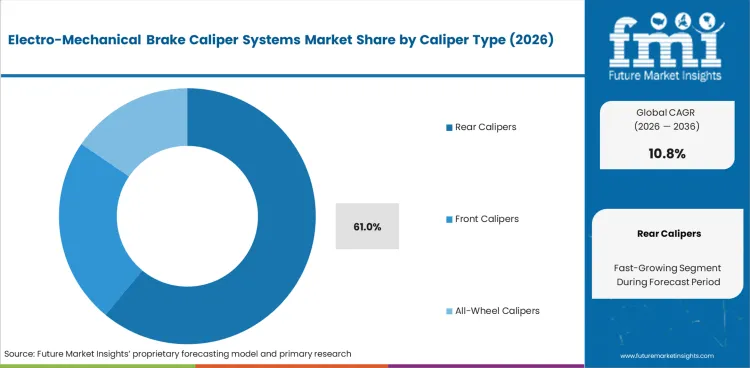
- In 2026, rear calipers are expected to contribute 61.0% of the caliper type segment. Rear axle placement gives automakers a lower-risk starting point for electric braking validation.
- Front and all-wheel caliper formats need deeper thermal proof and stronger clamp-force validation. Their use improves as OEMs gain confidence in full dry-brake architecture.
Insights into Electro-Mechanical Brake Caliper Systems Market by Actuation Type
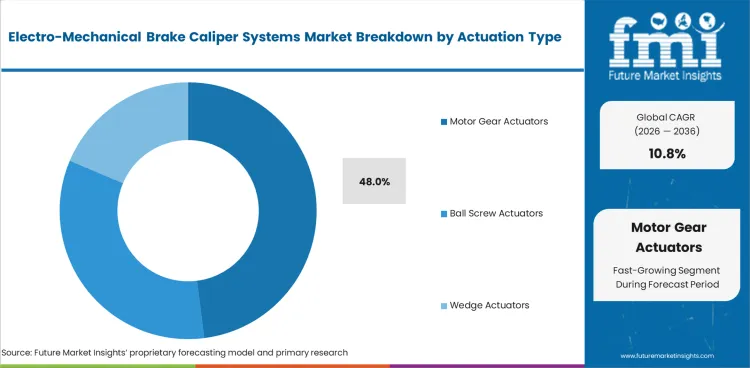
- Motor gear actuators are projected to account for 48.0% of the actuation type segment in 2026. Gear-based designs offer balanced packaging and braking force control across passenger vehicle platforms.
- Ball screw and wedge actuators address selected high-force braking needs. Their value improves in programs requiring faster response and stronger mechanical efficiency.
Insights into Electro-Mechanical Brake Caliper Systems Market by Vehicle Type
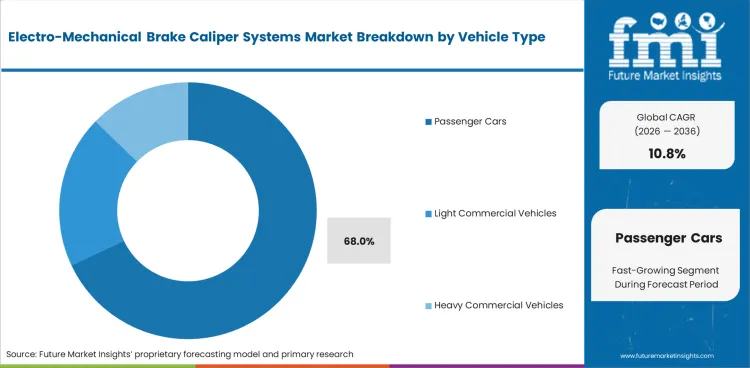
- Passenger cars are expected to account for 68.0% of the vehicle type segment in 2026. Premium EV platforms absorb early validation cost better across brake-by-wire programs.
- Light commercial and heavy commercial vehicles need longer durability proof. Their adoption pace is slower as fleet operators need service readiness and stronger load-cycle evidence.
Insights into Electro-Mechanical Brake Caliper Systems Market by Propulsion Type
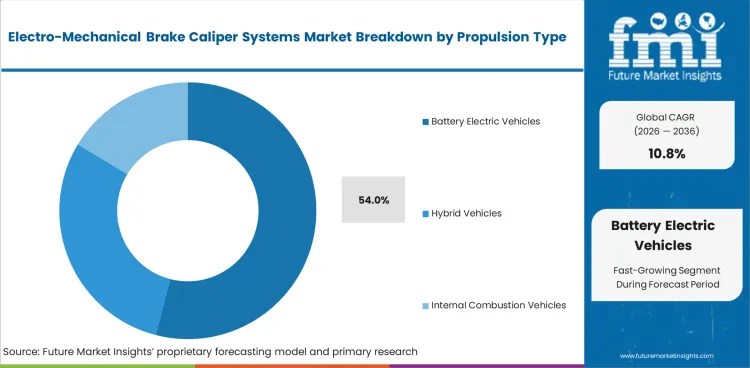
- Battery electric vehicles are projected to represent 54.0% of the propulsion type segment in 2026. EV platforms gain the most value from reduced brake drag and tighter energy recovery control.
- Hybrid vehicles create selected demand for electronic braking support. Internal combustion vehicles use electro-mechanical calipers more slowly as hydraulic systems retain cost advantages.
Insights into Electro-Mechanical Brake Caliper Systems Market by Sales Channel
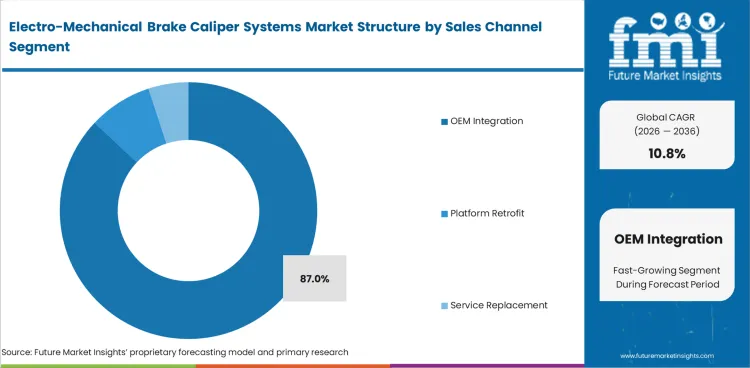
- OEM integration is expected to hold 87.0% of the sales channel segment in 2026. Factory installation supports safety approval and software calibration before vehicle launch.
- Platform retrofit and service replacement demand stay limited in early adoption. Brake-by-wire calipers need vehicle-level validation and trained service networks before aftermarket scale improves.
Electro-Mechanical Brake Caliper Systems Market Drivers, Restraints, and Opportunities
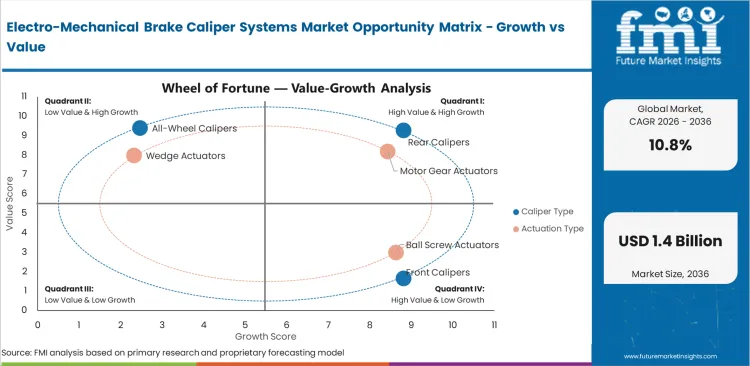
- Dry brake architecture creates demand for wheel-end actuation as automakers reduce hydraulic hardware.
- Redundant electronics create cost pressure for suppliers serving safety-critical braking programs.
- Zonal vehicle controllers create opportunity for electric calipers as motion control becomes more centralized.
Electro-mechanical brake caliper systems keep growing as EV platforms need lower wheel drag and precise electronic braking control for energy recovery. Cost pressure and validation burden can slow broader adoption across lower-priced vehicles. Growth continues through rear axle EMB programs and OEM brake-by-wire integration.
Aluminum Housing Cost Relief May Limit EMB Caliper Price Escalation
April 2025 World Bank data gives a more direct price-movement angle for Electro-Mechanical Brake Caliper Systems. Aluminum is used in caliper housings and carriers across brake caliper assemblies. It is used in brackets and lightweight structural interfaces for vehicles. The World Bank stated that aluminum prices rose 2% in 2025Q1 on frontloaded demand, but projected a 10% decline in 2025 and a further 3% decline in 2026. For electro-mechanical caliper suppliers, this points to softer housing-cost pressure after short-term procurement volatility. Price reductions may not fully pass through because actuator motors and sensors are embedded in EMB assemblies and continue to add cost. Seals and manufacturing expenses stay embedded in EMB assemblies and limit how much savings reach customers. Aluminum easing can improve supplier margin flexibility during OEM sourcing rounds.
Copper-Linked Actuator Costs Support Surcharge Pricing
February 2026 USGS copper data indicate another price pressure point for Electro-Mechanical Brake Caliper Systems. These systems add actuator motors and connectors to the mechanical caliper which increases complexity. They integrate sensors and control electronics so copper exposure rises compared to conventional hydraulic calipers. Short harnesses are included in the design and this further increases copper usage. USGS projected the COMEX copper price at a record USD 4.80 per pound for 2025, 14% above USD 4.22 per pound in 2024; it stated copper products went into electrical and electronic products at 23% and transportation equipment at 18%. This supports higher pricing for motorized caliper variants and stronger surcharge language in supply contracts. Suppliers with localized harness sourcing and recycled copper channels can cushion price movement, but actuator-rich designs are more exposed.
Analysis of Electro-Mechanical Brake Caliper Systems Market By Key Countries
.webp "Top Country Growth Comparison Electro Mechanical Brake Caliper Systems Market Cagr (2026 2036)")
| Country | CAGR |
|---|---|
| China | 14.2% |
| Germany | 12.6% |
| United States | 11.8% |
| South Korea | 10.9% |
| Japan | 10.5% |
| India | 9.8% |
| Mexico | 9.2% |
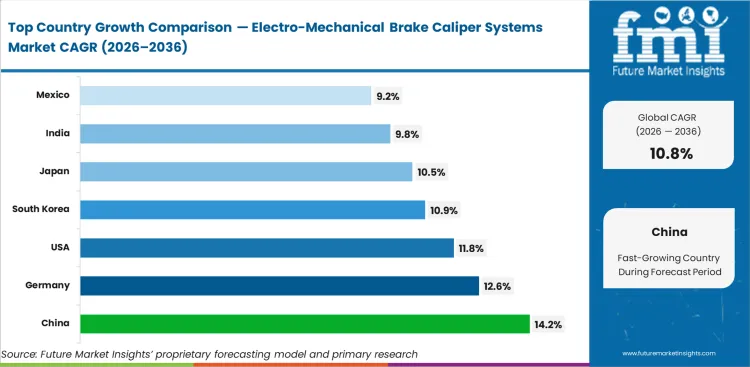
Source: Future Market Insights, 2026.
Electro-Mechanical Brake Caliper Systems Market CAGR Analysis By Country
- Rear calipers are expected to account for 61.0% of caliper type demand in 2026, as rear axle programs offer a lower-risk entry point for early EMB validation.
- A 48.0% share is projected for motor gear actuators, reflecting their balance between compact packaging and reliable clamp-force control.
- Passenger cars are expected to represent 68.0% of vehicle type revenue, led by premium EV platforms able to absorb early brake-by-wire validation costs.
- Battery electric vehicles are forecast to account for 54.0% of propulsion-based sales, as dry braking aligns closely with energy recovery and reduced wheel drag.
- OEM integration is projected to command 87.0% of sales channel value, since factory-level validation is required for safety approval and software calibration.
Demand for electro-mechanical brake caliper systems is forecast to rise at 10.8% CAGR from 2026 to 2036. Country-level analysis covers the major markets contributing to this forecast, with the key markets listed below.
Demand Outlook for Electro-Mechanical Brake Caliper Systems Market in China
China’s electro-mechanical brake caliper systems industry is projected to record a CAGR of 14.2% through 2036. IEA reported over 13 million electric car sales in China in 2025, with electric cars close to 55% of new car sales. This large EV base raises demand for brake platforms designed around energy recovery and electronic motion control. Local caliper and actuator suppliers can gain from faster platform cycles among domestic automakers.
- Shanghai vehicle engineering centers create strong access to EV platform teams and chassis software groups.
- China’s national trade-in scheme offered CNY 20,000 for eligible electric car replacement purchases in 2025.
- Domestic EV makers value rear axle EMB programs as a lower-risk step toward full dry braking.
Sales Analysis of Electro-Mechanical Brake Caliper Systems Market in Germany
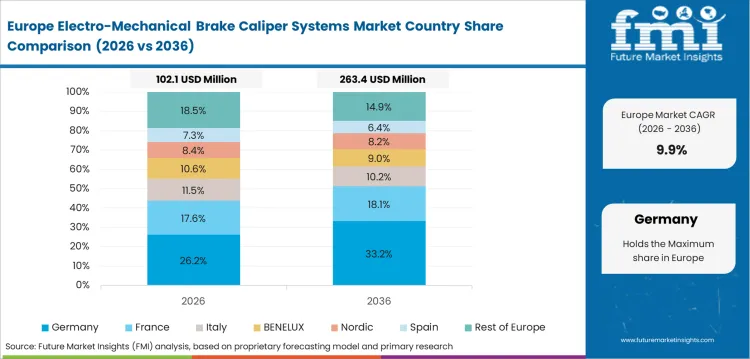
The electro-mechanical brake caliper systems sector in Germany is expected to expand at a CAGR of 12.6% during the assessment period. IEA reported Germany electric car sales increased by 50% in 2025 and reached a record high of 850,000 units. This EV rebound strengthens the case for dry brake systems within premium vehicle programs. Brake suppliers benefit from local OEM engineering teams seeking validated calipers and control software.
- Baden-Württemberg and Bavaria create close links between premium OEMs and brake system suppliers.
- Continental showcased its Future Brake System roadmap at Auto Shanghai 2025, including fully electro-mechanical braking.
- German EV company-car tax treatment creates stronger demand for premium electric platforms with by-wire content.
Demand Outlook for Electro-Mechanical Brake Caliper Systems Market in the United States
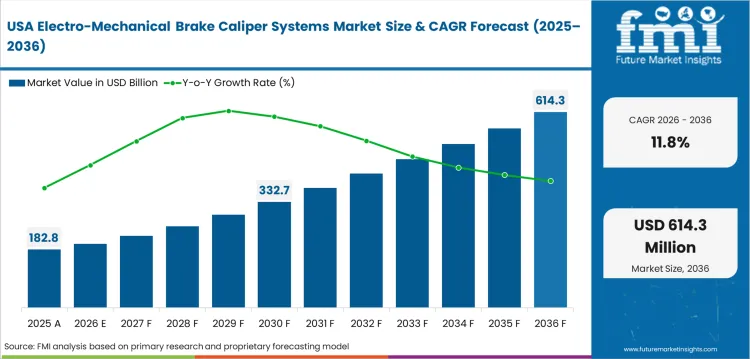
The USA electro-mechanical brake caliper systems industry is forecast to grow at a CAGR of 11.8% by 2036. IEA reported USA electric car sales around 1.5 million in 2025, with electric cars near 10% of total car sales. Safety regulation adds another reason for brake system redesign as FMVSS No. 127 changes braking requirements. OEMs value suppliers with tested electronic brake response and redundancy records.
- Michigan engineering centers create strong access to vehicle dynamics teams and brake test programs.
- FMVSS No. 127 creates a defined light-vehicle safety path for AEB and pedestrian AEB systems.
- California EV demand helps OEMs justify premium brake-by-wire content on early electric platforms.
Opportunity Analysis of Electro-Mechanical Brake Caliper Systems Market in South Korea
The electro-mechanical brake caliper systems segment in South Korea is forecast to expand at 10.9% CAGR over the forecast years. IEA reported Korean electric car sales grew around 65% year-on-year in 2025 and exceeded 200,000 units. This faster EV movement gives brake-by-wire systems a stronger base in export-focused vehicle programs. Suppliers with local electronics access can improve actuator control and system validation timing.
- Ulsan vehicle production creates demand for safety-grade brake electronics and platform validation.
- Hwaseong engineering programs help local OEMs test chassis-by-wire systems near vehicle software teams.
- Korea’s 2030 zero-emission vehicle target raises interest in brake systems suited to EV platforms.
Future Outlook for Electro-Mechanical Brake Caliper Systems Market in Japan
Japan’s electro-mechanical brake caliper systems industry is expected to post 10.5% CAGR by 2036. IEA reported Japan electric car sales were just above 100,000 units in 2025, with electric cars below 3% of sales. Hybrid strength slows full EMB diffusion, and the safety engineering depth favors careful use in premium programs. Suppliers can target limited high-value platforms before broader cost reduction.
- Aichi automotive engineering creates a strong base for brake system testing and supplier collaboration.
- Japanese hybrid vehicle strength keeps early EMB use focused on premium battery electric platforms.
- METI EV subsidy activity can help selected electric models absorb higher braking system cost.
Demand Outlook for Electro-Mechanical Brake Caliper Systems Market in India
India’s electro-mechanical brake caliper systems industry is projected to record a CAGR of 9.8% through 2036. IEA reported India electric car sales increased 75% year-on-year in 2025 and reached 165,000 units. This smaller base creates selective demand instead of broad use across entry vehicles. Local suppliers can benefit as premium EV assembly and safety electronics sourcing deepen.
- Pune and Chennai automotive corridors provide supplier access to EV platform localization programs.
- Domestic electric car production by Tata and Mahindra accounted for roughly 60% of India EV sales in 2025.
- Premium EV launches create early demand for brake systems with stronger software integration.
In-depth Analysis of Electro-Mechanical Brake Caliper Systems Market in Mexico
The electro-mechanical brake caliper systems sector in Mexico is expected to expand at a CAGR of 9.2% during the assessment period. IEA reported Latin America electric car sales grew 75% in 2025, with Brazil and Mexico generating over 75% of regional sales expansion. Mexico benefits through North American export platforms and supplier proximity to USA safety requirements. Brake makers can target programs built for regional vehicle launches.
- Nuevo León and Coahuila supplier bases link brake component makers with North American assembly programs.
- Mexico’s export-oriented plants can add EMB content first on vehicles aimed at USA safety standards.
- Regional plug-in hybrid expansion creates phased demand for electronic braking and actuator-ready calipers.
Competitive Landscape and Strategic Positioning
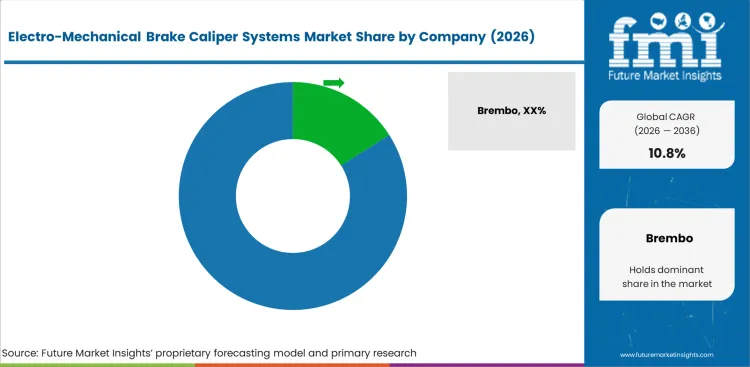
Electro-Mechanical Brake Caliper Systems Market Analysis By Company
- Brembo leads through Sensify production and software-based braking coverage across intelligent brake programs for premium vehicle platforms.
- ZF and Bosch compete on brake-by-wire portfolios with strong access to OEM platform planning and validation work.
- Specialist chassis suppliers build positions through EMB licensing and actuator manufacturing for local vehicle program testing.
Competitive strength in this market is built on tested actuator performance and reliable brake control software for safety-critical vehicle platforms. Brembo holds a strong position through Sensify production and integrated braking software for intelligent brake programs. ZF focus on electro-mechanical braking contracts serving high-volume light vehicle platforms. Bosch adds credibility through public-road brake-by-wire validation completed in 2025. Continental uses Future Brake System development to extend its brake portfolio toward dry caliper architecture. BWI Group and thyssenkrupp Steering add specialist depth through EMB licensing and manufacturing cooperation.
Safety validation cost and actuator durability proof create the main entry barriers for new competitors. Software integration across vehicle platforms adds further pressure as brake systems must pass strict launch checks. Automakers favor suppliers offering electric calipers and brake control software with proven testing records. Winning suppliers will be those able to combine validated hardware with control software and reduce vehicle program risk.
Key Companies in the Electro-Mechanical Brake Caliper Systems Market
Key global companies leading the electro-mechanical brake caliper systems market include:
Brembo, ZF, and Bosch have strong braking infrastructure for electro-mechanical actuation and OEM program delivery.
Continental, BWI Group, and thyssenkrupp Steering serve automakers through dry brake architecture and chassis-by-wire technology.
HL Mando holds a specialist position across brake-by-wire and EMB products for EV and chassis control programs.
Competitive Benchmarking: Electro-Mechanical Brake Caliper Systems Market
| Company | Electric Caliper Depth | Redundancy Design | OEM Program Access | Geographic Footprint |
|---|---|---|---|---|
| Brembo | High | High | Strong | Europe, Americas, and Asia, with headquarters and R&D base in Italy |
| ZF | High | High | Strong | Global footprint across Europe, North America, South America, Asia-Pacific, India, Middle East, Africa, and Australia |
| Bosch | Medium | High | Strong | Global mobility network across around 66 countries, with over 300 locations and more than 100 plants |
| Continental | High | Medium | Strong | Global presence across Germany and 56 other countries and markets |
| BWI Group | High | Medium | Moderate | China, United States, Italy, France, Czech Republic, Mexico, and Poland |
| thyssenkrupp Steering | Medium | High | Moderate | Global automotive footprint across around 90 manufacturing sites on four continents |
| HL Mando | Medium | Medium | Strong | South Korea-centered global network with R&D and manufacturing presence across Asia, North America, and Europe |
Source: Future Market Insights, 2026.
Key Developments in Electro-Mechanical Brake Caliper Systems Market
- In May 2026, Brembo announced that SENSIFY™ entered production for a leading global vehicle manufacturer and is fitted as standard on 100% of vehicles in the program. The development is directly relevant to the Electro-Mechanical Brake Caliper Systems Market because Brembo describes SENSIFY™ as a fluid-free architecture which distributes braking intelligence at wheel level, removes hydraulic circuits and centralized actuation, and enables accurate modulation of braking forces. The production launch confirms that dry brake-by-wire platforms are moving from validation programs into commercial vehicle deployment, supporting wider adoption of electric wheel-end braking systems.
- April 2025, Nexteer Automotive launched its Electro-Mechanical Brake system as an brake-by-wire solution for software-defined chassis integration. The development is relevant because Nexteer’s EMB replaces hydraulic fluid and mechanical linkages with electronic control, while using high-precision actuators at each wheel. This directly aligns with electro-mechanical brake caliper system development because braking force moves closer to wheel-end actuation, supporting independent wheel control, lower mechanical losses, and future EV and ADAS braking architectures.
Key Players in the Electro-Mechanical Brake Caliper Systems Market
Major Global Players:
- Brembo
- ZF
- Bosch
- Continental
- HL Mando
Specialist Players:
- BWI Group
- thyssenkrupp Steering
Report Scope and Coverage
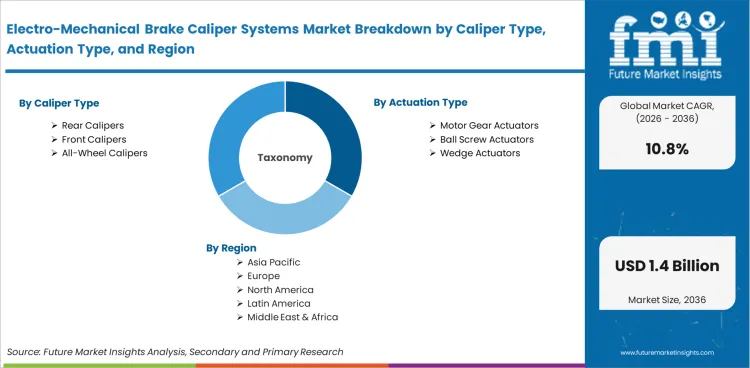
Electro-Mechanical Brake Caliper Systems Market Breakdown By Caliper Type, Actuation Type, Vehicle Type, Propulsion Type, Sales Channel, And Region
| Parameter | Details |
|---|---|
| Quantitative Units | USD 0.5 billion to USD 1.4 billion, at a CAGR of 10.8% |
| Market Definition | Electric service brake caliper systems using actuators and local control electronics for wheel-end clamp force |
| Regions Covered | North America, Latin America, Europe, East Asia, South Asia and Pacific, Middle East and Africa |
| Countries Covered | United States, Germany, China, India, Japan, South Korea, Mexico, and 30 plus countries |
| Key Companies Profiled | Brembo, ZF, Bosch, Continental, BWI Group, thyssenkrupp Steering, HL Mando |
| Forecast Period | 2026 to 2036 |
| Approach | Hybrid bottom-up and top-down methodology starting with vehicle platform demand and verified brake-by-wire use patterns |
Electro-Mechanical Brake Caliper Systems Market by Segments
Electro-Mechanical Brake Caliper Systems Market by Segments
Electro-Mechanical Brake Caliper Systems Market Segmented by Caliper Type:
- Rear Calipers
- Front Calipers
- All-Wheel Calipers
Electro-Mechanical Brake Caliper Systems Market Segmented by Actuation Type:
- Motor Gear Actuators
- Ball Screw Actuators
- Wedge Actuators
Electro-Mechanical Brake Caliper Systems Market Segmented by Vehicle Type:
- Passenger Cars
- Light Commercial Vehicles
- Heavy Commercial Vehicles
Electro-Mechanical Brake Caliper Systems Market Segmented by Propulsion Type:
- Battery Electric Vehicles
- Hybrid Vehicles
- Internal Combustion Vehicles
Electro-Mechanical Brake Caliper Systems Market Segmented by Sales Channel:
- OEM Integration
- Platform Retrofit
- Service Replacement
Electro-Mechanical Brake Caliper Systems Market by Region:
- North America
- USA
- Canada
- Mexico
- Latin America
- Brazil
- Chile
- Rest of Latin America
- Europe
- Germany
- UK
- Italy
- Spain
- France
- Rest of Europe
- East Asia
- China
- Japan
- South Korea
- South Asia and Pacific
- India
- ASEAN
- Australia & New Zealand
- Rest of South Asia and Pacific
- Middle East and Africa
- Saudi Arabia
- Other GCC Countries
- South Africa
- Rest of Middle East and Africa
Research Sources and Bibliography
- International Energy Agency. (2026, May). Global EV Outlook 2026: Trends in electric cars. IEA.
- Federal Register. (2024, May 9). Federal Motor Vehicle Safety Standards: Automatic Emergency Braking Systems for Light Vehicles.
- ZF. (2025, January 6). ZF secures substantial brake-by-wire technology business for light vehicles.
- Bosch. (2025, January 30). With brake-by-wire from Bosch to the Arctic Circle.
- Brembo. (2026, May 4). The New Standard Begins: SENSIFY™ by Brembo Enters Production.
- Continental AG. (2025, April 15). Safe, Exciting, Autonomous: Solutions for Automated Driving and Light Projection Debut at Auto Shanghai.
- BWI Group. (2024, April 9). BWI Group and thyssenkrupp Steering partner in EMB to lead world’s chassis-by-wire technology.
- Nexteer Automotive. (2025, April 15). Nexteer launches brake-by-wire system [Press release]. Nexteer Launches Brake-by-Wire System - Nexteer
- ZF Group. (2025, January 6). ZF secures substantial brake-by-wire technology business for light vehicles [Press release]. ZF secures substantial brake-by-wire technology business for light vehicles - ZF
- USA Geological Survey. (2026, February). Copper. In Mineral commodity summaries 2026. U.S. Geological Survey. Mineral Commodity Summaries 2026.
- Brembo. (2026, May 4). The New Standard Begins: SENSIFY™ by Brembo Enters Production. Brembo Group.
- Bosch. (2025, January 30). With brake-by-wire from Bosch to the Arctic Circle. Bosch Media Service.
- Continental AG. (2025, April 15). Safe, Exciting, Autonomous: Solutions for Automated Driving and Light Projection Debut at Auto Shanghai. Continental.
- ZF. (2025, January 6). ZF secures substantial brake-by-wire technology business for light vehicles. ZF Press.
- World Bank. (2025, April). Commodity markets outlook: April 2025. World Bank. Commodity Markets Outlook -- April 2025
- Brembo. (2026, May 4). The new standard begins: SENSIFY™ by Brembo enters production [Press release]. The New Standard Begins: SENSIFY™ by Brembo Enters Production
This Report Answers
- What is the current and future size of the electro-mechanical brake caliper systems market?
- How fast is the electro-mechanical brake caliper systems market expected to expand between 2026 and 2036?
- Which caliper type is expected to lead the market by 2026 across early EMB programs?
- Which propulsion segment is expected to account for the leading demand by 2026?
- What factors are driving demand for electro-mechanical brake caliper systems globally?
- How are AEB rules influencing brake-by-wire system planning across light vehicle platforms?
- Why are passenger cars the main demand base for electric brake calipers?
- Which countries are projected to record faster expansion through 2036?
- Who are the key companies active in the electro-mechanical brake caliper systems market?
- How does FMI estimate and validate the market forecast?
Frequently Asked Questions
What is the global market demand for Electro-Mechanical Brake Caliper Systems in 2026?
In 2026, the global market for electro-mechanical brake caliper systems is estimated at USD 0.5 billion.
How big will the market for Electro-Mechanical Brake Caliper Systems be in 2036?
By 2036, the market for electro-mechanical brake caliper systems is projected to reach USD 1.4 billion.
How much is demand for Electro-Mechanical Brake Caliper Systems expected to expand between 2026 and 2036?
Between 2026 and 2036, demand for electro-mechanical brake caliper systems is expected to expand at a CAGR of 10.8%.
Which caliper type segment is likely to be the leading seller globally by 2026?
Rear calipers are expected to account for 61.0% of the caliper type segment in 2026 across early EMB programs.
What is causing demand to rise in China?
China electro-mechanical brake caliper systems demand is projected to record 14.2% CAGR through 2036, driven by EV platform turnover.
What is causing demand to rise in Germany?
Germany electro-mechanical brake caliper systems demand is projected to expand at 12.6% CAGR through 2036, driven by chassis engineering depth.
What is covered in the Electro-Mechanical Brake Caliper Systems Market definition?
The market includes electric service brake calipers using actuators and control electronics for wheel-end braking force.
How does FMI make the Electro-Mechanical Brake Caliper Systems forecast and check it?
Forecasting models use a hybrid bottom-up and top-down approach, starting with vehicle platform demand and brake-by-wire use patterns.
Preview the report firsthand - request a free sample
Get SampleGet the brochure for pricing and purchase details.
Get PDFTable of Content
- Key Takeaways
- Market Size and CAGR
- Top Growth Driver
- Fastest Growing Segment
- Leading Region
- Key Companies
- Emerging Opportunities
- Executive Summary
- Global Market Outlook
- Demand-side Trends
- Supply-side Trends
- Technology Roadmap Analysis
- Analysis and Recommendations
- Analyst Perspective (What is happening? Why now? What should investors know?)
- Key Questions Answered
- How large is the market?
- What is the CAGR?
- What are key trends?
- Which region dominates?
- Who are the leaders?
- Market Overview
- Market Coverage / Taxonomy
- Market Definition / Scope / Limitations
- Research Methodology
- Chapter Orientation
- Analytical Lens and Working Hypotheses
- Market Structure, Signals, and Trend Drivers
- Benchmarking and Cross-market Comparability
- Market Sizing, Forecasting, and Opportunity Mapping
- Research Design and Evidence Framework
- Desk Research Programme (Secondary Evidence)
- Expert Input and Fieldwork (Primary Evidence)
- Tooling, Models, and Reference Databases
- Data Engineering and Model Build
- Quality Assurance and Audit Trail
- Market Background
- Market Dynamics (Drivers, Restraints, Opportunity, Trends)
- Scenario Forecast (Optimistic, Likely, Conservative)
- Impact Analysis
- AI Impact
- Sustainability Impact
- Regulatory Impact
- Technology Impact
- Consumer / Buyer Analysis
- Purchase Drivers
- Adoption Barriers
- Buyer Journey
- Opportunity Map Analysis
- Product Life Cycle Analysis
- Supply Chain Analysis
- Investment Feasibility Matrix
- Value Chain Analysis
- PESTLE and Porter's Analysis
- Regulatory Landscape
- Regional Parent Market Outlook
- Production and Consumption Statistics
- Import and Export Statistics
- Global Market Analysis and Forecast, 2021 to 2036
- Historical Market Size Value (USD Billion) & Volume (Unit) Analysis, 2021 to 2025
- Current and Future Market Size Value (USD Billion) & Volume (Unit) Projections, 2026 to 2036
- Y-o-Y Growth Trend Analysis
- Absolute $ Opportunity Analysis
- Global Market Pricing Analysis, 2021 to 2036
- Global Market Analysis and Forecast, By Caliper Type, 2021 to 2036
- Introduction / Key Findings
- Historical Market Size Value (USD Billion) & Volume (Unit) Analysis By Caliper Type, 2021 to 2025
- Current and Future Market Size Value (USD Billion) & Volume (Unit) Analysis and Forecast By Caliper Type, 2026 to 2036
- Rear Calipers
- Front Calipers
- All-Wheel Calipers
- Rear Calipers
- Y-o-Y Growth Trend Analysis By Caliper Type, 2021 to 2025
- Absolute $ Opportunity Analysis By Caliper Type, 2026 to 2036
- Global Market Analysis and Forecast, By Actuation Type, 2021 to 2036
- Introduction / Key Findings
- Historical Market Size Value (USD Billion) & Volume (Unit) Analysis By Actuation Type, 2021 to 2025
- Current and Future Market Size Value (USD Billion) & Volume (Unit) Analysis and Forecast By Actuation Type, 2026 to 2036
- Motor Gear Actuators
- Ball Screw Actuators
- Wedge Actuators
- Motor Gear Actuators
- Y-o-Y Growth Trend Analysis By Actuation Type, 2021 to 2025
- Absolute $ Opportunity Analysis By Actuation Type, 2026 to 2036
- Global Market Analysis and Forecast, By Vehicle Type, 2021 to 2036
- Introduction / Key Findings
- Historical Market Size Value (USD Billion) & Volume (Unit) Analysis By Vehicle Type, 2021 to 2025
- Current and Future Market Size Value (USD Billion) & Volume (Unit) Analysis and Forecast By Vehicle Type, 2026 to 2036
- Passenger Cars
- Light Commercial Vehicles
- Heavy Commercial Vehicles
- Passenger Cars
- Y-o-Y Growth Trend Analysis By Vehicle Type, 2021 to 2025
- Absolute $ Opportunity Analysis By Vehicle Type, 2026 to 2036
- Global Market Analysis and Forecast, By Propulsion Type, 2021 to 2036
- Introduction / Key Findings
- Historical Market Size Value (USD Billion) & Volume (Unit) Analysis By Propulsion Type, 2021 to 2025
- Current and Future Market Size Value (USD Billion) & Volume (Unit) Analysis and Forecast By Propulsion Type, 2026 to 2036
- Battery Electric Vehicles
- Hybrid Vehicles
- Internal Combustion Vehicles
- Battery Electric Vehicles
- Y-o-Y Growth Trend Analysis By Propulsion Type, 2021 to 2025
- Absolute $ Opportunity Analysis By Propulsion Type, 2026 to 2036
- Global Market Analysis and Forecast, By Sales Channel, 2021 to 2036
- Introduction / Key Findings
- Historical Market Size Value (USD Billion) & Volume (Unit) Analysis By Sales Channel, 2021 to 2025
- Current and Future Market Size Value (USD Billion) & Volume (Unit) Analysis and Forecast By Sales Channel, 2026 to 2036
- OEM Integration
- Platform Retrofit
- Service Replacement
- OEM Integration
- Y-o-Y Growth Trend Analysis By Sales Channel, 2021 to 2025
- Absolute $ Opportunity Analysis By Sales Channel, 2026 to 2036
- Global Market Analysis and Forecast, By Region, 2021 to 2036
- Introduction
- Historical Market Size Value (USD Billion) & Volume (Unit) Analysis By Region, 2021 to 2025
- Current Market Size Value (USD Billion) & Volume (Unit) Analysis and Forecast By Region, 2026 to 2036
- North America
- Latin America
- Western Europe
- Eastern Europe
- East Asia
- South Asia and Pacific
- Middle East & Africa
- Market Attractiveness Analysis By Region
- North America Market Analysis and Forecast, By Country, 2021 to 2036
- Historical Market Size Value (USD Billion) & Volume (Unit) Trend Analysis By Market Taxonomy, 2021 to 2025
- Market Size Value (USD Billion) & Volume (Unit) Forecast By Market Taxonomy, 2026 to 2036
- By Country
- USA
- Canada
- Mexico
- By Caliper Type
- By Actuation Type
- By Vehicle Type
- By Propulsion Type
- By Sales Channel
- By Country
- Market Attractiveness Analysis
- By Country
- By Caliper Type
- By Actuation Type
- By Vehicle Type
- By Propulsion Type
- By Sales Channel
- Key Takeaways
- Latin America Market Analysis and Forecast, By Country
- Historical Market Size Value (USD Billion) & Volume (Unit) Trend Analysis By Market Taxonomy, 2021 to 2025
- Market Size Value (USD Billion) & Volume (Unit) Forecast By Market Taxonomy, 2026 to 2036
- By Country
- Brazil
- Chile
- Rest of Latin America
- By Caliper Type
- By Actuation Type
- By Vehicle Type
- By Propulsion Type
- By Sales Channel
- By Country
- Market Attractiveness Analysis
- By Country
- By Caliper Type
- By Actuation Type
- By Vehicle Type
- By Propulsion Type
- By Sales Channel
- Key Takeaways
- Western Europe Market Analysis and Forecast, By Country
- Historical Market Size Value (USD Billion) & Volume (Unit) Trend Analysis By Market Taxonomy, 2021 to 2025
- Market Size Value (USD Billion) & Volume (Unit) Forecast By Market Taxonomy, 2026 to 2036
- By Country
- Germany
- UK
- Italy
- Spain
- France
- Nordic
- BENELUX
- Rest of Western Europe
- By Caliper Type
- By Actuation Type
- By Vehicle Type
- By Propulsion Type
- By Sales Channel
- By Country
- Market Attractiveness Analysis
- By Country
- By Caliper Type
- By Actuation Type
- By Vehicle Type
- By Propulsion Type
- By Sales Channel
- Key Takeaways
- Eastern Europe Market Analysis and Forecast, By Country
- Historical Market Size Value (USD Billion) & Volume (Unit) Trend Analysis By Market Taxonomy, 2021 to 2025
- Market Size Value (USD Billion) & Volume (Unit) Forecast By Market Taxonomy, 2026 to 2036
- By Country
- Russia
- Poland
- Hungary
- Balkan & Baltic
- Rest of Eastern Europe
- By Caliper Type
- By Actuation Type
- By Vehicle Type
- By Propulsion Type
- By Sales Channel
- By Country
- Market Attractiveness Analysis
- By Country
- By Caliper Type
- By Actuation Type
- By Vehicle Type
- By Propulsion Type
- By Sales Channel
- Key Takeaways
- East Asia Market Analysis and Forecast, By Country
- Historical Market Size Value (USD Billion) & Volume (Unit) Trend Analysis By Market Taxonomy, 2021 to 2025
- Market Size Value (USD Billion) & Volume (Unit) Forecast By Market Taxonomy, 2026 to 2036
- By Country
- China
- Japan
- South Korea
- By Caliper Type
- By Actuation Type
- By Vehicle Type
- By Propulsion Type
- By Sales Channel
- By Country
- Market Attractiveness Analysis
- By Country
- By Caliper Type
- By Actuation Type
- By Vehicle Type
- By Propulsion Type
- By Sales Channel
- Key Takeaways
- South Asia and Pacific Market Analysis and Forecast, By Country
- Historical Market Size Value (USD Billion) & Volume (Unit) Trend Analysis By Market Taxonomy, 2021 to 2025
- Market Size Value (USD Billion) & Volume (Unit) Forecast By Market Taxonomy, 2026 to 2036
- By Country
- India
- ASEAN
- Australia & New Zealand
- Rest of South Asia and Pacific
- By Caliper Type
- By Actuation Type
- By Vehicle Type
- By Propulsion Type
- By Sales Channel
- By Country
- Market Attractiveness Analysis
- By Country
- By Caliper Type
- By Actuation Type
- By Vehicle Type
- By Propulsion Type
- By Sales Channel
- Key Takeaways
- Middle East & Africa Market Analysis and Forecast, By Country
- Historical Market Size Value (USD Billion) & Volume (Unit) Trend Analysis By Market Taxonomy, 2021 to 2025
- Market Size Value (USD Billion) & Volume (Unit) Forecast By Market Taxonomy, 2026 to 2036
- By Country
- Kingdom of Saudi Arabia
- Other GCC Countries
- Türkiye
- South Africa
- Other African Union
- Rest of Middle East & Africa
- By Caliper Type
- By Actuation Type
- By Vehicle Type
- By Propulsion Type
- By Sales Channel
- By Country
- Market Attractiveness Analysis
- By Country
- By Caliper Type
- By Actuation Type
- By Vehicle Type
- By Propulsion Type
- By Sales Channel
- Key Takeaways
- Key Countries Market Analysis
- USA
- Pricing Analysis
- Market Share Analysis, 2025
- By Caliper Type
- By Actuation Type
- By Vehicle Type
- By Propulsion Type
- By Sales Channel
- Canada
- Pricing Analysis
- Market Share Analysis, 2025
- By Caliper Type
- By Actuation Type
- By Vehicle Type
- By Propulsion Type
- By Sales Channel
- Mexico
- Pricing Analysis
- Market Share Analysis, 2025
- By Caliper Type
- By Actuation Type
- By Vehicle Type
- By Propulsion Type
- By Sales Channel
- Brazil
- Pricing Analysis
- Market Share Analysis, 2025
- By Caliper Type
- By Actuation Type
- By Vehicle Type
- By Propulsion Type
- By Sales Channel
- Chile
- Pricing Analysis
- Market Share Analysis, 2025
- By Caliper Type
- By Actuation Type
- By Vehicle Type
- By Propulsion Type
- By Sales Channel
- Germany
- Pricing Analysis
- Market Share Analysis, 2025
- By Caliper Type
- By Actuation Type
- By Vehicle Type
- By Propulsion Type
- By Sales Channel
- UK
- Pricing Analysis
- Market Share Analysis, 2025
- By Caliper Type
- By Actuation Type
- By Vehicle Type
- By Propulsion Type
- By Sales Channel
- Italy
- Pricing Analysis
- Market Share Analysis, 2025
- By Caliper Type
- By Actuation Type
- By Vehicle Type
- By Propulsion Type
- By Sales Channel
- Spain
- Pricing Analysis
- Market Share Analysis, 2025
- By Caliper Type
- By Actuation Type
- By Vehicle Type
- By Propulsion Type
- By Sales Channel
- France
- Pricing Analysis
- Market Share Analysis, 2025
- By Caliper Type
- By Actuation Type
- By Vehicle Type
- By Propulsion Type
- By Sales Channel
- India
- Pricing Analysis
- Market Share Analysis, 2025
- By Caliper Type
- By Actuation Type
- By Vehicle Type
- By Propulsion Type
- By Sales Channel
- ASEAN
- Pricing Analysis
- Market Share Analysis, 2025
- By Caliper Type
- By Actuation Type
- By Vehicle Type
- By Propulsion Type
- By Sales Channel
- Australia & New Zealand
- Pricing Analysis
- Market Share Analysis, 2025
- By Caliper Type
- By Actuation Type
- By Vehicle Type
- By Propulsion Type
- By Sales Channel
- China
- Pricing Analysis
- Market Share Analysis, 2025
- By Caliper Type
- By Actuation Type
- By Vehicle Type
- By Propulsion Type
- By Sales Channel
- Japan
- Pricing Analysis
- Market Share Analysis, 2025
- By Caliper Type
- By Actuation Type
- By Vehicle Type
- By Propulsion Type
- By Sales Channel
- South Korea
- Pricing Analysis
- Market Share Analysis, 2025
- By Caliper Type
- By Actuation Type
- By Vehicle Type
- By Propulsion Type
- By Sales Channel
- Russia
- Pricing Analysis
- Market Share Analysis, 2025
- By Caliper Type
- By Actuation Type
- By Vehicle Type
- By Propulsion Type
- By Sales Channel
- Poland
- Pricing Analysis
- Market Share Analysis, 2025
- By Caliper Type
- By Actuation Type
- By Vehicle Type
- By Propulsion Type
- By Sales Channel
- Hungary
- Pricing Analysis
- Market Share Analysis, 2025
- By Caliper Type
- By Actuation Type
- By Vehicle Type
- By Propulsion Type
- By Sales Channel
- Kingdom of Saudi Arabia
- Pricing Analysis
- Market Share Analysis, 2025
- By Caliper Type
- By Actuation Type
- By Vehicle Type
- By Propulsion Type
- By Sales Channel
- Türkiye
- Pricing Analysis
- Market Share Analysis, 2025
- By Caliper Type
- By Actuation Type
- By Vehicle Type
- By Propulsion Type
- By Sales Channel
- South Africa
- Pricing Analysis
- Market Share Analysis, 2025
- By Caliper Type
- By Actuation Type
- By Vehicle Type
- By Propulsion Type
- By Sales Channel
- USA
- Market Structure Analysis
- Competition Dashboard
- Competition Benchmarking
- Market Share Analysis of Top Players
- By Regional
- By Caliper Type
- By Actuation Type
- By Vehicle Type
- By Propulsion Type
- By Sales Channel
- Emerging Startups
- Innovation Benchmarking
- Competition Analysis
- Competition Deep Dive
- Brembo
- Overview
- Product Portfolio
- Profitability by Market Segments (Product/Region/Sales Channel)
- Sales Footprint
- Strategy Overview
- Marketing Strategy
- Product Strategy
- Channel Strategy
- ZF
- Bosch
- Continental
- BWI Group
- thyssenkrupp Steering
- HL Mando
- Brembo
- Case Studies
- Success Stories
- Recent Developments
- Competition Deep Dive
- Assumptions & Acronyms Used


