

- Industry Size (2026)
- USD 1.37 Bn
- Forecast (2036)
- USD 2.62 Bn
- CAGR (2026 to 2036)
- 6.70%
Electrotherapy System Market Size, Market Forecast and Outlook By FMI
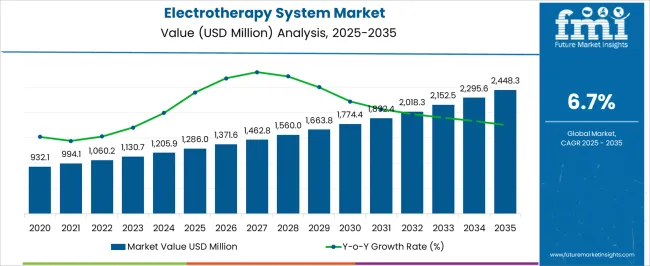
The electrotherapy system market was valued at USD 1.29 billion in 2025, projected to reach USD 1.37 billion in 2026, and is forecast to expand to USD 2.62 billion by 2036 at a 6.70% CAGR. Growing emphasis on non-pharmacological pain management driven by opioid reduction mandates, expanding physiotherapy and rehabilitation service capacity, and the increasing clinical evidence base for neuromuscular electrical stimulation are sustaining demand for electrotherapy devices. Hospital pain management departments and outpatient rehabilitation centres are integrating electrotherapy protocols as first-line interventions to reduce analgesic medication dependence, creating institutional procurement cycles anchored to clinical pathway standardization.
The absolute dollar opportunity of approximately USD 1.25 billion over the forecast period reflects the broadening clinical application base from traditional pain management into sports medicine recovery, pelvic floor rehabilitation, and wound healing acceleration protocols. Wireless wearable electrotherapy devices are creating a direct-to-consumer product tier that bypasses clinical procurement channels and captures self-management pain relief spending. Multi-modality electrotherapy platforms combining TENS, interferential current, and micro-current capabilities within single devices are commanding premium per-unit pricing by consolidating equipment requirements across therapy departments.
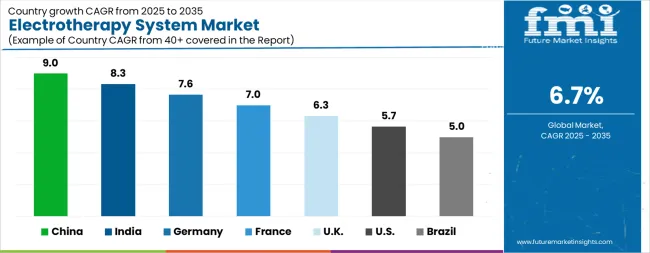
China sets the pace at a 9.0% CAGR, driven by rehabilitation medicine department expansion across county-level hospitals and traditional medicine integration programmes incorporating electro-acupuncture. India follows at 8.3% as physiotherapy clinic proliferation and sports medicine infrastructure investment generate electrotherapy device procurement. Germany registers 7.6% growth supported by established rehabilitation centre density and statutory health insurance coverage for electrotherapy treatments. France maintains 7.0% driven by physical therapy reimbursement framework expansion. UK expands at 6.3% anchored by NHS musculoskeletal pathway electrotherapy integration. USA tracks at 5.7% driven by opioid reduction mandate compliance and outpatient rehabilitation equipment investment. Brazil registers 5.0% with SUS rehabilitation service expansion.
Summary of Electrotherapy System Market
- Electrotherapy System Market Definition
- Electrotherapy systems deliver controlled electrical stimulation for pain relief, neuromuscular rehabilitation, and tissue repair through TENS, interferential, spinal cord stimulation, and micro-current modalities across hospital, rehabilitation, clinic, and home settings.
- Demand Drivers in the Market
- Opioid reduction mandates compelling hospital pain management departments to adopt non-pharmacological first-line interventions are creating institutional electrotherapy procurement cycles anchored to clinical pathway standardization across acute and chronic pain protocols.
- Wireless wearable electrotherapy devices are creating a direct-to-consumer tier that captures self-management pain relief spending outside traditional clinical procurement channels.
- Multi-modality platforms combining TENS, interferential, and micro-current capabilities command premium pricing by consolidating equipment across therapy departments into single-device solutions.
- Key Segments Analyzed in the FMI Report
- Transcutaneous Spinal Electroanalgesia by Product Type: 35.2% share in 2026, reflecting the clinical evidence base supporting spinal electroanalgesia for chronic back pain management as a non-invasive alternative to pharmacological intervention.
- Pain Management by Application: 30.8% share in 2026, as musculoskeletal pain management constitutes the highest-volume therapeutic indication driving electrotherapy device utilization across all clinical settings.
- China: 9.0% compound growth driven by rehabilitation department expansion across county hospitals and electro-acupuncture integration within traditional medicine programmes.
- Analyst Opinion at FMI
- The electrotherapy system market is experiencing a clinical legitimacy upgrade as randomized controlled trial evidence accumulates for neuromuscular stimulation and pain management applications, converting electrotherapy from a supplementary physiotherapy modality to a protocol-mandated first-line intervention. Manufacturers who cannot provide clinical evidence packages supporting specific treatment protocols face formulary exclusion as hospital value analysis committees demand outcome data for equipment procurement justification. The critical market expansion risk centers on reimbursement coverage variability, as electrotherapy treatment coding and payment rates differ across jurisdictions, creating uneven adoption patterns that complicate manufacturer revenue forecasting.
- Strategic Implications / Executive Takeaways
- Electrotherapy manufacturers must invest in randomized controlled trial programmes generating protocol-specific clinical evidence to support hospital value analysis committee procurement approval and payer coverage determinations.
- Rehabilitation centre directors must integrate multi-modality electrotherapy platforms into standardized treatment protocols to reduce per-patient equipment requirements and improve therapy department operational efficiency.
- Direct-to-consumer wearable electrotherapy brands must develop clinical validation data sufficient to support healthcare provider recommendation, bridging the gap between consumer marketing and clinical credibility.
Electrotherapy System Market Key Takeaways
| Metric | Details |
|---|---|
| Industry Size (2026) | USD 1.37 Billion |
| Industry Value (2036) | USD 2.62 Billion |
| CAGR (2026-2036) | 6.70% |
Source: Future Market Insights, 2026
Electrotherapy System Market Definition
Electrotherapy systems are medical devices that deliver controlled electrical stimulation to the body for therapeutic purposes including pain relief, neuromuscular rehabilitation, tissue repair, and functional restoration. These systems encompass transcutaneous electrical nerve stimulators, interferential current therapy units, spinal cord stimulators, electro-acupuncture devices, micro-current therapy platforms, and pulsed shortwave diathermy equipment used across hospital, rehabilitation centre, clinic, and home care settings.
Electrotherapy System Market Inclusions
Market scope includes TENS units, interferential current devices, spinal cord stimulation systems, transcutaneous spinal electroanalgesia platforms, electro-acupuncture stimulators, micro-current therapy devices, iontophoresis units, and pelvic floor stimulation systems. Coverage spans hospital, rehabilitation, long-term care, clinic, and home use applications across professional and consumer device segments.
Electrotherapy System Market Exclusions
Implantable neurostimulation pulse generators counted in the neuromodulation device market, diagnostic electromyography equipment, and electroconvulsive therapy systems are excluded. Electrode pads and accessories sold separately fall outside analytical parameters.
Electrotherapy System Market Research Methodology
- Primary Research: Analysts engaged with rehabilitation medicine department heads, physiotherapy clinic procurement managers, and electrotherapy device manufacturer clinical affairs directors to map the clinical pathway integration and procurement triggers for electrotherapy system adoption.
- Desk Research: Data collection phases aggregated rehabilitation service capacity statistics, physiotherapy clinic establishment data, and national health insurance coverage determinations for electrotherapy treatment reimbursement.
- Market-Sizing and Forecasting: Baseline values derive from a bottom-up aggregation of electrotherapy system unit sales multiplied by average per-unit prices across product type and end user categories, applying region-specific rehabilitation service expansion curves.
- Data Validation and Update Cycle: Projections are tested against publicly reported physical therapy and rehabilitation device segment revenues from leading electrotherapy manufacturers.
Why is the Electrotherapy System Market Growing?
The Electrotherapy System market is experiencing steady growth, driven by the increasing prevalence of chronic pain, musculoskeletal disorders, and rehabilitation needs across both developed and emerging healthcare markets. Rising demand for non-invasive pain management solutions and physiotherapy interventions is accelerating adoption of electrotherapy devices. Continuous advancements in medical device technologies, including enhanced waveform modulation, programmable intensity settings, and ergonomic designs, are improving patient outcomes and treatment efficiency.
Hospitals, rehabilitation centers, and outpatient clinics are increasingly integrating electrotherapy systems into clinical protocols to optimize pain relief, accelerate recovery, and reduce dependence on pharmacological interventions. Regulatory approvals, along with increasing awareness among healthcare providers and patients regarding alternative therapy options, are further supporting market expansion.
The growing focus on evidence-based practices, combined with rising healthcare expenditure and investment in advanced rehabilitation equipment, is contributing to market momentum As healthcare providers aim to improve patient satisfaction and treatment effectiveness, the Electrotherapy System market is expected to maintain strong growth, with technological innovations driving sustained adoption across clinical settings.
Segmental Analysis
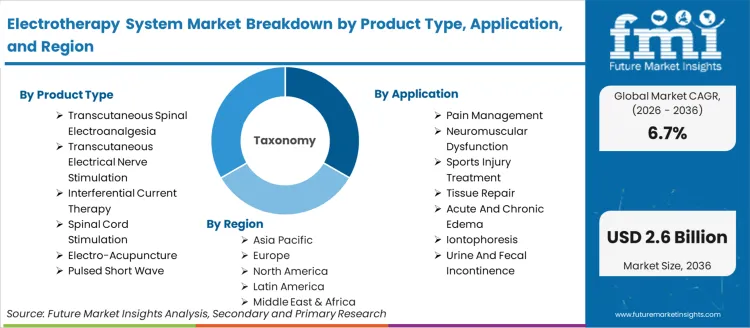
The electrotherapy system market is segmented by product type, application, end user, and geographic regions. By product type, electrotherapy system market is divided into Transcutaneous Spinal Electroanalgesia (TSE), Transcutaneous Electrical Nerve Stimulation (TENS), Interferential Current Therapy (IC), Spinal Cord Stimulation (SCS), Electro-Acupuncture (EA), Pulsed Short Wave Diathermy (PSWD), Micro-Current Therapy, Percutaneous Electrical Nerve Stimulation (PENS), and Others. In terms of application, electrotherapy system market is classified into Pain Management, Neuromuscular Dysfunction, Sports Injury Treatment, Tissue Repair, Acute And Chronic Edema, Iontophoresis, Urine And Fecal Incontinence, and Others. Based on end user, electrotherapy system market is segmented into Hospitals, Long Term Care Centers, Rehabilitation Centers, Clinics, and Others. Regionally, the electrotherapy system industry is classified into North America, Latin America, Western Europe, Eastern Europe, Balkan & Baltic Countries, Russia & Belarus, Central Asia, East Asia, South Asia & Pacific, and the Middle East & Africa.
Insights into the Transcutaneous Spinal Electroanalgesia Product Type Segment
The transcutaneous spinal electroanalgesia (TSE) segment is projected to hold 35.2% of the market revenue in 2026, establishing it as the leading product type. Growth in this segment is being driven by the effectiveness of TSE in delivering targeted pain relief and neuromodulation without the need for invasive procedures. The ability to customize stimulation intensity and frequency allows for tailored treatment plans, improving patient comfort and therapeutic outcomes.
Integration of advanced control systems and user-friendly interfaces has increased clinical adoption across hospitals, rehabilitation centers, and outpatient facilities. TSE systems are being leveraged for a wide range of applications, including chronic back pain, neuropathic pain, and post-surgical rehabilitation, which has reinforced their preference among clinicians.
Ongoing technological enhancements, such as improved electrode design, programmable treatment protocols, and real-time monitoring, are further strengthening adoption As demand for non-pharmacological and efficient pain management solutions rises, the transcutaneous spinal electroanalgesia segment is expected to maintain its leadership position within the electrotherapy system market.
Insights into the Pain Management Application Segment
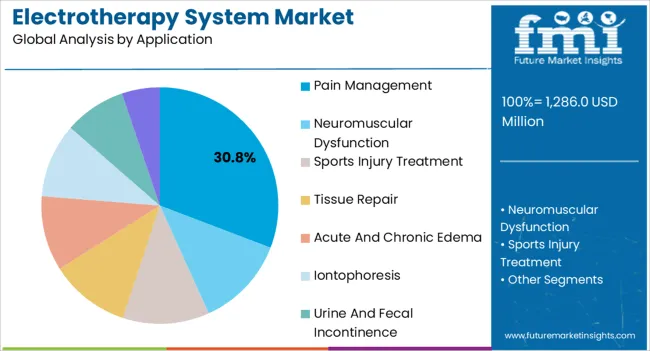
The pain management application segment is anticipated to account for 30.8% of the market revenue in 2026, making it the leading application area. Growth is being driven by increasing patient demand for non-invasive therapeutic options and the growing prevalence of chronic and post-operative pain conditions. Electrotherapy systems, including TSE devices, are being deployed to provide localized or systemic pain relief by modulating neural pathways and reducing discomfort without the need for medication.
Clinical adoption is being supported by evidence demonstrating efficacy in both acute and chronic pain management, along with reduced side effects compared with pharmacological treatments. Hospitals and rehabilitation centers are increasingly integrating these applications into physiotherapy and multidisciplinary pain management programs.
Advances in device technology, including programmable protocols, wireless connectivity, and safety features, are further facilitating adoption As healthcare providers seek efficient, patient-centric, and cost-effective treatment modalities, the pain management application segment is expected to remain the primary driver of market growth.
Insights into the Hospitals End-User Segment
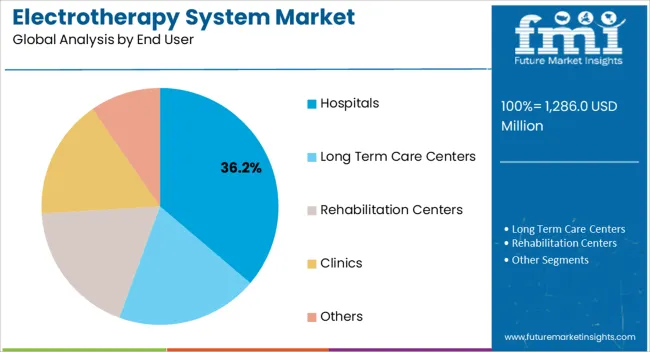
The hospitals end-user segment is projected to hold 36.2% of the market revenue in 2026, establishing it as the leading end-use industry. Growth is being driven by the high adoption of electrotherapy systems in inpatient and outpatient settings for pain management, rehabilitation, and post-operative care. Hospitals benefit from centralized deployment, allowing multiple departments to leverage the same devices for diverse patient needs, improving cost efficiency and resource utilization.
Integration with physiotherapy, neurology, and orthopedic departments enhances the value of electrotherapy systems, enabling multidisciplinary treatment approaches. Technological advancements, including programmable intensity, multi-channel delivery, and enhanced monitoring, support clinical decision-making and patient safety, further strengthening adoption.
Rising investment in hospital infrastructure, growing focus on patient outcomes, and increasing demand for non-invasive and evidence-based treatment solutions are key factors reinforcing growth As hospitals continue to prioritize efficiency, effectiveness, and patient satisfaction, this end-user segment is expected to remain the dominant contributor to market revenue within the electrotherapy system sector.
Market Overview
Electrotherapy System Market Overview
Electrotherapy System is the use of electric energy in the medical treatment. Most athletic trainers and therapists uses electrotherapy system in the management of athletic injuries. Electrotherapy system is used relieve pain, elicit muscle contraction for strength and reeducation after trauma or immobilization, in iontophoresis and to manage edema and chronic wound.
Electrotherapy system is used in ion-therapy, for stimulating the motor system and pain therapy. In neuromuscular diseases, electrotherapy system is used to support voluntary movement and build muscles through the activation of muscle systems and neuro-facilitation. Electrotherapy system can be used at home to surgical procedures.
Specifically, electrotherapy system uses energy waves along the electromagnetic spectrum to create changes in the body that affect its physiological and chemical output. Electrotherapy system is mostly used for pain management to patients who are suffering from chronic pain associated with post-surgical incisions, arthritis, and pains of the back and neck, fractures.
Electrotherapy system is also used to increase the production of corticosteroids and vitamin D in the body. Electrotherapy system can be used to treat inflammatory conditions associated with orthopedics, bronchitis, certain conditions associated with psoriasis. According to American Academy of Pain Medicine, more than 1.5 billion people worldwide are suffering from chronic pain.
Analysis of Electrotherapy System Market By Key Countries
.webp "Top Country Growth Comparison Electrotherapy System Market Cagr (2026 2036)")
| Country | CAGR |
|---|---|
| China | 9.0% |
| India | 8.3% |
| Germany | 7.6% |
| France | 7.0% |
| UK | 6.3% |
| USA | 5.7% |
| Brazil | 5.0% |
Source: FMI analysis based on primary research and proprietary forecasting model
Country-wise Analysis
The Electrotherapy System Market is expected to register a CAGR of 6.7% during the forecast period, exhibiting varied country level momentum. China leads with the highest CAGR of 9.0%, followed by India at 8.3%. Developed markets such as Germany, France, and the UK continue to expand steadily, while the USA is likely to grow at consistent rates. Brazil posts the lowest CAGR at 5.0%, yet still underscores a broadly positive trajectory for the global Electrotherapy System Market. In 2024, Germany held a dominant revenue in the Western Europe market and is expected to grow with a CAGR of 7.6%. The USA Electrotherapy System Market is estimated to be valued at USD 441.5 million in 2026 and is anticipated to reach a valuation of USD 765.1 million by 2036. Sales are projected to rise at a CAGR of 5.7% over the forecast period between 2026 and 2036. While Japan and South Korea markets are estimated to be valued at USD 63.2 million and USD 39.6 million respectively in 2026.
Key Players in the Electrotherapy System Market
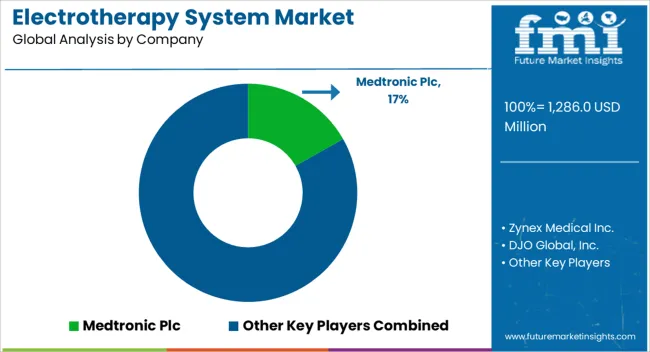
- Medtronic Plc
- Zynex Medical Inc.
- DJO Global, Inc.
- Nevro Corporation
- BTL Industries, Inc.
- Zealmax Innovations Pvt. Ltd.
- LivaNova PLC
- EMS Physio Ltd.
- STYMCO Medical
- Omron Corporation
- TensCare Ltd
- Neuro20 Technologies Corp
Scope of the Report
| Metric | Value |
|---|---|
| Quantitative Units | USD 1.37 Billion to USD 2.62 Billion, at a CAGR of 6.70% |
| Market Definition | Electrotherapy systems deliver controlled electrical stimulation for pain relief, neuromuscular rehabilitation, and tissue repair through TENS, interferential, spinal cord stimulation, and micro-current modalities across hospital, rehabilitation, clinic, and home settings. |
| Segmentation | Product Type: Transcutaneous Spinal Electroanalgesia, Transcutaneous Electrical Nerve Stimulation, Interferential Current Therapy, Spinal Cord Stimulation, Electro-Acupuncture, Pulsed Short Wave Diathermy, Micro-Current Therapy, Percutaneous Electrical Nerve Stimulation, and Others; Application: Pain Management, Neuromuscular Dysfunction, Sports Injury Treatment, Tissue Repair, Acute And Chronic Edema, Iontophoresis, Urine And Fecal Incontinence, and Others; End User: Hospitals, Long Term Care Centers, Rehabilitation Centers, Clinics, and Others |
| Regions Covered | North America, Latin America, Europe, East Asia, South Asia, Oceania, Middle East & Africa |
| Countries Covered | China, India, Germany, France, UK, USA, Brazil, and 40 plus countries |
| Key Companies Profiled | Medtronic Plc, Zynex Medical Inc., DJO Global, Inc., Nevro Corporation, BTL Industries, Inc., Zealmax Innovations Pvt. Ltd., LivaNova PLC, EMS Physio Ltd., STYMCO Medical, Omron Corporation, TensCare Ltd, Neuro20 Technologies Corp |
| Forecast Period | 2026 to 2036 |
| Approach | Forecasting models apply a bottom-up methodology starting with installed base metrics and projecting conversion rates to technology adoption. |
Electrotherapy System Market by Segments
Product Type:
- Transcutaneous Spinal Electroanalgesia (TSE)
- Transcutaneous Electrical Nerve Stimulation (TENS)
- Interferential Current Therapy (IC)
- Spinal Cord Stimulation (SCS)
- Electro-Acupuncture (EA)
- Pulsed Short Wave Diathermy (PSWD)
- Micro-Current Therapy
- Percutaneous Electrical Nerve Stimulation (PENS)
- Others
Application:
- Pain Management
- Neuromuscular Dysfunction
- Sports Injury Treatment
- Tissue Repair
- Acute And Chronic Edema
- Iontophoresis
- Urine And Fecal Incontinence
- Others
End User:
- Hospitals
- Long Term Care Centers
- Rehabilitation Centers
- Clinics
- Others
Region:
- North America
- USA
- Canada
- Mexico
- Latin America
- Brazil
- Chile
- Rest of Latin America
- Western Europe
- Germany
- UK
- Italy
- Spain
- France
- Nordic
- BENELUX
- Rest of Western Europe
- Eastern Europe
- Russia
- Poland
- Hungary
- Balkan & Baltic
- Rest of Eastern Europe
- East Asia
- China
- Japan
- South Korea
- South Asia and Pacific
- India
- ASEAN
- Australia & New Zealand
- Rest of South Asia and Pacific
- Middle East & Africa
- Kingdom of Saudi Arabia
- Other GCC Countries
- Turkiye
- South Africa
- Other African Union
- Rest of Middle East & Africa
Bibliography
- 1. World Health Organization. (2024). Rehabilitation Service Capacity: Global Assessment and Infrastructure Targets. WHO.
- 2. National Institute for Health and Care Excellence. (2024). NICE Technology Appraisal: Electrotherapy for Musculoskeletal Pain Management. NICE.
- 3. USA Centers for Medicare and Medicaid Services. (2024). National Coverage Determination: Electrostimulation for Pain Management. CMS.
- 4. National Health Commission of China. (2024). County Hospital Rehabilitation Department: Equipment and Staffing Standards. NHC.
- 5. Deutsche Gesellschaft fur Physikalische Medizin und Rehabilitation. (2024). Electrotherapy Clinical Practice Guidelines Update. DGPMR.
- 6. Indian Association of Physiotherapists. (2024). Electrotherapy Practice Standards and Equipment Specification Guidelines. IAP.
- This bibliography is provided for reader reference. The full FMI report contains the complete reference list with primary research documentation.
This bibliography is provided for reader reference and is not exhaustive. The full report contains the complete reference list and detailed citations.
Frequently Asked Questions
How large is the demand for Electrotherapy Systems in the global market in 2026?
Demand is estimated to be valued at USD 1.37 billion in 2026.
What will be the market size by 2036?
Market size is projected to reach USD 2.62 billion by 2036.
What is the expected CAGR between 2026 and 2036?
Demand is expected to grow at a CAGR of 6.70% between 2026 and 2036.
Which Product Type is poised to lead global sales by 2026?
Transcutaneous Spinal Electroanalgesia accounts for 35.2% share supported by clinical evidence for chronic back pain management.
How is Pain Management positioned as an Application in 2026?
Pain Management represents 30.8% share as the highest-volume indication driving device utilization across all settings.
What is driving demand in China?
Rehabilitation department expansion and electro-acupuncture integration within traditional medicine programmes fuel the fastest growth at 9.0% CAGR through 2036.
What is included in the scope of this report?
The market covers TENS, interferential, spinal cord stimulation, electro-acupuncture, micro-current, iontophoresis, and pelvic floor devices across professional and consumer segments.
What is excluded from the scope of this report?
Implantable neurostimulation generators, diagnostic EMG equipment, electroconvulsive therapy systems, and separately sold electrode accessories are excluded.
Preview the report firsthand - request a free sample
Get SampleGet the brochure for pricing and purchase details.
Get PDFTable of Content
- Executive Summary
- Global Market Outlook
- Demand-side Trends
- Supply-side Trends
- Technology Roadmap Analysis
- Analysis and Recommendations
- Market Overview
- Market Coverage / Taxonomy
- Market Definition / Scope / Limitations
- Research Methodology
- Chapter Orientation
- Analytical Lens and Working Hypotheses
- Market Structure, Signals, and Trend Drivers
- Benchmarking and Cross-market Comparability
- Market Sizing, Forecasting, and Opportunity Mapping
- Research Design and Evidence Framework
- Desk Research Programme (Secondary Evidence)
- Company Annual and Sustainability Reports
- Peer-reviewed Journals and Academic Literature
- Corporate Websites, Product Literature, and Technical Notes
- Earnings Decks and Investor Briefings
- Statutory Filings and Regulatory Disclosures
- Technical White Papers and Standards Notes
- Trade Journals, Industry Magazines, and Analyst Briefs
- Conference Proceedings, Webinars, and Seminar Materials
- Government Statistics Portals and Public Data Releases
- Press Releases and Reputable Media Coverage
- Specialist Newsletters and Curated Briefings
- Sector Databases and Reference Repositories
- FMI Internal Proprietary Databases and Historical Market Datasets
- Subscription Datasets and Paid Sources
- Social Channels, Communities, and Digital Listening Inputs
- Additional Desk Sources
- Expert Input and Fieldwork (Primary Evidence)
- Primary Modes
- Qualitative Interviews and Expert Elicitation
- Quantitative Surveys and Structured Data Capture
- Blended Approach
- Why Primary Evidence is Used
- Field Techniques
- Interviews
- Surveys
- Focus Groups
- Observational and In-context Research
- Social and Community Interactions
- Stakeholder Universe Engaged
- C-suite Leaders
- Board Members
- Presidents and Vice Presidents
- R&D and Innovation Heads
- Technical Specialists
- Domain Subject-matter Experts
- Scientists
- Physicians and Other Healthcare Professionals
- Governance, Ethics, and Data Stewardship
- Research Ethics
- Data Integrity and Handling
- Primary Modes
- Tooling, Models, and Reference Databases
- Desk Research Programme (Secondary Evidence)
- Data Engineering and Model Build
- Data Acquisition and Ingestion
- Cleaning, Normalisation, and Verification
- Synthesis, Triangulation, and Analysis
- Quality Assurance and Audit Trail
- Market Background
- Market Dynamics
- Drivers
- Restraints
- Opportunity
- Trends
- Scenario Forecast
- Demand in Optimistic Scenario
- Demand in Likely Scenario
- Demand in Conservative Scenario
- Opportunity Map Analysis
- Product Life Cycle Analysis
- Supply Chain Analysis
- Investment Feasibility Matrix
- Value Chain Analysis
- PESTLE and Porter’s Analysis
- Regulatory Landscape
- Regional Parent Market Outlook
- Production and Consumption Statistics
- Import and Export Statistics
- Market Dynamics
- Global Market Analysis 2021 to 2025 and Forecast, 2026 to 2036
- Historical Market Size Value (USD Million) Analysis, 2021 to 2025
- Current and Future Market Size Value (USD Million) Projections, 2026 to 2036
- Y-o-Y Growth Trend Analysis
- Absolute $ Opportunity Analysis
- Global Market Pricing Analysis 2021 to 2025 and Forecast 2026 to 2036
- Global Market Analysis 2021 to 2025 and Forecast 2026 to 2036, By Product Type
- Introduction / Key Findings
- Historical Market Size Value (USD Million) Analysis By Product Type , 2021 to 2025
- Current and Future Market Size Value (USD Million) Analysis and Forecast By Product Type , 2026 to 2036
- Transcutaneous Spinal Electroanalgesia
- Transcutaneous Electrical Nerve Stimulation
- Interferential Current Therapy
- Spinal Cord Stimulation
- Electro-Acupuncture
- Pulsed Short Wave Diathermy
- Micro-Current Therapy
- Percutaneous Electrical Nerve Stimulation
- Others
- Transcutaneous Spinal Electroanalgesia
- Y-o-Y Growth Trend Analysis By Product Type , 2021 to 2025
- Absolute $ Opportunity Analysis By Product Type , 2026 to 2036
- Global Market Analysis 2021 to 2025 and Forecast 2026 to 2036, By Application
- Introduction / Key Findings
- Historical Market Size Value (USD Million) Analysis By Application, 2021 to 2025
- Current and Future Market Size Value (USD Million) Analysis and Forecast By Application, 2026 to 2036
- Pain Management
- Neuromuscular Dysfunction
- Sports Injury Treatment
- Tissue Repair
- Acute And Chronic Edema
- Iontophoresis
- Urine And Fecal Incontinence
- Others
- Pain Management
- Y-o-Y Growth Trend Analysis By Application, 2021 to 2025
- Absolute $ Opportunity Analysis By Application, 2026 to 2036
- Global Market Analysis 2021 to 2025 and Forecast 2026 to 2036, By End User
- Introduction / Key Findings
- Historical Market Size Value (USD Million) Analysis By End User, 2021 to 2025
- Current and Future Market Size Value (USD Million) Analysis and Forecast By End User, 2026 to 2036
- Hospitals
- Long Term Care Centers
- Rehabilitation Centers
- Clinics
- Others
- Hospitals
- Y-o-Y Growth Trend Analysis By End User, 2021 to 2025
- Absolute $ Opportunity Analysis By End User, 2026 to 2036
- Global Market Analysis 2021 to 2025 and Forecast 2026 to 2036, By Region
- Introduction
- Historical Market Size Value (USD Million) Analysis By Region, 2021 to 2025
- Current Market Size Value (USD Million) Analysis and Forecast By Region, 2026 to 2036
- North America
- Latin America
- Western Europe
- Eastern Europe
- East Asia
- South Asia and Pacific
- Middle East & Africa
- Market Attractiveness Analysis By Region
- North America Market Analysis 2021 to 2025 and Forecast 2026 to 2036, By Country
- Historical Market Size Value (USD Million) Trend Analysis By Market Taxonomy, 2021 to 2025
- Market Size Value (USD Million) Forecast By Market Taxonomy, 2026 to 2036
- By Country
- USA
- Canada
- Mexico
- By Product Type
- By Application
- By End User
- By Country
- Market Attractiveness Analysis
- By Country
- By Product Type
- By Application
- By End User
- Key Takeaways
- Latin America Market Analysis 2021 to 2025 and Forecast 2026 to 2036, By Country
- Historical Market Size Value (USD Million) Trend Analysis By Market Taxonomy, 2021 to 2025
- Market Size Value (USD Million) Forecast By Market Taxonomy, 2026 to 2036
- By Country
- Brazil
- Chile
- Rest of Latin America
- By Product Type
- By Application
- By End User
- By Country
- Market Attractiveness Analysis
- By Country
- By Product Type
- By Application
- By End User
- Key Takeaways
- Western Europe Market Analysis 2021 to 2025 and Forecast 2026 to 2036, By Country
- Historical Market Size Value (USD Million) Trend Analysis By Market Taxonomy, 2021 to 2025
- Market Size Value (USD Million) Forecast By Market Taxonomy, 2026 to 2036
- By Country
- Germany
- UK
- Italy
- Spain
- France
- Nordic
- BENELUX
- Rest of Western Europe
- By Product Type
- By Application
- By End User
- By Country
- Market Attractiveness Analysis
- By Country
- By Product Type
- By Application
- By End User
- Key Takeaways
- Eastern Europe Market Analysis 2021 to 2025 and Forecast 2026 to 2036, By Country
- Historical Market Size Value (USD Million) Trend Analysis By Market Taxonomy, 2021 to 2025
- Market Size Value (USD Million) Forecast By Market Taxonomy, 2026 to 2036
- By Country
- Russia
- Poland
- Hungary
- Balkan & Baltic
- Rest of Eastern Europe
- By Product Type
- By Application
- By End User
- By Country
- Market Attractiveness Analysis
- By Country
- By Product Type
- By Application
- By End User
- Key Takeaways
- East Asia Market Analysis 2021 to 2025 and Forecast 2026 to 2036, By Country
- Historical Market Size Value (USD Million) Trend Analysis By Market Taxonomy, 2021 to 2025
- Market Size Value (USD Million) Forecast By Market Taxonomy, 2026 to 2036
- By Country
- China
- Japan
- South Korea
- By Product Type
- By Application
- By End User
- By Country
- Market Attractiveness Analysis
- By Country
- By Product Type
- By Application
- By End User
- Key Takeaways
- South Asia and Pacific Market Analysis 2021 to 2025 and Forecast 2026 to 2036, By Country
- Historical Market Size Value (USD Million) Trend Analysis By Market Taxonomy, 2021 to 2025
- Market Size Value (USD Million) Forecast By Market Taxonomy, 2026 to 2036
- By Country
- India
- ASEAN
- Australia & New Zealand
- Rest of South Asia and Pacific
- By Product Type
- By Application
- By End User
- By Country
- Market Attractiveness Analysis
- By Country
- By Product Type
- By Application
- By End User
- Key Takeaways
- Middle East & Africa Market Analysis 2021 to 2025 and Forecast 2026 to 2036, By Country
- Historical Market Size Value (USD Million) Trend Analysis By Market Taxonomy, 2021 to 2025
- Market Size Value (USD Million) Forecast By Market Taxonomy, 2026 to 2036
- By Country
- Kingdom of Saudi Arabia
- Other GCC Countries
- Turkiye
- South Africa
- Other African Union
- Rest of Middle East & Africa
- By Product Type
- By Application
- By End User
- By Country
- Market Attractiveness Analysis
- By Country
- By Product Type
- By Application
- By End User
- Key Takeaways
- Key Countries Market Analysis
- USA
- Pricing Analysis
- Market Share Analysis, 2025
- By Product Type
- By Application
- By End User
- Canada
- Pricing Analysis
- Market Share Analysis, 2025
- By Product Type
- By Application
- By End User
- Mexico
- Pricing Analysis
- Market Share Analysis, 2025
- By Product Type
- By Application
- By End User
- Brazil
- Pricing Analysis
- Market Share Analysis, 2025
- By Product Type
- By Application
- By End User
- Chile
- Pricing Analysis
- Market Share Analysis, 2025
- By Product Type
- By Application
- By End User
- Germany
- Pricing Analysis
- Market Share Analysis, 2025
- By Product Type
- By Application
- By End User
- UK
- Pricing Analysis
- Market Share Analysis, 2025
- By Product Type
- By Application
- By End User
- Italy
- Pricing Analysis
- Market Share Analysis, 2025
- By Product Type
- By Application
- By End User
- Spain
- Pricing Analysis
- Market Share Analysis, 2025
- By Product Type
- By Application
- By End User
- France
- Pricing Analysis
- Market Share Analysis, 2025
- By Product Type
- By Application
- By End User
- India
- Pricing Analysis
- Market Share Analysis, 2025
- By Product Type
- By Application
- By End User
- ASEAN
- Pricing Analysis
- Market Share Analysis, 2025
- By Product Type
- By Application
- By End User
- Australia & New Zealand
- Pricing Analysis
- Market Share Analysis, 2025
- By Product Type
- By Application
- By End User
- China
- Pricing Analysis
- Market Share Analysis, 2025
- By Product Type
- By Application
- By End User
- Japan
- Pricing Analysis
- Market Share Analysis, 2025
- By Product Type
- By Application
- By End User
- South Korea
- Pricing Analysis
- Market Share Analysis, 2025
- By Product Type
- By Application
- By End User
- Russia
- Pricing Analysis
- Market Share Analysis, 2025
- By Product Type
- By Application
- By End User
- Poland
- Pricing Analysis
- Market Share Analysis, 2025
- By Product Type
- By Application
- By End User
- Hungary
- Pricing Analysis
- Market Share Analysis, 2025
- By Product Type
- By Application
- By End User
- Kingdom of Saudi Arabia
- Pricing Analysis
- Market Share Analysis, 2025
- By Product Type
- By Application
- By End User
- Turkiye
- Pricing Analysis
- Market Share Analysis, 2025
- By Product Type
- By Application
- By End User
- South Africa
- Pricing Analysis
- Market Share Analysis, 2025
- By Product Type
- By Application
- By End User
- USA
- Market Structure Analysis
- Competition Dashboard
- Competition Benchmarking
- Market Share Analysis of Top Players
- By Regional
- By Product Type
- By Application
- By End User
- Competition Analysis
- Competition Deep Dive
- Medtronic Plc
- Overview
- Product Portfolio
- Profitability by Market Segments (Product/Age /Sales Channel/Region)
- Sales Footprint
- Strategy Overview
- Marketing Strategy
- Product Strategy
- Channel Strategy
- Zynex Medical Inc.
- DJO Global, Inc.
- Nevro Corporation
- BTL Industries, Inc.
- Zealmax Innovations Pvt. Ltd.
- LivaNova PLC
- EMS Physio Ltd.
- STYMCO Medical
- Omron Corporation
- TensCare Ltd
- Neuro20 Technologies Corp
- Medtronic Plc
- Competition Deep Dive
- Assumptions & Acronyms Used


