

- Market Size (2026)
- USD 327.4 Mn
- Forecast (2036)
- USD 493.3 Mn
- CAGR (2026 to 2036)
- 4.2%
How big is Ethyl 3-Ethoxypropionate (EEP) Market in 2026?
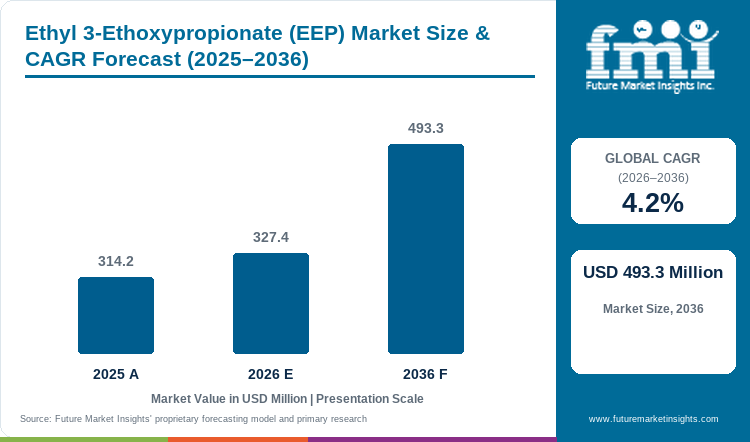
The ethyl 3-ethoxypropionate (EEP) market is valued at USD 327.4 million in 2026 and is projected to reach USD 493.3 million by 2036, expanding at a CAGR of 4.2% over the 2026-2036 period.
The market was valued at USD 314.2 million in 2025. Demand is estimated at USD 327.4 million in 2026 and is projected to reach USD 493.3 million by 2036 at a 4.2% CAGR. The estimate covers merchant ethyl 3-ethoxypropionate sold as a slow-evaporating ether-ester solvent. Other glycol ethers, acetates and custom blends without separately priced EEP are excluded.
EEP is assessed within the Asia Pacific industrial solvents market, but demand is tied to its specific ether-ester chemistry and slow evaporation profile. Coatings and inks remain the main demand base, with use depending on whether EEP delivers the required solvency, drying rate and film performance.
Key Takeaways
- The market is valued at USD 327.4 million in 2026 and is projected to add USD 165.9 million in value by 2036.
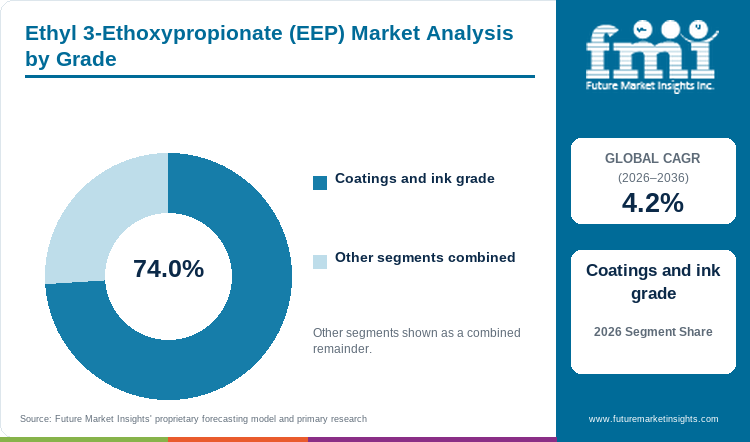
- Coatings and ink grade is projected to account for 74.0% of Grade demand in 2026 because coatings and inks are the main industrial uses of EEP.
- 99.0% and above is projected to account for 69.0% of Purity demand in 2026 as formulators require consistent solvent composition and performance.
- Paints and coatings are projected to account for 58.0% of Application demand in 2026 because EEP's slow evaporation can support flow, leveling and film formation.
- VOC controls can limit EEP demand as coating producers move toward waterborne, high-solids and other lower-VOC systems.
- Key players in this market include Eastman and LyondellBasell. Dow and KH Neochem are also included, along with Daicel and Jiangsu Dynamic Chemical. Tokyo Chemical Industry and Merck KGaA complete the profiled group.
Analyst Perspective
“EEP earns its place through a drying profile that solves a coating problem. A formulator will retain it only when gains in flow and leveling as well as appearance outweigh VOC and handling costs.”
- Nikhil Kaitwade, Principal Consultant, Future Market Insights
How is the ethyl 3-ethoxypropionate (EEP) market segmented?
The ethyl 3-ethoxypropionate (EEP) market is segmented by grade, purity, application, end-use industry, packaging, and region. Coatings and ink grade leads the grade category with 74.0% of 2026 revenue.
Grade and purity define product specifications. Application separates coatings and inks from cleaning and synthesis uses. End-use industry shows where EEP is consumed, while packaging reflects purchase volume and handling requirements.
Why does coatings and ink grade lead EEP demand?
EEP is widely used in coatings and inks because it combines good solvency with slow evaporation. That gives formulators more control over flow and drying.
- Coatings and ink grade is estimated to account for 74.0% in 2026 because coatings and inks are the main industrial uses of EEP.
- EEP is used across automotive, industrial and packaging coating systems.
Why does 99.0% and above lead purity demand?
Higher-purity EEP gives formulators more consistent solvent performance and reduces variation between batches.
- 99.0% and above is estimated to account for 69.0% in 2026 because coating and ink formulations need consistent solvent quality.
- Commercial EEP is commonly supplied at 99.0% minimum assay.
Why do paints and coatings lead application demand?
Paints and coatings benefit from EEP's slow evaporation and strong solvency. It helps maintain flow during application and supports a smoother finish.
- Paints and coatings are estimated to account for 58.0% in 2026 because EEP supports controlled drying and film formation.
- EEP is used in automotive, industrial, marine and protective coatings.
How do industrial and automotive coatings shape demand?
Automotive and industrial coatings use EEP where formulators need good flow, controlled evaporation and a clean surface finish.
- Industrial and automotive coatings are estimated to account for 52.0% in 2026 because these applications place greater emphasis on finish quality.
- EEP is used in both OEM and refinish coating systems.
Why do bulk deliveries lead packaging demand?
Large coating and chemical plants use enough solvent to justify bulk storage and direct transfer into production.
- Bulk and tank delivery is estimated to account for 55.0% in 2026 because large formulators buy solvents in high volumes.
- Drums and IBCs remain more practical for smaller production runs.
What are the drivers, restraints and opportunities in the Ethyl 3-Ethoxypropionate (EEP) Market?
In the ethyl 3-ethoxypropionate (EEP) market, the key driver is slow-evaporating solvents that improve flow, leveling and surface appearance in industrial coatings, the key restraint is VOC regulation and shifts to waterborne or high-solids coatings that reduce solvent intensity, and the key opportunity is high-purity EEP for electronics cleaning, specialty inks and tightly controlled coating systems.
- Driver: Industrial coatings use slow-evaporating solvents to improve flow and leveling as well as surface appearance.
- Restraint: VOC regulation and the shift to waterborne or high-solids coatings reduce solvent intensity.
- Opportunity: High-purity EEP can serve electronics cleaning and specialty inks as well as tightly controlled coating systems.
Growth in the coating additives market supports EEP where formulators need strong solvency and a controlled evaporation tail. Consumption depends on the solvent blend and coating solids rather than coated area alone.
A coating can be reformulated around water and exempt solvents or higher solids. The transition still requires new drying and film-performance validation. EEP is retained where it prevents surface defects, while procurement teams continue to compare exposure and emissions profiles.
The e-series glycol ether market provides a broader family context for EEP and related solvents. Electronics and specialty-ink users can justify high-purity grades when residues and water as well as evaporation repeatability affect process yield.
Which country CAGRs are profiled in the Ethyl 3-Ethoxypropionate (EEP) Market?
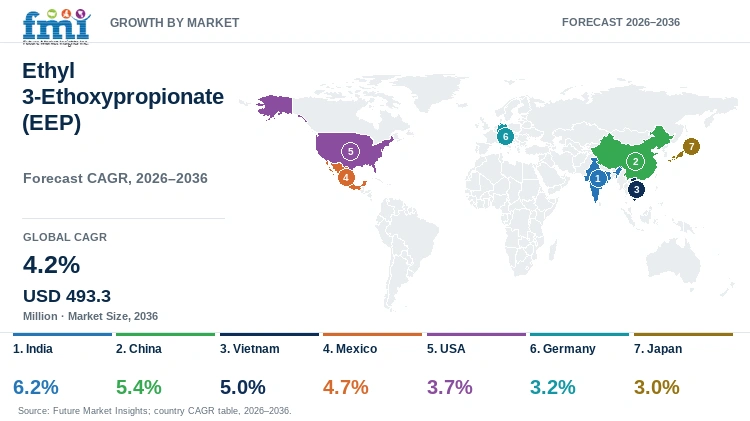
| Country | CAGR |
|---|---|
| India | 6.2% |
| China | 5.4% |
| Vietnam | 5.0% |
| Mexico | 4.7% |
| USA | 3.7% |
| Germany | 3.2% |
| Japan | 3.0% |
How do country-level CAGRs compare in the Ethyl 3-Ethoxypropionate (EEP) Market?
India is projected to record the highest CAGR at 6.8% through 2036, standing 0.4 percentage points above China. Vietnam follows 0.3 percentage points behind China, while Mexico trails Vietnam by 0.4 percentage points. The gap widens across mature markets, with the USA 1.3 percentage points below Mexico. Germany and Japan are expected to grow at a slower pace as solvent demand is increasingly influenced by reformulation and lower-VOC coating systems.
- India: 6.8% CAGR, 0.4 percentage points above China, supported by growth in coatings and electronics manufacturing.
- China: 6.4% CAGR, 0.3 percentage points above Vietnam, with electronics and chemical manufacturing supporting solvent consumption. China’s computer, communication and electronic-equipment manufacturing output grew 11.8% year over year in December 2025.
- Vietnam: 6.1% CAGR, 0.4 percentage points above Mexico, supported by expansion in electronics manufacturing.
- Mexico: 5.7% CAGR, 1.3 percentage points above the USA, with automotive coatings providing an important demand base.
- USA: 4.4% CAGR, 0.6 percentage points above Germany, as solvent selection becomes more closely tied to VOC-compliant coating formulations.
- Germany: 3.8% CAGR, 0.2 percentage points above Japan, reflecting greater use of lower-solvent and waterborne coating systems.
- Japan: 3.6% CAGR, with specialty solvent demand supported by automotive and electronics applications.
Across the key countries in this market, these rates measure revenue within the defined product boundary and do not represent growth of the wider parent industry.
Country-wise Analysis
- India: Expansion in coatings, electronics and industrial manufacturing is broadening the addressable base for specialty solvents such as EEP. Demand is likely to remain concentrated in applications that require controlled evaporation and strong solvency.
- China: EEP demand is supported by the country's deep electronics and chemical manufacturing base. In 2025, output from computer, communication and other electronic equipment manufacturing increased 10.6%, while raw chemical materials and chemical products also recorded growth.
- Vietnam: Electronics manufacturing is becoming a stronger demand anchor for industrial solvents. Vietnam's Ministry of Industry and Trade reported a 39.7% increase in exports of computers, electronic products and components during the first half of 2025, strengthening the downstream base for processing and finishing materials.
- Mexico: Automotive manufacturing keeps industrial coatings central to the solvent opportunity. EEP demand is therefore more closely linked to vehicle finishing and related coating applications than to broad-based solvent consumption.
- USA: Formulation changes matter more than simple manufacturing expansion. EPA guidance identifies waterborne and high-solids coatings among the approaches used to reduce VOC emissions, which places pressure on conventional solvent use while preserving demand where specialty solvents remain technically necessary.
- Germany: The market is shaped by continued efforts to reduce solvent emissions from coatings and related applications. This pushes EEP toward formulations where its performance characteristics justify its use despite the broader move toward lower-solvent systems.
- Japan: Demand is anchored in established automotive, electronics and industrial coating applications. The opportunity is therefore centered more on specification-driven specialty solvent use than on rapid expansion in overall solvent volumes.
Who are the notable companies in the Ethyl 3-Ethoxypropionate (EEP) Market?
Eastman, LyondellBasell, Dow, KH Neochem, Daicel, Jiangsu Dynamic Chemical, Tokyo Chemical Industry, Merck KGaA are the notable companies profiled in this market.
Eastman has direct current public EEP documentation. Other solvent groups are benchmarked on oxygenated-solvent capability and application support, with Low used where merchant EEP is not confirmed.
- Direct and Documented EEP Supply: Eastman and Tokyo Chemical Industry. Merck KGaA is also included.
- Oxygenated Solvent Platforms: KH Neochem and Daicel. Jiangsu Dynamic Chemical is also included.
- Adjacent Global Solvent Groups: LyondellBasell and Dow.
Competitive Benchmarking: Ethyl 3-Ethoxypropionate (EEP) Market
| Company | Direct EEP Evidence | High-Purity Capability | Application Support | Geographic Reach |
|---|---|---|---|---|
| Eastman | High | High | High | Global |
| LyondellBasell | Low | High | High | Global |
| Dow | Low | High | High | Global |
| KH Neochem | Medium | High | High | Asia, global |
| Daicel | Medium | High | High | Asia, global |
| Jiangsu Dynamic Chemical | Medium | Medium | Medium | Asia, export |
| Tokyo Chemical Industry | High | Medium | Medium | Global |
| Merck KGaA | Medium | Medium | High | Global |
High direct evidence requires a named EEP product. Medium reflects relevant ether-ester or catalog capability. Low identifies adjacent solvent participation without confirmed current merchant EEP.
Key Developments in the Ethyl 3-Ethoxypropionate (EEP) Market
- In March 2025, Eastman updated its EEP technical data sheet and documented 99.0% assay as well as slow evaporation and coating or ink applications.
- In 2025, European chemical registration resources continued to list EEP for industrial use. This kept exposure and environmental documentation central to purchasing.
- In 2024, electronics manufacturing investment continued across India and China as well as Vietnam and Mexico. This expanded the potential customer base for controlled-purity solvents.
Key Players in the Ethyl 3-Ethoxypropionate (EEP) Market
Direct and Documented EEP Supply
- Eastman
- Tokyo Chemical Industry
- Merck KGaA
Oxygenated Solvent Platforms
- KH Neochem
- Daicel
- Jiangsu Dynamic Chemical
Adjacent Global Solvent Groups
- LyondellBasell
- Dow
Ethyl 3-Ethoxypropionate (EEP) Market - Report Scope
| Coverage field | Report scope |
|---|---|
| Market Size | USD 327.4 million in 2026 and USD 493.3 million by 2036 at 4.2% CAGR. |
| Market Definition | Ethyl 3-ethoxypropionate sold as a slow-evaporating ether-ester solvent for coatings, inks, electronics, cleaning and synthesis. |
| Segmentation | Grade, purity, application, end-use industry, packaging and region. |
| Regional Coverage | North America, Latin America, Western Europe, Eastern Europe, East Asia, South Asia and Pacific, and Middle East and Africa. |
| Countries Covered | India, China, Vietnam, Mexico, USA, Germany, Japan and more than 20 countries included in the full report. |
| Key Companies Profiled | Eastman, LyondellBasell, Dow, KH Neochem, Daicel, Jiangsu Dynamic Chemical, Tokyo Chemical Industry, Merck KGaA. |
| Forecast Period | 2026 to 2036. |
| Approach | Bottom-up model using relevant coating and ink output, solvent recipe share, electronics demand, packaging mix and regional realized price. |
Ethyl 3-Ethoxypropionate (EEP) Market - Research Methodology
| Method | Approach |
|---|---|
| Primary Research | FMI analysts gathered input from manufacturers, system integrators, distributors, plant engineers, procurement teams and application specialists. Interviews tested purchasing criteria, replacement cycles, qualification work and technical-service requirements. |
| Desk Research | Desk research covered government statistics, standards, industry associations, technical literature, patents, official product information and corporate announcements. Evidence was screened for scope, date and direct relevance. |
| Market Sizing and Forecasting | Bottom-up model using relevant coating and ink output, solvent recipe share, electronics demand, packaging mix and regional realized price. |
| Data Validation | Estimates were checked against parent-market activity, installed-base indicators, product specifications and supplier participation. Adjacent products without the defined function were excluded. |
Ethyl 3-Ethoxypropionate (EEP) Market by Segments
Ethyl 3-Ethoxypropionate (EEP) Market segmented by Grade:
- Coatings and ink grade
- Electronics and cleaning grade
- Synthesis and laboratory grade
Ethyl 3-Ethoxypropionate (EEP) Market segmented by Purity:
- 99.0% and above
- 98.0% to below 99.0%
- Below 98.0%
Ethyl 3-Ethoxypropionate (EEP) Market segmented by Application:
- Paints and coatings
- Printing inks
- Electronics and precision cleaning
- Chemical synthesis
- Other industrial formulations
Ethyl 3-Ethoxypropionate (EEP) Market segmented by End-use Industry:
- Industrial and automotive coatings
- Printing and packaging inks
- Electronics manufacturing
- Adhesives and specialty chemicals
Ethyl 3-Ethoxypropionate (EEP) Market segmented by Packaging:
- Bulk and tank delivery
- Drums
- Intermediate bulk containers
- Small packs
Ethyl 3-Ethoxypropionate (EEP) Market by Region:
- North America
- United States
- Canada
- Latin America
- Brazil
- Mexico
- Argentina
- Chile
- Western Europe
- Germany
- France
- United Kingdom
- Italy
- Spain
- Benelux
- Nordics
- Eastern Europe
- Poland
- Czech Republic
- Romania
- Hungary
- East Asia
- China
- Japan
- South Korea
- South Asia and Pacific
- India
- ASEAN
- Australia and New Zealand
- Middle East and Africa
- GCC Countries
- South Africa
- Türkiye
- Israel
Research Sources and Bibliography
- Eastman. (2025, March 20). Eastman EEP Solvent Technical Data Sheet.
- Eastman. (n.d.; accessed September 23, 2026). EEP solvent product page.
- European Chemicals Agency. (n.d.; accessed September 23, 2026). Ethyl 3-ethoxypropionate substance information.
- PubChem. (n.d.; accessed September 23, 2026). Ethyl 3-ethoxypropionate compound summary.
- United States Environmental Protection Agency. (2025). Volatile organic compound resources for coatings.
- Semiconductor Industry Association. (2025). Global electronics and semiconductor manufacturing resources.
- Future Market Insights. (2026). E-Series Glycol Ether Market.
- Future Market Insights. (2026). Asia Pacific Industrial Solvents Market.
This bibliography is provided for reader reference and is not exhaustive. The full report contains the complete reference list and detailed citations.
This Report Answers
- How large is the ethyl 3-ethoxypropionate (EEP) market in 2026 and 2036?
- Which product specification leads demand in 2026?
- What operating condition converts technical need into a purchase?
- Which constraint can delay qualification or replacement?
- How do country growth rates compare across the profiled markets?
- Which companies provide direct or adjacent market capability?
Frequently Asked Questions
How big is the ethyl 3-ethoxypropionate (EEP) market in 2026?
The ethyl 3-ethoxypropionate (EEP) market is valued at USD 327.4 million in 2026 and is projected to reach USD 493.3 million by 2036. The estimate covers revenue within the stated market definition and excludes adjacent equipment or chemicals sold without the required function.
What is the CAGR of the ethyl 3-ethoxypropionate (EEP) market from 2026 to 2036?
The market is projected to grow at 4.2% CAGR between 2026 and 2036. Expansion depends on end-market output together with the rate at which plants adopt higher-specification products.
Which grade leads the ethyl 3-ethoxypropionate (EEP) market?
Coatings and ink grade is expected to hold 74.0% share in 2026 because coatings and inks are the principal industrial applications. Application testing protects qualified solvent demand.
Which countries are projected to record higher growth?
India is projected at 6.2% CAGR, followed by China at 5.4% and Vietnam at 5.0% through 2036. The comparison reflects local production investment and the timing of replacement or qualification cycles.
Which companies are active in the ethyl 3-ethoxypropionate (EEP) market?
The profiled group includes Eastman, LyondellBasell, Dow, KH Neochem, Daicel, Jiangsu Dynamic Chemical, Tokyo Chemical Industry, Merck KGaA. Capability differs by product range and application evidence.
Preview the report firsthand - request a free sample
Get SampleGet the brochure for pricing and purchase details.
Get PDFTable of Content
- Key Takeaways
- Market Size and CAGR
- Top Growth Driver
- Fastest Growing Segment
- Leading Region
- Key Companies
- Emerging Opportunities
- Executive Summary
- Global Market Outlook
- Demand-side Trends
- Supply-side Trends
- Technology Roadmap Analysis
- Analysis and Recommendations
- Analyst Perspective (What is happening? Why now? What should investors know?)
- Key Questions Answered
- How large is the market?
- What is the CAGR?
- What are key trends?
- Which region dominates?
- Who are the leaders?
- Market Overview
- Market Coverage / Taxonomy
- Market Definition / Scope / Limitations
- Research Methodology
- Chapter Orientation
- Analytical Lens and Working Hypotheses
- Market Structure, Signals, and Trend Drivers
- Benchmarking and Cross-market Comparability
- Market Sizing, Forecasting, and Opportunity Mapping
- Research Design and Evidence Framework
- Desk Research Programme (Secondary Evidence)
- Expert Input and Fieldwork (Primary Evidence)
- Tooling, Models, and Reference Databases
- Data Engineering and Model Build
- Quality Assurance and Audit Trail
- Market Background
- Market Dynamics (Drivers, Restraints, Opportunity, Trends)
- Scenario Forecast (Optimistic, Likely, Conservative)
- Impact Analysis
- AI Impact
- Sustainability Impact
- Regulatory Impact
- Technology Impact
- Consumer / Buyer Analysis
- Purchase Drivers
- Adoption Barriers
- Buyer Journey
- Opportunity Map Analysis
- Product Life Cycle Analysis
- Supply Chain Analysis
- Investment Feasibility Matrix
- Value Chain Analysis
- PESTLE and Porter's Analysis
- Regulatory Landscape
- Regional Parent Market Outlook
- Production and Consumption Statistics
- Import and Export Statistics
- Global Market Analysis and Forecast, 2021 to 2036
- Historical Market Size Value (USD Million) Analysis, 2021 to 2025
- Current and Future Market Size Value (USD Million) Projections, 2026 to 2036
- Y-o-Y Growth Trend Analysis
- Absolute $ Opportunity Analysis
- Global Market Pricing Analysis, 2021 to 2036
- Global Market Analysis and Forecast, By Grade, 2021 to 2036
- Introduction / Key Findings
- Historical Market Size Value (USD Million) Analysis By Grade, 2021 to 2025
- Current and Future Market Size Value (USD Million) Analysis and Forecast By Grade, 2026 to 2036
- Coatings and ink grade
- Electronics and cleaning grade
- Synthesis and laboratory grade
- Y-o-Y Growth Trend Analysis By Grade, 2021 to 2025
- Absolute $ Opportunity Analysis By Grade, 2026 to 2036
- Global Market Analysis and Forecast, By Purity, 2021 to 2036
- Introduction / Key Findings
- Historical Market Size Value (USD Million) Analysis By Purity, 2021 to 2025
- Current and Future Market Size Value (USD Million) Analysis and Forecast By Purity, 2026 to 2036
- 99.0% and above
- 98.0% to below 99.0%
- Below 98.0%
- Y-o-Y Growth Trend Analysis By Purity, 2021 to 2025
- Absolute $ Opportunity Analysis By Purity, 2026 to 2036
- Global Market Analysis and Forecast, By Application, 2021 to 2036
- Introduction / Key Findings
- Historical Market Size Value (USD Million) Analysis By Application, 2021 to 2025
- Current and Future Market Size Value (USD Million) Analysis and Forecast By Application, 2026 to 2036
- Paints and coatings
- Printing inks
- Electronics and precision cleaning
- Chemical synthesis
- Other industrial formulations
- Y-o-Y Growth Trend Analysis By Application, 2021 to 2025
- Absolute $ Opportunity Analysis By Application, 2026 to 2036
- Global Market Analysis and Forecast, By End-use Industry, 2021 to 2036
- Introduction / Key Findings
- Historical Market Size Value (USD Million) Analysis By End-use Industry, 2021 to 2025
- Current and Future Market Size Value (USD Million) Analysis and Forecast By End-use Industry, 2026 to 2036
- Industrial and automotive coatings
- Printing and packaging inks
- Electronics manufacturing
- Adhesives and specialty chemicals
- Y-o-Y Growth Trend Analysis By End-use Industry, 2021 to 2025
- Absolute $ Opportunity Analysis By End-use Industry, 2026 to 2036
- Global Market Analysis and Forecast, By Packaging, 2021 to 2036
- Introduction / Key Findings
- Historical Market Size Value (USD Million) Analysis By Packaging, 2021 to 2025
- Current and Future Market Size Value (USD Million) Analysis and Forecast By Packaging, 2026 to 2036
- Bulk and tank delivery
- Drums
- Intermediate bulk containers
- Small packs
- Y-o-Y Growth Trend Analysis By Packaging, 2021 to 2025
- Absolute $ Opportunity Analysis By Packaging, 2026 to 2036
- Global Market Analysis and Forecast, By Region, 2021 to 2036
- Introduction
- Historical Market Size Value (USD Million) Analysis By Region, 2021 to 2025
- Current Market Size Value (USD Million) Analysis and Forecast By Region, 2026 to 2036
- North America
- Latin America
- Western Europe
- Eastern Europe
- East Asia
- South Asia and Pacific
- Middle East and Africa
- Market Attractiveness Analysis By Region
- North America Market Analysis and Forecast, By Country, 2021 to 2036
- Historical Market Size Value (USD Million) Trend Analysis By Market Taxonomy, 2021 to 2025
- Market Size Value (USD Million) Forecast By Market Taxonomy, 2026 to 2036
- By Country
- United States
- Canada
- By Grade
- By Purity
- By Application
- By End-use Industry
- By Packaging
- By Country
- Market Attractiveness Analysis
- By Country
- By Grade
- By Purity
- By Application
- By End-use Industry
- By Packaging
- Key Takeaways
- Latin America Market Analysis and Forecast, By Country
- Historical Market Size Value (USD Million) Trend Analysis By Market Taxonomy, 2021 to 2025
- Market Size Value (USD Million) Forecast By Market Taxonomy, 2026 to 2036
- By Country
- Brazil
- Mexico
- Argentina
- Chile
- By Grade
- By Purity
- By Application
- By End-use Industry
- By Packaging
- By Country
- Market Attractiveness Analysis
- By Country
- By Grade
- By Purity
- By Application
- By End-use Industry
- By Packaging
- Key Takeaways
- Western Europe Market Analysis and Forecast, By Country
- Historical Market Size Value (USD Million) Trend Analysis By Market Taxonomy, 2021 to 2025
- Market Size Value (USD Million) Forecast By Market Taxonomy, 2026 to 2036
- By Country
- Germany
- France
- United Kingdom
- Italy
- Spain
- Benelux
- Nordics
- By Grade
- By Purity
- By Application
- By End-use Industry
- By Packaging
- By Country
- Market Attractiveness Analysis
- By Country
- By Grade
- By Purity
- By Application
- By End-use Industry
- By Packaging
- Key Takeaways
- Eastern Europe Market Analysis and Forecast, By Country
- Historical Market Size Value (USD Million) Trend Analysis By Market Taxonomy, 2021 to 2025
- Market Size Value (USD Million) Forecast By Market Taxonomy, 2026 to 2036
- By Country
- Poland
- Czech Republic
- Romania
- Hungary
- By Grade
- By Purity
- By Application
- By End-use Industry
- By Packaging
- By Country
- Market Attractiveness Analysis
- By Country
- By Grade
- By Purity
- By Application
- By End-use Industry
- By Packaging
- Key Takeaways
- East Asia Market Analysis and Forecast, By Country
- Historical Market Size Value (USD Million) Trend Analysis By Market Taxonomy, 2021 to 2025
- Market Size Value (USD Million) Forecast By Market Taxonomy, 2026 to 2036
- By Country
- China
- Japan
- South Korea
- By Grade
- By Purity
- By Application
- By End-use Industry
- By Packaging
- By Country
- Market Attractiveness Analysis
- By Country
- By Grade
- By Purity
- By Application
- By End-use Industry
- By Packaging
- Key Takeaways
- South Asia and Pacific Market Analysis and Forecast, By Country
- Historical Market Size Value (USD Million) Trend Analysis By Market Taxonomy, 2021 to 2025
- Market Size Value (USD Million) Forecast By Market Taxonomy, 2026 to 2036
- By Country
- India
- ASEAN
- Australia and New Zealand
- By Grade
- By Purity
- By Application
- By End-use Industry
- By Packaging
- By Country
- Market Attractiveness Analysis
- By Country
- By Grade
- By Purity
- By Application
- By End-use Industry
- By Packaging
- Key Takeaways
- Middle East and Africa Market Analysis and Forecast, By Country
- Historical Market Size Value (USD Million) Trend Analysis By Market Taxonomy, 2021 to 2025
- Market Size Value (USD Million) Forecast By Market Taxonomy, 2026 to 2036
- By Country
- GCC Countries
- South Africa
- Türkiye
- Israel
- By Grade
- By Purity
- By Application
- By End-use Industry
- By Packaging
- By Country
- Market Attractiveness Analysis
- By Country
- By Grade
- By Purity
- By Application
- By End-use Industry
- By Packaging
- Key Takeaways
- Key Countries Market Analysis
- United States
- Pricing Analysis
- Market Share Analysis, 2025
- By Grade
- By Purity
- By Application
- By End-use Industry
- By Packaging
- Canada
- Pricing Analysis
- Market Share Analysis, 2025
- By Grade
- By Purity
- By Application
- By End-use Industry
- By Packaging
- Mexico
- Pricing Analysis
- Market Share Analysis, 2025
- By Grade
- By Purity
- By Application
- By End-use Industry
- By Packaging
- Brazil
- Pricing Analysis
- Market Share Analysis, 2025
- By Grade
- By Purity
- By Application
- By End-use Industry
- By Packaging
- Chile
- Pricing Analysis
- Market Share Analysis, 2025
- By Grade
- By Purity
- By Application
- By End-use Industry
- By Packaging
- Germany
- Pricing Analysis
- Market Share Analysis, 2025
- By Grade
- By Purity
- By Application
- By End-use Industry
- By Packaging
- United Kingdom
- Pricing Analysis
- Market Share Analysis, 2025
- By Grade
- By Purity
- By Application
- By End-use Industry
- By Packaging
- Italy
- Pricing Analysis
- Market Share Analysis, 2025
- By Grade
- By Purity
- By Application
- By End-use Industry
- By Packaging
- Spain
- Pricing Analysis
- Market Share Analysis, 2025
- By Grade
- By Purity
- By Application
- By End-use Industry
- By Packaging
- France
- Pricing Analysis
- Market Share Analysis, 2025
- By Grade
- By Purity
- By Application
- By End-use Industry
- By Packaging
- India
- Pricing Analysis
- Market Share Analysis, 2025
- By Grade
- By Purity
- By Application
- By End-use Industry
- By Packaging
- ASEAN
- Pricing Analysis
- Market Share Analysis, 2025
- By Grade
- By Purity
- By Application
- By End-use Industry
- By Packaging
- Australia and New Zealand
- Pricing Analysis
- Market Share Analysis, 2025
- By Grade
- By Purity
- By Application
- By End-use Industry
- By Packaging
- China
- Pricing Analysis
- Market Share Analysis, 2025
- By Grade
- By Purity
- By Application
- By End-use Industry
- By Packaging
- Japan
- Pricing Analysis
- Market Share Analysis, 2025
- By Grade
- By Purity
- By Application
- By End-use Industry
- By Packaging
- South Korea
- Pricing Analysis
- Market Share Analysis, 2025
- By Grade
- By Purity
- By Application
- By End-use Industry
- By Packaging
- Poland
- Pricing Analysis
- Market Share Analysis, 2025
- By Grade
- By Purity
- By Application
- By End-use Industry
- By Packaging
- Hungary
- Pricing Analysis
- Market Share Analysis, 2025
- By Grade
- By Purity
- By Application
- By End-use Industry
- By Packaging
- Türkiye
- Pricing Analysis
- Market Share Analysis, 2025
- By Grade
- By Purity
- By Application
- By End-use Industry
- By Packaging
- South Africa
- Pricing Analysis
- Market Share Analysis, 2025
- By Grade
- By Purity
- By Application
- By End-use Industry
- By Packaging
- Vietnam
- Pricing Analysis
- Market Share Analysis, 2025
- By Grade
- By Purity
- By Application
- By End-use Industry
- By Packaging
- United States
- Market Structure Analysis
- Competition Dashboard
- Competition Benchmarking
- Market Share Analysis of Top Players
- By Regional
- By Grade
- By Purity
- By Application
- By End-use Industry
- By Packaging
- Emerging Startups
- Innovation Benchmarking
- Competition Analysis
- Competition Deep Dive
- Eastman
- Overview
- Product Portfolio
- Profitability by Market Segments
- Sales Footprint
- Strategy Overview
- Marketing Strategy
- Product Strategy
- Channel Strategy
- LyondellBasell
- Dow
- KH Neochem
- Daicel
- Jiangsu Dynamic Chemical
- Tokyo Chemical Industry
- Merck KGaA
- Eastman
- Case Studies
- Success Stories
- Recent Developments
- Competition Deep Dive
- Assumptions & Acronyms Used


